
What if your business repayments actually shrank during your quietest months instead of looming over your balance sheet like a fixed burden? It’s a common frustration for many UK merchants who find that traditional bank loans simply don’t account for the natural ebb and flow of daily trade. When you’re weighing up a business cash advance vs loan UK, the right choice depends on whether you value the predictable structure of a bank or the responsive flexibility of sales-based funding. With bank approval rates for SMEs sitting at just 44 per cent, the search for a more accessible alternative has never been more urgent.
We understand that you need clear, no-nonsense answers to protect your cash flow. This guide promises to strip away the corporate jargon and reveal the critical differences between these two popular funding routes. We’ll explore why a business cash advance offers next-day access to funds and repayments that mirror your actual sales performance. By the end, you’ll have the confidence to choose a capital solution that acts as a supportive ally to your business rather than a source of monthly stress.
Key Takeaways
- Compare the core mechanical differences in a business cash advance vs loan UK to see which model best supports your long-term growth and stability.
- Learn how sales-linked funding provides a reassuring safety net during quiet months by ensuring your repayments always mirror your actual daily card turnover.
- Discover why alternative finance offers a faster path to capital with next-day funding and significantly higher approval rates than traditional high street banks.
- Understand the clear cost distinction between a transparent, fixed factor rate and the compounding interest often found in standard fixed-term loans.
- Gain the clarity needed to decide whether your business thrives best with the fixed structure of a bank or the modern flexibility of a merchant cash advance.
Understanding Business Cash Advances and Loans in the UK
Choosing the right capital for your business is a decision that dictates your daily peace of mind. For decades, the only path to growth was through a high street bank. However, the rise of alternative finance has changed the conversation, making the debate of business cash advance vs loan UK essential for modern merchants. While both provide a lump sum of capital, they operate on entirely different mechanical principles that affect your cash flow in very different ways.
The Traditional Business Loan: A Fixed Commitment
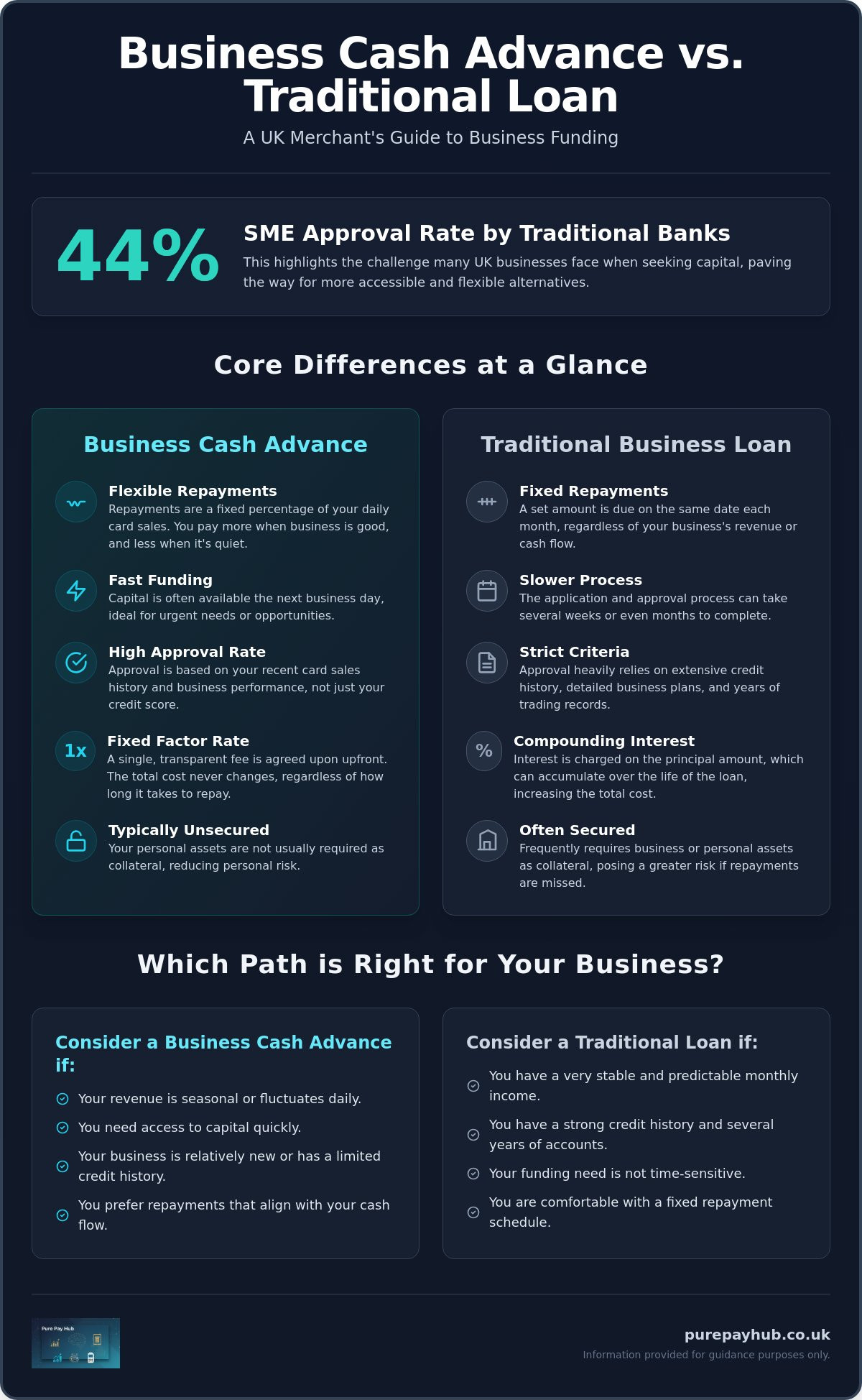
A traditional business loan is a straightforward debt agreement. You receive a principal amount and agree to pay it back over a set period, usually between one and five years. This repayment is tied to an interest rate, which can be fixed or variable. The defining feature here is the rigid monthly schedule. Whether you’ve had your best month or a quiet fortnight, the bank expects the same amount on the same day. This predictability suits businesses with stable, predictable income. Traditional loans usually involve:
- A fixed repayment date every month.
- Compounding interest charges that add to the total debt.
- Strict eligibility criteria often requiring years of trading history.
For many independent retailers or hospitality venues, these barriers are often too high to overcome. Banks focus heavily on your past credit history and may require significant documentation before they even consider an application. This rigid structure can create unnecessary stress during seasonal dips in trade.
The Business Cash Advance: A Modern Alternative
For businesses that rely on card terminals, a Merchant Cash Advance (MCA) offers a more fluid approach. Instead of a traditional loan, this is technically a purchase of your future credit and debit card sales. You receive capital upfront, and in exchange, you agree to pay back a fixed percentage of every card transaction you take. A cash advance typically offers:
- No fixed monthly payments or rigid deadlines.
- Repayments that automatically move with your sales volume.
- Approval based on your recent card turnover rather than just credit scores.
Because it’s a purchase of future revenue rather than a standard credit agreement, it doesn’t have a fixed expiry date. You simply pay as you earn. If sales are slow, you pay less; if business is booming, you pay the advance off faster. This unsecured facility means you don’t usually need to put up personal assets as collateral. It’s a natural extension of your existing card machine service, focusing on your current trading health rather than your long-term financial history.
The regulatory landscape for these products is distinct. Most unsecured business lending in the UK falls outside the scope of the Financial Conduct Authority (FCA). This is especially true for cash advances because they are structured as a commercial purchase of assets, specifically your future sales, rather than a credit agreement. This makes it vital to work with a transparent partner who values clarity over complex fee structures. Understanding this distinction helps you see why the approval process is often much faster than a bank’s, as the focus remains on your actual business performance.
How Repayment Structures Differ: Fixed vs Flexible
The fundamental difference in a business cash advance vs loan UK is how they interact with your bank account each month. One is a rigid demand; the other is a rhythmic partnership. Traditional loans operate on a calendar basis, whilst advances operate on a performance basis. This distinction often determines whether a business owner sleeps soundly during a slow trading week or spends their Sunday night worrying about an upcoming direct debit.
Repaying a Loan During Quiet Periods
Banks prioritise consistency above all else. When you take a standard business loan, you agree to a specific monthly figure. If your revenue drops by 30 per cent due to seasonal trends or local roadworks, that figure doesn’t change. This creates a squeeze where your margins thin out just to meet the debt obligation. You’re forced to find the money from your reserves, which can stifle your daily operations. Some lenders offer interest-only periods, but these are often temporary measures that eventually increase the total cost of the debt. Whilst government-backed business finance schemes can provide more stability than some private high street options, the fixed nature of the repayment remains a constant pressure for many small firms. Missing a payment doesn’t just result in late fees; it can trigger a default that damages your ability to borrow in the future.
The “Pay-as-you-Earn” Model of Cash Advances
A cash advance works in harmony with your card machine. Instead of finding a large sum at the end of the month, a small, fixed percentage of your daily sales is diverted to repay the advance. If you have a busy Saturday, you pay back more. If you’re closed on a Monday, you pay nothing. It’s an automated process that removes the need for manual bank transfers or the administrative burden of tracking payment dates. Because there is no fixed term, there are no late fees or penalties if your sales slow down and it takes you longer to repay. This flexibility acts as a built-in safety net for your cash flow. It ensures that your outgoing payments never outpace your incoming revenue, allowing you to maintain a healthy balance sheet even during unpredictable periods. If you’re looking for a way to fund growth without the anxiety of fixed costs, exploring a Business Cash Advance could be the right move for your cash flow. This model treats you as a partner, ensuring the funding supports your development rather than draining your resources when you need them most.
Eligibility and Speed: Which is Easier to Secure?
The process of securing capital is often where the business cash advance vs loan UK debate becomes most practical. For many business owners, the choice isn’t just about the cost. It’s about who will actually say “yes” and how quickly the funds will arrive in their account. Traditional banks remain cautious; only 44 per cent of SME loan applications are currently approved by high street lenders. This makes the speed and accessibility of alternative funding a critical factor for businesses needing to act fast.
Bank Loan Requirements: The High Bar
Securing a traditional bank loan usually requires a mountain of paperwork. You’ll need to provide several years of audited accounts, detailed business plans, and a pristine credit score. Banks often view newer businesses as high risk, leading to the common “computer says no” response for SMEs that haven’t been trading for at least three years. Access to finance remains a significant hurdle for smaller firms, a challenge often highlighted by the British Business Bank in their market reports. Many traditional loans are also secured. This means the bank may ask for personal assets, such as your home, as collateral. Even if your application is successful, you can still expect to wait between two and four weeks for the funds to be released.
Cash Advance Requirements: Turnover is King
A business cash advance flips this model on its head. Instead of focusing on your past debt history, the primary proof of health is your merchant statement. This is a monthly report from your card processor that details the volume and value of your card transactions. If you have a consistent monthly card turnover of at least £2,500 and have been trading for just three to six months, you’re likely eligible. This focus on current performance rather than historical credit makes it a much more accessible option for modern merchants.
This facility is entirely unsecured. You don’t need to put your home or other physical assets at risk to access the capital you need. The application process is streamlined and digital. PurePay Hub prioritises efficiency, often providing approval and next-day funding once your statements are reviewed. This 24 to 48-hour window is a stark contrast to the weeks of waiting required by traditional institutions. It allows you to buy stock, repair equipment, or cover an unexpected bill without the stress of a prolonged and uncertain approval cycle.
The True Cost: Comparing Interest Rates and Factor Rates
Understanding the total cost of capital is where many business owners feel the most friction. When you’re comparing a business cash advance vs loan UK, you’re looking at two different mathematical languages. Traditional loans use Annual Percentage Rate (APR). Cash advances use a factor rate. One is a moving target; the other is a fixed sum. Choosing between them requires looking past the initial number to see how the debt will actually behave over time.
Understanding Compounding Interest in Loans
Traditional business loans are built on compounding interest. This means the interest is calculated on your remaining balance every month. If your loan term extends or if you take a repayment holiday, the total amount you pay back increases. In late 2025, the average effective interest rate on new SME loans was around 6.3 per cent. However, this figure rarely tells the whole story. UK banks often include arrangement fees, annual service charges, and exit penalties if you try to settle the debt early. These hidden costs can turn a seemingly cheap loan into a complex financial burden that grows heavier the longer it stays on your books.
The Simplicity of the Factor Rate
A business cash advance operates with total transparency. Instead of a percentage that compounds over time, you’re given a single factor rate upfront. This is a simple multiplier. For example, if you receive £10,000 with a factor rate of 1.2, your total repayment is fixed at £12,000. You know exactly what you owe from day one. This cost never increases, regardless of how long it takes for your card sales to pay off the advance. There are no surprise fees for early repayment because there is no fixed term. You simply pay as you earn until the agreed sum is cleared.
This simplicity allows you to protect your margins with absolute certainty. You can calculate your return on investment before the funds even hit your account. Whilst the equivalent APR of a cash advance can appear higher on paper, the lack of compounding interest and hidden bank fees often makes it a more predictable choice for fast-growing businesses. You’re paying for the speed and the flexibility of the model, not for the privilege of navigating a bank’s complex fee structure. If you value clarity and want to avoid the headache of compounding debt, you can request a transparent quote for a Business Cash Advance to see your total cost upfront. This no-nonsense approach to the business cash advance vs loan UK debate ensures your funding supports your growth without any nasty surprises.
Making the Choice for Your Business Growth
Deciding between a business cash advance vs loan UK isn’t about finding a universal winner. It’s about matching your funding to the specific rhythm of your trade. Neither option is inherently better; they simply serve different strategic purposes. One provides a rigid anchor for long-term stability, whilst the other offers a flexible sail to help you navigate the changing winds of the UK high street. Success lies in choosing the tool that supports your cash flow without becoming a burden.
When a Loan Makes Sense
Traditional bank loans remain a strong choice for long-term infrastructure projects where you can predict your returns with high certainty. If you’re purchasing a commercial property or investing in heavy machinery with a ten-year lifespan, a fixed-term loan provides a predictable, low-cost structure. These products are also the only viable option for B2B businesses that operate primarily through invoicing rather than card terminals. If you have high-value physical assets to leverage as security, you may find that traditional lenders offer lower interest rates that suit a slow and steady growth plan. However, you must be prepared for the rigid monthly commitment that remains unchanged regardless of your monthly performance.
Why a Business Cash Advance Wins for Retail and Hospitality
For businesses that live and breathe on daily card sales, the flexibility of a cash advance is often the superior choice. This model is specifically designed for the realities of the modern merchant. It allows you to manage seasonal stock fluctuations with ease; you can stock up for the busy Christmas or summer periods without the fear of fixed-debt pressure during the subsequent quiet months. It’s also a powerful tool for reactive growth. Whether you need to cover an unexpected VAT bill, repair a broken oven, or seize a time-limited bulk discount from a supplier, the speed of alternative finance is a major advantage.
With challenger banks and alternative lenders now accounting for 60 per cent of SME loans, the shift away from traditional banking is clear. PurePay Hub acts as your supportive business ally in this changing landscape. We provide transparent, sales-linked funding that acts as a stabilising force for your finances. You’ll never have to worry about finding a fixed sum at the end of a slow month because your repayments always mirror your actual performance. If you’re ready to secure capital that grows with you, see how a PurePay Hub cash advance can support your growth. We’re here to ensure you have the funds you need today, with a repayment structure that protects your tomorrow.
Secure Your Business’s Financial Future
Choosing between a business cash advance vs loan UK is a pivotal decision for your firm’s cash flow. You’ve seen how traditional loans offer a fixed structure that doesn’t account for the natural fluctuations of seasonal trade. In contrast, a merchant cash advance provides a modern, sales-linked alternative that moves in sync with your actual daily revenue. It’s about deciding whether you want a debt that dictates your schedule or funding that acts as a supportive ally to your growth.
We believe that UK business owners deserve a partner who values transparency over hidden bank fees and complex interest structures. You can access unsecured capital without putting your personal assets at risk. With funding approved in as little as 24 hours and no fixed monthly repayments, you stay in total control of your financial momentum. It’s time to move past the frustration of lengthy bank applications and rigid deadlines. Apply for a transparent Business Cash Advance with PurePay Hub today and build the future your business deserves. We’re ready to help you thrive on your own terms.
Frequently Asked Questions
Can I get a business cash advance if I have a poor credit score?
Yes, you can qualify for a cash advance even with a less than perfect credit score. Traditional banks focus heavily on your past credit history, but alternative lenders prioritise your current trading health. If your business consistently processes at least £2,500 in card payments every month, your recent merchant statements serve as the primary proof of your ability to repay the advance.
Is a business cash advance more expensive than a bank loan?
A cash advance can have a higher equivalent APR than a low-interest bank loan, but the total cost is often more transparent. You pay a single, fixed factor rate that never increases, regardless of how long it takes to repay. Because there is no compounding interest or late fees, you avoid the hidden costs that often cause traditional bank debt to escalate over time.
How much can I typically borrow with a merchant cash advance in the UK?
You can typically borrow between £3,000 and £500,000 depending on your average monthly card turnover. Most providers will offer an advance equivalent to 100 per cent or 150 per cent of your monthly sales volume. This ensures the capital is proportional to your business size, keeping the daily percentage deductions manageable for your specific cash flow requirements.
What happens to my repayments if my card machine breaks or I stop trading?
Repayments stop automatically if you aren’t processing card transactions. Since the advance is paid back as a fixed percentage of your daily sales, no sales means no payment is deducted. You won’t face penalties, late fees, or damage to your credit score during these quiet periods. This flexibility is a core advantage when weighing up a business cash advance vs loan UK.
Do I need to change my card machine provider to get a cash advance?
You don’t usually need to switch your payment processor to access this type of funding. PurePay Hub works alongside your existing countertop or portable card machines by reviewing your merchant statements to determine eligibility. This allows you to maintain your current hardware and service agreements whilst quickly accessing the unsecured capital you need for stock or refurbishments.
How long does the application process take for a PurePay Hub advance?
The application process is built for speed, often resulting in approval within hours of submitting your merchant statements. Once approved, the funds are typically deposited into your business account within 24 to 48 hours. This efficiency is designed for merchants who need to seize a time-limited opportunity or cover an urgent bill without waiting weeks for a bank’s decision.
Are there any hidden fees or interest charges with a cash advance?
There are no hidden fees or compounding interest charges with a transparent cash advance. You’re provided with a single factor rate upfront, so you know the exact total repayment amount before you agree to the funding. You won’t encounter arrangement fees, annual service charges, or early exit penalties, ensuring your margins remain protected throughout the life of the agreement.
Is a business cash advance regulated by the FCA?
Merchant cash advances are not currently regulated by the Financial Conduct Authority (FCA) in the UK. This is because they are structured as a commercial purchase of future revenue rather than a traditional credit agreement or loan. It’s vital to partner with a dependable provider who values honesty and clear communication to ensure your business cash advance vs loan UK comparison is based on fair, transparent terms.
Leave a Reply