
Your high-street bank is likely charging you for the privilege of waiting for your own money. Between opaque service fees and hidden markups, many UK merchants are paying significantly more than the headline rate suggests. It’s a common frustration to open a monthly statement only to find a wall of jargon that makes it impossible to see where your profit is going. You should know exactly what you’re paying for without needing a financial expert to decode the bill.
Learning how to choose a payment processor UK businesses can truly trust is about more than just finding a low percentage; it’s about reclaiming control over your cash flow. This 2026 guide will help you secure transparent rates with zero hidden markups and ensure you get rapid access to your revenue. We’ll break down the latest FCA regulatory shifts, explain how to bypass traditional bank fees, and show you how to make next-day funding your new standard. By the end, you’ll have a clear roadmap to lower costs and a healthier bottom line.
Key Takeaways
- Decode the complex fee structures used by high-street banks to identify exactly where hidden markups are draining your monthly profits.
- Learn the essential criteria for how to choose a payment processor UK merchants can rely on for transparent, interchange-plus pricing models.
- Discover how to optimise your Merchant Category Code and security protocols to naturally lower your per-transaction rates.
- Understand how switching to next-day funding as standard can eliminate cash flow bottlenecks and provide immediate access to your revenue.
- Identify the right hardware, from portable card machines to integrated EPOS systems, to reduce administrative overhead and manual errors.
Understanding Card Transaction Fees in the UK
Every time a customer taps their card, a complex chain of events ensures the money moves safely from their bank to yours. These card transaction fees aren’t just arbitrary charges; they cover the high-tech infrastructure and security protocols required to prevent fraud. Understanding what is a payment processor and how it fits into this financial chain is the first step toward reducing your overheads. Many UK business owners treat these costs as a fixed utility, but legacy bank markups often inflate the bill without adding any extra value.
2026 is a pivotal year for your bottom line. With the Payment Systems Regulator (PSR) merging into the FCA by the end of the year and the government’s “Modernising Payment Services Regulation” consultation ongoing since July 2026, the industry is shifting. Rules are becoming more agile and transparent. If you haven’t reviewed your contract lately, you’re likely stuck on an outdated fee structure that doesn’t reflect these new standards. Staying with a traditional high-street bank often means you’re subsidising their legacy systems rather than benefiting from modern, lean processing.
Your transaction volume dictates your bargaining power. High-street banks often apply a “one size fits all” markup that penalises smaller merchants. Independent providers look at your specific data to offer fairer deals. Knowing how to choose a payment processor UK businesses can actually partner with means looking for a provider that scales their rates as your shop or restaurant grows. It’s about finding a balance between security and cost-efficiency.
The Anatomy of a Transaction Fee
The Merchant Service Charge (MSC) is the core percentage you pay on every sale. It sounds small, but even a 0.5% difference can save a busy merchant thousands of pounds annually. Don’t ignore the fixed per-transaction fees. If you process hundreds of small tickets, a 20p fixed fee is a massive drain compared to a 10p charge. You should also watch out for monthly terminal rentals and PCI compliance costs. A fair provider keeps these transparent rather than hiding them in the small print of a complex monthly statement.
Why Rates Vary Between Debit and Credit Cards
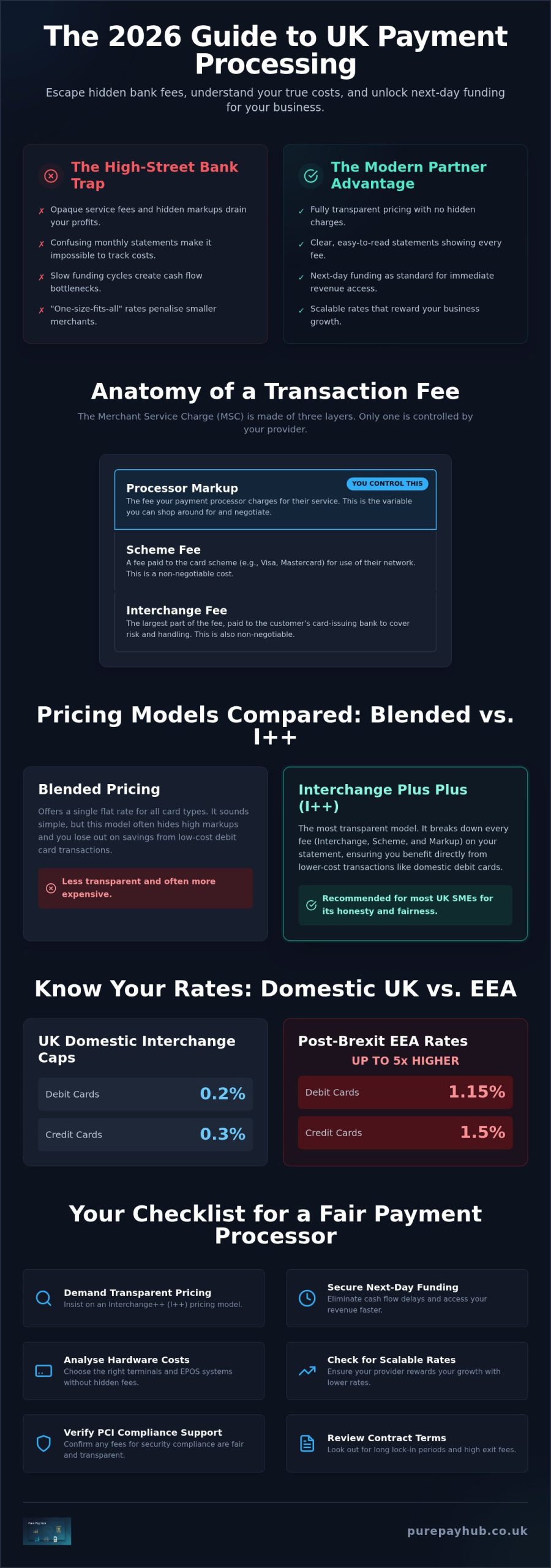
Debit cards are the gold standard for low-cost processing. In the UK, domestic interchange fees are currently capped at 0.2% for debit and 0.3% for credit cards. Credit cards carry higher rates because they involve more risk and often fund consumer reward schemes. Since Brexit, transactions with the EEA have seen fees jump fivefold. Debit rose to 1.15% and credit to 1.5%. Understanding these shifts helps you decide how to choose a payment processor UK wide that offers the most competitive rates for your specific customer base and transaction behaviour.
Decoding Your Merchant Statement: Interchange vs Markup
Opening your merchant statement shouldn’t feel like a test of your patience. Most traditional banks rely on your confusion to hide their margins. They bundle costs into a single figure, making it impossible to see where the network fees end and their profit begins. If you want to know how to choose a payment processor UK providers can’t hide from, you must learn to separate the core costs from the added fluff. A transparent statement is the first sign of a partner that values your business over their own markup.
Every transaction fee consists of three distinct layers. First is the interchange fee, which goes to the card-issuing bank. Second is the scheme fee, paid to Visa or Mastercard for using their network. Finally, there is the processor markup, which is the only part your provider actually controls. Understanding this hierarchy allows you to spot where you are being overcharged. Choosing a partner that prioritises clarity over complexity is the best way to protect your margins. You can view transparent rate options to see how an honest statement should look.
The biggest decision you’ll face is choosing between a blended pricing model and Interchange Plus Plus (I++). Blended pricing offers a flat rate for all transactions, which sounds simple but often hides the savings from low-cost debit cards. I++ is far more transparent. It shows you the exact interchange and scheme costs, with the processor’s margin added clearly as a separate line. For most UK SMEs, I++ is the superior choice because it ensures you benefit directly when network costs drop or when you process high volumes of domestic debit cards.
Interchange Fees: The Non-Negotiable Core
Interchange is the base cost of any transaction. While these rates are set by the card schemes, the UK Payment Systems Regulator’s market review has consistently pushed for more transparency to protect merchants. In the UK, these are currently capped at 0.2% for debit and 0.3% for credit cards. However, these caps only apply to domestic consumer cards. If your business handles many business-to-business (B2B) or international transactions, your core costs will naturally be higher. Knowing this helps you set realistic expectations for your total processing bill.
Merchant Service Charges: Where You Can Save
The Merchant Service Charge (MSC) is where your provider adds their profit. Independent ISOs often have lower overheads than high-street banks, allowing them to offer more competitive markups. Beyond the percentage rate, keep a sharp eye out for hidden extras that drain your account. These often include:
- Minimum Monthly Service Charge (MMSC): A fee applied if your total transaction charges don’t meet a set threshold.
- PCI Non-Compliance Fees: Heavy penalties for not completing your annual security self-assessment.
- Authorisation Fees: A small, flat charge for every time the terminal “asks” the bank for permission to take a payment.
A professional partner will explain these terms upfront. They won’t bury them in the small print or use them as a “stealth tax” on your hard-earned revenue.
5 Practical Strategies to Slash Your Processing Costs
Lowering your card fees requires more than a one-time negotiation. It’s an ongoing process of technical optimisation. If you want to master how to choose a payment processor UK merchants can grow with, you need to look at the data behind your transactions. Small adjustments in how you handle security or categorise your business can lead to significant annual savings. You don’t have to accept the first rate you’re offered as a permanent fixture of your overheads.
One of the most overlooked factors is your Merchant Category Code (MCC). This four-digit number tells the card schemes what type of business you run. If your provider has misclassified you, you might be paying high-risk surcharges without even knowing it. For example, a local bakery wrongly coded as a high-volume catering firm will face higher interchange costs. Regularly reviewing this code ensures you aren’t being penalised for a risk profile that doesn’t apply to you.
Security also plays a vital role in cost reduction. Implementing 3D Secure for online sales doesn’t just protect you from fraud. It shifts the liability for chargebacks back to the card issuer, which often results in lower processing rates. Similarly, encouraging customers to use debit cards for large tickets is a smart move. Since debit interchange is capped lower than credit, steering your customers toward debit can protect your margins on high-value sales. Integrating your hardware is another quick win. Moving from a standalone card machine to fully integrated EPOS Systems eliminates manual entry errors and removes the need for expensive third-party gateways.
Optimising Your Business Profile
Your business description must be precise. If your actual activity changes but your profile remains stagnant, you risk penalties or account freezes. Conduct a statement audit every quarter to spot “fee creep”. This is where providers slowly increase small, miscellaneous charges over time. Staying vigilant is the only way to ensure your rates remain competitive as you scale. A professional partner will help you refine your profile rather than leaving you to guess.
Leveraging Technology for Lower Rates
Modern tools like a Virtual Terminal or Payment Links offer more than just convenience. They allow you to take remote payments securely, often at lower rates than traditional phone-order methods. These tools also help you stay on top of PCI DSS compliance. By using a secure, hosted environment for card data, you avoid the heavy monthly non-compliance fines that banks love to charge. It’s a simple way to keep your costs lean and your cash flow healthy.
Selecting Hardware That Minimises Operational Overhead
The physical kit you use to take payments is just as important as the rate you’re quoted. Many startups are lured in by “free” card readers or low-cost apps. These often hide high percentage rates that eat into your profit as your turnover increases. Understanding how to choose a payment processor UK merchants can actually scale with means calculating the total cost of ownership over a year, not just the first week. Choosing the wrong device can lead to slow queues and frustrated customers during your busiest hours.
A Countertop Card Machine is the workhorse of the retail world. It’s reliable and plugs directly into your broadband. This stability is essential for high-volume environments where a dropped connection means a lost sale. For restaurants or cafes, a Portable Card Machine uses Bluetooth or Wi-Fi to take the payment to the customer. This speeds up table turnover and improves the customer experience. If you operate at trade shows or outdoor markets, a Mobile Card Machine with an integrated SIM card ensures you never miss a transaction due to poor local Wi-Fi.
Hardware vs. Software Solutions
A dedicated machine is almost always more efficient than a mobile phone app for a busy shop. Dedicated hardware is built for one purpose: processing payments quickly and securely. Whilst apps are convenient for occasional sales, they lack the speed and professional feel of a proper terminal. Hardware rental is often a smarter move for growing SMEs. It keeps your upfront costs low and ensures you always have access to the latest security updates and 4G connectivity. You can compare our card machine options to find the right fit for your business.
Integrated Payments and Efficiency
The real magic happens when you connect your card machine to your EPOS Systems. This integration removes the need for staff to type the amount into the terminal manually. It eliminates human error and prevents costly discrepancies at the end of the day. Seamless integration also provides you with real-time reporting. You can track your daily cash flow and monitor staff performance from a single dashboard. This level of clarity helps you make better decisions about stock and staffing levels. It also reduces the risk of chargebacks because the transaction data matches your till records exactly. High-quality hardware isn’t just about taking money; it’s about making your entire operation run more smoothly.
Switching to PurePay Hub: Transparent Rates and Next-Day Funding
Choosing a partner shouldn’t be a gamble. When you’re deciding how to choose a payment processor UK businesses can rely on, the final decision usually comes down to trust. We’ve built PurePay Hub on a foundation of total transparency. We don’t believe in the murky fee structures or the hidden markups that traditional high-street banks use to pad their profits. Instead, we offer a no-nonsense approach that prioritises your cash flow and your peace of mind.
One of our most significant advantages is next-day funding as standard. Most providers hold onto your revenue for days, effectively using your hard-earned money to balance their own books. We believe that once a sale is made, that money belongs in your account. By providing rapid access to your funds, we help you eliminate cash flow bottlenecks and give you the stability needed to manage daily expenses without stress. This isn’t an optional extra; it’s how we believe modern business should operate.
Getting started is just as efficient. We offer next-day onboarding, meaning you can go from an initial enquiry to taking payments in just 24 hours. You’ll be supported by UK-based payment experts who understand the nuances of your specific industry. We don’t use distant call centres or scripts. You get direct access to people who know how to solve problems and keep your business moving forward.
Beyond Just Processing: Supporting Your Growth
We view ourselves as a long-term partner rather than a simple service provider. For businesses looking to expand, our Business Cash Advance offers a flexible alternative to traditional bank loans. Unlike a standard loan with fixed monthly interest, this funding is repaid as a small percentage of your future card sales. If you have a quiet month, your repayments naturally decrease. It’s a fair, transparent way to invest in new equipment or stock without the pressure of a rigid debt schedule. As your turnover grows, our partnership evolves to match your ambition.
Making the Switch Simple
Many merchants stick with expensive providers because they fear the technical headache of switching. We’ve refined our process to ensure the transition is seamless. We handle the technical heavy lifting so you don’t lose a single day of trading. Once you’re live, our merchant portal provides complete financial clarity with transparent reporting that actually makes sense. When you understand how to choose a payment processor UK merchants can grow with, you realise that the support behind the machine is just as vital as the hardware itself. You can see every transaction and every fee in real-time, untainted by hidden costs.
Get a transparent quote from PurePay Hub today and see the difference a fair partner makes.
Take Control of Your Merchant Costs Today
Deciphering your monthly statement shouldn’t be the hardest part of your day. By separating non-negotiable interchange fees from arbitrary processor markups, you’ve already taken the first step toward a leaner bottom line. Remember that the right hardware integration and a correctly assigned Merchant Category Code are your best tools for long-term savings. Understanding how to choose a payment processor UK merchants can actually trust is about finding a partner that values your cash flow as much as you do.
You don’t have to accept opaque pricing or slow access to your own revenue as the cost of doing business. PurePay Hub offers a fair alternative to traditional banking models. With debit rates starting from 0.3%, next-day funding as standard, and a total ban on hidden markups or corporate jargon, we’re here to support your growth. Join PurePay Hub for transparent, low-cost card processing and start keeping more of what you earn. Your business deserves a processing partner that talks straight and acts fast.
Frequently Asked Questions
What is the average card processing fee for small businesses in the UK?
Card processing fees for UK small businesses typically range from 0.4% to 1.7% for debit cards and 0.7% to 3.4% for credit cards. These averages depend heavily on your industry, monthly turnover, and whether you take payments in person or online. Most independent providers offer more competitive rates than traditional high-street banks because they have lower operational overheads and more flexible pricing structures.
Can I pass on card transaction fees to my customers in the UK?
No, you cannot legally pass on card transaction fees to customers using consumer debit or credit cards in the UK. This practice was banned in 2018 under the Consumer Rights Regulations to ensure shoppers aren’t penalised for their choice of payment. Whilst you can’t surcharge, you can choose to set a minimum spend limit for card payments or offer a small discount to those paying by cash.
Is it cheaper to use a mobile card reader or a countertop machine?
Countertop machines are usually cheaper for established businesses with steady footfall because they offer lower transaction rates in exchange for a small monthly rental fee. Mobile card readers often have no monthly costs but charge a much higher percentage on every sale, sometimes double the rate of a dedicated terminal. When learning how to choose a payment processor UK merchants should calculate if their monthly sales volume justifies the rental of a fixed machine.
How long does it take to switch card machine providers?
Switching card machine providers can take as little as 24 hours with a modern, agile provider that offers next-day onboarding. Traditional banks often take two to three weeks to process applications and dispatch hardware. Choosing a partner that prioritises speed ensures your business doesn’t suffer from downtime or lost sales whilst you wait for your new equipment to arrive and activate.
What are interchange fees and why do they change?
Interchange fees are the base costs paid to the card-issuing bank to cover the risk and administrative handling of a transaction. These fees are capped in the UK at 0.2% for debit and 0.3% for credit cards for domestic consumer transactions. They change due to shifts in government regulation, updates from the Payment Systems Regulator, or international agreements, such as the fivefold increase seen on cross-border fees following Brexit.
How does PCI compliance affect my monthly card machine costs?
PCI compliance usually adds a small monthly fee, typically between £5 and £20, to ensure your business meets global security standards for handling card data. This fee is essential for protecting your customers and your reputation from potential data breaches. If you don’t keep your compliance up to date, you may be charged significant non-compliance penalties that can reach hundreds of pounds over a year.
Why are credit card fees higher than debit card fees?
Credit card fees are higher because they involve a greater level of financial risk and often fund consumer perks like cashback or reward points. Debit cards simply move existing funds from a bank account, making them much safer and cheaper for the banking system to process. This difference in risk is why the non-negotiable interchange rates for credit cards are set higher than those for debit cards.
What is a Merchant Category Code and why does it matter for my rates?
A Merchant Category Code (MCC) is a four-digit number used by card schemes to classify your business based on the risk associated with your industry. It matters because it directly dictates the interchange rates you are eligible for; if you’re misclassified as a high-risk business, you’ll pay more for every transaction. Understanding how to choose a payment processor UK businesses can trust involves ensuring your provider assigns the correct code to protect your margins.
Leave a Reply