Author: sbdnx

  • How to Choose a Payment Processor in the UK: 2026 Fee Reduction Guide

    How to Choose a Payment Processor in the UK: 2026 Fee Reduction Guide

    Your high-street bank is likely charging you for the privilege of waiting for your own money. Between opaque service fees and hidden markups, many UK merchants are paying significantly more than the headline rate suggests. It’s a common frustration to open a monthly statement only to find a wall of jargon that makes it impossible to see where your profit is going. You should know exactly what you’re paying for without needing a financial expert to decode the bill.

    Learning how to choose a payment processor UK businesses can truly trust is about more than just finding a low percentage; it’s about reclaiming control over your cash flow. This 2026 guide will help you secure transparent rates with zero hidden markups and ensure you get rapid access to your revenue. We’ll break down the latest FCA regulatory shifts, explain how to bypass traditional bank fees, and show you how to make next-day funding your new standard. By the end, you’ll have a clear roadmap to lower costs and a healthier bottom line.

    Key Takeaways

    • Decode the complex fee structures used by high-street banks to identify exactly where hidden markups are draining your monthly profits.
    • Learn the essential criteria for how to choose a payment processor UK merchants can rely on for transparent, interchange-plus pricing models.
    • Discover how to optimise your Merchant Category Code and security protocols to naturally lower your per-transaction rates.
    • Understand how switching to next-day funding as standard can eliminate cash flow bottlenecks and provide immediate access to your revenue.
    • Identify the right hardware, from portable card machines to integrated EPOS systems, to reduce administrative overhead and manual errors.

    Understanding Card Transaction Fees in the UK

    Every time a customer taps their card, a complex chain of events ensures the money moves safely from their bank to yours. These card transaction fees aren’t just arbitrary charges; they cover the high-tech infrastructure and security protocols required to prevent fraud. Understanding what is a payment processor and how it fits into this financial chain is the first step toward reducing your overheads. Many UK business owners treat these costs as a fixed utility, but legacy bank markups often inflate the bill without adding any extra value.

    2026 is a pivotal year for your bottom line. With the Payment Systems Regulator (PSR) merging into the FCA by the end of the year and the government’s “Modernising Payment Services Regulation” consultation ongoing since July 2026, the industry is shifting. Rules are becoming more agile and transparent. If you haven’t reviewed your contract lately, you’re likely stuck on an outdated fee structure that doesn’t reflect these new standards. Staying with a traditional high-street bank often means you’re subsidising their legacy systems rather than benefiting from modern, lean processing.

    Your transaction volume dictates your bargaining power. High-street banks often apply a “one size fits all” markup that penalises smaller merchants. Independent providers look at your specific data to offer fairer deals. Knowing how to choose a payment processor UK businesses can actually partner with means looking for a provider that scales their rates as your shop or restaurant grows. It’s about finding a balance between security and cost-efficiency.

    The Anatomy of a Transaction Fee

    The Merchant Service Charge (MSC) is the core percentage you pay on every sale. It sounds small, but even a 0.5% difference can save a busy merchant thousands of pounds annually. Don’t ignore the fixed per-transaction fees. If you process hundreds of small tickets, a 20p fixed fee is a massive drain compared to a 10p charge. You should also watch out for monthly terminal rentals and PCI compliance costs. A fair provider keeps these transparent rather than hiding them in the small print of a complex monthly statement.

    Why Rates Vary Between Debit and Credit Cards

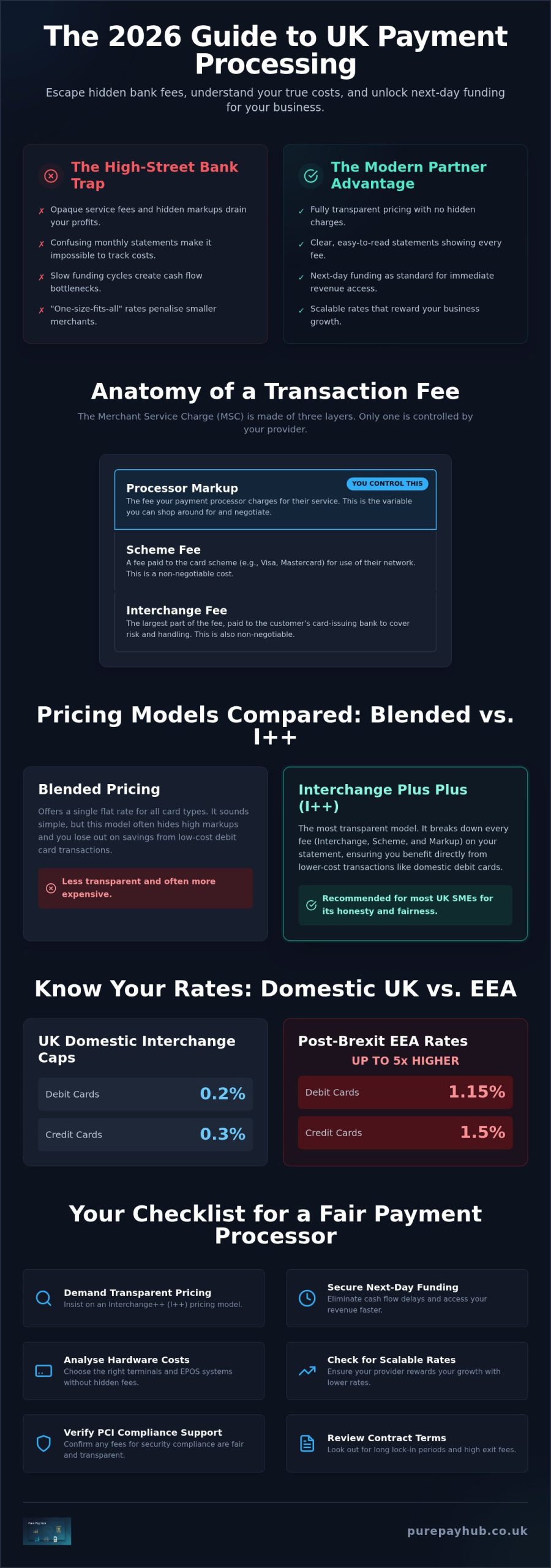
    Debit cards are the gold standard for low-cost processing. In the UK, domestic interchange fees are currently capped at 0.2% for debit and 0.3% for credit cards. Credit cards carry higher rates because they involve more risk and often fund consumer reward schemes. Since Brexit, transactions with the EEA have seen fees jump fivefold. Debit rose to 1.15% and credit to 1.5%. Understanding these shifts helps you decide how to choose a payment processor UK wide that offers the most competitive rates for your specific customer base and transaction behaviour.

    Decoding Your Merchant Statement: Interchange vs Markup

    Opening your merchant statement shouldn’t feel like a test of your patience. Most traditional banks rely on your confusion to hide their margins. They bundle costs into a single figure, making it impossible to see where the network fees end and their profit begins. If you want to know how to choose a payment processor UK providers can’t hide from, you must learn to separate the core costs from the added fluff. A transparent statement is the first sign of a partner that values your business over their own markup.

    Every transaction fee consists of three distinct layers. First is the interchange fee, which goes to the card-issuing bank. Second is the scheme fee, paid to Visa or Mastercard for using their network. Finally, there is the processor markup, which is the only part your provider actually controls. Understanding this hierarchy allows you to spot where you are being overcharged. Choosing a partner that prioritises clarity over complexity is the best way to protect your margins. You can view transparent rate options to see how an honest statement should look.

    The biggest decision you’ll face is choosing between a blended pricing model and Interchange Plus Plus (I++). Blended pricing offers a flat rate for all transactions, which sounds simple but often hides the savings from low-cost debit cards. I++ is far more transparent. It shows you the exact interchange and scheme costs, with the processor’s margin added clearly as a separate line. For most UK SMEs, I++ is the superior choice because it ensures you benefit directly when network costs drop or when you process high volumes of domestic debit cards.

    Interchange Fees: The Non-Negotiable Core

    Interchange is the base cost of any transaction. While these rates are set by the card schemes, the UK Payment Systems Regulator’s market review has consistently pushed for more transparency to protect merchants. In the UK, these are currently capped at 0.2% for debit and 0.3% for credit cards. However, these caps only apply to domestic consumer cards. If your business handles many business-to-business (B2B) or international transactions, your core costs will naturally be higher. Knowing this helps you set realistic expectations for your total processing bill.

    Merchant Service Charges: Where You Can Save

    The Merchant Service Charge (MSC) is where your provider adds their profit. Independent ISOs often have lower overheads than high-street banks, allowing them to offer more competitive markups. Beyond the percentage rate, keep a sharp eye out for hidden extras that drain your account. These often include:

    • Minimum Monthly Service Charge (MMSC): A fee applied if your total transaction charges don’t meet a set threshold.
    • PCI Non-Compliance Fees: Heavy penalties for not completing your annual security self-assessment.
    • Authorisation Fees: A small, flat charge for every time the terminal “asks” the bank for permission to take a payment.

    A professional partner will explain these terms upfront. They won’t bury them in the small print or use them as a “stealth tax” on your hard-earned revenue.

    5 Practical Strategies to Slash Your Processing Costs

    Lowering your card fees requires more than a one-time negotiation. It’s an ongoing process of technical optimisation. If you want to master how to choose a payment processor UK merchants can grow with, you need to look at the data behind your transactions. Small adjustments in how you handle security or categorise your business can lead to significant annual savings. You don’t have to accept the first rate you’re offered as a permanent fixture of your overheads.

    One of the most overlooked factors is your Merchant Category Code (MCC). This four-digit number tells the card schemes what type of business you run. If your provider has misclassified you, you might be paying high-risk surcharges without even knowing it. For example, a local bakery wrongly coded as a high-volume catering firm will face higher interchange costs. Regularly reviewing this code ensures you aren’t being penalised for a risk profile that doesn’t apply to you.

    Security also plays a vital role in cost reduction. Implementing 3D Secure for online sales doesn’t just protect you from fraud. It shifts the liability for chargebacks back to the card issuer, which often results in lower processing rates. Similarly, encouraging customers to use debit cards for large tickets is a smart move. Since debit interchange is capped lower than credit, steering your customers toward debit can protect your margins on high-value sales. Integrating your hardware is another quick win. Moving from a standalone card machine to fully integrated EPOS Systems eliminates manual entry errors and removes the need for expensive third-party gateways.

    Optimising Your Business Profile

    Your business description must be precise. If your actual activity changes but your profile remains stagnant, you risk penalties or account freezes. Conduct a statement audit every quarter to spot “fee creep”. This is where providers slowly increase small, miscellaneous charges over time. Staying vigilant is the only way to ensure your rates remain competitive as you scale. A professional partner will help you refine your profile rather than leaving you to guess.

    Leveraging Technology for Lower Rates

    Modern tools like a Virtual Terminal or Payment Links offer more than just convenience. They allow you to take remote payments securely, often at lower rates than traditional phone-order methods. These tools also help you stay on top of PCI DSS compliance. By using a secure, hosted environment for card data, you avoid the heavy monthly non-compliance fines that banks love to charge. It’s a simple way to keep your costs lean and your cash flow healthy.
    How to Choose a Payment Processor in the UK: 2026 Fee Reduction Guide

    Selecting Hardware That Minimises Operational Overhead

    The physical kit you use to take payments is just as important as the rate you’re quoted. Many startups are lured in by “free” card readers or low-cost apps. These often hide high percentage rates that eat into your profit as your turnover increases. Understanding how to choose a payment processor UK merchants can actually scale with means calculating the total cost of ownership over a year, not just the first week. Choosing the wrong device can lead to slow queues and frustrated customers during your busiest hours.

    A Countertop Card Machine is the workhorse of the retail world. It’s reliable and plugs directly into your broadband. This stability is essential for high-volume environments where a dropped connection means a lost sale. For restaurants or cafes, a Portable Card Machine uses Bluetooth or Wi-Fi to take the payment to the customer. This speeds up table turnover and improves the customer experience. If you operate at trade shows or outdoor markets, a Mobile Card Machine with an integrated SIM card ensures you never miss a transaction due to poor local Wi-Fi.

    Hardware vs. Software Solutions

    A dedicated machine is almost always more efficient than a mobile phone app for a busy shop. Dedicated hardware is built for one purpose: processing payments quickly and securely. Whilst apps are convenient for occasional sales, they lack the speed and professional feel of a proper terminal. Hardware rental is often a smarter move for growing SMEs. It keeps your upfront costs low and ensures you always have access to the latest security updates and 4G connectivity. You can compare our card machine options to find the right fit for your business.

    Integrated Payments and Efficiency

    The real magic happens when you connect your card machine to your EPOS Systems. This integration removes the need for staff to type the amount into the terminal manually. It eliminates human error and prevents costly discrepancies at the end of the day. Seamless integration also provides you with real-time reporting. You can track your daily cash flow and monitor staff performance from a single dashboard. This level of clarity helps you make better decisions about stock and staffing levels. It also reduces the risk of chargebacks because the transaction data matches your till records exactly. High-quality hardware isn’t just about taking money; it’s about making your entire operation run more smoothly.

    Switching to PurePay Hub: Transparent Rates and Next-Day Funding

    Choosing a partner shouldn’t be a gamble. When you’re deciding how to choose a payment processor UK businesses can rely on, the final decision usually comes down to trust. We’ve built PurePay Hub on a foundation of total transparency. We don’t believe in the murky fee structures or the hidden markups that traditional high-street banks use to pad their profits. Instead, we offer a no-nonsense approach that prioritises your cash flow and your peace of mind.

    One of our most significant advantages is next-day funding as standard. Most providers hold onto your revenue for days, effectively using your hard-earned money to balance their own books. We believe that once a sale is made, that money belongs in your account. By providing rapid access to your funds, we help you eliminate cash flow bottlenecks and give you the stability needed to manage daily expenses without stress. This isn’t an optional extra; it’s how we believe modern business should operate.

    Getting started is just as efficient. We offer next-day onboarding, meaning you can go from an initial enquiry to taking payments in just 24 hours. You’ll be supported by UK-based payment experts who understand the nuances of your specific industry. We don’t use distant call centres or scripts. You get direct access to people who know how to solve problems and keep your business moving forward.

    Beyond Just Processing: Supporting Your Growth

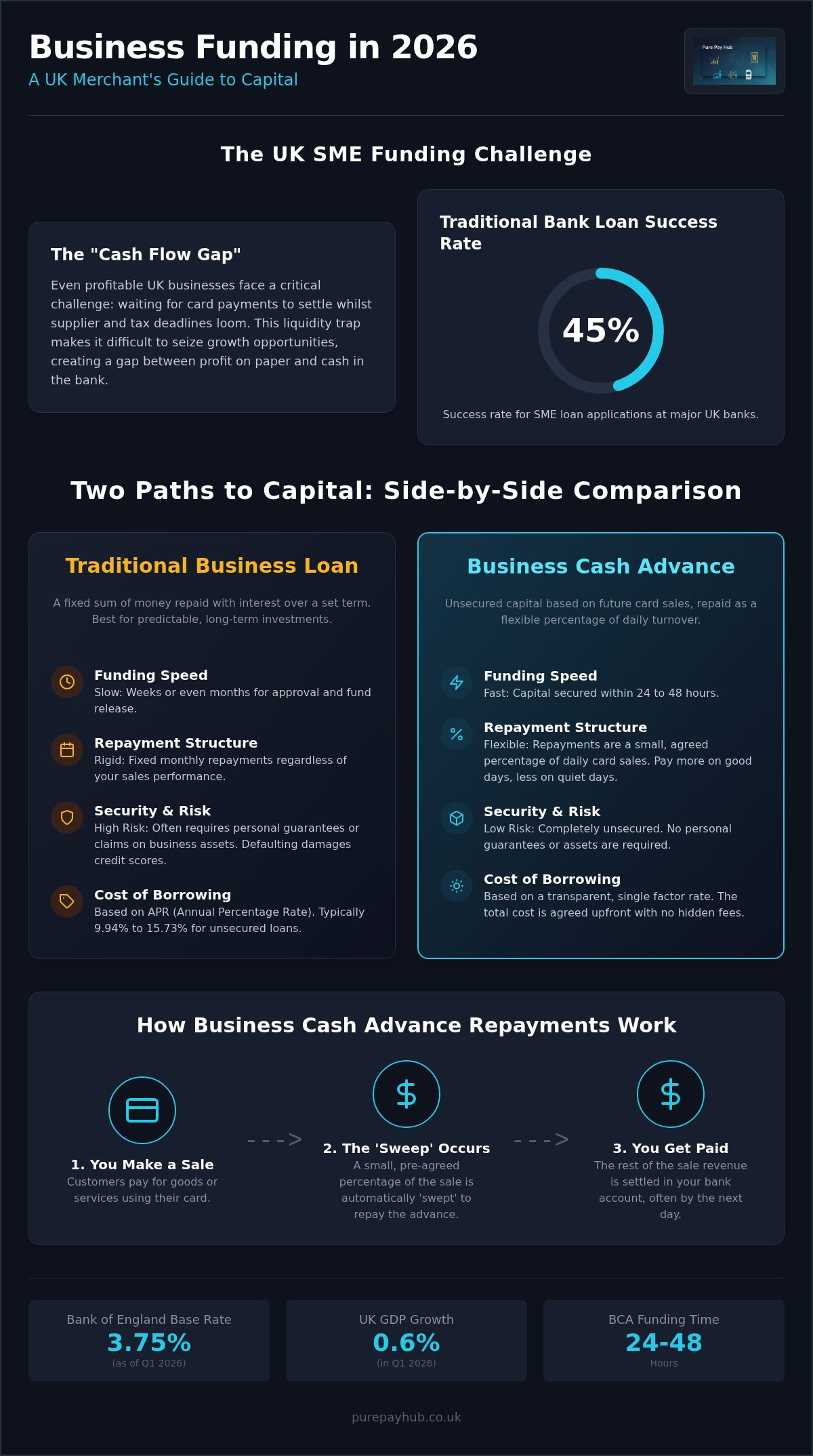
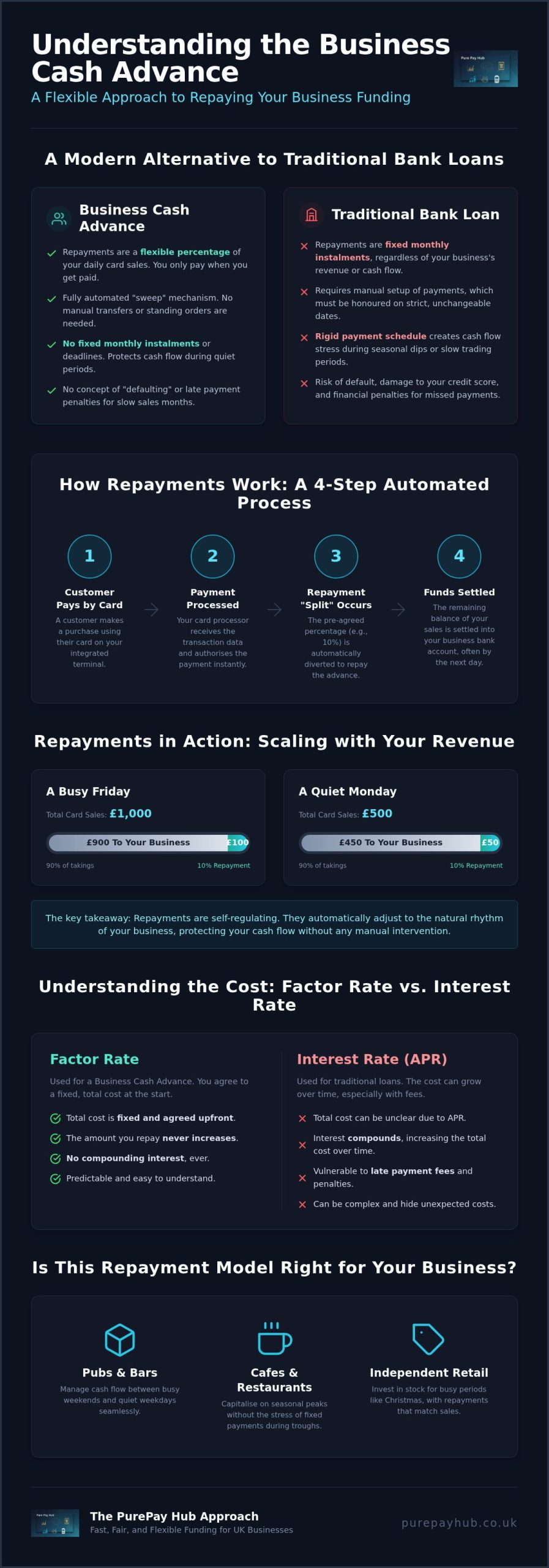
    We view ourselves as a long-term partner rather than a simple service provider. For businesses looking to expand, our Business Cash Advance offers a flexible alternative to traditional bank loans. Unlike a standard loan with fixed monthly interest, this funding is repaid as a small percentage of your future card sales. If you have a quiet month, your repayments naturally decrease. It’s a fair, transparent way to invest in new equipment or stock without the pressure of a rigid debt schedule. As your turnover grows, our partnership evolves to match your ambition.

    Making the Switch Simple

    Many merchants stick with expensive providers because they fear the technical headache of switching. We’ve refined our process to ensure the transition is seamless. We handle the technical heavy lifting so you don’t lose a single day of trading. Once you’re live, our merchant portal provides complete financial clarity with transparent reporting that actually makes sense. When you understand how to choose a payment processor UK merchants can grow with, you realise that the support behind the machine is just as vital as the hardware itself. You can see every transaction and every fee in real-time, untainted by hidden costs.

    Get a transparent quote from PurePay Hub today and see the difference a fair partner makes.

    Take Control of Your Merchant Costs Today

    Deciphering your monthly statement shouldn’t be the hardest part of your day. By separating non-negotiable interchange fees from arbitrary processor markups, you’ve already taken the first step toward a leaner bottom line. Remember that the right hardware integration and a correctly assigned Merchant Category Code are your best tools for long-term savings. Understanding how to choose a payment processor UK merchants can actually trust is about finding a partner that values your cash flow as much as you do.

    You don’t have to accept opaque pricing or slow access to your own revenue as the cost of doing business. PurePay Hub offers a fair alternative to traditional banking models. With debit rates starting from 0.3%, next-day funding as standard, and a total ban on hidden markups or corporate jargon, we’re here to support your growth. Join PurePay Hub for transparent, low-cost card processing and start keeping more of what you earn. Your business deserves a processing partner that talks straight and acts fast.

    Frequently Asked Questions

    What is the average card processing fee for small businesses in the UK?

    Card processing fees for UK small businesses typically range from 0.4% to 1.7% for debit cards and 0.7% to 3.4% for credit cards. These averages depend heavily on your industry, monthly turnover, and whether you take payments in person or online. Most independent providers offer more competitive rates than traditional high-street banks because they have lower operational overheads and more flexible pricing structures.

    Can I pass on card transaction fees to my customers in the UK?

    No, you cannot legally pass on card transaction fees to customers using consumer debit or credit cards in the UK. This practice was banned in 2018 under the Consumer Rights Regulations to ensure shoppers aren’t penalised for their choice of payment. Whilst you can’t surcharge, you can choose to set a minimum spend limit for card payments or offer a small discount to those paying by cash.

    Is it cheaper to use a mobile card reader or a countertop machine?

    Countertop machines are usually cheaper for established businesses with steady footfall because they offer lower transaction rates in exchange for a small monthly rental fee. Mobile card readers often have no monthly costs but charge a much higher percentage on every sale, sometimes double the rate of a dedicated terminal. When learning how to choose a payment processor UK merchants should calculate if their monthly sales volume justifies the rental of a fixed machine.

    How long does it take to switch card machine providers?

    Switching card machine providers can take as little as 24 hours with a modern, agile provider that offers next-day onboarding. Traditional banks often take two to three weeks to process applications and dispatch hardware. Choosing a partner that prioritises speed ensures your business doesn’t suffer from downtime or lost sales whilst you wait for your new equipment to arrive and activate.

    What are interchange fees and why do they change?

    Interchange fees are the base costs paid to the card-issuing bank to cover the risk and administrative handling of a transaction. These fees are capped in the UK at 0.2% for debit and 0.3% for credit cards for domestic consumer transactions. They change due to shifts in government regulation, updates from the Payment Systems Regulator, or international agreements, such as the fivefold increase seen on cross-border fees following Brexit.

    How does PCI compliance affect my monthly card machine costs?

    PCI compliance usually adds a small monthly fee, typically between £5 and £20, to ensure your business meets global security standards for handling card data. This fee is essential for protecting your customers and your reputation from potential data breaches. If you don’t keep your compliance up to date, you may be charged significant non-compliance penalties that can reach hundreds of pounds over a year.

    Why are credit card fees higher than debit card fees?

    Credit card fees are higher because they involve a greater level of financial risk and often fund consumer perks like cashback or reward points. Debit cards simply move existing funds from a bank account, making them much safer and cheaper for the banking system to process. This difference in risk is why the non-negotiable interchange rates for credit cards are set higher than those for debit cards.

    What is a Merchant Category Code and why does it matter for my rates?

    A Merchant Category Code (MCC) is a four-digit number used by card schemes to classify your business based on the risk associated with your industry. It matters because it directly dictates the interchange rates you are eligible for; if you’re misclassified as a high-risk business, you’ll pay more for every transaction. Understanding how to choose a payment processor UK businesses can trust involves ensuring your provider assigns the correct code to protect your margins.

  • Lowest Card Machine Rates for UK Small Business: 2026

    Lowest Card Machine Rates for UK Small Business: 2026

    Why are you still paying a 1.75% flat rate for a transaction that costs a fraction of that to process? It’s a frustrating reality for many local merchants who see their hard-earned margins swallowed by opaque fee structures and hidden admin costs. You likely started with a “simple” flat fee to avoid complexity. Instead, you’ve ended up subsidising expensive rewards cards while your own debit transactions remain overpriced. Finding the lowest card machine rates for small business UK shouldn’t feel like solving a puzzle designed to confuse you.

    We believe you deserve total clarity and a fair deal. This guide will show you exactly how to slash your transaction costs by moving away from expensive blended models and toward transparent pricing. You’ll discover how to access debit rates closer to 0.3% and secure next-day funding without the burden of hidden PCI compliance fees. We’ll break down the latest 2026 UK fee models and compare the market’s most competitive providers so you can reclaim control of your business finances.

    Key Takeaways

    • Understand the hidden costs within flat-rate pricing and learn how to identify the transaction, hardware, and admin fees that inflate your monthly bill.
    • Discover how to secure the lowest card machine rates for small business UK by moving to an Interchange-Plus model that treats debit and credit cards differently.
    • Compare traditional bank offerings against independent providers to find the most cost-effective solution for your specific monthly turnover.
    • Use our success checklist to calculate your average transaction value and uncover your true “effective” rate from current statements.
    • Learn how to accelerate your cash flow with next-day funding and modern, integrated EPOS systems that eliminate manual reconciliation.

    Understanding Card Machine Fees: Why “Simple” Isn’t Always Cheapest

    Don’t let the word “simple” fool you. In the payments industry, simplicity is often a premium service you didn’t ask for. To find the lowest card machine rates for small business UK, you first need to look past the headline numbers. Most providers bundle their costs into a single figure, but your actual bill is built from three distinct pillars. This lack of transparency makes it difficult for you to see where your money is actually going.

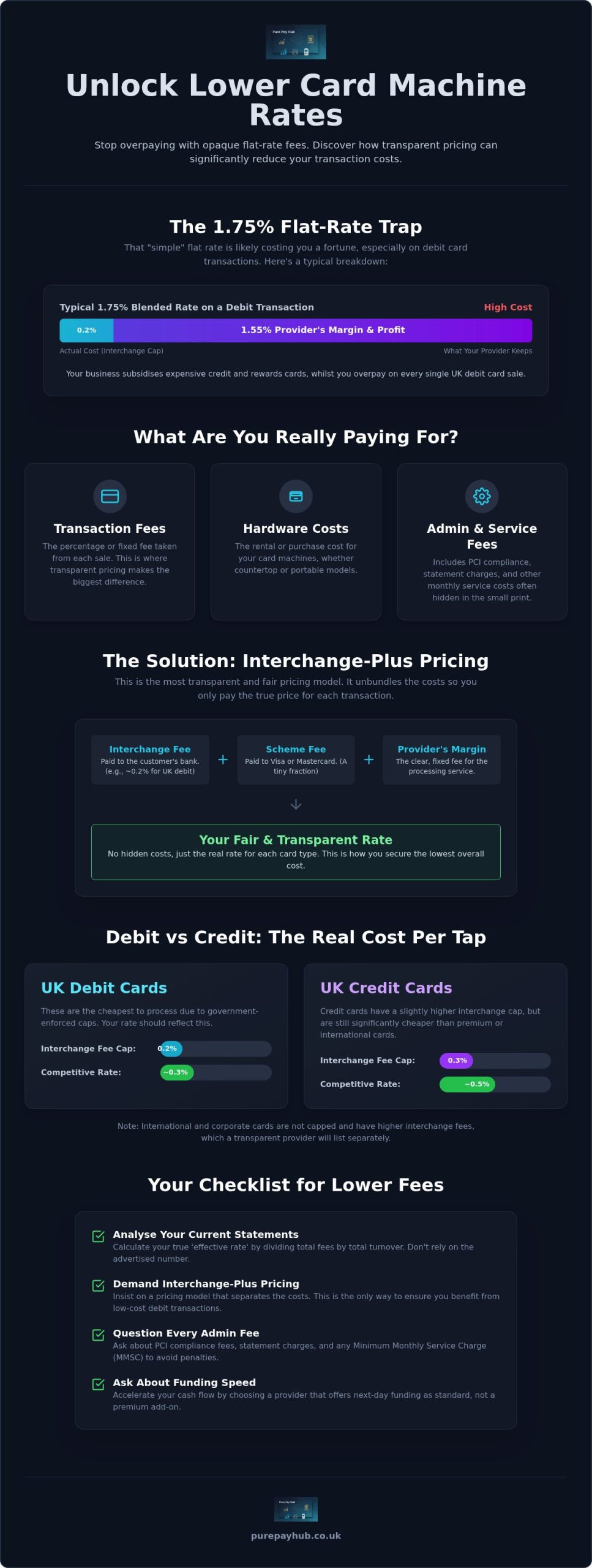
    First, there are transaction fees, which are the percentage of each sale you lose. Second, hardware costs cover your equipment, whether you choose a Countertop Card Machine or a Portable Card Machine. Finally, admin fees include everything from statement charges to PCI compliance. When these are lumped together into a flat rate like 1.75%, you lose all visibility. This total cost is known as your Merchant Service Charge (MSC). It’s the real price of doing business, and it’s often far higher than it needs to be.

    Understanding the components of your MSC is vital. What are interchange fees? These are the baseline costs set by banks, which are capped at 0.2% for UK consumer debit cards. If your provider charges you a flat 1.75%, they are keeping the 1.55% difference as pure profit on every debit tap. For high-volume, low-margin UK retailers, securing the lowest card machine rates for small business UK is the difference between a healthy profit and barely breaking even.

    The Trap of Flat-Rate Pricing

    Flat rates penalise businesses that primarily take UK debit cards. Since the cost to the provider is so low, a flat fee essentially forces you to subsidise the expensive credit and rewards cards used by other people’s customers. If your turnover exceeds £2,500 a month, the “no monthly fee” model offered by entry-level providers likely costs you more than a subscription plan with lower transaction rates. It’s a classic marketing hook that becomes a growth tax as your business scales.

    Fixed vs. Variable Transaction Costs

    Transaction costs come in two formats: fixed and variable. A fixed fee, such as 10p per tap, can devastate a coffee shop with a low average transaction value. Conversely, a high variable percentage eats into the margins of a high-end furniture store. You must also watch for the Minimum Monthly Service Charge (MMSC). This is a floor on what you pay; if your monthly transactions don’t generate enough fees, the provider charges you the difference anyway. Transparency means knowing exactly which model fits your specific trade without hidden penalties.

    Interchange Fees and Merchant Rates Explained

    The fairest way to process payments is through the “Interchange-Plus” model. It’s the only way to see exactly what you’re paying for. This model breaks your costs into three clean parts: the interchange fee paid to the customer’s bank, the scheme fee paid to Visa or Mastercard, and the provider’s margin. Most traditional banks hide these components inside a single, high percentage. By separating them, you gain the clarity needed to secure the lowest card machine rates for small business UK. The Payment Systems Regulator recently conducted a Market review into card fees, which highlights how complex these underlying structures can be for the average merchant.

    Debit cards are significantly cheaper for you to process because their interchange fees are legally capped at 0.2%. Credit cards have a slightly higher cap of 0.3%. In the current 2026 market, competitive merchant rates typically start around 0.3% for debit and 0.5% for credit. If your provider isn’t passing these savings on to you, they are simply padding their own pockets. You can explore these transparent merchant rates to see how they compare with your current provider’s “all-in” offer.

    Security is another area where fees often hide. PCI compliance is a mandatory data security standard, yet many providers use it as a revenue stream. They might charge you a monthly “non-compliance” fine that costs more than the service itself. A supportive partner helps you complete your compliance self-assessment quickly to ensure you avoid these unnecessary penalties entirely.

    Debit vs. Credit: The Pricing Divide

    Your profit margin changes with every tap. A local customer using a standard UK debit card costs you very little. However, international or corporate cards are not subject to the same fee caps. These premium cards can carry interchange fees as high as 1.5% or more. A transparent provider will list these card types separately on your statement. This allows you to see your “effective rate” across all card types rather than guessing based on a blended average. It’s the difference between seeing a blurred total and a high-definition breakdown of your expenses.

    Hidden Fees to Scrutinise

    Small charges often add up to large monthly losses. Authorisation fees are a prime example; these are tiny costs (often 1p to 3p) charged every time the machine talks to the bank. Whilst they seem negligible, they can be significant for businesses with hundreds of daily sales. You should also check for refund fees and chargeback costs. Some providers even charge you a monthly fee just to access your own transaction data through an online portal. Always demand a provider that offers clear, accessible data without a subscription tax.

    Comparing the Best Card Machine Providers for UK SMEs

    The right provider for your neighbour might be the wrong choice for you. Your monthly turnover is the most important metric when searching for the lowest card machine rates for small business UK. If you process less than £1,000 a month, the convenience of a flat-rate mobile reader often outweighs the higher transaction cost. However, once your sales hit the £5,000 mark, those “simple” percentages start to drain your bank account. For businesses processing £20,000 or more, a bespoke Interchange-Plus agreement is the only way to protect your margins from unnecessary markups.

    Next-day funding has become a non-negotiable standard for the modern UK high street. Waiting three to five working days for your money to clear is a relic of old-fashioned banking that stifles your cash flow. Whether you use a Countertop Card Machine at a fixed till or a Portable Card Machine for table service, you should expect your funds to arrive the following morning. This speed allows you to pay suppliers and manage staff wages without relying on expensive overdrafts.

    Traditional Banks vs. Specialist Fintechs

    High-street banks often treat merchant services as a secondary product. Their systems are frequently slower to set up and their fee structures remain rigid. Specialist UK providers and Independent Sales Organisations (ISOs) are far more agile. They focus exclusively on payments, which allows them to offer more competitive, tailored rates. Perhaps most importantly, specialists usually provide better support. When your terminal fails on a busy Saturday afternoon, you need to speak to a human expert immediately rather than getting lost in a corporate phone menu.

    Hardware Rental vs. Upfront Purchase

    You have two main paths for equipment: buying a basic reader or leasing professional-grade hardware. Entry-level mobile readers are cheap to buy upfront but often lack the durability and print speed required for a busy retail environment. Leasing a Countertop Card Machine or a Mobile Card Machine usually involves a small monthly fee, but this often includes vital benefits. A typical rental package should cover:

    • Ongoing Technical Support: Rapid assistance if the hardware develops a fault.
    • Hardware Replacements: A new unit sent out if your current one breaks.
    • Security Updates: Ensuring your terminal always meets the latest encryption standards.

    Choosing the right hardware depends on your specific environment. A fixed Countertop Card Machine is the most reliable for retail desks. A Portable Card Machine uses Bluetooth or Wi-Fi to reach customers within your premises, whilst a Mobile Card Machine uses a roaming SIM card to take payments anywhere in the UK with a signal. Matching your hardware to your business model ensures you aren’t paying for features you don’t use.

    Lowest Card Machine Rates for UK Small Business: 2026

    How to Secure the Lowest Rates: A Checklist for Success

    Securing the lowest card machine rates for small business UK requires more than just a quick search. It requires preparation. You need to approach providers as an informed partner rather than a passive customer. Start by gathering at least three months of your most recent merchant statements. These documents hold the key to your current spending. You can calculate your “effective rate” by dividing your total monthly fees by your total monthly turnover. If this figure is significantly higher than the headline rate you were promised, you are likely paying for hidden markups and unnecessary admin costs.

    Don’t settle for “off-the-shelf” pricing. Every business is unique, and your rates should reflect that. Request a bespoke quote that accounts for your specific industry and card mix. Finally, scrutinise your contract length. The payments market changes rapidly, and you need the flexibility to move if a better deal emerges. Avoid long-term ties that lock you into outdated pricing models for years at a time.

    The Power of Your Transaction Data

    Your processing history is your strongest negotiation tool. A proven track record of reliable transactions lowers your risk profile in the eyes of an underwriter. This lower risk should translate directly into a lower provider margin. Your Average Transaction Value (ATV) is equally vital for your strategy. If you have a high ATV, you should prioritise negotiating a lower percentage rate. If your ATV is low, focus on reducing the fixed pence fee per transaction. Demand next-day access to your funds as a standard feature. It’s your money; you shouldn’t have to wait a week to use it for your own business growth.

    Switching Providers Without the Stress

    Moving to a fairer deal is simpler than most people think. First, check your current contract for exit fees or notice periods. Many traditional banks require 30 to 90 days of notice, whilst some modern providers offer rolling monthly terms. Once you’ve identified your exit path, the onboarding timeline for a transparent partner is typically five to seven working days. Ensure your new hardware, such as a Countertop Card Machine or a Portable Card Machine, integrates seamlessly with your existing EPOS Systems. Proper integration prevents manual entry errors and saves you hours of reconciliation work every single week.

    Ready to see how much you could save? Switch to transparent payments today and reclaim your margins.

    PurePay Hub: Transparent Payments for UK Businesses

    PurePay Hub exists as the antidote to the opaque fee structures that have frustrated UK merchants for decades. We don’t believe in hiding behind complex terminology or “all-in” rates that favour the provider over the partner. Instead, we offer a stabilising force for your business finances through absolute clarity. By providing the lowest card machine rates for small business UK, we ensure that more of your revenue stays where it belongs: in your local business. Getting a transparent quote designed for your growth is the first step toward reclaiming your hard-earned margins.

    Our model is built on fairness. We offer debit card charges starting from 0.3% and credit card rates from 0.5%. When you combine these competitive rates with next-day access to your funds, your cash flow becomes predictable and healthy. We also provide integrated EPOS Systems that talk directly to your card terminals. This eliminates the stress of manual reconciliation and reduces the risk of human error at the till. We provide the tools you need to run a modern, efficient business without the corporate jargon.

    Why Our Rates Stay Low

    We maintain our commitment to a no-nonsense approach by stripping away the hidden markups common in traditional banking. There are no surprise admin fees or inflated PCI compliance charges to worry about. We support UK SMEs across the retail, hospitality, and service sectors by treating every merchant as a long-term ally. Your merchant account is designed to grow with you. As your volume increases, your pricing remains transparent and principled. We act as a supportive business partner rather than a distant financial institution.

    Beyond the Card Machine

    Our support extends past the physical till. If you need to bill customers remotely, our Virtual Terminal and Payment Links provide secure, professional ways to take payments without a physical card present. For businesses looking to expand, we offer a Business Cash Advance. This allows you to secure funding for development based on your future card sales, providing a flexible alternative to traditional bank loans. Every service we offer is designed to foster your business development through simplicity and honesty. We win your trust through steady, fair service rather than shouting for attention.

    Secure your lowest card machine rates with PurePay Hub today and experience a fairer way to get paid.

    Secure a Fairer Future for Your Business

    You now have the knowledge to look past the marketing “simplicity” of flat rates and identify the true cost of your merchant services. By switching to a transparent model that separates interchange fees from provider margins, you can significantly reduce your monthly overheads. Finding the lowest card machine rates for small business UK is the first step toward building a more resilient and profitable operation. It’s about ensuring your hard-earned revenue stays within your business rather than padding a bank’s bottom line.

    We’re here to act as your reliable expert and supportive partner. Our commitment to a no-nonsense approach means you can access debit rates from 0.3% and credit rates from 0.5%. We also provide next-day funding as standard; this ensures your cash flow remains steady and predictable whilst you focus on serving your customers. Don’t let hidden fees or opaque structures hold your growth back any longer. Your business deserves a payment solution built on honesty, clarity, and efficiency.

    Get a Transparent Quote from PurePay Hub

    Frequently Asked Questions

    What are the average card machine rates for small businesses in the UK?

    Average merchant service fees in the UK typically range from 1.4% to 3.4% per transaction for small businesses. These costs depend heavily on your card mix and monthly turnover. If you process around £10,000 per month, you should expect to pay between £140 and £250 in total fees. Securing the lowest card machine rates for small business UK often requires moving away from these high averages toward more transparent, volume-based pricing models.

    Is it cheaper to buy or rent a card machine?

    Renting a card machine is often the better choice for established retailers, whilst buying a reader suits low-volume traders. Upfront purchases for basic readers cost between £19 and £49 plus VAT, but these devices often lack durability. Renting professional hardware like a Countertop Card Machine ensures you receive ongoing technical support and rapid replacements if the unit fails. This approach protects your ability to trade without the risk of long-term hardware downtime.

    How do I avoid hidden fees on my merchant statement?

    You can avoid hidden fees by demanding an Interchange-Plus pricing structure. This model clearly separates the bank’s interchange fee, the card scheme fee, and the provider’s margin on your monthly statement. Always scrutinise your bill for “non-compliance” penalties or authorisation fees that weren’t clearly stated in your contract. Transparent providers will provide a clean breakdown that eliminates these murky markups and ensures you only pay for the service you actually use.

    Can I get a card machine with no monthly contract?

    You can obtain a card machine with no monthly contract from providers like Square or Zettle, but this flexibility usually comes with a higher flat-rate fee. These “pay-as-you-go” models often charge around 1.75% per transaction. Whilst this is helpful for seasonal businesses or startups, it quickly becomes expensive as your sales grow. More competitive rates are usually found through providers that offer short-term rolling agreements tailored to your specific monthly volume.

    What is the difference between a merchant account and a business bank account?

    A merchant account is a dedicated financial facility that allows you to accept card payments, whereas a business bank account is where your cleared funds are stored. When a customer taps their card, the funds first sit in your merchant account for security checks. Once processed, the money is transferred to your business bank account. You need both to operate, and a transparent provider will ensure the link between them is seamless and fast.

    How long does it take for card payments to reach my bank account?

    Card payments typically take three to five working days to reach a business bank account through traditional providers. However, modern fintech partners now offer next-day funding as a standard feature for UK merchants. This speed is vital for managing cash flow and paying suppliers without delays. Accessing your revenue the following morning allows you to reinvest in your business growth immediately rather than waiting for outdated banking cycles to complete.

    Do I need to pay for PCI compliance separately?

    You should not have to pay for PCI compliance as a hidden extra, but many providers charge “non-compliance” fees if you haven’t completed your annual self-assessment. Some companies include the compliance service in their package, whilst others charge a separate monthly or annual fee. A fair partner will guide you through the security standards to ensure you remain compliant and avoid these unnecessary penalties. Always check if your provider uses compliance as a revenue stream.

    Are mobile card readers cheaper than countertop machines for small shops?

    Mobile card readers have lower upfront costs, but a Countertop Card Machine is usually more cost-effective for busy shops with high transaction volumes. Mobile readers are perfect for market stalls or businesses on the go. However, fixed terminals offer faster printing speeds and more reliable connections for a permanent retail desk. Finding the lowest card machine rates for small business UK involves matching your hardware choice to your actual trading environment to avoid overpaying for convenience.

  • How EPOS Systems Streamline Small Business Accounting: A 2026 Guide

    How EPOS Systems Streamline Small Business Accounting: A 2026 Guide

    Why are you still spending your evenings manually typing sales figures into a spreadsheet? It’s a common frustration for local shop owners and restaurateurs who find themselves buried in receipts long after the doors have closed. If you’ve ever felt that sinking feeling during a stressful end-of-day cashing up session, you’re not alone. Learning how EPOS systems streamline small business accounting is no longer just a luxury. It’s a vital step for any merchant wanting to navigate the 2026 regulatory shifts with confidence.

    We know that the fear of HMRC errors or missing a Making Tax Digital deadline can be exhausting. You deserve a partner that simplifies the link between your daily sales and your bank balance. This guide promises to show you how modern EPOS integration automates your bookkeeping, removes the risk of manual errors, and ensures you stay compliant with ease. We will explore the tools that provide a real-time view of your cash flow and explain why automated VAT calculations are the secret to a stress-free tax season.

    Key Takeaways

    • Learn why an integrated digital bridge is the essential link between your shop floor and your bookkeeping software.
    • Discover how EPOS systems streamline small business accounting by syncing every transaction in real-time to eliminate manual data entry.
    • Understand how to automate VAT calculations and ensure your business remains fully MTD-compliant as regulations evolve in 2026.
    • Find out how to remove human error from your daily cashing up and achieve perfect reconciliation between your till and your bank.
    • Explore how combining low transaction rates with next-day funding can transform your cash flow and financial clarity.

    What is an Integrated EPOS System in an Accounting Context?

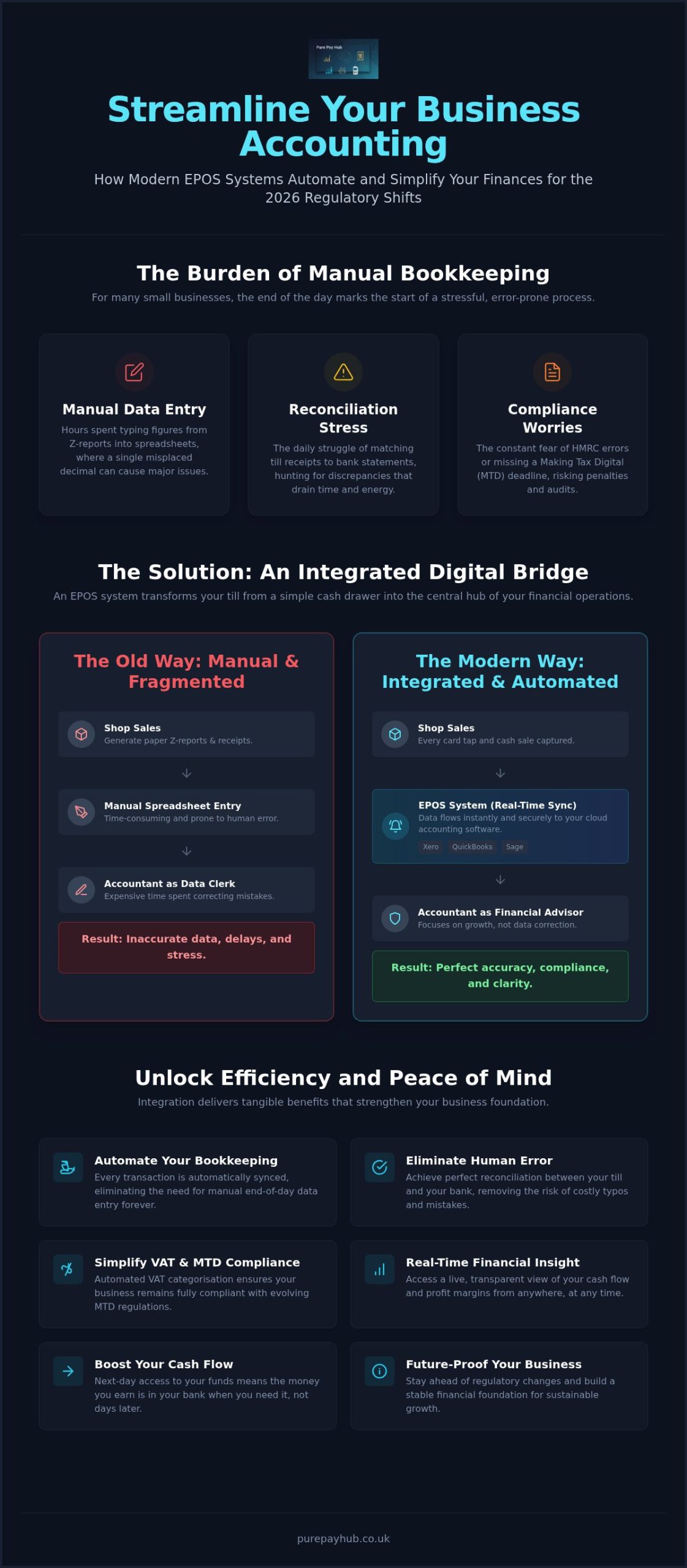
    Understanding how EPOS systems streamline small business accounting starts with redefining the till itself. In a modern setting, an EPOS is no longer just a locked drawer for cash. It functions as a digital bridge that connects your physical sales floor directly to your financial ledger. Every time a customer taps their card, a wealth of data moves across this bridge. This includes the price, the specific VAT rate, the stock deducted, and even which staff member processed the transaction.

    The old legacy cash registers were “dumb” machines. They recorded a total and printed a receipt, leaving you to piece together the story of your business at the end of the month. Modern data-driven systems are different. They provide a transparent, real-time narrative of your business health. For your bookkeeper, “integrated” is the most important word in their vocabulary. It means your sales data flows automatically into your accounting software without anyone having to lift a pen or open a spreadsheet.

    The Move from Manual to Digital Bookkeeping

    Manual data entry is the biggest threat to your business accuracy. When you spend hours typing figures from Z-reports into a computer, mistakes are inevitable. A single misplaced decimal point can lead to a stressful HMRC enquiry or a skewed view of your profits. Transitioning to automated tools is the primary way how EPOS systems streamline small business accounting in a competitive market. The humble UK till has evolved into a sophisticated financial management hub that protects you from these human errors.

    An EPOS system is a real-time data synchronisation tool that allows SMEs to link every transaction directly to their financial records. This evolution ensures that your business stays compliant whilst you focus on serving your customers.

    Core Components of a Modern Accounting-First EPOS

    A high-quality Point of Sale (POS) system built for 2026 focuses on three core pillars to support your accounting:

    • Cloud-based storage: This gives you and your accountant instant access to financial records from any location, ensuring you aren’t tied to the shop floor to check your numbers.
    • Automated VAT categorisation: The system identifies whether an item is standard, reduced, or zero-rated at the point of sale, removing the guesswork from your tax returns.
    • Hardware integration: Seamless connections with a Countertop Card Machine ensure that the amount on the till always matches the amount processed by the bank.

    By centralising these functions, you create a stable foundation for your finances. You won’t just save time; you’ll gain the clarity needed to make informed decisions about your business growth and development.

    Real-Time Data Synchronisation with Accounting Software

    The “monthly shoebox” is a relic of the past. For years, small business owners spent the first Monday of every month sorting through crumpled receipts and faded Z-reports. This manual process isn’t just tedious; it’s expensive. When you hand a messy bundle of paperwork to your accountant, you’re paying them to be a data entry clerk rather than a financial advisor. Real-time synchronisation changes this dynamic. By using API connections, your till literally talks to your accounting software. This is a primary example of how EPOS systems streamline small business accounting by ensuring every sale is recorded the moment it happens.

    Cloud updates allow you to monitor your profit margins whilst you’re at home or even asleep. You don’t need to wait for a quarterly report to see if your food costs are too high or if a specific product line isn’t performing. The data is “clean,” meaning it arrives in your ledger pre-categorised and ready for review. Governments worldwide are encouraging this shift, highlighting the importance of digital tools for tax management to reduce administrative burdens and improve transparency.

    Seamless Integration with Xero, QuickBooks, and Sage

    Most UK merchants already use platforms like Xero, QuickBooks, or Sage. A modern EPOS doesn’t replace these; it feeds them. Whether a customer pays by cash or card, the system splits the transaction into its component parts. It identifies the net sale, the VAT, and the payment method. This automation ensures your bank reconciliation is a simple “click and confirm” process rather than a multi-hour detective job. You can see your physical sales match your digital records instantly without any manual intervention.

    The Benefit of Next-Day Access to Funds

    Cash flow is the heartbeat of any retail or hospitality business. If your sales data says you’ve had a record-breaking Friday, but the money doesn’t hit your bank until Wednesday, your accounting becomes a guessing game. PurePay Hub provides next-day access to funds, which is a critical metric for accurate forecasting. This speed allows you to match your digital sales reports with actual bank deposits almost immediately. It removes the stress of “pending” balances and gives you a true view of your available capital.

    When your bank balance reflects your till reports within 24 hours, your cash flow forecasting becomes reliable. You can pay suppliers, manage payroll, and invest in stock with total confidence. If you want to see this level of clarity in your own books, exploring an integrated EPOS system is the logical next step. It turns your payment processing into a stabilising force for your entire business.

    Simplifying VAT Compliance and Making Tax Digital (MTD)

    Tax season doesn’t have to be a period of dread. For many merchants, the complexity of VAT is what makes bookkeeping feel like a second job. This is where you see exactly how EPOS systems streamline small business accounting by removing the manual calculation of tax on every pint, pastry, or pair of shoes sold. Instead of checking every receipt, the system applies the correct VAT rate the moment the barcode is scanned or the item is selected on the screen. It also monitors your taxable turnover against the compulsory £90,000 VAT registration threshold, ensuring you know exactly when you need to register or if you are approaching the £88,000 deregistration limit.

    Managing standard, reduced, and zero-rated items happens entirely in the background. By integrating with other business tools, your EPOS ensures that these figures are not just accurate at the till but are also correctly categorised in your final ledger. This creates a digital paper trail that is essentially “audit-ready” from day one. If HMRC ever requests a review of your records, you can generate a comprehensive report at the touch of a button. You no longer have to worry about missing digital records or inconsistent data entry that could trigger an investigation.

    Staying Compliant with MTD Requirements

    Making Tax Digital (MTD) is shifting from a suggestion to a strict requirement for almost every UK business. From April 2026, self-employed individuals and landlords with an annual income over £50,000 must comply with MTD for Income Tax Self Assessment (ITSA). This threshold will extend to those earning over £30,000 in April 2027. Your EPOS acts as the “functional compatible software” needed to bridge the gap between your daily operations and HMRC’s digital portal. It stores your records in the required digital format, helping you avoid costly fines whilst keeping your focus on daily growth.

    Managing Split VAT and Hospitality Complexities

    In the hospitality sector, VAT is famously complex. A sandwich sold to a customer sitting in a chair carries a different VAT implication than one taken away. Integrated systems handle these “split VAT” scenarios automatically. They prevent the expensive miscalculations that often occur when staff are busy and have to make manual tax decisions on the fly. For pub and restaurant owners, this automation turns a potential accounting nightmare into a simple, background process. It provides total clarity on what is owed, protecting your profit margins from unexpected tax bills at the end of the quarter.

    How EPOS Systems Streamline Small Business Accounting: A 2026 Guide

    Eliminating Human Error and Reconciliation Stress

    Reconciliation is a fancy word for a simple question: does the money in the bank match what the till says you sold? For many, this is where the evening takes a turn for the worse. Manual reconciliation is the primary source of accounting errors. It usually involves a tired business owner squinting at a card machine receipt whilst typing numbers into a spreadsheet. One slip of the finger and your books are out by hundreds of pounds, leading to hours of forensic searching for a misplaced decimal point.

    The “Double Entry” problem disappears when your hardware is synced. Because your card machine is linked to your EPOS, there is no need for staff to “key in” the price twice. This automated matching is a core reason how EPOS systems streamline small business accounting for modern retailers. It ensures that the till and the bank always match; identifying discrepancies instantly rather than at the end of a long month. This creates a culture of financial transparency amongst your staff, as every penny is accounted for in real-time. You can spot a mistake the moment it happens, rather than chasing a phantom error weeks later.

    Automated End-of-Day Reporting

    Cashing up used to mean manual Z-reports and piles of paper. Modern systems generate these reports automatically and can email them directly to your accountant in a format they actually like. It removes the friction from your daily routine. The psychological relief of seeing a perfectly balanced till every single evening is worth the investment alone. It means you can go home knowing your data is accurate and your ledger is clean, without the nagging worry of a cashing-up catastrophe.

    Tracking Stock Value for Accurate Balance Sheets

    Your accounting isn’t just about sales; it’s about assets. An integrated system links stock control directly to your business assets, allowing for a much more precise balance sheet. This automation provides several key benefits:

    • Automated COGS: Your “Cost of Goods Sold” is calculated on the fly, giving you accurate profit reporting for every single shift.
    • Real-time Valuation: You always know the exact value of the stock sitting on your shelves, which is vital for insurance and tax purposes.
    • Reduced Stocktakes: Whilst you’ll still need an occasional count, the need for massive, manual year-end stocktakes is significantly reduced.

    Accurate stock data means your balance sheet reflects the true value of your business at all times. If you want to stop the late-night stress and ensure your records are always spot on, browse our integrated EPOS systems and reclaim your evenings.

    Future-Proofing Your Business with PurePay Hub

    A reliable accounting process is built on a foundation of transparency. If your merchant service provider hides costs within complex fee structures, your reconciliation will never be truly accurate. We believe that clarity is the most important tool for any business owner. By combining low transaction rates with high-end accounting efficiency, you can ensure your business remains profitable and organised as you grow. This is the final piece of the puzzle in understanding how EPOS systems streamline small business accounting; they turn your payment data into a strategic asset rather than a daily chore.

    Scaling your business should be an exciting milestone, not an accounting headache. Whether you are opening a second boutique or a third cafe, an integrated system allows you to manage multiple locations from a single, centralised dashboard. You can compare the performance of different sites and ensure that your bookkeeping remains consistent across the entire brand. This bird’s-eye view prevents the fragmentation that often occurs when small businesses expand too quickly without the right digital infrastructure in place.

    Clean data also opens doors to growth capital. Traditional bank loans often require mountains of paperwork and weeks of waiting. However, because your EPOS records every transaction, you have a verified history of your revenue. This makes accessing a Business Cash Advance much simpler. Lenders can see the health of your business through your sales data, allowing you to secure funding based on your actual performance rather than just a credit score. It is a modern way to fund renovations or stock purchases whilst keeping your cash flow stable.

    The PurePay Hub Advantage for UK SMEs

    We position ourselves as a fair partner to regional business owners. This starts with debit rates from 0.3%, ensuring you keep more of your hard-earned revenue. We don’t hide behind corporate jargon or opaque markups. Instead, we provide reliable UK-based support to help you organise your setup from day one. Our no-nonsense approach to merchant services means you get a modern fintech experience with the personal touch of a local expert who understands the UK market.

    Taking the Next Step Toward Automation

    Switching to a more efficient system shouldn’t be a burden. We help merchants move away from restrictive contracts by offering solutions that allow you to switch to an integrated system without the stress of exit fees. Every business is unique, which is why consulting with a PurePay Hub expert is the best way to find your perfect EPOS match. We will look at your specific sector and accounting needs to build a package that works for you. Don’t let manual data entry hold your business back any longer. You can get a transparent quote and streamline your accounts today to see the difference that true integration makes.

    Reclaim Your Time and Protect Your Profits

    The shift toward digital finance is inevitable, but it doesn’t have to be a source of stress. We have explored how EPOS systems streamline small business accounting by turning every transaction into a clean data point for your ledger. You now understand how real-time synchronisation removes the need for manual data entry and ensures your VAT calculations are always audit-ready. By automating these repetitive tasks, you protect your business from human error and remain fully compliant with the latest MTD requirements.

    PurePay Hub is here to act as your supportive business ally. We offer a transparent fee model with debit card rates starting from 0.3% and next-day funding as standard. There are no hidden markups or opaque fee structures; just a reliable, modern system designed to stabilise your finances. It’s time to stop worrying about cashing-up discrepancies and start focusing on your growth. Switch to PurePay Hub and start saving on every transaction today. We look forward to helping you build a more efficient, future-proof business.

    Frequently Asked Questions

    Can an EPOS system really replace my manual bookkeeping?

    An EPOS system automates the vast majority of your daily sales record keeping. It acts as a digital bridge that captures every transaction, meaning you no longer need to manually log individual sales or Z-reports. Whilst it doesn’t replace the strategic advice of an accountant, it eliminates the tedious hours of data entry that often lead to mistakes. It ensures your ledger is always up to date without the need for a pen and paper.

    Does an EPOS system automatically calculate VAT for HMRC?

    Yes, modern systems automatically apply the correct VAT rate to every item sold at the point of sale. Whether an item is standard, reduced, or zero-rated, the software categorises the tax instantly. This is a key way how EPOS systems streamline small business accounting, as it prevents the need for manual calculations at the end of the quarter. It ensures your VAT returns are based on precise, per-transaction data rather than estimates.

    Which accounting software is best to use with a UK EPOS system?

    Most UK merchants find that Xero, QuickBooks, or Sage offer the best integration capabilities. These platforms are designed to talk to your EPOS through secure API connections. This allows for a seamless flow of data where your sales, stock, and VAT figures appear in your accounts automatically. Choosing a well-known platform ensures that your accountant can easily access the clean data they need to manage your business finances effectively.

    How does an integrated card machine reduce accounting errors?

    An integrated card machine removes the need for staff to manually type the transaction amount into the terminal. When the till and the card machine are linked, the price is sent directly to the device. This eliminates keying-in errors where a staff member might accidentally enter the wrong figure. It ensures your bank deposits always match your till reports, which makes your daily reconciliation a stress-free and accurate process.

    What are the costs involved in connecting EPOS to accounting software?

    Connecting your systems usually involves a monthly software subscription fee and an initial hardware investment. Some providers also charge a small integration fee to link your till with your chosen accounting platform. You should always check for transparent fee structures to avoid hidden markups. Investing in this connection often pays for itself by reducing the number of hours your accountant spends on manual data entry and reconciliation.

    Is my data safe when syncing EPOS with cloud accounting tools?

    Yes, cloud-based systems use high-level encryption to protect your financial data during the synchronisation process. This is the same level of security used by major banks to ensure your information remains confidential. By storing your records in the cloud, you also protect your business from data loss caused by hardware failure or theft. It provides a secure, centralised location for your records that you can access safely from any location.

    How do I manage cash payments alongside card sales in my accounts?

    Your EPOS system categorises every sale by payment type, allowing you to track cash and card transactions separately. When you perform your end-of-day cashing up, the system tells you exactly how much cash should be in the drawer. This data is then synced to your accounting software under different headings. It ensures your books reflect your actual bankings and helps you identify any discrepancies in your cash handling immediately.

    Can I use an EPOS system to help with my Making Tax Digital (MTD) returns?

    Absolutely, an EPOS system is a vital tool for meeting your Making Tax Digital obligations. It acts as the functional compatible software required by HMRC to keep digital records of your transactions. By automatically capturing your sales and VAT data, it ensures you have an accurate, digital paper trail for your quarterly returns. This is essential for how EPOS systems streamline small business accounting as we approach the 2026 MTD deadlines.

  • Speed Up Customer Payments: A Guide for UK Businesses

    Speed Up Customer Payments: A Guide for UK Businesses

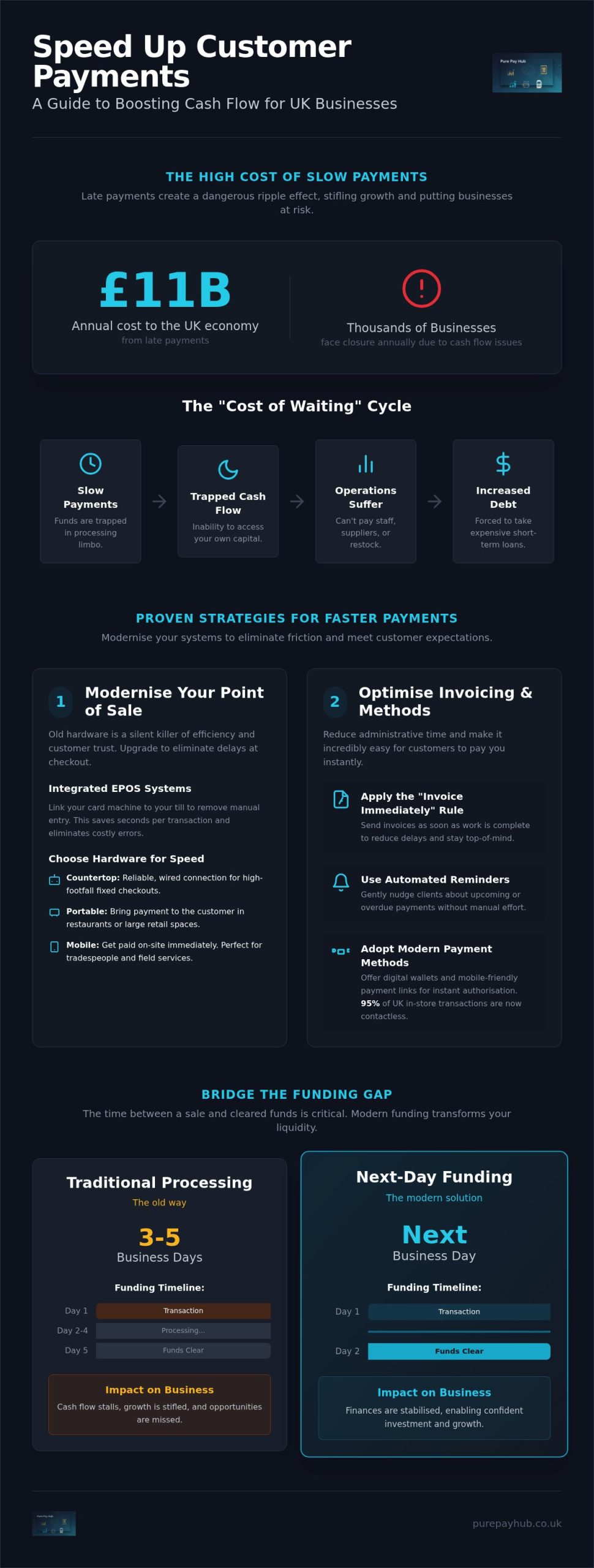
    Late payments cost the UK economy an estimated £11 billion every year, a staggering figure that leads to the closure of thousands of businesses annually. If you have ever felt the stress of a mounting invoice list whilst your own bank balance stays stagnant, you are certainly not alone. Most business owners agree that chasing money is the most frustrating part of the job. It drains your time and stifles your growth, but it is a cycle you can break.

    Learning how to speed up customer payments is the most effective way to protect your cash flow and modernise your operations. This guide shares proven strategies to reduce payment friction, automate your collections, and ensure funds reach your account without delay. We will look at how integrated EPOS systems and next-day funding can transform your liquidity. We also cover the latest UK late payment reforms and why moving beyond traditional Bacs processing is essential for a competitive edge. Discover how to create a fairer, faster payment experience that benefits both your business and your customers.

    Key Takeaways

    • Understand why reducing the “cost of waiting” is vital for maintaining healthy cash flow and funding your business growth.
    • Learn how modernising your hardware with integrated EPOS systems can eliminate manual entry errors and speed up the checkout process.
    • Discover how to speed up customer payments by adopting digital wallets and mobile-friendly payment links that offer instant authorisation.
    • Apply the “Invoice Immediately” rule and use automated reminders to reduce administrative time spent chasing outstanding funds.
    • Explore how PurePay Hub’s next-day funding provides a stabilising force for your finances compared to traditional 3-5 day clearing cycles.

    Why Payment Speed is the Lifeblood of Your Cash Flow

    Payment speed is the specific window of time between a completed sale and the moment those funds clear into your bank account. It is not just about the transaction itself; it is about the accessibility of your capital. For many UK merchants, this gap is where growth stalls. Understanding how to speed up customer payments is the first step toward building a resilient business that can weather economic shifts. The mechanics of modern payment systems have evolved rapidly, moving from slow manual settlements to near-instant digital transfers. If your business is still relying on outdated cycles, you are essentially providing interest-free loans to your customers whilst your own bills mount up.

    The “cost of waiting” is a heavy burden for SMEs. When funds are trapped in processing limbo, your ability to restock inventory, pay staff, or invest in new equipment is compromised. This often leads to an increased reliance on expensive short-term borrowing just to keep the lights on. Beyond the balance sheet, there is a significant psychological element to consider. Customers are far more likely to settle an account or complete a purchase when the process is seamless and immediate. Friction causes hesitation, and hesitation leads to delays or, worse, lost sales.

    The Financial Impact of Late and Slow Payments

    Slow turnover creates a dangerous ripple effect through your supply chain. If you can’t pay your suppliers on time because your customers haven’t paid you, your professional reputation suffers. Days Sales Outstanding, or DSO, is a metric that tracks the average number of days your business takes to collect payment after a sale is completed. A high DSO is a red flag for any business. Recent UK economic data suggests that late payments cost the economy £11 billion annually, pushing thousands of firms toward critical financial distress. Reducing this window is not just about efficiency; it is about survival.

    Customer Expectations in a Digital-First Economy

    Consumer behaviour has shifted dramatically across the UK. As of 2024, almost 95% of eligible in-store transactions are made using contactless methods. Customers now expect speed as a standard feature of any service. A slow checkout experience or a clunky invoicing process leads to frustration and basket abandonment. In the retail and hospitality sectors, a delay of just a few seconds can be the difference between a loyal regular and a one-time visitor. By removing hurdles, you position your brand as a modern, favourite choice amongst local shoppers who value their time as much as their money.

    Eliminating Friction: Modernising Your Point of Sale

    Old hardware is a silent killer of business efficiency. If your card terminal takes ten seconds to connect or frequently drops its signal, you’re losing more than just time. You’re losing customer trust. Every second a person spends waiting at the till is a moment they spend reconsidering their purchase or feeling frustrated by your service. Modernising your physical hardware is one of the most direct ways to address how to speed up customer payments in a face-to-face environment. High-performance terminals ensure that the moment a card or phone is tapped, the transaction is authorised and completed without hesitation.

    The Power of Integrated EPOS Systems

    Manual data entry is slow and prone to expensive errors. Integrated EPOS Systems link your card machine directly to your till, which completely removes the need for “double-keying” prices. When the staff member rings up an item, the exact total is sent to the terminal instantly. This doesn’t just save several seconds per transaction; it simplifies your end-of-day reconciliation by ensuring your reports always match your bank deposits. This level of precision is becoming increasingly important as the government’s late payment reforms place more scrutiny on how businesses manage their financial workflows and reporting. Efficient, integrated systems make this compliance effortless whilst keeping your queues moving during peak trading periods.

    Portable vs. Countertop: Choosing for Speed

    The right tool depends entirely on your business layout. Countertop Card Machines are reliable workhorses for fixed retail points with high footfall. They provide a stable, wired connection that never fails. However, in hospitality or large retail spaces, speed often means bringing the payment to the customer rather than making them walk to you. Portable Card Machines allow your team to take payments at the table or even in the middle of a queue, preventing bottlenecks from forming at the bar. For tradespeople or field-based services, a Mobile Card Machine ensures you get paid before you even leave the site. Getting the money immediately via a handheld device is always faster and more reliable than sending an invoice and waiting for a bank transfer. If you want to see which technology suits your specific workflow, you can compare the latest portable and mobile card machines to find a perfect fit.

    Prioritising hardware that supports the latest NFC and contactless standards is no longer optional. With the removal of the fixed £100 contactless limit in early 2026, your equipment must be ready to handle higher-value transactions securely. Modern terminals allow for greater flexibility, letting customers pay for larger orders with a simple tap of their phone or watch. This reduces the friction of PIN entry and keeps your business at the forefront of UK payment trends.

    Choosing the Right Payment Methods for Faster Settlements

    Selecting the correct payment channel is the most tactical decision you can make regarding how to speed up customer payments. Whilst cash feels immediate, it carries hidden delays in the form of bank trips and manual counting. Bacs payments, a staple for many UK businesses, still operate on a rigid three-working-day cycle. If you submit a payment on Monday, the funds won’t clear until Wednesday. This delay is a relic of an older era. In contrast, card transactions and digital wallets provide authorisation in seconds, allowing you to move on to the next task with confidence. Cheque culture is even more restrictive, often taking a full week to clear whilst leaving your business vulnerable to bounces.

    Digital wallets like Apple Pay and Google Pay have revolutionised the checkout experience. They eliminate the need for physical cards and, more importantly, the need for a PIN. Encouraging “one-tap” behaviour reduces the time spent at the point of sale, which is vital for high-volume traders. By offering these methods, you align your business with the fastest settlement technologies available today. It isn’t just about the technology; it’s about matching the pace of your customers’ lives.

    Contactless and Digital Wallet Dominance

    Biometric authorisation via FaceID or TouchID is significantly faster than traditional PIN entry. It is also more secure. As of March 2026, the fixed £100 contactless limit in the UK has been removed. This change allows banks and payment providers to set their own limits, enabling your customers to pay for more expensive items with a simple tap. You should ensure your terminals are updated to accept these higher-value transactions without requiring a PIN. Accepting all major cards ensures you never turn a customer away, keeping your revenue flowing without interruption.

    Online Payment Gateways and Virtual Terminals

    If you provide services over the phone or remotely, you need tools that match your pace. A Virtual Terminal allows you to take secure card payments during a call, securing the funds immediately rather than waiting for a bank transfer. For even greater speed, “Payment Links” let you send a secure checkout page via email or SMS. This is a game-changer for tradespeople and consultants. It allows the customer to pay on their mobile in seconds. To prevent drop-outs on your website, keep your checkout process to a single page with minimal steps. Every extra click is an opportunity for a customer to change their mind. Efficiency in your Online Payment Gateway is the best way to turn a “maybe” into a completed sale.

    Speed Up Customer Payments: A Guide for UK Businesses

    Streamlining Invoicing and Recurring Payment Workflows

    Waiting until the end of the month to send your invoices is a common mistake that creates an artificial bottleneck in your cash flow. If you complete a job on the 5th but don’t bill until the 30th, you’ve already lost three weeks of liquidity. Adopting an “Invoice Immediately” rule ensures your business stays at the top of your customer’s priority list whilst the value of your work is still fresh in their mind. This simple shift in timing is one of the most effective answers to how to speed up customer payments without needing to invest in complex new infrastructure.

    You can also influence payment behaviour through strategic incentives. Offering a small early settlement discount, perhaps 2%, can motivate clients to pay within days rather than weeks. Conversely, you should be clear about late payment penalties. Under current UK legislation, you have the right to charge interest of 8% above the Bank of England base rate on late business-to-business payments. Whilst you may not always choose to enforce this, having it stated clearly on your terms of service sets a professional boundary that discourages ditherers.

    Best Practices for Clear and Transparent Invoicing

    A UK-compliant tax invoice must include your business name, address, a unique identification number, and a clear breakdown of the VAT and total amount due. Ambiguity is the enemy of speed. If a customer has to call you to clarify an itemised charge or find your bank details, the invoice will sit at the bottom of their pile. You can eliminate this friction by including multiple “Pay Now” options directly within the digital document. Using Payment Links inside your email or PDF allows the customer to settle the balance instantly via their smartphone, bypassing the need for manual bank transfers entirely.

    Automating the Collections Process

    Chasing money manually is a drain on your mental energy and your administrative budget. Modern software allows you to set up automated email sequences that nudge customers as the due date approaches. These reminders should be polite but firm, providing a direct link to pay in every message. By syncing your payment provider with accounting platforms like Xero or QuickBooks, your books update automatically the moment a transaction clears. For businesses with variable or one-off high-value sales, this automation is far more flexible than traditional Direct Debit. If you are ready to stop the manual chase, you can set up secure Payment Links to start collecting funds the moment your work is done.

    Whilst Bacs remains a cost-effective choice for high-volume payroll, it is often too slow for modern business needs. Transitioning your recurring billing to automated card payments ensures that you are in control of the collection date. This moves your relationship from one of “waiting and hoping” to one of “consistent settlement,” providing the financial stability you need to plan for the future.

    Accelerating Growth with PurePay Hub’s Next-Day Funding

    Most discussions regarding how to speed up customer payments focus entirely on the point of sale. However, the final hurdle for any UK business is settlement speed. This is the time it takes for money to move from your payment processor into your actual bank account. Whilst many traditional providers keep your hard-earned funds in limbo for three to five working days, PurePay Hub operates differently. We act as a stabilizing force for your finances by providing next-day access to your funds. This ensures that the revenue you generated yesterday is available to spend, reinvest, or save by the following morning.

    Our commitment to UK business owners is built on a foundation of transparency and fairness. We offer debit card rates starting from 0.3 per cent, which is a significant departure from the opaque and inflated fee structures used by many competitors. By lowering your transaction costs, we help you retain more of your margin. This extra capital can then be used to reinvest in the integrated EPOS systems or mobile hardware discussed earlier in this guide. When your processing fees are low and your settlement is fast, your business gains a distinct competitive advantage.

    Next-Day Funding: The Ultimate Cash Flow Tool

    Accessing your card sales the very next day fundamentally changes how you plan your business operations. It provides a level of liquidity that allows you to respond to opportunities or emergencies without hesitation. You no longer have to rely on expensive bank overdrafts or high-interest short-term loans to cover a temporary gap. This steady, predictable flow of capital is especially vital for regional merchants who need to manage inventory levels with precision. The PurePay Hub onboarding process is designed for speed and simplicity. We ensure you are set up and ready to receive next-day settlements with minimal administrative delay.

    A Partner in Your Business Development

    We pride ourselves on a no-nonsense approach to merchant services. You won’t find hidden markups or complex jargon in our contracts. Instead, you get a supportive business ally that understands the local merchant community. Our UK-based support team is always available to help you manage PCI compliance or troubleshoot technical issues, ensuring your payment links and terminals never miss a beat. For businesses facing seasonal peaks or looking to expand, we also offer Business Cash Advances based on your card turnover. This provides a flexible way to bridge gaps whilst waiting for your busiest periods to arrive. If you are ready to transform your settlement cycle, you can organise a consultation with PurePay Hub to speed up your payments today and take full control of your cash flow.

    Take Control of Your Financial Future

    Mastering how to speed up customer payments is about more than just convenience. It is a fundamental shift in how you protect your business’s liquidity and professional reputation. By modernising your point of sale with integrated EPOS solutions and embracing digital wallets, you remove the hurdles that cause customers to hesitate. Streamlining your invoicing and adopting an “Invoice Immediately” rule prevents your capital from being trapped in outdated cycles.

    At PurePay Hub, we position ourselves as your fair partner in this transition. We provide a stabilising force for your finances by offering debit rates from 0.3% and providing next-day funding as standard. This ensures your money works for you without the frustration of traditional bank delays. Stop waiting for old systems to catch up with your ambition. Start taking faster payments with PurePay Hub – Get a quote today. You have built a dependable business; now give it the cash flow it deserves to thrive.

    Frequently Asked Questions

    How can I encourage my customers to pay invoices on time?

    You can encourage timely payments by sending invoices the moment a job is finished rather than waiting until the end of the month. Providing a direct “Pay Now” button through Payment Links makes it easier for customers to settle up instantly on their mobile. Clear terms and small early-payment discounts also provide a strong incentive for clients to prioritise your bill over others.

    What is the fastest payment method for a small UK business?

    Card payments and digital wallets are the fastest methods for immediate authorisation at the point of sale. Whilst cash feels instant, it requires manual handling and bank trips that delay your actual access to the funds. For bank-to-bank transfers, the Faster Payments scheme is the best option for near-instant settlement compared to the traditional three-day Bacs cycle used by many larger firms.

    Does integrated EPOS really speed up customer service?

    Integrated EPOS systems significantly speed up service by linking your till directly to your card machine. This eliminates “double-keying,” where staff have to manually type the price into the terminal for every sale. It reduces human error and cuts several seconds off every transaction. This is vital for managing queues and improving the customer experience during your busiest trading periods.

    What is next-day funding and how does it work?

    Next-day funding is a service where the money from your card sales is deposited into your bank account on the next working day. Traditional providers often take three to five days to clear these funds, which can stall your business growth. By reducing this gap, you improve your liquidity and reduce the need for expensive short-term borrowing or bank overdrafts to cover your costs.

    Are digital wallets like Apple Pay faster than physical cards?

    Digital wallets like Apple Pay and Google Pay are generally faster than physical cards because they use biometric authorisation such as FaceID or TouchID. This removes the need for customers to enter a PIN, even for transactions that exceed the old £100 contactless limit. It creates a seamless “one-tap” experience that keeps your checkout process moving at a modern, digital-first pace.

    How much do card machine transaction fees affect my cash flow?

    High transaction fees directly reduce your profit margins and the total capital available to reinvest in your business. Opaque fee structures with hidden markups can make it difficult to predict your exact weekly income. Choosing a provider with transparent rates, such as debit charges starting from 0.3%, ensures more of every sale stays in your pocket to support your ongoing development.

    Can I take payments over the phone to speed up collections?

    You can take secure phone payments instantly by using a Virtual Terminal. This allows you to process a customer’s card details securely during a conversation, securing the funds immediately. It is a much more efficient alternative to sending a traditional invoice and waiting days for a client to log into their banking app and set up a manual transfer.

    What should I do if a customer consistently pays late?

    If a customer consistently pays late, you should implement automated email reminders and consider charging statutory late payment interest. For recurring services, switching the customer from manual bank transfers to automated card payments is a proactive way to address how to speed up customer payments. This ensures you are in total control of the collection date rather than waiting on the customer’s own schedule.

  • Bridging the Gap: Moving from the Shoebox Method to Modern VAT Prep in 2026

    Bridging the Gap: Moving from the Shoebox Method to Modern VAT Prep in 2026

    Imagine it’s 10 PM on a Sunday, and you’re surrounded by a mountain of crumpled thermal receipts, trying to decipher a faded ink blotch from three months ago. Most UK business owners dread the quarterly VAT cycle. You likely feel the pressure of potential HMRC penalties for a simple manual entry error, or the frustration of paying an accountant high fees just to sort through basic data entry. This “shoebox method” isn’t just stressful; it’s a drain on your focus and your finances.

    You can reclaim your time and gain total confidence in your compliance by understanding how epos systems simplify vat returns for small business. This shift transforms your accounting from a manual chore into a seamless, automated background process. We’ll explore how to align with the 2026 Making Tax Digital (MTD) regulations and transform your VAT preparation into a paperless, audit-ready workflow that keeps your records accurate and your accountancy costs low.

    Key Takeaways

    • Understand why physical receipts create data silos and how moving to digital records prepares you for the 2026 MTD deadline.
    • Discover how epos systems simplify vat returns for small business by automatically capturing transaction fees that are often missed during manual entry.
    • Reduce your quarterly VAT workload from hours of stressful sorting to minutes of simple digital review through automated data integration.
    • Follow a practical roadmap to audit your current paper trail and transition to a payment provider with built-in reporting capabilities.
    • Benefit from transparent fee structures and a “digital shoebox” that helps lower your accountancy costs whilst protecting you during HMRC audits.

    What is the “Shoebox Method” and Why is it Failing UK Businesses?

    The “shoebox method” isn’t a strategy. It’s a survival tactic. For decades, many UK small business owners have relied on the habit of stuffing physical receipts, invoices, and bank statements into a literal or metaphorical box. You wait until the end of the quarter, tip the contents onto a desk, and hope for the best. This creates a massive “data silo.” Your financial information exists in a physical form that your accounting software simply cannot see. It’s invisible, unsearchable, and prone to decay.

    This approach fuels a specific type of psychological stress: deadline dread. As the VAT submission window nears, the pressure builds. You know you’ll spend your weekend sorting through crumpled paper instead of resting or growing your business. By the time 2026 arrives, this method won’t just be stressful; it will be a regulatory liability. Physical records alone are no longer sufficient for a modern, compliant business. PurePay Hub helps bridge this gap by turning your daily transactions into clear, digital records that are always audit-ready.

    The High Cost of Manual Entry Errors

    Manual data entry is a gamble. A single misread digit on a faded receipt can lead to an incorrect VAT return. HMRC views these discrepancies with scrutiny. One small typo could trigger a full audit, consuming weeks of your time and peace of mind. Discovering how epos systems simplify vat returns for small business allows you to replace these manual risks with digital precision.

    There’s also a hidden financial drain. If you hand a box of paper to an accountant, you’re paying professional rates for basic data entry. It’s a poor use of your budget. Perhaps most importantly, physical receipts are fragile. If a receipt for a large business expense goes missing, you lose the ability to claim that VAT back. You’re essentially leaving your own money on the table because of a piece of paper that went missing in transit.

    Why 2026 is the Turning Point for Digital Compliance

    The regulatory environment in the UK is shifting permanently. Making Tax Digital (MTD) is expanding its scope to cover more businesses, including those previously below certain thresholds. HMRC is moving away from annual or quarterly summaries towards a system of real-time data submission and mandatory digital links. You can no longer simply type a total figure into a box on a website. MTD is the mandatory digital link between business records and HMRC. By 2026, every transaction needs a clear, digital trail. PurePay Hub acts as your digital shoebox, ensuring every card payment is recorded and categorised correctly from the moment the customer taps their card. Relying on paper is a risk that modern businesses can’t afford to take.

    Understanding the VAT Gap: How Small Errors Cost You Thousands

    The VAT Gap isn’t just a figure for Treasury spreadsheets. At the business level, it represents the difference between what you actually owe and what you report. This gap often grows from tiny, recurring errors rather than deliberate evasion. For many UK merchants, these inaccuracies lead to overpaying tax or, worse, underpaying and facing heavy penalties. Identifying these leaks is the first step toward financial clarity.

    Manual reconciliation between bank statements and card reports is where most systems fail. Your bank statement usually shows a “net settlement” figure, which is your total sales minus the merchant fees. If you only record that net figure, you’re missing out on deductible expenses. Understanding how epos systems simplify vat returns for small business is essential here. These systems break down every transaction into its constituent parts, ensuring you see the gross sale and the fee separately.

    Product categorisation at the till is another common trap. If you sell a mix of standard-rated and zero-rated items, such as hot food and cold takeaway, a manual system relies on the operator to remember the difference every time. One mistake per hour adds up to thousands of pounds in miscalculated tax over a year. Modern systems automate this, applying the correct VAT rate based on the product code, which removes the risk of human error at the point of sale.

    The Financial Leakage of Merchant Fees

    Merchant service charges are a deductible business expense. If you aren’t tracking them accurately, you’re essentially paying tax on money you never actually kept. Integrated systems automatically track these fees for every transaction processed, creating a clear paper trail for your accountant. Contrast this with manual methods where fees are often “lost” in the net figures hitting your bank account. Switching to a provider that offers integrated reporting ensures these fees are never ignored and always accounted for in your favour.

    HMRC Penalties in 2026: A Warning for the Unprepared

    HMRC has moved to a points-based penalty system for VAT. Every late or inaccurate submission earns you a point. Once you hit a specific threshold, you face a £200 fine for every subsequent mistake. It’s a cumulative system designed to punish persistent manual errors. Interest charges are also aggressive, often applied after just 16 days of late payment. To avoid an inspection, watch out for these manual “red flags”:

    • Inconsistent gross profit margins that don’t match your industry average.
    • Frequent “round number” entries that suggest estimation rather than precision.
    • Discrepancies between your annual accounts and your quarterly VAT returns.
    • Missing digital links between your sales records and your submission software.

    By automating your data capture, you eliminate these red flags and provide HMRC with the transparent, digital evidence they require. This proactive approach saves you from the stress of an audit and the drain of avoidable fines.

    Manual vs. Integrated VAT Prep: A Comparison for 2026

    The difference between manual and integrated VAT preparation is stark. For a typical small business, manual sorting takes roughly 10 hours every quarter. You spend this time hunting for receipts and cross-referencing bank statements. In contrast, a digital review takes about 10 minutes. This efficiency is exactly how epos systems simplify vat returns for small business. You aren’t building the data from scratch. You’re simply verifying what has already been captured at the point of sale.

    Manual entry carries a high risk of transposition errors. Typing “£19.99” as “£19.66” might seem minor. Across hundreds of transactions, it distorts your liability and attracts HMRC scrutiny. By 2026, HMRC’s “Digital Link” requirement means that data must flow electronically between software programs. Simply copy-pasting figures from a spreadsheet into a VAT portal is no longer compliant. Integrated systems ensure that your sales data moves from the point of purchase to your tax return without human interference.

    Managing the cash flow for a quarterly VAT bill is a common headache. Integrated systems with next-day funding allow you to see your cleared funds almost immediately. This visibility helps you set aside tax obligations in real-time. You avoid the stress of a surprise bill because you have a constant, accurate view of your cleared balance.

    The Role of Integrated Card Machines

    A PurePay Hub card machine doesn’t work in isolation. It talks directly to your EPOS and your ledger. This integration creates a centralised Merchant Portal that acts as a digital dashboard for all your sales and fee data. You no longer need to print and store physical end-of-day Z-reports. Everything is logged digitally. This creates a permanent, searchable record that is impossible to lose or damage.

    Lowering Your Accountancy Fees

    Clean data saves money. Accountants often charge by the hour. If you provide them with a clean, digital data export, they spend less time on basic data entry. This shifts the relationship. You stop paying for administrative chores and start paying for strategic advice that helps your business grow. A simple way to speed this up is by sharing portal access directly with your bookkeeper. This removes you from the middle of the data chain and ensures your records are always up to date without your constant intervention.

    The 2026 Transition Roadmap: Moving to Digital VAT Prep

    Transitioning to a digital-first model is a logical progression, not a sudden leap. You need a clear roadmap to move away from the paper-heavy habits of the past. Following a structured plan ensures you remain compliant whilst reducing your administrative burden.

    Step 1: Audit your current “shoebox.” Identify exactly where your paper trail begins. Is it physical supplier invoices, till rolls, or handwritten petty cash slips? Knowing where the paper enters helps you block those manual entry points. Step 2: Select a digital-first payment provider. You need more than just a terminal; you need a partner that offers integrated reporting as standard. Step 3: Connect your hardware to your software. This is how epos systems simplify vat returns for small business. When your card machine and EPOS talk to your cloud accounting platform, your VAT records update automatically in the background. Step 4: Train your staff. Proper categorisation at the point of purchase ensures your data is clean from the start. Step 5: Replace the “Quarterly Scramble” with a “Monthly Digital Review.” A ten-minute check-in once a month keeps you ahead of the game and removes the stress of the VAT deadline.

    Choosing the Right Hardware for Compliance

    Your choice of hardware impacts your compliance. Whether you use countertop card machines or portable units, they must offer integrated reporting. Reliable connectivity is non-negotiable. Look for devices with 4G and Wi-Fi backup to ensure no transaction data is lost during a signal drop. For remote or B2B sales, Payment Links are invaluable. They keep your non-face-to-face sales within the same digital ecosystem, providing a consistent audit trail for HMRC. Explore our range of integrated card machines to start your digital transition today.

    Setting Up Your Digital Links

    Under current HMRC MTD rules, a “Digital Link” is a mandatory electronic transfer of data between software programmes. Manual copy-pasting or typing figures from one screen to another is no longer compliant. PurePay Hub automates this flow, sending transaction data directly to your ledger. This isn’t just about speed; it’s about security. High-level PCI compliance protects this digital data flow, ensuring your financial records remain private and untampered with. By automating these links, you create a robust, audit-ready system that satisfies HMRC requirements without the need for manual intervention.

    PurePay Hub: Bridging the Gap with Transparent Payments

    PurePay Hub acts as the bridge between your daily sales and your final tax submission. We don’t just provide hardware; we offer a way to simplify your entire financial workflow. By moving away from the shoebox, you gain a partner dedicated to your growth. Our no-nonsense fee structure starts with debit card rates from 0.3% and credit card rates from 0.5%. These transparent costs mean you always know exactly what’s being deducted from your sales. This clarity is a fundamental part of how epos systems simplify vat returns for small business. You no longer have to guess your margins or hunt for hidden markups in your reporting.

    Our integrated EPOS systems are particularly effective for the hospitality sector. They solve the business-level VAT Gap by automatically applying the correct tax rates to mixed products. Whether it’s a takeaway coffee or a sit-down meal, the system handles the calculation at the till. This precision protects you from overpaying tax or underreporting revenue. To help you manage your quarterly VAT liabilities, we offer next-day access to your funds. This steady cash flow ensures you always have the capital ready when your tax bill arrives.

    A Partner, Not Just a Provider

    We pride ourselves on being a local expert for regional business owners. Our UK-based support team understands the specific challenges you face. Through our Merchant Portal, you can generate audit-ready reports at the touch of a button. It serves as your digital shoebox, keeping every record safe and accessible. If you’re unsure about your current costs, we invite you to a “Health Check.” We’ll review your existing card machine rates and show you exactly where you can save money whilst improving your VAT prep.

    Next Steps for Your Business

    Moving from chaos to clarity doesn’t have to be a long process. You can ensure HMRC compliance and lower your accountancy fees by making the switch now. It’s time to ditch the shoebox and embrace an automated, stress-free workflow. Our quick onboarding process means you can be up and running before your next VAT quarter begins. Contact PurePay Hub today to transform your payment processing into your most reliable accounting tool.

    Secure Your Business Future Before 2026

    Moving from a paper-heavy “shoebox” to a streamlined digital workflow is no longer just a matter of convenience; it’s a necessity for UK compliance. By automating your record-keeping at the point of sale, you eliminate the stress of the quarterly scramble and protect your business from costly HMRC penalties. This transition highlights how epos systems simplify vat returns for small business by creating mandatory digital links and capturing deductible merchant fees automatically.

    PurePay Hub supports local merchants with a transparent, no-nonsense approach to payments. With debit card rates starting from 0.3%, next-day funding as standard, and integrated reporting for HMRC MTD compliance, we provide the stability your finances need. You can ditch the manual data entry and focus on growing your business with confidence. We’re here to ensure your move to digital is simple, fair, and reliable.

    Get a no-nonsense quote and simplify your VAT prep with PurePay Hub.

    Take the first step toward a paperless, audit-ready future today. Trade the stress of Sunday night sorting for the clarity of automated accounting.

    Frequently Asked Questions

    What exactly is the “Shoebox Method” in accounting?

    The shoebox method is the manual habit of collecting physical receipts and invoices in a container to be processed at a later date. This creates a data silo that is invisible to modern accounting software and relies entirely on manual entry. It often leads to a stressful quarterly scramble where errors are common and valuable deductible expenses are frequently missed or lost.

    Is the shoebox method still legal for UK businesses in 2026?

    No, the pure shoebox method is no longer compliant for VAT-registered businesses under Making Tax Digital (MTD) rules. By 2026, HMRC requires digital records and automated links between your sales and your tax return. Whilst you can keep physical copies for your own records, the actual submission process must be digital. Relying solely on paper records is now a significant regulatory risk.

    How does an integrated card machine help with my VAT return?

    An integrated card machine automatically transfers transaction data to your EPOS and accounting software. This is how epos systems simplify vat returns for small business by removing the need for manual data entry at the end of the day. Every sale is logged in real-time with the correct VAT rate applied, ensuring your digital records are accurate and ready for submission without any extra work.

    What are the penalties for manual entry errors on a VAT return in 2026?

    HMRC uses a points-based penalty system where each inaccurate or late submission earns you a point. Once you reach a specific threshold, you face a £200 fine for every subsequent mistake. Additionally, interest charges apply to unpaid tax after just 16 days. Moving to an automated system helps you avoid these red flags and protects your cash flow from the drain of avoidable cumulative fines.

    Do I need expensive software to move away from the shoebox method?

    You don’t need a complex or high-cost setup to transition to digital accounting. Many modern payment providers include integrated reporting as part of their standard service. By choosing hardware that talks directly to your existing ledger, you can automate your workflow without a massive upfront investment. This shift often pays for itself by significantly reducing the hours your accountant spends on basic data entry.

    How can I reclaim VAT on my card machine transaction fees?

    You can reclaim VAT on merchant service charges because they are a deductible business expense. Integrated systems track these fees for every transaction, providing the clear digital evidence HMRC requires for an audit. Manual methods often lose these figures in net settlement totals. Using a digital portal ensures every penny of your deductible fees is accounted for, which naturally lowers your overall tax liability.

    Can PurePay Hub help me if I am already behind on my VAT prep?

    Yes, we can help you get back on track by providing immediate access to clear, digital reporting. Our Merchant Portal acts as a digital archive for all transactions processed through our machines, allowing you to export clean, organised data for previous periods. Our quick onboarding process means you can start capturing accurate, compliant data before your next quarterly deadline, helping you avoid future points-based penalties.

    What is the “Digital Link” requirement in Making Tax Digital?

    A digital link is a mandatory electronic transfer of data between software programmes or applications. HMRC rules state that these links must be automated; you cannot manually copy and paste figures between a spreadsheet and your VAT software. Integrated systems satisfy this requirement by moving your sales data from the point of purchase directly to your ledger. This ensures the data remains untainted by manual errors during the transfer.

  • How to Improve Business Cash Flow: 2026 UK Guide

    How to Improve Business Cash Flow: 2026 UK Guide

    Did you know that 82% of UK SMEs have faced cash flow difficulties as of March 2026? It is a staggering figure that highlights a common frustration: doing the hard work but waiting far too long to see the money in your bank account. You are likely tired of slow settlement times from card providers and the drain of high transaction costs on your margins. We understand that liquidity isn’t just a line on a spreadsheet; it’s the lifeblood of your daily operations.

    This guide will show you how to improve business cash flow uk wide by mastering practical strategies and modern tools designed for the current economic climate. You’ll learn how to accelerate your revenue through next-day funding and use the latest Small Business Protections Bill to tackle late payments. We’ll also provide a clear plan for managing seasonal dips and lowering your monthly overheads. By the end of this article, you’ll have a decisive roadmap to secure your liquidity and keep your business moving forward with confidence.

    Key Takeaways

    • Learn why liquidity has become the primary survival metric for 2026 and how to prioritise it over simple turnover figures.
    • Implement a 13-week rolling forecast to identify seasonal patterns and financial “danger zones” before they impact your daily operations.
    • Discover how to improve business cash flow uk wide by moving away from slow, outdated settlement cycles toward modern payment technology.
    • Manage your outflows more effectively by negotiating stronger supplier terms and avoiding the “inventory trap” that ties up your capital.
    • Understand how next-day funding acts as a vital cash flow accelerator, ensuring your earned revenue is available for immediate use.

    What is Business Cash Flow and Why Does it Matter in 2026?

    Cash flow is the literal movement of money into and out of your business bank account. Unlike profit, which is an accounting figure representing what you have earned on paper, cash flow tells you if you can actually pay your bills today. Professional analysts define What is Business Cash Flow through three distinct categories: operational, investing, and financing. Operational flow covers your daily trading activity; investing involves buying or selling assets like equipment; and financing relates to loans or capital injections. In the current climate, your ability to manage these movements determines whether you stay afloat or sink.

    Many owners focus exclusively on their Profit and Loss statement, but a healthy P&L can be a dangerous mask. You might show a £50,000 profit for the quarter, but if that money is trapped in unpaid invoices whilst your suppliers demand immediate payment, you are facing a crisis. Understanding how to improve business cash flow uk businesses need to look beyond the top line and focus on the speed of their settlement cycles. Liquidity is the only metric that guarantees you can meet payroll and settle your tax liabilities on time.

    The 2026 UK Economic Context

    The UK economy in 2026 presents unique hurdles for small and medium enterprises. With the Bank of England base rate at 3.75%, the cost of traditional borrowing remains a significant burden for those relying on overdrafts or credit lines. Recent data from March 2026 reveals that 82% of UK SMEs have faced cash flow difficulties, highlighting a systemic struggle with liquidity across the country. Additionally, HMRC’s Making Tax Digital requirements now demand more frequent reporting, which has forced many owners to gain better visibility of their books, even as they struggle with the 7.75% late payment interest rate imposed by the tax office.

    Cash Flow vs Profitability

    The timing gap is the most common killer of otherwise successful firms. This is the delay between you delivering a service and the client finally paying the invoice. If you operate in a B2B environment, you might face 30, 60, or even 90-day terms. During this wait, you still have to pay rent, wages, and transaction fees. This often leads to the growth trap; a scenario where winning a huge new contract actually drains your cash because you must hire staff or buy stock before the first payment arrives. Success is expensive, and without a clear plan on how to improve business cash flow uk companies often find themselves “profitable” but insolvent.

    Strategic Forecasting: How to Predict Your Financial Future

    Forecasting is not just a task for corporate accountants. A 13-week rolling cash flow forecast is the most effective tool for any small business owner. It breaks the year into manageable quarters, allowing you to identify seasonal dips and financial “danger zones” before they arrive. If you want to know how to improve business cash flow uk specialists recommend looking at your bank balance three months ahead. This foresight gives you the time to adjust your spending or accelerate your invoicing before a shortfall occurs.

    Scenario planning acts as your financial safety net. You should regularly ask yourself “what if” questions. What happens if your main supplier raises prices by 10%? What if your utility bills spike during the winter months? By running these models, you can determine the exact size of the buffer fund you need to stay secure. A rainy day fund is no longer a luxury. With the Bank of England base rate sitting at 3.75% as of July 2026, emergency borrowing is expensive. Aiming for a cash reserve that covers at least three months of operating costs provides the stability your business deserves.

    Tools for Accurate Forecasting

    Ditch the manual spreadsheets. They are prone to human error and are often out of date before you even finish them. Modern EPOS systems provide real-time sales data that integrates directly with cloud accounting software. This automation gives you a live view of your cash position. When your bank feed, card machine data, and accounting software talk to each other, you gain a level of clarity that manual entry simply cannot match. It allows you to spend less time on data entry and more time on strategic growth.

    Managing Trade Debtors

    Late payments are a significant drain on UK liquidity. In 2025, 90% of companies experienced late payments, and the average small business is currently owed around £22,000 in overdue invoices. You must implement a strict credit control programme to combat this. Don’t feel pressured to offer 30-day terms if your business cannot support the wait. Moving to Net 7 or even payment upon receipt is a valid way how to improve business cash flow uk wide. Automated reminders take the emotion out of chasing money. They ensure your clients understand that you are a principled partner who values prompt settlement.

    Accelerating Inflows: Getting Paid Faster in the UK

    Earning revenue is only half the battle. Accessing it is what keeps your business alive. For too long, UK merchants have accepted T+3 settlement cycles as the industry standard. This means waiting three working days for your card sales to reach your bank account. In a fast-moving economy, this delay is more than a nuisance; it’s a structural weakness that drains your liquidity. If you take a large payment on a Friday, you shouldn’t have to wait until Wednesday to use those funds.

    Digital-first payment methods are no longer optional. They are the primary way how to improve business cash flow uk businesses can regain control. By reducing the friction at the point of sale, you increase transaction volume and ensure that every interaction leads to a successful payment. Moving away from cash and slow-clearing cheques is the first step toward a more responsive financial model. You need systems that prioritise speed and transparency over traditional banking bureaucracy.

    The Power of Next-Day Funding

    Next-day funding acts as a vital cash flow accelerator for your operations. If you trade heavily over a weekend, receiving those funds on Monday instead of Wednesday completely changes your ability to restock or meet Monday payroll. Switching from a three-day to a one-day settlement cycle effectively gives your business two extra days of liquidity every single week. When you compare payment providers, you should look at their funding speed as closely as their rates. A slightly lower fee is worthless if your money is trapped in a clearing system when you need it most.

    Modern Payment Solutions

    Technology now allows you to collect payments remotely and instantly, bypassing the need for a physical presence. These tools are designed to fit the way modern customers prefer to pay, which naturally speeds up your inflows.

    • Payment Links: These allow you to secure deposits or full payments via a simple URL sent through email or SMS. It’s an ideal way to ensure you aren’t out of pocket before work begins.
    • Virtual Terminals: These turn your computer or tablet into a card machine, allowing you to take secure telephone orders without expensive hardware.
    • Portable Card Machines: High-performance mobile devices reduce queue times in retail and hospitality. Faster service means more transactions per hour and a healthier bottom line.

    Integrating these tools into your daily routine is a practical way how to improve business cash flow uk owners can see immediate results. You don’t need to wait for a better economic cycle to see an improvement in your bank balance. You simply need to upgrade the infrastructure that handles your earned revenue to ensure it moves at the same pace as your business.

    Optimising Outflows and Bridging the Funding Gap

    Controlling the money leaving your business is just as vital as accelerating what comes in. When exploring how to improve business cash flow uk, many owners forget to audit their own spending habits. Start with your suppliers. Negotiating a move from 30-day to 45 or 60-day terms provides an immediate liquidity boost. It gives you more time to convert your stock or services into cash before the bill falls due. You should also be wary of the “Inventory Trap”. Excess stock sitting in a warehouse is simply dead capital that could be better used for marketing or payroll. Keep your inventory lean and responsive to actual demand.

    Strategic financing can bridge temporary gaps without depleting your hard-earned reserves. However, traditional debt can be a double-edged sword. With the Bank of England base rate at 3.75% as of July 2026, the cost of a standard bank loan is significant. These loans often come with rigid monthly repayments that don’t account for the natural ebbs and flows of your trade. If you have a quiet month, a fixed loan payment can quickly become a burden that threatens your stability.

    The Business Cash Advance Advantage

    A Business Cash Advance offers a more flexible alternative to traditional lending. Unlike a bank loan, there are no fixed monthly payments. Instead, you repay the advance through a small, agreed percentage of your future card sales. This creates a natural “safety valve” for your business. When trade is booming, you repay faster; when things slow down, your repayments reduce automatically. It’s an unsecured form of capital, meaning you don’t need to put your home or business assets at risk. This makes it an ideal tool for managing seasonal stock purchases or funding a sudden repair without the stress of a fixed debt schedule.

    Reducing Fixed Overheads

    Hidden costs are the silent killers of liquidity. You must regularly audit your merchant service charges for opaque markups and “junk” fees that many traditional providers slip into their monthly statements. These small, recurring costs eat into your margins over time. Switching to a provider with transparent pricing and an integrated EPOS system can drastically reduce these leaks. Integrated systems also cut down on manual admin costs, as your sales data flows directly into your accounts without the need for time-consuming data entry. If you want to see exactly where you can save, you can check our fair card machine rates to ensure you aren’t paying more than you should. By tightening these outflows, you ensure more of your revenue stays where it belongs: in your bank account.

    Modernising Your Infrastructure with PurePay Hub

    Many traditional banks and payment providers focus on cutting your operating costs whilst ignoring the “cost of taking money”. High merchant fees and hidden markups are silent drains on your liquidity. We take a different approach. PurePay Hub provides transparent pricing with debit rates from 0.3% and credit card rates from 0.5%. By stripping away the murky fee structures used by competitors, we ensure more of your hard-earned revenue stays within your business. This clarity is essential for anyone looking at how to improve business cash flow uk wide.

    Speed is our standard. We provide next-day access to your funds as a core feature, not a premium add-on. This removes the T+3 settlement bottleneck that hampers so many UK SMEs. When your card machine data syncs seamlessly with your hospitality or retail EPOS system, your entire financial infrastructure becomes more efficient. You gain real-time visibility and faster access to capital. Our onboarding process is designed to be no-nonsense and straightforward, supported by expert UK-based professionals who understand the local merchant community.

    A Partner, Not Just a Provider

    We position ourselves as a supportive ally to your business. PurePay Hub organises your payment processing to maximise your daily liquidity. You won’t be left to deal with a distant call centre. Instead, you benefit from a dedicated merchant account manager who understands your specific industry challenges. If you need to bridge a seasonal gap or fund an expansion, we facilitate flexible funding via our Business Cash Advance. This allows you to access capital that you repay only as you make sales, providing a stabilising force for your finances during quieter periods.

    Taking the Next Step

    Switching your payment provider shouldn’t be a headache. We help you navigate the transition without the worry of hidden exit fees from your current contract. Our team can perform a free, transparent audit of your existing processing statements to identify exactly where you are losing money to unnecessary markups. It is a simple, effective way to see how to improve business cash flow uk for your specific circumstances. You deserve a partner that values fairness and straight-talking over corporate jargon.

    Join PurePay Hub and accelerate your cash flow today. Take control of your revenue and secure the liquidity your business needs to thrive in 2026.

    Securing Your Financial Stability for the Years Ahead

    Managing liquidity requires a dual approach of sharp forecasting and modern technology. You’ve seen how a rolling forecast and tighter credit control can prevent shortfalls before they occur. However, the most immediate impact comes from shortening the distance between a customer’s payment and the funds arriving in your bank account. It’s time to move beyond paper profits and focus on the real-time health of your bank balance.

    Mastering how to improve business cash flow uk wide isn’t just about cutting costs; it’s about building a responsive infrastructure that supports your growth. By choosing a partner that prioritises transparency and speed, you remove the friction that traditionally stalls SME development. We are here to act as your supportive business ally with expert UK-based support and a no-nonsense onboarding process.

    Switch to PurePay Hub for 0.3% rates and next-day funding to reclaim control of your earned revenue. With next-day access to your funds as standard and debit rates starting from 0.3%, you can focus on what you do best whilst we ensure your liquidity remains robust. You have the tools and the plan; now it’s time to put them into action with confidence.

    Frequently Asked Questions

    What is the most effective way to improve cash flow quickly?

    The fastest method is to accelerate your receivables by switching to next-day settlement for card payments. Many traditional providers hold your funds for up to three days, which creates a needless delay. By accessing your earned revenue within 24 hours, you gain immediate liquidity to pay suppliers or staff. Combining this with shorter invoice terms for B2B clients ensures that cash enters your account at the same pace as your sales.

    How does a Business Cash Advance help with seasonal cash flow?

    A Business Cash Advance provides flexible capital that you repay as a small percentage of your future card sales. This is particularly helpful for seasonal businesses because your repayments automatically decrease during quieter months. Unlike a traditional bank loan with fixed monthly costs, this model scales with your trade. It acts as a financial buffer, allowing you to buy stock or cover overheads without the pressure of a rigid debt schedule.

    Why is my business making a profit but I have no cash in the bank?

    Profit is an accounting figure that records revenue when an invoice is raised, but cash flow only tracks when money actually arrives. You might have thousands of pounds in paper profit whilst your bank account remains empty because of unpaid invoices or high stock levels. This timing gap is a primary reason why owners seek advice on how to improve business cash flow uk wide. Success often requires upfront spending that drains your liquidity before the customer pays.

    What are the typical card machine rates for small businesses in the UK?

    Card processing fees vary significantly between providers, but you should look for transparent models without hidden markups. We offer debit card rates starting from 0.3% and credit card rates from 0.5%. Many traditional banks bundle fees into complex structures that make it difficult to see what you are actually paying. Always audit your monthly statements to identify junk fees or extra charges that eat into your margins.

    Can I get my card machine payments settled the next day?

    Yes, next-day settlement is available and should be considered a standard requirement for modern businesses. Whilst some older systems still rely on three-day clearing cycles, our infrastructure ensures you have access to your funds on the next working day. This rapid settlement prevents your revenue from being trapped in the banking system. It allows you to maintain a steady flow of capital to meet your daily operational needs without delay.

    What is the difference between cash flow and liquidity?

    Cash flow is the movement of money into and out of your business over a specific period. Liquidity refers to your overall ability to meet immediate financial obligations using cash or assets that can be quickly converted. High liquidity means you have the ready money to handle emergencies or sudden opportunities. Understanding the relationship between these two metrics is vital for maintaining a resilient and stable business in the current economic climate.

    How does an integrated EPOS system help manage business finances?

    An integrated EPOS system connects your sales directly to your accounting software and merchant account. This automation removes the need for manual data entry and reduces the risk of human error. It provides a real-time view of your sales performance and stock levels, allowing for more accurate forecasting. When your hardware and software work together, you spend less time on administration and more time on strategic growth.

    What should I do if my cash flow forecast shows a negative balance?

    You must act immediately to bridge the gap if your forecast predicts a shortfall. Start by chasing overdue invoices or offering small discounts for early settlement. Review your upcoming outflows and negotiate longer terms with suppliers to keep cash in the bank. If the gap is significant, consider a flexible funding option like a Business Cash Advance. This proactive approach is a key part of how to improve business cash flow uk businesses use to survive seasonal dips.

  • Payment Links: The Ultimate Guide to Getting Paid Instantly in 2026

    Payment Links: The Ultimate Guide to Getting Paid Instantly in 2026

    Why are you still waiting three to five days for your hard-earned money to clear in a world where cash usage has dropped below 8%? If you’re tired of chasing unpaid invoices or losing a chunk of your profit to high transaction fees, you’re not alone. Most UK business owners feel the same frustration with complex setups and opaque pricing. Using payment links allows you to bypass these hurdles entirely. You can turn any text, email, or social media message into a secure checkout without needing a complex website or technical degree.

    At PurePay Hub, we believe you deserve a fair partner rather than a distant financial institution. This guide shows you how to reclaim your time and accelerate your cash flow. You’ll discover how to access your funds the very next day and secure the lowest possible transaction rates, starting from just 0.3% for debit cards. We’ll walk through the simple “copy and paste” steps to get you paid instantly whilst staying fully compliant with the latest PCI DSS v4.0.1 standards. It’s time to move away from the murky fee structures of global giants and embrace a simpler, more transparent way to do business.

    Key Takeaways

    • Master the art of converting any SMS, email, or social media message into a professional checkout without the expense of a full e-commerce website.
    • Identify the specific steps to accelerate your cash flow and ensure your hard-earned funds reach your bank account the very next day.
    • Compare the true cost of payment links and discover how moving away from flat-fee giants can reduce your debit card rates to just 0.3%.
    • Learn how to simplify your administrative workload by letting a dedicated partner manage the complexities of PCI DSS v4.0.1 compliance.
    • Find out how to generate secure URLs in seconds using a Virtual Terminal to handle deposits and final balances with ease.

    A payment link is a unique URL that directs your customers to a secure, branded checkout page. It functions as a digital “buy button” that you can share across any communication channel, from WhatsApp messages to professional emails. Unlike traditional e-commerce, this method requires no website, hosting, or complex coding knowledge. It’s a streamlined solution designed for the modern business owner who needs to accept payments without the overhead of a full online shop.

    This technology is particularly effective for wholesalers, consultants, tradespeople, and retailers who take remote orders. Instead of waiting for a customer to manually set up a bank transfer, you simply send a link. Your customer clicks, enters their card details, and the transaction is complete. It’s a direct, no-nonsense approach to cash flow that fits perfectly into a busy working day.

    Selling Without a Website: The New Standard

    Social commerce and “conversational selling” are frequently outperforming traditional storefronts because they meet customers where they are. Whether you’re finishing a consultation or confirming a quote, payment links allow you to close the deal in the moment. They remove the common friction points found in manual invoicing and bank transfers. By offering a familiar card-payment interface, you provide a psychological sense of security that a simple list of bank details cannot match. It makes your small business look and act like a global player whilst maintaining your local identity.

    The Shift from BACS to Instant Card Payments

    Sharing your sort code and account number over email is an outdated practice that carries unnecessary security risks. A professional payment service provider handles the heavy lifting of encryption, ensuring that sensitive data is never exposed. When a customer pays via a card link, you receive an instant confirmation. This allows you to release goods or begin services immediately rather than waiting for days for funds to clear. A payment link is a secure gateway for remote transactions that protects both your business and your clients.

    By moving away from slow BACS transfers, you gain a level of certainty that is vital for managing a healthy balance sheet. You no longer have to guess if a payment is “on its way.” You see the result in real-time. This shift represents a move toward a more disciplined and efficient way of operating, where the focus remains on your work rather than chasing administrative loose ends.

    The Mechanics of Secure Digital Payments and PCI Compliance

    Security isn’t just a technical requirement; it’s the foundation of the trust between you and your customers. Every transaction processed through payment links is protected by high-level encryption. This ensures that sensitive cardholder data is never exposed during transit. We also utilise tokenisation, a process that replaces actual card details with unique, non-sensitive identifiers. Even in the unlikely event of a data interception, the information remains entirely useless to unauthorised parties. This layered approach to safety allows you to focus on your work whilst we handle the digital fortress protecting your revenue.

    Identity verification has become more sophisticated with the implementation of 3D Secure 2.0. This protocol is a mandatory part of Strong Customer Authentication (SCA) in the UK. It requires customers to verify their identity through their banking app or a one-time passcode. For you, this means a significant reduction in fraudulent chargebacks. It shifts the liability for fraud away from your business and onto the card issuer. It’s a disciplined way to ensure that the person paying you is exactly who they claim to be.

    PCI Compliance: Protecting Your Business and Reputation

    The PCI Security Standards Council establishes the global rules for handling card data, known as PCI DSS. For many small business owners, the administrative burden of staying compliant is a major source of stress. PurePay Hub manages the heavy lifting by providing a hosted checkout environment. Because the payment data never touches your own devices or servers, your scope for compliance is drastically reduced. This setup doesn’t just protect your reputation; it also helps you avoid the monthly non-compliance fines that traditional banks often slip into their fee structures.

    Delivery Methods: From WhatsApp to QR Codes

    Sharing your link is a simple “copy and paste” exercise that fits into your existing workflow. You can send payment links via WhatsApp, SMS, or Facebook Messenger to close a sale during a conversation. This flexibility is perfect for tradespeople or consultants who agree on a price and want to secure a deposit immediately. You can also generate QR codes for physical assets like brochures, menus, or shop windows. This turns every physical touchpoint into a potential point of sale. To ensure a professional finish, you can customise the checkout page with your own logo and brand colours. If you want to see how this simplicity could work for your business, you can explore secure payment solutions with PurePay Hub today.

    Comparing Costs: Transparent Rates vs. Flat-Fee Providers

    Many global providers lure business owners in with the promise of “no monthly fees.” This sounds appealing on the surface. However, the true cost of payment links is often hidden in the transaction rates. A flat fee of 1.5% or 1.75% might seem small on a single transaction. For a business with a healthy turnover, these rates represent a significant drain on your annual profit. Choosing a provider based on a “free” software hook often results in paying far more than necessary over the long term.

    PurePay Hub takes a different approach by offering debit card rates from 0.3%. When you compare this to the standard 1.5% charged by big-name competitors, the difference is stark. Reducing your transaction costs by just 1% can translate into thousands of pounds in additional profit every year. This is money that stays in your business to fund growth, stock, or staff rather than disappearing into the pockets of a distant financial giant. We believe in a fair partnership where your success isn’t penalised by inflated margins.

    Interchange-Plus: The Transparent Alternative

    Understanding your bill requires looking at the three components of a transaction fee: the Interchange fee (paid to the card-issuing bank), the Scheme fee (paid to Visa or Mastercard), and the Merchant Service Charge (the provider’s margin). Flat-rate providers bundle these together and add a significant markup to cover their risks. Our interchange-plus model strips away this complexity. It prevents “markup creep” by showing you exactly what you are paying for each component. This level of clarity ensures you always receive the best possible value for every link you send.

    The Value of Next-Day Funding

    Waiting for your funds is a silent growth killer for UK small businesses. Most traditional providers make you wait between three and seven days for your money to clear. There is a vital distinction between “settlement,” which is the approval of the transaction, and “funding,” which is when the cash actually hits your bank account. We prioritise your cash flow by providing next-day access to your funds. This means your Saturday sales are typically in your account by Monday. It’s a disciplined approach to finance that provides the stability you need to manage your daily operations with confidence.

    By combining lower transaction rates with faster funding, you create a more resilient business. You aren’t just saving money; you are gaining time and liquidity. This shift from a passive fee-payer to an informed merchant is the first step toward true financial efficiency.

    Generating revenue shouldn’t be a complicated process. To get the most out of your payment links, you need a disciplined workflow that fits into your existing daily routine. By following a simple, five-step method, you can turn every digital interaction into a potential sale without the need for a complex website.

    • Step 1: Identify your most frequent remote payment scenarios. This might include taking deposits for bespoke orders or collecting final balances after a service is completed.
    • Step 2: Generate a link in your Virtual Terminal or mobile app in seconds. It is a quick, no-nonsense process that doesn’t disrupt your work.
    • Step 3: Embed the link into your favourite digital channels. You can paste it directly into a WhatsApp message, an SMS, or even an Instagram DM.
    • Step 4: Track real-time clicks and payment status via your centralised dashboard. This allows you to see exactly when a customer has viewed the link and when the funds are secured.
    • Step 5: Reconcile your digital and physical sales with a single reporting tool. This connects your remote efforts with your in-store EPOS Systems for a clear, unified financial picture.

    Social Commerce and the Power of Instagram

    Instagram is a powerful tool for modern business, but the transition from follower to customer is often clunky. Using “Link in Bio” strategies or direct message links converts interest into immediate revenue. These links are the perfect companion for influencer marketing, as they allow you to track the success of specific campaigns with precision. By simplifying the path to purchase, you drastically reduce the abandoned cart rate that often plagues traditional e-commerce sites. It’s about meeting your customers where they already spend their time.

    Streamlining Invoices and Deposits

    For service-based businesses, chasing money is an exhausting task that eats into your productive hours. You can replace the inefficient “Call to Pay” instruction with a clickable link in your PDF invoices. This allows customers to pay at their convenience without needing to speak to a member of staff. Taking secure deposits for bookings is just as simple, as you don’t need a physical card reader present to secure your time. This proactive approach reduces your “days sales outstanding” (DSO) and ensures your cash flow remains steady and predictable. If you’re ready to simplify your workflow, you can set up your payment links with PurePay Hub today.

    Adopting these versatile tools allows you to act as a modern, efficient merchant. You aren’t just taking payments; you’re building a more resilient business model that values both your time and your customer’s convenience. This level of professional service builds the long-term trust that is essential for any regional business owner.

    PurePay Hub: Your Partner for Integrated UK Payments

    PurePay Hub provides a unified platform that brings your entire payment ecosystem under one roof. Unlike global competitors that treat payment links as a detached digital tool, we integrate them seamlessly with our Countertop, Portable, and Mobile Card Machines. This approach ensures your business stays agile and organised. Our no-nonsense philosophy means you’ll never encounter hidden markups or opaque fee structures. We’re a fair partner to regional business owners, offering the technical power of a modern fintech with the personal touch of a dedicated UK-based team.

    Scaling your operations is simple when your infrastructure is built for growth. You might start by sending your first payment link to secure a remote deposit, but our platform grows with you. As your needs evolve, you can transition to a fully integrated EPOS system or add a Virtual Terminal for telephone orders. PurePay Hub acts as a stabilising force for your finances, providing a disciplined framework that lets you focus on your customers rather than your card processor.

    Seamless Omnichannel Integration

    Managing a physical shop whilst handling online orders often leads to administrative headaches. PurePay Hub solves this by allowing you to manage both through a single merchant ID. A centralised dashboard simplifies your end-of-month accounting by providing a unified view of all transactions. You won’t have to waste time reconciling data from different providers or dealing with multiple support desks. Having a single point of contact for your hardware and digital payments reduces frustration and ensures your business runs like a well-oiled machine.

    Getting Started: Quick Onboarding and Support

    Switching to a fairer service shouldn’t be a hurdle. We’ve simplified the onboarding process for UK businesses to ensure you can start accepting payments without delay. In many cases, we can even help you move from your current provider without you having to worry about exit fees. Our UK-based experts don’t just set up your account; they help you choose the fee structure that provides the most value for your specific transaction volume. This principled approach to service is what sets us apart from distant financial institutions. Ready to lower your rates? Get your PurePay Hub payment links today.

    By choosing PurePay Hub, you’re investing in a partnership built on clarity and trust. We believe that when your payment processing is transparent and efficient, your business is free to thrive. It’s time to move away from the skepticism of the past and embrace a modern, dependable way to get paid.

    Take Control of Your Cash Flow Today

    The shift toward digital commerce doesn’t have to be complex or expensive. By adopting payment links, you remove the barriers between your services and your customer’s wallet. You’ve seen how this simple tool eliminates the need for a website whilst providing the security of a global bank. You now have the knowledge to move away from high-fee, flat-rate providers and embrace a more transparent, disciplined approach to your revenue. It’s about reclaiming your time and ensuring your business is ready for the demands of 2026.

    PurePay Hub is here to act as your fair partner in this transition. We offer debit card rates starting from 0.3% and provide next-day funding as standard. Our dedicated UK-based account management team ensures you never feel like just another number in a global database. We provide the stability your business needs to flourish in a rapidly changing market. It’s time to stop chasing invoices and start growing your business with confidence. Switch to PurePay Hub and get your first payment link today. We look forward to supporting your journey toward better, fairer merchant services.

    Frequently Asked Questions

    What is a payment link and how do I send one?

    A payment link is a unique URL that leads your customer directly to a secure checkout page. You generate these links through your Virtual Terminal or mobile app in seconds. Once created, you simply copy and paste the link into an email, SMS, or WhatsApp message. It’s a direct, no-nonsense way to close a sale during a digital conversation without needing a physical card reader.

    Do I need a website to use payment links for my business?

    You don’t need a website, hosting, or any technical coding skills to use this service. The checkout page is hosted on a secure server, which means your business can accept card payments instantly. This makes it an ideal solution for tradespeople, wholesalers, or consultants who prefer to work via direct communication rather than managing a complex e-commerce storefront.

    Are payment links secure for my customers to use?

    Every link uses high-level encryption and 3D Secure 2.0 to protect sensitive cardholder data. Your customers enter their details onto a secure, PCI-compliant page, so you never have to handle or store their card information yourself. This professional setup builds immediate trust and protects your reputation by ensuring every transaction meets the latest security standards.

    How much do payment links cost per transaction?

    Transaction costs depend on your specific volume, but we offer debit card rates starting from 0.3%. We use a transparent interchange-plus model to ensure you aren’t paying the inflated flat fees common with global providers. This approach keeps your overheads low and ensures that more of your hard-earned profit stays within your business.

    Can I take recurring payments or subscriptions via a link?

    You can set up recurring payment schedules or subscriptions through your centralised dashboard. This is particularly useful for service-based businesses that offer monthly retainers or membership fees. Once the customer authorises the first payment, the system handles the rest automatically, which reduces your administrative burden and ensures you get paid on time every month.

    How quickly will I receive the money in my bank account?

    We provide next-day funding as standard for our merchants. Whilst some traditional banks make you wait between three and seven days for funds to clear, our system ensures that your money is available in your account the following working day. This rapid access to cash flow is a vital tool for managing your daily operations and growth.

    Can I use payment links alongside my physical card machine?

    You can use payment links alongside your Countertop, Portable, or Mobile Card Machine. All your transactions are tracked through a single, unified platform. This makes it easy to reconcile your physical and digital sales at the end of the month without having to switch between different providers or complicated spreadsheets.

    What payment methods can my customers use (e.g., Apple Pay)?

    Your customers can pay using all major credit and debit cards, including Visa and Mastercard. The checkout page also supports modern digital wallets like Apple Pay and Google Pay for a faster experience. Providing these familiar and secure options makes the process more convenient for your clients and helps to reduce the likelihood of abandoned payments.

  • How to Reconcile Card Machine Payments with Bank Statements: A UK Merchant’s Guide

    How to Reconcile Card Machine Payments with Bank Statements: A UK Merchant’s Guide

    Why does the figure on your card machine receipt rarely match the deposit in your bank account? It’s the question that keeps many UK business owners at their desks long after the shutters have closed. Learning how to reconcile card machine payments with bank statements shouldn’t feel like a forensic investigation. You’ve likely spent hours squinting at spreadsheets, trying to account for transaction fees or the frustrating delay between a sale and a settlement. It makes VAT returns and tax season far more stressful than they need to be.

    At PurePay Hub, we believe reconciliation is about synchronising your business rhythm with your payment provider’s clock. This guide will help you master the art of matching your daily card takings with your bank deposits to ensure every penny is accounted for and your books are perfectly balanced. We’ll show you how to build a streamlined routine that gives you clear visibility on your net profit and keeps your records ready for HMRC. With a transparent approach to your finances, you can stop guessing and start growing with confidence.

    Key Takeaways

    • Identify why payment reconciliation is your best defence against fraud and banking errors whilst ensuring your HMRC records remain perfectly balanced.
    • Uncover the technical reasons behind the “Gross vs Net” settlement gap to understand why your daily takings don’t always match your bank statement.
    • Master a simple step-by-step routine for how to reconcile card machine payments with bank statements using consistent “End of Day” terminal reports.
    • Learn how to automate your bookkeeping by connecting your EPOS system and card machine directly to your favourite accounting software.
    • Discover how next-day funding and clear, integrated reporting can remove the stress from your monthly VAT returns and financial planning.

    What is Payment Reconciliation and Why Does it Matter?

    Payment reconciliation is the essential process of cross-referencing your internal sales records with the actual funds received in your bank account. It is the only reliable way to ensure your business remains profitable and compliant. For any UK merchant, learning how to reconcile card machine payments with bank statements is a fundamental skill that prevents money from slipping through the cracks. It isn’t just a chore for the end of the month; it’s a daily habit that protects your livelihood.

    Performing this check helps you detect fraud, identify bank errors, and ensure your tax reporting is spot on. When you have a clear view of your finances, you can make better decisions about stock, staffing, and growth. It turns your bank statement from a confusing list of numbers into a clear map of your business’s health. By understanding how to reconcile card machine payments with bank statements, you gain a level of cash flow visibility that many small business owners lack. This clarity is what allows a business to move from simply surviving to truly thriving.

    We often recommend the “Three-Way Match” as the ultimate verification method. This involves comparing your EPOS or till report, your daily card machine totals, and your final bank statement. If these three figures don’t align, you have a discrepancy that needs investigating. It might be a simple human error at the till or a more complex technical glitch. Either way, spotting it early saves you from a massive headache during tax season.

    Internal vs External Financial Records

    Your financial data comes from two distinct directions. Internal records include your EPOS reports, manual till rolls, and customer invoices. These show what you should have earned based on your sales activity. External records are the statements from your bank and your merchant service provider, showing what you actually received after processing. The Three-Way Match is the gold standard for UK bookkeeping as it compares your till report, card machine report, and bank statement to ensure total accuracy.

    The Consequences of Poor Reconciliation

    Neglecting your books can lead to a domino effect of problems. Unnoticed transaction failures mean you’ve given away products or services for free. You also risk submitting inaccurate VAT returns to HMRC, which can lead to costly penalties and unwanted scrutiny. Messy books also make it much harder to access growth capital. If you ever apply for a Business Cash Advance, lenders will look for clear, reconciled statements to prove your business is a safe bet. Transparent reporting ensures you never have to worry about these hidden traps.

    A Step-by-Step Guide to Reconciling Card Payments

    Mastering how to reconcile card machine payments with bank statements requires a disciplined routine. It turns a mountain of data into a manageable checklist. Follow these five steps to ensure your books stay balanced and your cash flow remains transparent.

    • Step 1: Perform an “End of Day” closure. Run this on your card terminal at the same time every day. This creates a clear snapshot of your takings and sets a firm boundary for your reporting period.
    • Step 2: Export your daily sales report. Pull this data from your EPOS system or till. This is your internal proof of what should have been collected during the shift.
    • Step 3: Compare gross sales with the “Capture” total. Your terminal report will show a “Capture” figure. Match this against your till’s gross sales to ensure every transaction was successfully sent to the processor.
    • Step 4: Identify the “Settlement” amount. This is the actual cash that arrives in your bank account. Depending on your provider, this figure might be the net amount after fees are deducted, appearing one to three days after the sale.
    • Step 5: Use a “suspense account” for discrepancies. If the numbers don’t align, don’t panic. Log the difference in a temporary account so you can investigate without halting your entire bookkeeping process.

    Setting Your Reconciliation Schedule

    High-volume hospitality businesses should aim for daily checks. It’s far easier to spot a £20 error from yesterday than to find one from three weeks ago. Synchronise your till closure with your provider’s cut-off time, which is often 10pm or midnight, to avoid sales bleeding into the next day’s report. Always keep physical Z-reports as a backup; they are a vital safety net if your digital records ever glitch.

    Matching Transactions to Bank Deposits

    Transaction batches usually appear as a single lump sum on your bank statement. Traditional banking often creates a “Friday to Monday” weekend lag, where three days of sales arrive as one confusing deposit. This delay makes matching a nightmare for busy merchants. Our next-day funding simplifies this step by providing a 1:1 daily match, ensuring your bank account mirrors your terminal report without the frustrating wait. This clarity allows you to see exactly what you’ve earned the very next morning.

    Why Your Bank Statement Doesn’t Match Your Card Machine

    It is one of the most persistent frustrations for UK merchants. You check your card machine report, then your bank statement, and the figures simply don’t align. This discrepancy is usually the biggest hurdle when learning how to reconcile card machine payments with bank statements. In most cases, it isn’t a sign of a missing sale or a bank error. Instead, it’s a result of how your payment provider handles your fees and settlement timing.

    Variable costs also play a role. Merchant Service Charges (MSC) are often made up of Interchange fees set by card schemes like Visa and Mastercard. These costs fluctuate based on the type of card your customer uses, such as a premium rewards card versus a standard debit card. Because these costs vary, the final amount deposited into your bank can change daily. This makes manual reconciliation a complex task for even the most organised business owner.

    Refunds and chargebacks add another layer of confusion. If you issue a refund, that amount is clawed back from your future settlements. This creates “phantom” gaps where your sales records show a higher total than your bank deposits. Tracking these individual deductions is vital to ensure your books remain accurate and your net profit is clearly visible.

    Gross Settlement vs Net Settlement

    The way you receive your money depends on your settlement model. With Gross Settlement, you receive the full value of your sales, and your provider invoices you for fees later. This makes your books easy to read. However, many providers use Net Settlement. This means they strip out their transaction fees before the money ever reaches your account. Net settlement is the most common cause of “missing” money in your bank account. If your till says £500 but your bank says £492, those missing pounds are likely your transaction fees.

    Timing Discrepancies and Cut-off Points

    Timing is the other major factor. Most providers have a strict cut-off point, often around 10pm or midnight. Any transaction made after this time will “roll over” to the next business day’s report. If you run a late-night bar or restaurant, your Friday night takings might be split across two different settlement dates. This creates a disconnect between your daily till closure and your actual bank deposits.

    Bank holidays and weekends also disrupt the flow. Traditional banks don’t process settlements on non-business days. This means your Friday, Saturday, and Sunday sales often arrive as one giant lump sum on Tuesday morning. Pending transactions on your bank statement can also be misleading. These are merely authorisations; they haven’t settled yet. Relying on pending figures will inevitably lead to errors in your daily books. Understanding these rhythms is the key to a stress-free reconciliation process.

    Tools to Automate and Organise Your Reconciliation

    Manual spreadsheets are the enemy of efficiency. If you are still typing transaction numbers into Excel every Sunday night, you are working harder than you need to. Modern accounting tools have completely changed how to reconcile card machine payments with bank statements by doing the heavy lifting for you. By connecting your merchant account directly to your financial software, you can turn a three-hour task into a five-minute check. This automation ensures your records stay accurate whilst giving you back your valuable time.

    Cloud-based reporting dashboards offer real-time visibility that paper statements simply cannot match. Instead of waiting for the end of the month, you can see exactly which payments have settled and which are still processing. Using “Bank Feeds” allows your accounting software to pull data directly from your bank, automatically suggesting matches for your sales records. This proactive approach means you can spot a discrepancy the moment it happens rather than discovering it weeks later during a stressful audit.

    Software Integrations for UK SMEs

    Platforms like Xero, QuickBooks, and Sage are the backbone of modern UK bookkeeping. In Xero, you can set up specific bank rules that automatically recognise your merchant provider’s deposits. QuickBooks handles “Merchant Fees” as a separate expense line, which is vital for keeping your books clean. Many merchants overlook the VAT implications of card processing fees; whilst these fees are often exempt, they must be recorded correctly to ensure your net profit figures are honest. Moving away from manual entry dramatically reduces human error and keeps your business compliant with HMRC standards.

    The Role of Integrated Payments

    An integrated EPOS system acts as a bridge between your sales and your bank account. It eliminates the need for “double entry” by sending the exact bill amount from your till directly to your card machine. This ensures the figure on your till report always matches the figure on your card terminal. This level of precision is essential for “Making Tax Digital” (MTD) compliance. When your systems talk to each other, your VAT submissions become a simple task rather than a source of dread.

    One local hospitality business reported saving five hours a week simply by moving to an automated setup. Before the change, the owner spent every Monday morning manually matching paper receipts to bank lines. After integrating their card machine with their accounting software, the system matched the vast majority of transactions automatically. This isn’t just about saving time; it’s about having the mental space to focus on your customers instead of your calculator. If you’re ready to stop the manual grind, our EPOS systems provide the seamless integration you need to keep your business running smoothly.

    How PurePay Hub Simplifies Your Daily Finances

    Managing your business shouldn’t mean staying up late to balance the books. At PurePay Hub, we’ve designed our services to remove the friction from your financial routine. Understanding how to reconcile card machine payments with bank statements becomes simple when your provider prioritises clarity. We provide the tools you need to see exactly where your money is at any given moment. Our goal is to act as a stabilising force for your finances, ensuring every penny is accounted for without the usual administrative headache.

    One of the biggest hurdles we’ve discussed is the timing gap between a sale and a deposit. Traditional banks often leave you waiting days for your funds to settle; this makes your bank statement look like a jigsaw puzzle with missing pieces. We offer next-day funding as a standard feature. This means your bank statement matches your daily sales much more closely. It eliminates the confusion of weekend lags and holiday delays, providing a predictable rhythm that simplifies your bookkeeping and improves your cash flow visibility.

    Clarity You Can Count On

    Our monthly reporting statements are built for busy merchants. You won’t find hidden markups or confusing “admin” fees buried in the small print. Every transaction and fee is broken down clearly; this makes it easy to identify your true net profit at a glance. You can manage everything through a centralised dashboard, giving you a bird’s-eye view of your takings across every location you operate. This no-nonsense approach reduces the mental load of financial management and saves you hours of manual work every single week.

    Our card machines talk directly to your EPOS systems and accounting software. This integration ensures that your internal sales records and external bank deposits are always in sync. If you ever have a question about a specific entry or a complex settlement, our UK-based team is here to help. We act as a supportive business ally, providing straight-talking advice to help you understand your statements. You’re never just a number to us; we’re here to help your local business grow by providing the professional support you deserve.

    Getting Started with a Fairer Partner

    Switching to a provider that values transparency is a decisive step toward better business health. Our merchant accounts work seamlessly with your existing bank, so there’s no need to change your established banking relationships. You get the benefit of competitive rates, with debit card rates starting from 0.3%, and the reliability of a modern fintech partner. Mastering how to reconcile card machine payments with bank statements is much easier when you have a partner that values honesty as much as you do.

    Speak to PurePay Hub today for a transparent quote and discover a fairer way to manage your payments.

    Take Control of Your Business Finances Today

    Balanced books are the foundation of every successful UK business. By following a disciplined routine and understanding the technical nuances of settlement models, you can eliminate the stress of mismatched totals. Mastering how to reconcile card machine payments with bank statements ensures you always have clear visibility on your net profit. It protects you from fraud, keeps your records compliant for HMRC, and gives you the confidence to make informed growth decisions.

    You don’t have to face the spreadsheets alone. With debit card rates from 0.3% and next-day funding as standard, our systems are built to make your daily routine effortless. Our UK-based professional support team is always on hand to help you navigate your statements with total clarity. It’s time to move away from the manual grind and partner with a provider that values transparency as much as you do. Switch to a card machine with transparent reporting and next-day funding today. Your perfectly balanced books are just one step away.

    Frequently Asked Questions

    Why is my card machine total higher than my bank deposit?

    Your bank deposit is often lower because transaction fees are stripped out before the money reaches you. This is known as net settlement. It’s the most frequent hurdle for those learning how to reconcile card machine payments with bank statements. Other reasons include refunds or sales made after your daily cut-off time rolling over to the next settlement period.

    How long should it take for card payments to appear in my bank account?

    Standard settlement usually takes between one and three business days in the UK. However, PurePay Hub provides next-day funding as a standard feature to reduce this frustrating delay. Faster access to your money makes your daily bookkeeping much simpler and gives you a clearer view of your actual cash flow without the long wait.

    What is the best way to record card machine fees in my accounts?

    You should record card machine fees as a separate business expense rather than just recording the net amount you receive. This ensures your gross sales figures remain accurate for HMRC. Whilst most processing fees are exempt from VAT, you must still document them correctly to keep your profit and loss statements honest and professional.

    Do I need to reconcile card payments every single day?

    Daily reconciliation is the gold standard for high-volume businesses like cafes or shops. It allows you to spot human errors or technical glitches whilst the day’s events are still fresh in your mind. If your volume is lower, a weekly check might suffice, but daily habits prevent small discrepancies from turning into a massive headache at the end of the month.

    What happens if a customer initiates a chargeback during reconciliation?

    A chargeback will appear as a deduction from your future settlements, creating a gap in your expected totals. When this happens, log the disputed amount in a suspense account to keep your books balanced whilst you investigate. It’s important to track these separately so they don’t skew your daily sales reports or VAT calculations during tax season.

    Can I use Xero or QuickBooks to reconcile my card machine payments?

    Yes, you can use these platforms to automate how to reconcile card machine payments with bank statements. By connecting your merchant account to Xero or QuickBooks, the software can automatically match bank deposits with your sales invoices. This reduces the risk of manual data entry errors and saves you hours of administrative work every week.

    Why do weekend sales take longer to show up in my bank account?

    Traditional banks don’t process settlements over the weekend or on bank holidays. This means your sales from Friday, Saturday, and Sunday usually arrive as a single lump sum on Tuesday morning. This weekend lag is a common source of confusion, but choosing a provider with next-day funding can help bypass these archaic processing cycles for a more consistent cash flow.

    What is a merchant statement and how do I read it?

    A merchant statement is a monthly document that provides a transparent breakdown of every transaction and fee. To read it correctly, focus on the gross value of sales versus the net settlement deposited into your account. It serves as your primary tool for verifying that your provider is charging you fairly and according to your agreed rates without hidden markups.

  • Business Cash Advance vs Business Loan UK: 2026 Comparison Guide

    Business Cash Advance vs Business Loan UK: 2026 Comparison Guide

    Did you know that the success rate for SME loan applications at the UK’s largest banks recently sat at just 45%? For many local merchants, the traditional route to capital feels increasingly like a closed door. You’ve likely felt the stress of unpredictable monthly revenue making a fixed, rigid repayment plan feel like a weight around your neck. It’s exhausting to wait weeks for a bank’s slow approval process whilst you’re trying to weigh up a business cash advance vs business loan UK to find the right liquidity for your business.

    We’re here to clear the fog. This 2026 guide helps you navigate these complexities so you can secure the perfect funding solution for your company’s growth. We will compare the speed of access, the true cost of borrowing, and how flexible repayment models can finally align with your daily sales. By the end, you’ll have a clear path to fast capital with transparent terms and no hidden markups. We’re committed to being a fair partner as you explore the best way to fuel your next stage of development.

    Key Takeaways

    • Understand why the ‘cash flow gap’ affects even profitable UK firms and how to bridge it in the current 2026 economic climate.
    • Evaluate a business cash advance vs business loan UK to decide if your company benefits more from fixed monthly terms or flexible, turnover-linked repayments.
    • Discover how to secure essential working capital within 24 to 48 hours, bypassing the lengthy approval times often found at traditional high-street banks.
    • Learn how the ‘sweep’ mechanism automatically adjusts your repayments based on daily card sales, protecting your liquidity during slower trading weeks.
    • Identify how combining low-rate card processing with next-day funding can eliminate hidden fees and provide a stable foundation for your company’s growth.

    Defining the UK Business Finance Landscape in 2026

    UK SMEs are currently operating in a rebounding but complex economy. While GDP grew by 0.6% in the first quarter of 2026, the residual impact of inflation and the 3.75% Bank of England base rate continue to squeeze margins. This environment creates the “Cash Flow Gap”. It’s a frustrating reality where a company stays profitable on paper but lacks the liquid cash to seize new opportunities. You might be weighing up a business cash advance vs business loan UK to bridge this divide. Both have their place. Traditional loans offer fixed structures, while advances offer a rhythm that follows your sales. A Business Cash Advance is unsecured capital provided to your company based on your future card turnover.

    The SME Liquidity Challenge

    Wait times for card settlements can cripple a small business. When you sell a product today, you often wait days for the funds to arrive, yet your suppliers won’t wait to be paid. This liquidity trap is often worsened by quarterly VAT obligations and tax deadlines. Traditional banking is simply too slow for this pace. With high-street loan success rates sitting at 45% in recent years, many owners find the old ways of borrowing are no longer fit for purpose. A Merchant Cash Advance provides a modern alternative that bypasses these bottlenecks by focusing on your real-time performance rather than historical data.

    Why Flexibility is the New Priority

    Rigid five-year terms are becoming a relic of the past. Modern merchants need agile, short-term funding that responds to shifting consumer behaviour. If the cost of living causes a temporary dip in your shop’s footfall, a fixed monthly bank repayment becomes a source of high stress. Flexibility is now the primary goal. There is a massive psychological benefit to using finance that scales with you. Your repayments drop automatically if your sales do, ensuring your business stays stable during quieter periods. This alignment of cost and income is the stabilising force many owners now prioritise.

    The Traditional Route: How Business Loans Work in the UK

    Traditional lending has been the backbone of UK commerce for decades. It relies on a predictable structure where you borrow a principal sum and repay it with interest over a set period. When evaluating a business cash advance vs business loan UK, the loan represents the “fixed” path. You’ll usually encounter an Annual Percentage Rate (APR) that dictates your monthly cost. With the Bank of England base rate at 3.75% in July 2026, representative APRs for unsecured bank loans often range between 9.94% and 15.73%. These figures are locked in from day one.

    High-street banks look for stability. They typically demand a strong credit score, at least two years of trading history, and a comprehensive business plan. This makes loans a preferred choice for long-term infrastructure projects or property acquisition. However, you must consider the “fixed burden”. Your monthly repayment stays exactly the same regardless of your performance. It doesn’t care if you’ve had a record-breaking month or if footfall dropped due to local roadworks. The bank expects its instalment on the same date every month without fail.

    Advantages of Fixed-Term Lending

    Predictability is the primary draw for established firms. You can organise your monthly budget with total precision because your outgoings are set in stone. For businesses with high, stable margins, the total cost of capital may be lower over the duration of the term. It also helps you build a formal credit profile with a traditional financial institution. This is a solid choice amongst various working capital finance options if your revenue is consistent and guaranteed year-round.

    The Downsides for Modern Retailers

    The risks are significant for modern, sales-driven businesses. Seasonal dips can make those fixed payments feel impossible to meet. If you miss a payment, you risk default and damage to your credit score. Banks also frequently require security, such as personal guarantees or business assets, which adds personal risk to the deal. The biggest hurdle in 2026 remains the speed of access. The application process is notoriously slow and bureaucratic. It can take weeks or even months to get a decision. If you need a more responsive partner, you might find a flexible capital solution better suited to your daily sales rhythm.

    The Modern Alternative: A Deep Dive into Business Cash Advances

    A Business Cash Advance (BCA) offers a total reframe of how you access capital. Unlike the rigid structures of high-street banks, this model operates as a purchase of your future revenue. It’s an agile solution for the modern merchant. You receive a lump sum upfront, and in return, you agree to sell a small portion of your future card sales. This is where the business cash advance vs business loan UK debate becomes particularly interesting for retail and hospitality owners. Because it’s a sales-based agreement rather than a traditional loan, there’s no fixed monthly instalment. Instead, a “sweep” mechanism automatically deducts a pre-agreed percentage from your daily card transactions until the advance is settled.

    You don’t need to put your home or shop equipment up as collateral. BCAs are unsecured, which removes a massive layer of personal risk. Speed is another decisive factor. Whilst a bank might take weeks to review a business plan, a BCA provider can often approve your application within 24 hours. They prioritise your real-time performance over historical credit data. This allows you to secure working capital exactly when you need it, rather than waiting for a slow bureaucratic process to conclude.

    Repayments That Mirror Your Success

    Think of this as a “pay-as-you-trade” model. On a busy Saturday when the till is ringing, you pay back a bit more. On a quiet Monday or during a seasonal dip, your repayments drop automatically. This provides a built-in safety net that traditional loans simply cannot offer. It eliminates that crushing “end-of-month” anxiety where you’re scrambling to cover a fixed bank transfer despite a slow week of trading. For seasonal businesses in the UK, this flexibility is a vital lifeline that keeps your cash flow stable year-round. If you want to provide your own customers with similar flexibility, check out ZipLoan for consumer payment solutions.

    Eligibility Based on Performance, Not Just Credit

    Eligibility is refreshingly simple. Providers look at your card turnover history instead of demanding complex five-year business plans. If you’ve been trading for at least six months and process a consistent volume of card payments, you’re likely to qualify. Your card machine data acts as the primary evidence of your business’s health. This allows newer companies to access capital that high-street banks would typically deny. By using your actual sales data, providers can offer funding that is fair, transparent, and perfectly sized for your current capacity.

    Business Cash Advance vs Business Loan UK: 2026 Comparison Guide

    Business Cash Advance vs Business Loan UK: Side-by-Side

    Choosing between a business cash advance vs business loan UK depends entirely on your operational needs. The differences are stark. A high-street loan often requires a four-week wait for approval. In contrast, a cash advance can reach your account within 24 to 48 hours. Security is another major differentiator. Most banks demand asset security or personal guarantees. A cash advance is unsecured, meaning your personal property remains protected. It’s a lower-risk entry point for merchants who value their personal financial safety.

    The cost models also differ significantly. Loans use an Annual Percentage Rate (APR), which currently averages between 9.94% and 15.73% for many UK SMEs. Cash advances use a factor rate, typically ranging from 1.1 to 1.5. This means you know the total cost of the advance from the start. There are no compounding interest charges to worry about. You simply pay back the agreed amount as a percentage of your sales. It’s a transparent system that eliminates the fear of debt spiralling out of control.

    When to Choose a Business Loan

    Standard loans are ideal for long-term investments. If you’re purchasing a new premises or investing in heavy machinery that will last a decade, the fixed structure is beneficial. It suits firms with very stable, non-seasonal revenue streams. If you have an exceptional credit score and aren’t in a rush, a traditional bank might offer a lower total cost over several years. It’s a marathon, not a sprint. This route works best for businesses with predictable, steady growth that don’t mind a slow, bureaucratic application process.

    When to Choose a Business Cash Advance

    This option is built for speed and agility. It’s the right choice for bridging a temporary cash flow gap or buying stock for a busy period like Christmas. If your revenue fluctuates significantly throughout the year, the flexible repayment model protects your liquidity. It’s also perfect if you need capital immediately to capitalise on a time-sensitive opportunity. You don’t need a perfect credit score to qualify. Your business’s actual sales performance is what matters most. It’s a fair, modern way to access the funds you need to grow.

    You can apply for a flexible business cash advance today to secure the funds your business needs without the long wait for bank approval.

    Maximising Liquidity with PurePay Hub’s Unified Approach

    PurePay Hub simplifies your financial operations by merging payment technology with capital access. We don’t see these as separate services; they are two sides of the same coin. By using our card machines, you’re already building the data needed to secure funding. When you weigh up a business cash advance vs business loan UK, the speed of access is often the deciding factor. We provide next-day funding as standard. This means your money hits your account whilst the sale is still fresh, providing the immediate liquidity traditional banks often withhold. This unified approach removes the friction from your daily cash flow.

    Transparency is our standard. You won’t find hidden monthly markups or predatory “PCI non-compliance” traps here. Our approach is built on clarity and fair partnership. Consider the experience of a regional boutique owner. They needed to double their stock capacity for a summer expansion but were deterred by the rigid terms of bank debt. By using a PurePay Hub Business Cash Advance, they secured the necessary funds in 48 hours. They scaled their inventory without the stress of fixed monthly instalments, allowing the repayments to fluctuate naturally with their seasonal sales peaks.

    Beyond Funding: Low-Rate Card Processing

    Protecting your margins is essential for long-term growth. We offer debit card rates starting from 0.3%, ensuring you keep more of every pound you earn. Whether you use a Countertop Card Machine or a Portable Card Machine, our hardware provides the reliable data required for quick funding decisions. We simplify your merchant account by removing complex fee structures. This efficiency allows you to focus on your customers rather than your processing statements. A stable financial foundation starts with fair rates and reliable hardware that works as hard as you do.

    Your Partner in Growth

    We pride ourselves on a no-nonsense application process. There are no mountains of paperwork or endless meetings. Our team acts as a supportive ally, helping you choose the right terminal and funding mix for your specific industry. We understand the local merchant community because we’re part of it. We value straight-talking and efficiency over corporate jargon. You can take the first step toward a more flexible financial future today. Get a transparent quote from PurePay Hub today and see how a tailored funding solution can fuel your next stage of development.

    Take Control of Your Company’s Financial Future

    Deciding on a business cash advance vs business loan UK is a strategic choice that defines your daily operational freedom. You now understand that whilst traditional bank loans provide fixed structures for long-term assets, they often lack the agility modern merchants need. A sales-based advance offers a flexible alternative that moves in harmony with your turnover. It protects your liquidity during quieter periods and ensures you aren’t tied to rigid, high-stress repayment schedules.

    We’re committed to being a fair partner in your success. By merging low-rate card processing with fast capital access, you can close the cash flow gap for good. You’ll benefit from debit card rates starting from 0.3% and next-day funding as standard. We never use hidden monthly markups; our goal is your stability and growth. Secure your business cash flow with PurePay Hub’s low-rate card machines today. Your company’s next stage of development is within reach, and we’re ready to help you navigate it with confidence.

    Frequently Asked Questions

    What is the primary difference between a business loan and a cash advance?

    The main distinction lies in the repayment structure. A traditional loan requires fixed monthly instalments regardless of your sales performance. A cash advance is a purchase of future revenue where you only pay back a small percentage of your daily card takings. When choosing a business cash advance vs business loan UK, remember that the advance scales with your trade, whilst a loan remains a rigid monthly burden.

    How quickly can a UK business receive a cash advance?

    You can typically receive funds within 24 to 48 hours of approval. This is significantly faster than the four-week wait often associated with high-street bank loans. We prioritise efficiency because we know that time-sensitive opportunities won’t wait. Our streamlined application process focuses on your card machine data, allowing us to provide the liquidity you need without the bureaucratic delays of traditional finance.

    Do I need a perfect credit score to get a Business Cash Advance?

    No, a perfect credit score isn’t a requirement for this type of funding. We look at your business’s health and card turnover history instead of just your personal credit file. If your company has been trading for at least six months and processes regular card payments, you’re likely to qualify. This makes the business cash advance vs business loan UK choice much easier for newer firms that banks often overlook.

    Can I use a Business Cash Advance to pay my VAT or HMRC bill?

    Yes, you have total freedom over how you use the capital. Many UK merchants use an advance to settle quarterly VAT bills or HMRC obligations to avoid late payment penalties. Because the money is unsecured working capital, you can use it for stock, marketing, or tax payments. It provides a flexible safety net that helps you manage sudden cash requirements without disrupting your daily operations.

    Are there any hidden fees in a PurePay Hub merchant account?

    No, we don’t hide fees in complex financial agreements. Transparency is a core value of our brand, so you won’t encounter hidden monthly markups or “PCI non-compliance” traps. We believe in straight-talking and fair partnerships. You’ll always know exactly what your processing rates are and the total cost of any advance before you sign, ensuring there are no nasty surprises on your monthly statement.

    What happens to my repayments if my business has a quiet month?

    Your repayments will automatically decrease during quieter periods. Since you pay back a fixed percentage of your daily sales, a drop in revenue means you pay back less that day. This “pay-as-you-trade” model removes the anxiety of meeting a fixed bank transfer when footfall is low. It’s a built-in stabiliser that ensures your funding remains affordable even during seasonal dips or unexpected closures.

    Is a Business Cash Advance more expensive than a bank loan?

    It depends on your business model and how you value flexibility. Advances use a factor rate instead of an APR, meaning you know the total repayment amount from day one. Whilst the total cost might be higher than some low-interest bank loans, the lack of compounding interest and the flexible repayment rhythm often make it a more sustainable choice for retailers. You aren’t punished for slower months.

    How does next-day funding improve my daily cash flow?

    Next-day funding closes the “Cash Flow Gap” by giving you immediate access to your sales revenue. You don’t have to wait days for card settlements to arrive whilst your suppliers are demanding payment. Getting your money whilst the sale is fresh keeps your business liquid and agile. It allows you to reinvest in stock or cover daily overheads without relying on expensive overdrafts or personal credit cards.

  • The Repayment Process for a Business Cash Advance: A Transparent Guide for 2026

    The Repayment Process for a Business Cash Advance: A Transparent Guide for 2026

    What if your business funding only asked for payment on the days you actually made a sale? For most regional business owners, the dread of a rigid monthly bank transfer during a quiet week is a constant source of stress. You might feel overwhelmed by confusing factor rates or anxious about hidden fees that traditional lenders often tuck away in the fine print. We understand that you need a partner. You don’t need a distant financial institution that ignores the natural rhythm of your trade.

    This guide explains how the repayment process for a business cash advance works to protect your cash flow whilst providing the capital your business needs to grow. You’ll discover how the daily split mechanism operates to keep your finances stable and predictable. We will clarify exactly how costs are calculated so you can move forward with confidence. By the end of this article, you will see how this modern approach ensures your repayments scale perfectly with your revenue, giving you the breathing room to focus on what you do best.

    Key Takeaways

    • Understand how the repayment process for a business cash advance functions as a flexible “sweep” rather than a rigid monthly instalment.
    • Learn how repayments integrate directly with your card machine to ensure capital flows back only when you make a sale.
    • Discover the difference between factor rates and interest rates to ensure you always have a predictable, fixed cost of capital from day one.
    • See how the self-regulating nature of these repayments protects your cash flow during seasonal dips or quiet trading periods.
    • Explore how PurePay Hub provides a supportive partnership with next-day funding to stabilise your regional business finances.

    What is the repayment process for a business cash advance?

    The repayment process for a business cash advance is built on the principle of partnership. Unlike a traditional bank loan where you owe a fixed amount every month regardless of your income, this model uses a “split” or “sweep” mechanism. Every time a customer taps their card on your terminal, a small, pre-agreed percentage of 그 sale is automatically directed toward your balance. This ensures that you only pay back the capital as you earn it. It’s a modern way to understand what a merchant cash advance is and how it supports daily operations.

    This agreed percentage typically sits between 10% and 20% of your daily card takings. Because the system is linked directly to your merchant account, the process is entirely automated. You don’t need to set up standing orders or manually transfer funds at the end of the week. There are no monthly instalments to honour and no fixed end dates to hit. If you have a busy Saturday, you pay back a little more; if you’re closed on a Monday, you pay back nothing at all.

    The difference between a loan and an advance

    It’s vital to understand why we use the term “advance” rather than “loan”. You aren’t borrowing money in the conventional sense. Instead, you are selling a portion of your future card sales at a discount. Because this isn’t a loan, there is no APR and no compounding interest to track. You agree on a fixed total cost at the start, and that figure remains static regardless of how long it takes to finish the repayment. The repayment process for a business cash advance removes the risk of late payment penalties. There is no concept of “defaulting” just because you had a quiet month, as the repayments simply slow down in line with your sales.

    Who is this repayment model designed for?

    This structure is a perfect fit for regional businesses with high card turnover, such as pubs, cafes, and independent retail shops. If your revenue fluctuates from day to day, a fixed bank payment can feel like a weight around your neck. This model removes that burden. It’s an unsecured form of capital, which means you don’t need to put your home or commercial property at risk. It’s a clean, no-nonsense solution for merchants who need capital to grow whilst keeping their daily cash flow stable and protected.

    How the daily repayment mechanism works

    The mechanics behind the repayment process for a business cash advance are designed to be entirely hands-off for the merchant. Once the agreement is finalised, the technology handles the heavy lifting. This automation ensures that the repayment happens at the point of sale, which is the core reason why these products offer such flexible payment terms compared to traditional bank loans. You don’t have to worry about remembering due dates or calculating what you owe each week.

    The daily flow typically follows these four steps:

    • Step 1: A customer completes a purchase using your countertop, portable, or mobile card machine.
    • Step 2: Your card processor receives the transaction data and authorises the payment.
    • Step 3: The pre-agreed percentage, known as the “split”, is automatically diverted to settle the advance.
    • Step 4: The remaining balance of your daily sales is settled into your business bank account, often as soon as the next day.

    Visualising the “Split” in real-time

    Let’s look at a practical example. Imagine your business generates £1,000 in card sales on a busy Friday. If your agreed repayment rate is 10%, the system automatically allocates £100 towards your advance balance. The remaining £900 is sent to your bank account as usual. If Saturday is quieter and you take £500, only £50 is diverted. The split is a frictionless transaction that requires no manual admin or accounting adjustments from the business owner. It’s a self-regulating system that mirrors the health of your trade.

    The role of your merchant account provider

    For this system to work, the advance must be linked directly to your card processing terminal. This is why many business owners choose to work with a provider that manages both the hardware and the funding. By integrating the two, the data flow is cleaner and more reliable. There’s no risk of a missed payment or a technical glitch between separate institutions. It creates a stable financial environment where your growth is supported by your own success.

    At PurePay Hub, we specialise in this integrated approach. We ensure that our countertop and mobile card machines are perfectly synced with the funding process. This setup allows for next-day funding, which is essential for managing the remaining 90% of your revenue. You get the capital you need to grow without the headache of managing separate payment schedules. It’s a transparent, efficient way to keep your business moving whilst the technology handles the paperwork in the background. The repayment process for a business cash advance should never get in the way of your daily trade; it should act as a quiet, supportive background process that keeps your finances stable.

    Understanding the cost: Factor rates vs Interest rates

    Clarity is the foundation of trust in business finance. When you examine the repayment process for a business cash advance, the most important term to understand is the “Factor Rate”. This isn’t an interest rate that fluctuates with the market or compounds over time. It’s a simple multiplier used to determine the total cost of your funding from the very first day. In 2026, typical factor rates usually range from 1.10 to 1.50. By using this multiplier, you know exactly how many pence in the pound you’ll be paying back before you even sign the agreement.

    One of the biggest misconceptions is that a longer repayment period leads to a higher cost. With a traditional bank loan, this is often true because interest accrues every month you hold the balance. However, a cash advance operates differently. Because the cost is fixed at the start, it doesn’t matter if your sales patterns mean you finish the repayment in six months or twelve. The total amount you pay remains exactly the same. This predictability is a vital safeguard for your cash flow, as it removes the anxiety of ballooning debt.

    Why there are no hidden markups

    We believe in a no-nonsense approach to capital. Many traditional lenders bury arrangement fees, setup costs, or early exit penalties in pages of complex legal jargon. PurePay Hub takes a different path. Our commitment to transparency means there are no hidden markups to catch you out. You won’t face late fees during a quiet week because the automated system simply waits for your next sale. It’s a fair, honest structure designed to support regional merchants rather than penalise them for the natural ebbs and flows of trade.

    Calculating your total repayment amount

    Working out your commitment is straightforward. You simply use the formula: Principal x Factor Rate = Total Repayment. For example, if you receive an advance of £10,000 at a factor rate of 1.2, your total repayment is £12,000. This figure stays static. Whether your daily card sales are high or low, that total never budges. The repayment process for a business cash advance ensures the cost of capital is a fixed fee rather than a variable interest rate, providing you with absolute certainty as you plan your future business growth.

    The Repayment Process for a Business Cash Advance: A Transparent Guide for 2026

    Managing cash flow whilst repaying your advance

    Cash flow is the heartbeat of any regional business. Managing it shouldn’t feel like a constant battle against the calendar. The repayment process for a business cash advance is inherently designed to protect your liquidity by moving in perfect sync with your daily trade. Unlike traditional debt, which demands a pound of flesh regardless of your performance, this model acts as a self-regulating financial tool. When your sales are high, you clear the balance faster. When things quieten down, your repayments naturally shrink to match.

    This flexibility prevents the dangerous “over-leveraging” that often happens with fixed-term loans. Business owners frequently find themselves in a trap where they must choose between paying their staff and meeting a rigid bank instalment. Because a cash advance only takes a percentage of what you actually earn, it ensures you never pay more than you can afford. It’s a fair partnership that prioritises the health of your business over the demands of a repayment schedule.

    Seasonality and the “Safety Net” effect

    For many UK merchants, seasonality is a significant hurdle. Consider the hospitality sector, where a bustling December is often followed by the notorious January lull. If you make £0 in card sales on a snowy Tuesday afternoon, your repayment for that day is £0. Contrast this with a traditional bank loan where a £500 monthly payment is due regardless of whether your shop was open or empty. This “Safety Net” effect allows you to plan your stock purchasing and staff rotas with much more confidence. You aren’t constantly looking over your shoulder at a looming deadline.

    Reporting and transparency

    Staying organised is essential for any growing company. To manage your advance effectively, you need clear data at your fingertips. Most modern providers offer a merchant dashboard where you can monitor your progress in real-time. You can see exactly how much has been diverted each day and what your remaining balance looks like. By using your EPOS system data alongside these reports, you can forecast exactly when you’ll clear the advance. This level of transparency helps you decide when it might be the right time to seek further capital for your next project.

    We believe that funding should be a source of growth, not a source of stress. Our reporting tools are designed to keep you informed and in control of your finances at every stage. If you’re ready to secure capital that works with your revenue rather than against it, you can apply for a business cash advance today and see the difference a flexible partner makes. The repayment process for a business cash advance is built to ensure you always have enough cash on hand to keep your doors open and your business thriving.

    The PurePay Hub approach: Fast, fair, and flexible

    PurePay Hub positions itself as a fair ally to UK merchants. We believe that securing growth capital shouldn’t involve wading through thickets of corporate jargon. Our approach ensures that your countertop and mobile card machines work in perfect harmony with your funding. By automating the repayment process for a business cash advance, we allow you to focus on serving your customers whilst we handle the technical settlement in the background. It’s a modern solution designed for the pace of the 2026 business environment.

    We specialise in speed. Our next-day funding feature is a core component of our service. It keeps your business moving by ensuring that the majority of your daily takings are available almost immediately. This rapid access to funds is essential for maintaining a healthy trade balance, especially when you’re scaling up or managing seasonal stock requirements. You don’t have to wait for days to see the results of your hard work hit your bank account.

    Why UK businesses choose PurePay Hub

    Merchants across the country appreciate our “no-nonsense” ethos. We act as local experts who understand the specific challenges of the UK high street. Beyond funding, we provide highly competitive card processing rates, starting from just 0.3% for debit transactions. By choosing us, you benefit from having a single point of contact for both your payment hardware and your business capital. This streamlined relationship reduces administrative headaches and builds a foundation of long-term reliability. We don’t hide behind complex fee structures; we provide the clarity you need to succeed.

    How to get started with a business cash advance

    We’ve designed our onboarding process to be as inclusive as possible for SMEs and sole traders. The eligibility criteria are straightforward, primarily focusing on your minimum monthly card turnover rather than a list of complex assets. Our application process is quick and transparent. You can receive a quote without any initial impact on your credit score, allowing you to explore your options with total peace of mind. We take the time to understand your specific needs, ensuring the repayment process for a business cash advance is tailored to your unique sales patterns.

    Our team provides the clarity and support you need to choose the right funding path for your development. If you’re ready to secure capital that works with your revenue rather than against it, we are ready to partner with you. You can Enquire about a Business Cash Advance with PurePay Hub today and discover a fairer way to fund your future.

    Stabilising your business growth with flexible capital

    Choosing the right funding shouldn’t feel like a gamble. You’ve seen how the repayment process for a business cash advance prioritises your cash flow by mirroring your daily sales. By replacing rigid interest rates with transparent factor rates, you gain a predictable cost of capital that never increases. This automated system removes the administrative burden, allowing you to focus on your customers whilst your funding settles itself in the background. It’s a modern way to protect your liquidity during quiet periods.

    PurePay Hub is committed to being a fair partner for regional merchants. We offer next-day funding to keep your operations moving and provide competitive card processing rates, such as 0.3% for debit and 0.5% for credit transactions. You get an honest, fixed-fee solution without hidden markups or late penalties. This ensures that your capital remains a tool for development rather than a source of financial stress.

    It’s time to trade with confidence and invest in your next big project. Apply for a Business Cash Advance with PurePay Hub today and secure the capital your business deserves. Your success is our success, and we’re here to help you grow every step of the way.

    Frequently Asked Questions

    How long does the repayment process for a business cash advance typically take?

    The timeframe generally spans between 3 and 18 months, depending entirely on your daily sales volume. Because there is no fixed term, the process concludes only when the agreed balance is cleared. If your business experiences a surge in trade, you will naturally finish the repayment sooner than a business with slower turnover.

    What happens to the repayment process if I stop taking card payments?

    The repayment process for a business cash advance simply pauses until your next card sale is processed. There are no late fees or penalties for days when you have zero revenue, as the advance is only settled as a percentage of actual takings. This makes it a stress-free option for seasonal businesses or those undergoing temporary closures for renovations.

    Can I pay off my business cash advance early to save on costs?

    You can settle the balance early at any time, though it typically won’t reduce the total cost of the funding. Since the advance uses a fixed factor rate instead of compounding interest, the total amount owed is agreed upon from day one. You won’t face early exit penalties, but the fixed cost of capital remains static regardless of the speed of repayment.

    Is there an interest rate applied during the repayment process?

    No, there is no interest rate applied during the repayment process for a business cash advance. Instead, you pay a fixed fee determined by a factor rate agreed at the start. This ensures the total cost of your capital never increases, providing you with absolute certainty and protection against the fluctuating rates found in traditional bank loans.

    Do I need to change my card machine provider to get a cash advance?

    In most cases, the advance must be linked to your card processing terminal to allow for automated daily settlements. Many merchants choose to switch to an integrated solution like a PurePay Hub countertop or mobile card machine. This ensures a seamless data flow and allows for next-day funding of your remaining revenue, keeping your finances stable.

    Will the daily repayment percentage ever change during the term?

    The daily percentage, often between 10% and 20%, is fixed at the start of your agreement and does not change. This provides a predictable structure that allows you to manage your daily cash flow with precision. You’ll always know exactly what portion of each sale is being diverted toward the advance, ensuring there are no surprises.

    What is the maximum amount I can advance based on my card sales?

    Lenders typically offer an advance equivalent to 100% to 150% of your average monthly card turnover. If your business processes £20,000 in card sales each month, you could potentially secure an advance of up to £30,000. This ensures the funding is proportionate to your revenue and doesn’t place an undue burden on your daily operations.

    How do I track how much of my advance I have already repaid?

    You can monitor your progress in real-time through your dedicated merchant dashboard or via regular monthly statements. These reporting tools show every daily deduction and provide a clear view of your remaining balance. It’s a transparent system designed to keep you organised and in control of your business finances at every stage.