Tag: EPOS Systems

  • Marketing Myths: Closing the Gap for Small Businesses

    Marketing Myths: Closing the Gap for Small Businesses

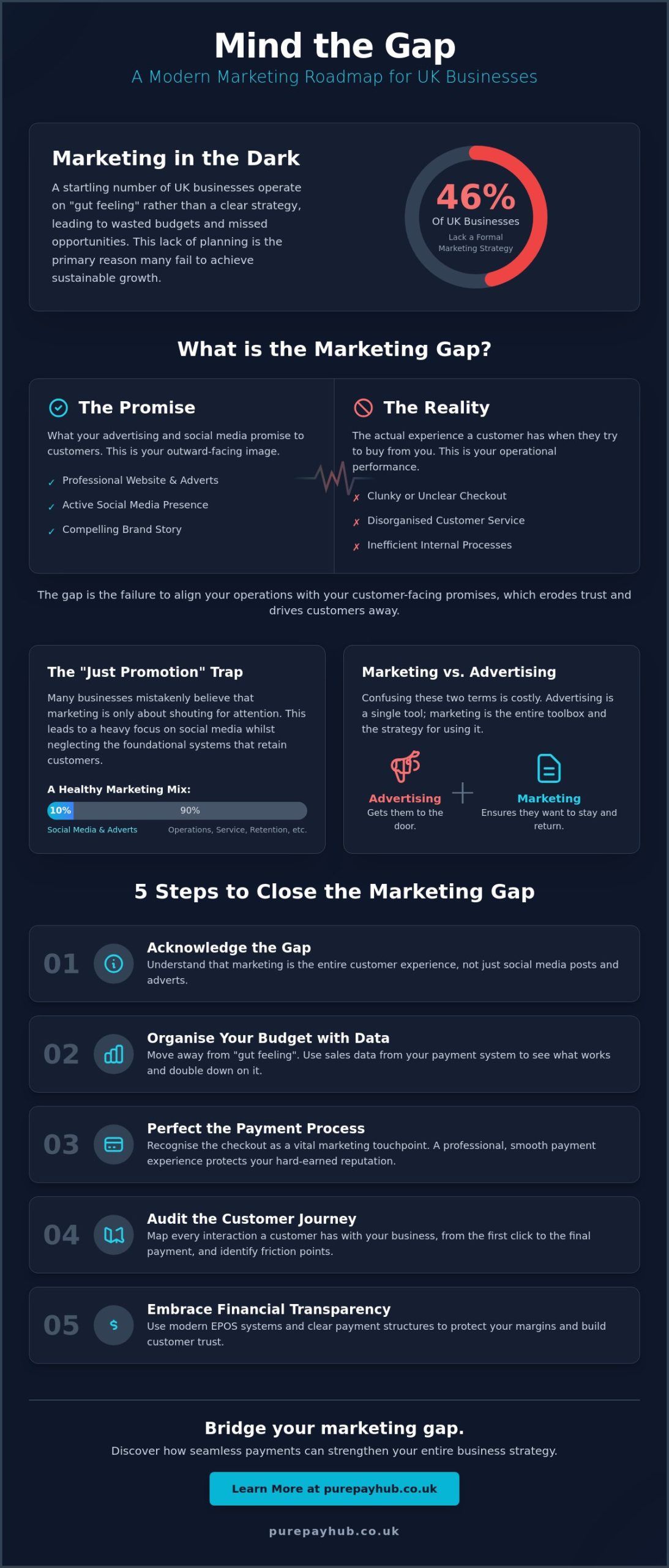
    Did you know that 46% of UK businesses operate without a formal marketing strategy? It is a startling figure from April 2026 that explains why so many owners feel they are shouting into a void. The Gap: Small businesses think marketing is just social media posts and expensive adverts, but this narrow view often leads to wasted budgets and empty results. You might feel overwhelmed by the constant noise or frustrated when your latest campaign fails to deliver a return.

    We understand that you want clarity rather than corporate jargon. Marketing should not feel like a gamble or a distraction from your core work. This article shows you how to move beyond simple shouting to build a system that actually grows your business. You will learn how to clarify the difference between your brand and your operations whilst discovering practical ways to keep your existing customers coming back. We will also explore how smarter payment processes can improve your cash flow and simplify your daily tasks.

    Key Takeaways

    • Understand why The Gap: Small businesses think marketing is just … social media and adverts is preventing many UK firms from reaching their full potential.
    • Move away from “gut feeling” tactics and learn how to organise a promotional budget that relies on clear, actionable data.
    • Recognise the checkout as a vital marketing touchpoint where professional card machines protect your hard-earned reputation.
    • Learn a practical five-step process to audit your customer journey from the first interaction to the final payment.
    • Discover how transparent payment structures and modern EPOS systems can protect your margins whilst improving your business image.

    What is the Marketing Gap for Small Businesses?

    Many UK business owners feel they are running on a treadmill. They post daily on LinkedIn and pay for digital adverts, yet the phone doesn’t ring as often as it should. This frustration usually stems from a fundamental misunderstanding of how growth works. The Gap: Small businesses think marketing is just about getting seen, but visibility is worthless without a seamless experience to back it up. If your social media looks professional but your service feels chaotic, you’ve created a disconnect that drives customers away.

    We define the marketing gap as the failure to align business operations with customer expectations. It’s the space between the promise you make in an advert and the reality a customer faces when they try to buy from you. In the past, business growth relied on “outbound” shouting. You bought a billboard or a radio slot and hoped for the best. Today, the focus has shifted to “inbound” trust-building. Customers in 2026 are more informed than ever. They’ve likely used AI tools to research your industry before they even click your link. If your operations don’t match your promises, they’ll leave immediately.

    The “Just Promotion” Trap

    Social media is often the first place owners turn, but it usually represents only 10% of a healthy marketing mix. This is a common trap. Shouting for attention on TikTok doesn’t help if your internal processes are weak. You end up chasing new leads whilst your existing customer base feels forgotten. This “shouting” without a foundation leads to a wasted budget and high frustration. It’s much harder to win a new customer than it is to keep an old one, yet many SMEs ignore their current fans in favour of the next “viral” post.

    Marketing vs. Advertising: Knowing the Difference

    It is vital to distinguish between these two terms to avoid wasting money. Advertising is a specific tool you use to reach people, whereas marketing is the overarching strategy. To truly understand What is Marketing?, you must look at the entire journey from discovery to the final payment. Advertising gets them to the door; marketing ensures they want to walk through it and come back again.

    In a 2026 context, the traditional 4 Ps have evolved. Your “Product” now includes the ease of your digital service. Your “Promotion” must be supported by “Place” (your digital presence) and “Price” (your financial transparency). If these elements don’t work together, your advertising spend is simply subsidising your competitors’ growth. You educate the customer, but they buy from the person who offers the smoother experience.

    Why Most UK SMEs are “Marketing in the Dark”

    Operating a business on “gut feeling” is a tradition for many UK entrepreneurs. Whilst intuition is valuable for spotting opportunities, it is a dangerous way to organise your promotional budget. In 2026, British small businesses face significant pressure from rising inflation and energy costs. You cannot afford to guess where your next customer is coming from. Precision is no longer a luxury; it is a survival requirement. When every pound counts, “random acts of marketing”—like a one-off advert or a sporadic social media post—simply drain your cash flow without providing a clear return.

    The Gap: Small businesses think marketing is just about following trends or copying what the shop next door is doing. This lack of data-driven decision-making keeps many owners in the dark. Without a documented roadmap, you’re essentially throwing darts at a board in a pitch-black room. You might hit the target eventually, but you’ll waste a lot of resources in the process. Understanding the specific Small Business Marketing Challenges of the current year is the first step toward switching on the lights.

    The Missing Roadmap

    As of April 2026, 46% of UK businesses operate without a formal marketing strategy. This lack of planning is why many fail to scale. You don’t need a 50-page document or a complex agency retainer to succeed. A simple one-page strategy that outlines what you are doing, why you are doing it, and how you will measure success often outperforms a bloated corporate plan. Set SMART goals that relate directly to your bank balance. If a marketing activity doesn’t clearly lead to a sale or a lead, it shouldn’t be on your roadmap.

    The Data Disconnect

    Your best marketing tool is often sitting right on your counter. Your sales data holds the key to understanding customer behaviour. By looking at when and how people pay, you can identify your “favourite” customers—those who spend the most and return most frequently. You don’t need a degree in data science to track your ROI. Simple methods, such as checking your transparent payment solutions for sales peaks after a campaign, can tell you exactly what is working. Use these insights to double down on successful tactics and cut the ones that only add to the noise.

    The Invisible Marketing: Why Payments Matter

    Marketing is often viewed as a way to get people through the door. However, the experience doesn’t stop once a customer decides to buy. The checkout is the final “marketing” touchpoint of every transaction. If a customer has a great time in your shop but struggles at the till, that frustration is what they’ll remember. A slow or unreliable card machine doesn’t just delay a sale; it actively damages your brand reputation. The Gap: Small businesses think marketing is just what happens before the sale, but the payment process is where you prove your professionalism.

    Checkout Speed as a Competitive Advantage

    The “payment moment” is psychologically sensitive. Customers are handing over their hard-earned money, and any friction during this process creates anxiety. Long queues caused by clunky hardware can kill referrals and discourage repeat visits. By using integrated EPOS systems, you reduce waiting times and keep the customer’s mood positive. A seamless payment is a silent promise of professional service. It tells the customer that you value their time as much as their money. When you look at Local Marketing Strategies, efficiency at the point of sale is often the most underrated way to stand out from your competitors.

    Trust and Transparency

    Your choice of merchant services says a lot about your brand’s values. If your provider uses murky fee structures or hidden markups, it becomes harder for you to remain transparent with your own customers. Honesty is a powerful marketing tool. Being “easy to do business with” is a reputation that pays dividends for years. The Gap: Small businesses think marketing is just about the initial attraction, but the physical act of paying is where trust is truly solidified. This includes offering modern payment flexibility. Accepting Apple Pay and Google Pay isn’t just a technical requirement; it’s a way to build customer loyalty whilst meeting them where they are.

    Modern hardware also allows you to extend your marketing beyond the transaction. Using your card machine to provide professional digital receipts or payment links creates a clean, high-tech impression. It shows you’re a forward-thinking business that respects modern standards. By removing the hidden costs of a poor payment experience, you bridge the gap between a one-time lead and a loyal advocate. You don’t need to shout for attention when your operations speak for themselves.

    Marketing Myths: Closing the Gap for Small Businesses

    5 Steps to Close the Marketing Gap in 2026

    Bridging the distance between effort and profit requires a disciplined approach. You don’t need a massive budget to start seeing results; you need a system. The Gap: Small businesses think marketing is just about finding new people to talk to, but true growth starts with the people who are already standing in front of you. By shifting your focus from shouting for attention to refining your internal processes, you can build a more resilient company.

    Audit the Customer Journey

    Start by walking in your customer’s shoes to find points of friction. Visit your own website on a mobile phone. Stand at your counter and time how long it takes to complete a transaction. These small moments are where you find “leaks” in your sales funnel. If a customer struggles to find information or waits too long to pay, they will likely drop off and head to a competitor. Fix these basic operational issues before spending a single penny on new adverts. A smooth journey is the most effective promotional tool you have.

    For inspiration on seamless customer journeys, look at the luxury sector; when you explore Ocean Cruises with a specialist like The Russell Travel Team (Lightning Travel), every detail is managed to ensure the reality matches the high-end promise.

    Focusing on Customer Lifetime Value (CLV)

    It is five times cheaper to keep an existing customer than it is to find a new one. Your best marketing tool is a happy repeat buyer who refers their friends. Focus on increasing your CLV by making every interaction feel professional and effortless. If you need to scale up your stock levels to meet this demand, consider a Business Cash Advance to fund inventory that drives sales. By rewarding loyalty through seamless, integrated systems, you turn a one-time visitor into a long-term advocate for your brand.

    Document your plan clearly. Write down what you are doing, why you are doing it, and how you will measure the result. This prevents “random acts of marketing” and ensures every decision relates to your bank balance. Optimise your operations by ensuring your hardware and software support your growth. High-quality EPOS Systems and reliable Card Machines make your business look larger and more established. Build your local authority through genuine partnership and professional reliability. When you are easy to do business with, your reputation grows naturally without the need for constant shouting.

    If you are ready to professionalise your checkout and protect your margins, you can explore our transparent payment solutions today.

    How PurePay Hub Bridges the Gap for UK SMEs

    Operational friction is the silent killer of brand reputation. We have explored how a clunky checkout can undo hours of hard work spent on social media or advertising. PurePay Hub exists to remove that friction. We provide the professional hardware that makes small businesses look big. Whether you use a Countertop Card Machine for your permanent till or a Portable Card Machine for service on the move, our tools ensure a professional finish to every customer interaction. The Gap: Small businesses think marketing is just about the initial attraction, but we believe it is about the steady promise of a better, fairer service.

    Fairness is our priority. We offer transparent, no-nonsense rates, such as 0.3% for debit transactions, to protect your hard-earned margins. This clarity ensures that your marketing budget isn’t quietly drained by hidden markups or complex fee structures. We also provide next-day funding as standard. This ensures your cash flow keeps up with your growth, allowing you to reinvest in your business without waiting days for your own money to arrive. When your finances are stable and predictable, you can plan your next move with total confidence.

    A Partner, Not Just a Provider

    We position ourselves as a supportive business ally rather than a distant financial institution. Our “no-jargon” approach mirrors the clarity you need in your own marketing strategy. You don’t have time to decode complex contracts or hidden costs. By providing reliable hardware and straight-talking support, we ensure you are never “marketing in the dark” regarding your operational expenses. Our systems act as a stabilising force for your business, allowing you to focus on building relationships with your customers whilst we handle the technicalities of the transaction.

    Fueling Your Marketing Strategy

    Effective marketing often requires a capital injection at the right moment. We support your expansion through flexible Business Cash Advances based on your actual sales. You can use this funding to launch seasonal marketing campaigns, upgrade your inventory, or professionalise your digital presence. Because the repayments are linked to your sales, the process feels fair and manageable even during quieter periods.

    Data is the final piece of the puzzle. Our integrated EPOS Systems provide the insights you need to understand your busiest periods and customer behaviours. This information allows you to target your promotions with precision rather than relying on gut feeling. When you combine professional hardware with data-driven strategy, you close the gap between simply “shouting” and achieving actual, sustainable growth. Organise your payments with PurePay Hub and close the gap today.

    Bridge the Gap for Sustainable Growth

    The Gap: Small businesses think marketing is just promotion, but actual growth comes from aligning your operations with your promises. By auditing your customer journey and focusing on retention, you turn one-time shoppers into loyal advocates. Every touchpoint matters. The moment of payment is your final chance to prove your professionalism and build lasting trust.

    You don’t have to navigate these challenges alone. We provide the tools and transparency needed to protect your margins whilst you scale. You can get a transparent quote on card machine rates from PurePay Hub to start professionalising your operations today. Our fair model includes debit card rates from 0.3%, next-day access to funds, and PCI compliance management as standard.

    Take control of your business narrative. With the right systems in place, your brand will look larger, act faster, and grow more reliably.

    Frequently Asked Questions

    What is the biggest marketing mistake small businesses make?

    The biggest mistake is treating advertising as the entire marketing strategy. The Gap: Small businesses think marketing is just about social media or adverts, but it actually encompasses your whole customer journey. Ignoring your operations and current customers whilst chasing new leads leads to wasted budgets and high friction. You must fix your internal processes and ensure your service is reliable before you start shouting for attention.

    How can I market my small business with no budget?

    You can market effectively with no budget by optimising your Google Business Profile and encouraging word of mouth through exceptional service. Focus on being easy to do business with by ensuring your payment process is seamless and professional. High quality service is your most powerful promotional tool. It costs nothing but your time and attention to turn a one-time visitor into a loyal advocate for your brand.

    Why do I need a marketing plan if I am a sole trader?

    A plan ensures your effort translates into profit rather than just noise. Even for a sole trader, a documented roadmap prevents you from wasting time on tactics that do not suit your specific goals. It helps you stay disciplined and ensures your promotional activities actually relate to your bank balance. Without a plan, you risk falling into the trap of random acts of marketing that drain your energy and cash.

    Does my card machine really affect my marketing?

    Yes, your card machine is the final physical touchpoint of your brand experience. A slow or unreliable machine creates friction and anxiety at the most sensitive moment of the sale. Professional hardware signals that you are a dependable business, which encourages repeat visits and positive referrals. Providing a seamless payment experience is a silent promise of professional service that protects your hard-earned reputation and ensures customers leave with a positive impression.

    How do I measure the ROI of my marketing efforts?

    You measure ROI by comparing your marketing spend against the specific sales growth it generates over a set period. Use your EPOS reports to track sales peaks during campaign periods and identify which products are performing best. This data-driven approach removes the guesswork from your budget. It helps you identify which favourite customers are driving your revenue so you can double down on the tactics that actually work for your business.

    What is the difference between a merchant account and a business bank account?

    A business bank account is where you store your company’s cash and pay your regular bills. A merchant account is a specific type of account that allows you to accept and process card payments from your customers. The funds from your card sales are held in the merchant account during security checks before being deposited into your bank account. Both are essential for a modern business to operate professionally and transparently.

    Can a business cash advance help with my marketing?

    A business cash advance is an excellent way to fund seasonal marketing or inventory boosts without the pressure of fixed monthly payments. Unlike traditional loans, repayments are linked directly to your future card sales. This makes it a flexible option for businesses looking to bridge a gap in their growth strategy. You can use the funds to launch new campaigns or upgrade your hardware, paying back only when you are actually making sales.

    Why is customer retention considered part of marketing?

    Retention is a vital part of marketing because it is five times cheaper to keep a customer than to find a new one. The Gap: Small businesses think marketing is just about the first sale, but the real profit lies in the lifetime value of a customer. Happy repeat buyers are the foundation of any sustainable growth strategy. By focusing on retention, you ensure your business remains resilient whilst reducing the constant pressure to find new leads.

  • How Menu Engineering Increases Your Average Basket Value

    How Menu Engineering Increases Your Average Basket Value

    Did you know that a disciplined approach to menu engineering can increase your profitability by up to 15% without needing to find a single new customer? It’s a powerful tool that many businesses overlook. Most regional owners feel the squeeze of rising overheads whilst their average basket values remain stubbornly flat. It’s frustrating to watch customers consistently choose your cheapest loss leaders, leaving you with thin margins at the end of the month. We believe in providing clear, honest strategies to help you grow.

    You can influence customer behaviour by using strategic menu engineering or shelf layouts that naturally lead customers to the card machine with a higher basket value. By applying simple psychological pricing and layout design, you can reduce friction at the checkout and make every transaction more valuable. This article provides a practical framework for categorising your products and reveals the layout changes you can implement tonight. You’ll discover how to streamline your card payments and ensure your business achieves the turnover it deserves.

    Key Takeaways

    • Master the strategic placement of items to influence purchasing behaviour and increase your average transaction value without needing new customers.
    • Discover how to create menu engineering or shelf layouts that naturally lead customers to the card machine with a higher basket value using the “Golden Triangle” and “Bulls-eye Zone.”
    • Reduce the “pain of paying” by understanding why customers feel more comfortable spending higher amounts whilst using a card machine compared to cash.
    • Follow a simple five-step audit to categorise your inventory and move your most profitable products into high-visibility areas tonight.
    • Learn how integrated EPOS systems provide the real-time data you need to keep your layouts optimised and your margins healthy.

    What is Menu Engineering and Why Does it Drive Basket Value?

    Menu engineering is the strategic analysis and placement of products to influence what a customer chooses to buy. It isn’t merely a list of prices; it’s a deliberate design choice that guides a customer’s eye towards your most profitable offerings. This approach works just as effectively for a restaurant menu as it does for a retail floor plan. By understanding how people scan information, you can subtly steer their decisions without them feeling pressured.

    For UK SMEs, focusing on your Average Transaction Value (ATV) is vital for sustainable growth. Whilst increasing footfall is expensive and time-consuming, increasing the value of each existing sale is direct and efficient. Implementing menu engineering or shelf layouts that naturally lead customers to the card machine with a higher basket value allows you to maximise your margins. A well-engineered journey ensures that by the time a customer reaches the till, they’ve chosen items that benefit your bottom line.

    The Four Categories of Profitability

    To start engineering your profits, you must first categorise your inventory into four distinct groups based on popularity and profit margins:

    • Stars: These are your high-popularity, high-profit items. You want these to be the most visible products in your shop or on your menu.
    • Puzzles: These items have high profit margins but low popularity. They often just need better placement or highlighting to start selling.
    • Plow Horses: These are staples with high popularity but low profit. They bring people through the door, but you shouldn’t over-promote them at the expense of Stars.
    • Dogs: These products have low popularity and low profit. They take up valuable space and should usually be removed or rebranded.

    The Psychology of Choice Architecture

    Human psychology plays a massive role in how we shop. If you offer too many choices, customers often experience “analysis paralysis” and end up choosing the cheapest or most familiar option. By limiting your selection to your best-performing items, you make the decision process easier and faster for the buyer.

    You can also use the “Decoy Effect” to your advantage. By placing a high-priced item near your “Star” product, the Star begins to look like a bargain. People also tend to remember the first and last items on a list most clearly. Placing your high-margin products at the beginning or end of a section ensures they stay top-of-mind. This psychological path leads to a more confident customer who is ready to complete a higher-value transaction at your card machine.

    The Science of Layout: From the Golden Triangle to Shelf Psychology

    Understanding where your customer looks first is the foundation of any successful layout. In hospitality, the “Golden Triangle” describes the predictable pattern of eye movement across a menu. Most diners scan the centre first, then move to the top right, before finally glancing at the top left. This is prime real estate. If you place your “Stars” in these three areas, you’re far more likely to see them chosen. It’s a simple, no-nonsense way to guide behaviour without saying a word.

    In a retail environment, The Science of Layout suggests that “eye-level is buy-level.” Products placed in the “Bulls-eye Zone”—the area between chest and eye height—receive the most attention. To maximise profit, you should use anchor products to guide the gaze. These are your popular, everyday staples that customers actively look for. By placing high-margin “Stars” immediately next to these anchors, you capitalise on the customer’s existing focus. Using menu engineering or shelf layouts that naturally lead customers to the card machine with a higher basket value ensures your most profitable items aren’t left gathering dust.

    Clutter is the enemy of a high average transaction value. When a customer is overwhelmed by too many visual signals, they often default to the cheapest option or leave entirely. This is why white space, or negative space, is essential. By giving your premium items room to breathe, you signal their importance and quality. A clean, intentional design reduces shopper stress and makes the path to a higher-value sale feel effortless.

    Hospitality: Designing for the Dine-In Experience

    You can give your “Puzzles”—those high-profit but low-popularity items—a significant boost by using boxes or borders. These visual cues break the customer’s scanning pattern and force them to pause. Language also matters; using descriptive terms like “locally sourced” rather than generic descriptions increases the perceived value of a dish. Many successful venues also remove currency symbols (£) from their menus. This subtle change helps decouple the choice from the immediate thought of spending money, reducing the psychological barrier to ordering a more expensive treat.

    Retail: Shelf Layouts that Lead to the Till

    Retailers should focus on vertical merchandising to encourage customers to scan across different price points. Placing high-margin impulse buys in the “decompression zone” near the till is a proven way to top up a basket at the final moment. Cross-merchandising is another powerful tool; placing complementary items together, such as premium crackers next to the cheese selection, reminds customers of needs they hadn’t considered. Ensuring you have a fast, reliable Countertop Card Machine at the end of this journey makes the final payment feel as seamless as the browsing experience.

    Reducing the “Pain of Paying” at the Card Machine

    A common concern for many regional business owners is whether a higher total at the till will alienate their regulars. It’s a valid worry, but the psychology of spending changes significantly depending on the payment method. Research into consumer behaviour consistently shows that customers feel less “pain” when tapping a card compared to handing over physical banknotes. Cash is tangible; once it leaves the wallet, it’s gone. Card payments are abstract, which allows customers to focus on the value of their purchase rather than the immediate loss of funds.

    In the UK, the £100 contactless limit has created a psychological “sweet spot” for engineered basket values. If your menu engineering or shelf layouts that naturally lead customers to the card machine with a higher basket value target a total just under this threshold, the transaction remains entirely frictionless. The customer doesn’t even need to enter a PIN. This seamless closure is the final step in a well-designed sales journey. Your card machine shouldn’t be a hurdle; it should be the tool that completes the experience without a second thought.

    The Frictionless Checkout

    The final seconds of a sale are the most critical for customer satisfaction. A clunky, slow, or unreliable card reader can trigger “buyer’s remorse” as the customer waits. They start to question the extra item they picked up or the premium dish they ordered whilst the machine struggles to connect. To maintain the momentum of your engineered layout, you need hardware that responds instantly. A fast checkout reinforces the customer’s positive decision and leaves them with a modern, professional impression of your business.

    We believe in supporting your growth with practical features that make a difference to your daily turnover. Integrated tipping prompts on the card machine can naturally increase your overall take without making the interaction awkward for your staff. Furthermore, for businesses with high-turnover engineered menus, having next-day access to your funds is essential for maintaining a healthy cash flow and restocking your “Stars” without delay.

    Building Trust with Transparent Rates

    Profitability isn’t just about the price on the shelf; it’s about what you keep after processing fees. When you have a clear, honest understanding of your costs, you can price your high-margin items more competitively. PurePay Hub’s no-nonsense approach mirrors the transparency of a well-designed menu, ensuring you aren’t surprised by hidden markups. Our low debit rates of 0.3% allow for better margin protection on high-volume items, ensuring your hard-earned profits stay in your business where they belong.

    How Menu Engineering Increases Your Average Basket Value

    5 Steps to Engineer Your Profit Tonight

    Transforming your profitability doesn’t require a complete overhaul of your business model. It starts with small, disciplined changes to how you present your products. By implementing menu engineering or shelf layouts that naturally lead customers to the card machine with a higher basket value, you take control of your revenue. Use these five steps to begin the process immediately.

    • Step 1: Audit your sales data. Use your recent sales history to categorise every item into the four-quadrant matrix: Stars, Puzzles, Plow Horses, and Dogs. Be honest about what is actually making you money.
    • Step 2: Relocate your Stars. Move your high-profit, high-popularity items to the “Golden Triangle” of your menu or the eye-level “Bulls-eye Zone” of your shelves. Visibility is the primary driver of selection.
    • Step 3: Refine your presentation. Rewrite descriptions to focus on quality and origin. Remove currency symbols (£) to shift the customer’s focus away from the cost and towards the value of the experience.
    • Step 4: Empower your team. Train your staff to recognise and suggest “Puzzles.” Since these items are high-margin but low-volume, a simple recommendation can significantly boost your daily profit.
    • Step 5: Optimise the final tap. Ensure your card machine is visible and ready for a fast, professional finish. The easier it is to pay, the more likely the customer is to leave with a positive impression.

    Analysing the Data with Your EPOS System

    Modern EPOS Systems are the most valuable tool in a business owner’s arsenal. They provide the raw data needed to identify your “Plow Horses”—the items that are popular but might be dragging down your overall margin. Instead of focusing on total revenue, track the “Gross Profit Margin” per item. This tells you exactly how much each sale contributes to your overheads. If your data suggests a shop refit is needed to better align with your new menu engineering or shelf layouts that naturally lead customers to the card machine with a higher basket value, you might consider a Business Cash Advance to fund the improvements without the stress of fixed monthly repayments.

    Testing and Iterating

    Engineering is a process, not a one-time event. You should only change one or two elements of your layout at a time. This allows you to measure the impact accurately without confusing your regulars. Monitor your card transaction volumes closely after moving high-margin items to the till area; if the numbers don’t climb, try a different “Star.” Remember to adjust your strategy for seasonal trends. A layout that works in the height of summer won’t necessarily be effective during the Christmas rush. Stay flexible and let the data guide your decisions.

    Closing the Loop: How PurePay Hub Supports Your Growth

    You’ve done the hard work of designing menu engineering or shelf layouts that naturally lead customers to the card machine with a higher basket value. Now, you need the physical infrastructure to handle that increased turnover with ease. Our Countertop Card Machine is built for the rigours of a high-traffic till point, ensuring that every “Star” item you’ve promoted is processed without delay. We don’t believe in overcomplicating your operations; we provide the reliable tools that let you focus on your customers whilst we handle the technicalities of the transaction.

    For hospitality businesses, our Portable Card Machine allows you to take the point of sale directly to the table. This maintains the momentum of a well-engineered menu by allowing guests to pay the moment they’re ready, reducing the chance of “buyer’s remorse” during a long wait for the bill. By using Integrated EPOS Systems, you close the feedback loop with real-time data. You can see exactly which layout changes are driving higher basket values and which items need further refinement. This data-driven approach removes the guesswork and acts as a stabilizing force for your business finances.

    Protecting your newly engineered margins is our priority. We are committed to providing some of the lowest card machine rates in the industry, ensuring that the extra profit you’ve generated stays in your bank account. Transparency is at the core of what we do; you won’t find hidden markups or complex fee structures here. We act as a supportive partner to help your regional business thrive in a competitive market by keeping your costs predictable and fair.

    Reliable Hardware for High-Volume Sales

    A fast processor is essential when you’re dealing with high-volume sales. If your card reader lags, you risk creating a bottleneck that frustrates customers and dampens the positive experience you’ve created. Our hardware is designed for speed, preventing queues even during peak periods. In retail environments, our Mobile Card Machines offer a flexible way to bust queues by taking payments anywhere on the shop floor. Our hardware offers several key benefits for your busy till point:

    • Fast processors to eliminate transaction lag.
    • Long battery life for our mobile and portable units.
    • Secure, encrypted transactions for peace of mind.
    • Quick Onboarding to get your new strategy live in days, not weeks.

    Financial Support for Your Next Layout Refit

    Ready to boost your basket value? Explore PurePay Hub’s card machine solutions today.

    Take Control of Your Profitability Today

    Strategic layout design isn’t just about aesthetics; it’s a fundamental driver of your business’s financial health. By categorising your inventory and mastering the “Golden Triangle,” you can subtly guide every customer towards your most profitable items. Implementing menu engineering or shelf layouts that naturally lead customers to the card machine with a higher basket value is a proven method for sustainable growth. It reduces decision fatigue for your shoppers whilst protecting your hard-earned margins.

    You now have a clear framework to begin your audit tonight. We are here to ensure your hardware is as efficient as your new layout. Our transparent approach means you get debit card rates starting from 0.3% and next-day access to funds without hidden markups or complex fee structures. This clarity allows you to focus on what matters most: growing your business with confidence.

    Join PurePay Hub for transparent card machine rates and next-day funding.

    Your journey towards a higher average transaction value starts with a single change. Start small, track your data, and watch your margins grow.

    Frequently Asked Questions

    What is the “Golden Triangle” in menu engineering?

    The Golden Triangle refers to the specific pattern in which customers scan a menu. Most diners look at the centre first, then move to the top-right corner, and finally to the top-left. By placing your highest-margin items in these three areas, you significantly increase the likelihood of them being selected. It is a simple psychological tactic that ensures your most profitable dishes get the most attention from every guest.

    How often should I update my menu or shelf layout?

    You should aim to review your sales data and update your layouts at least once a quarter. Consumer habits change with the seasons; a layout that works in the winter might not be effective during the summer months. Regular updates allow you to test new products and phase out items that are no longer performing. Staying flexible ensures your business remains aligned with current customer demand and fluctuating ingredient costs.

    Can I use menu engineering in a small retail shop?

    Absolutely. Menu engineering principles translate perfectly into retail through strategic shelf layouts. By placing high-margin impulse buys at eye level and using anchor products to guide the customer’s gaze, you can influence purchasing decisions in any size space. Small shops often benefit most from these changes because they need to maximise the profit potential of every square inch of shelf space available to them.

    Do customers spend more on card than with cash in the UK?

    Yes, UK consumers typically spend significantly more when paying by card compared to using physical cash. The abstract nature of digital payments reduces the immediate psychological “pain of paying,” which encourages higher basket values. Using menu engineering or shelf layouts that naturally lead customers to the card machine with a higher basket value capitalises on this behaviour, making it easier for them to choose premium options without hesitation.

    How does an EPOS system help with menu engineering?

    An EPOS system acts as the brain of your engineering strategy by providing detailed sales reports. It allows you to track the exact popularity and gross profit margin of every item you sell. Without this data, you are just guessing which products are your “Stars” and which are your “Dogs.” Real-time insights enable you to make informed decisions about product placement and pricing almost instantly.

    Is it expensive to implement these layout changes?

    Implementing these changes is often very low-cost. Most menu engineering involves simply reorganising the information on a page or moving physical products to different shelves. You don’t need a full renovation to see results. Small adjustments, such as removing currency symbols or adding more descriptive language, require very little investment but can lead to a noticeable increase in your average transaction value and overall profitability.

    What are “Plow Horse” items and should I keep them?

    “Plow Horse” items are products that are highly popular but have low profit margins. You should definitely keep them because they are the staples that bring customers through your door. However, you shouldn’t give them prime real estate in your layout. Instead, use your menu engineering or shelf layouts that naturally lead customers to the card machine with a higher basket value to steer people towards your “Stars” instead.

    How do I use a business cash advance to improve my shop layout?

    A Business Cash Advance provides the upfront capital needed for more significant changes, such as installing new modular shelving or professional signage. Unlike a traditional bank loan, you repay the advance through a fixed percentage of your future card sales. This makes it a flexible option for regional owners who want to invest in a layout refit without the pressure of fixed monthly repayments during quieter trading periods.

  • Compare Card Payment Providers UK: The 2026 Merchant Services Guide

    Compare Card Payment Providers UK: The 2026 Merchant Services Guide

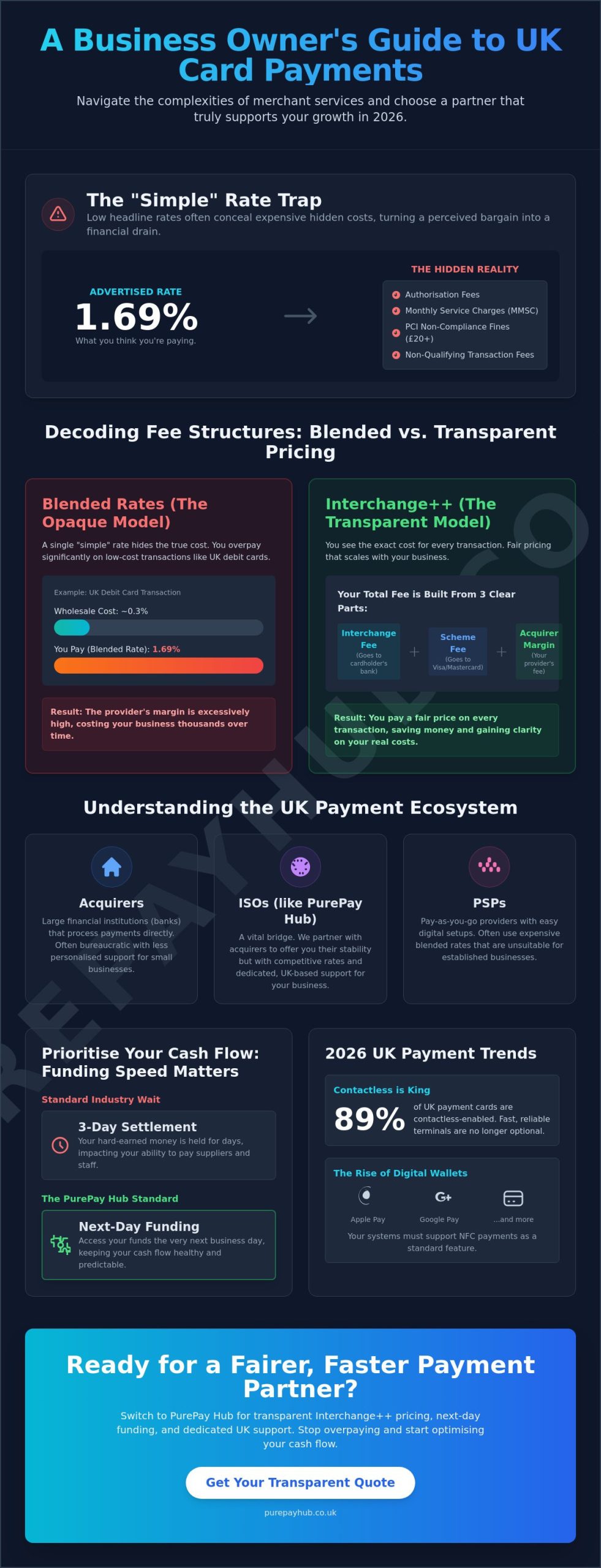
    The lowest headline rate on a card machine often ends up being the most expensive mistake a UK business can make. You’ve likely noticed that a “simple” flat rate rarely stays simple whilst hidden markups and non-qualifying fees clutter your monthly statement. It’s an industry built on complexity, and when you try to compare card payment providers UK, the lack of clarity often feels intentional. You want to focus on serving your community, not decoding why your hard-earned revenue is tied up for days.

    We agree that you deserve better than opaque contracts and slow access to your own funds. This 2026 guide provides a transparent, data-driven framework to help you identify providers that actually prioritise your cash flow. We’ll show you how to move beyond basic percentages to find genuine Interchange++ pricing and reliable next-day funding. By examining the impact of the 2026 PSR cross-border fee caps and seeing how the PurePay Hub standard of transparency compares to traditional providers, you’ll gain the clarity needed to choose a partner that supports your growth.

    Key Takeaways

    • Understand the critical differences between acquirers, ISOs, and PSPs to ensure you partner with a provider that offers direct stability and support.
    • Decode complex fee structures to avoid the blended rate trap and switch to transparent Interchange++ pricing that reveals your true transaction costs.
    • Apply our data-driven framework to compare card payment providers UK based on your specific monthly turnover and average transaction value.
    • Learn how to prioritise your cash flow by identifying providers that offer next-day funding rather than the standard three-day wait.
    • Discover how PurePay Hub acts as a stabilising force for your finances through honest pricing on portable card machines and integrated EPOS systems.

    The days of simply plugging in a bulky terminal and waiting for a dial-up connection are over. British retail now runs on integrated ecosystems where hardware and software speak the same language. If you want to compare card payment providers UK, you must first understand that you aren’t just buying a machine; you’re choosing a financial partner. The market has shifted toward “softPOS” technologies and mobile-first solutions that allow merchants to accept payments on smartphones. This evolution makes the choice of provider more critical than ever for your daily cash flow.

    You’ll encounter three main types of players in this space. Acquirers are the massive financial institutions that actually process the money. Payment Service Providers (PSPs) offer quick, digital-only setups that are often easy to start but expensive as you grow. Then there are Independent Sales Organisations (ISOs). These entities provide the personalised service and competitive rates that big banks often ignore. Every transaction you process involves an Interchange fee, which is the baseline cost set by card schemes. A transparent provider will show you these costs clearly rather than hiding them behind a flat, “blended” rate.

    The UK market is uniquely demanding. According to UK Finance data from March 2026, 89% of UK payment cards are now contactless-enabled. Consumers expect to tap and go in seconds. Meeting this demand requires hardware that is both fast and compliant with the latest PCI-DSS security regulations. Failure to keep up doesn’t just mean lost sales; it can lead to heavy non-compliance penalties that drain your revenue.

    The Role of an ISO in the UK Ecosystem

    ISOs like PurePay Hub act as a vital bridge between small businesses and the rigid bureaucracy of big banks. We take the raw processing power of major acquirers and refine it into a service that actually works for a local business owner. Because we handle high volumes across many merchants, we can often negotiate better rates than a single business going direct to a bank. You get the stability of a major financial institution paired with the dedicated, UK-based support of a partner who knows your name. It’s a way to bypass corporate jargon and get straight to the fair pricing your business deserves.

    Current Payment Trends: Contactless and Digital Wallets

    Digital wallets have moved from a novelty to a necessity. Apple Pay and Google Pay now dominate consumer behaviour, especially amongst younger demographics. Your Countertop Card Machine or Portable Card Machine must support Near Field Communication (NFC) as a standard feature. Looking ahead, Open Banking and QR code payments are beginning to gain traction. These methods allow customers to pay directly from their bank accounts, potentially offering even lower fees for merchants in the future. Staying ahead of these trends ensures your business remains accessible to every type of shopper.

    Decoding Fee Structures: Interchange++ vs. Blended Rates

    Headline rates are often smoke and mirrors in the merchant services industry. To truly compare card payment providers UK, you must look at what’s under the bonnet. Every transaction fee is a cocktail of three distinct ingredients. First is the interchange fee, which is the wholesale cost paid to the card-issuing bank. Second is the scheme fee, which goes to networks like Visa or Mastercard. Finally, there’s the acquirer margin, which is the only part your provider actually keeps as profit. The Payment Systems Regulator (PSR) oversees these structures to keep the market competitive, yet many providers still find ways to mask their true margins behind “simple” pricing.

    Beyond the basic percentage, you must watch for hidden extras that drain your daily revenue. Many providers sneak in authorisation fees for every transaction attempt, regardless of whether it’s successful. You might also encounter a Minimum Monthly Service Charge (MMSC) if your turnover dips during a quiet month. Perhaps the most frustrating are PCI non-compliance fines, which can add £20 or £30 to your bill simply for missing a paperwork deadline. Choosing a partner that offers a transparent merchant account ensures these murky costs don’t eat into your hard-earned profits.

    Why Blended Rates Can Cost You Thousands

    Pay-as-you-go (PAYG) providers favour blended rates because they’re easy to market. You pay a flat 1.5% to 1.75% regardless of the card type used. This sounds convenient, but it’s often a trap for established businesses. Most domestic debit card transactions have a wholesale cost far below 0.5%. By charging you a flat 1.5%, the provider pockets the massive difference as pure profit. They use your high-volume debit sales to subsidise expensive premium or corporate cards that your customers might only use occasionally. Blended rates prioritise simplicity over actual cost efficiency.

    The Transparency of Interchange++

    Interchange++ is the gold standard for honest merchant services. This model separates the three cost components on your monthly statement, passing the wholesale savings directly to your business. You pay the exact interchange and scheme fees plus a small, fixed margin. This level of clarity is why growing UK businesses prefer this model for long-term stability. Reading your statement becomes a straightforward task because you can see exactly where every penny goes. You won’t find yourself paying an inflated “one-size-fits-all” margin that doesn’t reflect your actual transaction behaviour.

    Compare Card Payment Providers UK: The 2026 Merchant Services Guide

    Provider Comparison: PAYG vs. Traditional Merchant Accounts

    Deciding between a Pay-As-You-Go (PAYG) provider and a traditional merchant account is a major step for any British business. PAYG models appeal to seasonal traders or those with infrequent sales because they lack monthly overheads. However, they charge a premium for this lack of commitment. To compare card payment providers UK effectively, you have to look past the instant setup and assess the true cost of convenience. Once your sales volume stabilises, the high flat rates of basic readers often become a significant drain on your margins.

    Traditional merchant accounts represent the professional standard for businesses processing over £5,000 each month. These accounts provide much lower transaction rates and more durable hardware, such as a Countertop Card Machine or a Portable Card Machine. While they involve a monthly fee, the savings on every tap and insert usually far outweigh the fixed cost. These professional setups offer seamless connectivity with your EPOS Systems and accounting software; this keeps your back-office tasks as streamlined as your customer service. You gain a level of operational stability that basic app-based readers simply cannot match.

    The Tipping Point: When to Switch from PAYG

    The transition to a managed merchant account usually makes sense at the £5,000 monthly turnover mark. At this level, the flat 1.75% fee common with app-based readers begins to undercut your growth. A managed account gives you access to wholesale rates that reflect your specific business profile. Additionally, PAYG hardware often struggles with the processing speed and battery life required in a high-pressure hospitality or retail setting. We’ve helped local shops cut their total processing costs by 40% by moving to a transparent account that rewards their success rather than penalising their volume.

    Hardware Options: Countertop, Portable, and Mobile

    Your hardware should match your service style. Selecting the right tool ensures a smooth customer experience and reliable uptime:

    • Countertop Card Machine: The fixed retail workhorse. It stays at the till and uses a stable internet connection for total reliability.
    • Portable Card Machine: Uses Bluetooth or Wi-Fi to reach customers. It’s the favourite for tableside service in cafes and restaurants.
    • Mobile Card Machine: Uses GPRS or 4G networks via a roaming SIM. It’s vital for couriers, tradespeople, and outdoor events across the UK.

    Modern hardware does more than process payments. It acts as a stabilising force by syncing directly with your digital records. This connectivity removes manual errors and provides a real-time view of your daily revenue, allowing you to make informed decisions about your business growth.

    The Decision Framework: How to Choose Your Provider

    Choosing a partner shouldn’t feel like a gamble. You need a logical sequence to compare card payment providers UK and find a fit that actually works for your specific business model. It’s easy to get distracted by shiny hardware, but the true value lies in the operational details that impact your daily life. Use this five-step framework to filter out the noise and identify a provider that acts as a genuine business ally.

    Start by auditing your current monthly volume and average transaction value. This data is your strongest negotiating tool. High-volume merchants require the transparency of Interchange++ to keep costs low, whilst those with a lower turnover might focus on minimising monthly rental fees. Next, check for hardware compatibility. If you use integrated EPOS Systems, your new Countertop Card Machine or Portable Card Machine must talk to your software without friction. Finally, review the quality of technical support. Many low-cost providers outsource their helpdesks to distant call centres. When your terminal stops working during a busy lunch service, you need reliable, UK-based support that understands the local market and can provide immediate resolutions.

    • Audit your data: Know your monthly card turnover and average transaction size before you start negotiations.
    • Evaluate settlement times: Determine if your cash flow can handle a three-day wait or if next-day funding is a necessity.
    • Check compatibility: Ensure your payment gateway or physical terminal integrates with your current accounting and sales software.
    • Scrutinise the contract: Look for short terms and avoid auto-renewal clauses that lock you in for years.
    • Test the support: Prioritise providers with dedicated UK-based teams that offer direct assistance when things go wrong.

    Settlement Speed: The Overlooked Metric

    Traditional banking often leaves you waiting. The difference between T+1 (next-day) and T+3 (three-day) settlement can be the difference between paying a supplier on time or missing a deadline. Accessing your funds quickly is essential for maintaining a healthy cash flow. PurePay Hub facilitates faster access to your hard-earned revenue, ensuring your bank balance reflects your actual sales. Don’t let a provider hold your money hostage when modern technology allows for rapid transfers.

    Contract Terms and Exit Strategies

    The merchant services industry is notorious for 36-month “auto-renewal” traps that make switching nearly impossible. Scrutinise every exit clause and look for a Service Level Agreement (SLA) that guarantees high uptime and clear service standards. We recommend that merchants always request a no-obligation quote before signing any long-term agreement. Request a transparent quote for your business here.

    PurePay Hub: Transparent Payments and Next-Day Funding

    Finding a provider that respects your bottom line shouldn’t be a struggle. We built PurePay Hub to offer a direct alternative to the murky pricing structures used by traditional banks. When you compare card payment providers UK, you’ll find that many hide their true margins behind complex jargon. We take a different path. Our commitment to transparency ensures you see exactly what you pay for. There are no hidden markups or unexpected fees to derail your financial planning. Our identity is built on being untainted by the opaque practices that frustrate so many business owners.

    Cash flow is the lifeblood of your business. Waiting three to five days for your revenue to settle is a frustration you don’t need. We provide next-day funding as a standard feature, acting as a stabilising force for your finances. Our onboarding process is designed for speed and efficiency. We aim to get your business set up and accepting payments in days rather than weeks. Whether you need a Countertop Card Machine for your shop or a Virtual Terminal for remote sales, we provide the tools to keep your revenue moving without delay.

    Fair Rates for UK Small Businesses

    We believe in fairness. Our Interchange++ pricing model passes wholesale savings directly to you. We offer competitive rates with debit cards starting from 0.3% and credit cards from 0.5%. These rates are tailored to your specific sector, ensuring you aren’t subsidising other industries with higher risk profiles. Your security is also a priority. Every system we provide is fully PCI-compliant and backed by 24/7 monitoring to protect your data and your customers. Our portable card machines are designed for maximum retail efficiency, allowing you to take the till to the customer without compromising on speed or reliability.

    A Partner in Your Growth

    We do more than just process transactions. We act as a supportive ally for your long-term development. If you need capital to expand, our Business Cash Advance provides a flexible alternative to traditional loans. Your repayments are linked directly to your card turnover; this means you pay back more when business is brisk and less during quieter periods. Our systems offer seamless EPOS integration for hospitality and retail environments, connecting your sales data with your inventory management. It is time to move away from impersonal banking and join a partnership built on clarity. Organise a transparent quote with PurePay Hub today.

    Take Control of Your Merchant Services

    The landscape of UK merchant services is evolving fast. You’ve seen why the “one-size-fits-all” approach of blended rates often traps growing businesses in unnecessary costs. True transparency comes from an Interchange++ model that separates wholesale costs from provider margins. It’s also clear that you shouldn’t have to wait three days to access your own hard-earned revenue. When you compare card payment providers UK, prioritise partners who offer next-day funding and dedicated UK-based support. This ensures your operations remain resilient and your cash flow stays healthy.

    PurePay Hub acts as a stabilising force for your finances. We don’t believe in opaque bureaucracy or hidden markups. Instead, we offer a direct partnership built on honesty and efficiency. With debit rates from 0.3% and credit rates from 0.5%, we provide the clarity you need to scale with confidence. Don’t let slow funding or complex fee structures hold your business back any longer. You deserve a partner that values your time as much as your revenue.

    Compare your current rates and save with PurePay Hub

    We’re here to help you build a more profitable and predictable future for your business.

    Frequently Asked Questions

    How much are typical card machine fees for UK small businesses?

    Typical fees consist of an interchange fee, scheme fee, and an acquirer margin. For established UK businesses, debit card rates often start from 0.3% and credit cards from 0.5% when using a transparent pricing model. You should also look for authorisation fees and Minimum Monthly Service Charges (MMSC) on your statement. These costs vary based on your sector and monthly card turnover. Always ask for a full breakdown to avoid hidden markups.

    What is the difference between a card reader and a merchant account?

    A card reader is the physical hardware used to tap or insert a card, whilst a merchant account is the digital facility where funds are held before being settled into your bank. Many Pay-As-You-Go providers combine these into a single service with a flat rate. Professional providers separate them to offer more transparent pricing. Having a dedicated merchant account often allows you to access lower rates as your business volume grows.

    Can I get a card machine with next-day funding?

    Yes, you can get a card machine with next-day funding to improve your business cash flow. Whilst many traditional banks still take three to five working days to settle funds, modern providers prioritise faster access to your revenue. This service ensures your bank balance reflects your actual sales almost immediately. It acts as a stabilising force for your finances, allowing you to pay suppliers and staff without unnecessary delays.

    Are there card payment providers with no monthly fees?

    Card payment providers with no monthly fees do exist, but they usually charge higher transaction rates to compensate. These models are ideal for seasonal traders or micro-businesses with low turnover. However, once you process more than £5,000 monthly, the “free” account often becomes more expensive than a professional one with a small monthly rental. It’s essential to compare card payment providers UK based on your total cost of ownership.

    How long does it take to switch card payment providers?

    Switching card payment providers typically takes between three to ten working days. The process involves a standard credit check and an application for a new merchant account. Once approved, your new hardware, such as a Portable Card Machine, is dispatched via courier for immediate use. Most modern providers handle the heavy lifting of the transition, ensuring your service remains active so you never miss a sale during the move.

    What information do I need to provide to compare card payment quotes?

    To get an accurate quote, you need to provide your annual card turnover, average transaction value, and your current merchant statements. These documents allow a provider to see exactly what you’re currently paying in interchange and scheme fees. Providing this data ensures the new quote is tailored to your specific business profile. It also helps identify hidden markups that you can eliminate to save money on your processing costs.

    Is it cheaper to buy or rent a card machine terminal?

    Buying a terminal upfront is often cheaper for micro-businesses, but renting is the preferred choice for established retailers. Rental models usually include inclusive software updates, hardware replacements, and technical support. This means you won’t be stuck with an obsolete Countertop Card Machine if security regulations change. Renting also spreads the cost, keeping your initial capital free for other areas of business development and growth.

    What is PCI compliance and why am I being charged for it?

    PCI compliance is a mandatory security standard that ensures you’re protecting your customers’ sensitive card data. Providers charge for this to cover the costs of secure processing environments and regular security monitoring. It’s a vital part of maintaining trust in the UK payment ecosystem. If you don’t complete your annual compliance self-assessment, you may be hit with non-compliance fines that significantly increase your monthly bill.

  • Integrated EPOS Systems for Hospitality UK: The 2026 Merchant’s Guide

    Integrated EPOS Systems for Hospitality UK: The 2026 Merchant’s Guide

    Why are you still losing money to a “manual entry tax” every time a staff member mistypes a bill total into your card reader? In 2026, with the National Living Wage increase and new business rates multipliers squeezing margins, your business cannot afford simple human errors or high transaction fees. You deserve a system that works as hard as you do, without the frustration of waiting days for your card sales to hit your bank account.

    It’s time to stop settling for complex tech that slows your team down. This guide reveals how integrated EPOS systems for hospitality UK can automate your daily operations and protect your bottom line. We will show you how to choose a solution that prioritises transparent rates and instant fund access over flashy, unnecessary features. From handling the latest tipping legislation to streamlining your countertop card machine, you’ll learn exactly how to transform your EPOS into a powerful cash-flow tool. We’ll explore the essential steps to slash your overheads and get your business running with the precision it deserves.

    Key Takeaways

    • Understand how the “handshake” effect between your till and card reader eliminates costly manual entry errors and speeds up service.
    • Learn to identify your top-performing servers and reduce wastage through real-time inventory and staff performance monitoring.
    • Navigate the three-tier cost structure of integrated EPOS systems for hospitality UK to avoid the trap of inflated transaction rates.
    • Master the process of auditing contracts and migrating data to ensure a seamless transition when switching providers.
    • Discover how next-day funding and fair transaction rates can keep your cash flow steady and your profit margins protected.

    What are Integrated EPOS Systems for Hospitality in the UK?

    An integrated EPOS system is a unified digital platform where your till software, card terminal, and back-office systems share data in real-time. It moves beyond the traditional Point of Sale (POS) system by centralising every aspect of your operation. In 2026, these systems have evolved into total business management tools. They handle everything from stock levels to staff rotas; ensuring that your data isn’t trapped in separate silos. This centralisation acts as a stabilizing force for your finances.

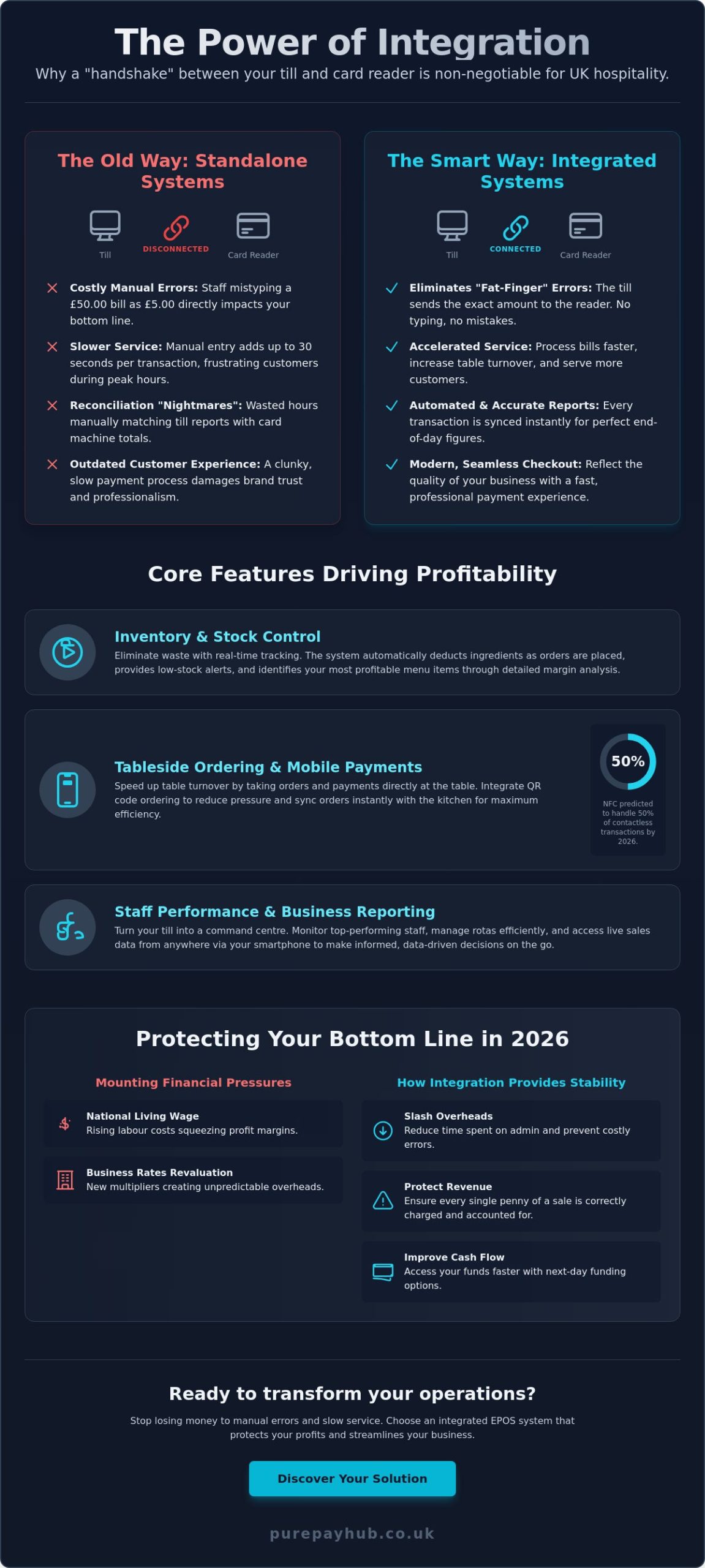
    The most immediate benefit is what we call the “handshake” effect. When a server hits “pay” on the till, the exact amount is instantly sent to your card machine. There is no manual typing. This removes the risk of a £50 bill being accidentally keyed in as £5.00. It’s a simple, reliable connection that saves money and protects your margins from avoidable human error. By 2026, the UK hospitality industry has moved firmly away from legacy on-premise servers. Cloud-based systems are now the standard because they allow you to manage your business from anywhere. Whether you’re at the bar or at home, you can see live sales data. This shift is essential for modern merchants who need to respond quickly to rising labour costs; and you can learn more about Shift4 POS UK to see how these advanced EPOS solutions can be tailored to your specific venue.

    The Difference Between Standard and Integrated EPOS

    Standard systems operate as disconnected “standalone” units. Your till and your card machine don’t speak to each other. This leads to a nightmare during end-of-day reconciliation when the figures don’t match. Integrated EPOS systems for hospitality UK fix this by automatically syncing every transaction. Standalone machines are becoming obsolete because they create unnecessary admin work that busy owners simply don’t have time for. A synced system ensures your reports are always accurate without the need for manual tallying.

    Why Integration is Non-Negotiable for Modern Pubs and Restaurants

    Speed is the currency of hospitality. Integration can reduce the time it takes to process a bill by up to 30 seconds. In a packed restaurant, that’s the difference between another round of drinks or a frustrated guest. It also eliminates “fat-finger” errors. These small mistakes cost UK merchants thousands of pounds every year in lost revenue. A seamless checkout doesn’t just save money; it reflects the professionalism of your brand. Your customers expect a modern, efficient experience. A clunky, manual process feels out of place in 2026 and can damage the trust you’ve worked hard to build.

    Core Features that Drive Hospitality Profitability

    Profitability in hospitality is won or lost on tiny margins. In 2026, you can’t rely on guesswork to manage your stock or your staff. Modern integrated EPOS systems for hospitality UK provide the visibility you need to make informed decisions. They turn your till from a simple cash box into a data-driven command centre. This transition is vital as merchants face higher payroll costs and the new business rates revaluation that took effect in April 2026.

    Inventory and Stock Control

    Waste is a silent profit killer. With automatic stock depletion, your system deducts every gram of coffee or millilitre of gin the moment an order is placed. This real-time tracking means you aren’t waiting for a monthly stocktake to spot a problem. You’ll receive low-stock alerts before a customer asks for a dish you can’t serve. This prevents the “sorry, we’re out of that” conversation that ruins guest experiences. Detailed margin analysis also identifies which menu items are actually making money. If a high-effort dish has a low margin, the data will show you it’s time for a menu refresh.

    Tableside Ordering and Mobile Payments

    Walking back and forth to a fixed till wastes time and energy. Using a Portable Card Machine allows your team to take orders and process payments directly at the table. This is essential for faster table turnover. You can also integrate order-and-pay via QR codes to reduce pressure during peak hours. QR code ordering has seen significant adoption, with a 30% annual growth rate recorded between 2019 and 2022. These digital orders sync directly with your kitchen display, ensuring chefs receive instructions instantly. It’s about creating a smooth, efficient flow that keeps both staff and customers happy. With NFC predicted to handle 50% of contactless transactions by 2026, having modern, integrated hardware is no longer optional.

    Staff performance monitoring is another vital tool. Your EPOS tracks who is upselling effectively and who might need more training. You can manage your rotas directly through the till, matching your strongest team members with your busiest shifts. Whilst you’re away from the premises, advanced reporting lets you access all this sales data from your smartphone. You’ll see exactly how your business is performing in real-time. If you want to see how these features can stabilise your finances, you might want to explore how PurePay Hub integrates with your preferred hardware to protect your bottom line.

    Guest management has also become a priority. By building a database of regulars, you can drive repeat visits through loyalty programmes. This reduces your reliance on expensive advertising and builds a community around your brand. In an era where consumer spending is squeezed, these direct relationships are your most valuable asset.

    Integrated EPOS Systems for Hospitality UK: The 2026 Merchant’s Guide

    The True Cost of Integration: Beyond the Hardware Price Tag

    Many providers shout about low upfront hardware costs but stay silent on the fees that actually drain your bank account. To understand the real price of integrated EPOS systems for hospitality UK, you must look at the three-tier cost structure: hardware, software, and processing. While a shiny new terminal looks great, the transaction rates are where your long-term profitability is decided. You need a partner that prioritises your cash flow over their own markups.

    Avoid the “Hidden Markup” trap. A “free” EPOS system often hides inflated processing rates. If you aren’t paying for the software, you’re usually paying for it through every pint or meal you sell. This is why we advocate for Interchange Plus pricing. It’s the most transparent model because it separates the actual cost of the transaction from the provider’s margin. PurePay Hub offers rates starting from 0.3% for debit cards and 0.5% for credit cards. This ensures you keep more of your hard-earned revenue instead of losing it to murky fee structures.

    Understanding Transaction Fees and Merchant Services

    Don’t let providers charge you a flat, high rate for all cards. Debit cards cost less to process than credit cards; your pricing should reflect that reality. For a hospitality business with a £500,000 turnover, the difference between a 1.5% flat rate and a 0.3% debit rate can save you thousands of pounds every year. Those savings directly fund your staff or your next menu development. You should also watch out for excessive PCI compliance fees. Security is mandatory, but it shouldn’t be used as a hidden profit centre by your processor.

    Monthly Rental vs. Outright Purchase

    Choosing between leasing and buying depends on your current cash flow. Leasing preserves your capital. This is particularly useful when facing the 2026 business rates revaluation or the recent National Living Wage increases. If you choose to lease, look for maintenance contracts that offer next-day hardware replacement. Your business can’t afford to stop because a screen broke. Most importantly, avoid “locked” systems. Some providers tie their hardware to their own expensive processing. This prevents you from switching to a fairer partner later. True flexibility means owning or leasing hardware that allows you to choose the best merchant services for your specific needs. We believe in earning your loyalty through fair service, not restrictive contracts.

    How to Switch EPOS Providers Without the Headache

    Switching your system often feels like a risk you’d rather avoid. Many hospitality owners stay with expensive, outdated providers simply because they fear the downtime. However; staying with a provider that eats your margins through hidden fees is a far greater risk. Transitioning to modern integrated EPOS systems for hospitality UK doesn’t have to be a nightmare if you follow a disciplined plan. It’s about moving from a state of frustration to one of informed confidence.

    Start by auditing your current contract. You need to identify your notice period and any potential exit fees. Some legacy companies use complex terms to keep you locked in. Once you know your exit date, focus on data migration. You shouldn’t have to type in every burger and pint manually. Most modern platforms allow you to export your menu, staff list, and customer database. If your current provider makes this difficult; ask for a standard CSV export of your sales data. This ensures you keep your valuable business history.

    The 5-Step Migration Checklist

    • Step 1: Request a full fee breakdown from your current provider. Compare these figures against transparent market rates to see your exact annual savings.
    • Step 2: Export your inventory and menu CSV files. Clean up any old items you no longer sell before importing them into your new system.
    • Step 3: Arrange a site survey. Cloud integration requires stable Wi-Fi or ethernet cabling. Ensure your back-of-house setup is ready for the shift.
    • Step 4: Conduct a ‘dummy run’ with staff. Train your team during a quiet Tuesday morning to build confidence before the pressure of a busy Friday night.
    • Step 5: Verify your hardware. Check if your existing cash drawers or thermal printers can be repurposed to save on upfront costs.

    Avoiding Common Pitfalls During the Switch

    Timing is everything. Avoid contract overlap by scheduling your new system to go live 48 hours before your old one expires. This gives you a safety net without paying for two subscriptions for a month. Also; beware the proprietary hardware trap. If a system only works with one specific tablet; you’re just trading one form of lock-in for another. Choose flexible systems that value your independence. Finally; ensure you have access to UK-based technical support. When a till goes down during a bank holiday; you need a partner who answers the phone immediately. Ready to make the move? Switch to PurePay Hub and start keeping more of your revenue.

    Why PurePay Hub is the Partner of Choice for UK Hospitality

    Choosing a payment partner is about more than just finding a machine that works. It is about finding a stabilizing force for your business’s finances. Traditional providers often treat local merchants like a high-risk afterthought, hiding their margins behind corporate jargon and complex fee structures. We take a different path. Our “Pure” approach to pricing is built on transparency and calm advocacy for the business owner. When you invest in integrated EPOS systems for hospitality UK through us, you aren’t just buying hardware; you are gaining a partner dedicated to protecting your thin margins.

    Our fee structure is designed to be the fairest in the industry. We offer rates starting from 0.3% for debit cards and 0.5% for credit cards. These are not temporary “teaser” rates; they are a commitment to fair partnership. Most importantly, we solve the slow-funding problem that plagues the industry. Instead of waiting three to five business days for your sales to hit your bank account, we provide next-day funding. Accessing your hard-earned cash within 24 hours ensures you can pay suppliers and staff without the stress of a cash-flow gap.

    Seamless Integration and Expert Support

    Efficiency shouldn’t be complicated. Our EPOS solutions integrate effortlessly with our Countertop Card Machine, Portable Card Machine, and Mobile Card Machine options. This ensures your data flows perfectly from the table to the back office. The onboarding process is disciplined and fast, designed specifically for busy owners who don’t have time for technical delays. You won’t be left talking to a chatbot. Every merchant has access to UK-based account management. You can speak to a real person who understands the specific challenges of the UK hospitality landscape, from the latest tipping legislation to seasonal demand shifts.

    Growth Beyond Payments

    We believe your payment data should work for you. By using your consistent transaction history, you can qualify for a Business Cash Advance. This allows you to fund your next refurbishment or kitchen upgrade based on your future card sales. It is a flexible way to grow without the rigid repayments of a traditional bank loan. Whether you are running a single local café or scaling to a multi-venue operation, our centralised reporting keeps you in control. You can see the health of your entire business from one dashboard, allowing you to make the right decisions for your future development.

    Get a transparent quote and see how much you could save with PurePay Hub

    Secure Your Margins and Scale Your Business

    The UK hospitality sector is changing rapidly. With rising labour costs and new business rates, your technology must be more than just a payment tool; it must be a stabilising force for your finances. By adopting integrated EPOS systems for hospitality UK, you eliminate the “fat-finger” errors that drain revenue and gain the real-time visibility needed to manage stock effectively. You’ve seen how the right integration turns daily data into a genuine competitive advantage.

    Success in 2026 depends on transparency and speed. You shouldn’t have to wait days for your own money or settle for opaque fee structures that eat into your profits. We believe in a fairer partnership for regional merchants. With debit card rates from 0.3% and credit card rates from 0.5%, you keep more of every sale. Our next-day access to funds and “no hidden monthly markups” policy ensure your cash flow remains healthy and predictable.

    Switch to PurePay Hub and slash your hospitality transaction fees today. It’s time to stop overpaying for your processing and start growing with a partner who values your hard work. Your business deserves a modern, efficient future.

    Frequently Asked Questions

    What is an integrated EPOS system for hospitality?

    An integrated system is a unified digital platform where your till software and card terminal communicate directly in real-time. This setup ensures that every sale made on the till is automatically mirrored on your payment device. It removes the need for staff to re-key amounts manually; preventing costly errors and speeding up the checkout process for your guests.

    How much does a hospitality EPOS system cost in the UK?

    Industry data from 2026 shows that software plans typically range from free basic tiers to over £200 per month for advanced restaurant features. Hardware bundles can cost several hundred pounds depending on the number of terminals required. You should always look for a provider that offers clear; upfront costs without hiding their profit in inflated transaction fees.

    Can I use my existing card machine with a new EPOS system?

    This depends on whether your current hardware is “open” or “proprietary.” Many legacy providers lock their machines to their own software; preventing integration with third-party systems. However; modern providers often allow you to repurpose standard peripherals like cash drawers and thermal printers to help reduce your initial investment when you decide to switch.

    What are the typical transaction rates for UK restaurants?

    As of early 2026; some providers charge flat rates between 1.6% and 2.5% for all card types. More transparent models use Interchange Plus; where you pay the actual cost of the transaction plus a small; fixed margin. This approach often results in significantly lower rates for debit cards compared to the flat-rate models used by many traditional fintech companies.

    How long does it take to set up a new EPOS system?

    A standard setup usually takes between three and seven working days from the initial survey to your “go-live” date. This timeline includes hardware delivery; menu configuration; and essential staff training. We recommend planning your transition during a quiet period to ensure your team feels confident before their first busy Friday night.

    Is an integrated system better for small cafés or just large restaurants?

    Integrated EPOS systems for hospitality UK are vital for businesses of all sizes. For a small café; the time saved on manual entry and reconciliation allows a single staff member to serve more customers during a morning rush. For larger venues; the centralised reporting and inventory tracking are essential for maintaining control over multiple service areas and high-volume sales.

    What happens if my internet goes down during service?

    Most modern cloud-based systems include an “offline mode” that allows you to continue taking orders and processing payments. Once your connection is restored; the system automatically syncs the data to ensure your sales reports and inventory levels are updated. This prevents service interruptions and protects your revenue during unexpected technical issues.

    Does PurePay Hub offer next-day funding for all hospitality clients?

    Yes; we provide next-day funding as a standard feature to help you maintain a healthy cash flow. Accessing your card sales within 24 hours means you don’t have to wait for traditional banking cycles to pay your staff or suppliers. It’s a stabilising force for your finances that ensures your money is available exactly when you need it.