Tag: business loans

  • Business Cash Advance vs Business Loan UK: 2026 Comparison Guide

    Business Cash Advance vs Business Loan UK: 2026 Comparison Guide

    Did you know that the success rate for SME loan applications at the UK’s largest banks recently sat at just 45%? For many local merchants, the traditional route to capital feels increasingly like a closed door. You’ve likely felt the stress of unpredictable monthly revenue making a fixed, rigid repayment plan feel like a weight around your neck. It’s exhausting to wait weeks for a bank’s slow approval process whilst you’re trying to weigh up a business cash advance vs business loan UK to find the right liquidity for your business.

    We’re here to clear the fog. This 2026 guide helps you navigate these complexities so you can secure the perfect funding solution for your company’s growth. We will compare the speed of access, the true cost of borrowing, and how flexible repayment models can finally align with your daily sales. By the end, you’ll have a clear path to fast capital with transparent terms and no hidden markups. We’re committed to being a fair partner as you explore the best way to fuel your next stage of development.

    Key Takeaways

    • Understand why the ‘cash flow gap’ affects even profitable UK firms and how to bridge it in the current 2026 economic climate.
    • Evaluate a business cash advance vs business loan UK to decide if your company benefits more from fixed monthly terms or flexible, turnover-linked repayments.
    • Discover how to secure essential working capital within 24 to 48 hours, bypassing the lengthy approval times often found at traditional high-street banks.
    • Learn how the ‘sweep’ mechanism automatically adjusts your repayments based on daily card sales, protecting your liquidity during slower trading weeks.
    • Identify how combining low-rate card processing with next-day funding can eliminate hidden fees and provide a stable foundation for your company’s growth.

    Defining the UK Business Finance Landscape in 2026

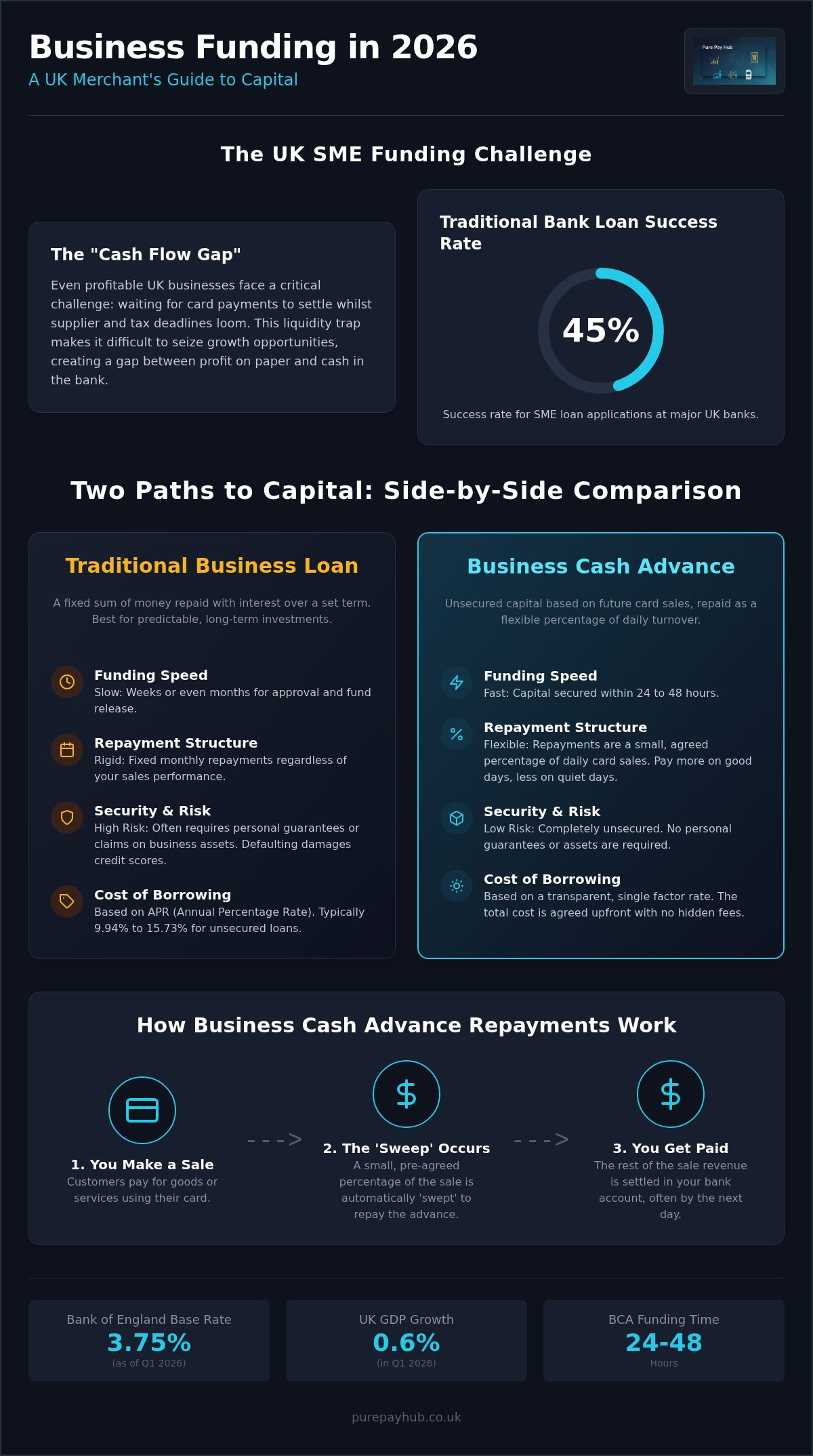
    UK SMEs are currently operating in a rebounding but complex economy. While GDP grew by 0.6% in the first quarter of 2026, the residual impact of inflation and the 3.75% Bank of England base rate continue to squeeze margins. This environment creates the “Cash Flow Gap”. It’s a frustrating reality where a company stays profitable on paper but lacks the liquid cash to seize new opportunities. You might be weighing up a business cash advance vs business loan UK to bridge this divide. Both have their place. Traditional loans offer fixed structures, while advances offer a rhythm that follows your sales. A Business Cash Advance is unsecured capital provided to your company based on your future card turnover.

    The SME Liquidity Challenge

    Wait times for card settlements can cripple a small business. When you sell a product today, you often wait days for the funds to arrive, yet your suppliers won’t wait to be paid. This liquidity trap is often worsened by quarterly VAT obligations and tax deadlines. Traditional banking is simply too slow for this pace. With high-street loan success rates sitting at 45% in recent years, many owners find the old ways of borrowing are no longer fit for purpose. A Merchant Cash Advance provides a modern alternative that bypasses these bottlenecks by focusing on your real-time performance rather than historical data.

    Why Flexibility is the New Priority

    Rigid five-year terms are becoming a relic of the past. Modern merchants need agile, short-term funding that responds to shifting consumer behaviour. If the cost of living causes a temporary dip in your shop’s footfall, a fixed monthly bank repayment becomes a source of high stress. Flexibility is now the primary goal. There is a massive psychological benefit to using finance that scales with you. Your repayments drop automatically if your sales do, ensuring your business stays stable during quieter periods. This alignment of cost and income is the stabilising force many owners now prioritise.

    The Traditional Route: How Business Loans Work in the UK

    Traditional lending has been the backbone of UK commerce for decades. It relies on a predictable structure where you borrow a principal sum and repay it with interest over a set period. When evaluating a business cash advance vs business loan UK, the loan represents the “fixed” path. You’ll usually encounter an Annual Percentage Rate (APR) that dictates your monthly cost. With the Bank of England base rate at 3.75% in July 2026, representative APRs for unsecured bank loans often range between 9.94% and 15.73%. These figures are locked in from day one.

    High-street banks look for stability. They typically demand a strong credit score, at least two years of trading history, and a comprehensive business plan. This makes loans a preferred choice for long-term infrastructure projects or property acquisition. However, you must consider the “fixed burden”. Your monthly repayment stays exactly the same regardless of your performance. It doesn’t care if you’ve had a record-breaking month or if footfall dropped due to local roadworks. The bank expects its instalment on the same date every month without fail.

    Advantages of Fixed-Term Lending

    Predictability is the primary draw for established firms. You can organise your monthly budget with total precision because your outgoings are set in stone. For businesses with high, stable margins, the total cost of capital may be lower over the duration of the term. It also helps you build a formal credit profile with a traditional financial institution. This is a solid choice amongst various working capital finance options if your revenue is consistent and guaranteed year-round.

    The Downsides for Modern Retailers

    The risks are significant for modern, sales-driven businesses. Seasonal dips can make those fixed payments feel impossible to meet. If you miss a payment, you risk default and damage to your credit score. Banks also frequently require security, such as personal guarantees or business assets, which adds personal risk to the deal. The biggest hurdle in 2026 remains the speed of access. The application process is notoriously slow and bureaucratic. It can take weeks or even months to get a decision. If you need a more responsive partner, you might find a flexible capital solution better suited to your daily sales rhythm.

    The Modern Alternative: A Deep Dive into Business Cash Advances

    A Business Cash Advance (BCA) offers a total reframe of how you access capital. Unlike the rigid structures of high-street banks, this model operates as a purchase of your future revenue. It’s an agile solution for the modern merchant. You receive a lump sum upfront, and in return, you agree to sell a small portion of your future card sales. This is where the business cash advance vs business loan UK debate becomes particularly interesting for retail and hospitality owners. Because it’s a sales-based agreement rather than a traditional loan, there’s no fixed monthly instalment. Instead, a “sweep” mechanism automatically deducts a pre-agreed percentage from your daily card transactions until the advance is settled.

    You don’t need to put your home or shop equipment up as collateral. BCAs are unsecured, which removes a massive layer of personal risk. Speed is another decisive factor. Whilst a bank might take weeks to review a business plan, a BCA provider can often approve your application within 24 hours. They prioritise your real-time performance over historical credit data. This allows you to secure working capital exactly when you need it, rather than waiting for a slow bureaucratic process to conclude.

    Repayments That Mirror Your Success

    Think of this as a “pay-as-you-trade” model. On a busy Saturday when the till is ringing, you pay back a bit more. On a quiet Monday or during a seasonal dip, your repayments drop automatically. This provides a built-in safety net that traditional loans simply cannot offer. It eliminates that crushing “end-of-month” anxiety where you’re scrambling to cover a fixed bank transfer despite a slow week of trading. For seasonal businesses in the UK, this flexibility is a vital lifeline that keeps your cash flow stable year-round. If you want to provide your own customers with similar flexibility, check out ZipLoan for consumer payment solutions.

    Eligibility Based on Performance, Not Just Credit

    Eligibility is refreshingly simple. Providers look at your card turnover history instead of demanding complex five-year business plans. If you’ve been trading for at least six months and process a consistent volume of card payments, you’re likely to qualify. Your card machine data acts as the primary evidence of your business’s health. This allows newer companies to access capital that high-street banks would typically deny. By using your actual sales data, providers can offer funding that is fair, transparent, and perfectly sized for your current capacity.
    Business Cash Advance vs Business Loan UK: 2026 Comparison Guide

    Business Cash Advance vs Business Loan UK: Side-by-Side

    Choosing between a business cash advance vs business loan UK depends entirely on your operational needs. The differences are stark. A high-street loan often requires a four-week wait for approval. In contrast, a cash advance can reach your account within 24 to 48 hours. Security is another major differentiator. Most banks demand asset security or personal guarantees. A cash advance is unsecured, meaning your personal property remains protected. It’s a lower-risk entry point for merchants who value their personal financial safety.

    The cost models also differ significantly. Loans use an Annual Percentage Rate (APR), which currently averages between 9.94% and 15.73% for many UK SMEs. Cash advances use a factor rate, typically ranging from 1.1 to 1.5. This means you know the total cost of the advance from the start. There are no compounding interest charges to worry about. You simply pay back the agreed amount as a percentage of your sales. It’s a transparent system that eliminates the fear of debt spiralling out of control.

    When to Choose a Business Loan

    Standard loans are ideal for long-term investments. If you’re purchasing a new premises or investing in heavy machinery that will last a decade, the fixed structure is beneficial. It suits firms with very stable, non-seasonal revenue streams. If you have an exceptional credit score and aren’t in a rush, a traditional bank might offer a lower total cost over several years. It’s a marathon, not a sprint. This route works best for businesses with predictable, steady growth that don’t mind a slow, bureaucratic application process.

    When to Choose a Business Cash Advance

    This option is built for speed and agility. It’s the right choice for bridging a temporary cash flow gap or buying stock for a busy period like Christmas. If your revenue fluctuates significantly throughout the year, the flexible repayment model protects your liquidity. It’s also perfect if you need capital immediately to capitalise on a time-sensitive opportunity. You don’t need a perfect credit score to qualify. Your business’s actual sales performance is what matters most. It’s a fair, modern way to access the funds you need to grow.

    You can apply for a flexible business cash advance today to secure the funds your business needs without the long wait for bank approval.

    Maximising Liquidity with PurePay Hub’s Unified Approach

    PurePay Hub simplifies your financial operations by merging payment technology with capital access. We don’t see these as separate services; they are two sides of the same coin. By using our card machines, you’re already building the data needed to secure funding. When you weigh up a business cash advance vs business loan UK, the speed of access is often the deciding factor. We provide next-day funding as standard. This means your money hits your account whilst the sale is still fresh, providing the immediate liquidity traditional banks often withhold. This unified approach removes the friction from your daily cash flow.

    Transparency is our standard. You won’t find hidden monthly markups or predatory “PCI non-compliance” traps here. Our approach is built on clarity and fair partnership. Consider the experience of a regional boutique owner. They needed to double their stock capacity for a summer expansion but were deterred by the rigid terms of bank debt. By using a PurePay Hub Business Cash Advance, they secured the necessary funds in 48 hours. They scaled their inventory without the stress of fixed monthly instalments, allowing the repayments to fluctuate naturally with their seasonal sales peaks.

    Beyond Funding: Low-Rate Card Processing

    Protecting your margins is essential for long-term growth. We offer debit card rates starting from 0.3%, ensuring you keep more of every pound you earn. Whether you use a Countertop Card Machine or a Portable Card Machine, our hardware provides the reliable data required for quick funding decisions. We simplify your merchant account by removing complex fee structures. This efficiency allows you to focus on your customers rather than your processing statements. A stable financial foundation starts with fair rates and reliable hardware that works as hard as you do.

    Your Partner in Growth

    We pride ourselves on a no-nonsense application process. There are no mountains of paperwork or endless meetings. Our team acts as a supportive ally, helping you choose the right terminal and funding mix for your specific industry. We understand the local merchant community because we’re part of it. We value straight-talking and efficiency over corporate jargon. You can take the first step toward a more flexible financial future today. Get a transparent quote from PurePay Hub today and see how a tailored funding solution can fuel your next stage of development.

    Take Control of Your Company’s Financial Future

    Deciding on a business cash advance vs business loan UK is a strategic choice that defines your daily operational freedom. You now understand that whilst traditional bank loans provide fixed structures for long-term assets, they often lack the agility modern merchants need. A sales-based advance offers a flexible alternative that moves in harmony with your turnover. It protects your liquidity during quieter periods and ensures you aren’t tied to rigid, high-stress repayment schedules.

    We’re committed to being a fair partner in your success. By merging low-rate card processing with fast capital access, you can close the cash flow gap for good. You’ll benefit from debit card rates starting from 0.3% and next-day funding as standard. We never use hidden monthly markups; our goal is your stability and growth. Secure your business cash flow with PurePay Hub’s low-rate card machines today. Your company’s next stage of development is within reach, and we’re ready to help you navigate it with confidence.

    Frequently Asked Questions

    What is the primary difference between a business loan and a cash advance?

    The main distinction lies in the repayment structure. A traditional loan requires fixed monthly instalments regardless of your sales performance. A cash advance is a purchase of future revenue where you only pay back a small percentage of your daily card takings. When choosing a business cash advance vs business loan UK, remember that the advance scales with your trade, whilst a loan remains a rigid monthly burden.

    How quickly can a UK business receive a cash advance?

    You can typically receive funds within 24 to 48 hours of approval. This is significantly faster than the four-week wait often associated with high-street bank loans. We prioritise efficiency because we know that time-sensitive opportunities won’t wait. Our streamlined application process focuses on your card machine data, allowing us to provide the liquidity you need without the bureaucratic delays of traditional finance.

    Do I need a perfect credit score to get a Business Cash Advance?

    No, a perfect credit score isn’t a requirement for this type of funding. We look at your business’s health and card turnover history instead of just your personal credit file. If your company has been trading for at least six months and processes regular card payments, you’re likely to qualify. This makes the business cash advance vs business loan UK choice much easier for newer firms that banks often overlook.

    Can I use a Business Cash Advance to pay my VAT or HMRC bill?

    Yes, you have total freedom over how you use the capital. Many UK merchants use an advance to settle quarterly VAT bills or HMRC obligations to avoid late payment penalties. Because the money is unsecured working capital, you can use it for stock, marketing, or tax payments. It provides a flexible safety net that helps you manage sudden cash requirements without disrupting your daily operations.

    Are there any hidden fees in a PurePay Hub merchant account?

    No, we don’t hide fees in complex financial agreements. Transparency is a core value of our brand, so you won’t encounter hidden monthly markups or “PCI non-compliance” traps. We believe in straight-talking and fair partnerships. You’ll always know exactly what your processing rates are and the total cost of any advance before you sign, ensuring there are no nasty surprises on your monthly statement.

    What happens to my repayments if my business has a quiet month?

    Your repayments will automatically decrease during quieter periods. Since you pay back a fixed percentage of your daily sales, a drop in revenue means you pay back less that day. This “pay-as-you-trade” model removes the anxiety of meeting a fixed bank transfer when footfall is low. It’s a built-in stabiliser that ensures your funding remains affordable even during seasonal dips or unexpected closures.

    Is a Business Cash Advance more expensive than a bank loan?

    It depends on your business model and how you value flexibility. Advances use a factor rate instead of an APR, meaning you know the total repayment amount from day one. Whilst the total cost might be higher than some low-interest bank loans, the lack of compounding interest and the flexible repayment rhythm often make it a more sustainable choice for retailers. You aren’t punished for slower months.

    How does next-day funding improve my daily cash flow?

    Next-day funding closes the “Cash Flow Gap” by giving you immediate access to your sales revenue. You don’t have to wait days for card settlements to arrive whilst your suppliers are demanding payment. Getting your money whilst the sale is fresh keeps your business liquid and agile. It allows you to reinvest in stock or cover daily overheads without relying on expensive overdrafts or personal credit cards.

  • Business Cash Advance vs Loan UK: Which is Best for Your Cash Flow?

    Business Cash Advance vs Loan UK: Which is Best for Your Cash Flow?

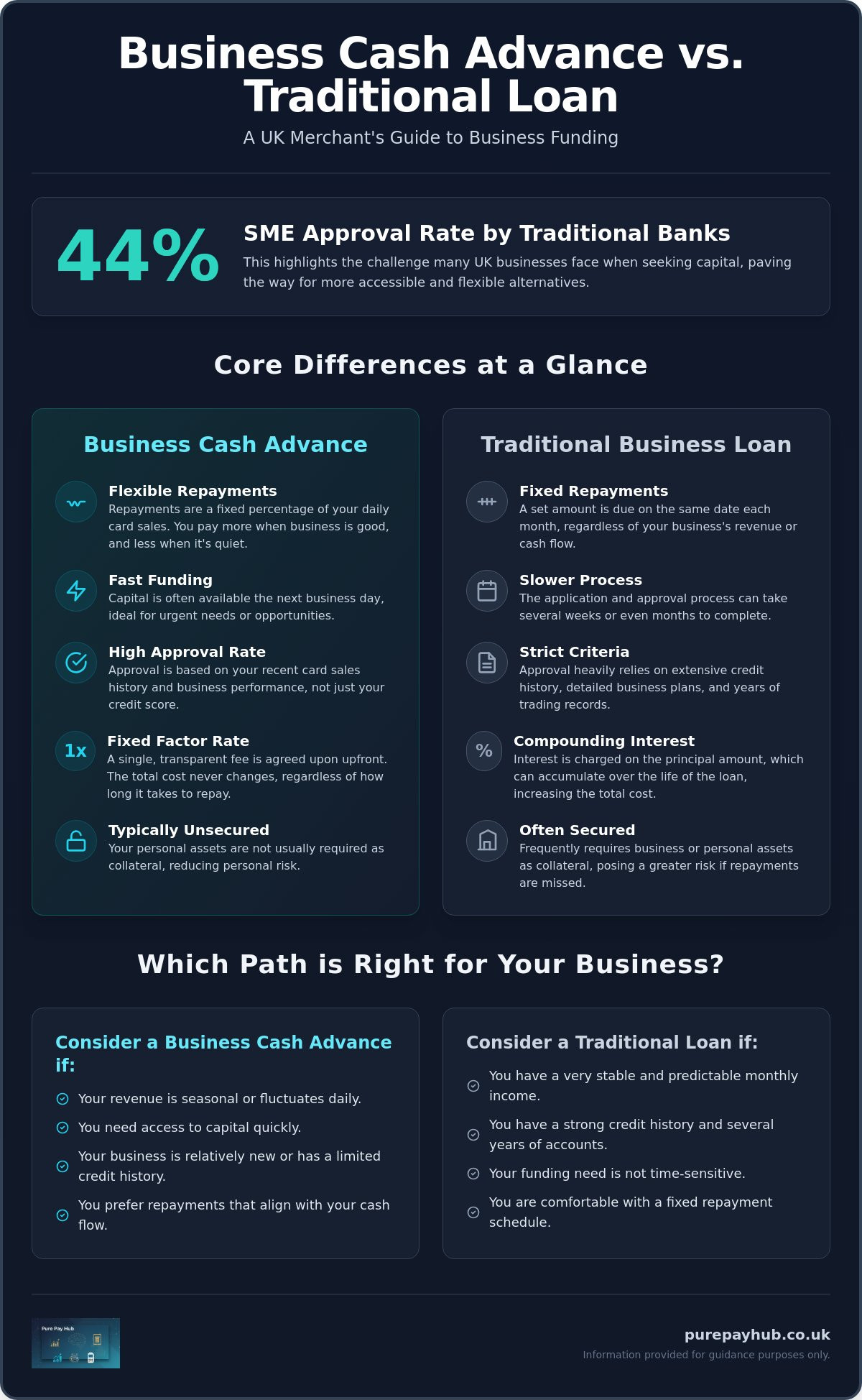
    What if your business repayments actually shrank during your quietest months instead of looming over your balance sheet like a fixed burden? It’s a common frustration for many UK merchants who find that traditional bank loans simply don’t account for the natural ebb and flow of daily trade. When you’re weighing up a business cash advance vs loan UK, the right choice depends on whether you value the predictable structure of a bank or the responsive flexibility of sales-based funding. With bank approval rates for SMEs sitting at just 44 per cent, the search for a more accessible alternative has never been more urgent.

    We understand that you need clear, no-nonsense answers to protect your cash flow. This guide promises to strip away the corporate jargon and reveal the critical differences between these two popular funding routes. We’ll explore why a business cash advance offers next-day access to funds and repayments that mirror your actual sales performance. By the end, you’ll have the confidence to choose a capital solution that acts as a supportive ally to your business rather than a source of monthly stress.

    Key Takeaways

    • Compare the core mechanical differences in a business cash advance vs loan UK to see which model best supports your long-term growth and stability.
    • Learn how sales-linked funding provides a reassuring safety net during quiet months by ensuring your repayments always mirror your actual daily card turnover.
    • Discover why alternative finance offers a faster path to capital with next-day funding and significantly higher approval rates than traditional high street banks.
    • Understand the clear cost distinction between a transparent, fixed factor rate and the compounding interest often found in standard fixed-term loans.
    • Gain the clarity needed to decide whether your business thrives best with the fixed structure of a bank or the modern flexibility of a merchant cash advance.

    Understanding Business Cash Advances and Loans in the UK

    Choosing the right capital for your business is a decision that dictates your daily peace of mind. For decades, the only path to growth was through a high street bank. However, the rise of alternative finance has changed the conversation, making the debate of business cash advance vs loan UK essential for modern merchants. While both provide a lump sum of capital, they operate on entirely different mechanical principles that affect your cash flow in very different ways.

    The Traditional Business Loan: A Fixed Commitment

    A traditional business loan is a straightforward debt agreement. You receive a principal amount and agree to pay it back over a set period, usually between one and five years. This repayment is tied to an interest rate, which can be fixed or variable. The defining feature here is the rigid monthly schedule. Whether you’ve had your best month or a quiet fortnight, the bank expects the same amount on the same day. This predictability suits businesses with stable, predictable income. Traditional loans usually involve:

    • A fixed repayment date every month.
    • Compounding interest charges that add to the total debt.
    • Strict eligibility criteria often requiring years of trading history.

    For many independent retailers or hospitality venues, these barriers are often too high to overcome. Banks focus heavily on your past credit history and may require significant documentation before they even consider an application. This rigid structure can create unnecessary stress during seasonal dips in trade.

    The Business Cash Advance: A Modern Alternative

    For businesses that rely on card terminals, a Merchant Cash Advance (MCA) offers a more fluid approach. Instead of a traditional loan, this is technically a purchase of your future credit and debit card sales. You receive capital upfront, and in exchange, you agree to pay back a fixed percentage of every card transaction you take. A cash advance typically offers:

    • No fixed monthly payments or rigid deadlines.
    • Repayments that automatically move with your sales volume.
    • Approval based on your recent card turnover rather than just credit scores.

    Because it’s a purchase of future revenue rather than a standard credit agreement, it doesn’t have a fixed expiry date. You simply pay as you earn. If sales are slow, you pay less; if business is booming, you pay the advance off faster. This unsecured facility means you don’t usually need to put up personal assets as collateral. It’s a natural extension of your existing card machine service, focusing on your current trading health rather than your long-term financial history.

    The regulatory landscape for these products is distinct. Most unsecured business lending in the UK falls outside the scope of the Financial Conduct Authority (FCA). This is especially true for cash advances because they are structured as a commercial purchase of assets, specifically your future sales, rather than a credit agreement. This makes it vital to work with a transparent partner who values clarity over complex fee structures. Understanding this distinction helps you see why the approval process is often much faster than a bank’s, as the focus remains on your actual business performance.

    How Repayment Structures Differ: Fixed vs Flexible

    The fundamental difference in a business cash advance vs loan UK is how they interact with your bank account each month. One is a rigid demand; the other is a rhythmic partnership. Traditional loans operate on a calendar basis, whilst advances operate on a performance basis. This distinction often determines whether a business owner sleeps soundly during a slow trading week or spends their Sunday night worrying about an upcoming direct debit.

    Repaying a Loan During Quiet Periods

    Banks prioritise consistency above all else. When you take a standard business loan, you agree to a specific monthly figure. If your revenue drops by 30 per cent due to seasonal trends or local roadworks, that figure doesn’t change. This creates a squeeze where your margins thin out just to meet the debt obligation. You’re forced to find the money from your reserves, which can stifle your daily operations. Some lenders offer interest-only periods, but these are often temporary measures that eventually increase the total cost of the debt. Whilst government-backed business finance schemes can provide more stability than some private high street options, the fixed nature of the repayment remains a constant pressure for many small firms. Missing a payment doesn’t just result in late fees; it can trigger a default that damages your ability to borrow in the future.

    The “Pay-as-you-Earn” Model of Cash Advances

    A cash advance works in harmony with your card machine. Instead of finding a large sum at the end of the month, a small, fixed percentage of your daily sales is diverted to repay the advance. If you have a busy Saturday, you pay back more. If you’re closed on a Monday, you pay nothing. It’s an automated process that removes the need for manual bank transfers or the administrative burden of tracking payment dates. Because there is no fixed term, there are no late fees or penalties if your sales slow down and it takes you longer to repay. This flexibility acts as a built-in safety net for your cash flow. It ensures that your outgoing payments never outpace your incoming revenue, allowing you to maintain a healthy balance sheet even during unpredictable periods. If you’re looking for a way to fund growth without the anxiety of fixed costs, exploring a Business Cash Advance could be the right move for your cash flow. This model treats you as a partner, ensuring the funding supports your development rather than draining your resources when you need them most.

    Eligibility and Speed: Which is Easier to Secure?

    The process of securing capital is often where the business cash advance vs loan UK debate becomes most practical. For many business owners, the choice isn’t just about the cost. It’s about who will actually say “yes” and how quickly the funds will arrive in their account. Traditional banks remain cautious; only 44 per cent of SME loan applications are currently approved by high street lenders. This makes the speed and accessibility of alternative funding a critical factor for businesses needing to act fast.

    Bank Loan Requirements: The High Bar

    Securing a traditional bank loan usually requires a mountain of paperwork. You’ll need to provide several years of audited accounts, detailed business plans, and a pristine credit score. Banks often view newer businesses as high risk, leading to the common “computer says no” response for SMEs that haven’t been trading for at least three years. Access to finance remains a significant hurdle for smaller firms, a challenge often highlighted by the British Business Bank in their market reports. Many traditional loans are also secured. This means the bank may ask for personal assets, such as your home, as collateral. Even if your application is successful, you can still expect to wait between two and four weeks for the funds to be released.

    Cash Advance Requirements: Turnover is King

    A business cash advance flips this model on its head. Instead of focusing on your past debt history, the primary proof of health is your merchant statement. This is a monthly report from your card processor that details the volume and value of your card transactions. If you have a consistent monthly card turnover of at least £2,500 and have been trading for just three to six months, you’re likely eligible. This focus on current performance rather than historical credit makes it a much more accessible option for modern merchants.

    This facility is entirely unsecured. You don’t need to put your home or other physical assets at risk to access the capital you need. The application process is streamlined and digital. PurePay Hub prioritises efficiency, often providing approval and next-day funding once your statements are reviewed. This 24 to 48-hour window is a stark contrast to the weeks of waiting required by traditional institutions. It allows you to buy stock, repair equipment, or cover an unexpected bill without the stress of a prolonged and uncertain approval cycle.

    Business Cash Advance vs Loan UK: Which is Best for Your Cash Flow?

    The True Cost: Comparing Interest Rates and Factor Rates

    Understanding the total cost of capital is where many business owners feel the most friction. When you’re comparing a business cash advance vs loan UK, you’re looking at two different mathematical languages. Traditional loans use Annual Percentage Rate (APR). Cash advances use a factor rate. One is a moving target; the other is a fixed sum. Choosing between them requires looking past the initial number to see how the debt will actually behave over time.

    Understanding Compounding Interest in Loans

    Traditional business loans are built on compounding interest. This means the interest is calculated on your remaining balance every month. If your loan term extends or if you take a repayment holiday, the total amount you pay back increases. In late 2025, the average effective interest rate on new SME loans was around 6.3 per cent. However, this figure rarely tells the whole story. UK banks often include arrangement fees, annual service charges, and exit penalties if you try to settle the debt early. These hidden costs can turn a seemingly cheap loan into a complex financial burden that grows heavier the longer it stays on your books.

    The Simplicity of the Factor Rate

    A business cash advance operates with total transparency. Instead of a percentage that compounds over time, you’re given a single factor rate upfront. This is a simple multiplier. For example, if you receive £10,000 with a factor rate of 1.2, your total repayment is fixed at £12,000. You know exactly what you owe from day one. This cost never increases, regardless of how long it takes for your card sales to pay off the advance. There are no surprise fees for early repayment because there is no fixed term. You simply pay as you earn until the agreed sum is cleared.

    This simplicity allows you to protect your margins with absolute certainty. You can calculate your return on investment before the funds even hit your account. Whilst the equivalent APR of a cash advance can appear higher on paper, the lack of compounding interest and hidden bank fees often makes it a more predictable choice for fast-growing businesses. You’re paying for the speed and the flexibility of the model, not for the privilege of navigating a bank’s complex fee structure. If you value clarity and want to avoid the headache of compounding debt, you can request a transparent quote for a Business Cash Advance to see your total cost upfront. This no-nonsense approach to the business cash advance vs loan UK debate ensures your funding supports your growth without any nasty surprises.

    Making the Choice for Your Business Growth

    Deciding between a business cash advance vs loan UK isn’t about finding a universal winner. It’s about matching your funding to the specific rhythm of your trade. Neither option is inherently better; they simply serve different strategic purposes. One provides a rigid anchor for long-term stability, whilst the other offers a flexible sail to help you navigate the changing winds of the UK high street. Success lies in choosing the tool that supports your cash flow without becoming a burden.

    When a Loan Makes Sense

    Traditional bank loans remain a strong choice for long-term infrastructure projects where you can predict your returns with high certainty. If you’re purchasing a commercial property or investing in heavy machinery with a ten-year lifespan, a fixed-term loan provides a predictable, low-cost structure. These products are also the only viable option for B2B businesses that operate primarily through invoicing rather than card terminals. If you have high-value physical assets to leverage as security, you may find that traditional lenders offer lower interest rates that suit a slow and steady growth plan. However, you must be prepared for the rigid monthly commitment that remains unchanged regardless of your monthly performance.

    Why a Business Cash Advance Wins for Retail and Hospitality

    For businesses that live and breathe on daily card sales, the flexibility of a cash advance is often the superior choice. This model is specifically designed for the realities of the modern merchant. It allows you to manage seasonal stock fluctuations with ease; you can stock up for the busy Christmas or summer periods without the fear of fixed-debt pressure during the subsequent quiet months. It’s also a powerful tool for reactive growth. Whether you need to cover an unexpected VAT bill, repair a broken oven, or seize a time-limited bulk discount from a supplier, the speed of alternative finance is a major advantage.

    With challenger banks and alternative lenders now accounting for 60 per cent of SME loans, the shift away from traditional banking is clear. PurePay Hub acts as your supportive business ally in this changing landscape. We provide transparent, sales-linked funding that acts as a stabilising force for your finances. You’ll never have to worry about finding a fixed sum at the end of a slow month because your repayments always mirror your actual performance. If you’re ready to secure capital that grows with you, see how a PurePay Hub cash advance can support your growth. We’re here to ensure you have the funds you need today, with a repayment structure that protects your tomorrow.

    Secure Your Business’s Financial Future

    Choosing between a business cash advance vs loan UK is a pivotal decision for your firm’s cash flow. You’ve seen how traditional loans offer a fixed structure that doesn’t account for the natural fluctuations of seasonal trade. In contrast, a merchant cash advance provides a modern, sales-linked alternative that moves in sync with your actual daily revenue. It’s about deciding whether you want a debt that dictates your schedule or funding that acts as a supportive ally to your growth.

    We believe that UK business owners deserve a partner who values transparency over hidden bank fees and complex interest structures. You can access unsecured capital without putting your personal assets at risk. With funding approved in as little as 24 hours and no fixed monthly repayments, you stay in total control of your financial momentum. It’s time to move past the frustration of lengthy bank applications and rigid deadlines. Apply for a transparent Business Cash Advance with PurePay Hub today and build the future your business deserves. We’re ready to help you thrive on your own terms.

    Frequently Asked Questions

    Can I get a business cash advance if I have a poor credit score?

    Yes, you can qualify for a cash advance even with a less than perfect credit score. Traditional banks focus heavily on your past credit history, but alternative lenders prioritise your current trading health. If your business consistently processes at least £2,500 in card payments every month, your recent merchant statements serve as the primary proof of your ability to repay the advance.

    Is a business cash advance more expensive than a bank loan?

    A cash advance can have a higher equivalent APR than a low-interest bank loan, but the total cost is often more transparent. You pay a single, fixed factor rate that never increases, regardless of how long it takes to repay. Because there is no compounding interest or late fees, you avoid the hidden costs that often cause traditional bank debt to escalate over time.

    How much can I typically borrow with a merchant cash advance in the UK?

    You can typically borrow between £3,000 and £500,000 depending on your average monthly card turnover. Most providers will offer an advance equivalent to 100 per cent or 150 per cent of your monthly sales volume. This ensures the capital is proportional to your business size, keeping the daily percentage deductions manageable for your specific cash flow requirements.

    What happens to my repayments if my card machine breaks or I stop trading?

    Repayments stop automatically if you aren’t processing card transactions. Since the advance is paid back as a fixed percentage of your daily sales, no sales means no payment is deducted. You won’t face penalties, late fees, or damage to your credit score during these quiet periods. This flexibility is a core advantage when weighing up a business cash advance vs loan UK.

    Do I need to change my card machine provider to get a cash advance?

    You don’t usually need to switch your payment processor to access this type of funding. PurePay Hub works alongside your existing countertop or portable card machines by reviewing your merchant statements to determine eligibility. This allows you to maintain your current hardware and service agreements whilst quickly accessing the unsecured capital you need for stock or refurbishments.

    How long does the application process take for a PurePay Hub advance?

    The application process is built for speed, often resulting in approval within hours of submitting your merchant statements. Once approved, the funds are typically deposited into your business account within 24 to 48 hours. This efficiency is designed for merchants who need to seize a time-limited opportunity or cover an urgent bill without waiting weeks for a bank’s decision.

    Are there any hidden fees or interest charges with a cash advance?

    There are no hidden fees or compounding interest charges with a transparent cash advance. You’re provided with a single factor rate upfront, so you know the exact total repayment amount before you agree to the funding. You won’t encounter arrangement fees, annual service charges, or early exit penalties, ensuring your margins remain protected throughout the life of the agreement.

    Is a business cash advance regulated by the FCA?

    Merchant cash advances are not currently regulated by the Financial Conduct Authority (FCA) in the UK. This is because they are structured as a commercial purchase of future revenue rather than a traditional credit agreement or loan. It’s vital to partner with a dependable provider who values honesty and clear communication to ensure your business cash advance vs loan UK comparison is based on fair, transparent terms.

  • Merchant Cash Advance vs Business Loan: 2026 UK Funding Guide

    Merchant Cash Advance vs Business Loan: 2026 UK Funding Guide

    Why should your business be forced to pay a fixed monthly fee during a quiet trading week just because you needed capital six months ago? It is a common frustration for merchants who find that traditional bank structures don’t account for the natural ebb and flow of British high street trade. When you compare a merchant cash advance vs business loan UK providers offer very different paths that directly impact your monthly cash flow.

    We know that rigid repayment schedules and complex applications feel like a barrier rather than a bridge to growth. You need a funding partner that prioritises transparency over fine print and offers repayments that actually breathe with your daily card sales. This guide explores the critical differences between these models to help you secure the fairest funding for your business. We will show you how to access capital within 48 hours and explain why a sales-aligned repayment structure might be the stabilising force your finances need in 2026.

    Key Takeaways

    • Learn how to choose between a merchant cash advance vs business loan UK by matching your repayment structure to your actual daily card sales.
    • Understand the “pay-as-you-trade” model that automates deductions through your card terminal, protecting your cash flow during quieter trading periods.
    • Discover the specific eligibility criteria that allow merchants with limited trading history or varied credit scores to access capital in as little as 48 hours.
    • Identify high-impact use cases for cash advances, such as seasonal stock replenishment and emergency repairs, where speed and flexibility are paramount.
    • Explore the benefits of centralising your payment processing and funding through PurePay Hub to ensure total transparency and a simplified financial overview.

    Defining the Two Pillars of UK SME Finance

    For decades, the high street bank manager held the keys to business growth. That era has ended. Today, UK SMEs are increasingly looking beyond traditional banking halls to find capital that matches their modern trading patterns. With the Bank of England base rate sitting at 4.75% as of March 2026, the cost of borrowing has become a central concern for every shop owner and restaurateur. This shift toward alternative finance isn’t just about speed; it’s about finding a model that doesn’t penalise a business for having a slow month.

    When you evaluate a merchant cash advance vs business loan UK options, you’re essentially choosing between a rigid financial contract and a flexible sales partnership. Your merchant service provider often acts as the bridge here. They use your existing card terminal data to prove your business’s health, bypassing the mountain of paperwork that traditional lenders usually demand. It’s a no-nonsense approach that prioritises your actual trading history over a static credit score.

    What is a Merchant Cash Advance?

    Technically, a Merchant Cash Advance (MCA) is not a loan. It’s a commercial transaction where you sell a specific portion of your future credit and debit card sales in exchange for an immediate lump sum. This distinction is vital. Because it’s an advance on sales rather than a debt, there are no fixed monthly deadlines. If your sales drop during a quiet week, your repayments drop too. This flexibility reduces the financial anxiety that often keeps business owners awake at night. It’s also an unsecured form of capital. You don’t need to put your home or commercial property at risk to secure the funds.

    The Traditional Business Loan Explained

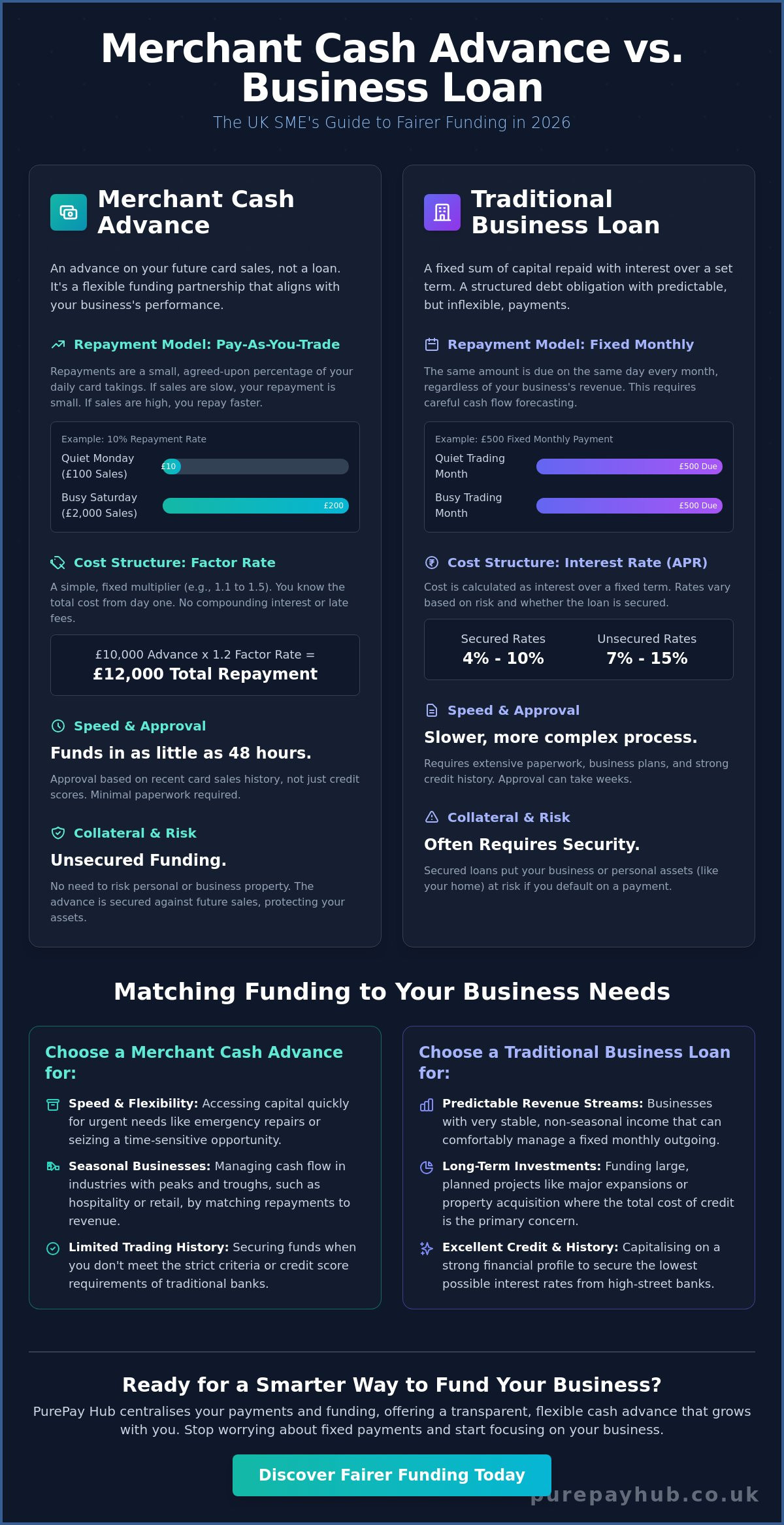
    A business loan follows a more familiar structure. You receive a principal amount and repay it, plus interest, over a set period, typically between one and five years. These payments are fixed. Whether you have a record-breaking month or your shop is closed for renovations, the lender expects the same amount on the same day. Most qualified UK SMEs find secured loan rates between 4% and 10%, whilst unsecured rates from high-street banks range from 7% to 15%. This model provides a clear end date for your debt, but it offers zero wiggle room when cash flow gets tight. It remains a popular choice for long-term investments where the total cost of credit is the primary concern.

    Analysing Repayment Structures: Fixed vs Flexible

    The fundamental difference between a merchant cash advance vs business loan UK business owners must understand lies in the repayment mechanics. One is a rigid debt. The other is a percentage of your success. Traditional loans are built on time, requiring you to pay back a set amount every month regardless of your bank balance. A merchant cash advance (MCA) is built on sales. It uses a pay-as-you-trade model that aligns perfectly with the reality of high-street commerce.

    To understand the cost, you must look at the factor rate rather than an APR. While bank loans use interest that can compound, MCAs use a fixed multiplier. Factor rates typically range between 1.1 and 1.5. If you receive an advance of £10,000 at a 1.2 factor rate, you pay back exactly £12,000. There are no hidden fees or late penalties because the total cost is agreed upon at the start. This transparency allows you to calculate your business cash advance costs with total certainty before you commit.

    How MCA Repayments Scale With Your Sales

    Imagine a rainy Monday in a seaside cafe. Footfall is low and card sales barely reach £100. With an MCA, if your agreed repayment is 10%, you only pay £10 that day. Fast forward to a sunny Saturday where sales hit £2,000; your repayment naturally scales to £200. This is known as the “sweep” method. The payment processor automatically splits the daily takings at the point of sale. You don’t need to manage the admin or set up standing orders. If you take zero sales on a bank holiday, you pay zero pounds. This structure removes the psychological weight of a looming monthly deadline.

    The Rigidity of Business Loan Schedules

    Traditional loans operate on a calendar, not a sales report. Whether you choose a high-street bank or a structured programme like UK Government Start Up Loans, you face a fixed monthly outgoing. These loans are currently fixed at a 7.5% interest rate for 2026, which is excellent for businesses with highly predictable, non-seasonal income. However, for most merchants, this rigidity creates risk. A single underperforming month can lead to a technical default if you haven’t set aside enough cash to cover the fixed instalment. Loans demand precise forecasting, whereas advances adapt to your actual performance.

    Merchant Cash Advance vs Business Loan: 2026 UK Funding Guide

    The Critical Differences: Eligibility and Transparency

    Securing capital shouldn’t feel like an interrogation. Yet, for many merchants, the traditional bank application process is exactly that. When you weigh up a merchant cash advance vs business loan UK lenders generally fall into two camps: those who look at your past and those who look at your potential. Traditional banks demand a “heavy” documentation trail, often requiring three years of audited accounts and a near-perfect credit score. PurePay Hub takes a different approach. We focus on the health of your daily card sales, making the process faster and far more inclusive.

    The core of this transparency lies in how we evaluate your business. Rather than obsessing over personal financial history, we prioritise your merchant statement history. This data provides a real-time picture of your business performance. It shows us your consistency and your customer volume. If you want to see how this fits into the broader financial ecosystem, you can read the official government definition of a Merchant Cash Advance. This model ensures that your funding is based on what your business actually does, not just what a credit agency says about you.

    Credit Scores and Approval Rates

    Will a poor credit score stop you from growing? In the world of high-street banking, the answer is often yes. However, MCA providers typically look for just 3–6 months of consistent card processing behaviour. We understand that a business owner’s personal credit history doesn’t always reflect the strength of their shop or restaurant. This makes a cash advance an accessible option for newer businesses that have been trading for at least six months. Approval rates in this sector are significantly higher because the risk is tied to your future sales, which we can see evidence of in your daily terminal activity.

    Understanding Factor Rates vs APR

    Transparency is our standard. Traditional loans use an Annual Percentage Rate (APR), which can be confusing when applied to short-term, flexible funding. Instead, we use a Factor Rate. This is a simple multiplier applied to the total sum you receive. For example, a 1.2x factor rate on a £10,000 advance means you pay back £12,000 in total. There are no compounding interest charges or hidden monthly fees to worry about. A factor rate provides a fixed total cost of capital that never increases, regardless of how long it takes to repay. This clarity allows you to plan your stock purchases or marketing campaigns without fearing a spike in costs if sales fluctuate.

    Strategic Suitability: Matching Funding to Your Business Model

    Choosing the right path when comparing a merchant cash advance vs business loan UK wide depends entirely on your specific objective. It isn’t just about finding the lowest headline rate. It’s about the strategic fit for your daily operations. If you need to fix a broken oven in a busy restaurant or stock up for a summer festival, the “cost of waiting” for a traditional bank can far outweigh the cost of capital. Losing two weeks of trading whilst waiting for a bank manager’s approval is a heavy price to pay for a slightly lower interest rate.

    A simple framework helps determine which model suits your current needs. Ask yourself: will this capital generate immediate revenue or solve an urgent bottleneck? If the answer is yes, a flexible advance is often the superior choice. Use this quick guide to align your funding with your goals:

    • Short-term revenue drivers: Use a cash advance for stock replenishment, seasonal marketing, or emergency repairs.
    • Long-term infrastructure: Use a traditional loan for commercial property purchases or multi-year research projects.
    • Cash flow management: Use an advance to bridge the gap during quiet months without adding fixed debt.

    Why Seasonal Businesses Favour Merchant Advances

    Hospitality and retail merchants face unique pressures that traditional lenders often ignore. The “January dip” often follows a frantic December, leaving cash reserves low just when you need to prepare for the spring. An MCA acts as a vital buffer during these fluctuations. Because providers can often deliver funding within 24 to 48 hours, it’s the ideal solution for sudden stock opportunities or equipment failure. You don’t have to worry about fixed repayments during your quietest weeks. Your funding behaves like your business; it scales down when the streets are empty and catches up when the tourists return.

    When a Traditional Loan Remains the Better Choice

    For long-term capital projects, a traditional loan is still a formidable tool. If you’re a B2B service provider who doesn’t process high volumes of card payments, an MCA won’t be an option. Loans are also better suited for purchasing commercial property or investing in significant structural renovations. Businesses with substantial assets can often leverage them to secure interest rates between 4% and 10%. This lower cost of credit makes sense when you have the luxury of time and a highly predictable income stream that won’t be shaken by seasonal shifts.

    If your business relies on daily card transactions and you need a partner that understands your rhythm, you can apply for a business cash advance today and receive a transparent decision in hours.

    Streamlining Your Cash Flow with PurePay Hub

    Most financial institutions treat your card processing and your business funding as two entirely separate worlds. This fragmentation creates unnecessary friction for busy merchants. When you compare a merchant cash advance vs business loan UK providers often make you jump through hoops with different companies. PurePay Hub removes this complexity. We bring your terminal and your capital under one roof. It’s a modern approach that turns your daily sales data into a powerful growth tool.

    Integrated Payments and Funding

    Our card machines do more than just process transactions. They provide the real-time insights needed for instant funding decisions. Because we see your trading volume directly, we don’t need to ask for stacks of bank statements or audited accounts. This integration allows for a seamless “pay-as-you-trade” experience. You get one clear monthly statement that covers both your processing fees and your advance repayments. We keep our debit rates starting from 0.3%, ensuring that more of your hard-earned profit stays exactly where it belongs; in your business bank account.

    Having your funding source and your card terminal linked simplifies everything. There are no manual transfers to manage and no risk of missing a fixed deadline. The system handles the split automatically. This gives you next-day access to funds when you need them most, providing a level of agility that traditional loans simply cannot match. It is about making your finances work as hard as you do.

    Getting Started: The Next Steps

    We believe in straight-talking and calm advocacy. We aren’t here to push debt; we’re here to help you choose the route that fits your actual turnover. Our application process is designed to be as efficient as your business. It follows a simple three-step path: Connect your terminal data, Assess your eligibility with our team, and receive your Fund. It’s a no-nonsense consultation that puts you in control of your cash flow.

    If you’re ready to move away from the rigid structures of the past, we’re here to help. You can Explore our Business Cash Advance options today and discover how integrated funding can stabilise your finances. Whether you’re looking to upgrade your EPOS system or simply need a buffer for a quiet month, we’ll find a solution that breathes with your business.

    Securing a Fairer Financial Future for Your Business

    Choosing between a merchant cash advance vs business loan UK wide comes down to how you want your capital to behave. If your business thrives on daily card sales, you shouldn’t be tethered to a rigid monthly debt that ignores your quietest weeks. You’ve seen how flexible repayments and inclusive eligibility can remove the barriers to growth that traditional banks often maintain. By aligning your funding with your actual turnover, you protect your cash flow whilst keeping your momentum high.

    PurePay Hub is here to act as your supportive business ally. We offer a transparent approach with debit card rates from 0.3% and next-day funding as standard. There are no hidden markups or corporate jargon to decode; just clear, honest service designed for local merchants. It’s time to trade on your own terms with a partner that values your success as much as you do.

    Ready to take the next step? Get a transparent quote for your business funding today and see how simple integrated finance can be. We look forward to helping your business flourish throughout 2026 and beyond.

    Frequently Asked Questions

    What is the main difference between a merchant cash advance and a business loan?

    The primary difference involves how you repay the capital. A traditional loan requires fixed monthly instalments regardless of your income. In contrast, a merchant cash advance is a purchase of future card sales where repayments fluctuate based on your daily takings. This makes the merchant cash advance vs business loan UK choice a matter of choosing between rigid debt and flexible sales-linked funding that protects your cash flow.

    Can I get a merchant cash advance with a poor credit score in the UK?

    Yes, you can often secure funding even with a less-than-perfect credit history. MCA providers prioritise your recent card processing volume over your historical credit score. If your business has been trading for at least six months and shows consistent card turnover, you are likely to be eligible. This inclusive approach focuses on your current business health rather than past financial hurdles that might stop a bank loan.

    How much does a merchant cash advance cost compared to a loan?

    Traditional loans typically have lower headline interest rates, with secured APRs often between 4% and 10% in 2026. Merchant cash advances use a factor rate, usually between 1.1 and 1.5, which can result in a higher equivalent APR. You are essentially paying for the convenience of speed and the flexibility of repayments that drop when your sales do. It is a trade-off between the lowest cost and the best cash flow protection.

    Do I need to change my card machine provider to get an MCA?

    You don’t always need to switch, but using an integrated provider simplifies the process significantly. When your card terminal and funding source are under one roof, the data flows seamlessly for faster decisions. We can often work with your existing setup, but our own terminals ensure you benefit from our lowest debit rates starting from 0.3% and automated, hassle-free repayments that require no manual admin.

    What happens to my repayments if my business has a slow month?

    Your repayments automatically decrease during a slow month. Because the provider takes a fixed percentage of your daily card sales, you only pay back what you can afford based on your actual income. If you have a week with zero sales, you make zero repayments. This pay-as-you-trade model removes the pressure of finding a fixed sum when footfall on the high street is unexpectedly low.

    How long does it take to get the money in my bank account?

    You can typically access the funds within 24 to 48 hours of approval. This is significantly faster than traditional bank loans, which can take weeks to process. The streamlined application focuses on your digital merchant statements, allowing for rapid assessment. Once you sign the agreement, the lump sum is transferred directly into your business bank account, providing the agility needed for emergency repairs or stock opportunities.

    Are there any hidden fees or late payment penalties with an MCA?

    There are no late payment penalties or hidden markups because there are no fixed deadlines. The total cost of the advance is agreed upon at the start using a transparent factor rate. Since your repayments are a percentage of sales, you can’t be late as long as you continue to process card payments. This structure provides total clarity regarding the total cost of credit from the very first day.

    Is a merchant cash advance regulated by the FCA?

    Merchant cash advances are not currently regulated by the Financial Conduct Authority (FCA) in the UK. This is because they are technically a purchase of future receivables rather than a traditional consumer or business loan. Because of this, it’s essential to partner with a transparent provider that prioritises honesty and clear fee structures. Conduct thorough due diligence to ensure your funding partner adheres to high standards of fairness.