Tag: SME funding

  • A Complete Guide to Merchant Advance Funding for UK Businesses in 2026

    A Complete Guide to Merchant Advance Funding for UK Businesses in 2026

    Why should your business be forced to meet a heavy fixed repayment during your quietest trading month? Many owners now turn to a merchant advance because traditional bank structures don’t account for the natural ebb and flow of daily commerce. It’s frustrating to wait weeks for a decision only to be asked for personal assets as security. You deserve a financial partner that understands the reality of the British high street and values transparency over complex jargon.

    This guide explores how this flexible funding solution works in harmony with your card machine sales. You’ll discover how to access unsecured capital within days with repayments that automatically synchronise with your actual turnover. We’ll break down the 2026 landscape, from factor rates to approval criteria, so you can secure the funding you need without hidden fees or APR traps. It’s time to move toward a state of informed confidence with capital that supports your growth rather than hindering your cash flow.

    Key Takeaways

    • Understand how a merchant advance functions as a purchase of future card sales rather than a traditional debt obligation.
    • Learn why approval speeds of just a few days and the absence of fixed repayment terms provide a distinct advantage over bank loans.
    • Identify the specific turnover and trading history requirements needed for UK SMEs to qualify for this unsecured funding.
    • Discover how to use capital for high-impact growth, such as upgrading your EPOS systems or securing bulk inventory discounts.
    • See how integrated card machines and transparent fee structures remove the stress of hidden costs and manual repayments.

    What is a Merchant Advance and How Does it Function?

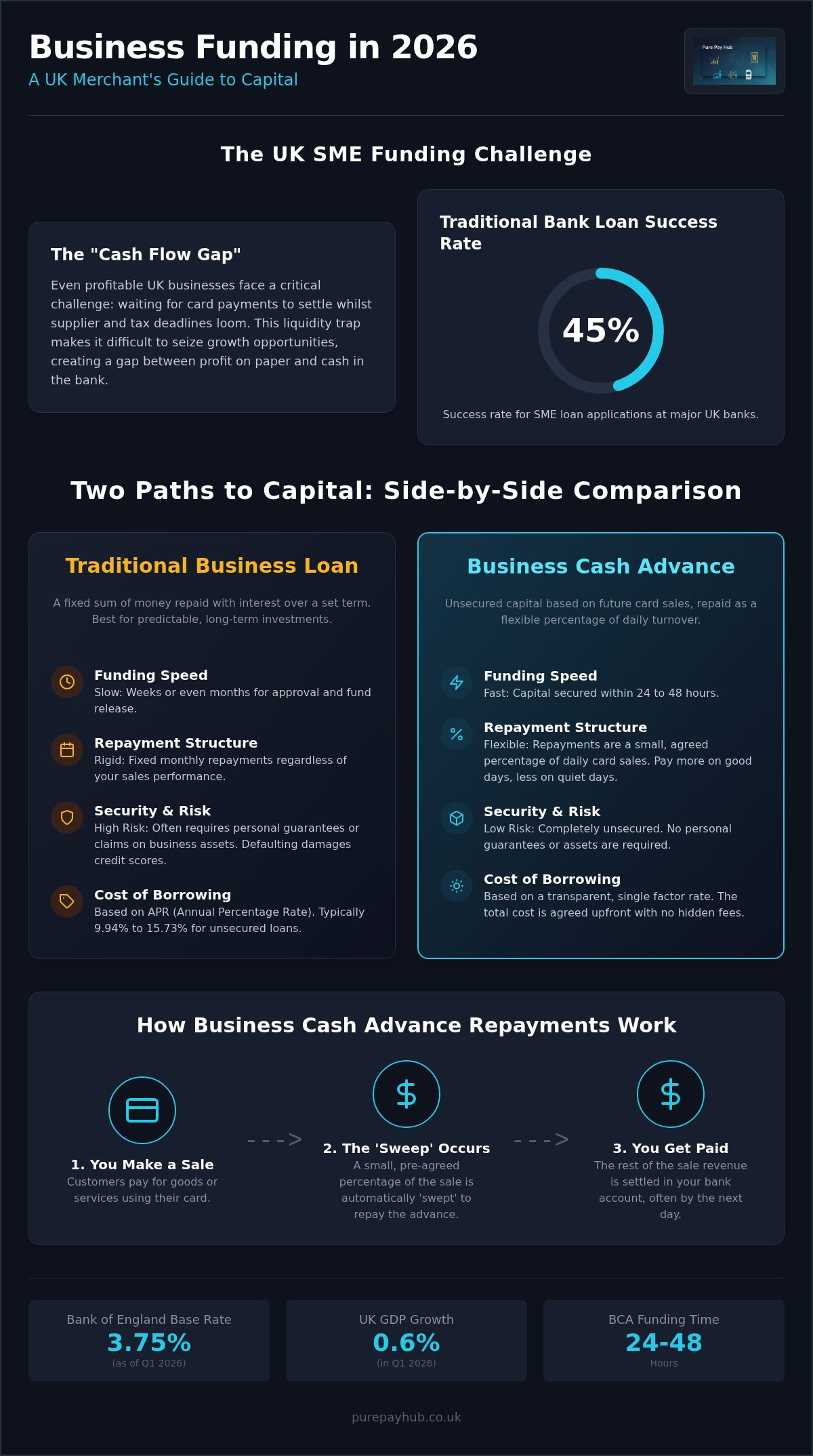
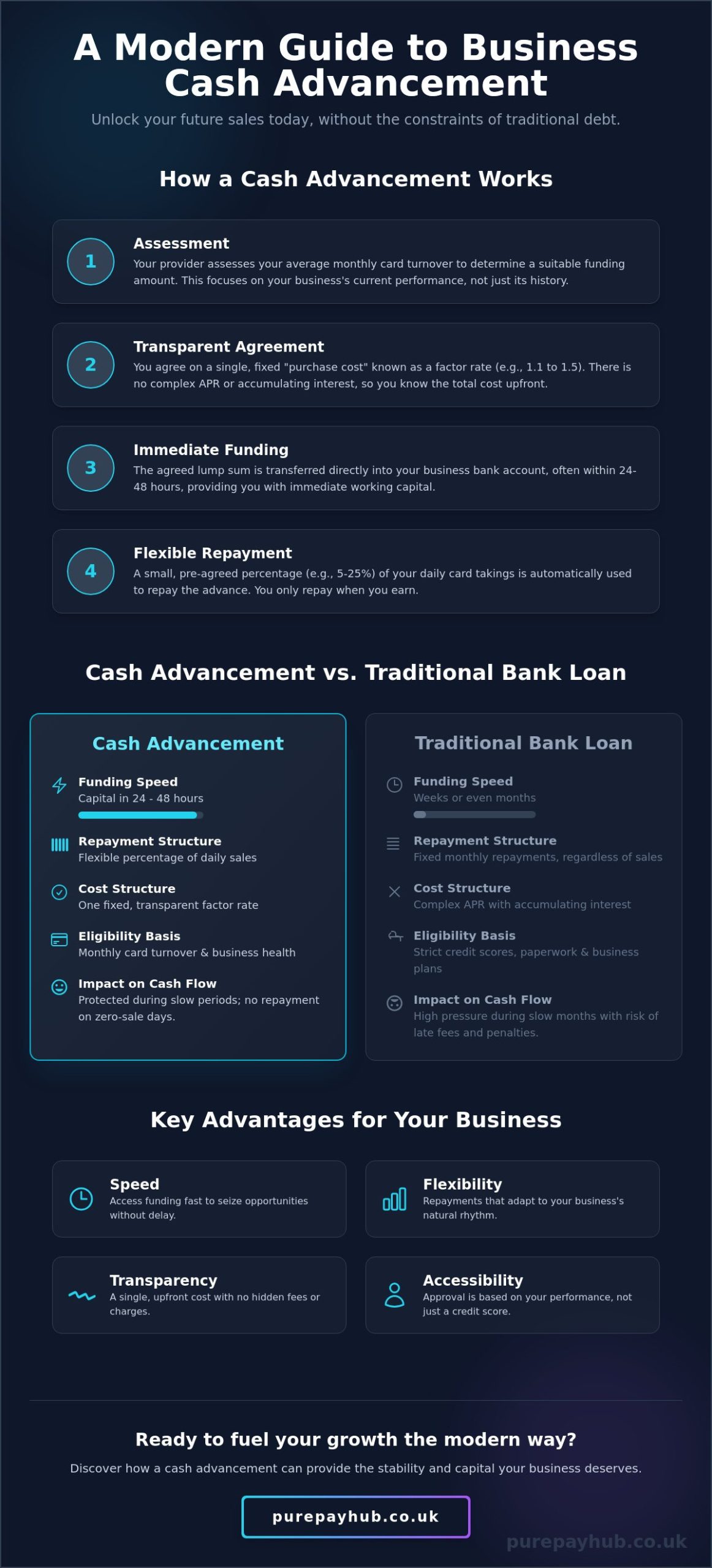
    A merchant advance is a modern funding solution designed specifically for businesses that process payments through card terminals. Unlike a traditional bank loan, which involves borrowing a fixed sum and paying it back with interest, this model is technically a purchase of your future credit and debit card takings. You receive a lump sum of capital upfront, and in exchange, you agree to sell a small portion of your future revenue to the provider. This distinction is vital for understanding What is a Merchant Cash Advance? and why it sits outside the standard regulatory framework of consumer credit. By focusing on the purchase of an asset (your future sales) rather than a debt obligation, providers can offer a level of flexibility that high-street banks simply cannot match. Your card machine provider plays a central role here, acting as the bridge that facilitates the flow of funds without requiring manual monthly transfers. This integrated approach means you don’t need to worry about missing a deadline or managing complex payment schedules.

    The Mechanics of Repayment

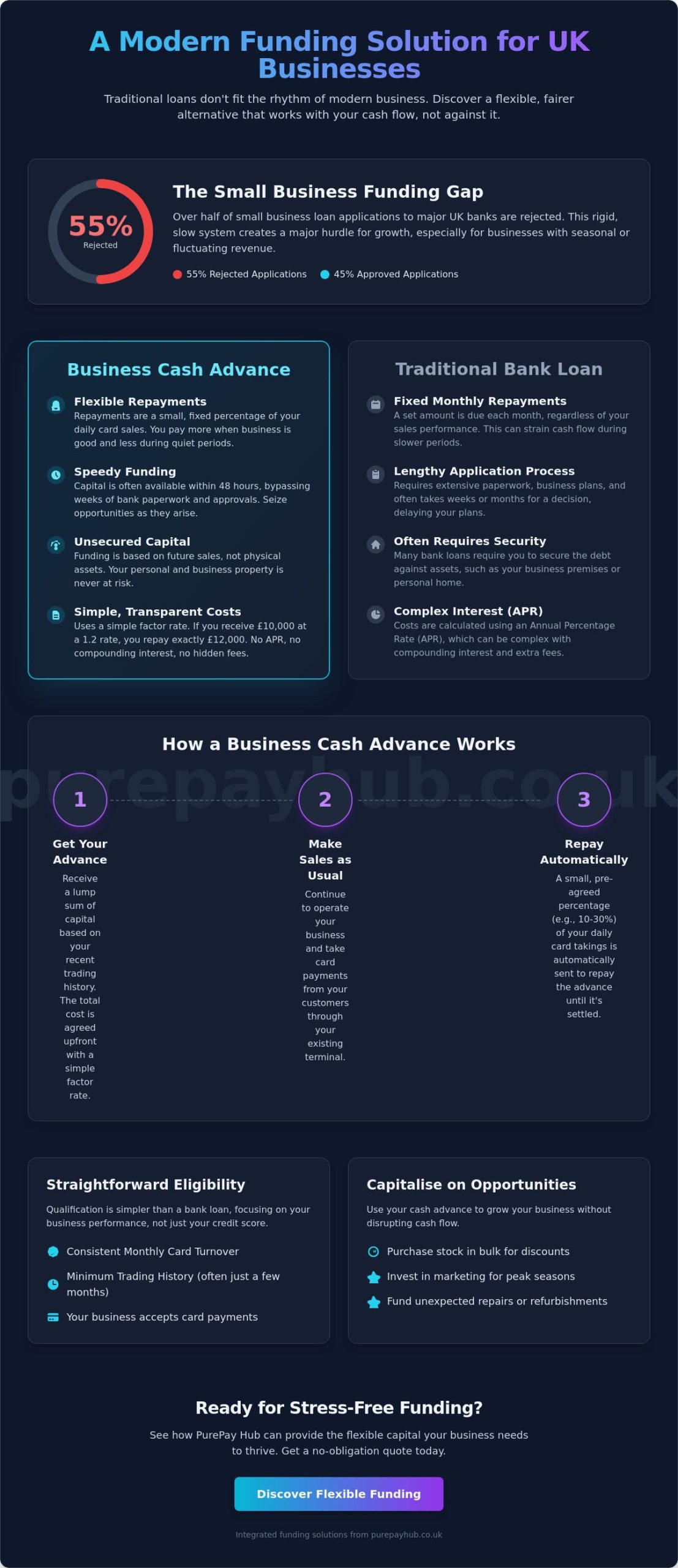
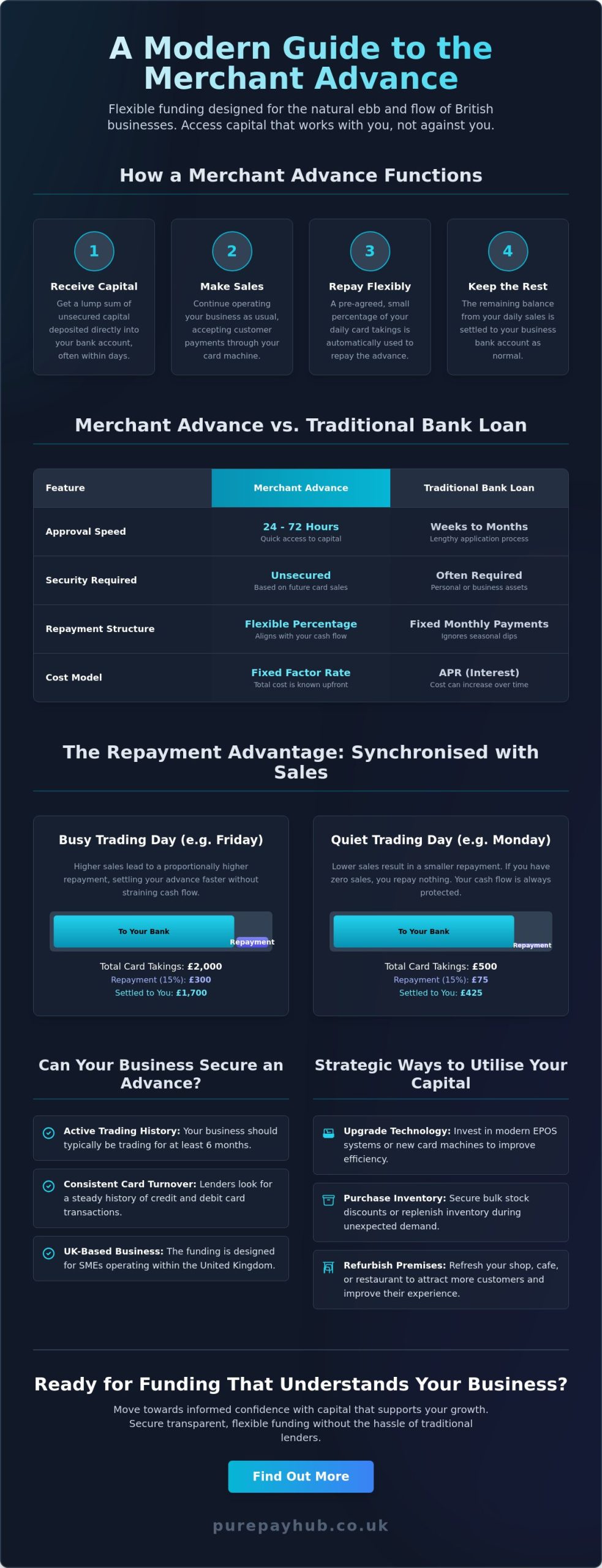
    The beauty of a merchant advance lies in its simplicity. Repayment happens through a “split percentage” taken directly from your daily terminal batches. If you have a busy Friday, you pay back a bit more; if you have a quiet Monday, you pay back less. The system automatically pauses repayments if your business makes no sales on a particular day, ensuring your cash flow remains protected. This removes the stress of fixed monthly costs that often plague seasonal businesses. The “sweep” is the automated mechanism used by payment processors to divert the agreed percentage of daily card takings toward the advance balance before the remaining funds reach your bank account. It’s a hands-off process that lets you focus on running your shop or restaurant while the technology handles the logistics.

    Why Card Turnover is the Primary Metric

    Traditional lenders often demand physical assets or property as collateral. In contrast, providers of a merchant advance prioritise your card transaction history above all else. They look for consistent card behaviour, usually over a six-month period, to assess the health and stability of your business. This approach allows you to secure capital even if you don’t own your premises or have high-value equipment to leverage. Whether you use a Portable Card Machine for tableside service or a Countertop Card Machine at a fixed till, every transaction builds your profile. Modern EPOS Systems provide even deeper insights, using real-time data to refine the advance amount and ensure the funding is sustainable for your specific turnover levels. This data-driven approach removes the guesswork and provides a clearer path to growth for regional merchants who have been overlooked by traditional banks.

    Merchant Advance vs. Traditional Loans: A Comparison

    Traditional banking often feels like a relic of a slower era. You apply for a loan, wait weeks for a decision, and then find yourself tied to a rigid monthly repayment schedule that ignores your actual trading conditions. A merchant advance operates on a completely different timeline. Approval usually takes days rather than weeks. This speed is a cornerstone of UK Alternative Business Finance; it provides a vital lifeline when growth opportunities arise suddenly or stock needs urgent replenishment. You aren’t left waiting in a queue whilst your competitors move ahead.

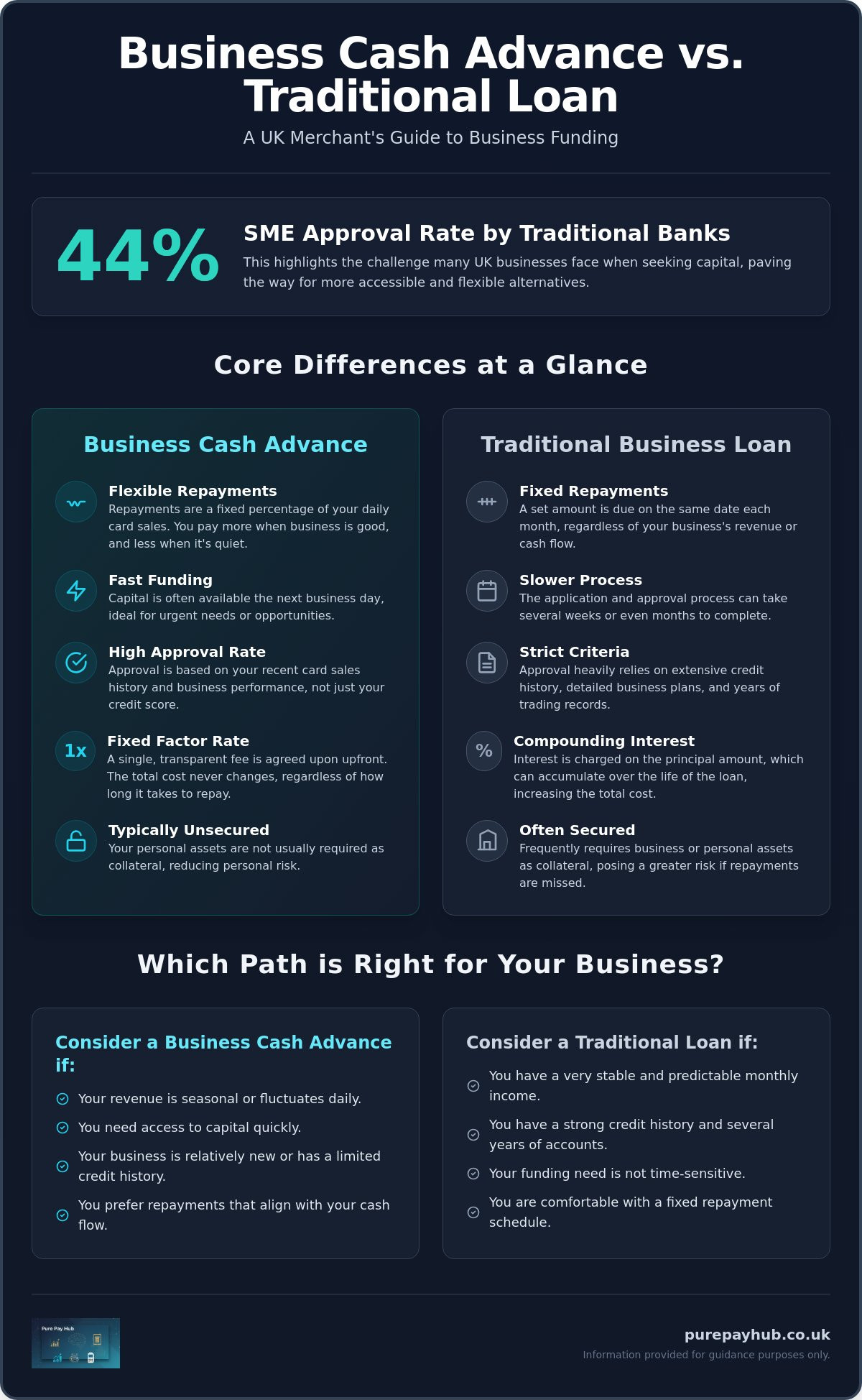
    Most bank loans require tangible collateral, such as property or significant business assets. For many UK SMEs, particularly those in the service or retail sectors, this is a major hurdle. An advance is typically unsecured. Your transaction history serves as the primary security instead of your home or warehouse. There is also the distinct “No Fixed Term” advantage. Since you pay back a fixed percentage of card sales, there is no set end date. If trading is slow, you aren’t penalised for taking longer to settle the balance. It’s a fairer partnership that respects the natural rhythm of your daily turnover.

    Understanding Factor Rates vs. APR

    Banks use Annual Percentage Rates (APR), where interest compounds over time. If you take longer to pay, the cost increases. Advances use factor rates, which are simple multipliers. If you receive an advance with a factor rate of 1.2, your total repayment amount is fixed from the start. This figure never changes regardless of how long the repayment takes. Factor rates offer total cost certainty because the amount you owe is locked in from day one, allowing you to protect your margins with absolute precision.

    The Impact on Your Credit Score

    Applying for traditional credit usually triggers a “hard” search on your file. This can lower your credit score and stay visible to other lenders for months. Many advance providers use “soft” searches for initial quotes, which protects your rating whilst you explore your options. You can also often avoid the heavy personal guarantees that high-street lenders demand. This allows you to maintain your business credit health whilst accessing quick capital for growth. If you want to see how your data can work for you, consider how an integrated EPOS system provides the transparency lenders value during the application process.

    A Complete Guide to Merchant Advance Funding for UK Businesses in 2026

    Eligibility: Can Your Business Secure an Advance?

    Qualifying for a merchant advance is often simpler than business owners expect. Whilst high street banks obsess over personal assets and long-term debt ratios, this model focuses on your actual performance. The primary requirement is a consistent stream of card sales. Most UK lenders require a minimum monthly card turnover to get started. According to verified 2026 industry data, this threshold typically ranges from £1,000 to £10,000 depending on the provider. For instance, 365 Finance generally looks for £10,000 in monthly sales, whereas providers like Liberis may consider businesses with £1,000 in monthly takings.

    The “Six-Month Rule” is another vital benchmark. Lenders usually prefer to see at least six months of trading history to gauge the stability of your revenue. This history matters more than the overall age of your company. It allows the provider to see how your business handles different trading periods. Some specialist providers might even consider as little as three or four months of data if your transaction volume is high. Eligibility spans a wide variety of sectors, including:

    • Hospitality: Restaurants, pubs, and cafes with high daily card volumes.
    • Retail: High street boutiques and convenience stores using a Countertop Card Machine.
    • E-commerce: Online businesses processing payments through an Online Payment Gateway.
    • Service Providers: Hairdressers or garages using a Portable Card Machine for customer convenience.

    Documentation is refreshingly minimal. You won’t need to produce a fifty-page business plan or years of audited accounts. Instead, you simply provide your recent merchant statements. This allows the lender to verify your card behaviour and confirm that a merchant advance is a sustainable choice for your cash flow.

    Calculating Your Funding Potential

    Your funding limit is usually tied directly to your performance. You can typically secure between 1x and 2x your average monthly card turnover. If your shop averages £15,000 in card sales, you might access up to £30,000. Seasonal peaks also play a role. A strong Christmas period or a busy summer season can boost your potential advance limit. Using detailed reports from EPOS Systems is an excellent way to prove this revenue stability to a lender, as it provides a granular view of your growth trends.

    The Application Journey

    The journey from enquiry to funding is built for speed. It starts by securely sharing your transaction data with your chosen provider. This involves a “soft search” on your credit file. Unlike the “hard” searches used by banks, a soft search doesn’t damage your credit score or leave a visible mark for other lenders. Once you’re approved, the timeline is rapid. Many UK businesses receive their funds within 24 to 48 hours. It’s a transparent process designed to get capital into your account without the traditional banking red tape.

    Strategic Ways to Utilise Your Advance in 2026

    Strategic capital deployment is what separates business survival from genuine growth. A merchant advance provides the liquidity needed to act quickly when opportunities arise. Many UK retailers use these funds for inventory management, specifically bulk buying stock to secure better margins from suppliers. By paying upfront, you can often negotiate discounts that far outweigh the cost of the advance itself. This is particularly effective during periods of high inflation or supply chain volatility where stock prices fluctuate rapidly. You aren’t just borrowing; you’re investing in your own profitability.

    Beyond stock, operational buffers are a common use for this capital. You might face an unexpected repair or a looming tax bill that threatens your cash flow. Having access to unsecured funds allows you to resolve these issues without the stress of traditional bank delays. It’s about maintaining stability whilst you focus on daily operations. The flexibility of the model means you can manage these costs without the fear of a fixed monthly repayment hanging over your head during a quiet week.

    Managing Seasonal Fluctuations

    Hospitality businesses often face a sharp decline in revenue during the quiet winter months. A merchant advance is a favourite amongst seasonal retailers because it aligns perfectly with this natural rhythm. You can secure the capital in late autumn to fund marketing campaigns or staff costs. Since repayments are a fixed percentage of card sales, you pay back very little during a slow January. The repayment speed automatically accelerates when your trade picks up in the spring. This synchronisation ensures you aren’t burdened by heavy debts when the till is quiet.

    Investing in Digital Transformation

    Modernising your payment infrastructure is one of the most effective ways to see a long-term ROI. You might use your advance to upgrade to a Portable Card Machine, which allows for faster table turnover in busy restaurants. Alternatively, investing in EPOS Systems provides the data needed to track inventory and customer behaviour with precision. Expanding into e-commerce by integrating an Online Payment Gateway also opens new revenue streams. These upgrades aren’t just costs; they are investments in efficiency that help your business scale. If you’re ready to modernise your setup, you can apply for a Business Cash Advance to fund your digital transition today.

    Securing Transparent Funding with PurePay Hub

    Traditional finance often feels like a series of hurdles. At PurePay Hub, we believe capital should be a catalyst for growth rather than a source of stress. Our commitment to transparency means you will never encounter hidden markups or complex fee structures that cloud your financial planning. We position ourselves as a fair partner to regional business owners. By integrating your funding directly with your card machine service, we turn a merchant advance into a seamless feature of your daily operations. This isn’t just about money; it’s about providing a stabilising force for your business’s finances. We aim to alleviate the frustration business owners feel when dealing with opaque lending practices found elsewhere in the industry.

    Repayment with us is completely invisible. Because our technology is built into your Countertop Card Machine or Portable Card Machine, the agreed percentage is deducted automatically from your daily terminal batches. You don’t need to set up standing orders or manually track deadlines. We understand your daily transaction volume because we process it. This deep integration allows us to offer next-day funding options in many cases. It ensures you keep your momentum high when you need to restock or repair equipment. You focus on the customer; our systems handle the logistics of the repayment process behind the scenes.

    A Partner-Led Approach to Finance

    We move away from the impersonal third-person phrasing of traditional banking. Our approach is built on direct partnership. We organise your funding based on real-time card data, which means our offers are always grounded in the reality of your turnover. You get a supportive business ally instead of a distant financial institution. Whether you are using our Online Payment Gateway or physical terminals, you have direct access to expert support for all your merchant service needs. We pride ourselves on being a reliable, local expert that acts as a supportive business partner for UK merchants across every sector.

    Getting Started Today

    Our process is designed to save you hours of paperwork. We don’t demand exhaustive business plans or complex historical audits. We look at your current performance and your future potential through your transaction history. It’s a disciplined, efficient way to access the capital your business deserves. You can move from curiosity to confirmed funding with minimal friction. This no-nonsense approach prioritises clarity over corporate jargon, allowing you to make decisions with informed confidence. Checking your merchant advance eligibility is the first step toward a fairer financial future for your business.

    Check your merchant advance eligibility with PurePay Hub today.

    Empower Your Business Growth in 2026

    Success on the British high street requires capital that moves at the speed of your ambition. You’ve seen how a merchant advance provides a flexible alternative to rigid bank loans by synchronising repayments with your actual daily turnover. It’s a solution that respects your cash flow during quiet spells whilst providing the fuel needed for seasonal growth or digital transformation. By focusing on your card transaction history rather than physical assets, you can access the funding you need without the stress of personal guarantees or long approval queues.

    Choosing a partner who values transparency is the final piece of the puzzle. At PurePay Hub, we prioritise clarity and efficiency to help you scale with confidence. With debit card rates from 0.3% and next-day funding available, you can maintain your momentum without worrying about hidden markups or exit fees. We’re here to act as your supportive business ally, ensuring your finance works as hard as you do.

    Apply for a transparent Merchant Advance with PurePay Hub and take the next step toward a more stable, prosperous future today.

    Frequently Asked Questions

    Is a merchant advance the same as a bank loan?

    No, a merchant advance is not a loan in the traditional legal sense. It is a commercial agreement where a provider purchases a portion of your future card revenue at a discount. Unlike a bank loan with fixed monthly interest, this model synchronises with your daily turnover to ensure repayments are always affordable.

    How much does a merchant advance cost in the UK?

    Costs are determined by a factor rate rather than an annual percentage rate. In the UK market, these rates typically range between 1.1 and 1.5 based on your risk profile. This means you know the total cost of capital from day one; it won’t increase even if your repayment takes longer than expected.

    What happens if my card sales stop for a few days?

    Your repayments will simply pause until your sales resume. Because the repayment mechanism only triggers when a transaction occurs on your card terminal, there is no risk of defaulting during quiet periods. This flexibility protects your cash flow whilst you focus on getting back to business.

    Can I get a merchant advance with a poor credit score?

    Yes, businesses with less-than-perfect credit scores can often still qualify for a merchant advance. Providers prioritise your recent card terminal behaviour and turnover stability over historical credit data. A soft search is usually performed during the application to protect your credit file from visible marks.

    Do I need to change my card machine provider to get an advance?

    Not necessarily, but using an integrated partner often simplifies the process. At PurePay Hub, we link the funding directly to our Countertop Card Machine or Portable Card Machine. This integration ensures that the repayment process remains completely hands-off and invisible to your daily operations.

    How long does it take to receive the funds?

    You can typically expect to receive the funds within 24 to 48 hours of approval. The digital nature of modern payment processing allows for rapid data verification and automated transfers. This speed makes it an ideal choice for urgent stock purchases or unexpected repairs.

    Are there any hidden fees or late payment penalties?

    There are no late payment penalties because there is no fixed repayment schedule. Transparent providers also avoid hidden markups or exit fees. You simply pay back the agreed factor rate through a small percentage of your daily sales until the balance is cleared.

    Is a merchant advance secured against my home or assets?

    No, these advances are generally unsecured. You don’t need to provide personal assets like your home or vehicle as collateral. The security for the provider is your proven track record of card sales, making it a lower-risk option amongst small business owners who don’t own property.

  • Merchant Cash Advance vs Business Loan: 2026 UK Funding Guide

    Merchant Cash Advance vs Business Loan: 2026 UK Funding Guide

    Why should your business be forced to pay a fixed monthly fee during a quiet trading week just because you needed capital six months ago? It is a common frustration for merchants who find that traditional bank structures don’t account for the natural ebb and flow of British high street trade. When you compare a merchant cash advance vs business loan UK providers offer very different paths that directly impact your monthly cash flow.

    We know that rigid repayment schedules and complex applications feel like a barrier rather than a bridge to growth. You need a funding partner that prioritises transparency over fine print and offers repayments that actually breathe with your daily card sales. This guide explores the critical differences between these models to help you secure the fairest funding for your business. We will show you how to access capital within 48 hours and explain why a sales-aligned repayment structure might be the stabilising force your finances need in 2026.

    Key Takeaways

    • Learn how to choose between a merchant cash advance vs business loan UK by matching your repayment structure to your actual daily card sales.
    • Understand the “pay-as-you-trade” model that automates deductions through your card terminal, protecting your cash flow during quieter trading periods.
    • Discover the specific eligibility criteria that allow merchants with limited trading history or varied credit scores to access capital in as little as 48 hours.
    • Identify high-impact use cases for cash advances, such as seasonal stock replenishment and emergency repairs, where speed and flexibility are paramount.
    • Explore the benefits of centralising your payment processing and funding through PurePay Hub to ensure total transparency and a simplified financial overview.

    Defining the Two Pillars of UK SME Finance

    For decades, the high street bank manager held the keys to business growth. That era has ended. Today, UK SMEs are increasingly looking beyond traditional banking halls to find capital that matches their modern trading patterns. With the Bank of England base rate sitting at 4.75% as of March 2026, the cost of borrowing has become a central concern for every shop owner and restaurateur. This shift toward alternative finance isn’t just about speed; it’s about finding a model that doesn’t penalise a business for having a slow month.

    When you evaluate a merchant cash advance vs business loan UK options, you’re essentially choosing between a rigid financial contract and a flexible sales partnership. Your merchant service provider often acts as the bridge here. They use your existing card terminal data to prove your business’s health, bypassing the mountain of paperwork that traditional lenders usually demand. It’s a no-nonsense approach that prioritises your actual trading history over a static credit score.

    What is a Merchant Cash Advance?

    Technically, a Merchant Cash Advance (MCA) is not a loan. It’s a commercial transaction where you sell a specific portion of your future credit and debit card sales in exchange for an immediate lump sum. This distinction is vital. Because it’s an advance on sales rather than a debt, there are no fixed monthly deadlines. If your sales drop during a quiet week, your repayments drop too. This flexibility reduces the financial anxiety that often keeps business owners awake at night. It’s also an unsecured form of capital. You don’t need to put your home or commercial property at risk to secure the funds.

    The Traditional Business Loan Explained

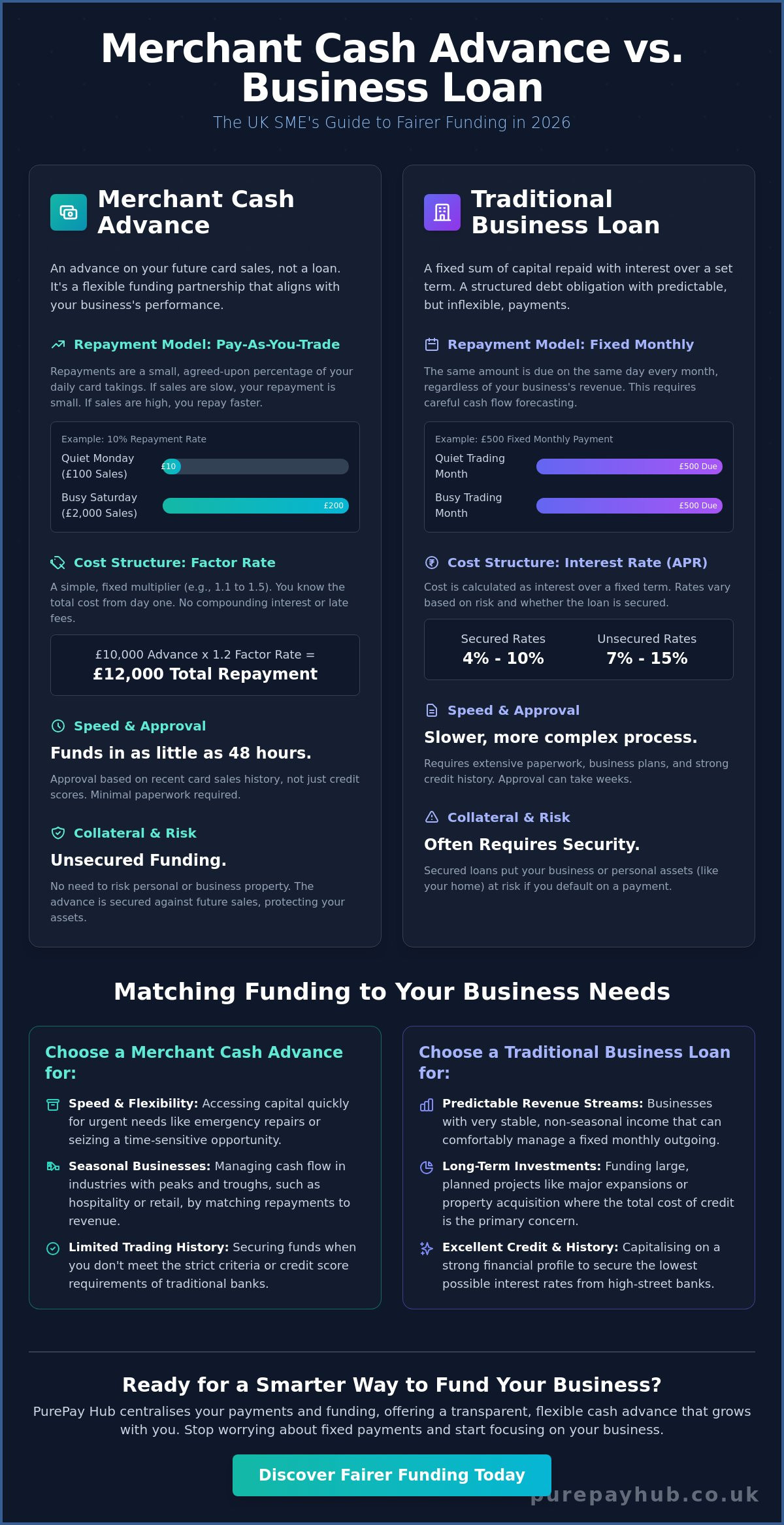
    A business loan follows a more familiar structure. You receive a principal amount and repay it, plus interest, over a set period, typically between one and five years. These payments are fixed. Whether you have a record-breaking month or your shop is closed for renovations, the lender expects the same amount on the same day. Most qualified UK SMEs find secured loan rates between 4% and 10%, whilst unsecured rates from high-street banks range from 7% to 15%. This model provides a clear end date for your debt, but it offers zero wiggle room when cash flow gets tight. It remains a popular choice for long-term investments where the total cost of credit is the primary concern.

    Analysing Repayment Structures: Fixed vs Flexible

    The fundamental difference between a merchant cash advance vs business loan UK business owners must understand lies in the repayment mechanics. One is a rigid debt. The other is a percentage of your success. Traditional loans are built on time, requiring you to pay back a set amount every month regardless of your bank balance. A merchant cash advance (MCA) is built on sales. It uses a pay-as-you-trade model that aligns perfectly with the reality of high-street commerce.

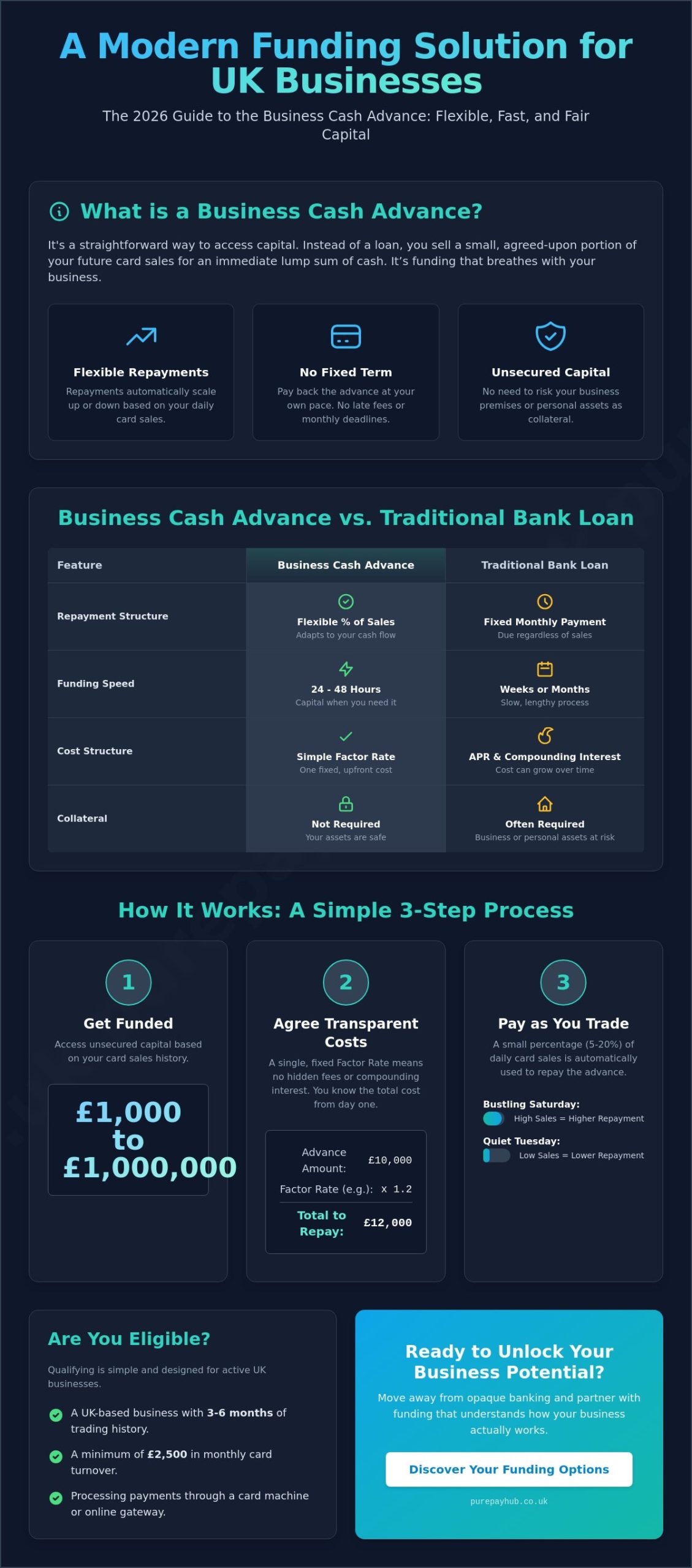
    To understand the cost, you must look at the factor rate rather than an APR. While bank loans use interest that can compound, MCAs use a fixed multiplier. Factor rates typically range between 1.1 and 1.5. If you receive an advance of £10,000 at a 1.2 factor rate, you pay back exactly £12,000. There are no hidden fees or late penalties because the total cost is agreed upon at the start. This transparency allows you to calculate your business cash advance costs with total certainty before you commit.

    How MCA Repayments Scale With Your Sales

    Imagine a rainy Monday in a seaside cafe. Footfall is low and card sales barely reach £100. With an MCA, if your agreed repayment is 10%, you only pay £10 that day. Fast forward to a sunny Saturday where sales hit £2,000; your repayment naturally scales to £200. This is known as the “sweep” method. The payment processor automatically splits the daily takings at the point of sale. You don’t need to manage the admin or set up standing orders. If you take zero sales on a bank holiday, you pay zero pounds. This structure removes the psychological weight of a looming monthly deadline.

    The Rigidity of Business Loan Schedules

    Traditional loans operate on a calendar, not a sales report. Whether you choose a high-street bank or a structured programme like UK Government Start Up Loans, you face a fixed monthly outgoing. These loans are currently fixed at a 7.5% interest rate for 2026, which is excellent for businesses with highly predictable, non-seasonal income. However, for most merchants, this rigidity creates risk. A single underperforming month can lead to a technical default if you haven’t set aside enough cash to cover the fixed instalment. Loans demand precise forecasting, whereas advances adapt to your actual performance.

    Merchant Cash Advance vs Business Loan: 2026 UK Funding Guide

    The Critical Differences: Eligibility and Transparency

    Securing capital shouldn’t feel like an interrogation. Yet, for many merchants, the traditional bank application process is exactly that. When you weigh up a merchant cash advance vs business loan UK lenders generally fall into two camps: those who look at your past and those who look at your potential. Traditional banks demand a “heavy” documentation trail, often requiring three years of audited accounts and a near-perfect credit score. PurePay Hub takes a different approach. We focus on the health of your daily card sales, making the process faster and far more inclusive.

    The core of this transparency lies in how we evaluate your business. Rather than obsessing over personal financial history, we prioritise your merchant statement history. This data provides a real-time picture of your business performance. It shows us your consistency and your customer volume. If you want to see how this fits into the broader financial ecosystem, you can read the official government definition of a Merchant Cash Advance. This model ensures that your funding is based on what your business actually does, not just what a credit agency says about you.

    Credit Scores and Approval Rates

    Will a poor credit score stop you from growing? In the world of high-street banking, the answer is often yes. However, MCA providers typically look for just 3–6 months of consistent card processing behaviour. We understand that a business owner’s personal credit history doesn’t always reflect the strength of their shop or restaurant. This makes a cash advance an accessible option for newer businesses that have been trading for at least six months. Approval rates in this sector are significantly higher because the risk is tied to your future sales, which we can see evidence of in your daily terminal activity.

    Understanding Factor Rates vs APR

    Transparency is our standard. Traditional loans use an Annual Percentage Rate (APR), which can be confusing when applied to short-term, flexible funding. Instead, we use a Factor Rate. This is a simple multiplier applied to the total sum you receive. For example, a 1.2x factor rate on a £10,000 advance means you pay back £12,000 in total. There are no compounding interest charges or hidden monthly fees to worry about. A factor rate provides a fixed total cost of capital that never increases, regardless of how long it takes to repay. This clarity allows you to plan your stock purchases or marketing campaigns without fearing a spike in costs if sales fluctuate.

    Strategic Suitability: Matching Funding to Your Business Model

    Choosing the right path when comparing a merchant cash advance vs business loan UK wide depends entirely on your specific objective. It isn’t just about finding the lowest headline rate. It’s about the strategic fit for your daily operations. If you need to fix a broken oven in a busy restaurant or stock up for a summer festival, the “cost of waiting” for a traditional bank can far outweigh the cost of capital. Losing two weeks of trading whilst waiting for a bank manager’s approval is a heavy price to pay for a slightly lower interest rate.

    A simple framework helps determine which model suits your current needs. Ask yourself: will this capital generate immediate revenue or solve an urgent bottleneck? If the answer is yes, a flexible advance is often the superior choice. Use this quick guide to align your funding with your goals:

    • Short-term revenue drivers: Use a cash advance for stock replenishment, seasonal marketing, or emergency repairs.
    • Long-term infrastructure: Use a traditional loan for commercial property purchases or multi-year research projects.
    • Cash flow management: Use an advance to bridge the gap during quiet months without adding fixed debt.

    Why Seasonal Businesses Favour Merchant Advances

    Hospitality and retail merchants face unique pressures that traditional lenders often ignore. The “January dip” often follows a frantic December, leaving cash reserves low just when you need to prepare for the spring. An MCA acts as a vital buffer during these fluctuations. Because providers can often deliver funding within 24 to 48 hours, it’s the ideal solution for sudden stock opportunities or equipment failure. You don’t have to worry about fixed repayments during your quietest weeks. Your funding behaves like your business; it scales down when the streets are empty and catches up when the tourists return.

    When a Traditional Loan Remains the Better Choice

    For long-term capital projects, a traditional loan is still a formidable tool. If you’re a B2B service provider who doesn’t process high volumes of card payments, an MCA won’t be an option. Loans are also better suited for purchasing commercial property or investing in significant structural renovations. Businesses with substantial assets can often leverage them to secure interest rates between 4% and 10%. This lower cost of credit makes sense when you have the luxury of time and a highly predictable income stream that won’t be shaken by seasonal shifts.

    If your business relies on daily card transactions and you need a partner that understands your rhythm, you can apply for a business cash advance today and receive a transparent decision in hours.

    Streamlining Your Cash Flow with PurePay Hub

    Most financial institutions treat your card processing and your business funding as two entirely separate worlds. This fragmentation creates unnecessary friction for busy merchants. When you compare a merchant cash advance vs business loan UK providers often make you jump through hoops with different companies. PurePay Hub removes this complexity. We bring your terminal and your capital under one roof. It’s a modern approach that turns your daily sales data into a powerful growth tool.

    Integrated Payments and Funding

    Our card machines do more than just process transactions. They provide the real-time insights needed for instant funding decisions. Because we see your trading volume directly, we don’t need to ask for stacks of bank statements or audited accounts. This integration allows for a seamless “pay-as-you-trade” experience. You get one clear monthly statement that covers both your processing fees and your advance repayments. We keep our debit rates starting from 0.3%, ensuring that more of your hard-earned profit stays exactly where it belongs; in your business bank account.

    Having your funding source and your card terminal linked simplifies everything. There are no manual transfers to manage and no risk of missing a fixed deadline. The system handles the split automatically. This gives you next-day access to funds when you need them most, providing a level of agility that traditional loans simply cannot match. It is about making your finances work as hard as you do.

    Getting Started: The Next Steps

    We believe in straight-talking and calm advocacy. We aren’t here to push debt; we’re here to help you choose the route that fits your actual turnover. Our application process is designed to be as efficient as your business. It follows a simple three-step path: Connect your terminal data, Assess your eligibility with our team, and receive your Fund. It’s a no-nonsense consultation that puts you in control of your cash flow.

    If you’re ready to move away from the rigid structures of the past, we’re here to help. You can Explore our Business Cash Advance options today and discover how integrated funding can stabilise your finances. Whether you’re looking to upgrade your EPOS system or simply need a buffer for a quiet month, we’ll find a solution that breathes with your business.

    Securing a Fairer Financial Future for Your Business

    Choosing between a merchant cash advance vs business loan UK wide comes down to how you want your capital to behave. If your business thrives on daily card sales, you shouldn’t be tethered to a rigid monthly debt that ignores your quietest weeks. You’ve seen how flexible repayments and inclusive eligibility can remove the barriers to growth that traditional banks often maintain. By aligning your funding with your actual turnover, you protect your cash flow whilst keeping your momentum high.

    PurePay Hub is here to act as your supportive business ally. We offer a transparent approach with debit card rates from 0.3% and next-day funding as standard. There are no hidden markups or corporate jargon to decode; just clear, honest service designed for local merchants. It’s time to trade on your own terms with a partner that values your success as much as you do.

    Ready to take the next step? Get a transparent quote for your business funding today and see how simple integrated finance can be. We look forward to helping your business flourish throughout 2026 and beyond.

    Frequently Asked Questions

    What is the main difference between a merchant cash advance and a business loan?

    The primary difference involves how you repay the capital. A traditional loan requires fixed monthly instalments regardless of your income. In contrast, a merchant cash advance is a purchase of future card sales where repayments fluctuate based on your daily takings. This makes the merchant cash advance vs business loan UK choice a matter of choosing between rigid debt and flexible sales-linked funding that protects your cash flow.

    Can I get a merchant cash advance with a poor credit score in the UK?

    Yes, you can often secure funding even with a less-than-perfect credit history. MCA providers prioritise your recent card processing volume over your historical credit score. If your business has been trading for at least six months and shows consistent card turnover, you are likely to be eligible. This inclusive approach focuses on your current business health rather than past financial hurdles that might stop a bank loan.

    How much does a merchant cash advance cost compared to a loan?

    Traditional loans typically have lower headline interest rates, with secured APRs often between 4% and 10% in 2026. Merchant cash advances use a factor rate, usually between 1.1 and 1.5, which can result in a higher equivalent APR. You are essentially paying for the convenience of speed and the flexibility of repayments that drop when your sales do. It is a trade-off between the lowest cost and the best cash flow protection.

    Do I need to change my card machine provider to get an MCA?

    You don’t always need to switch, but using an integrated provider simplifies the process significantly. When your card terminal and funding source are under one roof, the data flows seamlessly for faster decisions. We can often work with your existing setup, but our own terminals ensure you benefit from our lowest debit rates starting from 0.3% and automated, hassle-free repayments that require no manual admin.

    What happens to my repayments if my business has a slow month?

    Your repayments automatically decrease during a slow month. Because the provider takes a fixed percentage of your daily card sales, you only pay back what you can afford based on your actual income. If you have a week with zero sales, you make zero repayments. This pay-as-you-trade model removes the pressure of finding a fixed sum when footfall on the high street is unexpectedly low.

    How long does it take to get the money in my bank account?

    You can typically access the funds within 24 to 48 hours of approval. This is significantly faster than traditional bank loans, which can take weeks to process. The streamlined application focuses on your digital merchant statements, allowing for rapid assessment. Once you sign the agreement, the lump sum is transferred directly into your business bank account, providing the agility needed for emergency repairs or stock opportunities.

    Are there any hidden fees or late payment penalties with an MCA?

    There are no late payment penalties or hidden markups because there are no fixed deadlines. The total cost of the advance is agreed upon at the start using a transparent factor rate. Since your repayments are a percentage of sales, you can’t be late as long as you continue to process card payments. This structure provides total clarity regarding the total cost of credit from the very first day.

    Is a merchant cash advance regulated by the FCA?

    Merchant cash advances are not currently regulated by the Financial Conduct Authority (FCA) in the UK. This is because they are technically a purchase of future receivables rather than a traditional consumer or business loan. Because of this, it’s essential to partner with a transparent provider that prioritises honesty and clear fee structures. Conduct thorough due diligence to ensure your funding partner adheres to high standards of fairness.