
What if the secret to clearing your slowest-moving stock and doubling your average basket value was already sitting on your hard drive, waiting to be read? Many UK business owners feel buried under complex reports that offer plenty of numbers but very little direction. It is frustrating to watch your capital sit on a shelf in the form of unsold inventory, especially when you are also trying to manage staff schedules during unpredictable quiet periods. You likely suspect that using EPOS data to increase sales is possible, but the path from raw data to real-world profit often feels blocked by technical jargon.
We believe that your transaction history should be your greatest asset, not a source of stress. This guide will show you how to transform those daily figures into a clear, actionable roadmap for your business. You will learn how to leverage the latest 2026 standards, including the Data (Use and Access) Act 2025, to optimise your stock levels, reduce waste, and build a loyalty programme that keeps your customers coming back. We are going to break down exactly how to turn your transaction records into a blueprint for a more profitable and efficient shop floor.
Key Takeaways
- Transition from reactive bookkeeping to proactive revenue generation by treating your transaction history as a digital blueprint for growth.
- Identify your “Hero” products and eliminate “Dead” stock to ensure your business capital is always working for you.
- Master the art of predictive analytics to prepare for seasonal peaks and avoid the hidden costs of the “Out of Stock” trap.
- Implement four practical strategies, including using EPOS data to increase sales through targeted promotions and customer loyalty programmes.
- Understand the critical role of seamless payment integration in maintaining data accuracy and protecting your hard-earned profit margins.
Beyond the Transaction: Why Your EPOS Data is an Untapped Revenue Stream
Every time a customer taps their card or requests a receipt, they leave a digital trail. This is the essence of your Point of Sale (POS) system. It is far more than a digital cash drawer. It is a living record of preferences, peak trading times, and inventory movement. In the 2026 UK market, the businesses that thrive are moving away from reactive bookkeeping. They no longer look at reports once a month just to see what happened. Instead, they are using EPOS data to increase sales by predicting what will happen tomorrow.
The 2026 retail landscape is more regulated and competitive than ever. With new Electronic Sales Suppression (ESS) standards in place since June 2026, the accuracy of your records is no longer optional. It is a legal requirement. This shift actually benefits legitimate businesses. It forces a level of transparency that makes using EPOS data to increase sales a natural next step for any principled owner. Relying on a “gut feeling” is a common trap. You might think Friday afternoons are your busiest time because the shop feels crowded, but your data might show that Tuesday mornings actually generate higher-value transactions. National chains use this type of analysis to win. To compete, you need that same level of clarity.
Ignoring your data comes with a heavy price tag. It leads to the “Out of Stock” trap, where you lose revenue because a popular item isn’t on the shelf. Conversely, it results in overstocking products that simply don’t move, tying up your vital cash flow. You might also find yourself understaffed during a sudden rush or paying for idle hands during a quiet spell. These inefficiencies quietly drain your profit margins.
The Anatomy of a High-Performing EPOS System
Modern EPOS Systems are built on the synergy between hardware and software. Your card machine should never be a separate island of information. Whether you use a Countertop Card Machine or a Portable Card Machine, it must sync instantly with your central software. Real-time syncing ensures you aren’t making decisions based on yesterday’s news. This integration centres the customer experience whilst collecting the vital metrics you need to grow. It allows for faster checkouts and more accurate stock counts simultaneously.
Moving from “Ringing Up” to “Analysing Up”
Most businesses use their till for “ringing up” sales. Strategic owners use it for “analysing up” their entire operation. There is a massive gap between simply processing a payment and leveraging that interaction to drive a second purchase. Transparency in your data builds a foundation of trust and financial health. It allows you to see exactly where your margins are being squeezed and where cross-selling opportunities are being missed. EPOS data is the primary driver of modern SME competitive advantage, transforming every transaction into a strategic building block for long-term growth. If you are looking to move your records to a system that supports this level of insight, you can learn more about Switch My Books to facilitate a smooth migration.
The Three Pillars of EPOS Analytics: What to Track to Optimise Growth
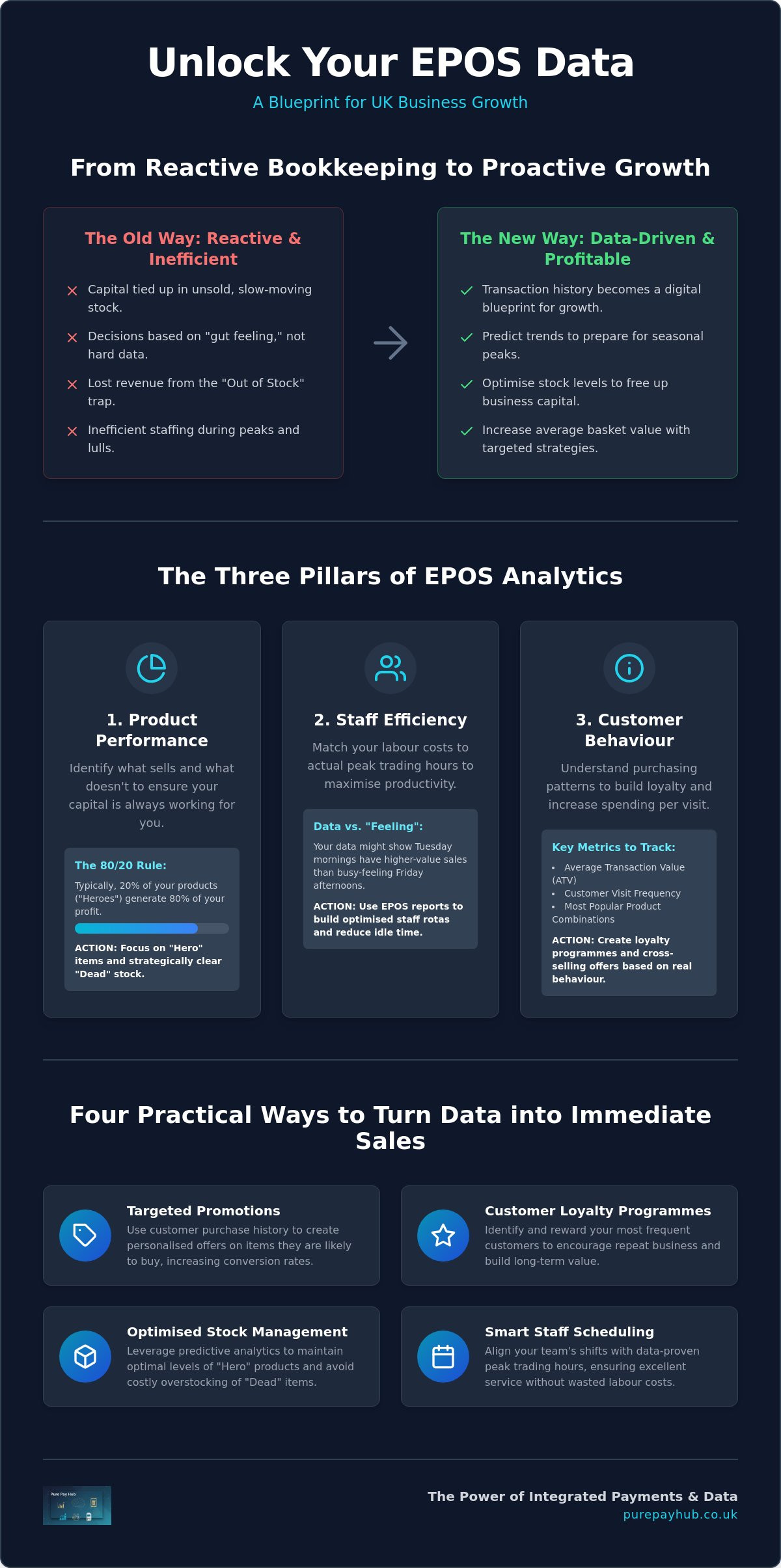
Data without focus is just noise. To move from basic transaction recording to strategic growth, you must categorise your metrics into three distinct pillars. These pillars allow you to see exactly where your revenue is coming from and where your capital is being wasted. By using EPOS data to increase sales, you transform your till from a simple payment point into a powerful diagnostic tool. This structured approach ensures you aren’t just looking at the total takings at the end of the day, but understanding the mechanics behind every pound earned.
The first pillar is Product Performance. This involves identifying your “Hero” products, the items that drive the majority of your profit, and your “Dead” stock, which sits on shelves and ties up your cash flow. The second pillar is Staff Efficiency. This focuses on matching your labour costs to actual peak trading hours. Finally, the third pillar is Customer Behaviour. This uses customer data analytics to track Average Transaction Value (ATV) and visit frequency. When you consolidate these pillars, you gain a holistic view of your business health that allows for confident decision-making.
Identifying Your Most Profitable Items
The 80/20 rule is a fundamental principle for UK merchants. It suggests that 20% of your products likely drive 80% of your total profit. Your EPOS system can verify this instantly. High-volume items are often mistaken for best sellers, but if their margins are slim, they might not be your most valuable stock. By performing a “basket analysis,” you can see which products are frequently bought together. This allows you to organise your shop floor or menu to encourage cross-selling. If data shows that customers who buy item A almost always buy item B, placing them near each other is a simple way of using EPOS data to increase sales without spending a penny on marketing.
Optimising Your Workforce with Labour-to-Sales Ratios
Staffing is often your largest overhead. Using heat maps from your EPOS data allows you to identify exactly when you need more hands on deck. You can reduce “dead time” by organising staff breaks and administrative tasks during data-verified lulls. This ensures you are never understaffed during a sudden rush or paying for idle labour during quiet periods. You can also motivate your team with data-driven sales targets. Tracking performance allows you to reward your most efficient workers and identify where training is needed. Finding the right EPOS Systems is the first step toward gaining this level of operational clarity. It turns your workforce into a lean, data-driven team that directly contributes to your bottom line.
Predictive vs Reactive: Analysing Trends to Prevent Lost Sales
Reactive management is a common cycle for many independent merchants. You notice a shelf is empty, you order more, and you wait for the delivery. By the time the stock arrives, the peak has often passed. This is the “Out of Stock” trap. It costs you more than just a single transaction. It damages customer trust and pushes them toward your competitors. Using EPOS data to increase sales means breaking this cycle. You use your historical figures to see the surge coming before it hits your shop floor.
Your transaction history is a map of consumer behaviour. By calculating the true cost of lost sales, you see the urgency of predictive ordering. Modern systems allow you to set automated stock alerts. These triggers notify you when inventory hits a specific level, ensuring you never face an empty shelf during a busy weekend. You should also consider external factors. A local festival or a sudden heatwave in the UK can shift your EPOS trends overnight. High-performing businesses track these variables to ensure they are always prepared and never miss a revenue opportunity.
Forecasting for Success
Building a 12-month sales calendar is essential for stability. You should use your 2025 data to prepare for 2026 peaks. According to the Office for National Statistics, retail sales volumes in Great Britain rose by 1.2% in May 2026. This type of growth requires careful planning. Adjust your stock levels to match these shifting consumer spending patterns whilst maintaining your margins. Predictive analysis is the bridge between survival and scaling.
Using Data to Secure Growth Capital
Your EPOS turnover data is a powerful tool for securing funding. Many traditional lenders are hesitant to support small businesses without extensive collateral. However, your data tells a different story. It shows consistent revenue and reliable customer interest. This makes your business a prime candidate for a Business Cash Advance. Lenders prefer data-rich businesses because the risk is transparent and manageable. It is a fairer way to access the capital you need to expand.
PurePay Hub’s approach to funding is built on this transparency. We look at your actual card sales performance rather than just a credit score. By analysing your real-time transaction volume, we can help facilitate unsecured capital that works with your cash flow. Repayments are typically a small percentage of your daily card takings, meaning you only pay back as you earn. This synergy between data and finance is a practical example of using EPOS data to increase sales by funding the inventory your customers actually want.
Four Practical Ways to Turn Data Insights into Immediate Sales
Turning numbers into revenue requires a shift from observation to execution. You have already identified your “Hero” products and mapped your quiet periods in previous steps. Now, you must use those insights to influence customer behaviour at the point of purchase. Using EPOS data to increase sales is about making small, calculated adjustments that compound over time. Here are four practical steps to start today.
- Step 1: Clear slow-moving stock. Use your inventory reports to identify items that haven’t moved in 30 days. Instead of a store-wide sale, bundle these with a high-margin best-seller to protect your overall profit whilst clearing shelf space.
- Step 2: Reward your best customers. Implement a loyalty programme that identifies your top 10% of spenders. Offer them exclusive early access to new ranges or tailored rewards based on their specific purchase history.
- Step 3: Prompt the upsell. Configure your system to show “frequently bought with” prompts to your staff. This simple reminder ensures they never miss a chance to suggest a relevant add-on whilst the customer is already at the till.
- Step 4: Use dynamic pricing. If your heat maps show a consistent lull on Tuesday afternoons, create a “Flash Sale” for that specific window. This drives footfall and keeps your staff productive during verified quiet periods.
Crafting Promotions That Actually Work
A common mistake for many UK merchants is the “blanket discount.” Slashing prices across the board devalues your brand and erodes your margin. Data-led offers are far more surgical. Use your system to see which specific deals your customers actually favourite. If a “buy one get one half price” offer on a specific line drives more total revenue than a flat 20% discount, the data has spoken. Testing and measuring these variations allows you to refine your strategy until every promotion is a verified winner.
The Power of Personalisation
Modern retail thrives on personalisation. By integrating CRM data into your EPOS, you can send tailored offers via email or SMS that resonate with the individual. If a customer only ever buys vegan products, sending them a discount on steak is a wasted interaction. Recognising top-tier customers allows you to increase their lifetime value through targeted appreciation. You should also consider your store layout. Organise your shelves based on customer flow data to encourage impulse buys near the checkout. If you want to start using EPOS data to increase sales with these advanced tools, explore our integrated EPOS Systems to see how we can support your growth.
Integrating Payments and Data: The PurePay Hub Advantage
Data is only as good as its accuracy. If your staff are manually typing transaction totals into a standalone till, you are inviting human error into your records. A single mistyped decimal point can skew your entire monthly report. By ensuring a seamless link between your card machine and your EPOS system, you protect the integrity of your insights. This integration is the final piece of the puzzle when using EPOS data to increase sales. It saves your team hours of administrative work each week, allowing them to focus on serving customers rather than reconciling receipts.
At PurePay Hub, we prioritise transparency. Our merchant accounts are designed to be a stabilising force for your finances. When you focus on using EPOS data to increase sales, the quality of your payment processor becomes your greatest asset. We offer low-rate processing, starting from 0.3% for debit card transactions and 0.5% for credit card transactions. This no-nonsense approach ensures you keep more of your hard-earned profit whilst gaining access to powerful analytics. When your payment tech and data work in harmony, your business becomes more efficient and more predictable.
Speed is vital in the 2026 retail environment. We provide next-day access to your funds, turning your data-driven sales into usable cash flow instantly. You don’t have to wait days for your money to clear. This immediate access allows you to act on the insights you’ve gathered, such as restocking a popular item or funding a new promotion without delay. It bridges the gap between seeing a trend and profiting from it.
Transparent Fees, Powerful Insights
We avoid the murky fee structures used by traditional banks. Our Countertop Card Machine and Portable Card Machine units feed directly into your sales reporting. This creates a centralised view of your business health. You can process transactions at high speed whilst maintaining full PCI compliance, knowing that your customer data is secure and your records are untainted by hidden markups. This level of clarity allows you to make decisions with informed confidence.
Taking the Next Step
Switching to a provider that values your growth is a straightforward process. Our onboarding for UK SMEs is designed to be simple and efficient. We act as your supportive business partner, helping you upgrade your payment tech without the stress. Enquire today to see how our EPOS integrations can boost your turnover.
Transform Your Transaction Data into Future Growth
The path to a more profitable 2026 starts with the information you already hold. By moving from reactive bookkeeping to proactive analysis, you turn every customer interaction into a strategic advantage. You now have the steps to identify high-margin products, optimise your workforce, and launch promotions that actually resonate with your local community. Using EPOS data to increase sales isn’t just a technical upgrade; it’s a commitment to the long-term health and transparency of your business.
At PurePay Hub, we are ready to act as your reliable business partner. We provide the tools you need to succeed without the burden of complex fee structures or hidden markups. With debit card rates from 0.3% and next-day funding as standard, we ensure your cash flow remains as healthy as your data insights. You deserve a payment partner that values your growth as much as you do. Our modern systems are designed to simplify your operations whilst protecting your hard-earned margins.
Take control of your turnover today. Discover how PurePay Hub’s integrated EPOS solutions can increase your sales and help you build a more resilient, data-driven business. Your future success is waiting in your data.
Frequently Asked Questions
How can EPOS data help me reduce stock waste?
EPOS data identifies your slowest-moving items by tracking inventory in real-time. By spotting these “dead” lines early, you can run targeted promotions to clear them before they expire or become obsolete. This prevents your capital from being locked in unsold stock and ensures your shelf space is always occupied by products that drive profit.
What is the most important EPOS metric for a small retail shop?
Average Transaction Value (ATV) is often the most critical metric for small shops. It tells you exactly how much each customer spends on average during a single visit. Focusing on increasing this through upselling and bundling allows you to boost your total revenue without the high cost of acquiring new customers.
Can I use EPOS data to improve my staff scheduling?
Yes, you can use sales heat maps to align your staff rota with your actual peak trading hours. By identifying verified quiet periods, you can schedule breaks or administrative tasks when they won’t impact customer service. This ensures you aren’t paying for idle labour during lulls whilst remaining fully staffed for busy surges.
Do I need a data analyst to understand my EPOS reports?
You don’t need a specialist or a technical background to interpret your reports. Modern systems are designed for busy business owners and provide clean dashboards with visual summaries. These tools make using EPOS data to increase sales simple and intuitive, turning complex transaction history into clear, actionable directions.
How does integrated payment processing improve data accuracy?
Integration eliminates the need for manual entry, which is the primary source of bookkeeping errors in UK businesses. For those who want to extend this accuracy to their broader administration, a comprehensive management system like Számlázó Programom can provide the necessary structure. When your card machine speaks directly to your till, every penny is accounted for automatically, ensuring your sales reports are 100% accurate and perfectly aligned with your actual bank deposits.
Can EPOS data help me get a business loan or cash advance?
Your EPOS turnover is a powerful proof of your business health when applying for a Business Cash Advance. Lenders use this real-time data to assess your ability to repay based on your actual card sales performance. It is a faster and fairer alternative to traditional bank loans that often require extensive collateral.
What is the difference between a POS and an EPOS system?
A POS is a traditional point of sale, whilst an EPOS is an “Electronic” system that is usually cloud-based and connected. EPOS systems offer advanced features like real-time inventory tracking, customer loyalty modules, and remote access. They turn a simple till into a comprehensive management tool that supports using EPOS data to increase sales.
How often should I review my EPOS sales reports?
You should check your top-level daily totals every evening, but perform a deeper review of your sales reports weekly. This allows you to spot emerging trends or stock issues before they impact your bottom line. A monthly strategic review is then ideal for planning your long-term promotions and seasonal stock orders.
Leave a Reply