Tag: EPOS

  • Card Reader Guide 2026: Choosing the Best Payment Terminal for Your UK Business

    Card Reader Guide 2026: Choosing the Best Payment Terminal for Your UK Business

    What if your card reader was a tool for growth rather than a drain on your hard-earned margins? Many UK business owners accept high transaction fees and delayed access to funds as a necessary evil of doing business. It’s a frustrating reality that can stifle your cash flow whilst you wait days for settlements to reach your account. You deserve a partner that prioritises transparency over hidden costs and complex contracts.

    Finding the right terminal is about more than just the upfront cost of the hardware. This guide will help you master the complexities of modern payment processing, from hardware types to securing the most cost-effective rates for your specific volume. We’ll show you how to achieve next-day access to your funds and choose durable equipment that stays connected when you need it most. We’ll explore the latest UK market trends for 2026, compare transaction models, and provide the clarity you need to make an informed decision for your business.

    Key Takeaways

    • Identify the right hardware for your specific environment, choosing between countertop stability, portable Wi-Fi units, or mobile flexibility.
    • Avoid the “flat-rate trap” by selecting a card reader solution that offers transparent pricing tailored to your actual transaction volume.
    • Prioritise next-day settlement to ensure your hard-earned funds are available in your account whilst avoiding unnecessary delays.
    • Protect your reputation and your customers by implementing the latest PCI DSS security standards and end-to-end encryption.
    • Streamline your business by integrating payment terminals with EPOS systems and online gateways for a unified sales experience.

    What is a Card Reader and How Does it Benefit UK Merchants?

    A business card reader is far more than a simple plastic gadget. It’s a sophisticated payment terminal designed to act as a secure gateway between your customer’s bank and your merchant account. These devices capture sensitive financial data, encrypt it instantly, and transmit it through secure networks to ensure every penny reaches its destination. In the modern UK economy, these terminals are the lifeblood of commerce. They don’t just sit on a counter; they integrate directly with EPOS systems to manage your inventory and sales data in real-time. This connectivity means when you sell an item, your stock levels update automatically. It removes the guesswork from your daily operations and lets you focus on serving your community.

    The role of the merchant account in this journey is vital. Think of it as a holding pen where funds are verified before they land in your business bank account. Without a robust terminal and a reliable merchant setup, your cash flow becomes unpredictable. We believe in providing the tools that make this journey as short and transparent as possible. By using professional hardware, you signal to your customers that their data is safe and your business is dependable.

    The Evolution of Payment Acceptance in the UK

    British payment behaviour has undergone a massive transformation. We’ve moved quickly from the era of magnetic stripes to the security of Chip and PIN. Today, Near Field Communication (NFC) is the standard. In 2024, UK consumers made 18.9 billion contactless payments, which accounted for over 60% of all card transactions. This shift has made mobile wallets like Apple Pay and Google Pay essential for every local shop. These methods rely on biometric authentication, offering a level of security that traditional cards cannot match. As the standard contactless limit remains at £100 for most physical cards, digital wallets allow for even larger secure transactions. If your business isn’t equipped for digital-first behaviour, you’re effectively closing your doors to a significant portion of the market.

    Merchant Accounts vs. Payment Service Providers

    Choosing how your payments are handled is a critical business decision. Many “off-the-shelf” providers act as aggregators. They bundle your transactions with thousands of other businesses into one large account. This often leads to account stability issues or sudden freezes when a provider’s automated system flags a perfectly normal transaction. A dedicated merchant account is different. It provides you with a unique Merchant ID, offering a much higher level of reliability and professional support. PurePay Hub simplifies the onboarding process for these accounts. We’ve stripped away the corporate jargon and hidden markups that often plague traditional banking. Our goal is to get you set up with a stable, fair, and efficient system that respects your time and your margins. You get the benefit of a direct partnership without the headache of complex, opaque contracts.

    Portable, Mobile, or Countertop: Choosing Your Hardware

    Selecting the right hardware is a foundational decision for your business. It isn’t just about aesthetics; it’s about reliability under pressure. A card reader that fails during a busy Saturday lunch rush is more than an inconvenience. It’s a lost sale and a damaged reputation. To avoid this, you must match your terminal to your physical workspace. Whether you operate from a fixed boutique, a bustling restaurant, or a mobile van, there is a specific machine designed for your workflow.

    Fixed Countertop Terminals for Retail

    Countertop card machines are the workhorses of the retail world. They rely on a permanent power source and a wired Ethernet connection. This provides unmatched stability compared to wireless alternatives. These units sit at the heart of your checkout, often integrating seamlessly with cash drawers and receipt printers. If your customers always come to you to pay, a fixed terminal ensures you never have to worry about battery life or signal drops. They are the ideal choice for high-street shops that require a fast, dependable central checkout point.

    Roaming with Portable and Mobile Units

    If you need to take the payment to the customer, portable and mobile units are the solution. Portable machines use Wi-Fi or Bluetooth to roam within a specific premises, making them the favourite for hospitality venues offering table-side service. This flexibility reduces queues at the till and creates a smoother experience for your guests. For those who work on the go, such as tradespeople or market traders, a mobile card machine with a built-in 4G or 5G SIM is essential. These devices allow you to accept payments anywhere with a mobile signal, ensuring you never miss a sale whilst out in the field.

    Ruggedness is a key factor for any roaming device. If you’re working on a construction site or in a busy kitchen, your equipment needs to withstand drops and spills. We recommend looking for hardware with “all-day” battery life to ensure you aren’t left stranded mid-shift. Reliability in your hardware is just one half of the story; the other is the fairness of the rates you pay. The UK’s Payment Systems Regulator closely monitors the industry to ensure processing fees remain competitive for small businesses. Choosing the right device should be a stress-free process. If you need a solution that moves with your staff, you might consider a portable card machine that offers both durability and ease of use. Your hardware should be a silent partner that just works, allowing you to focus on your craft.

    Card Reader Guide 2026: Choosing the Best Payment Terminal for Your UK Business

    Decoding Transaction Fees: Avoiding the Flat-Rate Trap

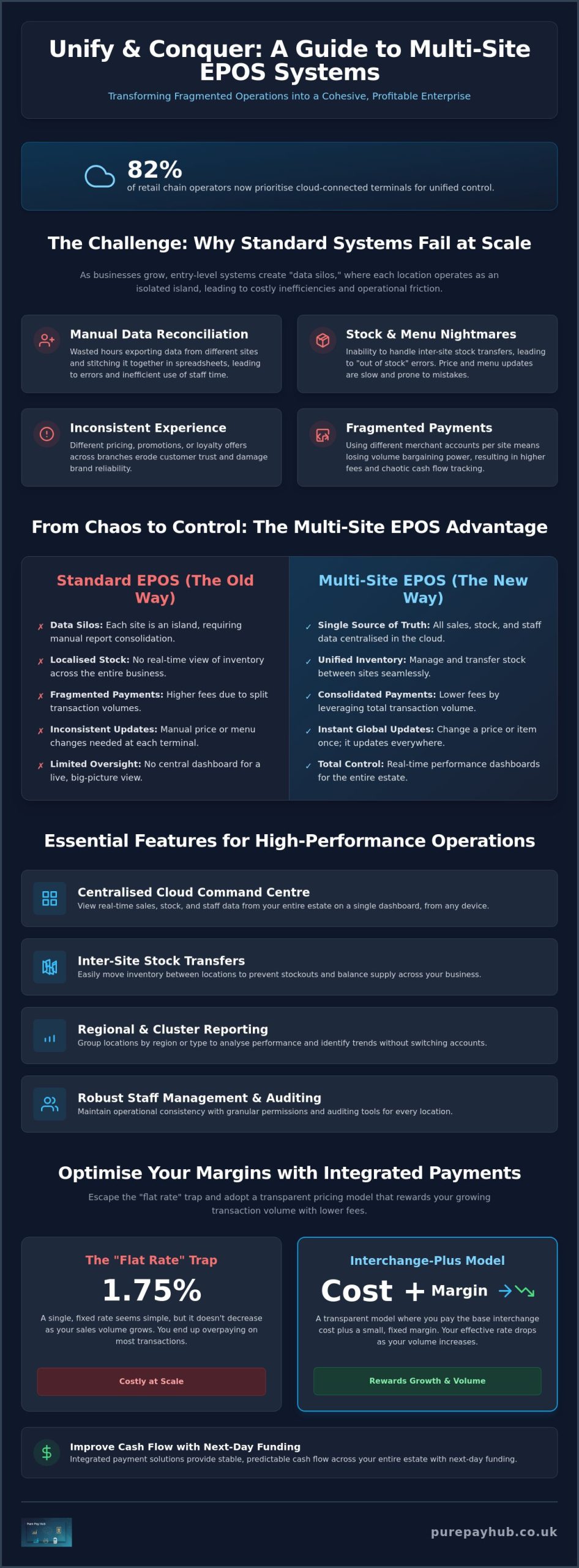
    Many business owners choose a card reader based on how quickly they can get it out of the box. They often land on a flat-rate pricing model because it seems predictable. However, that simplicity often comes at a high price. A standard flat rate of 1.75% might suit a tiny hobbyist stall, but it quickly eats into the margins of a growing shop or restaurant. You’re effectively paying a massive premium for the illusion of simplicity. Savvy owners look deeper into the fee structure to find a model that scales with their success.

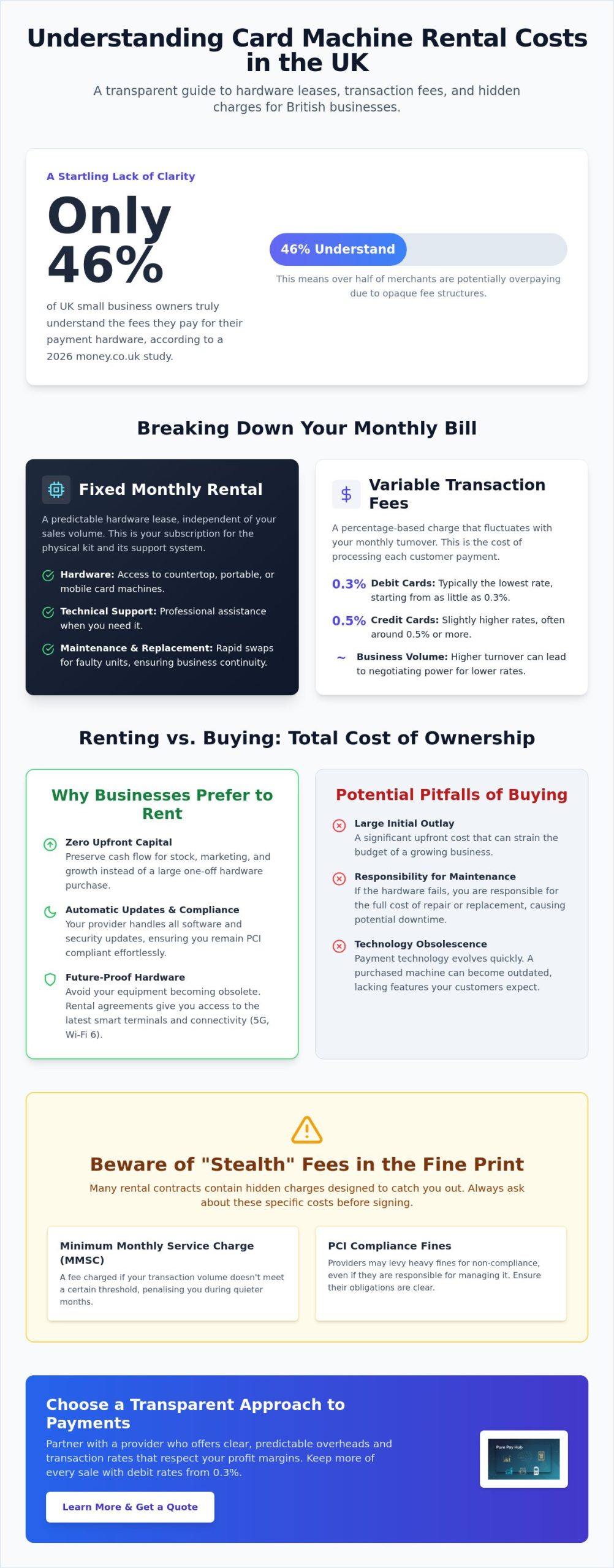
    Interchange Plus pricing is the professional alternative to the flat-rate trap. This model splits the fee into the actual cost from the card issuer and a small, transparent markup. For many merchants, this brings debit card rates down to the 0.3% range and credit cards to around 0.5%. When you compare these figures to a flat fee nearing 2%, the savings are staggering. Over a year, this difference can represent thousands of pounds back in your pocket. You also need to weigh up the cost of hardware. Buying a terminal upfront for a small fee is common for starters, but established businesses often prefer monthly rentals. This usually includes better technical support and ensures your hardware never becomes obsolete.

    Why Volume Matters for Your Rate

    As your turnover increases, your “break-even” point shifts. Once you process more than a few thousand pounds a month, flat rates become a financial burden rather than a convenience. PurePay Hub focuses on this critical transition. We tailor transaction rates to your specific business volume rather than forcing you into a one-size-fits-all box. It’s a no-nonsense approach that rewards your growth instead of taxing it. By understanding your monthly throughput, you can negotiate a deal that reflects the actual cost of processing your payments.

    Hidden Costs to Watch Out For

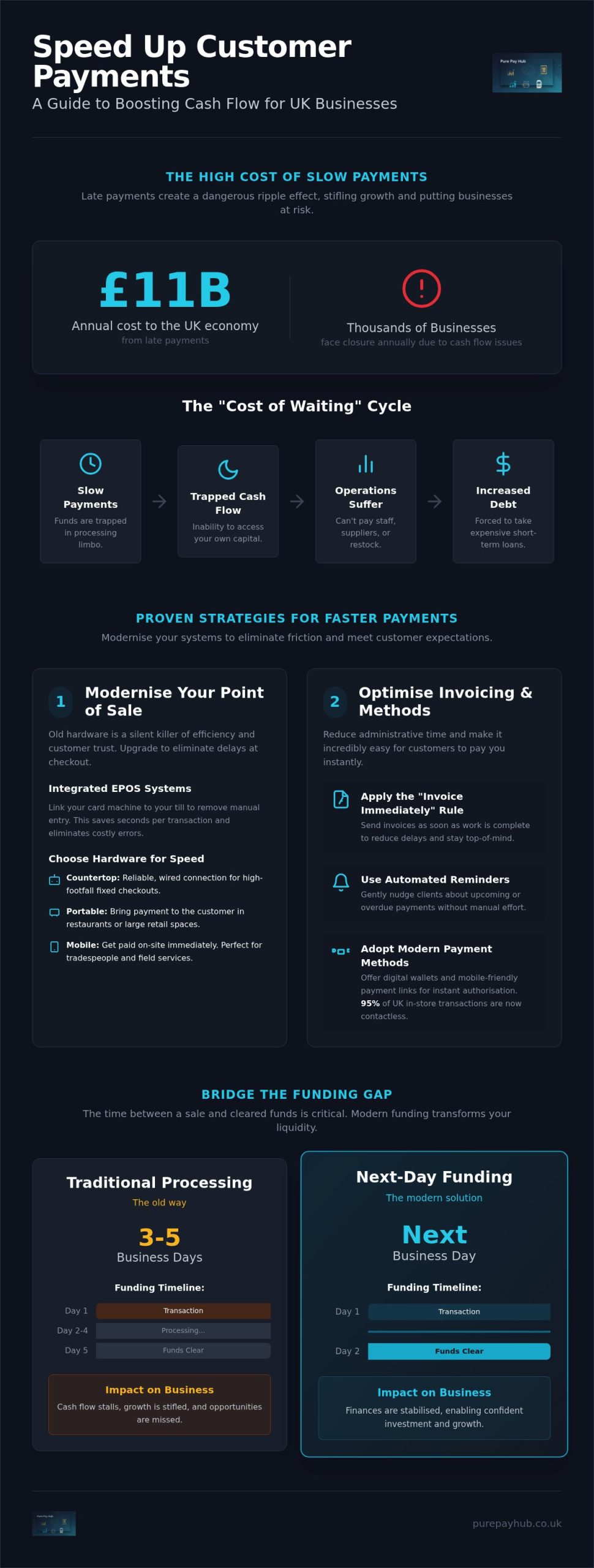
    Low headline rates often mask other charges that appear on your monthly statement. PCI compliance is a major factor. If you don’t stay compliant with the PCI Data Security Standard (PCI DSS), you could face significant non-compliance fines every month. Some providers also bury exit fees or minimum monthly service charges in the small print. These “subscription traps” are exactly what modern regulations aim to prevent. We believe you should stay with a provider because of good service, not because you’re locked in by a contract. Finally, consider funding speed. Waiting three to five days for your money is an outdated practice that hurts your cash flow. Next-day funding should be a standard feature for any serious merchant terminal.

    Essential Security and Compliance for UK Businesses

    Security is the foundation of trust between you and your customers. A modern card reader does more than just process a transaction; it acts as a fortress for sensitive financial data. Every time a customer taps or inserts their card, the terminal uses end-to-end encryption to scramble the details instantly. This ensures that even if data is intercepted, it remains completely unreadable to unauthorised parties. Point-to-Point Encryption (P2PE) takes this a step further by protecting data from the moment it enters the terminal until it reaches the secure payment gateway. By using P2PE-validated hardware, you significantly reduce your business’s liability and simplify the complex compliance landscape.

    Physical security is just as important as digital protection. You should regularly inspect your terminal for signs of tampering. Look for broken security seals, unusual wires, or added bulk to the card slot. A secure terminal is designed to be tamper-evident. It will often shut down or display an error message if its internal components are disturbed. Maintaining this vigilance protects your reputation and keeps your merchant account in good standing.

    Navigating PCI Compliance with Ease

    Compliance is a mandatory requirement for every UK merchant, regardless of size. The transition to the PCI DSS v4.0 standard was finalised on March 31, 2025. This update places a greater emphasis on multi-factor authentication and continuous security monitoring. For most SMEs, this involves an annual Self-Assessment Questionnaire (SAQ). It’s a task that many business owners find daunting. PurePay Hub removes the stress by assisting with compliance management. We help you meet the v4.0 requirements without the headache. Failing to comply isn’t just a technical oversight; it carries heavy financial risks. Non-compliance fines can be substantial, and the cost of a data breach can be terminal for a small business.

    Fraud Prevention in the Age of Contactless

    Fraudulent behaviour is a constant threat, but modern technology provides powerful defences. Current terminals use advanced algorithms to detect and block suspicious card patterns in real-time. The rise of mobile wallets has also bolstered security. Services like Apple Pay and Google Pay use biometric authorisation, such as Face ID or fingerprint scanning, to verify the user. Because these methods don’t share the actual card number with the terminal, they are inherently more secure than physical cards. This technology helps protect your business from the frustration of chargebacks and disputes. If you’re ready to secure your sales with a platform that prioritises your safety, you can apply for a secure merchant account today. We provide the stability you need to grow with confidence.

    Maximising Cash Flow with PurePay Hub

    Cash flow is the lifeblood of every local business. A reliable card reader should do more than just process sales; it should actively support your liquidity. Many traditional providers hold onto your money for days, creating unnecessary bottlenecks in your daily operations. PurePay Hub prioritises your access to capital by providing next-day settlement. This ensures that the money you earn today is available in your account tomorrow. It’s a straightforward approach that respects your hard work and helps you manage your overheads with confidence.

    Our solutions offer seamless integration across all your sales channels. Whether you use a countertop machine in a boutique or a mobile unit for outdoor events, your data remains centralised. This consistency extends to our online payment gateway and payment links, allowing you to manage retail, hospitality, and digital sales from a single platform. You also benefit from a professional, UK-based support partner. We don’t believe in distant call centres or automated scripts. When you need help, you speak to a local expert who understands the unique challenges of the British merchant community.

    Funding Your Future with Cash Advances

    Growth often requires a sudden injection of capital, whether for refurbishing your premises or stocking up for a peak season. A Business Cash Advance provides a flexible alternative to traditional bank loans. Instead of rigid monthly payments and fixed interest rates, you secure funding based on your future card turnover. Repayment happens as a small, pre-agreed percentage of your daily sales. This is a fairer system because it aligns with your actual performance. If you have a quiet week, your repayments automatically decrease. It’s an unsecured way to access capital that works with your business rhythm rather than against it.

    Getting Started with PurePay Hub

    Switching your payment provider shouldn’t be a source of stress. We’ve designed our onboarding process to be quick, clear, and entirely transparent. We help you move away from murky fee structures and hidden markups without disrupting your service. Our team handles the technicalities, ensuring your new hardware and EPOS systems are ready to go from day one. You deserve a partner that acts as a stabilising force for your finances rather than a drain on your resources. If you’re ready to see how much you could save on your transaction fees, organise your free rate review with PurePay Hub today. We’ll provide a no-nonsense comparison that puts you back in control of your margins.

    Take Control of Your Business Payments in 2026

    Choosing the right card reader is a pivotal step toward securing your business’s financial health. We’ve explored how matching your hardware to your workspace ensures reliability whilst a transparent fee structure protects your margins from the flat-rate trap. By prioritising modern security standards like PCI DSS v4.0, you build lasting trust with your customers and safeguard your reputation against fraud. Reliability in your payment terminal is no longer a luxury; it’s a fundamental requirement for any competitive UK merchant.

    Your business deserves a partner that values fairness as much as you do. With debit rates starting from 0.3% and next-day funding as standard, you can keep your cash flow moving without the frustration of hidden costs. Our UK-based expert technical support is always on hand to ensure your operations run smoothly, allowing you to focus on growth rather than paperwork. We believe in providing the clarity and stability you need to thrive in an evolving market.

    Ready to move away from opaque contracts and high fees? Get a personalised quote and start saving on your card reader rates today. Let’s work together to build a more efficient and profitable future for your business.

    Frequently Asked Questions

    How much does a card reader cost for a small business?

    Hardware costs depend on whether you choose to buy your terminal upfront or opt for a monthly rental. Whilst entry-level units are affordable for starters, established businesses often prefer rental models to ensure they always have the latest secure technology. You should weigh up the initial purchase price against the long-term value of included technical support and software updates.

    Can I use a card reader without a business bank account?

    You generally cannot use a professional merchant terminal without a dedicated business bank account. Financial regulations in the UK require that commercial funds are processed through an account designed to handle business-level volumes. Using a personal account for business transactions often leads to account freezes or closures by your bank. It’s better to establish a clear, professional financial structure from day one.

    How long does it take for card payments to reach my bank account?

    Settlement speeds depend on your provider, but you should expect next-day funding as a standard feature. Older systems might still take three to five working days to clear your hard-earned money. Delayed access to funds can hurt your cash flow. It’s vital to choose a partner that prioritises quick settlements to keep your business moving.

    What is the cheapest way to take card payments in the UK?

    Interchange Plus pricing is typically the most cost-effective way to process payments for growing businesses. Whilst flat-rate models seem simple, they often hide high markups that eat into your margins as your turnover increases. By choosing a transparent fee structure, you ensure that you only pay a fair rate based on the actual cost of the transaction.

    Do I need a separate card reader for Apple Pay and Google Pay?

    You don’t need a separate device for mobile wallets. Any modern card reader equipped with NFC technology can process Apple Pay and Google Pay transactions seamlessly. These digital wallets use the same secure contactless technology as physical cards. This makes it easy for you to offer your customers the payment methods they prefer without extra hardware.

    What happens if my card reader loses its Wi-Fi connection?

    If your terminal loses its Wi-Fi signal, it will usually try to reconnect automatically or switch to a built-in mobile data SIM. Reliable hardware is designed to handle these interruptions without losing transaction data. If you work in an area with poor connectivity, choosing a mobile unit with 4G or 5G backup ensures you never miss a sale.

    Are there any monthly fees for renting a card machine?

    Monthly rental fees are common for professional-grade hardware and often provide better long-term value. These fees usually include essential software updates, PCI compliance assistance, and swift hardware replacements if something goes wrong. It’s a predictable cost that prevents your business from facing unexpected repair bills or outdated, insecure equipment.

    How do I switch card machine providers without paying huge fees?

    Switching providers starts with a clear understanding of your current contract and a professional rate review. You should look for a partner that offers transparent, no-nonsense terms without hidden exit fees or subscription traps. A good provider will help you manage the onboarding process quickly, ensuring your new card reader is ready to use without disrupting your daily sales.

  • Apple Pay for UK Businesses: The Complete Merchant Guide for 2026

    Apple Pay for UK Businesses: The Complete Merchant Guide for 2026

    In 2025, 67% of people in the UK used apple pay for point-of-sale transactions, proving that mobile wallets are now a standard expectation rather than a luxury. You have likely felt the frustration of watching a queue grow whilst a customer fumbles for a physical card or cash. It is a common pain point that leads to lost sales and unnecessary stress for your team. You deserve a payment partner that prioritises your efficiency over complex fee structures and opaque banking jargon.

    Discover how accepting Apple Pay can streamline your checkout, enhance your security, and lower transaction friction for your UK business. We believe in providing a fair, transparent path to modernising your till without the usual industry headaches. This guide covers everything from the latest 2026 interchange fee regulations to how our portable card machines and EPOS systems integrate seamlessly with NFC technology. We will help you move from confusion to confidence, ensuring your processing costs remain predictable and your customers stay satisfied.

    Key Takeaways

    • Understand why UK consumers are rapidly moving away from physical cards and how this shift affects your checkout speed.
    • Discover how tokenisation and biometrics in apple pay work together to shield your business from fraudulent chargebacks.
    • Clear up the confusion around processing fees with a transparent breakdown of merchant service charges for mobile wallets.
    • Learn how to quickly audit your card machine hardware to ensure you are ready for the latest NFC technology.
    • Find out how to secure predictable processing rates and get your merchant services up and running in a matter of days.

    What is Apple Pay for Businesses and Why Does it Matter?

    The way we pay has changed forever. For a modern merchant, understanding What is Apple Pay is the first step toward a more efficient till. It is a mobile payment and digital wallet service that allows customers to pay using an iPhone or Apple Watch via Near Field Communication (NFC) technology. Whilst consumers see a sleek app, you see a tool that reduces checkout friction. By 2026, the shift is undeniable. Over half of all UK contactless payments are now mobile-based, driven by a desire for speed and security.

    Accepting apple pay requires more than just a bank account. You need an NFC-enabled terminal, such as a Portable Card Machine or a Countertop Card Machine, to bridge the gap between the customer’s device and your merchant account. This technology fits perfectly into the UK’s rapid move toward a cashless society. It is no longer about just ‘taking cards’; it’s about meeting your customers exactly where they are. We see this as a partnership between your business and the latest financial tech.

    The Growth of Digital Wallets in the UK

    Data from UK Finance shows that 57% of UK adults were registered for a mobile wallet in 2024. By 2025, adoption surged even further, with 67% of the population using the service for point-of-sale transactions. Regional businesses are moving away from cash-only models because digital wallets encourage spontaneous purchases. A customer who forgets their physical wallet can still buy from you if they have their phone. This flexibility builds immediate loyalty and ensures you never lose a sale to a ‘cash only’ sign. It makes your business feel modern and accessible to every demographic.

    Core Terminology for Merchants

    NFC stands for Near Field Communication. It is a short-range wireless technology that allows two devices to talk when they are close together. Your physical card reader or EPOS System detects the encrypted signal from an iPhone and processes it instantly. This differs from a Virtual Terminal, which is used for keyed-in remote payments. Whilst ‘Contactless’ and ‘Apple Pay’ seem the same at the till, the backend involves different layers of security. This process, known as tokenisation, ensures that sensitive card data is never actually shared with your hardware, protecting both you and your customer.

    How Apple Pay Works: Security and Tokenisation Explained

    Security shouldn’t be a headache for a busy business owner. In an industry often viewed with skepticism, apple pay offers a level of protection that traditional magnetic stripe or even Chip and Pin methods simply cannot match. The foundation of this system is tokenisation. This process replaces sensitive card data with a unique, encrypted identifier called a “token”. When a customer taps their iPhone against your Portable Card Machine, your hardware never actually “sees” or stores their 16-digit card number. This ensures that even if your local system were compromised, there is no usable financial data for a criminal to steal.

    Biometric authentication adds another layer of calm advocacy for your business. By requiring Face ID, Touch ID, or a passcode, the system confirms the user’s identity before the transaction is even broadcast. This significantly reduces the risk of fraudulent chargebacks. For you, the merchant, this often results in a liability shift. Because the authentication is handled securely on the device, the risk for “card-present” fraud typically moves away from your business and toward the card-issuing bank. You can find more detail on these technical safeguards in this overview of Apple Pay security and privacy.

    The Process of a Transaction

    The journey from a tap to your bank account is remarkably swift. First, the customer’s device sends the digital token to your Payment Gateway. The gateway then passes this token to the card network for verification. Because there is no physical card to insert or mechanical chip to read, these transactions are typically faster than traditional methods. This speed reduces queues and keeps your customers happy. Choosing the right NFC-enabled terminal is the first step toward securing your till and speeding up your throughput.

    PCI Compliance and Data Protection

    Managing data protection is a heavy burden for regional merchants. However, using mobile wallets simplifies your PCI DSS compliance requirements. Since you aren’t storing actual credit card numbers on your local servers or EPOS Systems, the scope of your security audits is greatly reduced. This isn’t just a technical benefit; it’s a brand promise. You can confidently reassure your customers that their data is safe, positioning yourself as a modern, dependable business partner in the local community. It is a no-nonsense approach to safety that lets you focus on growth rather than red tape.

    Apple Pay for UK Businesses: The Complete Merchant Guide for 2026

    Accepting Apple Pay: Merchant Costs and Business Benefits

    A common misconception amongst regional business owners is that modern mobile wallets carry hidden premiums. This simply isn’t true. Accepting apple pay typically costs exactly the same as a standard contactless card transaction. You pay your agreed Merchant Service Charge (MSC) to your processor, and that is it. Apple does not charge merchants a penny extra for the privilege of using their platform. By removing this barrier, you can focus on what really matters: moving customers through your shop faster and more securely.

    Speed is a silent revenue generator. When you reduce queue times during peak hours, you capture sales that might otherwise be lost to frustration. Features like “Express Mode” allow for even faster transactions in high-volume retail environments, as customers don’t even need to wake their device. This efficiency doesn’t just improve the atmosphere of your shop; it directly boosts your throughput at the till. It is a no-nonsense way to modernise your service without increasing your overheads.

    Fee Structures for UK Small Businesses

    Understanding your costs requires looking at two main components: interchange fees and processor markups. In the UK, domestic interchange fees are capped at 0.2% for debit cards and 0.3% for credit cards. Transparent, fixed-rate pricing models often provide the best value for apple pay volume because they offer predictability. Contrast this with the hidden costs of cash. Between bank deposit fees, insurance premiums, and the risk of theft, digital payments are often the more cost-effective choice for a disciplined business. We prioritise clarity, ensuring you know exactly what leaves your account every month.

    The Hidden Value of Digital Payments

    Digital payments often lead to higher average transaction values. When customers aren’t limited by the physical cash in their pockets, they feel more comfortable making spontaneous additions to their baskets. Beyond the immediate sale, these systems integrate seamlessly with digital loyalty programmes and e-receipts. This allows you to build a direct relationship with your local community. Reconciliation also becomes a breeze. Instead of counting coins at the end of a long shift, your EPOS Systems and Portable Card Machines provide digital-first reporting that organises your finances in seconds.

    Setting Up Apple Pay on Your Card Machine or EPOS

    Transitioning to mobile payments is simpler than traditional banks suggest. It starts with a clear, no-nonsense audit of your current setup. You don’t need a degree in computer science to get your business ready for 2026. Follow these five steps to ensure your till is fully optimised for apple pay.

    • Audit your hardware: Look for the universal contactless symbol on your current terminal. If your machine was manufactured before the mid-2010s, it likely lacks the necessary NFC chip.
    • Enable acceptance: Contact your merchant service provider. They must toggle mobile wallet acceptance on your account backend to ensure tokens are processed correctly.
    • Update your EPOS software: Running the latest version of your EPOS Systems software prevents integration glitches and ensures security patches are current.
    • Train your team: Your staff should know that customers don’t need to ‘wake’ their device to pay. Simple cues make the process feel seamless for everyone involved.
    • Display signage: Use official decals to show you are modernised. Letting customers know you accept their favourite payment method reduces hesitation at the point of sale.

    Hardware Requirements

    Your choice of hardware should mirror your business layout. A Countertop Card Machine is a stabilising force for fixed retail points. However, if you run a restaurant or a busy showroom, a Portable Card Machine allows you to take the till to the customer. This flexibility is essential for maintaining high throughput. Regardless of the model, a stable Wi-Fi or 4G connection is non-negotiable. Mobile transactions rely on real-time token verification; a dropped signal means a lost sale. We also understand the importance of cash flow, which is why we prioritise next-day funding for businesses processing high volumes of mobile payments.

    Common Integration Troubleshooting

    Even the best systems encounter occasional hiccups. If a customer’s apple pay is declined whilst their physical card works, it is usually a bank-side security check rather than a hardware fault. Ask them to try again or use their physical card. Handling refunds is also slightly different. You will need the last four digits of their Device Account Number, found in their Apple Wallet, rather than their physical card number. Finally, remember that Apple Pay often bypasses the standard £100 contactless limit through biometric authentication. This allows for larger transactions without the need for a PIN. If you are ready to upgrade your hardware, explore our range of NFC-enabled card machines today.

    Why PurePay Hub is the Ideal Partner for Apple Pay Integration

    Choosing a payment partner is about more than just hardware. It is about finding a fair ally that values your time and your bottom line. We provide a refreshingly transparent fee structure with rates starting from 0.3% for debit and 0.5% for credit. This includes all apple pay transactions, ensuring you never face hidden markups or “premium wallet” surcharges. Our goal is to provide a stabilising force for your finances, allowing you to plan your growth with total certainty.

    Efficiency is at the heart of our no-nonsense onboarding process. We understand that regional merchants can’t afford to wait weeks for new equipment. You can have your NFC-enabled terminal delivered and ready for the till in days. Once you are up and running, our next-day funding ensures your cash flow remains healthy as your digital volume grows. If you ever need help, our UK-based support team is just a phone call away. They understand the local business landscape and speak your language, not corporate jargon.

    Growth Beyond Payments

    Your transaction data is more than just a record of sales. It is a roadmap for your future development. By building a consistent history of apple pay and card transactions, your business may qualify for a Business Cash Advance. This flexible funding option is based on your future sales, providing the capital you need to renovate, restock, or expand. Our reporting tools also allow you to track mobile versus physical card trends, giving you the insights needed to future-proof your business against the next wave of digital payment innovation.

    Take the Next Step with PurePay Hub

    The “PurePay Promise” is simple: clarity, fairness, and direct partnership. We aren’t a distant financial institution; we are a supportive ally to the UK’s local merchant community. Whether you need a free rate review to see how much you could save or a hardware upgrade to a modern Portable Card Machine, we are here to help. Modernising your checkout shouldn’t be a struggle. It should be the catalyst that takes your business to the next level. Get your Apple Pay-ready card machine from PurePay Hub today.

    Future-Proof Your Business with Confident Payment Solutions

    The transition toward a digital-first economy represents a significant opportunity to strengthen your regional business. By embracing apple pay, you secure your transactions through advanced tokenisation whilst providing the rapid checkout experience your customers now expect. You don’t have to settle for the opaque fee structures or the frustratingly slow settlement times often found with traditional banks. Efficiency and transparency are within your reach when you choose a partner that prioritises your growth.

    Modernising your till should be a straightforward step toward long-term development. We act as your reliable local expert, ensuring your move to mobile payments is both smooth and cost-effective. You can focus on serving your community whilst we manage the technicalities of your financial processing with honesty and integrity. It is time to replace confusion with informed confidence and a stable financial foundation.

    Switch to PurePay Hub for transparent Apple Pay rates and next-day funding. Benefit from debit rates starting at 0.3%, next-day funding as standard, and a total absence of hidden monthly markups. We are ready to help you stabilise your finances and build a more resilient business today.

    Frequently Asked Questions

    Do I need a special card machine to accept Apple Pay?

    You need a terminal equipped with Near Field Communication (NFC) technology. Most modern Countertop Card Machines and Portable Card Machines include this as standard. If your current hardware displays the universal contactless symbol, it is already capable of communicating with an iPhone or Apple Watch. If you are using an older device, upgrading to a modern NFC-enabled terminal is a quick and straightforward process that ensures you don’t miss out on mobile sales.

    Is Apple Pay more expensive for merchants than standard card payments?

    No, it is not more expensive. You simply pay the standard Merchant Service Charge agreed with your processor for a contactless transaction. Apple does not charge merchants any additional fees for the privilege of using their platform. This makes apple pay a cost-effective way to speed up your checkout without increasing your overheads or dealing with the hidden markups often found in traditional banking contracts.

    What is the transaction limit for Apple Pay in the UK for 2026?

    Whilst the standard UK contactless limit for physical cards remains at £100, mobile wallets operate differently. Because the customer authenticates the payment using Face ID or Touch ID, they can often complete transactions well above this limit. This is known as Consumer Device Cardholder Verification Method (CDCVM). It allows your business to accept larger payments securely without the customer needing to remember their physical card or PIN.

    How do I process a refund for a customer who paid with Apple Pay?

    Processing a refund is simple but requires the customer’s Device Account Number rather than their physical card number. They can find these last four digits in their Apple Wallet under the card’s information. You then enter this number into your card machine or EPOS System to match the original transaction token. This ensures the funds are returned safely to the correct account whilst maintaining the security of the customer’s actual card details.

    Does Apple Pay work without an internet connection on the customer’s phone?

    Yes, the customer’s device does not require an active internet connection to complete a purchase. The communication happens via short-range radio waves between the phone and your terminal. However, your card reader or Online Payment Gateway must have a stable connection to the internet to authorise the transaction with the bank. This ensures that the digital token is verified and the funds are secured in real-time.

    Are Apple Pay transactions secure for my business?

    Mobile payments are significantly more secure than traditional card methods. Tokenisation ensures that sensitive card data is never shared with your business hardware or stored on your servers. Additionally, biometric authentication nearly eliminates the risk of fraudulent transactions from lost or stolen devices. This security architecture protects your business from the stress of chargebacks and simplifies your overall PCI compliance requirements.

    How long does it take for Apple Pay funds to reach my bank account?

    The time it takes for funds to reach your account depends entirely on your merchant service provider. Many traditional banks still take three to five working days to settle funds. We understand that cash flow is the lifeblood of a regional business, which is why we provide next-day funding as standard. This ensures that your apple pay revenue is available for you to use almost immediately.

    Can I accept Apple Pay on my website as well as in-store?

    Absolutely. You can accept mobile payments online by integrating an Online Payment Gateway into your website checkout. This provides a ‘one-tap’ purchase experience that reduces cart abandonment. For businesses without a full website, Payment Links offer a no-nonsense way to accept these payments via email or SMS. Both methods use the same secure tokenisation technology to protect your business and your customers.

  • The Ultimate Guide to Choosing a Card Payment Machine in 2026

    The Ultimate Guide to Choosing a Card Payment Machine in 2026

    Your “simple” card payment machine might be the single biggest drain on your business’s monthly bottom line. Many providers hide behind complex jargon while taking a hefty cut of every transaction you process. It’s frustrating to watch a significant percentage of every sale vanish into opaque fee structures, only to wait three to five days for the remaining funds to actually reach your bank account. You’ve worked hard to build your business; you shouldn’t have to settle for hardware that drops its Wi-Fi connection or settlement terms that stall your growth.

    We believe in a fairer, more transparent approach to merchant services. This guide will show you exactly how to secure transaction rates below 1% and unlock next-day funding, ensuring your cash flow stays as healthy as your sales figures. We’ll explore the latest hardware options for 2026, from portable card machines to full EPOS systems, while breaking down the fee models that protect your margins. By the end of this guide, you’ll have a clear roadmap to choosing a reliable payment partner that treats your business as a priority rather than a policy number.

    Key Takeaways

    • Identify the specific hardware that suits your business model, from fixed countertop units to a portable card payment machine for flexible service.
    • Learn how to look beyond headline rental costs to secure transaction rates below 1%, shielding your profits from high flat-rate fees.
    • Discover how to end the wait for your funds by moving to a provider that offers next-day settlement as standard.
    • Master the process of auditing your merchant statements to expose hidden markups and navigate existing contract notice periods.
    • Understand why a transparent partnership is the best defence against the opaque pricing structures common in the traditional banking sector.

    What is a Card Payment Machine and Why Does Your Choice Matter?

    A card payment machine acts as the vital bridge between your customer’s bank account and your business balance. It’s the final, most critical link in your sales chain. Modern terminals are no longer simple card readers; they are sophisticated communication hubs. They securely process everything from traditional Chip & PIN to digital wallets like Apple Pay and Google Pay. To truly understand What is a Payment Terminal?, you must view it as a security gatekeeper that protects both your revenue and your customer’s sensitive data.

    Your choice of hardware directly dictates your daily cash flow and annual profit margins. It isn’t just about the physical device on your counter. The wrong choice can result in funds being held for days or high percentage cuts on every sale that slowly erode your bottom line. The UK market has shifted significantly. We’ve moved from restrictive “rent-only” legacy models to flexible, high-tech ownership options. This shift empowers you to choose a partner that offers next-day funding and transparent rates, rather than being stuck with a distant financial institution that treats your business like a policy number.

    The Shift from Cash to Contactless

    Consumer behaviour has changed permanently. The overwhelming majority of retail transactions in the UK are now card-based. “Tap to Pay” technology has removed the friction from spending, making it the preferred method for almost every demographic. Refusing card payments isn’t a viable option for a modern business. It creates a physical barrier that turns customers away. Accepting cards is about more than just convenience; it’s about legitimising your business in a digital-first economy and ensuring you never miss a sale because a customer isn’t carrying cash.

    Types of Payment Technology in 2026

    Selecting the right technology requires a focus on your specific operational needs. You shouldn’t pay for mobility if you don’t need it, but you shouldn’t be tethered to a desk if your business moves. Here are the primary categories for 2026:

    • Traditional Countertop: These units use a fixed Ethernet connection for maximum reliability. They are the workhorses of retail centres and pharmacies where the till stays in one place and speed is paramount.
    • Portable & Mobile: These use Bluetooth, Wi-Fi, or GPRS to offer total flexibility. They are the standard for table service or mobile trades, ensuring you can take payments anywhere whilst maintaining a secure connection.
    • Smart Terminals: These Android-powered devices can manage inventory and sales data whilst processing payments. They bridge the gap between a simple card reader and a full EPOS system.

    Hardware reliability is a major factor that many business owners overlook until it’s too late. A card payment machine that frequently drops its Wi-Fi connection causes queues, frustrated staff, and lost revenue. In a fast-paced environment, you need hardware that is as resilient as it is fast. Choosing a modern, well-supported terminal ensures your business stays online and your transactions clear without unnecessary delay.

    Choosing the Right Hardware: Countertop, Portable, or Mobile?

    Selecting the correct card payment machine is a decision that impacts your staff’s speed and your customer’s patience. It isn’t just about picking a sleek device; it’s about matching technology to your specific environment. Whether you operate a bustling high-street shop or a roaming food truck, your hardware must remain a silent, reliable partner in every sale. The right choice ensures that the transaction process is invisible to the customer but infallible for your business.

    Countertop machines are the undisputed workhorses of retail and pharmacy centres. These units rely on a fixed Ethernet connection, which virtually eliminates the risk of terminal downtime during peak hours. When you have a queue of twenty people, you can’t afford for your Wi-Fi to flicker. These terminals integrate seamlessly with your existing cash drawer and receipt printer, creating a secure, centralised payment station that anchors your checkout process. A fairer approach to hardware ensures you aren’t overpaying for features you don’t use whilst maintaining this rock-solid reliability.

    For those in hospitality, portable units are the standard. They allow you to take the till directly to the customer whilst maintaining a strong Wi-Fi connection within your premises. This mobility increases efficiency and often leads to higher tips, as the payment happens at the moment of peak satisfaction. When choosing the right credit card processing plan, consider how many roaming units you need to prevent bottlenecks at the bar during a busy Friday night shift.

    If your business takes you on the road, mobile machines are the answer. These devices use built-in SIM cards to process payments anywhere in the UK with a mobile signal. They are perfect for delivery services or outdoor market stalls where traditional connectivity isn’t an option. For businesses looking for a complete solution, integrated EPOS systems combine payment processing with stock management into one clear interface, giving you a real-time view of your entire operation.

    Best for Retail: Countertop Reliability

    A fixed connection is the best defence against technical failure. In a retail setting, a countertop card payment machine provides a permanent, secure point of sale. Because these units don’t rely on battery power or fluctuating Wi-Fi signals, they offer the highest level of security and uptime. This stability is essential for high-volume environments where every second of downtime equals lost revenue. You can also organise your counter space more effectively by integrating these units directly with your legacy hardware.

    Best for Hospitality: Portable and Roaming Units

    In a restaurant or café, staff efficiency is tied to movement. Portable units allow servers to close tables without returning to a central station, which speeds up table turnover significantly. Modern portable units are designed with full-day shift usage in mind, featuring long battery lives that won’t fail during a lunch rush. Using multiple units allows you to spread the workload amongst your team, ensuring that customers never have to wait for the “only machine” to become available.

    The Ultimate Guide to Choosing a Card Payment Machine in 2026

    The True Cost of Card Processing: Beyond the Monthly Rental

    Focusing solely on the monthly rental price of a card payment machine is a mistake that costs UK small businesses thousands of pounds every year. While a terminal might only cost between £15 and £30 per month, the real impact on your bottom line lies in the transaction rates and hidden service fees. Traditional providers often use these low headline costs to distract from high percentage cuts on every sale you process. You must look at the total cost of ownership to protect your margins and ensure your business remains profitable.

    Your monthly statement consists of several layers. The most significant is the Merchant Service Charge (MSC). This includes the Interchange fee, which is a non-negotiable cost set by card schemes like Visa and Mastercard. On top of this, many providers add a substantial markup. Before you sign a payment processing contract, you should also check for “hidden” extras. These often include PCI compliance fees of £4 to £6, minimum monthly service charges (MMSC) that can reach £30, and steep exit fees if you decide to switch. These small additions quickly stack up, turning a “cheap” deal into a heavy financial burden.

    The “Flat Rate” Trap vs. Merchant Accounts

    Flat-rate providers often market a single transaction fee, typically around 1.75%, as a simple solution. Whilst this appears easy to understand, it’s often a trap for growing businesses. A flat rate subsidises high-risk or international cards by overcharging you on standard UK debit cards, which usually carry much lower underlying costs. If your business processes more than £2,000 per month, moving to a full merchant account is almost always more cost-effective. PurePay Hub operates on a more transparent model, with rates starting at 0.3% for debit and 0.5% for credit, allowing you to keep a much larger portion of your revenue.

    Understanding Payout Speeds and Cash Flow

    Cash flow is the lifeblood of any regional business. Many traditional banks still operate on a “3-5 day” settlement cycle. This delay is essentially an interest-free loan you’re giving to the processor whilst your own bills, stock orders, and payroll requirements wait. In 2026, next-day funding should be a non-negotiable requirement for your card payment machine. Accessing your funds within 24 hours allows you to reinvest in stock immediately and manage your liquidity with confidence. It removes the stress of “pending” balances and gives you a real-time view of your available capital.

    How to Switch Providers and Set Up for Success

    Switching your merchant services provider shouldn’t feel like a leap into the unknown. Whilst many companies focus on the ease of their own signup, they often ignore the logistical hurdles of leaving a restrictive contract. To ensure a smooth transition, you must first understand the true state of your current agreement. Start by auditing your last three months of merchant statements to identify hidden markups and unnecessary admin fees. This clarity allows you to compare your current costs against a more transparent model, ensuring your new card payment machine actually delivers the savings you expect.

    Check your existing contract for notice periods or exit fee clauses before making any commitments. Under current UK regulations, contracts for card readers cannot exceed 18 months, but many traditional providers still bake in auto-renewal terms that can catch you off guard. If you find yourself facing a steep exit fee, speak to your prospective partner. Some modern providers are willing to discuss ways to offset these costs to facilitate your move to a fairer service. Once you’ve cleared the legal hurdles, select hardware that matches your specific business layout and customer flow. If you’re ready to leave opaque pricing behind, you can request a transparent quote for your business today.

    Avoiding Exit Fees and Contract Traps

    Negotiating a better deal involves more than just a lower transaction rate. You should prioritise “rolling contracts” over long-term commitments to maintain your business’s agility. A rolling monthly agreement proves that the provider is confident in their service; they don’t need to trap you to keep your custom. Always read the fine print of a card machine lease to ensure there are no hidden “end-of-term” charges or mandatory hardware insurance fees that you didn’t ask for. This discipline protects your future cash flow from unexpected shocks.

    Setting Up Your New Terminal

    Setting up your new hardware is a straightforward process if you follow a logical sequence. Whilst Wi-Fi offers flexibility, a hardwired Ethernet connection remains the most secure and stable option for fixed points of sale. Once connected, run a test transaction for a small amount to verify the link to your merchant account. This is also the time to set up staff logins and configure your digital terminal for tips, VAT, and custom receipt branding. Taking these steps before your first real customer arrives prevents any awkward delays at the till. Organise your transition by keeping your old terminal active until the new card payment machine is fully tested and live to avoid any downtime.

    PurePay Hub: Transparent Payments for UK Businesses

    PurePay Hub stands as a stabilising force for your business’s finances. In an industry often viewed with skepticism, we prioritise clarity over corporate jargon. We position ourselves as a fair partner to regional business owners rather than a distant financial institution. Our no-nonsense approach ensures that you understand every aspect of your merchant services, from the hardware on your counter to the final settlement in your bank account. By removing the stress of hidden costs, we allow you to focus on what matters most: serving your customers and growing your brand.

    Reliability is the foundation of our service. Whether you need a single countertop card payment machine for a local pharmacy or a network of integrated EPOS systems for a busy retail centre, our solutions are designed to scale with your ambitions. We understand that technical issues can halt your sales, which is why our UK-based support team is always ready to resolve problems quickly. You won’t be passed amongst different departments or left waiting for days for a response. We treat your business as a priority, ensuring your payment processing remains a silent, efficient partner in your daily operations.

    Beyond Payments: Business Cash Advances

    We provide more than just a way to take payments. A Business Cash Advance offers a flexible way to access capital based on your future card sales. Unlike traditional loans with rigid monthly interest, repayments fluctuate naturally with your daily turnover. When your sales are high, you pay back more; when things are quieter, your repayments reduce accordingly. This model is perfect for funding renovations, purchasing new stock, or launching a marketing campaign without the pressure of fixed monthly overheads.

    The PurePay Hub Advantage

    The PurePay Hub identity is built on the steady promise of better, fairer service. We believe that your hard-earned money should be in your account as quickly as possible. Whilst many competitors hold onto your funds for several days, we provide next-day funding as standard. This immediate access to capital keeps your business moving and simplifies your cash flow management. Our pricing model is equally transparent, offering rates that protect your margins:

    • Debit Cards: Rates starting at 0.3%
    • Credit Cards: Rates starting at 0.5%
    • Funding: Next-day settlement as standard
    • Contracts: Flexible terms without hidden traps

    Choosing a card payment machine shouldn’t involve navigating a sea of technicalities or worrying about surprise fees. We offer the technical precision you need framed by a commitment to simplicity. If you’re ready for a partnership that values honesty and integrity, Contact PurePay Hub today for a bespoke quote. Let’s work together to secure the fastest funding and the lowest transaction rates for your business.

    Secure Your Business Future with Transparent Payments

    Selecting a card payment machine is a strategic decision that directly affects your annual profitability. You now have the tools to distinguish between sleek marketing and genuine financial utility. By prioritising reliable hardware and avoiding the trap of expensive flat-rate fees, you ensure that more of every sale stays exactly where it belongs. A fair partnership is built on the foundation of clarity; your payment processor should be a silent, efficient ally rather than a source of financial stress.

    PurePay Hub is here to act as your supportive business partner. We provide a disciplined approach to merchant services that eliminates the frustration of opaque costs and slow settlement cycles. Our partners benefit from debit card rates starting at 0.3% and next-day access to funds, all with a guarantee of no hidden markup fees. We focus on the technical precision of your payments so you can focus on the growth of your business.

    Start saving on your transaction fees with PurePay Hub

    Taking the step toward a more transparent provider is the smartest move you can make for your bottom line. We look forward to supporting your continued success and helping your business thrive in the modern economy.

    Frequently Asked Questions

    How much does a card payment machine cost per month in the UK?

    Monthly rental for a card payment machine in the UK generally falls between £15 and £30. You should be aware that this headline figure is rarely the total cost. Most providers include additional service charges, PCI fees, and minimum monthly service charges that can double your expected bill. Always request a full breakdown of all recurring costs before committing to a specific terminal.

    What is the cheapest way to take card payments for a small business?

    The most cost-effective method depends entirely on your monthly turnover. For very low volumes, a flat-rate reader might seem attractive because there are no monthly fees. However, once you process more than £2,000 per month, the high transaction rates of flat-rate providers become a burden. Switching to a dedicated merchant account with rates below 1% will save you significantly more in the long run.

    Can I get a card machine without a long-term contract?

    You can certainly find providers that offer rolling monthly contracts. Whilst many traditional banks try to lock you into agreements lasting 18 months or longer, modern fintech partners prioritise flexibility. Choosing a rolling contract gives you the freedom to leave if the service doesn’t meet your expectations; this forces the provider to maintain high standards and fair pricing to keep your custom.

    How long does it take for card payments to reach my bank account?

    Settlement times vary significantly between providers. Traditional banking structures often take three to five working days to clear your funds. In 2026, you should look for next-day funding as a standard feature. Accessing your money within 24 hours provides the liquidity needed to manage stock levels and payroll without relying on expensive credit or overdrafts.

    Do I need a specific merchant account to use a card machine?

    A merchant account is essential for processing any transaction through a card payment machine. This account acts as a holding area where funds are verified before being settled into your business bank account. Whilst some providers bundle this into a single service, it remains a distinct financial requirement for accepting card payments legally and securely in the UK.

    What happens if my business Wi-Fi goes down whilst taking a payment?

    Most modern terminals include a mobile SIM card as a fallback for when your business Wi-Fi fails. These units automatically switch to 4G or GPRS networks to ensure you don’t lose sales during a local internet outage. If you operate in an area with poor connectivity, choosing a “roaming” SIM that connects to the strongest available network is a vital safeguard for your revenue.

    Are there extra fees for accepting Apple Pay or Google Pay?

    There are typically no additional transaction fees for accepting Apple Pay or Google Pay. These digital wallet payments are processed using the same contactless technology as a physical card. Because they use biometric authentication, they are often more secure; this can lead to fewer chargebacks and disputes for your business compared to traditional card-present sales.

    How do I avoid PCI compliance fines on my monthly statement?

    To avoid PCI compliance fines, you must complete your annual Self-Assessment Questionnaire (SAQ). Many businesses are charged “non-compliance fees” simply because they haven’t updated their details on the merchant portal. Ensure your hardware meets the latest PCI DSS 4.0 standards and maintain a regular schedule for security updates to keep these unnecessary costs off your monthly statement.

  • What is an EPOS System? The Complete Guide for UK Businesses

    What is an EPOS System? The Complete Guide for UK Businesses

    With nearly 95% of eligible in-store transactions in the UK now being contactless, the traditional cash till has become a bottleneck for growth rather than a tool for success. If you are asking what is epos system technology and how it differs from a standard register, you are looking for a way to modernise your daily operations. You likely understand the frustration of losing hours to manual stock takes or catching human errors only after a busy shift has ended. It’s difficult to scale when you lack clarity on which items actually drive your profit.

    We believe in straightforward solutions that respect your time and your bottom line. This guide promises to show you how an EPOS system works to automate your inventory and provide real-time business data from any location. We will explore the essential components you need, from countertop card machines to seamless software integrations; ensuring your sales and payments work in perfect harmony to protect your cash flow. Discover how to turn every transaction into a strategic advantage for your business.

    Key Takeaways

    • Transform your daily operations by turning a basic till into a digital command centre that eliminates manual stock take errors.
    • Understand exactly what is epos system technology and how its combination of hardware and software synchronises your sales and inventory automatically.
    • Gain immediate clarity on your most profitable products with real-time data access that you can view from any location.
    • Learn how to bridge the gap between sales and card payments to achieve seamless integration and faster fund settlement.
    • Discover how your transaction history can help you secure a Business Cash Advance to fund your future business growth.

    What is an EPOS System? The Modern Business Command Centre

    An Electronic Point of Sale (EPOS) system is much more than a digital version of a cash drawer. It is a centralised digital ecosystem that acts as the brain of your business. Whilst a traditional till simply stores cash and prints a basic receipt, an EPOS system synchronises every sale with your inventory, accounting, and staff records in real time. For any UK merchant asking what is epos system technology, the answer lies in its ability to turn a simple transaction into a wealth of actionable data.

    The journey from mechanical registers to cloud-based intelligence has changed how we manage shops and restaurants. Modern systems don’t just sit on a counter; they live in the cloud. This means your business data is live and accessible from your phone or laptop whilst you travel. You no longer need to be physically present to know your current stock levels or your total takings for the afternoon. This level of transparency allows you to make informed decisions based on facts rather than guesswork.

    Consumer behaviour has shifted rapidly. In 2024, nearly 95% of all eligible in-store card transactions in the UK were contactless. Customers expect speed and flexibility. An EPOS system meets this demand by integrating payment processing directly into the checkout flow; ensuring you never miss a sale due to slow hardware or outdated software. It creates a professional image that builds trust with your local community.

    The Core Difference Between EPOS and a Standard Till

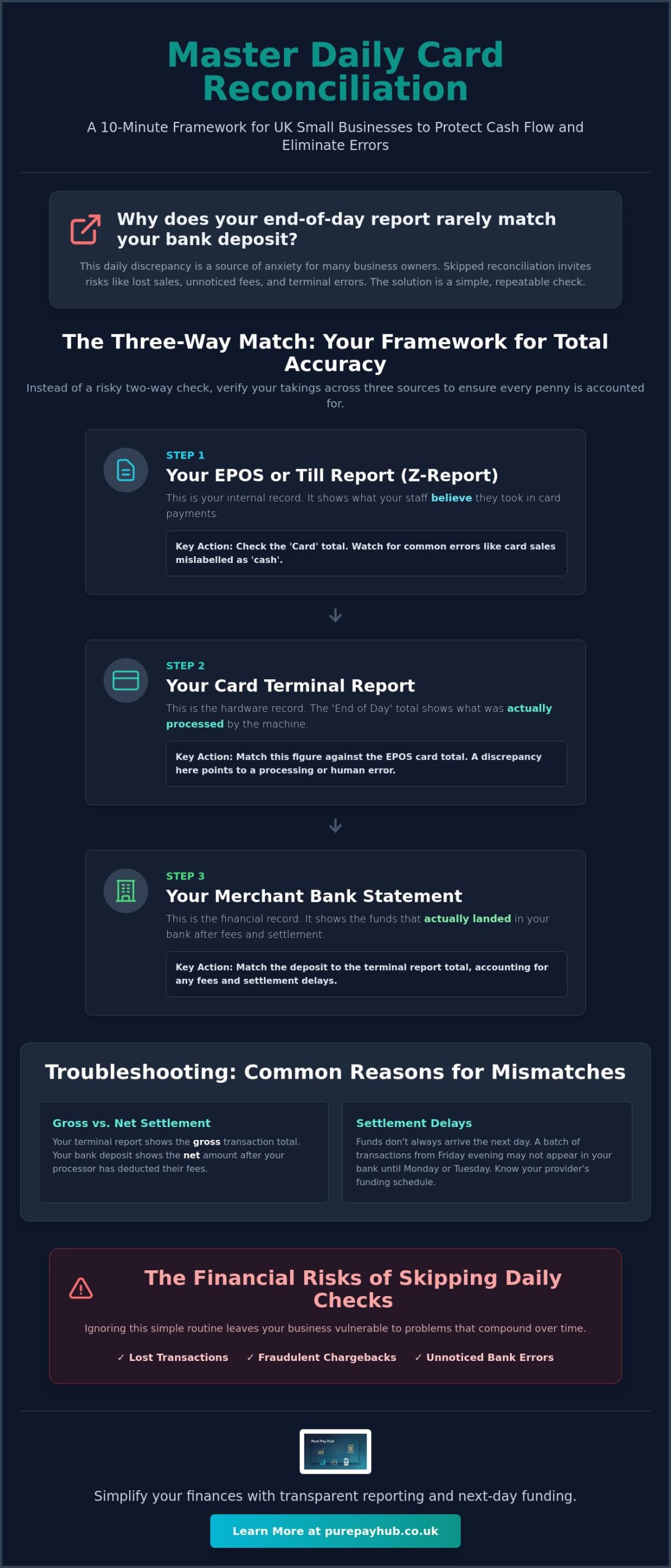
    A standard till relies on manual entry. These systems invite human error during busy periods and offer very little insight into your actual performance. EPOS systems use automated barcode scanning and integrated card terminals to ensure every price is accurate. The most significant benefit is the removal of the end-of-day manual reconciliation headache. Because the system tracks every penny automatically, your reports are ready the moment you close your doors. You move from simple price-logging to comprehensive business management with a single tool.

    Is EPOS the Same as POS?

    You will often hear these terms used interchangeably, but there is a subtle distinction. A Point of Sale (POS) traditionally refers to the physical location where a transaction happens, such as a checkout counter. The “E” in EPOS highlights the electronic connectivity that modern UK businesses require. It represents the software and hardware working together to manage your entire operation. In the merchant services industry, most professionals use these terms to describe the same digital solution, but understanding what is epos system functionality helps you choose the right tool for your specific needs.

    The Anatomy of EPOS: Hardware, Software, and Connectivity

    Understanding what is epos system architecture requires looking at three distinct layers: the hardware you touch, the software that thinks, and the connectivity that moves your money. When these three elements work in harmony, they create a stable foundation for your daily operations. A breakdown in any one of these areas can lead to lost sales or frustrated customers, which is why choosing a unified solution is vital for long-term reliability.

    The hardware layer is the most visible part of your setup. It typically includes a touchscreen interface, a receipt printer, and a cash drawer. However, the true engine of the checkout is your card terminal. Whether you utilise a countertop card machine at a fixed point or a portable card machine for service on the move, these devices must be robust and user-friendly. Security is equally important; your hardware choice must support PCI DSS compliance to protect cardholder data and shield your business from potential penalties. Modern providers often handle these complex security requirements for you, allowing you to focus on your customers.

    The software layer acts as the brain of the operation. In the past, businesses relied on “legacy” systems that stored data on bulky on-site servers. These are now largely obsolete because they are expensive to maintain and risky to operate. If a local server fails, your business grinds to a halt. Modern UK merchants have shifted toward cloud-based “Software as a Service” (SaaS) models. This shift ensures your data is backed up automatically and accessible from any location whilst you are away from the shop floor. For more detail on these digital shifts, you can read a comprehensive guide to EPOS systems which highlights how cloud intelligence has become the industry standard.

    Essential EPOS Hardware for UK Merchants

    Your specific industry will dictate your hardware needs. A retail boutique might favour a sleek, tablet-based system to maintain a modern aesthetic. Conversely, a busy pub will require a mix of countertop units and mobile card machines to take payments at the table. You may also need peripheral equipment such as barcode scanners for rapid stock entry or kitchen printers to send orders directly to your chefs. If you are ready to upgrade your physical setup, exploring a tailored EPOS system can help you identify the exact tools your floor plan requires.

    Software: The Difference Between Cloud and Legacy

    The biggest advantage of cloud software is the delivery of automatic updates. You don’t need to manually install new versions or worry about your system becoming obsolete. Every time a new feature is released or a security patch is required, the system updates itself in the background. This ensures your business always has the latest tools to manage inventory and staff performance without the technical headache of legacy software management. It is a fairer, more transparent way to keep your business technology current.

    What is an EPOS System? The Complete Guide for UK Businesses

    How an EPOS System Works to Organise Your Business

    When you process a sale, a complex series of background tasks occurs instantly. Understanding what is epos system logic helps you see beyond the simple beep of a scanner. The moment an item is scanned, the software doesn’t just calculate a total; it subtracts that specific unit from your inventory, logs the staff member’s ID, and prepares the data for your accounting records. This automated journey from scan to fund settlement ensures your books are always accurate without any manual intervention. It turns a busy shift into a clean, organised data set that reflects the true state of your business.

    Managing a team becomes far simpler when you have a transparent view of the shop floor. An EPOS system allows you to monitor individual staff performance and identify who your top sellers are during any given period. It also helps reduce shrinkage by highlighting discrepancies between stock levels and actual sales. By creating a database of your favourite customers, you can track their purchasing behaviour and offer personalised rewards. This level of insight was once reserved for major corporations, but modern technology has made it accessible to every local merchant, providing the tools needed to compete on a larger scale.

    Streamlining the Checkout Experience

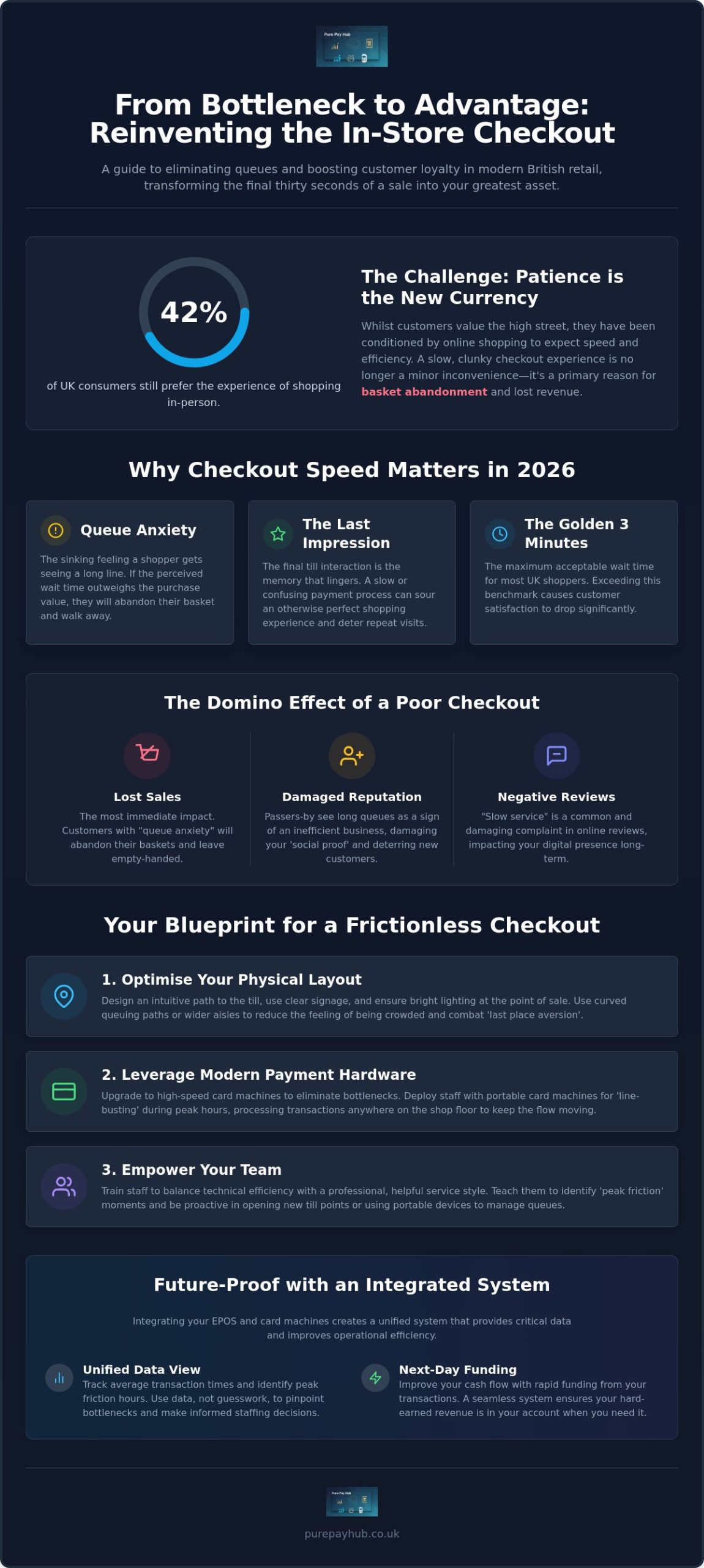
    Queues are the enemy of retail and hospitality. An integrated system removes the friction of manual entry. By combining your till software with your card machines, you eliminate the need to type amounts into a terminal twice. This reduces human error and speeds up service significantly. You can also automate promotions. If you run a buy one get one free offer, the system applies the discount instantly. This level of precision protects your margins whilst keeping customers happy. Digital receipts are another advantage; they save on paper costs whilst allowing you to collect valuable customer emails for future marketing efforts.

    The Power of Data-Driven Reporting

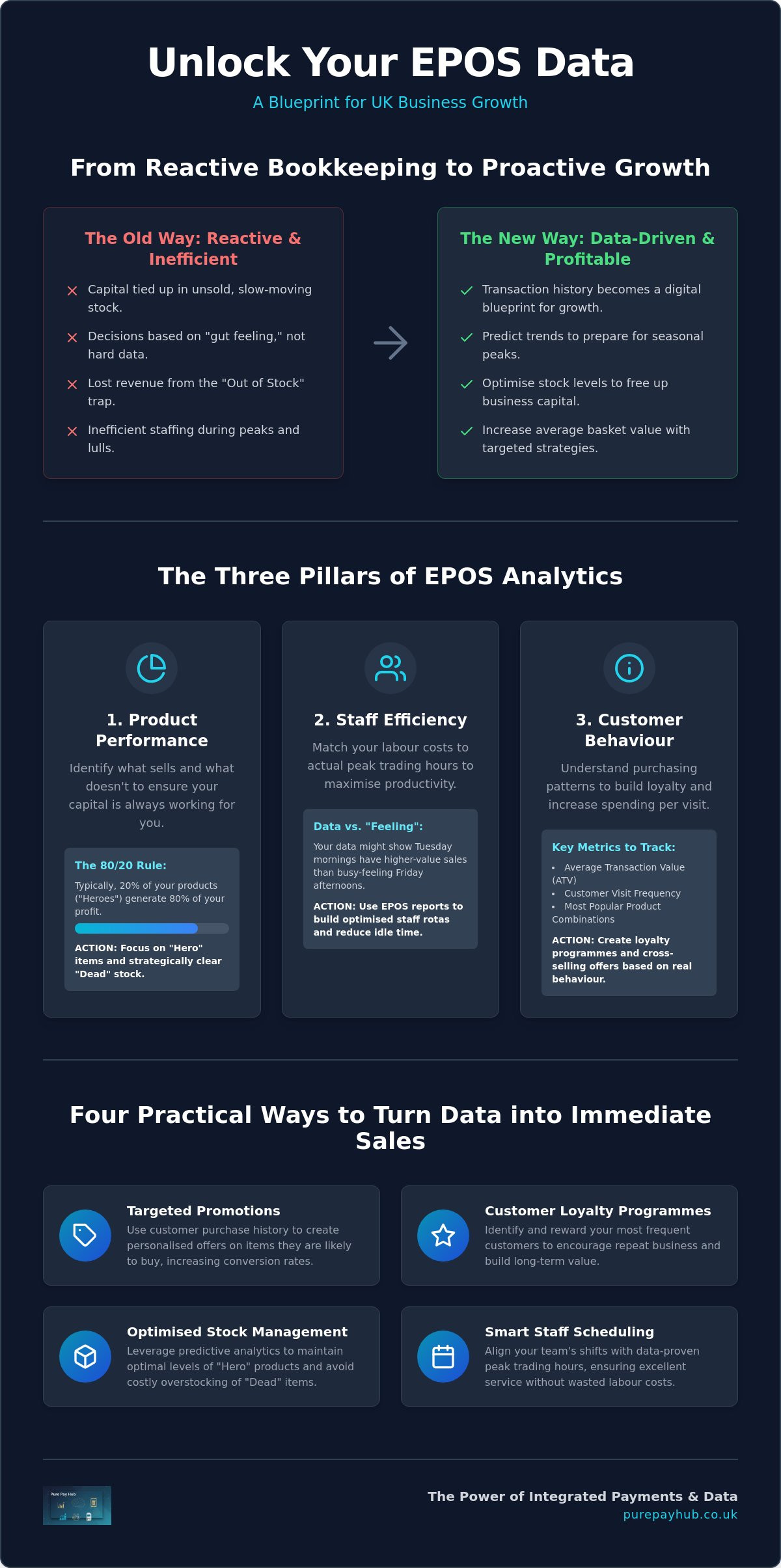
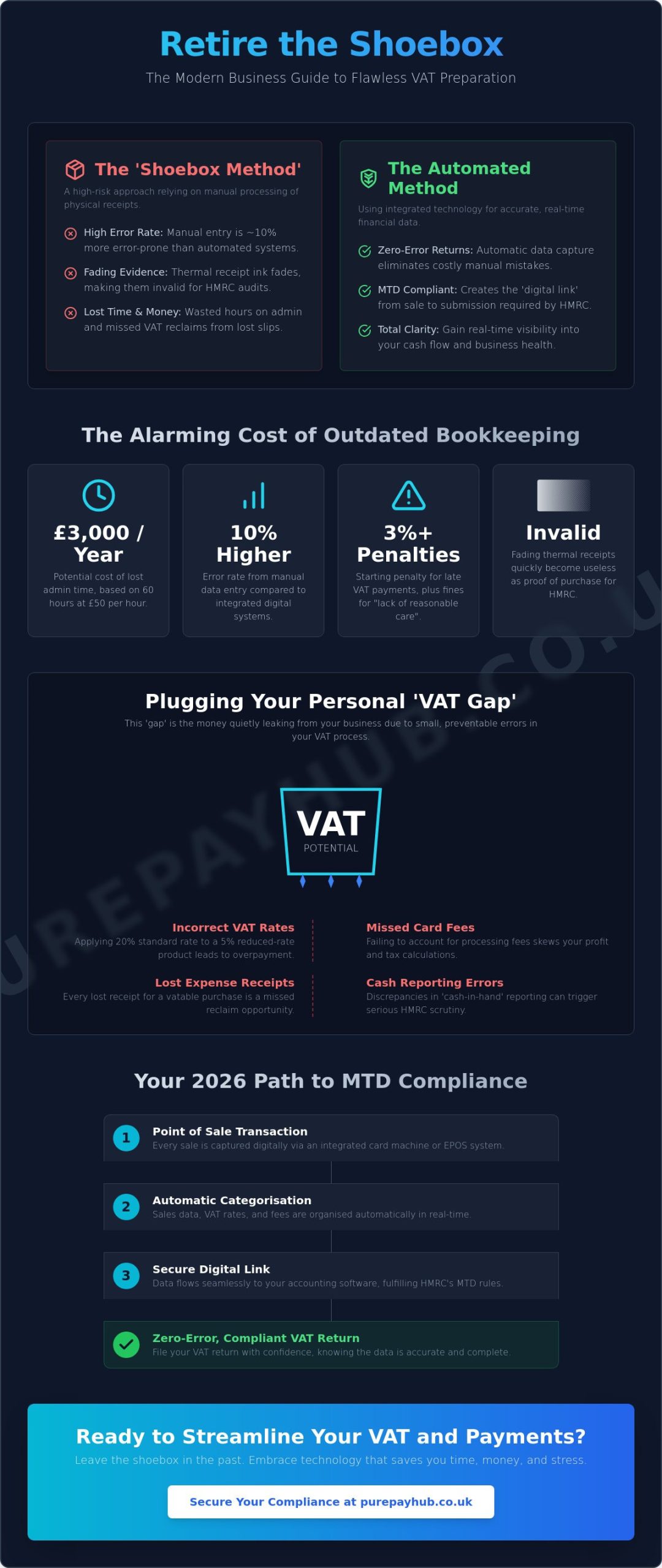
    Data is your most valuable asset. A modern system allows you to identify your best-sellers and dead stock in seconds. You no longer have to guess which products are truly profitable. You can compare performance across multiple locations from a single dashboard, which is essential for business development. This transparency is also crucial for Making Tax Digital (MTD) compliance. You can export clean, organised data directly to your accountant, saving hours of administrative work. By turning every transaction into a strategic data point, you can focus on growing your business rather than just maintaining it. It provides the clarity needed to make confident decisions about your future inventory and staffing levels.

    Choosing the Right EPOS for Your Industry and Budget

    Choosing the right system is a critical decision for your business’s future. When you investigate what is epos system technology for your specific sector, you’ll find that one size rarely fits all. You need a solution that understands your daily challenges; whether that’s managing a busy lunch rush or tracking hundreds of individual stock items. We advocate for a no-nonsense approach to selection. Focus on the features that actually save you time and the fees that respect your margins.

    Evaluating the true cost of ownership is essential. You will likely encounter two main models: hardware rental or upfront purchase, combined with monthly software subscriptions. Whilst a low entry price is tempting, always look for hidden markups in the transaction-based processing fees. Support is another non-negotiable factor. If your system goes down on a busy Saturday night, you need 24/7 UK-based help to get back online. A distant help centre that only operates during office hours isn’t a partnership; it’s a liability.

    Hospitality vs Retail: What Features Do You Need?

    Hospitality businesses rely on floor plans and kitchen display systems to keep service moving. If you run a pub, you need to manage tables and split bills without causing a queue at the bar. Retailers, on the other hand, require complex size and colour matrices and automatic stock alerts. If you operate online, your in-store sales must sync with your e-commerce platform to prevent overselling. Service-based businesses like salons should look for integrated appointment booking and deposit management to reduce the financial impact of no-shows.

    Scrutinising the Fee Structure

    This is where many traditional providers hide their profit. You must understand the difference between debit and credit card rates. Debit cards account for approximately 80% of all card transactions in the UK, and these typically carry lower processing costs. You might see rates of 0.3% for debit versus 0.5% for credit. Don’t get trapped by “blended” rates that charge you the same for a basic debit card as they do for a premium credit card. Avoid long-term contracts with high exit fees. They often signal a provider who isn’t confident in their own service. Transparent, transaction-based fees are far better for your seasonal cash flow. They ensure you only pay when you are actually making money.

    If you want a partner that values honesty over hidden markups, you can get a quote for a transparent EPOS system today.

    Future-Proofing with PurePay Hub: Integrated EPOS and Payments

    Choosing the right technology is the first step, but the real power lies in how that technology integrates with your financial flow. At PurePay Hub, we move beyond the basic question of what is epos system software and focus on how it stabilises your business. We provide a centralised service that links your sales data directly to your payment processing. This integration ensures that your countertop or portable card machines communicate perfectly with your till; allowing for next-day funding that keeps your cash flow healthy and predictable.

    Our approach is built on transparency and fairness. We avoid the murky fee structures often found in traditional banking. Instead, we offer a single, clear monthly statement that shows exactly where your money goes. We act as a supportive business ally; providing a no-nonsense merchant account management service that removes the stress of hidden markups. You get the technical precision of a modern fintech company with the personal touch of a local expert who understands the regional market.

    Seamless Payment Integration

    Double-keying errors are a common frustration for busy merchants. By linking your terminal and till, you eliminate the need to enter amounts twice, which removes the risk of human error during peak trading periods. Your customers can pay using Apple Pay, Google Pay, or any major card instantly. We are committed to providing the lowest card machine rates for UK SMEs. This isn’t just about processing payments; it’s about creating a frictionless experience that encourages repeat business and builds trust with your local community. It simplifies your daily admin whilst protecting your bottom line.

    Unlocking Growth with EPOS Intelligence

    The data captured by your system is a powerful tool for expansion. We use your sales volume records to help you qualify for a Business Cash Advance. This provides you with unsecured capital without the rigid constraints or complex paperwork of a traditional bank loan. You simply repay the advance as a small, fixed percentage of your daily card sales. It is a flexible way to fund new equipment or store renovations that scales naturally with your success. If your sales are slower one day, your repayment is smaller. Contact us to see how we can stabilise your finances and help your business reach its full potential.

    Take Control of Your Business Growth

    Transitioning from a manual till to a digital command centre is about more than just taking payments. It is about gaining the visibility you need to run a more efficient operation. Understanding what is epos system capability allows you to automate your stock takes, reduce human error, and build a stronger relationship with your favourite customers. You no longer have to settle for opaque fees or slow, unresponsive service.

    We are here to act as your supportive business ally. With debit card rates from 0.3% and next-day access to your funds, we ensure your hard-earned money stays where it belongs. Our UK-based expert support is always available to provide clear, honest guidance whenever you need it. You can get a transparent quote for your integrated EPOS and card payments today. Take the next step with confidence and build the modern business you’ve always envisioned.

    Frequently Asked Questions

    Is an EPOS system expensive for a small UK business?

    Costs vary depending on your specific requirements, but there are options to suit most budgets. When asking what is epos system investment likely to be, you’ll find that businesses can choose between upfront hardware purchases or monthly rental models. Modern providers often offer free software plans where you only pay transaction fees; making it an accessible investment for startups and smaller merchants.

    Can I use an EPOS system without an internet connection?

    Yes, many modern systems feature an offline mode that allows you to continue taking payments and scanning items if your connection drops. The system stores the transaction data locally and syncs with the cloud once the internet is restored. This ensures your service remains uninterrupted during a busy shift and prevents any loss of sales data.

    How long does it take to set up a new EPOS system?

    A basic setup can be completed in a few hours, whilst more complex systems with large inventories might take a few days. The process involves configuring your software, importing your product list, and connecting your card terminals. Most providers offer guided installation to ensure your business command centre is operational as quickly as possible without disrupting your trade.

    Do I need a specific merchant account for an EPOS system?

    You generally need a merchant account that is compatible with your chosen software to ensure seamless fund settlement. Whilst some businesses try to use separate providers, an integrated merchant account simplifies your finances by providing a single monthly statement. This creates a more stable and transparent environment for managing your daily takings and tracking your overall business performance.

    What happens if my EPOS hardware breaks during a busy shift?

    Reliable providers offer rapid hardware replacement or remote support to get you back online quickly. Because modern systems are cloud-based, your data is safe even if the physical terminal fails. You can often log in to your software from a tablet or mobile device as a temporary backup to keep the queues moving whilst you wait for a replacement unit.

    Can an EPOS system help with my VAT and tax returns?

    Yes, these systems automate the collection of sales data required for Making Tax Digital (MTD) compliance. You can export clean, accurate reports directly to your accounting software, which significantly reduces the time spent on manual calculations. It provides a transparent audit trail for your VAT and annual tax returns; ensuring you stay on the right side of HMRC regulations.

    Is it difficult to switch from a traditional cash register to EPOS?

    The switch is straightforward and often provides immediate relief from manual administrative tasks. Most modern interfaces are designed to be intuitive and require minimal staff training. Once you understand what is epos system functionality and how it automates your stock levels, you will likely find it much easier to manage than a mechanical till and a paper ledger.

    Does an EPOS system work with my existing card machine?

    It depends on the compatibility of your current hardware and software. Whilst some standalone card machines can work alongside a till, an integrated solution is much more efficient for a growing business. Linking your terminal and till prevents double-keying errors and ensures your sales data and payment records are always perfectly synchronised for easier end-of-day reconciliation.

  • Card Payment Methods for Small Business UK: The 2026 Merchant’s Guide

    Card Payment Methods for Small Business UK: The 2026 Merchant’s Guide

    In January 2026, contactless payments accounted for a staggering 75% of all debit card transactions across the UK. Since the mandatory £100 limit was removed on 19 March 2026, the way your customers pay has shifted permanently. Finding the most efficient card payment methods for small business UK shouldn’t feel like a battle against hidden “non-compliance” fees or complex contracts. You’ve likely grown tired of waiting days for your funds to clear or dealing with hardware that fails during a busy Saturday afternoon.

    We believe that payment processing should be a transparent partnership that fuels your cash flow, not a cost centre filled with markups. This guide promises to show you the most cost-effective ways to accept card payments, from physical terminals to remote payment links. We will explore the latest transaction-based pricing models and next-day funding options available to you right now. You’ll gain the clarity needed to choose reliable hardware that stays connected, allowing you to focus on growing your business with absolute confidence.

    Key Takeaways

    • Understand why offering diverse card payment methods for small business UK is essential in 2026 to capture every sale in an increasingly cashless economy.
    • Compare the benefits of countertop, portable, and mobile hardware against remote solutions like virtual terminals and secure payment links.
    • Learn how to decode complex merchant statements and move toward a transparent, transaction-based pricing model that removes hidden markups.
    • Discover how next-day funding and Business Cash Advances can improve your cash flow and provide the capital you need for growth.
    • Identify the specific payment setup your industry requires, from “pay-at-table” hospitality tech to integrated EPOS systems for retail shops.

    The Evolution of Card Payment Methods for Small Business UK

    The UK’s journey toward a cashless society has reached a definitive milestone in 2026. By January of this year, contactless transactions accounted for 75% of all debit card activity. We’ve moved beyond the era where “cash only” signs were acceptable. For modern SMEs, providing robust card payment methods for small business UK is no longer a luxury; it’s a fundamental pillar of trade. If you aren’t equipped to handle digital payments, you’re effectively turning away a massive portion of the market that no longer carries a physical wallet.

    At the centre of this evolution is the PurePay Hub. We position our service as a stabilising force for your finances, ensuring that your payment infrastructure is as reliable as your service. This “Pure” approach is built on transaction-based clarity. It removes the murky fee structures used by competitors and replaces them with honest, simplified pricing that supports your growth rather than hindering it. Whether you’re taking payments face-to-face via a mobile terminal, online through a gateway, or remotely using secure payment links, transparency is our default setting.

    Current UK Payment Trends and Consumer Behaviour

    Shoppers in the UK have embraced digital convenience with record-breaking speed. The history of contactless payments shows how quickly we moved from niche adoption to total market dominance. Since 19 March 2026, banks have had the freedom to set their own contactless limits, effectively ending the old £100 cap for many providers. This change has made mobile wallets the primary choice for 33% of consumers. If your checkout is slow or your hardware drops connection, you aren’t just losing time. You’re losing the trust of a customer who expects an instant, secure experience. Speed has become a primary currency in the British retail and hospitality sectors.

    Why Your Choice of Method Affects Your Bottom Line

    The decision to limit your payment options directly impacts your profit margins. Cash-only policies are increasingly rare, especially whilst 50.5% of all card spending now happens online or via remote channels. Beyond the risk of lost footfall, manual bookkeeping for cash sales often leads to errors that cost businesses hours of administrative time. By using integrated card payment methods for small business UK, you automate your record-keeping and reduce the risk of manual mistakes. Secure, professional interfaces don’t just process money; they signal to your customers that your business is dependable and modern. This reliability is what turns a one-time visitor into a loyal advocate for your brand.

    In-Person vs Remote: Comparing Your Payment Options

    Every UK merchant has a unique workflow. A florist might need a countertop machine for their shopfront in the morning but require a secure payment link for a wedding order in the afternoon. Choosing the right card payment methods for small business UK isn’t about finding a one-size-fits-all device. It’s about building a toolkit that mirrors how you actually trade. Whether you are serving customers face-to-face or taking orders over the phone, your setup must be fast, reliable, and entirely transparent.

    Physical Terminals: Countertop to Mobile

    For businesses with a fixed location, countertop card machines remain the reliable workhorse. These devices plug directly into your power supply and ethernet port, ensuring they never run out of battery or drop a Wi-Fi signal during a rush. They are the gold standard for high-street retail where speed at the till is a priority. If your business involves moving around a premises, such as a restaurant or a large showroom, portable units are the better fit. These use Wi-Fi or Bluetooth to allow for “pay-at-table” service, which significantly improves the customer experience.

    Mobile card machines represent the ultimate flexibility for tradespeople, delivery drivers, and market traders. These devices use GPRS or 4G SIM cards to process transactions anywhere with a mobile signal. You don’t need to rely on a customer’s guest Wi-Fi or a patchy hotspot. Many micro-businesses in 2026 are also adopting “Tap to Pay” technology. This allows you to accept contactless payments directly on your smartphone without needing any additional hardware at all. It’s a simplified, modern solution for those just starting their journey.

    Remote and Digital Payment Methods

    Remote payments are often the missing piece in a merchant’s strategy. Virtual terminals turn your computer, tablet, or phone into a secure payment centre. They allow you to take card details over the phone and process them through a secure web-based dashboard. This is a vital tool for wholesalers, professional services, and any business that takes bookings in advance. It removes the need for physical contact whilst maintaining high security standards.

    Payment links have become one of the most popular card payment methods for small business UK due to their sheer simplicity. You generate a unique “pay now” button and send it to your customer via email, SMS, or WhatsApp. The customer pays at their convenience using their own device. This method is particularly effective for chasing invoices or taking deposits. For those with a website, an online payment gateway is essential. It provides a seamless checkout experience that keeps your brand front and centre. If you’re looking to upgrade your current setup, exploring transparent payment solutions can help you find the right balance between hardware and digital tools.

    Deciding between a standalone card reader and an integrated EPOS system depends on your growth plans. Standalone readers are excellent for simplicity. However, an integrated EPOS system connects your payments directly to your inventory and accounting software. This link reduces manual entry errors and gives you a real-time view of your business health. It’s a disciplined approach to management that saves hours of administrative work every week.

    Card Payment Methods for Small Business UK: The 2026 Merchant's Guide

    Decoding Merchant Fees: The PurePay Hub Transparency Model

    Most merchants feel a sense of dread when their monthly statement arrives. It’s often a dense document filled with acronyms like MSC, IFR, and PCI, designed to confuse rather than clarify. Understanding the fee structure behind card payment methods for small business UK is the first step to protecting your margins. We believe in a different standard. Our “Pure” approach replaces industry jargon with absolute clarity, ensuring you know exactly where every penny of your transaction fee is going.

    The cost of taking a payment is split into three main parts: the interchange fee, the card scheme fee, and the merchant service charge. Under the UK’s Interchange Fee Regulation (IFR), domestic consumer card fees are capped at 0.2% for debit cards and 0.3% for credit cards. However, many providers add significant markups on top of these base rates. Whilst typical transaction fees for small businesses range from 1.4% to 2.5%, some “flat-rate” providers charge a premium for simplicity. We advocate for a transaction-based model that reflects the actual cost of processing, giving you a fairer deal on every sale.

    Breaking Down the Costs of Taking Cards

    Debit cards remain the favourite method for daily transactions in Britain. Because of the 0.2% interchange cap, these are the most cost-effective payments to process. Credit cards are slightly more expensive due to their 0.3% cap and the additional risk involved for the bank. You should also consider your hardware costs. Monthly

    Selecting the Right Setup for Your Business Type

    Every industry has a distinct rhythm. A local butcher has different operational needs than a mobile plumber or a high-street solicitor. The goal is to match your choice of card payment methods for small business UK to your specific customer behaviour. When you align your hardware with how your clients actually prefer to pay, you remove friction from the sale. This alignment is the foundation of a disciplined, professional merchant strategy.

    Retail and Hospitality Configurations

    High-street shops prioritising high throughput need countertop machines at permanent checkout points. In a busy retail environment, every second saved reduces queues and prevents lost sales. Integrated EPOS systems are essential here. They link your card machine directly to your stock levels and accounting software. This integration removes the need for tedious double-entry and stops staff from making manual pricing errors. It provides a real-time view of your business health, allowing for more accurate stock management and financial planning.

    For UK pubs and cafes, the “pay-at-table” model is now the expected standard. Since the 19 March 2026 change to contactless limits, customers expect to settle bills quickly without leaving their seats. Portable machines using Wi-Fi allow your team to take payments anywhere on the premises. This flexibility keeps the atmosphere relaxed whilst ensuring your table turnover remains high. Reliable hardware that doesn’t drop its connection is the difference between a smooth service and a frustrated customer.

    Service-Based and Mobile Business Needs

    Mobile trades and delivery drivers face the unique challenge of patchy connectivity. Relying on a customer’s home Wi-Fi is often unprofessional and unreliable. Mobile card machines with GPRS or 4G SIMs ensure you can take payments in the field, whether you’re in a city centre or a rural village. Payment links are also a brilliant tool for collecting deposits before work begins. You can send a link via WhatsApp or email, allowing the customer to pay instantly from their own device. This method has seen massive growth, especially as digital wallet preferences reached 33% of UK customers by early 2026. To find the perfect configuration for your trade, you can view our full range of merchant solutions today.

    By choosing card payment methods for small business UK that fit your specific workflow, you build a foundation for growth. Whether you need the speed of an integrated retail till or the mobility of a GPRS-enabled reader, the right setup ensures you never miss a sale. A transparent partnership with your processor means you can scale your equipment as your business expands.

    Maximising Growth with PurePay Hub Solutions

    Taking payments is the heartbeat of your enterprise. However, the right card payment methods for small business UK should do more than just process a transaction. They should act as a catalyst for your expansion. We don’t just provide hardware; we offer a partnership that prioritises your financial health. This starts with our commitment to simplicity and ends with your business reaching its full potential through reliable, honest service.

    Accelerating Your Cash Flow

    The standard 3-5 day wait for funds to clear is a relic of the past. It’s a delay that many SMEs simply cannot afford whilst managing daily overheads and supplier invoices. We’ve replaced this friction with next-day funding as a standard feature. Getting your money into your bank account within 24 hours ensures your cash flow remains fluid and predictable. It allows you to reinvest in stock or pay your team without the stress of a clearing cycle.

    Our “Hub” approach centralises all your payment data into one clean, modern dashboard. You can track every sale across your mobile readers, countertop units, and virtual terminals in real time. This transaction-based reporting removes the guesswork from your finances. You won’t have to sift through complex statements to find hidden costs. Instead, you get a transparent view of your earnings, helping you maintain a disciplined approach to your business accounting.

    Funding Your Future Growth

    Sometimes, growth requires a capital injection that traditional banks are slow to provide. A Business Cash Advance offers a modern alternative by using your future card sales to fund current projects. Unlike a rigid bank loan with fixed monthly costs, this is a flexible arrangement where you repay as you earn. Repayments are calculated as a small percentage of your daily card takings, meaning they stay in sync with your actual performance.

    If you have a quieter month, your repayments naturally decrease in proportion to your sales. This makes it a much safer option for card payment methods for small business UK than traditional debt. It’s a fair way to fund a new piece of equipment, a marketing campaign, or a shop fit-out. We know that time is your most valuable asset, so our onboarding process is designed to be completed within 24 hours. You don’t have to navigate corporate jargon or wait weeks for a decision. Once you’re live, our dedicated UK support team is always on hand to help you navigate any challenges.

    We are here to ensure your payment infrastructure is a source of strength, not a cause of frustration. If you’re ready to experience a more transparent way of working, you can Get a transparent quote from PurePay Hub today. Let’s build a partnership that puts your growth first.

    Future-Proof Your Business with Transparent Payments

    The UK’s transition to a truly digital economy is complete. With contactless payments dominating 75% of debit transactions as of January 2026, your choice of card payment methods for small business UK determines your daily efficiency. You’ve seen how the right mix of hardware and remote links can streamline your operations. Now it’s time to ensure your processing costs are just as efficient as your service.

    We believe in a partnership where your success comes first. This means providing debit rates from 0.3% and ensuring next-day access to your funds to keep your cash flow moving. We’ve removed the stress of hidden monthly compliance fees and complex contracts. You deserve a payment partner that acts as a reliable ally for your growth. Switch to PurePay Hub for transparent, transaction-based card payments and take control of your financial future today. Your business is ready for the next level of clarity.

    Frequently Asked Questions

    What are the cheapest card payment methods for small business UK?

    Debit cards are the most cost-effective option because domestic interchange fees are capped at 0.2% under UK regulations. To keep costs low, you should choose a provider that offers transparent, transaction-based pricing rather than tiered models that hide markups. Avoiding monthly “non-compliance” fees and choosing hardware with no hidden rental costs will also protect your margins. For many SMEs, the most efficient card payment methods for small business UK are those that align fees directly with your actual sales volume.

    Do I need a business bank account to take card payments?

    Yes, you must have a dedicated business bank account to clear funds from a merchant services provider. UK regulations and anti-money laundering rules require a clear separation between personal and professional finances. This ensures that your tax records remain accurate and that your business income is easily auditable. Whilst some micro-payment apps might offer workarounds, a professional merchant account will always require a verified business bank account to ensure next-day funding arrives safely.

    How long does it take to set up a card machine for my business?

    Digital onboarding for a new merchant account can be completed in as little as 24 hours. Once your application is approved, physical hardware such as countertop or portable machines are typically dispatched via next-day courier. This means you can go from your initial enquiry to taking your first payment in just two or three working days. We prioritise speed and simplicity to ensure your trade isn’t interrupted by lengthy administrative delays or complex paperwork.

    Can I take card payments on my phone without a machine?

    Yes, you can accept contactless payments directly on a compatible smartphone using “Tap to Pay” technology. This has become a major trend in 2026 for mobile traders and service providers who don’t want to carry extra hardware. Alternatively, you can use payment links or virtual terminals to process transactions via your phone’s web browser. These methods are perfect for micro-businesses that need a flexible, software-led approach to their daily sales.

    What is the difference between a merchant account and a payment gateway?

    A merchant account is a dedicated holding area where your funds sit after a sale before being settled into your bank account. A payment gateway is the digital “tunnel” that securely sends card data from your website or virtual terminal to the banks for authorisation. Think of the gateway as the digital card machine and the merchant account as the temporary vault. You need both to accept online or remote payments, but they are often bundled together in one transparent package.

    How much are typical card machine transaction fees in the UK?

    For small businesses, typical transaction fees for card payment methods for small business UK range from 1.4% to 2.5% per sale. These rates depend on whether you are processing a domestic debit card, which is capped at 0.2% interchange, or a credit card, which is capped at 0.3%. Some providers offer flat-rate pricing, such as 1.69%, whilst others provide bespoke rates for businesses with a turnover exceeding £75,000. Always check for hidden “admin” fees that can inflate these base percentages.

    Is it legal to charge customers extra for using a credit card in the UK?

    No, it is illegal to charge customers a surcharge for using a consumer credit or debit card in the UK. This ban was introduced in January 2018 under the Payment Services Directive 2 (PSD2) to protect shoppers from unfair costs. You must build your processing fees into your general pricing strategy rather than adding them at the point of sale. This rule applies to both online and face-to-face transactions, ensuring a fair and transparent experience for every customer.

    What happens if my card machine loses its Wi-Fi connection?

    Professional card machines are designed with built-in redundancy to prevent lost sales during a connection failure. Most portable and mobile units will automatically switch to a GPRS or 4G mobile signal via a roaming SIM card if the Wi-Fi drops. Some devices also offer an “offline mode” or “Store and Forward” feature, which allows you to capture payment details and process them once the connection is restored. This ensures your checkout remains fast and reliable even in areas with patchy internet coverage.

  • How to Reduce Customer Queue Times in Retail: A Guide for UK Merchants

    How to Reduce Customer Queue Times in Retail: A Guide for UK Merchants

    Did you know that 86% of shoppers identify waiting in line as their single biggest frustration when shopping in-store? According to QueueAway data from March 2026, approximately 32% of your customers will walk out and abandon their purchase if they see a long queue. You’ve likely felt that familiar sting of watching a potential sale leave because your checkout process couldn’t keep up. Learning how to reduce customer queue times in retail is now essential for any UK merchant wanting to protect their bottom line.

    We believe your payment processing should be pure, fast, and completely transparent. This guide provides practical strategies to remove the technical friction that causes transaction lag at your point of sale. You’ll discover how to leverage modern portable card machines and integrated EPOS systems to increase your turnover. We’ll also explore how to use trading data to manage peak hours effectively, ensuring your staff stay calm and your customers leave with a smile. It’s time to turn your checkout from a bottleneck into a competitive advantage.

    Key Takeaways

    • Understand the financial cost of queue abandonment and learn exactly how to reduce customer queue times in retail by removing technical friction at the point of sale.
    • Discover how to conduct a professional checkout audit to identify whether your bottlenecks are caused by staff scanning lag or slow card machine processing.
    • Learn the practical steps to transition from manual data entry to an integrated EPOS system for faster, error-free transactions during peak hours.
    • Evaluate the efficiency of different physical queuing layouts versus digital solutions to ensure your store remains organised and productive.
    • Identify how speed-optimised portable hardware and transparent, transaction-based pricing can help you scale your business without the burden of hidden fees.

    The Real Cost of Long Queues in UK Retail

    Every second your customers spend standing still is a second they spend reconsidering their purchase. In UK retail, the financial impact of a slow checkout is stark. Recent data from QueueAway (March 2026) shows that 32% of shoppers will abandon their basket if they perceive the wait to be too long. This isn’t just a lost sale today; it’s a direct hit to your bottom line that compounds over time. Understanding the principles of Queueing theory helps merchants identify where these bottlenecks form and why they matter.

    It’s vital to distinguish between dwell time and transaction time. Dwell time represents the valuable minutes customers spend browsing your aisles, which you want to maximise. Transaction time is the purely functional period spent at the till, which you must minimise. When transaction time bleeds into the shopping experience, it creates friction. Learning how to reduce customer queue times in retail is about protecting that positive browsing experience from being overshadowed by a frustrating exit.

    Queue psychology is the study of how the human brain perceives wait times based on environmental factors and social fairness. By 2026, consumer patience has reached a record low. With 95% of transactions being contactless and the FCA removing the £100 single-transaction limit in March 2026, shoppers expect instant results. They don’t compare your queue to the shop next door; they compare it to the speed of a digital “one-click” purchase.

    Understanding Queue Abandonment

    For many shoppers, especially Millennials and Gen Z, the tipping point occurs between three and five minutes. Once a customer crosses this threshold, the perceived value of the item often drops below the perceived “cost” of the wait. This abandonment destroys customer lifetime value. A shopper who leaves empty-handed today is 73% less likely to return. Visible queues also act as a deterrent for new footfall, stopping potential sales before they even enter your shop.

    The Psychology of Waiting

    Perception is often more important than reality. Actual wait time is measured with a stopwatch, but perceived wait time is what the customer feels. Unoccupied time feels significantly longer than occupied time. You can reduce frustration by keeping customers engaged or providing clear signage. When shoppers see an organised system, their anxiety levels drop. Mastering how to reduce customer queue times in retail requires balancing technical speed with these psychological cues.

    Identifying Friction Points in Your Checkout Flow

    To understand how to reduce customer queue times in retail, you must first measure the problem with precision. Start by conducting a professional “checkout audit” during your busiest trading window. Use a stopwatch to track the time from when a customer reaches the counter to the moment the receipt prints. You’ll likely discover that seconds are leaked during the “scanning lag” or when staff struggle with manual data entry. Staff training plays a vital role here. If your team isn’t confident with the EPOS interface, errors will occur. These mistakes don’t just cost money; they stop the flow of your entire shop.

    A critical factor often missed by UK merchants is the difference between occupied and unoccupied time. As explored in the psychology of waiting in lines, customers who are mentally engaged feel the wait is significantly shorter. If a shopper is simply staring at a frozen screen, every second feels like ten. This is why outdated hardware is a silent killer of transaction speed. Upgrading to a high-speed Portable Card Machine can solve many of these technical delays by allowing you to take payments anywhere on the shop floor.

    Technical Bottlenecks: Card Machine Lag

    Your card machine’s “handshake” with the merchant bank should be near-instant. If you’re still relying on patchy Wi-Fi or legacy connections, you’re building a queue by default. In 2024, almost 95% of in-store transactions were contactless, according to Barclays research. This means your customers expect a “tap and go” experience. Any delay in processing signals a lack of efficiency and increases the risk of queue abandonment. High-speed, PCI-compliant processing is now a baseline requirement for maintaining turnover.

    Layout and Merchandising Friction

    Poor shop layout often causes accidental bottlenecks. While impulse buy displays increase margins, they shouldn’t block the physical path to the exit. Analyse your counter height and bag-packing space. If a customer cannot bag their items comfortably, the next person in line cannot start their transaction. It’s a domino effect that slows everyone down. Organising your queue area to keep aisles clear ensures that browsing customers aren’t put off by the crowd at the till. A well-designed “payment zone” respects the customer’s personal space and speeds up the final step of their journey.

    How to Reduce Customer Queue Times in Retail: A Guide for UK Merchants

    Digital vs Physical: Strategies to Minimise Wait Times

    Choosing between a single-line serpentine queue and a multi-checkout system depends on your shop’s footprint and typical basket size. Research into the effect of express checkouts suggests that separating small basket transactions can significantly improve flow and perceived fairness. For a small UK retailer, this doesn’t always require a dedicated physical lane. It might simply mean having a staff member ready with a Mobile Card Machine to process shoppers with one or two items. Understanding how to reduce customer queue times in retail involves balancing this physical layout with digital agility.

    Self-service kiosks are an option for high-volume environments, but they often lack the personal touch that defines local British businesses. A more effective middle ground is the use of integrated EPOS Systems. These systems synchronise your stock and sales data instantly, removing the need for staff to double-check prices or manual inventory levels during a transaction. When your digital and physical systems talk to each other, the “transaction lag” we identified earlier virtually disappears. We see this as the “Pure” approach to retail; it’s clean, fast, and removes the clutter from your counter.

    Staffing Models for Peak Periods

    Success during peak trading hours relies on a flexible “float” staff method. This involves moving team members from merchandising or stockroom duties to the tills the moment a queue exceeds three people. You can take this further by implementing “queue busting.” Instead of waiting for customers to reach the counter, a staff member can use a Portable Card Machine to take payments from people whilst they are still in line. This is particularly effective for handling complex transactions like returns or exchanges away from the main till, keeping the primary flow moving for simple purchases.

    Technology Integration

    Integrated payments are the cornerstone of a modern checkout. When your card terminal is linked directly to your EPOS, you eliminate the risk of manual entry errors. This doesn’t just save money; it saves time. The rise of NFC technology has made the “tap and go” process the standard for UK shoppers. By using the data from your POS, you can predict exactly when your peak hours will occur each week. This allows you to organise your staff rotas with precision, ensuring you’re never understaffed when the rush begins. At PurePay Hub, we act as your merchant’s ally by providing the tools that turn these data insights into faster transaction speeds.

    A Step-by-Step Guide to Streamlining Your In-Store Experience

    Moving from theory to practice requires a structured approach. If you want to master how to reduce customer queue times in retail, you must treat your checkout as a data-driven process. Follow these five steps to identify and eliminate the friction points holding your business back.

    • Step 1: Conduct a Peak-Hour Audit. Grab a stopwatch during your busiest window, typically between 12:00 and 14:00 on a Saturday. Measure the time from the first item scanned to the final receipt print. If this exceeds 60 seconds for a standard basket, you have a bottleneck.
    • Step 2: Upgrade to an Integrated EPOS System. Manual data entry is the enemy of speed. An integrated system ensures your till and card terminal talk to each other instantly. This removes the need for staff to double-key amounts, which prevents errors and saves roughly 10 to 15 seconds per transaction.
    • Step 3: Deploy Portable Card Machines. Don’t let your counter be the only place people can pay. Use a Portable Card Machine to bust queues by serving customers whilst they are still standing in line. This is especially effective during seasonal rushes.
    • Step 4: Optimise Your Connectivity. For countertop units, an Ethernet connection is always superior to Wi-Fi. It provides a dedicated, stable line that ensures your terminal’s “handshake” with the bank is near-instant.
    • Step 5: Refine Staff Incentive Programmes. Motivate your team based on checkout throughput and accuracy. High-performing staff should be recognised for maintaining a steady flow without sacrificing the quality of the customer interaction.

    Optimising the Payment Moment

    The technical “handshake” between your card reader and the merchant bank is often where seconds are lost. A slow connection can add five seconds to every transaction. Over 100 customers, that’s nearly ten minutes of pure delay. Ensure your hardware is set for the fastest possible response. We also recommend choosing a provider that offers next-day funding. This maintains your operational momentum, allowing you to reinvest in your shop’s efficiency without waiting days for your hard-earned capital to arrive.

    Monitoring and Feedback

    Your checkout flow should evolve alongside your business. Regularly review your transaction logs to spot patterns in slow service times. Is it always a Tuesday morning? Perhaps that’s when a specific staff member needs more training. Use customer feedback to identify “invisible” frustrations, such as a lack of bagging space or confusing signage. Continuous improvement ensures that your transaction speed remains a core strength of your brand. It’s about creating a pure, frictionless journey from the aisle to the exit.

    How PurePay Hub Optimises Your Transaction Speed

    We’ve discussed the technical and psychological barriers to a fast checkout. Now, you need the right tools to implement those changes. PurePay Hub provides speed-focused hardware designed specifically for the pace of UK high streets. Our Countertop and Portable card machines are engineered to eliminate the “handshake” lag that causes queues to stall. When you understand how to reduce customer queue times in retail, you realise that hardware is your first line of defence. Choosing a partner that prioritises purity in processing ensures every tap, dip, or swipe happens in a heartbeat.

    Our approach is built on transparency and fairness. We offer a transaction-based fee model with rates as low as 0.3% for debit cards and 0.5% for credit cards. There are no long-term contracts or hidden monthly service fees for basic accounts. This means you can grow your volume during peak seasons without being penalised by murky markups. We act as a central, stabilising force for your business finances. This is the “Hub” concept; it’s one reliable place for all your retail payment needs.

    Getting started shouldn’t be a hurdle. Our no-nonsense onboarding process is designed to get you taking payments faster than traditional banks. We understand that every day spent waiting for a terminal is a day of lost revenue. By simplifying the technicalities, we help you focus on how to reduce customer queue times in retail through better service and faster hardware.

    Integrated EPOS for Seamless Retail

    Our EPOS systems are built to talk directly to our card machines. This integration saves vital seconds per customer by removing the need for manual data entry. It also provides real-time reporting. You can see exactly when your shop gets busy, allowing you to organise staff rotas for peak times with total precision. Because our rates are transparent, your business growth is never hindered by unexpected costs. You keep more of what you earn whilst providing a better experience for your shoppers.

    Reliable Support for UK Merchants

    We position ourselves as your ally. If you encounter a technical glitch during a busy Saturday rush, you need a partner who answers the phone. We provide supportive, expert troubleshooting to keep your lines moving. Operational momentum is further supported by our next-day access to funds. You won’t be left waiting for your capital to clear. It’s time to experience a fairer way to process payments. Visit the PurePay Hub homepage for a transparent quote and see how we can transform your checkout speed today.

    Taking Control of Your Shop Floor Flow

    Reducing wait times is about more than just moving faster; it’s about eliminating the technical friction that causes 32% of shoppers to walk away. Throughout this guide, we’ve explored how a simple audit can reveal lost seconds and why integrated technology is the ultimate solution for modern UK merchants. By implementing these practical strategies, you’ll finally master how to reduce customer queue times in retail whilst building a more resilient, data-driven business that respects your customers’ time.

    We’re here to act as your ally with transparent debit rates from 0.3% and integrated UK EPOS solutions that keep your transactions pure and simple. You shouldn’t have to wait days for your money to clear, which is why next-day funding comes as standard for our partners. Switch to PurePay Hub for faster, fairer card payments and start protecting your hard-earned revenue today. Your customers value their time. It’s time to show them you value it just as much. Let’s make your checkout the fastest part of their journey.

    Frequently Asked Questions

    How long is the average acceptable wait time in UK retail?

    Most UK shoppers consider two to three minutes the maximum acceptable wait time before frustration sets in. Research from QueueAway in March 2026 indicates that millennials and Gen Z are the least patient, with many abandoning their purchase after just 180 seconds. In a convenience or high street environment, your goal should be a transaction speed that keeps the line moving every 60 seconds. Exceeding this threshold significantly increases the risk of basket abandonment and lost revenue.

    Can a faster card machine really reduce my queue times?

    A high speed card machine can shave up to ten seconds off every transaction by reducing the “handshake” time between the terminal and the bank. Over 100 customers, this saves nearly 17 minutes of total queue time. It’s a vital part of how to reduce customer queue times in retail because it eliminates technical friction that staff cannot control manually. Modern hardware ensures that the final payment step is the quickest part of the customer journey.

    What is queue busting and how do I implement it?

    Queue busting is the practice of processing payments for customers whilst they are still standing in line. You implement this by deploying Portable Card Machines during peak trading hours. A staff member can walk down the queue and handle simple transactions or returns away from the main counter. This prevents a single complex sale from blocking the entire flow of your shop and makes the wait feel shorter for those remaining in line.

    Are self-checkout systems worth the investment for small shops?

    Self checkout systems are often too expensive and impersonal for small UK retailers. While they can handle high volumes, they require significant floor space and constant supervision to prevent theft or technical errors. Most SMEs find that an integrated EPOS system combined with a portable card terminal offers better value. This setup provides the speed of self service whilst maintaining the personal partnership between the merchant and the customer.

    How does an integrated EPOS system speed up the checkout process?

    Integrated EPOS systems speed up the checkout by eliminating the need for manual data entry. When your till and card terminal are linked, the transaction amount is sent automatically with a single click. This saves approximately 15 seconds per customer and prevents costly human errors. It’s a clean, pure way to manage your sales data without slowing down your customers during the most critical part of their visit.

    What are the best ways to distract customers in a long queue?

    Occupying a customer’s mind reduces their perceived wait time significantly. You can achieve this by placing small, interesting merchandise near the till or using digital signage to display useful shop information. According to established queueing theory, unoccupied time feels much longer than occupied time. Providing a distraction turns a boring wait into an engaging part of the shopping experience, which helps maintain brand loyalty even during busy periods.

    How do I calculate my store’s queue abandonment rate?

    You calculate your queue abandonment rate by comparing your total footfall against completed transactions during a specific peak window. If 100 people enter your shop during a busy hour but only 68 make a purchase, you have a potential abandonment rate of 32%. Use your EPOS data to track these patterns over time. Identifying when these drops occur is the first step in learning how to reduce customer queue times in retail effectively.

    Is contactless payment always faster than Chip and PIN?

    Contactless payment is typically 10 to 15 seconds faster than traditional Chip and PIN. It removes the need for the customer to enter a code or wait for the machine to read the physical chip. As of March 2026, the FCA has removed the £100 single transaction limit for contactless payments. This allows for even faster processing of larger baskets, making it the most efficient method for UK merchants to keep their lines moving.