
Why should you pay for a card machine that is sitting in a darkened office whilst your business is closed for the winter? It’s a question thousands of UK merchants ask every year as they watch fixed monthly rental fees chip away at their hard-earned reserves. Finding the right payment processing for seasonal businesses shouldn’t feel like a trap. You need a setup that scales with you. It should provide robust support during the summer rush or Christmas peak without penalising you when the tourists go home.
We understand that your cash flow doesn’t follow a straight line. With debit cards now accounting for more than half of all UK payments, having reliable hardware is essential, but it must be on your terms. This guide shows you how to eliminate wasted off-season costs and maximise peak-period revenue with solutions built for your specific rhythm. We’ll look at flexible hardware that works anywhere, next-day funding to manage high-volume stock demands, and turnover-based financing that actually understands how your income fluctuates. You can finally stop worrying about the bank and focus on your busiest season yet.
Key Takeaways
- Identify the most effective hardware for your specific trading environment, ensuring reliable 4G or 5G connectivity for outdoor or remote locations.
- Discover how flexible payment processing for seasonal businesses eliminates rigid monthly minimums and ensures you only pay for the service whilst you are actually trading.
- Learn how to navigate transparent transaction rates and avoid hidden costs like exit or re-activation fees that often trap merchants during the off-season.
- Understand how a Business Cash Advance provides a low-stress alternative to traditional loans by linking repayments directly to your daily turnover.
What is Payment Processing for Seasonal Businesses?
Seasonal payment processing is a merchant service model designed to align your costs with your actual trading periods. Traditional providers often expect a steady stream of income every month. They don’t account for the reality of British tourism or holiday retail. To understand the foundational mechanics of these accounts, one might ask: What is Payment Processing for Seasonal Businesses? It’s a solution that breathes with your business. For a trader who earns 80% of their revenue in four months, a standard bank contract feels like a heavy weight. You shouldn’t be punished for the natural rhythm of your industry.
Effective payment processing for seasonal businesses must be flexible. We distinguish between “truly seasonal” traders, like seaside kiosks that close entirely for winter, and “peak-heavy” businesses. The latter might stay open year-round but see turnover fluctuate by 500% during the Christmas rush. In both cases, you need a transparent fee structure. You shouldn’t be subsidising your provider during your quietest weeks. When your income drops, your overheads must follow suit. This ensures your peak-period profits stay in your pocket rather than being drained by off-season fees.
The Seasonal Business Landscape in the UK
The UK’s seasonal economy is diverse, spanning coastal hospitality to festive markets. The recent staycation trend has increased demand for reliable payments in rural and coastal areas. By 2026, consumer behaviour has shifted entirely towards contactless and digital wallets. Whether you’re running a temporary festival stall or a summer surf school, your customers expect to tap and go. If your system is sluggish or fails in a remote spot, you lose sales. Modern payment processing for seasonal businesses ensures you have the technology to meet these expectations without the year-round price tag.
The Hidden Costs of Traditional Merchant Accounts
Traditional banks often hide traps in their fine print. The Minimum Monthly Service Charge (MMSC) is a prime example. If your sales drop below a certain level, the bank charges you a penalty fee to make up the difference. Then there are PCI compliance fines. Some providers penalise you if a terminal is “inactive” for too long. Perhaps most damaging are long-term hardware leases. Paying for a countertop unit for three years when you only use it for four months is a drain on your cash flow. You need a partner that understands the off-season shouldn’t be a financial burden. We focus on clarity, ensuring you know exactly what you’re paying and why.
Choosing the Right Hardware: Portable vs Mobile vs Countertop
Your trading environment dictates your hardware needs. A beachfront kiosk in Cornwall faces different challenges than a festive market stall in Manchester. For many, the choice between a Portable Card Machine and a Mobile Card Machine comes down to connectivity. If you’re trading outdoors, you can’t rely on patchy public Wi-Fi. You need a device with a built-in 4G or 5G SIM to ensure every transaction goes through instantly. Battery life is equally critical. There’s nothing worse than a dead terminal during a Saturday afternoon rush. Reliable payment processing for seasonal businesses requires kit that works as hard as you do. For entrepreneurs whose work takes them on the road or abroad for sourcing, you can discover JellyPenny for stylish travel essentials that help you stay organised during your busiest seasons.
Portable and Mobile Card Machines for On-the-Go Trading
Mobile units are the favourite choice for festival vendors and pop-up shops. These devices use GPRS technology to find the strongest signal available, allowing you to take payments anywhere in the UK. Speed is the priority here. During peak times, queue-busting becomes your main objective. A slow connection doesn’t just frustrate customers; it costs you sales. Our range of mobile solutions prioritises rapid processing to keep your queues moving. Whether you’re serving coffee from a van or selling crafts at a fair, your hardware should be a silent, efficient partner in your success.
Countertop Units and EPOS for Peak Volume Efficiency
As your business grows, you might find that a simple mobile reader isn’t enough. If you’ve moved into a permanent summer venue or a large indoor market, a Countertop Card Machine offers superior stability. These units plug directly into your broadband, providing the fastest possible transaction speeds. For high-volume hospitality, integrating EPOS Systems is a game-changer. It allows you to manage stock levels in real-time whilst the sales are flying in. You’ll know exactly when you’re running low on your best-selling items without having to leave the till.
Transitioning from mobile to countertop hardware is a sign of scaling success. However, high volume brings its own pressure. You need your money fast to restock and pay staff. This is where next-day funding becomes the lifeblood of your operation. Waiting five days for your funds to clear isn’t an option when you have a delivery arriving tomorrow. Modern payment processing for seasonal businesses should bridge the gap between making a sale and having that cash ready to reinvest. By choosing the right mix of hardware and funding speed, you create a stable foundation for your busiest months.
Navigating Fees and Contracts Without the Off-Season Stress
Transparency is the foundation of any fair partnership. In the merchant services industry, headline rates often mask the true cost of ownership. You might see a provider offering incredibly low transaction fees, only to find your profit swallowed by monthly admin charges. For effective payment processing for seasonal businesses, you should look for a balance. A transparent fee structure usually starts with competitive base rates, such as 0.3% for consumer debit cards and 0.5% for consumer credit cards. These figures represent the actual cost of moving money. If your provider isn’t clear about these benchmarks, they’re likely hiding a markup elsewhere.
Don’t be swayed by the promise of “free” card readers. In this industry, nothing is truly free. Providers who give away hardware often recoup those costs through significantly higher transaction rates. For a high-volume summer business, a 1.75% flat rate can be far more expensive than paying a small monthly rental for a professional terminal with lower processing fees. You must calculate your total spend over the entire season. A professional Portable Card Machine might have an upfront cost, but the savings on every tap will quickly add up during your busiest weeks.
Understanding Interchange Plus vs Blended Pricing
Interchange Plus is often the most transparent model for high-volume traders. It separates the card issuer’s fee from the processor’s margin, so you see exactly where every penny goes. Conversely, blended pricing combines everything into one flat rate. This can simplify accounting for smaller stalls or pop-up shops, but it often lacks the granular detail needed to optimise costs. In 2026, the merchant service charge represents the total percentage-based cost of processing a transaction, encompassing interchange fees, scheme fees, and the acquirer’s margin.
Negotiating Flexibility into Your Merchant Agreement
The biggest stress for seasonal merchants is the “dead” period. You must ask your provider about account hibernation. Can you pause your service in January without paying “re-activation” or “exit” fees? A fair partner understands that your shop is shut and won’t penalise you for inactivity. You should also prioritise the following terms in your agreement:
- Next-day funding: Essential for maintaining cash flow when you need to restock quickly.
- No-cost PCI management: Compliance should be a standard part of the service, not a hidden monthly extra.
- UK-based technical support: You need a human on the phone if your system goes down during a bank holiday weekend.
By securing these terms, you protect your business from off-season drain. Your merchant account should be a tool for growth, not a source of constant financial anxiety whilst your doors are closed.
Managing Cash Flow with Business Cash Advances
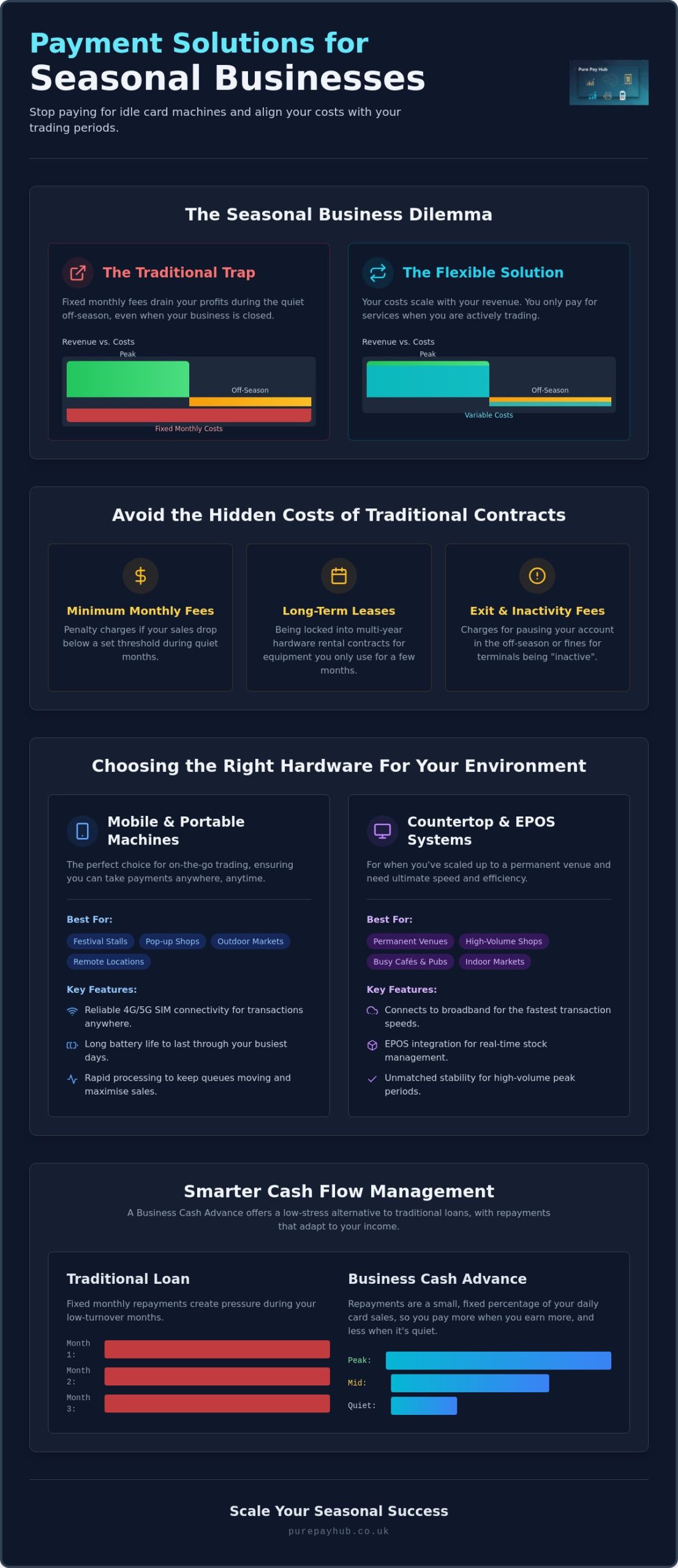
Traditional banks often struggle to support seasonal traders. They look for steady monthly income and often demand fixed repayments regardless of your current sales. A Business Cash Advance is different. It’s an unsecured capital injection based on your future card turnover. This makes it the ideal companion for payment processing for seasonal businesses. Instead of a rigid monthly bill, you repay the advance through a small, pre-agreed percentage of your daily card sales. If you have a quiet Tuesday, your repayment is lower. If you have a record-breaking Saturday, you pay back a bit more. It’s a system that breathes with your turnover.
This model prioritises your business’s health by aligning debt with income. Most seasonal owners find that their biggest expenses hit just as their cash reserves are at their lowest. By using your card processing history as proof of earnings, you can access funding that traditional lenders might refuse. It removes the stress of meeting a fixed payment during a “washout” week or an unexpectedly quiet shoulder season. You focus on the work, whilst the repayment takes care of itself in the background.
Bridging the Pre-Season Funding Gap
The weeks leading up to your peak period are often the most financially straining. You need to hire seasonal staff, refurbish your venue, or buy bulk inventory before the first customer walks through the door. Securing a traditional loan can take weeks of paperwork and stress. In contrast, this model uses your previous season’s card processing history to prove your business’s health. You can often access the funds in just a few days. This speed allows you to seize opportunities, like a last-minute discount from a supplier, without draining your personal savings. Typical use cases include:
- Hospitality: Refurbishing a seaside hotel or beer garden before the summer rush.
- Retail: Purchasing bulk stock for Christmas markets or holiday pop-ups, such as professional supplies from specialised online retailers like PoscART.
- Marketing: Funding social media campaigns to drive bookings for the coming peak.
Transparent Repayment Structures
Clarity is essential when managing debt. With this model, there is no compound interest and no fixed monthly cost. You only pay a pre-agreed factor fee. This means you know the total cost of the advance from day one. It won’t fluctuate if the Bank of England changes rates. This structure offers a unique layer of protection. If bad weather keeps the crowds away and your sales dip, your bank balance isn’t hit by a massive, inflexible loan payment. You only repay whilst you are earning. Ready to prepare for your peak? Apply for a Business Cash Advance today and secure the capital your business needs to thrive.
Scaling Your Seasonal Success with PurePay Hub
PurePay Hub is built for the reality of regional business. We don’t believe in corporate jargon or hidden markups. Our commitment is to provide a “Pure” experience. This means transparency is at the heart of every contract we sign. For merchants, payment processing for seasonal businesses should be about keeping more of your revenue. Our 0.3% debit rates are designed to do exactly that. We help you maximise your peak earnings rather than losing them to opaque fee structures. We act as a fair partner to regional business owners, providing the stability you need to grow.
Customisation is another pillar of our service. You might start your season with a single Mobile Card Machine for a coastal pop-up stall. As your volume increases, you can easily integrate EPOS Systems or add a Countertop Card Machine for a permanent indoor venue. We provide the specific hardware bundles that fit your current stage of growth. Our onboarding process is disciplined and fast. We ensure you are ready to trade in record time. You won’t miss a single day of your peak season due to administrative delays or slow hardware delivery.
The PurePay Hub Advantage for Seasonal Traders
Next-day funding comes as standard with our service. We know you need to pay suppliers and staff immediately. Waiting for a distant financial institution to clear your funds is a luxury you don’t have during a summer rush. Our UK-based support team is always available. If you face a technical glitch on a busy bank holiday weekend, we are here to solve it. Our “Pure” approach means no hidden traps or “re-activation” fees when you return for the next season. We position our offering as a stabilizing force for your finances, ensuring you have clear sight of every penny earned.
Ready for the Next Peak? Get Started Today
Switching providers shouldn’t be a headache. We offer a free statement analysis to help you uncover the hidden costs of your current contract. Our team will show you exactly where you can save. To get started, follow this simple checklist:
- Review your current notice period to avoid exit penalties.
- Gather your last three months of merchant statements for a clear comparison.
- Identify the hardware that fits your upcoming trading location.
- Contact our team for a transparent, no-nonsense quote.
You are in control of your financial future. We provide the tools and the clarity to help you succeed. Don’t let rigid bank contracts drain your off-season reserves. Organise your seasonal payments with PurePay Hub and experience a fairer way to process your sales.
Secure Your Seasonal Success
Managing a business that fluctuates with the weather or the calendar requires more than just a card reader. It demands a partnership built on transparency and mutual growth. You’ve seen how the right payment processing for seasonal businesses can eliminate the drain of off-season rental fees whilst providing the high-speed connectivity needed for peak-time rushes. By choosing hardware that matches your environment and a fee structure that respects your bottom line, you protect your hard-earned margins from unnecessary costs.
We’re here to provide that stabilising force for your finances. With debit card rates starting from 0.3% and next-day funding to keep your supply chain moving, we ensure your cash flow remains healthy throughout the year. There are no hidden markups or corporate jargon; just a fair, reliable service that works as hard as you do. Get a transparent quote for your seasonal business today. We look forward to helping you make your next peak your most successful and profitable one yet.
Frequently Asked Questions
Can I pause my card machine contract during the off-season?
Yes, you can pause your contract if you have a flexible merchant agreement. Traditional banks often enforce 12-month minimums, but a tailored solution for seasonal traders allows for hibernation periods. This ensures you aren’t paying for a service you aren’t using whilst your shop is closed. Always check for “re-activation fees” before signing; transparent providers will offer a zero-penalty pause to support your cash flow during the winter.
What happens if I don’t use my card reader for several months?
If your card reader is inactive for several months, some providers charge “inactivity fees” or trigger PCI compliance alerts. However, with flexible payment processing for seasonal businesses, we account for these dormant periods. It’s vital to keep your terminal charged and occasionally powered on to receive security updates. A fair partner won’t penalise you for the natural downtime of your industry, provided you’ve communicated your seasonal trading schedule clearly during the initial setup process.
How much does it cost to rent a card machine for just the summer?
Rental costs depend on the hardware type and the specific length of your peak season. Whilst we avoid listing fixed prices, you should expect to pay a small monthly fee for a professional terminal rather than a high flat-rate transaction fee. This model is often more cost-effective for high-volume summer traders who want lower processing rates. We recommend getting a tailored quote to see how a short-term rental compares to year-round bank commitments.
Is a business cash advance better than a bank loan for a seasonal business?
A Business Cash Advance is often superior for seasonal traders because repayments are linked directly to your sales volume. Unlike a bank loan with fixed monthly costs, the advance is repaid as a pre-agreed percentage of your daily card takings. If you have a slow week due to bad weather, your repayments naturally drop. This flexibility protects your bank balance during the off-season, making it a lower-risk option for businesses with fluctuating or unpredictable income patterns.
How quickly can I get set up with a mobile card machine for a pop-up shop?
You can typically get set up with a mobile card machine in just a few working days. Our onboarding process is designed to be disciplined and efficient, ensuring you don’t miss the start of a festival or holiday market. Once your account is approved, the hardware is dispatched via next-day delivery. This speed is essential for pop-up vendors who need to move quickly to secure a trading spot and start taking contactless payments immediately.
Do I still have to pay PCI compliance fees if I am not trading?
You are still required to maintain PCI compliance even whilst you are not trading, but you shouldn’t be charged extra for it. Some providers use “non-compliance fees” as a hidden markup for inactive accounts. A transparent partner includes PCI management as a standard part of your service. This ensures your data remains secure year-round without adding an unnecessary financial burden to your off-season overheads. Always demand clarity on these administrative costs before signing any agreement.
What are the best card machines for outdoor events with poor Wi-Fi?
A Mobile Card Machine with a built-in 4G or 5G SIM is the best choice for outdoor events with poor Wi-Fi. These units don’t rely on local internet connections; they find the strongest mobile signal available across multiple networks. This ensures you can take payments at a beachfront kiosk or a remote festival stall. Reliable connectivity is the backbone of successful payment processing for seasonal businesses, preventing lost sales and frustrated customers during your most critical trading hours.
Can I accept Apple Pay and Google Pay with a portable card machine?
Yes, every Portable Card Machine we provide fully supports Apple Pay, Google Pay, and other digital wallets. Modern consumers expect contactless options as standard, and your hardware must keep pace with these behaviours. These transactions are processed with the same speed and security as traditional chip-and-pin payments. Offering these digital options helps reduce queue times during your busiest periods, ensuring a smoother experience for your customers whilst maximising your peak revenue.
Leave a Reply