
Why does the figure on your card machine rarely match the balance landing in your bank account? For many UK small business owners, this daily discrepancy is a source of constant anxiety. You shouldn’t have to wonder if a transaction has gone missing or if fees are eroding your hard-earned margins. Learning how to reconcile card payments daily is the most effective way to protect your cash flow and spot errors before they become expensive problems. It’s a vital daily health check that keeps your finances transparent and your mind at ease.
We know that after a long shift, the last thing you want is a complex accounting headache. You likely feel that reconciliation is a tedious chore that only adds to your workload. This guide will change that. We’ll show you how to master a stress-free routine that takes just ten minutes of your time. You’ll gain total confidence that every penny of your card sales is accounted for. We’ll break down settlement timings and explain how transaction fees are actually deducted, providing a repeatable framework to ensure your bank balance always reflects your true sales.
Key Takeaways
- Understand why daily checks are the only way to catch missing transactions before they disappear into your records.
- Learn how to reconcile card payments daily using the Three-Way Match framework to ensure your EPOS, terminal, and bank statement always align.
- Identify the common reasons why your bank balance rarely matches your end-of-day reports, including the nuances of gross versus net settlement.
- Implement a repeatable 10-minute workflow that transforms a complex accounting chore into a simple, stress-free habit.
- Discover how transparent reporting and next-day funding can simplify your financial oversight and protect your business cash flow.
What is Daily Card Reconciliation and Why Does it Matter?
At its core, card reconciliation is the simple process of matching your daily card sales to the actual funds deposited into your merchant account. It’s a verification step. You’re ensuring that the digital records from your card machine align perfectly with the cash that eventually lands in your bank. Understanding how to reconcile card payments daily is not just about balancing books; it’s about protecting your revenue from invisible leaks. It’s the difference between assuming you’ve been paid and knowing you’ve been paid.
Whilst some traditional accounting advice suggests reconciliation can be a monthly task, for a busy UK SME, that’s often too late. Daily is the magic interval. Errors are fresh in your mind. If a staff member accidentally cancelled a transaction or a terminal glitch occurred during the lunch rush, you’ll remember the context today. You won’t remember it in three weeks. This proactive habit turns a potential financial crisis into a minor, five-minute correction. It keeps your data clean and your stress levels low.
There’s also a vital link between this routine and your wider business health. Accurate cash flow forecasting depends on knowing exactly when money hits your account. Daily checks remove the guesswork. You begin to see the patterns in settlement timings and fee deductions. This level of clarity makes your VAT returns and Year-End accounts far less daunting. For professional support with these tasks, DBM Accountancy Ltd provides expert tax services for ambitious businesses. Instead of facing a mountain of discrepancies when HMRC deadlines loom, you have a verified, transparent trail of every transaction.
The Financial Risks of Skipping Reconciliation
Skipping this process invites unnecessary risk. Transactions can occasionally fail to process correctly, leaving “lost” sales that never reach your bank. You might also fall victim to fraudulent chargebacks. If you don’t spot a suspicious reversal quickly, the window to dispute it can close. Daily checks also help you catch bank errors or terminal glitches. If these go unnoticed for weeks, they become incredibly difficult to trace and rectify with your provider.
Reconciliation vs. Bookkeeping: Knowing the Difference
It’s vital to distinguish between these two pillars of finance. Bookkeeping is the act of recording transactions. Bank reconciliation is the act of verifying them. They work together to provide a “true” view of your business. You cannot rely solely on your bank statement to track sales. A bank statement only shows what arrived, not what should have arrived. Knowing how to reconcile card payments daily bridges that gap, ensuring your records reflect reality rather than just a list of deposits.
The Three-Way Match: A Framework for Total Accuracy
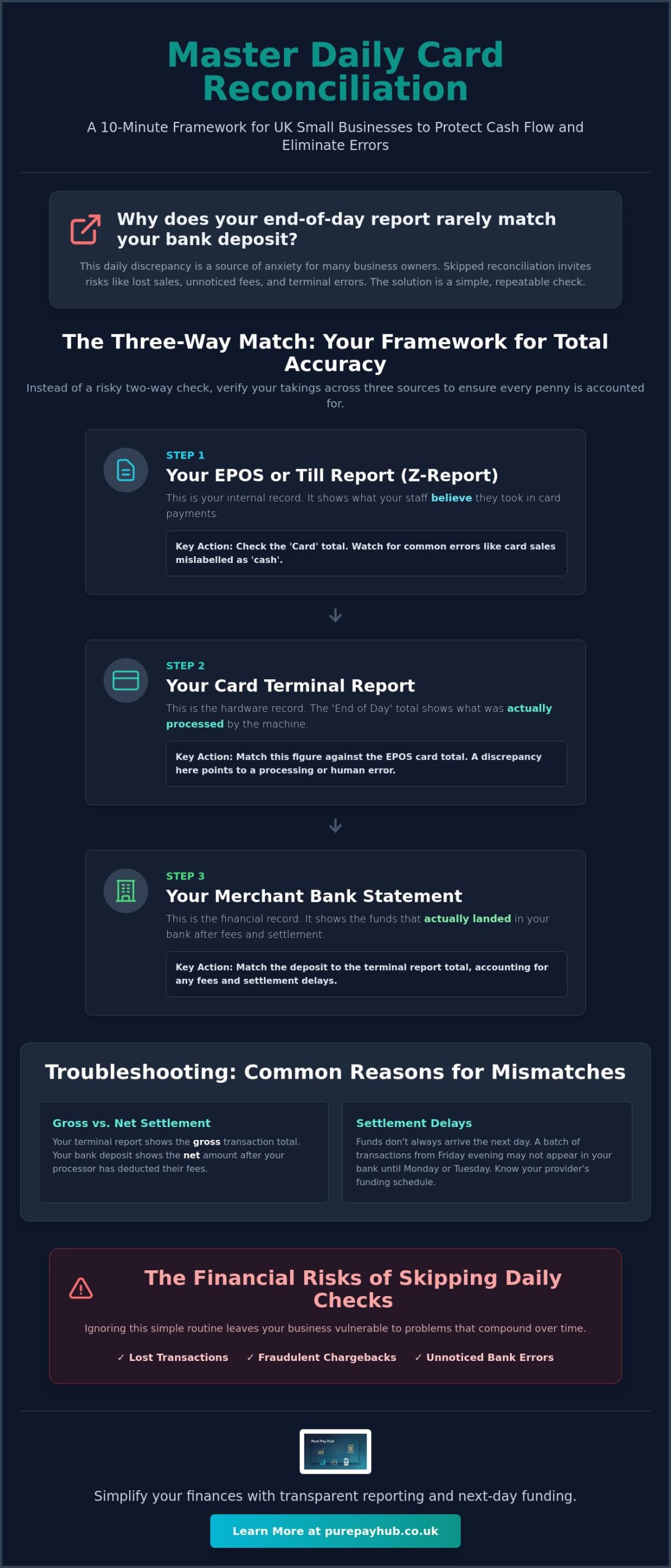
Most business owners make the mistake of comparing their till reports directly to their bank statements. This “Two-Way Match” is risky. It ignores the critical middle step where transactions are actually processed. To truly master how to reconcile card payments daily, you must adopt the Three-Way Match. This process ensures the accuracy, completeness, and validity of your financial data by cross-referencing three distinct sources: your EPOS system, your physical card terminal, and your merchant bank portal.
If you only check your till against your bank, you might miss a transaction that was approved on the till but failed at the terminal hardware. Conversely, a staff member might accidentally hit the “Cash” button for a card sale. Without the terminal report as a bridge, you’ll never know which record is the “truth”. By organising your data into these three pillars, you create a robust safety net that catches human error and technical glitches alike.
Step 1: The EPOS or Till Report
Start by pulling your daily Z-Report. The Z-Report is the primary internal record of your daily takings. Look specifically at the “Card” total. This figure represents what your staff believe they took in card payments. It’s common to find errors here, such as a sale being mislabelled as cash during a busy period. Identifying these slips early prevents them from skewing your final figures and keeps your internal records clean.
Step 2: The Card Terminal End-of-Day Report
Run a “Total” or “End of Day” report on your physical card machine. This shows every transaction that actually passed through the terminal’s hardware and reached the processor. Match this total against your EPOS card total. If the terminal says “No Transactions” but your till is full of card sales, you have a processing issue that needs immediate attention. If the numbers align, you’ve confirmed the sale was both recorded and successfully processed.
Step 3: The Merchant Bank Portal
Log into your merchant dashboard to view your Settlement Report. This bridges the gap between the terminal and your bank. You’ll see “Settled” funds (money on its way) versus “Pending” funds (transactions still being verified). Verify that the gross amount matches your terminal report before any fees are taken. Understanding these settlement timings is much easier when you use a transparent merchant service that provides clear, real-time data. Remember that whilst the sale is instant, the fund appearance in your business bank account usually follows a specific settlement cycle.
Troubleshooting Common Reconciliation Discrepancies
It’s a common frustration for UK merchants. You finish a long day, run your reports, and find the figures don’t match your bank statement. Don’t panic. These gaps are rarely signs of missing money. Most often, they’re simply quirks of the payment system. Learning how to reconcile card payments daily involves understanding these structural discrepancies so you can identify real issues amongst the noise.
These mismatches usually stem from how and when your money is processed. If you expect a perfect 1:1 match between your daily till report and your bank balance every single morning, you’ll likely be disappointed. The key is knowing which “ghost” figures to look for and how to account for them in your records.
Understanding Net vs. Gross Settlement
Gross settlement is the gold standard for simplicity. You receive the full sale amount in your bank, and your provider bills you for fees separately, usually once a month. This makes your bank statement easy to read. Net settlement is more complex. Here, your provider deducts transaction fees before the money reaches your account. If you’re on a net model, your bank deposit will always be lower than your terminal report. You’ll need to calculate the missing percentage to verify it matches your agreed rates. This step-by-step guide to credit card reconciliation provides a solid foundation for handling these calculations and spotting fee-related gaps.
The Impact of “Next-Day” and “T+3” Funding
In the UK, settlement cycles vary between providers. Some offer next-day funding, whilst others use a T+3 model, meaning funds take three working days to clear. Weekends and bank holidays disrupt this flow even further. A sale made on a Friday evening might not hit your bank until Tuesday or Wednesday. This delay creates a “rolling” reconciliation. You aren’t just matching today’s sales; you’re verifying sales from several days ago. Keeping a simple log of “Pending” funds helps you track this movement without losing your mind.
Handling Refunds and Chargebacks
Refunds and chargebacks are major reconciliation disruptors. A refund issued today might be deducted from today’s total, even if the original sale happened last week. This makes your daily terminal report look lower than your EPOS sales. Chargebacks are even more sudden. These deductions often happen without prior warning in your portal, creating a mismatch that looks like a technical error. Always check your merchant dashboard for “Adjustments” before assuming a transaction has gone missing.
Human Error and Operational Slips
Sometimes the cause is simpler. Human error remains the most frequent reason for a small £5 or £10 mismatch. A staff member might split a bill incorrectly or accidentally process a sale as cash on the till whilst taking card on the terminal. These slips are easy to spot when you check daily. They’re nearly impossible to find if you wait until the end of the month. By knowing how to reconcile card payments daily, you catch these minor operational errors before they skew your monthly profit and loss reports.
A 10-Minute Step-by-Step Daily Reconciliation Workflow
You don’t need expensive enterprise software or a degree in accounting to maintain perfect books. A simple, disciplined routine is enough for most UK small businesses. Mastering how to reconcile card payments daily takes just ten minutes when you have your tools ready. Before you start, ensure you have three things to hand: your EPOS Z-report, your card terminal’s end-of-day printout, and access to your merchant portal.
Consistency is the foundation of accuracy. By following a set workflow, you remove the guesswork and ensure that no transaction slips through the cracks. This process isn’t about complex maths. It’s about verifying that the digital trail of your sales matches the physical reality of your bank deposits.
Beyond the digital trail, understanding your physical store traffic can provide valuable context to your sales data; many retailers explore FootfallCam Pro2 People Counters to gain insights into visitor conversion rates alongside their daily financial reconciliation.
- Step 1: Close the day. Run the end-of-day reports on your EPOS system and your card terminal simultaneously. This ensures the “bucket” of sales recorded on your till aligns with the “batch” of transactions on your hardware.
- Step 2: Compare the totals. Match the card total from your till report against the grand total on your terminal slip. Note any immediate variances. If they match, you’ve confirmed that every sale recorded was successfully processed.
- Step 3: Verify the batch. Log into your merchant portal. Confirm that the status of today’s batch is “Sent” or “Settled”. This confirms the money is officially on its way to your bank.
- Step 4: Update your tracker. Enter these figures into a simple spreadsheet or your accounting software. Recording these daily snapshots prevents small errors from snowballing into a month-end crisis.
Setting a Reconciliation “Cut-off” Time
Timing errors are a major cause of reconciliation headaches. To avoid this, set a fixed “cut-off” time for your checks. Many merchants find that 10:00 AM the following morning is the best time to look at the previous day’s sales. This allows the banking systems time to catch up and update your portal. If you run a late-night hospitality business, ensure your business “day” aligns with your provider’s batch window. This prevents sales made after midnight from bleeding into the wrong report.
Documenting Variances: The “Reason Code” Method
Don’t waste hours chasing a few pennies. Use a “Reason Code” system to log discrepancies quickly. Mark “HE” for human error, such as a staff member hitting the wrong button, or “TF” for a timing factor. If a mismatch is within a tiny tolerance, like £0.01, don’t lose sleep over it. A well-maintained variance log is a gift to your accountant at year-end, providing a clear map of every minor hiccup. If your current provider makes this data hard to find, you can upgrade to a clearer payment system that simplifies your daily reporting and protects your cash flow.
Simplifying Your Finances with PurePay Hub
We’ve established that a disciplined routine is the key to financial clarity. However, your merchant provider shouldn’t make you work hard to access your own data. PurePay Hub provides the transparent reporting you need to master how to reconcile card payments daily without the usual administrative headache. Our platform acts as a stabilising force for your business, offering a modern fintech experience that never loses focus on the individual business owner.
One of the biggest hurdles in reconciliation is when your EPOS system and card machine operate in silos. We solve this by providing integrated solutions where your hardware and software talk to each other in real time. This automation eliminates the risk of manual entry errors or mislabelled transactions that often lead to end-of-day frustration. If a discrepancy does occur, you aren’t left to figure it out alone. You have direct access to UK-based experts who act as your supportive business partner, helping you resolve issues quickly so you can get back to running your company.
Next-Day Access to Funds
Traditional “T+3” settlement cycles turn reconciliation into a stressful guessing game. Waiting three or five days for funds to clear makes it nearly impossible to maintain a clean, real-time record of your cash flow. PurePay Hub offers next-day funding specifically tailored for UK SMEs. This ensures that the sales you made yesterday are the funds you see in your bank account today. This consistency simplifies your financial admin and provides an immediate view of your actual cash position. You no longer need to manage complex rolling logs; your bank statement simply follows your terminal reports in a logical, predictable rhythm.
Transparent Rates and Simple Statements
Hidden markups and complex fee structures are the primary enemies of accurate accounting. We believe in total transparency. Our merchant statements are designed to be read in seconds. They align perfectly with your daily terminal reports, making the Three-Way Match a straightforward task rather than a forensic investigation. You’ll know exactly what fees to expect, which removes the “ghost” figures that often cause anxiety whilst you are balancing the books. By choosing a partner that values honesty, you ensure that every penny of your card sales is accounted for without the need for complex workarounds.
Simplify your daily reconciliation with a PurePay Hub card machine and take the stress out of your end-of-day routine. Our no-nonsense approach to payments ensures your bank balance always matches your hard work.
Take Control of Your Daily Cash Flow
Financial clarity shouldn’t be a luxury for UK small businesses. By implementing the Three-Way Match and sticking to a disciplined 10-minute workflow, you protect your revenue from human error and technical glitches. Mastering how to reconcile card payments daily ensures that your hard-earned sales actually reach your bank account without invisible leaks or timing confusion. It turns a daunting accounting chore into a simple habit that supports your long-term growth.
You deserve a payment partner that prioritises honesty and efficiency over complex jargon. We provide the tools you need to stay in control, including debit card rates from 0.3% and next-day access to your funds. With no hidden markups and transparent reporting, you can spend less time on admin and more time growing your business. Switch to PurePay Hub for clearer reporting and next-day funding to experience a fairer, more dependable way to manage your payments. It’s time to trade financial anxiety for informed confidence. Your business is worth the extra ten minutes of care.
Frequently Asked Questions
Why does my card machine total not match my bank statement?
Mismatches usually occur due to settlement delays or specific fee structures. If your provider uses net settlement, they deduct transaction fees before depositing the funds into your account. Additionally, sales made after your daily batch “cut-off” time often won’t appear on your bank statement until the following working day. This creates a temporary gap that is easily explained once you check your merchant portal.
How long should card payment reconciliation take each day?
A disciplined routine should take no more than 10 minutes of your time each morning. By preparing your reports in advance and following a structured Three-Way Match workflow, you can verify your sales figures with total efficiency. This small daily investment prevents hours of forensic accounting at year-end. It ensures that any discrepancies are caught and resolved whilst the details are still fresh in your mind.
What is a merchant settlement report?
A merchant settlement report is a detailed record showing which batches of transactions have been cleared for payment. It provides a transparent breakdown of gross sales, refunds, and any fee deductions. This report is the vital link between your terminal and your bank. It allows you to see exactly which funds are “pending” and which have been “settled”, making it easier to track your true cash position.
Can I automate my daily card reconciliation?
You can certainly automate large parts of the process by using integrated EPOS and card machine systems. These tools synchronise data automatically, which significantly reduces the risk of human error during the busy workday. However, even with the best automation, a brief daily oversight remains essential. A quick manual check ensures that technical glitches or “ghost” transactions don’t skew your final financial records.
What should I do if I find a discrepancy in my card payments?
First, check for common operational slips like a sale being recorded as cash instead of card on your till. Review your merchant portal for any pending refunds or chargebacks that might have reduced your daily total. If the figures still don’t add up after these checks, contact your provider’s UK-based support team. They can provide a detailed transaction investigation to help you locate the missing funds.
Do I need to reconcile payments on weekends and bank holidays?
You aren’t required to work on holidays, but you must understand how they affect your financial data flow. Banking systems don’t process settlements on weekends or bank holidays. This means your Tuesday bank deposit might contain a combined total from Friday, Saturday, and Sunday sales. Understanding these timing factors is key to maintaining a stress-free reconciliation routine that accurately reflects your business activity.
How do transaction fees affect my daily reconciliation?
Fees change the final figure you see on your bank statement depending on your settlement model. In a net settlement model, your provider takes their cut before paying you. This makes how to reconcile card payments daily slightly more complex as you must account for that missing percentage. Choosing a provider with transparent rates and simple statements makes it much easier to verify that you are being charged fairly.
Is it better to reconcile card payments daily or monthly?
Daily reconciliation is the gold standard for healthy cash flow management in any UK SME. It allows you to spot errors, fraud, or terminal glitches immediately. Waiting until the end of the month makes it nearly impossible to remember the specific context of a small mismatch. Learning how to reconcile card payments daily protects your margins and gives you informed confidence in your bank balance.
Leave a Reply