
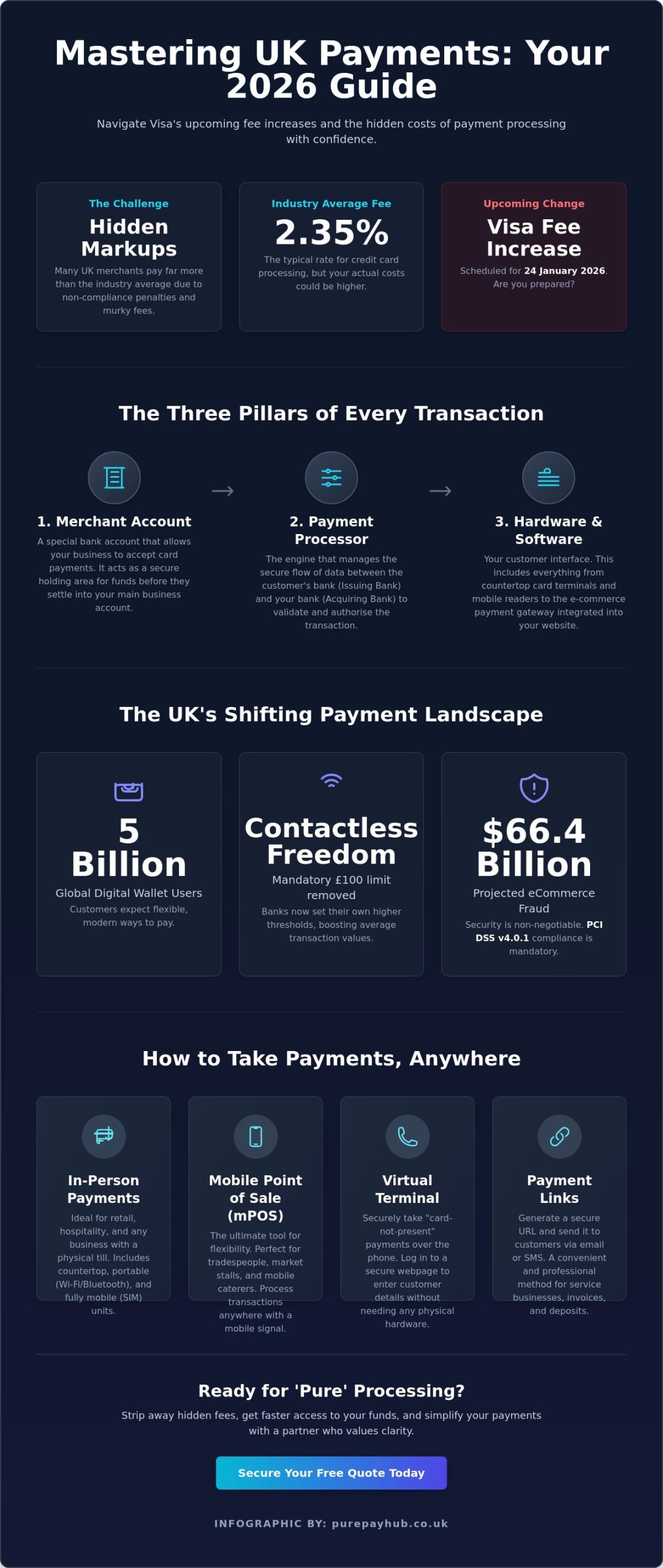
Did you know that Visa is scheduled to increase its fees on 24 January 2026? Whilst the industry average for credit card processing sits at 2.35%, many UK merchants are actually paying far more because of “non-compliance” penalties and murky markups. You’ve likely felt the sting of long settlement periods delaying your cash flow or stared at a statement filled with jargon like “interchange plus” and wondered where your profit went. It’s frustrating when the simple act to take payments feels like a constant battle against hidden costs.
You deserve a partner that prioritises clarity over corporate jargon. We’ve built this guide to help you master the essentials of UK payment processing and strip away the confusion of complex fee structures. You’ll discover how to secure faster access to your hard-earned funds and ensure your setup is fully compliant with the mandatory PCI DSS v4.0.1 standards. We’ll walk you through choosing the right methods for 2026 and setting up a merchant account that scales as your business grows.
Key Takeaways
- Understand the three essential pillars of processing to ensure your money moves securely from the customer’s bank to your business account.
- Identify the most efficient ways to take payments across retail, hospitality, and online environments to suit your specific sales volume.
- Decode the difference between transaction-based fees and hardware rentals to remove hidden markups from your monthly statements.
- Follow a proven five-step checklist to audit your business needs and choose a merchant setup that truly scales.
- Optimise your cash flow with next-day funding and learn how flexible finance can support your long-term growth plans.
What Does it Actually Mean to Take Payments in 2026?
Taking payments is no longer just about swapping cash for goods. In 2026, payment processing acts as the vital digital bridge between your customer’s bank account and your business balance. It’s a complex journey that happens in seconds. For a modern SME, the ability to take payments efficiently is a utility, much like electricity or water. You need it to be reliable, invisible, and fairly priced. With Visa scheduled to increase its fees on 24 January 2026, understanding how this bridge works is essential for protecting your margins.
To understand the process, you must look at the three pillars that support every transaction:
- The Merchant Account: This is a specific bank account that allows your business to accept card payments. It acts as a temporary holding area before funds are cleared and moved to your business bank account.
- The Payment Processor: This is the engine. It manages the flow of data between the banks to ensure the transaction is valid, authorised, and secure.
- Hardware and Software: This is your interface. It includes everything from sleek countertop terminals in a shop to the e-commerce gateway on your website.
At PurePay Hub, we advocate for “pure” processing. This means we strip away the hidden fluff and complex markups that traditional providers often bury in the small print. We focus on secure, transaction-based clarity so you can focus on growth. When your processing is pure, you aren’t surprised by unexpected costs at the end of the month.
The Shift in UK Consumer Behaviour
Consumer habits have transformed rapidly. By January 2026, global digital wallet users reached 5 billion. In the UK, the mandatory £100 contactless limit was removed on 19 March 2026, whilst banks now set their own thresholds. Relying on “cash only” is a risk few businesses can afford. Accepting diverse methods, from physical cards to digital tap-to-pay on smartphones, directly increases your average transaction value (ATV). This shift is also paving the way for digital asset integration, where fintech providers like Pallapay are helping businesses adapt to new ways of exchanging value. Customers naturally spend more when they aren’t limited by the physical notes in their wallet.
Key Terminology Every Merchant Should Know
The industry is full of jargon, but the basics are simple. Your Acquiring Bank is the institution that maintains your merchant account and “acquires” the funds for you. The Issuing Bank is the customer’s bank that “issues” their card. Settlement is the final step where funds are moved into your bank balance. In 2026, security is governed by PCI DSS v4.0.1. This is the mandatory gold standard that ensures every tap is protected against the $66.4 billion eCommerce fraud threat projected for this year.
Choosing Your Method: How to Take Payments Anywhere
Your business might start at a physical till, but it shouldn’t end there. In 2026, 92% of merchants accept digital wallets, and your customers expect that same level of flexibility whether they are in your shop or on your website. To stay competitive, you need a setup that handles every scenario. Whether you are selling at a local market or invoicing a client across the country, the goal is to take payments without friction or technical delays.
We view your payment setup as a central Hub. Instead of juggling different providers for your shop, your website, and your phone orders, a unified system brings everything together. This creates a stabilising force for your finances and provides one clear view of your cash flow. This clarity is vital when eCommerce fraud is projected to cost merchants $66.4 billion this year. By centralising your streams, you reduce your risk and simplify your reporting.
In-Person: Countertop vs. Mobile Units
Countertop machines are the reliable workhorses of the retail world. They sit at your fixed till point and usually connect via Ethernet for maximum stability. If your customers always come to you, this is your foundation. Portable units offer more freedom, using Bluetooth or Wi-Fi to reach tables in a restaurant or move around a showroom floor. For tradespeople or mobile caterers, a SIM-based mobile machine is essential. It connects to the 4G or 5G network so you can process transactions anywhere with a signal. An mPOS, or mobile Point of Sale, is the ultimate tool for on-the-go flexibility.
Remote Payments: Virtual Terminals and Links
Not every sale happens face-to-face. A virtual terminal allows you to take payments over the phone securely. You simply log into a secure webpage and type in the customer’s details whilst they are on the line. It’s a professional way to handle “card-not-present” transactions without needing physical hardware on site.
Payment links are another favourite choice for service-based SMEs and wholesalers. You generate a secure URL and send it via email or SMS. The customer clicks, pays at their convenience, and the settlement process begins. It’s transparent, honest, and incredibly fast. If you’re looking for a transparent partnership to manage these different streams, choosing a unified provider is the first step toward financial clarity. This approach ensures your business stays agile as the UK market continues to move away from traditional cash transactions.
Decoding the Costs: Transaction Fees vs. Monthly Rentals
Understanding the true cost to take payments is often the biggest hurdle for UK business owners. Most providers present a “blended” rate that looks simple but actually hides significant markups. The Merchant Service Charge (MSC) is the core fee you pay on every transaction. Typically, debit card rates are significantly lower than credit card rates because the risk to the bank is lower. With the average processing cost for Visa and Mastercard sitting at approximately 2.35%, any rate significantly higher than this suggests a heavy processor markup.
Hardware rental is another area where transparency is often lacking. A fair monthly price for a modern countertop unit should be clear and fixed. However, the real danger lies in the “hidden” extras. Many legacy providers charge a Minimum Monthly Service Charge (MMSC) if you don’t hit a certain sales volume. They also levy heavy fines for PCI non-compliance. Since PCI DSS v4.0.1 became mandatory on 31 March 2025, these fines have become a common way for processors to squeeze extra profit from unsuspecting merchants. We believe in a different approach. We advocate for transaction-based clarity where you only pay for what you use.
Understanding Interchange Plus Pricing
Interchange Plus is the “pure” alternative to confusing flat rates. This model reveals exactly what the card schemes charge (the interchange) and exactly what the processor takes as their fee. It’s the most honest way to view your statements. For high-volume merchants, debit card charges can start as low as 0.3%, whilst credit cards remain higher. This model allows you to see the direct benefit of the proposed 0.1 percentage point reduction in interchange fees scheduled to last for the next five years.
Avoiding the ‘Exit Fee’ Trap
The UK market is notorious for long-term contracts. These agreements often stretch from 12 to 48 months and include aggressive exit fees. Always check the small print for rolling renewals that lock you in for another year without your knowledge. You should also look for cancellation notice periods, which can sometimes be as long as six months. PurePay Hub simplifies the onboarding process to avoid these legacy headaches. We focus on building a partnership based on performance rather than restrictive legal traps. This ensures your business remains agile and ready to grow.
The Merchant’s Checklist: 5 Steps to Take Payments
Setting up your business to take payments shouldn’t be a months-long ordeal. Whilst legacy banks often move at a glacial pace, a modern fintech approach allows you to get up and running with speed and precision. This checklist serves as your roadmap to a secure, transparent setup that avoids the common pitfalls of hidden fees and technical friction.
Step 1: Audit your sales volume. Before signing any contract, look at your average transaction size and your monthly turnover. If your average sale is small, per-transaction pence fees matter more than percentages. If you’re a high-ticket wholesaler, the percentage rate is your priority. Step 2: Choose your primary environment. A busy cafe needs a portable Wi-Fi unit for table service, whilst a boutique retail shop might prefer a fixed countertop terminal. If you’re selling across multiple channels, ensure your hardware and online gateway are synced through a single Hub to keep your reporting clean.
Preparing Your Documentation
To speed up your application, you must organise your “Know Your Customer” (KYC) documents in advance. You’ll typically need a valid photo ID, proof of business address, and three months of recent bank statements. Having a dedicated business bank account is essential for clean accounting and faster settlement. When your documents are ready, modern onboarding can often be completed within 24-48 hours, getting you ready to take payments almost immediately.
Integrating with EPOS Systems
Step 4: Select hardware that integrates. Integrated payments are vastly superior to standalone units for any growing business. In an integrated setup, the till communicates directly with the card machine. This eliminates the need to type the amount in twice, which drastically reduces human error and prevents costly mistakes during busy shifts. It’s particularly vital for the fast-paced nature of UK hospitality. You can explore our specialised integrated EPOS systems for hospitality UK to see how this works in practice.
Step 5: Run a penny test. Once your hardware arrives, process a transaction for £0.01. This “penny test” ensures that the connection to the acquiring bank is active and that your settlement path is clear. It’s the final check to guarantee that when you start your first full day of trading, your funds will arrive in your account without delay. If you’re ready to start your journey, apply for your merchant account today and join a partnership built on purity and clarity.
Beyond the Transaction: Cash Flow and Growth
Your business doesn’t stop once the customer leaves the premises. The real work of growth begins when those funds hit your account. When you take payments, you’re generating more than just revenue; you’re creating a data map of your business’s health. In 2026, the speed of your settlement and the flexibility of your capital determine how quickly you can respond to new opportunities. We position PurePay Hub as your central command centre, ensuring that the bridge between a sale and your bank balance is as short as possible.
Your transaction history is a powerful tool for tracking customer behaviour and seasonal trends. By analysing when people choose to take payments most frequently, you can optimise your staffing levels and stock orders. Our Hub provides this clarity through simplified reporting that strips away the noise. This allows you to make informed decisions based on pure data rather than guesswork. When your payment processor acts as a growth partner, your business is built to scale sustainably.
Next-Day Access to Funds
Standard settlement periods often leave merchants waiting between 3 and 5 working days for their money. This delay creates a bottleneck that prevents you from restocking inventory or paying staff on time. For UK SMEs in 2026, next-day access to funds has moved from a luxury to a non-negotiable requirement. It provides the liquidity needed to keep your operations fluid and responsive. You can learn more about this in our Next-Day Funding for Retailers guide.
Business Cash Advances Explained
Traditional bank loans often come with rigid monthly repayments that don’t account for your actual trading volume. A Business Cash Advance is a more transparent and honest alternative. You receive a lump sum upfront and repay it as a fixed percentage of your daily card sales. This “pay-as-you-trade” model is inherently safer for seasonal businesses. If you have a quiet Tuesday, you pay back less. If you have a record-breaking Saturday, you pay back more. It’s a partnership that aligns with your success. Discover how PurePay Hub can support your cash flow with a Business Cash Advance today.
Secure Your Financial Future Today
The UK payment landscape is evolving rapidly. With Visa increasing fees on 24 January 2026, you cannot afford to stay with a provider that hides behind complex jargon. You now have a clear checklist to audit your sales, choose the right hardware, and secure your cash flow with next-day funding. The ability to take payments should be a pure utility that supports your growth rather than a drain on your resources.
By moving away from “blended” rates and embracing the transparency of an Interchange Plus model, you protect your margins from hidden monthly markups. You also ensure your business stays ahead of mandatory security standards like PCI DSS v4.0.1. We act as your reliable ally in this shifting market, providing the stability your business needs to thrive.
Switch to PurePay Hub for transparent, transaction-based payments today. You will benefit from debit card rates starting from 0.3% and next-day funding as standard. It’s time to simplify your setup and focus on your customers. Your business deserves a partner that values honesty as much as you do.
Frequently Asked Questions
How long does it take to set up a merchant account to take payments?
Modern onboarding allows you to set up a merchant account within 24 to 48 hours. If you have your “Know Your Customer” documentation ready, such as photo ID and bank statements, the process is streamlined and efficient. This ensures you can take payments and start trading without the long delays typically associated with traditional high-street banks.
Can I take payments on my phone without a card machine?
You can take payments on your smartphone using a virtual terminal or secure payment links. A virtual terminal turns your phone’s browser into a secure interface for over-the-phone orders. Alternatively, you can send a unique URL via SMS or email, allowing the customer to pay instantly from their own device without needing a physical terminal on site.
What are the average transaction fees for small businesses in the UK?
Small businesses in the UK typically pay between 1.5% and 3.5% per credit card transaction. As of May 2026, the average processing cost for Visa and Mastercard is approximately 2.35%. These rates vary depending on whether you use a “blended” flat rate or a more transparent “interchange plus” model that reveals the true cost of processing.
Is it possible to take payments online and in-store with the same provider?
Managing both online and in-store sales with a single provider is the most efficient way to run your business. Using a unified “Hub” simplifies your reporting and gives you a single view of your cash flow. For those operating as digital platforms or marketplaces, click here to learn more about Gemba’s specialised banking infrastructure. It also ensures your transaction-based fees remain consistent and clear across all your sales channels, from your website to your physical till.
What happens if my card machine loses Wi-Fi connection during a sale?
Most modern terminals switch automatically to a 4G or 5G SIM connection if your Wi-Fi drops. This ensures you don’t lose a sale during busy shifts. If you don’t have a SIM-enabled device, some units offer an “offline mode” that stores the transaction data securely and processes it once your internet connection is restored.
How do I avoid paying monthly PCI non-compliance fees?
You avoid non-compliance fees by providing 12 months of continuous operational evidence for PCI DSS v4.0.1. This became mandatory for all UK businesses on 31 March 2025. We help you through the annual self-assessment process to ensure your security standards are met, protecting you from the unnecessary penalties that many traditional processors charge.
Can I take payments from international customers with a UK merchant account?
You can accept cards from international customers, but these transactions often carry different interchange fees. Whilst your UK merchant account handles global payments, be aware that currency conversion and “non-EEA” card rates can impact your final settlement. We advocate for transparency here so you always know the exact cost of your global sales.
What is the difference between a merchant account and a business bank account?
A merchant account is a temporary holding area where funds are cleared and authorised after a transaction. A business bank account is the final destination where your hard-earned profits are settled. You need both to function; the merchant account acts as the bridge that moves money from your customer’s bank to your own balance.
Leave a Reply