Tag: PCI Compliance

  • The Ultimate Guide to Choosing a Portable Card Machine for Your UK Business

    The Ultimate Guide to Choosing a Portable Card Machine for Your UK Business

    Did you know that for a UK business turning over £10,000 a month, the difference between the highest and lowest transaction rates can result in an extra £145 in fees every single month? It is a staggering amount of money to lose simply because of an opaque pricing structure. You likely feel the frustration of watching these margins shrink while waiting days for funds to clear or battling connectivity drops during your busiest hours. You need a portable card machine that offers more than just a way to take payments; you need a tool that protects your bottom line.

    This guide will show you how to balance mobility and security while accessing the UK’s lowest transaction rates. We will help you move toward next-day funding and reliable 4G connectivity without the headache of hidden monthly costs or complex jargon. We will explore the latest 2026 industry standards, including the transition to PCI DSS v4.0.1 and the reality of the £100 contactless limit, to ensure your business stays compliant and profitable. Discover how to find a payment partner that prioritises your growth through transparent, fair, and dependable service.

    Key Takeaways

    • Distinguish between standalone portable terminals and app-reliant mobile readers to ensure your hardware choice supports your specific business environment.
    • Identify the essential hardware specifications, from thermal printers to battery capacity, required to maintain UK tax compliance and operational uptime.
    • Uncover the “Flat Rate Trap” and learn how an Interchange Plus pricing model offers a fairer, more transparent way to handle your card processing.
    • Protect your cash flow by prioritising next-day access to funds and avoiding providers that hold your money for three working days or longer.
    • Discover why a portable card machine from PurePay Hub offers a reliable, low-cost solution with debit card rates starting at 0.3% and zero hidden markups.

    What is a Portable Card Machine and Why Does Your Business Need One?

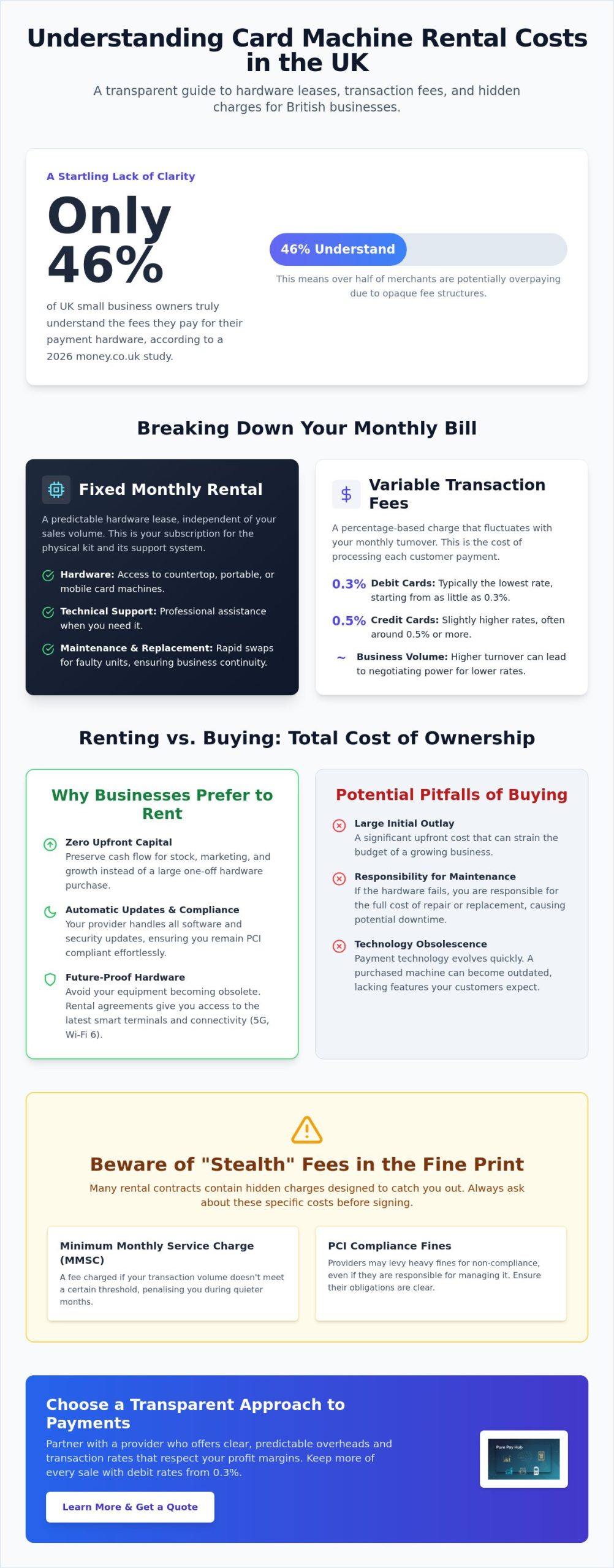
    A portable card machine is a wireless, battery-powered device designed to take payments away from a fixed till point. To understand the basics of what is a payment terminal, it is useful to see it as a standalone computer that securely processes encrypted transaction data. Unlike traditional countertop units that rely on a physical cable for power and internet, these devices give you the freedom to move. They are the standard for modern UK businesses that value efficiency and customer service.

    For a busy pub or a plumber, mobility isn’t a luxury; it’s a necessity. If you run a restaurant, you shouldn’t force customers to queue at a desk to pay. Taking the terminal to the table improves the guest experience and speeds up table turnover. In retail, these units act as “queue-busters” during peak periods like Christmas, allowing staff to take payments anywhere on the shop floor. This flexibility ensures you never miss a sale because of a physical bottleneck at the counter.

    To find tailored equipment that meets these specific industry demands, you can learn more about professional payment processing and card machine options designed for high-performance environments.

    Portable vs. Mobile Card Readers: Which is Right?

    Many providers blur the lines between “mobile” and “portable” devices. A mobile reader is typically a small, inexpensive square that connects to your smartphone via Bluetooth. It depends entirely on your phone’s battery and a mobile app to function. This can be unreliable during a busy shift. A true portable card machine is a standalone powerhouse. It has its own processor, a built-in thermal receipt printer, and an internal SIM card.

    Tradespeople often prefer these rugged units because they don’t drain their phone battery and can withstand the rigours of a van or a building site. High-ticket businesses, such as jewellery shops or boutique hotels, find that customers trust the professional, dedicated look of a terminal over a plastic dongle attached to a personal phone. It projects an image of reliability and security that a consumer-grade device simply cannot match.

    Connectivity Options: Wi-Fi, GPRS, and 4G

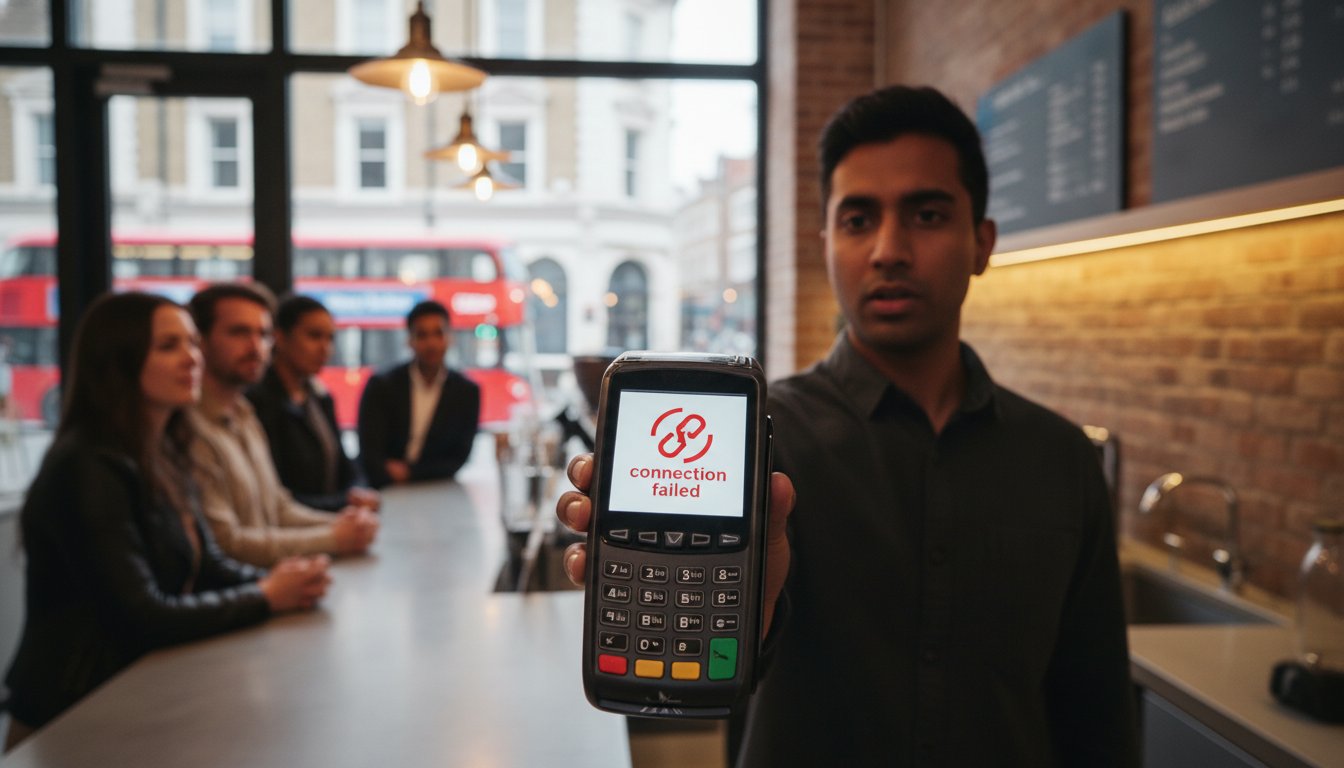
    Connectivity is the heartbeat of any mobile payment solution. Most portable units use dual-connectivity, switching between Wi-Fi and mobile data. This provides a vital safety net. If your shop’s broadband fails, the machine automatically connects to a 4G or GPRS network. This ensures your business stays online even when your local infrastructure doesn’t.

    We recommend looking for devices equipped with roaming SIMs. These don’t just stick to one provider like O2 or EE; they scan for the strongest available signal across all UK networks. This is crucial for outdoor events, beer gardens, or trade work in rural areas where signal strength varies. Relying on Wi-Fi alone is a risk. A dead zone in a garden or a basement could mean a lost sale and a frustrated customer. A multi-network SIM removes that stress entirely.

    Key Features to Evaluate Before You Invest

    Choosing a portable card machine requires you to look past glossy marketing photos and focus on operational endurance. You need a device that survives a full shift without a recharge. Aim for a battery capacity that provides 8 to 12 hours of active use. If your terminal dies at 2 PM on a busy Saturday, your revenue stops immediately. Physical durability is equally vital. While a sleek touchscreen looks modern, physical buttons are often more reliable in environments where hands might be wet, greasy, or gloved.

    Ergonomics play a major role in staff productivity. A heavy, clunky machine becomes a burden after several hours of service. Look for lightweight designs with a textured grip to prevent accidental drops. This is especially important for hospitality staff navigating crowded dining rooms or tradespeople working on doorsteps. A well-designed unit feels like a tool, not a weight, allowing your team to focus on the customer rather than the hardware.

    The Necessity of a Built-in Receipt Printer

    Many entry-level readers offer digital-only receipts via email or SMS. Whilst this sounds modern, it often creates unnecessary friction in the UK market. Many customers still prefer a physical paper receipt, especially for business expense claims or quick reassurance. Manually typing a customer’s email address into a small screen for every transaction wastes valuable seconds and irritates people in a rush. An integrated thermal printer handles this in an instant. It also simplifies your end-of-day routine by printing a physical “Z-report.” This makes reconciling your daily takings a straightforward task rather than a digital chore.

    Security and PCI Compliance Simplified

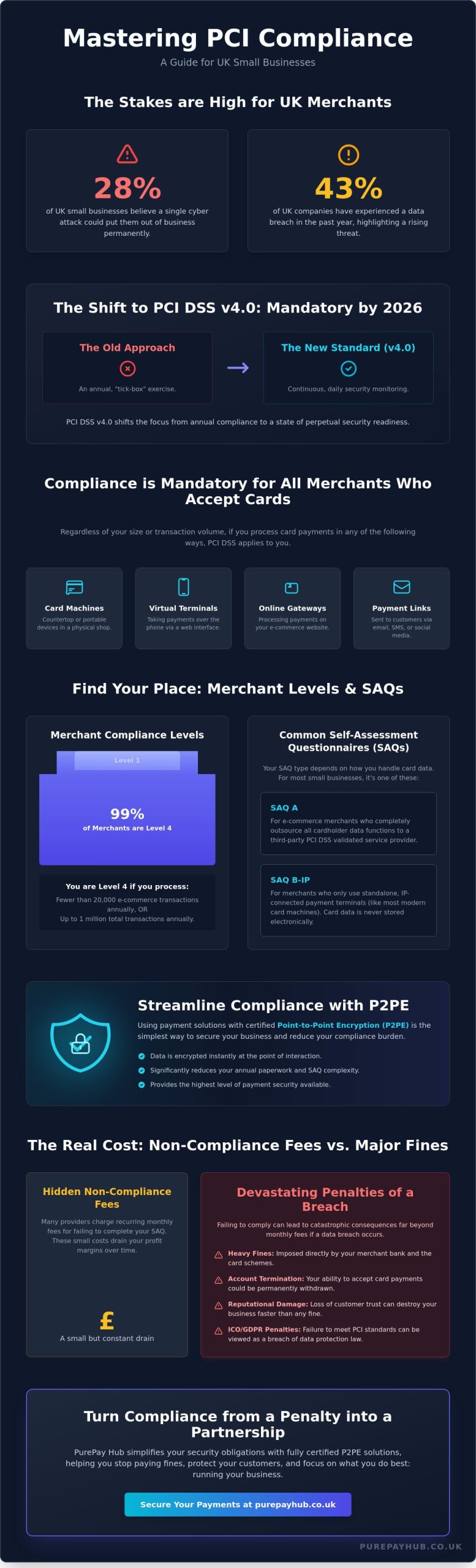
    PCI compliance is the global security standard for protecting cardholder data. Modern portable machines now automate most of this process. They perform security updates in the background without interrupting your service. This ensures your hardware remains compliant with the latest PCI PTS 6.x standards, which are essential for long-term security. By using a terminal that automates these protocols, you avoid the “non-compliance fines” that many traditional banks still levy against small businesses. A provider-managed merchant account ensures your security is always up to date, leaving you to run your business with total peace of mind.

    If you want a device that balances these technical demands with straightforward service, consider how a professional payment partner can streamline your setup and protect your margins.

    The Ultimate Guide to Choosing a Portable Card Machine for Your UK Business

    The True Cost of Payments: Flat Rates vs. Interchange Plus

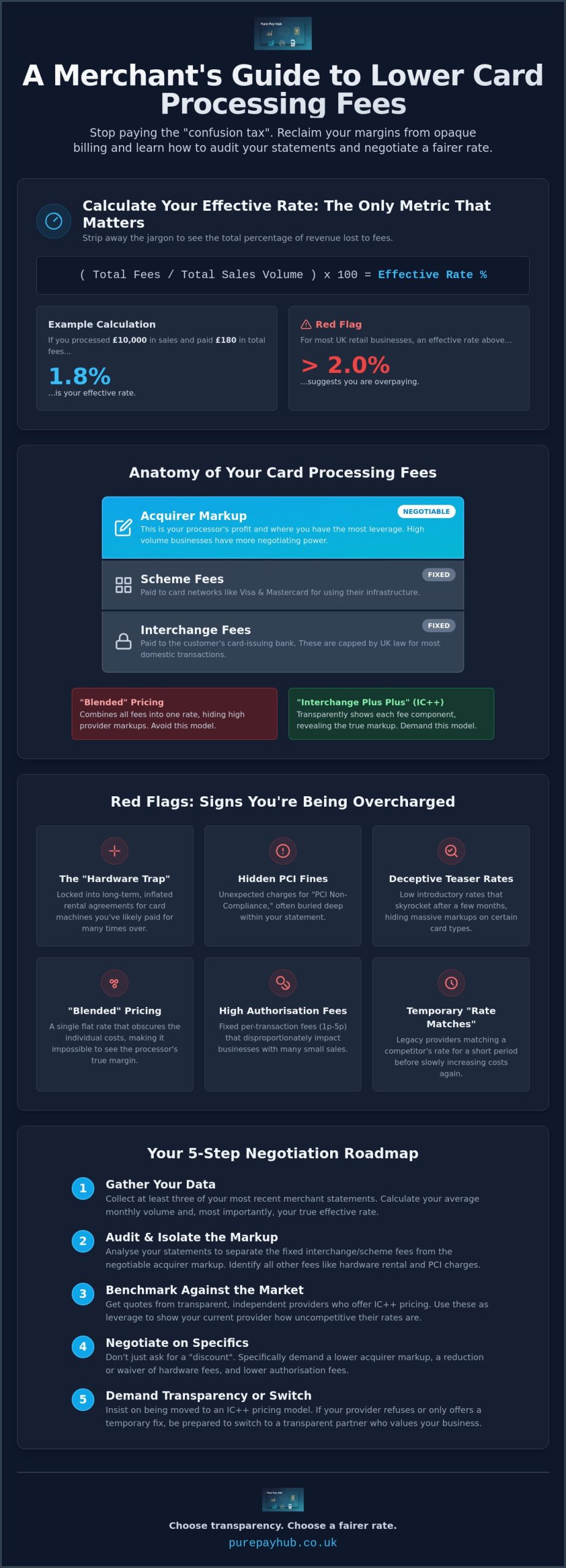
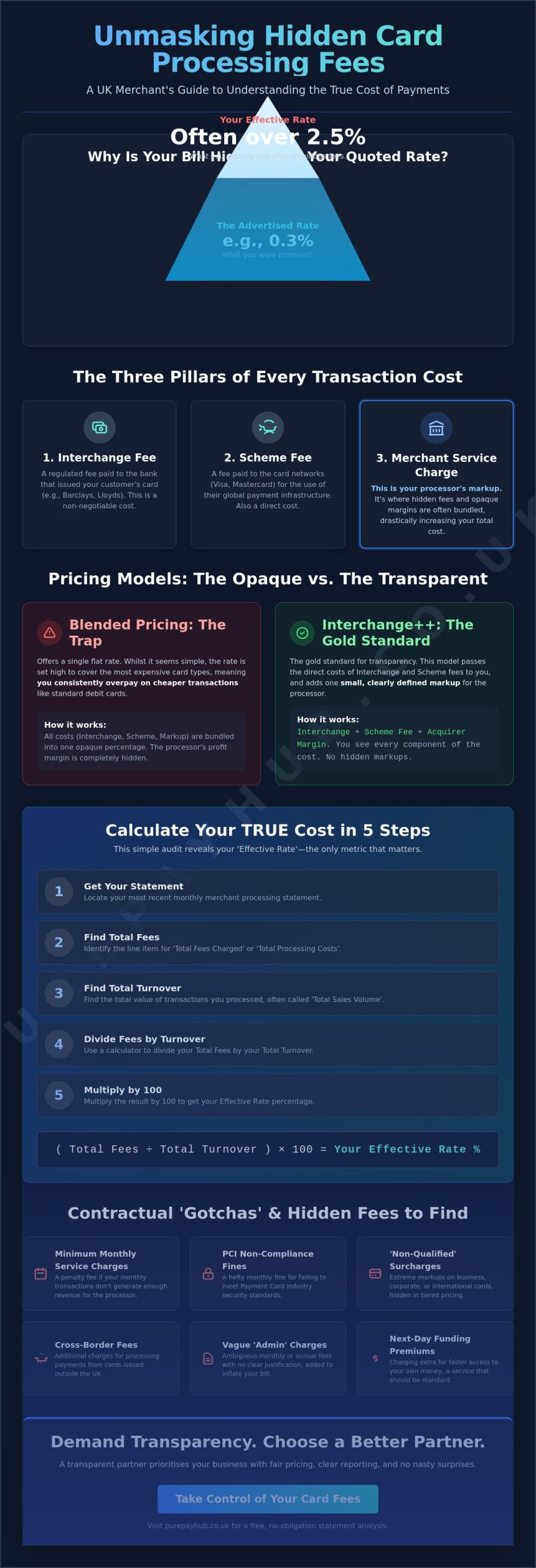
    Many providers tempt you with a single, simple number. They call it “fair and flexible.” In reality, a flat rate of 1.75% is often a trap for growing businesses. This model averages the cost of expensive credit cards with much cheaper debit cards, but you pay the high price for both. Since debit cards account for approximately 80% of all card transactions in the UK, you are likely overpaying on the vast majority of your sales. A flat rate prioritises the provider’s profit over your business’s margins.

    Interchange Plus is the professional alternative. This model passes on the actual cost of the transaction from the card issuer, known as the interchange fee, plus a small, transparent margin. It removes the guesswork. At PurePay Hub, we offer debit rates starting from 0.3%. When compared to a standard 1.75% flat rate, this represents a 75% saving on your processing costs. You should also watch for “hidden” fees that flat-rate providers often omit from their headlines, such as authorisation fees, statement fees, and monthly PCI compliance charges.

    Calculating Your Real Merchant Service Charge (MSC)

    Your Merchant Service Charge is the total percentage you pay on every sale. To understand your true costs, you must separate the interchange fees set by Visa and Mastercard from the markup your provider adds. Debit cards should always be significantly cheaper for you to process than credit cards. Consider the impact on a £1,000 transaction. At a 1.75% flat rate, you pay £17.50 in fees. With a 0.3% rate on a portable card machine from a transparent provider, that same transaction costs you just £3.00. Over a month, these small differences determine whether your business thrives or merely survives.

    Monthly Rental vs. Outright Purchase

    It is easy to be swayed by a cheap, one-off hardware cost. Some readers sell for as little as £19, but they often tie you to those expensive flat-rate contracts forever. Buying your hardware outright might seem cost-effective, but it often leaves you responsible for repairs and security upgrades. Leasing a professional portable card machine is frequently the smarter move for established merchants. A rental model includes full technical support and ensures you always have the latest, most secure hardware. This approach protects your cash flow and guarantees that your payment technology never becomes obsolete or vulnerable to new security threats.

    Operational Excellence: Funding Speeds and Support

    Taking a payment is only half the battle. The true test of a portable card machine provider is how quickly that money reaches your bank account. Many popular flat-rate providers operate on a “T+3” basis. This means you wait three working days for your own revenue to clear. For a small business with tight margins, this delay is a significant risk. It ties up your capital and makes it harder to respond to unexpected costs. Next-day funding is the gold standard for UK merchants. It ensures your Friday night takings are available to you by Monday morning, keeping your business liquid and agile.

    Operational excellence also extends to how your hardware talks to your software. A modern portable unit should integrate seamlessly with your EPOS system. This synchronisation prevents manual entry errors and saves time during busy shifts. When a staff member rings up an order on the till, the amount should automatically appear on the terminal screen. This reduces friction at the point of sale and ensures your digital records always match your physical bank balance.

    Solving the Cash Flow Gap

    Next-day funding allows you to pay suppliers and staff without relying on expensive overdrafts or credit. It turns your daily revenue into immediate working capital. At PurePay Hub, we prioritise this speed because we understand that cash flow is the lifeblood of regional trade. Before you sign any contract, ask for a written guarantee of their funding schedule. Some providers promise “fast” payments but hide caveats in the small print that revert to three-day cycles during bank holidays or weekends. Reliable access to your funds should be a non-negotiable part of your service agreement.

    UK Support: The Safety Net You Need

    There is nothing more frustrating than a terminal failure during a peak service period. If your machine stops working on a busy Saturday night, an “email-only” support ticket is useless. You need to speak to a person who understands the UK market and can provide immediate technical assistance. International call centres often rely on generic scripts that don’t account for local connectivity issues or specific UK banking protocols.

    We believe in the value of a dedicated account manager. Having a direct point of contact for your merchant ID means you aren’t just another number in a database. Local, professional advice ensures that if things go wrong, you have a partner working to get you back online quickly. This level of advocacy is what separates a distant financial institution from a true business ally. To secure a payment partner that values your time as much as you do, switch to next-day funding with PurePay Hub today.

    Why PurePay Hub is the Logical Choice for UK Merchants

    Selecting a portable card machine is about more than just hardware; it’s about choosing a partner that won’t eat into your hard-earned margins. PurePay Hub operates with a distinct no-nonsense approach. We prioritise clarity over corporate jargon. Our goal is to build immediate trust by removing the skepticism often associated with payment processing. We don’t just provide a service; we act as a fair ally to regional business owners across the UK.

    Our onboarding process is quick and disciplined. We understand that you don’t have time for endless paperwork or technical delays. Once you join us, you gain access to a platform built on transparency. We have moved away from the impersonal phrasing of traditional banking to create a direct partnership with you. This ensures your payment setup is a source of stability, not a cause of stress.

    Transparent Rates, No Hidden Markups

    We provide calm advocacy in an industry that is often intentionally confusing. You deserve to see the real cost of your transactions. When you request a quote, we show you exactly where your money goes. With debit rates starting from 0.3%, we offer a significant saving compared to the 1.75% flat rates pushed by many competitors. Switching is simple. We assist with every step of the transition to ensure your business experiences zero downtime during the move.

    Beyond the Machine: Business Cash Advances

    A true business partner supports your long-term development. We offer Business Cash Advances that allow you to access unsecured capital based on your card turnover. This isn’t a traditional loan with rigid monthly costs. Instead, your repayments fluctuate with your daily takings. If your sales are lower one week, your repayment amount drops accordingly. This flexible model protects your cash flow whilst providing the funds you need to renovate, restock, or expand.

    We are a modern fintech company that hasn’t lost focus on the individual merchant. By choosing a portable card machine through PurePay Hub, you are choosing a steady promise of better, fairer service. We don’t shout for attention; we win it through reliable results and honest pricing. Join the community of UK businesses that have already secured their financial future with a partner they can actually trust.

    Secure Your Business Growth with Better Payments

    Choosing the right payment technology is a pivotal decision for any modern merchant. You now understand that a true portable card machine offers more than just mobility; it provides the robust connectivity and hardware durability needed to keep your business running during peak hours. By moving away from expensive flat-rate traps and embracing transparent Interchange Plus pricing, you can protect your margins and reinvest that capital back into your growth. Reliability depends on both speed and support. Waiting days for your funds to clear is an unnecessary burden that restricts your operational flexibility.

    You deserve a partner that prioritises your success through clear communication and fair service. Switch to PurePay Hub today for transparent rates and next-day funding. Benefit from debit card rates starting at 0.3% and the peace of mind that comes with UK-based professional support. It’s time to leave hidden fees behind and build a more profitable future for your business. We’re ready to help you make the move.

    Frequently Asked Questions

    How long does the battery last on a portable card machine?

    Most professional units provide between 8 and 12 hours of active use on a single charge. This capacity ensures your team can process payments throughout a full shift without needing to return the device to its base. Factors like screen brightness and the frequency of receipt printing will impact total battery life. For high-volume hospitality environments, choosing a terminal with “all-day” endurance is essential to avoid service interruptions during peak periods.

    Do I need a Wi-Fi connection to use a portable card reader?

    No, you don’t strictly need a Wi-Fi connection if your device is equipped with an internal SIM card. Modern terminals use dual-connectivity to ensure you stay online. They typically prioritise your local Wi-Fi but switch to 4G or GPRS mobile data automatically if the signal drops. This roaming capability is vital for tradespeople working on-site or restaurants with outdoor seating where Wi-Fi coverage might be inconsistent or weak.

    How much are the transaction fees for portable card machines in the UK?

    Transaction fees vary significantly depending on whether you choose a flat-rate model or Interchange Plus pricing. Many entry-level providers charge a fixed rate of around 1.75% for every transaction. More transparent partners offer debit rates starting from 0.3%. Since debit cards account for the vast majority of UK card payments, opting for a model that reflects the actual cost of processing can save your business hundreds of pounds every month.

    What is the difference between a mobile card reader and a portable card machine?

    A mobile reader is a small device that relies on a Bluetooth connection to a smartphone app. In contrast, a portable card machine is a standalone terminal with its own processor and internal SIM. These professional units also feature built-in thermal receipt printers. They are more durable and project a more reliable image to your customers, making them the preferred choice for established businesses that require consistent, high-speed performance.

    How quickly will I receive the funds from my card sales?

    Funding speeds range from next-day access to three working days, depending on your provider’s schedule. Next-day funding is the gold standard for maintaining healthy cash flow and paying suppliers on time. Some providers hold your revenue for longer, which can create unnecessary financial pressure. It’s important to verify the specific settlement terms in your contract to ensure you aren’t left waiting for your own money after a busy weekend.

    Can portable card machines accept Apple Pay and Google Pay?

    Yes, all modern portable terminals are equipped with NFC technology to accept digital wallets like Apple Pay and Google Pay. These contactless methods are increasingly popular with UK consumers who prefer the convenience of paying with their phone or watch. Ensuring your device handles these transactions quickly and securely is a basic requirement for modern customer service. It also helps speed up your checkout process and reduces physical queues.

    Is a portable card machine secure for my customers?

    Yes, these devices must adhere to strict PCI DSS security standards to protect sensitive cardholder data. They use point-to-point encryption to ensure that transaction details are never stored or exposed. Choosing a terminal that meets the latest PCI PTS 6.x standards provides the highest level of protection against fraud. Most modern units now automate security updates in the background, so your business stays compliant with the latest regulations without any manual effort.

    What happens if my portable card machine loses signal?

    If your portable card machine loses its Wi-Fi connection, a unit with a roaming SIM will automatically scan for the strongest 4G or GPRS signal. This ensures you can continue taking payments without interruption. Some devices also offer an offline mode that stores encrypted transaction data to be processed once the signal is restored. However, dual-connectivity remains the most reliable safeguard against broadband outages, ensuring your business never misses a sale due to local technical issues.

  • Restaurant EPOS System: The Ultimate UK Merchant’s Guide for 2026

    Restaurant EPOS System: The Ultimate UK Merchant’s Guide for 2026

    Did you know that 60% of UK restaurant owners are entering 2026 with deep concerns about staffing shortages? This reality makes your restaurant epos system the central hub of your entire operation. You have likely seen opaque transaction charges eating into slim hospitality margins. It is frustrating to wait days for your own money to arrive whilst hardware fails during a frantic Saturday night service. We understand that you need a solution that is as dependable as your head chef.

    You deserve a partner that offers pure transparency and next-day funding to manage your suppliers better. This guide shows you how to choose an integrated EPOS to streamline your operations and slash unnecessary transaction costs. We will explore the latest PCI DSS 4.0 compliance standards and the shift toward AI-driven automation. You will learn how to achieve faster table turnover and a transparent, transaction-based pricing model that protects your hard-earned profit.

    Key Takeaways

    • Learn how a modern restaurant epos system acts as a digital hub to bridge the gap between front-of-house service and back-office efficiency.
    • Discover the essential features like floor plan management and Kitchen Display Systems that eliminate paper waste and accelerate table turnover.
    • Demystify the complex world of interchange fees to ensure your profit isn’t eroded by hidden markups or opaque pricing structures.
    • Determine the ideal hardware mix for your service style, comparing the reliability of countertop units with the flexibility of portable machines.
    • See how next-day funding creates a stable cash flow environment, allowing you to settle with suppliers and staff without the usual banking delays.

    What is a Restaurant EPOS System and Why Does Your Venue Need One?

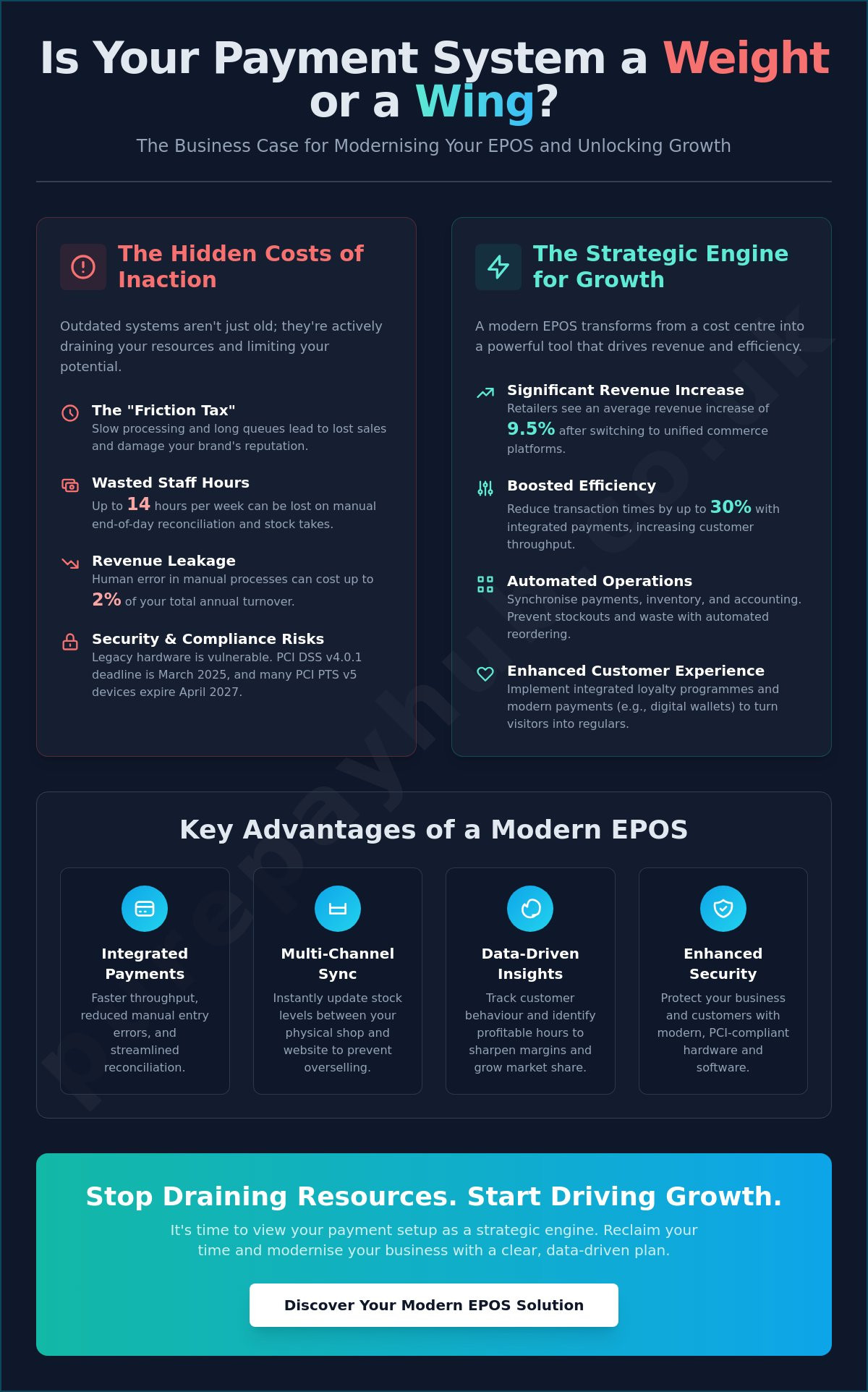
    A restaurant epos system is no longer just a digital till for holding cash. In the modern UK hospitality sector, it is the central heartbeat of your entire venue. Short for Electronic Point of Sale, this technology integrates hardware and software to manage sales, inventory, and staff performance in one place. Unlike the clunky, isolated registers of the past, these systems act as a “Hub” for your entire business operation. They ensure that a pint ordered at the bar is instantly reflected in your stock levels and financial reports. This level of synchronisation is what separates a struggling café from a thriving restaurant.

    The shift from traditional cash registers to integrated digital hubs has been rapid. A standard Point of Sale (POS) system now handles everything from table bookings to complex split-bill payments. This modernisation is a “Pure” necessity for any merchant aiming to grow in 2026. With contactless transactions making up 95% of in-store card payments as of 2024, your hardware must be fast and reliable. Customers expect a seamless experience. If your tech lags during a peak Saturday night, your reputation and your bottom line will suffer. Furthermore, with PCI DSS 4.0 requirements now mandatory, having a secure, updated system is essential to protect your business from data breaches and heavy fines.

    The Evolution of the Hospitality Hub

    We’ve moved beyond simple transactions into the era of data-driven guest management. Modern systems allow you to track customer preferences and dining habits with precision. This centralisation reduces human error significantly. When a waiter enters an order into a handheld device, it goes straight to the kitchen display. No more lost paper tickets or misread handwriting. Cloud-based technology is now the industry standard. It gives you the power to monitor your restaurant’s performance from your phone, whether you’re on-site or at home. You can adjust menu prices or check live sales figures in seconds.

    Key Benefits: Efficiency, Accuracy, and Growth

    Efficiency is the primary driver of profit in an industry with slim margins. An integrated restaurant epos system slashes “table-to-till” lag time, allowing your staff to focus on service rather than admin. Consider these key advantages:

    • Improved Accuracy: Precise order entry means fewer “comps” for incorrect dishes and less food waste in the kitchen.
    • Menu Engineering: Use integrated stats to identify your most profitable items. If a high-margin dish isn’t selling, you’ll know by Tuesday morning and can adjust your strategy.
    • Staff Management: Track which servers turn tables fastest and identify training needs based on hard data rather than guesswork.

    The UK hospitality market is projected to reach £99 billion by 2032. To claim your share, you need tools that support growth and scale with you. Accuracy in your kitchen leads to happier guests and better reviews. When your front-of-house and back-of-house are in perfect sync, your venue runs like a well-oiled machine. It’s about creating a transparent environment where every penny is accounted for and every customer feels valued.

    Core Features of a High-Performing Restaurant EPOS

    A high-performing restaurant epos system is defined by its ability to simplify complex tasks. It isn’t just about the hardware; it’s about the software’s capacity to mirror your physical space. Table and floor plan management allows you to customise layouts in real-time. This visual aid helps staff identify which tables are waiting for drinks or nearing the end of their meal. This clarity can increase table turnover speed by 20% during peak service. When every minute counts, having a clear view of your dining room is essential to maintaining a steady flow of guests.

    Integrating a Kitchen Display System (KDS) removes the chaos of paper tickets. Orders from the floor appear instantly on screens in the kitchen, organised by priority. This eliminates lost chits and ensures your head chef stays in control. Beyond the kitchen, automated inventory alerts protect your margins. You can set notifications for when favourite ingredients, like your Sunday roast essentials, run low. This proactive approach prevents the dreaded conversation where staff must tell a guest that a popular dish is unavailable. The cost of a POS system is often justified by these efficiency gains and the reduction in food waste.

    Staff management tools within the hub allow you to track individual performance with ease. You can see who is upselling effectively and organise rotas based on historical sales data. This level of insight turns a good venue into a highly profitable one. It creates a transparent environment where hard work is recognised and training needs are identified through hard data. If you’re looking to streamline your venue’s workflow, exploring an integrated restaurant epos system is the first step toward better management and long-term growth.

    Intuitive Order and Table Management

    The “park order” function is a game-changer for venues with a bar area. It allows staff to start a tab at the bar and seamlessly transfer it to a table once the party is seated. Split-billing capabilities are equally vital for a modern experience. In 2026, guests expect to pay for exactly what they consumed without a 10-minute struggle at the till. Making the end-of-meal process painless ensures your guests leave on a high note and are more likely to return.

    Advanced Kitchen and Inventory Sync

    KDS technology improves communication between chefs and servers by providing a real-time status of every dish. Front-of-house staff don’t have to interrupt the kitchen to ask for updates, which keeps the kitchen focused on quality. Ingredient-level tracking allows you to manage the cost versus profit on every plate you serve. By automating resupply orders, you ensure your kitchen is always stocked with the essentials. This level of automation reduces the administrative burden on your management team, allowing them to focus on guest satisfaction.

    Restaurant EPOS System: The Ultimate UK Merchant’s Guide for 2026

    Many UK merchants find the world of card processing intentionally murky. Traditional banks often use complex jargon to hide high interchange fees and service charges. A transparent restaurant epos system should do the exact opposite. Transaction-based pricing is the fairest model for the hospitality sector. It ensures you only pay for the service you actually use. Flat-rate models might seem simple at first glance, but they often result in you subsidising the provider’s risk. If your business processes a high volume of debit cards, paying a flat 1.75% fee is a significant and unnecessary drain on your weekly cash flow.

    We advocate for a “Pure” approach where debit rates start at a competitive 0.3%. This strategy prioritises your margins over corporate profit. Some owners worry that switching providers is too expensive or time-consuming. However, a 1% saving on a £500,000 annual turnover puts £5,000 back into your pocket every year. When choosing the best restaurant POS system, look for partners who offer clear, itemised reporting. This transparency is essential for your monthly accounting. It helps you spot any unexpected discrepancies early and ensures your financial records are always accurate.

    Understanding the Fee Structure

    Clarity starts with knowing exactly what you pay for each tap or insert. We break this down simply: debit card processing at 0.3% and credit cards at 0.5%. Many bundled contracts include “hidden markups” that inflate these base rates without providing extra value. These extra costs are often buried in the small print of a long-term agreement. Transparent reporting allows you to see the “interchange” cost versus the “service” fee. This level of detail is vital for maintaining a healthy balance sheet in a competitive market where every penny counts.

    Hardware Rental vs. Outright Purchase

    Choosing between renting or buying your hardware depends on your long-term growth plans. Monthly hardware rental is often the smarter choice for busy venues. It includes ongoing maintenance and technical support, ensuring you are never left stranded during a frantic Saturday night rush. Countertop units are reliable for fixed points like bars or takeaway counters. Portable machines are essential for full table service, allowing staff to take payments without leaving the guest’s side. This flexibility improves the customer experience and speeds up the final stage of the meal.

    All hardware must be compliant with PCI DSS 4.0 standards. These new requirements became mandatory on March 31, 2025. Failing to meet these updated security rules can lead to monthly non-compliance fines that quickly erode your savings. Investing in modern, compliant hardware is a direct investment in your business’s security and reputation. It provides peace of mind that your customer data is always protected from potential breaches. Reliable hardware means fewer service interruptions and a more professional environment for your staff and guests alike.

    Choosing the Right Hardware: Countertop vs. Portable Machines

    Your service style is the blueprint for your hardware needs. A bustling quick-service cafe has different requirements than a sophisticated full-service restaurant. In 2026, the visual appeal of your restaurant epos system matters as much as its processing speed. Sleek, modern aesthetics reflect your brand’s quality. Bulky, beige terminals are a thing of the past. You need hardware that blends into a high-end interior whilst remaining rugged enough for daily use. This balance of form and function ensures your staff feel confident and your guests feel impressed.

    Hospitality is a high-impact environment. Hardware must be durable. Spilt drinks and accidental drops are inevitable during a busy shift. Look for devices with high IP ratings for waterproofing and reinforced casings for drop-resistance. This longevity ensures your investment lasts for years rather than months. Reliability is the cornerstone of a successful service. When your hardware is built to last, you avoid the stress of mid-service failures that disrupt your operations and frustrate your team.

    Digital wallet integration is now a non-negotiable standard. With nearly 95% of in-store transactions being contactless as of 2024, your machines must support Apple Pay and Google Pay flawlessly. This speed at the point of sale keeps queues moving and customers happy. It also aligns with the removal of the mandatory £100 contactless limit in March 2026, giving your guests more flexibility in how they pay. If you’re ready to upgrade your hardware, view our range of sleek card machines designed for modern hospitality.

    The Countertop Powerhouse

    Fixed terminals are the workhorses of quick-service venues. They provide a stable point of sale for high-volume transactions at a single point. Integrated receipt printers and customer-facing displays create a professional “Hub” at the counter. We recommend a wired ethernet connection for these units. It provides the ultimate stability, especially in older UK buildings with thick walls that can interfere with Wi-Fi signals. A stable connection means no lag during the morning coffee rush.

    Mobile and Portable Flexibility

    Taking the till to the table is the gold standard for full table service. Portable machines allow staff to process orders and payments without leaving the guest’s side. This convenience naturally increases “upsell” opportunities. It’s much easier for a guest to order another round of drinks if the server can add it to the bill instantly. For outdoor seating areas or pop-up events, ensure your devices have 4G roaming capabilities. This prevents service interruptions when the Wi-Fi signal drops, ensuring a “Pure” and uninterrupted payment experience for every guest.

    The PurePay Hub Advantage: Seamless Integration and Next-Day Funding

    PurePay Hub acts as your dedicated merchant ally in a financial landscape that’s often far too complex. While many providers focus solely on software “bells and whistles”, we prioritise the lifeblood of your business: your cash flow. A restaurant epos system is only effective if it helps you access your hard-earned money without delay. We’ve built our service to be a stabilising force, providing the clarity and speed that traditional banks simply cannot match. Our partnership approach ensures you aren’t just another account number in a distant database.

    Cash flow management remains the biggest hurdle for the 176,685 hospitality businesses currently operating in the UK. With 99.6% of these being small or medium-sized enterprises, every day spent waiting for funds impacts your ability to grow. We provide Business Cash Advances that facilitate expansion based on your future card turnover. This means you can invest in new equipment or refurbish your dining room without the rigid constraints of a traditional bank loan. It’s a transparent way to fuel your ambition using the steady momentum of your own sales.

    Next-Day Access to Your Funds

    Waiting three to five working days for your funds to clear is a relic of the past that your business cannot afford. Faster funding allows you to negotiate significantly better terms with your food and drink suppliers, as you can settle invoices with confidence and speed. Next-Day Funding is the definitive operational standard for the UK hospitality sector in 2026. This rapid access ensures your weekend takings are available to cover staff wages or emergency repairs by Monday morning. It removes the stress of “penniless” weekends and puts you back in control of your financial destiny.

    Support and Partnership

    We provide UK-based technical support that’s available whilst your restaurant is actually open and serving guests. There’s nothing more frustrating than a system glitch during a Saturday night rush with no one to call. Our team understands the urgency of hospitality and speaks your language, avoiding corporate jargon at every turn. We also take the weight of PCI compliance management off your shoulders. By handling the complex security requirements of the 2025 PCI DSS 4.0 standards, we let you focus on what you do best: providing an exceptional dining experience. We believe in a no-nonsense onboarding process that gets your restaurant epos system live and taking payments in record time.

    Organise a transparent quote for your restaurant EPOS today and experience the difference of a partner that values your profit as much as you do.

    Secure Your Venue’s Future and Profitability

    Choosing the right restaurant epos system is the most impactful decision you’ll make for your venue this year. You’ve seen how integrated hardware and transparent, transaction-based pricing protect your margins whilst improving table turnover. By moving away from opaque fee structures, you reclaim total control over your business finances. We believe your success depends on a partnership built on honesty, clarity, and technical excellence. It’s about turning your payment terminal into a stabilising force for your entire operation.

    Accessing your funds shouldn’t be a waiting game in a fast-paced hospitality environment. With next-day funding as standard and debit card rates starting from 0.3%, we provide the stability you need to manage suppliers and staff with absolute confidence. There are no hidden monthly markups to surprise you when you check your statements. It’s time to simplify your operations and focus on delivering the exceptional service your guests expect. We’re here to help you grow with tools that work as hard as you do.

    Get your free, no-obligation restaurant EPOS quote from PurePay Hub and start your journey toward a fairer, more profitable future today. We look forward to supporting your restaurant’s growth.

    Frequently Asked Questions

    How much does a restaurant EPOS system cost in the UK?

    Typical monthly software costs range from £20 to £150, whilst upfront hardware bundles generally fall between £500 and £2,500. For instance, basic cloud-based plans from major providers often start around £69 per month. These costs vary based on the number of terminals and the complexity of your floor plan. Investing in a reliable restaurant epos system ensures you avoid the long-term costs of manual errors and slow service.

    Can I use my existing card machine with a new EPOS system?

    Integration depends on whether your current hardware is “open” or “locked” to a specific merchant acquirer. Many traditional providers lock their terminals to prevent you from switching to a fairer rate. We specialise in seamless integration to ensure your front-of-house hardware talks to your back-office software without friction. It’s best to check compatibility before signing a new contract to avoid unnecessary hardware replacement costs.

    What is the difference between an EPOS and a standard POS?

    An EPOS system is the modern, cloud-based evolution of a traditional Point of Sale. While a standard POS might only handle the final transaction, an EPOS acts as a digital hub for your entire operation. It manages inventory, tracks staff performance, and provides real-time sales data from any location. This connectivity is essential for the 176,685 hospitality businesses currently operating in the UK market.

    Does a restaurant EPOS system work offline if the Wi-Fi fails?

    Yes, most high-performing systems include an “offline mode” that allows you to continue taking payments if your Wi-Fi fails. The system securely stores transaction data and synchronises with the cloud once the connection is restored. This prevents service interruptions during a busy Saturday night shift. It’s a critical safety net that ensures you never have to turn away a guest due to temporary technical issues.

    How do I switch EPOS providers without paying massive exit fees?

    You should start by reviewing your current contract for specific notice periods or early exit clauses. Some modern providers offer incentives to help cover these costs when you switch to a more transparent, transaction-based model. We recommend moving toward a partnership that avoids hidden monthly markups. This approach protects your margins and makes the transition to a fairer service much easier for your business.

    What are the typical transaction rates for UK restaurants in 2026?

    Standard transaction fees in 2026 typically sit between 1% and 2.5% for most UK providers. However, we advocate for a fairer approach, offering debit rates from 0.3% to help you retain more of your hard-earned profit. This transparency protects your annual balance sheet and overall growth, especially as digital wallets continue to dominate the payment landscape.

    Is next-day funding available for all card types?

    Next-day funding is standard for major card types like Visa and Mastercard through our integrated restaurant epos system. This ensures your weekend takings are in your account by Monday morning to help with urgent supplier payments. Some niche cards may have slightly different clearing cycles depending on the provider. Faster access to your money is a “Pure” necessity for managing a modern hospitality cash flow effectively.

    How does an EPOS system help with VAT and MTD compliance?

    Your system automates VAT calculations for every sale and integrates directly with accounting software for Making Tax Digital (MTD) compliance. This removes the need for manual data entry and reduces the risk of expensive errors in your HMRC submissions. By synchronising your daily sales with platforms like Xero or QuickBooks, you save hours of administrative work every week. It provides a transparent audit trail that simplifies your year-end accounting.

  • Choosing the Best Countertop Card Machine with Receipt Printer in 2026

    Choosing the Best Countertop Card Machine with Receipt Printer in 2026

    Is your countertop card machine with receipt printer actually a silent drain on your monthly profits? While a fast printer keeps your queues moving, the hidden “admin” fees and opaque markups often attached to these devices can quietly erode your hard-earned margins. You deserve a payment setup that works as hard as you do, providing both hardware reliability and total financial clarity.

    We understand the frustration of seeing complex fee structures eat into your bottom line whilst you wait days for your funds to clear. It’s time to stop settling for “standard” rates that don’t reflect your actual business volume. This guide will show you how to secure a reliable, high-speed terminal that balances modern features with the lowest transaction rates in the UK. You’ll learn how to move away from expensive flat-rate models and embrace a transparent, transaction-based approach that supports your growth.

    We’ll preview the top-rated machines for 2026 that meet the mandatory PCI DSS v4.0 security standards and offer next-day access to your cash. By the end of this article, you’ll know exactly how to choose hardware that makes your checkout fast, fair, and purely professional.

    Key Takeaways

    • Learn why a fixed countertop card machine with receipt printer builds more customer trust and retail stability than portable alternatives.
    • Discover how to slash processing costs by switching from expensive flat rates to transparent, transaction-based pricing models.
    • Identify the essential connectivity and security features, including PCI DSS v4.0 compliance, needed for a reliable 2026 checkout.
    • Master your till point layout to eliminate cable clutter and speed up transaction times for your customers.
    • Find out how to access your money faster with next-day funding that bypasses traditional banking delays.

    Beyond the Tap: Why Your Business Needs a Countertop Card Machine with a Receipt Printer

    A physical receipt is more than just a scrap of paper; it’s a symbol of a completed, professional agreement. Even as we move further into 2026, the psychological impact of a tangible proof of purchase remains significant. Statistics show that 45% of UK consumers still prefer a physical receipt for high-value purchases exceeding £100. This small gesture builds immediate trust and provides peace of mind for both the shopper and the merchant. It signals that your business is established, transparent, and prepared to stand behind every sale.

    For UK VAT-registered businesses, meticulous record-keeping is a legal necessity rather than a choice. Providing a detailed, printed receipt helps your customers manage their own VAT returns whilst ensuring you maintain a clear, physical audit trail for HMRC. This documentation also serves as a vital frontline defence against chargeback anxiety. Having an immediate, printed proof of purchase significantly reduces the likelihood of disputed transactions or “friendly fraud” that can often plague modern retail environments. Choosing a robust payment terminal ensures your business remains the gold standard in professionalism and security.

    Whilst mobile devices have their place, they often lack the gravitas of a fixed unit. A countertop card machine with receipt printer tells your customers that your checkout is a stable, secure point of sale. It eliminates the “where do I pay?” confusion that can occur in busy retail spaces, creating a dedicated centre for your financial operations.

    The Role of Physical Receipts in 2026

    Modern thermal printing has transformed the checkout experience into something fast and efficient. These machines are incredibly quiet and don’t require expensive ink cartridges, which keeps your daily overheads low. Beyond the transaction details, your receipts are a powerful branding tool. You can easily customise them with your brand logo, social media handles, or a personalised “thank you” message to encourage repeat visits. This turns a simple transaction into a lasting brand touchpoint that the customer takes home with them.

    Reliability Over Portability: The Countertop Advantage

    High-volume retail requires a constant, uninterrupted power supply that only a wired unit can provide. Relying on a battery-powered device during a frantic Saturday rush is a risk you don’t need to take. A countertop card machine with receipt printer connects directly to your mains, meaning you’ll never miss a sale due to a dead battery.

    Stability is the second pillar of the countertop advantage. Whilst mobile units often struggle with patchy Wi-Fi or 4G signals, a fixed terminal can be hardwired via Ethernet. This ensures 100% uptime and significantly faster processing speeds. Ergonomics also play a vital role; fixed units are generally easier for elderly or less tech-savvy customers to use, as the stable base and clear display provide a much more accessible experience than smaller, handheld alternatives.

    Key Features of a Reliable Countertop Payment Terminal

    Selecting a countertop card machine with receipt printer requires looking beyond the sleek casing to the technology underneath. Reliability in 2026 is defined by three specific pillars: connectivity, security, and integration. Your business cannot afford downtime during a peak period. This is why the best terminals offer a “triple-threat” of connectivity options. They use high-speed Ethernet as a primary line, Wi-Fi as a secondary, and 4G as a fail-safe backup. If your local broadband drops, your machine switches to mobile data in seconds. You keep trading whilst your competitors are left apologising to frustrated customers.

    Security is equally non-negotiable for a modern merchant. As of May 2026, PCI DSS v4.0 is the mandatory standard for all UK organisations handling card data. Modern terminals use end-to-end encryption to ensure cardholder data never touches your internal network in a readable format. This simplifies your compliance journey and protects your hard-earned reputation. When considering POS system costs, remember that hardware which integrates seamlessly with your EPOS saves you money on manual entry errors and admin time. Our “Pure” design philosophy focuses on clean, intuitive interfaces. This means your staff can master the terminal in minutes, reducing training overheads and checkout friction.

    High-Speed Thermal Printing Specs

    In a busy retail environment, every second counts. Look for a printer that delivers at least 30 lines per second. This ensures your customer isn’t standing awkwardly at the till waiting for a long receipt to finish. Efficiency also means an easy-load mechanism. You should be able to drop in a new roll and click it shut in under five seconds. Most professional terminals use standard 57mm thermal rolls. These are widely available and affordable, ensuring you aren’t locked into proprietary, expensive consumables that eat into your margins.

    Payment Versatility and NFC

    Your terminal must be a universal receiver. It needs to handle Apple Pay, Google Pay, and Samsung Pay with the same speed as a physical card. With contactless payments projected to surpass £10 trillion globally by 2027, your hardware must be ready for high-value tap-and-go transactions. Whilst the UK contactless limit remains a primary checkout tool, your hardware should be future-proofed for potential increases in transaction caps. Never overlook the physical keypad. A high-quality, tactile keypad is essential for chip and PIN reliability, especially for older customers or during transactions that exceed contactless limits.

    If you’re looking for a setup that combines these features without the hidden fees, explore our integrated payment solutions designed specifically for the UK market.

    Choosing the Best Countertop Card Machine with Receipt Printer in 2026

    The Real Cost of Payments: Flat Rates vs Transaction-Based Processing

    Choosing a countertop card machine with receipt printer is only half the battle. The hardware facilitates the sale, but your processing model determines how much of that sale you actually keep. Many UK merchants are lured by the simplicity of “flat-rate” pricing, often set at 1.75% or higher. Whilst this looks clean on a marketing brochure, it frequently acts as a hidden tax on your growth. For a small business processing £10,000 a month, a 1.75% flat rate costs £175 in fees. In contrast, a transaction-based model with a 0.3% debit rate plus a modest monthly fee could reduce that cost to under £50. This is a saving of £1,500 every year that stays in your business instead of going to a distant processor.

    We believe in the “Pure” fee model, where transparency is the priority. This means separating the Merchant Service Charge (MSC) into its honest components. For most UK businesses, this translates to debit card rates as low as 0.3% and credit cards at 0.5%. Understanding these numbers is vital because it moves you away from “Qualifying” vs “Non-Qualifying” tiered pricing headaches. Interchange fees are the base costs set by card schemes like Visa and Mastercard that processors must pay to the card-issuing bank. By using an interchange-plus model, you pay the real cost plus a small, transparent markup, rather than a padded flat rate that assumes every customer is using an expensive corporate rewards card.

    Why “No Monthly Fee” Can Be a Trap

    The promise of £0 per month is a powerful marketing tool used by mobile-first providers. However, the break-even point for switching to a professional countertop contract is often much lower than you think. Once your turnover exceeds £2,000 per month, the high transaction fees of “free” accounts begin to cost more than a fixed monthly subscription with lower rates. You must also watch out for “admin,” “statement,” or “compliance” fees buried in the small print. Maintaining high PCI Security Standards is essential, but these costs should be clearly stated, not used as a back-door way to inflate your monthly bill.

    Transparency in Transaction Billing

    PurePay Hub advocates for transaction-based clarity because it aligns our success with yours. We don’t believe in murky pricing structures that change based on how a card is swiped or tapped. Our Hub concept ensures that whether you are using your countertop card machine with receipt printer or an online gateway, your rates remain fair and predictable. This level of clarity allows you to forecast your margins with precision, turning your payment processing from a confusing overhead into a strategic advantage for your business.

    How to Organise Your Till Point for Maximum Efficiency

    A messy counter creates friction. Whilst the technical specs of your countertop card machine with receipt printer are vital, the physical layout of your till point dictates the actual speed of your service. Professionalism starts with a clean, intentional workspace. You must ensure your power and Ethernet lines are tucked away using cable tidies or under-counter mounts. Loose wires aren’t just an eyesore; they’re a significant health and safety risk. A 2024 retail safety study found that trip hazards at the point of sale account for 15% of in-store accidents. Keeping your cables disciplined ensures your terminal remains stable and your staff stay safe.

    Positioning is the next pillar of efficiency. We recommend a customer-facing setup using a high-quality swivel stand. This allows your staff to initiate the sale and then rotate the terminal so the customer can enter their PIN or tap their device in comfort. This physical “handover” creates a clear boundary for the transaction and speeds up the process. It also protects the privacy of the customer. Daily maintenance is the final piece of the puzzle. Use a simple microfibre cloth to keep the keypad clean and occasionally use a cleaning card to remove dust from the thermal print head. This prevents “faded” receipts and ensures your branding remains sharp and legible every single time.

    The Ergonomics of the Checkout

    Accessibility is a legal requirement under the Equality Act 2010. You must ensure your terminal is reachable for all customers, including those using wheelchairs. If you don’t use a swivel stand, ensure your device has a coiled cable with at least 1.5 metres of reach. Lighting also plays a silent role in your success. Avoid placing your terminal directly under harsh spotlights. Glare on the screen can cause customers to hesitate or enter their PIN incorrectly, which adds unnecessary seconds to your queue times.

    Workflow Optimisation

    Modern terminals allow you to toggle between “Automatic Printing” and “Print on Demand”. For small, low-value sales, offering a choice can save you up to 30% on paper roll costs over a year. However, for high-value retail, automatic printing is the gold standard for trust. You should also use your terminal to simplify your admin. Modern units can generate end-of-day reconciliation reports in seconds, matching your physical takings to your digital records with “Pure” accuracy. This eliminates the headache of manual counting and helps you spot discrepancies immediately.

    Ready to upgrade your till point with hardware that works as hard as you do? Explore our range of professional countertop terminals designed for maximum retail efficiency.

    The PurePay Hub Advantage: Transparent Rates and Next-Day Funding

    In the fast-paced UK retail market, cash flow isn’t just a metric; it’s your lifeblood. Many traditional providers still force you to wait three to five working days for your funds to clear. This delay is a relic of the past that hampers your ability to restock inventory or pay staff. PurePay Hub eliminates this friction by offering next-day access to your funds as standard. We believe your money should be in your account, not sitting in a bank’s ledger. Our onboarding process is equally efficient. We can get your new countertop card machine with receipt printer live and ready for transactions in as little as 48 hours.

    Our Hub concept is designed to be the central, stabilising force for your business finances. It doesn’t matter if you operate in retail, hospitality, or online. We centralise all your payment data into one clear, manageable platform. If you ever run into a technical hitch, our UK-based support team is available to help. You won’t be navigating a complex automated menu; you’ll speak to real humans who understand the local market. This direct partnership approach ensures that when your Wi-Fi drops or a printer jams, you’re back in business quickly. We don’t hide behind distant call centres or impersonal ticket systems. Instead, we act as your local expert, providing the clarity you need to grow.

    Purity in Processing

    We’ve built our reputation on a commitment to zero hidden markups. Traditional processors often hide their profits behind complex interchange fees and “admin” costs. We do things differently. By favouring small business growth over corporate profit margins, we provide statements that you can actually read. You don’t need a degree in finance to understand where your money is going. Our transparent reporting gives you a clear view of every transaction, ensuring your processing is always Pure and untainted by unexpected charges. This simplicity allows you to focus on your customers rather than your spreadsheets.

    Beyond the Machine: Business Cash Advances

    Your countertop card machine with receipt printer can do more than just process sales; it can unlock your next stage of growth. Through our Business Cash Advance offering, your daily turnover can provide access to unsecured capital for expansion. Repayments are flexible and based entirely on a small percentage of your future card sales. This means when you have a quiet day, your repayments automatically adjust to match your income. It’s a fair, supportive way to fund renovations or new equipment without the stress of fixed monthly bank loans.

    Get a transparent quote for your countertop card machine today

    Secure a Fairer Future for Your Business Checkout

    Choosing the right countertop card machine with receipt printer is more than just a hardware upgrade. It’s a strategic move to protect your margins and build lasting customer trust. You’ve seen how moving away from restrictive flat-rate models can stop the quiet drain on your profits. A professional, fixed terminal provides the stability and speed your high-volume retail environment demands while ensuring you stay compliant with the latest security standards.

    PurePay Hub is here to act as your ally. We offer debit card rates from 0.3% and provide next-day funding as standard. You won’t find any hidden markups or exit fee traps in our contracts. We prioritise your growth by delivering transaction-based clarity and UK-based support that actually listens. It’s time to stop settling for opaque fees and start enjoying the benefits of a truly transparent partnership.

    Switch to a PurePay Hub Countertop Machine and Start Saving

    Your business deserves a payment setup that is as reliable and honest as the service you provide every day. Take control of your processing costs and give your checkout the professional edge it deserves.

    Frequently Asked Questions

    Do I need a separate merchant account for a countertop card machine?

    Yes, you require a merchant account to process payments, but we simplify this by providing an integrated solution. Your countertop card machine with receipt printer arrives pre-configured with your account details. This avoids the hassle of dealing with multiple banks and ensures your hardware and processing fees are managed in one transparent hub. It’s a faster way to get your business ready for sales without the usual administrative delays.

    Can I use a countertop card machine without a phone line?

    Yes, modern terminals have moved beyond the limitations of traditional phone lines. Most professional units now connect via high-speed Ethernet or Wi-Fi for significantly faster processing. If your primary connection fails, our machines include 4G SIM cards as a fail-safe backup. This ensures you never miss a sale due to a local broadband outage or a snapped phone cable. You stay connected and ready to trade at all times.

    What is the cheapest card machine rate for a UK small business?

    Interchange-plus pricing is consistently the most cost-effective model for businesses processing over £2,000 per month. Whilst flat rates of 1.75% look simple, they are often much more expensive than a transaction-based model. We offer debit card rates from 0.3% and credit card rates from 0.5%. This transparency allows you to keep a larger share of every sale you process. It’s a fairer approach that supports your long-term growth.

    How much does thermal receipt paper cost for these machines?

    Standard 57mm thermal paper rolls are very affordable and widely available amongst UK suppliers. You can typically purchase a box of 20 rolls for approximately £15 to £20. Since these machines use thermal technology, you don’t have to worry about the cost of ink or ribbons. This keeps your ongoing maintenance costs predictable and low for your busy retail environment. It’s a silent saving that adds up over the year.

    What happens if my internet goes down while taking a payment?

    Our terminals feature automatic failover to 4G mobile data to keep your business running smoothly. If your Wi-Fi or Ethernet connection drops, the terminal switches to a mobile network in seconds. This prevents the frustration of declined transactions during a busy rush. It’s a vital safety net that provides total peace of mind for high-volume retail and hospitality environments. You won’t have to turn away customers because of a technical glitch.

    Is a receipt printer built into all countertop machines?

    No, not all card machines include a printer, but a dedicated countertop card machine with receipt printer features an integrated thermal unit. These “all-in-one” devices are specifically designed for fixed till points where speed and professionalism are priorities. Choosing an integrated unit saves precious counter space and eliminates the need for separate, bulky external printers and additional power cables. It keeps your checkout area looking clean and organised.

    How long does it take for card payments to reach my bank account?

    While many UK providers still take three to five working days, we provide next-day funding as standard. This means the takings from your Monday sales will typically be in your business bank account by Tuesday. Improving your cash flow allows you to settle supplier invoices faster and manage your daily operations with much greater confidence. You shouldn’t have to wait for the money you’ve already earned.

    Are there any hidden PCI compliance fees with PurePay Hub?

    No, we don’t believe in “hidden” markups or surprise admin charges. All compliance requirements are discussed openly during your onboarding process to ensure your business meets the mandatory PCI DSS v4.0 standards. We provide clear, simplified reporting so you can see exactly what you are paying for each month. Our goal is to eliminate the skepticism surrounding payment processing by being your most honest and transparent business partner.

  • How to Take Payments: The Ultimate SME Checklist for 2026

    How to Take Payments: The Ultimate SME Checklist for 2026

    Did you know that Visa is scheduled to increase its fees on 24 January 2026? Whilst the industry average for credit card processing sits at 2.35%, many UK merchants are actually paying far more because of “non-compliance” penalties and murky markups. You’ve likely felt the sting of long settlement periods delaying your cash flow or stared at a statement filled with jargon like “interchange plus” and wondered where your profit went. It’s frustrating when the simple act to take payments feels like a constant battle against hidden costs.

    You deserve a partner that prioritises clarity over corporate jargon. We’ve built this guide to help you master the essentials of UK payment processing and strip away the confusion of complex fee structures. You’ll discover how to secure faster access to your hard-earned funds and ensure your setup is fully compliant with the mandatory PCI DSS v4.0.1 standards. We’ll walk you through choosing the right methods for 2026 and setting up a merchant account that scales as your business grows.

    Key Takeaways

    • Understand the three essential pillars of processing to ensure your money moves securely from the customer’s bank to your business account.
    • Identify the most efficient ways to take payments across retail, hospitality, and online environments to suit your specific sales volume.
    • Decode the difference between transaction-based fees and hardware rentals to remove hidden markups from your monthly statements.
    • Follow a proven five-step checklist to audit your business needs and choose a merchant setup that truly scales.
    • Optimise your cash flow with next-day funding and learn how flexible finance can support your long-term growth plans.

    What Does it Actually Mean to Take Payments in 2026?

    Taking payments is no longer just about swapping cash for goods. In 2026, payment processing acts as the vital digital bridge between your customer’s bank account and your business balance. It’s a complex journey that happens in seconds. For a modern SME, the ability to take payments efficiently is a utility, much like electricity or water. You need it to be reliable, invisible, and fairly priced. With Visa scheduled to increase its fees on 24 January 2026, understanding how this bridge works is essential for protecting your margins.

    To understand the process, you must look at the three pillars that support every transaction:

    • The Merchant Account: This is a specific bank account that allows your business to accept card payments. It acts as a temporary holding area before funds are cleared and moved to your business bank account.
    • The Payment Processor: This is the engine. It manages the flow of data between the banks to ensure the transaction is valid, authorised, and secure.
    • Hardware and Software: This is your interface. It includes everything from sleek countertop terminals in a shop to the e-commerce gateway on your website.

    At PurePay Hub, we advocate for “pure” processing. This means we strip away the hidden fluff and complex markups that traditional providers often bury in the small print. We focus on secure, transaction-based clarity so you can focus on growth. When your processing is pure, you aren’t surprised by unexpected costs at the end of the month.

    The Shift in UK Consumer Behaviour

    Consumer habits have transformed rapidly. By January 2026, global digital wallet users reached 5 billion. In the UK, the mandatory £100 contactless limit was removed on 19 March 2026, whilst banks now set their own thresholds. Relying on “cash only” is a risk few businesses can afford. Accepting diverse methods, from physical cards to digital tap-to-pay on smartphones, directly increases your average transaction value (ATV). This shift is also paving the way for digital asset integration, where fintech providers like Pallapay are helping businesses adapt to new ways of exchanging value. Customers naturally spend more when they aren’t limited by the physical notes in their wallet.

    Key Terminology Every Merchant Should Know

    The industry is full of jargon, but the basics are simple. Your Acquiring Bank is the institution that maintains your merchant account and “acquires” the funds for you. The Issuing Bank is the customer’s bank that “issues” their card. Settlement is the final step where funds are moved into your bank balance. In 2026, security is governed by PCI DSS v4.0.1. This is the mandatory gold standard that ensures every tap is protected against the $66.4 billion eCommerce fraud threat projected for this year.

    Choosing Your Method: How to Take Payments Anywhere

    Your business might start at a physical till, but it shouldn’t end there. In 2026, 92% of merchants accept digital wallets, and your customers expect that same level of flexibility whether they are in your shop or on your website. To stay competitive, you need a setup that handles every scenario. Whether you are selling at a local market or invoicing a client across the country, the goal is to take payments without friction or technical delays.

    We view your payment setup as a central Hub. Instead of juggling different providers for your shop, your website, and your phone orders, a unified system brings everything together. This creates a stabilising force for your finances and provides one clear view of your cash flow. This clarity is vital when eCommerce fraud is projected to cost merchants $66.4 billion this year. By centralising your streams, you reduce your risk and simplify your reporting.

    In-Person: Countertop vs. Mobile Units

    Countertop machines are the reliable workhorses of the retail world. They sit at your fixed till point and usually connect via Ethernet for maximum stability. If your customers always come to you, this is your foundation. Portable units offer more freedom, using Bluetooth or Wi-Fi to reach tables in a restaurant or move around a showroom floor. For tradespeople or mobile caterers, a SIM-based mobile machine is essential. It connects to the 4G or 5G network so you can process transactions anywhere with a signal. An mPOS, or mobile Point of Sale, is the ultimate tool for on-the-go flexibility.

    Remote Payments: Virtual Terminals and Links

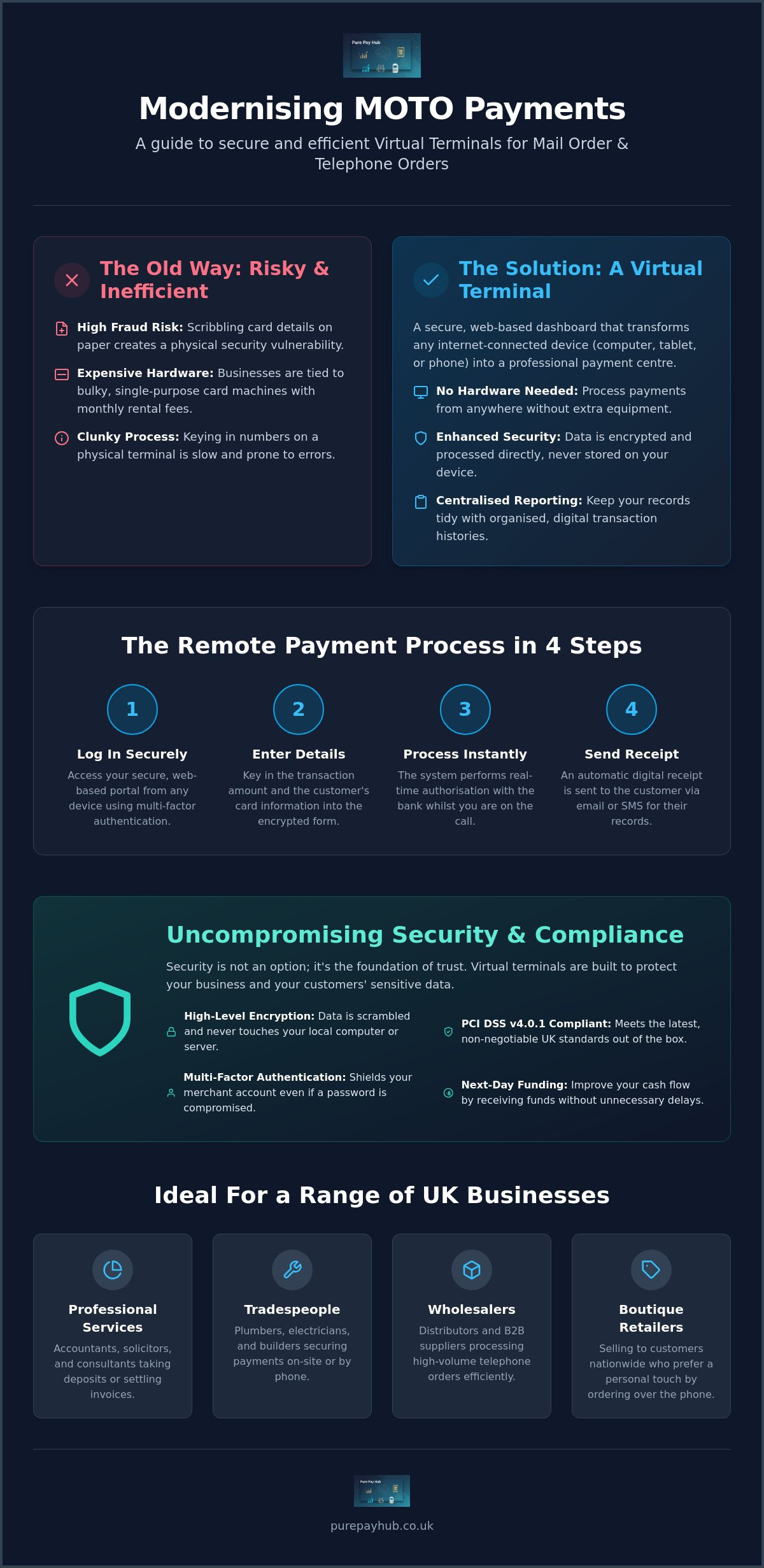
    Not every sale happens face-to-face. A virtual terminal allows you to take payments over the phone securely. You simply log into a secure webpage and type in the customer’s details whilst they are on the line. It’s a professional way to handle “card-not-present” transactions without needing physical hardware on site.

    Payment links are another favourite choice for service-based SMEs and wholesalers. You generate a secure URL and send it via email or SMS. The customer clicks, pays at their convenience, and the settlement process begins. It’s transparent, honest, and incredibly fast. If you’re looking for a transparent partnership to manage these different streams, choosing a unified provider is the first step toward financial clarity. This approach ensures your business stays agile as the UK market continues to move away from traditional cash transactions.

    How to Take Payments: The Ultimate SME Checklist for 2026

    Decoding the Costs: Transaction Fees vs. Monthly Rentals

    Understanding the true cost to take payments is often the biggest hurdle for UK business owners. Most providers present a “blended” rate that looks simple but actually hides significant markups. The Merchant Service Charge (MSC) is the core fee you pay on every transaction. Typically, debit card rates are significantly lower than credit card rates because the risk to the bank is lower. With the average processing cost for Visa and Mastercard sitting at approximately 2.35%, any rate significantly higher than this suggests a heavy processor markup.

    Hardware rental is another area where transparency is often lacking. A fair monthly price for a modern countertop unit should be clear and fixed. However, the real danger lies in the “hidden” extras. Many legacy providers charge a Minimum Monthly Service Charge (MMSC) if you don’t hit a certain sales volume. They also levy heavy fines for PCI non-compliance. Since PCI DSS v4.0.1 became mandatory on 31 March 2025, these fines have become a common way for processors to squeeze extra profit from unsuspecting merchants. We believe in a different approach. We advocate for transaction-based clarity where you only pay for what you use.

    Understanding Interchange Plus Pricing

    Interchange Plus is the “pure” alternative to confusing flat rates. This model reveals exactly what the card schemes charge (the interchange) and exactly what the processor takes as their fee. It’s the most honest way to view your statements. For high-volume merchants, debit card charges can start as low as 0.3%, whilst credit cards remain higher. This model allows you to see the direct benefit of the proposed 0.1 percentage point reduction in interchange fees scheduled to last for the next five years.

    Avoiding the ‘Exit Fee’ Trap

    The UK market is notorious for long-term contracts. These agreements often stretch from 12 to 48 months and include aggressive exit fees. Always check the small print for rolling renewals that lock you in for another year without your knowledge. You should also look for cancellation notice periods, which can sometimes be as long as six months. PurePay Hub simplifies the onboarding process to avoid these legacy headaches. We focus on building a partnership based on performance rather than restrictive legal traps. This ensures your business remains agile and ready to grow.

    The Merchant’s Checklist: 5 Steps to Take Payments

    Setting up your business to take payments shouldn’t be a months-long ordeal. Whilst legacy banks often move at a glacial pace, a modern fintech approach allows you to get up and running with speed and precision. This checklist serves as your roadmap to a secure, transparent setup that avoids the common pitfalls of hidden fees and technical friction.

    Step 1: Audit your sales volume. Before signing any contract, look at your average transaction size and your monthly turnover. If your average sale is small, per-transaction pence fees matter more than percentages. If you’re a high-ticket wholesaler, the percentage rate is your priority. Step 2: Choose your primary environment. A busy cafe needs a portable Wi-Fi unit for table service, whilst a boutique retail shop might prefer a fixed countertop terminal. If you’re selling across multiple channels, ensure your hardware and online gateway are synced through a single Hub to keep your reporting clean.

    Preparing Your Documentation

    To speed up your application, you must organise your “Know Your Customer” (KYC) documents in advance. You’ll typically need a valid photo ID, proof of business address, and three months of recent bank statements. Having a dedicated business bank account is essential for clean accounting and faster settlement. When your documents are ready, modern onboarding can often be completed within 24-48 hours, getting you ready to take payments almost immediately.

    Integrating with EPOS Systems

    Step 4: Select hardware that integrates. Integrated payments are vastly superior to standalone units for any growing business. In an integrated setup, the till communicates directly with the card machine. This eliminates the need to type the amount in twice, which drastically reduces human error and prevents costly mistakes during busy shifts. It’s particularly vital for the fast-paced nature of UK hospitality. You can explore our specialised integrated EPOS systems for hospitality UK to see how this works in practice.

    Step 5: Run a penny test. Once your hardware arrives, process a transaction for £0.01. This “penny test” ensures that the connection to the acquiring bank is active and that your settlement path is clear. It’s the final check to guarantee that when you start your first full day of trading, your funds will arrive in your account without delay. If you’re ready to start your journey, apply for your merchant account today and join a partnership built on purity and clarity.

    Beyond the Transaction: Cash Flow and Growth

    Your business doesn’t stop once the customer leaves the premises. The real work of growth begins when those funds hit your account. When you take payments, you’re generating more than just revenue; you’re creating a data map of your business’s health. In 2026, the speed of your settlement and the flexibility of your capital determine how quickly you can respond to new opportunities. We position PurePay Hub as your central command centre, ensuring that the bridge between a sale and your bank balance is as short as possible.

    Your transaction history is a powerful tool for tracking customer behaviour and seasonal trends. By analysing when people choose to take payments most frequently, you can optimise your staffing levels and stock orders. Our Hub provides this clarity through simplified reporting that strips away the noise. This allows you to make informed decisions based on pure data rather than guesswork. When your payment processor acts as a growth partner, your business is built to scale sustainably.

    Next-Day Access to Funds

    Standard settlement periods often leave merchants waiting between 3 and 5 working days for their money. This delay creates a bottleneck that prevents you from restocking inventory or paying staff on time. For UK SMEs in 2026, next-day access to funds has moved from a luxury to a non-negotiable requirement. It provides the liquidity needed to keep your operations fluid and responsive. You can learn more about this in our Next-Day Funding for Retailers guide.

    Business Cash Advances Explained

    Traditional bank loans often come with rigid monthly repayments that don’t account for your actual trading volume. A Business Cash Advance is a more transparent and honest alternative. You receive a lump sum upfront and repay it as a fixed percentage of your daily card sales. This “pay-as-you-trade” model is inherently safer for seasonal businesses. If you have a quiet Tuesday, you pay back less. If you have a record-breaking Saturday, you pay back more. It’s a partnership that aligns with your success. Discover how PurePay Hub can support your cash flow with a Business Cash Advance today.

    Secure Your Financial Future Today

    The UK payment landscape is evolving rapidly. With Visa increasing fees on 24 January 2026, you cannot afford to stay with a provider that hides behind complex jargon. You now have a clear checklist to audit your sales, choose the right hardware, and secure your cash flow with next-day funding. The ability to take payments should be a pure utility that supports your growth rather than a drain on your resources.

    By moving away from “blended” rates and embracing the transparency of an Interchange Plus model, you protect your margins from hidden monthly markups. You also ensure your business stays ahead of mandatory security standards like PCI DSS v4.0.1. We act as your reliable ally in this shifting market, providing the stability your business needs to thrive.

    Switch to PurePay Hub for transparent, transaction-based payments today. You will benefit from debit card rates starting from 0.3% and next-day funding as standard. It’s time to simplify your setup and focus on your customers. Your business deserves a partner that values honesty as much as you do.

    Frequently Asked Questions

    How long does it take to set up a merchant account to take payments?

    Modern onboarding allows you to set up a merchant account within 24 to 48 hours. If you have your “Know Your Customer” documentation ready, such as photo ID and bank statements, the process is streamlined and efficient. This ensures you can take payments and start trading without the long delays typically associated with traditional high-street banks.

    Can I take payments on my phone without a card machine?

    You can take payments on your smartphone using a virtual terminal or secure payment links. A virtual terminal turns your phone’s browser into a secure interface for over-the-phone orders. Alternatively, you can send a unique URL via SMS or email, allowing the customer to pay instantly from their own device without needing a physical terminal on site.

    What are the average transaction fees for small businesses in the UK?

    Small businesses in the UK typically pay between 1.5% and 3.5% per credit card transaction. As of May 2026, the average processing cost for Visa and Mastercard is approximately 2.35%. These rates vary depending on whether you use a “blended” flat rate or a more transparent “interchange plus” model that reveals the true cost of processing.

    Is it possible to take payments online and in-store with the same provider?

    Managing both online and in-store sales with a single provider is the most efficient way to run your business. Using a unified “Hub” simplifies your reporting and gives you a single view of your cash flow. For those operating as digital platforms or marketplaces, click here to learn more about Gemba’s specialised banking infrastructure. It also ensures your transaction-based fees remain consistent and clear across all your sales channels, from your website to your physical till.

    What happens if my card machine loses Wi-Fi connection during a sale?

    Most modern terminals switch automatically to a 4G or 5G SIM connection if your Wi-Fi drops. This ensures you don’t lose a sale during busy shifts. If you don’t have a SIM-enabled device, some units offer an “offline mode” that stores the transaction data securely and processes it once your internet connection is restored.

    How do I avoid paying monthly PCI non-compliance fees?

    You avoid non-compliance fees by providing 12 months of continuous operational evidence for PCI DSS v4.0.1. This became mandatory for all UK businesses on 31 March 2025. We help you through the annual self-assessment process to ensure your security standards are met, protecting you from the unnecessary penalties that many traditional processors charge.

    Can I take payments from international customers with a UK merchant account?

    You can accept cards from international customers, but these transactions often carry different interchange fees. Whilst your UK merchant account handles global payments, be aware that currency conversion and “non-EEA” card rates can impact your final settlement. We advocate for transparency here so you always know the exact cost of your global sales.

    What is the difference between a merchant account and a business bank account?

    A merchant account is a temporary holding area where funds are cleared and authorised after a transaction. A business bank account is the final destination where your hard-earned profits are settled. You need both to function; the merchant account acts as the bridge that moves money from your customer’s bank to your own balance.