
Why are you still waiting up to five days for your own hard-earned money to reach your bank account? If you feel stuck with opaque fee structures and expensive monthly rentals for outdated terminals, you are likely paying a loyalty tax that your business cannot afford. You deserve a payment partner that prioritises your cash flow over their own bottom line.
We understand the frustration of seeing transaction costs eat into your margins whilst your hardware feels increasingly unreliable. This guide explains exactly how to switch merchant service providers UK businesses can rely on to secure lower rates and faster funding. By following our step-by-step approach, you can transition to modern countertop or portable card machines and settle your funds by the next working day.
You will learn how to navigate the mandatory 90-day notice periods, avoid common exit traps, and time your cutover to ensure your business stays online throughout the entire process. It’s time to swap complex jargon for clarity and move your finances into the modern era.
Key Takeaways
- Learn how to calculate your true effective rate to expose hidden markups and determine if your current provider is hindering your growth.
- Audit your Merchant Service Agreement and hardware leases to identify potential exit fees and “liquidated damages” before starting the transition.
- Master the “double-running” strategy on how to switch merchant service providers UK wide without experiencing any technical downtime or lost sales.
- Evaluate modern payment solutions, from portable card machines to virtual terminals, to ensure your hardware is as efficient as your new transaction rates.
- Secure a faster cash flow cycle by moving to a provider that offers next-day funding instead of making you wait 3-5 days for your money to clear.
Identifying the Signs: When to Switch Merchant Service Providers
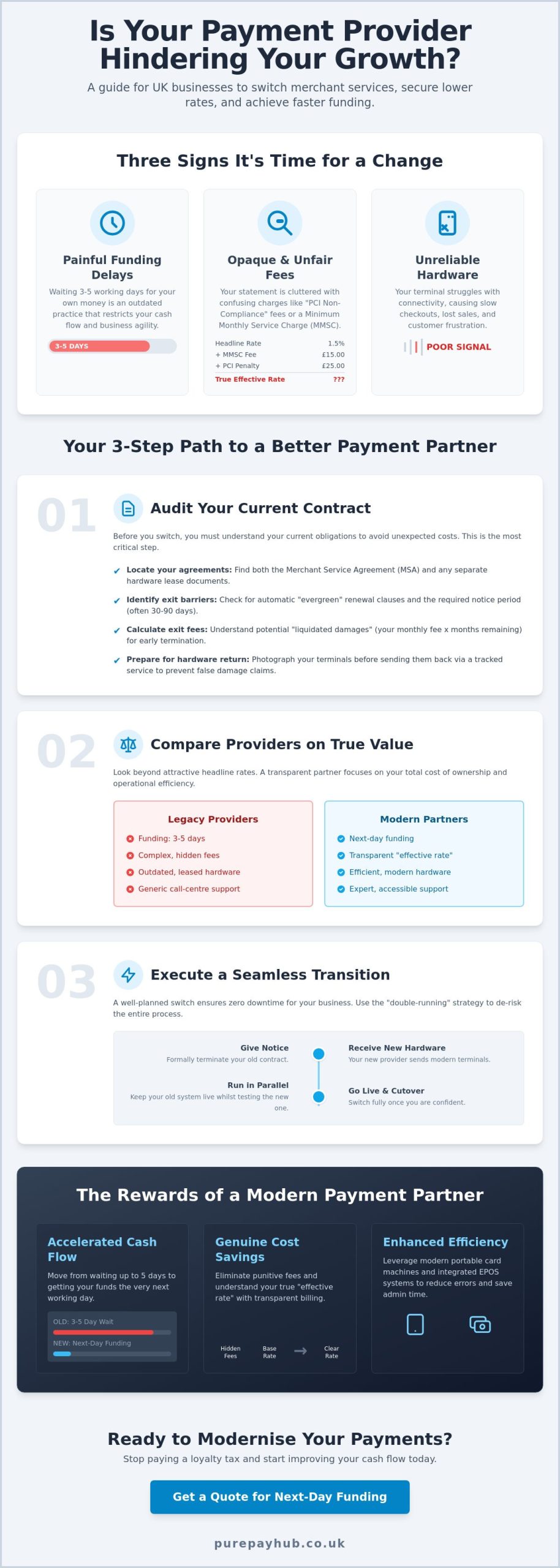
Many business owners focus solely on the transaction percentage. This is a mistake. Your headline rate might look attractive, but your “effective rate”, which represents the total cost of processing divided by your turnover, often tells a different story. If your monthly statement is cluttered with miscellaneous charges, it’s time to evaluate your partnership. Choosing a reliable payment service provider should simplify your life, not complicate your accounting. If you’re researching how to switch merchant service providers UK, the first step is recognising that you’ve outgrown your current setup.
The Real Cost of “Cheap” Rates
Scrutinise your statement for “PCI Non-Compliance” fees. These are often flat monthly penalties that punish you for administrative oversight. They serve no purpose other than padding the provider’s profits. You should also look for a Minimum Monthly Service Charge (MMSC). This fee ensures the provider makes money even during your quietest months. If you process low volumes, these charges can make your actual transaction costs skyrocket. Poor terminal connectivity is another red flag. If your hardware struggles to maintain a signal, you risk losing customers who won’t wait for a slow checkout. In a mobile-first market, reliable Portable Card Machine options are a necessity, not a luxury.
Funding Delays and Operational Friction
Cash flow is the lifeblood of any SME. Waiting three to five days for funds to clear is no longer the industry standard; it’s an outdated practice that benefits the bank’s balance sheet instead of yours. Next-day funding should be your baseline expectation. When your money sits in a provider’s account, you lose the agility to pay suppliers or restock inventory. This delay creates unnecessary stress for regional business owners who need immediate access to their capital.
There is also the “support gap” to consider. Legacy high-street banks often treat merchant services as a secondary product. When your terminal fails on a busy Saturday, you need an expert, not a generic call centre agent. Modern solutions like integrated EPOS Systems reduce manual reconciliation errors and save you hours of admin every week. Your payment partner should act as a supportive ally that facilitates your growth rather than a distant institution that hinders it.
Step 1: Auditing Your Current Contract and Exit Terms
Before you sign a new agreement, you must understand the strings attached to your old one. Locating your Merchant Service Agreement (MSA) is the priority. This document outlines your transaction rates, but you’ll likely have a separate lease agreement for your hardware. If you’re learning how to switch merchant service providers UK businesses often discover these are two distinct legal contracts. It’s vital to check for automatic renewal clauses. Some providers insert “evergreen” terms that trap you for another 12 to 24 months if you don’t cancel within a specific window.
You should also verify your notice period. Most standard contracts require a 30-day notice, but this must usually align with your contract’s end date to avoid penalties. If you’re in the middle of a fixed-term agreement, you’ll face “liquidated damages”. This is a fancy term for early exit fees, typically calculated by multiplying your monthly service charge by the number of months remaining. Knowing this number upfront prevents nasty surprises later.
The Hardware Lease Trap
Many merchants don’t realise their card machine is leased through a third-party finance company, not the bank processing their payments. This means you might need to send two separate cancellation notices. Document the condition of your Countertop Card Machine or Mobile Card Machine before you pack them up. Take clear photos of the screen and casing. Opaque “damage” charges are a common tactic used by legacy providers to claw back revenue during an exit. Managing the logistics of returning hardware requires discipline. Always use a tracked delivery service to prove the equipment reached the lessor safely.
Negotiating Your Way Out
Ask your current provider for a formal settlement figure. Whilst this number might seem high, you should weigh it against the potential savings of a new FCA-authorised provider. If a new partner offers significantly lower transaction rates, the ROI of paying an exit fee could be realised in just a few months. It’s a strategic cash-flow decision, not just an administrative one.
Write a formal notice of termination that includes your Merchant ID (MID) and the specific date you intend to stop processing. Be direct and professional. Don’t leave room for “retention” calls to delay your progress. If you’re unsure about the math, you can request a transparent contract review to see exactly how much you could save by making the move today.
Step 2: Comparing UK Providers for Value and Transparency
Finding the right partner is about more than just a low headline rate. Many traditional providers use blended pricing, which bundles different transaction types into one flat fee. Whilst this seems simple, it often masks significant markups on debit card transactions. If you are researching how to switch merchant service providers UK, look for Interchange-Plus (IC+) pricing instead. This model offers total transparency by separating the non-negotiable costs from the provider’s markup. It ensures you aren’t overpaying for simple domestic debit payments just because your provider wants to simplify their own billing.
You should also evaluate your physical hardware needs based on your specific environment. A Countertop Card Machine is perfect for a fixed till point in a retail shop. If you run a restaurant or a pub, a Portable Card Machine allows you to take payments at the table via Wi-Fi. For traders on the move, a Mobile Card Machine using 4G connectivity is essential. Don’t settle for outdated kit that slows down your queue; modern hardware should be fast, reliable, and easy for your staff to operate.
Beyond the hardware, verify the support structure. You need a dedicated UK-based account manager who understands the local market and can help when things go wrong. Check the settlement cut-off times too. Next-day funding is a game-changer for cash flow. It ensures your Saturday takings are in your account by Monday morning, rather than sitting in a clearing system for several days.
The “Interchange-Plus” Advantage
IC+ pricing provides visibility into exactly what the banks are charging for every transaction. This model prevents “margin creep”, where providers slowly increase their fees over the life of your contract without a clear explanation. By using this structure, you can access competitive rates, such as 0.3% for debit cards and 0.5% for credit cards. This level of clarity allows you to see the exact impact of interchange caps on your bottom line.
Integration and Ecosystem Compatibility
Your new card machine must speak to your existing EPOS Systems. Manual entry leads to human error and reconciliation headaches at the end of the day. A seamless integration saves hours of admin every week. You should also consider how a Virtual Terminal can help you take secure phone or mail-order payments. If you want to expand your reach, Payment Links are a brilliant way to supplement your physical storefront sales by allowing customers to pay remotely via a secure URL.
Step 3: Executing a Seamless Transition Without Downtime
Transitioning your payment system shouldn’t mean going offline. Executing a seamless move requires a disciplined approach to timing and documentation. You must never cancel your existing contract until your new Merchant ID (MID) is fully active and tested. If you want to know how to switch merchant service providers UK businesses often find that a “double-running” strategy is the safest route. Keep your old terminal and your new Portable Card Machine on the counter for at least 48 hours. This overlap ensures that you aren’t left without a way to take payments if there is a delay in the new funding path.
Before you process your first live sale, conduct a test transaction for a small amount, such as £1.00. This verifies that the connection is secure and that the funds are correctly routed to your business bank account. You should also migrate your PCI DSS compliance data immediately. Most modern providers help you through this portal-based process to ensure you don’t incur non-compliance fines during your first month. Staff training is equally vital. Ensure your team knows how to use the new reporting dashboard and any specific features on the Mobile Card Machine before the old system is packed away.
Managing the Cutover
Timing is everything. We recommend performing the final cutover on a Tuesday or Wednesday. These are typically lower volume days for most UK SMEs, which reduces the pressure if your team has questions about the new hardware. If you have an active Business Cash Advance, the transition requires extra care. Since repayments are typically deducted as a percentage of your daily card takings, switching providers can disrupt this flow. You must contact your lender to discuss a settlement figure or check if your new partner can facilitate a transition of the facility. Ignoring this can lead to technical defaults on your advance.
For businesses with recurring payments or saved customer cards, check if your new Online Payment Gateway supports “token migration”. This allows you to move sensitive card data securely without asking your customers to re-enter their details.
Onboarding and Verification
Speedy onboarding depends on your preparation. Have your KYC (Know Your Customer) documents ready, including valid photo ID, recent bank statements, and proof of business address. Modern fintech partners can often complete the initial verification within a 24-hour window. Once verified, you can begin setting up your Virtual Terminal alongside your physical hardware. This allows you to take phone orders immediately whilst your staff get used to the new EPOS Systems. To begin your move without the stress of technical downtime, request your free transition plan today.
Why PurePay Hub is the Logical Choice for Your Next Merchant Account
Traditional high-street banks often treat merchant services as a secondary product. They rely on their legacy status to keep businesses on high rates and slow funding cycles. PurePay Hub operates differently. As a specialist partner, we prioritise the needs of regional business owners. We provide a level of service that distant financial institutions simply cannot match. If you are ready to finalise your plan on how to switch merchant service providers UK, we offer the transparency and speed your business deserves.
We provide market-leading rates starting at 0.3% for debit and 0.5% for credit cards. Our “No-Nonsense” promise means you’ll never encounter hidden markups or opaque service charges. What you see is exactly what you pay. We offer next-day access to your funds, ensuring your cash flow remains fluid and predictable. Whether you need a Countertop Card Machine for your till or a fully integrated EPOS system, our hardware suite is built for modern efficiency.
Your Partner in Business Growth
We don’t just process payments; we support your development. Our Business Cash Advance provides a flexible way to fund your next expansion phase, with repayments based on your future card sales. You’ll also benefit from professional, UK-based support. Our team understands the local merchant landscape and provides clear, punchy reporting that makes your end-of-month accounts a breeze. When evaluating how to switch merchant service providers UK, the quality of this direct partnership is what sets a specialist apart from a generic bank.
Getting Started is Simple
We’ve streamlined our application process to respect your time. Busy business owners can apply quickly and access transparent hardware rental agreements with no long-term restrictive tie-ins. We believe in winning your loyalty through better service, not restrictive contracts. Our goal is to provide a stabilising force for your finances through clarity and reliability. It’s time to move away from the frustration of hidden costs and partner with an ally that values your growth.
Switch to PurePay Hub today and start saving on every transaction.
Take Control of Your Business Cash Flow Today
Switching your payment partner shouldn’t be a source of stress. By auditing your current exit terms and choosing a transparent Interchange-Plus pricing model, you’ve already done the hard work. Understanding how to switch merchant service providers UK businesses can trust is about more than just paperwork; it’s about reclaiming your profit margins and ensuring your money reaches your account when you need it most.
Modern hardware and next-day funding are no longer optional extras. They are essential tools for any growing regional business. You’ve learned how to manage the cutover without downtime and how to avoid the common traps found in legacy hardware leases. Now is the time to put that knowledge into practice and move away from the opaque fees of the past.
We’re here to make the transition effortless. With debit rates from 0.3%, next-day funding as standard, and no hidden monthly markups, we provide the stability your finances require. It’s time to partner with a team that values your growth as much as you do. Your business deserves a partner that treats you like a person, not just a transaction.
Join PurePay Hub: The fairer, faster way to take card payments
Frequently Asked Questions
How long does it typically take to switch merchant service providers in the UK?
Most modern providers can approve a new account within three to five working days. However, the total transition time depends on the notice period in your current contract, which is typically between 30 and 90 days. You should start the application process at least one month before you intend to go live with your new hardware.
Can I keep my existing card machine if I switch providers?
You generally cannot keep your current hardware because card machines are encrypted to a specific provider’s network for security reasons. Switching requires new equipment, such as a modern Countertop Card Machine or a Portable Card Machine. This ensures you have access to the latest security features and faster processing speeds provided by your new partner.
Will my business have to stop taking payments during the switch?
Your business won’t experience any downtime if you use a “double-running” strategy. By keeping your old terminal active until your new Merchant ID (MID) is verified and tested, you maintain a continuous service for your customers. We recommend a 48-hour overlap period to ensure the new connection is stable before you return your old equipment.
What are the typical exit fees for a merchant service contract?
Exit fees, often called liquidated damages, vary based on the time remaining on your fixed-term contract. These are usually calculated by multiplying your monthly service charge by the number of months left in your agreement. You should also check your Merchant Service Agreement for administrative closure charges or equipment return fees that might apply.
Is it possible to switch if I have an outstanding Business Cash Advance?
You can switch, but you must coordinate with your lender first. Since Business Cash Advance repayments are deducted as a percentage of your daily card sales, changing providers disrupts this automated process. You’ll need to discuss a settlement figure or check if your new provider can help facilitate the transition of the facility to avoid a technical default.
What documents do I need to provide to open a new merchant account?
To open a new account, you’ll need standard KYC (Know Your Customer) documentation. This typically includes valid photo identification for all directors, three months of recent business bank statements, and proof of your business trading address. Having these ready ensures a smooth application when you’re looking at how to switch merchant service providers UK businesses can rely on.
How much can a small business realistically save by switching providers?
Savings depend on your annual turnover and your current fee structure. Many SMEs find that moving from a “blended” bank rate to a transparent Interchange-Plus model significantly reduces their total costs. By eliminating hidden markups and PCI non-compliance fines, you can often reinvest a substantial amount of capital back into your business operations every year.
Does PurePay Hub handle the cancellation of my old provider?
Legally, only the authorised business owner can terminate an existing Merchant Service Agreement. Whilst we cannot cancel the contract on your behalf, we provide a structured transition plan and guidance on drafting your notice of termination. This support helps you navigate the process and ensures your old provider cannot use retention tactics to delay your move.
Leave a Reply