
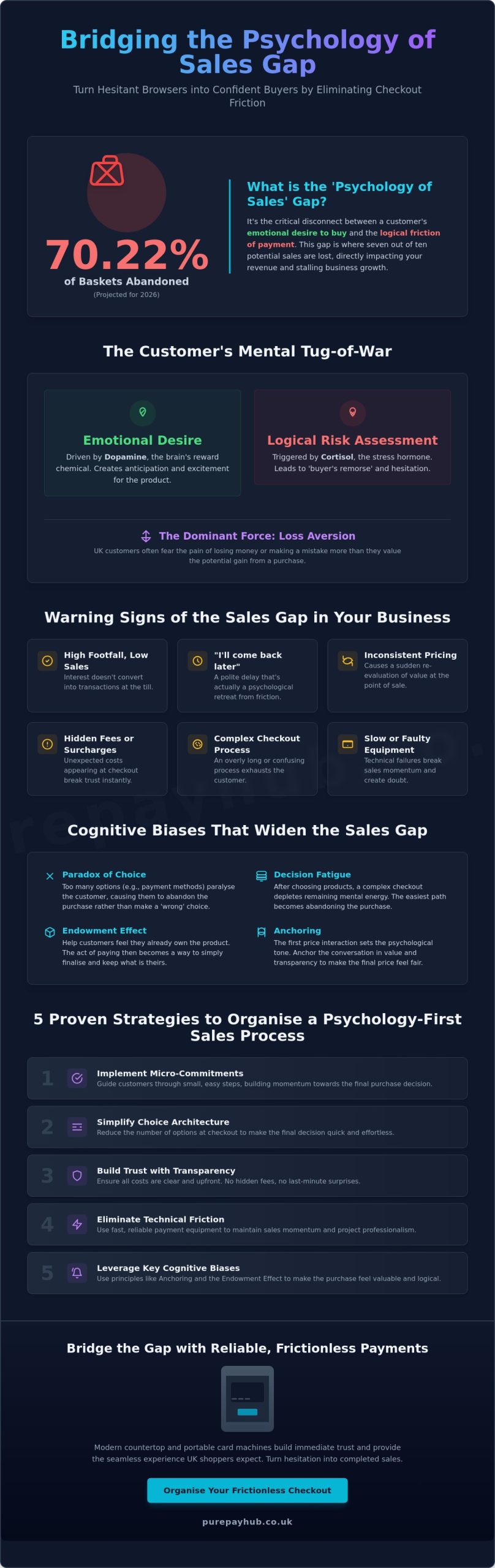
Did you know that in 2026, approximately 70.22% of shoppers abandon their baskets before completing a purchase? For a UK business owner, watching seven out of ten potential sales vanish at the final hurdle is more than just a statistic; it’s a direct hit to your revenue. This disconnect is often caused by the Psychology of Sales gap. It isn’t usually a lack of interest in what you’re selling. Instead, it’s often a failure of friction management at the point of payment, where hidden doubts and complex processes suddenly take over.
You likely feel the frustration of deals stalling at the “thinking about it” stage or seeing customers hesitate when they reach your checkout. We agree that opaque processes and unexpected friction are the enemies of growth. This guide will show you how to identify these psychological barriers and bridge them effectively. You’ll learn how to organise a frictionless checkout experience that encourages faster decision-making. We’ll preview the cognitive biases influencing customer behaviour and explain how clear, honest payment solutions can turn a hesitant browser into a confident buyer.
Key Takeaways
- Understand why customer intent often fails to translate into a final transaction by identifying 1. The “Psychology of Sales” Gap in your current process.
- Discover how cognitive biases like the paradox of choice and decision fatigue can paralyse your customers at the point of purchase.
- Learn to protect sales momentum by eliminating technical friction and avoiding the psychological exit caused by slow or unreliable equipment.
- Implement actionable strategies, from micro-commitments to simplified choice architecture, to guide your customers seamlessly toward a final decision.
- Explore how using reliable countertop or portable card machines builds immediate trust and provides the frictionless experience modern UK shoppers expect.
What is the ‘Psychology of Sales’ Gap and Why Does It Stall Your Growth?
Every business owner has experienced the frustration of a customer who seems ready to buy but suddenly pulls away. This isn’t usually a problem with your product or your service. It’s a fundamental disconnect between a buyer’s emotional intent and the final physical act of payment. We call this phenomenon 1. The “Psychology of Sales” Gap. It represents the space where interest turns into hesitation, and it’s a measurable friction point that can stall your business growth if left unaddressed.
In 2026, this gap is widening. UK consumers are more skeptical than ever before. They face a constant barrage of choices and marketing messages, leading to a state of choice overload. When a customer reaches the point of transaction, they often hit a “Moment of Hesitation.” This is a subconscious risk assessment where they weigh the value of the purchase against the potential for regret. For a local merchant, bridging this gap is essential. Failing to do so doesn’t just lose you a single sale; it disrupts your cash flow and prevents you from building the momentum needed to scale your operations.
The Emotional vs. Logical Tug-of-War
The study of consumer behaviour shows that purchasing decisions are rarely purely logical. Initial desire is often driven by dopamine, the chemical associated with reward and anticipation. However, as the customer moves closer to the checkout, cortisol levels can rise. This stress hormone triggers a sense of “buyer’s remorse” before the sale is even finalised. In the UK market, “Loss Aversion” plays a massive role. Customers often fear the pain of making a mistake or losing their money more than they value the gain from your product.
We define 1. The “Psychology of Sales” Gap as a measurable friction point in the customer journey where emotional desire is overtaken by logical risk assessment.
Signs Your Business is Suffering from the Gap
You can identify if this gap is affecting your bottom line by looking at specific patterns in your daily trade. If you notice high footfall in your shop but surprisingly low transaction volumes, you’re likely losing people at the final hurdle. The “I’ll come back later” phenomenon is another clear indicator. Whilst it sounds like a polite delay, it’s actually a psychological retreat. The customer has encountered a friction point that made the risk feel too high. Common triggers include:
- Inconsistent pricing that causes a sudden re-evaluation of value.
- Hidden fees or surcharges that appear only at the point of sale.
- A checkout process that feels overly complex or time-consuming.
- Technical failures, such as slow card machines, that break the customer’s focus.
By recognising these signs, you can begin to organise a sales process that prioritises clarity and reassurance. Eliminating these psychological barriers is the first step toward creating a dependable, frictionless experience that keeps your customers moving forward.
The Hidden Cognitive Biases Influencing Every Transaction
Every transaction is a minefield of subconscious shortcuts. These cognitive biases are the invisible forces that often widen 1. The “Psychology of Sales” Gap. When you understand how the human brain processes a purchase, you can smooth the path for your customers and remove the mental barriers that lead to abandoned baskets.
The “Paradox of Choice” is a primary culprit for stalled sales. Whilst we often think more options are better, too many payment methods can actually paralyse a buyer. They get stuck wondering which one is the safest or best to use. This is compounded by “Decision Fatigue.” After a customer has spent time choosing products, their mental energy is depleted. The checkout process must be the simplest part of their day. If it requires extra thinking, they are likely to walk away.
You can also leverage the “Endowment Effect” by helping customers visualise the product as already being theirs. When a buyer feels they already own the benefit, the act of paying is simply a way to keep it. This is often supported by “Anchoring.” Your first price interaction sets the psychological tone for the entire sale. If you anchor the conversation in value and transparency from the start, the final transaction feels like a fair and logical conclusion. By addressing these biases, you effectively bridge 1. The “Psychology of Sales” Gap and create a more dependable revenue stream.
Loss Aversion and the Fear of the “Wrong” Choice
UK consumers are particularly sensitive to perceived financial risk. “Loss Aversion” means they feel the pain of a potential mistake more acutely than the joy of a gain. You can soothe the buyer’s amygdala through “Risk Reversal” strategies. Clear, honest communication about costs and straightforward return policies are essential. Even your hardware plays a role. A sleek, modern card machine signals reliability and security. A dated or unreliable device triggers a red flag, suggesting the business might be stuck in the past. To ensure your counter reflects your professional standards, you might consider upgrading your payment technology to something that inspires confidence.
The Bandwagon Effect: Using Social Proof at the Counter
We are social creatures who look for cues that we are making the right decision. The “Bandwagon Effect” is a powerful tool at the point of sale. Subtle environmental signals can suggest that “people like you shop here.” Displaying recognisable payment logos like Visa, Mastercard, and Apple Pay acts as a silent validation of your business. These logos are psychological anchors of trust. Even a busy shop can be a positive signal. A queue suggests popularity and quality, provided your checkout speed is high. If your systems are fast and efficient, a busy counter reinforces the customer’s choice rather than testing their patience.
Dealing with ‘Checkout Churn’: Where Momentum Meets Friction
Momentum is the most fragile asset in any sales interaction. It is the invisible energy that carries a customer from “I want this” to “I have paid for this.” When this flow is interrupted, you encounter 1. The “Psychology of Sales” Gap. This gap is often forced open by technical friction. Slow card machines or signal drops don’t just delay the payment. They create a ‘Psychological Exit.’ In those few seconds of waiting, the customer’s brain has time to re-evaluate the purchase. This often leads to second thoughts or immediate abandonment.
A professional payment area acts as a ‘Centre of Certainty.’ It grounds the transaction in reality and builds immediate trust. We advocate for a ‘no-nonsense’ approach. Over-complicated sales scripts or aggressive upselling at the counter often create suspicion rather than sales. When you prioritise clarity and speed, you reassure the customer that they are making a sensible, secure choice. Bridging 1. The “Psychology of Sales” Gap requires you to protect the customer’s momentum until the very last second.
The High Cost of Technical Friction
Speed is not just about efficiency. It is about emotional stability. Research shows that an estimated $260 billion in lost orders are recoverable in the US and EU through better checkout design and user experience. Even a minor 3-second delay in card processing can trigger a noticeable rise in buyer anxiety. When a customer sees a “Connection Error” on a card machine, the psychological message is clear. It suggests the business is unprofessional or unreliable. It breaks the trust you worked hard to build. Seamless hardware acts as a silent closer in the sales process, ensuring the final step is as rewarding as the first.
Organising a Frictionless Payment Zone
The physical environment of your checkout centre matters. It should be clean, well-lit, and free of clutter. This creates a sense of order and security. However, you don’t always need to tether your customers to a fixed point. Portable card machines allow you to take the payment to the customer, whether they are at a table or on the shop floor. This removes the physical friction of walking to a queue.
There is also a psychological benefit to the merchant having “Next-Day Access to Funds.” When you have confidence in your own cash flow, that stability translates to the customer experience. You appear more dependable and less desperate for the sale. By organising your space and your technology around the customer’s comfort, you turn the point of sale into a point of connection.
- Ensure your payment area is tidy and professional to signal reliability.
- Use portable card machines to meet the customer where they are.
- Eliminate technical errors that break the buyer’s focus.
5 Proven Strategies to Organise a Psychology-First Sales Process
Bridging 1. The “Psychology of Sales” Gap doesn’t require a degree in behavioural science. It requires a commitment to clarity and a disdain for friction. By organising your sales environment around the customer’s mental state, you can transform hesitant browsers into loyal advocates. Here are five practical strategies to help you close the gap today.
- Simplify choice architecture: Avoid overwhelming customers with irrelevant options at the point of sale. If you offer too many payment methods or unnecessary upsells, you trigger decision fatigue. Keep the final steps focused and direct.
- Use micro-commitments: Lead the buyer naturally toward the final transaction. Small agreements, such as asking if they found everything they needed, create a rhythm of “yes” that makes the final payment feel like a natural progression.
- Lead with transparency: Display all costs and fees early. “Price Shock” at the till is the fastest way to lose a customer’s trust. Whether you use standard rates or a credit card processing with surcharge program from Strictly, clear pricing prevents the psychological retreat that happens when a buyer feels misled.
- Implement high-speed hardware: Maintain the “Dopamine Loop” of the purchase. A fast, responsive card machine ensures the excitement of the buy isn’t killed by a spinning loading icon or a connection delay.
- Reinforce the decision: Provide a professional, branded digital or physical receipt. This small act confirms they’ve made a secure and sensible choice, reducing the risk of post-purchase regret.
Transparency as a Competitive Advantage
For UK SMEs, “No Hidden Fees” is more than a slogan. It is a powerful psychological trigger. UK consumers value honesty and straightforwardness amongst the businesses they support. When you clearly display your payment process with professional signage, you build a foundation of trust that traditional, opaque institutions often lack. We believe that security is a core part of this partnership. Ensuring your business is PCI compliant provides customers with the silent reassurance that their data is protected whilst they pay. If you want to build this trust immediately, you can explore our transparent payment solutions designed specifically for local merchants.
The Power of Speed and Reliability
Reducing “Time to Transaction” should be a key performance indicator for your business. Every second saved at the counter is a second where the customer doesn’t have time to doubt their choice. Fast processing is supported by efficient backend systems. An integrated EPOS system that manages stock in real-time prevents the “Out of Stock” let-down, which can be a major psychological blow to a motivated buyer. Additionally, next-day access to funds allows you to reinvest in your customer experience immediately. When your finances are stable and fast, your business projects an aura of reliability that customers can feel. This confidence is contagious and encourages repeat visits.
Bridging the Gap with PurePay Hub: Frictionless Payments for Modern Businesses
Closing 1. The “Psychology of Sales” Gap requires more than just understanding the theory. It requires the right tools to manage the moment of truth at the counter. At PurePay Hub, we provide the technology that turns a customer’s hesitation into a completed transaction. Our Countertop Card Machine and Portable Card Machine are designed to eliminate technical friction. They ensure that your payment process is as smooth and professional as the service you provide.
Transparency is the foundation of trust. We offer clear, competitive rates of 0.3% on debit card transactions and 0.5% on credit card transactions. When you don’t have to worry about hidden markups or complex fee structures, you can focus on your customers. This honesty builds a stronger bond between you and your community. An integrated EPOS system acts as the brain of your business, organising the entire sales journey from stock management to the final tap of a card. It prevents the errors that create psychological exits for your buyers.
We also understand that business confidence is linked to cash flow. Our “Next-Day Access to Funds” model ensures you aren’t left waiting for your own money. When you have the certainty of steady capital, you project a sense of stability that customers can feel. It allows you to maintain a high standard of service without the stress of financial delays.
Reliability You Can Bank On
Technical downtime is the fastest way to reopen the sales gap. If your machine fails, your customer’s momentum dies instantly. We provide 24/7 technical support to ensure your systems stay online when you need them most. Our hardware isn’t just reliable; it looks the part. A modern, professional Countertop Card Machine signals to your customers that you take their security seriously. With the PCI PTS POI v5 certification set to expire in April 2027, now is the time to ensure your hardware meets the latest standards. Our quick onboarding process means you can start building this trust with a stress-free partnership almost immediately.
Taking the Stress Out of Cash Flow
Sometimes, bridging the gap requires a physical change to your environment. Whether it’s a new layout to improve flow or a fresh look to boost social proof, a Business Cash Advance can provide the necessary funding. This isn’t a traditional loan with rigid monthly costs. Instead, repayment is calculated as a small percentage of your daily card sales. This fair model aligns perfectly with your actual business behaviour. If you have a quiet day, your repayments are lower. It’s a supportive way to grow without the pressure of fixed overheads.
Ready to close the gap? Explore PurePay Hub’s card machines today.
Turn Browsers into Buyers Today
You now have the practical strategies to manage the hidden forces that stall your transactions. By simplifying your choice architecture and using reliable hardware, you can effectively close 1. The “Psychology of Sales” Gap. Remember that transparency isn’t just a moral choice; it’s a competitive advantage that builds immediate trust with your local community. Protecting your customer’s momentum at the point of sale ensures that their initial desire leads to a successful purchase rather than a missed opportunity.
It’s time to move away from opaque fee structures and unreliable equipment that creates unnecessary friction. You can switch to a fairer, faster payment partner with PurePay Hub. We offer debit card rates from 0.3% and provide next-day access to funds, all without hidden markups or corporate jargon. We’re here to help you organise a frictionless experience that keeps your business moving forward. Let’s start building a more dependable and profitable future for your trade together.
Frequently Asked Questions
What exactly is the “Psychology of Sales” gap?
It is the disconnect between a customer’s intent to buy and the final act of payment. This gap represents the space where interest turns into hesitation due to friction or doubt. By identifying these moments, you can create a smoother journey that maintains buyer momentum until the transaction is complete.
How does a slow card machine affect my customer’s psychological state?
Speed is a proxy for reliability and security in the mind of the customer. A slow card machine creates a “Psychological Exit,” giving the buyer time to doubt their purchase or feel anxiety about the transaction’s safety. Rapid processing maintains the positive energy of the purchase and ensures the customer leaves with a sense of confidence.
Can changing my payment provider really improve my conversion rates?
Yes, switching to a provider that offers faster hardware and transparent processes can significantly lower abandonment rates. When you eliminate technical errors and hidden costs, you remove the primary triggers for buyer hesitation. This directly addresses 1. The “Psychology of Sales” Gap by making the final hurdle effortless for your customers.
What are the most common cognitive biases in UK retail?
Loss aversion and the paradox of choice are particularly prevalent amongst UK shoppers. Customers often fear making a “wrong” choice more than they value the benefit of the purchase. Additionally, providing too many complex payment options can lead to decision fatigue, causing the buyer to walk away rather than make a final choice.
How can I make my checkout process feel more secure for customers?
Use recognisable payment logos and modern hardware to signal immediate trust. Displaying clear information about PCI compliance and providing instant, branded receipts also reassures the customer that their data is protected. A clean, well-lit payment centre further grounds the transaction in a sense of safety and professional order.
Why is transparency in transaction fees important for buyer trust?
Hidden markups or unexpected fees at the till trigger “Price Shock,” which destroys merchant-customer trust instantly. UK consumers value honest, straight-talking business partners. By leading with clear rates, you prevent the psychological retreat that occurs when a customer feels they are being misled by opaque or complex financial structures.
What is the role of an EPOS system in bridging the sales gap?
An EPOS system acts as the central brain that organises your entire sales journey. It manages stock in real-time to avoid the psychological let-down of “out of stock” items and ensures that pricing remains consistent across all channels. This stability prevents the friction points that often widen 1. The “Psychology of Sales” Gap.
Is a business cash advance a good way to improve my sales environment?
A business cash advance provides the capital needed for a physical “facelift” to improve your retail or restaurant space. Because repayments are a percentage of your daily card sales, the model is fair and aligns with your actual trade behaviour. This allows you to invest in a more welcoming environment without the stress of fixed monthly overheads.
Leave a Reply