Tag: Checkout Optimisation

  • Improving Checkout Experience In-Store: A 2026 Guide for UK Retailers

    Improving Checkout Experience In-Store: A 2026 Guide for UK Retailers

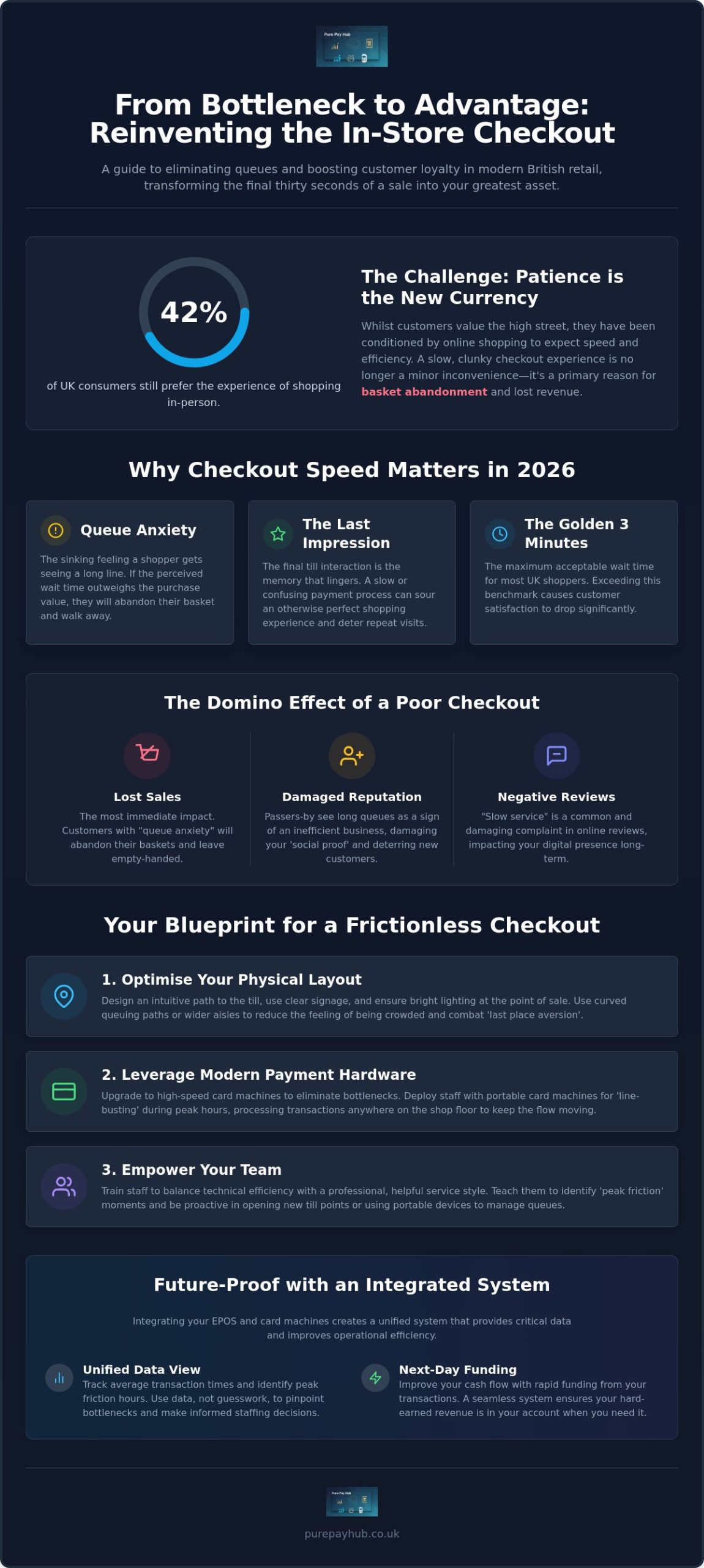
    What if the biggest barrier to your next sale isn’t your stock or your prices, but the final thirty seconds your customer spends at the till? You have likely seen it happen: a shopper spots a long queue, sighs, and leaves their basket behind. It is a frustrating way to lose revenue, especially when outdated card machines or clunky EPOS systems are the primary culprits. Improving checkout experience in store is no longer just a luxury for UK retailers; it is a vital strategy for survival in a market where 42% of consumers still prefer shopping in person but have zero patience for friction.

    We understand that you want a till point that works as hard as you do, without hidden fees eating into your hard-earned margins. This guide shows you exactly how to eliminate queues, modernise your payment hardware, and create a seamless journey that keeps customers coming back. We will explore the latest 2026 trends in portable card machines and intelligent EPOS systems, giving you the practical tools to turn your checkout from a bottleneck into a genuine competitive advantage.

    Key Takeaways

    • Understand the psychology of “queue anxiety” and how modern standards for speed directly influence customer loyalty and basket abandonment.
    • Learn how to optimise your shop floor layout and use clear signage to guide customers naturally toward a frictionless point of sale.
    • Discover how upgrading to high-speed payment hardware is the simplest way of improving checkout experience in store whilst protecting your margins.
    • Explore strategies for training your team to balance technical efficiency with a professional, helpful British service style.
    • See how integrating your EPOS and card machines through PurePay Hub creates a unified data view and supports your cash flow with next-day funding.

    The Psychology of the Queue: Why Checkout Speed Matters in 2026

    In 2026, a frictionless checkout is no longer a luxury; it is the baseline for modern British retail. UK shoppers have been conditioned by the lightning speed of online shopping to expect the same level of efficiency on the high street. When a customer reaches the end of their journey, they want to pay and leave without a struggle. This final interaction is your “Last Impression”. It is the memory that lingers long after they have left the shop. Even if your service was impeccable and your products are perfect, a slow or confusing till experience can sour the entire visit and stop a customer from returning.

    This is where “Queue Anxiety” becomes a genuine threat to your bottom line. It is that sinking feeling a shopper gets when they see a line snaking through the aisles. It leads directly to basket abandonment. If the perceived wait time outweighs the value of the purchase, the customer will simply walk away. In 2026, consumer behaviour prioritises speed over almost all other in-store factors. Shoppers value their time more than ever, and they will reward businesses that respect it with their loyalty.

    The Cost of a Poor Checkout Experience

    A clunky till point does more than just lose a single sale. It damages your brand’s “Social Proof”. When passers-by look through your shop window and see a stagnant queue, they often decide not to enter at all. They assume your business is inefficient or understaffed. There is also a significant digital fallout to consider. A single bad experience often leads to negative online reviews, where “slow service” is a recurring complaint that deters potential visitors. Whilst some retailers have integrated self-checkout systems to manage the flow of smaller baskets, the primary goal remains the same: reducing the physical and mental effort required to finish a transaction. Improving checkout experience in store is about protecting your reputation as much as your revenue.

    Setting Benchmarks for Your Store

    You cannot improve what you do not measure. Start by tracking your average transaction time from the moment the first item is scanned until the payment is confirmed. Identify your “Peak Friction” hours; these are the times when your staff are busiest and your card machines are under the most pressure. Having a clear data view allows you to see where the bottlenecks actually occur. Improving checkout experience in store requires a clear target to aim for. The “Golden Three Minutes” is the maximum acceptable wait time for UK shoppers; once that limit is passed, customer satisfaction drops significantly. By making small, intentional changes to your workflow, you can ensure your team consistently hits this benchmark, even during the busiest periods of the day.

    Optimising Your Physical Layout for Frictionless Flow

    Your shop floor is more than just a showroom; it is a guided journey. Whilst the “Decompression Zone” at your entrance lets customers adjust to your environment, the path leading to the till must be equally intuitive. Improving checkout experience in store starts with a layout that removes physical barriers and psychological stress. If a customer feels trapped or crowded, their patience evaporates. You should aim for a flow that feels open and logical, guiding the shopper toward the exit without forcing them through a maze.

    Research from Harvard Business School highlights the concept of Last Place Aversion, where customers at the end of a queue feel the highest level of dissatisfaction. You can combat this by using curved queuing paths or wider aisles that make the space feel expansive rather than cramped. Strategic placement of impulse items is a classic retail tactic, but you must avoid creating bottlenecks. Use low-profile shelving that doesn’t obstruct the view of the till. If customers can see the staff, their anxiety decreases. Bright, warm lighting at the point of sale also makes the wait feel shorter by creating an inviting atmosphere that signals the end of their journey.

    Implementing Effective Line-Busting Strategies

    Static counters often become the biggest hurdle during peak hours. You can solve this by deploying staff with a Portable Card Machine to process transactions amongst the aisles. This “line-busting” technique prevents a single long queue from forming and keeps the shop floor moving. Train your team to identify “Peak Friction” moments. When more than three people are waiting, a second “floating” till should open immediately. Reducing the physical footprint of your countertop payment centre also frees up space, making the area feel less congested and more professional.

    Signage and Communication

    Confusion is the enemy of efficiency. Use clear, favourite visual cues to direct customers to the correct area. If you have separate points for collections or returns, signpost them boldly. Improving checkout experience in store also means being transparent about technology. Clearly display that you accept Apple Pay, Google Pay, and all major contactless cards. This small detail prevents the “fumble for the wallet” moment at the till. During exceptionally busy periods, a staff member should manage the queue, offering a friendly greeting and a realistic estimate of the wait time to keep morale high.

    Leveraging Modern Payment Hardware to Eliminate Bottlenecks

    Your hardware is the engine room of your store. If your card machine is five years old, it is likely running on outdated processors that struggle with modern encryption standards. This creates a lag of several seconds per transaction. Whilst a few seconds sounds minor, it adds up to hours of lost productivity over a month of trading. Improving checkout experience in store requires hardware that processes payments at the speed of the customer’s intent. You need a system that responds instantly, ensuring the final step of the journey is as swift as the first.

    Reliability is equally critical for a professional retail environment. A card terminal that loses its Wi-Fi connection during a busy Saturday afternoon is a disaster for shop floor morale and customer trust. Modern devices now feature “Always-On” connectivity with automatic 4G or 5G failover. If your broadband dips, your terminal switches to a mobile network instantly. This prevents the frustration of a stalled queue and ensures you never have to turn a customer away because your system is “down”.

    Security should never be a bottleneck for your business. PCI compliance is a non-negotiable requirement for UK retailers, but it shouldn’t mean a clunky or slow interface. Modern terminals handle complex security protocols in the background, keeping your data safe whilst maintaining a rapid transaction flow. This balance of safety and speed is what defines a dependable payment partner.

    Choosing the Right Terminal for Your Store

    • Countertop Card Machine: These are the workhorses of the high street. They are best for high-volume, fixed-position retail environments like newsagents, boutiques, or pharmacies where transactions happen at a central point.
    • Portable Card Machine: These units are ideal for hospitality or large showrooms. They allow you to take the till to the customer, which is a highly effective way of reducing physical queues.
    • Mobile Card Machine: Essential for pop-ups, market stalls, or “line-busting” during seasonal peaks. They offer the ultimate flexibility for businesses on the move.

    The Rise of Digital Wallets
    UK shoppers have fully embraced the digital wallet. In 2024, almost 95% of eligible in-store card transactions were contactless, and that trend has only accelerated. By 2026, Apple Pay and Google Pay have moved from being alternatives to being the preferred choice for many. These platforms use biometric authentication, such as FaceID or TouchID, which is significantly faster than entering a PIN. As the £100 single-transaction limit was removed in March 2026, customers can now use their phones for even larger purchases. Improving checkout experience in store means being ready for this shift. Preparing your hardware for the next wave of wearable payment technology, including smartwatches and payment rings, ensures your business remains modern and accessible.

    Improving Checkout Experience In-Store: A 2026 Guide for UK Retailers

    Staff Training and the Human Element of the Transaction

    Technology provides the framework, but your team provides the friction-free reality. Improving checkout experience in store requires a delicate balance between high-speed processing and a warm, professional British service style. Your staff are the face of your business. If they appear stressed or overwhelmed by a long queue, that tension transfers to the customer. A confident, well-trained employee can make a three-minute wait feel like thirty seconds simply through calm advocacy and clear communication.

    Technical hitches are inevitable in retail. Whether it is a slow Wi-Fi signal or a momentary lag in the payment gateway, your staff must be trained to handle these moments without panicking. Instead of staring at a loading screen in silence, they should keep the conversation flowing. This prevents the customer from focusing on the delay. Discretion is also vital when resolving payment issues. If a card is declined, your team should handle it quietly. Suggesting an alternative method, such as trying a different terminal or using Payment Links for remote settlement, allows the customer to resolve the issue without embarrassment or stalling the rest of the queue.

    The “Speedy Upsell” is a skill that combines sales with efficiency. Train your staff to suggest small, relevant items only whilst they are already scanning the main basket. If the suggestion requires a long explanation, it is not a checkout upsell. It should be a natural, five-second addition that increases your average basket value without adding a single minute to the total transaction time. This approach keeps the queue moving whilst maximising the potential of every visitor.

    Efficiency Through Expertise

    Every team member must be a “Power User” of your software. They should know the shortcuts and common functions by heart. Standardising the “Wrap and Pack” process is another simple way to shave seconds off every sale. By creating a favourite internal “Checkout Handbook”, you ensure that new starters adopt these efficient habits from day one. Investing in modern EPOS Systems ensures your team has the tools they need to maintain this high standard of service even during peak seasonal rushes.

    Managing Returns and Exchanges

    Mixed queues are a primary cause of frustration. A customer buying a single item shouldn’t be stuck behind someone processing a complex return. Where space allows, a separate desk for exchanges is vital for maintaining the main queue flow. Moving toward digital receipts also speeds up the post-purchase experience, as they are easier to store and retrieve than crumpled paper. An integrated EPOS system can process a return in under 30 seconds. This speed ensures that even the less pleasant parts of the shopping journey remain frictionless and professional, protecting your brand reputation and improving checkout experience in store for everyone.

    Future-Proofing Your Store with PurePay Hub Solutions

    PurePay Hub provides the stabilising force your business needs to thrive in a competitive market. By integrating your EPOS system directly with your card machines, we eliminate the need for manual data entry. This reduces human error and ensures your records are always accurate. Improving checkout experience in store is far easier when your back-office and your shop floor speak the same language. You get a unified data view that shows exactly how your store is performing in real-time, allowing you to make informed decisions with confidence and clarity.

    Cash flow is the lifeblood of any retail operation, yet many traditional providers make you wait days for your funds to clear. We provide next-day funding as standard to ensure your business stays liquid and responsive. This allows you to maintain high stock levels and keep your shop floor morale high. When you aren’t waiting for your money, you can react faster to customer trends and seasonal demands. Our transparent pricing, including 0.3% debit rates, ensures you keep more of your hard-earned revenue. You can then reinvest these savings into better store layouts or staff development. If a technical hitch occurs, our 24/7 UK-based support is always ready to help. Your checkout will never stay offline for long.

    Streamlining Your Back-Office

    Automated reporting saves you hours of tedious admin time every week. It frees up managers to spend more time on the shop floor amongst the customers, where they are needed most. By using your transaction data, you can accurately predict your busiest periods with precision. This allows you to schedule enough staff for peak checkout times, preventing the queue anxiety that often leads to basket abandonment. Integrated systems simply make your business run more smoothly and professionally, turning your data into a tool for growth.

    Scaling with Ease

    Your business should never be held back by its technology or its finances. With PurePay Hub, you can add new terminals instantly as your customer base grows. Whether you need an extra Countertop Card Machine for a new till point or a Mobile Card Machine for a seasonal pop-up, the process is seamless and fast. We also offer a Business Cash Advance to help you fund store refurbishments or layout changes. This support ensures you can continue improving checkout experience in store as your brand evolves, keeping you ahead of the competition whilst maintaining a fair and honest partnership with your payment provider.

    Click here to see how PurePay Hub can transform your in-store checkout experience today.

    Take Control of Your Store’s Final Impression

    Your checkout is the ultimate moment of truth for your business. By optimising your physical layout and investing in high-speed hardware, you remove the barriers that cause basket abandonment. We have explored how a combination of strategic signage, expert staff training, and reliable technology creates a journey that customers actually enjoy. Improving checkout experience in store isn’t just about speed; it’s about building lasting trust through every transaction.

    You deserve a payment partner that prioritises your growth with fair, transparent terms. We offer debit card rates from 0.3% and provide next-day access to your funds, ensuring your cash flow remains as steady as your service. Our structure is built on honesty, with no hidden fees to worry about. It’s time to move away from clunky systems and opaque pricing models that hold your business back.

    Upgrade your checkout experience with PurePay Hub today. Let’s turn your till point into your greatest asset and ensure every customer leaves your store with a smile.

    Frequently Asked Questions

    How can I reduce queues in my small shop without hiring more staff?

    You can reduce queues by deploying portable payment technology that allows your team to process sales anywhere on the shop floor. This approach focuses on improving checkout experience in store by removing the reliance on a single fixed till point. By using line-busting techniques during busy periods, your existing staff can handle more transactions without the need for additional headcount. A logical layout and clear signage also help customers navigate your store more efficiently.

    Is a portable card machine better than a countertop one for retail?

    The choice depends on your specific shop layout and typical transaction volume. A Countertop Card Machine is a robust workhorse for businesses with a dedicated till area and high-speed requirements. However, a Portable Card Machine offers the flexibility to take payments directly to the customer, which is ideal for large showrooms or boutique environments. Many modern UK retailers now use a combination of both to ensure they can manage peak times effectively.

    What is the fastest way to process a card payment in-store?

    Contactless payments using digital wallets like Apple Pay or Google Pay are currently the fastest method available. These systems use NFC technology and biometric authentication, such as FaceID, which eliminates the need for a customer to enter a PIN. Since the single-transaction limit was removed in March 2026, these methods are even more efficient for higher-value sales. This speed is a critical factor in improving checkout experience in store for time-pressed shoppers.

    How much do integrated EPOS systems cost for UK small businesses?

    Costs for integrated EPOS systems vary based on the complexity of your inventory and the number of terminals you require. Rather than looking for the lowest headline price, you should focus on a transparent fee model that avoids hidden markups. A fair partner will provide a clear breakdown of costs, allowing you to understand exactly how your investment supports your back-office efficiency and real-time stock management without any unexpected surprises.

    Can I use a mobile card reader for line-busting during busy periods?

    Yes, a Mobile Card Machine is specifically designed for this purpose and is an essential tool for managing seasonal peaks. These devices connect via 4G or 5G networks, allowing your staff to process payments anywhere in the store or even outside. This flexibility prevents a single long queue from forming and ensures you don’t lose sales because of a perceived wait time at the main counter.

    What are the benefits of Apple Pay for in-store checkout speed?

    Apple Pay significantly reduces the total time spent at the till by removing the physical steps of finding a wallet and entering a PIN. The transaction is authenticated almost instantly via the customer’s phone or watch, making it one of the most frictionless methods available. It also offers enhanced security through tokenisation, which protects both your business and your customers from fraud whilst maintaining a rapid transaction flow.

    How do I switch card machine providers without interrupting my store operations?

    Switching providers is a straightforward process that involves a short period of parallel running. You should set up your new card machines and EPOS system whilst your current contract is still active to ensure there is no gap in service. A reliable provider will guide you through the configuration and testing phases, ensuring your team is fully trained before you make the final switch to the new system.

    What is next-day funding and how does it help my retail business?

    Next-day funding ensures that the money from your card sales is cleared into your business bank account on the following working day. This rapid access to your revenue is a vital stabilising force for your finances, allowing you to pay suppliers and manage stock levels without delay. It removes the stress of waiting for traditional clearing cycles, giving you a much clearer view of your daily cash position.

  • Closing the Sales Gap: Psychological Insights for Success

    Closing the Sales Gap: Psychological Insights for Success

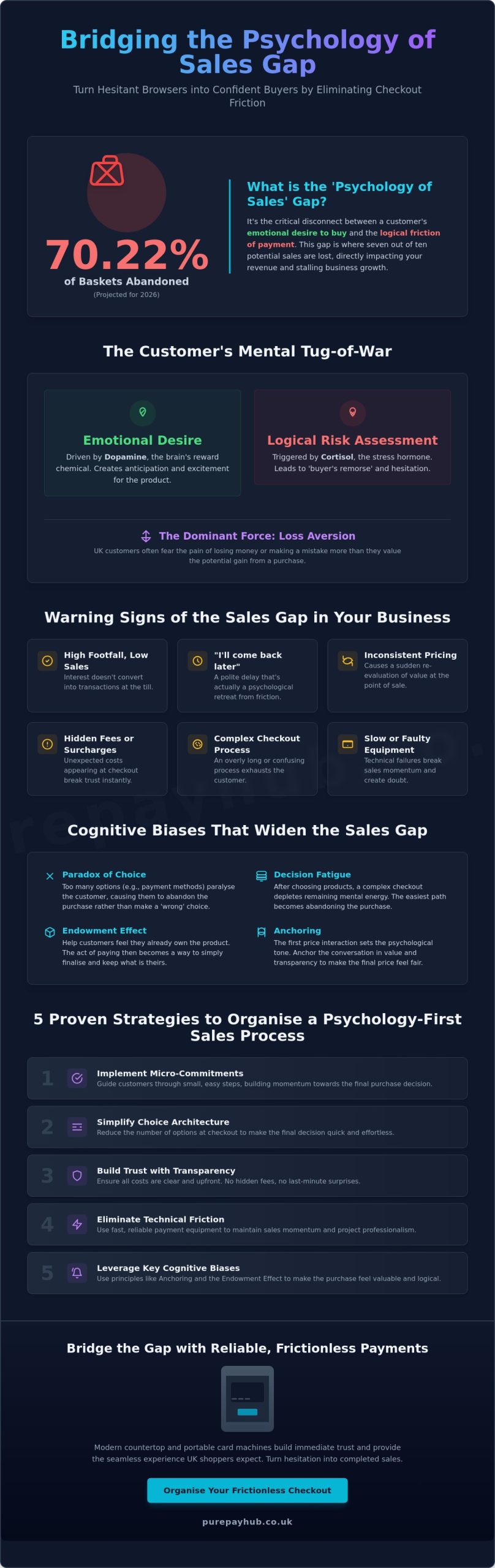
    Did you know that in 2026, approximately 70.22% of shoppers abandon their baskets before completing a purchase? For a UK business owner, watching seven out of ten potential sales vanish at the final hurdle is more than just a statistic; it’s a direct hit to your revenue. This disconnect is often caused by the Psychology of Sales gap. It isn’t usually a lack of interest in what you’re selling. Instead, it’s often a failure of friction management at the point of payment, where hidden doubts and complex processes suddenly take over.

    You likely feel the frustration of deals stalling at the “thinking about it” stage or seeing customers hesitate when they reach your checkout. We agree that opaque processes and unexpected friction are the enemies of growth. This guide will show you how to identify these psychological barriers and bridge them effectively. You’ll learn how to organise a frictionless checkout experience that encourages faster decision-making. We’ll preview the cognitive biases influencing customer behaviour and explain how clear, honest payment solutions can turn a hesitant browser into a confident buyer.

    Key Takeaways

    • Understand why customer intent often fails to translate into a final transaction by identifying 1. The “Psychology of Sales” Gap in your current process.
    • Discover how cognitive biases like the paradox of choice and decision fatigue can paralyse your customers at the point of purchase.
    • Learn to protect sales momentum by eliminating technical friction and avoiding the psychological exit caused by slow or unreliable equipment.
    • Implement actionable strategies, from micro-commitments to simplified choice architecture, to guide your customers seamlessly toward a final decision.
    • Explore how using reliable countertop or portable card machines builds immediate trust and provides the frictionless experience modern UK shoppers expect.

    What is the ‘Psychology of Sales’ Gap and Why Does It Stall Your Growth?

    Every business owner has experienced the frustration of a customer who seems ready to buy but suddenly pulls away. This isn’t usually a problem with your product or your service. It’s a fundamental disconnect between a buyer’s emotional intent and the final physical act of payment. We call this phenomenon 1. The “Psychology of Sales” Gap. It represents the space where interest turns into hesitation, and it’s a measurable friction point that can stall your business growth if left unaddressed.

    In 2026, this gap is widening. UK consumers are more skeptical than ever before. They face a constant barrage of choices and marketing messages, leading to a state of choice overload. When a customer reaches the point of transaction, they often hit a “Moment of Hesitation.” This is a subconscious risk assessment where they weigh the value of the purchase against the potential for regret. For a local merchant, bridging this gap is essential. Failing to do so doesn’t just lose you a single sale; it disrupts your cash flow and prevents you from building the momentum needed to scale your operations.

    The Emotional vs. Logical Tug-of-War

    The study of consumer behaviour shows that purchasing decisions are rarely purely logical. Initial desire is often driven by dopamine, the chemical associated with reward and anticipation. However, as the customer moves closer to the checkout, cortisol levels can rise. This stress hormone triggers a sense of “buyer’s remorse” before the sale is even finalised. In the UK market, “Loss Aversion” plays a massive role. Customers often fear the pain of making a mistake or losing their money more than they value the gain from your product.

    We define 1. The “Psychology of Sales” Gap as a measurable friction point in the customer journey where emotional desire is overtaken by logical risk assessment.

    Signs Your Business is Suffering from the Gap

    You can identify if this gap is affecting your bottom line by looking at specific patterns in your daily trade. If you notice high footfall in your shop but surprisingly low transaction volumes, you’re likely losing people at the final hurdle. The “I’ll come back later” phenomenon is another clear indicator. Whilst it sounds like a polite delay, it’s actually a psychological retreat. The customer has encountered a friction point that made the risk feel too high. Common triggers include:

    • Inconsistent pricing that causes a sudden re-evaluation of value.
    • Hidden fees or surcharges that appear only at the point of sale.
    • A checkout process that feels overly complex or time-consuming.
    • Technical failures, such as slow card machines, that break the customer’s focus.

    By recognising these signs, you can begin to organise a sales process that prioritises clarity and reassurance. Eliminating these psychological barriers is the first step toward creating a dependable, frictionless experience that keeps your customers moving forward.

    The Hidden Cognitive Biases Influencing Every Transaction

    Every transaction is a minefield of subconscious shortcuts. These cognitive biases are the invisible forces that often widen 1. The “Psychology of Sales” Gap. When you understand how the human brain processes a purchase, you can smooth the path for your customers and remove the mental barriers that lead to abandoned baskets.

    The “Paradox of Choice” is a primary culprit for stalled sales. Whilst we often think more options are better, too many payment methods can actually paralyse a buyer. They get stuck wondering which one is the safest or best to use. This is compounded by “Decision Fatigue.” After a customer has spent time choosing products, their mental energy is depleted. The checkout process must be the simplest part of their day. If it requires extra thinking, they are likely to walk away.

    You can also leverage the “Endowment Effect” by helping customers visualise the product as already being theirs. When a buyer feels they already own the benefit, the act of paying is simply a way to keep it. This is often supported by “Anchoring.” Your first price interaction sets the psychological tone for the entire sale. If you anchor the conversation in value and transparency from the start, the final transaction feels like a fair and logical conclusion. By addressing these biases, you effectively bridge 1. The “Psychology of Sales” Gap and create a more dependable revenue stream.

    Loss Aversion and the Fear of the “Wrong” Choice

    UK consumers are particularly sensitive to perceived financial risk. “Loss Aversion” means they feel the pain of a potential mistake more acutely than the joy of a gain. You can soothe the buyer’s amygdala through “Risk Reversal” strategies. Clear, honest communication about costs and straightforward return policies are essential. Even your hardware plays a role. A sleek, modern card machine signals reliability and security. A dated or unreliable device triggers a red flag, suggesting the business might be stuck in the past. To ensure your counter reflects your professional standards, you might consider upgrading your payment technology to something that inspires confidence.

    The Bandwagon Effect: Using Social Proof at the Counter

    We are social creatures who look for cues that we are making the right decision. The “Bandwagon Effect” is a powerful tool at the point of sale. Subtle environmental signals can suggest that “people like you shop here.” Displaying recognisable payment logos like Visa, Mastercard, and Apple Pay acts as a silent validation of your business. These logos are psychological anchors of trust. Even a busy shop can be a positive signal. A queue suggests popularity and quality, provided your checkout speed is high. If your systems are fast and efficient, a busy counter reinforces the customer’s choice rather than testing their patience.

    Dealing with ‘Checkout Churn’: Where Momentum Meets Friction

    Momentum is the most fragile asset in any sales interaction. It is the invisible energy that carries a customer from “I want this” to “I have paid for this.” When this flow is interrupted, you encounter 1. The “Psychology of Sales” Gap. This gap is often forced open by technical friction. Slow card machines or signal drops don’t just delay the payment. They create a ‘Psychological Exit.’ In those few seconds of waiting, the customer’s brain has time to re-evaluate the purchase. This often leads to second thoughts or immediate abandonment.

    A professional payment area acts as a ‘Centre of Certainty.’ It grounds the transaction in reality and builds immediate trust. We advocate for a ‘no-nonsense’ approach. Over-complicated sales scripts or aggressive upselling at the counter often create suspicion rather than sales. When you prioritise clarity and speed, you reassure the customer that they are making a sensible, secure choice. Bridging 1. The “Psychology of Sales” Gap requires you to protect the customer’s momentum until the very last second.

    The High Cost of Technical Friction

    Speed is not just about efficiency. It is about emotional stability. Research shows that an estimated $260 billion in lost orders are recoverable in the US and EU through better checkout design and user experience. Even a minor 3-second delay in card processing can trigger a noticeable rise in buyer anxiety. When a customer sees a “Connection Error” on a card machine, the psychological message is clear. It suggests the business is unprofessional or unreliable. It breaks the trust you worked hard to build. Seamless hardware acts as a silent closer in the sales process, ensuring the final step is as rewarding as the first.

    Organising a Frictionless Payment Zone

    The physical environment of your checkout centre matters. It should be clean, well-lit, and free of clutter. This creates a sense of order and security. However, you don’t always need to tether your customers to a fixed point. Portable card machines allow you to take the payment to the customer, whether they are at a table or on the shop floor. This removes the physical friction of walking to a queue.

    There is also a psychological benefit to the merchant having “Next-Day Access to Funds.” When you have confidence in your own cash flow, that stability translates to the customer experience. You appear more dependable and less desperate for the sale. By organising your space and your technology around the customer’s comfort, you turn the point of sale into a point of connection.

    • Ensure your payment area is tidy and professional to signal reliability.
    • Use portable card machines to meet the customer where they are.
    • Eliminate technical errors that break the buyer’s focus.

    Closing the Sales Gap: Psychological Insights for Success

    5 Proven Strategies to Organise a Psychology-First Sales Process

    Bridging 1. The “Psychology of Sales” Gap doesn’t require a degree in behavioural science. It requires a commitment to clarity and a disdain for friction. By organising your sales environment around the customer’s mental state, you can transform hesitant browsers into loyal advocates. Here are five practical strategies to help you close the gap today.

    • Simplify choice architecture: Avoid overwhelming customers with irrelevant options at the point of sale. If you offer too many payment methods or unnecessary upsells, you trigger decision fatigue. Keep the final steps focused and direct.
    • Use micro-commitments: Lead the buyer naturally toward the final transaction. Small agreements, such as asking if they found everything they needed, create a rhythm of “yes” that makes the final payment feel like a natural progression.
    • Lead with transparency: Display all costs and fees early. “Price Shock” at the till is the fastest way to lose a customer’s trust. Whether you use standard rates or a credit card processing with surcharge program from Strictly, clear pricing prevents the psychological retreat that happens when a buyer feels misled.
    • Implement high-speed hardware: Maintain the “Dopamine Loop” of the purchase. A fast, responsive card machine ensures the excitement of the buy isn’t killed by a spinning loading icon or a connection delay.
    • Reinforce the decision: Provide a professional, branded digital or physical receipt. This small act confirms they’ve made a secure and sensible choice, reducing the risk of post-purchase regret.

    Transparency as a Competitive Advantage

    For UK SMEs, “No Hidden Fees” is more than a slogan. It is a powerful psychological trigger. UK consumers value honesty and straightforwardness amongst the businesses they support. When you clearly display your payment process with professional signage, you build a foundation of trust that traditional, opaque institutions often lack. We believe that security is a core part of this partnership. Ensuring your business is PCI compliant provides customers with the silent reassurance that their data is protected whilst they pay. If you want to build this trust immediately, you can explore our transparent payment solutions designed specifically for local merchants.

    The Power of Speed and Reliability

    Reducing “Time to Transaction” should be a key performance indicator for your business. Every second saved at the counter is a second where the customer doesn’t have time to doubt their choice. Fast processing is supported by efficient backend systems. An integrated EPOS system that manages stock in real-time prevents the “Out of Stock” let-down, which can be a major psychological blow to a motivated buyer. Additionally, next-day access to funds allows you to reinvest in your customer experience immediately. When your finances are stable and fast, your business projects an aura of reliability that customers can feel. This confidence is contagious and encourages repeat visits.

    Bridging the Gap with PurePay Hub: Frictionless Payments for Modern Businesses

    Closing 1. The “Psychology of Sales” Gap requires more than just understanding the theory. It requires the right tools to manage the moment of truth at the counter. At PurePay Hub, we provide the technology that turns a customer’s hesitation into a completed transaction. Our Countertop Card Machine and Portable Card Machine are designed to eliminate technical friction. They ensure that your payment process is as smooth and professional as the service you provide.

    Transparency is the foundation of trust. We offer clear, competitive rates of 0.3% on debit card transactions and 0.5% on credit card transactions. When you don’t have to worry about hidden markups or complex fee structures, you can focus on your customers. This honesty builds a stronger bond between you and your community. An integrated EPOS system acts as the brain of your business, organising the entire sales journey from stock management to the final tap of a card. It prevents the errors that create psychological exits for your buyers.

    We also understand that business confidence is linked to cash flow. Our “Next-Day Access to Funds” model ensures you aren’t left waiting for your own money. When you have the certainty of steady capital, you project a sense of stability that customers can feel. It allows you to maintain a high standard of service without the stress of financial delays.

    Reliability You Can Bank On

    Technical downtime is the fastest way to reopen the sales gap. If your machine fails, your customer’s momentum dies instantly. We provide 24/7 technical support to ensure your systems stay online when you need them most. Our hardware isn’t just reliable; it looks the part. A modern, professional Countertop Card Machine signals to your customers that you take their security seriously. With the PCI PTS POI v5 certification set to expire in April 2027, now is the time to ensure your hardware meets the latest standards. Our quick onboarding process means you can start building this trust with a stress-free partnership almost immediately.

    Taking the Stress Out of Cash Flow

    Sometimes, bridging the gap requires a physical change to your environment. Whether it’s a new layout to improve flow or a fresh look to boost social proof, a Business Cash Advance can provide the necessary funding. This isn’t a traditional loan with rigid monthly costs. Instead, repayment is calculated as a small percentage of your daily card sales. This fair model aligns perfectly with your actual business behaviour. If you have a quiet day, your repayments are lower. It’s a supportive way to grow without the pressure of fixed overheads.

    Ready to close the gap? Explore PurePay Hub’s card machines today.

    Turn Browsers into Buyers Today

    You now have the practical strategies to manage the hidden forces that stall your transactions. By simplifying your choice architecture and using reliable hardware, you can effectively close 1. The “Psychology of Sales” Gap. Remember that transparency isn’t just a moral choice; it’s a competitive advantage that builds immediate trust with your local community. Protecting your customer’s momentum at the point of sale ensures that their initial desire leads to a successful purchase rather than a missed opportunity.

    It’s time to move away from opaque fee structures and unreliable equipment that creates unnecessary friction. You can switch to a fairer, faster payment partner with PurePay Hub. We offer debit card rates from 0.3% and provide next-day access to funds, all without hidden markups or corporate jargon. We’re here to help you organise a frictionless experience that keeps your business moving forward. Let’s start building a more dependable and profitable future for your trade together.

    Frequently Asked Questions

    What exactly is the “Psychology of Sales” gap?

    It is the disconnect between a customer’s intent to buy and the final act of payment. This gap represents the space where interest turns into hesitation due to friction or doubt. By identifying these moments, you can create a smoother journey that maintains buyer momentum until the transaction is complete.

    How does a slow card machine affect my customer’s psychological state?

    Speed is a proxy for reliability and security in the mind of the customer. A slow card machine creates a “Psychological Exit,” giving the buyer time to doubt their purchase or feel anxiety about the transaction’s safety. Rapid processing maintains the positive energy of the purchase and ensures the customer leaves with a sense of confidence.

    Can changing my payment provider really improve my conversion rates?

    Yes, switching to a provider that offers faster hardware and transparent processes can significantly lower abandonment rates. When you eliminate technical errors and hidden costs, you remove the primary triggers for buyer hesitation. This directly addresses 1. The “Psychology of Sales” Gap by making the final hurdle effortless for your customers.

    What are the most common cognitive biases in UK retail?

    Loss aversion and the paradox of choice are particularly prevalent amongst UK shoppers. Customers often fear making a “wrong” choice more than they value the benefit of the purchase. Additionally, providing too many complex payment options can lead to decision fatigue, causing the buyer to walk away rather than make a final choice.

    How can I make my checkout process feel more secure for customers?

    Use recognisable payment logos and modern hardware to signal immediate trust. Displaying clear information about PCI compliance and providing instant, branded receipts also reassures the customer that their data is protected. A clean, well-lit payment centre further grounds the transaction in a sense of safety and professional order.

    Why is transparency in transaction fees important for buyer trust?

    Hidden markups or unexpected fees at the till trigger “Price Shock,” which destroys merchant-customer trust instantly. UK consumers value honest, straight-talking business partners. By leading with clear rates, you prevent the psychological retreat that occurs when a customer feels they are being misled by opaque or complex financial structures.

    What is the role of an EPOS system in bridging the sales gap?

    An EPOS system acts as the central brain that organises your entire sales journey. It manages stock in real-time to avoid the psychological let-down of “out of stock” items and ensures that pricing remains consistent across all channels. This stability prevents the friction points that often widen 1. The “Psychology of Sales” Gap.

    Is a business cash advance a good way to improve my sales environment?

    A business cash advance provides the capital needed for a physical “facelift” to improve your retail or restaurant space. Because repayments are a percentage of your daily card sales, the model is fair and aligns with your actual trade behaviour. This allows you to invest in a more welcoming environment without the stress of fixed monthly overheads.

  • How to Reduce Customer Queue Times in Retail: A Guide for UK Merchants

    How to Reduce Customer Queue Times in Retail: A Guide for UK Merchants

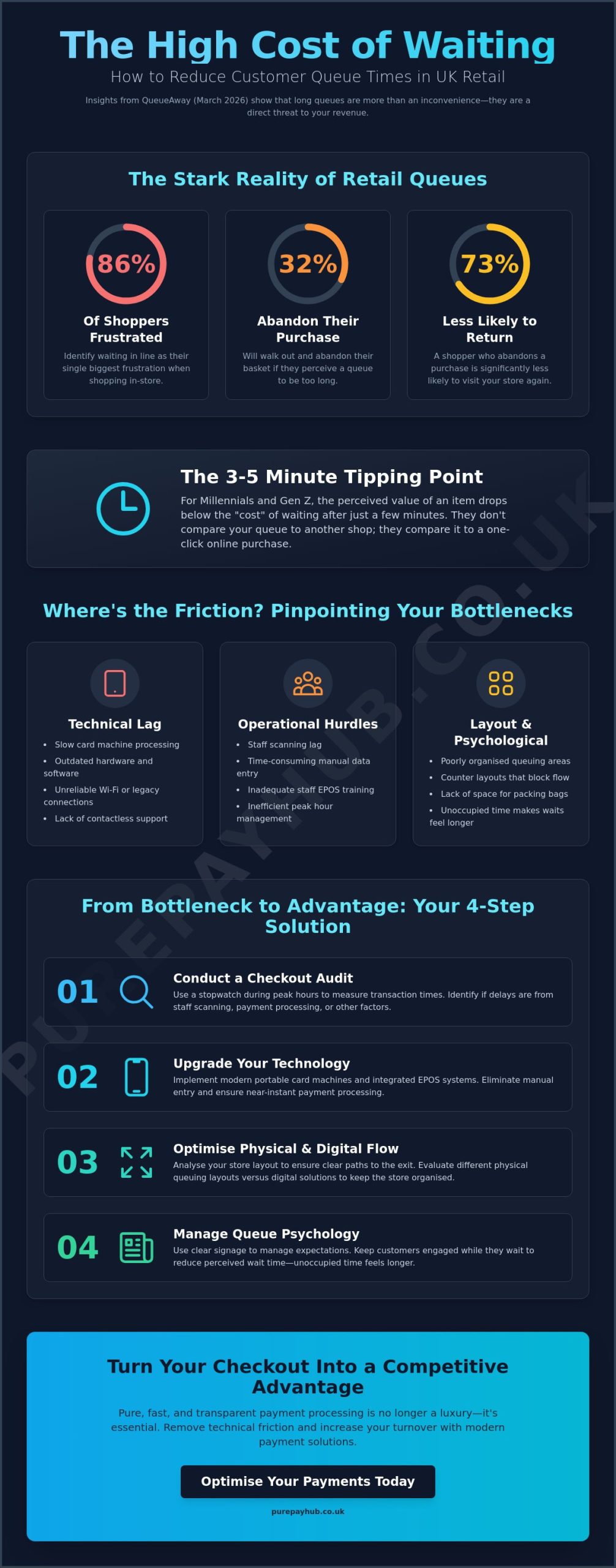
    Did you know that 86% of shoppers identify waiting in line as their single biggest frustration when shopping in-store? According to QueueAway data from March 2026, approximately 32% of your customers will walk out and abandon their purchase if they see a long queue. You’ve likely felt that familiar sting of watching a potential sale leave because your checkout process couldn’t keep up. Learning how to reduce customer queue times in retail is now essential for any UK merchant wanting to protect their bottom line.

    We believe your payment processing should be pure, fast, and completely transparent. This guide provides practical strategies to remove the technical friction that causes transaction lag at your point of sale. You’ll discover how to leverage modern portable card machines and integrated EPOS systems to increase your turnover. We’ll also explore how to use trading data to manage peak hours effectively, ensuring your staff stay calm and your customers leave with a smile. It’s time to turn your checkout from a bottleneck into a competitive advantage.

    Key Takeaways

    • Understand the financial cost of queue abandonment and learn exactly how to reduce customer queue times in retail by removing technical friction at the point of sale.
    • Discover how to conduct a professional checkout audit to identify whether your bottlenecks are caused by staff scanning lag or slow card machine processing.
    • Learn the practical steps to transition from manual data entry to an integrated EPOS system for faster, error-free transactions during peak hours.
    • Evaluate the efficiency of different physical queuing layouts versus digital solutions to ensure your store remains organised and productive.
    • Identify how speed-optimised portable hardware and transparent, transaction-based pricing can help you scale your business without the burden of hidden fees.

    The Real Cost of Long Queues in UK Retail

    Every second your customers spend standing still is a second they spend reconsidering their purchase. In UK retail, the financial impact of a slow checkout is stark. Recent data from QueueAway (March 2026) shows that 32% of shoppers will abandon their basket if they perceive the wait to be too long. This isn’t just a lost sale today; it’s a direct hit to your bottom line that compounds over time. Understanding the principles of Queueing theory helps merchants identify where these bottlenecks form and why they matter.

    It’s vital to distinguish between dwell time and transaction time. Dwell time represents the valuable minutes customers spend browsing your aisles, which you want to maximise. Transaction time is the purely functional period spent at the till, which you must minimise. When transaction time bleeds into the shopping experience, it creates friction. Learning how to reduce customer queue times in retail is about protecting that positive browsing experience from being overshadowed by a frustrating exit.

    Queue psychology is the study of how the human brain perceives wait times based on environmental factors and social fairness. By 2026, consumer patience has reached a record low. With 95% of transactions being contactless and the FCA removing the £100 single-transaction limit in March 2026, shoppers expect instant results. They don’t compare your queue to the shop next door; they compare it to the speed of a digital “one-click” purchase.

    Understanding Queue Abandonment

    For many shoppers, especially Millennials and Gen Z, the tipping point occurs between three and five minutes. Once a customer crosses this threshold, the perceived value of the item often drops below the perceived “cost” of the wait. This abandonment destroys customer lifetime value. A shopper who leaves empty-handed today is 73% less likely to return. Visible queues also act as a deterrent for new footfall, stopping potential sales before they even enter your shop.

    The Psychology of Waiting

    Perception is often more important than reality. Actual wait time is measured with a stopwatch, but perceived wait time is what the customer feels. Unoccupied time feels significantly longer than occupied time. You can reduce frustration by keeping customers engaged or providing clear signage. When shoppers see an organised system, their anxiety levels drop. Mastering how to reduce customer queue times in retail requires balancing technical speed with these psychological cues.

    Identifying Friction Points in Your Checkout Flow

    To understand how to reduce customer queue times in retail, you must first measure the problem with precision. Start by conducting a professional “checkout audit” during your busiest trading window. Use a stopwatch to track the time from when a customer reaches the counter to the moment the receipt prints. You’ll likely discover that seconds are leaked during the “scanning lag” or when staff struggle with manual data entry. Staff training plays a vital role here. If your team isn’t confident with the EPOS interface, errors will occur. These mistakes don’t just cost money; they stop the flow of your entire shop.

    A critical factor often missed by UK merchants is the difference between occupied and unoccupied time. As explored in the psychology of waiting in lines, customers who are mentally engaged feel the wait is significantly shorter. If a shopper is simply staring at a frozen screen, every second feels like ten. This is why outdated hardware is a silent killer of transaction speed. Upgrading to a high-speed Portable Card Machine can solve many of these technical delays by allowing you to take payments anywhere on the shop floor.

    Technical Bottlenecks: Card Machine Lag

    Your card machine’s “handshake” with the merchant bank should be near-instant. If you’re still relying on patchy Wi-Fi or legacy connections, you’re building a queue by default. In 2024, almost 95% of in-store transactions were contactless, according to Barclays research. This means your customers expect a “tap and go” experience. Any delay in processing signals a lack of efficiency and increases the risk of queue abandonment. High-speed, PCI-compliant processing is now a baseline requirement for maintaining turnover.

    Layout and Merchandising Friction

    Poor shop layout often causes accidental bottlenecks. While impulse buy displays increase margins, they shouldn’t block the physical path to the exit. Analyse your counter height and bag-packing space. If a customer cannot bag their items comfortably, the next person in line cannot start their transaction. It’s a domino effect that slows everyone down. Organising your queue area to keep aisles clear ensures that browsing customers aren’t put off by the crowd at the till. A well-designed “payment zone” respects the customer’s personal space and speeds up the final step of their journey.

    How to Reduce Customer Queue Times in Retail: A Guide for UK Merchants

    Digital vs Physical: Strategies to Minimise Wait Times

    Choosing between a single-line serpentine queue and a multi-checkout system depends on your shop’s footprint and typical basket size. Research into the effect of express checkouts suggests that separating small basket transactions can significantly improve flow and perceived fairness. For a small UK retailer, this doesn’t always require a dedicated physical lane. It might simply mean having a staff member ready with a Mobile Card Machine to process shoppers with one or two items. Understanding how to reduce customer queue times in retail involves balancing this physical layout with digital agility.

    Self-service kiosks are an option for high-volume environments, but they often lack the personal touch that defines local British businesses. A more effective middle ground is the use of integrated EPOS Systems. These systems synchronise your stock and sales data instantly, removing the need for staff to double-check prices or manual inventory levels during a transaction. When your digital and physical systems talk to each other, the “transaction lag” we identified earlier virtually disappears. We see this as the “Pure” approach to retail; it’s clean, fast, and removes the clutter from your counter.

    Staffing Models for Peak Periods

    Success during peak trading hours relies on a flexible “float” staff method. This involves moving team members from merchandising or stockroom duties to the tills the moment a queue exceeds three people. You can take this further by implementing “queue busting.” Instead of waiting for customers to reach the counter, a staff member can use a Portable Card Machine to take payments from people whilst they are still in line. This is particularly effective for handling complex transactions like returns or exchanges away from the main till, keeping the primary flow moving for simple purchases.

    Technology Integration

    Integrated payments are the cornerstone of a modern checkout. When your card terminal is linked directly to your EPOS, you eliminate the risk of manual entry errors. This doesn’t just save money; it saves time. The rise of NFC technology has made the “tap and go” process the standard for UK shoppers. By using the data from your POS, you can predict exactly when your peak hours will occur each week. This allows you to organise your staff rotas with precision, ensuring you’re never understaffed when the rush begins. At PurePay Hub, we act as your merchant’s ally by providing the tools that turn these data insights into faster transaction speeds.

    A Step-by-Step Guide to Streamlining Your In-Store Experience

    Moving from theory to practice requires a structured approach. If you want to master how to reduce customer queue times in retail, you must treat your checkout as a data-driven process. Follow these five steps to identify and eliminate the friction points holding your business back.

    • Step 1: Conduct a Peak-Hour Audit. Grab a stopwatch during your busiest window, typically between 12:00 and 14:00 on a Saturday. Measure the time from the first item scanned to the final receipt print. If this exceeds 60 seconds for a standard basket, you have a bottleneck.
    • Step 2: Upgrade to an Integrated EPOS System. Manual data entry is the enemy of speed. An integrated system ensures your till and card terminal talk to each other instantly. This removes the need for staff to double-key amounts, which prevents errors and saves roughly 10 to 15 seconds per transaction.
    • Step 3: Deploy Portable Card Machines. Don’t let your counter be the only place people can pay. Use a Portable Card Machine to bust queues by serving customers whilst they are still standing in line. This is especially effective during seasonal rushes.
    • Step 4: Optimise Your Connectivity. For countertop units, an Ethernet connection is always superior to Wi-Fi. It provides a dedicated, stable line that ensures your terminal’s “handshake” with the bank is near-instant.
    • Step 5: Refine Staff Incentive Programmes. Motivate your team based on checkout throughput and accuracy. High-performing staff should be recognised for maintaining a steady flow without sacrificing the quality of the customer interaction.

    Optimising the Payment Moment

    The technical “handshake” between your card reader and the merchant bank is often where seconds are lost. A slow connection can add five seconds to every transaction. Over 100 customers, that’s nearly ten minutes of pure delay. Ensure your hardware is set for the fastest possible response. We also recommend choosing a provider that offers next-day funding. This maintains your operational momentum, allowing you to reinvest in your shop’s efficiency without waiting days for your hard-earned capital to arrive.

    Monitoring and Feedback

    Your checkout flow should evolve alongside your business. Regularly review your transaction logs to spot patterns in slow service times. Is it always a Tuesday morning? Perhaps that’s when a specific staff member needs more training. Use customer feedback to identify “invisible” frustrations, such as a lack of bagging space or confusing signage. Continuous improvement ensures that your transaction speed remains a core strength of your brand. It’s about creating a pure, frictionless journey from the aisle to the exit.

    How PurePay Hub Optimises Your Transaction Speed

    We’ve discussed the technical and psychological barriers to a fast checkout. Now, you need the right tools to implement those changes. PurePay Hub provides speed-focused hardware designed specifically for the pace of UK high streets. Our Countertop and Portable card machines are engineered to eliminate the “handshake” lag that causes queues to stall. When you understand how to reduce customer queue times in retail, you realise that hardware is your first line of defence. Choosing a partner that prioritises purity in processing ensures every tap, dip, or swipe happens in a heartbeat.

    Our approach is built on transparency and fairness. We offer a transaction-based fee model with rates as low as 0.3% for debit cards and 0.5% for credit cards. There are no long-term contracts or hidden monthly service fees for basic accounts. This means you can grow your volume during peak seasons without being penalised by murky markups. We act as a central, stabilising force for your business finances. This is the “Hub” concept; it’s one reliable place for all your retail payment needs.

    Getting started shouldn’t be a hurdle. Our no-nonsense onboarding process is designed to get you taking payments faster than traditional banks. We understand that every day spent waiting for a terminal is a day of lost revenue. By simplifying the technicalities, we help you focus on how to reduce customer queue times in retail through better service and faster hardware.

    Integrated EPOS for Seamless Retail

    Our EPOS systems are built to talk directly to our card machines. This integration saves vital seconds per customer by removing the need for manual data entry. It also provides real-time reporting. You can see exactly when your shop gets busy, allowing you to organise staff rotas for peak times with total precision. Because our rates are transparent, your business growth is never hindered by unexpected costs. You keep more of what you earn whilst providing a better experience for your shoppers.

    Reliable Support for UK Merchants

    We position ourselves as your ally. If you encounter a technical glitch during a busy Saturday rush, you need a partner who answers the phone. We provide supportive, expert troubleshooting to keep your lines moving. Operational momentum is further supported by our next-day access to funds. You won’t be left waiting for your capital to clear. It’s time to experience a fairer way to process payments. Visit the PurePay Hub homepage for a transparent quote and see how we can transform your checkout speed today.

    Taking Control of Your Shop Floor Flow

    Reducing wait times is about more than just moving faster; it’s about eliminating the technical friction that causes 32% of shoppers to walk away. Throughout this guide, we’ve explored how a simple audit can reveal lost seconds and why integrated technology is the ultimate solution for modern UK merchants. By implementing these practical strategies, you’ll finally master how to reduce customer queue times in retail whilst building a more resilient, data-driven business that respects your customers’ time.

    We’re here to act as your ally with transparent debit rates from 0.3% and integrated UK EPOS solutions that keep your transactions pure and simple. You shouldn’t have to wait days for your money to clear, which is why next-day funding comes as standard for our partners. Switch to PurePay Hub for faster, fairer card payments and start protecting your hard-earned revenue today. Your customers value their time. It’s time to show them you value it just as much. Let’s make your checkout the fastest part of their journey.

    Frequently Asked Questions

    How long is the average acceptable wait time in UK retail?

    Most UK shoppers consider two to three minutes the maximum acceptable wait time before frustration sets in. Research from QueueAway in March 2026 indicates that millennials and Gen Z are the least patient, with many abandoning their purchase after just 180 seconds. In a convenience or high street environment, your goal should be a transaction speed that keeps the line moving every 60 seconds. Exceeding this threshold significantly increases the risk of basket abandonment and lost revenue.

    Can a faster card machine really reduce my queue times?

    A high speed card machine can shave up to ten seconds off every transaction by reducing the “handshake” time between the terminal and the bank. Over 100 customers, this saves nearly 17 minutes of total queue time. It’s a vital part of how to reduce customer queue times in retail because it eliminates technical friction that staff cannot control manually. Modern hardware ensures that the final payment step is the quickest part of the customer journey.

    What is queue busting and how do I implement it?

    Queue busting is the practice of processing payments for customers whilst they are still standing in line. You implement this by deploying Portable Card Machines during peak trading hours. A staff member can walk down the queue and handle simple transactions or returns away from the main counter. This prevents a single complex sale from blocking the entire flow of your shop and makes the wait feel shorter for those remaining in line.

    Are self-checkout systems worth the investment for small shops?

    Self checkout systems are often too expensive and impersonal for small UK retailers. While they can handle high volumes, they require significant floor space and constant supervision to prevent theft or technical errors. Most SMEs find that an integrated EPOS system combined with a portable card terminal offers better value. This setup provides the speed of self service whilst maintaining the personal partnership between the merchant and the customer.

    How does an integrated EPOS system speed up the checkout process?

    Integrated EPOS systems speed up the checkout by eliminating the need for manual data entry. When your till and card terminal are linked, the transaction amount is sent automatically with a single click. This saves approximately 15 seconds per customer and prevents costly human errors. It’s a clean, pure way to manage your sales data without slowing down your customers during the most critical part of their visit.

    What are the best ways to distract customers in a long queue?

    Occupying a customer’s mind reduces their perceived wait time significantly. You can achieve this by placing small, interesting merchandise near the till or using digital signage to display useful shop information. According to established queueing theory, unoccupied time feels much longer than occupied time. Providing a distraction turns a boring wait into an engaging part of the shopping experience, which helps maintain brand loyalty even during busy periods.

    How do I calculate my store’s queue abandonment rate?

    You calculate your queue abandonment rate by comparing your total footfall against completed transactions during a specific peak window. If 100 people enter your shop during a busy hour but only 68 make a purchase, you have a potential abandonment rate of 32%. Use your EPOS data to track these patterns over time. Identifying when these drops occur is the first step in learning how to reduce customer queue times in retail effectively.

    Is contactless payment always faster than Chip and PIN?

    Contactless payment is typically 10 to 15 seconds faster than traditional Chip and PIN. It removes the need for the customer to enter a code or wait for the machine to read the physical chip. As of March 2026, the FCA has removed the £100 single transaction limit for contactless payments. This allows for even faster processing of larger baskets, making it the most efficient method for UK merchants to keep their lines moving.