
Tag: ecommerce

  • Choosing the Best Payment Gateway for Subscription Box UK Businesses in 2026

    Choosing the Best Payment Gateway for Subscription Box UK Businesses in 2026

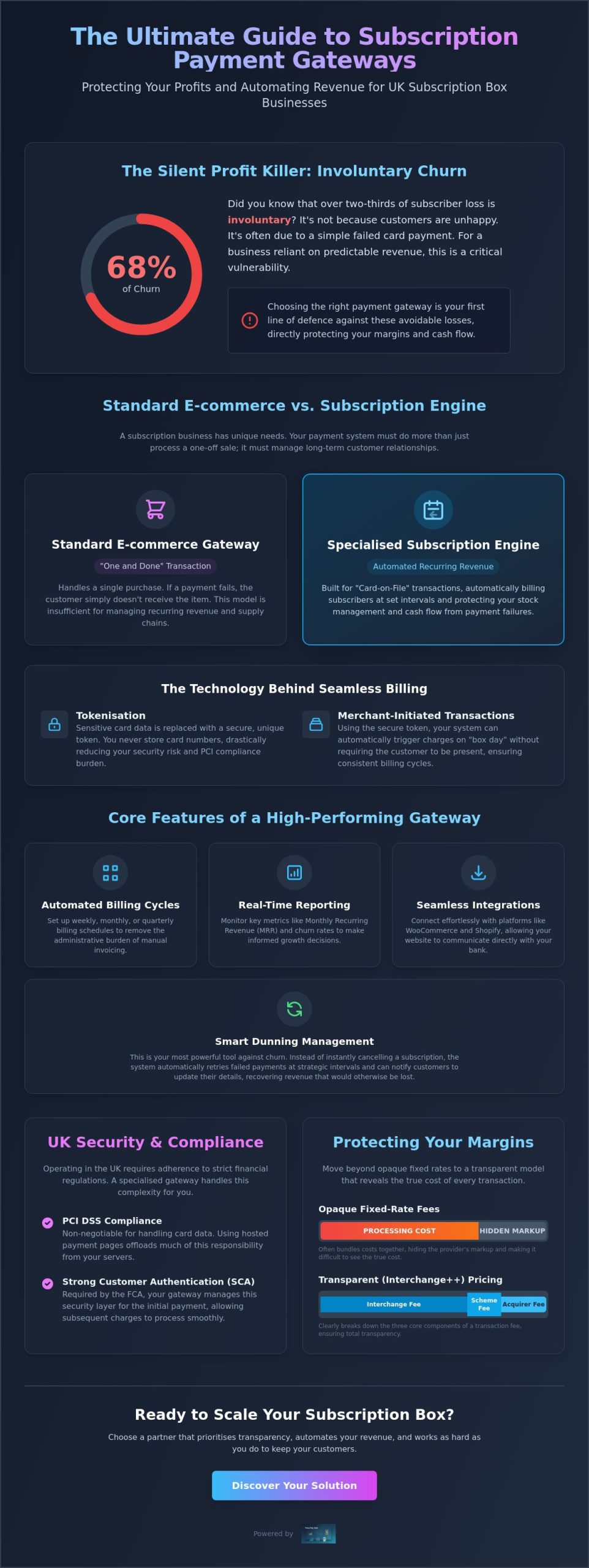
    Did you know that 68% of subscription churn is involuntary, often caused by nothing more than a failed card payment? For a growing business, these avoidable losses are a silent profit killer. Finding the right payment gateway for subscription box UK operations isn’t just about processing transactions; it’s about protecting your margins and ensuring your revenue remains predictable. You deserve a partner that prioritises transparency over complex jargon and hidden markups.

    We understand that your focus should stay on curation and customer delight, not on chasing failed payments or deciphering confusing bank statements. You need a reliable system that works as hard as you do. This article will show you how to protect your margins and automate your recurring revenue with a payment gateway tailored for the UK market. We’ll compare the latest 2026 fee structures, explore how to combat failed payments, and help you choose a system that gets funds into your account quickly to keep your stock levels healthy.

    Key Takeaways

    • Understand how a dedicated digital bridge automates your recurring billing cycles to ensure consistent cash flow.
    • Discover why choosing the right payment gateway for subscription box UK businesses is essential for tackling the 68% of churn caused by failed payments.
    • Learn to protect your margins by moving beyond opaque fixed-rate fees to a transparent pricing model that reveals the true cost of every transaction.
    • Master smart dunning management techniques that automatically retry failed cards before you lose a loyal subscriber.
    • Gain clarity on the difference between standard one-off gateways and specialised engines designed for long-term recurring revenue.

    What is a Subscription Payment Gateway and Why Does Your UK Business Need One?

    Your payment gateway is the digital heartbeat of your subscription business. It isn’t just a simple checkout button; it’s a sophisticated bridge that securely stores customer card data and triggers charges at specific intervals. For a standard shop, a gateway handles a “one and done” transaction. However, a payment gateway for subscription box UK operations must manage “Card-on-File” technology. This allows you to bill a customer multiple times without asking them to re-enter their details every month. It transforms a single sale into a predictable stream of revenue.

    As a Payment Service Provider (PSP), your gateway acts as the essential intermediary between your customer’s bank and your own merchant account. In the UK, this role is even more critical due to strict regulations. The Financial Conduct Authority (FCA) requires Strong Customer Authentication (SCA) for most online payments. A specialised subscription gateway handles these complex security layers automatically. It ensures that the first payment is fully authenticated, while subsequent “merchant-initiated transactions” can proceed smoothly without the customer being present.

    The Mechanics of Recurring Transactions

    The magic behind seamless billing lies in tokenisation. Tokenisation is the process of replacing sensitive card data with a unique identifier. This means you never actually store a customer’s 16-digit card number on your own servers, which drastically reduces your security risk. When “box day” arrives, your system sends this token to the gateway to trigger the charge. These merchant-initiated transactions are the backbone of your business. They allow you to maintain a steady rhythm of deliveries without requiring manual intervention from your subscribers every single month.

    Subscription Box vs. Standard E-commerce

    Physical subscription boxes face challenges that digital services or standard e-commerce shops don’t encounter. In a normal shop, if a payment fails, the customer simply doesn’t get the item. In the subscription world, your entire supply chain relies on payment reliability. If 15% of your payments fail on the day you’ve booked a courier and packed your perishable goods, your margins will vanish. You’re left with physical stock that has nowhere to go and a logistical headache to solve.

    Managing these hurdles requires tools beyond a simple web form. If a customer calls to update their billing date or switch their box frequency, you need a Virtual Terminal. This allows you to securely update subscription details or process manual payments over the phone. Choosing a robust payment gateway for subscription box UK businesses ensures that your stock management and your cash flow stay perfectly in sync, protecting your business from the chaos of failed “box day” transactions.

    Core Features of a High-Performing Subscription Gateway

    A high-performing gateway is your most diligent employee. It works whilst you sleep, ensuring that every recurring charge is triggered exactly when it should be. By setting automated billing cycles for weekly, monthly, or quarterly intervals, you remove the administrative burden of manual invoicing. Selecting a robust payment gateway for subscription box UK businesses involves looking beyond the checkout button. You need a system that integrates seamlessly with platforms like WooCommerce or Shopify, allowing your website to talk directly to your bank without technical friction.

    Reliability extends to how your system handles failure. Smart dunning management is your first line of defence against the 68% of churn caused by failed payments. Instead of immediately cancelling a subscription when a card is declined, a sophisticated gateway will automatically retry the charge at strategic intervals. It might even send a polite, automated reminder to the customer to update their details. This proactive approach keeps your revenue steady and your customers happy. Real-time reporting on monthly recurring revenue (MRR) and churn rates then provides the clarity you need to make informed growth decisions.

    Security and Compliance Standards

    Security should never be an afterthought. PCI DSS compliance is non-negotiable for any UK merchant handling card data. Using a hosted payment page is a smart way to reduce your compliance burden, as sensitive data never actually touches your servers. Staying compliant with evolving UK law is equally vital. The UK government crackdown on subscription traps will introduce new rules in spring 2027 regarding renewal reminders and cancellation rights. Your gateway must support these transparent practices. Implementing 3D Secure 2.0 helps you meet these standards, reducing fraud whilst maintaining a smooth, fast checkout experience for your subscribers.

    Flexible Payment Methods for UK Subscribers

    Offering flexibility at the checkout can significantly boost your sign-up rates. Whilst most subscribers prefer using Visa or Mastercard, the rise of digital wallets like Apple Pay and Google Pay cannot be ignored. These methods allow for one-touch sign-ups, which is perfect for mobile users. For higher-value boxes, you might even consider balancing card payments with Direct Debit to ensure long-term stability. Finding an Online Payment Gateway that supports a wide range of payment methods ensures you never lose a customer at the final hurdle. A specialised payment gateway for subscription box UK operations makes these complex choices simple, providing a dependable foundation for your business to scale.

    Calculating the Real Cost: Transaction Fees and Margin Protection

    Subscription boxes live or die by their margins. When you sell a physical product for £15 or £20, every penny counts. Whilst many business owners look only at the headline rate, the real cost is often buried in a complex breakdown. Your total fee usually consists of three core elements:

    • Interchange fees: Paid to the cardholder’s bank.
    • Scheme fees: Paid to card networks like Visa or Mastercard.
    • Merchant service charge: The processing fee kept by your provider.

    Standard “fixed-rate” pricing might seem simple, but it’s often a trap for UK businesses. These providers charge a high flat fee to cover their own risks. This means you pay the same rate for a low-cost debit card as you do for an expensive international credit card. This inefficiency eats into your profit. A specialised payment gateway for subscription box UK operations should offer more granularity. PurePay Hub, for example, provides debit card rates starting from 0.3%, allowing you to keep more of your hard-earned revenue.

    Hidden Costs to Watch Out For

    Transparency is the foundation of a fair partnership. Beyond the transaction fee, you must account for refund costs. Some gateways keep the original fee even when you return money to a customer; these costs can spiral if your return rate is high. You should also be wary of PCI non-compliance fines. These monthly penalties are often added by traditional banks if your security paperwork isn’t perfect. We believe that gateway fees should be transparent and free from monthly markups. This level of clarity is not just good practice; it aligns with the standards set out in the Digital Markets, Competition and Consumers Act 2024, which demands fairer treatment for UK subscribers and clearer business operations.

    The Value of Next-Day Funding

    Cash flow is king. If you need to purchase ingredients, packaging, or products for next month’s box, you can’t afford to wait. Many traditional gateways operate on a 7-day rolling settlement. This delay ties up your capital and makes growth difficult. Switching to a provider that offers next-day access to funds changes the game. It allows you to pay your suppliers faster, which can help you negotiate better bulk rates. Quick funding provides the stability you need to manage stock levels effectively without relying on expensive credit or overdrafts.
    Choosing the Best Payment Gateway for Subscription Box UK Businesses in 2026

    Reducing Churn: How Your Gateway Keeps Subscribers Longer

    Churn is the silent enemy of the subscription model. Whilst you focus on keeping your subscribers happy with excellent products, your gateway should be focusing on keeping their payments active. There are two distinct types of churn to manage. Voluntary churn occurs when a customer chooses to leave your service. Involuntary churn, however, is a technical failure. Recent research indicates that 68% of subscription churn is involuntary, often caused by expired cards, lost cards, or insufficient funds.

    A high-quality payment gateway for subscription box UK businesses uses “Account Updater” services to combat this. These services talk directly to card networks like Visa and Mastercard to refresh card details automatically when they expire. This happens behind the scenes without your customer ever needing to lift a finger. When this automatic update isn’t possible, a logical dunning sequence becomes your safety net. This is a series of automated emails and SMS messages triggered by a failed payment, guiding the user to fix the issue before their subscription is cancelled.

    Optimising Your Retry Logic

    Retrying a card isn’t just about repetition; it’s about timing. There is a science to when you should attempt a charge. Retrying on common UK paydays or in the early hours of the morning often yields better results than random attempts. However, you must balance recovery with the customer experience. Too many retries can lead to bank fees for the customer or trigger fraud alerts. If automated retries fail, sending a secure Payment Link allows the customer to manually update their details in seconds on any device.

    Enhancing the Customer Checkout Experience

    Your gateway’s job starts at the very first sign-up. Reducing friction here is essential for high conversion rates. For UK users, a mobile-optimised payment centre is a necessity, not a luxury. If your checkout looks clunky or untrustworthy on a smartphone, you will lose subscribers before they even start. Personalising the payment experience to match your brand’s colours and style builds trust. It makes the transition from your shop to the payment page feel seamless and professional.

    If you want to stop losing revenue to avoidable payment failures, it is time to switch to a partner that understands the UK market. Explore our Online Payment Gateway to see how we can help you reduce churn and protect your hard-earned revenue.

    Scaling Your Subscription Box with PurePay Hub

    Scaling a subscription business requires more than just a software tool; it requires a foundation built on trust and clarity. PurePay Hub acts as a stabilising force for your finances. We provide a no-nonsense approach to pricing that prioritises your growth over our own markups. By choosing a specialised payment gateway for subscription box UK merchants, you gain a partner that understands the regional retail landscape. We don’t hide behind corporate jargon or distant call centres. Instead, we offer a fair, transparent service designed for the specific needs of UK SMEs.

    Growth often means expanding beyond the digital space. You might decide to showcase your curation at a local artisan market or open a permanent shop. Our systems ensure your online presence and physical presence are perfectly aligned. You can integrate your Online Payment Gateway with our range of Countertop or Mobile Card Machines. This unified approach gives you a single, clear view of your revenue. To help you scale even faster, we offer access to a Business Cash Advance. This provides the capital you need to secure stock for a major launch without the rigid repayment structures of a traditional bank loan.

    Why PurePay Hub is the Fair Partner for Sub-Boxes

    We believe in moving away from the impersonal nature of traditional banking. Your business is more than just a merchant ID to us. We provide direct access to UK-based support, ensuring you can talk to a human expert whenever you have a query. Our onboarding process is streamlined and efficient. We know that every day spent waiting for a gateway is a day you aren’t shipping boxes. We aim to get you up and running quickly so you can focus on building your community. Our goal is to alleviate the stress of complex fee structures so you can get back to what you do best.

    Next Steps to Optimise Your Payments

    The first step toward better margins is clarity. We recommend conducting a thorough fee audit on your current provider to reveal any hidden markups or monthly penalties. Switching to PurePay Hub is a smooth process designed to protect your existing subscriber base. We work with you to ensure that card data is migrated securely, preventing any disruption to your recurring revenue. Your profit belongs to you, and we’re here to help you keep more of it. Don’t let opaque banking practices tax your hard-earned growth any longer.

    Request a transparent quote from PurePay Hub today to see how a dedicated payment gateway for subscription box UK operations can transform your business.

    Secure Your Subscription Success in 2026

    Managing a subscription brand is a constant balancing act between logistics and loyalty. We’ve seen how involuntary churn can be defeated with smart retry logic and how transparent pricing protects your essential margins. Choosing the right payment gateway for subscription box UK operations ensures your revenue is automated whilst your cash flow remains healthy. You shouldn’t have to settle for opaque fee structures or delayed settlements that hinder your ability to restock and grow.

    PurePay Hub is designed to be a stabilising force for your finances. We offer debit card rates starting from 0.3% and provide next-day access to your funds to keep your supply chain moving. There are no hidden monthly markups to catch you out. You deserve a partner that acts as a fair ally to your business. Switch to PurePay Hub for fairer subscription rates and start scaling with confidence today. Your dedication to your customers deserves a payment system that works just as hard as you do.

    Frequently Asked Questions

    Is a subscription payment gateway different from a standard gateway?

    Yes, a subscription gateway is specifically designed to handle recurring billing through tokenisation. Unlike a standard gateway that processes one-off sales, a payment gateway for subscription box UK businesses securely stores a digital token. This allows you to trigger future payments automatically without the customer needing to be present at checkout every month. It transforms a single sign-up into a reliable revenue stream.

    Can I use a virtual terminal to take subscription orders over the phone?

    You can use a Virtual Terminal to process subscription orders manually or over the phone. This tool is essential for providing high-quality customer service. If a subscriber wants to update their details or start a new plan whilst speaking to you, you can securely enter their information. This ensures there is no interruption to their service and keeps your records accurate.

    How much are the typical transaction fees for a UK subscription box?

    Transaction fees usually include interchange fees, scheme fees, and the provider’s processing rate. Many traditional providers use a flat-rate model that can be expensive for low-margin physical goods. We prioritise transparency by offering a breakdown of these costs. Our debit card rates start from 0.3%, which helps you protect your profit margins as your subscription business scales.

    What happens if a customer’s card expires during their subscription?

    A modern payment gateway for subscription box UK operations uses Account Updater services to refresh card details automatically. If a card expires or is replaced, the system communicates with the card networks to update the stored token. This prevents involuntary churn. It ensures your “box day” deliveries aren’t disrupted by technical payment failures that the customer might not even notice.

    How does SCA (Strong Customer Authentication) affect my monthly billing?

    SCA requires a two-factor check for the initial sign-up, but subsequent recurring payments are usually exempt. These are classified as merchant-initiated transactions. Your gateway handles this complexity by ensuring the first payment is fully authenticated. This allows future charges to happen seamlessly without further customer intervention, keeping your billing cycle consistent and compliant with UK financial regulations.

    Can I offer both card payments and Direct Debit on my website?

    Offering both card payments and Direct Debit is a great way to provide flexibility to your subscribers. Cards are excellent for instant sign-ups and mobile users who prefer digital wallets. Direct Debit can be more stable for higher-value boxes. Providing these choices helps reduce friction at the checkout and improves your overall conversion rates by catering to different customer preferences.

    How long does it take to receive funds from my subscription sales?

    Settlement times vary between providers, but standard rolling settlements often take seven days. We understand that cash flow is vital for purchasing stock and packaging for your next shipment. That’s why we offer next-day access to your funds. This ensures you have the capital ready to pay suppliers and manage your inventory without the stress of unnecessary delays.

    Is it difficult to switch payment providers for an existing subscription base?

    Switching providers doesn’t have to disrupt your existing subscriber base. We handle the secure migration of your customer tokens to ensure a seamless transition. This means your subscribers won’t need to re-enter their card details or sign up again. It’s a straightforward process that allows you to move to a fairer rate without the risk of losing your loyal customers.

  • Closing the Sales Gap: Psychological Insights for Success

    Closing the Sales Gap: Psychological Insights for Success

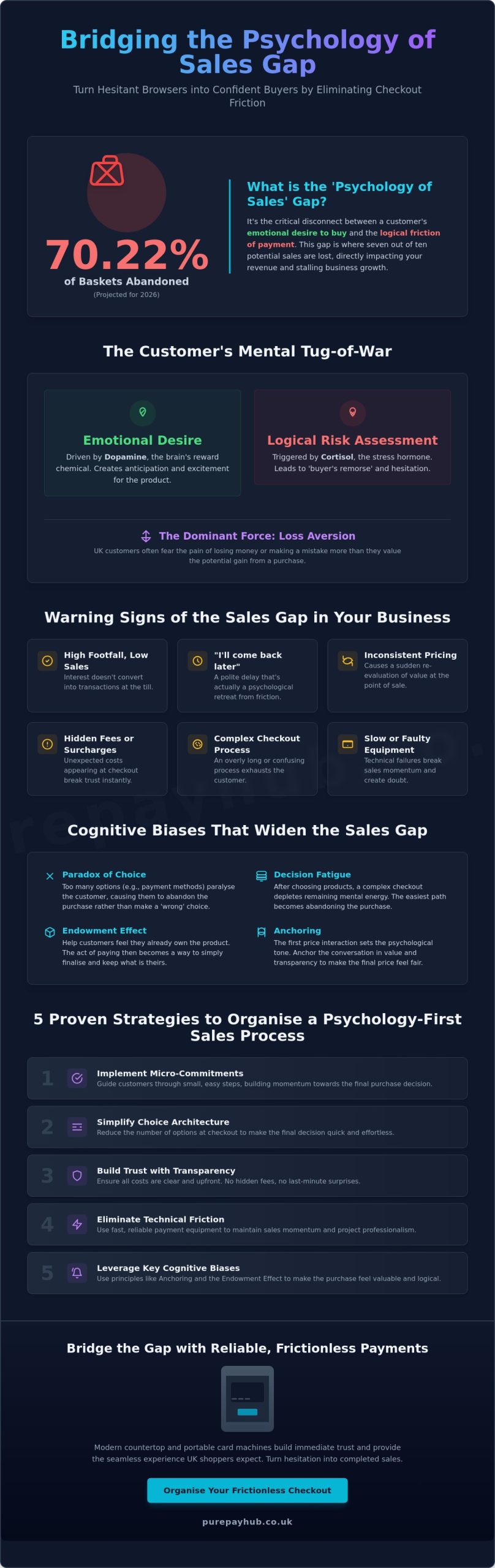
    Did you know that in 2026, approximately 70.22% of shoppers abandon their baskets before completing a purchase? For a UK business owner, watching seven out of ten potential sales vanish at the final hurdle is more than just a statistic; it’s a direct hit to your revenue. This disconnect is often caused by the Psychology of Sales gap. It isn’t usually a lack of interest in what you’re selling. Instead, it’s often a failure of friction management at the point of payment, where hidden doubts and complex processes suddenly take over.

    You likely feel the frustration of deals stalling at the “thinking about it” stage or seeing customers hesitate when they reach your checkout. We agree that opaque processes and unexpected friction are the enemies of growth. This guide will show you how to identify these psychological barriers and bridge them effectively. You’ll learn how to organise a frictionless checkout experience that encourages faster decision-making. We’ll preview the cognitive biases influencing customer behaviour and explain how clear, honest payment solutions can turn a hesitant browser into a confident buyer.

    Key Takeaways

    • Understand why customer intent often fails to translate into a final transaction by identifying 1. The “Psychology of Sales” Gap in your current process.
    • Discover how cognitive biases like the paradox of choice and decision fatigue can paralyse your customers at the point of purchase.
    • Learn to protect sales momentum by eliminating technical friction and avoiding the psychological exit caused by slow or unreliable equipment.
    • Implement actionable strategies, from micro-commitments to simplified choice architecture, to guide your customers seamlessly toward a final decision.
    • Explore how using reliable countertop or portable card machines builds immediate trust and provides the frictionless experience modern UK shoppers expect.

    What is the ‘Psychology of Sales’ Gap and Why Does It Stall Your Growth?

    Every business owner has experienced the frustration of a customer who seems ready to buy but suddenly pulls away. This isn’t usually a problem with your product or your service. It’s a fundamental disconnect between a buyer’s emotional intent and the final physical act of payment. We call this phenomenon 1. The “Psychology of Sales” Gap. It represents the space where interest turns into hesitation, and it’s a measurable friction point that can stall your business growth if left unaddressed.

    In 2026, this gap is widening. UK consumers are more skeptical than ever before. They face a constant barrage of choices and marketing messages, leading to a state of choice overload. When a customer reaches the point of transaction, they often hit a “Moment of Hesitation.” This is a subconscious risk assessment where they weigh the value of the purchase against the potential for regret. For a local merchant, bridging this gap is essential. Failing to do so doesn’t just lose you a single sale; it disrupts your cash flow and prevents you from building the momentum needed to scale your operations.

    The Emotional vs. Logical Tug-of-War

    The study of consumer behaviour shows that purchasing decisions are rarely purely logical. Initial desire is often driven by dopamine, the chemical associated with reward and anticipation. However, as the customer moves closer to the checkout, cortisol levels can rise. This stress hormone triggers a sense of “buyer’s remorse” before the sale is even finalised. In the UK market, “Loss Aversion” plays a massive role. Customers often fear the pain of making a mistake or losing their money more than they value the gain from your product.

    We define 1. The “Psychology of Sales” Gap as a measurable friction point in the customer journey where emotional desire is overtaken by logical risk assessment.

    Signs Your Business is Suffering from the Gap

    You can identify if this gap is affecting your bottom line by looking at specific patterns in your daily trade. If you notice high footfall in your shop but surprisingly low transaction volumes, you’re likely losing people at the final hurdle. The “I’ll come back later” phenomenon is another clear indicator. Whilst it sounds like a polite delay, it’s actually a psychological retreat. The customer has encountered a friction point that made the risk feel too high. Common triggers include:

    • Inconsistent pricing that causes a sudden re-evaluation of value.
    • Hidden fees or surcharges that appear only at the point of sale.
    • A checkout process that feels overly complex or time-consuming.
    • Technical failures, such as slow card machines, that break the customer’s focus.

    By recognising these signs, you can begin to organise a sales process that prioritises clarity and reassurance. Eliminating these psychological barriers is the first step toward creating a dependable, frictionless experience that keeps your customers moving forward.

    The Hidden Cognitive Biases Influencing Every Transaction

    Every transaction is a minefield of subconscious shortcuts. These cognitive biases are the invisible forces that often widen 1. The “Psychology of Sales” Gap. When you understand how the human brain processes a purchase, you can smooth the path for your customers and remove the mental barriers that lead to abandoned baskets.

    The “Paradox of Choice” is a primary culprit for stalled sales. Whilst we often think more options are better, too many payment methods can actually paralyse a buyer. They get stuck wondering which one is the safest or best to use. This is compounded by “Decision Fatigue.” After a customer has spent time choosing products, their mental energy is depleted. The checkout process must be the simplest part of their day. If it requires extra thinking, they are likely to walk away.

    You can also leverage the “Endowment Effect” by helping customers visualise the product as already being theirs. When a buyer feels they already own the benefit, the act of paying is simply a way to keep it. This is often supported by “Anchoring.” Your first price interaction sets the psychological tone for the entire sale. If you anchor the conversation in value and transparency from the start, the final transaction feels like a fair and logical conclusion. By addressing these biases, you effectively bridge 1. The “Psychology of Sales” Gap and create a more dependable revenue stream.

    Loss Aversion and the Fear of the “Wrong” Choice

    UK consumers are particularly sensitive to perceived financial risk. “Loss Aversion” means they feel the pain of a potential mistake more acutely than the joy of a gain. You can soothe the buyer’s amygdala through “Risk Reversal” strategies. Clear, honest communication about costs and straightforward return policies are essential. Even your hardware plays a role. A sleek, modern card machine signals reliability and security. A dated or unreliable device triggers a red flag, suggesting the business might be stuck in the past. To ensure your counter reflects your professional standards, you might consider upgrading your payment technology to something that inspires confidence.

    The Bandwagon Effect: Using Social Proof at the Counter

    We are social creatures who look for cues that we are making the right decision. The “Bandwagon Effect” is a powerful tool at the point of sale. Subtle environmental signals can suggest that “people like you shop here.” Displaying recognisable payment logos like Visa, Mastercard, and Apple Pay acts as a silent validation of your business. These logos are psychological anchors of trust. Even a busy shop can be a positive signal. A queue suggests popularity and quality, provided your checkout speed is high. If your systems are fast and efficient, a busy counter reinforces the customer’s choice rather than testing their patience.

    Dealing with ‘Checkout Churn’: Where Momentum Meets Friction

    Momentum is the most fragile asset in any sales interaction. It is the invisible energy that carries a customer from “I want this” to “I have paid for this.” When this flow is interrupted, you encounter 1. The “Psychology of Sales” Gap. This gap is often forced open by technical friction. Slow card machines or signal drops don’t just delay the payment. They create a ‘Psychological Exit.’ In those few seconds of waiting, the customer’s brain has time to re-evaluate the purchase. This often leads to second thoughts or immediate abandonment.

    A professional payment area acts as a ‘Centre of Certainty.’ It grounds the transaction in reality and builds immediate trust. We advocate for a ‘no-nonsense’ approach. Over-complicated sales scripts or aggressive upselling at the counter often create suspicion rather than sales. When you prioritise clarity and speed, you reassure the customer that they are making a sensible, secure choice. Bridging 1. The “Psychology of Sales” Gap requires you to protect the customer’s momentum until the very last second.

    The High Cost of Technical Friction

    Speed is not just about efficiency. It is about emotional stability. Research shows that an estimated $260 billion in lost orders are recoverable in the US and EU through better checkout design and user experience. Even a minor 3-second delay in card processing can trigger a noticeable rise in buyer anxiety. When a customer sees a “Connection Error” on a card machine, the psychological message is clear. It suggests the business is unprofessional or unreliable. It breaks the trust you worked hard to build. Seamless hardware acts as a silent closer in the sales process, ensuring the final step is as rewarding as the first.

    Organising a Frictionless Payment Zone

    The physical environment of your checkout centre matters. It should be clean, well-lit, and free of clutter. This creates a sense of order and security. However, you don’t always need to tether your customers to a fixed point. Portable card machines allow you to take the payment to the customer, whether they are at a table or on the shop floor. This removes the physical friction of walking to a queue.

    There is also a psychological benefit to the merchant having “Next-Day Access to Funds.” When you have confidence in your own cash flow, that stability translates to the customer experience. You appear more dependable and less desperate for the sale. By organising your space and your technology around the customer’s comfort, you turn the point of sale into a point of connection.

    • Ensure your payment area is tidy and professional to signal reliability.
    • Use portable card machines to meet the customer where they are.
    • Eliminate technical errors that break the buyer’s focus.

    Closing the Sales Gap: Psychological Insights for Success

    5 Proven Strategies to Organise a Psychology-First Sales Process

    Bridging 1. The “Psychology of Sales” Gap doesn’t require a degree in behavioural science. It requires a commitment to clarity and a disdain for friction. By organising your sales environment around the customer’s mental state, you can transform hesitant browsers into loyal advocates. Here are five practical strategies to help you close the gap today.

    • Simplify choice architecture: Avoid overwhelming customers with irrelevant options at the point of sale. If you offer too many payment methods or unnecessary upsells, you trigger decision fatigue. Keep the final steps focused and direct.
    • Use micro-commitments: Lead the buyer naturally toward the final transaction. Small agreements, such as asking if they found everything they needed, create a rhythm of “yes” that makes the final payment feel like a natural progression.
    • Lead with transparency: Display all costs and fees early. “Price Shock” at the till is the fastest way to lose a customer’s trust. Whether you use standard rates or a credit card processing with surcharge program from Strictly, clear pricing prevents the psychological retreat that happens when a buyer feels misled.
    • Implement high-speed hardware: Maintain the “Dopamine Loop” of the purchase. A fast, responsive card machine ensures the excitement of the buy isn’t killed by a spinning loading icon or a connection delay.
    • Reinforce the decision: Provide a professional, branded digital or physical receipt. This small act confirms they’ve made a secure and sensible choice, reducing the risk of post-purchase regret.

    Transparency as a Competitive Advantage

    For UK SMEs, “No Hidden Fees” is more than a slogan. It is a powerful psychological trigger. UK consumers value honesty and straightforwardness amongst the businesses they support. When you clearly display your payment process with professional signage, you build a foundation of trust that traditional, opaque institutions often lack. We believe that security is a core part of this partnership. Ensuring your business is PCI compliant provides customers with the silent reassurance that their data is protected whilst they pay. If you want to build this trust immediately, you can explore our transparent payment solutions designed specifically for local merchants.

    The Power of Speed and Reliability

    Reducing “Time to Transaction” should be a key performance indicator for your business. Every second saved at the counter is a second where the customer doesn’t have time to doubt their choice. Fast processing is supported by efficient backend systems. An integrated EPOS system that manages stock in real-time prevents the “Out of Stock” let-down, which can be a major psychological blow to a motivated buyer. Additionally, next-day access to funds allows you to reinvest in your customer experience immediately. When your finances are stable and fast, your business projects an aura of reliability that customers can feel. This confidence is contagious and encourages repeat visits.

    Bridging the Gap with PurePay Hub: Frictionless Payments for Modern Businesses

    Closing 1. The “Psychology of Sales” Gap requires more than just understanding the theory. It requires the right tools to manage the moment of truth at the counter. At PurePay Hub, we provide the technology that turns a customer’s hesitation into a completed transaction. Our Countertop Card Machine and Portable Card Machine are designed to eliminate technical friction. They ensure that your payment process is as smooth and professional as the service you provide.

    Transparency is the foundation of trust. We offer clear, competitive rates of 0.3% on debit card transactions and 0.5% on credit card transactions. When you don’t have to worry about hidden markups or complex fee structures, you can focus on your customers. This honesty builds a stronger bond between you and your community. An integrated EPOS system acts as the brain of your business, organising the entire sales journey from stock management to the final tap of a card. It prevents the errors that create psychological exits for your buyers.

    We also understand that business confidence is linked to cash flow. Our “Next-Day Access to Funds” model ensures you aren’t left waiting for your own money. When you have the certainty of steady capital, you project a sense of stability that customers can feel. It allows you to maintain a high standard of service without the stress of financial delays.

    Reliability You Can Bank On

    Technical downtime is the fastest way to reopen the sales gap. If your machine fails, your customer’s momentum dies instantly. We provide 24/7 technical support to ensure your systems stay online when you need them most. Our hardware isn’t just reliable; it looks the part. A modern, professional Countertop Card Machine signals to your customers that you take their security seriously. With the PCI PTS POI v5 certification set to expire in April 2027, now is the time to ensure your hardware meets the latest standards. Our quick onboarding process means you can start building this trust with a stress-free partnership almost immediately.

    Taking the Stress Out of Cash Flow

    Sometimes, bridging the gap requires a physical change to your environment. Whether it’s a new layout to improve flow or a fresh look to boost social proof, a Business Cash Advance can provide the necessary funding. This isn’t a traditional loan with rigid monthly costs. Instead, repayment is calculated as a small percentage of your daily card sales. This fair model aligns perfectly with your actual business behaviour. If you have a quiet day, your repayments are lower. It’s a supportive way to grow without the pressure of fixed overheads.

    Ready to close the gap? Explore PurePay Hub’s card machines today.

    Turn Browsers into Buyers Today

    You now have the practical strategies to manage the hidden forces that stall your transactions. By simplifying your choice architecture and using reliable hardware, you can effectively close 1. The “Psychology of Sales” Gap. Remember that transparency isn’t just a moral choice; it’s a competitive advantage that builds immediate trust with your local community. Protecting your customer’s momentum at the point of sale ensures that their initial desire leads to a successful purchase rather than a missed opportunity.

    It’s time to move away from opaque fee structures and unreliable equipment that creates unnecessary friction. You can switch to a fairer, faster payment partner with PurePay Hub. We offer debit card rates from 0.3% and provide next-day access to funds, all without hidden markups or corporate jargon. We’re here to help you organise a frictionless experience that keeps your business moving forward. Let’s start building a more dependable and profitable future for your trade together.

    Frequently Asked Questions

    What exactly is the “Psychology of Sales” gap?

    It is the disconnect between a customer’s intent to buy and the final act of payment. This gap represents the space where interest turns into hesitation due to friction or doubt. By identifying these moments, you can create a smoother journey that maintains buyer momentum until the transaction is complete.

    How does a slow card machine affect my customer’s psychological state?

    Speed is a proxy for reliability and security in the mind of the customer. A slow card machine creates a “Psychological Exit,” giving the buyer time to doubt their purchase or feel anxiety about the transaction’s safety. Rapid processing maintains the positive energy of the purchase and ensures the customer leaves with a sense of confidence.

    Can changing my payment provider really improve my conversion rates?

    Yes, switching to a provider that offers faster hardware and transparent processes can significantly lower abandonment rates. When you eliminate technical errors and hidden costs, you remove the primary triggers for buyer hesitation. This directly addresses 1. The “Psychology of Sales” Gap by making the final hurdle effortless for your customers.

    What are the most common cognitive biases in UK retail?

    Loss aversion and the paradox of choice are particularly prevalent amongst UK shoppers. Customers often fear making a “wrong” choice more than they value the benefit of the purchase. Additionally, providing too many complex payment options can lead to decision fatigue, causing the buyer to walk away rather than make a final choice.

    How can I make my checkout process feel more secure for customers?

    Use recognisable payment logos and modern hardware to signal immediate trust. Displaying clear information about PCI compliance and providing instant, branded receipts also reassures the customer that their data is protected. A clean, well-lit payment centre further grounds the transaction in a sense of safety and professional order.

    Why is transparency in transaction fees important for buyer trust?

    Hidden markups or unexpected fees at the till trigger “Price Shock,” which destroys merchant-customer trust instantly. UK consumers value honest, straight-talking business partners. By leading with clear rates, you prevent the psychological retreat that occurs when a customer feels they are being misled by opaque or complex financial structures.

    What is the role of an EPOS system in bridging the sales gap?

    An EPOS system acts as the central brain that organises your entire sales journey. It manages stock in real-time to avoid the psychological let-down of “out of stock” items and ensures that pricing remains consistent across all channels. This stability prevents the friction points that often widen 1. The “Psychology of Sales” Gap.

    Is a business cash advance a good way to improve my sales environment?

    A business cash advance provides the capital needed for a physical “facelift” to improve your retail or restaurant space. Because repayments are a percentage of your daily card sales, the model is fair and aligns with your actual trade behaviour. This allows you to invest in a more welcoming environment without the stress of fixed monthly overheads.