Tag: business growth

  • Choosing the Best Restaurant EPOS System in the UK for 2026

    Choosing the Best Restaurant EPOS System in the UK for 2026

    How much of your hard-earned Friday night profit is disappearing into opaque transaction fees before the weekend even starts? You likely know the frustration of thin margins being eaten away by hidden charges and the stress of system downtime during a peak dinner rush. It’s common to feel that your current setup, with its fragmented reporting between the till and the card machine, is holding your business back rather than helping it grow.

    Choosing the right restaurant EPOS system UK for 2026 can change that by slashing transaction costs and finally uniting your front-of-house with the kitchen. We promise to show you how to select an integrated solution that provides next-day access to your funds, lowers your merchant service charges, and ensures your operations run seamlessly. This guide explores the latest hardware and software strategies to help you reclaim your margins whilst maintaining the transparency your business deserves. You’ll learn how to move from a state of frustration to one of informed confidence, ensuring your technology acts as a supportive partner in your success.

    Key Takeaways

    • Understand how to transition from a basic till to an integrated ecosystem that manages payments, staff, and stock from one central hub.
    • Identify the essential features for a restaurant EPOS system UK, including floor plan customisation and Kitchen Display Systems that reduce order errors.
    • Learn to calculate the Total Cost of Ownership by contrasting fixed hardware costs with variable merchant service charges to protect your margins.
    • Discover the steps to ensure a seamless transition between providers without experiencing system downtime or losing a single night of trade.
    • Leverage transparent transaction rates as low as 0.3% for debit and 0.5% for credit to turn every payment into a growth opportunity.

    What is a Restaurant EPOS System and Why is it Critical in 2026?

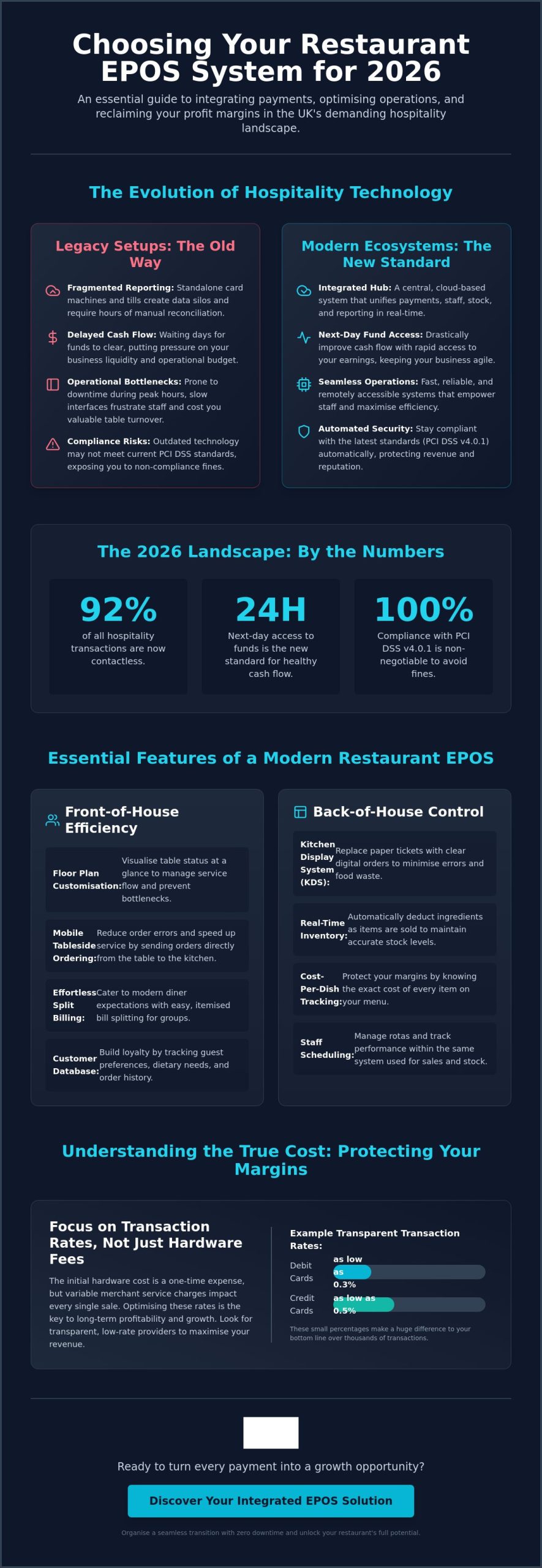
    A What is a Point of Sale (POS) system is no longer just a box for holding cash. In 2026, a restaurant EPOS system UK acts as the central nervous system of your entire hospitality business. It’s the point where every customer interaction, kitchen order, and stock adjustment meets. The days of simple, standalone tills are over. Modern owners have transitioned toward integrated ecosystems that manage payments, staff scheduling, and inventory in one place. This shift is critical because 2026 brings unique pressures. With rising operational costs and thin margins, you need real-time data synchronisation to make informed decisions. You aren’t just managing a till anymore; you’re optimising a digital business partner that works as hard as you do.

    The Evolution of Hospitality Tech: From Tills to Ecosystems

    Legacy setups often relied on standalone card machines that didn’t talk to the till. This created fragmented reporting and endless manual reconciliation. Modern EPOS systems remove this friction entirely. Because they’re cloud-based, you can monitor your restaurant’s performance from your phone whilst away from the site. This transparency is vital for spotting waste or staffing issues early. In a high-inflation economy, the speed of your cash flow is also paramount. Integrated systems provide next-day access to funds, ensuring your business stays liquid and ready for the next delivery. This reliability helps alleviate the stress that business owners feel regarding complex fee structures and delayed payments.

    Why “Good Enough” is No Longer Enough for UK Restaurants

    Consumer behaviour has changed rapidly. Statistics from early 2026 show that contactless payments now account for 92% of all hospitality transactions. If your system is slow or prone to downtime, you’re directly hurting your table turnover. A laggy interface during a peak Friday night doesn’t just frustrate staff; it costs you covers. Security is another non-negotiable factor. With PCI DSS v4.0.1 now being the sole supported standard as of 2025, using outdated tech risks monthly non-compliance fines. A modern restaurant EPOS system UK keeps you compliant automatically, protecting your reputation and your revenue. By prioritising clarity and efficiency, you ensure your technology supports your growth rather than acting as a bottleneck.

    Essential Features Every UK Restaurant EPOS Must Have

    The best systems don’t just process payments; they orchestrate the entire floor. A robust restaurant EPOS system UK provides a clear, customisable floor plan that acts as the foundation for your service speed. Your staff should be able to see, at a glance, which tables are waiting for drinks, which are mid-course, and which are ready for the bill. This visual clarity prevents bottlenecks and ensures no customer is left waiting during a frantic shift. Beyond the floor plan, your system must offer granular inventory tracking. With food prices remaining volatile in 2026, knowing your exact cost-per-dish is the only way to protect your margins. Every ingredient should be accounted for, from the premium steaks to the garnish.

    Front-of-House Efficiency: Table Management and Mobile Ordering

    Speed at the table is the heartbeat of a busy shift. By adopting restaurant industry technology trends like mobile tableside ordering, you eliminate the constant back-and-forth to a central terminal. Waitstaff can send orders directly to the kitchen the moment they are taken; this significantly reduces lead times and improves order accuracy. For weekend diners, split-billing features are no longer optional. Customers expect to pay for exactly what they had without a mathematical debate at the end of the night. These tools also allow you to build a database of your guests. Recognising a favourite customer’s previous order or dietary preference builds the kind of loyalty that keeps a local business thriving.

    Back-of-House Control: Inventory and Kitchen Integration

    Your kitchen is where your margins are won or lost. A Kitchen Display System (KDS) replaces messy paper tickets with clear, digital prompts that reduce errors and food waste. These screens ensure the kitchen team receives orders the second they are placed, keeping the rhythm of service steady. Integration with your inventory is equally vital. When a burger is sold, your system should automatically deduct a bun and a patty from your stock levels in real-time. Automated low-stock alerts prevent the awkwardness of a server having to tell a guest that a menu item is unavailable mid-service. This level of control allows you to run a leaner, more profitable operation. If you are looking to upgrade, choosing a modern EPOS system can help you centralise these complex tasks into one manageable dashboard.

    Managing your team effectively requires more than just a paper rota. Modern systems include staff management tools that track individual performance and handle shift scheduling. You can see which servers are upselling effectively and which shifts require more support. By identifying these patterns, you can optimise your labour costs whilst ensuring your best staff are rewarded. This data-driven approach turns your EPOS from a simple tool into a strategic asset for your restaurant’s long-term growth.

    Calculating the Real Cost: Software Fees vs. Transaction Rates

    Finding the most cost-effective restaurant EPOS system UK requires looking past the initial sales pitch. You must evaluate the Total Cost of Ownership (TCO) to understand how much money actually leaves your bank account each month. Many owners focus on the hardware price or the software subscription whilst ignoring the variable merchant service charges that follow. These transaction fees are often the largest expense in your technology stack. The effective rate is the true measure of payment processing costs; it represents your total monthly fees as a percentage of your total sales volume.

    A transparent financial strategy balances fixed and variable costs. Fixed monthly hardware rentals provide predictability, but they shouldn’t be bundled with opaque processing terms. You need a partner that identifies every cost clearly, from the terminal lease to the per-transaction markup. This clarity helps you move from a state of frustration regarding hidden fees toward a state of informed confidence in your margins. Your technology should be a stabilizing force for your business finances, not a source of unexpected overheads.

    The Trap of “Free” EPOS Software

    Entry-level providers often lure business owners with the promise of “free” software. This is frequently a financial trap that punishes your success. These systems usually carry high transaction rates of 1.75% or more, which can cost a thriving restaurant thousands of pounds in unnecessary fees. For a restaurant with a £20,000 monthly turnover, a “free” system at a 1.5% rate costs you £300 a month. Conversely, a paid system with a £50 monthly fee and a 0.3% rate costs you only £110 in total. The “free” option is actually £190 more expensive every single month. You should also insist on next-day access to funds as a standard feature. In a fast-moving hospitality environment, waiting days for your own money is an outdated practice you don’t have to accept.

    Understanding Merchant Service Charges (MSC)

    Transparency in Merchant Service Charges (MSC) is the no-nonsense approach every owner should demand. You deserve to know exactly what you’re paying for debit and credit transactions. Fair rates, such as those from PurePay, typically start around 0.3% for debit cards and 0.5% for credit cards. These small differences in percentage points can save you enough to hire another staff member or upgrade your kitchen equipment over the course of a year. Avoid long-term contracts that hide annual fee increases or exit penalties. A supportive business ally won’t need to lock you in with complex legalese; they’ll keep your business through fair service and honest pricing. By prioritising these clear fee structures, you ensure your technology acts as a growth engine rather than a drain on your resources.

    Choosing the Best Restaurant EPOS System in the UK for 2026

    Organising a Seamless Transition to Your New System

    Switching your restaurant EPOS system UK shouldn’t feel like a leap into the dark. It’s a strategic move. It requires a structured plan to avoid losing a single night of trade. Many owners worry about the administrative headache of setting up new technology during a busy season. The right partner makes this transition effortless by prioritising clarity over complexity. You need a system that stabilises your finances from day one. This transition follows a simple logic: identify the bottlenecks in your old setup and configure the new one to solve them. It’s about improvement, not just replacement.

    Data Migration: Moving Your Menu and Stock

    Moving your data is the perfect time for a digital spring clean. Audit your current menu before you start the import. Remove unpopular items that clutter your interface and slow down your servers. This ensures a clean import into your new setup. Crucially, you must map your VAT categories correctly. This keeps you compliant with HMRC and prevents accounting errors later. Generic global advice often ignores these UK-specific banking and tax requirements. A provider that offers dedicated technical support during this phase prevents costly mistakes. They help you bridge the gap between your old till and your new integrated ecosystem whilst ensuring your historical data remains accessible for year-end reporting.

    Staff Buy-In: Training for Peak Performance

    Your staff use the system during the frantic Saturday night rush. They need an interface that makes sense immediately. A punchy, intuitive design reduces the learning curve for new hires and seasoned veterans alike. Don’t go live without a mock service. Run a practice shift with your team to test the workflow. This builds the confidence your team needs to handle high-pressure situations without hesitation. Once live, use the granular reporting to reward your most efficient performers. You can see which staff members are upselling effectively or managing their tables with the most speed. This turns a technical change into a motivational tool for your entire team.

    A successful transition relies on a partner who values your time and your margins. You deserve a system that is as disciplined and professional as your kitchen. By following a clear onboarding framework, you can upgrade your technology without the stress usually associated with new software. If you’re ready to leave behind opaque fees and fragmented reporting, you can switch to a more transparent EPOS system today and start reclaiming your hard-earned profits.

    Why PurePay Hub is the Growth Engine for UK Restaurants

    PurePay Hub acts as a stabilising force for your restaurant’s finances. In an industry often viewed with scepticism, we provide a transparent alternative to the opaque practices of traditional banks. Choosing our restaurant EPOS system UK means you aren’t just buying hardware; you’re entering a disciplined partnership. We offer 0.3% debit and 0.5% credit transaction rates to ensure your margins remain protected. This clear fee structure allows you to forecast your overheads with absolute certainty. Our goal is to alleviate the stress that business owners feel regarding hidden costs and complex markup models.

    Integrated Payments and Next-Day Funding

    Integrated payments remove the frustration of manual entry on card machines. When your till and your terminal speak the same language, human errors disappear. This efficiency is supported by our range of Countertop Card Machines and Portable Card Machines, designed to suit any restaurant layout. We believe in calm advocacy for our partners, which is why next-day access to your funds is a standard feature. You shouldn’t have to wait for your own money to arrive whilst your suppliers need paying. By prioritising your cash flow, we ensure your technology acts as a supportive ally rather than a bottleneck.

    Unlocking Capital with Business Cash Advances

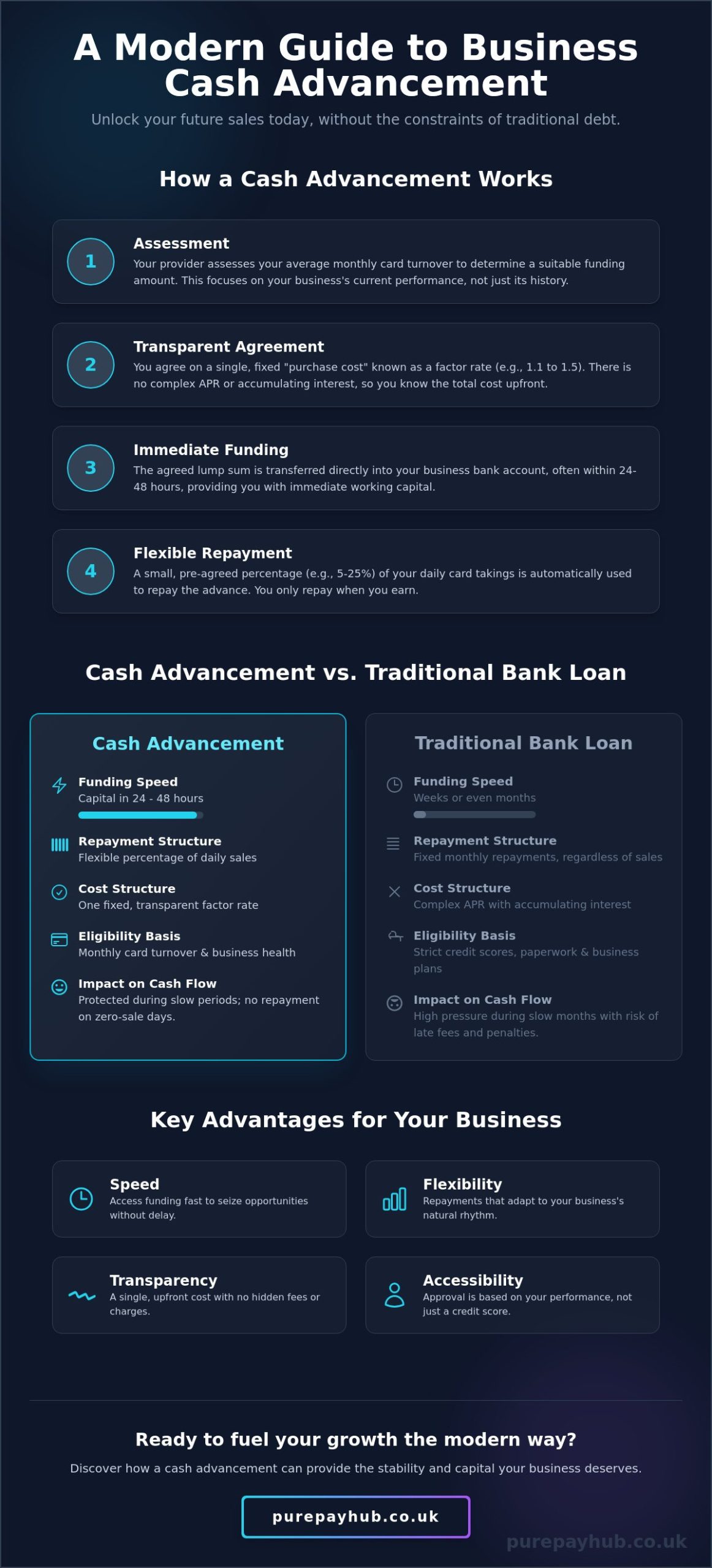
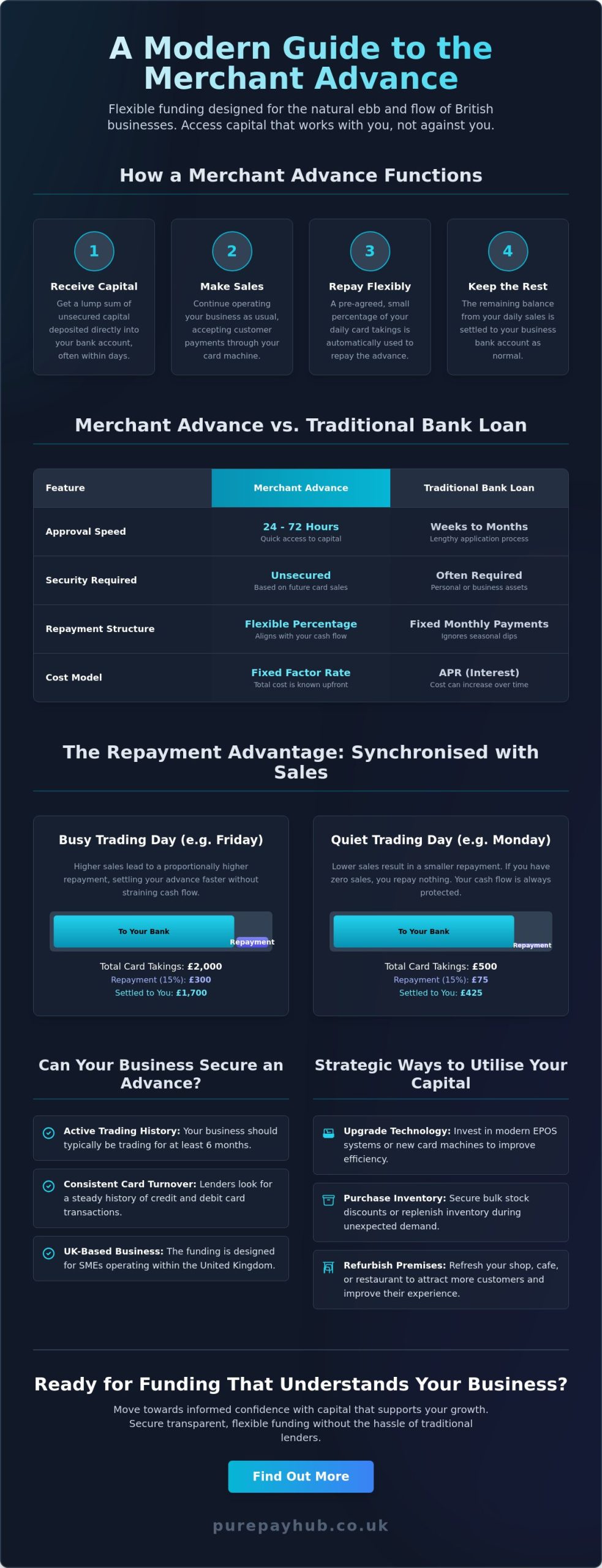
    We understand that growth requires capital, but traditional bank loans are often too rigid for the hospitality sector. Our Business Cash Advance allows you to use your future card sales to secure unsecured capital today. This is a game-changer for owners planning refurbishments or kitchen upgrades. Unlike bank loans with fixed monthly repayments, this model follows a “pay-as-you-earn” structure. Your repayments are a small, agreed percentage of your daily card sales. If you have a quieter week, your repayments automatically reduce. It’s a flexible, no-nonsense way to fund your expansion without the pressure of traditional debt cycles.

    Our focus remains on the individual business owner. We disdain hidden markups and corporate jargon, choosing instead to lead our partners toward a state of informed confidence. By centralising your payments, your reporting, and your funding, we help you lead your business with a clear head. You deserve a partner that values efficiency and straight-talking as much as you do. You can organise a transparent rate review with PurePay Hub today to discover how much your business could save.

    Reclaiming Your Margins in 2026

    The right technology should be a stabilising force for your finances, not a source of stress. You’ve seen how a modern restaurant EPOS system UK acts as a central nervous system, uniting your front-of-house with the kitchen whilst protecting your hard-earned margins. By looking past the trap of “free” software and focusing on transparent transaction rates, you can turn every payment into a growth opportunity. Whether you’re streamlining a single site or planning a multi-venue expansion, the path to a more profitable 2026 starts with clarity and integrated reporting.

    We are here to act as your fair partner in an industry that often feels opaque. You deserve a setup that offers next-day funding as standard and provides no-nonsense, UK-based support when you need it most. It’s time to stop letting hidden fees eat into your success. We provide debit rates from 0.3% and credit rates from 0.5% to ensure you keep more of what you earn every single day.

    Switch to PurePay Hub for 0.3% rates and integrated EPOS

    Take the next step toward a more efficient, profitable future for your restaurant. Your success is our priority.

    Frequently Asked Questions

    How much does a typical restaurant EPOS system cost in the UK?

    The total cost depends on your specific hardware needs and the number of terminals required for your floor plan. You will typically encounter a combination of upfront hardware costs for screens and printers; a monthly software subscription fee; and variable transaction rates. It is vital to look at the total cost of ownership rather than just the initial price tag to ensure your margins remain protected from hidden markups.

    Can I keep my existing card machine when I switch EPOS providers?

    You can technically use a standalone card machine, but you will lose the significant advantages of an integrated restaurant EPOS system UK. Integrated systems allow your till and terminal to communicate directly; this removes the need for manual data entry and prevents reconciliation errors at the end of a shift. Switching to a unified provider usually simplifies your reporting and results in faster access to your funds.

    What is the difference between an EPOS system and a standard cash register?

    A standard cash register is a passive tool for recording sales and storing cash; an EPOS system is an active partner that helps you optimise your entire business. It tracks inventory in real-time, manages staff rotas, and provides granular data on your most profitable dishes. Whilst a till only handles the final transaction, an EPOS system orchestrates everything from the initial order to the final kitchen prompt.

    How long does it take to install a new restaurant EPOS system?

    A standard installation usually takes between one and three days depending on the size of your venue and the complexity of your menu. This period includes the physical setup of your terminals and a dedicated training session to ensure your team is confident before the first live service. Choosing a partner that prioritises quick onboarding helps you transition between systems without losing a single night of trade.

    Do I need a specific internet speed to run a cloud-based EPOS?

    Stability is more important than raw speed; most cloud-based systems run perfectly on a standard fibre connection with speeds of 10-20Mbps. You should ensure your Wi-Fi coverage is consistent across your entire dining area to support portable card machines for tableside ordering. We recommend using a dedicated network for your business operations to keep your connection fast and secure during peak periods.

    Is a business cash advance better than a traditional bank loan for my restaurant?

    A business cash advance offers more flexibility for the hospitality sector because repayments are based on a small percentage of your daily card sales. This “pay-as-you-earn” model means you pay back less during quieter weeks, which protects your cash flow. Traditional bank loans require rigid monthly payments regardless of your turnover; this can create unnecessary financial pressure during the off-season or slower months.

    What happens if my internet goes down during service?

    Modern systems include an offline mode that allows you to continue taking orders and processing payments even if your connection drops. All data synchronises automatically once your internet is restored. This feature ensures that a temporary technical glitch doesn’t disrupt your service or lead to lost revenue during a busy Friday night rush. Your business remains operational and your data remains secure.

    How does an integrated EPOS help with HMRC and VAT reporting?

    An integrated restaurant EPOS system UK automatically maps every sale to the correct VAT category; this ensures your reporting is accurate and fully compliant with HMRC requirements. You can export clean, professional data directly into your accounting software, which saves hours of manual reconciliation for your bookkeeper. This level of transparency provides you with an effortless audit trail and total confidence in your financial records.

  • Mastering Growth: The Financial Psychology Gap Explained

    Mastering Growth: The Financial Psychology Gap Explained

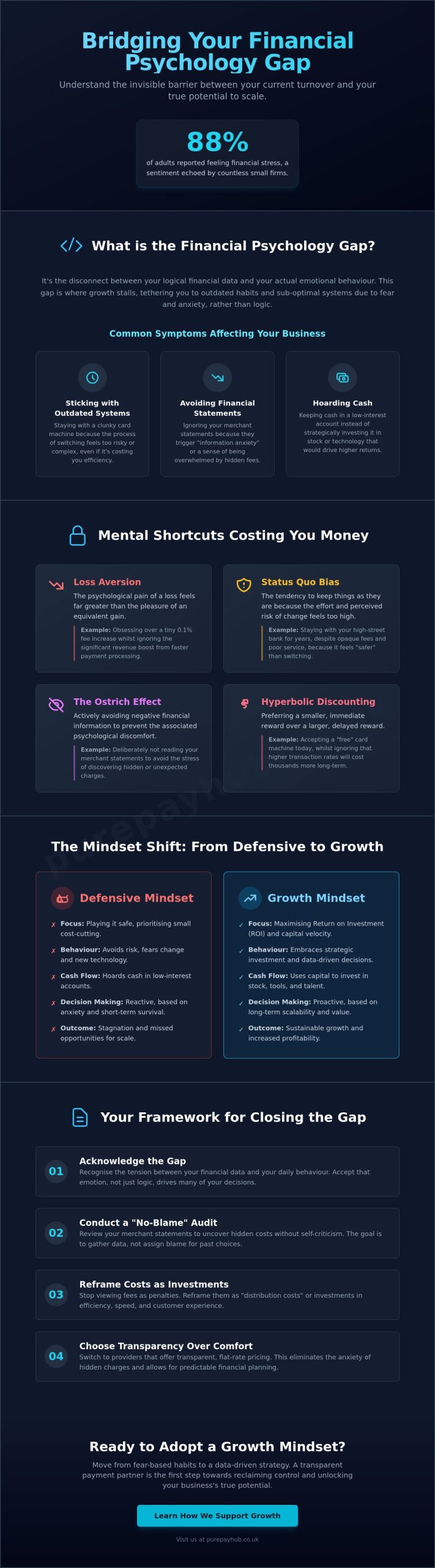
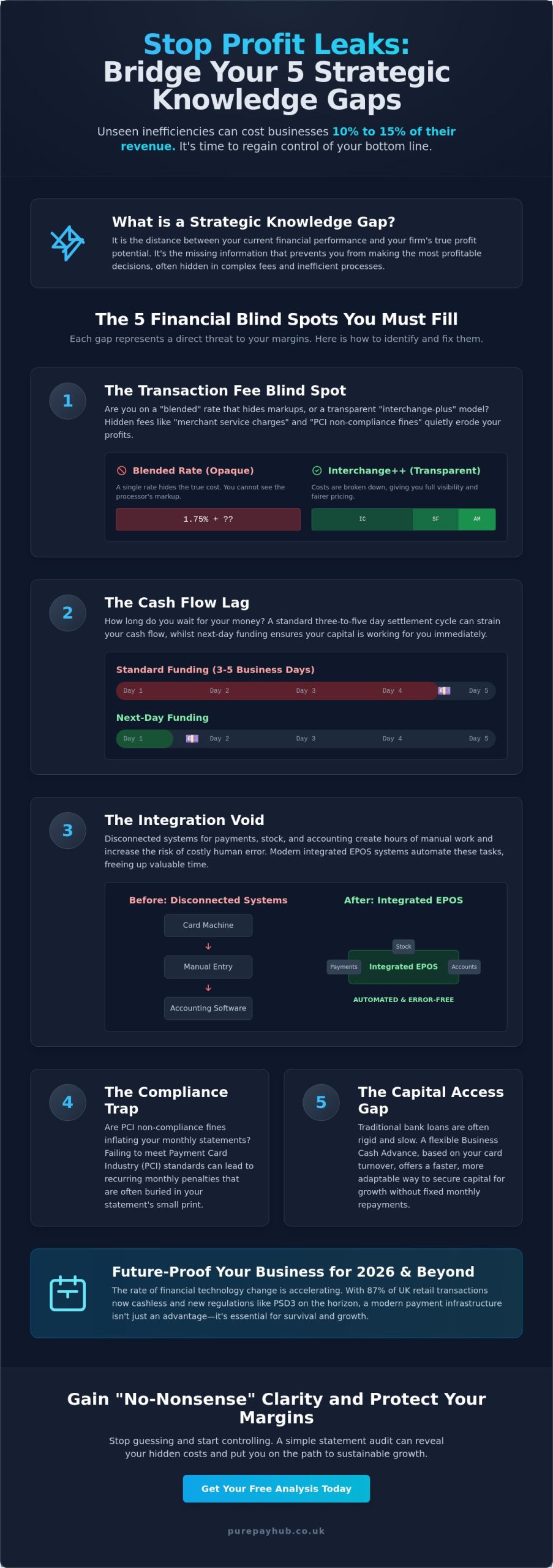
    Why does your business feel financially stagnant even though your sales are consistent? It’s a common frustration for many regional business owners who feel trapped by the very systems meant to support them. Recent research from the National Endowment for Financial Education shows that 88% of adults reported feeling financial stress in early 2026. For small firms, this often manifests as 4. The “Financial Psychology” Gap (Mindset). This gap is the invisible barrier between your current turnover and your true potential for scale.

    You likely recognise the anxiety that comes with hidden card machine fees or the fatigue of wading through corporate jargon. It’s easy to feel overwhelmed and stay with a sub-optimal provider simply because the risk of switching feels too high. We’re here to help you bridge that gap. This guide will provide actionable steps to reduce your financial stress and offer a framework for evaluating providers based on value rather than fear. You’ll learn how to move from defensive cash management to a mindset of strategic growth and clearer decision-making.

    Key Takeaways

    • Understand the hidden tension between your financial data and daily behaviour to stop “playing it safe” from hindering your long-term growth.
    • Identify how psychological biases like loss aversion cause you to over-prioritise small fees over significant revenue gains.
    • Learn to bridge 4. The “Financial Psychology” Gap (Mindset) by replacing fear-based habits with a transparent, data-driven approach to your finances.
    • Discover a “no-blame” audit framework for your merchant statements to uncover hidden costs and reclaim control of your cash flow.
    • Transition from a defensive, risk-avoidant stance to a growth mindset that focuses on capital velocity and business scalability.

    What is the Financial Psychology Gap in Business?

    Your balance sheet tells one story, but your daily actions often tell another. The distance between your financial data and your actual financial behaviour is where growth often stalls. This disconnect is what we call 4. The “Financial Psychology” Gap (Mindset). It’s a psychological hurdle that keeps you tethered to legacy banking systems and outdated habits, even when the numbers suggest a different path. Understanding this gap is the first step toward reclaiming your time and your profit margins.

    Many UK business owners inherit “money scripts” from early career experiences or family backgrounds. These scripts act as internal rules that dictate how you handle capital. If you were taught that debt is always dangerous or that banks are the only safe harbour, you might view strategic investment with unnecessary suspicion. This is deeply rooted in behavioural economics, where emotional triggers often override cold, hard logic. Sticking with a high-street giant because it feels “safe” is a common trap. In reality, these legacy institutions often drain your resources through opaque fee structures and slow fund availability.

    The Symptoms of a Mindset Gap

    How do you know if this gap is affecting your business? Look at your decision-making patterns. You might find yourself obsessing over a 0.1% difference in transaction fees whilst completely ignoring the fact that your current provider holds your funds for three working days. This is a classic symptom of focusing on the wrong metric due to underlying anxiety. Other signs include:

    • Avoiding your financial statements because they trigger “information anxiety” or a sense of being overwhelmed.
    • Staying with an outdated, clunky countertop card machine simply because the process of switching feels too risky or complex.
    • Hoarding cash in a low-interest account instead of using a business cash advance to purchase stock that would drive a higher return.

    Why Business Logic Often Fails

    Rational accounting usually takes a backseat to emotional survival instincts during periods of economic pressure. When you are worried about overheads, your brain naturally narrows its focus to immediate, short-term costs. This survival mode prevents you from considering the long-term ROI of better equipment or faster payment gateways. You aren’t being “bad at business”; you’re simply human. The conflict between your rational brain and your emotional gut feeling is what creates the friction. The Mindset Gap is the primary barrier to SME scaling in 2026. By recognising that your hesitation is psychological rather than mathematical, you can start making decisions based on growth rather than fear.

    Common Psychological Biases Affecting Your Cash Flow

    Your brain is hardwired for survival, not necessarily for profit optimisation. Whilst you might believe your business decisions are purely logical, they are often steered by deep-seated behavioral biases. These mental shortcuts helped our ancestors avoid predators, but in 2026, they often lead to stagnant cash flow and missed scaling opportunities. Recognising these biases is essential to closing 4. The “Financial Psychology” Gap (Mindset) and moving your business forward.

    Loss aversion is perhaps the most damaging bias for a merchant. It describes why the psychological pain of a £10 fee feels significantly more intense than the joy of a £1000 sale. This leads many owners to “The Ostrich Effect,” where they ignore merchant statements entirely to avoid the stress of seeing hidden charges. Similarly, hyperbolic discounting tempts owners to accept a “free” card machine today, ignoring the fact that higher transaction rates will cost them thousands over the next two years. These biases create a fog of confusion that prevents clear, data-driven action.

    Loss Aversion and Merchant Fees

    Fear of variable rates often stops businesses from adopting efficient, integrated EPOS systems. You might fixate on a tiny percentage increase in one area whilst ignoring the massive efficiency gains elsewhere. To overcome this, try reframing “fees” as “distribution costs.” Just as you pay for fuel or packaging, payment processing is a necessary vehicle for your revenue. Shifting to transparent, flat-rate pricing models can lower this emotional resistance. It replaces the “nasty surprise” of hidden markups with a predictable cost structure you can actually plan around.

    Overcoming the Status Quo Bias

    The status quo bias is the tendency to keep things as they are because change feels “risky.” This is the primary reason many merchants stay with sub-optimal providers for years. They focus on the “switching friction” instead of the opportunity cost. Consider the difference between three-day funding and next-day access to your capital. In a climate where 41.3% of small businesses cite cash flow as their top challenge in 2026, those extra 48 hours of liquidity are vital. Auditing your provider without emotional attachment allows you to see the numbers for what they are. If you are ready to see how a fairer partnership looks, you can explore our transparent payment solutions designed for regional growth.

    Closing the gap requires a disciplined approach to your finances. Start by identifying one “fear-based” habit this week. Whether it is finally opening that statement or questioning a “free” equipment offer, every small step reduces the power these biases have over your bottom line. By moving from a defensive posture to a growth-oriented one, you ensure your business is built on a foundation of clarity rather than avoidance.

    The Defensive Mindset vs. The Growth Mindset

    A defensive mindset is often born from a desire to protect what you have already built. Whilst this sounds sensible, it frequently manifests as obsessive cost-cutting and a deep-seated avoidance of any perceived risk. This approach creates a psychological ceiling. You might find yourself hoarding cash in low-interest accounts or delaying essential upgrades because the immediate cost feels too high. This is a survival tactic, not a strategy for expansion. It keeps you small by forcing you to focus on the pennies whilst the pounds of potential profit slip away.

    Transitioning to a growth mindset requires viewing capital through the lens of movement and velocity. Instead of asking “how much does this cost?”, you begin to ask “how quickly will this help me scale?”. Your choice of payment technology is a clear signal of which mindset is currently driving your business. If you are clinging to a clunky, unreliable terminal simply because you fear the friction of switching, you are likely trapped in 4. The “Financial Psychology” Gap (Mindset). Realising that transparent, fair partnerships are the foundation of a growth-oriented business allows you to stop playing it safe and start playing to win.

    Hoarding vs. Velocity

    Waiting for funds to clear for three or four working days creates a “scarcity” loop in your daily operations. It forces you into a defensive posture where you hesitate to pay suppliers or restock popular items because you are waiting for your own money to arrive. This stagnation is the enemy of growth. By prioritising next-day funding, you maintain a healthy “flow” state in your stock management. This mindset shift also changes how you view a Business Cash Advance. To a defensive owner, it looks like debt to be avoided. To a growth-oriented owner, it is a powerful lever to seize a time-sensitive opportunity or bridge a seasonal gap without slowing down.

    Customer Experience as a Psychological Asset

    Friction at the point of sale creates a subtle but damaging psychological burden for both the owner and the customer. A slow terminal or a confusing checkout process generates “micro-stress” that erodes confidence. Conversely, using modern, sleek portable card machines provides an immediate professional boost. It signals to your customers that your business is modern, efficient, and dependable. Investing in high-quality PurePay Hub countertop solutions is a direct investment in your professional pride. When your tools work perfectly, you can focus entirely on the human side of your business, knowing that the technical foundations are stable and untainted by hidden markups.

    Mastering Growth: The Financial Psychology Gap Explained

    Practical Steps to Close the Financial Psychology Gap

    Closing the gap isn’t a matter of willpower; it’s a matter of process. You’ve already identified the biases that hold you back. Now, you must implement systems that make those biases irrelevant. Bridging 4. The “Financial Psychology” Gap (Mindset) requires a transition from emotional avoidance to disciplined, data-driven action. By following these four practical steps, you can dismantle the barriers to your business growth and create a more resilient cash flow.

    Start with a “No-Blame” audit of your last three merchant statements. The goal isn’t to regret past decisions, but to understand your current baseline. Identify one fear-based habit, such as ignoring your daily settlement reports, and replace it with a five-minute review each morning. Once you have a handle on your habits, automate your transparency. Choose providers that offer clear reporting tools and integrate your EPOS systems with your card machines. This integration eliminates manual errors and reclaims hours of your week previously spent on reconciliation.

    The 10-Minute Statement Audit

    When you open your statement, look specifically for the distinction between interchange fees and provider markups. Interchange is the non-negotiable cost set by card schemes, whilst markups are where legacy banks often hide their profit. Gaining total clarity on your fee structures immediately lowers the physiological stress associated with financial management. During this audit, keep an eye out for “zombie” subscriptions. These are recurring monthly charges for “premium” services or insurance that you likely haven’t used in years. Cutting these unnecessary costs provides an immediate, risk-free boost to your bottom line.

    Building a Supportive Financial Ecosystem

    Your business thrives when you surround yourself with transparent partners rather than opaque institutions. The psychological relief of having Next-Day Access to your own hard-earned money cannot be overstated. It moves you from a scarcity loop into a state of operational flow. When you decide to upgrade your systems, communicate the change clearly to your team. Explain that moving to modern technology isn’t just about saving money; it’s about making their jobs easier and the customer experience smoother. This alignment ensures everyone is moving toward a growth mindset. If you’re ready to remove the mystery from your merchant services, switch to a transparent provider that prioritises your growth.

    How PurePay Hub Supports a Growth Mindset

    PurePay Hub operates on a simple, no-nonsense philosophy. We believe that financial anxiety is often fuelled by unnecessary jargon and opaque fee structures. By stripping away these complexities, we act as a calm, reliable advocate for your business finances. Our goal is to help you bridge 4. The “Financial Psychology” Gap (Mindset) by providing a service that is both transparent and predictable. We don’t just process payments; we provide a stable foundation for your growth.

    Transparency is our primary service. We offer debit card charges from 0.3% with no hidden surprises. This clarity allows you to plan your cash flow with confidence. We also empower UK merchants with next-day funding and a quick onboarding process. You won’t be left waiting for your own money. Instead, you’ll have the liquidity you need to respond to opportunities as they arise. This speed of capital is essential for moving from a defensive posture to a growth-oriented strategy.

    Tech that Works for You, Not Against You

    Our technology is designed to reduce operational friction. For hospitality and retail businesses, our integrated EPOS systems provide immense psychological ease. They remove the need for manual reconciliation and reduce the risk of human error. If your business requires mobility, our portable and mobile card machines offer the reliability you need to trade anywhere. For those who manage sales remotely, our Virtual Terminals simplify the process of getting paid. These tools aren’t just gadgets; they’re professional assets that reinforce your growth mindset by making the “money part” of your job feel effortless.

    Fairness as a Core Identity

    We prioritise fair rates because we value long-term trust over short-term markups. By offering 0.5% for credit cards, we ensure that your processing costs remain manageable as you scale. This commitment to fairness is backed by a support team that provides reassuring, professional guidance whenever you need it. You aren’t just another account number to us; you’re a partner. Moving away from traditional banking doesn’t mean losing support. It means gaining a partner that actually understands the regional merchant community. If you’re ready to see the difference that total transparency makes, organise a transparent rate review with PurePay Hub today.

    Reclaim Your Financial Future

    Moving your business from a state of survival to a state of scale requires more than just better sales figures. It demands a fundamental shift in how you perceive and manage your capital. By auditing your statements and identifying the biases that keep you tethered to legacy banks, you can finally bridge 4. The “Financial Psychology” Gap (Mindset). This transition allows you to replace fear-based hesitation with the informed confidence needed to invest in your own success.

    You deserve a partner that prioritises your clarity over their own markups. With debit rates starting from 0.3% and next-day access to your funds, we provide the stability and velocity your cash flow needs. Our no-nonsense, UK-based support team is here to ensure you never feel overwhelmed by jargon again. It’s time to stop playing it safe with providers that hold you back. Switch to a transparent payment partner and close the gap today. Your growth is waiting; let us help you reach it.

    Frequently Asked Questions

    What is financial psychology in a business context?

    Financial psychology refers to the emotional and cognitive factors that influence how a business owner manages their company’s capital. It explores the deep-seated “money scripts” and biases that dictate your financial behaviour. By understanding these psychological drivers, you can move away from irrational, fear-based habits and start making decisions that prioritise long-term scalability and efficiency over short-term survival instincts.

    How does my mindset affect my business bank balance?

    Your mindset acts as either a catalyst or a ceiling for your liquidity and profit margins. A defensive mindset often leads to cash hoarding and the avoidance of strategic investments, which can leave your balance stagnant. Conversely, a growth mindset focuses on the velocity of capital. By viewing your finances as a tool for expansion rather than a resource to be protected, you open the door to higher returns.

    Why do I feel anxious when checking my merchant statements?

    This anxiety is often a result of the “Ostrich Effect” combined with the opaque jargon used by traditional providers. When statements are cluttered with hidden markups and complex fee structures, your brain perceives them as a threat rather than a management tool. Switching to a provider that offers total transparency can eliminate this micro-stress, allowing you to review your data with a sense of calm and control.

    Can changing my card machine provider really improve my business mindset?

    Yes, because removing the friction of a sub-optimal service directly reduces operational stress. Transitioning to a transparent, fair partner helps bridge 4. The “Financial Psychology” Gap (Mindset) by providing predictable costs and reliable technology. When you don’t have to worry about hidden surprises, you can focus your mental energy on high-level strategy and customer experience rather than administrative frustration.

    What is the most common psychological barrier to business growth?

    Loss aversion is the most frequent barrier for regional merchants. It describes the tendency for the pain of a small transaction fee to feel more intense than the gain of a significant sale. This bias often keeps owners tied to legacy banks that offer poor value, simply because the “risk” of switching feels too high. Overcoming this requires reframing these costs as necessary vehicles for revenue distribution.

    How do I stop making emotional decisions about my business finances?

    You can reduce emotional interference by implementing automated, data-driven systems. Integrated EPOS systems and clear merchant dashboards replace “gut feelings” with objective facts. When you have immediate access to accurate data, you’re less likely to fall victim to the survival instincts that lead to short-sighted decisions. Discipline comes from having tools that provide clarity and remove the guesswork from your daily operations.

    Why is transparency so important in merchant services?

    Transparency is the foundation of trust in any financial partnership. It removes the “information anxiety” that fuels poor financial behaviour and allows for precise budgeting. Knowing exactly what you pay for every transaction prevents the frustration of unexpected costs. Clear, upfront pricing models enable you to evaluate your provider based on the actual value they add to your business rather than fear of the unknown.

    How can next-day funding reduce business stress?

    Next-day funding eliminates the “scarcity loop” created by waiting multiple days for your funds to clear. Having immediate access to your own hard-earned money provides the liquidity needed to pay suppliers and manage stock levels without hesitation. This steady flow of capital reduces the psychological burden of cash flow management, allowing you to maintain a proactive and growth-oriented stance in your daily business activities.

  • How Menu Engineering Increases Your Average Basket Value

    How Menu Engineering Increases Your Average Basket Value

    Did you know that a disciplined approach to menu engineering can increase your profitability by up to 15% without needing to find a single new customer? It’s a powerful tool that many businesses overlook. Most regional owners feel the squeeze of rising overheads whilst their average basket values remain stubbornly flat. It’s frustrating to watch customers consistently choose your cheapest loss leaders, leaving you with thin margins at the end of the month. We believe in providing clear, honest strategies to help you grow.

    You can influence customer behaviour by using strategic menu engineering or shelf layouts that naturally lead customers to the card machine with a higher basket value. By applying simple psychological pricing and layout design, you can reduce friction at the checkout and make every transaction more valuable. This article provides a practical framework for categorising your products and reveals the layout changes you can implement tonight. You’ll discover how to streamline your card payments and ensure your business achieves the turnover it deserves.

    Key Takeaways

    • Master the strategic placement of items to influence purchasing behaviour and increase your average transaction value without needing new customers.
    • Discover how to create menu engineering or shelf layouts that naturally lead customers to the card machine with a higher basket value using the “Golden Triangle” and “Bulls-eye Zone.”
    • Reduce the “pain of paying” by understanding why customers feel more comfortable spending higher amounts whilst using a card machine compared to cash.
    • Follow a simple five-step audit to categorise your inventory and move your most profitable products into high-visibility areas tonight.
    • Learn how integrated EPOS systems provide the real-time data you need to keep your layouts optimised and your margins healthy.

    What is Menu Engineering and Why Does it Drive Basket Value?

    Menu engineering is the strategic analysis and placement of products to influence what a customer chooses to buy. It isn’t merely a list of prices; it’s a deliberate design choice that guides a customer’s eye towards your most profitable offerings. This approach works just as effectively for a restaurant menu as it does for a retail floor plan. By understanding how people scan information, you can subtly steer their decisions without them feeling pressured.

    For UK SMEs, focusing on your Average Transaction Value (ATV) is vital for sustainable growth. Whilst increasing footfall is expensive and time-consuming, increasing the value of each existing sale is direct and efficient. Implementing menu engineering or shelf layouts that naturally lead customers to the card machine with a higher basket value allows you to maximise your margins. A well-engineered journey ensures that by the time a customer reaches the till, they’ve chosen items that benefit your bottom line.

    The Four Categories of Profitability

    To start engineering your profits, you must first categorise your inventory into four distinct groups based on popularity and profit margins:

    • Stars: These are your high-popularity, high-profit items. You want these to be the most visible products in your shop or on your menu.
    • Puzzles: These items have high profit margins but low popularity. They often just need better placement or highlighting to start selling.
    • Plow Horses: These are staples with high popularity but low profit. They bring people through the door, but you shouldn’t over-promote them at the expense of Stars.
    • Dogs: These products have low popularity and low profit. They take up valuable space and should usually be removed or rebranded.

    The Psychology of Choice Architecture

    Human psychology plays a massive role in how we shop. If you offer too many choices, customers often experience “analysis paralysis” and end up choosing the cheapest or most familiar option. By limiting your selection to your best-performing items, you make the decision process easier and faster for the buyer.

    You can also use the “Decoy Effect” to your advantage. By placing a high-priced item near your “Star” product, the Star begins to look like a bargain. People also tend to remember the first and last items on a list most clearly. Placing your high-margin products at the beginning or end of a section ensures they stay top-of-mind. This psychological path leads to a more confident customer who is ready to complete a higher-value transaction at your card machine.

    The Science of Layout: From the Golden Triangle to Shelf Psychology

    Understanding where your customer looks first is the foundation of any successful layout. In hospitality, the “Golden Triangle” describes the predictable pattern of eye movement across a menu. Most diners scan the centre first, then move to the top right, before finally glancing at the top left. This is prime real estate. If you place your “Stars” in these three areas, you’re far more likely to see them chosen. It’s a simple, no-nonsense way to guide behaviour without saying a word.

    In a retail environment, The Science of Layout suggests that “eye-level is buy-level.” Products placed in the “Bulls-eye Zone”—the area between chest and eye height—receive the most attention. To maximise profit, you should use anchor products to guide the gaze. These are your popular, everyday staples that customers actively look for. By placing high-margin “Stars” immediately next to these anchors, you capitalise on the customer’s existing focus. Using menu engineering or shelf layouts that naturally lead customers to the card machine with a higher basket value ensures your most profitable items aren’t left gathering dust.

    Clutter is the enemy of a high average transaction value. When a customer is overwhelmed by too many visual signals, they often default to the cheapest option or leave entirely. This is why white space, or negative space, is essential. By giving your premium items room to breathe, you signal their importance and quality. A clean, intentional design reduces shopper stress and makes the path to a higher-value sale feel effortless.

    Hospitality: Designing for the Dine-In Experience

    You can give your “Puzzles”—those high-profit but low-popularity items—a significant boost by using boxes or borders. These visual cues break the customer’s scanning pattern and force them to pause. Language also matters; using descriptive terms like “locally sourced” rather than generic descriptions increases the perceived value of a dish. Many successful venues also remove currency symbols (£) from their menus. This subtle change helps decouple the choice from the immediate thought of spending money, reducing the psychological barrier to ordering a more expensive treat.

    Retail: Shelf Layouts that Lead to the Till

    Retailers should focus on vertical merchandising to encourage customers to scan across different price points. Placing high-margin impulse buys in the “decompression zone” near the till is a proven way to top up a basket at the final moment. Cross-merchandising is another powerful tool; placing complementary items together, such as premium crackers next to the cheese selection, reminds customers of needs they hadn’t considered. Ensuring you have a fast, reliable Countertop Card Machine at the end of this journey makes the final payment feel as seamless as the browsing experience.

    Reducing the “Pain of Paying” at the Card Machine

    A common concern for many regional business owners is whether a higher total at the till will alienate their regulars. It’s a valid worry, but the psychology of spending changes significantly depending on the payment method. Research into consumer behaviour consistently shows that customers feel less “pain” when tapping a card compared to handing over physical banknotes. Cash is tangible; once it leaves the wallet, it’s gone. Card payments are abstract, which allows customers to focus on the value of their purchase rather than the immediate loss of funds.

    In the UK, the £100 contactless limit has created a psychological “sweet spot” for engineered basket values. If your menu engineering or shelf layouts that naturally lead customers to the card machine with a higher basket value target a total just under this threshold, the transaction remains entirely frictionless. The customer doesn’t even need to enter a PIN. This seamless closure is the final step in a well-designed sales journey. Your card machine shouldn’t be a hurdle; it should be the tool that completes the experience without a second thought.

    The Frictionless Checkout

    The final seconds of a sale are the most critical for customer satisfaction. A clunky, slow, or unreliable card reader can trigger “buyer’s remorse” as the customer waits. They start to question the extra item they picked up or the premium dish they ordered whilst the machine struggles to connect. To maintain the momentum of your engineered layout, you need hardware that responds instantly. A fast checkout reinforces the customer’s positive decision and leaves them with a modern, professional impression of your business.

    We believe in supporting your growth with practical features that make a difference to your daily turnover. Integrated tipping prompts on the card machine can naturally increase your overall take without making the interaction awkward for your staff. Furthermore, for businesses with high-turnover engineered menus, having next-day access to your funds is essential for maintaining a healthy cash flow and restocking your “Stars” without delay.

    Building Trust with Transparent Rates

    Profitability isn’t just about the price on the shelf; it’s about what you keep after processing fees. When you have a clear, honest understanding of your costs, you can price your high-margin items more competitively. PurePay Hub’s no-nonsense approach mirrors the transparency of a well-designed menu, ensuring you aren’t surprised by hidden markups. Our low debit rates of 0.3% allow for better margin protection on high-volume items, ensuring your hard-earned profits stay in your business where they belong.

    How Menu Engineering Increases Your Average Basket Value

    5 Steps to Engineer Your Profit Tonight

    Transforming your profitability doesn’t require a complete overhaul of your business model. It starts with small, disciplined changes to how you present your products. By implementing menu engineering or shelf layouts that naturally lead customers to the card machine with a higher basket value, you take control of your revenue. Use these five steps to begin the process immediately.

    • Step 1: Audit your sales data. Use your recent sales history to categorise every item into the four-quadrant matrix: Stars, Puzzles, Plow Horses, and Dogs. Be honest about what is actually making you money.
    • Step 2: Relocate your Stars. Move your high-profit, high-popularity items to the “Golden Triangle” of your menu or the eye-level “Bulls-eye Zone” of your shelves. Visibility is the primary driver of selection.
    • Step 3: Refine your presentation. Rewrite descriptions to focus on quality and origin. Remove currency symbols (£) to shift the customer’s focus away from the cost and towards the value of the experience.
    • Step 4: Empower your team. Train your staff to recognise and suggest “Puzzles.” Since these items are high-margin but low-volume, a simple recommendation can significantly boost your daily profit.
    • Step 5: Optimise the final tap. Ensure your card machine is visible and ready for a fast, professional finish. The easier it is to pay, the more likely the customer is to leave with a positive impression.

    Analysing the Data with Your EPOS System

    Modern EPOS Systems are the most valuable tool in a business owner’s arsenal. They provide the raw data needed to identify your “Plow Horses”—the items that are popular but might be dragging down your overall margin. Instead of focusing on total revenue, track the “Gross Profit Margin” per item. This tells you exactly how much each sale contributes to your overheads. If your data suggests a shop refit is needed to better align with your new menu engineering or shelf layouts that naturally lead customers to the card machine with a higher basket value, you might consider a Business Cash Advance to fund the improvements without the stress of fixed monthly repayments.

    Testing and Iterating

    Engineering is a process, not a one-time event. You should only change one or two elements of your layout at a time. This allows you to measure the impact accurately without confusing your regulars. Monitor your card transaction volumes closely after moving high-margin items to the till area; if the numbers don’t climb, try a different “Star.” Remember to adjust your strategy for seasonal trends. A layout that works in the height of summer won’t necessarily be effective during the Christmas rush. Stay flexible and let the data guide your decisions.

    Closing the Loop: How PurePay Hub Supports Your Growth

    You’ve done the hard work of designing menu engineering or shelf layouts that naturally lead customers to the card machine with a higher basket value. Now, you need the physical infrastructure to handle that increased turnover with ease. Our Countertop Card Machine is built for the rigours of a high-traffic till point, ensuring that every “Star” item you’ve promoted is processed without delay. We don’t believe in overcomplicating your operations; we provide the reliable tools that let you focus on your customers whilst we handle the technicalities of the transaction.

    For hospitality businesses, our Portable Card Machine allows you to take the point of sale directly to the table. This maintains the momentum of a well-engineered menu by allowing guests to pay the moment they’re ready, reducing the chance of “buyer’s remorse” during a long wait for the bill. By using Integrated EPOS Systems, you close the feedback loop with real-time data. You can see exactly which layout changes are driving higher basket values and which items need further refinement. This data-driven approach removes the guesswork and acts as a stabilizing force for your business finances.

    Protecting your newly engineered margins is our priority. We are committed to providing some of the lowest card machine rates in the industry, ensuring that the extra profit you’ve generated stays in your bank account. Transparency is at the core of what we do; you won’t find hidden markups or complex fee structures here. We act as a supportive partner to help your regional business thrive in a competitive market by keeping your costs predictable and fair.

    Reliable Hardware for High-Volume Sales

    A fast processor is essential when you’re dealing with high-volume sales. If your card reader lags, you risk creating a bottleneck that frustrates customers and dampens the positive experience you’ve created. Our hardware is designed for speed, preventing queues even during peak periods. In retail environments, our Mobile Card Machines offer a flexible way to bust queues by taking payments anywhere on the shop floor. Our hardware offers several key benefits for your busy till point:

    • Fast processors to eliminate transaction lag.
    • Long battery life for our mobile and portable units.
    • Secure, encrypted transactions for peace of mind.
    • Quick Onboarding to get your new strategy live in days, not weeks.

    Financial Support for Your Next Layout Refit

    Ready to boost your basket value? Explore PurePay Hub’s card machine solutions today.

    Take Control of Your Profitability Today

    Strategic layout design isn’t just about aesthetics; it’s a fundamental driver of your business’s financial health. By categorising your inventory and mastering the “Golden Triangle,” you can subtly guide every customer towards your most profitable items. Implementing menu engineering or shelf layouts that naturally lead customers to the card machine with a higher basket value is a proven method for sustainable growth. It reduces decision fatigue for your shoppers whilst protecting your hard-earned margins.

    You now have a clear framework to begin your audit tonight. We are here to ensure your hardware is as efficient as your new layout. Our transparent approach means you get debit card rates starting from 0.3% and next-day access to funds without hidden markups or complex fee structures. This clarity allows you to focus on what matters most: growing your business with confidence.

    Join PurePay Hub for transparent card machine rates and next-day funding.

    Your journey towards a higher average transaction value starts with a single change. Start small, track your data, and watch your margins grow.

    Frequently Asked Questions

    What is the “Golden Triangle” in menu engineering?

    The Golden Triangle refers to the specific pattern in which customers scan a menu. Most diners look at the centre first, then move to the top-right corner, and finally to the top-left. By placing your highest-margin items in these three areas, you significantly increase the likelihood of them being selected. It is a simple psychological tactic that ensures your most profitable dishes get the most attention from every guest.

    How often should I update my menu or shelf layout?

    You should aim to review your sales data and update your layouts at least once a quarter. Consumer habits change with the seasons; a layout that works in the winter might not be effective during the summer months. Regular updates allow you to test new products and phase out items that are no longer performing. Staying flexible ensures your business remains aligned with current customer demand and fluctuating ingredient costs.

    Can I use menu engineering in a small retail shop?

    Absolutely. Menu engineering principles translate perfectly into retail through strategic shelf layouts. By placing high-margin impulse buys at eye level and using anchor products to guide the customer’s gaze, you can influence purchasing decisions in any size space. Small shops often benefit most from these changes because they need to maximise the profit potential of every square inch of shelf space available to them.

    Do customers spend more on card than with cash in the UK?

    Yes, UK consumers typically spend significantly more when paying by card compared to using physical cash. The abstract nature of digital payments reduces the immediate psychological “pain of paying,” which encourages higher basket values. Using menu engineering or shelf layouts that naturally lead customers to the card machine with a higher basket value capitalises on this behaviour, making it easier for them to choose premium options without hesitation.

    How does an EPOS system help with menu engineering?

    An EPOS system acts as the brain of your engineering strategy by providing detailed sales reports. It allows you to track the exact popularity and gross profit margin of every item you sell. Without this data, you are just guessing which products are your “Stars” and which are your “Dogs.” Real-time insights enable you to make informed decisions about product placement and pricing almost instantly.

    Is it expensive to implement these layout changes?

    Implementing these changes is often very low-cost. Most menu engineering involves simply reorganising the information on a page or moving physical products to different shelves. You don’t need a full renovation to see results. Small adjustments, such as removing currency symbols or adding more descriptive language, require very little investment but can lead to a noticeable increase in your average transaction value and overall profitability.

    What are “Plow Horse” items and should I keep them?

    “Plow Horse” items are products that are highly popular but have low profit margins. You should definitely keep them because they are the staples that bring customers through your door. However, you shouldn’t give them prime real estate in your layout. Instead, use your menu engineering or shelf layouts that naturally lead customers to the card machine with a higher basket value to steer people towards your “Stars” instead.

    How do I use a business cash advance to improve my shop layout?

    A Business Cash Advance provides the upfront capital needed for more significant changes, such as installing new modular shelving or professional signage. Unlike a traditional bank loan, you repay the advance through a fixed percentage of your future card sales. This makes it a flexible option for regional owners who want to invest in a layout refit without the pressure of fixed monthly repayments during quieter trading periods.

  • Closing the Sales Gap: Psychological Insights for Success

    Closing the Sales Gap: Psychological Insights for Success

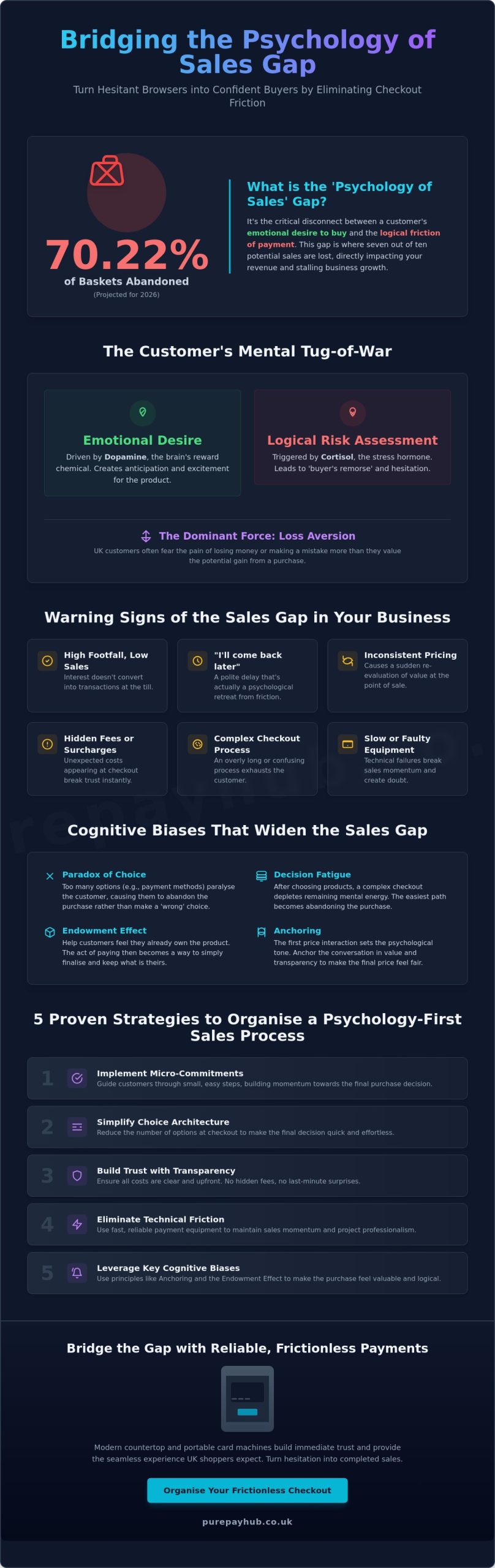
    Did you know that in 2026, approximately 70.22% of shoppers abandon their baskets before completing a purchase? For a UK business owner, watching seven out of ten potential sales vanish at the final hurdle is more than just a statistic; it’s a direct hit to your revenue. This disconnect is often caused by the Psychology of Sales gap. It isn’t usually a lack of interest in what you’re selling. Instead, it’s often a failure of friction management at the point of payment, where hidden doubts and complex processes suddenly take over.

    You likely feel the frustration of deals stalling at the “thinking about it” stage or seeing customers hesitate when they reach your checkout. We agree that opaque processes and unexpected friction are the enemies of growth. This guide will show you how to identify these psychological barriers and bridge them effectively. You’ll learn how to organise a frictionless checkout experience that encourages faster decision-making. We’ll preview the cognitive biases influencing customer behaviour and explain how clear, honest payment solutions can turn a hesitant browser into a confident buyer.

    Key Takeaways

    • Understand why customer intent often fails to translate into a final transaction by identifying 1. The “Psychology of Sales” Gap in your current process.
    • Discover how cognitive biases like the paradox of choice and decision fatigue can paralyse your customers at the point of purchase.
    • Learn to protect sales momentum by eliminating technical friction and avoiding the psychological exit caused by slow or unreliable equipment.
    • Implement actionable strategies, from micro-commitments to simplified choice architecture, to guide your customers seamlessly toward a final decision.
    • Explore how using reliable countertop or portable card machines builds immediate trust and provides the frictionless experience modern UK shoppers expect.

    What is the ‘Psychology of Sales’ Gap and Why Does It Stall Your Growth?

    Every business owner has experienced the frustration of a customer who seems ready to buy but suddenly pulls away. This isn’t usually a problem with your product or your service. It’s a fundamental disconnect between a buyer’s emotional intent and the final physical act of payment. We call this phenomenon 1. The “Psychology of Sales” Gap. It represents the space where interest turns into hesitation, and it’s a measurable friction point that can stall your business growth if left unaddressed.

    In 2026, this gap is widening. UK consumers are more skeptical than ever before. They face a constant barrage of choices and marketing messages, leading to a state of choice overload. When a customer reaches the point of transaction, they often hit a “Moment of Hesitation.” This is a subconscious risk assessment where they weigh the value of the purchase against the potential for regret. For a local merchant, bridging this gap is essential. Failing to do so doesn’t just lose you a single sale; it disrupts your cash flow and prevents you from building the momentum needed to scale your operations.

    The Emotional vs. Logical Tug-of-War

    The study of consumer behaviour shows that purchasing decisions are rarely purely logical. Initial desire is often driven by dopamine, the chemical associated with reward and anticipation. However, as the customer moves closer to the checkout, cortisol levels can rise. This stress hormone triggers a sense of “buyer’s remorse” before the sale is even finalised. In the UK market, “Loss Aversion” plays a massive role. Customers often fear the pain of making a mistake or losing their money more than they value the gain from your product.

    We define 1. The “Psychology of Sales” Gap as a measurable friction point in the customer journey where emotional desire is overtaken by logical risk assessment.

    Signs Your Business is Suffering from the Gap

    You can identify if this gap is affecting your bottom line by looking at specific patterns in your daily trade. If you notice high footfall in your shop but surprisingly low transaction volumes, you’re likely losing people at the final hurdle. The “I’ll come back later” phenomenon is another clear indicator. Whilst it sounds like a polite delay, it’s actually a psychological retreat. The customer has encountered a friction point that made the risk feel too high. Common triggers include:

    • Inconsistent pricing that causes a sudden re-evaluation of value.
    • Hidden fees or surcharges that appear only at the point of sale.
    • A checkout process that feels overly complex or time-consuming.
    • Technical failures, such as slow card machines, that break the customer’s focus.

    By recognising these signs, you can begin to organise a sales process that prioritises clarity and reassurance. Eliminating these psychological barriers is the first step toward creating a dependable, frictionless experience that keeps your customers moving forward.

    The Hidden Cognitive Biases Influencing Every Transaction

    Every transaction is a minefield of subconscious shortcuts. These cognitive biases are the invisible forces that often widen 1. The “Psychology of Sales” Gap. When you understand how the human brain processes a purchase, you can smooth the path for your customers and remove the mental barriers that lead to abandoned baskets.

    The “Paradox of Choice” is a primary culprit for stalled sales. Whilst we often think more options are better, too many payment methods can actually paralyse a buyer. They get stuck wondering which one is the safest or best to use. This is compounded by “Decision Fatigue.” After a customer has spent time choosing products, their mental energy is depleted. The checkout process must be the simplest part of their day. If it requires extra thinking, they are likely to walk away.

    You can also leverage the “Endowment Effect” by helping customers visualise the product as already being theirs. When a buyer feels they already own the benefit, the act of paying is simply a way to keep it. This is often supported by “Anchoring.” Your first price interaction sets the psychological tone for the entire sale. If you anchor the conversation in value and transparency from the start, the final transaction feels like a fair and logical conclusion. By addressing these biases, you effectively bridge 1. The “Psychology of Sales” Gap and create a more dependable revenue stream.

    Loss Aversion and the Fear of the “Wrong” Choice

    UK consumers are particularly sensitive to perceived financial risk. “Loss Aversion” means they feel the pain of a potential mistake more acutely than the joy of a gain. You can soothe the buyer’s amygdala through “Risk Reversal” strategies. Clear, honest communication about costs and straightforward return policies are essential. Even your hardware plays a role. A sleek, modern card machine signals reliability and security. A dated or unreliable device triggers a red flag, suggesting the business might be stuck in the past. To ensure your counter reflects your professional standards, you might consider upgrading your payment technology to something that inspires confidence.

    The Bandwagon Effect: Using Social Proof at the Counter

    We are social creatures who look for cues that we are making the right decision. The “Bandwagon Effect” is a powerful tool at the point of sale. Subtle environmental signals can suggest that “people like you shop here.” Displaying recognisable payment logos like Visa, Mastercard, and Apple Pay acts as a silent validation of your business. These logos are psychological anchors of trust. Even a busy shop can be a positive signal. A queue suggests popularity and quality, provided your checkout speed is high. If your systems are fast and efficient, a busy counter reinforces the customer’s choice rather than testing their patience.

    Dealing with ‘Checkout Churn’: Where Momentum Meets Friction

    Momentum is the most fragile asset in any sales interaction. It is the invisible energy that carries a customer from “I want this” to “I have paid for this.” When this flow is interrupted, you encounter 1. The “Psychology of Sales” Gap. This gap is often forced open by technical friction. Slow card machines or signal drops don’t just delay the payment. They create a ‘Psychological Exit.’ In those few seconds of waiting, the customer’s brain has time to re-evaluate the purchase. This often leads to second thoughts or immediate abandonment.

    A professional payment area acts as a ‘Centre of Certainty.’ It grounds the transaction in reality and builds immediate trust. We advocate for a ‘no-nonsense’ approach. Over-complicated sales scripts or aggressive upselling at the counter often create suspicion rather than sales. When you prioritise clarity and speed, you reassure the customer that they are making a sensible, secure choice. Bridging 1. The “Psychology of Sales” Gap requires you to protect the customer’s momentum until the very last second.

    The High Cost of Technical Friction

    Speed is not just about efficiency. It is about emotional stability. Research shows that an estimated $260 billion in lost orders are recoverable in the US and EU through better checkout design and user experience. Even a minor 3-second delay in card processing can trigger a noticeable rise in buyer anxiety. When a customer sees a “Connection Error” on a card machine, the psychological message is clear. It suggests the business is unprofessional or unreliable. It breaks the trust you worked hard to build. Seamless hardware acts as a silent closer in the sales process, ensuring the final step is as rewarding as the first.

    Organising a Frictionless Payment Zone

    The physical environment of your checkout centre matters. It should be clean, well-lit, and free of clutter. This creates a sense of order and security. However, you don’t always need to tether your customers to a fixed point. Portable card machines allow you to take the payment to the customer, whether they are at a table or on the shop floor. This removes the physical friction of walking to a queue.

    There is also a psychological benefit to the merchant having “Next-Day Access to Funds.” When you have confidence in your own cash flow, that stability translates to the customer experience. You appear more dependable and less desperate for the sale. By organising your space and your technology around the customer’s comfort, you turn the point of sale into a point of connection.

    • Ensure your payment area is tidy and professional to signal reliability.
    • Use portable card machines to meet the customer where they are.
    • Eliminate technical errors that break the buyer’s focus.

    Closing the Sales Gap: Psychological Insights for Success

    5 Proven Strategies to Organise a Psychology-First Sales Process

    Bridging 1. The “Psychology of Sales” Gap doesn’t require a degree in behavioural science. It requires a commitment to clarity and a disdain for friction. By organising your sales environment around the customer’s mental state, you can transform hesitant browsers into loyal advocates. Here are five practical strategies to help you close the gap today.

    • Simplify choice architecture: Avoid overwhelming customers with irrelevant options at the point of sale. If you offer too many payment methods or unnecessary upsells, you trigger decision fatigue. Keep the final steps focused and direct.
    • Use micro-commitments: Lead the buyer naturally toward the final transaction. Small agreements, such as asking if they found everything they needed, create a rhythm of “yes” that makes the final payment feel like a natural progression.
    • Lead with transparency: Display all costs and fees early. “Price Shock” at the till is the fastest way to lose a customer’s trust. Whether you use standard rates or a credit card processing with surcharge program from Strictly, clear pricing prevents the psychological retreat that happens when a buyer feels misled.
    • Implement high-speed hardware: Maintain the “Dopamine Loop” of the purchase. A fast, responsive card machine ensures the excitement of the buy isn’t killed by a spinning loading icon or a connection delay.
    • Reinforce the decision: Provide a professional, branded digital or physical receipt. This small act confirms they’ve made a secure and sensible choice, reducing the risk of post-purchase regret.

    Transparency as a Competitive Advantage

    For UK SMEs, “No Hidden Fees” is more than a slogan. It is a powerful psychological trigger. UK consumers value honesty and straightforwardness amongst the businesses they support. When you clearly display your payment process with professional signage, you build a foundation of trust that traditional, opaque institutions often lack. We believe that security is a core part of this partnership. Ensuring your business is PCI compliant provides customers with the silent reassurance that their data is protected whilst they pay. If you want to build this trust immediately, you can explore our transparent payment solutions designed specifically for local merchants.

    The Power of Speed and Reliability

    Reducing “Time to Transaction” should be a key performance indicator for your business. Every second saved at the counter is a second where the customer doesn’t have time to doubt their choice. Fast processing is supported by efficient backend systems. An integrated EPOS system that manages stock in real-time prevents the “Out of Stock” let-down, which can be a major psychological blow to a motivated buyer. Additionally, next-day access to funds allows you to reinvest in your customer experience immediately. When your finances are stable and fast, your business projects an aura of reliability that customers can feel. This confidence is contagious and encourages repeat visits.

    Bridging the Gap with PurePay Hub: Frictionless Payments for Modern Businesses

    Closing 1. The “Psychology of Sales” Gap requires more than just understanding the theory. It requires the right tools to manage the moment of truth at the counter. At PurePay Hub, we provide the technology that turns a customer’s hesitation into a completed transaction. Our Countertop Card Machine and Portable Card Machine are designed to eliminate technical friction. They ensure that your payment process is as smooth and professional as the service you provide.

    Transparency is the foundation of trust. We offer clear, competitive rates of 0.3% on debit card transactions and 0.5% on credit card transactions. When you don’t have to worry about hidden markups or complex fee structures, you can focus on your customers. This honesty builds a stronger bond between you and your community. An integrated EPOS system acts as the brain of your business, organising the entire sales journey from stock management to the final tap of a card. It prevents the errors that create psychological exits for your buyers.

    We also understand that business confidence is linked to cash flow. Our “Next-Day Access to Funds” model ensures you aren’t left waiting for your own money. When you have the certainty of steady capital, you project a sense of stability that customers can feel. It allows you to maintain a high standard of service without the stress of financial delays.

    Reliability You Can Bank On

    Technical downtime is the fastest way to reopen the sales gap. If your machine fails, your customer’s momentum dies instantly. We provide 24/7 technical support to ensure your systems stay online when you need them most. Our hardware isn’t just reliable; it looks the part. A modern, professional Countertop Card Machine signals to your customers that you take their security seriously. With the PCI PTS POI v5 certification set to expire in April 2027, now is the time to ensure your hardware meets the latest standards. Our quick onboarding process means you can start building this trust with a stress-free partnership almost immediately.

    Taking the Stress Out of Cash Flow

    Sometimes, bridging the gap requires a physical change to your environment. Whether it’s a new layout to improve flow or a fresh look to boost social proof, a Business Cash Advance can provide the necessary funding. This isn’t a traditional loan with rigid monthly costs. Instead, repayment is calculated as a small percentage of your daily card sales. This fair model aligns perfectly with your actual business behaviour. If you have a quiet day, your repayments are lower. It’s a supportive way to grow without the pressure of fixed overheads.

    Ready to close the gap? Explore PurePay Hub’s card machines today.

    Turn Browsers into Buyers Today

    You now have the practical strategies to manage the hidden forces that stall your transactions. By simplifying your choice architecture and using reliable hardware, you can effectively close 1. The “Psychology of Sales” Gap. Remember that transparency isn’t just a moral choice; it’s a competitive advantage that builds immediate trust with your local community. Protecting your customer’s momentum at the point of sale ensures that their initial desire leads to a successful purchase rather than a missed opportunity.

    It’s time to move away from opaque fee structures and unreliable equipment that creates unnecessary friction. You can switch to a fairer, faster payment partner with PurePay Hub. We offer debit card rates from 0.3% and provide next-day access to funds, all without hidden markups or corporate jargon. We’re here to help you organise a frictionless experience that keeps your business moving forward. Let’s start building a more dependable and profitable future for your trade together.

    Frequently Asked Questions

    What exactly is the “Psychology of Sales” gap?

    It is the disconnect between a customer’s intent to buy and the final act of payment. This gap represents the space where interest turns into hesitation due to friction or doubt. By identifying these moments, you can create a smoother journey that maintains buyer momentum until the transaction is complete.

    How does a slow card machine affect my customer’s psychological state?

    Speed is a proxy for reliability and security in the mind of the customer. A slow card machine creates a “Psychological Exit,” giving the buyer time to doubt their purchase or feel anxiety about the transaction’s safety. Rapid processing maintains the positive energy of the purchase and ensures the customer leaves with a sense of confidence.

    Can changing my payment provider really improve my conversion rates?

    Yes, switching to a provider that offers faster hardware and transparent processes can significantly lower abandonment rates. When you eliminate technical errors and hidden costs, you remove the primary triggers for buyer hesitation. This directly addresses 1. The “Psychology of Sales” Gap by making the final hurdle effortless for your customers.

    What are the most common cognitive biases in UK retail?

    Loss aversion and the paradox of choice are particularly prevalent amongst UK shoppers. Customers often fear making a “wrong” choice more than they value the benefit of the purchase. Additionally, providing too many complex payment options can lead to decision fatigue, causing the buyer to walk away rather than make a final choice.

    How can I make my checkout process feel more secure for customers?

    Use recognisable payment logos and modern hardware to signal immediate trust. Displaying clear information about PCI compliance and providing instant, branded receipts also reassures the customer that their data is protected. A clean, well-lit payment centre further grounds the transaction in a sense of safety and professional order.

    Why is transparency in transaction fees important for buyer trust?

    Hidden markups or unexpected fees at the till trigger “Price Shock,” which destroys merchant-customer trust instantly. UK consumers value honest, straight-talking business partners. By leading with clear rates, you prevent the psychological retreat that occurs when a customer feels they are being misled by opaque or complex financial structures.

    What is the role of an EPOS system in bridging the sales gap?

    An EPOS system acts as the central brain that organises your entire sales journey. It manages stock in real-time to avoid the psychological let-down of “out of stock” items and ensures that pricing remains consistent across all channels. This stability prevents the friction points that often widen 1. The “Psychology of Sales” Gap.

    Is a business cash advance a good way to improve my sales environment?

    A business cash advance provides the capital needed for a physical “facelift” to improve your retail or restaurant space. Because repayments are a percentage of your daily card sales, the model is fair and aligns with your actual trade behaviour. This allows you to invest in a more welcoming environment without the stress of fixed monthly overheads.

  • 5 Strategic Knowledge Gaps to Fill for Business Growth

    5 Strategic Knowledge Gaps to Fill for Business Growth

    Businesses that lack clear visibility into their profit margins by product or customer can lose approximately 10% to 15% of their revenue. It’s a staggering figure, yet many regional business owners still struggle with opaque financial terminology and rising operational costs that feel out of their control. You might often feel like your competitors have access to better rates or more advanced tools. Here are 5 strategic knowledge gaps you can fill to stop the profit leaks and regain control over your bottom line.

    We understand the frustration of seeing your hard-earned margins squeezed by hidden markups and complex fee structures. It’s exhausting to manage daily operations whilst wondering if your payment infrastructure is actually working against you. PurePay Hub is here to act as your supportive business ally, showing you how to identify these critical blind spots to protect your margins and accelerate your business growth. We will explore clear, actionable areas for improvement, from mastering your transaction data to preparing for 2026 payment regulations, ensuring your cash flow remains steady and your overheads stay low. By the end of this guide, you will have a transparent roadmap to move from financial uncertainty toward a state of informed confidence.

    Key Takeaways

    • Understand that a strategic knowledge gap is the distance between your current financial performance and your business’s actual profit potential.
    • Here are 5 strategic knowledge gaps you can fill to protect your margins, focusing on invisible fee structures and cash flow inefficiencies.
    • Learn how to conduct a rigorous Statement Audit to identify hidden costs and evaluate your Funding Velocity to ensure quicker access to your capital.
    • Discover how modern payment infrastructure, such as integrated EPOS Systems, can automate manual processes and reclaim lost time.
    • Find out how to align with a supportive partner to gain the “no-nonsense” clarity required for long-term, sustainable business growth.

    What is a Strategic Knowledge Gap in a Business Context?

    In simple terms, a strategic knowledge gap represents the distance between your company’s current financial performance and its true profit potential. Whilst many owners focus on increasing sales, they often overlook the internal inefficiencies that quietly drain their bank accounts. What is a Strategic Knowledge Gap in a Business Context? It is essentially the missing information that prevents you from making the most profitable decisions for your firm’s future. Here are 5 strategic knowledge gaps you can fill to transform your business from a reactive operation into a proactive market leader.

    These gaps often remain invisible because you’re busy with the daily grind of serving customers and managing staff. Traditional banking institutions often thrive on this lack of clarity, using complex jargon to hide the true cost of their services. It’s vital to distinguish between “soft skill” gaps, like leadership styles, and “strategic financial” gaps that directly impact your margins. A soft skill gap might slow down a meeting; a financial knowledge gap can cost you thousands in unnecessary transaction fees every single month.

    As of June 2026, the “half-life” of financial technology knowledge is shorter than ever. With 87% of UK retail transactions now being cashless, what worked in 2024 is likely obsolete today. New regulations like PSD3 and the mandatory shift to structured payment addresses mean that yesterday’s “good enough” setup is now a liability. Staying stagnant isn’t just a choice; it’s a risk to your business’s survival.

    The Cost of “Not Knowing” in the UK Market

    Unaddressed knowledge gaps lead to a significant loss of competitiveness amongst UK SMEs. When you don’t understand the true mechanics of your overheads, you cannot price your services effectively or negotiate better terms with suppliers. Honesty in auditing your own level of expertise is the first step toward building better vendor partnerships. A strategic knowledge gap is a measurable barrier to revenue growth.

    Why Traditional “Team Training” Isn’t the Only Answer

    Not every gap requires a classroom or a seminar. In the modern fintech world, some gaps are best filled by better systems rather than just more training. We call this “systemic knowledge,” where your hardware, such as advanced EPOS Systems, does the heavy lifting for you. This creates a bridge between your internal expertise and external strategic awareness, allowing you to focus on growth whilst your infrastructure manages the technicalities of payment processing and cash flow security.

    The 5 Strategic Knowledge Gaps You Must Fill to Scale

    Scaling a business isn’t just about hiring more people or increasing your marketing budget. It’s about fixing the leaks in your bucket before you pour more water in. Here are 5 strategic knowledge gaps you can fill to ensure your infrastructure supports your growth rather than hindering it. These aren’t HR issues; they are financial blind spots that directly affect your bottom line. Learning How to Identify Your Business’s Financial Blind Spots often starts with looking at your outgoing payments and incoming settlements.

    • The Transaction Fee Blind Spot: Understanding if you are on a “blended” rate or an “interchange-plus” model.
    • The Cash Flow Lag: Knowing how next-day funding compares to standard three-to-five day cycles.
    • The Integration Void: Recognising the cost of non-integrated systems in terms of staff labour and manual entry errors.
    • The Compliance Trap: Identifying the impact of PCI non-compliance fines that quietly inflate your monthly statements.
    • The Capital Access Gap: Differentiating between rigid bank loans and flexible Business Cash Advances.

    Deep Dive: The Transaction Fee Blind Spot

    Hidden markups are the enemy of profit. A headline rate of 0.3% for debit cards sounds excellent. However, this can be undermined by “merchant service charges” and “minimum monthly fees” tucked away in the small print. Transparent pricing is a strategic advantage because it allows you to forecast your costs with total precision. To find the truth, grab your latest statement and look for these items:

    • PCI Non-Compliance fees (usually around £30 per month).
    • Minimum Monthly Service Charge (MMSC).
    • Authorisation fees hidden inside a “blended” rate.

    Deep Dive: The Integration Void

    In a busy UK hospitality environment, manual entry is a recipe for disaster. It leads to “leakage” where staff enter the wrong amount or forget to record a sale entirely. Integrated EPOS Systems ensure your till and card terminal speak the same language. This setup reduces errors and speeds up the checkout process. It turns a clunky manual task into a seamless experience for both your team and your customers. Filling this gap doesn’t just save money; it saves time and reduces staff stress during peak hours. When your hardware does the thinking, your team can focus on service.

    5 Strategic Knowledge Gaps to Fill for Business Growth

    How to Identify Your Business’s Financial Blind Spots

    Identification is the first step toward recovery. You can’t fix what you haven’t measured. Here are 5 strategic knowledge gaps you can fill by starting with a rigorous look at your current financial setup. Most business owners avoid their merchant statements because they’re intentionally designed to be confusing. It’s time to cut through the noise and look at the hard data. You need to know exactly where your money is going before it ever reaches your business account.

    Start with a Statement Audit. Open your last three statements and look past the headline rate. Are you paying “minimum monthly service charges” or “non-compliance fees”? These are often avoidable costs that traditional banks hope you won’t notice. Next, evaluate your Funding Velocity. Check your bank records to see how long it takes for your card takings to clear. If your money takes three to five days to arrive, your provider is holding onto your capital whilst you wait to pay suppliers. In 2026, next-day funding should be your baseline for healthy cash flow management.

    Assess your Hardware Friction by observing your staff during peak hours. Do they have to restart the terminal frequently? Does the battery on your Portable Card Machine die mid-shift? This friction costs you customer goodwill and reduces your total turnover. Finally, review your Compliance Health. If you see a £30 “PCI fee” on your statement every month, you’re paying a fine for a gap in your paperwork. It’s a simple fix that puts money back in your pocket immediately without requiring a single extra sale.

    The 10-Minute Financial Health Check

    Clarity beats corporate jargon every time. You can organise your financial priorities by looking at your costs objectively. Compare your current credit card processing rate, which might be as high as 1.5%, against the 0.5% industry standard for credit cards. If there’s a 1% difference, you’re essentially giving away a portion of your margin for no reason. This check isn’t about being an accountant; it’s about being a disciplined owner who values transparency and fairness.

    Analysing Customer Behaviour and Payment Preferences

    Your customers’ habits have changed rapidly over the last two years. If you don’t offer Payment Links for remote orders or Virtual Terminals for phone payments, you’re creating a barrier to sale. Failing to support favourite methods like NFC or digital wallets is a significant knowledge gap that directly affects your conversion rates. Modern customers expect a frictionless checkout experience that matches their digital lifestyle. Meeting these expectations is a strategic necessity. If your current setup doesn’t support these tools, you’re likely losing sales to competitors who have already modernised their payment infrastructure.

    Closing the Gap: Implementing Modern Payment Infrastructure

    Technology isn’t just a tool; it’s a bridge. Some industry voices suggest that closing skills gaps is an impossible task that requires years of intensive training. We disagree. Here are 5 strategic knowledge gaps you can fill simply by upgrading the infrastructure that handles your daily transactions. By moving from manual entry to automated systems, you eliminate the human error that leads to financial blind spots. Modern fintech solutions allow your hardware to do the heavy lifting, ensuring your data remains accurate and your margins stay protected.

    Cash flow is the lifeblood of any UK business. If you are currently waiting several days for your funds to clear, you have a systemic gap in your liquidity that is entirely avoidable. Switching to a provider that offers next-day access to funds solves this problem instantly. It allows you to pay suppliers promptly and manage your stock levels with greater agility. This isn’t just a convenience; it is a strategic move that keeps your capital working for you rather than sitting in a bank’s clearing system.

    Expansion also requires mobility. Portable Card Machines and Mobile Card Machines allow your staff to take payments at the table, on the shop floor, or even on the road. This expands your service area without the need for fixed, expensive infrastructure. It turns every customer interaction into a potential point of sale, ensuring you never miss a transaction due to technical limitations.

    The Power of Integrated EPOS Systems

    Integrated systems centre all your business data in one place. In the retail and hospitality sectors, this means your inventory levels, staff performance, and sales data are always in sync. You no longer need to guess which products are your most profitable or which hours are your busiest. This efficiency gain allows you to make decisions based on real-time facts rather than gut feeling. Next-day funding should be a standard expectation in this environment. It’s a foundational requirement for any modern, competitive business that values its time as much as its profit.

    Leveraging Business Cash Advances for Growth

    Traditional high-street bank loans often come with murky structures and rigid monthly repayments. This can be dangerous for seasonal businesses that experience fluctuating turnover. A Business Cash Advance offers a fairer, more transparent alternative. You receive unsecured capital up-front and repay it through a fixed percentage of your daily card sales. This means if you have a quiet day, your repayment is naturally smaller. It’s a disciplined way to bridge seasonal gaps or fund a new project without the stress of fixed debt obligations hanging over your head.

    Ready to modernise your setup? Get started with PurePay Hub today to fill your strategic gaps with transparent, reliable payment solutions.

    How PurePay Hub Bridges Your Strategic Knowledge Gaps

    PurePay Hub acts as the bridge between your current financial frustration and future clarity. We provide the no-nonsense partnership that regional business owners have been missing for far too long. Identifying a problem is the first step, but solving it requires the right tools and a partner who advocates for your success. Here are 5 strategic knowledge gaps you can fill by aligning with a provider that values transparency as much as you do. We aim to move you from a state of uncertainty to being fully operational with a modern setup within a matter of days.

    Our approach centres on fairness and discipline. We believe that a 0.3% debit rate and a 0.5% credit rate should be the benchmark for a “filled” fee gap. Unlike traditional institutions that hide behind complex terminology, we prioritise your bottom line. We also provide dedicated merchant account management to ensure your business stays on top of PCI compliance. This active support prevents those avoidable monthly fines from creeping back into your statements, allowing you to focus on growth whilst we manage the technicalities of security.

    The transition process is designed for speed and simplicity because we know you don’t have weeks to wait for new hardware. Our onboarding is streamlined to get your new EPOS Systems or card terminals running quickly. Once you are live, our team takes over the heavy lifting of compliance and transaction routing. This provides a stabilising force for your finances, turning your payment infrastructure into a reliable engine for development rather than a source of stress.

    Transparent Rates, No Hidden Markups

    Trust is built through honesty and clear communication. PurePay Hub is proud to be untainted by hidden markups, providing you with monthly reporting statements that actually make sense to a busy owner. We break down every transaction so you can see your true costs without the corporate jargon. This level of clarity allows you to reclaim your margins and reinvest in your firm’s future. Organise a free statement audit with PurePay Hub today to see exactly where your current provider is letting you down.

    Your Partner in National Business Growth

    We position ourselves as a supportive ally rather than a distant financial institution. Whether you need a Countertop Card Machine for a fixed till point or a Mobile Card Machine for taking payments on the move, we have the hardware to suit your specific business model. Our goal is to provide the steady promise of better, fairer service that helps you scale with confidence. Explore our card machine solutions and close your knowledge gaps to start your journey toward informed financial confidence today.

    Secure Your Business Future with Financial Clarity

    Identifying blind spots is only the first step toward reclaiming your profit. You now understand how a rigorous Statement Audit reveals hidden markups and how integrated EPOS systems prevent costly manual errors. Here are 5 strategic knowledge gaps you can fill to ensure your margins remain protected whilst your competitors struggle with outdated, opaque fee structures. By prioritising transparency and modern infrastructure, you turn your payment setup from a necessary cost into a powerful growth engine.

    It’s time to stop the profit leaks and demand a fairer deal for your business. Switch to PurePay Hub and start saving on your card processing fees today. You’ll benefit from debit card rates starting from 0.3%, next-day access to funds, and the no-nonsense transparent pricing your firm deserves. Taking control of your financial data is the most impactful move you can make for your business this year. We’re ready to help you build a more profitable, dependable future.

    Frequently Asked Questions

    What exactly is a strategic knowledge gap in a small business?

    It is the measurable difference between your current operational performance and your maximum profit potential. In a payment context, it’s often a lack of awareness regarding hidden processing costs or inefficient cash flow cycles that drain your margins. Here are 5 strategic knowledge gaps you can fill to bridge this distance and ensure your infrastructure supports your scaling ambitions rather than hindering them.

    How can I tell if I am paying too much for my card machine processing?

    You should compare your total monthly fees against your total card turnover to calculate your “effective rate”. If this percentage is significantly higher than the headline rates you were originally promised, you are likely being hit by hidden markups or minimum monthly charges. A honest statement audit is the only way to uncover these discrepancies and identify exactly where your current provider is overcharging for their services.

    Can an EPOS system really help me make better strategic decisions?

    Yes, because it centralises your sales, inventory, and staff data into a single source of truth. Instead of guessing your busiest hours or most profitable products, you can use real-time reporting to optimise your stock levels and staff rotas. This shift from gut feeling to data-driven management allows you to respond to market changes with informed confidence rather than reactive panic during peak periods.

    Is a business cash advance better than a traditional bank loan?

    It is often a fairer choice for businesses with fluctuating turnover because repayments are linked directly to your daily card sales. Unlike a bank loan with fixed monthly instalments, a Business Cash Advance adjusts to your performance; you pay less during quiet periods and more when business is booming. This flexible structure protects your liquidity without the need for traditional property-based collateral or rigid repayment schedules.

    How long does it take to switch providers and get next-day funding?

    The transition process is designed to be swift, typically taking just a few working days from your initial application to being fully operational. Once your account is set up and your new hardware arrives, next-day funding becomes your standard settlement cycle. This immediate improvement in your funding velocity ensures your capital is available for reinvestment almost as soon as a sale is made, keeping your cash flow steady.

    What are the most common hidden fees in merchant service contracts?

    You should look for “minimum monthly service charges”, “authorisation fees”, and “PCI non-compliance fines” on your statements. These costs are frequently omitted from the initial sales pitch but appear once you’ve signed the contract. Here are 5 strategic knowledge gaps you can fill by learning to identify these murky structures and switching to a provider that prioritises transparent, no-nonsense pricing models for every merchant.

    How does PCI compliance affect my monthly business costs?

    Failing to maintain compliance can result in a monthly fine appearing on your merchant statement, which is an avoidable overhead that quietly drains your profits. Whilst this fee is common amongst traditional providers, it’s often a sign of a lack of support. Dedicated merchant account management helps you stay compliant, ensuring you only pay for the services you actually use rather than penalties for incomplete or outdated paperwork.

  • The Business Owner’s Guide to Cash Advancement: Unlocking Capital in 2026

    The Business Owner’s Guide to Cash Advancement: Unlocking Capital in 2026

    Your future sales are not just a forecast; they are the liquid capital you need to grow your business right now. Traditional bank loans often feel like a trap because they demand fixed monthly repayments regardless of whether your footfall is high or your shop floor is empty. A cash advancement isn’t debt in the conventional sense. It’s an early purchase of your future success at a fixed, transparent cost that respects your actual revenue.

    You likely feel that the current banking system is too slow and too rigid for the pace of modern trade. We agree that your business deserves a financial partner, not a distant creditor who ignores your seasonal ebbs and flows. This guide promises to demystify the process of securing capital so you can stabilise your cash flow with total confidence. We will examine how factor rates replace complex interest calculations, how repayments scale naturally with your card sales, and how you can bypass the bank’s red tape to secure funding that moves as fast as you do.

    Key Takeaways

    • Learn how a cash advancement differs from traditional debt by selling a small portion of your future card turnover for immediate working capital.
    • Discover why the fixed “purchase cost” model provides more transparency than complex APR structures found in traditional banking.
    • Compare the speed of merchant funding against slow bank approvals to see how capital can be accessed in as little as 24 to 48 hours.
    • Understand why your merchant behaviour and monthly card turnover are more critical for eligibility than a standard credit score.
    • See how integrating your card machines with PurePay Hub simplifies the funding process and creates a reliable partnership for growth.

    What is Cash Advancement? Defining Merchant Funding for UK SMEs

    Many business owners feel a sense of hesitation when they first hear the term “cash advancement”. This is often because traditional high-street banks use similar language to describe expensive credit card withdrawals for individuals. In a commercial context, the reality is far more supportive. A cash advancement is not a loan. It is a modern financial arrangement where a provider purchases a specific portion of your future card takings at a discount. Your card machine provider plays a central role here; they provide the data that proves your business’s strength, acting as the bridge between your daily trade and the capital you need to expand.

    This mechanism allows you to access capital immediately without waiting for your customers to tap their cards over the coming months. To understand the technical foundation of this model, it helps to look at What is a Merchant Cash Advance? and how it differs from debt. Essentially, you are trading tomorrow’s revenue for today’s opportunity. Because the provider is buying an asset, your future sales, there is no fixed interest rate or rigid monthly repayment schedule to worry about.

    The Crucial Difference: Consumer vs Business Advancement

    Searching for financial help often leads to personal banking results that don’t apply to your shop, restaurant, or salon. Consumer advances are high-cost loans against a credit limit. By contrast, a business cash advancement is an unsecured product designed specifically for growth. It doesn’t rely on a fixed monthly interest charge. Instead, the cost is agreed upfront as a single, transparent fee. This ensures that you never face the “interest on interest” trap that can plague traditional commercial credit or personal banking products.

    Why UK Businesses are Moving Away from Traditional Debt

    The economic landscape in 2026 has seen a significant shift in how SMEs view capital. With the Bank of England base rate sitting at 4.75 per cent as of March 2026, traditional bank loans have become both more expensive and harder to secure. Many merchants find that banks have tightened their lending criteria, leading to weeks of frustrating paperwork and eventual rejection. Business owners are choosing advancement because of the speed and flexibility it offers. Approval often happens within 24 to 48 hours. This is because your eligibility is based on the healthy behaviour of your card turnover rather than just a historic credit number. In an era where agility is everything, waiting months for a bank manager to review a business plan is no longer a viable option for a growing company.

    How Business Cash Advancement Works: The Mechanism of Future Sales

    Understanding the mechanics of a cash advancement is the first step toward regaining financial control. Unlike the opaque approval processes at a traditional bank, this model relies on the objective data generated by your business every day. It’s a logical, four-step journey from application to funding. First, the provider assesses your average monthly card turnover. This figure determines how much capital you can comfortably access. Second, you agree on a fixed “purchase cost”. In the UK market, this is usually expressed as a factor rate between 1.1 and 1.5. Because there is no APR, you know the total cost of the funding before you receive a single penny.

    Once the terms are settled, you receive the lump sum directly into your business bank account. The final step is the automatic repayment. Instead of a monthly bill, a small percentage of your daily card machine takings, often between 5 per cent and 25 per cent, is used to settle the balance. This ensures that the pace of repayment always matches the pace of your trade. To get a deeper sense of how a merchant cash advance works compared to other financial products, it’s helpful to see it as a partnership rather than a debt.

    The Repayment Logic: Pay Whilst You Earn

    The beauty of this system lies in its flexibility. This process, often called “split-funding”, means the provider receives their agreed percentage before the rest of the daily settlement hits your bank account. It protects your cash flow during quiet trading periods. If you have a slow Tuesday with no card sales, you make no repayment. There are no late fees or penalties for a slow month. You only pay back the advance when your customers are paying you. This synchronisation removes the anxiety of fixed overheads during seasonal dips.

    The Role of Your Card Machine Infrastructure

    Your hardware is the foundation of this entire process. Modern Countertop Card Machines make data collection seamless and transparent. Your transaction history serves as the ultimate proof of your business’s health. For most providers, this consistent behaviour matters far more than a historic credit score. Accurate reporting via your merchant account dashboard ensures that the funding amount is perfectly scaled to your capacity. If you are ready to see how your turnover translates into capital, exploring a Business Cash Advance can provide the clarity you need.

    The Business Owner’s Guide to Cash Advancement: Unlocking Capital in 2026

    Business Cash Advance vs Traditional Bank Loans: Which is Better?

    Choosing between a high-street bank loan and a cash advancement often comes down to the rhythm of your business. Traditional loans are built on a foundation of rigidity. They require fixed monthly repayments that stay the same regardless of your sales volume. If you have a quiet month in your shop or cafe, the bank still expects the same cheque. A merchant cash advance works differently. Because it is revenue-based, your repayments scale naturally with your takings. This eliminates the anxiety of a fixed overhead during slow trading periods. You aren’t just borrowing money; you’re selling a portion of future sales to a partner who shares the risk of a quiet week.

    Speed is another defining factor. Securing a bank loan can take weeks or even months of back-and-forth communication. In contrast, most merchant funding providers can approve and deposit funds within 24 to 48 hours. This is because the decision is based on your card turnover data rather than a complex manual review of your entire business history. There is also the significant advantage of protection. Most business cash advances are unsecured. You don’t have to put your home or business premises up as collateral. This “No Collateral” approach keeps your personal assets safe whilst giving you the capital to grow.

    Transparency is the final piece of the puzzle. Banks often hide the true cost of borrowing behind compound interest rates, arrangement fees, and late payment penalties. With an advancement, you agree to one single, upfront fee. There are no “APR surprises” or hidden markups. You know exactly what you will pay back from the very first day.

    When to Choose a Traditional Bank Loan

    Bank loans still have their place in the financial ecosystem. They are often the better choice for long-term property purchases or multi-year capital projects where you need five to ten years to repay. If your business has a high volume of BACS payments or cash but very low card turnover, a bank might be your only option. They are also suitable for established firms with a perfect ten-year credit history that can afford to wait through a long approval process for slightly lower long-term costs.

    When Cash Advancement is the Superior Strategy

    For most modern retailers and hospitality venues, a cash advancement is the more agile choice. It is ideal for inventory purchasing ahead of peak seasons like Christmas or summer holidays. It also provides a vital safety net for emergency equipment repairs or sudden Portable Card Machine upgrades. If you need to bridge a cash flow gap whilst waiting for a merchant account settlement, this flexible funding ensures your operations never grind to a halt. It puts the power back into your hands, allowing you to react to opportunities or challenges in real-time.

    Eligibility and Best Practices: Is Your Business Ready for Funding?

    Eligibility for merchant funding is refreshingly simple compared to the hurdles of traditional banking. Providers prioritise the current health of your business over the mistakes of your past. Your “merchant behaviour” is the primary metric for approval. This includes the consistency and volume of your daily card takings. This shift toward data-driven assessment means that even businesses with less-than-perfect credit scores can secure the capital they need to grow. The approval process bypasses the subjective judgement of a bank manager and looks at the objective reality of your sales.

    Before you apply for a cash advancement, it’s vital to organise your finances to ensure a smooth journey. Most providers require at least three to six months of trading history to establish a reliable average of your turnover. By having your merchant statements ready, you provide a clear window into your business’s success. This transparency builds immediate trust and allows for a much faster decision than a standard commercial loan application.

    Qualifying for an Advancement in the UK

    To qualify for funding in the UK, your business typically needs to process at least £2,500 in monthly card sales. You must be a UK-registered business with a valid merchant ID. PurePay Hub takes a forward-looking approach to these requirements. We focus on your future potential rather than just your historic balance sheet. If your shop or restaurant has a steady stream of customers using card machines, you are already halfway to securing the capital you need. This model is specifically designed for the regional merchant community who may be underserved by distant financial institutions.

    Managing Your Advancement Responsibly

    Responsible management starts with the “1.5x rule”. As a best practice, you should avoid taking an advance that exceeds 1.5 times your average monthly card turnover. This ensures that the daily repayment percentage doesn’t hamper your ability to cover essential overheads like rent or wages. Stability is the goal. You should also avoid “stacking” multiple advances from different providers at the same time. This can create unnecessary pressure on your cash flow. Instead, use the funds for clear, revenue-generating activities. This might include:

    • Purchasing bulk inventory ahead of a busy seasonal peak.
    • Launching a targeted local marketing campaign.
    • Upgrading your kitchen or salon equipment to increase capacity.
    • Hiring additional staff for the Christmas or summer holidays.

    Monitoring your daily percentage via your merchant dashboard allows you to keep a close eye on your progress. If you’re ready to see how your turnover translates into growth, you can apply for a Business Cash Advance today. This simple step can unlock the capital you need to take your business to the next level without the burden of traditional debt.

    Strategic Cash Flow with PurePay Hub: Transparency First

    PurePay Hub simplifies the cash advancement process by removing the friction typical of traditional finance. We believe that your payment data should work for you. By using a single partner for your payment infrastructure and your capital needs, you gain a level of clarity that distant banks simply cannot provide. This integrated approach means we already understand the pulse of your business. There is no need to spend days gathering historic paperwork when your daily trade tells the story of your success.

    Speed is a critical component of our service. We offer next-day funding because we know that opportunities in the regional merchant community don’t wait for bank committees. Whether you are facing an unexpected repair or a sudden chance to buy stock at a discount, the capital is there when you actually need it. The PurePay promise is rooted in absolute honesty. You will never encounter hidden markups, complex jargon, or the murky fee structures that often plague this industry. We provide a stabilizing force for your finances through a partnership built on trust.

    Beyond the Capital: A Partnership for Growth

    Our relationship with you extends far beyond a one-off transaction. We provide access to competitive Card Machine Rates alongside our funding options. This dual focus ensures that your daily processing costs remain lean whilst your growth capital remains accessible. Our experts are always on hand to help you understand your merchant statements. We look for ways to streamline your operations as your turnover increases. As your business scales, our solutions scale with you. This provides a dependable financial foundation that evolves alongside your ambitions.

    Getting Started Today

    You don’t need to produce a 50-page business plan to work with us. Our application process is direct and efficient. We prioritise straight-talking and human connection. When you contact us, you speak to a person who understands the local business landscape, not a pre-programmed algorithm. We act as your supportive business ally, ensuring you feel informed and confident at every stage. If you are ready to unlock the capital hidden in your future sales, you can Enquire about a Business Cash Advance with PurePay Hub today. It’s time to experience a fairer, faster way to fund your future.

    Secure Your Future with Flexible Funding

    You now understand that capital doesn’t have to come with the heavy burden of fixed debt. By choosing a cash advancement, you align your repayments with your actual success. This guide has shown how revenue-based funding protects your cash flow and how simple eligibility criteria can replace the rigid demands of high-street banks. It’s about moving away from the frustration of slow approvals and toward a model that values your daily trade. You’ve learned that your card turnover is your greatest asset.

    PurePay Hub is here to act as your supportive business partner. We offer a transparent alternative to traditional lending, providing next-day access to funds and debit card rates from 0.3 per cent. Because there are no fixed monthly repayments, you can trade with informed confidence. You’re ready to stop waiting for bank managers and start investing in your own potential. Our no-nonsense approach ensures you stay in control of every penny without the worry of hidden markups or complex jargon.

    Secure your business cash advancement with PurePay Hub today and take the first step toward a more stable, successful 2026. We are ready to help you grow on your own terms.

    Frequently Asked Questions

    Is a business cash advancement regulated by the FCA?

    No, the Financial Conduct Authority (FCA) does not currently regulate commercial lending or merchant cash advances. As of May 2026, the FCA is undertaking a review of how its regulations can help SMEs access finance, but there are no specific new regulations impacting these products at this time. We prioritise transparency to ensure you always understand your agreement without the need for complex regulatory jargon.

    How much does a cash advancement actually cost in total?

    You agree to a single, fixed cost upfront that is determined by a factor rate. This is not a loan with a fluctuating interest rate, so the total amount you repay never changes once you sign the contract. Because there is no APR, you don’t face compound interest or hidden markups. We believe in straight-talking finance where the price you see is the price you pay from the start.

    Can I get a cash advance if I have a poor credit score?

    Yes, it’s possible because your approval depends on your recent card machine turnover rather than a historic credit number. Providers look at your current business health and the consistency of your daily takings. If your shop or restaurant has a steady flow of customers, you have a high chance of approval. This makes a cash advancement a viable option for merchants who have been turned away by traditional banks.

    How long does it take to receive the funds in my bank account?

    You can typically receive your funds within 24 to 48 hours of approval. Our process is designed for speed because we know that business opportunities don’t wait for slow bank committees. Once we verify your card sales data, the capital is transferred directly to your business bank account. This ensures you have the liquid capital needed to buy stock or repair equipment immediately.

    Will a cash advancement affect my ability to get a bank loan later?

    It shouldn’t negatively impact your ability to secure traditional debt in the future. Because this is the sale of future receivables rather than a traditional loan, it doesn’t appear on your balance sheet in the same way as bank debt. Maintaining healthy cash flow through an advance can show future lenders that your business is stable and growing. It’s always wise to check with your accountant regarding specific reporting.

    What happens if my business has a very slow month of sales?

    Your repayments automatically reduce during slow months because they are based on a percentage of your daily sales. If you have a day with no card takings, you make no repayment. This flexibility protects your business from the pressure of fixed monthly bills during quiet periods. It ensures that your financial obligations always match the actual rhythm of your trade.

    Do I need to switch my card machine provider to get an advance?

    Not necessarily, but having an integrated partner for both your machine and your funding makes the process much simpler. Using PurePay Hub for your Countertop or Portable Card Machines allows for seamless data sharing and faster approval. We can often provide more competitive support when we handle your payment processing and your capital needs under one roof.

    Are there any restrictions on what I can use the funding for?

    There are no rigid restrictions on how you use your capital. Most merchants use the funds for revenue-generating activities such as purchasing bulk inventory, launching marketing campaigns, or hiring extra staff for busy seasons. Unlike some bank loans that require a specific spending plan, this funding gives you the freedom to invest where your business needs it most.

  • A Complete Guide to Merchant Advance Funding for UK Businesses in 2026

    A Complete Guide to Merchant Advance Funding for UK Businesses in 2026

    Why should your business be forced to meet a heavy fixed repayment during your quietest trading month? Many owners now turn to a merchant advance because traditional bank structures don’t account for the natural ebb and flow of daily commerce. It’s frustrating to wait weeks for a decision only to be asked for personal assets as security. You deserve a financial partner that understands the reality of the British high street and values transparency over complex jargon.

    This guide explores how this flexible funding solution works in harmony with your card machine sales. You’ll discover how to access unsecured capital within days with repayments that automatically synchronise with your actual turnover. We’ll break down the 2026 landscape, from factor rates to approval criteria, so you can secure the funding you need without hidden fees or APR traps. It’s time to move toward a state of informed confidence with capital that supports your growth rather than hindering your cash flow.

    Key Takeaways

    • Understand how a merchant advance functions as a purchase of future card sales rather than a traditional debt obligation.
    • Learn why approval speeds of just a few days and the absence of fixed repayment terms provide a distinct advantage over bank loans.
    • Identify the specific turnover and trading history requirements needed for UK SMEs to qualify for this unsecured funding.
    • Discover how to use capital for high-impact growth, such as upgrading your EPOS systems or securing bulk inventory discounts.
    • See how integrated card machines and transparent fee structures remove the stress of hidden costs and manual repayments.

    What is a Merchant Advance and How Does it Function?

    A merchant advance is a modern funding solution designed specifically for businesses that process payments through card terminals. Unlike a traditional bank loan, which involves borrowing a fixed sum and paying it back with interest, this model is technically a purchase of your future credit and debit card takings. You receive a lump sum of capital upfront, and in exchange, you agree to sell a small portion of your future revenue to the provider. This distinction is vital for understanding What is a Merchant Cash Advance? and why it sits outside the standard regulatory framework of consumer credit. By focusing on the purchase of an asset (your future sales) rather than a debt obligation, providers can offer a level of flexibility that high-street banks simply cannot match. Your card machine provider plays a central role here, acting as the bridge that facilitates the flow of funds without requiring manual monthly transfers. This integrated approach means you don’t need to worry about missing a deadline or managing complex payment schedules.

    The Mechanics of Repayment

    The beauty of a merchant advance lies in its simplicity. Repayment happens through a “split percentage” taken directly from your daily terminal batches. If you have a busy Friday, you pay back a bit more; if you have a quiet Monday, you pay back less. The system automatically pauses repayments if your business makes no sales on a particular day, ensuring your cash flow remains protected. This removes the stress of fixed monthly costs that often plague seasonal businesses. The “sweep” is the automated mechanism used by payment processors to divert the agreed percentage of daily card takings toward the advance balance before the remaining funds reach your bank account. It’s a hands-off process that lets you focus on running your shop or restaurant while the technology handles the logistics.

    Why Card Turnover is the Primary Metric

    Traditional lenders often demand physical assets or property as collateral. In contrast, providers of a merchant advance prioritise your card transaction history above all else. They look for consistent card behaviour, usually over a six-month period, to assess the health and stability of your business. This approach allows you to secure capital even if you don’t own your premises or have high-value equipment to leverage. Whether you use a Portable Card Machine for tableside service or a Countertop Card Machine at a fixed till, every transaction builds your profile. Modern EPOS Systems provide even deeper insights, using real-time data to refine the advance amount and ensure the funding is sustainable for your specific turnover levels. This data-driven approach removes the guesswork and provides a clearer path to growth for regional merchants who have been overlooked by traditional banks.

    Merchant Advance vs. Traditional Loans: A Comparison

    Traditional banking often feels like a relic of a slower era. You apply for a loan, wait weeks for a decision, and then find yourself tied to a rigid monthly repayment schedule that ignores your actual trading conditions. A merchant advance operates on a completely different timeline. Approval usually takes days rather than weeks. This speed is a cornerstone of UK Alternative Business Finance; it provides a vital lifeline when growth opportunities arise suddenly or stock needs urgent replenishment. You aren’t left waiting in a queue whilst your competitors move ahead.

    Most bank loans require tangible collateral, such as property or significant business assets. For many UK SMEs, particularly those in the service or retail sectors, this is a major hurdle. An advance is typically unsecured. Your transaction history serves as the primary security instead of your home or warehouse. There is also the distinct “No Fixed Term” advantage. Since you pay back a fixed percentage of card sales, there is no set end date. If trading is slow, you aren’t penalised for taking longer to settle the balance. It’s a fairer partnership that respects the natural rhythm of your daily turnover.

    Understanding Factor Rates vs. APR

    Banks use Annual Percentage Rates (APR), where interest compounds over time. If you take longer to pay, the cost increases. Advances use factor rates, which are simple multipliers. If you receive an advance with a factor rate of 1.2, your total repayment amount is fixed from the start. This figure never changes regardless of how long the repayment takes. Factor rates offer total cost certainty because the amount you owe is locked in from day one, allowing you to protect your margins with absolute precision.

    The Impact on Your Credit Score

    Applying for traditional credit usually triggers a “hard” search on your file. This can lower your credit score and stay visible to other lenders for months. Many advance providers use “soft” searches for initial quotes, which protects your rating whilst you explore your options. You can also often avoid the heavy personal guarantees that high-street lenders demand. This allows you to maintain your business credit health whilst accessing quick capital for growth. If you want to see how your data can work for you, consider how an integrated EPOS system provides the transparency lenders value during the application process.

    A Complete Guide to Merchant Advance Funding for UK Businesses in 2026

    Eligibility: Can Your Business Secure an Advance?

    Qualifying for a merchant advance is often simpler than business owners expect. Whilst high street banks obsess over personal assets and long-term debt ratios, this model focuses on your actual performance. The primary requirement is a consistent stream of card sales. Most UK lenders require a minimum monthly card turnover to get started. According to verified 2026 industry data, this threshold typically ranges from £1,000 to £10,000 depending on the provider. For instance, 365 Finance generally looks for £10,000 in monthly sales, whereas providers like Liberis may consider businesses with £1,000 in monthly takings.

    The “Six-Month Rule” is another vital benchmark. Lenders usually prefer to see at least six months of trading history to gauge the stability of your revenue. This history matters more than the overall age of your company. It allows the provider to see how your business handles different trading periods. Some specialist providers might even consider as little as three or four months of data if your transaction volume is high. Eligibility spans a wide variety of sectors, including:

    • Hospitality: Restaurants, pubs, and cafes with high daily card volumes.
    • Retail: High street boutiques and convenience stores using a Countertop Card Machine.
    • E-commerce: Online businesses processing payments through an Online Payment Gateway.
    • Service Providers: Hairdressers or garages using a Portable Card Machine for customer convenience.

    Documentation is refreshingly minimal. You won’t need to produce a fifty-page business plan or years of audited accounts. Instead, you simply provide your recent merchant statements. This allows the lender to verify your card behaviour and confirm that a merchant advance is a sustainable choice for your cash flow.

    Calculating Your Funding Potential

    Your funding limit is usually tied directly to your performance. You can typically secure between 1x and 2x your average monthly card turnover. If your shop averages £15,000 in card sales, you might access up to £30,000. Seasonal peaks also play a role. A strong Christmas period or a busy summer season can boost your potential advance limit. Using detailed reports from EPOS Systems is an excellent way to prove this revenue stability to a lender, as it provides a granular view of your growth trends.

    The Application Journey

    The journey from enquiry to funding is built for speed. It starts by securely sharing your transaction data with your chosen provider. This involves a “soft search” on your credit file. Unlike the “hard” searches used by banks, a soft search doesn’t damage your credit score or leave a visible mark for other lenders. Once you’re approved, the timeline is rapid. Many UK businesses receive their funds within 24 to 48 hours. It’s a transparent process designed to get capital into your account without the traditional banking red tape.

    Strategic Ways to Utilise Your Advance in 2026

    Strategic capital deployment is what separates business survival from genuine growth. A merchant advance provides the liquidity needed to act quickly when opportunities arise. Many UK retailers use these funds for inventory management, specifically bulk buying stock to secure better margins from suppliers. By paying upfront, you can often negotiate discounts that far outweigh the cost of the advance itself. This is particularly effective during periods of high inflation or supply chain volatility where stock prices fluctuate rapidly. You aren’t just borrowing; you’re investing in your own profitability.

    Beyond stock, operational buffers are a common use for this capital. You might face an unexpected repair or a looming tax bill that threatens your cash flow. Having access to unsecured funds allows you to resolve these issues without the stress of traditional bank delays. It’s about maintaining stability whilst you focus on daily operations. The flexibility of the model means you can manage these costs without the fear of a fixed monthly repayment hanging over your head during a quiet week.

    Managing Seasonal Fluctuations

    Hospitality businesses often face a sharp decline in revenue during the quiet winter months. A merchant advance is a favourite amongst seasonal retailers because it aligns perfectly with this natural rhythm. You can secure the capital in late autumn to fund marketing campaigns or staff costs. Since repayments are a fixed percentage of card sales, you pay back very little during a slow January. The repayment speed automatically accelerates when your trade picks up in the spring. This synchronisation ensures you aren’t burdened by heavy debts when the till is quiet.

    Investing in Digital Transformation

    Modernising your payment infrastructure is one of the most effective ways to see a long-term ROI. You might use your advance to upgrade to a Portable Card Machine, which allows for faster table turnover in busy restaurants. Alternatively, investing in EPOS Systems provides the data needed to track inventory and customer behaviour with precision. Expanding into e-commerce by integrating an Online Payment Gateway also opens new revenue streams. These upgrades aren’t just costs; they are investments in efficiency that help your business scale. If you’re ready to modernise your setup, you can apply for a Business Cash Advance to fund your digital transition today.

    Securing Transparent Funding with PurePay Hub

    Traditional finance often feels like a series of hurdles. At PurePay Hub, we believe capital should be a catalyst for growth rather than a source of stress. Our commitment to transparency means you will never encounter hidden markups or complex fee structures that cloud your financial planning. We position ourselves as a fair partner to regional business owners. By integrating your funding directly with your card machine service, we turn a merchant advance into a seamless feature of your daily operations. This isn’t just about money; it’s about providing a stabilising force for your business’s finances. We aim to alleviate the frustration business owners feel when dealing with opaque lending practices found elsewhere in the industry.

    Repayment with us is completely invisible. Because our technology is built into your Countertop Card Machine or Portable Card Machine, the agreed percentage is deducted automatically from your daily terminal batches. You don’t need to set up standing orders or manually track deadlines. We understand your daily transaction volume because we process it. This deep integration allows us to offer next-day funding options in many cases. It ensures you keep your momentum high when you need to restock or repair equipment. You focus on the customer; our systems handle the logistics of the repayment process behind the scenes.

    A Partner-Led Approach to Finance

    We move away from the impersonal third-person phrasing of traditional banking. Our approach is built on direct partnership. We organise your funding based on real-time card data, which means our offers are always grounded in the reality of your turnover. You get a supportive business ally instead of a distant financial institution. Whether you are using our Online Payment Gateway or physical terminals, you have direct access to expert support for all your merchant service needs. We pride ourselves on being a reliable, local expert that acts as a supportive business partner for UK merchants across every sector.

    Getting Started Today

    Our process is designed to save you hours of paperwork. We don’t demand exhaustive business plans or complex historical audits. We look at your current performance and your future potential through your transaction history. It’s a disciplined, efficient way to access the capital your business deserves. You can move from curiosity to confirmed funding with minimal friction. This no-nonsense approach prioritises clarity over corporate jargon, allowing you to make decisions with informed confidence. Checking your merchant advance eligibility is the first step toward a fairer financial future for your business.

    Check your merchant advance eligibility with PurePay Hub today.

    Empower Your Business Growth in 2026

    Success on the British high street requires capital that moves at the speed of your ambition. You’ve seen how a merchant advance provides a flexible alternative to rigid bank loans by synchronising repayments with your actual daily turnover. It’s a solution that respects your cash flow during quiet spells whilst providing the fuel needed for seasonal growth or digital transformation. By focusing on your card transaction history rather than physical assets, you can access the funding you need without the stress of personal guarantees or long approval queues.

    Choosing a partner who values transparency is the final piece of the puzzle. At PurePay Hub, we prioritise clarity and efficiency to help you scale with confidence. With debit card rates from 0.3% and next-day funding available, you can maintain your momentum without worrying about hidden markups or exit fees. We’re here to act as your supportive business ally, ensuring your finance works as hard as you do.

    Apply for a transparent Merchant Advance with PurePay Hub and take the next step toward a more stable, prosperous future today.

    Frequently Asked Questions

    Is a merchant advance the same as a bank loan?

    No, a merchant advance is not a loan in the traditional legal sense. It is a commercial agreement where a provider purchases a portion of your future card revenue at a discount. Unlike a bank loan with fixed monthly interest, this model synchronises with your daily turnover to ensure repayments are always affordable.

    How much does a merchant advance cost in the UK?

    Costs are determined by a factor rate rather than an annual percentage rate. In the UK market, these rates typically range between 1.1 and 1.5 based on your risk profile. This means you know the total cost of capital from day one; it won’t increase even if your repayment takes longer than expected.

    What happens if my card sales stop for a few days?

    Your repayments will simply pause until your sales resume. Because the repayment mechanism only triggers when a transaction occurs on your card terminal, there is no risk of defaulting during quiet periods. This flexibility protects your cash flow whilst you focus on getting back to business.

    Can I get a merchant advance with a poor credit score?

    Yes, businesses with less-than-perfect credit scores can often still qualify for a merchant advance. Providers prioritise your recent card terminal behaviour and turnover stability over historical credit data. A soft search is usually performed during the application to protect your credit file from visible marks.

    Do I need to change my card machine provider to get an advance?

    Not necessarily, but using an integrated partner often simplifies the process. At PurePay Hub, we link the funding directly to our Countertop Card Machine or Portable Card Machine. This integration ensures that the repayment process remains completely hands-off and invisible to your daily operations.

    How long does it take to receive the funds?

    You can typically expect to receive the funds within 24 to 48 hours of approval. The digital nature of modern payment processing allows for rapid data verification and automated transfers. This speed makes it an ideal choice for urgent stock purchases or unexpected repairs.

    Are there any hidden fees or late payment penalties?

    There are no late payment penalties because there is no fixed repayment schedule. Transparent providers also avoid hidden markups or exit fees. You simply pay back the agreed factor rate through a small percentage of your daily sales until the balance is cleared.

    Is a merchant advance secured against my home or assets?

    No, these advances are generally unsecured. You don’t need to provide personal assets like your home or vehicle as collateral. The security for the provider is your proven track record of card sales, making it a lower-risk option amongst small business owners who don’t own property.