
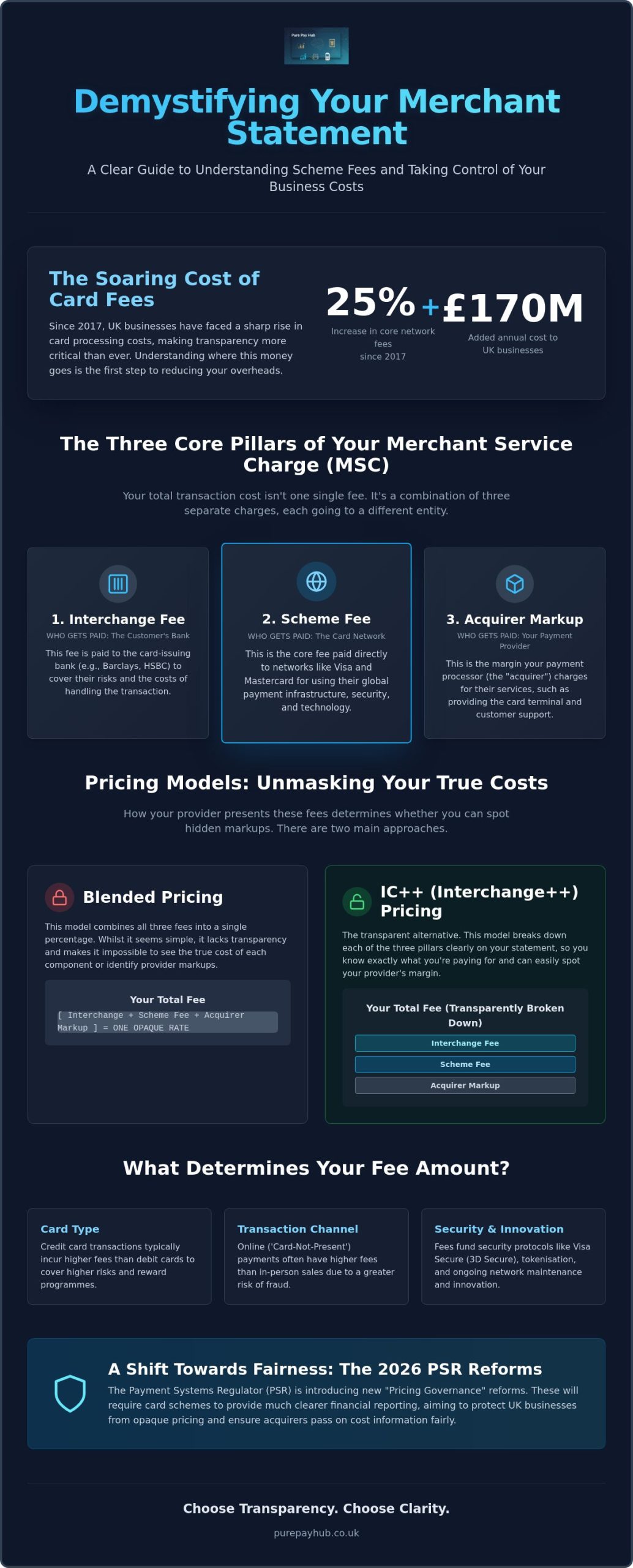
Did you know that card networks have hiked their core fees by at least 25% since 2017, adding a staggering £170 million in annual costs to UK businesses? If you’ve looked at your monthly bill and felt a sense of dread, you aren’t alone. It’s frustrating to deal with opaque billing structures that seem designed to keep you confused. Understanding exactly what are scheme fees on merchant statements is the first step to taking back control of your business overheads.
We’re here to pull back the curtain on these complex charges. You’ll learn how to identify mandatory network costs versus the sneaky markups some providers hide in the margins. We’ll also cover the 2026 Payment Systems Regulator (PSR) reforms and recent Visa Secure fee updates that affect your bottom line. This guide provides a clear roadmap to help you audit your own statement and ensure you’re partnering with a provider that values transparency and fairness.
Key Takeaways
- Understand that scheme fees are mandatory network access costs paid directly to card schemes like Visa and Mastercard rather than your acquirer.
- Learn exactly what are scheme fees on merchant statements by breaking down the three core pillars of your Merchant Service Charge.
- Discover how factors like card type and transaction channel influence your costs and why credit cards often attract higher fees than debit cards.
- Identify the crucial differences between “blended” and “IC++” pricing models to help you spot hidden markups and unmask your true processing costs.
- Gain the tools to audit your monthly statements effectively and find a partner that prioritises clear, honest billing over complex jargon.
Defining Scheme Fees: The Invisible Engine of UK Card Payments
Scheme fees are mandatory network access costs that you pay to card networks like Visa and Mastercard for the right to process transactions across their global infrastructure. Whilst they appear alongside other charges on your bill, these fees aren’t kept by your card machine provider or your bank. Instead, they’re passed directly to the card schemes. If you operate a business in the UK and accept card payments, these fees are a non-negotiable part of your overheads.
The primary purpose of these charges is to maintain the massive, secure payment rails that span the globe. Every time a customer taps their phone or inserts a card into your Countertop Card Machine, a complex web of technology springs into action. Scheme fees fund the security protocols, fraud prevention systems, and data centres that keep this system running 24 hours a day. Without this investment, the trust and speed we expect from modern payments would simply vanish.
How Card Networks Charge for Market Access
Think of Visa and Mastercard as the digital motorways of the financial world. They don’t actually issue cards to consumers; banks do that. Instead, they provide the “rails” that connect your business to the customer’s bank account. You’re paying for the brand’s network, not just the physical card. These costs also cover constant innovation. In 2026, we’ve seen this through the introduction of new Visa Secure fees and updated Mastercard transaction categories. These updates fund advancements like tokenisation, which protects sensitive data, and 3D Secure authentication, which reduces your liability for fraudulent online sales.
Scheme Fees vs. Interchange: Clearing the Confusion
Confusion often arises when business owners ask what are scheme fees on merchant statements because they are frequently lumped together with other costs. It is vital to distinguish them from the Interchange fee. Whilst both are mandatory, they go to different places. The interchange fee is paid to the customer’s bank to cover their risk and handling costs. The scheme fee goes solely to the network (Visa or Mastercard) for providing the technology.
Legacy providers often hide these details within a “blended” rate. This lack of transparency makes it impossible for you to see if you’re paying the true cost or a marked-up version. At PurePay Hub, we favour a no-nonsense approach. By breaking these pillars down, we help you understand exactly where your money is going. You shouldn’t have to guess why your costs have increased; you deserve to see the data clearly on every statement.
Why Scheme Fees Appear on Your Merchant Statement
Your monthly bill is more than just a single transaction rate. It is actually a combination of three distinct costs known as the Merchant Service Charge (MSC). To truly understand what are scheme fees on merchant statements, you must first recognise how your provider bundles these charges. The MSC consists of the interchange fee paid to the customer’s bank, the acquirer markup kept by your provider, and the scheme fees paid to Visa or Mastercard.
Many traditional providers prefer “blended” pricing models. This approach rolls all three pillars into one flat percentage, which effectively hides the individual costs from view. Whilst this might seem simpler, it prevents you from seeing if your provider is passing on savings or padding their own margins. Since 2017, the cost of these network fees has risen by at least 25 per cent. This trend has added an estimated £170 million in annual costs to UK businesses, making transparency more critical than ever for your cash flow.
Transactional vs. Non-Transactional Fees
Scheme fees aren’t always charged the same way. Transactional fees are the most common; these are per-payment costs that vary based on the value or volume of sales you process. However, you will also encounter non-transactional fees. These are often fixed monthly costs for network participation or specific security programmes. When these are aggregated on a monthly report, they can look like a confusing list of acronyms. If you find your current bill is too complex to decode, it might be time to switch to a transparent card machine provider that prioritises clarity over jargon.
The Role of the PSR in 2026
The regulatory landscape is shifting in favour of the business owner. In 2026, the Payment Systems Regulator’s market review has introduced new remedies to tackle opaque pricing. These “Pricing Governance” reforms require card schemes to provide much clearer financial reporting to acquirers.
The goal is simple: to ensure UK SMEs aren’t being overcharged through hidden fee hikes. These reforms mean that by the end of 2026, more providers will be forced to show a granular breakdown of costs. This regulatory pressure is a direct response to the lack of competition and the rising prices seen post-Brexit. For you, it means better protection and a much easier path to auditing your own statements for fairness.
Factors That Influence Your Scheme Fee Costs
Scheme fees aren’t a fixed penalty for doing business. They are dynamic costs that change based on the specific “DNA” of every transaction you process. When you ask what are scheme fees on merchant statements, you’re really looking at a risk and service assessment performed by the card networks. Several variables dictate whether you pay the minimum rate or a premium tier.
The type of card used is the primary driver of cost. Debit cards generally attract lower fees whilst credit cards sit at a higher tier. This reflects the increased processing complexity and financial risk involved in credit transactions. If your business accepts many corporate or commercial cards, expect higher costs. For instance, as of 13 July 2026, Mastercard revised its Acquiring Transaction Fee with an additional 0.03 per cent rate specifically for commercial products.
The “channel” also dictates the price. Using a Portable Card Machine for a face-to-face sale is almost always cheaper than taking a payment via an Online Payment Gateway. Card-Not-Present (CNP) transactions carry a higher risk of fraud. Consequently, the networks charge a premium for the extra security layers required. In April 2026, Visa introduced a Token Facilitation Fee for both face-to-face and CNP sales to fund the infrastructure that keeps these digital transactions secure.
Regionality and Cross-Border Charges
Where the card was issued matters just as much as where the sale happens. A UK-issued card used in a local shop is a domestic transaction with standard rates. However, if a tourist uses a US-issued card in that same shop, you will see higher “inter-regional” scheme fees. Post-Brexit, the UK sits outside the EEA (European Economic Area) fee caps for certain transactions. This means cards from Europe may also incur higher costs than they did previously. Businesses in tourist-heavy areas or those selling globally online should audit their statements to see how these cross-border charges impact their monthly totals.
Secure Authentication and Compliance
Security isn’t just about safety; it’s about cost control. Using 3D Secure 2.0 (3DS) can actually lower your fees because it reduces the risk of fraud for the network. Conversely, “unsecured” transactions often face penalties or higher base rates. PSD3 is the evolution of secure payment standards, designed to enhance consumer protection and further streamline electronic payments across the UK and Europe. Following these standards is vital. As of April 2026, new Visa Secure fees apply to both cardholder-initiated and merchant-initiated transactions. If your data quality is poor or you skip these authentication steps, the networks will charge you more to cover the increased risk.
Decoding Your Statement: Spotting Hidden Markups
Most business owners find their monthly PDF statement overwhelming. It is often a sea of acronyms and percentages that seem designed to confuse rather than inform. To find out exactly what are scheme fees on merchant statements, you need to look past the top-line summary. Look for the section usually labelled “Processing Fees” or “Transaction Breakdown”. This is where the real costs are often buried beneath layers of corporate jargon.
A standard UK statement should categorise costs into three clear buckets: the amount paid to the bank, the amount paid to the network, and the amount kept by your provider. If these aren’t clearly separated, your provider is likely using a pricing model that keeps you in the dark. Realising how these components interact is the only way to ensure you aren’t being overcharged for every tap and dip of a customer’s card.
Interchange Plus Plus (IC++) vs. Blended Pricing
IC++ is the gold standard for transparency in the UK. This model separates the Interchange fee, the scheme fee, and the acquirer markup. It ensures you pay the exact market rate for the first two components, with a fixed, visible fee for the provider’s service. This is the most honest way to bill, as any reduction in network costs is passed directly to you.
Blended pricing, however, rolls these three pillars into one flat rate. Whilst it might look simpler on a Portable Card Machine report, it is much harder to audit. Blended rates often mask high provider margins. If Visa or Mastercard lowers a specific fee, a provider on a blended plan can simply pocket the difference. Whilst micro-merchants might value the simplicity of a single rate, any growing business should demand an IC++ model to protect their margins.
Red Flags: Identifying “Junk” Fees
Hidden markups often masquerade as official-sounding costs. When auditing your statement, look for these specific red flags:
- Admin Fees or Service Premiums: These are often listed near your scheme fees but are actually pure profit for the provider.
- Inflated Scheme Fees: Some providers add a tiny, invisible markup to the actual network rate, assuming you won’t check the official Visa or Mastercard tables.
- Non-Qualifying Surcharges: Common in blended models, these penalise you for certain card types without explaining why.
Don’t just accept your bill as a fixed cost. Calculate your “Effective Rate” by taking your total monthly fees and dividing them by your total card turnover. If you process £10,000 and your fees are £150, your effective rate is 1.5 per cent. If this number creeps up whilst your sales volume stays the same, your provider is likely inflating their margins. If your current statement is a maze of hidden costs, it is time to switch to a provider that values honesty. Get a transparent quote from PurePay Hub today and see exactly what you are paying for.
PurePay Hub: Transparent Processing Without the Complexity
Finding out exactly what are scheme fees on merchant statements shouldn’t feel like an interrogation. Most legacy banks and providers rely on your confusion to protect their margins, but we believe you deserve better. PurePay Hub was built on the principle of calm advocacy for UK business owners. We strip away the corporate jargon and provide a payment partnership rooted in honesty and integrity.
We use a strict Interchange Plus Plus (IC++) pricing model to ensure you never pay a penny more than necessary. Unlike blended rates that mask the true cost of network access, our model passes through the actual scheme costs directly to you. This transparency allows us to offer competitive entry points, with debit card charges starting from 0.3 per cent and credit card charges from 0.5 per cent. When the card networks update their rates, you see the change clearly, rather than wondering why your provider has suddenly hiked your monthly bill.
Our Commitment to Statement Clarity
We organise your monthly reporting so it actually makes sense. You won’t find “service premiums” or “admin fees” disguised as mandatory network costs on our watch. Every line item is clearly defined, allowing you to see exactly where your money is going. If you’re still struggling to understand what are scheme fees on merchant statements from a previous provider, our team is here to help. We provide personalised support to help you audit your old bills and identify exactly where you’ve been overcharged in the past. This no-nonsense approach turns your monthly statement from a source of stress into a tool for financial stability.
Switching to a Fairer Payment Partner
Legacy providers often count on the “hassle factor” to keep you trapped in expensive contracts. We’ve simplified the transition process to make switching as seamless as possible. Our quick onboarding system means you can move from an opaque bank to a transparent partner without disrupting your daily operations. We understand that cash flow is the lifeblood of your business, which is why we prioritise next-day access to funds as standard.
Whether you need a Countertop Card Machine for your shop or a Virtual Terminal for remote sales, we provide the hardware and software that fits your specific needs. Our role is to act as your supportive business ally, ensuring your payment infrastructure is modern, dependable, and, above all, fair. Stop guessing what you’re paying for and start keeping more of your hard-earned revenue. Get a transparent quote from PurePay Hub today and experience the difference that honest processing makes to your bottom line.
Take Control of Your Payment Costs Today
Your merchant statement shouldn’t be a source of frustration. By now, you know that scheme fees are mandatory network costs, but their lack of transparency is often a choice made by your provider. The 2026 regulatory shift is a powerful ally for UK businesses, yet you don’t have to wait for the law to catch up with legacy banks. Understanding what are scheme fees on merchant statements gives you the leverage to demand a fairer deal and audit your bills with confidence.
At PurePay Hub, we’re committed to being the supportive partner you deserve. We offer a clear, IC++ model with debit card rates from 0.3% and credit card rates from 0.5%. When you combine this with next-day access to your funds, you gain a payment infrastructure that supports your growth rather than draining your margins.
Switch to PurePay Hub for transparent, no-nonsense payment processing. You’ve worked hard to build your business; it’s time your payment partner worked just as hard for you.
Frequently Asked Questions
What is the difference between interchange fees and scheme fees?
Interchange fees are paid to the customer’s bank whilst scheme fees go directly to the card network. Interchange covers the bank’s administrative costs and transaction risk. Scheme fees fund the processing technology and security infrastructure managed by Visa and Mastercard. Both are mandatory components of your total Merchant Service Charge.
Are scheme fees regulated in the UK?
Yes, the Payment Systems Regulator (PSR) oversees how these fees are set and disclosed. In 2026, the PSR introduced new “Pricing Governance” remedies to protect UK SMEs. These reforms require card schemes to provide clearer financial reporting, making it harder for providers to hide markups within mandatory network costs.
Can I negotiate the scheme fees on my merchant statement?
You cannot negotiate scheme fees directly as they are set by Visa and Mastercard at a network level. Every merchant in the UK pays these same base rates for specific transaction types. However, you can negotiate the “acquirer markup” kept by your provider or switch to a partner that passes these network costs through without adding hidden premiums.
Why have my scheme fees increased recently?
Costs have risen because card networks frequently update their pricing. In 2026, Mastercard revised its Acquiring Transaction Fee in July and Visa introduced new Token Facilitation Fees in April. These network-level changes contribute to the 25 per cent increase in core processing fees that the PSR has identified since 2017.
What does “Interchange Plus Plus” mean for my business?
Interchange Plus Plus (IC++) is a transparent billing model that separates each cost component. It identifies exactly what are scheme fees on merchant statements by showing the network cost, the interchange rate, and your provider’s markup as three distinct lines. This prevents providers from hiding extra profit within a single, “blended” rate.
Is it possible to avoid paying scheme fees?
No, these fees are mandatory for any business that accepts Visa or Mastercard payments. They are the price of admission for using the global payment “rails” that connect your shop to the customer’s bank. You can, however, lower your overall costs by using secure authentication like 3D Secure 2.0 to qualify for better rates.
How often do Visa and Mastercard change their fee structures?
Card networks traditionally update their fee structures twice a year, typically in April and October. However, 2026 has seen a more frequent schedule of revisions due to new regulatory requirements and security updates. Changes were implemented in January, April, and July of this year to reflect new PSR transparency standards.
What should I do if I suspect my provider is overcharging on scheme fees?
Request a granular, itemised breakdown of your monthly statement immediately. If your provider uses vague terms like “service premium” or refuses to show the individual network rates, it is a major red flag. Consider moving to an ISO that uses the IC++ model to ensure you only pay the actual network costs plus a visible, agreed markup.
Leave a Reply