Tag: UK Business

  • What are Scheme Fees on Merchant Statements? A 2026 UK Business Guide

    What are Scheme Fees on Merchant Statements? A 2026 UK Business Guide

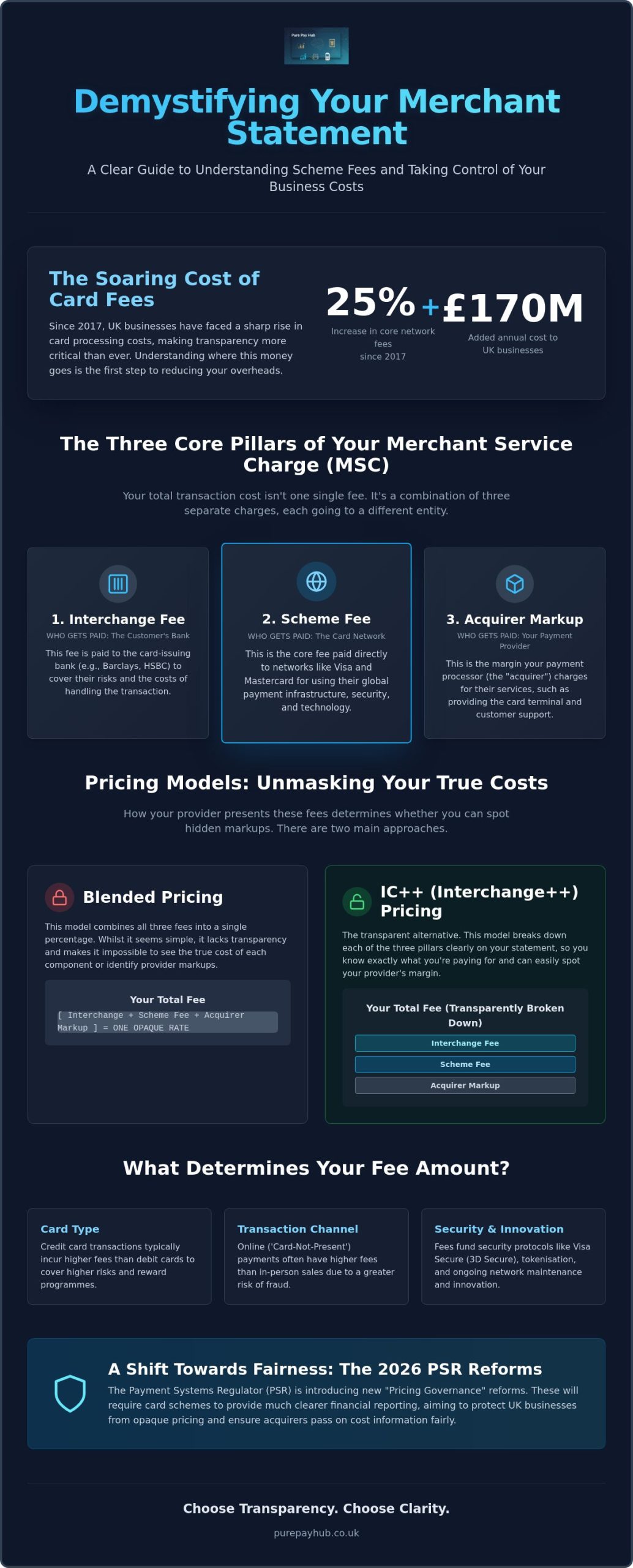
    Did you know that card networks have hiked their core fees by at least 25% since 2017, adding a staggering £170 million in annual costs to UK businesses? If you’ve looked at your monthly bill and felt a sense of dread, you aren’t alone. It’s frustrating to deal with opaque billing structures that seem designed to keep you confused. Understanding exactly what are scheme fees on merchant statements is the first step to taking back control of your business overheads.

    We’re here to pull back the curtain on these complex charges. You’ll learn how to identify mandatory network costs versus the sneaky markups some providers hide in the margins. We’ll also cover the 2026 Payment Systems Regulator (PSR) reforms and recent Visa Secure fee updates that affect your bottom line. This guide provides a clear roadmap to help you audit your own statement and ensure you’re partnering with a provider that values transparency and fairness.

    Key Takeaways

    • Understand that scheme fees are mandatory network access costs paid directly to card schemes like Visa and Mastercard rather than your acquirer.
    • Learn exactly what are scheme fees on merchant statements by breaking down the three core pillars of your Merchant Service Charge.
    • Discover how factors like card type and transaction channel influence your costs and why credit cards often attract higher fees than debit cards.
    • Identify the crucial differences between “blended” and “IC++” pricing models to help you spot hidden markups and unmask your true processing costs.
    • Gain the tools to audit your monthly statements effectively and find a partner that prioritises clear, honest billing over complex jargon.

    Defining Scheme Fees: The Invisible Engine of UK Card Payments

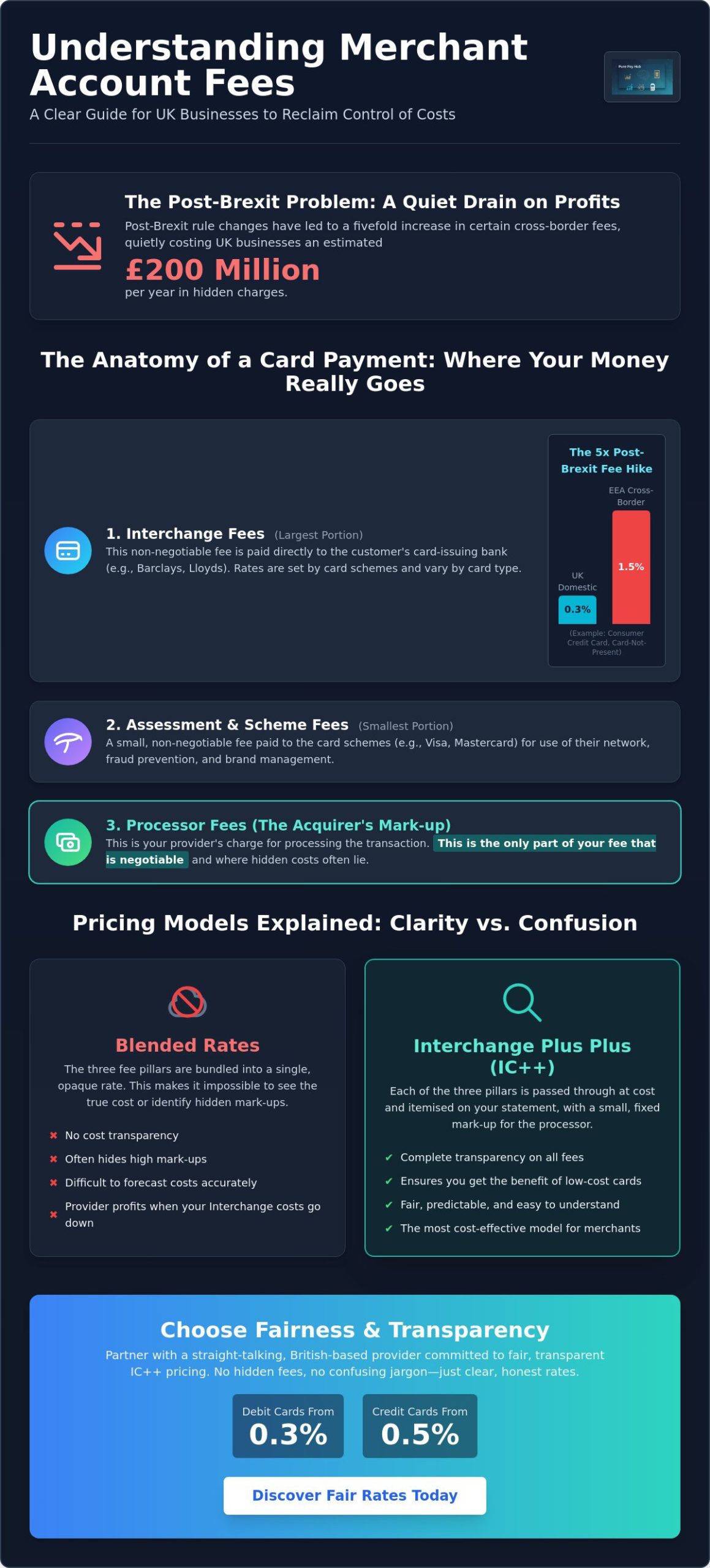
    Scheme fees are mandatory network access costs that you pay to card networks like Visa and Mastercard for the right to process transactions across their global infrastructure. Whilst they appear alongside other charges on your bill, these fees aren’t kept by your card machine provider or your bank. Instead, they’re passed directly to the card schemes. If you operate a business in the UK and accept card payments, these fees are a non-negotiable part of your overheads.

    The primary purpose of these charges is to maintain the massive, secure payment rails that span the globe. Every time a customer taps their phone or inserts a card into your Countertop Card Machine, a complex web of technology springs into action. Scheme fees fund the security protocols, fraud prevention systems, and data centres that keep this system running 24 hours a day. Without this investment, the trust and speed we expect from modern payments would simply vanish.

    How Card Networks Charge for Market Access

    Think of Visa and Mastercard as the digital motorways of the financial world. They don’t actually issue cards to consumers; banks do that. Instead, they provide the “rails” that connect your business to the customer’s bank account. You’re paying for the brand’s network, not just the physical card. These costs also cover constant innovation. In 2026, we’ve seen this through the introduction of new Visa Secure fees and updated Mastercard transaction categories. These updates fund advancements like tokenisation, which protects sensitive data, and 3D Secure authentication, which reduces your liability for fraudulent online sales.

    Scheme Fees vs. Interchange: Clearing the Confusion

    Confusion often arises when business owners ask what are scheme fees on merchant statements because they are frequently lumped together with other costs. It is vital to distinguish them from the Interchange fee. Whilst both are mandatory, they go to different places. The interchange fee is paid to the customer’s bank to cover their risk and handling costs. The scheme fee goes solely to the network (Visa or Mastercard) for providing the technology.

    Legacy providers often hide these details within a “blended” rate. This lack of transparency makes it impossible for you to see if you’re paying the true cost or a marked-up version. At PurePay Hub, we favour a no-nonsense approach. By breaking these pillars down, we help you understand exactly where your money is going. You shouldn’t have to guess why your costs have increased; you deserve to see the data clearly on every statement.

    Why Scheme Fees Appear on Your Merchant Statement

    Your monthly bill is more than just a single transaction rate. It is actually a combination of three distinct costs known as the Merchant Service Charge (MSC). To truly understand what are scheme fees on merchant statements, you must first recognise how your provider bundles these charges. The MSC consists of the interchange fee paid to the customer’s bank, the acquirer markup kept by your provider, and the scheme fees paid to Visa or Mastercard.

    Many traditional providers prefer “blended” pricing models. This approach rolls all three pillars into one flat percentage, which effectively hides the individual costs from view. Whilst this might seem simpler, it prevents you from seeing if your provider is passing on savings or padding their own margins. Since 2017, the cost of these network fees has risen by at least 25 per cent. This trend has added an estimated £170 million in annual costs to UK businesses, making transparency more critical than ever for your cash flow.

    Transactional vs. Non-Transactional Fees

    Scheme fees aren’t always charged the same way. Transactional fees are the most common; these are per-payment costs that vary based on the value or volume of sales you process. However, you will also encounter non-transactional fees. These are often fixed monthly costs for network participation or specific security programmes. When these are aggregated on a monthly report, they can look like a confusing list of acronyms. If you find your current bill is too complex to decode, it might be time to switch to a transparent card machine provider that prioritises clarity over jargon.

    The Role of the PSR in 2026

    The regulatory landscape is shifting in favour of the business owner. In 2026, the Payment Systems Regulator’s market review has introduced new remedies to tackle opaque pricing. These “Pricing Governance” reforms require card schemes to provide much clearer financial reporting to acquirers.

    The goal is simple: to ensure UK SMEs aren’t being overcharged through hidden fee hikes. These reforms mean that by the end of 2026, more providers will be forced to show a granular breakdown of costs. This regulatory pressure is a direct response to the lack of competition and the rising prices seen post-Brexit. For you, it means better protection and a much easier path to auditing your own statements for fairness.

    Factors That Influence Your Scheme Fee Costs

    Scheme fees aren’t a fixed penalty for doing business. They are dynamic costs that change based on the specific “DNA” of every transaction you process. When you ask what are scheme fees on merchant statements, you’re really looking at a risk and service assessment performed by the card networks. Several variables dictate whether you pay the minimum rate or a premium tier.

    The type of card used is the primary driver of cost. Debit cards generally attract lower fees whilst credit cards sit at a higher tier. This reflects the increased processing complexity and financial risk involved in credit transactions. If your business accepts many corporate or commercial cards, expect higher costs. For instance, as of 13 July 2026, Mastercard revised its Acquiring Transaction Fee with an additional 0.03 per cent rate specifically for commercial products.

    The “channel” also dictates the price. Using a Portable Card Machine for a face-to-face sale is almost always cheaper than taking a payment via an Online Payment Gateway. Card-Not-Present (CNP) transactions carry a higher risk of fraud. Consequently, the networks charge a premium for the extra security layers required. In April 2026, Visa introduced a Token Facilitation Fee for both face-to-face and CNP sales to fund the infrastructure that keeps these digital transactions secure.

    Regionality and Cross-Border Charges

    Where the card was issued matters just as much as where the sale happens. A UK-issued card used in a local shop is a domestic transaction with standard rates. However, if a tourist uses a US-issued card in that same shop, you will see higher “inter-regional” scheme fees. Post-Brexit, the UK sits outside the EEA (European Economic Area) fee caps for certain transactions. This means cards from Europe may also incur higher costs than they did previously. Businesses in tourist-heavy areas or those selling globally online should audit their statements to see how these cross-border charges impact their monthly totals.

    Secure Authentication and Compliance

    Security isn’t just about safety; it’s about cost control. Using 3D Secure 2.0 (3DS) can actually lower your fees because it reduces the risk of fraud for the network. Conversely, “unsecured” transactions often face penalties or higher base rates. PSD3 is the evolution of secure payment standards, designed to enhance consumer protection and further streamline electronic payments across the UK and Europe. Following these standards is vital. As of April 2026, new Visa Secure fees apply to both cardholder-initiated and merchant-initiated transactions. If your data quality is poor or you skip these authentication steps, the networks will charge you more to cover the increased risk.
    What are Scheme Fees on Merchant Statements? A 2026 UK Business Guide

    Decoding Your Statement: Spotting Hidden Markups

    Most business owners find their monthly PDF statement overwhelming. It is often a sea of acronyms and percentages that seem designed to confuse rather than inform. To find out exactly what are scheme fees on merchant statements, you need to look past the top-line summary. Look for the section usually labelled “Processing Fees” or “Transaction Breakdown”. This is where the real costs are often buried beneath layers of corporate jargon.

    A standard UK statement should categorise costs into three clear buckets: the amount paid to the bank, the amount paid to the network, and the amount kept by your provider. If these aren’t clearly separated, your provider is likely using a pricing model that keeps you in the dark. Realising how these components interact is the only way to ensure you aren’t being overcharged for every tap and dip of a customer’s card.

    Interchange Plus Plus (IC++) vs. Blended Pricing

    IC++ is the gold standard for transparency in the UK. This model separates the Interchange fee, the scheme fee, and the acquirer markup. It ensures you pay the exact market rate for the first two components, with a fixed, visible fee for the provider’s service. This is the most honest way to bill, as any reduction in network costs is passed directly to you.

    Blended pricing, however, rolls these three pillars into one flat rate. Whilst it might look simpler on a Portable Card Machine report, it is much harder to audit. Blended rates often mask high provider margins. If Visa or Mastercard lowers a specific fee, a provider on a blended plan can simply pocket the difference. Whilst micro-merchants might value the simplicity of a single rate, any growing business should demand an IC++ model to protect their margins.

    Red Flags: Identifying “Junk” Fees

    Hidden markups often masquerade as official-sounding costs. When auditing your statement, look for these specific red flags:

    • Admin Fees or Service Premiums: These are often listed near your scheme fees but are actually pure profit for the provider.
    • Inflated Scheme Fees: Some providers add a tiny, invisible markup to the actual network rate, assuming you won’t check the official Visa or Mastercard tables.
    • Non-Qualifying Surcharges: Common in blended models, these penalise you for certain card types without explaining why.

    Don’t just accept your bill as a fixed cost. Calculate your “Effective Rate” by taking your total monthly fees and dividing them by your total card turnover. If you process £10,000 and your fees are £150, your effective rate is 1.5 per cent. If this number creeps up whilst your sales volume stays the same, your provider is likely inflating their margins. If your current statement is a maze of hidden costs, it is time to switch to a provider that values honesty. Get a transparent quote from PurePay Hub today and see exactly what you are paying for.

    PurePay Hub: Transparent Processing Without the Complexity

    Finding out exactly what are scheme fees on merchant statements shouldn’t feel like an interrogation. Most legacy banks and providers rely on your confusion to protect their margins, but we believe you deserve better. PurePay Hub was built on the principle of calm advocacy for UK business owners. We strip away the corporate jargon and provide a payment partnership rooted in honesty and integrity.

    We use a strict Interchange Plus Plus (IC++) pricing model to ensure you never pay a penny more than necessary. Unlike blended rates that mask the true cost of network access, our model passes through the actual scheme costs directly to you. This transparency allows us to offer competitive entry points, with debit card charges starting from 0.3 per cent and credit card charges from 0.5 per cent. When the card networks update their rates, you see the change clearly, rather than wondering why your provider has suddenly hiked your monthly bill.

    Our Commitment to Statement Clarity

    We organise your monthly reporting so it actually makes sense. You won’t find “service premiums” or “admin fees” disguised as mandatory network costs on our watch. Every line item is clearly defined, allowing you to see exactly where your money is going. If you’re still struggling to understand what are scheme fees on merchant statements from a previous provider, our team is here to help. We provide personalised support to help you audit your old bills and identify exactly where you’ve been overcharged in the past. This no-nonsense approach turns your monthly statement from a source of stress into a tool for financial stability.

    Switching to a Fairer Payment Partner

    Legacy providers often count on the “hassle factor” to keep you trapped in expensive contracts. We’ve simplified the transition process to make switching as seamless as possible. Our quick onboarding system means you can move from an opaque bank to a transparent partner without disrupting your daily operations. We understand that cash flow is the lifeblood of your business, which is why we prioritise next-day access to funds as standard.

    Whether you need a Countertop Card Machine for your shop or a Virtual Terminal for remote sales, we provide the hardware and software that fits your specific needs. Our role is to act as your supportive business ally, ensuring your payment infrastructure is modern, dependable, and, above all, fair. Stop guessing what you’re paying for and start keeping more of your hard-earned revenue. Get a transparent quote from PurePay Hub today and experience the difference that honest processing makes to your bottom line.

    Take Control of Your Payment Costs Today

    Your merchant statement shouldn’t be a source of frustration. By now, you know that scheme fees are mandatory network costs, but their lack of transparency is often a choice made by your provider. The 2026 regulatory shift is a powerful ally for UK businesses, yet you don’t have to wait for the law to catch up with legacy banks. Understanding what are scheme fees on merchant statements gives you the leverage to demand a fairer deal and audit your bills with confidence.

    At PurePay Hub, we’re committed to being the supportive partner you deserve. We offer a clear, IC++ model with debit card rates from 0.3% and credit card rates from 0.5%. When you combine this with next-day access to your funds, you gain a payment infrastructure that supports your growth rather than draining your margins.

    Switch to PurePay Hub for transparent, no-nonsense payment processing. You’ve worked hard to build your business; it’s time your payment partner worked just as hard for you.

    Frequently Asked Questions

    What is the difference between interchange fees and scheme fees?

    Interchange fees are paid to the customer’s bank whilst scheme fees go directly to the card network. Interchange covers the bank’s administrative costs and transaction risk. Scheme fees fund the processing technology and security infrastructure managed by Visa and Mastercard. Both are mandatory components of your total Merchant Service Charge.

    Are scheme fees regulated in the UK?

    Yes, the Payment Systems Regulator (PSR) oversees how these fees are set and disclosed. In 2026, the PSR introduced new “Pricing Governance” remedies to protect UK SMEs. These reforms require card schemes to provide clearer financial reporting, making it harder for providers to hide markups within mandatory network costs.

    Can I negotiate the scheme fees on my merchant statement?

    You cannot negotiate scheme fees directly as they are set by Visa and Mastercard at a network level. Every merchant in the UK pays these same base rates for specific transaction types. However, you can negotiate the “acquirer markup” kept by your provider or switch to a partner that passes these network costs through without adding hidden premiums.

    Why have my scheme fees increased recently?

    Costs have risen because card networks frequently update their pricing. In 2026, Mastercard revised its Acquiring Transaction Fee in July and Visa introduced new Token Facilitation Fees in April. These network-level changes contribute to the 25 per cent increase in core processing fees that the PSR has identified since 2017.

    What does “Interchange Plus Plus” mean for my business?

    Interchange Plus Plus (IC++) is a transparent billing model that separates each cost component. It identifies exactly what are scheme fees on merchant statements by showing the network cost, the interchange rate, and your provider’s markup as three distinct lines. This prevents providers from hiding extra profit within a single, “blended” rate.

    Is it possible to avoid paying scheme fees?

    No, these fees are mandatory for any business that accepts Visa or Mastercard payments. They are the price of admission for using the global payment “rails” that connect your shop to the customer’s bank. You can, however, lower your overall costs by using secure authentication like 3D Secure 2.0 to qualify for better rates.

    How often do Visa and Mastercard change their fee structures?

    Card networks traditionally update their fee structures twice a year, typically in April and October. However, 2026 has seen a more frequent schedule of revisions due to new regulatory requirements and security updates. Changes were implemented in January, April, and July of this year to reflect new PSR transparency standards.

    What should I do if I suspect my provider is overcharging on scheme fees?

    Request a granular, itemised breakdown of your monthly statement immediately. If your provider uses vague terms like “service premium” or refuses to show the individual network rates, it is a major red flag. Consider moving to an ISO that uses the IC++ model to ensure you only pay the actual network costs plus a visible, agreed markup.

  • Secure Online Payment Gateway for Ecommerce: The 2026 Merchant Guide

    Secure Online Payment Gateway for Ecommerce: The 2026 Merchant Guide

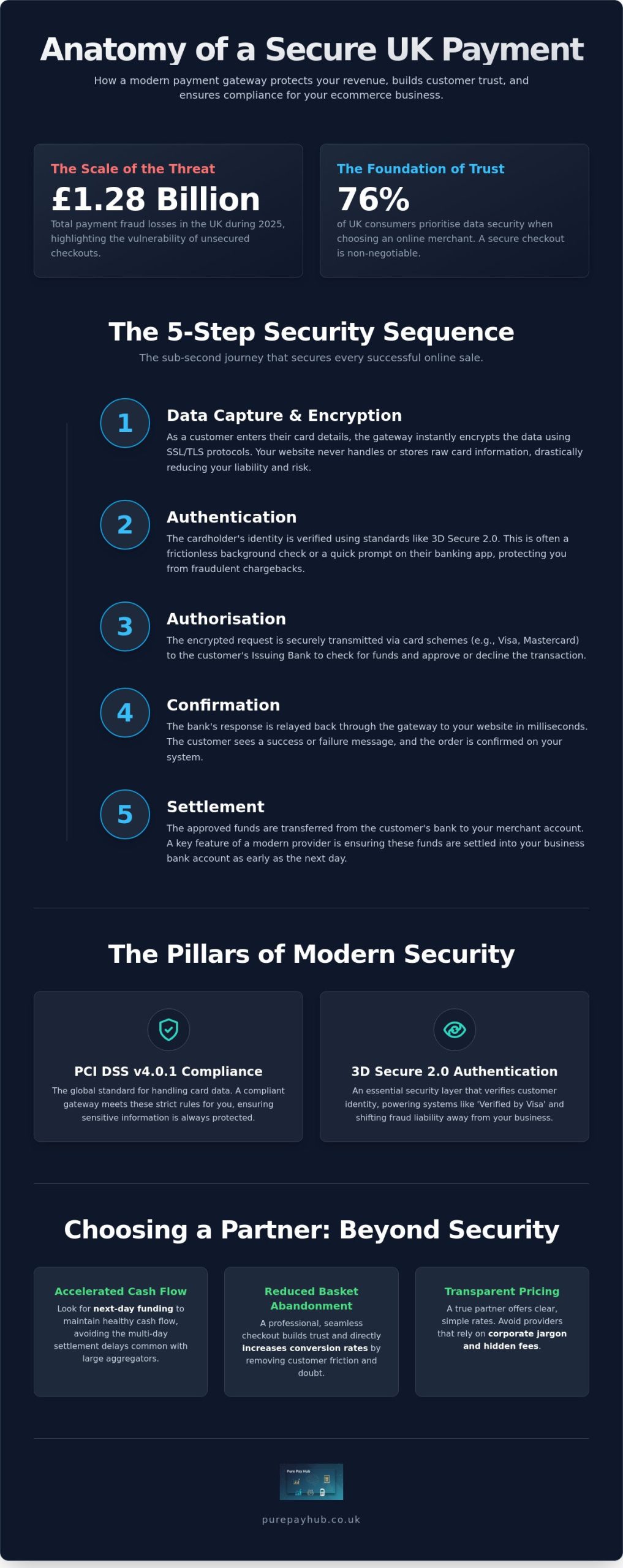
    Total payment fraud losses in the UK reached £1.28 billion in 2025, a stark reminder that your checkout is often the most vulnerable part of your business. Finding a secure online payment gateway for ecommerce isn’t just about technical compliance. It’s about protecting your revenue and building genuine trust with every customer. You’ve likely felt the frustration of abandoned carts caused by clunky checkouts, or the stress of seeing your funds held for days on end by traditional, distant providers.

    We believe in a no-nonsense approach to finance that prioritises the merchant. You deserve a partner that offers clarity instead of corporate jargon and hidden fees. This guide will help you master the technical and security essentials required to protect your business whilst providing a seamless checkout experience for your UK customers. We’ll show you how to turn your payment setup into a competitive advantage.

    We’ll examine the requirements of PCI DSS v4.0.1 and the July 2026 Mastercard data mandate. You’ll also discover how to secure next-day access to your sales revenue and achieve transaction rates that actually support your growth. It’s time to move from frustration toward a state of informed confidence.

    Key Takeaways

    • Understand why your digital “handshake” is the key to reducing basket abandonment and building lasting trust with your UK customer base.
    • Learn how to navigate the latest PCI-DSS v4.0.1 requirements and 3D Secure 2.0 to protect your business from rising fraud.
    • Discover why next-day funding is a critical feature for maintaining healthy cash flow compared to the slow settlement times of major aggregators.
    • Master the essentials of choosing a secure online payment gateway for ecommerce that offers transparent pricing and integrates with your card machines.
    • Demystify the complex journey of a transaction from the moment a customer clicks “Pay Now” to the final settlement in your account.

    Why a Secure Online Payment Gateway is Critical for Your UK Ecommerce Growth

    Think of your gateway as the digital “handshake” between your website and the global banking network. It is the precise moment where trust is either solidified or broken. Implementing a secure online payment gateway for ecommerce is no longer just a technical tick-box exercise. It is a fundamental requirement for survival in a market where 76% of UK consumers now prioritise data security when choosing an online merchant. If that handshake feels weak or suspicious, your customers will simply walk away.

    There is a direct correlation between visible security markers and reduced basket abandonment. British shoppers are savvy; they look for reassurance before entering their card details. When a checkout looks professional and displays recognised security protocols, friction disappears. Conversely, the cost of insecurity is absolute. A single data breach can end a small UK business overnight. Beyond the immediate financial penalties, the loss of reputation is often impossible to recover. With UK payment fraud losses reaching £1.28 billion in 2025, your gateway acts as your first and strongest line of defence.

    The goal for 2026 is a “frictionless” secure checkout. Security should never be a hurdle that slows down a legitimate purchase. Modern gateways use background authentication to verify users without forcing them through endless pop-up windows. This balance keeps your revenue safe whilst ensuring the user journey remains fast and intuitive.

    The Role of the Gateway in the Payment Ecosystem

    Confusion often exists between a gateway and a merchant account. Your gateway is the messenger that carries transaction data. The merchant account is the destination where your funds are held before being settled into your business bank account. You need both to accept card payments online in the UK. To understand the technical journey, it helps to research How Payment Gateways Work as a secure relay. This system doesn’t just move data; it protects you from fraudulent chargebacks by verifying the legitimacy of every request in real-time.

    Building Customer Trust in 2026

    Trust is built through familiarity and technical excellence. Standards like 3D Secure 2.0, including “Verified by Visa” and “Mastercard ID Check”, are now the expected norm for British shoppers. These tools provide an extra layer of protection that reduces your liability for fraud. Localised payment methods also play a vital role in conversion. A secure online payment gateway for ecommerce should feel local to the shopper, offering the currencies and card types they use every day. A payment gateway is a secure bridge for encrypted transaction data. By ensuring this bridge is robust, you provide the stability your business needs to grow.

    Behind the Scenes: How Payment Gateways Secure Every Transaction

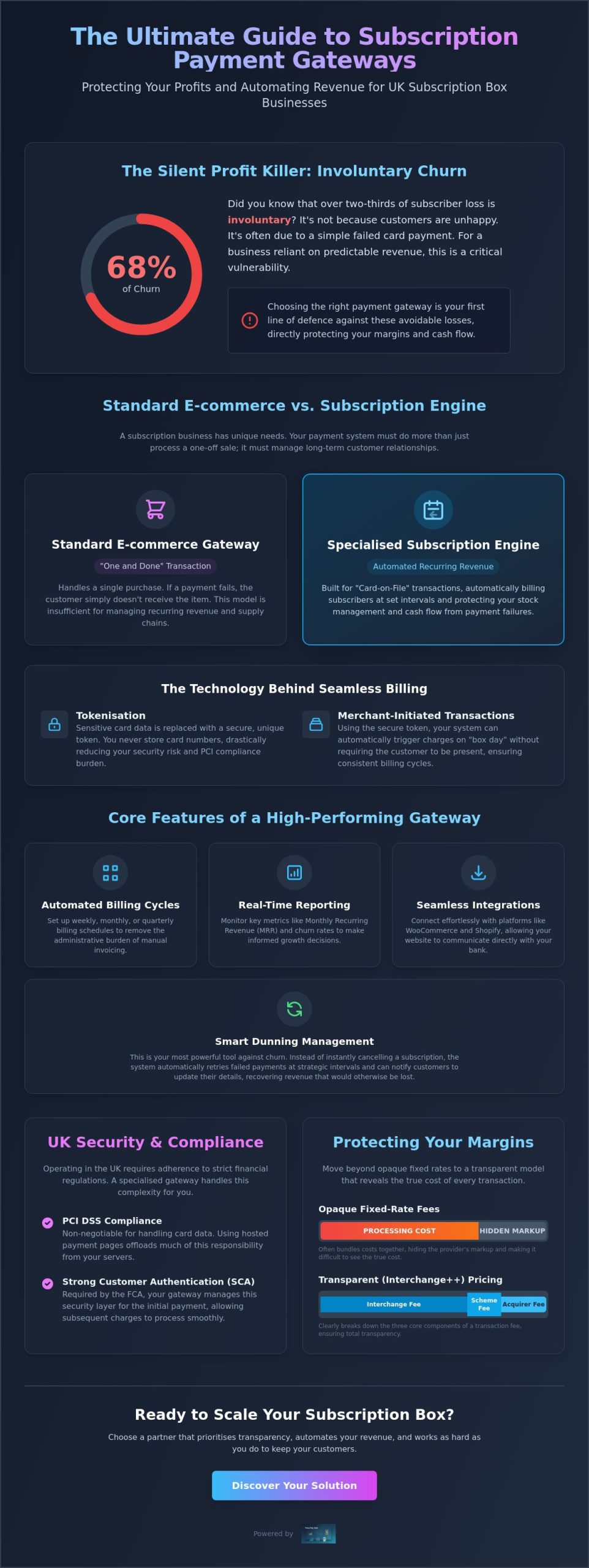
    When your customer clicks “Pay Now”, a complex sequence of events triggers in less than a second. This millisecond journey is the difference between a successful sale and a potential security breach. A secure online payment gateway for ecommerce acts as the invisible orchestrator between your website, the card schemes, and the banking network. It ensures that sensitive data travels safely whilst filtering out malicious actors before they can impact your bottom line.

    The process involves two primary financial institutions: the Acquiring Bank and the Issuing Bank. The Acquiring Bank is your business bank, responsible for receiving the funds. The Issuing Bank belongs to your customer and is the entity that approves or declines the transaction based on available funds and security checks. Between these two points, encryption serves as a protective tunnel. By using SSL/TLS protocols at the browser level, the gateway prevents “man-in-the-middle” attacks, where hackers attempt to intercept data as it moves through the internet.

    The 5-Step Security Sequence

    • Step 1: Data Capture and Encryption. Card details are immediately encrypted at the point of entry. This ensures your website never actually “sees” or stores the raw data.
    • Step 2: Authentication. The system uses 3D Secure protocols to verify the cardholder’s identity, often through a mobile app notification or biometric check.
    • Step 3: Authorisation. A request is sent through card schemes like Visa or Mastercard to the Issuing Bank to confirm the transaction is legitimate.
    • Step 4: Fraud Scrubbing. The gateway applies advanced filters to check for suspicious patterns, such as high-risk IP addresses or unusual purchase behaviour.
    • Step 5: Final Response. The gateway relays the approval or decline back to your checkout page to complete the user journey.

    This rigorous verification and response phase happens instantly. If you are looking for a partner to manage this complexity with total transparency, our Online Payment Gateway is designed specifically for the needs of British merchants.

    Tokenisation: The Future of Card Data Security

    Tokenisation is a game-changer for modern ecommerce. It replaces sensitive card numbers with unique, non-sensitive “tokens”. If a hacker were to breach a database of tokens, the information would be useless to them. This technology significantly reduces your burden when adhering to PCI-DSS Security Standards. Because the actual card data stays with the processor, your compliance requirements are simplified.

    Beyond security, tokenisation enables the seamless experiences customers now expect. It powers “one-click” checkouts and manages recurring subscriptions without requiring the customer to re-enter their details. This balance of safety and speed is what defines a truly effective secure online payment gateway for ecommerce in 2026. It allows you to focus on growth whilst the technical heavy lifting happens safely in the background.

    Security standards are often viewed as a burden; however, they are your best defence against the growing threat of cybercrime. For any merchant, a secure online payment gateway for ecommerce must adhere to the Payment Card Industry Data Security Standard (PCI-DSS). This is not a suggestion. It is a global requirement to ensure all companies that process, store, or transmit card information maintain a secure environment. If you fail to meet these standards, the consequences are significant.

    The legal implications for non-compliance in the UK are severe. Beyond the risk of heavy fines from card schemes, you face the potential loss of your ability to process payments entirely. Most small businesses don’t have the resources to build a digital fortress. This is where a hosted payment page becomes invaluable. By redirecting your customers to a secure environment managed by your provider, you offload 99% of your security risk. Your servers never touch the sensitive data, which simplifies your life and protects your customers.

    Understanding Your PCI Compliance Responsibilities

    Compliance levels vary based on how you handle data. Most small ecommerce sites fall under SAQ A, which applies when you use a hosted page. If you store card data on your own servers, you face the much more rigorous SAQ D. We help our merchants navigate these requirements to avoid the monthly non-compliance fees that often catch business owners off guard. Choosing a Level 1 PCI Service Provider is non-negotiable. It ensures your partner meets the highest possible security audit standards.

    The Evolution of 3D Secure

    The original 3D Secure was a conversion killer. It forced customers to remember complex passwords, leading to abandoned carts. 3D Secure 2.0 (3DS2) has changed the game by using biometrics and app-based verification. This aligns with the requirements for Strong Customer Authentication (SCA) in the UK. It ensures that high-risk transactions are verified without ruining the user experience.

    Customers today are more aware of secure online shopping practices than ever before. They expect a checkout that feels modern and safe. A major benefit of using 3DS2 is the liability shift. By successfully authenticating a transaction through 3DS2, the liability for fraudulent chargebacks shifts from the merchant to the bank. This provides an essential layer of financial protection for your business. Implementing a secure online payment gateway for ecommerce that supports these protocols isn’t just about safety. It is about building a resilient, trusted brand that prioritises customer security.

    Secure Online Payment Gateway for Ecommerce: The 2026 Merchant Guide

    Choosing Your Provider: Beyond Just Transaction Rates

    Choosing a secure online payment gateway for ecommerce involves looking past the flashy marketing of global aggregators. Many merchants fall into the trap of only comparing the headline transaction fee. Whilst a low percentage looks attractive on paper, it often masks inefficiencies that can cripple your daily operations. Large, multi-national payment platforms are popular for their quick setup. However, they often lack the localised support and flexible funding options that an independent UK provider can offer.

    You must also be vigilant regarding hidden costs. It’s common to see extra charges for gateway access, PCI compliance, and monthly statements. These micro-fees quickly add up, eating into your margins. A transparent partner will lay these out clearly from the start. If you sell both online and in-person, ensure your gateway integrates with your EPOS Systems. Having a single view of your sales across all channels simplifies your accounting and inventory management.

    Settlement Speeds: Why 7 Days is Too Long

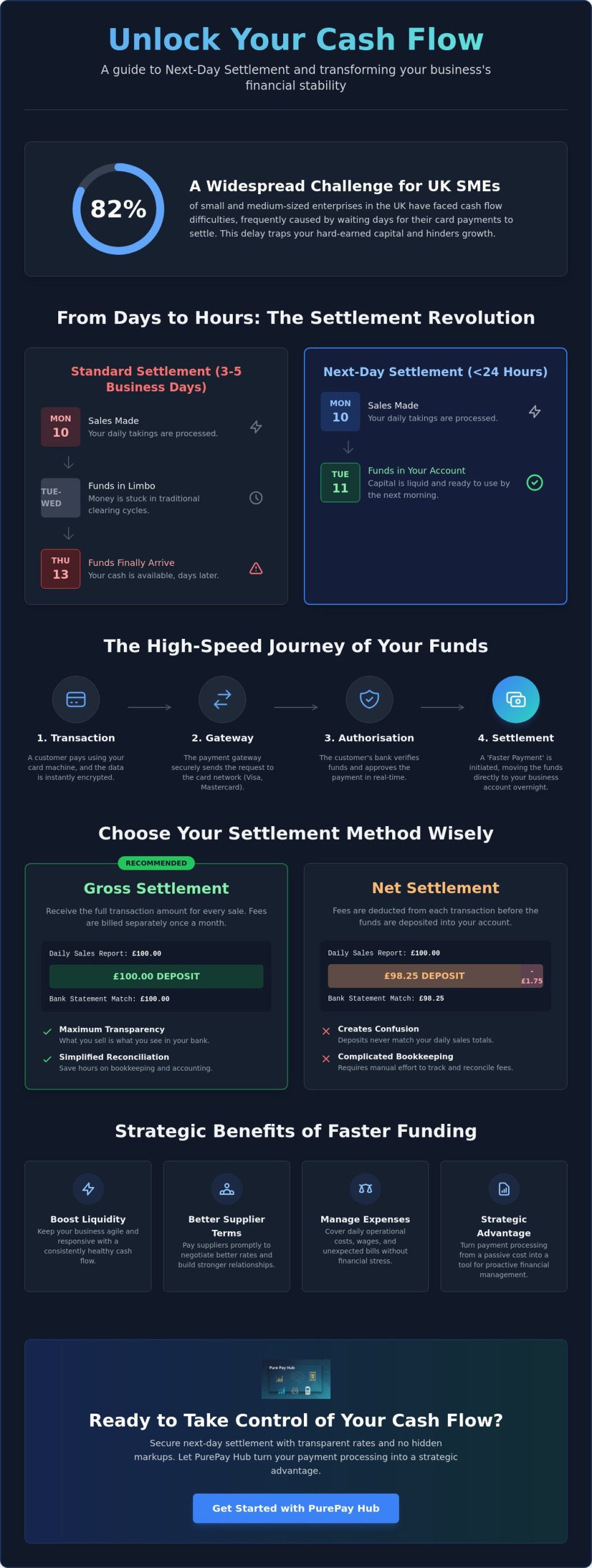
    The funding gap is the silent killer of small business cash flow. This is the delay between a customer paying and the money actually landing in your bank account. Standard settlement windows can stretch to seven days or more. This delay makes it difficult to manage payroll, pay suppliers, or restock inventory. We believe you should have next-day access to your sales revenue. Accelerated settlement provides a significant competitive edge for UK SMEs, allowing you to reinvest your hard-earned cash immediately rather than waiting for a distant processor to release it.

    Pricing Models: Interchange-Plus vs Flat Rate

    Flat-rate pricing is simple but often expensive. If you pay a flat 1.75% on every transaction, you’re likely overpaying for debit card payments. Debit cards carry much lower processing costs than premium credit cards. Interchange-plus pricing is the no-nonsense alternative. It provides total transparency by separating the actual cost of the transaction from the processor’s markup. This ensures you only pay a fair margin on top of the base rates. PurePay Hub offers rates as low as 0.3% for debit and 0.5% for credit cards, reflecting our commitment to fair and honest pricing for the local merchant community. If you’re ready for a fairer deal, you can get a transparent quote today to see how much you could save.

    A secure online payment gateway for ecommerce should be a tool for growth, not a source of frustration. By prioritising settlement speed and pricing transparency, you ensure your business remains agile and profitable in an increasingly competitive UK market.

    PurePay Hub: Transparent, Secure, and Built for British Business

    Traditional corporate processors often treat merchants like entries on a spreadsheet. They hide behind layers of jargon and opaque fee structures that make it impossible to know what you are actually paying. PurePay Hub was founded to disrupt this culture. We provide a no-nonsense alternative designed specifically for regional business owners who value honesty and integrity. We aren’t a distant financial institution. We are a fair partner committed to your growth.

    One of the biggest frustrations for merchants is the lack of support when things go wrong. Most technical guides focus on the code, but they ignore the human reality of a gateway failure. When a transaction won’t process during your busiest hour, you don’t need a chatbot or a generic ticket number. You need a UK-based expert who understands your market and can provide immediate clarity. Our support team is disciplined and knowledgeable, ensuring you never feel abandoned by your technology. We’ve simplified the onboarding process, allowing most businesses to start taking payments within 24 to 48 hours.

    The PurePay Hub Advantage for Ecommerce

    Efficiency shouldn’t be complicated. Our secure online payment gateway for ecommerce integrates seamlessly with major platforms like Shopify, WooCommerce, and Magento. This ensures your technical transition is smooth and your checkout remains stable from day one. We also address the funding gap mentioned earlier by providing next-day funding as standard. This keeps your cash flow healthy and allows you to reinvest in your business without delay. You can track every penny through our centralised merchant dashboard, which offers transparent reporting untainted by hidden markups.

    Supporting Your Growth with Business Cash Advances

    Growth often requires capital, but traditional bank loans can be rigid and slow. We offer a Business Cash Advance as a flexible alternative for retailers. This facility provides capital based on your future card sales. Instead of fixed monthly payments, the advance is repaid as a small percentage of your daily takings. This means your repayments stay in sync with your actual revenue; if you have a quiet day, you pay back less. It is a fairer way to fund inventory or expansion without the stress of a traditional debt schedule.

    Choosing a secure online payment gateway for ecommerce is about more than just security protocols. It is about finding a single partner that can handle your card machines, online payments, and growth capital with total transparency. If you are ready to move away from the opaque practices of traditional competitors, we are here to help. Organise your secure payment gateway with PurePay Hub today and experience a fairer way to take payments.

    Secure Your Future with a Fairer Payment Partner

    The landscape of digital payments in 2026 demands a balance between rigorous security and an effortless user experience. You now know that a secure online payment gateway for ecommerce is more than just a technical necessity. It’s the foundation of your customer’s trust and your business’s financial health. By prioritising Level 1 PCI security and embracing 3DS2 protocols, you protect your revenue whilst reducing friction at the checkout.

    Don’t let slow settlement times or opaque fee structures hold your growth back. You deserve a partner that offers clarity and rewards your hard work with faster access to your funds. Transitioning to a system that puts the merchant first provides the stability you need to scale in the competitive UK market. It’s about moving from technical confusion to a state of total confidence.

    Switch to a fairer, more secure payment gateway with PurePay Hub and benefit from debit card rates from 0.3%, next-day funding for UK merchants, and Level 1 PCI-compliant security. We’re ready to help you build a more resilient and profitable business today.

    Frequently Asked Questions

    What is the difference between a payment gateway and a payment processor?

    A payment gateway is the digital “handshake” that encrypts transaction data at the point of sale. The processor is the back-end system that actually moves the money between the different banks involved. You need both to function, though many modern providers bundle these services together for simplicity. This integration helps you avoid the technical headache of managing multiple different contracts and connections.

    How much does a secure online payment gateway cost in the UK?

    Costs vary based on your transaction volume and the pricing model you choose. Most providers charge a percentage per transaction plus a small fixed fee. You should also look for monthly gateway fees or PCI compliance charges that might be hidden in the small print. A transparent provider will always show you these costs upfront to help you manage your business cash flow effectively.

    Is my business too small to need a secure payment gateway?

    No business is too small to prioritise security. Every merchant needs a secure online payment gateway for ecommerce regardless of their turnover. Fraudsters often target smaller sites because they assume the security measures are weaker. Protecting your customer data is a legal requirement in the UK and is essential for building a brand that shoppers can actually trust.

    How long does it take to set up an online payment gateway?

    Setting up a modern gateway typically takes between 24 and 48 hours. This includes the time needed for identity checks and linking the system to your website. Once your account is approved, integration is usually a simple process of installing a plugin or entering an API key. You can be taking payments and generating revenue almost immediately after your application is processed.

    Can I use the same gateway for my physical shop and my online store?

    Yes, you can use an integrated system to manage both your physical shop and your online store. This is often achieved through an EPOS system that synchronises your inventory and sales data in one centralised place. It simplifies your accounting significantly and provides a consistent experience for your customers, whether they are buying from you in person or through your website.

    What happens if my payment gateway goes down?

    If a gateway goes down, your website cannot accept payments, which leads to immediate revenue loss and frustrated customers. High-quality providers maintain multiple redundant servers to ensure maximum uptime. For businesses prioritising transparency, using StatusPulse for public status pages and uptime monitoring can help keep your customers informed and protect your reputation during any service disruptions. Choosing a partner with a proven track record of stability ensures your business remains open for orders without technical interruptions.

    Do I need a separate merchant account for my ecommerce gateway?

    You do need a merchant account to receive funds, but it doesn’t always have to be a separate contract. Some providers offer a bundled service where the secure online payment gateway for ecommerce and the merchant account are provided as one package. This often makes the setup process much faster for new businesses and provides you with a single point of contact for support.

    How does 3D Secure 2.0 affect my checkout conversion rate?

    3D Secure 2.0 actually helps improve conversion rates by making the authentication process frictionless for the shopper. Unlike the old system that required complex passwords, 3DS2 uses biometrics and background data checks to verify the cardholder. This reduces basket abandonment whilst providing the high level of security your customers expect. It turns a potential hurdle into a smooth and reassuring experience.

  • Using EPOS Data to Increase Sales: A Strategic Guide for UK Businesses in 2026

    Using EPOS Data to Increase Sales: A Strategic Guide for UK Businesses in 2026

    What if the secret to clearing your slowest-moving stock and doubling your average basket value was already sitting on your hard drive, waiting to be read? Many UK business owners feel buried under complex reports that offer plenty of numbers but very little direction. It is frustrating to watch your capital sit on a shelf in the form of unsold inventory, especially when you are also trying to manage staff schedules during unpredictable quiet periods. You likely suspect that using EPOS data to increase sales is possible, but the path from raw data to real-world profit often feels blocked by technical jargon.

    We believe that your transaction history should be your greatest asset, not a source of stress. This guide will show you how to transform those daily figures into a clear, actionable roadmap for your business. You will learn how to leverage the latest 2026 standards, including the Data (Use and Access) Act 2025, to optimise your stock levels, reduce waste, and build a loyalty programme that keeps your customers coming back. We are going to break down exactly how to turn your transaction records into a blueprint for a more profitable and efficient shop floor.

    Key Takeaways

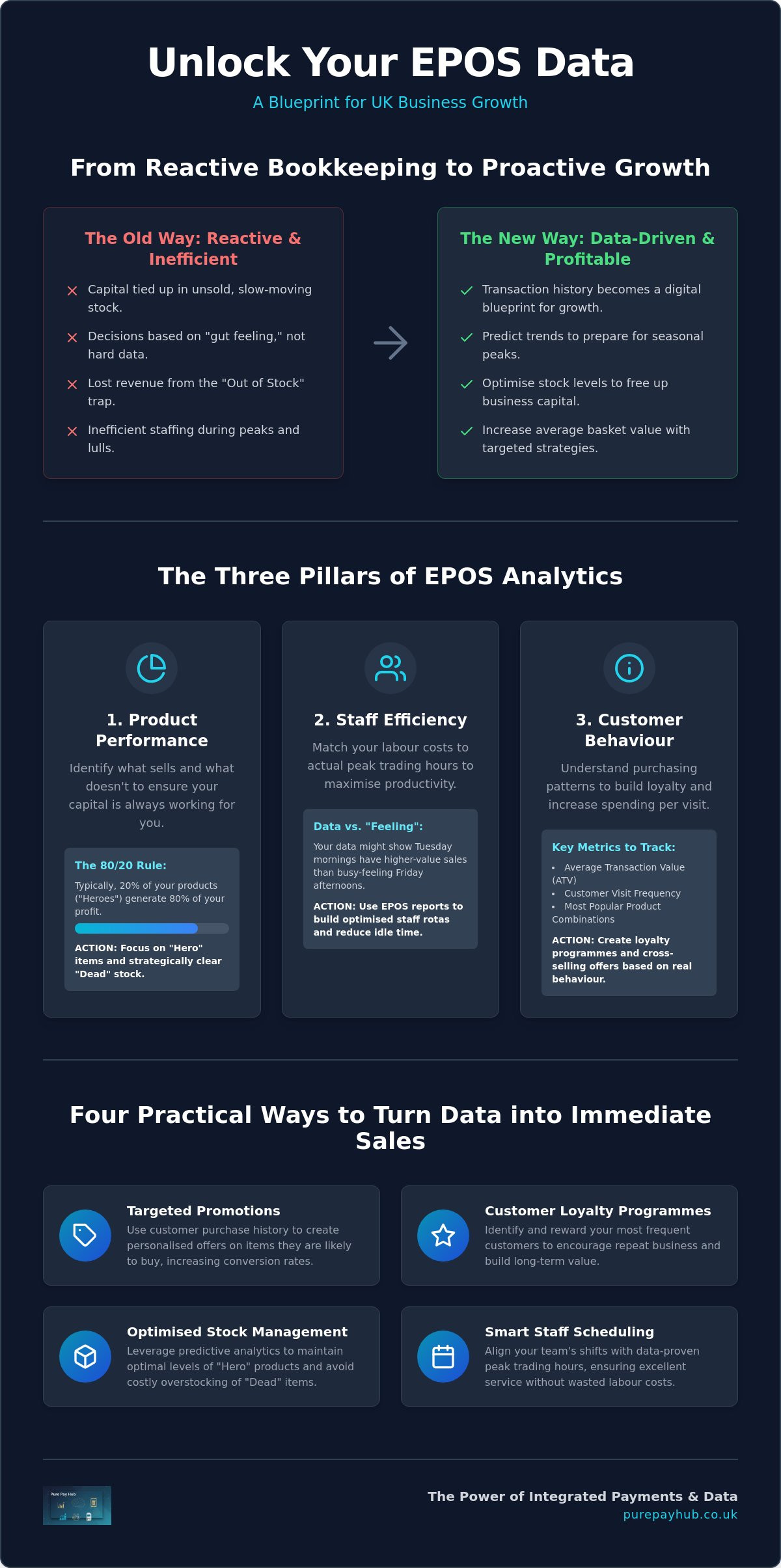
    • Transition from reactive bookkeeping to proactive revenue generation by treating your transaction history as a digital blueprint for growth.
    • Identify your “Hero” products and eliminate “Dead” stock to ensure your business capital is always working for you.
    • Master the art of predictive analytics to prepare for seasonal peaks and avoid the hidden costs of the “Out of Stock” trap.
    • Implement four practical strategies, including using EPOS data to increase sales through targeted promotions and customer loyalty programmes.
    • Understand the critical role of seamless payment integration in maintaining data accuracy and protecting your hard-earned profit margins.

    Beyond the Transaction: Why Your EPOS Data is an Untapped Revenue Stream

    Every time a customer taps their card or requests a receipt, they leave a digital trail. This is the essence of your Point of Sale (POS) system. It is far more than a digital cash drawer. It is a living record of preferences, peak trading times, and inventory movement. In the 2026 UK market, the businesses that thrive are moving away from reactive bookkeeping. They no longer look at reports once a month just to see what happened. Instead, they are using EPOS data to increase sales by predicting what will happen tomorrow.

    The 2026 retail landscape is more regulated and competitive than ever. With new Electronic Sales Suppression (ESS) standards in place since June 2026, the accuracy of your records is no longer optional. It is a legal requirement. This shift actually benefits legitimate businesses. It forces a level of transparency that makes using EPOS data to increase sales a natural next step for any principled owner. Relying on a “gut feeling” is a common trap. You might think Friday afternoons are your busiest time because the shop feels crowded, but your data might show that Tuesday mornings actually generate higher-value transactions. National chains use this type of analysis to win. To compete, you need that same level of clarity.

    Ignoring your data comes with a heavy price tag. It leads to the “Out of Stock” trap, where you lose revenue because a popular item isn’t on the shelf. Conversely, it results in overstocking products that simply don’t move, tying up your vital cash flow. You might also find yourself understaffed during a sudden rush or paying for idle hands during a quiet spell. These inefficiencies quietly drain your profit margins.

    The Anatomy of a High-Performing EPOS System

    Modern EPOS Systems are built on the synergy between hardware and software. Your card machine should never be a separate island of information. Whether you use a Countertop Card Machine or a Portable Card Machine, it must sync instantly with your central software. Real-time syncing ensures you aren’t making decisions based on yesterday’s news. This integration centres the customer experience whilst collecting the vital metrics you need to grow. It allows for faster checkouts and more accurate stock counts simultaneously.

    Moving from “Ringing Up” to “Analysing Up”

    Most businesses use their till for “ringing up” sales. Strategic owners use it for “analysing up” their entire operation. There is a massive gap between simply processing a payment and leveraging that interaction to drive a second purchase. Transparency in your data builds a foundation of trust and financial health. It allows you to see exactly where your margins are being squeezed and where cross-selling opportunities are being missed. EPOS data is the primary driver of modern SME competitive advantage, transforming every transaction into a strategic building block for long-term growth. If you are looking to move your records to a system that supports this level of insight, you can learn more about Switch My Books to facilitate a smooth migration.

    The Three Pillars of EPOS Analytics: What to Track to Optimise Growth

    Data without focus is just noise. To move from basic transaction recording to strategic growth, you must categorise your metrics into three distinct pillars. These pillars allow you to see exactly where your revenue is coming from and where your capital is being wasted. By using EPOS data to increase sales, you transform your till from a simple payment point into a powerful diagnostic tool. This structured approach ensures you aren’t just looking at the total takings at the end of the day, but understanding the mechanics behind every pound earned.

    The first pillar is Product Performance. This involves identifying your “Hero” products, the items that drive the majority of your profit, and your “Dead” stock, which sits on shelves and ties up your cash flow. The second pillar is Staff Efficiency. This focuses on matching your labour costs to actual peak trading hours. Finally, the third pillar is Customer Behaviour. This uses customer data analytics to track Average Transaction Value (ATV) and visit frequency. When you consolidate these pillars, you gain a holistic view of your business health that allows for confident decision-making.

    Identifying Your Most Profitable Items

    The 80/20 rule is a fundamental principle for UK merchants. It suggests that 20% of your products likely drive 80% of your total profit. Your EPOS system can verify this instantly. High-volume items are often mistaken for best sellers, but if their margins are slim, they might not be your most valuable stock. By performing a “basket analysis,” you can see which products are frequently bought together. This allows you to organise your shop floor or menu to encourage cross-selling. If data shows that customers who buy item A almost always buy item B, placing them near each other is a simple way of using EPOS data to increase sales without spending a penny on marketing.

    Optimising Your Workforce with Labour-to-Sales Ratios

    Staffing is often your largest overhead. Using heat maps from your EPOS data allows you to identify exactly when you need more hands on deck. You can reduce “dead time” by organising staff breaks and administrative tasks during data-verified lulls. This ensures you are never understaffed during a sudden rush or paying for idle labour during quiet periods. You can also motivate your team with data-driven sales targets. Tracking performance allows you to reward your most efficient workers and identify where training is needed. Finding the right EPOS Systems is the first step toward gaining this level of operational clarity. It turns your workforce into a lean, data-driven team that directly contributes to your bottom line.

    Reactive management is a common cycle for many independent merchants. You notice a shelf is empty, you order more, and you wait for the delivery. By the time the stock arrives, the peak has often passed. This is the “Out of Stock” trap. It costs you more than just a single transaction. It damages customer trust and pushes them toward your competitors. Using EPOS data to increase sales means breaking this cycle. You use your historical figures to see the surge coming before it hits your shop floor.

    Your transaction history is a map of consumer behaviour. By calculating the true cost of lost sales, you see the urgency of predictive ordering. Modern systems allow you to set automated stock alerts. These triggers notify you when inventory hits a specific level, ensuring you never face an empty shelf during a busy weekend. You should also consider external factors. A local festival or a sudden heatwave in the UK can shift your EPOS trends overnight. High-performing businesses track these variables to ensure they are always prepared and never miss a revenue opportunity.

    Forecasting for Success

    Building a 12-month sales calendar is essential for stability. You should use your 2025 data to prepare for 2026 peaks. According to the Office for National Statistics, retail sales volumes in Great Britain rose by 1.2% in May 2026. This type of growth requires careful planning. Adjust your stock levels to match these shifting consumer spending patterns whilst maintaining your margins. Predictive analysis is the bridge between survival and scaling.

    Using Data to Secure Growth Capital

    Your EPOS turnover data is a powerful tool for securing funding. Many traditional lenders are hesitant to support small businesses without extensive collateral. However, your data tells a different story. It shows consistent revenue and reliable customer interest. This makes your business a prime candidate for a Business Cash Advance. Lenders prefer data-rich businesses because the risk is transparent and manageable. It is a fairer way to access the capital you need to expand.

    PurePay Hub’s approach to funding is built on this transparency. We look at your actual card sales performance rather than just a credit score. By analysing your real-time transaction volume, we can help facilitate unsecured capital that works with your cash flow. Repayments are typically a small percentage of your daily card takings, meaning you only pay back as you earn. This synergy between data and finance is a practical example of using EPOS data to increase sales by funding the inventory your customers actually want.

    Using EPOS Data to Increase Sales: A Strategic Guide for UK Businesses in 2026

    Four Practical Ways to Turn Data Insights into Immediate Sales

    Turning numbers into revenue requires a shift from observation to execution. You have already identified your “Hero” products and mapped your quiet periods in previous steps. Now, you must use those insights to influence customer behaviour at the point of purchase. Using EPOS data to increase sales is about making small, calculated adjustments that compound over time. Here are four practical steps to start today.

    • Step 1: Clear slow-moving stock. Use your inventory reports to identify items that haven’t moved in 30 days. Instead of a store-wide sale, bundle these with a high-margin best-seller to protect your overall profit whilst clearing shelf space.
    • Step 2: Reward your best customers. Implement a loyalty programme that identifies your top 10% of spenders. Offer them exclusive early access to new ranges or tailored rewards based on their specific purchase history.
    • Step 3: Prompt the upsell. Configure your system to show “frequently bought with” prompts to your staff. This simple reminder ensures they never miss a chance to suggest a relevant add-on whilst the customer is already at the till.
    • Step 4: Use dynamic pricing. If your heat maps show a consistent lull on Tuesday afternoons, create a “Flash Sale” for that specific window. This drives footfall and keeps your staff productive during verified quiet periods.

    Crafting Promotions That Actually Work

    A common mistake for many UK merchants is the “blanket discount.” Slashing prices across the board devalues your brand and erodes your margin. Data-led offers are far more surgical. Use your system to see which specific deals your customers actually favourite. If a “buy one get one half price” offer on a specific line drives more total revenue than a flat 20% discount, the data has spoken. Testing and measuring these variations allows you to refine your strategy until every promotion is a verified winner.

    The Power of Personalisation

    Modern retail thrives on personalisation. By integrating CRM data into your EPOS, you can send tailored offers via email or SMS that resonate with the individual. If a customer only ever buys vegan products, sending them a discount on steak is a wasted interaction. Recognising top-tier customers allows you to increase their lifetime value through targeted appreciation. You should also consider your store layout. Organise your shelves based on customer flow data to encourage impulse buys near the checkout. If you want to start using EPOS data to increase sales with these advanced tools, explore our integrated EPOS Systems to see how we can support your growth.

    Integrating Payments and Data: The PurePay Hub Advantage

    Data is only as good as its accuracy. If your staff are manually typing transaction totals into a standalone till, you are inviting human error into your records. A single mistyped decimal point can skew your entire monthly report. By ensuring a seamless link between your card machine and your EPOS system, you protect the integrity of your insights. This integration is the final piece of the puzzle when using EPOS data to increase sales. It saves your team hours of administrative work each week, allowing them to focus on serving customers rather than reconciling receipts.

    At PurePay Hub, we prioritise transparency. Our merchant accounts are designed to be a stabilising force for your finances. When you focus on using EPOS data to increase sales, the quality of your payment processor becomes your greatest asset. We offer low-rate processing, starting from 0.3% for debit card transactions and 0.5% for credit card transactions. This no-nonsense approach ensures you keep more of your hard-earned profit whilst gaining access to powerful analytics. When your payment tech and data work in harmony, your business becomes more efficient and more predictable.

    Speed is vital in the 2026 retail environment. We provide next-day access to your funds, turning your data-driven sales into usable cash flow instantly. You don’t have to wait days for your money to clear. This immediate access allows you to act on the insights you’ve gathered, such as restocking a popular item or funding a new promotion without delay. It bridges the gap between seeing a trend and profiting from it.

    Transparent Fees, Powerful Insights

    We avoid the murky fee structures used by traditional banks. Our Countertop Card Machine and Portable Card Machine units feed directly into your sales reporting. This creates a centralised view of your business health. You can process transactions at high speed whilst maintaining full PCI compliance, knowing that your customer data is secure and your records are untainted by hidden markups. This level of clarity allows you to make decisions with informed confidence.

    Taking the Next Step

    Switching to a provider that values your growth is a straightforward process. Our onboarding for UK SMEs is designed to be simple and efficient. We act as your supportive business partner, helping you upgrade your payment tech without the stress. Enquire today to see how our EPOS integrations can boost your turnover.

    Transform Your Transaction Data into Future Growth

    The path to a more profitable 2026 starts with the information you already hold. By moving from reactive bookkeeping to proactive analysis, you turn every customer interaction into a strategic advantage. You now have the steps to identify high-margin products, optimise your workforce, and launch promotions that actually resonate with your local community. Using EPOS data to increase sales isn’t just a technical upgrade; it’s a commitment to the long-term health and transparency of your business.

    At PurePay Hub, we are ready to act as your reliable business partner. We provide the tools you need to succeed without the burden of complex fee structures or hidden markups. With debit card rates from 0.3% and next-day funding as standard, we ensure your cash flow remains as healthy as your data insights. You deserve a payment partner that values your growth as much as you do. Our modern systems are designed to simplify your operations whilst protecting your hard-earned margins.

    Take control of your turnover today. Discover how PurePay Hub’s integrated EPOS solutions can increase your sales and help you build a more resilient, data-driven business. Your future success is waiting in your data.

    Frequently Asked Questions

    How can EPOS data help me reduce stock waste?

    EPOS data identifies your slowest-moving items by tracking inventory in real-time. By spotting these “dead” lines early, you can run targeted promotions to clear them before they expire or become obsolete. This prevents your capital from being locked in unsold stock and ensures your shelf space is always occupied by products that drive profit.

    What is the most important EPOS metric for a small retail shop?

    Average Transaction Value (ATV) is often the most critical metric for small shops. It tells you exactly how much each customer spends on average during a single visit. Focusing on increasing this through upselling and bundling allows you to boost your total revenue without the high cost of acquiring new customers.

    Can I use EPOS data to improve my staff scheduling?

    Yes, you can use sales heat maps to align your staff rota with your actual peak trading hours. By identifying verified quiet periods, you can schedule breaks or administrative tasks when they won’t impact customer service. This ensures you aren’t paying for idle labour during lulls whilst remaining fully staffed for busy surges.

    Do I need a data analyst to understand my EPOS reports?

    You don’t need a specialist or a technical background to interpret your reports. Modern systems are designed for busy business owners and provide clean dashboards with visual summaries. These tools make using EPOS data to increase sales simple and intuitive, turning complex transaction history into clear, actionable directions.

    How does integrated payment processing improve data accuracy?

    Integration eliminates the need for manual entry, which is the primary source of bookkeeping errors in UK businesses. For those who want to extend this accuracy to their broader administration, a comprehensive management system like Számlázó Programom can provide the necessary structure. When your card machine speaks directly to your till, every penny is accounted for automatically, ensuring your sales reports are 100% accurate and perfectly aligned with your actual bank deposits.

    Can EPOS data help me get a business loan or cash advance?

    Your EPOS turnover is a powerful proof of your business health when applying for a Business Cash Advance. Lenders use this real-time data to assess your ability to repay based on your actual card sales performance. It is a faster and fairer alternative to traditional bank loans that often require extensive collateral.

    What is the difference between a POS and an EPOS system?

    A POS is a traditional point of sale, whilst an EPOS is an “Electronic” system that is usually cloud-based and connected. EPOS systems offer advanced features like real-time inventory tracking, customer loyalty modules, and remote access. They turn a simple till into a comprehensive management tool that supports using EPOS data to increase sales.

    How often should I review my EPOS sales reports?

    You should check your top-level daily totals every evening, but perform a deeper review of your sales reports weekly. This allows you to spot emerging trends or stock issues before they impact your bottom line. A monthly strategic review is then ideal for planning your long-term promotions and seasonal stock orders.

  • How to Reconcile Card Payments Daily: A Practical Guide for UK SMEs

    How to Reconcile Card Payments Daily: A Practical Guide for UK SMEs

    Why does the figure on your card machine rarely match the balance landing in your bank account? For many UK small business owners, this daily discrepancy is a source of constant anxiety. You shouldn’t have to wonder if a transaction has gone missing or if fees are eroding your hard-earned margins. Learning how to reconcile card payments daily is the most effective way to protect your cash flow and spot errors before they become expensive problems. It’s a vital daily health check that keeps your finances transparent and your mind at ease.

    We know that after a long shift, the last thing you want is a complex accounting headache. You likely feel that reconciliation is a tedious chore that only adds to your workload. This guide will change that. We’ll show you how to master a stress-free routine that takes just ten minutes of your time. You’ll gain total confidence that every penny of your card sales is accounted for. We’ll break down settlement timings and explain how transaction fees are actually deducted, providing a repeatable framework to ensure your bank balance always reflects your true sales.

    Key Takeaways

    • Understand why daily checks are the only way to catch missing transactions before they disappear into your records.
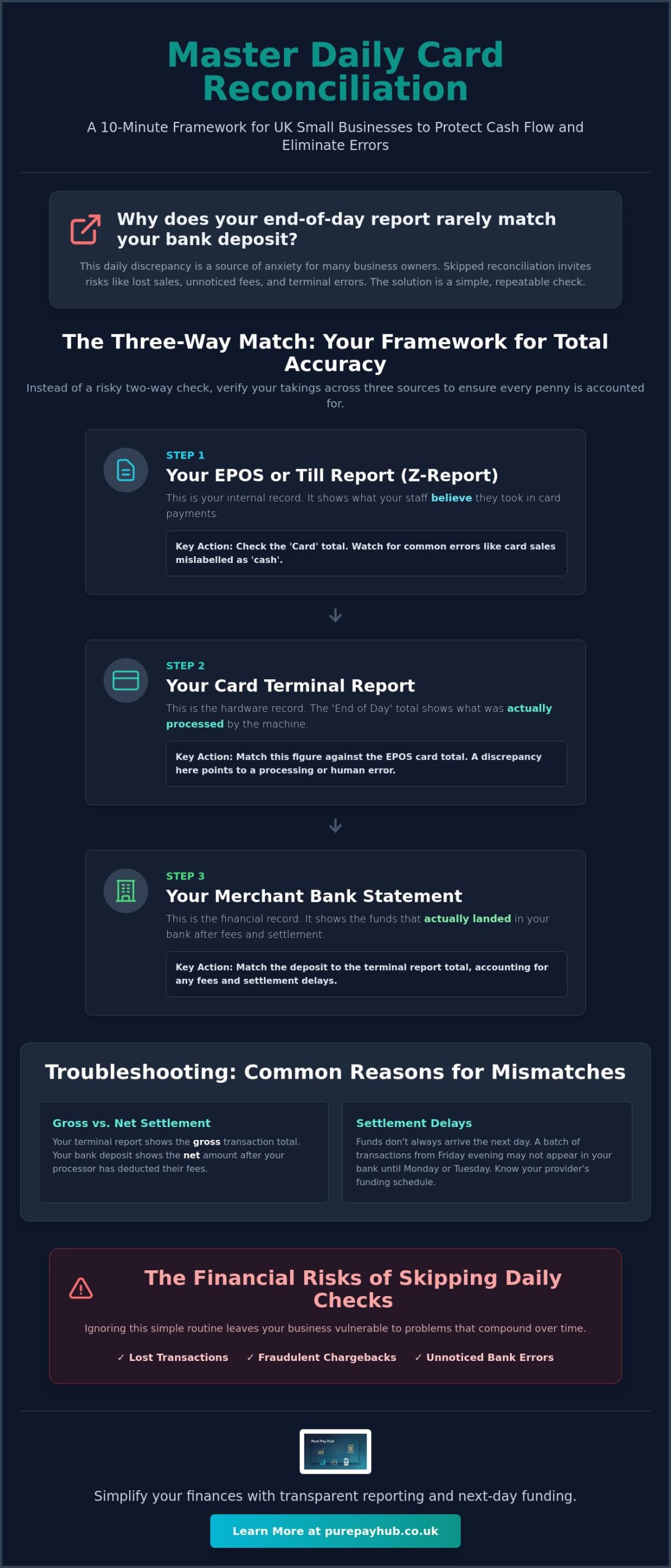
    • Learn how to reconcile card payments daily using the Three-Way Match framework to ensure your EPOS, terminal, and bank statement always align.
    • Identify the common reasons why your bank balance rarely matches your end-of-day reports, including the nuances of gross versus net settlement.
    • Implement a repeatable 10-minute workflow that transforms a complex accounting chore into a simple, stress-free habit.
    • Discover how transparent reporting and next-day funding can simplify your financial oversight and protect your business cash flow.

    What is Daily Card Reconciliation and Why Does it Matter?

    At its core, card reconciliation is the simple process of matching your daily card sales to the actual funds deposited into your merchant account. It’s a verification step. You’re ensuring that the digital records from your card machine align perfectly with the cash that eventually lands in your bank. Understanding how to reconcile card payments daily is not just about balancing books; it’s about protecting your revenue from invisible leaks. It’s the difference between assuming you’ve been paid and knowing you’ve been paid.

    Whilst some traditional accounting advice suggests reconciliation can be a monthly task, for a busy UK SME, that’s often too late. Daily is the magic interval. Errors are fresh in your mind. If a staff member accidentally cancelled a transaction or a terminal glitch occurred during the lunch rush, you’ll remember the context today. You won’t remember it in three weeks. This proactive habit turns a potential financial crisis into a minor, five-minute correction. It keeps your data clean and your stress levels low.

    There’s also a vital link between this routine and your wider business health. Accurate cash flow forecasting depends on knowing exactly when money hits your account. Daily checks remove the guesswork. You begin to see the patterns in settlement timings and fee deductions. This level of clarity makes your VAT returns and Year-End accounts far less daunting. For professional support with these tasks, DBM Accountancy Ltd provides expert tax services for ambitious businesses. Instead of facing a mountain of discrepancies when HMRC deadlines loom, you have a verified, transparent trail of every transaction.

    The Financial Risks of Skipping Reconciliation

    Skipping this process invites unnecessary risk. Transactions can occasionally fail to process correctly, leaving “lost” sales that never reach your bank. You might also fall victim to fraudulent chargebacks. If you don’t spot a suspicious reversal quickly, the window to dispute it can close. Daily checks also help you catch bank errors or terminal glitches. If these go unnoticed for weeks, they become incredibly difficult to trace and rectify with your provider.

    Reconciliation vs. Bookkeeping: Knowing the Difference

    It’s vital to distinguish between these two pillars of finance. Bookkeeping is the act of recording transactions. Bank reconciliation is the act of verifying them. They work together to provide a “true” view of your business. You cannot rely solely on your bank statement to track sales. A bank statement only shows what arrived, not what should have arrived. Knowing how to reconcile card payments daily bridges that gap, ensuring your records reflect reality rather than just a list of deposits.

    The Three-Way Match: A Framework for Total Accuracy

    Most business owners make the mistake of comparing their till reports directly to their bank statements. This “Two-Way Match” is risky. It ignores the critical middle step where transactions are actually processed. To truly master how to reconcile card payments daily, you must adopt the Three-Way Match. This process ensures the accuracy, completeness, and validity of your financial data by cross-referencing three distinct sources: your EPOS system, your physical card terminal, and your merchant bank portal.

    If you only check your till against your bank, you might miss a transaction that was approved on the till but failed at the terminal hardware. Conversely, a staff member might accidentally hit the “Cash” button for a card sale. Without the terminal report as a bridge, you’ll never know which record is the “truth”. By organising your data into these three pillars, you create a robust safety net that catches human error and technical glitches alike.

    Step 1: The EPOS or Till Report

    Start by pulling your daily Z-Report. The Z-Report is the primary internal record of your daily takings. Look specifically at the “Card” total. This figure represents what your staff believe they took in card payments. It’s common to find errors here, such as a sale being mislabelled as cash during a busy period. Identifying these slips early prevents them from skewing your final figures and keeps your internal records clean.

    Step 2: The Card Terminal End-of-Day Report

    Run a “Total” or “End of Day” report on your physical card machine. This shows every transaction that actually passed through the terminal’s hardware and reached the processor. Match this total against your EPOS card total. If the terminal says “No Transactions” but your till is full of card sales, you have a processing issue that needs immediate attention. If the numbers align, you’ve confirmed the sale was both recorded and successfully processed.

    Step 3: The Merchant Bank Portal

    Log into your merchant dashboard to view your Settlement Report. This bridges the gap between the terminal and your bank. You’ll see “Settled” funds (money on its way) versus “Pending” funds (transactions still being verified). Verify that the gross amount matches your terminal report before any fees are taken. Understanding these settlement timings is much easier when you use a transparent merchant service that provides clear, real-time data. Remember that whilst the sale is instant, the fund appearance in your business bank account usually follows a specific settlement cycle.

    Troubleshooting Common Reconciliation Discrepancies

    It’s a common frustration for UK merchants. You finish a long day, run your reports, and find the figures don’t match your bank statement. Don’t panic. These gaps are rarely signs of missing money. Most often, they’re simply quirks of the payment system. Learning how to reconcile card payments daily involves understanding these structural discrepancies so you can identify real issues amongst the noise.

    These mismatches usually stem from how and when your money is processed. If you expect a perfect 1:1 match between your daily till report and your bank balance every single morning, you’ll likely be disappointed. The key is knowing which “ghost” figures to look for and how to account for them in your records.

    Understanding Net vs. Gross Settlement

    Gross settlement is the gold standard for simplicity. You receive the full sale amount in your bank, and your provider bills you for fees separately, usually once a month. This makes your bank statement easy to read. Net settlement is more complex. Here, your provider deducts transaction fees before the money reaches your account. If you’re on a net model, your bank deposit will always be lower than your terminal report. You’ll need to calculate the missing percentage to verify it matches your agreed rates. This step-by-step guide to credit card reconciliation provides a solid foundation for handling these calculations and spotting fee-related gaps.

    The Impact of “Next-Day” and “T+3” Funding

    In the UK, settlement cycles vary between providers. Some offer next-day funding, whilst others use a T+3 model, meaning funds take three working days to clear. Weekends and bank holidays disrupt this flow even further. A sale made on a Friday evening might not hit your bank until Tuesday or Wednesday. This delay creates a “rolling” reconciliation. You aren’t just matching today’s sales; you’re verifying sales from several days ago. Keeping a simple log of “Pending” funds helps you track this movement without losing your mind.

    Handling Refunds and Chargebacks

    Refunds and chargebacks are major reconciliation disruptors. A refund issued today might be deducted from today’s total, even if the original sale happened last week. This makes your daily terminal report look lower than your EPOS sales. Chargebacks are even more sudden. These deductions often happen without prior warning in your portal, creating a mismatch that looks like a technical error. Always check your merchant dashboard for “Adjustments” before assuming a transaction has gone missing.

    Human Error and Operational Slips

    Sometimes the cause is simpler. Human error remains the most frequent reason for a small £5 or £10 mismatch. A staff member might split a bill incorrectly or accidentally process a sale as cash on the till whilst taking card on the terminal. These slips are easy to spot when you check daily. They’re nearly impossible to find if you wait until the end of the month. By knowing how to reconcile card payments daily, you catch these minor operational errors before they skew your monthly profit and loss reports.

    How to Reconcile Card Payments Daily: A Practical Guide for UK SMEs

    A 10-Minute Step-by-Step Daily Reconciliation Workflow

    You don’t need expensive enterprise software or a degree in accounting to maintain perfect books. A simple, disciplined routine is enough for most UK small businesses. Mastering how to reconcile card payments daily takes just ten minutes when you have your tools ready. Before you start, ensure you have three things to hand: your EPOS Z-report, your card terminal’s end-of-day printout, and access to your merchant portal.

    Consistency is the foundation of accuracy. By following a set workflow, you remove the guesswork and ensure that no transaction slips through the cracks. This process isn’t about complex maths. It’s about verifying that the digital trail of your sales matches the physical reality of your bank deposits.

    Beyond the digital trail, understanding your physical store traffic can provide valuable context to your sales data; many retailers explore FootfallCam Pro2 People Counters to gain insights into visitor conversion rates alongside their daily financial reconciliation.

    • Step 1: Close the day. Run the end-of-day reports on your EPOS system and your card terminal simultaneously. This ensures the “bucket” of sales recorded on your till aligns with the “batch” of transactions on your hardware.
    • Step 2: Compare the totals. Match the card total from your till report against the grand total on your terminal slip. Note any immediate variances. If they match, you’ve confirmed that every sale recorded was successfully processed.
    • Step 3: Verify the batch. Log into your merchant portal. Confirm that the status of today’s batch is “Sent” or “Settled”. This confirms the money is officially on its way to your bank.
    • Step 4: Update your tracker. Enter these figures into a simple spreadsheet or your accounting software. Recording these daily snapshots prevents small errors from snowballing into a month-end crisis.

    Setting a Reconciliation “Cut-off” Time

    Timing errors are a major cause of reconciliation headaches. To avoid this, set a fixed “cut-off” time for your checks. Many merchants find that 10:00 AM the following morning is the best time to look at the previous day’s sales. This allows the banking systems time to catch up and update your portal. If you run a late-night hospitality business, ensure your business “day” aligns with your provider’s batch window. This prevents sales made after midnight from bleeding into the wrong report.

    Documenting Variances: The “Reason Code” Method

    Don’t waste hours chasing a few pennies. Use a “Reason Code” system to log discrepancies quickly. Mark “HE” for human error, such as a staff member hitting the wrong button, or “TF” for a timing factor. If a mismatch is within a tiny tolerance, like £0.01, don’t lose sleep over it. A well-maintained variance log is a gift to your accountant at year-end, providing a clear map of every minor hiccup. If your current provider makes this data hard to find, you can upgrade to a clearer payment system that simplifies your daily reporting and protects your cash flow.

    Simplifying Your Finances with PurePay Hub

    We’ve established that a disciplined routine is the key to financial clarity. However, your merchant provider shouldn’t make you work hard to access your own data. PurePay Hub provides the transparent reporting you need to master how to reconcile card payments daily without the usual administrative headache. Our platform acts as a stabilising force for your business, offering a modern fintech experience that never loses focus on the individual business owner.

    One of the biggest hurdles in reconciliation is when your EPOS system and card machine operate in silos. We solve this by providing integrated solutions where your hardware and software talk to each other in real time. This automation eliminates the risk of manual entry errors or mislabelled transactions that often lead to end-of-day frustration. If a discrepancy does occur, you aren’t left to figure it out alone. You have direct access to UK-based experts who act as your supportive business partner, helping you resolve issues quickly so you can get back to running your company.

    Next-Day Access to Funds

    Traditional “T+3” settlement cycles turn reconciliation into a stressful guessing game. Waiting three or five days for funds to clear makes it nearly impossible to maintain a clean, real-time record of your cash flow. PurePay Hub offers next-day funding specifically tailored for UK SMEs. This ensures that the sales you made yesterday are the funds you see in your bank account today. This consistency simplifies your financial admin and provides an immediate view of your actual cash position. You no longer need to manage complex rolling logs; your bank statement simply follows your terminal reports in a logical, predictable rhythm.

    Transparent Rates and Simple Statements

    Hidden markups and complex fee structures are the primary enemies of accurate accounting. We believe in total transparency. Our merchant statements are designed to be read in seconds. They align perfectly with your daily terminal reports, making the Three-Way Match a straightforward task rather than a forensic investigation. You’ll know exactly what fees to expect, which removes the “ghost” figures that often cause anxiety whilst you are balancing the books. By choosing a partner that values honesty, you ensure that every penny of your card sales is accounted for without the need for complex workarounds.

    Simplify your daily reconciliation with a PurePay Hub card machine and take the stress out of your end-of-day routine. Our no-nonsense approach to payments ensures your bank balance always matches your hard work.

    Take Control of Your Daily Cash Flow

    Financial clarity shouldn’t be a luxury for UK small businesses. By implementing the Three-Way Match and sticking to a disciplined 10-minute workflow, you protect your revenue from human error and technical glitches. Mastering how to reconcile card payments daily ensures that your hard-earned sales actually reach your bank account without invisible leaks or timing confusion. It turns a daunting accounting chore into a simple habit that supports your long-term growth.

    You deserve a payment partner that prioritises honesty and efficiency over complex jargon. We provide the tools you need to stay in control, including debit card rates from 0.3% and next-day access to your funds. With no hidden markups and transparent reporting, you can spend less time on admin and more time growing your business. Switch to PurePay Hub for clearer reporting and next-day funding to experience a fairer, more dependable way to manage your payments. It’s time to trade financial anxiety for informed confidence. Your business is worth the extra ten minutes of care.

    Frequently Asked Questions

    Why does my card machine total not match my bank statement?

    Mismatches usually occur due to settlement delays or specific fee structures. If your provider uses net settlement, they deduct transaction fees before depositing the funds into your account. Additionally, sales made after your daily batch “cut-off” time often won’t appear on your bank statement until the following working day. This creates a temporary gap that is easily explained once you check your merchant portal.

    How long should card payment reconciliation take each day?

    A disciplined routine should take no more than 10 minutes of your time each morning. By preparing your reports in advance and following a structured Three-Way Match workflow, you can verify your sales figures with total efficiency. This small daily investment prevents hours of forensic accounting at year-end. It ensures that any discrepancies are caught and resolved whilst the details are still fresh in your mind.

    What is a merchant settlement report?

    A merchant settlement report is a detailed record showing which batches of transactions have been cleared for payment. It provides a transparent breakdown of gross sales, refunds, and any fee deductions. This report is the vital link between your terminal and your bank. It allows you to see exactly which funds are “pending” and which have been “settled”, making it easier to track your true cash position.

    Can I automate my daily card reconciliation?

    You can certainly automate large parts of the process by using integrated EPOS and card machine systems. These tools synchronise data automatically, which significantly reduces the risk of human error during the busy workday. However, even with the best automation, a brief daily oversight remains essential. A quick manual check ensures that technical glitches or “ghost” transactions don’t skew your final financial records.

    What should I do if I find a discrepancy in my card payments?

    First, check for common operational slips like a sale being recorded as cash instead of card on your till. Review your merchant portal for any pending refunds or chargebacks that might have reduced your daily total. If the figures still don’t add up after these checks, contact your provider’s UK-based support team. They can provide a detailed transaction investigation to help you locate the missing funds.

    Do I need to reconcile payments on weekends and bank holidays?

    You aren’t required to work on holidays, but you must understand how they affect your financial data flow. Banking systems don’t process settlements on weekends or bank holidays. This means your Tuesday bank deposit might contain a combined total from Friday, Saturday, and Sunday sales. Understanding these timing factors is key to maintaining a stress-free reconciliation routine that accurately reflects your business activity.

    How do transaction fees affect my daily reconciliation?

    Fees change the final figure you see on your bank statement depending on your settlement model. In a net settlement model, your provider takes their cut before paying you. This makes how to reconcile card payments daily slightly more complex as you must account for that missing percentage. Choosing a provider with transparent rates and simple statements makes it much easier to verify that you are being charged fairly.

    Is it better to reconcile card payments daily or monthly?

    Daily reconciliation is the gold standard for healthy cash flow management in any UK SME. It allows you to spot errors, fraud, or terminal glitches immediately. Waiting until the end of the month makes it nearly impossible to remember the specific context of a small mismatch. Learning how to reconcile card payments daily protects your margins and gives you informed confidence in your bank balance.

  • Choosing the Best Restaurant EPOS System in the UK for 2026

    Choosing the Best Restaurant EPOS System in the UK for 2026

    How much of your hard-earned Friday night profit is disappearing into opaque transaction fees before the weekend even starts? You likely know the frustration of thin margins being eaten away by hidden charges and the stress of system downtime during a peak dinner rush. It’s common to feel that your current setup, with its fragmented reporting between the till and the card machine, is holding your business back rather than helping it grow.

    Choosing the right restaurant EPOS system UK for 2026 can change that by slashing transaction costs and finally uniting your front-of-house with the kitchen. We promise to show you how to select an integrated solution that provides next-day access to your funds, lowers your merchant service charges, and ensures your operations run seamlessly. This guide explores the latest hardware and software strategies to help you reclaim your margins whilst maintaining the transparency your business deserves. You’ll learn how to move from a state of frustration to one of informed confidence, ensuring your technology acts as a supportive partner in your success.

    Key Takeaways

    • Understand how to transition from a basic till to an integrated ecosystem that manages payments, staff, and stock from one central hub.
    • Identify the essential features for a restaurant EPOS system UK, including floor plan customisation and Kitchen Display Systems that reduce order errors.
    • Learn to calculate the Total Cost of Ownership by contrasting fixed hardware costs with variable merchant service charges to protect your margins.
    • Discover the steps to ensure a seamless transition between providers without experiencing system downtime or losing a single night of trade.
    • Leverage transparent transaction rates as low as 0.3% for debit and 0.5% for credit to turn every payment into a growth opportunity.

    What is a Restaurant EPOS System and Why is it Critical in 2026?

    A What is a Point of Sale (POS) system is no longer just a box for holding cash. In 2026, a restaurant EPOS system UK acts as the central nervous system of your entire hospitality business. It’s the point where every customer interaction, kitchen order, and stock adjustment meets. The days of simple, standalone tills are over. Modern owners have transitioned toward integrated ecosystems that manage payments, staff scheduling, and inventory in one place. This shift is critical because 2026 brings unique pressures. With rising operational costs and thin margins, you need real-time data synchronisation to make informed decisions. You aren’t just managing a till anymore; you’re optimising a digital business partner that works as hard as you do.

    The Evolution of Hospitality Tech: From Tills to Ecosystems

    Legacy setups often relied on standalone card machines that didn’t talk to the till. This created fragmented reporting and endless manual reconciliation. Modern EPOS systems remove this friction entirely. Because they’re cloud-based, you can monitor your restaurant’s performance from your phone whilst away from the site. This transparency is vital for spotting waste or staffing issues early. In a high-inflation economy, the speed of your cash flow is also paramount. Integrated systems provide next-day access to funds, ensuring your business stays liquid and ready for the next delivery. This reliability helps alleviate the stress that business owners feel regarding complex fee structures and delayed payments.

    Why “Good Enough” is No Longer Enough for UK Restaurants

    Consumer behaviour has changed rapidly. Statistics from early 2026 show that contactless payments now account for 92% of all hospitality transactions. If your system is slow or prone to downtime, you’re directly hurting your table turnover. A laggy interface during a peak Friday night doesn’t just frustrate staff; it costs you covers. Security is another non-negotiable factor. With PCI DSS v4.0.1 now being the sole supported standard as of 2025, using outdated tech risks monthly non-compliance fines. A modern restaurant EPOS system UK keeps you compliant automatically, protecting your reputation and your revenue. By prioritising clarity and efficiency, you ensure your technology supports your growth rather than acting as a bottleneck.

    Essential Features Every UK Restaurant EPOS Must Have

    The best systems don’t just process payments; they orchestrate the entire floor. A robust restaurant EPOS system UK provides a clear, customisable floor plan that acts as the foundation for your service speed. Your staff should be able to see, at a glance, which tables are waiting for drinks, which are mid-course, and which are ready for the bill. This visual clarity prevents bottlenecks and ensures no customer is left waiting during a frantic shift. Beyond the floor plan, your system must offer granular inventory tracking. With food prices remaining volatile in 2026, knowing your exact cost-per-dish is the only way to protect your margins. Every ingredient should be accounted for, from the premium steaks to the garnish.

    Front-of-House Efficiency: Table Management and Mobile Ordering

    Speed at the table is the heartbeat of a busy shift. By adopting restaurant industry technology trends like mobile tableside ordering, you eliminate the constant back-and-forth to a central terminal. Waitstaff can send orders directly to the kitchen the moment they are taken; this significantly reduces lead times and improves order accuracy. For weekend diners, split-billing features are no longer optional. Customers expect to pay for exactly what they had without a mathematical debate at the end of the night. These tools also allow you to build a database of your guests. Recognising a favourite customer’s previous order or dietary preference builds the kind of loyalty that keeps a local business thriving.

    Back-of-House Control: Inventory and Kitchen Integration

    Your kitchen is where your margins are won or lost. A Kitchen Display System (KDS) replaces messy paper tickets with clear, digital prompts that reduce errors and food waste. These screens ensure the kitchen team receives orders the second they are placed, keeping the rhythm of service steady. Integration with your inventory is equally vital. When a burger is sold, your system should automatically deduct a bun and a patty from your stock levels in real-time. Automated low-stock alerts prevent the awkwardness of a server having to tell a guest that a menu item is unavailable mid-service. This level of control allows you to run a leaner, more profitable operation. If you are looking to upgrade, choosing a modern EPOS system can help you centralise these complex tasks into one manageable dashboard.

    Managing your team effectively requires more than just a paper rota. Modern systems include staff management tools that track individual performance and handle shift scheduling. You can see which servers are upselling effectively and which shifts require more support. By identifying these patterns, you can optimise your labour costs whilst ensuring your best staff are rewarded. This data-driven approach turns your EPOS from a simple tool into a strategic asset for your restaurant’s long-term growth.

    Calculating the Real Cost: Software Fees vs. Transaction Rates

    Finding the most cost-effective restaurant EPOS system UK requires looking past the initial sales pitch. You must evaluate the Total Cost of Ownership (TCO) to understand how much money actually leaves your bank account each month. Many owners focus on the hardware price or the software subscription whilst ignoring the variable merchant service charges that follow. These transaction fees are often the largest expense in your technology stack. The effective rate is the true measure of payment processing costs; it represents your total monthly fees as a percentage of your total sales volume.

    A transparent financial strategy balances fixed and variable costs. Fixed monthly hardware rentals provide predictability, but they shouldn’t be bundled with opaque processing terms. You need a partner that identifies every cost clearly, from the terminal lease to the per-transaction markup. This clarity helps you move from a state of frustration regarding hidden fees toward a state of informed confidence in your margins. Your technology should be a stabilizing force for your business finances, not a source of unexpected overheads.

    The Trap of “Free” EPOS Software

    Entry-level providers often lure business owners with the promise of “free” software. This is frequently a financial trap that punishes your success. These systems usually carry high transaction rates of 1.75% or more, which can cost a thriving restaurant thousands of pounds in unnecessary fees. For a restaurant with a £20,000 monthly turnover, a “free” system at a 1.5% rate costs you £300 a month. Conversely, a paid system with a £50 monthly fee and a 0.3% rate costs you only £110 in total. The “free” option is actually £190 more expensive every single month. You should also insist on next-day access to funds as a standard feature. In a fast-moving hospitality environment, waiting days for your own money is an outdated practice you don’t have to accept.

    Understanding Merchant Service Charges (MSC)

    Transparency in Merchant Service Charges (MSC) is the no-nonsense approach every owner should demand. You deserve to know exactly what you’re paying for debit and credit transactions. Fair rates, such as those from PurePay, typically start around 0.3% for debit cards and 0.5% for credit cards. These small differences in percentage points can save you enough to hire another staff member or upgrade your kitchen equipment over the course of a year. Avoid long-term contracts that hide annual fee increases or exit penalties. A supportive business ally won’t need to lock you in with complex legalese; they’ll keep your business through fair service and honest pricing. By prioritising these clear fee structures, you ensure your technology acts as a growth engine rather than a drain on your resources.

    Choosing the Best Restaurant EPOS System in the UK for 2026

    Organising a Seamless Transition to Your New System

    Switching your restaurant EPOS system UK shouldn’t feel like a leap into the dark. It’s a strategic move. It requires a structured plan to avoid losing a single night of trade. Many owners worry about the administrative headache of setting up new technology during a busy season. The right partner makes this transition effortless by prioritising clarity over complexity. You need a system that stabilises your finances from day one. This transition follows a simple logic: identify the bottlenecks in your old setup and configure the new one to solve them. It’s about improvement, not just replacement.

    Data Migration: Moving Your Menu and Stock

    Moving your data is the perfect time for a digital spring clean. Audit your current menu before you start the import. Remove unpopular items that clutter your interface and slow down your servers. This ensures a clean import into your new setup. Crucially, you must map your VAT categories correctly. This keeps you compliant with HMRC and prevents accounting errors later. Generic global advice often ignores these UK-specific banking and tax requirements. A provider that offers dedicated technical support during this phase prevents costly mistakes. They help you bridge the gap between your old till and your new integrated ecosystem whilst ensuring your historical data remains accessible for year-end reporting.

    Staff Buy-In: Training for Peak Performance

    Your staff use the system during the frantic Saturday night rush. They need an interface that makes sense immediately. A punchy, intuitive design reduces the learning curve for new hires and seasoned veterans alike. Don’t go live without a mock service. Run a practice shift with your team to test the workflow. This builds the confidence your team needs to handle high-pressure situations without hesitation. Once live, use the granular reporting to reward your most efficient performers. You can see which staff members are upselling effectively or managing their tables with the most speed. This turns a technical change into a motivational tool for your entire team.

    A successful transition relies on a partner who values your time and your margins. You deserve a system that is as disciplined and professional as your kitchen. By following a clear onboarding framework, you can upgrade your technology without the stress usually associated with new software. If you’re ready to leave behind opaque fees and fragmented reporting, you can switch to a more transparent EPOS system today and start reclaiming your hard-earned profits.

    Why PurePay Hub is the Growth Engine for UK Restaurants

    PurePay Hub acts as a stabilising force for your restaurant’s finances. In an industry often viewed with scepticism, we provide a transparent alternative to the opaque practices of traditional banks. Choosing our restaurant EPOS system UK means you aren’t just buying hardware; you’re entering a disciplined partnership. We offer 0.3% debit and 0.5% credit transaction rates to ensure your margins remain protected. This clear fee structure allows you to forecast your overheads with absolute certainty. Our goal is to alleviate the stress that business owners feel regarding hidden costs and complex markup models.

    Integrated Payments and Next-Day Funding

    Integrated payments remove the frustration of manual entry on card machines. When your till and your terminal speak the same language, human errors disappear. This efficiency is supported by our range of Countertop Card Machines and Portable Card Machines, designed to suit any restaurant layout. We believe in calm advocacy for our partners, which is why next-day access to your funds is a standard feature. You shouldn’t have to wait for your own money to arrive whilst your suppliers need paying. By prioritising your cash flow, we ensure your technology acts as a supportive ally rather than a bottleneck.

    Unlocking Capital with Business Cash Advances

    We understand that growth requires capital, but traditional bank loans are often too rigid for the hospitality sector. Our Business Cash Advance allows you to use your future card sales to secure unsecured capital today. This is a game-changer for owners planning refurbishments or kitchen upgrades. Unlike bank loans with fixed monthly repayments, this model follows a “pay-as-you-earn” structure. Your repayments are a small, agreed percentage of your daily card sales. If you have a quieter week, your repayments automatically reduce. It’s a flexible, no-nonsense way to fund your expansion without the pressure of traditional debt cycles.

    Our focus remains on the individual business owner. We disdain hidden markups and corporate jargon, choosing instead to lead our partners toward a state of informed confidence. By centralising your payments, your reporting, and your funding, we help you lead your business with a clear head. You deserve a partner that values efficiency and straight-talking as much as you do. You can organise a transparent rate review with PurePay Hub today to discover how much your business could save.

    Reclaiming Your Margins in 2026

    The right technology should be a stabilising force for your finances, not a source of stress. You’ve seen how a modern restaurant EPOS system UK acts as a central nervous system, uniting your front-of-house with the kitchen whilst protecting your hard-earned margins. By looking past the trap of “free” software and focusing on transparent transaction rates, you can turn every payment into a growth opportunity. Whether you’re streamlining a single site or planning a multi-venue expansion, the path to a more profitable 2026 starts with clarity and integrated reporting.

    We are here to act as your fair partner in an industry that often feels opaque. You deserve a setup that offers next-day funding as standard and provides no-nonsense, UK-based support when you need it most. It’s time to stop letting hidden fees eat into your success. We provide debit rates from 0.3% and credit rates from 0.5% to ensure you keep more of what you earn every single day.

    Switch to PurePay Hub for 0.3% rates and integrated EPOS

    Take the next step toward a more efficient, profitable future for your restaurant. Your success is our priority.

    Frequently Asked Questions

    How much does a typical restaurant EPOS system cost in the UK?

    The total cost depends on your specific hardware needs and the number of terminals required for your floor plan. You will typically encounter a combination of upfront hardware costs for screens and printers; a monthly software subscription fee; and variable transaction rates. It is vital to look at the total cost of ownership rather than just the initial price tag to ensure your margins remain protected from hidden markups.

    Can I keep my existing card machine when I switch EPOS providers?

    You can technically use a standalone card machine, but you will lose the significant advantages of an integrated restaurant EPOS system UK. Integrated systems allow your till and terminal to communicate directly; this removes the need for manual data entry and prevents reconciliation errors at the end of a shift. Switching to a unified provider usually simplifies your reporting and results in faster access to your funds.

    What is the difference between an EPOS system and a standard cash register?

    A standard cash register is a passive tool for recording sales and storing cash; an EPOS system is an active partner that helps you optimise your entire business. It tracks inventory in real-time, manages staff rotas, and provides granular data on your most profitable dishes. Whilst a till only handles the final transaction, an EPOS system orchestrates everything from the initial order to the final kitchen prompt.

    How long does it take to install a new restaurant EPOS system?

    A standard installation usually takes between one and three days depending on the size of your venue and the complexity of your menu. This period includes the physical setup of your terminals and a dedicated training session to ensure your team is confident before the first live service. Choosing a partner that prioritises quick onboarding helps you transition between systems without losing a single night of trade.

    Do I need a specific internet speed to run a cloud-based EPOS?

    Stability is more important than raw speed; most cloud-based systems run perfectly on a standard fibre connection with speeds of 10-20Mbps. You should ensure your Wi-Fi coverage is consistent across your entire dining area to support portable card machines for tableside ordering; to learn more about choosing a reliable connection for your business, consider comparing standard internet options. We recommend using a dedicated network for your business operations to keep your connection fast and secure during peak periods.

    Is a business cash advance better than a traditional bank loan for my restaurant?

    A business cash advance offers more flexibility for the hospitality sector because repayments are based on a small percentage of your daily card sales. This “pay-as-you-earn” model means you pay back less during quieter weeks, which protects your cash flow. Traditional bank loans require rigid monthly payments regardless of your turnover; this can create unnecessary financial pressure during the off-season or slower months.

    What happens if my internet goes down during service?

    Modern systems include an offline mode that allows you to continue taking orders and processing payments even if your connection drops. All data synchronises automatically once your internet is restored. This feature ensures that a temporary technical glitch doesn’t disrupt your service or lead to lost revenue during a busy Friday night rush. Your business remains operational and your data remains secure.

    How does an integrated EPOS help with HMRC and VAT reporting?

    An integrated restaurant EPOS system UK automatically maps every sale to the correct VAT category; this ensures your reporting is accurate and fully compliant with HMRC requirements. You can export clean, professional data directly into your accounting software, which saves hours of manual reconciliation for your bookkeeper. This level of transparency provides you with an effortless audit trail and total confidence in your financial records.

  • Card Machine for Tradesmen UK: The 2026 Guide to Reliable On-Site Payments

    Card Machine for Tradesmen UK: The 2026 Guide to Reliable On-Site Payments

    How much time did you spend this week chasing a bank transfer that was “definitely sent” or waiting for a cheque to clear? It’s a common frustration for professionals who still rely on manual payments or basic apps. A 2026 study by money.co.uk found that only 46% of UK SMEs with card machines fully understand their fees. You shouldn’t have to be a financial expert to get paid fairly for your hard work. Finding the right card machine for tradesmen UK means moving past high transaction fees on small jobs and the constant worry of a signal dropping out when you’re on-site.

    We believe your payment setup should be a tool for growth, not a source of stress. This guide shows you how to eliminate “cash-only” limitations and secure your earnings instantly at the end of every job. You’ll discover how to access lower rates than standard pay-as-you-go readers and ensure your money is in the bank by the next morning. We’ll break down the latest 2026 hardware options, from portable terminals to mobile readers, so you can build a reliable cash flow that supports your trade business.

    Key Takeaways

    • Meeting the “contactless expectation” helps you secure payments instantly and reduces the security risks of carrying large amounts of cash in your van.
    • Compare mobile and portable terminals to find the right connection type for your work environment, whether you need 4G connectivity for remote sites or Wi-Fi for a workshop.
    • Learn how to avoid the “flat-rate trap” by choosing a card machine for tradesmen UK that offers transparent Merchant Service Charges instead of high fixed fees.
    • Follow a simple checklist to prepare your trade credentials for a quick setup, ensuring you can take professional on-site payments without delay.
    • Discover how switching to a dedicated merchant partner can provide faster settlement times and lower rates that respect your hard-earned profit margins.

    Beyond “Cash Only”: Why UK Tradesmen are Switching to Card Machines

    Cash is no longer king on the British doorstep. In 2026, most homeowners don’t keep enough physical currency to cover even a basic call-out fee, let alone a full boiler service or electrical rewire. If you tell a customer you’re “cash only,” you’re creating a hurdle that many won’t bother to jump. Choosing a reliable card machine for tradesmen UK removes this friction. It ensures you can accept payment the moment the job is finished, rather than sending your customer on a late-night hunt for an ATM.

    Security is another major driver for this shift. Carrying large amounts of cash in a van makes you a target. It’s a liability that creates unnecessary stress during your workday. Digital payments move money directly from the customer’s account to yours, bypassing the physical risks entirely. Beyond safety, a professional payment terminal builds immediate credibility. It signals that you’re a legitimate, modern business. This trust is vital when you’re working in a new client’s home for the first time.

    The Death of the Bank Transfer Lag

    We’ve all heard the phrase, “I’ll pay it tonight, I promise.” Too often, that promise turns into days of chasing unpaid invoices and sending awkward reminder texts. This lag kills your business cash flow. When you take a card payment on-site, the transaction is settled before you even pack your tools away. There is also a distinct psychological shift at play. Customers are statistically more likely to approve small extras or additional repairs when they can pay by card; the friction of setting up a new bank transfer often stops those “while you’re here” jobs from happening. You’ll also spend far fewer hours on a Sunday evening reconciling your bank statements against your job list.

    VAT and Tax Compliance Simplified

    Staying on top of your books is easier when every job creates its own digital footprint. As Making Tax Digital (MTD) requirements become more stringent, having an organised digital record of every transaction is a massive advantage. You can send automatic digital receipts to your customers via email or SMS, which provides a better experience for them and a cleaner paper trail for your accountant. Modern card machines integrate directly with your accounting software to save you up to three hours of admin every single week. This automation reduces the risk of manual entry errors and ensures your VAT returns are based on accurate, real-time data.

    Portable vs. Mobile: Choosing the Right Terminal for the Job

    Picking the right hardware is about more than just aesthetics. For a busy plumber or electrician, a card machine for tradesmen UK needs to be as rugged as a cordless drill. You have two main choices: portable and mobile. A Portable Card Machine relies on Wi-Fi. It’s excellent if you have a workshop or if your customers are happy for you to jump on their home network. However, a Mobile Card Machine is the true workhorse for on-site visits. These devices come with built-in SIM cards, allowing you to process payments via 4G or GPRS from a driveway, a building site, or the side of the road.

    Battery life is a non-negotiable factor. You need a terminal that lasts a full 10-hour shift without needing to sit on a charging cradle. There’s nothing more unprofessional than a dead battery just as a client reaches for their wallet. Durability matters just as much. Your terminal will live in a dusty van, sit on workbenches, and occasionally get knocked over. Professional-grade hardware is built to withstand these environments, unlike consumer-level tablets or flimsy plastic readers that often fail under pressure.

    The Connectivity Checklist

    Connectivity issues are the biggest cause of payment frustration. While Wi-Fi is fast, it’s often unreliable at the far end of a garden or in a basement. GPRS and 4G provide a more stable alternative in rural postcodes. We recommend looking for devices with roaming SIM cards. These automatically switch to the strongest available network, whether that’s EE, Vodafone, or O2. This “stand-alone” advantage is why we advise against phone-tethered apps. You don’t want to be faffing with Bluetooth pairing or draining your phone battery when you could be moving to the next job.

    Payment Links and Virtual Terminals

    Not every payment happens face-to-face. A Virtual Terminal allows you to take secure deposits over the phone before you even load the van. This reduces the risk of no-shows and secures your time. For jobs where you can’t access the property, you can send secure Payment Links via SMS. The customer clicks, pays, and you receive an instant notification. This is also useful for setting up recurring card payments for maintenance contracts or service plans. If you are looking for a setup that handles both on-site and remote payments, exploring a Mobile Card Machine is a smart first step.

    Demystifying the Cost: Transaction Rates vs. Monthly Rentals

    Many businesses fall into the “flat-rate trap” when they first start out. It feels safe to have no monthly costs, but this convenience comes at a premium. If your turnover is consistent, a 1.75% transaction fee is simply too high. For an established business, a dedicated card machine for tradesmen UK with a merchant account is usually the more profitable path. Merchant Service Charges (MSC) represent the core cost of processing any UK card payment. These rates often sit between 0.3% and 0.5% for debit cards. When you add a small monthly rental fee for a professional terminal, your total monthly spend often drops significantly compared to flat-rate apps.

    Interchange fees shouldn’t be a mystery amongst traders. This is the fee paid to the customer’s bank for every transaction. Transparent providers pass these through clearly rather than bundling them into a high, opaque flat rate. Paying for hardware rental ensures you have a reliable device and access to these lower processing rates that respect your profit margins. It’s a stabilizing force for your finances that provides clarity instead of confusion.

    Optimising your overheads doesn’t stop at transaction fees; managing your vehicle’s daily expenses is just as crucial. For instance, Fleetmaxx Solutions provides a way to compare fuel management solutions, helping you keep your refuelling costs under control while you move between jobs.

    Calculating Your Break-Even Point

    Let’s look at the numbers. If you process £5,000 a month at a 1.75% flat rate, you pay £87.50. With a merchant rate of 0.4% plus a £20 rental fee, your cost is only £40. That is a saving of £47.50 every single month. Pay-as-you-go models are fine for hobbyists or those with very low volumes. Professional tradespeople need predictable, lower costs to protect their margins. Be wary of “Next Day Funding” claims in flat-rate apps; they often charge extra for this service, whereas merchant accounts frequently include it as standard.

    Fairness and Transparency in Fee Structures

    Clarity is key when reviewing any payment contract. You should look for a no-nonsense approach with reasonable contract lengths and clear exit fees. Some providers hide “PCI Non-Compliance” fees in the small print. These are avoidable charges if you complete a simple annual security profile. Security also involves understanding your responsibilities when handling fraudulent payments and disputes. A fair partner acts as a supportive ally, helping you navigate these issues without adding hidden markups to your bill. This transparency builds the trust necessary for a long-term business partnership.

    Card Machine for Tradesmen UK: The 2026 Guide to Reliable On-Site Payments

    Setting Up for Success: A Checklist for On-Site Payments

    Getting your card machine for tradesmen UK operational is a straightforward process if you have your paperwork in order. You’ll typically need to provide proof of your business address and a recent business bank account statement. This verification process is a mark of a professional merchant setup. It ensures your funds are handled securely and transparently. Unlike the instant sign-up apps mentioned earlier, this step secures the lower rates that protect your profit margins.

    Once your hardware arrives, decide on your primary connection. If you’ve opted for a SIM-based mobile machine, check the signal strength in your van before heading to your first job. We always recommend performing a small test transaction of £1.00. This confirms the link between your terminal and your bank account is active. It’s better to find a signal dead-spot now than when you’re standing in front of a client with your tools packed away.

    Don’t keep your new capability a secret. Add “All Major Cards Accepted” stickers to your van and include the logos on your flyers. This small change often leads to more bookings from customers who prefer the security of card payments over bank transfers. It signals that you’re a modern, reliable professional who values customer convenience.

    Managing Your Cash Flow

    Cash flow is the lifeblood of any trade business. Setting up Next-Day Funding ensures your material budget stays healthy. It allows you to pay for supplies for tomorrow’s job using today’s earnings. You can also use built-in transaction reports to track which jobs are most profitable over time. Many tradespeople use these reports to organise their tax set-aside automatically. This removes the stress of a surprise bill from HMRC at the end of the quarter.

    The Business Cash Advance Advantage

    Your card turnover creates a valuable digital history. This record can act as a credit score for a Business Cash Advance. Unlike a traditional bank loan, this unsecured capital is based on your future card sales. It’s a flexible way to fund new tools or a van upgrade without the rigid monthly repayments of a bank. You simply pay back a small percentage of each card transaction as you earn. This makes it a supportive tool that works with your seasonal fluctuations rather than against them. If you’re ready to grow, you can apply for a Business Cash Advance to take your trade to the next level.

    PurePay Hub: Transparent Payment Solutions for the Modern Trade

    Choosing a card machine for tradesmen UK shouldn’t feel like a gamble. We built PurePay Hub to be the fair partner you’ve been looking for. Our “no-nonsense” approach means you get technical precision without the corporate jargon. While many providers hide markups in complex fee structures, we prioritise clarity. You deserve to keep more of your hard-earned money. That is why our debit card charges start from just 0.3%. This is a significant shift from the high flat rates that often drain the profits of regional businesses.

    Next-day access to funds comes as standard with our service. We know your business doesn’t stop; your cash flow shouldn’t either. Whether you need to restock materials or cover a van repair, having your takings in your account by the next morning is a stabilising force. If you ever run into a hitch, our dedicated UK support team is here to help. We understand the local merchant community because we are part of it. You won’t be left hanging by a distant financial institution when you’re in the middle of a job.

    Tailored Terminals for the Road

    Our mobile units are designed specifically for the professional who lives and works out of a van. These are not flimsy gadgets. They are robust, professional-grade tools. Each Mobile Card Machine features integrated systems that connect your on-site payments directly with your back-office reports. This automation eliminates hours of manual data entry. If you encounter a signal issue or a technical question whilst on a job, our support team provides immediate, calm advocacy to get you back to work. We focus on efficiency so you can focus on your trade.

    Partnering for Growth

    We view ourselves as a supportive business ally rather than just a service provider. As your turnover grows, our solutions scale with you. This partnership includes access to a Business Cash Advance to bridge the gap between large-scale projects. It provides the capital you need for growth without the rigid constraints of traditional bank lending. We are committed to transparency and honesty in every transaction. If you are ready to see how much you could save with PurePay Hub, our team is standing by to help you make the switch.

    Secure Your Business Future Today

    The shift toward digital payments is a necessity for any modern professional. By choosing a dedicated card machine for tradesmen UK, you eliminate the stress of chasing bank transfers and the security risks of carrying large amounts of cash in your van. You now understand how mobile terminals provide the essential connectivity needed for rural jobs and why merchant accounts offer a more sustainable fee structure than basic, flat-rate apps. It’s about protecting your margins whilst providing the convenience your customers expect in 2026.

    PurePay Hub acts as your supportive business ally. We offer debit rates starting from 0.3% and provide next-day funding as standard to keep your material budget healthy. Our no-nonsense approach ensures you always have clarity regarding your costs with no hidden markups to cloud your books. We believe in providing the tools you need to grow without the administrative headaches of traditional banking. Switch to PurePay Hub for lower rates and next-day funding and take the first step toward a more reliable cash flow. Your trade deserves a payment partner that works as hard as you do every single day.

    Frequently Asked Questions

    Do I need a separate business bank account to use a card machine?

    You will need a dedicated business bank account to clear funds through a professional merchant service. Most providers require this to verify your trade status and keep your professional income separate from personal spending. Having a separate account also simplifies your VAT and tax reporting whilst ensuring your business remains compliant with UK financial regulations.

    What is the cheapest card machine for a sole trader in the UK?

    The cheapest option depends on your monthly turnover rather than just the upfront cost of the hardware. Whilst a pay-as-you-go reader has a low initial price, high transaction fees can eat into your profits as your business grows. For established professionals, a card machine for tradesmen UK with a lower merchant service charge often results in the lowest total cost.

    Can I take card payments if there is no Wi-Fi at the job site?

    You can certainly take payments without Wi-Fi by using a Mobile Card Machine equipped with a built-in SIM card. These devices connect to 4G or GPRS networks to process transactions from driveways, gardens, or building sites. This ensures you never have to ask a customer for their Wi-Fi password or worry about signal dead-zones inside a property.

    How long does it take for the money to reach my account?

    Most modern payment providers offer next-day funding as standard to help you manage your material budget. Some services even provide instant settlement, moving the funds into your account within seconds of the transaction. You should check your specific contract terms to ensure your cash flow remains steady and predictable for your next project.

    Are there any hidden fees like PCI compliance that I should worry about?

    PCI compliance is a mandatory security standard, but you shouldn’t be surprised by non-compliance fees. These charges are easily avoided by completing a simple annual security profile to prove your business handles data safely. Transparent partners will guide you through this process to ensure you aren’t hit with unnecessary costs on your monthly statement.

    Can I take payments over the phone with a mobile card machine?

    You can take phone payments using a Virtual Terminal or by sending a secure Payment Link to the customer’s mobile. This is ideal for taking deposits before you arrive on-site or for settling invoices after you’ve left the property. It provides a professional alternative to manual card entry and keeps your transaction history organised in one place.

    Is it better to buy a card reader or rent a professional terminal?

    Renting a professional terminal is often the better choice for full-time tradespeople who need reliability and lower rates. Whilst buying a basic reader is fine for occasional jobs, a rented terminal usually comes with better technical support and much lower transaction fees. This setup respects your profit margins and provides a more dependable tool for daily use.

    What happens if the card machine breaks whilst I am at a customer’s house?

    If your hardware fails whilst you are on-site, you can use a backup method like a Payment Link sent via SMS. This allows the customer to pay securely on their own device whilst you pack up your tools. Professional merchant partners also provide rapid technical support and replacement services to ensure your business stays operational with minimal downtime.

  • Next Day Settlement Payment Processing: A Guide for UK Businesses in 2026

    Next Day Settlement Payment Processing: A Guide for UK Businesses in 2026

    Did you know that 82% of UK SMEs have faced cash flow difficulties, often because they lack access to reliable next day settlement payment processing? It is a common frustration to see a healthy daily sales report whilst your bank balance remains stagnant for days. You have suppliers to pay and a business to grow, yet your hard-earned capital is trapped in a processing queue. This delay is a barrier to your stability.

    We believe that access to your own money should be simple and reliable. This guide explains how to secure your funds within 24 hours and transform your cash flow. You will discover how to obtain faster funding without the burden of hidden costs or the confusing fee structures that often hide in the small print. At PurePay Hub, our goal is to provide the clarity you need to act as a confident partner in your own financial growth.

    We will break down the latest 2026 payment regulations and provide a clear roadmap for achieving transparent, low transaction rates. We will also show you how to simplify your daily reconciliation so you can spend less time on paperwork and more time serving your customers. This is about turning your payment processing from a passive cost into a strategic advantage for your business.

    Key Takeaways

    • Shorten your funding cycle from several days to under 24 hours to ensure your business remains liquid whilst maintaining a healthy cash flow.
    • Understand the technical steps behind next day settlement payment processing and how modern gateways bypass traditional banking delays.
    • Discover how immediate access to capital allows you to negotiate better terms with suppliers and manage daily expenses without stress.
    • Compare standard and next-day timelines to see exactly how Monday’s sales can reach your bank account by Tuesday morning.
    • Learn how PurePay Hub organises the onboarding process to get your merchant account live with transparent rates and no hidden markups.

    What is Next Day Settlement Payment Processing?

    Next day settlement payment processing is a merchant service that ensures funds from card transactions reach your bank account within 24 hours. Historically, UK businesses accepted a 3-5 working day delay as an unavoidable cost of doing business. This is no longer the case. By 2026, the expectation for real-time or near-real-time funding has become the benchmark for operational efficiency. If you’re waiting a week for Monday’s takings to arrive, your business is effectively providing an interest-free loan to your bank.

    There is a fundamental difference between authorisation and settlement. When your customer taps their card, an authorisation message confirms the transaction is valid. This is the moment of the sale, signified by the familiar “beep” of the card machine, but it isn’t the moment you get paid. The financial settlement process represents the actual transfer of value. Modern processing standards now allow this transfer to happen almost as quickly as the authorisation itself, moving money from a “pending” state into your available balance overnight.

    The Difference Between Gross and Net Settlement

    Choosing how you receive your funds is just as important as how fast they arrive. Gross settlement means you receive the total value of every sale. Your processing fees are calculated separately and usually collected via a single monthly direct debit. This model is often the favourite for UK business owners because it simplifies reconciliation. Every penny on your daily sales report appears in your bank statement, making your accounting process transparent and error-free.

    Net settlement operates differently. Your provider deducts their commission from each transaction before the funds are deposited. Whilst this means you don’t have a large bill at the end of the month, it often creates a reconciliation headache. Your bank deposits will never quite match your till totals. For businesses prioritising clarity and simple bookkeeping, gross settlement is the superior choice for managing daily revenue.

    Why High Street Banks Still Lag Behind

    Traditional high street banks often struggle to provide these faster timelines. Many still operate on legacy systems that rely on batch processing. This method groups transactions together and processes them in fixed windows, often leading to significant delays over weekends and bank holidays. These institutions are frequently tethered to old-fashioned clearing cycles that were designed before the internet era.

    Independent providers have disrupted this space by building modern, agile infrastructure from the ground up. They bypass the bureaucratic bottlenecks of traditional banking to deliver funds directly. Settlement is the final transfer of funds from the customer’s bank to yours. By choosing a partner that prioritises speed, you ensure your revenue is working for you, not sitting idle in a bank’s clearing account.

    How the Next Day Settlement Process Works

    The journey from a customer tapping their card to funds appearing in your balance involves several high-speed digital handshakes. In the past, these steps were separated by days of manual clearing and legacy banking delays. Today, the process is streamlined into a continuous 24-hour cycle. It’s a precise sequence where technology replaces bureaucracy to keep your cash moving.

    • Step 1: The customer interacts with your hardware. Whether they use a Countertop Card Machine or a Portable Card Machine, the device captures and encrypts the transaction details instantly.
    • Step 2: The payment gateway acts as a secure messenger. It transmits this data to the card networks, such as Visa or Mastercard, to request payment.
    • Step 3: The issuing bank (the customer’s bank) checks for sufficient funds and fraud indicators. If the transaction is safe, they send an authorisation code back to your terminal.
    • Step 4: This is where next day settlement payment processing differs from traditional models. Your acquiring bank uses the infrastructure of UK payment systems to initiate a ‘Faster Payment’ directly to your business account.

    The Role of the Acquiring Bank

    Your acquiring bank is the essential middleman in this process. They guarantee the funds to you before they’ve even fully collected them from the customer’s bank. This is why your choice of partner is vital. A modern acquirer provides the stability needed for reliable 24-hour funding. Older, traditional banks often have rigid “cut-off” times. If you miss their 4 pm window, you might wait an extra day for your money. Modern independent providers often offer much later cut-off times, ensuring your evening trade is included in the next morning’s payout. If you’re looking for a partner that prioritises this reliability, you can view our range of card machines designed for rapid funding. Having UK-based support is also a major advantage. If a technical glitch delays a settlement batch, you need a local expert who understands the UK banking landscape to resolve it quickly.

    Security and PCI Compliance During Settlement

    Speed never comes at the expense of safety. Every stage of the 24-hour cycle uses point-to-point encryption to protect sensitive data. Interestingly, faster settlement actually reduces your “risk window”. Because funds are cleared and settled quickly, there’s less time for certain types of transaction disputes to linger in a pending state. It creates a cleaner financial trail for your business. PCI DSS compliance is mandatory for all next day processing. This global standard ensures that your business and your customers remain protected against data breaches throughout the entire settlement journey.

    Comparing Settlement Timelines: Next Day vs Standard

    Understanding the difference between standard and next day settlement is best achieved by looking at a typical trading week. In a standard cycle, which is often the default for high street banks, a transaction made on Monday usually doesn’t arrive in your account until Friday. This is known as a T+3 or T+4 settlement period. It leaves your capital in a state of limbo for the majority of the working week.

    By contrast, next day settlement payment processing ensures that those same Monday sales are available in your bank account by Tuesday morning. This shift significantly reduces the gap between making a sale and having the cash available to reinvest. This efficiency is made possible by the Faster Payment System, which allows for near-instant transfers between UK financial institutions once the initial card data is cleared.

    The disparity becomes even more apparent when you consider weekends and bank holidays.

    • Standard Model: Friday sales might not clear until the following Wednesday or Thursday.
    • Next Day Model: Friday sales typically arrive on Monday morning, keeping your weekend revenue accessible for the start of the new week.

    Bank holidays often act as “hidden” delays in the standard model, potentially stretching a 3-day wait into a 6-day ordeal. For a business with tight margins, this delay isn’t just an inconvenience; it’s a risk to operational stability.

    The Real Cost of Waiting 3-5 Days

    Waiting for your funds carries a measurable opportunity cost. When your money sits in a clearing account, it isn’t earning interest, paying off debt, or purchasing stock. Many UK businesses find themselves forced to use expensive overdrafts or short-term credit lines simply to bridge the gap created by their own slow payment processor. Research indicates that 82% of UK SMEs have faced cash flow difficulties, a statistic often driven by these avoidable delays. There is also a significant psychological benefit to seeing your bank balance reflect your hard work within 24 hours. It provides a sense of control and clarity that traditional banking simply cannot match.

    Same-Day vs Next-Day: Is there a difference?

    You might wonder if you should push for same-day settlement instead. For high-volume hospitality businesses that need to pay staff or buy fresh produce daily, same-day funding can be a necessity. However, it often comes with a higher fee premium that can eat into your profits. For the vast majority of UK SMEs, next day settlement is the “sweet spot”. It provides the speed required for healthy cash flow whilst keeping transaction costs low and manageable. It aligns perfectly with standard accounting practices, allowing for simple daily reconciliation without the added expense of ultra-fast funding options.

    Next Day Settlement Payment Processing: A Guide for UK Businesses in 2026

    Strategic Benefits of Faster Funding for UK SMEs

    Faster funding is more than a simple convenience; it is a strategic lever for growth. When you implement next day settlement payment processing, you improve your working capital ratio instantly. This ratio represents the difference between your current assets and your liabilities. By shortening the time it takes for sales to become cash, you make your business significantly more resilient. In 2025, 90% of UK companies experienced late payments. You can avoid this trap by ensuring your own revenue isn’t part of the problem.

    Liquidity gives you the power to negotiate. You can often secure better terms or early settlement discounts with your suppliers by offering faster payments yourself. This directly boosts your profit margins. It also simplifies payroll management. If you employ casual or shift-based staff who expect prompt payment, having your weekend takings in the bank by Monday morning ensures you meet those obligations without relying on credit. You gain the freedom to make real-time decisions on stock levels and marketing spend based on the cash you actually have, rather than what you’re waiting for.

    Managing Seasonal Peaks with Confidence

    Retail and hospitality businesses know the pressure of a busy weekend or a bank holiday. Next day settlement allows you to restock your inventory by Monday afternoon, ready for the week ahead. You effectively close the funding gap that typically occurs during major UK sales events. This agility ensures you never miss a sale due to low stock levels. Learn how a business cash advance can further support your seasonal growth if you require a larger capital injection for a planned expansion.

    Streamlining Your Bookkeeping

    Reconciliation should be a simple task, not a daily chore. With next day settlement payment processing, your bank statement finally matches your card machine’s daily Z-report. This clarity reduces the time your accountant spends on unreconciled transactions. It also makes your financial reporting more accurate. Modern, integrated EPOS Systems are designed to track these fast-moving funds automatically. They provide a clear, real-time view of your financial health that traditional, slower systems simply cannot match. If you’re ready to take control of your revenue, you can explore our EPOS systems to see how they integrate with your funding cycle.

    Securing Next Day Settlement with PurePay Hub

    PurePay Hub is built on a foundation of transparency and honesty. We reject the opaque practices of traditional banks that treat fast funding as a luxury. Our commitment to next day settlement payment processing is standard for every UK merchant we partner with. We believe you should access your revenue without paying “express” fees or navigating complex markups. Our indicative rates are designed to be fair; typically sitting within the 0.3% range for debit cards and 0.5% for credit cards. This no-nonsense approach ensures your hard-earned capital stays where it belongs: in your business.

    We organise our onboarding process to move at the speed of your business. We understand that every day spent waiting for a merchant ID is a day of restricted cash flow. Our team acts as a supportive ally, guiding you through the technical setup with clarity and discipline. We don’t use corporate jargon to hide costs. Instead, we provide a clean, dependable service that turns your payment processing into a stabilizing force for your finances. You deserve a partner that values efficiency as much as you do.

    Hardware Options for Fast Funding

    Every piece of hardware we provide is fully compatible with our rapid settlement cycle. Our Countertop Card Machine is the perfect anchor for retail stores, whilst our Portable Card Machine allows hospitality staff to take payments at the table. If you’re a service-based business or a mobile trader, our Mobile Card Machine ensures you get paid securely whilst on the move. We also provide a Virtual Terminal and Online Payment Gateway for those taking payments over the phone or internet. Every transaction, whether face-to-face or digital, is processed with the same commitment to 24-hour settlement.

    How to Switch and Start Receiving Funds Faster

    Transitioning from a legacy provider to a modern system is simpler than you might think. We follow a logical 3-step process to get you started. First, we provide a transparent comparison against your current rates. Second, we help you navigate the process of leaving your old provider, including assistance with understanding any exit fees. Finally, we setup your new merchant ID and ship your hardware. We handle the technicalities so you can focus on your customers. Get a transparent quote and start your next-day settlement journey today. It’s time to stop waiting for your money and start growing your business with a partner you can trust.

    Secure the Financial Stability Your Business Deserves

    The traditional wait for card payments is an unnecessary burden on your working capital. By choosing a partner that prioritises speed and clarity, you ensure that Monday’s revenue is ready for reinvestment by Tuesday morning. This shift allows you to manage stock, pay staff, and negotiate with suppliers from a position of strength. You gain control over your liquidity without the stress of pending balances or stagnant funds.

    Implementing next day settlement payment processing is a decisive step toward a more resilient business model. At PurePay Hub, we make this transition seamless. We provide next-day access to funds as standard and offer industry-leading debit rates starting from 0.3%. If you’re worried about the cost of moving, we provide assistance with hidden exit fees from your current provider. We believe in being a fair partner to every merchant we serve.

    Stop letting legacy banking cycles hold back your growth. Switch to PurePay Hub for transparent rates and next-day settlement and start putting your revenue to work immediately. We are ready to help you build a faster, fairer future for your business.

    Frequently Asked Questions

    Does next day settlement work on weekends and bank holidays?

    Next day settlement typically operates on a working day basis. This means that transactions processed on Friday, Saturday, and Sunday will usually arrive in your bank account on Monday morning. Bank holidays are not classed as working days; therefore, your funds will settle on the next available business day following the holiday period.

    Are there extra fees for next day settlement compared to standard processing?

    Many traditional banks still charge “premium” or “express” fees for faster funding, but modern providers often include this as a standard feature. At PurePay Hub, we believe next day settlement payment processing should be transparent and accessible without hidden markups. You should always check your merchant agreement for any daily service charges that some legacy processors still apply.

    Do I need to change my business bank account to get next day funding?

    You do not need to switch your existing business bank account to access faster settlement. Your payment processor will link your merchant ID directly to your current account using the UK’s Faster Payment System. This allows you to keep your primary banking relationship whilst benefiting from a significantly improved cash flow cycle.

    Is there a limit on the transaction volume for next day settlement?

    There is generally no specific limit on the volume of transactions that can be settled within 24 hours. However, extremely large or unusual spikes in your daily sales may occasionally trigger a standard security review by the acquiring bank. These reviews are a necessary part of fraud prevention and ensure the safety of your business revenue.

    How do I reconcile next day settlements with my accounting software?

    The simplest way to reconcile your accounts is to use a gross settlement model where the total sales on your Z-report match your bank deposit exactly. Most modern EPOS systems and accounting platforms can integrate directly with your merchant service. This automation allows you to track next day settlement payment processing within your software, reducing manual data entry and accounting errors.

    What is the ‘cut-off time’ for transactions to be included in the next day’s payout?

    The cut-off time is the specific hour when your daily transactions are batched for processing. Traditional high street banks often have early cut-off times around 4pm, which can delay your evening sales. Modern independent providers frequently offer much later windows, sometimes up to midnight, ensuring your full day of trading is included in the next morning’s payout.

    Can I get next day settlement for online payments and virtual terminals?

    Yes, next day settlement is available for transactions made through an Online Payment Gateway or Virtual Terminal. The speed of your funding is determined by your contract with the processor rather than the hardware you use. This ensures that your e-commerce and phone-based sales provide the same liquidity as your face-to-face card transactions.

    What happens if a settlement is delayed or doesn’t arrive as expected?

    If your funds don’t arrive as expected, you should first verify if there is a UK bank holiday or a scheduled maintenance window for the Faster Payment System. If the delay persists, contact your provider’s UK-based support team immediately. A reliable partner will offer transparent tracking and a direct line of communication to resolve any technical or security-related delays quickly.

  • Understanding Merchant Account Fees: A Transparent Guide for UK Businesses in 2026

    Understanding Merchant Account Fees: A Transparent Guide for UK Businesses in 2026

    Did you know that post-Brexit fee increases have quietly drained up to £200 million a year from UK businesses? It’s frustrating to look at your monthly statement and feel like you’re reading a foreign language. You see “non-compliance” fines and “scheme fees” without any clear explanation of why they’re there or how to stop them. Most business owners feel the same way, stuck in long-term contracts with expensive exit fees and opaque billing structures that seem designed to confuse.

    We’re here to change that. By understanding merchant account fees through a transparent lens, you can reclaim control over your bottom line and eliminate the hidden markups that traditional providers often bury in the fine print. You deserve a partner who speaks your language and prioritises fairness over corporate jargon. We believe that clarity isn’t just a preference; it’s a requirement for your growth.

    This guide provides total clarity on your transaction costs. We’ll break down the three pillars of fees, explain the impact of the January 2026 High Court ruling on cross-border charges, and show you exactly how to lower your Merchant Service Charge (MSC) for a more profitable year.

    Key Takeaways

    • Decode the three essential pillars: Interchange, Assessment, and Processor fees, to see exactly where your money goes.
    • Discover why understanding merchant account fees through the Interchange Plus Plus (IC++) model provides far better value and transparency than traditional blended rates.
    • Learn how to navigate monthly hardware rental and PCI DSS compliance costs without falling victim to hidden markups or unexpected fines.
    • Identify the specific strategies needed to lower your Merchant Service Charge (MSC) and reclaim control of your business’s bottom line.
    • Explore how a straight-talking, British-based partnership can deliver fair rates, starting from 0.3% for debit cards and 0.5% for credit cards.

    What Are Merchant Account Fees and Why Do They Matter?

    Merchant account fees represent the total cost your business pays to accept card payments from your customers. Essentially, these fees act as the financial bridge between the customer’s bank and your business’s bank account. Without this bridge, you can’t process digital transactions or grow in an increasingly cashless society. However, many providers build this bridge with hidden toll booths that quietly eat away at your hard-earned revenue. Understanding What is a merchant account? is the first step in identifying where these costs originate and how to control them.

    Gaining a deep level of understanding merchant account fees is critical for protecting your profit margins in 2026. With operating costs rising across the UK, you can’t afford to lose a percentage of every sale to “mystery” charges. It’s time for a psychological shift. You should view your payment processor as a strategic partner rather than just another utility bill. A fair partner helps you find efficiencies and lower costs as you scale. A distant institution simply views you as a data point on a balance sheet.

    The True Cost of a Transaction

    When a customer taps their card on your Countertop Card Machine, the money doesn’t arrive in your account instantly or in full. Fees are typically deducted at the source. This means the amount you see in your bank balance is already “net” of costs. This is where the frustration begins for many British merchants. Many providers lure you in with attractive headline rates that look incredibly cheap on paper. They use these low numbers to get you through the door, only to add extras later.

    The reality is often different. Your effective rate, the actual percentage you pay once every fee is tallied, can be significantly higher than that headline promise. UK businesses often pay more than they should because their monthly statements lack basic clarity. If you can’t tell exactly why a specific transaction cost what it did, you’re likely overpaying for your processing. We believe you should see every penny accounted for without having to hunt for it.

    Why Transparency is Your Best Business Asset

    The UK merchant services industry has a long history of opaque pricing. Complex terminology and bundled rates often hide the true cost of doing business. This lack of transparency makes it nearly impossible to forecast cash flow accurately. When you don’t know what your bill will look like at the end of the month, you’re operating in the dark. It’s a stressful and unnecessary way to run a regional company.

    Clear fee structures are a genuine business asset. They allow you to plan, reinvest, and scale with confidence. At PurePay Hub, we’ve committed to a no-nonsense billing approach for British merchants. We prioritise straight-talking over corporate jargon. By removing the smoke and mirrors, we help you focus on what really matters: serving your local community and growing your business with total peace of mind.

    The Three Pillars: Interchange, Assessment, and Processor Fees

    Every card payment you take is split into three distinct pieces. Understanding merchant account fees means looking past the single “total” on your statement to see exactly who is taking a slice of your sale. These three pillars combine to form your Merchant Service Charge (MSC). If your provider bundles these together without explanation, you’re likely paying more than you should for the privilege of accepting payments.

    Interchange Fees: The Non-Negotiable Core

    The largest portion of your transaction cost is the Interchange Fee. This money goes directly to the bank that issued your customer’s card. In the UK, domestic interchange is capped at 0.2% for consumer debit cards and 0.3% for consumer credit cards. These caps were designed to protect merchants, but they only apply to standard consumer cards. Business, corporate, and international cards often carry much higher rates because they fall outside these regulations.

    Brexit has also significantly impacted these costs. For online “card-not-present” transactions involving cards issued in the European Economic Area (EEA), fees have jumped to approximately 1.15% for debit and 1.5% for credit. This fivefold increase has cost UK businesses an estimated £150 million to £200 million a year. Because these rates are set by the banks, they are non-negotiable. However, a fair provider will pass on the lower domestic rates to you rather than hiding them behind a high “blended” average.

    Assessment Fees and Card Schemes

    Card schemes like Visa and Mastercard charge Assessment Fees to fund their global payment networks. These are mandatory costs that every merchant in the world must pay. They are typically very small. For instance, Mastercard might charge an Acquirer Volume Fee of 0.0050% for domestic transactions. Visa often applies a Clearing and Settlement Fee of roughly €0.0050 alongside a Card Not Present Service Fee of 0.0330% for domestic online sales. These rates are fixed and rarely change, but they form a vital part of the total cost of every tap, dip, or click.

    The Processor’s Markup: Where You Can Save

    The final pillar is the Processor’s Markup. This is the fee your merchant service provider charges for their service, technical support, and risk management. This is the only part of the fee structure where you have the power to negotiate and save. Some traditional banks inflate this margin with hidden extras or “service premiums” that add no real value to your business. Since UK law prohibits you from passing these costs directly to your customers under the rules on payment surcharges, finding a provider with a fair markup is the only way to protect your margins.

    Independent providers often offer more competitive markups than high-street banks because they prioritise efficiency and straight-talking over corporate overheads. If you want to see how these pillars look in practice for your specific business, you can request a transparent quote from our team. We provide a clear breakdown so you know exactly what you’re paying for, with debit card charges starting from 0.3% and credit cards from 0.5%.

    Monthly Hardware and Administrative Charges Explained

    A vital part of understanding merchant account fees involves looking at the fixed costs that appear on your statement every month, regardless of how many sales you make. Whilst transaction fees are tied to your volume, administrative and hardware charges are the baseline costs of keeping your payment infrastructure running. If you don’t keep a close eye on these line items, they can quietly erode your margins during slower trading periods.

    Card Machine Rental and Maintenance

    Hardware is the physical face of your payment system. When you lease a Countertop Card Machine or a Portable Card Machine, you aren’t just paying for the plastic and electronics; you’re paying for a service. A standard rental agreement should include regular software updates, security patches, and access to technical support. Leasing is the preferred route for most UK merchants because it ensures your hardware stays current with the latest UK payment standards. Owning your equipment might seem cheaper upfront, but you risk being left with an obsolete device that can’t handle new security requirements or card types.

    PCI Compliance and the ‘Non-Compliance’ Trap

    PCI DSS compliance is a mandatory security standard designed to keep your customers’ data secure. Most providers charge a standard ‘compliance fee’ to cover the costs of these annual security checks. However, many traditional banks use this as a way to levy ‘non-compliance fines’ if you haven’t completed your paperwork on time. PCI non-compliance fines are often avoidable with the right support. We help our partners prioritise and organise their security monitoring to ensure they meet the necessary standards. This proactive approach turns a potential financial penalty into a simple, managed part of your business administration.

    MMSC: Managing the Minimum Spend

    The Minimum Monthly Service Charge (MMSC) is a fee that applies if your total transaction charges don’t reach a specific threshold. It acts as a safety net for the provider to cover their basic account maintenance costs. This charge is a common source of frustration for seasonal businesses, such as coastal gift shops or Christmas markets, that may have months with very little activity. You should look for a provider with a fair MMSC threshold that reflects your business’s reality. If you find yourself consistently paying this fee, it’s a clear signal that your current contract isn’t aligned with your actual processing volume.

    Beyond these main charges, watch out for the ‘hidden’ cost of paper statements and administrative reporting. Many legacy providers still charge several pounds a month just to post you a physical bill. Switching to digital-only reporting is a quick way to eliminate these unnecessary drains on your cash flow. By staying disciplined with your account settings, you ensure that every penny you spend on merchant services is actually contributing to your business’s growth.

    Understanding Merchant Account Fees: A Transparent Guide for UK Businesses in 2026

    Comparing Pricing Models: Blended vs. Interchange Plus Plus

    Choosing the right pricing model is the final step in understanding merchant account fees. It dictates how your provider presents those three pillars we discussed earlier. Most UK businesses find themselves choosing between the simplicity of a blended rate or the total transparency of Interchange Plus Plus (IC++). Whilst one offers predictability, the other prioritises fairness and cost-efficiency. Avoid “tiered” pricing models where possible. These categorise transactions into “qualified” or “non-qualified” buckets without explaining why, making them the least transparent option for British SMEs.

    The Pros and Cons of Blended Rates

    Blended pricing offers a single, flat rate for all card types. It’s predictable and easy to calculate, which is why many new businesses prefer it. You know exactly what will be deducted from a £50 sale, regardless of the card used. However, this simplicity comes at a hidden cost. Because domestic debit card interchange fees are capped at 0.2% in the UK, a flat rate of 1.5% means your provider is pocketing a significant margin on every debit transaction. You’re effectively paying a premium for the convenience of not having to look at the details.

    Decoding IC++: The Gold Standard for Transparency

    Interchange Plus Plus (IC++) is the gold standard for transparency in the payments industry. It separates the interchange fee, the scheme fee, and the processor’s markup into three distinct line items. This model allows you to see the exact cost of every sale. Savvy SMEs and high-volume merchants favour this because it passes on the savings from lower-cost cards directly to the business. Research indicates that businesses processing over £10,000 per month could find IC++ pricing 30-40% cheaper than blended models. Reading an IC++ statement is straightforward once you recognise that you’re only paying the processor for their specific service, not a hidden markup on the bank’s fees.

    Switching Without the Stress

    Switching your provider shouldn’t be a source of stress. Start by identifying the exit fees in your current contract. Some legacy providers use expensive “early termination” clauses to keep you locked into opaque billing structures. When you compare new options, always ask for a “like-for-like” quote based on your actual card mix from the last three months. This ensures you aren’t comparing a “teaser” rate with your current effective rate. At PurePay Hub, we’ve designed our onboarding process to be quick and honest, helping you move to a fairer structure without the technical headache. Switch to a fairer pricing model today and start protecting your margins with a partner you can trust.

    Partnering for Fairness: The PurePay Hub Approach

    We believe that understanding merchant account fees shouldn’t require a background in high finance. Our approach is built on the principle of calm advocacy for the British business owner. Whilst traditional banks hide behind layers of corporate jargon, we prioritise straight-talking and absolute clarity. You deserve to know exactly what you’re paying for and why it matters for your growth. We don’t see ourselves as a distant financial institution; we’re a fair partner committed to your success.

    Our fee structure is designed to be as clean as our service. We offer competitive rates that respect your margins, with debit card charges starting from 0.3% and credit cards from 0.5%. We also understand that cash flow is the lifeblood of any regional business. That’s why we provide next-day access to your funds as standard. You shouldn’t have to wait days for your own money to reach your account. By integrating our EPOS Systems with your checkout process, we create a seamless experience that benefits both you and your customers.

    Support That Speaks Your Language

    When something goes wrong with your card machine, you need a solution, not a script. We provide British-based technical support to ensure you’re always connected. Our team acts as a supportive ally, speaking your language and resolving issues with efficiency. Whether you’re using a Portable Card Machine in a busy restaurant or a Countertop Card Machine in a boutique, we’re here to keep your business moving. This local expertise is what distinguishes us from global giants who often lose focus on the individual merchant.

    Beyond Payments: Business Cash Advances

    Sometimes your business needs a boost to reach the next level. We facilitate a Business Cash Advance as a flexible alternative to traditional bank loans. This is unsecured capital based on your future card turnover. It follows a simple “pay-as-you-earn” model. You repay the advance as a fixed percentage of your daily sales. If you have a quiet day, you pay back less. If you have a busy day, you pay back more. It’s a disciplined way to access funding without the stress of rigid monthly repayments.

    Get Started with Total Clarity

    Joining the PurePay Hub community is a straightforward process. We’ve removed the hurdles and complex paperwork that often stall a switch. During your first 30 days, you can expect total transparency on every transaction. We’ll show you how to read your statements and identify every cost layer. This is about moving from a state of frustration to one of informed confidence. We’re ready to help you eliminate hidden markups and reclaim your bottom line. Discover fair payment processing with PurePay Hub and experience the difference of a partner who values your business as much as you do.

    Secure Your Profit Margins with Total Clarity

    Mastering the hidden details of your payment statements is the most effective way to protect your business’s bottom line. We’ve explored how identifying the three pillars of transaction costs and choosing transparent IC++ models can prevent unnecessary revenue drain. By staying vigilant regarding PCI non-compliance traps and administrative markups, you move from a position of frustration to one of informed control.

    Understanding merchant account fees isn’t just about saving pennies; it’s about building a sustainable partnership that supports your growth. You deserve a provider that prioritises straight-talking and fairness over complex corporate structures. With debit rates starting from 0.3% and next-day funding as standard, the transition to a cleaner payment model is easier than you might think. Our British-based expert support is always ready to act as a supportive ally for your regional business.

    Ready to eliminate the mystery from your monthly billing? Switch to a fairer merchant account with PurePay Hub today. Take the first step toward a more transparent and profitable financial future for your company.

    Frequently Asked Questions

    What is the average merchant fee for a small business in the UK?

    Typical blended transaction fees for small businesses in the UK usually range from 1.4% to 2.5%. These rates vary based on your monthly processing volume and the specific mix of cards your customers use. Businesses with higher volumes often find better value by moving away from flat rates toward more transparent pricing models that reveal the true cost of each transaction.

    Why are credit card fees higher than debit card fees?

    Credit card fees are higher because they carry more financial risk and have higher interchange caps. In the UK, domestic interchange is capped at 0.2% for consumer debit cards but 0.3% for consumer credit cards. Business, corporate, and international credit cards often have even higher rates because they fall outside the standard domestic regulations that protect smaller transactions.

    Can I pass my merchant account fees on to my customers?

    No, you cannot legally pass these fees to your customers under current UK law. Since 2018, surcharging for most consumer credit and debit card payments has been prohibited. You must instead incorporate the cost of processing into your overall pricing strategy. This makes understanding merchant account fees essential for maintaining healthy profit margins without breaking compliance rules.

    What is a PCI non-compliance fee and how do I avoid it?

    A PCI non-compliance fee is a monthly penalty charged when a business fails to prove they meet mandatory data security standards. You can avoid this trap by completing your annual Self-Assessment Questionnaire (SAQ) and ensuring your security settings are up to date. A proactive provider will help you organise this documentation to ensure you never pay these avoidable fines.

    What is the difference between a merchant account and a business bank account?

    A merchant account is a dedicated holding account that authorises and processes card payments, whilst a business bank account is for your general day-to-day finances. When a customer pays by card, the funds settle in your merchant account first. After the provider deducts their fees, the remaining balance is then transferred to your regular business bank account for you to use.

    How long does it take for card payments to reach my bank account?

    Standard settlement times in the UK industry are usually between two and three working days. However, some providers now offer next-day funding as a standard feature to support your business’s cash flow. This ensures that the money you earn on a Monday is available in your business bank account by Tuesday, helping you manage your stock and expenses more effectively.

    Are there any hidden fees I should look for in my merchant contract?

    You should keep a close eye out for exit fees, Minimum Monthly Service Charges (MMSC), and paper statement fees. Some providers also add “PCI management” fees or inflate their margins on international cards without clearly stating the markup. Always ask for a full list of all administrative charges to ensure your understanding merchant account fees is based on reality rather than a teaser rate.

    Is it worth switching merchant providers if I’m on a long contract?

    It is often worth switching if the long-term savings on your transaction rates exceed the cost of your current provider’s exit fees. You should calculate your total “effective rate” over a full year to see the true impact of a switch. If a new partner can offer significantly lower markups and better support, the initial cost of leaving a contract can be recovered very quickly.

  • Choosing the Best Payment Gateway for Subscription Box UK Businesses in 2026

    Choosing the Best Payment Gateway for Subscription Box UK Businesses in 2026

    Did you know that 68% of subscription churn is involuntary, often caused by nothing more than a failed card payment? For a growing business, these avoidable losses are a silent profit killer. Finding the right payment gateway for subscription box UK operations isn’t just about processing transactions; it’s about protecting your margins and ensuring your revenue remains predictable. You deserve a partner that prioritises transparency over complex jargon and hidden markups.

    We understand that your focus should stay on curation and customer delight, not on chasing failed payments or deciphering confusing bank statements. You need a reliable system that works as hard as you do. This article will show you how to protect your margins and automate your recurring revenue with a payment gateway tailored for the UK market. We’ll compare the latest 2026 fee structures, explore how to combat failed payments, and help you choose a system that gets funds into your account quickly to keep your stock levels healthy.

    Key Takeaways

    • Understand how a dedicated digital bridge automates your recurring billing cycles to ensure consistent cash flow.
    • Discover why choosing the right payment gateway for subscription box UK businesses is essential for tackling the 68% of churn caused by failed payments.
    • Learn to protect your margins by moving beyond opaque fixed-rate fees to a transparent pricing model that reveals the true cost of every transaction.
    • Master smart dunning management techniques that automatically retry failed cards before you lose a loyal subscriber.
    • Gain clarity on the difference between standard one-off gateways and specialised engines designed for long-term recurring revenue.

    What is a Subscription Payment Gateway and Why Does Your UK Business Need One?

    Your payment gateway is the digital heartbeat of your subscription business. It isn’t just a simple checkout button; it’s a sophisticated bridge that securely stores customer card data and triggers charges at specific intervals. For a standard shop, a gateway handles a “one and done” transaction. However, a payment gateway for subscription box UK operations must manage “Card-on-File” technology. This allows you to bill a customer multiple times without asking them to re-enter their details every month. It transforms a single sale into a predictable stream of revenue.

    As a Payment Service Provider (PSP), your gateway acts as the essential intermediary between your customer’s bank and your own merchant account. In the UK, this role is even more critical due to strict regulations. The Financial Conduct Authority (FCA) requires Strong Customer Authentication (SCA) for most online payments. A specialised subscription gateway handles these complex security layers automatically. It ensures that the first payment is fully authenticated, while subsequent “merchant-initiated transactions” can proceed smoothly without the customer being present.

    The Mechanics of Recurring Transactions

    The magic behind seamless billing lies in tokenisation. Tokenisation is the process of replacing sensitive card data with a unique identifier. This means you never actually store a customer’s 16-digit card number on your own servers, which drastically reduces your security risk. When “box day” arrives, your system sends this token to the gateway to trigger the charge. These merchant-initiated transactions are the backbone of your business. They allow you to maintain a steady rhythm of deliveries without requiring manual intervention from your subscribers every single month.

    Subscription Box vs. Standard E-commerce

    Physical subscription boxes face challenges that digital services or standard e-commerce shops don’t encounter. In a normal shop, if a payment fails, the customer simply doesn’t get the item. In the subscription world, your entire supply chain relies on payment reliability. If 15% of your payments fail on the day you’ve booked a courier and packed your perishable goods, your margins will vanish. You’re left with physical stock that has nowhere to go and a logistical headache to solve.

    Managing these hurdles requires tools beyond a simple web form. If a customer calls to update their billing date or switch their box frequency, you need a Virtual Terminal. This allows you to securely update subscription details or process manual payments over the phone. Choosing a robust payment gateway for subscription box UK businesses ensures that your stock management and your cash flow stay perfectly in sync, protecting your business from the chaos of failed “box day” transactions.

    Core Features of a High-Performing Subscription Gateway

    A high-performing gateway is your most diligent employee. It works whilst you sleep, ensuring that every recurring charge is triggered exactly when it should be. By setting automated billing cycles for weekly, monthly, or quarterly intervals, you remove the administrative burden of manual invoicing. Selecting a robust payment gateway for subscription box UK businesses involves looking beyond the checkout button. You need a system that integrates seamlessly with platforms like WooCommerce or Shopify, allowing your website to talk directly to your bank without technical friction.

    Reliability extends to how your system handles failure. Smart dunning management is your first line of defence against the 68% of churn caused by failed payments. Instead of immediately cancelling a subscription when a card is declined, a sophisticated gateway will automatically retry the charge at strategic intervals. It might even send a polite, automated reminder to the customer to update their details. This proactive approach keeps your revenue steady and your customers happy. Real-time reporting on monthly recurring revenue (MRR) and churn rates then provides the clarity you need to make informed growth decisions.

    Security and Compliance Standards

    Security should never be an afterthought. PCI DSS compliance is non-negotiable for any UK merchant handling card data. Using a hosted payment page is a smart way to reduce your compliance burden, as sensitive data never actually touches your servers. Staying compliant with evolving UK law is equally vital. The UK government crackdown on subscription traps will introduce new rules in spring 2027 regarding renewal reminders and cancellation rights. Your gateway must support these transparent practices. Implementing 3D Secure 2.0 helps you meet these standards, reducing fraud whilst maintaining a smooth, fast checkout experience for your subscribers.

    Flexible Payment Methods for UK Subscribers

    Offering flexibility at the checkout can significantly boost your sign-up rates. Whilst most subscribers prefer using Visa or Mastercard, the rise of digital wallets like Apple Pay and Google Pay cannot be ignored. These methods allow for one-touch sign-ups, which is perfect for mobile users. For higher-value boxes, you might even consider balancing card payments with Direct Debit to ensure long-term stability. Finding an Online Payment Gateway that supports a wide range of payment methods ensures you never lose a customer at the final hurdle. A specialised payment gateway for subscription box UK operations makes these complex choices simple, providing a dependable foundation for your business to scale.

    Calculating the Real Cost: Transaction Fees and Margin Protection

    Subscription boxes live or die by their margins. When you sell a physical product for £15 or £20, every penny counts. Whilst many business owners look only at the headline rate, the real cost is often buried in a complex breakdown. Your total fee usually consists of three core elements:

    • Interchange fees: Paid to the cardholder’s bank.
    • Scheme fees: Paid to card networks like Visa or Mastercard.
    • Merchant service charge: The processing fee kept by your provider.

    Standard “fixed-rate” pricing might seem simple, but it’s often a trap for UK businesses. These providers charge a high flat fee to cover their own risks. This means you pay the same rate for a low-cost debit card as you do for an expensive international credit card. This inefficiency eats into your profit. A specialised payment gateway for subscription box UK operations should offer more granularity. PurePay Hub, for example, provides debit card rates starting from 0.3%, allowing you to keep more of your hard-earned revenue.

    Hidden Costs to Watch Out For

    Transparency is the foundation of a fair partnership. Beyond the transaction fee, you must account for refund costs. Some gateways keep the original fee even when you return money to a customer; these costs can spiral if your return rate is high. You should also be wary of PCI non-compliance fines. These monthly penalties are often added by traditional banks if your security paperwork isn’t perfect. We believe that gateway fees should be transparent and free from monthly markups. This level of clarity is not just good practice; it aligns with the standards set out in the Digital Markets, Competition and Consumers Act 2024, which demands fairer treatment for UK subscribers and clearer business operations.

    The Value of Next-Day Funding

    Cash flow is king. If you need to purchase ingredients, packaging, or products for next month’s box, you can’t afford to wait. Many traditional gateways operate on a 7-day rolling settlement. This delay ties up your capital and makes growth difficult. Switching to a provider that offers next-day access to funds changes the game. It allows you to pay your suppliers faster, which can help you negotiate better bulk rates. Quick funding provides the stability you need to manage stock levels effectively without relying on expensive credit or overdrafts.

    Choosing the Best Payment Gateway for Subscription Box UK Businesses in 2026

    Reducing Churn: How Your Gateway Keeps Subscribers Longer

    Churn is the silent enemy of the subscription model. Whilst you focus on keeping your subscribers happy with excellent products, your gateway should be focusing on keeping their payments active. There are two distinct types of churn to manage. Voluntary churn occurs when a customer chooses to leave your service. Involuntary churn, however, is a technical failure. Recent research indicates that 68% of subscription churn is involuntary, often caused by expired cards, lost cards, or insufficient funds.

    A high-quality payment gateway for subscription box UK businesses uses “Account Updater” services to combat this. These services talk directly to card networks like Visa and Mastercard to refresh card details automatically when they expire. This happens behind the scenes without your customer ever needing to lift a finger. When this automatic update isn’t possible, a logical dunning sequence becomes your safety net. This is a series of automated emails and SMS messages triggered by a failed payment, guiding the user to fix the issue before their subscription is cancelled.

    Optimising Your Retry Logic

    Retrying a card isn’t just about repetition; it’s about timing. There is a science to when you should attempt a charge. Retrying on common UK paydays or in the early hours of the morning often yields better results than random attempts. However, you must balance recovery with the customer experience. Too many retries can lead to bank fees for the customer or trigger fraud alerts. If automated retries fail, sending a secure Payment Link allows the customer to manually update their details in seconds on any device.

    Enhancing the Customer Checkout Experience

    Your gateway’s job starts at the very first sign-up. Reducing friction here is essential for high conversion rates. For UK users, a mobile-optimised payment centre is a necessity, not a luxury. If your checkout looks clunky or untrustworthy on a smartphone, you will lose subscribers before they even start. Personalising the payment experience to match your brand’s colours and style builds trust. It makes the transition from your shop to the payment page feel seamless and professional.

    If you want to stop losing revenue to avoidable payment failures, it is time to switch to a partner that understands the UK market. Explore our Online Payment Gateway to see how we can help you reduce churn and protect your hard-earned revenue.

    Scaling Your Subscription Box with PurePay Hub

    Scaling a subscription business requires more than just a software tool; it requires a foundation built on trust and clarity. PurePay Hub acts as a stabilising force for your finances. We provide a no-nonsense approach to pricing that prioritises your growth over our own markups. By choosing a specialised payment gateway for subscription box UK merchants, you gain a partner that understands the regional retail landscape. We don’t hide behind corporate jargon or distant call centres. Instead, we offer a fair, transparent service designed for the specific needs of UK SMEs.

    Growth often means expanding beyond the digital space. You might decide to showcase your curation at a local artisan market or open a permanent shop. Our systems ensure your online presence and physical presence are perfectly aligned. You can integrate your Online Payment Gateway with our range of Countertop or Mobile Card Machines. This unified approach gives you a single, clear view of your revenue. To help you scale even faster, we offer access to a Business Cash Advance. This provides the capital you need to secure stock for a major launch without the rigid repayment structures of a traditional bank loan.

    Why PurePay Hub is the Fair Partner for Sub-Boxes

    We believe in moving away from the impersonal nature of traditional banking. Your business is more than just a merchant ID to us. We provide direct access to UK-based support, ensuring you can talk to a human expert whenever you have a query. Our onboarding process is streamlined and efficient. We know that every day spent waiting for a gateway is a day you aren’t shipping boxes. We aim to get you up and running quickly so you can focus on building your community. Our goal is to alleviate the stress of complex fee structures so you can get back to what you do best.

    Next Steps to Optimise Your Payments

    The first step toward better margins is clarity. We recommend conducting a thorough fee audit on your current provider to reveal any hidden markups or monthly penalties. Switching to PurePay Hub is a smooth process designed to protect your existing subscriber base. We work with you to ensure that card data is migrated securely, preventing any disruption to your recurring revenue. Your profit belongs to you, and we’re here to help you keep more of it. Don’t let opaque banking practices tax your hard-earned growth any longer.

    Request a transparent quote from PurePay Hub today to see how a dedicated payment gateway for subscription box UK operations can transform your business.

    Secure Your Subscription Success in 2026

    Managing a subscription brand is a constant balancing act between logistics and loyalty. We’ve seen how involuntary churn can be defeated with smart retry logic and how transparent pricing protects your essential margins. Choosing the right payment gateway for subscription box UK operations ensures your revenue is automated whilst your cash flow remains healthy. You shouldn’t have to settle for opaque fee structures or delayed settlements that hinder your ability to restock and grow.

    PurePay Hub is designed to be a stabilising force for your finances. We offer debit card rates starting from 0.3% and provide next-day access to your funds to keep your supply chain moving. There are no hidden monthly markups to catch you out. You deserve a partner that acts as a fair ally to your business. Switch to PurePay Hub for fairer subscription rates and start scaling with confidence today. Your dedication to your customers deserves a payment system that works just as hard as you do.

    Frequently Asked Questions

    Is a subscription payment gateway different from a standard gateway?

    Yes, a subscription gateway is specifically designed to handle recurring billing through tokenisation. Unlike a standard gateway that processes one-off sales, a payment gateway for subscription box UK businesses securely stores a digital token. This allows you to trigger future payments automatically without the customer needing to be present at checkout every month. It transforms a single sign-up into a reliable revenue stream.

    Can I use a virtual terminal to take subscription orders over the phone?

    You can use a Virtual Terminal to process subscription orders manually or over the phone. This tool is essential for providing high-quality customer service. If a subscriber wants to update their details or start a new plan whilst speaking to you, you can securely enter their information. This ensures there is no interruption to their service and keeps your records accurate.

    How much are the typical transaction fees for a UK subscription box?

    Transaction fees usually include interchange fees, scheme fees, and the provider’s processing rate. Many traditional providers use a flat-rate model that can be expensive for low-margin physical goods. We prioritise transparency by offering a breakdown of these costs. Our debit card rates start from 0.3%, which helps you protect your profit margins as your subscription business scales.

    What happens if a customer’s card expires during their subscription?

    A modern payment gateway for subscription box UK operations uses Account Updater services to refresh card details automatically. If a card expires or is replaced, the system communicates with the card networks to update the stored token. This prevents involuntary churn. It ensures your “box day” deliveries aren’t disrupted by technical payment failures that the customer might not even notice.

    How does SCA (Strong Customer Authentication) affect my monthly billing?

    SCA requires a two-factor check for the initial sign-up, but subsequent recurring payments are usually exempt. These are classified as merchant-initiated transactions. Your gateway handles this complexity by ensuring the first payment is fully authenticated. This allows future charges to happen seamlessly without further customer intervention, keeping your billing cycle consistent and compliant with UK financial regulations.

    Can I offer both card payments and Direct Debit on my website?

    Offering both card payments and Direct Debit is a great way to provide flexibility to your subscribers. Cards are excellent for instant sign-ups and mobile users who prefer digital wallets. Direct Debit can be more stable for higher-value boxes. Providing these choices helps reduce friction at the checkout and improves your overall conversion rates by catering to different customer preferences.

    How long does it take to receive funds from my subscription sales?

    Settlement times vary between providers, but standard rolling settlements often take seven days. We understand that cash flow is vital for purchasing stock and packaging for your next shipment. That’s why we offer next-day access to your funds. This ensures you have the capital ready to pay suppliers and manage your inventory without the stress of unnecessary delays.

    Is it difficult to switch payment providers for an existing subscription base?

    Switching providers doesn’t have to disrupt your existing subscriber base. We handle the secure migration of your customer tokens to ensure a seamless transition. This means your subscribers won’t need to re-enter their card details or sign up again. It’s a straightforward process that allows you to move to a fairer rate without the risk of losing your loyal customers.

  • Marketing Myths: Closing the Gap for Small Businesses

    Marketing Myths: Closing the Gap for Small Businesses

    Did you know that 46% of UK businesses operate without a formal marketing strategy? It is a startling figure from April 2026 that explains why so many owners feel they are shouting into a void. The Gap: Small businesses think marketing is just social media posts and expensive adverts, but this narrow view often leads to wasted budgets and empty results. You might feel overwhelmed by the constant noise or frustrated when your latest campaign fails to deliver a return.

    We understand that you want clarity rather than corporate jargon. Marketing should not feel like a gamble or a distraction from your core work. This article shows you how to move beyond simple shouting to build a system that actually grows your business. You will learn how to clarify the difference between your brand and your operations whilst discovering practical ways to keep your existing customers coming back. We will also explore how smarter payment processes can improve your cash flow and simplify your daily tasks.

    Key Takeaways

    • Understand why The Gap: Small businesses think marketing is just … social media and adverts is preventing many UK firms from reaching their full potential.
    • Move away from “gut feeling” tactics and learn how to organise a promotional budget that relies on clear, actionable data.
    • Recognise the checkout as a vital marketing touchpoint where professional card machines protect your hard-earned reputation.
    • Learn a practical five-step process to audit your customer journey from the first interaction to the final payment.
    • Discover how transparent payment structures and modern EPOS systems can protect your margins whilst improving your business image.

    What is the Marketing Gap for Small Businesses?

    Many UK business owners feel they are running on a treadmill. They post daily on LinkedIn and pay for digital adverts, yet the phone doesn’t ring as often as it should. This frustration usually stems from a fundamental misunderstanding of how growth works. The Gap: Small businesses think marketing is just about getting seen, but visibility is worthless without a seamless experience to back it up. If your social media looks professional but your service feels chaotic, you’ve created a disconnect that drives customers away.

    We define the marketing gap as the failure to align business operations with customer expectations. It’s the space between the promise you make in an advert and the reality a customer faces when they try to buy from you. In the past, business growth relied on “outbound” shouting. You bought a billboard or a radio slot and hoped for the best. Today, the focus has shifted to “inbound” trust-building. Customers in 2026 are more informed than ever. They’ve likely used AI tools to research your industry before they even click your link. If your operations don’t match your promises, they’ll leave immediately.

    The “Just Promotion” Trap

    Social media is often the first place owners turn, but it usually represents only 10% of a healthy marketing mix. This is a common trap. Shouting for attention on TikTok doesn’t help if your internal processes are weak. You end up chasing new leads whilst your existing customer base feels forgotten. This “shouting” without a foundation leads to a wasted budget and high frustration. It’s much harder to win a new customer than it is to keep an old one, yet many SMEs ignore their current fans in favour of the next “viral” post.

    Marketing vs. Advertising: Knowing the Difference

    It is vital to distinguish between these two terms to avoid wasting money. Advertising is a specific tool you use to reach people, whereas marketing is the overarching strategy. To truly understand What is Marketing?, you must look at the entire journey from discovery to the final payment. Advertising gets them to the door; marketing ensures they want to walk through it and come back again.

    In a 2026 context, the traditional 4 Ps have evolved. Your “Product” now includes the ease of your digital service. Your “Promotion” must be supported by “Place” (your digital presence) and “Price” (your financial transparency). If these elements don’t work together, your advertising spend is simply subsidising your competitors’ growth. You educate the customer, but they buy from the person who offers the smoother experience.

    Why Most UK SMEs are “Marketing in the Dark”

    Operating a business on “gut feeling” is a tradition for many UK entrepreneurs. Whilst intuition is valuable for spotting opportunities, it is a dangerous way to organise your promotional budget. In 2026, British small businesses face significant pressure from rising inflation and energy costs. You cannot afford to guess where your next customer is coming from. Precision is no longer a luxury; it is a survival requirement. When every pound counts, “random acts of marketing”—like a one-off advert or a sporadic social media post—simply drain your cash flow without providing a clear return.

    The Gap: Small businesses think marketing is just about following trends or copying what the shop next door is doing. This lack of data-driven decision-making keeps many owners in the dark. Without a documented roadmap, you’re essentially throwing darts at a board in a pitch-black room. You might hit the target eventually, but you’ll waste a lot of resources in the process. Understanding the specific Small Business Marketing Challenges of the current year is the first step toward switching on the lights.

    The Missing Roadmap

    As of April 2026, 46% of UK businesses operate without a formal marketing strategy. This lack of planning is why many fail to scale. You don’t need a 50-page document or a complex agency retainer to succeed. A simple one-page strategy that outlines what you are doing, why you are doing it, and how you will measure success often outperforms a bloated corporate plan. Set SMART goals that relate directly to your bank balance. If a marketing activity doesn’t clearly lead to a sale or a lead, it shouldn’t be on your roadmap.

    The Data Disconnect

    Your best marketing tool is often sitting right on your counter. Your sales data holds the key to understanding customer behaviour. By looking at when and how people pay, you can identify your “favourite” customers—those who spend the most and return most frequently. You don’t need a degree in data science to track your ROI. Simple methods, such as checking your transparent payment solutions for sales peaks after a campaign, can tell you exactly what is working. Use these insights to double down on successful tactics and cut the ones that only add to the noise.

    The Invisible Marketing: Why Payments Matter

    Marketing is often viewed as a way to get people through the door. However, the experience doesn’t stop once a customer decides to buy. The checkout is the final “marketing” touchpoint of every transaction. If a customer has a great time in your shop but struggles at the till, that frustration is what they’ll remember. A slow or unreliable card machine doesn’t just delay a sale; it actively damages your brand reputation. The Gap: Small businesses think marketing is just what happens before the sale, but the payment process is where you prove your professionalism.

    Checkout Speed as a Competitive Advantage

    The “payment moment” is psychologically sensitive. Customers are handing over their hard-earned money, and any friction during this process creates anxiety. Long queues caused by clunky hardware can kill referrals and discourage repeat visits. By using integrated EPOS systems, you reduce waiting times and keep the customer’s mood positive. A seamless payment is a silent promise of professional service. It tells the customer that you value their time as much as their money. When you look at Local Marketing Strategies, efficiency at the point of sale is often the most underrated way to stand out from your competitors.

    Trust and Transparency

    Your choice of merchant services says a lot about your brand’s values. If your provider uses murky fee structures or hidden markups, it becomes harder for you to remain transparent with your own customers. Honesty is a powerful marketing tool. Being “easy to do business with” is a reputation that pays dividends for years. The Gap: Small businesses think marketing is just about the initial attraction, but the physical act of paying is where trust is truly solidified. This includes offering modern payment flexibility. Accepting Apple Pay and Google Pay isn’t just a technical requirement; it’s a way to build customer loyalty whilst meeting them where they are.

    Modern hardware also allows you to extend your marketing beyond the transaction. Using your card machine to provide professional digital receipts or payment links creates a clean, high-tech impression. It shows you’re a forward-thinking business that respects modern standards. By removing the hidden costs of a poor payment experience, you bridge the gap between a one-time lead and a loyal advocate. You don’t need to shout for attention when your operations speak for themselves.

    Marketing Myths: Closing the Gap for Small Businesses

    5 Steps to Close the Marketing Gap in 2026

    Bridging the distance between effort and profit requires a disciplined approach. You don’t need a massive budget to start seeing results; you need a system. The Gap: Small businesses think marketing is just about finding new people to talk to, but true growth starts with the people who are already standing in front of you. By shifting your focus from shouting for attention to refining your internal processes, you can build a more resilient company.

    Audit the Customer Journey

    Start by walking in your customer’s shoes to find points of friction. Visit your own website on a mobile phone. Stand at your counter and time how long it takes to complete a transaction. These small moments are where you find “leaks” in your sales funnel. If a customer struggles to find information or waits too long to pay, they will likely drop off and head to a competitor. Fix these basic operational issues before spending a single penny on new adverts. A smooth journey is the most effective promotional tool you have.

    For inspiration on seamless customer journeys, look at the luxury sector; when you explore Ocean Cruises with a specialist like The Russell Travel Team (Lightning Travel), every detail is managed to ensure the reality matches the high-end promise.

    Focusing on Customer Lifetime Value (CLV)

    It is five times cheaper to keep an existing customer than it is to find a new one. Your best marketing tool is a happy repeat buyer who refers their friends. Focus on increasing your CLV by making every interaction feel professional and effortless. If you need to scale up your stock levels to meet this demand, consider a Business Cash Advance to fund inventory that drives sales. By rewarding loyalty through seamless, integrated systems, you turn a one-time visitor into a long-term advocate for your brand.

    Document your plan clearly. Write down what you are doing, why you are doing it, and how you will measure the result. This prevents “random acts of marketing” and ensures every decision relates to your bank balance. Optimise your operations by ensuring your hardware and software support your growth. High-quality EPOS Systems and reliable Card Machines make your business look larger and more established. Build your local authority through genuine partnership and professional reliability. When you are easy to do business with, your reputation grows naturally without the need for constant shouting.

    If you are ready to professionalise your checkout and protect your margins, you can explore our transparent payment solutions today.

    How PurePay Hub Bridges the Gap for UK SMEs

    Operational friction is the silent killer of brand reputation. We have explored how a clunky checkout can undo hours of hard work spent on social media or advertising. PurePay Hub exists to remove that friction. We provide the professional hardware that makes small businesses look big. Whether you use a Countertop Card Machine for your permanent till or a Portable Card Machine for service on the move, our tools ensure a professional finish to every customer interaction. The Gap: Small businesses think marketing is just about the initial attraction, but we believe it is about the steady promise of a better, fairer service.

    Fairness is our priority. We offer transparent, no-nonsense rates, such as 0.3% for debit transactions, to protect your hard-earned margins. This clarity ensures that your marketing budget isn’t quietly drained by hidden markups or complex fee structures. We also provide next-day funding as standard. This ensures your cash flow keeps up with your growth, allowing you to reinvest in your business without waiting days for your own money to arrive. When your finances are stable and predictable, you can plan your next move with total confidence.

    A Partner, Not Just a Provider

    We position ourselves as a supportive business ally rather than a distant financial institution. Our “no-jargon” approach mirrors the clarity you need in your own marketing strategy. You don’t have time to decode complex contracts or hidden costs. By providing reliable hardware and straight-talking support, we ensure you are never “marketing in the dark” regarding your operational expenses. Our systems act as a stabilising force for your business, allowing you to focus on building relationships with your customers whilst we handle the technicalities of the transaction.

    Fueling Your Marketing Strategy

    Effective marketing often requires a capital injection at the right moment. We support your expansion through flexible Business Cash Advances based on your actual sales. You can use this funding to launch seasonal marketing campaigns, upgrade your inventory, or professionalise your digital presence. Because the repayments are linked to your sales, the process feels fair and manageable even during quieter periods.

    Data is the final piece of the puzzle. Our integrated EPOS Systems provide the insights you need to understand your busiest periods and customer behaviours. This information allows you to target your promotions with precision rather than relying on gut feeling. When you combine professional hardware with data-driven strategy, you close the gap between simply “shouting” and achieving actual, sustainable growth. Organise your payments with PurePay Hub and close the gap today.

    Bridge the Gap for Sustainable Growth

    The Gap: Small businesses think marketing is just promotion, but actual growth comes from aligning your operations with your promises. By auditing your customer journey and focusing on retention, you turn one-time shoppers into loyal advocates. Every touchpoint matters. The moment of payment is your final chance to prove your professionalism and build lasting trust.

    You don’t have to navigate these challenges alone. We provide the tools and transparency needed to protect your margins whilst you scale. You can get a transparent quote on card machine rates from PurePay Hub to start professionalising your operations today. Our fair model includes debit card rates from 0.3%, next-day access to funds, and PCI compliance management as standard.

    Take control of your business narrative. With the right systems in place, your brand will look larger, act faster, and grow more reliably.

    Frequently Asked Questions

    What is the biggest marketing mistake small businesses make?

    The biggest mistake is treating advertising as the entire marketing strategy. The Gap: Small businesses think marketing is just about social media or adverts, but it actually encompasses your whole customer journey. Ignoring your operations and current customers whilst chasing new leads leads to wasted budgets and high friction. You must fix your internal processes and ensure your service is reliable before you start shouting for attention.

    How can I market my small business with no budget?

    You can market effectively with no budget by optimising your Google Business Profile and encouraging word of mouth through exceptional service. Focus on being easy to do business with by ensuring your payment process is seamless and professional. High quality service is your most powerful promotional tool. It costs nothing but your time and attention to turn a one-time visitor into a loyal advocate for your brand.

    Why do I need a marketing plan if I am a sole trader?

    A plan ensures your effort translates into profit rather than just noise. Even for a sole trader, a documented roadmap prevents you from wasting time on tactics that do not suit your specific goals. It helps you stay disciplined and ensures your promotional activities actually relate to your bank balance. Without a plan, you risk falling into the trap of random acts of marketing that drain your energy and cash.

    Does my card machine really affect my marketing?

    Yes, your card machine is the final physical touchpoint of your brand experience. A slow or unreliable machine creates friction and anxiety at the most sensitive moment of the sale. Professional hardware signals that you are a dependable business, which encourages repeat visits and positive referrals. Providing a seamless payment experience is a silent promise of professional service that protects your hard-earned reputation and ensures customers leave with a positive impression.

    How do I measure the ROI of my marketing efforts?

    You measure ROI by comparing your marketing spend against the specific sales growth it generates over a set period. Use your EPOS reports to track sales peaks during campaign periods and identify which products are performing best. This data-driven approach removes the guesswork from your budget. It helps you identify which favourite customers are driving your revenue so you can double down on the tactics that actually work for your business.

    What is the difference between a merchant account and a business bank account?

    A business bank account is where you store your company’s cash and pay your regular bills. A merchant account is a specific type of account that allows you to accept and process card payments from your customers. The funds from your card sales are held in the merchant account during security checks before being deposited into your bank account. Both are essential for a modern business to operate professionally and transparently.

    Can a business cash advance help with my marketing?

    A business cash advance is an excellent way to fund seasonal marketing or inventory boosts without the pressure of fixed monthly payments. Unlike traditional loans, repayments are linked directly to your future card sales. This makes it a flexible option for businesses looking to bridge a gap in their growth strategy. You can use the funds to launch new campaigns or upgrade your hardware, paying back only when you are actually making sales.

    Why is customer retention considered part of marketing?

    Retention is a vital part of marketing because it is five times cheaper to keep a customer than to find a new one. The Gap: Small businesses think marketing is just about the first sale, but the real profit lies in the lifetime value of a customer. Happy repeat buyers are the foundation of any sustainable growth strategy. By focusing on retention, you ensure your business remains resilient whilst reducing the constant pressure to find new leads.