Category: Uncategorized

  • How Menu Engineering Increases Your Average Basket Value

    How Menu Engineering Increases Your Average Basket Value

    Did you know that a disciplined approach to menu engineering can increase your profitability by up to 15% without needing to find a single new customer? It’s a powerful tool that many businesses overlook. Most regional owners feel the squeeze of rising overheads whilst their average basket values remain stubbornly flat. It’s frustrating to watch customers consistently choose your cheapest loss leaders, leaving you with thin margins at the end of the month. We believe in providing clear, honest strategies to help you grow.

    You can influence customer behaviour by using strategic menu engineering or shelf layouts that naturally lead customers to the card machine with a higher basket value. By applying simple psychological pricing and layout design, you can reduce friction at the checkout and make every transaction more valuable. This article provides a practical framework for categorising your products and reveals the layout changes you can implement tonight. You’ll discover how to streamline your card payments and ensure your business achieves the turnover it deserves.

    Key Takeaways

    • Master the strategic placement of items to influence purchasing behaviour and increase your average transaction value without needing new customers.
    • Discover how to create menu engineering or shelf layouts that naturally lead customers to the card machine with a higher basket value using the “Golden Triangle” and “Bulls-eye Zone.”
    • Reduce the “pain of paying” by understanding why customers feel more comfortable spending higher amounts whilst using a card machine compared to cash.
    • Follow a simple five-step audit to categorise your inventory and move your most profitable products into high-visibility areas tonight.
    • Learn how integrated EPOS systems provide the real-time data you need to keep your layouts optimised and your margins healthy.

    What is Menu Engineering and Why Does it Drive Basket Value?

    Menu engineering is the strategic analysis and placement of products to influence what a customer chooses to buy. It isn’t merely a list of prices; it’s a deliberate design choice that guides a customer’s eye towards your most profitable offerings. This approach works just as effectively for a restaurant menu as it does for a retail floor plan. By understanding how people scan information, you can subtly steer their decisions without them feeling pressured.

    For UK SMEs, focusing on your Average Transaction Value (ATV) is vital for sustainable growth. Whilst increasing footfall is expensive and time-consuming, increasing the value of each existing sale is direct and efficient. Implementing menu engineering or shelf layouts that naturally lead customers to the card machine with a higher basket value allows you to maximise your margins. A well-engineered journey ensures that by the time a customer reaches the till, they’ve chosen items that benefit your bottom line.

    The Four Categories of Profitability

    To start engineering your profits, you must first categorise your inventory into four distinct groups based on popularity and profit margins:

    • Stars: These are your high-popularity, high-profit items. You want these to be the most visible products in your shop or on your menu.
    • Puzzles: These items have high profit margins but low popularity. They often just need better placement or highlighting to start selling.
    • Plow Horses: These are staples with high popularity but low profit. They bring people through the door, but you shouldn’t over-promote them at the expense of Stars.
    • Dogs: These products have low popularity and low profit. They take up valuable space and should usually be removed or rebranded.

    The Psychology of Choice Architecture

    Human psychology plays a massive role in how we shop. If you offer too many choices, customers often experience “analysis paralysis” and end up choosing the cheapest or most familiar option. By limiting your selection to your best-performing items, you make the decision process easier and faster for the buyer.

    You can also use the “Decoy Effect” to your advantage. By placing a high-priced item near your “Star” product, the Star begins to look like a bargain. People also tend to remember the first and last items on a list most clearly. Placing your high-margin products at the beginning or end of a section ensures they stay top-of-mind. This psychological path leads to a more confident customer who is ready to complete a higher-value transaction at your card machine.

    The Science of Layout: From the Golden Triangle to Shelf Psychology

    Understanding where your customer looks first is the foundation of any successful layout. In hospitality, the “Golden Triangle” describes the predictable pattern of eye movement across a menu. Most diners scan the centre first, then move to the top right, before finally glancing at the top left. This is prime real estate. If you place your “Stars” in these three areas, you’re far more likely to see them chosen. It’s a simple, no-nonsense way to guide behaviour without saying a word.

    In a retail environment, The Science of Layout suggests that “eye-level is buy-level.” Products placed in the “Bulls-eye Zone”—the area between chest and eye height—receive the most attention. To maximise profit, you should use anchor products to guide the gaze. These are your popular, everyday staples that customers actively look for. By placing high-margin “Stars” immediately next to these anchors, you capitalise on the customer’s existing focus. Using menu engineering or shelf layouts that naturally lead customers to the card machine with a higher basket value ensures your most profitable items aren’t left gathering dust.

    Clutter is the enemy of a high average transaction value. When a customer is overwhelmed by too many visual signals, they often default to the cheapest option or leave entirely. This is why white space, or negative space, is essential. By giving your premium items room to breathe, you signal their importance and quality. A clean, intentional design reduces shopper stress and makes the path to a higher-value sale feel effortless.

    Hospitality: Designing for the Dine-In Experience

    You can give your “Puzzles”—those high-profit but low-popularity items—a significant boost by using boxes or borders. These visual cues break the customer’s scanning pattern and force them to pause. Language also matters; using descriptive terms like “locally sourced” rather than generic descriptions increases the perceived value of a dish. Many successful venues also remove currency symbols (£) from their menus. This subtle change helps decouple the choice from the immediate thought of spending money, reducing the psychological barrier to ordering a more expensive treat.

    Retail: Shelf Layouts that Lead to the Till

    Retailers should focus on vertical merchandising to encourage customers to scan across different price points. Placing high-margin impulse buys in the “decompression zone” near the till is a proven way to top up a basket at the final moment. Cross-merchandising is another powerful tool; placing complementary items together, such as premium crackers next to the cheese selection, reminds customers of needs they hadn’t considered. Ensuring you have a fast, reliable Countertop Card Machine at the end of this journey makes the final payment feel as seamless as the browsing experience.

    Reducing the “Pain of Paying” at the Card Machine

    A common concern for many regional business owners is whether a higher total at the till will alienate their regulars. It’s a valid worry, but the psychology of spending changes significantly depending on the payment method. Research into consumer behaviour consistently shows that customers feel less “pain” when tapping a card compared to handing over physical banknotes. Cash is tangible; once it leaves the wallet, it’s gone. Card payments are abstract, which allows customers to focus on the value of their purchase rather than the immediate loss of funds.

    In the UK, the £100 contactless limit has created a psychological “sweet spot” for engineered basket values. If your menu engineering or shelf layouts that naturally lead customers to the card machine with a higher basket value target a total just under this threshold, the transaction remains entirely frictionless. The customer doesn’t even need to enter a PIN. This seamless closure is the final step in a well-designed sales journey. Your card machine shouldn’t be a hurdle; it should be the tool that completes the experience without a second thought.

    The Frictionless Checkout

    The final seconds of a sale are the most critical for customer satisfaction. A clunky, slow, or unreliable card reader can trigger “buyer’s remorse” as the customer waits. They start to question the extra item they picked up or the premium dish they ordered whilst the machine struggles to connect. To maintain the momentum of your engineered layout, you need hardware that responds instantly. A fast checkout reinforces the customer’s positive decision and leaves them with a modern, professional impression of your business.

    We believe in supporting your growth with practical features that make a difference to your daily turnover. Integrated tipping prompts on the card machine can naturally increase your overall take without making the interaction awkward for your staff. Furthermore, for businesses with high-turnover engineered menus, having next-day access to your funds is essential for maintaining a healthy cash flow and restocking your “Stars” without delay.

    Building Trust with Transparent Rates

    Profitability isn’t just about the price on the shelf; it’s about what you keep after processing fees. When you have a clear, honest understanding of your costs, you can price your high-margin items more competitively. PurePay Hub’s no-nonsense approach mirrors the transparency of a well-designed menu, ensuring you aren’t surprised by hidden markups. Our low debit rates of 0.3% allow for better margin protection on high-volume items, ensuring your hard-earned profits stay in your business where they belong.

    How Menu Engineering Increases Your Average Basket Value

    5 Steps to Engineer Your Profit Tonight

    Transforming your profitability doesn’t require a complete overhaul of your business model. It starts with small, disciplined changes to how you present your products. By implementing menu engineering or shelf layouts that naturally lead customers to the card machine with a higher basket value, you take control of your revenue. Use these five steps to begin the process immediately.

    • Step 1: Audit your sales data. Use your recent sales history to categorise every item into the four-quadrant matrix: Stars, Puzzles, Plow Horses, and Dogs. Be honest about what is actually making you money.
    • Step 2: Relocate your Stars. Move your high-profit, high-popularity items to the “Golden Triangle” of your menu or the eye-level “Bulls-eye Zone” of your shelves. Visibility is the primary driver of selection.
    • Step 3: Refine your presentation. Rewrite descriptions to focus on quality and origin. Remove currency symbols (£) to shift the customer’s focus away from the cost and towards the value of the experience.
    • Step 4: Empower your team. Train your staff to recognise and suggest “Puzzles.” Since these items are high-margin but low-volume, a simple recommendation can significantly boost your daily profit.
    • Step 5: Optimise the final tap. Ensure your card machine is visible and ready for a fast, professional finish. The easier it is to pay, the more likely the customer is to leave with a positive impression.

    Analysing the Data with Your EPOS System

    Modern EPOS Systems are the most valuable tool in a business owner’s arsenal. They provide the raw data needed to identify your “Plow Horses”—the items that are popular but might be dragging down your overall margin. Instead of focusing on total revenue, track the “Gross Profit Margin” per item. This tells you exactly how much each sale contributes to your overheads. If your data suggests a shop refit is needed to better align with your new menu engineering or shelf layouts that naturally lead customers to the card machine with a higher basket value, you might consider a Business Cash Advance to fund the improvements without the stress of fixed monthly repayments.

    Testing and Iterating

    Engineering is a process, not a one-time event. You should only change one or two elements of your layout at a time. This allows you to measure the impact accurately without confusing your regulars. Monitor your card transaction volumes closely after moving high-margin items to the till area; if the numbers don’t climb, try a different “Star.” Remember to adjust your strategy for seasonal trends. A layout that works in the height of summer won’t necessarily be effective during the Christmas rush. Stay flexible and let the data guide your decisions.

    Closing the Loop: How PurePay Hub Supports Your Growth

    You’ve done the hard work of designing menu engineering or shelf layouts that naturally lead customers to the card machine with a higher basket value. Now, you need the physical infrastructure to handle that increased turnover with ease. Our Countertop Card Machine is built for the rigours of a high-traffic till point, ensuring that every “Star” item you’ve promoted is processed without delay. We don’t believe in overcomplicating your operations; we provide the reliable tools that let you focus on your customers whilst we handle the technicalities of the transaction.

    For hospitality businesses, our Portable Card Machine allows you to take the point of sale directly to the table. This maintains the momentum of a well-engineered menu by allowing guests to pay the moment they’re ready, reducing the chance of “buyer’s remorse” during a long wait for the bill. By using Integrated EPOS Systems, you close the feedback loop with real-time data. You can see exactly which layout changes are driving higher basket values and which items need further refinement. This data-driven approach removes the guesswork and acts as a stabilizing force for your business finances.

    Protecting your newly engineered margins is our priority. We are committed to providing some of the lowest card machine rates in the industry, ensuring that the extra profit you’ve generated stays in your bank account. Transparency is at the core of what we do; you won’t find hidden markups or complex fee structures here. We act as a supportive partner to help your regional business thrive in a competitive market by keeping your costs predictable and fair.

    Reliable Hardware for High-Volume Sales

    A fast processor is essential when you’re dealing with high-volume sales. If your card reader lags, you risk creating a bottleneck that frustrates customers and dampens the positive experience you’ve created. Our hardware is designed for speed, preventing queues even during peak periods. In retail environments, our Mobile Card Machines offer a flexible way to bust queues by taking payments anywhere on the shop floor. Our hardware offers several key benefits for your busy till point:

    • Fast processors to eliminate transaction lag.
    • Long battery life for our mobile and portable units.
    • Secure, encrypted transactions for peace of mind.
    • Quick Onboarding to get your new strategy live in days, not weeks.

    Financial Support for Your Next Layout Refit

    Ready to boost your basket value? Explore PurePay Hub’s card machine solutions today.

    Take Control of Your Profitability Today

    Strategic layout design isn’t just about aesthetics; it’s a fundamental driver of your business’s financial health. By categorising your inventory and mastering the “Golden Triangle,” you can subtly guide every customer towards your most profitable items. Implementing menu engineering or shelf layouts that naturally lead customers to the card machine with a higher basket value is a proven method for sustainable growth. It reduces decision fatigue for your shoppers whilst protecting your hard-earned margins.

    You now have a clear framework to begin your audit tonight. We are here to ensure your hardware is as efficient as your new layout. Our transparent approach means you get debit card rates starting from 0.3% and next-day access to funds without hidden markups or complex fee structures. This clarity allows you to focus on what matters most: growing your business with confidence.

    Join PurePay Hub for transparent card machine rates and next-day funding.

    Your journey towards a higher average transaction value starts with a single change. Start small, track your data, and watch your margins grow.

    Frequently Asked Questions

    What is the “Golden Triangle” in menu engineering?

    The Golden Triangle refers to the specific pattern in which customers scan a menu. Most diners look at the centre first, then move to the top-right corner, and finally to the top-left. By placing your highest-margin items in these three areas, you significantly increase the likelihood of them being selected. It is a simple psychological tactic that ensures your most profitable dishes get the most attention from every guest.

    How often should I update my menu or shelf layout?

    You should aim to review your sales data and update your layouts at least once a quarter. Consumer habits change with the seasons; a layout that works in the winter might not be effective during the summer months. Regular updates allow you to test new products and phase out items that are no longer performing. Staying flexible ensures your business remains aligned with current customer demand and fluctuating ingredient costs.

    Can I use menu engineering in a small retail shop?

    Absolutely. Menu engineering principles translate perfectly into retail through strategic shelf layouts. By placing high-margin impulse buys at eye level and using anchor products to guide the customer’s gaze, you can influence purchasing decisions in any size space. Small shops often benefit most from these changes because they need to maximise the profit potential of every square inch of shelf space available to them.

    Do customers spend more on card than with cash in the UK?

    Yes, UK consumers typically spend significantly more when paying by card compared to using physical cash. The abstract nature of digital payments reduces the immediate psychological “pain of paying,” which encourages higher basket values. Using menu engineering or shelf layouts that naturally lead customers to the card machine with a higher basket value capitalises on this behaviour, making it easier for them to choose premium options without hesitation.

    How does an EPOS system help with menu engineering?

    An EPOS system acts as the brain of your engineering strategy by providing detailed sales reports. It allows you to track the exact popularity and gross profit margin of every item you sell. Without this data, you are just guessing which products are your “Stars” and which are your “Dogs.” Real-time insights enable you to make informed decisions about product placement and pricing almost instantly.

    Is it expensive to implement these layout changes?

    Implementing these changes is often very low-cost. Most menu engineering involves simply reorganising the information on a page or moving physical products to different shelves. You don’t need a full renovation to see results. Small adjustments, such as removing currency symbols or adding more descriptive language, require very little investment but can lead to a noticeable increase in your average transaction value and overall profitability.

    What are “Plow Horse” items and should I keep them?

    “Plow Horse” items are products that are highly popular but have low profit margins. You should definitely keep them because they are the staples that bring customers through your door. However, you shouldn’t give them prime real estate in your layout. Instead, use your menu engineering or shelf layouts that naturally lead customers to the card machine with a higher basket value to steer people towards your “Stars” instead.

    How do I use a business cash advance to improve my shop layout?

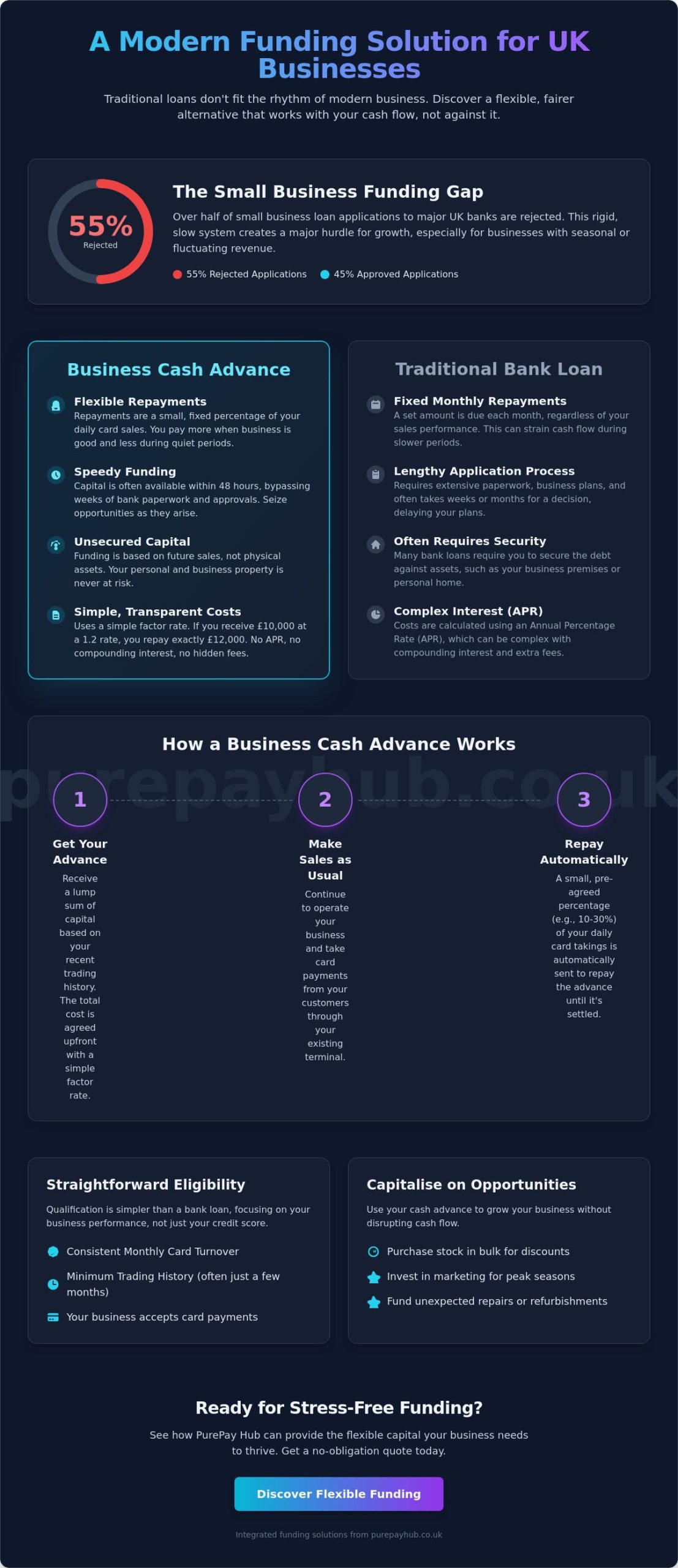
    A Business Cash Advance provides the upfront capital needed for more significant changes, such as installing new modular shelving or professional signage. Unlike a traditional bank loan, you repay the advance through a fixed percentage of your future card sales. This makes it a flexible option for regional owners who want to invest in a layout refit without the pressure of fixed monthly repayments during quieter trading periods.

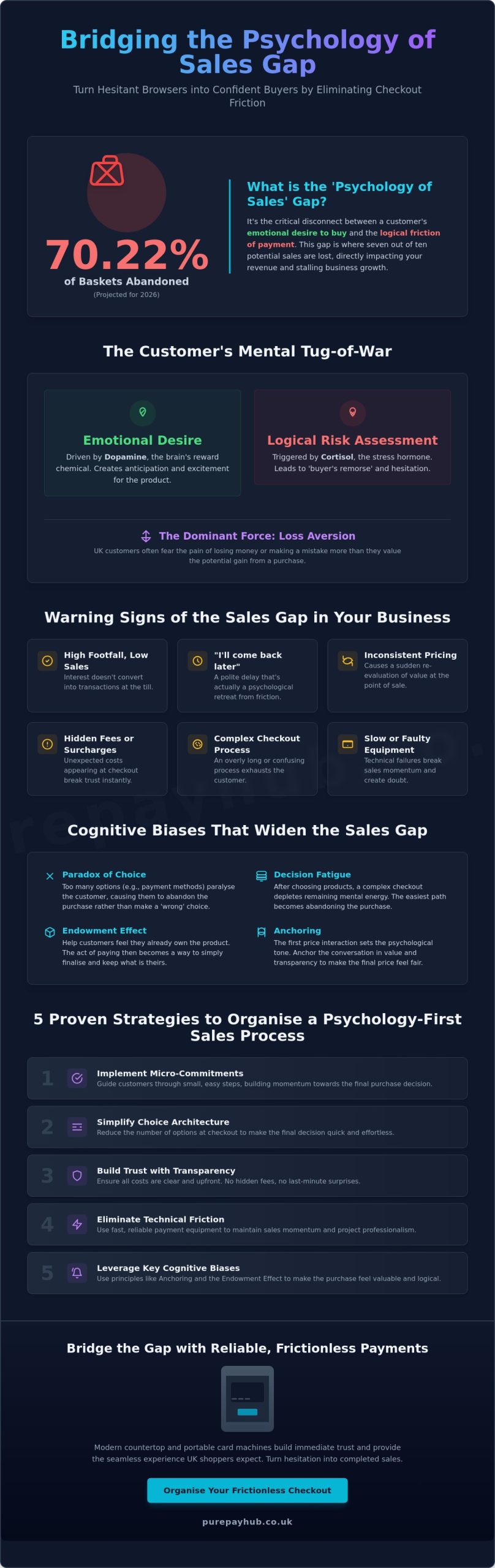
  • Closing the Sales Gap: Psychological Insights for Success

    Closing the Sales Gap: Psychological Insights for Success

    Did you know that in 2026, approximately 70.22% of shoppers abandon their baskets before completing a purchase? For a UK business owner, watching seven out of ten potential sales vanish at the final hurdle is more than just a statistic; it’s a direct hit to your revenue. This disconnect is often caused by the Psychology of Sales gap. It isn’t usually a lack of interest in what you’re selling. Instead, it’s often a failure of friction management at the point of payment, where hidden doubts and complex processes suddenly take over.

    You likely feel the frustration of deals stalling at the “thinking about it” stage or seeing customers hesitate when they reach your checkout. We agree that opaque processes and unexpected friction are the enemies of growth. This guide will show you how to identify these psychological barriers and bridge them effectively. You’ll learn how to organise a frictionless checkout experience that encourages faster decision-making. We’ll preview the cognitive biases influencing customer behaviour and explain how clear, honest payment solutions can turn a hesitant browser into a confident buyer.

    Key Takeaways

    • Understand why customer intent often fails to translate into a final transaction by identifying 1. The “Psychology of Sales” Gap in your current process.
    • Discover how cognitive biases like the paradox of choice and decision fatigue can paralyse your customers at the point of purchase.
    • Learn to protect sales momentum by eliminating technical friction and avoiding the psychological exit caused by slow or unreliable equipment.
    • Implement actionable strategies, from micro-commitments to simplified choice architecture, to guide your customers seamlessly toward a final decision.
    • Explore how using reliable countertop or portable card machines builds immediate trust and provides the frictionless experience modern UK shoppers expect.

    What is the ‘Psychology of Sales’ Gap and Why Does It Stall Your Growth?

    Every business owner has experienced the frustration of a customer who seems ready to buy but suddenly pulls away. This isn’t usually a problem with your product or your service. It’s a fundamental disconnect between a buyer’s emotional intent and the final physical act of payment. We call this phenomenon 1. The “Psychology of Sales” Gap. It represents the space where interest turns into hesitation, and it’s a measurable friction point that can stall your business growth if left unaddressed.

    In 2026, this gap is widening. UK consumers are more skeptical than ever before. They face a constant barrage of choices and marketing messages, leading to a state of choice overload. When a customer reaches the point of transaction, they often hit a “Moment of Hesitation.” This is a subconscious risk assessment where they weigh the value of the purchase against the potential for regret. For a local merchant, bridging this gap is essential. Failing to do so doesn’t just lose you a single sale; it disrupts your cash flow and prevents you from building the momentum needed to scale your operations.

    The Emotional vs. Logical Tug-of-War

    The study of consumer behaviour shows that purchasing decisions are rarely purely logical. Initial desire is often driven by dopamine, the chemical associated with reward and anticipation. However, as the customer moves closer to the checkout, cortisol levels can rise. This stress hormone triggers a sense of “buyer’s remorse” before the sale is even finalised. In the UK market, “Loss Aversion” plays a massive role. Customers often fear the pain of making a mistake or losing their money more than they value the gain from your product.

    We define 1. The “Psychology of Sales” Gap as a measurable friction point in the customer journey where emotional desire is overtaken by logical risk assessment.

    Signs Your Business is Suffering from the Gap

    You can identify if this gap is affecting your bottom line by looking at specific patterns in your daily trade. If you notice high footfall in your shop but surprisingly low transaction volumes, you’re likely losing people at the final hurdle. The “I’ll come back later” phenomenon is another clear indicator. Whilst it sounds like a polite delay, it’s actually a psychological retreat. The customer has encountered a friction point that made the risk feel too high. Common triggers include:

    • Inconsistent pricing that causes a sudden re-evaluation of value.
    • Hidden fees or surcharges that appear only at the point of sale.
    • A checkout process that feels overly complex or time-consuming.
    • Technical failures, such as slow card machines, that break the customer’s focus.

    By recognising these signs, you can begin to organise a sales process that prioritises clarity and reassurance. Eliminating these psychological barriers is the first step toward creating a dependable, frictionless experience that keeps your customers moving forward.

    The Hidden Cognitive Biases Influencing Every Transaction

    Every transaction is a minefield of subconscious shortcuts. These cognitive biases are the invisible forces that often widen 1. The “Psychology of Sales” Gap. When you understand how the human brain processes a purchase, you can smooth the path for your customers and remove the mental barriers that lead to abandoned baskets.

    The “Paradox of Choice” is a primary culprit for stalled sales. Whilst we often think more options are better, too many payment methods can actually paralyse a buyer. They get stuck wondering which one is the safest or best to use. This is compounded by “Decision Fatigue.” After a customer has spent time choosing products, their mental energy is depleted. The checkout process must be the simplest part of their day. If it requires extra thinking, they are likely to walk away.

    You can also leverage the “Endowment Effect” by helping customers visualise the product as already being theirs. When a buyer feels they already own the benefit, the act of paying is simply a way to keep it. This is often supported by “Anchoring.” Your first price interaction sets the psychological tone for the entire sale. If you anchor the conversation in value and transparency from the start, the final transaction feels like a fair and logical conclusion. By addressing these biases, you effectively bridge 1. The “Psychology of Sales” Gap and create a more dependable revenue stream.

    Loss Aversion and the Fear of the “Wrong” Choice

    UK consumers are particularly sensitive to perceived financial risk. “Loss Aversion” means they feel the pain of a potential mistake more acutely than the joy of a gain. You can soothe the buyer’s amygdala through “Risk Reversal” strategies. Clear, honest communication about costs and straightforward return policies are essential. Even your hardware plays a role. A sleek, modern card machine signals reliability and security. A dated or unreliable device triggers a red flag, suggesting the business might be stuck in the past. To ensure your counter reflects your professional standards, you might consider upgrading your payment technology to something that inspires confidence.

    The Bandwagon Effect: Using Social Proof at the Counter

    We are social creatures who look for cues that we are making the right decision. The “Bandwagon Effect” is a powerful tool at the point of sale. Subtle environmental signals can suggest that “people like you shop here.” Displaying recognisable payment logos like Visa, Mastercard, and Apple Pay acts as a silent validation of your business. These logos are psychological anchors of trust. Even a busy shop can be a positive signal. A queue suggests popularity and quality, provided your checkout speed is high. If your systems are fast and efficient, a busy counter reinforces the customer’s choice rather than testing their patience.

    Dealing with ‘Checkout Churn’: Where Momentum Meets Friction

    Momentum is the most fragile asset in any sales interaction. It is the invisible energy that carries a customer from “I want this” to “I have paid for this.” When this flow is interrupted, you encounter 1. The “Psychology of Sales” Gap. This gap is often forced open by technical friction. Slow card machines or signal drops don’t just delay the payment. They create a ‘Psychological Exit.’ In those few seconds of waiting, the customer’s brain has time to re-evaluate the purchase. This often leads to second thoughts or immediate abandonment.

    A professional payment area acts as a ‘Centre of Certainty.’ It grounds the transaction in reality and builds immediate trust. We advocate for a ‘no-nonsense’ approach. Over-complicated sales scripts or aggressive upselling at the counter often create suspicion rather than sales. When you prioritise clarity and speed, you reassure the customer that they are making a sensible, secure choice. Bridging 1. The “Psychology of Sales” Gap requires you to protect the customer’s momentum until the very last second.

    The High Cost of Technical Friction

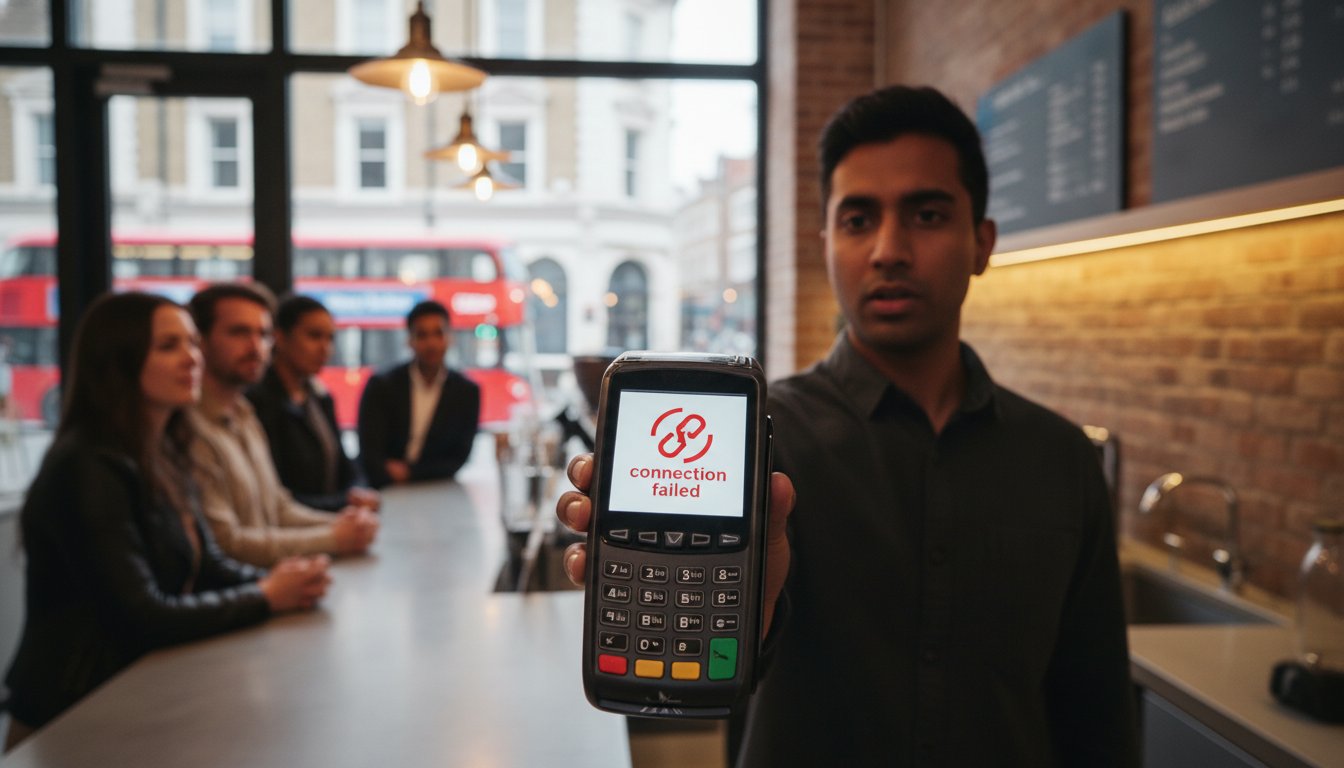
    Speed is not just about efficiency. It is about emotional stability. Research shows that an estimated $260 billion in lost orders are recoverable in the US and EU through better checkout design and user experience. Even a minor 3-second delay in card processing can trigger a noticeable rise in buyer anxiety. When a customer sees a “Connection Error” on a card machine, the psychological message is clear. It suggests the business is unprofessional or unreliable. It breaks the trust you worked hard to build. Seamless hardware acts as a silent closer in the sales process, ensuring the final step is as rewarding as the first.

    Organising a Frictionless Payment Zone

    The physical environment of your checkout centre matters. It should be clean, well-lit, and free of clutter. This creates a sense of order and security. However, you don’t always need to tether your customers to a fixed point. Portable card machines allow you to take the payment to the customer, whether they are at a table or on the shop floor. This removes the physical friction of walking to a queue.

    There is also a psychological benefit to the merchant having “Next-Day Access to Funds.” When you have confidence in your own cash flow, that stability translates to the customer experience. You appear more dependable and less desperate for the sale. By organising your space and your technology around the customer’s comfort, you turn the point of sale into a point of connection.

    • Ensure your payment area is tidy and professional to signal reliability.
    • Use portable card machines to meet the customer where they are.
    • Eliminate technical errors that break the buyer’s focus.

    Closing the Sales Gap: Psychological Insights for Success

    5 Proven Strategies to Organise a Psychology-First Sales Process

    Bridging 1. The “Psychology of Sales” Gap doesn’t require a degree in behavioural science. It requires a commitment to clarity and a disdain for friction. By organising your sales environment around the customer’s mental state, you can transform hesitant browsers into loyal advocates. Here are five practical strategies to help you close the gap today.

    • Simplify choice architecture: Avoid overwhelming customers with irrelevant options at the point of sale. If you offer too many payment methods or unnecessary upsells, you trigger decision fatigue. Keep the final steps focused and direct.
    • Use micro-commitments: Lead the buyer naturally toward the final transaction. Small agreements, such as asking if they found everything they needed, create a rhythm of “yes” that makes the final payment feel like a natural progression.
    • Lead with transparency: Display all costs and fees early. “Price Shock” at the till is the fastest way to lose a customer’s trust. Whether you use standard rates or a credit card processing with surcharge program from Strictly, clear pricing prevents the psychological retreat that happens when a buyer feels misled.
    • Implement high-speed hardware: Maintain the “Dopamine Loop” of the purchase. A fast, responsive card machine ensures the excitement of the buy isn’t killed by a spinning loading icon or a connection delay.
    • Reinforce the decision: Provide a professional, branded digital or physical receipt. This small act confirms they’ve made a secure and sensible choice, reducing the risk of post-purchase regret.

    Transparency as a Competitive Advantage

    For UK SMEs, “No Hidden Fees” is more than a slogan. It is a powerful psychological trigger. UK consumers value honesty and straightforwardness amongst the businesses they support. When you clearly display your payment process with professional signage, you build a foundation of trust that traditional, opaque institutions often lack. We believe that security is a core part of this partnership. Ensuring your business is PCI compliant provides customers with the silent reassurance that their data is protected whilst they pay. If you want to build this trust immediately, you can explore our transparent payment solutions designed specifically for local merchants.

    The Power of Speed and Reliability

    Reducing “Time to Transaction” should be a key performance indicator for your business. Every second saved at the counter is a second where the customer doesn’t have time to doubt their choice. Fast processing is supported by efficient backend systems. An integrated EPOS system that manages stock in real-time prevents the “Out of Stock” let-down, which can be a major psychological blow to a motivated buyer. Additionally, next-day access to funds allows you to reinvest in your customer experience immediately. When your finances are stable and fast, your business projects an aura of reliability that customers can feel. This confidence is contagious and encourages repeat visits.

    Bridging the Gap with PurePay Hub: Frictionless Payments for Modern Businesses

    Closing 1. The “Psychology of Sales” Gap requires more than just understanding the theory. It requires the right tools to manage the moment of truth at the counter. At PurePay Hub, we provide the technology that turns a customer’s hesitation into a completed transaction. Our Countertop Card Machine and Portable Card Machine are designed to eliminate technical friction. They ensure that your payment process is as smooth and professional as the service you provide.

    Transparency is the foundation of trust. We offer clear, competitive rates of 0.3% on debit card transactions and 0.5% on credit card transactions. When you don’t have to worry about hidden markups or complex fee structures, you can focus on your customers. This honesty builds a stronger bond between you and your community. An integrated EPOS system acts as the brain of your business, organising the entire sales journey from stock management to the final tap of a card. It prevents the errors that create psychological exits for your buyers.

    We also understand that business confidence is linked to cash flow. Our “Next-Day Access to Funds” model ensures you aren’t left waiting for your own money. When you have the certainty of steady capital, you project a sense of stability that customers can feel. It allows you to maintain a high standard of service without the stress of financial delays.

    Reliability You Can Bank On

    Technical downtime is the fastest way to reopen the sales gap. If your machine fails, your customer’s momentum dies instantly. We provide 24/7 technical support to ensure your systems stay online when you need them most. Our hardware isn’t just reliable; it looks the part. A modern, professional Countertop Card Machine signals to your customers that you take their security seriously. With the PCI PTS POI v5 certification set to expire in April 2027, now is the time to ensure your hardware meets the latest standards. Our quick onboarding process means you can start building this trust with a stress-free partnership almost immediately.

    Taking the Stress Out of Cash Flow

    Sometimes, bridging the gap requires a physical change to your environment. Whether it’s a new layout to improve flow or a fresh look to boost social proof, a Business Cash Advance can provide the necessary funding. This isn’t a traditional loan with rigid monthly costs. Instead, repayment is calculated as a small percentage of your daily card sales. This fair model aligns perfectly with your actual business behaviour. If you have a quiet day, your repayments are lower. It’s a supportive way to grow without the pressure of fixed overheads.

    Ready to close the gap? Explore PurePay Hub’s card machines today.

    Turn Browsers into Buyers Today

    You now have the practical strategies to manage the hidden forces that stall your transactions. By simplifying your choice architecture and using reliable hardware, you can effectively close 1. The “Psychology of Sales” Gap. Remember that transparency isn’t just a moral choice; it’s a competitive advantage that builds immediate trust with your local community. Protecting your customer’s momentum at the point of sale ensures that their initial desire leads to a successful purchase rather than a missed opportunity.

    It’s time to move away from opaque fee structures and unreliable equipment that creates unnecessary friction. You can switch to a fairer, faster payment partner with PurePay Hub. We offer debit card rates from 0.3% and provide next-day access to funds, all without hidden markups or corporate jargon. We’re here to help you organise a frictionless experience that keeps your business moving forward. Let’s start building a more dependable and profitable future for your trade together.

    Frequently Asked Questions

    What exactly is the “Psychology of Sales” gap?

    It is the disconnect between a customer’s intent to buy and the final act of payment. This gap represents the space where interest turns into hesitation due to friction or doubt. By identifying these moments, you can create a smoother journey that maintains buyer momentum until the transaction is complete.

    How does a slow card machine affect my customer’s psychological state?

    Speed is a proxy for reliability and security in the mind of the customer. A slow card machine creates a “Psychological Exit,” giving the buyer time to doubt their purchase or feel anxiety about the transaction’s safety. Rapid processing maintains the positive energy of the purchase and ensures the customer leaves with a sense of confidence.

    Can changing my payment provider really improve my conversion rates?

    Yes, switching to a provider that offers faster hardware and transparent processes can significantly lower abandonment rates. When you eliminate technical errors and hidden costs, you remove the primary triggers for buyer hesitation. This directly addresses 1. The “Psychology of Sales” Gap by making the final hurdle effortless for your customers.

    What are the most common cognitive biases in UK retail?

    Loss aversion and the paradox of choice are particularly prevalent amongst UK shoppers. Customers often fear making a “wrong” choice more than they value the benefit of the purchase. Additionally, providing too many complex payment options can lead to decision fatigue, causing the buyer to walk away rather than make a final choice.

    How can I make my checkout process feel more secure for customers?

    Use recognisable payment logos and modern hardware to signal immediate trust. Displaying clear information about PCI compliance and providing instant, branded receipts also reassures the customer that their data is protected. A clean, well-lit payment centre further grounds the transaction in a sense of safety and professional order.

    Why is transparency in transaction fees important for buyer trust?

    Hidden markups or unexpected fees at the till trigger “Price Shock,” which destroys merchant-customer trust instantly. UK consumers value honest, straight-talking business partners. By leading with clear rates, you prevent the psychological retreat that occurs when a customer feels they are being misled by opaque or complex financial structures.

    What is the role of an EPOS system in bridging the sales gap?

    An EPOS system acts as the central brain that organises your entire sales journey. It manages stock in real-time to avoid the psychological let-down of “out of stock” items and ensures that pricing remains consistent across all channels. This stability prevents the friction points that often widen 1. The “Psychology of Sales” Gap.

    Is a business cash advance a good way to improve my sales environment?

    A business cash advance provides the capital needed for a physical “facelift” to improve your retail or restaurant space. Because repayments are a percentage of your daily card sales, the model is fair and aligns with your actual trade behaviour. This allows you to invest in a more welcoming environment without the stress of fixed monthly overheads.

  • 10 Content Hacks for Better Blogs and Social Media

    10 Content Hacks for Better Blogs and Social Media

    What if your last blog post worked as hard for your business as your countertop card machine? For many regional business owners, content creation feels like an endless chore that yields little more than a handful of likes. You likely feel that the time spent writing could be better used elsewhere, especially when you don’t see a clear link between a social post and your bank balance. It’s a common frustration to feel that your voice is lost in an increasingly crowded digital space.

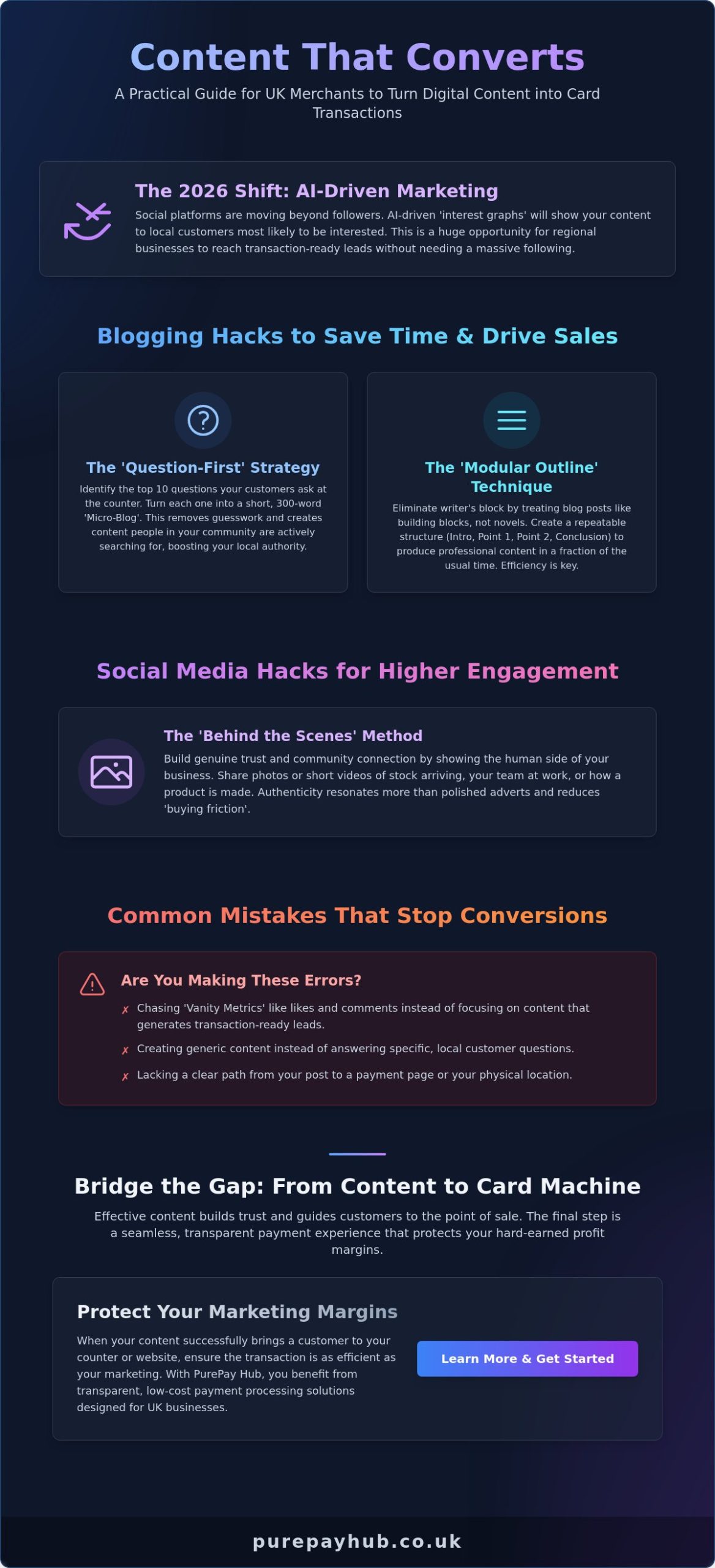
    We are here to change that perspective. You will discover how to build a streamlined content process along with specific “hacks” to use in your blogs and social content: these are the exact methods that turn casual scrollers into paying customers whilst saving you hours of work. By focusing on the 2026 shift toward AI-driven interest graphs, we help you achieve higher engagement amongst your local community. This guide provides ten essential strategies that create a direct path from a social post to a card transaction, ensuring your marketing is as efficient as your daily operations.

    Key Takeaways

    • Master the ‘Modular Outline’ technique to eliminate writer’s block and produce professional blog content in a fraction of the usual time.
    • Boost engagement amongst your regional audience along with specific “hacks” to use in your blogs and social content: such as the ‘Behind the Scenes’ method that builds genuine trust.
    • Learn to repurpose frequent customer questions into high-ranking content that establishes your authority whilst saving hours of manual work.
    • Identify and fix the common content mistakes that prevent readers from moving through to a card transaction on your website or terminal.
    • Understand how to protect your marketing margins by pairing effective content with transparent, low-cost payment processing solutions.

    The Reality of Content Marketing for Busy UK Merchants

    Managing a physical business leaves little room for digital experimentation. You spend your days managing stock, serving customers, and ensuring your staff are supported. When you finally sit down to “do marketing,” the last thing you need is a complex theory. To understand the basics, you might ask, What is Content Marketing? At its core, it is about providing value to attract and retain customers. For a busy merchant, this requires a streamlined approach along with specific “hacks” to use in your blogs and social content: to ensure every minute spent writing translates into a transaction.

    By early 2026, the digital landscape has fundamentally shifted. Social media platforms like Instagram and TikTok no longer rely solely on who follows you. They use AI-driven interest graphs to show your content to people who are likely to care about your local services. This is a massive opportunity for regional businesses. It means you don’t need a million followers to find your next customer. You just need content that resonates. We want to move you away from “vanity metrics” like likes and comments. Instead, we focus on transaction-ready leads who are ready to tap their cards.

    Why ‘Hacks’ are Essential, Not Optional

    Time is your most precious resource. Unlike digital publishers who can post ten times a day, you have a shop to run. You cannot afford to be a perfectionist. A ‘hack’ isn’t about cutting corners on quality; it is a shortcut to efficiency. It is about using proven frameworks to get your message across quickly. If a single, well-structured post brings three people to your door, it is more valuable than ten generic posts that get ignored. We focus on results that impact your bank balance, not just your ego. These methods are designed for the time-poor SME owner who needs quality without the wait.

    To ensure your time is spent as effectively as possible across all areas of your operations, implementing a comprehensive management tool like TrackMyBusiness can help you streamline and manage your workflows effortlessly.

    The Link Between Visibility and Your Merchant Account

    Your digital presence is the modern shop window. When a customer sees a helpful video or a transparent blog post, their “buying friction” decreases. Trust is built amongst your community before they even enter your premises. By the time they reach your countertop card machine, the sale is already half-made. They trust you because you have already provided value. Your social proof acts as a silent partner to your EPOS system, making the final transaction feel like a natural conclusion to their journey. Your digital voice should match the professional standard of your physical service.

    PurePay Hub understands this link between marketing and margins. We provide the modern payment infrastructure, such as our mobile card machine and payment links, that ensures you keep more of your hard-earned profit. When your content drives a customer to pay, our transparent fee structures ensure that the final step is as smooth as the first click. We are here to support your growth through clarity and partnership along with specific “hacks” to use in your blogs and social content: that actually work for your bottom line.

    Blogging Hacks to Produce Quality Content Whilst Saving Time

    Staring at a blank screen is a significant drain on your productivity. When you have a shop floor to manage or a team to lead, you don’t have the luxury of waiting for inspiration to strike. Efficiency comes from having a repeatable system along with specific “hacks” to use in your blogs and social content: these methods ensure your digital presence remains active without stealing hours from your working day. By treating your blog as a series of modular components rather than a literary masterpiece, you can produce professional results in a fraction of the time.

    To understand the broader context of these strategies, you can refer to Content Marketing: The Ultimate Guide. This resource highlights how modern businesses are moving away from long-winded prose toward direct, value-driven communication. Your goal is to provide answers that your customers are already searching for, positioning your business as the obvious solution in your local area.

    The ‘Question-First’ Content Strategy

    The most effective blog topics are likely already being discussed at your counter. Identify the top 10 questions customers ask whilst you are processing transactions on your Portable Card Machine. Each of these questions can be turned into a 300-word ‘Micro-Blog’ that provides immediate value to your community. This strategy removes the guesswork from your marketing. It ensures you are creating content that people actually want to read, which naturally improves your search engine visibility without the need for complex technical SEO knowledge.

    Modular Drafting: Fill in the Blanks

    Create a favourite template for your posts based on a Problem, Solution, Evidence, and CTA structure. This fills the page quickly and keeps your message focused on the customer’s needs. You should always write your headline last to ensure it accurately reflects the final content of the piece. Batching your writing is another vital along with specific “hacks” to use in your blogs and social content: because spending 60 minutes once a week is far more productive than trying to find 10 minutes every day. This disciplined approach keeps your tone consistent and your schedule predictable, allowing you to get back to the work of running your business.

    Social Media Hacks for Higher Engagement Amongst Your Customers

    Social media often feels like a shouting match where only the loudest voices are heard. For a local merchant, the goal isn’t to shout louder but to speak more clearly to the right people. High engagement is only useful if it leads to a transaction. You need a strategy that bridges the gap between a follower and a customer along with specific “hacks” to use in your blogs and social content: these ensure your time on these platforms is profitable. By moving away from overly polished advertising, you create a sense of direct partnership with your audience. This approach aligns with the 2026 shift toward interest-based algorithms that prioritise relevance over follower counts.

    Authenticity Over Production Value

    Modern consumers are savvy. They scroll past glossy, professional adverts because they look like corporate noise. A raw, 15-second video of your team preparing an order or unboxing new stock creates immediate trust. It shows the human side of your business. Use the ‘favourite’ feature on your social apps to save posts from competitors or creators that catch your eye. This builds a library of inspiration for when you have a spare five minutes. Don’t forget to ask for reviews at the point of sale. A customer’s genuine recommendation is the most powerful content you can share, and it requires zero production time from you. It is one of the most effective along with specific “hacks” to use in your blogs and social content: letting your customers do the marketing for you whilst you focus on operations.

    Closing the Sale on Social Media

    Visibility is only the first step. You must make it effortless for a customer to pay once they have decided to buy. A major barrier to conversion is forcing a customer to navigate a complex website or search for a product page. Instead, you should integrate payment links directly into your social media bios or automated direct messages. This allows a user to move from a post to a secure checkout in seconds. It removes the friction that often kills a sale before it begins.

    If a customer enquires about a product via a comment or message, don’t just answer the question. Provide a direct path to the purchase. You can use a virtual terminal to process orders over the phone or through a secure link, turning a simple enquiry into a confirmed sale. Timing is also critical. Look at your own sales data to see when your customers are most active. Posting just before peak spending hours ensures your business is at the top of their feed when they are ready to use their card. This ensures your digital presence acts as a stabilising force for your business finances.

    10 Content Hacks for Better Blogs and Social Media

    Why Most Small Business Content Fails to Convert (and How to Fix It)

    Many merchants produce excellent content only to find their bank balance remains unchanged. This disconnect usually happens at the very end of the customer journey. You have built trust and provided value, but you haven’t told the reader what to do next. Forgetting a clear Call to Action (CTA) is the most common reason for conversion failure. If a reader finishes your blog post or social update without a specific instruction, they will simply scroll away. You must be direct. Tell them to book a service, visit your shop, or use your payment links to secure a deal.

    Complexity is the next major hurdle. Every extra click you force a customer to make is an opportunity for them to change their mind. We advocate for a frictionless approach along with specific “hacks” to use in your blogs and social content: to ensure the distance between interest and transaction is as short as possible. Your digital strategy must lead directly to your Online Payment Gateway to capture the sale while the intent is high. If the path to purchase feels like a maze, your customers will leave before they reach the checkout.

    The Missing Link: The Smooth Checkout

    A high-quality blog post is wasted if your payment gateway is clunky or slow. Customers in 2026 expect a checkout experience that is as fast as their social media feed. If your site takes too long to load or requires too many form fields, they will abandon their basket. Security is another critical factor. You must reassure customers that their data is protected. Using a professional, recognisable payment gate builds immediate confidence. Also, as a business owner, you need that revenue quickly. We prioritise next-day funding so your marketing-driven profit is available to reinvest in your next campaign immediately.

    Simplifying the Path to Purchase

    Reducing the number of clicks is vital. If you are using a social hack to drive traffic, make sure the destination is ready for them. In your physical premises, you can use QR codes to link customers directly to your digital content or online menus. This creates a seamless loop between your in-person service and your online presence. Transparent pricing is also essential. Providing a clear breakdown of costs at the checkout prevents “sticker shock” and increases long-term loyalty amongst your community. When customers feel they are being treated fairly, they are more likely to return.

    Finally, you must analyse your data with a focus on results. Don’t just look at how many people liked a post. Look at your merchant account to see which specific pieces of content led to a card transaction. This disciplined approach ensures you are only spending time on the along with specific “hacks” to use in your blogs and social content: that actually grow your business. By aligning your digital presence with your physical professional standards, you turn content into a reliable revenue stream.

    Turning Your Traffic into Revenue with PurePay Hub

    Content marketing is only successful when it serves your bottom line. We have discussed how to streamline your process along with specific “hacks” to use in your blogs and social content: to drive engagement and build trust. However, the true measure of success is the revenue that eventually hits your merchant account. PurePay Hub ensures that your hard-earned marketing profit stays in your business. With debit rates as low as 0.3%, we provide a transparent fee structure that contrasts with the murky pricing models used by traditional banks. You shouldn’t lose your margins to hidden markups after doing the hard work of attracting a customer.

    Scaling your business requires both consistency and capital. If a particular content campaign shows promise amongst your local community, you might want to increase its reach. We offer a Business Cash Advance to help you fund your next big marketing push without the stress of fixed monthly repayments. This allows you to invest in better equipment or professional help to further refine your digital presence. Because we provide next-day access to your funds, you can reinvest your sales into your business immediately. This speed creates a momentum that supports steady growth and keeps your cash flow healthy.

    Seamless Payments for Every Channel

    Your customers should experience the same professional standard whether they are reading your blog or paying at your counter. We provide the infrastructure to make this happen. From our robust Countertop Card Machines for physical stores to our flexible Virtual Terminals for phone orders, you’ll be ready to take a payment wherever your customer is. Our integrated EPOS systems save you hours of manual admin by centralising your sales data. This gives you more time to focus on your marketing strategy rather than getting lost in spreadsheets. The PurePay Hub promise is simple: no hidden fees and straightforward support as a fair partner to your business.

    Your Next Steps to Content Success

    Success comes from consistent action rather than perfect planning. We recommend choosing three hacks from this guide to implement this week. Whether you start with the ‘Question-First’ blogging strategy or use raw video for social proof, the goal is to begin. Measure which of these along with specific “hacks” to use in your blogs and social content: result in the most card transactions. Whilst you refine your messaging, take a moment to review your current card machine rates. Ensuring your growth is cost-effective is the first step toward a more profitable future. We are here to provide the clarity and reliability you need to succeed.

    Switch to PurePay Hub today for fairer, faster business payments.

    Take Control of Your Business Growth Today

    You now have the tools to turn your digital presence into a pre-transactional asset that works whilst you manage your shop floor. We have explored how modular drafting saves you time and why raw video builds deeper trust amongst your community than stock photos. Implementing these strategies along with specific “hacks” to use in your blogs and social content: these methods ensure your marketing efforts lead directly to your merchant account without wasting your valuable hours.

    At PurePay Hub, we support your journey with transparent debit card rates from 0.3% and next-day funding as standard. Our UK-based expert support is always available to ensure your payment infrastructure is as reliable as your service. Don’t let complex marketing or hidden fees hold your business back from reaching its full potential. Start with a few small changes this week and watch your digital engagement turn into tangible revenue.

    Start saving on every transaction with PurePay Hub

    Frequently Asked Questions

    How often should I post on my business blog to see results?

    Consistency is more important than frequency for most regional businesses. Aim for one high-quality post per week to build authority without burning out your staff. Using a repeatable framework helps you maintain this schedule whilst managing your daily shop operations. This steady rhythm ensures you stay relevant to search engines and provides a constant stream of value for your local community and customer base.

    Do I really need a blog if I am active on social media?

    A blog is essential because it is a platform you own and control entirely. Whilst social media platforms frequently change their algorithms, your blog remains a permanent asset for search engines to find. It provides a deeper space to answer frequent customer questions along with specific “hacks” to use in your blogs and social content: that establish your professional expertise and authority in your local area.

    What is the easiest way to take payments through a social media post?

    Using Payment Links is the most efficient way to convert a social media follower into a customer. You can send a secure, unique link via a direct message or include it in your profile bio. This allows the customer to complete a secure card transaction immediately without needing to navigate a complex website or search for a specific product page. It removes the friction that often stops a sale.

    Can content marketing help me if I only have a physical shop?

    Content marketing is highly effective for physical shops as it builds trust before a customer even enters your premises. Sharing “behind the scenes” videos or local updates helps your business appear in the interest-based feeds of nearby residents. It turns your digital presence into a modern shop window that drives footfall directly to your countertop card machine or portable device during your opening hours.

    How do I know if my social media content is actually driving sales?

    You can track sales by monitoring which specific offers or links result in transactions on your merchant account data. Moving away from vanity metrics like “likes” or “shares” allows you to focus on the actual revenue generated from your digital activity. Clear, direct calls to action are the best way to ensure your content has a measurable and positive impact on your bank balance and cash flow.

    Is it worth paying for social media adverts as a small business?

    Paid adverts are worth considering if they are used to amplify content that is already performing well organically. For many small businesses, authentic and human-led content often delivers a better return on investment than polished adverts. We recommend testing your ideas organically first along with specific “hacks” to use in your blogs and social content: before committing your marketing budget to paid digital promotion or sponsored posts.

    For businesses ready to take the next step into paid media, HOT IRON Digital specialises in data-driven performance marketing to ensure your investment delivers measurable results.

    How can PurePay Hub help me manage my online and offline sales together?

    PurePay Hub provides a centralised view of your finances by integrating your EPOS systems with our online payment gateway and virtual terminals. This allows you to manage your in-store sales and digital orders through a single, transparent interface. It simplifies your daily admin and ensures your financial data is always accurate, helping you make informed decisions about your business’s future growth and long-term development.

  • 5 Strategic Knowledge Gaps to Fill for Business Growth

    5 Strategic Knowledge Gaps to Fill for Business Growth

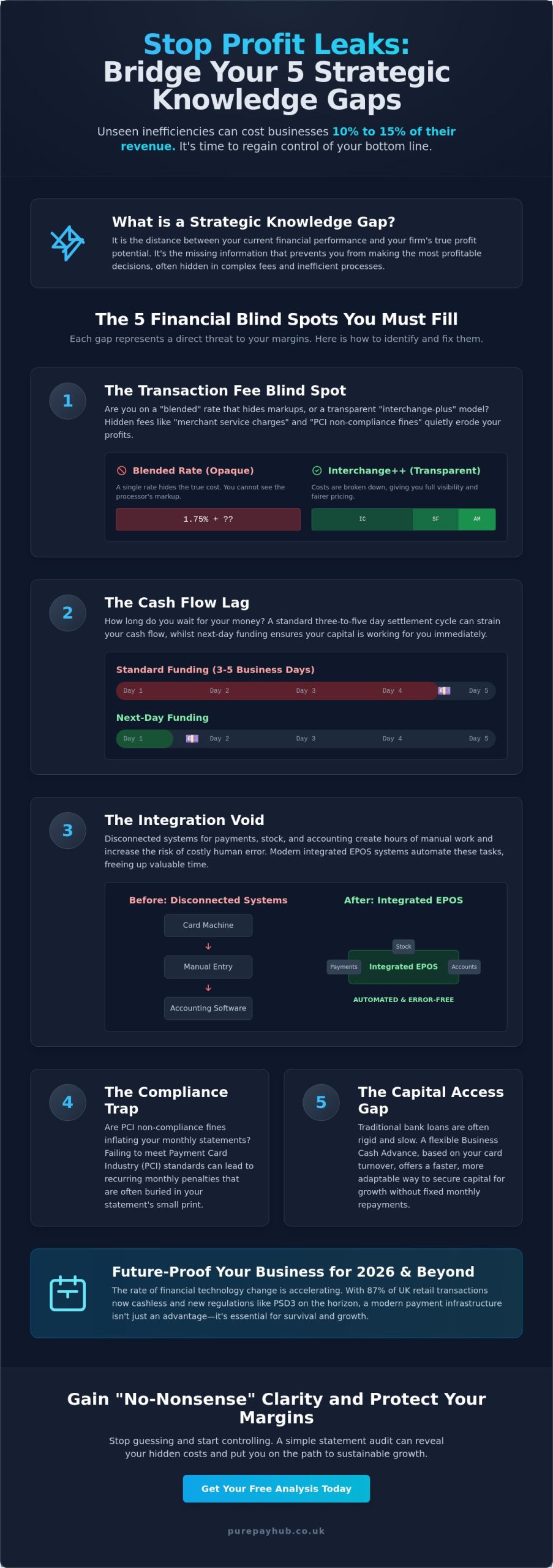
    Businesses that lack clear visibility into their profit margins by product or customer can lose approximately 10% to 15% of their revenue. It’s a staggering figure, yet many regional business owners still struggle with opaque financial terminology and rising operational costs that feel out of their control. You might often feel like your competitors have access to better rates or more advanced tools. Here are 5 strategic knowledge gaps you can fill to stop the profit leaks and regain control over your bottom line.

    We understand the frustration of seeing your hard-earned margins squeezed by hidden markups and complex fee structures. It’s exhausting to manage daily operations whilst wondering if your payment infrastructure is actually working against you. PurePay Hub is here to act as your supportive business ally, showing you how to identify these critical blind spots to protect your margins and accelerate your business growth. We will explore clear, actionable areas for improvement, from mastering your transaction data to preparing for 2026 payment regulations, ensuring your cash flow remains steady and your overheads stay low. By the end of this guide, you will have a transparent roadmap to move from financial uncertainty toward a state of informed confidence.

    Key Takeaways

    • Understand that a strategic knowledge gap is the distance between your current financial performance and your business’s actual profit potential.
    • Here are 5 strategic knowledge gaps you can fill to protect your margins, focusing on invisible fee structures and cash flow inefficiencies.
    • Learn how to conduct a rigorous Statement Audit to identify hidden costs and evaluate your Funding Velocity to ensure quicker access to your capital.
    • Discover how modern payment infrastructure, such as integrated EPOS Systems, can automate manual processes and reclaim lost time.
    • Find out how to align with a supportive partner to gain the “no-nonsense” clarity required for long-term, sustainable business growth.

    What is a Strategic Knowledge Gap in a Business Context?

    In simple terms, a strategic knowledge gap represents the distance between your company’s current financial performance and its true profit potential. Whilst many owners focus on increasing sales, they often overlook the internal inefficiencies that quietly drain their bank accounts. What is a Strategic Knowledge Gap in a Business Context? It is essentially the missing information that prevents you from making the most profitable decisions for your firm’s future. Here are 5 strategic knowledge gaps you can fill to transform your business from a reactive operation into a proactive market leader.

    These gaps often remain invisible because you’re busy with the daily grind of serving customers and managing staff. Traditional banking institutions often thrive on this lack of clarity, using complex jargon to hide the true cost of their services. It’s vital to distinguish between “soft skill” gaps, like leadership styles, and “strategic financial” gaps that directly impact your margins. A soft skill gap might slow down a meeting; a financial knowledge gap can cost you thousands in unnecessary transaction fees every single month.

    As of June 2026, the “half-life” of financial technology knowledge is shorter than ever. With 87% of UK retail transactions now being cashless, what worked in 2024 is likely obsolete today. New regulations like PSD3 and the mandatory shift to structured payment addresses mean that yesterday’s “good enough” setup is now a liability. Staying stagnant isn’t just a choice; it’s a risk to your business’s survival.

    The Cost of “Not Knowing” in the UK Market

    Unaddressed knowledge gaps lead to a significant loss of competitiveness amongst UK SMEs. When you don’t understand the true mechanics of your overheads, you cannot price your services effectively or negotiate better terms with suppliers. Honesty in auditing your own level of expertise is the first step toward building better vendor partnerships. A strategic knowledge gap is a measurable barrier to revenue growth.

    Why Traditional “Team Training” Isn’t the Only Answer

    Not every gap requires a classroom or a seminar. In the modern fintech world, some gaps are best filled by better systems rather than just more training. We call this “systemic knowledge,” where your hardware, such as advanced EPOS Systems, does the heavy lifting for you. This creates a bridge between your internal expertise and external strategic awareness, allowing you to focus on growth whilst your infrastructure manages the technicalities of payment processing and cash flow security.

    The 5 Strategic Knowledge Gaps You Must Fill to Scale

    Scaling a business isn’t just about hiring more people or increasing your marketing budget. It’s about fixing the leaks in your bucket before you pour more water in. Here are 5 strategic knowledge gaps you can fill to ensure your infrastructure supports your growth rather than hindering it. These aren’t HR issues; they are financial blind spots that directly affect your bottom line. Learning How to Identify Your Business’s Financial Blind Spots often starts with looking at your outgoing payments and incoming settlements.

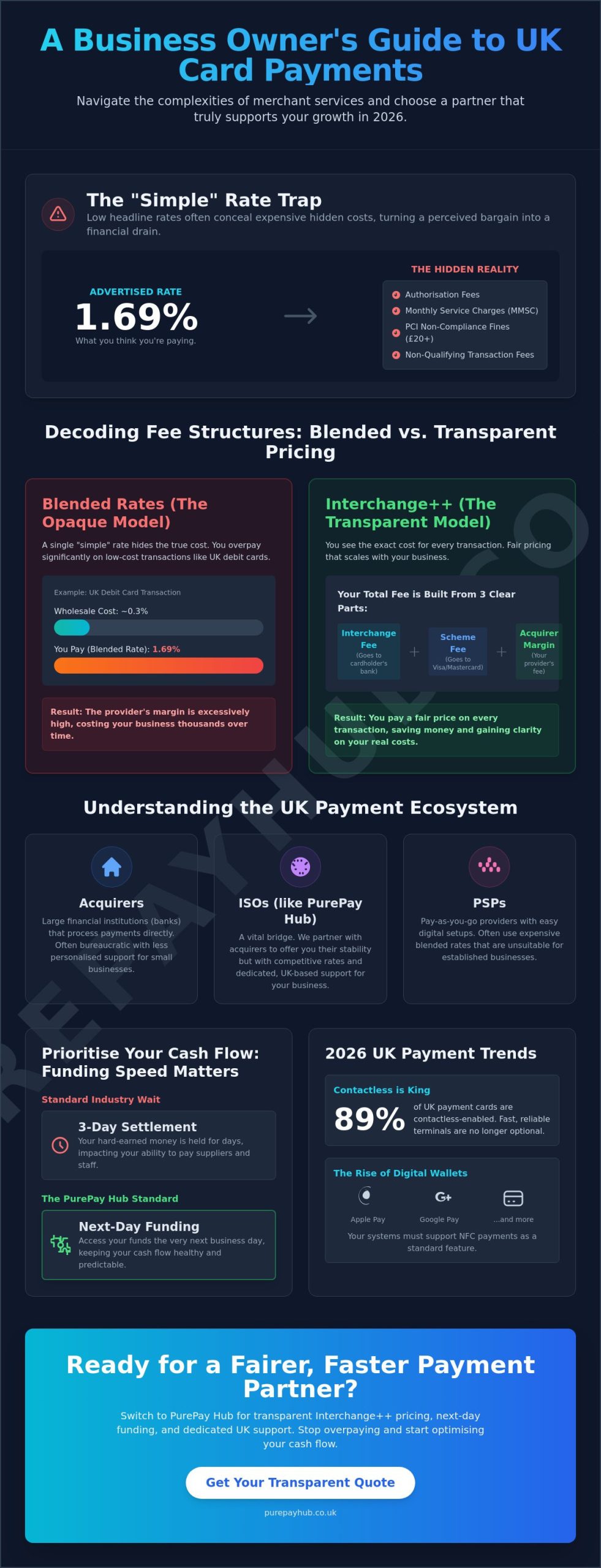
    • The Transaction Fee Blind Spot: Understanding if you are on a “blended” rate or an “interchange-plus” model.
    • The Cash Flow Lag: Knowing how next-day funding compares to standard three-to-five day cycles.
    • The Integration Void: Recognising the cost of non-integrated systems in terms of staff labour and manual entry errors.
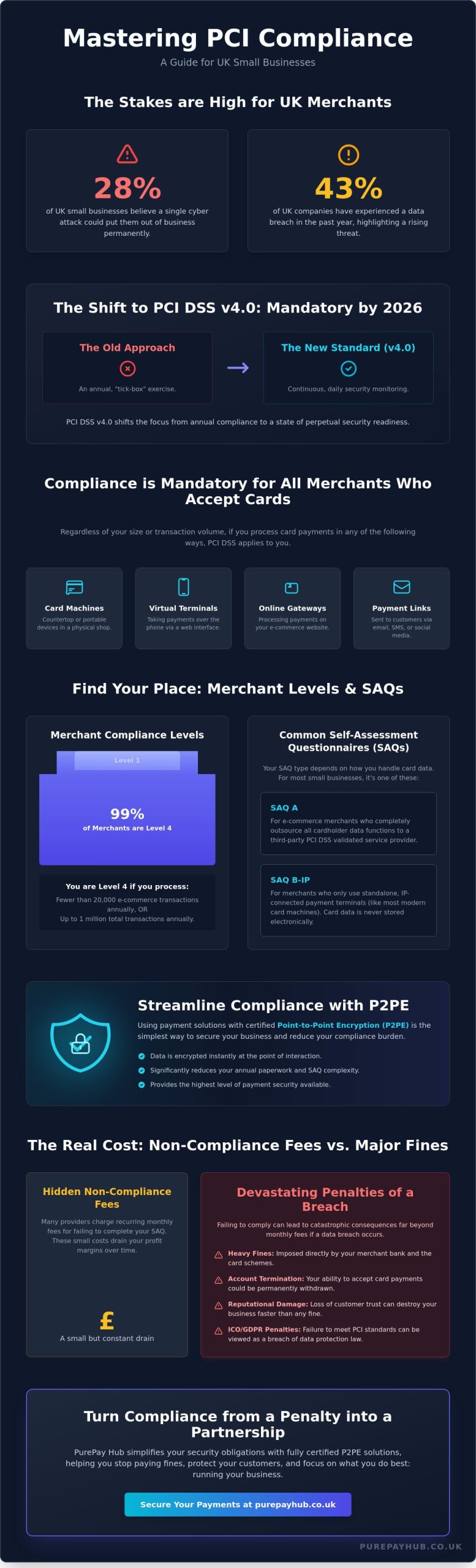
    • The Compliance Trap: Identifying the impact of PCI non-compliance fines that quietly inflate your monthly statements.
    • The Capital Access Gap: Differentiating between rigid bank loans and flexible Business Cash Advances.

    Deep Dive: The Transaction Fee Blind Spot

    Hidden markups are the enemy of profit. A headline rate of 0.3% for debit cards sounds excellent. However, this can be undermined by “merchant service charges” and “minimum monthly fees” tucked away in the small print. Transparent pricing is a strategic advantage because it allows you to forecast your costs with total precision. To find the truth, grab your latest statement and look for these items:

    • PCI Non-Compliance fees (usually around £30 per month).
    • Minimum Monthly Service Charge (MMSC).
    • Authorisation fees hidden inside a “blended” rate.

    Deep Dive: The Integration Void

    In a busy UK hospitality environment, manual entry is a recipe for disaster. It leads to “leakage” where staff enter the wrong amount or forget to record a sale entirely. Integrated EPOS Systems ensure your till and card terminal speak the same language. This setup reduces errors and speeds up the checkout process. It turns a clunky manual task into a seamless experience for both your team and your customers. Filling this gap doesn’t just save money; it saves time and reduces staff stress during peak hours. When your hardware does the thinking, your team can focus on service.

    5 Strategic Knowledge Gaps to Fill for Business Growth

    How to Identify Your Business’s Financial Blind Spots

    Identification is the first step toward recovery. You can’t fix what you haven’t measured. Here are 5 strategic knowledge gaps you can fill by starting with a rigorous look at your current financial setup. Most business owners avoid their merchant statements because they’re intentionally designed to be confusing. It’s time to cut through the noise and look at the hard data. You need to know exactly where your money is going before it ever reaches your business account.

    Start with a Statement Audit. Open your last three statements and look past the headline rate. Are you paying “minimum monthly service charges” or “non-compliance fees”? These are often avoidable costs that traditional banks hope you won’t notice. Next, evaluate your Funding Velocity. Check your bank records to see how long it takes for your card takings to clear. If your money takes three to five days to arrive, your provider is holding onto your capital whilst you wait to pay suppliers. In 2026, next-day funding should be your baseline for healthy cash flow management.

    Assess your Hardware Friction by observing your staff during peak hours. Do they have to restart the terminal frequently? Does the battery on your Portable Card Machine die mid-shift? This friction costs you customer goodwill and reduces your total turnover. Finally, review your Compliance Health. If you see a £30 “PCI fee” on your statement every month, you’re paying a fine for a gap in your paperwork. It’s a simple fix that puts money back in your pocket immediately without requiring a single extra sale.

    The 10-Minute Financial Health Check

    Clarity beats corporate jargon every time. You can organise your financial priorities by looking at your costs objectively. Compare your current credit card processing rate, which might be as high as 1.5%, against the 0.5% industry standard for credit cards. If there’s a 1% difference, you’re essentially giving away a portion of your margin for no reason. This check isn’t about being an accountant; it’s about being a disciplined owner who values transparency and fairness.

    Analysing Customer Behaviour and Payment Preferences

    Your customers’ habits have changed rapidly over the last two years. If you don’t offer Payment Links for remote orders or Virtual Terminals for phone payments, you’re creating a barrier to sale. Failing to support favourite methods like NFC or digital wallets is a significant knowledge gap that directly affects your conversion rates. Modern customers expect a frictionless checkout experience that matches their digital lifestyle. Meeting these expectations is a strategic necessity. If your current setup doesn’t support these tools, you’re likely losing sales to competitors who have already modernised their payment infrastructure.

    Closing the Gap: Implementing Modern Payment Infrastructure

    Technology isn’t just a tool; it’s a bridge. Some industry voices suggest that closing skills gaps is an impossible task that requires years of intensive training. We disagree. Here are 5 strategic knowledge gaps you can fill simply by upgrading the infrastructure that handles your daily transactions. By moving from manual entry to automated systems, you eliminate the human error that leads to financial blind spots. Modern fintech solutions allow your hardware to do the heavy lifting, ensuring your data remains accurate and your margins stay protected.

    Cash flow is the lifeblood of any UK business. If you are currently waiting several days for your funds to clear, you have a systemic gap in your liquidity that is entirely avoidable. Switching to a provider that offers next-day access to funds solves this problem instantly. It allows you to pay suppliers promptly and manage your stock levels with greater agility. This isn’t just a convenience; it is a strategic move that keeps your capital working for you rather than sitting in a bank’s clearing system.

    Expansion also requires mobility. Portable Card Machines and Mobile Card Machines allow your staff to take payments at the table, on the shop floor, or even on the road. This expands your service area without the need for fixed, expensive infrastructure. It turns every customer interaction into a potential point of sale, ensuring you never miss a transaction due to technical limitations.

    The Power of Integrated EPOS Systems

    Integrated systems centre all your business data in one place. In the retail and hospitality sectors, this means your inventory levels, staff performance, and sales data are always in sync. You no longer need to guess which products are your most profitable or which hours are your busiest. This efficiency gain allows you to make decisions based on real-time facts rather than gut feeling. Next-day funding should be a standard expectation in this environment. It’s a foundational requirement for any modern, competitive business that values its time as much as its profit.

    Leveraging Business Cash Advances for Growth

    Traditional high-street bank loans often come with murky structures and rigid monthly repayments. This can be dangerous for seasonal businesses that experience fluctuating turnover. A Business Cash Advance offers a fairer, more transparent alternative. You receive unsecured capital up-front and repay it through a fixed percentage of your daily card sales. This means if you have a quiet day, your repayment is naturally smaller. It’s a disciplined way to bridge seasonal gaps or fund a new project without the stress of fixed debt obligations hanging over your head.

    Ready to modernise your setup? Get started with PurePay Hub today to fill your strategic gaps with transparent, reliable payment solutions.

    How PurePay Hub Bridges Your Strategic Knowledge Gaps

    PurePay Hub acts as the bridge between your current financial frustration and future clarity. We provide the no-nonsense partnership that regional business owners have been missing for far too long. Identifying a problem is the first step, but solving it requires the right tools and a partner who advocates for your success. Here are 5 strategic knowledge gaps you can fill by aligning with a provider that values transparency as much as you do. We aim to move you from a state of uncertainty to being fully operational with a modern setup within a matter of days.

    Our approach centres on fairness and discipline. We believe that a 0.3% debit rate and a 0.5% credit rate should be the benchmark for a “filled” fee gap. Unlike traditional institutions that hide behind complex terminology, we prioritise your bottom line. We also provide dedicated merchant account management to ensure your business stays on top of PCI compliance. This active support prevents those avoidable monthly fines from creeping back into your statements, allowing you to focus on growth whilst we manage the technicalities of security.

    The transition process is designed for speed and simplicity because we know you don’t have weeks to wait for new hardware. Our onboarding is streamlined to get your new EPOS Systems or card terminals running quickly. Once you are live, our team takes over the heavy lifting of compliance and transaction routing. This provides a stabilising force for your finances, turning your payment infrastructure into a reliable engine for development rather than a source of stress.

    Transparent Rates, No Hidden Markups

    Trust is built through honesty and clear communication. PurePay Hub is proud to be untainted by hidden markups, providing you with monthly reporting statements that actually make sense to a busy owner. We break down every transaction so you can see your true costs without the corporate jargon. This level of clarity allows you to reclaim your margins and reinvest in your firm’s future. Organise a free statement audit with PurePay Hub today to see exactly where your current provider is letting you down.

    Your Partner in National Business Growth

    We position ourselves as a supportive ally rather than a distant financial institution. Whether you need a Countertop Card Machine for a fixed till point or a Mobile Card Machine for taking payments on the move, we have the hardware to suit your specific business model. Our goal is to provide the steady promise of better, fairer service that helps you scale with confidence. Explore our card machine solutions and close your knowledge gaps to start your journey toward informed financial confidence today.

    Secure Your Business Future with Financial Clarity

    Identifying blind spots is only the first step toward reclaiming your profit. You now understand how a rigorous Statement Audit reveals hidden markups and how integrated EPOS systems prevent costly manual errors. Here are 5 strategic knowledge gaps you can fill to ensure your margins remain protected whilst your competitors struggle with outdated, opaque fee structures. By prioritising transparency and modern infrastructure, you turn your payment setup from a necessary cost into a powerful growth engine.

    It’s time to stop the profit leaks and demand a fairer deal for your business. Switch to PurePay Hub and start saving on your card processing fees today. You’ll benefit from debit card rates starting from 0.3%, next-day access to funds, and the no-nonsense transparent pricing your firm deserves. Taking control of your financial data is the most impactful move you can make for your business this year. We’re ready to help you build a more profitable, dependable future.

    Frequently Asked Questions

    What exactly is a strategic knowledge gap in a small business?

    It is the measurable difference between your current operational performance and your maximum profit potential. In a payment context, it’s often a lack of awareness regarding hidden processing costs or inefficient cash flow cycles that drain your margins. Here are 5 strategic knowledge gaps you can fill to bridge this distance and ensure your infrastructure supports your scaling ambitions rather than hindering them.

    How can I tell if I am paying too much for my card machine processing?

    You should compare your total monthly fees against your total card turnover to calculate your “effective rate”. If this percentage is significantly higher than the headline rates you were originally promised, you are likely being hit by hidden markups or minimum monthly charges. A honest statement audit is the only way to uncover these discrepancies and identify exactly where your current provider is overcharging for their services.

    Can an EPOS system really help me make better strategic decisions?

    Yes, because it centralises your sales, inventory, and staff data into a single source of truth. Instead of guessing your busiest hours or most profitable products, you can use real-time reporting to optimise your stock levels and staff rotas. This shift from gut feeling to data-driven management allows you to respond to market changes with informed confidence rather than reactive panic during peak periods.

    Is a business cash advance better than a traditional bank loan?

    It is often a fairer choice for businesses with fluctuating turnover because repayments are linked directly to your daily card sales. Unlike a bank loan with fixed monthly instalments, a Business Cash Advance adjusts to your performance; you pay less during quiet periods and more when business is booming. This flexible structure protects your liquidity without the need for traditional property-based collateral or rigid repayment schedules.

    How long does it take to switch providers and get next-day funding?

    The transition process is designed to be swift, typically taking just a few working days from your initial application to being fully operational. Once your account is set up and your new hardware arrives, next-day funding becomes your standard settlement cycle. This immediate improvement in your funding velocity ensures your capital is available for reinvestment almost as soon as a sale is made, keeping your cash flow steady.

    What are the most common hidden fees in merchant service contracts?

    You should look for “minimum monthly service charges”, “authorisation fees”, and “PCI non-compliance fines” on your statements. These costs are frequently omitted from the initial sales pitch but appear once you’ve signed the contract. Here are 5 strategic knowledge gaps you can fill by learning to identify these murky structures and switching to a provider that prioritises transparent, no-nonsense pricing models for every merchant.

    How does PCI compliance affect my monthly business costs?

    Failing to maintain compliance can result in a monthly fine appearing on your merchant statement, which is an avoidable overhead that quietly drains your profits. Whilst this fee is common amongst traditional providers, it’s often a sign of a lack of support. Dedicated merchant account management helps you stay compliant, ensuring you only pay for the services you actually use rather than penalties for incomplete or outdated paperwork.

  • Best Card Machine for Small Retail Shop: A 2026 Guide to UK Merchant Services

    Best Card Machine for Small Retail Shop: A 2026 Guide to UK Merchant Services

    Did you know that 87% of UK retail transactions are now cashless? In 2026, your payment terminal is the most critical piece of equipment in your building. Finding the best card machine for small retail shop owners is no longer just about convenience; it is about survival. You’ve likely felt the frustration of high transaction fees draining your daily takings or the stress of waiting days for funds to clear. Managing the latest PCI DSS v4.0 compliance standards shouldn’t feel like a second job when you’re busy serving customers.

    We understand that every penny counts. You deserve a payment partner that offers total transparency and reliability during your peak hours. This guide will show you how to choose a card machine that slashes overheads and provides the next-day funding your cash flow needs. We will break down the latest merchant service trends, from the removal of contactless limits to the most dependable hardware on the market. By the end, you’ll have a clear path to a fairer, more efficient way to get paid.

    Key Takeaways

    • Identify why the best card machine for small retail shop owners in 2026 must serve as a central hub for growth rather than a simple card reader.
    • Master the difference between restrictive flat-rate pricing and transparent interchange plus models to significantly reduce your monthly overheads.
    • Protect your shop’s cash flow by selecting a payment partner that provides next-day funding and deep integration with your EPOS systems.
    • Explore how modern tools like payment links and virtual terminals allow you to take secure payments anywhere without needing a physical terminal.
    • Learn how PurePay Hub offers a fairer partnership with transparent transaction rates of 0.3% for debit and 0.5% for credit cards.

    What is the Best Card Machine for a Small Retail Shop in 2026?

    The definition of what a payment terminal is has undergone a radical transformation. Gone are the days when a card reader was merely a peripheral device tucked away at the end of a counter. In 2026, the best card machine for small retail shop owners acts as a central business hub. It synchronises your physical sales with your digital inventory; it tracks staff performance; and it ensures your cash flow remains fluid. If your current machine only “takes payments,” it is already holding your business back.

    Choosing the right hardware requires a clear understanding of your shop’s daily rhythm. You aren’t just looking for a piece of plastic and silicon; you’re looking for a reliable partner that won’t fail during a busy Saturday afternoon rush. Modern retail management now relies on the seamless integration of hardware and software to eliminate manual errors and save hours of administrative work. Efficiency is the key to protecting your margins.

    The Retail Shift: Why Cashless is No Longer Optional

    British consumer behaviour has shifted permanently. Recent data shows that 87% of UK retail transactions are now cashless. With the mandatory £100 contactless limit having been removed in March 2026, customers now expect the same “tap and go” convenience for high-value purchases that they once reserved for a coffee or a magazine. Digital wallets like Apple Pay and Google Pay have become the standard. If you display a “Cash Only” sign, you aren’t just being traditional; you’re actively turning away nearly nine out of ten potential customers. Accepting every major card and mobile wallet is the bare minimum for any shop aiming for growth.

    Countertop vs. Portable: Which Suits Your Shop Floor?

    Selecting the best card machine for small retail shop environments often comes down to your physical layout. Countertop machines remain the gold standard for fixed till points. They offer the highest level of reliability because they are usually hardwired to your internet connection. This makes them perfect for traditional retailers with a dedicated checkout area.

    Portable machines offer more flexibility. They use Wi-Fi or Bluetooth to allow you to take the payment to the customer. This is a game-changer for boutique clothing stores or furniture showrooms where closing the sale on the shop floor feels more personal and less transactional. Mobile readers are a different category entirely. Whilst they are popular for market stalls or pop-up events, they often rely on expensive flat-rate fee models that can eat into the margins of a permanent retail shop. For a dedicated storefront, a professional Countertop or Portable solution is almost always the more cost-effective choice.

    Understanding the Real Cost of Payment Processing

    Merchant statements are often designed to be confusing. They hide markups behind complex terminology to prevent you from seeing exactly where your money goes. If you are searching for the best card machine for small retail shop operations, you must look past the headline price of the terminal. The true cost of your service is found in the transaction fees and the underlying pricing model. Many providers rely on “Flat Rate” models that charge a single high percentage regardless of the card type. This is simple, but it is rarely the most cost-effective choice for a growing business.

    Established retailers benefit far more from an “Interchange Plus” model. This approach breaks down the cost into three parts: the interchange fee set by the card brand, the scheme fee, and the provider’s margin. It prevents your provider from hiding extra profits in a bloated flat rate. Whilst some best mobile credit card readers marketed to casual sellers use flat rates for simplicity, a professional shop needs more precision. Transparency is the only way to ensure you aren’t overpaying for every sale you make.

    Transaction Fees: Debit vs. Credit Card Rates

    Debit cards are the backbone of UK retail sales. They are significantly cheaper for providers to process than credit cards, yet many “no-nonsense” apps charge you the same high rate for both. This means they are pocketing the difference every time a customer pays with a standard bank card. Interchange Plus is the most transparent pricing structure for merchants. By using this model, you can access debit rates as low as 0.3%, compared to the 1.75% often found with entry-level apps. On a monthly turnover of £10,000, that difference represents hundreds of pounds kept in your own pocket rather than handed to a payment processor.

    Hardware Rental vs. Outright Purchase

    The “No Monthly Fee” myth is a common trap. Providers who don’t charge a rental fee for their hardware almost always compensate by inflating your transaction commissions. Buying a cheap reader outright might save you a few pounds today, but it can lead to expensive downtime if the device fails during a peak period. Professional merchant services usually offer hardware on a rental basis. This model includes several vital benefits:

    • Automatic Upgrades: Your hardware stays current with the latest security and software standards.
    • Inclusive Support: If your machine breaks, your provider is responsible for a swift replacement.
    • Lower Rates: Monthly rental fees are usually offset by significantly lower transaction commissions.

    Leasing a professional Countertop Card Machine ensures your till point remains a reliable pillar of your business. Switching to a transparent model like the one offered by PurePay Hub can immediately improve your bottom line by aligning your costs with your actual sales volume.

    Best Card Machine for Small Retail Shop: A 2026 Guide to UK Merchant Services

    Top Features to Look for in a Retail Card Machine

    When you search for the best card machine for small retail shop use, you must look beyond the sleek design of the hardware. The device is only as good as the features supporting your daily operations. Reliability is your first priority. A machine that loses connection during a Saturday afternoon rush isn’t just an inconvenience; it’s a direct loss of revenue. You need a terminal that offers dual-connectivity, switching seamlessly between Wi-Fi and 4G roaming SIMs to ensure zero downtime. This redundancy protects your business from local internet outages or weak signals.

    Security is the next critical pillar. As of June 2026, all UK businesses must be fully compliant with PCI DSS v4.0. This is no longer a “tick-box” exercise but a requirement for continuous monitoring. With 43% of UK companies experiencing a data breach in the last year, robust encryption is your first line of defence. Your merchant partner should handle the heavy lifting of compliance. This ensures your shop operates within the UK Payment Services Regulations 2017 without you needing to become a cybersecurity expert yourself.

    Next-Day Funding: Protecting Your Cash Flow

    Standard settlement periods of three to five business days are a relic of the past. In a modern retail environment, your cash needs to be as agile as your inventory. Next-day funding ensures that Tuesday’s sales are in your bank account by Wednesday morning. This speed allows you to restock popular items immediately and maintain a healthy cash position. PurePay Hub understands that for a small shop, liquidity is life. We prioritise rapid settlements so you can focus on growth rather than waiting for your own funds to clear.

    Integrated EPOS and Inventory Management

    The best card machine for small retail shop environments is one that communicates perfectly with your other systems. Integrating your card machine with EPOS Systems eliminates the need for manual data entry at the till. When a sale is made, your inventory levels should update automatically. This reduces human error and slashes the time spent on end-of-day cashing-up. Instead of reconciling stacks of paper receipts, you get a clean, digital overview of your business performance. This integration turns your payment terminal into a powerful tool for queue busting and precise stock management.

    Strategic Growth: Beyond Just Taking Payments

    Selecting the best card machine for small retail shop use involves more than comparing hardware specs. It is about choosing a platform that acts as a gateway to essential financial tools. Your payment data is a valuable asset that can be used to prove the health of your business and unlock opportunities for expansion. Many shop owners don’t realise that their daily takings can become a bridge to the capital they need for growth. By moving beyond a simple “plug and play” reader, you gain access to a professional merchant profile that carries weight with lenders and suppliers alike.

    We often hear from merchants who feel trapped by high fees but worry that switching is too difficult. They dread the potential for downtime or the complexity of setting up a new system. PurePay Hub solves this through a disciplined, managed onboarding process. We act as your supportive partner, organising the technical transition so you don’t miss a single sale. This straight-talking approach ensures you move from an expensive consumer app to a professional merchant account without the stress of traditional banking hurdles.

    Unlocking Capital with Business Cash Advances

    One of the most powerful benefits of a professional payment partner is the ability to access Business Cash Advance funding. Unlike a rigid bank loan with fixed monthly repayments, a cash advance is designed for the natural ebb and flow of retail. You receive an unsecured lump sum based on your average card turnover. Repayment is simple; you pay back a small, agreed percentage of your future card sales. If you have a quiet month, your repayments automatically decrease. This “repay as you earn” model protects your cash flow during seasonal dips, making it an ideal way to fund shop renovations or seasonal stock purchases.

    Virtual Terminals and Remote Payments

    The best card machine for small retail shop environments is one that doesn’t limit you to the physical counter. Modern retail is omnichannel. You should be able to take orders over the phone securely using a Virtual Terminal. This turns your computer or tablet into a secure payment point, allowing you to process transactions for local deliveries or bespoke orders without the customer needing to be present.

    You can also use Payment Links to close sales directly through social media or email. By sending a secure link to a customer, you provide a professional checkout experience that mirrors an online store. These tools allow you to expand your local shop into a regional delivery hub, ensuring you never lose a sale just because a customer couldn’t make it to your storefront.

    Ready to scale your retail business with a partner that values transparency? Contact PurePay Hub today to secure a fairer rate for your shop.

    Why PurePay Hub is the Partner Your Shop Deserves

    Choosing the best card machine for small retail shop owners often feels like a choice between two evils: high-street banks with archaic systems or faceless fintech apps with predatory flat rates. PurePay Hub was founded to offer a third way. We provide a transparent, professional alternative that treats you as a partner rather than just another transaction. Our goal is to stabilise your business finances through honest pricing and reliable hardware.

    We don’t hide behind corporate jargon or complex fee structures. Instead, we offer a straight-talking service that prioritises your margins. By providing you with a dedicated merchant ID and professional support, we ensure your shop has the same financial tools as the national chains. You deserve a partner that understands the regional retail landscape and advocates for your success.

    Transparent Rates and Fair Partnership

    Profitability in retail is won in the small percentages. Whilst other providers might push you toward a 1.75% flat rate, we offer a model built on genuine clarity. Our competitive rates allow you to keep more of your hard-earned money from every sale:

    • Debit Cards: 0.3% per transaction.
    • Credit Cards: 0.5% per transaction.
    • Zero Hidden Markups: No surprise fees for PCI compliance or statement access.

    We believe that a fair partnership starts with knowing exactly what you are paying for every tap or swipe. This commitment to honesty is why so many UK merchants are moving away from restrictive app-based readers and joining the PurePay Hub community. We provide the stability your business needs to thrive in an increasingly cashless economy.

    Getting Started: A Seamless Transition

    We know that the biggest barrier to switching is the fear of disruption. You can’t afford a single hour of downtime at your till point. That is why we provide a managed onboarding process designed specifically for busy retailers. We handle the technical heavy lifting, from setting up your Countertop Card Machine to ensuring your EPOS Systems are perfectly synced. Our team also manages your transition to the latest PCI DSS v4.0 standards, giving you total peace of mind that your customer data is secure.

    It’s time to reclaim the revenue your shop is losing to opaque fee models. Switching is simple; the savings start from the very first transaction you process. Don’t let high commissions hold back your retail growth any longer. Get a transparent quote from PurePay Hub today and discover how a fairer payment partner can transform your shop’s bottom line.

    Take Control of Your Shop’s Financial Future

    Your choice of payment hardware determines more than just how you take money. It dictates your cash flow, your inventory accuracy, and your ability to scale. Finding the best card machine for small retail shop owners in 2026 means looking for a partner that prioritises your margins over their own commissions. You’ve seen how transparent pricing models and integrated EPOS systems can remove the daily friction of running a busy storefront. Moving away from expensive, faceless apps is the first step toward reclaiming your revenue and stabilising your business.

    By choosing a provider that offers debit card rates from 0.3% and next-day access to your funds, you ensure your shop remains agile and well-stocked. You don’t have to navigate these technical shifts alone. Our team provides the UK-based professional support you need to make the switch without missing a single sale. It is time to move beyond simple card reading and start using a payment system that actively supports your growth.

    Join PurePay Hub for fairer, faster retail payments

    We look forward to helping your business thrive with the honesty and clarity you deserve.

    Frequently Asked Questions

    What is the cheapest card machine for a small retail business?

    The cheapest option depends on your transaction volume rather than just the upfront hardware cost. Whilst a basic mobile reader might cost less initially, a professional terminal with lower transaction rates often results in the lowest total cost of ownership for an established shop. You should always calculate the combined cost of hardware and monthly commissions to find the true value.

    How much are the typical monthly fees for a card machine in the UK?

    Monthly fees vary significantly based on your provider and the specific hardware you choose. Some providers offer “no monthly fee” models but compensate with higher transaction commissions; others charge a fixed rental fee for professional hardware to provide you with much lower processing rates. It is a balance between fixed overheads and variable transaction costs.

    Can I get a card machine with next-day funding?

    Yes, next-day funding is a standard feature for professional merchant services designed to support retail cash flow. This ensures your daily takings are settled into your account by the following morning, allowing you to restock inventory and manage overheads without waiting days for funds to clear. It is a vital tool for maintaining liquidity in a busy shop.

    What is the difference between a merchant account and a card reader?

    A card reader is the physical hardware used to take a payment, whilst a merchant account is the financial backend where your funds are held and processed. You need both to accept card payments; the reader captures the customer’s data, and the merchant account ensures the money is securely verified and transferred to your bank account.

    Do I need a business bank account to use a card machine?

    Most professional merchant service providers require you to have a dedicated business bank account to receive your settled funds. This is a standard security requirement in the UK that helps you keep your personal and professional finances separate whilst ensuring compliance with anti-money laundering regulations. It also projects a more professional image to your suppliers and partners.

    How long does it take to switch card machine providers?

    Switching providers typically takes between three to five working days once your application is approved. A managed onboarding process ensures that your new hardware arrives and is fully configured before you deactivate your old service. This prevents any disruption to your shop’s daily operations and ensures you don’t miss a single sale during the transition.

    Are there card machines with no monthly contract?

    Yes, several providers offer rolling monthly contracts or pay-as-you-go models with no long-term commitment. These are often considered the best card machine for small retail shop owners who are just starting out or running seasonal pop-up events. However, established shops usually find that a fixed contract offers much more competitive transaction rates and better hardware support.

    What happens if my card machine loses its Wi-Fi connection?

    Professional terminals with dual-connectivity will automatically switch to a 4G roaming SIM if your local Wi-Fi fails. This ensures you can continue taking payments without any interruption to your service. If your machine is a Wi-Fi only model, you may need to rely on a mobile hotspot until your primary internet connection is restored.

  • Building a Business Case for a New POS System: The 2026 ROI Guide

    Building a Business Case for a New POS System: The 2026 ROI Guide

    Retailers who switch to unified commerce platforms see an average revenue increase of 9.5 per cent, according to data from ConnectPOS. If your current setup feels more like a weight than a wing, you aren’t alone. Many business owners spend hours on manual end-of-day reconciliation whilst high transaction fees eat into their margins. Building a solid business case for a new POS system is the first step toward stopping this drain on your resources. It’s time to stop viewing your payment setup as a simple cost and start seeing it as a strategic engine for growth.

    We understand that upgrading feels like a daunting task, especially with the April 2027 expiry of older PCI PTS POI v5 devices fast approaching. You want clarity and fairness, not more corporate jargon. This guide will help you justify an upgrade by quantifying real efficiency gains and identifying hidden revenue streams. We will show you how to lower merchant service charges, automate your accounting integration, and speed up customer throughput. By the end of this article, you’ll have a clear, data-driven plan to modernise your business and reclaim your time.

    Key Takeaways

    • Identify the “friction tax” of slow processing and how manual reconciliation errors lead to avoidable revenue leakage.
    • Learn how to draft a persuasive business case for a new POS system by focusing on efficiency, security, and long-term growth.
    • Understand the impact of integrated payments on customer throughput and how automated accounting saves hours of administrative work.
    • Quantify the direct financial benefits of switching, from reduced transaction fees to unlocking hidden revenue streams.
    • Discover the advantage of transparent, no-nonsense fee structures that prioritise your business’s bottom line over hidden markups.

    The Hidden Cost of Inaction: Why Your Current System is Costing You Money

    Staying with an outdated payment setup isn’t the safe or frugal choice. It’s often the most expensive path a merchant can take. Many regional business owners view a hardware upgrade as a pure expense, but this perspective ignores the daily financial leak caused by legacy tech. When you begin building a business case for new POS system adoption, you must first account for the “friction tax.” This is the invisible cost of slow processing speeds. If a customer sees a long queue caused by a sluggish card reader, they often walk away. That isn’t just a lost sale; it’s a permanent dent in your brand’s reputation.

    To understand the full scope of the problem, we must look at what a POS system is in a modern context. It is no longer just a digital till; it’s the central engine of your business operations. Relying on older setups means you’re missing out on vital, real-time data. Without these insights, you cannot track customer behaviour or identify your most profitable trading hours. You are effectively flying blind whilst your competitors use data to sharpen their margins and steal your market share.

    Quantifying Manual Labour and Human Error

    Manual stock takes and end-of-day reports are massive drains on your resources. If your staff spend two hours every evening reconciling paper receipts and spreadsheets, that equates to fourteen hours of wages wasted every single week. Human error is inevitable in these manual processes, leading to “ghost inventory” where your records show items that aren’t actually on the shelf. This leads to missed sales opportunities and frustrated buyers. Industry data suggests that the cost of manual reconciliation often accounts for as much as 2 per cent of a merchant’s total annual turnover.

    The Risk of Legacy Hardware Failure

    System crashes during peak Saturday trade are a disaster for your brand. Patching old software is a temporary fix that often costs more in technician hours than a full upgrade. It also leaves your business vulnerable to security breaches. With PCI DSS v4.0.1 requirements becoming mandatory as of March 31, 2025, and many PCI PTS POI v5 devices set to expire on April 30, 2027, staying put is a significant regulatory risk. Legacy terminals also lack support for modern payment methods like digital wallets, which alienates a growing demographic of shoppers who no longer carry physical cards.

    Strategic Advantages: How Modern EPOS Systems Drive Business Growth

    A modern EPOS is far more than a digital cash drawer. It acts as a centralised hub that synchronises your payments, inventory, and staff management into one cohesive unit. When you develop a business case for new POS system investment, you’re looking at a shift from reactive management to proactive growth. Integrated payments are a core part of this transition. By removing the need for manual entry on a card terminal, businesses can reduce transaction times by up to 30 per cent. This speed doesn’t just please customers; it directly impacts your bottom line by increasing the volume of sales you can handle during your busiest hours.

    For retailers and hospitality venues, multi-channel synchronisation is no longer optional. It ensures that a sale made on your website instantly updates the stock levels in your physical shop. This prevents the embarrassment of overselling and allows for more aggressive, accurate promotion strategies based on real-time data. If you’re ready to see how these efficiencies look in practice, exploring modern EPOS Systems is a logical next step for your growth strategy.

    Inventory Mastery and Waste Reduction

    Automated reordering is a game-changer for maintaining healthy cash flow. It prevents the twin traps of stockouts and overstocking by triggering orders only when needed. In the hospitality sector, ingredient-level tracking is essential to reduce food waste and protect margins. The many benefits of a new POS become clear when you can instantly identify your most and least profitable lines. This allows you to cut dead stock and double down on the products your customers actually want.

    Enhancing Customer Experience and Loyalty

    Integrated loyalty programmes turn one-off visitors into regulars. By capturing transaction data at the point of sale, you can create personalised marketing campaigns that resonate with your local community. Mobile POS and “pay at table” features also significantly reduce queues, allowing your staff to spend more time on service and less time tethered to a fixed counter. This improved experience is a key pillar in any business case for new POS system adoption, as retailers with unified commerce platforms see a 9.5 per cent increase in revenue on average according to data from ConnectPOS.

    Building a Business Case for a New POS System: The 2026 ROI Guide

    Calculating the ROI: Quantifying the Value of an Upgrade

    Numbers don’t lie. Proving the value of an upgrade requires looking beyond the initial setup cost and examining the long-term impact on your overheads. You need a clear business case for new POS system adoption that speaks the language of profit and loss. When you quantify the direct savings and the potential for revenue uplift, the decision to modernise often moves from a “maybe” to a “must.”

    Transaction Fee Optimisation

    Legacy high-street banks often rely on your inertia. They keep you on outdated fee structures that include hidden markups and complex monthly rentals. Switching to an independent provider often reveals immediate savings. A reduction of just 0.5 per cent in your transaction fees can translate into thousands of pounds in annual profit for a busy merchant. This isn’t just about the rate; it’s about liquidity. Next-day funding ensures your takings are in your account when you need them, rather than being held by a distant bank for three to five working days. This immediate access to cash allows you to pay suppliers promptly and manage your stock more effectively.

    Operational Efficiency Gains

    Time is your most valuable asset. An intuitive interface reduces staff training time from days to hours. This is crucial for businesses with high staff turnover or seasonal peaks. You should also consider the financial benefit of tighter system permissions. By controlling who can issue refunds or void transactions, you significantly reduce “shrinkage” and internal errors. Automated reporting is the final piece of the puzzle. It typically saves senior management between five and ten hours per week by eliminating manual spreadsheet updates and data entry.

    Manual data entry is a silent profit killer. Integrating your EPOS with accounting software like Xero or QuickBooks eliminates hours of administrative drudgery. If your manager reclaims five hours a week from bookkeeping, that is over 250 hours a year redirected toward high-value tasks like staff development or customer engagement. This efficiency is a cornerstone of a robust business case for new POS system investment.

    Higher throughput is a direct result of faster service. If your team can process transactions 30 per cent faster, you can serve more customers during peak periods without increasing your headcount. In a restaurant setting, this often leads to an extra table turnover per evening. Finally, don’t ignore the tax side. Capital allowances often mean you can deduct the full cost of your hardware from your taxable profits in the first year, significantly reducing the net cost of your upgrade.

    Building the Business Case: Aligning Stakeholders and Operations

    A successful business case for new POS system adoption starts with a compelling executive summary. You must move beyond technical specifications and focus on three core pillars: Efficiency, Security, and Growth. Decision-makers need to see that this isn’t just a hardware swap. It is a strategic move to protect margins and scale the business. Start by auditing your current system’s performance. Record your average transaction times, the frequency of system freezes, and the hours spent on manual data entry each week. These baseline figures turn vague frustrations into hard data that justifies the investment.

    Mapping the solution involves directly connecting new features to your specific pain points. If your main issue is slow service during the Friday rush, highlight how integrated payments and mobile terminals remove bottlenecks. When you present a clear link between a feature and a financial gain, the argument for change becomes undeniable. If you are ready to start this transition with a partner who values transparency, you can view our range of EPOS Systems to see how modern hardware fits your specific operational needs.

    Addressing Stakeholder Objections

    The most common hurdle is the “if it isn’t broken, don’t fix it” mentality. You can counter this by pointing to the upcoming April 2027 expiry of legacy payment devices and the mandatory PCI DSS v4.0.1 requirements. A system that “works” but leaves you open to fines or crashes is, by definition, broken. Many stakeholders also fear the complexity of data migration. Modern cloud platforms have made this process remarkably simple, allowing you to move your product lists and customer data with minimal manual input. For businesses prioritising liquidity, hardware rental models offer a low-risk alternative to upfront purchases, keeping your cash flow steady whilst you upgrade.

    The Implementation Roadmap

    Setting realistic expectations is vital for maintaining staff morale. A structured roadmap should include five distinct phases: Audit, Selection, Testing, Training, and Go-Live. To ensure zero lost sales, consider a “parallel run” where you test the new setup during quiet hours before fully switching over. This prevents the chaos of learning a new system whilst a queue of customers waits. Training should be hands-on and concise; modern interfaces are designed to be as intuitive as a smartphone, which naturally reduces the learning curve. Finally, ensure you have access to 24/7 technical support during the first 30 days to handle any teething issues with confidence.

    The PurePay Hub Advantage: Simplifying Your Payment Infrastructure

    Choosing the right partner is the final step in solidifying your business case for new POS system adoption. At PurePay Hub, we strip away the complexity and hidden markups that define the traditional banking sector. Our commitment is simple: we provide transparent, professional payment solutions designed specifically for the UK merchant community. We don’t believe in corporate jargon or opaque fee structures. Instead, we offer a “no-nonsense” approach that ensures you know exactly what you are paying for and why.

    Efficiency starts with fair pricing. We offer UK-leading rates, with Debit transactions starting from 0.3 per cent and Credit from 0.5 per cent. When combined with our next-day funding, these rates provide a significant boost to your daily liquidity. Waiting for your money to clear is a thing of the past. We ensure your takings are available to re-invest in stock or staff when you need them most. This reliability acts as a stabilising force for your finances, allowing you to plan for growth with absolute confidence.

    Tailored Solutions for UK Merchants

    Every business has unique requirements. Whether you need a Countertop Card Machine for a fixed till point or a Portable Card Machine for table service, our hardware range is built for the rigours of daily trade. For those seeking a fully integrated experience, our EPOS Systems provide the centralised control we discussed earlier in this guide. We also offer a Business Cash Advance feature, providing a flexible way to fund expansion or refurbishments without the rigid constraints of traditional bank loans. Onboarding is designed to be stress-free, and we work closely with SMEs to ensure a smooth switch that avoids the typical exit fee headaches.

    A Partnership Built on Trust

    We position ourselves as a fair partner rather than a distant financial institution. This means you aren’t just another account number in a database. Every merchant we support has access to a dedicated account manager who understands the local business landscape. If you encounter a technical hurdle, our UK-based assistance team is ready to provide immediate, clear resolutions. We value discipline and integrity, ensuring that our support continues long after the initial sale is complete. Our goal is to act as your supportive business ally, helping you navigate the evolving world of payments with clarity and ease.

    Modernising your infrastructure is an investment in your future. If you are ready to stop the revenue leakage caused by legacy tech and start enjoying fairer rates, we are here to help. Build your business case with a transparent quote from PurePay Hub and take the first step toward a more profitable, efficient operation today.

    Modernise Your Business with Confidence

    Building a robust business case for new POS system adoption is about more than just hardware; it’s about reclaiming your time and protecting your margins. We’ve detailed how quantifying the “friction tax” of slow processing and automating manual reconciliation can turn a cost centre into a growth engine. With the 2027 hardware deadlines fast approaching, staying with legacy tech is no longer the frugal choice. It’s a risk to your brand and your bottom line.

    At PurePay Hub, we believe in fairness and clarity. We provide debit rates from 0.3% and ensure you have next-day access to your funds. There are no hidden markups or confusing corporate jargon here. We act as your supportive partner, helping you simplify your infrastructure so you can focus on your customers. You don’t have to navigate these changes alone. Take control of your financial future by making an informed choice today.

    Get a transparent POS and payment quote for your business

    Frequently Asked Questions

    How long does it typically take to see an ROI on a new POS system?

    You can typically expect a return on investment within 18 to 24 months. For high-volume merchants, the timeline is often shorter because the immediate reduction in transaction fees and administrative labour provides instant relief to your cash flow. This makes the business case for new POS system adoption particularly strong for businesses looking to scale quickly and reduce their daily overheads.

    What are the essential features I should look for in a modern EPOS?

    Look for a system that offers real-time inventory tracking, integrated payment processing, and automated reporting. A modern EPOS should act as a centralised hub for your operations, allowing you to manage staff and stock across multiple locations or online channels from a single interface. These features reduce manual errors and help you make data-driven decisions that protect your profit margins whilst improving the customer experience.

    Can I keep my current merchant account when upgrading my POS hardware?

    Whilst it is sometimes technically possible, we generally recommend switching to a provider that offers integrated processing. Using a separate, distant merchant account often results in higher fees and slower funding times. By moving to a unified setup, you benefit from a single point of contact for support and a more transparent fee structure that is untainted by hidden banking markups.

    How does a new POS system help with PCI compliance?

    New POS systems significantly simplify your compliance journey by using advanced encryption and tokenisation. This ensures that sensitive card data never actually enters your local network, which reduces the scope of your annual PCI DSS assessment. Modern terminals are also updated automatically to meet the latest security standards, ensuring you remain compliant with mandatory requirements like PCI DSS v4.0.1 without constant manual oversight.

    Is it better to lease or buy POS hardware upfront?

    Buying your hardware upfront is usually the most cost-effective option over a three-year period. However, leasing is an excellent alternative for businesses that prefer to preserve their cash flow for stock or expansion. We offer flexible models that allow you to access the latest EPOS Systems without a heavy initial capital outlay, making the transition manageable and predictable for regional SMEs.

    What happens to my data if the internet goes down during service?

    Most modern systems include an “offline mode” that allows you to continue processing transactions even if your internet connection fails. Your sales data is stored securely on the device and automatically synchronises with the cloud once your connection is restored. This prevents lost sales and ensures your business remains operational during peak hours, providing a stabilizing force for your finances regardless of technical glitches.

    How do integrated payments differ from using a standalone card machine?

    Integrated payments allow your POS hardware and card machine to communicate directly, eliminating the need for manual data entry. This reduces human error and speeds up the checkout process significantly. In contrast, a standalone machine requires your staff to type in the amount twice, which increases the risk of mistakes and slows down your service, ultimately leading to longer queues and customer frustration.

    Will a new POS system integrate with my existing accounting software?

    Yes, a modern EPOS will seamlessly integrate with leading accounting platforms like Xero or QuickBooks. This connection automates your daily sales sync and bank reconciliation, saving senior management several hours of administrative work each week. It is a vital component of any business case for new POS system investment, as it provides an accurate, real-time view of your financial health without the need for manual spreadsheets.

  • Business Cash Advance for Small Business UK: The Ultimate Guide to Flexible Funding

    Business Cash Advance for Small Business UK: The Ultimate Guide to Flexible Funding

    Did you know that over half of UK small business loan applications are currently rejected by major banks? It’s a discouraging reality for any owner trying to scale. When you do secure a traditional loan, you’re often stuck with rigid repayments that don’t account for seasonal dips or quiet weeks. We know that fixed monthly costs create unnecessary stress. A business cash advance for small business UK offers a fairer, more transparent way to bridge the gap.

    You deserve a financial partner that understands your daily challenges. You’ll discover how to secure flexible, revenue-linked capital to grow without the weight of fixed monthly bills. This guide covers everything from quick access to working capital to why this model keeps your personal assets safe. We’ll explain how to turn your future card sales into immediate growth, ensuring your repayments always mirror your actual daily turnover.

    Key Takeaways

    • Understand how a business cash advance for small business UK works by linking repayments to your daily card sales, ensuring you only pay back when you are making money.
    • Learn why this flexible funding model is often accessible within 48 hours, bypassing the lengthy and complex application processes of traditional high-street banks.
    • Discover the peace of mind that comes with unsecured capital, allowing you to grow your business without putting personal or commercial assets at risk.
    • Identify the straightforward eligibility requirements, focusing on your recent turnover and trading history rather than just a traditional credit score.
    • See how PurePay Hub simplifies the process by integrating funding directly with your existing payment systems for automated, stress-free management.

    Running a local shop or a seaside cafe in Britain means living by the rhythm of the seasons. You might see a surge in turnover during the summer holidays, only to face a quiet stretch once the school term starts. This volatility is a natural part of the business cycle, but it often clashes with the rigid expectations of traditional lenders. High-street banks typically operate on a one-size-fits-all model. They provide a lump sum and demand a fixed monthly repayment, regardless of whether your till was ringing or silent that week. It’s a system built for stability, not the reality of independent trade.

    This mismatch creates a “funding gap”. It’s the moment when your ambition for growth outpaces your available working capital. According to industry data from 2023, the success rate for SME loan applications at major banks dropped to just 45 per cent. Conventional banking is often too slow and too restrictive to help. Whilst-you-wait funding models, such as a What is a Merchant Cash Advance?, offer a modern alternative. They prioritise speed and adaptability over lengthy paperwork and fixed schedules. A business cash advance for small business UK bridges this gap by aligning your repayments with your actual sales.

    The Burden of Fixed Monthly Repayments

    Fixed repayments can quickly drain your cash reserves during quiet trading periods. If revenue doesn’t meet your projected targets, the pressure to find that monthly instalment becomes a major source of stress. It’s a significant risk of default that many owners simply can’t afford. This is why more UK SMEs are moving away from rigid financial structures. They want a partner that shares the risk. When your sales are lower, your repayments should be too. It’s a fairer way to manage debt without compromising your daily operations or staff wages.

    Capitalising on Immediate Business Opportunities

    Business doesn’t wait for a bank’s committee to meet. Sometimes you need to move fast. Securing a bulk-buy discount from a supplier can significantly improve your margins, but only if you have the cash ready. A business cash advance for small business UK provides that agility. It allows you to fund emergency repairs to vital equipment, like your countertop card machines or shop fittings, without disrupting your cash flow. You can also use this capital to invest in targeted marketing during peak UK shopping seasons, like the lead-up to Christmas or bank holiday weekends. This ensures you’re always ready to capture demand when it arrives.

    What is a Business Cash Advance? Revenue-Based Funding Explained

    A business cash advance for small business UK is an unsecured capital injection based on future card takings. Unlike a traditional bank loan, this isn’t money you “borrow” in the conventional sense. It is technically a purchase of your future credit and debit card sales. A provider gives you a lump sum upfront, and in exchange, they buy a specific portion of your future revenue at a fixed cost. This distinction is vital because it changes how the funding is regulated and how you manage it daily.

    The entire process is managed through your merchant account, which serves as the automated hub for the transaction. There’s no need to set up standing orders or worry about missing a deadline. Your card terminal communicates directly with the provider to facilitate the repayment. This level of integration is supported by industry bodies like The British Merchant Cash Advance Association, which helps maintain high standards of transparency across the UK’s alternative finance sector.

    Understanding the Factor Rate vs APR

    One of the biggest hurdles in traditional finance is the complexity of interest rates. Banks often use an Annual Percentage Rate (APR), which can be difficult to calculate when compound interest and monthly fees are added. A business cash advance for small business UK uses a factor rate instead. This is a simple multiplier applied to the advance amount. If you take an advance of £10,000 at a factor rate of 1.2, your total repayment is £12,000. You won’t face fluctuating interest or late payment penalties. This no-nonsense approach ensures you know exactly what the funding costs before you spend a single penny.

    The Repayment Mechanism: Pay as You Earn

    The “sweep” method is the engine behind this funding’s flexibility. Rather than a fixed monthly bill, a small percentage of your daily card sales is diverted to clear the balance. This percentage usually stays between 10 per cent and 30 per cent of your daily takings. The beauty of this system lies in its responsiveness to your trading volume. On a quiet Tuesday, you pay back very little. If you have a day with zero card sales, your repayments simply stop until the next customer taps their card. This ensures your working capital isn’t choked during slow weeks, allowing you to maintain a healthy cash flow whilst clearing the balance. You can check your eligibility for this type of funding through PurePay Hub’s business cash advance service.

    Business Cash Advance for Small Business UK: The Ultimate Guide to Flexible Funding

    Business Cash Advance vs. Traditional Loans: Which Suits Your SME?

    Choosing between a high-street bank and alternative finance is a pivotal decision for any merchant. Traditional loans are often slow. They require mounds of paperwork and can take weeks, or even months, to process. In contrast, a business cash advance for small business UK is designed for speed. You can often access funds within 24 to 48 hours of approval. This agility is essential when you need to settle a VAT bill or grab a time-sensitive stock opportunity. Traditional lenders lean heavily on your credit score and years of audited accounts. A cash advance looks at the health of your current trading instead. If you have a consistent history of card takings over the last 3 to 6 months, you are likely to qualify. It is a more inclusive way to fund a modern business.

    Criteria Business Cash Advance Traditional Bank Loan
    Speed of Funding 24 to 48 hours 3 to 6 weeks
    Security Required Unsecured (No assets) Secured (Property/Assets)
    Repayment Structure Flexible (Linked to sales) Fixed monthly amount
    Approval Basis Card sales history Credit score and accounts
    Cost Type Fixed factor rate Variable or fixed APR

    Fixed vs. Flexible Repayment Models

    Imagine a quiet month where footfall drops due to local roadworks or poor weather. With a bank loan, you still owe the same fixed amount. This creates a massive cash flow squeeze. The business cash advance for small business UK model removes this stress. Because it is revenue-linked, your repayments shrink during quiet times. There’s a significant psychological benefit to revenue-aligned debt. You don’t have to worry about defaulting during a seasonal dip because the system adjusts to your performance automatically. It keeps your business stable whilst you focus on bringing customers back through the door.

    Security, Collateral, and Personal Risk

    Most bank loans for SMEs are “secured”. This means you must pledge collateral, often your home or commercial property. If things go wrong, your personal assets are at risk. A cash advance is fundamentally different. It is an unsecured product. You aren’t putting your house on the line to get the capital you need. This protects your personal future and allows you to make smarter funding choices without the fear of losing everything. It is about empowering you to grow on your own terms, keeping your personal life separate from your business liabilities.

    Eligibility and Application: Preparing Your Business for Funding

    Securing a business cash advance for small business UK is a refreshingly direct process. Unlike the rigid gatekeeping of high-street banks, this funding model focuses on your current momentum. Most providers require a minimum monthly card turnover of between £2,500 and £5,000 to qualify. You also need a consistent trading history, typically spanning at least 3 to 6 months. This ensures your business has a proven track record of card transactions that can support the repayment structure. Eligibility is primarily based on card sales volume rather than just a credit score.

    One major advantage of this approach is the use of “soft search” credit checks. Traditional loan applications often leave a permanent mark on your credit report. This can negatively impact your score, especially if you apply to multiple lenders in a short period. A soft search allows providers to assess your suitability without affecting your credit rating at all. It is a transparent and risk-free way to explore your options. Your merchant service statements act as the primary evidence of your ability to repay, providing a clear picture of your daily takings and customer behaviour.

    The Application Checklist

    To ensure a smooth approval, you should have your documentation ready. You will typically need your last three to six months of merchant account statements to demonstrate your turnover. You also need proof of business identity and valid UK bank account details where the funds will be deposited. When presenting your turnover, ensure it is accurate and reflects your average monthly performance. This clarity helps providers offer you the best possible factor rate. It reduces the perceived risk and proves your business is a stable partner for development.

    Timing Your Advance for Maximum Impact

    Strategic timing is key to making the most of your capital. Many UK merchants apply for funding just before peak seasons, such as the Christmas rush or the summer holiday period. This allows them to stock up on inventory or hire extra staff when demand is highest. You might also consider an advance before a planned renovation or to replace aging equipment. However, it is vital to avoid over-leveraging. Only take what your future sales can comfortably support. Planning your funding around these cycles ensures the capital drives real growth rather than just covering existing gaps. Ready to take the next step? You can apply for a business cash advance through PurePay Hub and get a decision quickly.

    Securing Flexible Capital with PurePay Hub Merchant Services

    PurePay Hub approaches finance differently. We don’t view funding as a separate, distant service. Instead, we integrate the business cash advance for small business UK directly into our payment ecosystem. This centralised approach means your funding is perfectly aligned with your card processing. Whether you use our Countertop Card Machine, Portable Card Machine, or Mobile Card Machine, your hardware becomes a gateway to flexible capital. We understand that waiting weeks for a bank’s decision isn’t an option for a busy merchant. That’s why we offer next-day funding for our partners, ensuring you have the liquidity to act when opportunities arise.

    Our commitment to transparency is absolute. We’ve built our reputation on a no-nonsense approach that avoids the murky fee structures of traditional competitors. You won’t find hidden markups or complex corporate jargon here. We position ourselves as a fair partner to regional business owners, providing the clarity you need to manage your finances with confidence. Transitioning from a standard merchant to a funded partner is a seamless journey designed to support your long-term development. We act as a stabilising force, helping you turn daily turnover into a tool for sustainable growth.

    Transparent Processing and Integrated Funding

    There is a massive advantage in having your payment processor and funding facilitator under one roof. It removes the friction often found when dealing with multiple third parties. Our low transaction rates, starting at 0.3 per cent for debit cards, ensure you keep more of your hard-earned profit. Because the system is integrated, your reporting is simplified. You can track your daily sales and your advance repayments in one single, clear dashboard. This level of visibility prevents the confusion that often leads to cash flow stress, providing a clear path for your business’s finances.

    Getting Started with PurePay Hub

    Joining PurePay Hub is a straightforward process that prioritises your time. Our onboarding is fast, often taking just 10 to 15 minutes, with terminals delivered within 48 hours. If you’re already trading, switching to us is just as simple. You’ll gain access to our dedicated, UK-based support team who are ready to answer any questions about your funding or your hardware. We don’t hide behind automated bots or distant call centres. We are local experts committed to your success. If you’re ready to secure the capital your business needs to scale, you can Enquire about a Business Cash Advance with PurePay Hub today.

    Elevating Your Business with Flexible Funding

    Traditional banking often leaves UK merchants feeling constrained by rigid terms and slow processes. You’ve seen how revenue-linked capital offers a fairer alternative, aligning your repayments with your actual daily sales. By choosing a business cash advance for small business UK, you protect your personal assets whilst gaining the agility to invest in stock or equipment exactly when you need it. It is a modern solution designed for the unique rhythms of the British high street, ensuring you never pay more than you can afford during quieter trading periods.
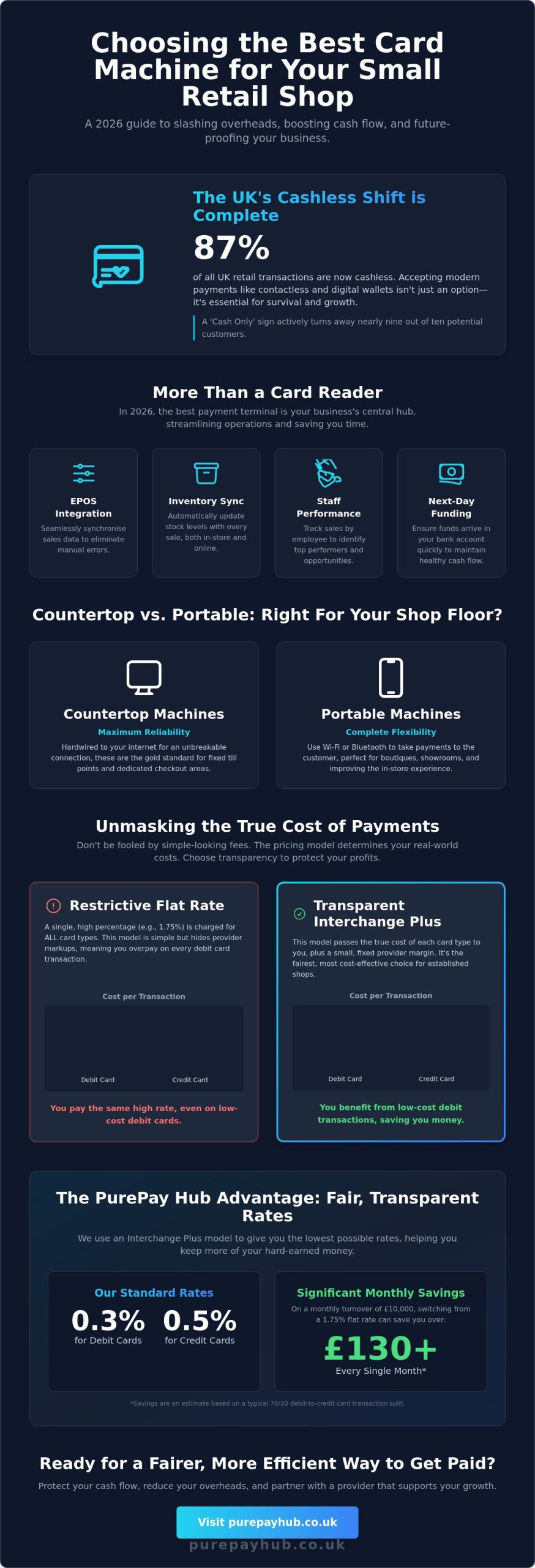
    PurePay Hub is here to simplify your growth journey with a commitment to total transparency. We provide next-day access to funds and debit card rates starting from 0.3 per cent; all supported by our dedicated UK-based expert team. We believe in straight-talking finance without the hidden markups or complex jargon that often complicates business development. Ready to transform your future card sales into immediate, usable working capital? Apply for a transparent Business Cash Advance today and take the next step with confidence. Your business has the potential to scale, and we are ready to provide the flexible tools to make it happen.

    Frequently Asked Questions

    What is the maximum amount I can borrow through a business cash advance?

    The amount you can secure is typically based on your average monthly card turnover. Most providers offer between 100 per cent and 200 per cent of your typical monthly sales volume. This ensures the advance remains manageable for your specific business size. If your average monthly takings are £10,000, you might access a lump sum up to £20,000 depending on your trading history and risk profile.

    How long does it take for the funds to reach my UK business bank account?

    Funds can reach your account in as little as 24 to 48 hours following approval. The digital application process is designed for speed; bypassing the weeks of manual checks required by traditional lenders. Once you have submitted your merchant statements and passed the soft search, the capital injection is processed quickly. This makes a business cash advance for small business UK an ideal choice for urgent stock needs or emergency repairs.

    Can I get a business cash advance if I have a poor credit history?

    Yes, you can still qualify even if you don’t have a perfect credit score. Providers prioritise your recent card sales and trading consistency over historical credit data. Because the funding is unsecured and linked to your future revenue, your ability to generate daily sales is the most important factor. This inclusive approach helps many independent merchants who have been unfairly turned away by high-street banks.

    Do I have to switch my card machine provider to get a cash advance?

    You don’t always have to switch; however, using an integrated provider like PurePay Hub simplifies the entire process. When your card machine and funding are aligned, repayments are automated through your daily takings without any manual intervention. If you are currently with another provider, switching to our countertop or portable machines can often unlock better transaction rates alongside your funding.

    Is there an interest rate or APR associated with a business cash advance?

    No, these products do not use interest rates or an Annual Percentage Rate (APR). Instead, you pay a fixed cost determined by a factor rate; which is agreed upon at the start. This means you’ll know exactly how much you will pay back from day one. There are no compound interest charges or late payment fees; ensuring total transparency for your business’s financial planning.

    What happens to my repayments if my card machine is broken or I am on holiday?

    Your repayments automatically pause or slow down if you aren’t processing card sales. Since the “sweep” mechanism takes a pre-agreed percentage of each transaction, zero sales means zero repayments. This provides a natural safety net during holiday closures or equipment downtime. You won’t face the stress of a fixed monthly bill whilst your till is silent; allowing you to focus on getting back to trade.

    Are there any restrictions on how I use the cash advancement?

    There are generally no restrictions on how you utilise the capital within your business. You can use a business cash advance for small business UK to settle tax bills, purchase seasonal stock, or invest in new marketing campaigns. Whether you need to upgrade your EPOS systems or fund a shop renovation; the choice is entirely yours. We provide the capital, and you provide the expertise to grow.

    Can start-up businesses in the UK apply for a merchant cash advance?

    Brand new start-ups usually need to establish a short trading history before they can apply. Most providers require at least 3 to 6 months of consistent card processing data to assess your average turnover. Once you have this baseline of sales, you can apply for funding to help scale your operations. It is an excellent secondary step for businesses that have moved past the initial launch phase.

  • Troubleshooting Card Machine Connection Issues: The Complete UK Business Guide (2026)

    Troubleshooting Card Machine Connection Issues: The Complete UK Business Guide (2026)

    UK retail and hospitality businesses lost an estimated £1.6 billion in 2025 due to payment system failures. You likely know the sinking feeling when a queue builds up and your screen displays a confusing “Connection Error” just as a customer reaches for their card. It’s frustrating to watch revenue slip away because of technical glitches, but mastering the art of troubleshooting card machine connection issues can save your trade.

    We understand that your business relies on seamless transactions; after all, debit cards now account for 80% of all UK payments. This guide provides the clear, no-nonsense steps you need to diagnose and fix connectivity faults instantly. You’ll learn how to restore your service without waiting hours for bank support and how to distinguish between a simple network drop and a hardware failure. We also explain how to stay compliant with the latest PCI DSS 4.0 standards to keep your local business secure and reliable.

    Key Takeaways

    • Identify why modern UK businesses must move away from analogue-dependent terminals to maintain reliable cash flow and customer trust.
    • Master the art of decoding error messages to quickly distinguish between local Wi-Fi faults and mobile SIM signal drops.
    • Implement a logical 5-step process for troubleshooting card machine connection issues, including the 30-second power cycle to restore service instantly.
    • Compare the reliability of Ethernet, Wi-Fi, and 4G roaming SIMs to ensure your hardware choice matches your specific business environment.
    • Discover how automatic failover technology can protect your revenue by switching seamlessly between networks during a local outage.

    Why Your Card Machine Keeps Losing Connection: Common UK Culprits

    Connectivity is the heartbeat of your business. When your terminal fails, queues grow and revenue stops. Effective troubleshooting card machine connection issues requires a clear understanding of why these drops happen in the first place. Often, the cause is a mix of ageing infrastructure and local network strain. You need to know if the fault lies with your Internet Service Provider (ISP), the payment gateway, or the hardware itself.

    If your Wi-Fi works on your smartphone but the terminal remains offline, the issue is likely the payment gateway or the device. Conversely, if no devices can connect, your ISP is the culprit. Hardware age is a frequent but overlooked factor. Over time, internal capacitors degrade and Wi-Fi antennas lose their sensitivity. If your device hasn’t been updated to the latest firmware, it may struggle to communicate with modern routers that use newer encryption standards. A modern payment terminal requires a stable, high-speed data exchange to process transactions securely. Keeping your hardware current is the first step in avoiding the headache of troubleshooting card machine connection issues during a busy shift.

    The Impact of the UK Digital Switchover

    The UK has moved away from traditional analogue infrastructure. Older machines that rely on Public Switched Telephone Network (PSTN) lines are now effectively obsolete. These phone-line connections can’t provide the “always-on” reliability required for 2026 business standards. Modern countertop units must use IP-based (Internet Protocol) connectivity via Ethernet or Wi-Fi. Older hardware often lacks the processing power to handle the complex security handshakes mandated by PCI DSS 4.0, leading to frequent timeouts and failed connections.

    Network Congestion in Retail Environments

    Your local environment is often the biggest hurdle. Many business owners provide guest Wi-Fi for customers, but this can throttle the bandwidth your terminal needs. During a “Friday Night Peak,” the surge in connected devices can cause your signal to drop exactly when you’re busiest. Interference is another silent killer. On a crowded high street, Bluetooth signals from neighbouring shops or even kitchen equipment can disrupt the wireless frequency your portable machine uses. Switching to a dedicated frequency or a wired Ethernet connection for fixed points is often the simplest fix for these environmental gremlins.

    Decoding Common Card Machine Error Messages

    Error codes are your first diagnostic tool, not just a nuisance. They provide the specific data needed for troubleshooting card machine connection issues. Instead of guessing why a payment failed, look directly at the screen for a specific prompt. These messages act as a map, telling you exactly where the digital handshake failed.

    “No Signal” or “No Service” typically points to a physical environment problem. For a mobile card machine, this means the roaming SIM cannot find a local mast. For a countertop unit, it suggests the Wi-Fi or Ethernet signal has dropped entirely. “Host Busy” or “Connection Timed Out” shifts the blame away from your shop. These messages mean your terminal successfully reached the internet, but the payment gateway or bank server is struggling to respond. This is usually temporary and requires a few minutes of patience rather than a hardware reset.

    One code you never want to see is “Alert Irruption.” This is a critical security feature mandated by the Payment Card Industry Data Security Standard (PCI DSS). It triggers when the terminal detects physical tampering or a significant internal hardware failure. Once this appears, the machine is permanently disabled to protect cardholder data. You cannot fix this through software; you will need a physical replacement from your provider to resume trading.

    Network vs. Hardware Errors

    A “Comms Error” usually signals a local network configuration fault. It often happens if your router’s firewall is too restrictive or if an IP conflict exists. In contrast, “Terminal Blocked” is rarely about the wire. It’s a security flag on your merchant account, often triggered by unusual activity or an expired compliance certificate. If you still use a digital VoIP adapter for an older unit, “Line Busy” suggests the adapter is failing to convert the digital signal correctly. If these errors persist, upgrading to modern Portable Card Machines with built-in 4G failover can eliminate these local bottlenecks.

    Offline Mode: “Store and Forward” Explained

    When connectivity fails, some terminals offer “Offline Mode” or “Store and Forward.” Your screen might say “Offline Transaction Accepted.” This allows you to keep the queue moving, but it carries risk. The machine stores the card data and attempts to process it once the connection returns. This is a vital fallback when troubleshooting card machine connection issues during peak hours.

    Because the transaction isn’t authorised in real-time, you won’t know if the card has sufficient funds or is reported stolen until later. If the authorisation fails when you reconnect, you lose that revenue. To clear the “Pending Transactions” queue, ensure your signal is strong and select the “Reconcile” or “End of Day” function. This pushes all stored data to the payment gateway for final processing and confirms your cash flow.

    Comparing Connectivity Methods: Ethernet vs. Wi-Fi vs. Mobile SIM

    Your choice of connection dictates your uptime percentage and transaction speed. If you operate from a fixed retail centre, Ethernet is the gold standard for your countertop card machine. It provides a dedicated, physical path for data that bypasses the fluctuations of wireless signals. Reliability is the primary goal here. A wired connection is almost immune to the environmental interference that plagues wireless setups. It ensures that the handshake between your terminal and the payment gateway remains unbroken.

    Whilst Wi-Fi offers essential flexibility for hospitality, it’s often prone to “dead zones” and signal drops. In busy restaurants or pubs, Bluetooth base-station interference is a common culprit that many guides overlook. When multiple wireless devices compete for the same frequency, your terminal can lose its connection to the server. Understanding the UK’s card payment systems helps merchants realise that stability isn’t just a technical preference; it’s a regulatory necessity for maintaining consistent service. If you find yourself constantly troubleshooting card machine connection issues, the physical method of connection is often the first place to look.

    The Power of Multi-Network Roaming SIMs

    For portable and mobile card machines, a standard consumer SIM is insufficient. Professional payment hardware relies on multi-network roaming SIMs. These intelligent chips don’t stick to one provider. Instead, they scan for the strongest available signal amongst O2, EE, and Vodafone. If one network suffers an outage, the machine switches to another automatically. This prevents you from being stranded in a signal blackspot during a busy shift. Whilst mobile data carries a specific monthly cost, the benefit of never missing a sale far outweighs the small overhead compared to the risk of total downtime.

    Optimising Your In-Store Network

    You can significantly reduce the need for troubleshooting card machine connection issues by segregating your digital traffic. Always put your card machines on a dedicated VLAN (Virtual Local Area Network). This ensures your payment data isn’t competing for bandwidth with guest Wi-Fi or your back-office streaming services. In larger venues, mesh Wi-Fi or signal boosters are essential to maintain a strong signal across the entire floor. You should also consider a “failover” system. This setup ensures that if your primary fixed-line broadband fails, your hardware automatically switches to a 4G backup. It acts as a silent insurance policy for your daily revenue.

    The Master 5-Step Troubleshooting Guide for UK Merchants

    When your queue is out the door, you don’t have time for long wait times for bank support. Following a logical sequence is the fastest way to restore service. Most connection faults are temporary glitches that you can resolve in under five minutes. Use this master 5-step guide for troubleshooting card machine connection issues to get your payments back on track.

    Step 1: The Power Cycle. Switch the unit off. Wait exactly 30 seconds. This duration is vital because it allows internal capacitors to discharge completely, clearing any lingering software loops. Step 2: Physical Layer Check. Inspect every connection. A loose Ethernet cable or a poorly seated battery can mimic a network outage. Step 3: Network Refresh. Disconnect from your Wi-Fi and re-enter the credentials. This forces the router to assign a fresh DHCP lease to the terminal, clearing IP conflicts. Step 4: Software Update. Perform a manual “Logon” or “System Initialisation” from the terminal menu. This forces the hardware to verify its security certificates against the payment gateway, ensuring you meet the latest PCI DSS 4.0 requirements. Step 5: Isolation Test. Try connecting the machine to a mobile hotspot to rule out your local ISP as the source of the fault.

    If your current hardware fails these tests frequently, it’s time to upgrade to reliable Countertop Card Machines built for the modern UK high street.

    Step 1 & 2: The Physical Fundamentals

    Physical wear is a silent revenue killer. If you use a portable card machine, remove the back cover and unseat the roaming SIM card. Use a dry, lint-free cloth to clean the gold contacts before re-inserting it firmly. For countertop units using Power-over-Ethernet (PoE), check the “comms” cable for fraying or sharp bends. Low voltage caused by damaged wires can lead to intermittent signal drops. Finally, ensure the charging base contacts are free from dust or grease; a weak charge often results in a weak wireless antenna performance.

    Advanced Diagnostic: The Hotspot Test

    The hotspot test is the most effective way to identify a local network failure. Turn on the personal hotspot on your smartphone and connect your card machine to it. If the terminal processes a test transaction immediately, your business router or firewall is the culprit. This proves the hardware is functional and the issue lies with your ISP or internal security settings. You can then tell your IT provider exactly what you’ve discovered. Providing this specific data helps them bypass basic scripts and implement a permanent fix for your network configuration much faster.

    Future-Proofing Your Payments with PurePay Hub Hardware

    Reliability shouldn’t be a luxury for your business. If you find yourself constantly troubleshooting card machine connection issues, your current hardware is likely failing to meet the demands of a modern retail environment. PurePay Hub provides a different approach by focusing on resilient technology that keeps your queue moving. We position ourselves as a fair partner to regional business owners, ensuring your payment system is a source of stability rather than stress.

    Our terminals are engineered specifically for the rigours of the modern UK high street. They feature automatic failover technology as standard. If your shop’s Wi-Fi drops, the machine seamlessly switches to a 4G roaming SIM without interrupting the transaction. You won’t even notice the transition. This built-in redundancy ensures you never miss a sale due to local network instability or broadband outages. It’s a no-nonsense solution designed to protect your revenue at all times.

    We also understand that cash flow is your lifeline. Even if you experience a brief connection drop during the day, our next-day funding ensures your money reaches your account without unnecessary delays. If you do encounter a complex fault, you won’t be stuck in a generic call centre queue. You’ll talk directly to a UK-based expert who understands your specific terminal and the unique challenges of your local business community. This direct partnership is what sets us apart from distant financial institutions.

    The PurePay Hub Advantage

    We take the technical burden off your shoulders from day one. Every PurePay Hub terminal arrives pre-configured for your specific needs. We organise the network settings before shipping, making it a true plug-and-play solution for your storefront. With low rates starting from 0.3%, more of your hard-earned profit stays exactly where it belongs. Our 24/7 technical support is always available to guide you through any unexpected hurdles, ensuring that troubleshooting card machine connection issues becomes a thing of the past.

    Choosing the Right Machine for Your Environment

    Selecting the right tool for the job is essential for maintaining high uptime percentages. Our countertop units provide reliable, fixed-point service for traditional retail environments where Ethernet stability is preferred. If you run a restaurant or pub, our portable units offer extended Wi-Fi range and long battery life for seamless table-side service. For tradespeople and delivery drivers on the move, our mobile units with global roaming ensure you can take secure payments anywhere in the UK.

    Don’t let technical glitches or opaque support practices dictate your daily revenue. Upgrade to a reliable PurePay Hub card machine today and experience the clarity of a fair, professional payment partnership that values your time as much as you do.

    Secure Your Trade with Resilient Payments

    Connectivity is the lifeline of your cash flow. We’ve explored how identifying local network bottlenecks and decoding specific error messages can save your trade during peak hours. Whilst mastering the art of troubleshooting card machine connection issues is a vital skill for any merchant, the ultimate goal is to eliminate the need for it entirely. By choosing hardware with automatic failover and segregating your digital traffic, you move from a state of frustration to one of informed confidence.

    Don’t let outdated terminals or opaque support structures hold your business back. You deserve a payment partner that prioritises transparency and uptime as much as you do. With debit rates starting from 0.3% and next-day funding as standard, our service is designed to keep your revenue moving. You’ll also benefit from direct access to UK-based technical support whenever you need a straight answer.

    Switch to PurePay Hub for reliable, UK-supported card machines and get back to what you do best: serving your local customers. Your business is built on hard work; your payment system should be too.

    Frequently Asked Questions

    Why is my card machine saying “No Connection” but my Wi-Fi is working?

    Your terminal likely faces a firewall restriction or an IP address conflict. Even if other devices connect to the internet, your card machine requires specific ports to be open to reach the payment gateway. You should check your router settings to ensure the terminal isn’t being blocked by a security protocol or try assigning it a static IP to prevent future drops.

    How do I reset my card machine without losing my daily totals?

    You can perform a soft reset by holding down the power button or using the “Restart” option in the settings menu. This action clears the temporary cache without affecting your stored batch totals or “Store and Forward” transactions. Avoid selecting “Factory Reset” or “Clear All Data” unless specifically instructed by your provider, as these will wipe your daily records.

    Can I still take payments if my business broadband goes down?

    Yes, provided your hardware has a roaming SIM or an “Offline Mode” feature. Mobile card machines will switch to a 4G or 5G signal automatically when the broadband fails. If you use a countertop unit without a SIM, you may be able to process transactions in “Store and Forward” mode, though these aren’t authorised in real-time and carry a higher risk of later decline.

    What does “Alert Irruption” mean and can I fix it myself?

    This is a terminal-locking security failure that you cannot fix yourself. It triggers when the device’s internal sensors detect physical tampering or a significant hardware fault. Because this is a protective measure for cardholder data, the machine is permanently disabled. You must contact your provider to arrange for a replacement unit to be shipped to your business.

    How often should I update the software on my payment terminal?

    You should allow your machine to update whenever a prompt appears, which usually happens during the “End of Day” process. Regular updates are essential for troubleshooting card machine connection issues and ensuring your business remains compliant with PCI DSS 4.0. Most modern units perform these updates automatically overnight to minimise disruption to your trading hours.

    Why does my portable card machine lose signal at the back of my shop?

    Physical obstructions like thick stone walls, metal shelving, or even kitchen equipment often cause “dead zones” in your premises. Wireless signals struggle to penetrate dense materials, leading to intermittent connectivity. If you frequently lose signal, consider installing a mesh Wi-Fi system or switching to a terminal that uses a multi-network roaming SIM for better coverage.

    Will my card machine work with a 5G network in 2026?

    Yes, modern payment hardware is designed to be forward-compatible with the latest UK mobile infrastructure. As 5G becomes the standard across the country, your terminal will prioritise the fastest available data network. This ensures that your transaction speeds remain high and your connection stays stable, even in crowded high-street environments where 4G bands might be congested.

    How do I check if the payment gateway provider is having an outage?

    The fastest way is to check the official status page of your payment provider or use a service like Downdetector. If your local internet is working on other devices but the terminal fails the “Host Connection” test, the issue is likely at the gateway level. In these instances, you simply have to wait for the provider to restore their central services.

  • PCI Compliance for Small Business UK: The 2026 Merchant Guide

    PCI Compliance for Small Business UK: The 2026 Merchant Guide

    Did you know that 28% of UK small businesses believe a single cyber attack could put them out of business for good? It’s a sobering thought for any merchant handling customer card details. We understand that managing PCI compliance for small business UK often feels like a trap designed to catch you out with hidden monthly non-compliance fees and confusing technical jargon like SAQ and DSS. You’d rather focus on serving your customers than decoding complex security manuals or worrying about the 43% of UK companies that have experienced a breach this year.

    You shouldn’t have to choose between security and simplicity. This guide helps you master the essentials of PCI DSS v4.0 so you can stop paying those frustrating non-compliance fines and ensure your customer data remains secure; all whilst maintaining a fast checkout. We’ll break down the mandatory 2026 requirements and show you how to protect your business from the rising threat of data theft. Here is how you can turn compliance from a monthly penalty into a steady security partnership that keeps your business and your reputation untainted.

    Key Takeaways

    • Identify your specific merchant level and the correct SAQ type to ensure your business meets the latest 2026 standards.
    • Learn how to spot hidden non-compliance charges on your statement to master PCI compliance for small business UK and protect your margins.
    • Follow a practical checklist to secure your card machines and digital environment against common physical and password-based vulnerabilities.
    • Understand the shift to PCI DSS v4.0 and why continuous security is now a mandatory requirement for every UK merchant.
    • Discover how P2PE-certified payment solutions can streamline your path to compliance and significantly reduce your annual paperwork.

    Understanding PCI Compliance for UK Small Businesses

    At its heart, the Payment Card Industry Data Security Standard (PCI DSS) is a set of security requirements designed to ensure that all companies processing, storing, or transmitting credit card information maintain a secure environment. It isn’t a government law, but a global standard established by the major card schemes like Visa, Mastercard, and American Express. These industry giants realised that for digital commerce to thrive, customers needed to feel safe. They created these rules to protect the entire ecosystem from the devastating impact of data theft. Managing PCI compliance for small business UK is about more than just avoiding fines; it’s about protecting your livelihood.

    By 2026, the role of the PCI Security Standards Council has evolved significantly. We’re no longer in an era where you can simply tick a box once a year and forget about it. The latest standards, specifically PCI DSS v4.0, demand continuous security monitoring. This means your security measures must be active and verified every single day. Whilst the standards may seem technical, their purpose is simple: to make fraud as difficult as possible for criminals. Compliance isn’t optional for specific niches. It applies to you if you use any of the following:

    • Countertop or portable card machines in a physical shop.
    • Virtual terminals for taking payments over the phone.
    • Online payment gateways for e-commerce websites.
    • Payment links sent via email or SMS.

    PCI compliance for small business UK is mandatory for every merchant, regardless of your size or transaction volume. Whether you process ten payments a month or ten thousand, the requirement to protect that data remains the same.

    Why PCI Compliance Matters for Your Reputation

    Security is the foundation of customer loyalty. When a local shopper taps their card on your mobile card machine, they’re trusting you with their financial life. Maintaining these standards builds a wall of trust amongst your customer base. It reduces the risk of card fraud and positions your business as a professional, secure centre for commerce. A single slip-up can destroy years of hard-earned reputation. Staying compliant is the best way to keep your brand untainted by the scandal of a data breach.

    The Legal and Contractual Reality

    Many business owners ask if PCI compliance is a legal requirement in the UK. While it isn’t a law passed by Parliament, it’s a strict contractual obligation between you and your merchant bank. If you fail to comply, you’re breaking your agreement. This can lead to heavy non-compliance fines or even the withdrawal of your ability to take card payments. The Information Commissioner’s Office (ICO) also takes a dim view of any business that suffers a breach due to poor security. Failing to meet PCI standards is often seen as a failure to protect personal data under GDPR, which can lead to severe regulatory penalties.

    Identifying Your Compliance Level and SAQ Type

    Knowing your place in the PCI hierarchy is the first step toward clearing the fog. The industry divides merchants into four levels based on their annual transaction volume. The vast majority, roughly 99% of companies, fall into Level 4. This level applies if you process fewer than 20,000 e-commerce transactions or up to 1 million total transactions annually. Managing PCI compliance for small business UK becomes far easier once you identify your specific merchant level, as it dictates the complexity of your reporting requirements.

    To prove you are following the rules, you must complete a Self-Assessment Questionnaire (SAQ). There are currently nine different types of SAQs under the v4.0 standards. The PCI Security Standards Council (PCI SSC) provides these documents to help you evaluate your security posture. The specific form you need depends entirely on how you handle card data. If you use a standalone, plug-and-play card machine, your workload is significantly lighter than a business hosting its own payment server.

    Common SAQ Types for UK Retailers and Hospitality

    Most high-street shops and cafes will deal with either SAQ A or SAQ B-IP. SAQ A is generally for e-commerce merchants who outsource all payment processing. If you use a countertop card machine connected via the internet, you likely need SAQ B-IP. We recommend looking for hardware that supports Point-to-Point Encryption (P2PE). This technology encrypts data from the moment a card is tapped until it reaches the processor. Using P2PE-certified devices or integrated EPOS systems can drastically reduce the number of security questions you have to answer each year.

    The Annual Renewal Cycle

    Compliance is a continuous cycle, not a one-time event. Your certification is valid for one year; you must renew it before the expiry date to avoid automatic non-compliance fines. These penalties can range from £20 to £40 per month, which quickly eats into your profits. We suggest setting a reminder three months before your certificate expires. Keep a dedicated digital folder for your network scans, staff training logs, and equipment inspection records. Organising your documentation throughout the year makes the renewal process a simple, stress-free task rather than a last-minute scramble. Maintaining your PCI compliance for small business UK status is about building consistent habits that protect your customers and your cash flow.

    PCI Compliance for Small Business UK: The 2026 Merchant Guide

    The Real Cost of PCI Compliance: Fees vs Fines

    Your monthly merchant statement often contains a confusing list of acronyms and charges. One of the most misunderstood is the “PCI Management Fee”. This is a standard service charge, typically ranging from £5 to £15 per month, which covers the cost of the security tools and support provided by your payment processor. It’s a legitimate cost of doing business safely. However, a “PCI Non-Compliance Fee” is entirely different. This is a penalty, not a service. If you see a charge between £20 and £40 on your statement, you’re being fined for failing to prove your security status. Understanding the financial side of PCI compliance for small business UK is essential for protecting your bottom line.

    Some traditional providers rely on opaque fee structures to boost their margins. They might bury non-compliance penalties deep in your statement, hoping you won’t notice the monthly drain on your cash flow. A fair partner should be transparent about these costs. They’ll help you achieve compliance rather than simply profiting from your confusion. The goal is to move from paying penalties to investing in a secure partnership that keeps your business untainted by unnecessary costs. Transparency is the hallmark of a modern fintech ally.

    How to Spot and Stop Non-Compliance Fines

    Check your statement for terms like “Non-PCI Compliant Fee” or “PCI Penalty”. If you find one, take immediate action. Log into your compliance portal or contact your provider to find out which documentation is missing. Completing your assessment can instantly stop these fines and boost your monthly cash flow. It’s often a simple matter of updating your records or confirming your hardware settings. Don’t let these preventable charges become a permanent fixture on your overheads whilst you are trying to grow your business.

    The Hidden Costs of a Data Breach

    The fines for non-compliance are small compared to the true cost of a data breach. Research shows the average direct cost of a cyber attack for a small UK business is £3,398. But this is just the tip of the iceberg. A breach where cardholder data is stolen triggers mandatory forensic audits that can cost thousands of pounds. You’ll also face the price of mandatory hardware replacement and the cost of notifying every affected customer. Beyond the immediate financial hit, the long-term brand damage is often irreversible. Customers value their security; if they feel their data isn’t safe, they’ll simply take their custom elsewhere. Maintaining PCI compliance for small business UK is your best defence against these business-ending threats.

    A Practical Checklist for PCI DSS v4.0 Standards

    The transition to the v4.0 standards has changed the landscape of PCI compliance for small business UK. It’s no longer enough to just own a secure device; you must manage the entire environment where payments happen. This starts with basic digital hygiene. Using a password like “admin123” or “password” is a major compliance failure that hackers can exploit in seconds. You need unique, complex credentials for every piece of hardware and software in your payment chain. If your staff use shared logins, you’re creating a security blind spot that v4.0 specifically aims to close.

    Network safety is another critical pillar for any modern shop or cafe. You must separate your guest Wi-Fi from the network used by your payment terminal. If a customer’s phone is on the same network as your card machine, you’ve created a potential doorway for data theft. Similarly, your data storage rules must be absolute. Never, ever write down card numbers or CVV codes on paper or in digital notes. If you don’t store the data, you can’t lose it. Training your team to recognise secure payment behaviour is now a mandatory requirement, ensuring everyone understands their role in protecting the business.

    Securing Your Physical Business Premises

    Physical tampering remains a persistent threat for UK retailers. We recommend performing daily visual checks on your portable card machine to look for skimming devices or evidence of casing swaps. Ensure your router and payment hardware are kept in a restricted area, ideally behind a counter or in a locked cabinet. You should also maintain a documented list of authorised staff who are permitted to handle the terminals. Staying on top of these physical checks is a vital part of maintaining PCI compliance for small business UK and keeping your equipment untainted by fraud.

    Digital Hygiene and Network Security

    If you use integrated EPOS systems, a robust firewall is your first line of defence. It acts as a digital bouncer, keeping unauthorised traffic away from your transaction data. For those taking payments over the phone, you must use a secure virtual terminal. Handling “Card Not Present” transactions requires specific protocols to ensure you aren’t inadvertently storing sensitive data during the call. If you’re looking for hardware that simplifies these requirements, our range of P2PE-certified card machines is designed to meet the highest security standards with minimal effort from your side.

    How PurePay Hub Simplifies Your Security Obligations

    PurePay Hub believes that payment security shouldn’t be a source of stress. We’ve built our service to act as a stabilising force for your finances. Managing PCI compliance for small business UK often feels like a full-time job. We aim to change that. Our approach prioritises clarity over corporate jargon, ensuring you understand your obligations without the headache. We provide the tools and the support you need to keep your business untainted by security failures. Our team serves as a reliable expert, helping you stay principled and disciplined in your data protection efforts.

    Our hardware comes pre-certified with the latest P2PE standards. This isn’t just a technical detail. It’s a commitment to reducing your administrative burden. By using our pre-configured devices, you significantly shorten your annual Self-Assessment Questionnaire. You can spend less time on paperwork and more time on growth. We act as a fair partner, making sure the technicalities of security don’t slow down your operations. We disdain the opaque practices of traditional competitors who leave you to figure out these complex rules on your own.

    Integrated Security in Every Transaction

    Our countertop and mobile units handle encryption automatically. The moment a customer taps their card, the data is shielded immediately. This level of protection provides the peace of mind you need to focus on the daily run of your shop or cafe. We also offer next-day funding, ensuring your cash flow remains as secure as your transaction data. Best of all, our transaction rates are untainted by hidden markups or the murky fee structures used by traditional banks. We believe in fairness and transparency in every transaction. You’ll always know exactly what you’re paying and why, with no hidden surprises on your monthly statement.

    Expert Support for Your SAQ

    You don’t have to face the transition to PCI DSS v4.0 alone. We provide access to UK-based technical support to help with any compliance queries you might have. Our team acts as a supportive business partner, guiding you through the technicalities of the 2026 standards. We’ll help you manage PCI compliance for small business UK whilst you navigate the assessment process, ensuring you avoid those unnecessary non-compliance fines discussed earlier. It’s about more than just providing software; it’s about a steady security partnership that values your time. We’re here to ensure your business stays compliant and your reputation remains spotless.

    Speak to a PurePay Hub expert about your merchant account today.

    Secure Your Future with a Fair Partner

    Securing your business shouldn’t feel like a constant battle against hidden costs and technical jargon. You now have the roadmap to master PCI compliance for small business UK, from identifying your SAQ type to implementing the latest v4.0 standards. By staying disciplined with your physical checks and digital hygiene, you protect your reputation whilst keeping your finances untainted by unnecessary penalties. Compliance is no longer a hurdle; it’s a foundation for a professional, trustworthy merchant environment.

    It’s time to move away from opaque fee structures and toward a partnership built on integrity. We’re here to help you navigate these obligations with clarity and confidence. Switch to PurePay Hub for transparent card processing and expert PCI support. You’ll benefit from debit card rates starting from 0.3%, next-day access to funds, and the reassurance of no-nonsense UK-based support. We’re ready to help you simplify your security so you can focus on what you do best: running your business. Let’s make your payment processing fairer and more secure today.

    Frequently Asked Questions

    Is PCI compliance mandatory for small businesses in the UK?

    Yes, PCI compliance is a mandatory contractual requirement for any UK merchant that accepts card payments. It isn’t a government law, but a set of security standards enforced by major card schemes like Visa and Mastercard. If you don’t comply, you’re breaking your agreement with your merchant bank. This can lead to your ability to take payments being withdrawn entirely.

    How much does PCI compliance actually cost per month?

    Most UK merchants pay a small monthly fee to their processor to cover the cost of compliance tools and support. These fees typically range from £5 to £15 per month. This is a legitimate service charge that helps you maintain your security status. It’s much more affordable than the non-compliance penalties that providers charge if you fail to prove your status each year.

    What happens if my business is not PCI compliant?

    Failing to meet the standards for PCI compliance for small business UK leads to immediate financial penalties. Most processors will add a monthly non-compliance fine to your statement, often between £20 and £40. You’ll also be fully liable for all costs if a data breach occurs. This includes forensic audits, card replacement fees, and potential legal claims that could bankrupt a small firm.

    Do I need PCI compliance if I only use a mobile card reader?

    Yes, every device that processes card payments requires compliance, including mobile card readers. Even if you only take a few payments a week, the data passing through your reader must be protected. Using a modern, P2PE-certified mobile reader simplifies the process, but you still need to complete an annual Self-Assessment Questionnaire to confirm your business follows safe handling procedures.

    What is the difference between PCI DSS v3.2.1 and v4.0?

    PCI DSS v4.0 replaced the older v3.2.1 version to address more sophisticated modern threats. The biggest change is the shift from an annual tick-box exercise to continuous security monitoring. It introduces stricter requirements for multi-factor authentication and more rigorous testing of security controls. This ensures that your business remains protected every day of the year, not just on the day you fill out your forms.

    How often do I need to renew my PCI compliance certificate?

    You must renew your PCI compliance certificate every 12 months. Your Self-Assessment Questionnaire (SAQ) is only valid for one year from the date of submission. We recommend starting your renewal process at least 90 days before the expiry date. This gives you plenty of time to address any technical issues or network scan failures without risking a lapse in your compliant status.

    Can I handle PCI compliance myself or do I need a consultant?

    Most small UK businesses can handle the PCI compliance for small business UK process themselves without hiring expensive consultants. Your payment provider should offer a compliance portal and technical support to guide you through the SAQ. If your business has a complex network or processes millions of transactions, you might need a Qualified Security Assessor, but for most local merchants, a supportive partner is enough.

  • Compare Card Payment Providers UK: The 2026 Merchant Services Guide

    Compare Card Payment Providers UK: The 2026 Merchant Services Guide

    The lowest headline rate on a card machine often ends up being the most expensive mistake a UK business can make. You’ve likely noticed that a “simple” flat rate rarely stays simple whilst hidden markups and non-qualifying fees clutter your monthly statement. It’s an industry built on complexity, and when you try to compare card payment providers UK, the lack of clarity often feels intentional. You want to focus on serving your community, not decoding why your hard-earned revenue is tied up for days.

    We agree that you deserve better than opaque contracts and slow access to your own funds. This 2026 guide provides a transparent, data-driven framework to help you identify providers that actually prioritise your cash flow. We’ll show you how to move beyond basic percentages to find genuine Interchange++ pricing and reliable next-day funding. By examining the impact of the 2026 PSR cross-border fee caps and seeing how the PurePay Hub standard of transparency compares to traditional providers, you’ll gain the clarity needed to choose a partner that supports your growth.

    Key Takeaways

    • Understand the critical differences between acquirers, ISOs, and PSPs to ensure you partner with a provider that offers direct stability and support.
    • Decode complex fee structures to avoid the blended rate trap and switch to transparent Interchange++ pricing that reveals your true transaction costs.
    • Apply our data-driven framework to compare card payment providers UK based on your specific monthly turnover and average transaction value.
    • Learn how to prioritise your cash flow by identifying providers that offer next-day funding rather than the standard three-day wait.
    • Discover how PurePay Hub acts as a stabilising force for your finances through honest pricing on portable card machines and integrated EPOS systems.

    The days of simply plugging in a bulky terminal and waiting for a dial-up connection are over. British retail now runs on integrated ecosystems where hardware and software speak the same language. If you want to compare card payment providers UK, you must first understand that you aren’t just buying a machine; you’re choosing a financial partner. The market has shifted toward “softPOS” technologies and mobile-first solutions that allow merchants to accept payments on smartphones. This evolution makes the choice of provider more critical than ever for your daily cash flow.

    You’ll encounter three main types of players in this space. Acquirers are the massive financial institutions that actually process the money. Payment Service Providers (PSPs) offer quick, digital-only setups that are often easy to start but expensive as you grow. Then there are Independent Sales Organisations (ISOs). These entities provide the personalised service and competitive rates that big banks often ignore. Every transaction you process involves an Interchange fee, which is the baseline cost set by card schemes. A transparent provider will show you these costs clearly rather than hiding them behind a flat, “blended” rate.

    The UK market is uniquely demanding. According to UK Finance data from March 2026, 89% of UK payment cards are now contactless-enabled. Consumers expect to tap and go in seconds. Meeting this demand requires hardware that is both fast and compliant with the latest PCI-DSS security regulations. Failure to keep up doesn’t just mean lost sales; it can lead to heavy non-compliance penalties that drain your revenue.

    The Role of an ISO in the UK Ecosystem

    ISOs like PurePay Hub act as a vital bridge between small businesses and the rigid bureaucracy of big banks. We take the raw processing power of major acquirers and refine it into a service that actually works for a local business owner. Because we handle high volumes across many merchants, we can often negotiate better rates than a single business going direct to a bank. You get the stability of a major financial institution paired with the dedicated, UK-based support of a partner who knows your name. It’s a way to bypass corporate jargon and get straight to the fair pricing your business deserves.

    Current Payment Trends: Contactless and Digital Wallets

    Digital wallets have moved from a novelty to a necessity. Apple Pay and Google Pay now dominate consumer behaviour, especially amongst younger demographics. Your Countertop Card Machine or Portable Card Machine must support Near Field Communication (NFC) as a standard feature. Looking ahead, Open Banking and QR code payments are beginning to gain traction. These methods allow customers to pay directly from their bank accounts, potentially offering even lower fees for merchants in the future. Staying ahead of these trends ensures your business remains accessible to every type of shopper.

    Decoding Fee Structures: Interchange++ vs. Blended Rates

    Headline rates are often smoke and mirrors in the merchant services industry. To truly compare card payment providers UK, you must look at what’s under the bonnet. Every transaction fee is a cocktail of three distinct ingredients. First is the interchange fee, which is the wholesale cost paid to the card-issuing bank. Second is the scheme fee, which goes to networks like Visa or Mastercard. Finally, there’s the acquirer margin, which is the only part your provider actually keeps as profit. The Payment Systems Regulator (PSR) oversees these structures to keep the market competitive, yet many providers still find ways to mask their true margins behind “simple” pricing.

    Beyond the basic percentage, you must watch for hidden extras that drain your daily revenue. Many providers sneak in authorisation fees for every transaction attempt, regardless of whether it’s successful. You might also encounter a Minimum Monthly Service Charge (MMSC) if your turnover dips during a quiet month. Perhaps the most frustrating are PCI non-compliance fines, which can add £20 or £30 to your bill simply for missing a paperwork deadline. Choosing a partner that offers a transparent merchant account ensures these murky costs don’t eat into your hard-earned profits.

    Why Blended Rates Can Cost You Thousands

    Pay-as-you-go (PAYG) providers favour blended rates because they’re easy to market. You pay a flat 1.5% to 1.75% regardless of the card type used. This sounds convenient, but it’s often a trap for established businesses. Most domestic debit card transactions have a wholesale cost far below 0.5%. By charging you a flat 1.5%, the provider pockets the massive difference as pure profit. They use your high-volume debit sales to subsidise expensive premium or corporate cards that your customers might only use occasionally. Blended rates prioritise simplicity over actual cost efficiency.

    The Transparency of Interchange++

    Interchange++ is the gold standard for honest merchant services. This model separates the three cost components on your monthly statement, passing the wholesale savings directly to your business. You pay the exact interchange and scheme fees plus a small, fixed margin. This level of clarity is why growing UK businesses prefer this model for long-term stability. Reading your statement becomes a straightforward task because you can see exactly where every penny goes. You won’t find yourself paying an inflated “one-size-fits-all” margin that doesn’t reflect your actual transaction behaviour.

    Compare Card Payment Providers UK: The 2026 Merchant Services Guide

    Provider Comparison: PAYG vs. Traditional Merchant Accounts

    Deciding between a Pay-As-You-Go (PAYG) provider and a traditional merchant account is a major step for any British business. PAYG models appeal to seasonal traders or those with infrequent sales because they lack monthly overheads. However, they charge a premium for this lack of commitment. To compare card payment providers UK effectively, you have to look past the instant setup and assess the true cost of convenience. Once your sales volume stabilises, the high flat rates of basic readers often become a significant drain on your margins.

    Traditional merchant accounts represent the professional standard for businesses processing over £5,000 each month. These accounts provide much lower transaction rates and more durable hardware, such as a Countertop Card Machine or a Portable Card Machine. While they involve a monthly fee, the savings on every tap and insert usually far outweigh the fixed cost. These professional setups offer seamless connectivity with your EPOS Systems and accounting software; this keeps your back-office tasks as streamlined as your customer service. You gain a level of operational stability that basic app-based readers simply cannot match.

    The Tipping Point: When to Switch from PAYG

    The transition to a managed merchant account usually makes sense at the £5,000 monthly turnover mark. At this level, the flat 1.75% fee common with app-based readers begins to undercut your growth. A managed account gives you access to wholesale rates that reflect your specific business profile. Additionally, PAYG hardware often struggles with the processing speed and battery life required in a high-pressure hospitality or retail setting. We’ve helped local shops cut their total processing costs by 40% by moving to a transparent account that rewards their success rather than penalising their volume.

    Hardware Options: Countertop, Portable, and Mobile

    Your hardware should match your service style. Selecting the right tool ensures a smooth customer experience and reliable uptime:

    • Countertop Card Machine: The fixed retail workhorse. It stays at the till and uses a stable internet connection for total reliability.
    • Portable Card Machine: Uses Bluetooth or Wi-Fi to reach customers. It’s the favourite for tableside service in cafes and restaurants.
    • Mobile Card Machine: Uses GPRS or 4G networks via a roaming SIM. It’s vital for couriers, tradespeople, and outdoor events across the UK.

    Modern hardware does more than process payments. It acts as a stabilising force by syncing directly with your digital records. This connectivity removes manual errors and provides a real-time view of your daily revenue, allowing you to make informed decisions about your business growth.

    The Decision Framework: How to Choose Your Provider

    Choosing a partner shouldn’t feel like a gamble. You need a logical sequence to compare card payment providers UK and find a fit that actually works for your specific business model. It’s easy to get distracted by shiny hardware, but the true value lies in the operational details that impact your daily life. Use this five-step framework to filter out the noise and identify a provider that acts as a genuine business ally.

    Start by auditing your current monthly volume and average transaction value. This data is your strongest negotiating tool. High-volume merchants require the transparency of Interchange++ to keep costs low, whilst those with a lower turnover might focus on minimising monthly rental fees. Next, check for hardware compatibility. If you use integrated EPOS Systems, your new Countertop Card Machine or Portable Card Machine must talk to your software without friction. Finally, review the quality of technical support. Many low-cost providers outsource their helpdesks to distant call centres. When your terminal stops working during a busy lunch service, you need reliable, UK-based support that understands the local market and can provide immediate resolutions.

    • Audit your data: Know your monthly card turnover and average transaction size before you start negotiations.
    • Evaluate settlement times: Determine if your cash flow can handle a three-day wait or if next-day funding is a necessity.
    • Check compatibility: Ensure your payment gateway or physical terminal integrates with your current accounting and sales software.
    • Scrutinise the contract: Look for short terms and avoid auto-renewal clauses that lock you in for years.
    • Test the support: Prioritise providers with dedicated UK-based teams that offer direct assistance when things go wrong.

    Settlement Speed: The Overlooked Metric

    Traditional banking often leaves you waiting. The difference between T+1 (next-day) and T+3 (three-day) settlement can be the difference between paying a supplier on time or missing a deadline. Accessing your funds quickly is essential for maintaining a healthy cash flow. PurePay Hub facilitates faster access to your hard-earned revenue, ensuring your bank balance reflects your actual sales. Don’t let a provider hold your money hostage when modern technology allows for rapid transfers.

    Contract Terms and Exit Strategies

    The merchant services industry is notorious for 36-month “auto-renewal” traps that make switching nearly impossible. Scrutinise every exit clause and look for a Service Level Agreement (SLA) that guarantees high uptime and clear service standards. We recommend that merchants always request a no-obligation quote before signing any long-term agreement. Request a transparent quote for your business here.

    PurePay Hub: Transparent Payments and Next-Day Funding

    Finding a provider that respects your bottom line shouldn’t be a struggle. We built PurePay Hub to offer a direct alternative to the murky pricing structures used by traditional banks. When you compare card payment providers UK, you’ll find that many hide their true margins behind complex jargon. We take a different path. Our commitment to transparency ensures you see exactly what you pay for. There are no hidden markups or unexpected fees to derail your financial planning. Our identity is built on being untainted by the opaque practices that frustrate so many business owners.

    Cash flow is the lifeblood of your business. Waiting three to five days for your revenue to settle is a frustration you don’t need. We provide next-day funding as a standard feature, acting as a stabilising force for your finances. Our onboarding process is designed for speed and efficiency. We aim to get your business set up and accepting payments in days rather than weeks. Whether you need a Countertop Card Machine for your shop or a Virtual Terminal for remote sales, we provide the tools to keep your revenue moving without delay.

    Fair Rates for UK Small Businesses

    We believe in fairness. Our Interchange++ pricing model passes wholesale savings directly to you. We offer competitive rates with debit cards starting from 0.3% and credit cards from 0.5%. These rates are tailored to your specific sector, ensuring you aren’t subsidising other industries with higher risk profiles. Your security is also a priority. Every system we provide is fully PCI-compliant and backed by 24/7 monitoring to protect your data and your customers. Our portable card machines are designed for maximum retail efficiency, allowing you to take the till to the customer without compromising on speed or reliability.

    A Partner in Your Growth

    We do more than just process transactions. We act as a supportive ally for your long-term development. If you need capital to expand, our Business Cash Advance provides a flexible alternative to traditional loans. Your repayments are linked directly to your card turnover; this means you pay back more when business is brisk and less during quieter periods. Our systems offer seamless EPOS integration for hospitality and retail environments, connecting your sales data with your inventory management. It is time to move away from impersonal banking and join a partnership built on clarity. Organise a transparent quote with PurePay Hub today.

    Take Control of Your Merchant Services

    The landscape of UK merchant services is evolving fast. You’ve seen why the “one-size-fits-all” approach of blended rates often traps growing businesses in unnecessary costs. True transparency comes from an Interchange++ model that separates wholesale costs from provider margins. It’s also clear that you shouldn’t have to wait three days to access your own hard-earned revenue. When you compare card payment providers UK, prioritise partners who offer next-day funding and dedicated UK-based support. This ensures your operations remain resilient and your cash flow stays healthy.

    PurePay Hub acts as a stabilising force for your finances. We don’t believe in opaque bureaucracy or hidden markups. Instead, we offer a direct partnership built on honesty and efficiency. With debit rates from 0.3% and credit rates from 0.5%, we provide the clarity you need to scale with confidence. Don’t let slow funding or complex fee structures hold your business back any longer. You deserve a partner that values your time as much as your revenue.

    Compare your current rates and save with PurePay Hub

    We’re here to help you build a more profitable and predictable future for your business.

    Frequently Asked Questions

    How much are typical card machine fees for UK small businesses?

    Typical fees consist of an interchange fee, scheme fee, and an acquirer margin. For established UK businesses, debit card rates often start from 0.3% and credit cards from 0.5% when using a transparent pricing model. You should also look for authorisation fees and Minimum Monthly Service Charges (MMSC) on your statement. These costs vary based on your sector and monthly card turnover. Always ask for a full breakdown to avoid hidden markups.

    What is the difference between a card reader and a merchant account?

    A card reader is the physical hardware used to tap or insert a card, whilst a merchant account is the digital facility where funds are held before being settled into your bank. Many Pay-As-You-Go providers combine these into a single service with a flat rate. Professional providers separate them to offer more transparent pricing. Having a dedicated merchant account often allows you to access lower rates as your business volume grows.

    Can I get a card machine with next-day funding?

    Yes, you can get a card machine with next-day funding to improve your business cash flow. Whilst many traditional banks still take three to five working days to settle funds, modern providers prioritise faster access to your revenue. This service ensures your bank balance reflects your actual sales almost immediately. It acts as a stabilising force for your finances, allowing you to pay suppliers and staff without unnecessary delays.

    Are there card payment providers with no monthly fees?

    Card payment providers with no monthly fees do exist, but they usually charge higher transaction rates to compensate. These models are ideal for seasonal traders or micro-businesses with low turnover. However, once you process more than £5,000 monthly, the “free” account often becomes more expensive than a professional one with a small monthly rental. It’s essential to compare card payment providers UK based on your total cost of ownership.

    How long does it take to switch card payment providers?

    Switching card payment providers typically takes between three to ten working days. The process involves a standard credit check and an application for a new merchant account. Once approved, your new hardware, such as a Portable Card Machine, is dispatched via courier for immediate use. Most modern providers handle the heavy lifting of the transition, ensuring your service remains active so you never miss a sale during the move.

    What information do I need to provide to compare card payment quotes?

    To get an accurate quote, you need to provide your annual card turnover, average transaction value, and your current merchant statements. These documents allow a provider to see exactly what you’re currently paying in interchange and scheme fees. Providing this data ensures the new quote is tailored to your specific business profile. It also helps identify hidden markups that you can eliminate to save money on your processing costs.

    Is it cheaper to buy or rent a card machine terminal?

    Buying a terminal upfront is often cheaper for micro-businesses, but renting is the preferred choice for established retailers. Rental models usually include inclusive software updates, hardware replacements, and technical support. This means you won’t be stuck with an obsolete Countertop Card Machine if security regulations change. Renting also spreads the cost, keeping your initial capital free for other areas of business development and growth.

    What is PCI compliance and why am I being charged for it?

    PCI compliance is a mandatory security standard that ensures you’re protecting your customers’ sensitive card data. Providers charge for this to cover the costs of secure processing environments and regular security monitoring. It’s a vital part of maintaining trust in the UK payment ecosystem. If you don’t complete your annual compliance self-assessment, you may be hit with non-compliance fines that significantly increase your monthly bill.