Tag: transaction fees

  • Choosing the Best Countertop Card Machine with Receipt Printer in 2026

    Choosing the Best Countertop Card Machine with Receipt Printer in 2026

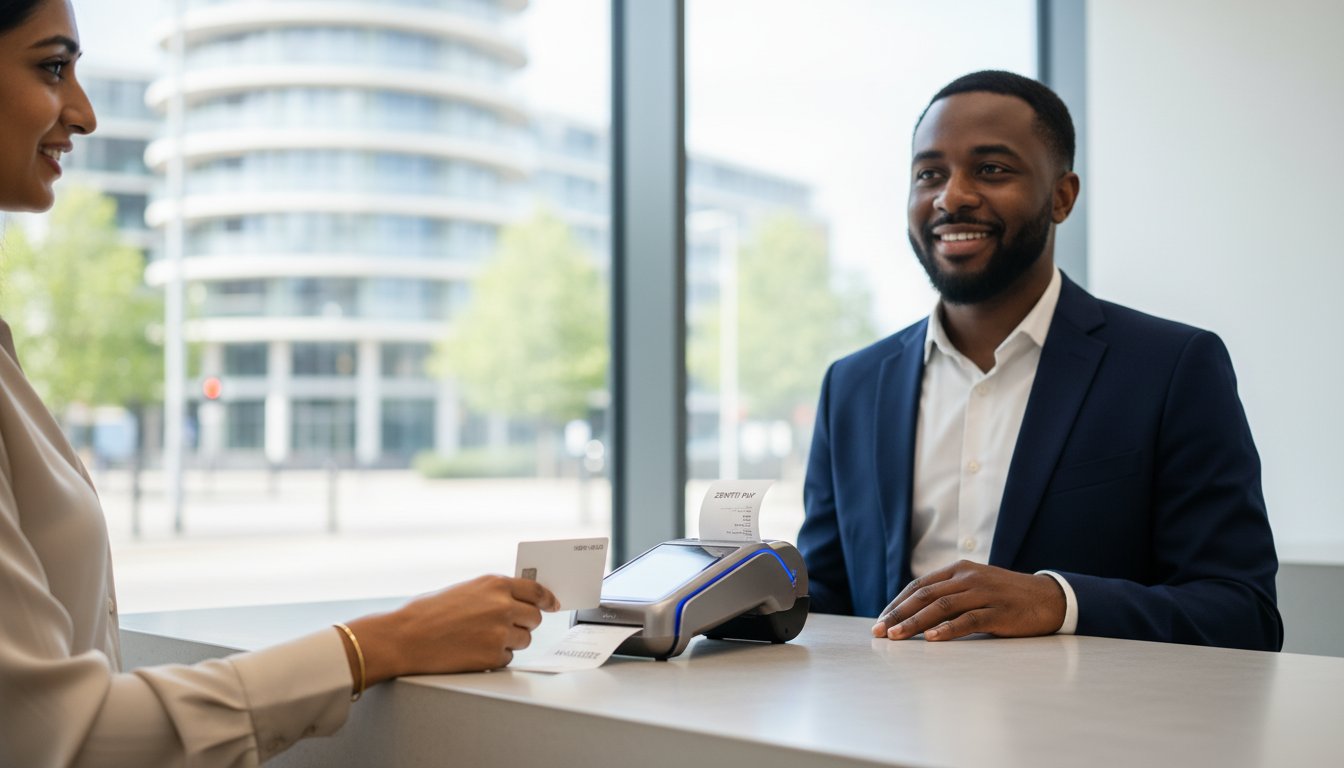
    Is your countertop card machine with receipt printer actually a silent drain on your monthly profits? While a fast printer keeps your queues moving, the hidden “admin” fees and opaque markups often attached to these devices can quietly erode your hard-earned margins. You deserve a payment setup that works as hard as you do, providing both hardware reliability and total financial clarity.

    We understand the frustration of seeing complex fee structures eat into your bottom line whilst you wait days for your funds to clear. It’s time to stop settling for “standard” rates that don’t reflect your actual business volume. This guide will show you how to secure a reliable, high-speed terminal that balances modern features with the lowest transaction rates in the UK. You’ll learn how to move away from expensive flat-rate models and embrace a transparent, transaction-based approach that supports your growth.

    We’ll preview the top-rated machines for 2026 that meet the mandatory PCI DSS v4.0 security standards and offer next-day access to your cash. By the end of this article, you’ll know exactly how to choose hardware that makes your checkout fast, fair, and purely professional.

    Key Takeaways

    • Learn why a fixed countertop card machine with receipt printer builds more customer trust and retail stability than portable alternatives.
    • Discover how to slash processing costs by switching from expensive flat rates to transparent, transaction-based pricing models.
    • Identify the essential connectivity and security features, including PCI DSS v4.0 compliance, needed for a reliable 2026 checkout.
    • Master your till point layout to eliminate cable clutter and speed up transaction times for your customers.
    • Find out how to access your money faster with next-day funding that bypasses traditional banking delays.

    Beyond the Tap: Why Your Business Needs a Countertop Card Machine with a Receipt Printer

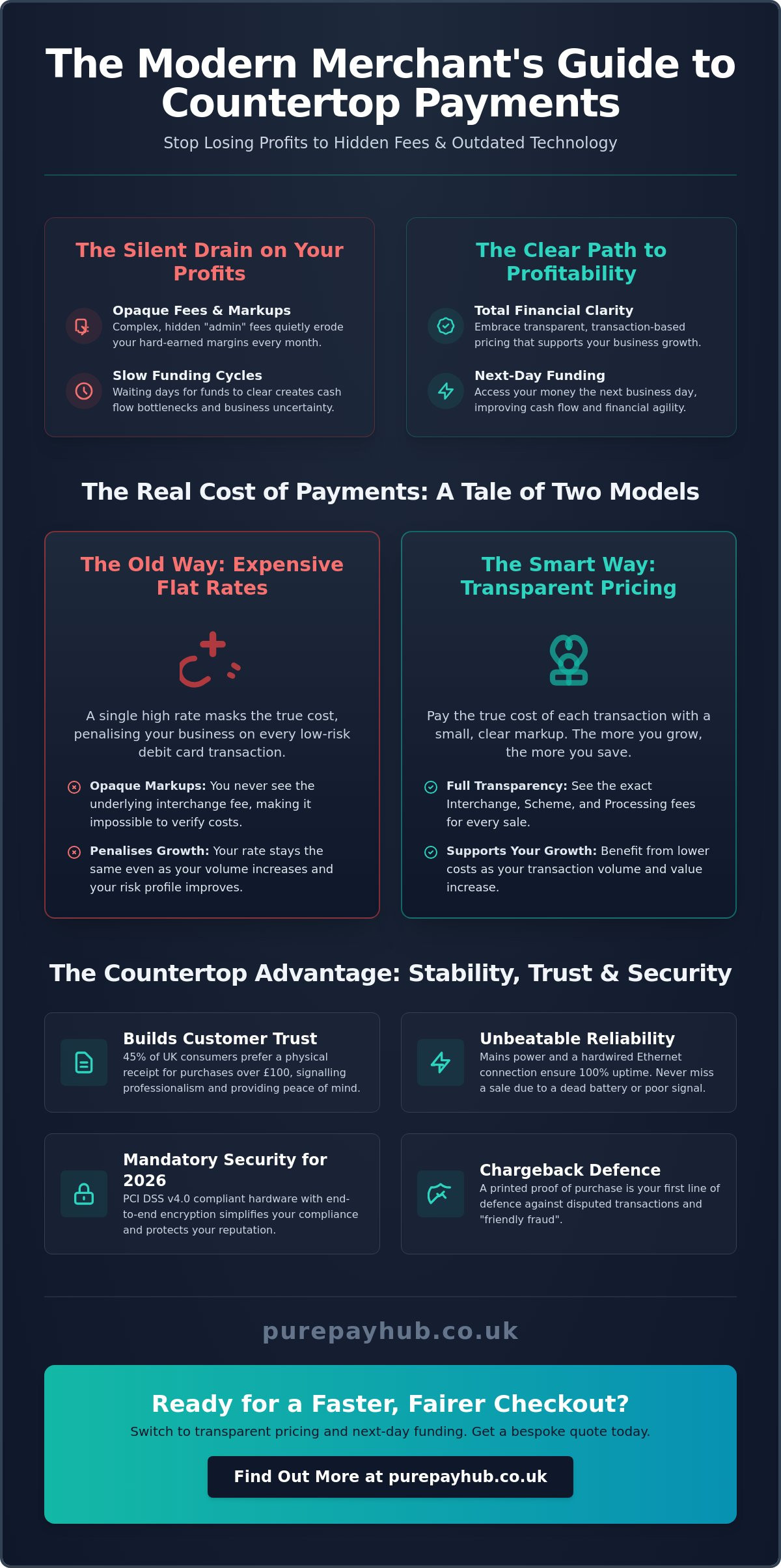
    A physical receipt is more than just a scrap of paper; it’s a symbol of a completed, professional agreement. Even as we move further into 2026, the psychological impact of a tangible proof of purchase remains significant. Statistics show that 45% of UK consumers still prefer a physical receipt for high-value purchases exceeding £100. This small gesture builds immediate trust and provides peace of mind for both the shopper and the merchant. It signals that your business is established, transparent, and prepared to stand behind every sale.

    For UK VAT-registered businesses, meticulous record-keeping is a legal necessity rather than a choice. Providing a detailed, printed receipt helps your customers manage their own VAT returns whilst ensuring you maintain a clear, physical audit trail for HMRC. This documentation also serves as a vital frontline defence against chargeback anxiety. Having an immediate, printed proof of purchase significantly reduces the likelihood of disputed transactions or “friendly fraud” that can often plague modern retail environments. Choosing a robust payment terminal ensures your business remains the gold standard in professionalism and security.

    Whilst mobile devices have their place, they often lack the gravitas of a fixed unit. A countertop card machine with receipt printer tells your customers that your checkout is a stable, secure point of sale. It eliminates the “where do I pay?” confusion that can occur in busy retail spaces, creating a dedicated centre for your financial operations.

    The Role of Physical Receipts in 2026

    Modern thermal printing has transformed the checkout experience into something fast and efficient. These machines are incredibly quiet and don’t require expensive ink cartridges, which keeps your daily overheads low. Beyond the transaction details, your receipts are a powerful branding tool. You can easily customise them with your brand logo, social media handles, or a personalised “thank you” message to encourage repeat visits. This turns a simple transaction into a lasting brand touchpoint that the customer takes home with them.

    Reliability Over Portability: The Countertop Advantage

    High-volume retail requires a constant, uninterrupted power supply that only a wired unit can provide. Relying on a battery-powered device during a frantic Saturday rush is a risk you don’t need to take. A countertop card machine with receipt printer connects directly to your mains, meaning you’ll never miss a sale due to a dead battery.

    Stability is the second pillar of the countertop advantage. Whilst mobile units often struggle with patchy Wi-Fi or 4G signals, a fixed terminal can be hardwired via Ethernet. This ensures 100% uptime and significantly faster processing speeds. Ergonomics also play a vital role; fixed units are generally easier for elderly or less tech-savvy customers to use, as the stable base and clear display provide a much more accessible experience than smaller, handheld alternatives.

    Key Features of a Reliable Countertop Payment Terminal

    Selecting a countertop card machine with receipt printer requires looking beyond the sleek casing to the technology underneath. Reliability in 2026 is defined by three specific pillars: connectivity, security, and integration. Your business cannot afford downtime during a peak period. This is why the best terminals offer a “triple-threat” of connectivity options. They use high-speed Ethernet as a primary line, Wi-Fi as a secondary, and 4G as a fail-safe backup. If your local broadband drops, your machine switches to mobile data in seconds. You keep trading whilst your competitors are left apologising to frustrated customers.

    Security is equally non-negotiable for a modern merchant. As of May 2026, PCI DSS v4.0 is the mandatory standard for all UK organisations handling card data. Modern terminals use end-to-end encryption to ensure cardholder data never touches your internal network in a readable format. This simplifies your compliance journey and protects your hard-earned reputation. When considering POS system costs, remember that hardware which integrates seamlessly with your EPOS saves you money on manual entry errors and admin time. Our “Pure” design philosophy focuses on clean, intuitive interfaces. This means your staff can master the terminal in minutes, reducing training overheads and checkout friction.

    High-Speed Thermal Printing Specs

    In a busy retail environment, every second counts. Look for a printer that delivers at least 30 lines per second. This ensures your customer isn’t standing awkwardly at the till waiting for a long receipt to finish. Efficiency also means an easy-load mechanism. You should be able to drop in a new roll and click it shut in under five seconds. Most professional terminals use standard 57mm thermal rolls. These are widely available and affordable, ensuring you aren’t locked into proprietary, expensive consumables that eat into your margins.

    Payment Versatility and NFC

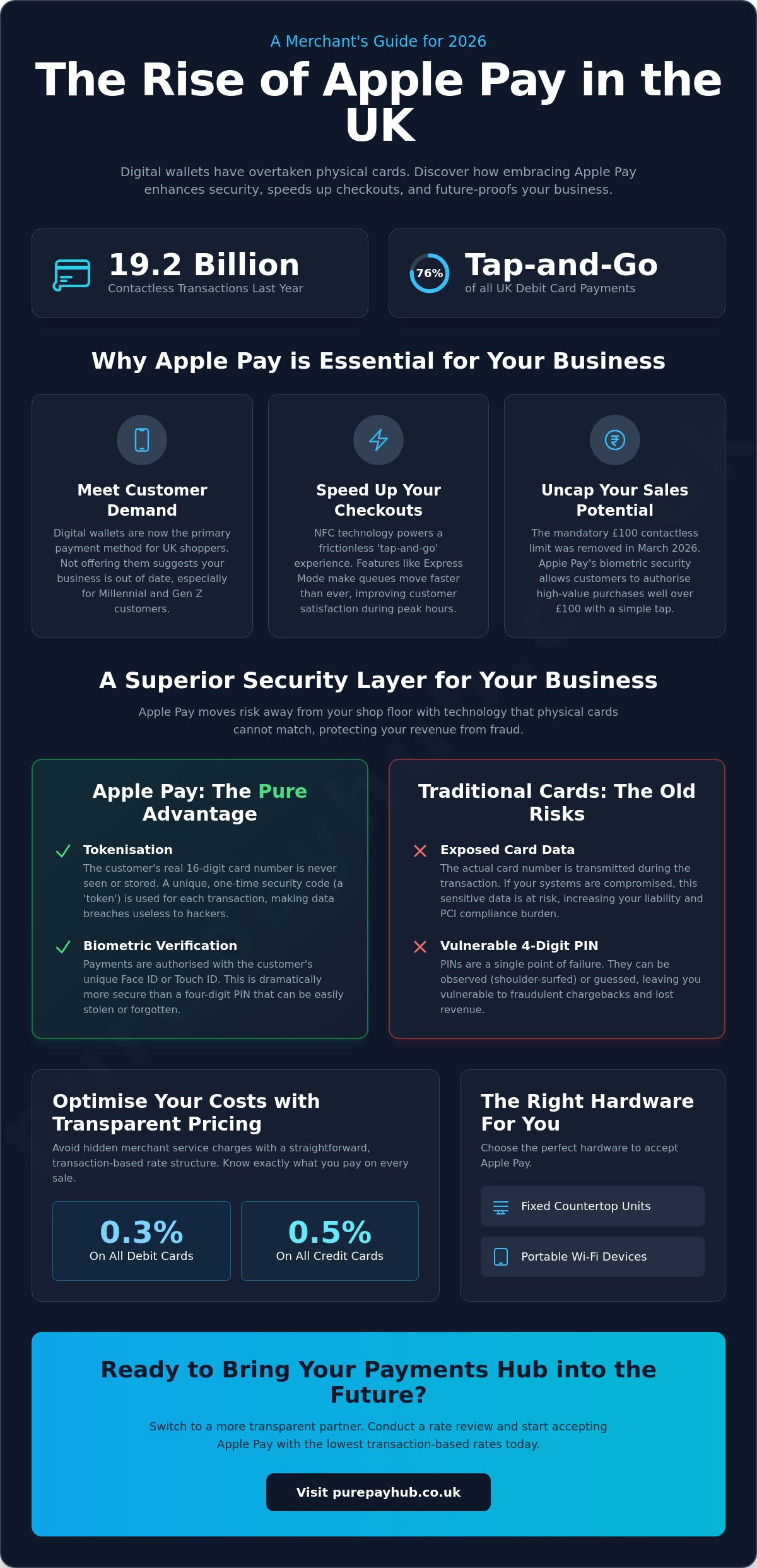
    Your terminal must be a universal receiver. It needs to handle Apple Pay, Google Pay, and Samsung Pay with the same speed as a physical card. With contactless payments projected to surpass £10 trillion globally by 2027, your hardware must be ready for high-value tap-and-go transactions. Whilst the UK contactless limit remains a primary checkout tool, your hardware should be future-proofed for potential increases in transaction caps. Never overlook the physical keypad. A high-quality, tactile keypad is essential for chip and PIN reliability, especially for older customers or during transactions that exceed contactless limits.

    If you’re looking for a setup that combines these features without the hidden fees, explore our integrated payment solutions designed specifically for the UK market.

    Choosing the Best Countertop Card Machine with Receipt Printer in 2026

    The Real Cost of Payments: Flat Rates vs Transaction-Based Processing

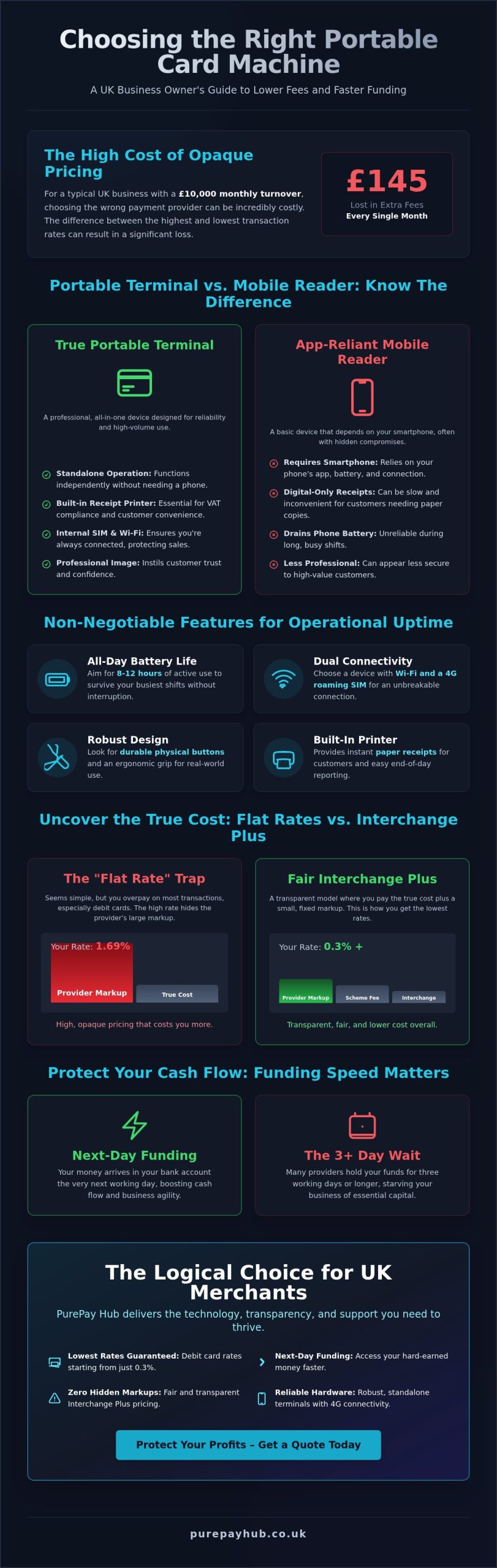
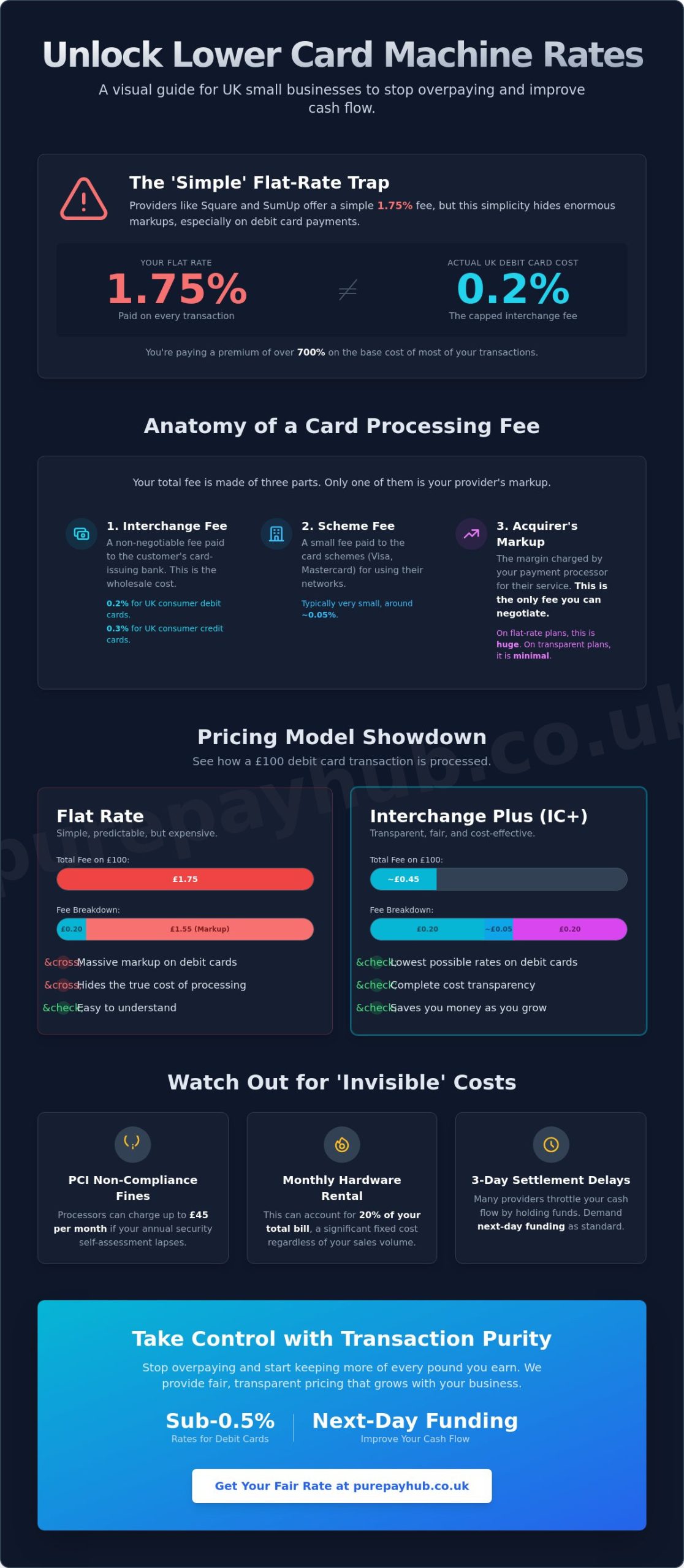
    Choosing a countertop card machine with receipt printer is only half the battle. The hardware facilitates the sale, but your processing model determines how much of that sale you actually keep. Many UK merchants are lured by the simplicity of “flat-rate” pricing, often set at 1.75% or higher. Whilst this looks clean on a marketing brochure, it frequently acts as a hidden tax on your growth. For a small business processing £10,000 a month, a 1.75% flat rate costs £175 in fees. In contrast, a transaction-based model with a 0.3% debit rate plus a modest monthly fee could reduce that cost to under £50. This is a saving of £1,500 every year that stays in your business instead of going to a distant processor.

    We believe in the “Pure” fee model, where transparency is the priority. This means separating the Merchant Service Charge (MSC) into its honest components. For most UK businesses, this translates to debit card rates as low as 0.3% and credit cards at 0.5%. Understanding these numbers is vital because it moves you away from “Qualifying” vs “Non-Qualifying” tiered pricing headaches. Interchange fees are the base costs set by card schemes like Visa and Mastercard that processors must pay to the card-issuing bank. By using an interchange-plus model, you pay the real cost plus a small, transparent markup, rather than a padded flat rate that assumes every customer is using an expensive corporate rewards card.

    Why “No Monthly Fee” Can Be a Trap

    The promise of £0 per month is a powerful marketing tool used by mobile-first providers. However, the break-even point for switching to a professional countertop contract is often much lower than you think. Once your turnover exceeds £2,000 per month, the high transaction fees of “free” accounts begin to cost more than a fixed monthly subscription with lower rates. You must also watch out for “admin,” “statement,” or “compliance” fees buried in the small print. Maintaining high PCI Security Standards is essential, but these costs should be clearly stated, not used as a back-door way to inflate your monthly bill.

    Transparency in Transaction Billing

    PurePay Hub advocates for transaction-based clarity because it aligns our success with yours. We don’t believe in murky pricing structures that change based on how a card is swiped or tapped. Our Hub concept ensures that whether you are using your countertop card machine with receipt printer or an online gateway, your rates remain fair and predictable. This level of clarity allows you to forecast your margins with precision, turning your payment processing from a confusing overhead into a strategic advantage for your business.

    How to Organise Your Till Point for Maximum Efficiency

    A messy counter creates friction. Whilst the technical specs of your countertop card machine with receipt printer are vital, the physical layout of your till point dictates the actual speed of your service. Professionalism starts with a clean, intentional workspace. You must ensure your power and Ethernet lines are tucked away using cable tidies or under-counter mounts. Loose wires aren’t just an eyesore; they’re a significant health and safety risk. A 2024 retail safety study found that trip hazards at the point of sale account for 15% of in-store accidents. Keeping your cables disciplined ensures your terminal remains stable and your staff stay safe.

    Positioning is the next pillar of efficiency. We recommend a customer-facing setup using a high-quality swivel stand. This allows your staff to initiate the sale and then rotate the terminal so the customer can enter their PIN or tap their device in comfort. This physical “handover” creates a clear boundary for the transaction and speeds up the process. It also protects the privacy of the customer. Daily maintenance is the final piece of the puzzle. Use a simple microfibre cloth to keep the keypad clean and occasionally use a cleaning card to remove dust from the thermal print head. This prevents “faded” receipts and ensures your branding remains sharp and legible every single time.

    The Ergonomics of the Checkout

    Accessibility is a legal requirement under the Equality Act 2010. You must ensure your terminal is reachable for all customers, including those using wheelchairs. If you don’t use a swivel stand, ensure your device has a coiled cable with at least 1.5 metres of reach. Lighting also plays a silent role in your success. Avoid placing your terminal directly under harsh spotlights. Glare on the screen can cause customers to hesitate or enter their PIN incorrectly, which adds unnecessary seconds to your queue times.

    Workflow Optimisation

    Modern terminals allow you to toggle between “Automatic Printing” and “Print on Demand”. For small, low-value sales, offering a choice can save you up to 30% on paper roll costs over a year. However, for high-value retail, automatic printing is the gold standard for trust. You should also use your terminal to simplify your admin. Modern units can generate end-of-day reconciliation reports in seconds, matching your physical takings to your digital records with “Pure” accuracy. This eliminates the headache of manual counting and helps you spot discrepancies immediately.

    Ready to upgrade your till point with hardware that works as hard as you do? Explore our range of professional countertop terminals designed for maximum retail efficiency.

    The PurePay Hub Advantage: Transparent Rates and Next-Day Funding

    In the fast-paced UK retail market, cash flow isn’t just a metric; it’s your lifeblood. Many traditional providers still force you to wait three to five working days for your funds to clear. This delay is a relic of the past that hampers your ability to restock inventory or pay staff. PurePay Hub eliminates this friction by offering next-day access to your funds as standard. We believe your money should be in your account, not sitting in a bank’s ledger. Our onboarding process is equally efficient. We can get your new countertop card machine with receipt printer live and ready for transactions in as little as 48 hours.

    Our Hub concept is designed to be the central, stabilising force for your business finances. It doesn’t matter if you operate in retail, hospitality, or online. We centralise all your payment data into one clear, manageable platform. If you ever run into a technical hitch, our UK-based support team is available to help. You won’t be navigating a complex automated menu; you’ll speak to real humans who understand the local market. This direct partnership approach ensures that when your Wi-Fi drops or a printer jams, you’re back in business quickly. We don’t hide behind distant call centres or impersonal ticket systems. Instead, we act as your local expert, providing the clarity you need to grow.

    Purity in Processing

    We’ve built our reputation on a commitment to zero hidden markups. Traditional processors often hide their profits behind complex interchange fees and “admin” costs. We do things differently. By favouring small business growth over corporate profit margins, we provide statements that you can actually read. You don’t need a degree in finance to understand where your money is going. Our transparent reporting gives you a clear view of every transaction, ensuring your processing is always Pure and untainted by unexpected charges. This simplicity allows you to focus on your customers rather than your spreadsheets.

    Beyond the Machine: Business Cash Advances

    Your countertop card machine with receipt printer can do more than just process sales; it can unlock your next stage of growth. Through our Business Cash Advance offering, your daily turnover can provide access to unsecured capital for expansion. Repayments are flexible and based entirely on a small percentage of your future card sales. This means when you have a quiet day, your repayments automatically adjust to match your income. It’s a fair, supportive way to fund renovations or new equipment without the stress of fixed monthly bank loans.

    Get a transparent quote for your countertop card machine today

    Secure a Fairer Future for Your Business Checkout

    Choosing the right countertop card machine with receipt printer is more than just a hardware upgrade. It’s a strategic move to protect your margins and build lasting customer trust. You’ve seen how moving away from restrictive flat-rate models can stop the quiet drain on your profits. A professional, fixed terminal provides the stability and speed your high-volume retail environment demands while ensuring you stay compliant with the latest security standards.

    PurePay Hub is here to act as your ally. We offer debit card rates from 0.3% and provide next-day funding as standard. You won’t find any hidden markups or exit fee traps in our contracts. We prioritise your growth by delivering transaction-based clarity and UK-based support that actually listens. It’s time to stop settling for opaque fees and start enjoying the benefits of a truly transparent partnership.

    Switch to a PurePay Hub Countertop Machine and Start Saving

    Your business deserves a payment setup that is as reliable and honest as the service you provide every day. Take control of your processing costs and give your checkout the professional edge it deserves.

    Frequently Asked Questions

    Do I need a separate merchant account for a countertop card machine?

    Yes, you require a merchant account to process payments, but we simplify this by providing an integrated solution. Your countertop card machine with receipt printer arrives pre-configured with your account details. This avoids the hassle of dealing with multiple banks and ensures your hardware and processing fees are managed in one transparent hub. It’s a faster way to get your business ready for sales without the usual administrative delays.

    Can I use a countertop card machine without a phone line?

    Yes, modern terminals have moved beyond the limitations of traditional phone lines. Most professional units now connect via high-speed Ethernet or Wi-Fi for significantly faster processing. If your primary connection fails, our machines include 4G SIM cards as a fail-safe backup. This ensures you never miss a sale due to a local broadband outage or a snapped phone cable. You stay connected and ready to trade at all times.

    What is the cheapest card machine rate for a UK small business?

    Interchange-plus pricing is consistently the most cost-effective model for businesses processing over £2,000 per month. Whilst flat rates of 1.75% look simple, they are often much more expensive than a transaction-based model. We offer debit card rates from 0.3% and credit card rates from 0.5%. This transparency allows you to keep a larger share of every sale you process. It’s a fairer approach that supports your long-term growth.

    How much does thermal receipt paper cost for these machines?

    Standard 57mm thermal paper rolls are very affordable and widely available amongst UK suppliers. You can typically purchase a box of 20 rolls for approximately £15 to £20. Since these machines use thermal technology, you don’t have to worry about the cost of ink or ribbons. This keeps your ongoing maintenance costs predictable and low for your busy retail environment. It’s a silent saving that adds up over the year.

    What happens if my internet goes down while taking a payment?

    Our terminals feature automatic failover to 4G mobile data to keep your business running smoothly. If your Wi-Fi or Ethernet connection drops, the terminal switches to a mobile network in seconds. This prevents the frustration of declined transactions during a busy rush. It’s a vital safety net that provides total peace of mind for high-volume retail and hospitality environments. You won’t have to turn away customers because of a technical glitch.

    Is a receipt printer built into all countertop machines?

    No, not all card machines include a printer, but a dedicated countertop card machine with receipt printer features an integrated thermal unit. These “all-in-one” devices are specifically designed for fixed till points where speed and professionalism are priorities. Choosing an integrated unit saves precious counter space and eliminates the need for separate, bulky external printers and additional power cables. It keeps your checkout area looking clean and organised.

    How long does it take for card payments to reach my bank account?

    While many UK providers still take three to five working days, we provide next-day funding as standard. This means the takings from your Monday sales will typically be in your business bank account by Tuesday. Improving your cash flow allows you to settle supplier invoices faster and manage your daily operations with much greater confidence. You shouldn’t have to wait for the money you’ve already earned.

    Are there any hidden PCI compliance fees with PurePay Hub?

    No, we don’t believe in “hidden” markups or surprise admin charges. All compliance requirements are discussed openly during your onboarding process to ensure your business meets the mandatory PCI DSS v4.0 standards. We provide clear, simplified reporting so you can see exactly what you are paying for each month. Our goal is to eliminate the skepticism surrounding payment processing by being your most honest and transparent business partner.

  • How to Take Payments: The Ultimate SME Checklist for 2026

    How to Take Payments: The Ultimate SME Checklist for 2026

    Did you know that Visa is scheduled to increase its fees on 24 January 2026? Whilst the industry average for credit card processing sits at 2.35%, many UK merchants are actually paying far more because of “non-compliance” penalties and murky markups. You’ve likely felt the sting of long settlement periods delaying your cash flow or stared at a statement filled with jargon like “interchange plus” and wondered where your profit went. It’s frustrating when the simple act to take payments feels like a constant battle against hidden costs.

    You deserve a partner that prioritises clarity over corporate jargon. We’ve built this guide to help you master the essentials of UK payment processing and strip away the confusion of complex fee structures. You’ll discover how to secure faster access to your hard-earned funds and ensure your setup is fully compliant with the mandatory PCI DSS v4.0.1 standards. We’ll walk you through choosing the right methods for 2026 and setting up a merchant account that scales as your business grows.

    Key Takeaways

    • Understand the three essential pillars of processing to ensure your money moves securely from the customer’s bank to your business account.
    • Identify the most efficient ways to take payments across retail, hospitality, and online environments to suit your specific sales volume.
    • Decode the difference between transaction-based fees and hardware rentals to remove hidden markups from your monthly statements.
    • Follow a proven five-step checklist to audit your business needs and choose a merchant setup that truly scales.
    • Optimise your cash flow with next-day funding and learn how flexible finance can support your long-term growth plans.

    What Does it Actually Mean to Take Payments in 2026?

    Taking payments is no longer just about swapping cash for goods. In 2026, payment processing acts as the vital digital bridge between your customer’s bank account and your business balance. It’s a complex journey that happens in seconds. For a modern SME, the ability to take payments efficiently is a utility, much like electricity or water. You need it to be reliable, invisible, and fairly priced. With Visa scheduled to increase its fees on 24 January 2026, understanding how this bridge works is essential for protecting your margins.

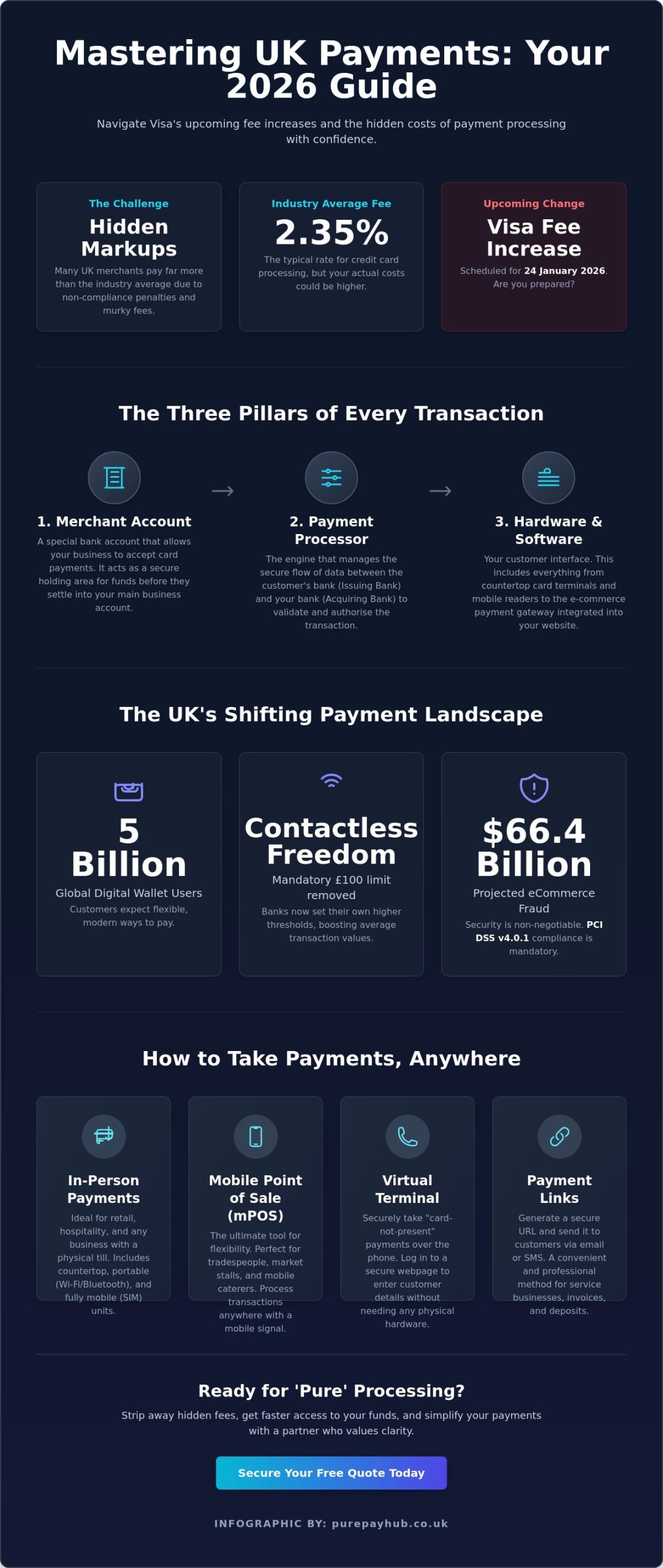
    To understand the process, you must look at the three pillars that support every transaction:

    • The Merchant Account: This is a specific bank account that allows your business to accept card payments. It acts as a temporary holding area before funds are cleared and moved to your business bank account.
    • The Payment Processor: This is the engine. It manages the flow of data between the banks to ensure the transaction is valid, authorised, and secure.
    • Hardware and Software: This is your interface. It includes everything from sleek countertop terminals in a shop to the e-commerce gateway on your website.

    At PurePay Hub, we advocate for “pure” processing. This means we strip away the hidden fluff and complex markups that traditional providers often bury in the small print. We focus on secure, transaction-based clarity so you can focus on growth. When your processing is pure, you aren’t surprised by unexpected costs at the end of the month.

    The Shift in UK Consumer Behaviour

    Consumer habits have transformed rapidly. By January 2026, global digital wallet users reached 5 billion. In the UK, the mandatory £100 contactless limit was removed on 19 March 2026, whilst banks now set their own thresholds. Relying on “cash only” is a risk few businesses can afford. Accepting diverse methods, from physical cards to digital tap-to-pay on smartphones, directly increases your average transaction value (ATV). This shift is also paving the way for digital asset integration, where fintech providers like Pallapay are helping businesses adapt to new ways of exchanging value. Customers naturally spend more when they aren’t limited by the physical notes in their wallet.

    Key Terminology Every Merchant Should Know

    The industry is full of jargon, but the basics are simple. Your Acquiring Bank is the institution that maintains your merchant account and “acquires” the funds for you. The Issuing Bank is the customer’s bank that “issues” their card. Settlement is the final step where funds are moved into your bank balance. In 2026, security is governed by PCI DSS v4.0.1. This is the mandatory gold standard that ensures every tap is protected against the $66.4 billion eCommerce fraud threat projected for this year.

    Choosing Your Method: How to Take Payments Anywhere

    Your business might start at a physical till, but it shouldn’t end there. In 2026, 92% of merchants accept digital wallets, and your customers expect that same level of flexibility whether they are in your shop or on your website. To stay competitive, you need a setup that handles every scenario. Whether you are selling at a local market or invoicing a client across the country, the goal is to take payments without friction or technical delays.

    We view your payment setup as a central Hub. Instead of juggling different providers for your shop, your website, and your phone orders, a unified system brings everything together. This creates a stabilising force for your finances and provides one clear view of your cash flow. This clarity is vital when eCommerce fraud is projected to cost merchants $66.4 billion this year. By centralising your streams, you reduce your risk and simplify your reporting.

    In-Person: Countertop vs. Mobile Units

    Countertop machines are the reliable workhorses of the retail world. They sit at your fixed till point and usually connect via Ethernet for maximum stability. If your customers always come to you, this is your foundation. Portable units offer more freedom, using Bluetooth or Wi-Fi to reach tables in a restaurant or move around a showroom floor. For tradespeople or mobile caterers, a SIM-based mobile machine is essential. It connects to the 4G or 5G network so you can process transactions anywhere with a signal. An mPOS, or mobile Point of Sale, is the ultimate tool for on-the-go flexibility.

    Remote Payments: Virtual Terminals and Links

    Not every sale happens face-to-face. A virtual terminal allows you to take payments over the phone securely. You simply log into a secure webpage and type in the customer’s details whilst they are on the line. It’s a professional way to handle “card-not-present” transactions without needing physical hardware on site.

    Payment links are another favourite choice for service-based SMEs and wholesalers. You generate a secure URL and send it via email or SMS. The customer clicks, pays at their convenience, and the settlement process begins. It’s transparent, honest, and incredibly fast. If you’re looking for a transparent partnership to manage these different streams, choosing a unified provider is the first step toward financial clarity. This approach ensures your business stays agile as the UK market continues to move away from traditional cash transactions.

    How to Take Payments: The Ultimate SME Checklist for 2026

    Decoding the Costs: Transaction Fees vs. Monthly Rentals

    Understanding the true cost to take payments is often the biggest hurdle for UK business owners. Most providers present a “blended” rate that looks simple but actually hides significant markups. The Merchant Service Charge (MSC) is the core fee you pay on every transaction. Typically, debit card rates are significantly lower than credit card rates because the risk to the bank is lower. With the average processing cost for Visa and Mastercard sitting at approximately 2.35%, any rate significantly higher than this suggests a heavy processor markup.

    Hardware rental is another area where transparency is often lacking. A fair monthly price for a modern countertop unit should be clear and fixed. However, the real danger lies in the “hidden” extras. Many legacy providers charge a Minimum Monthly Service Charge (MMSC) if you don’t hit a certain sales volume. They also levy heavy fines for PCI non-compliance. Since PCI DSS v4.0.1 became mandatory on 31 March 2025, these fines have become a common way for processors to squeeze extra profit from unsuspecting merchants. We believe in a different approach. We advocate for transaction-based clarity where you only pay for what you use.

    Understanding Interchange Plus Pricing

    Interchange Plus is the “pure” alternative to confusing flat rates. This model reveals exactly what the card schemes charge (the interchange) and exactly what the processor takes as their fee. It’s the most honest way to view your statements. For high-volume merchants, debit card charges can start as low as 0.3%, whilst credit cards remain higher. This model allows you to see the direct benefit of the proposed 0.1 percentage point reduction in interchange fees scheduled to last for the next five years.

    Avoiding the ‘Exit Fee’ Trap

    The UK market is notorious for long-term contracts. These agreements often stretch from 12 to 48 months and include aggressive exit fees. Always check the small print for rolling renewals that lock you in for another year without your knowledge. You should also look for cancellation notice periods, which can sometimes be as long as six months. PurePay Hub simplifies the onboarding process to avoid these legacy headaches. We focus on building a partnership based on performance rather than restrictive legal traps. This ensures your business remains agile and ready to grow.

    The Merchant’s Checklist: 5 Steps to Take Payments

    Setting up your business to take payments shouldn’t be a months-long ordeal. Whilst legacy banks often move at a glacial pace, a modern fintech approach allows you to get up and running with speed and precision. This checklist serves as your roadmap to a secure, transparent setup that avoids the common pitfalls of hidden fees and technical friction.

    Step 1: Audit your sales volume. Before signing any contract, look at your average transaction size and your monthly turnover. If your average sale is small, per-transaction pence fees matter more than percentages. If you’re a high-ticket wholesaler, the percentage rate is your priority. Step 2: Choose your primary environment. A busy cafe needs a portable Wi-Fi unit for table service, whilst a boutique retail shop might prefer a fixed countertop terminal. If you’re selling across multiple channels, ensure your hardware and online gateway are synced through a single Hub to keep your reporting clean.

    Preparing Your Documentation

    To speed up your application, you must organise your “Know Your Customer” (KYC) documents in advance. You’ll typically need a valid photo ID, proof of business address, and three months of recent bank statements. Having a dedicated business bank account is essential for clean accounting and faster settlement. When your documents are ready, modern onboarding can often be completed within 24-48 hours, getting you ready to take payments almost immediately.

    Integrating with EPOS Systems

    Step 4: Select hardware that integrates. Integrated payments are vastly superior to standalone units for any growing business. In an integrated setup, the till communicates directly with the card machine. This eliminates the need to type the amount in twice, which drastically reduces human error and prevents costly mistakes during busy shifts. It’s particularly vital for the fast-paced nature of UK hospitality. You can explore our specialised integrated EPOS systems for hospitality UK to see how this works in practice.

    Step 5: Run a penny test. Once your hardware arrives, process a transaction for £0.01. This “penny test” ensures that the connection to the acquiring bank is active and that your settlement path is clear. It’s the final check to guarantee that when you start your first full day of trading, your funds will arrive in your account without delay. If you’re ready to start your journey, apply for your merchant account today and join a partnership built on purity and clarity.

    Beyond the Transaction: Cash Flow and Growth

    Your business doesn’t stop once the customer leaves the premises. The real work of growth begins when those funds hit your account. When you take payments, you’re generating more than just revenue; you’re creating a data map of your business’s health. In 2026, the speed of your settlement and the flexibility of your capital determine how quickly you can respond to new opportunities. We position PurePay Hub as your central command centre, ensuring that the bridge between a sale and your bank balance is as short as possible.

    Your transaction history is a powerful tool for tracking customer behaviour and seasonal trends. By analysing when people choose to take payments most frequently, you can optimise your staffing levels and stock orders. Our Hub provides this clarity through simplified reporting that strips away the noise. This allows you to make informed decisions based on pure data rather than guesswork. When your payment processor acts as a growth partner, your business is built to scale sustainably.

    Next-Day Access to Funds

    Standard settlement periods often leave merchants waiting between 3 and 5 working days for their money. This delay creates a bottleneck that prevents you from restocking inventory or paying staff on time. For UK SMEs in 2026, next-day access to funds has moved from a luxury to a non-negotiable requirement. It provides the liquidity needed to keep your operations fluid and responsive. You can learn more about this in our Next-Day Funding for Retailers guide.

    Business Cash Advances Explained

    Traditional bank loans often come with rigid monthly repayments that don’t account for your actual trading volume. A Business Cash Advance is a more transparent and honest alternative. You receive a lump sum upfront and repay it as a fixed percentage of your daily card sales. This “pay-as-you-trade” model is inherently safer for seasonal businesses. If you have a quiet Tuesday, you pay back less. If you have a record-breaking Saturday, you pay back more. It’s a partnership that aligns with your success. Discover how PurePay Hub can support your cash flow with a Business Cash Advance today.

    Secure Your Financial Future Today

    The UK payment landscape is evolving rapidly. With Visa increasing fees on 24 January 2026, you cannot afford to stay with a provider that hides behind complex jargon. You now have a clear checklist to audit your sales, choose the right hardware, and secure your cash flow with next-day funding. The ability to take payments should be a pure utility that supports your growth rather than a drain on your resources.

    By moving away from “blended” rates and embracing the transparency of an Interchange Plus model, you protect your margins from hidden monthly markups. You also ensure your business stays ahead of mandatory security standards like PCI DSS v4.0.1. We act as your reliable ally in this shifting market, providing the stability your business needs to thrive.

    Switch to PurePay Hub for transparent, transaction-based payments today. You will benefit from debit card rates starting from 0.3% and next-day funding as standard. It’s time to simplify your setup and focus on your customers. Your business deserves a partner that values honesty as much as you do.

    Frequently Asked Questions

    How long does it take to set up a merchant account to take payments?

    Modern onboarding allows you to set up a merchant account within 24 to 48 hours. If you have your “Know Your Customer” documentation ready, such as photo ID and bank statements, the process is streamlined and efficient. This ensures you can take payments and start trading without the long delays typically associated with traditional high-street banks.

    Can I take payments on my phone without a card machine?

    You can take payments on your smartphone using a virtual terminal or secure payment links. A virtual terminal turns your phone’s browser into a secure interface for over-the-phone orders. Alternatively, you can send a unique URL via SMS or email, allowing the customer to pay instantly from their own device without needing a physical terminal on site.

    What are the average transaction fees for small businesses in the UK?

    Small businesses in the UK typically pay between 1.5% and 3.5% per credit card transaction. As of May 2026, the average processing cost for Visa and Mastercard is approximately 2.35%. These rates vary depending on whether you use a “blended” flat rate or a more transparent “interchange plus” model that reveals the true cost of processing.

    Is it possible to take payments online and in-store with the same provider?

    Managing both online and in-store sales with a single provider is the most efficient way to run your business. Using a unified “Hub” simplifies your reporting and gives you a single view of your cash flow. For those operating as digital platforms or marketplaces, click here to learn more about Gemba’s specialised banking infrastructure. It also ensures your transaction-based fees remain consistent and clear across all your sales channels, from your website to your physical till.

    What happens if my card machine loses Wi-Fi connection during a sale?

    Most modern terminals switch automatically to a 4G or 5G SIM connection if your Wi-Fi drops. This ensures you don’t lose a sale during busy shifts. If you don’t have a SIM-enabled device, some units offer an “offline mode” that stores the transaction data securely and processes it once your internet connection is restored.

    How do I avoid paying monthly PCI non-compliance fees?

    You avoid non-compliance fees by providing 12 months of continuous operational evidence for PCI DSS v4.0.1. This became mandatory for all UK businesses on 31 March 2025. We help you through the annual self-assessment process to ensure your security standards are met, protecting you from the unnecessary penalties that many traditional processors charge.

    Can I take payments from international customers with a UK merchant account?

    You can accept cards from international customers, but these transactions often carry different interchange fees. Whilst your UK merchant account handles global payments, be aware that currency conversion and “non-EEA” card rates can impact your final settlement. We advocate for transparency here so you always know the exact cost of your global sales.

    What is the difference between a merchant account and a business bank account?

    A merchant account is a temporary holding area where funds are cleared and authorised after a transaction. A business bank account is the final destination where your hard-earned profits are settled. You need both to function; the merchant account acts as the bridge that moves money from your customer’s bank to your own balance.

  • Virtual Terminal: The Complete Guide to Taking Remote Payments in 2026

    Virtual Terminal: The Complete Guide to Taking Remote Payments in 2026

    With card-not-present fraud now accounting for 70% of all UK card fraud losses, taking a payment over the phone often feels like a high-stakes gamble. You’ve likely experienced the frustration of opaque fee structures that climb as high as 2.95% plus 30p per transaction. It’s exhausting to manage complex security requirements whilst waiting days for your hard-earned money to reach your bank account. You deserve a payment partner that prioritises clarity over corporate jargon.

    This guide demonstrates how a virtual terminal can transform your computer into a secure, PCI-compliant payment centre with total fee transparency. We’ll show you how to achieve next-day funding and lower your overheads by leveraging the January 2026 PSR interchange fee caps. From mastering the March 2025 PCI DSS v4.0 standards to choosing a transaction-based model that fits your volume, you’ll learn how to build a more profitable payment hub for your business.

    Key Takeaways

    • Understand how a virtual terminal converts your existing laptop or tablet into a secure payment centre for immediate phone sales.
    • Learn the essential steps to stay compliant with PCI DSS v4.0 standards whilst protecting sensitive cardholder data.
    • Discover how to streamline your cash flow with next-day funding and a 24-hour onboarding process that requires no physical hardware.
    • Identify when to use real-time terminal processing versus flexible payment links to better suit your customer’s buying journey.
    • See why shifting to a “Pure” transaction-based pricing model offers better value and transparency than traditional flat-rate structures.

    What is a Virtual Terminal and Why Does Your Business Need One?

    A virtual terminal is a secure, cloud-based portal that transforms your existing hardware into a professional payment centre. You don’t need a bulky card machine to take a payment. Instead, you log into a browser-based dashboard and enter your customer’s details manually whilst they remain on the line. This technology is specifically designed for “Card-Not-Present” (CNP) transactions. By September 2025, online and remote spending accounted for 50.5% of total card spending in the UK. Having the right tools to capture this market isn’t just a luxury; it’s a necessity for survival.

    Understanding What is a Virtual Terminal helps clarify how it functions as the backbone of remote commerce. Unlike traditional shopfront setups, this software handles the complex encryption on your behalf. This ensures your business meets the March 2025 PCI DSS v4.0 standards without requiring a massive investment in cybersecurity infrastructure. For remote-first businesses, wholesalers, and tradespeople, it eliminates the need for physical hardware. This directly reduces your monthly rental costs and removes the headache of maintaining fragile card machines.

    The Core Difference Between Physical and Virtual Terminals

    Physical terminals rely on the card being present for a chip and pin or contactless tap. Whilst contactless payments reached 76% of all debit card transactions by December 2025, they don’t help when your client is fifty miles away. A virtual terminal bridges this gap. It allows for manual entry of card details during a telephone call. For B2B firms and professional services, this is often the preferred choice. It projects a more professional image than asking a client to visit a physical location just to settle an invoice. You maintain full control of the transaction flow whilst providing a seamless experience for your customer.

    Common Use Cases for UK Service Businesses

    Many tradespeople and consultants use this technology to secure their time and protect their cash flow. Common applications include:

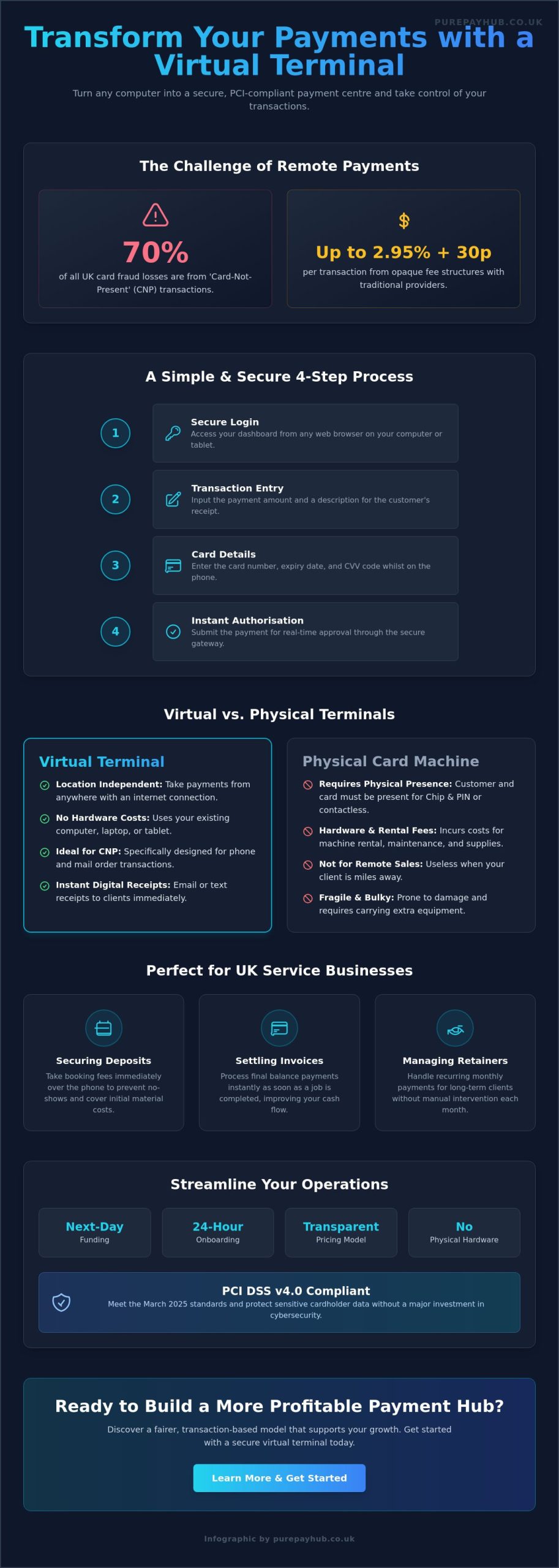
    • Securing deposits: Take a booking fee immediately to prevent no-shows and cover initial material costs.
    • Settling invoices: Process balance payments over the telephone as soon as a job is completed.
    • Managing retainers: Handle recurring monthly payments for long-term clients without them needing to take manual action each time.

    Using a centralised hub for these tasks keeps your records transparent and honest. It moves your business away from the opaque practices of traditional banks and toward a fairer, transaction-based model that supports your growth. By choosing a setup that prioritises clarity, you can focus on your craft rather than chasing payments. For instance, property providers can discover Unipad to see how they present clear room options and manage student bookings efficiently.

    How a Virtual Terminal Works: A Step-by-Step Walkthrough

    Accessing your virtual terminal starts with a secure login to your merchant hub using any standard web browser on your computer or tablet. You don’t need special software or complex downloads to get started. Once you are in, the interface is designed for speed and clarity. You enter the transaction amount and a brief description for your records. This description is vital because it appears on the customer’s receipt and helps you identify the sale later in your dashboard.

    The process follows four clear steps:

    • Secure Login: Access your dashboard via any web browser on your tablet or computer.
    • Transaction Entry: Input the amount and a description for the customer’s receipt.
    • Card Details: Enter the card number, expiry date, and CVV code whilst the customer is on the phone.
    • Submission: Submit the payment for real-time authorisation through the secure payment gateway.

    This entire sequence takes seconds. It provides an immediate result whilst your customer is still on the line. For many UK businesses, this speed is a significant upgrade over manual bank transfers or waiting for cheques to clear.

    The Anatomy of a Remote Transaction

    Behind every successful click, a complex series of security checks ensures the payment is legitimate. With card fraud losses seeing an 11% year-on-year increase in the UK, these checks are your first line of defence. This process is often detailed in any comprehensive guide to virtual terminals. First, the system performs a verification check. It confirms the card is valid and has sufficient funds for the purchase. Authorisation follows immediately. This is a split-second communication between the terminal and the customer’s bank. Finally, the confirmation step generates an instant digital receipt. You can email or text this directly to your client, providing immediate peace of mind for both parties.

    Managing Your Virtual Ledger

    Every sale you process appears instantly in your merchant dashboard. This real-time tracking is essential for modern business management. It allows you to organise your sales data for end-of-month accounting and VAT returns without sifting through piles of paper. Maintaining a healthy cash flow is the top priority for any growing SME. We understand that waiting for funds can stifle your operations. That’s why next-day funding is a core feature of our service. It ensures your money is in your bank account quickly, allowing you to reinvest in your business without delay. If you want to streamline your billing, you can explore our transparent hub options to see how we simplify remote payments.

    Virtual Terminal: The Complete Guide to Taking Remote Payments in 2026

    Choosing between these two methods depends on how you interact with your clients. A virtual terminal gives you direct control. You enter the card details whilst the customer is on the line, ensuring the transaction is finalised immediately. Conversely, a payment link shifts the responsibility to the customer. They receive a secure URL via email or SMS and complete the payment in their own time. Both methods are essential parts of a modern payment hub, but they serve different psychological needs and operational workflows.

    The “trust factor” varies significantly between demographics. Some customers feel more secure giving their details to a live person they’ve just spoken with. Others prefer the privacy of a digital link where they don’t have to read their CVV code aloud. From a cost perspective, both methods typically fall under the same “Card-Not-Present” (CNP) fee category. In 2026, typical UK transaction rates for these services range from 1.99% to 2.95%, often with an additional 25p to 30p per-transaction charge. Your choice should focus on which method delivers the smoothest experience for your specific clientele.

    When to Use a Virtual Terminal

    This method is ideal for high-pressure sales environments where closing the deal on the call is vital. If you let a customer hang up to wait for an email, you risk losing that momentum. A virtual terminal is the ultimate tool for immediate telephone commerce, ensuring the transaction is finalised before the call ends. It’s also the preferred choice for older demographics who might be less comfortable navigating digital links or mobile banking apps. For service providers taking deposits over the phone, it provides instant confirmation that the time slot is secured.

    When Payment Links Take the Lead

    Payment links are perfect for “out of hours” billing. You don’t need to be present to take the payment; you simply send the link and wait for the notification. This method also reduces the risk of human error in data entry. Since the customer inputs their own card number and expiry date, the liability for typos shifts away from your staff. Links are particularly effective when integrated into digital invoices. A “click-to-pay” button on a PDF invoice creates a seamless journey for B2B clients who may need to pass the link to their own finance department for settlement.

    Whether you prefer the direct approach of a terminal or the flexibility of a link, our “Pure” fee model ensures you never pay more than necessary. We prioritise honesty in our pricing, allowing your business to grow without the burden of hidden markups or complex tiered structures.

    Security, Compliance, and Fair Pricing for UK Merchants

    Security is the foundation of every transaction you process. With card-not-present fraud making up 70% of all UK card fraud losses, protecting your revenue is a non-negotiable priority. A professional virtual terminal acts as a secure buffer between sensitive customer data and your internal systems. It ensures you never need to write down card details on scraps of paper or store them in unsecured spreadsheets. Following the March 2025 transition to PCI DSS v4.0, the requirements for handling data became even stricter. Using a dedicated hub ensures you stay on the right side of these regulations without needing an in-house IT department.

    Fairness in pricing is just as vital as security. Many traditional providers trap SMEs in flat-rate models that hide the true cost of processing. We believe in a “Pure” transaction-based model. This approach is inherently fairer for growing businesses because it reflects the actual cost of each payment. When combined with next-day funding, this transparency helps you manage stock levels and payroll more effectively. You shouldn’t have to wait a week to access the money you earned yesterday. We ensure your funds are in your account within 24 hours, keeping your cash flow healthy and predictable.

    Navigating PCI Compliance Without the Stress

    Compliance often feels like a burden, but it’s actually your best defence against monthly non-compliance fines. Your virtual terminal provider handles the heavy lifting by encrypting data the moment it’s entered. To keep your team safe, establish a strict “no-paper” policy. Never record CVV codes or full card numbers outside of the secure portal. Fraud prevention tools like the Address Verification Service (AVS) add an extra layer of protection. They cross-reference the customer’s billing address with their bank records, stopping unauthorised transactions before they happen.

    Decoding Transaction Rates: Debit vs. Credit

    Not all cards cost the same to process. As of January 2026, the PSR has capped interchange fees for EEA transactions at 0.2% for debit and 0.3% for credit cards. Your monthly statements should reflect these differences through “Interchange Plus” pricing. This model separates the bank’s fee from the processor’s markup, allowing you to see exactly where every penny goes. If your current provider charges a single high rate for every card type, you are likely paying hidden markups. Identifying these costs is the first step toward a more profitable partnership. Switch to a fairer partner and get a transparent quote for your business today.

    Getting Started with a PurePay Hub Virtual Terminal

    Moving your business to a more transparent model shouldn’t be a hurdle. Our onboarding process is engineered for speed and simplicity. Most UK merchants are ready to take their first payment through the virtual terminal within 24 hours of starting their application. You don’t need to wait for a courier to deliver expensive hardware or pay monthly rental fees for a card reader you might only use occasionally. Instead, you use the secure devices you already own, such as your office computer, laptop, or tablet. This approach turns your existing workspace into a professional payment centre without any additional overheads.

    We ensure a seamless transition by integrating our hub with your existing reporting tools. This means your end-of-month reconciliation remains simple and accurate. If you hit a snag, you won’t be stuck in a global call centre queue. Our expert UK-based support team acts as your merchant ally. We help you optimise your payment flow and identify ways to reduce your processing costs based on your specific transaction volume. This partnership ensures you aren’t just getting a service; you’re gaining a specialist team dedicated to your business growth.

    The PurePay Hub Advantage

    We distinguish ourselves through a commitment to honesty. The “Pure” model means you get transaction-based fees without the hidden markups that often plague traditional banking agreements. By leveraging the January 2026 PSR fee caps, we ensure your business retains more of every sale. Accessing next-day funding keeps your business moving at pace. It allows you to settle supplier invoices or manage payroll without the typical three-to-five-day delay associated with older processors. We treat every merchant as a favourite ally, providing a stabilizing force for your business finances through our centralised hub.

    Your Next Steps to Secure Remote Payments

    Transitioning to a fairer system is straightforward. To get started, you’ll need to provide basic business information, including your UK bank account details and proof of identity. This allows us to verify your account quickly and maintain the high security standards required by the March 2025 PCI DSS v4.0 regulations. You can request a quote today to compare your current rates with our transparent model. Most businesses find that our “Pure” approach provides significant clarity over their monthly overheads. We don’t use complex tiered structures, so you’ll always know exactly what you are paying for every transaction.

    Contact us today to simplify your telephone payments and join a partnership built on growth, integrity, and absolute fee transparency.

    Secure Your Business Growth with Transparent Payments

    A virtual terminal is more than just a tool for taking phone orders; it’s a strategic asset that streamlines your entire cash flow. By removing the need for physical hardware and embracing the January 2026 PSR fee caps, you can significantly reduce your operating costs whilst maintaining total security. You’ve seen how simple it is to transition to a PCI-compliant environment that protects your revenue from the 11% year-on-year increase in card-not-present fraud.

    Choosing a partner that offers debit rates from 0.3% and next-day access to funds allows you to reinvest in your business without delay. This transaction-based approach eliminates the stress of hidden markups and opaque banking practices. It’s time to treat your business to the clarity and partnership it deserves. Switch to a fairer virtual terminal and start saving today to experience a professional service that prioritises your success. We are ready to help you build a more profitable future for your business.

    Frequently Asked Questions

    What exactly is a virtual terminal?

    A virtual terminal is a secure webpage that allows you to process card payments on any device with an internet connection. It functions as a digital version of a physical card machine, designed specifically for card-not-present transactions where you manually enter customer details. This setup is perfect for businesses that take orders over the phone or via post, as it requires no hardware beyond your existing computer or tablet.

    Do I need a special bank account to use a virtual terminal?

    You need a merchant account to process payments, but this typically connects directly to your existing UK business bank account. The merchant account acts as a holding area where transactions are verified before being settled into your main account. We help you set up this link during our 24-hour onboarding process, ensuring your funds flow smoothly into your current business banking setup without any additional complexity.

    How much does a virtual terminal cost per month in the UK?

    Monthly fees for these services in 2026 range from £0 for pay-as-you-go models to over £20 for subscription-based plans. Some providers charge a flat monthly fee to unlock lower per-transaction rates, whilst others offer no fixed costs in exchange for a higher percentage on each sale. It’s vital to choose a model that matches your volume to avoid overpaying for features you don’t use.

    Is it safe to take card details over the phone?

    Taking details over the phone is safe if you use a platform that complies with the March 2025 PCI DSS v4.0 standards. You must never write card details down or record them on unsecured devices. By entering the information directly into a secure virtual terminal, the data is encrypted immediately. This protects both your business and your customer from the 11% year-on-year rise in card-not-present fraud.

    Can I use a virtual terminal on my mobile phone or tablet?

    You can use a virtual terminal on any modern mobile phone or tablet that has a standard web browser. There is no need for a dedicated app or specialised hardware to take payments on the go. This flexibility is ideal for tradespeople or service providers who need to settle invoices or take deposits whilst working away from their main office or centre.

    How long does it take for the money to reach my bank account?

    Most modern providers offer next-day funding, ensuring your hard-earned money is available within 24 hours of the transaction. Whilst some traditional banks may still take three to five working days to settle funds, our transaction-based model prioritises your cash flow. Rapid access to capital is essential for managing stock and payroll in a fast-moving UK market.

    What is the difference between a virtual terminal and a payment gateway?

    A virtual terminal is the user interface where you manually enter card data, whereas a payment gateway is the invisible technology that authorises the transaction. Think of the terminal as the digital checkout counter and the gateway as the secure tunnel connecting that counter to the bank. Both work together to ensure every remote payment is processed, verified, and settled with total transparency.

    Are there any long-term contracts for virtual terminal services?

    Contract lengths vary by provider, but many modern fintech companies now offer rolling monthly agreements with no long-term commitment. Traditional banks often require 12 to 18-month contracts, which can be restrictive for growing SMEs. We favour a flexible approach that earns your loyalty through fair pricing and honest service rather than binding legal terms.