Month: May 2026

  • How to Take Payments: The Ultimate SME Checklist for 2026

    How to Take Payments: The Ultimate SME Checklist for 2026

    Did you know that Visa is scheduled to increase its fees on 24 January 2026? Whilst the industry average for credit card processing sits at 2.35%, many UK merchants are actually paying far more because of “non-compliance” penalties and murky markups. You’ve likely felt the sting of long settlement periods delaying your cash flow or stared at a statement filled with jargon like “interchange plus” and wondered where your profit went. It’s frustrating when the simple act to take payments feels like a constant battle against hidden costs.

    You deserve a partner that prioritises clarity over corporate jargon. We’ve built this guide to help you master the essentials of UK payment processing and strip away the confusion of complex fee structures. You’ll discover how to secure faster access to your hard-earned funds and ensure your setup is fully compliant with the mandatory PCI DSS v4.0.1 standards. We’ll walk you through choosing the right methods for 2026 and setting up a merchant account that scales as your business grows.

    Key Takeaways

    • Understand the three essential pillars of processing to ensure your money moves securely from the customer’s bank to your business account.
    • Identify the most efficient ways to take payments across retail, hospitality, and online environments to suit your specific sales volume.
    • Decode the difference between transaction-based fees and hardware rentals to remove hidden markups from your monthly statements.
    • Follow a proven five-step checklist to audit your business needs and choose a merchant setup that truly scales.
    • Optimise your cash flow with next-day funding and learn how flexible finance can support your long-term growth plans.

    What Does it Actually Mean to Take Payments in 2026?

    Taking payments is no longer just about swapping cash for goods. In 2026, payment processing acts as the vital digital bridge between your customer’s bank account and your business balance. It’s a complex journey that happens in seconds. For a modern SME, the ability to take payments efficiently is a utility, much like electricity or water. You need it to be reliable, invisible, and fairly priced. With Visa scheduled to increase its fees on 24 January 2026, understanding how this bridge works is essential for protecting your margins.

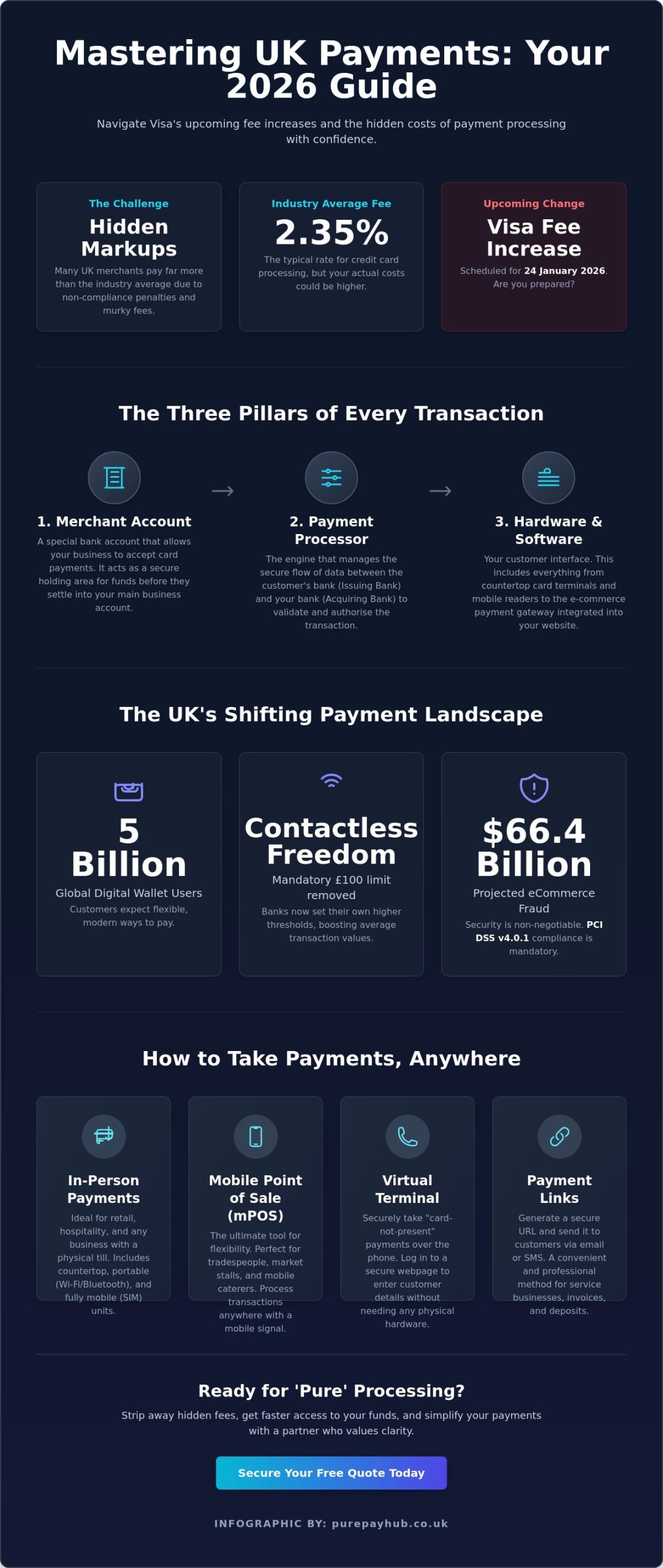
    To understand the process, you must look at the three pillars that support every transaction:

    • The Merchant Account: This is a specific bank account that allows your business to accept card payments. It acts as a temporary holding area before funds are cleared and moved to your business bank account.
    • The Payment Processor: This is the engine. It manages the flow of data between the banks to ensure the transaction is valid, authorised, and secure.
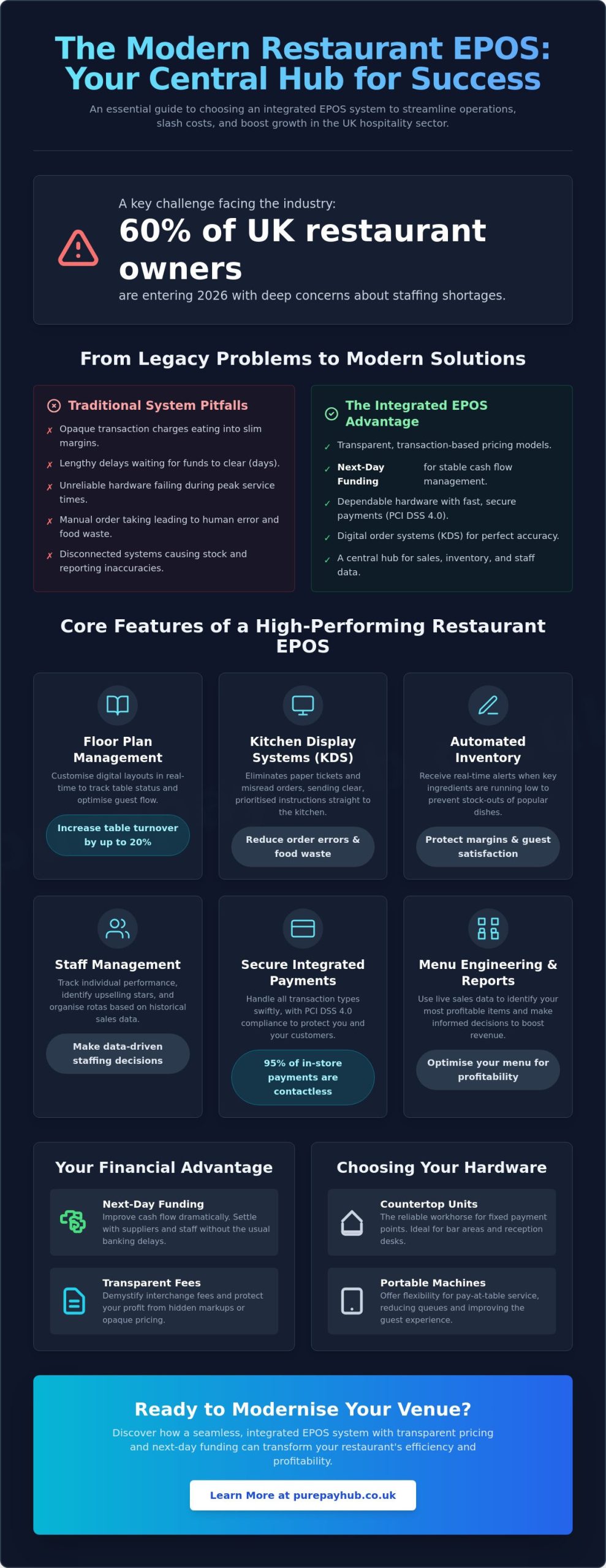
    • Hardware and Software: This is your interface. It includes everything from sleek countertop terminals in a shop to the e-commerce gateway on your website.

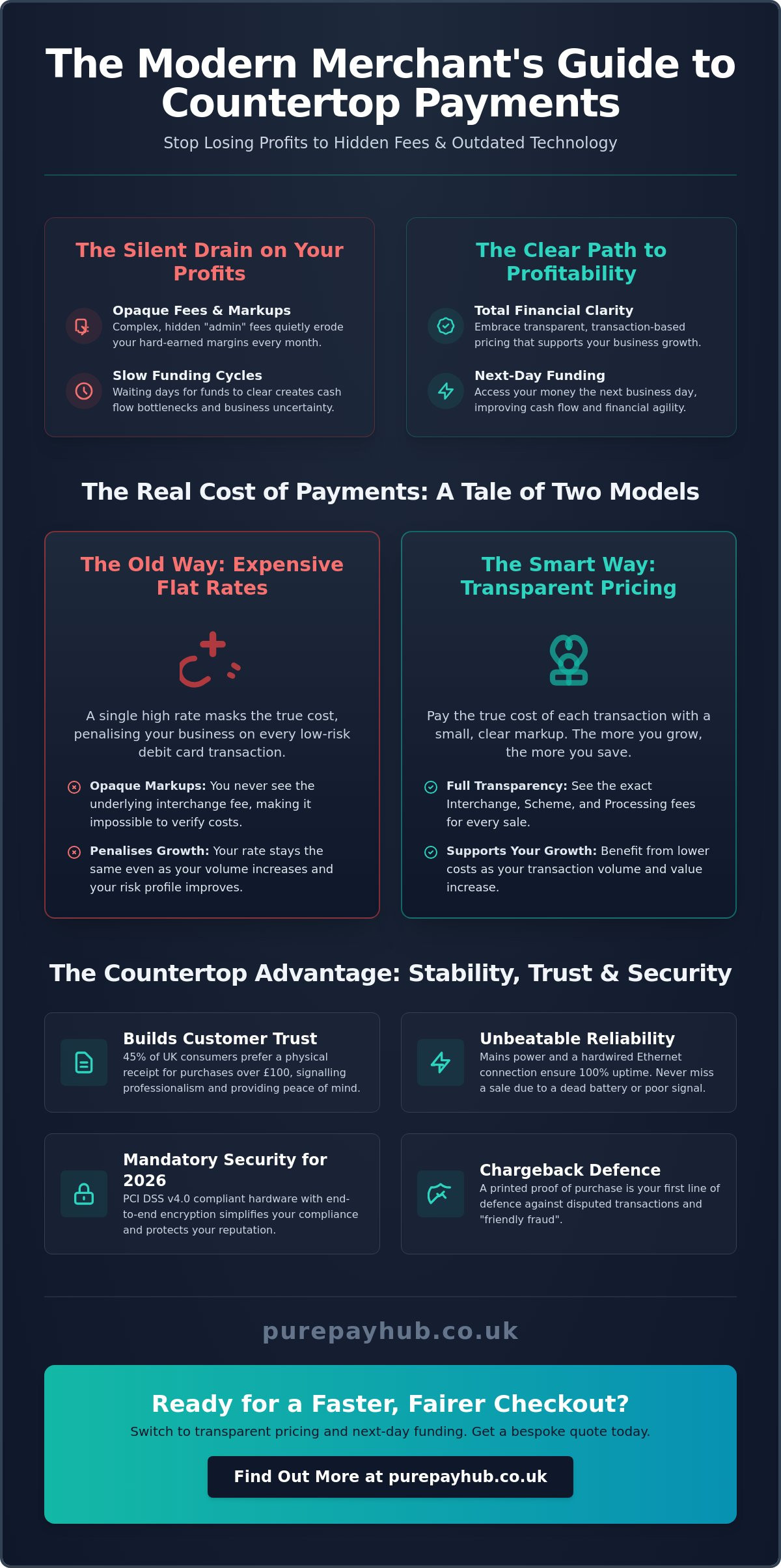
    At PurePay Hub, we advocate for “pure” processing. This means we strip away the hidden fluff and complex markups that traditional providers often bury in the small print. We focus on secure, transaction-based clarity so you can focus on growth. When your processing is pure, you aren’t surprised by unexpected costs at the end of the month.

    The Shift in UK Consumer Behaviour

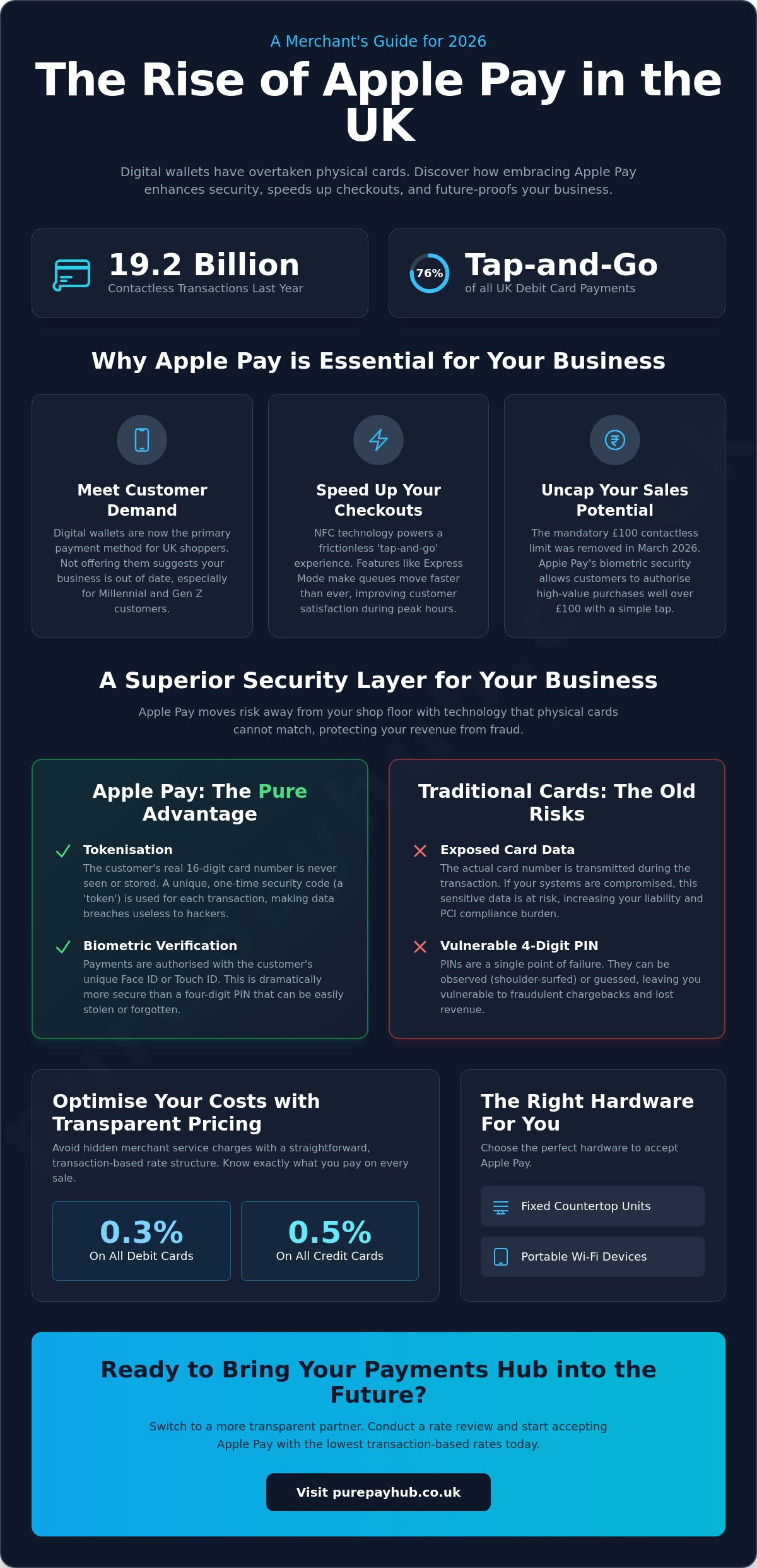
    Consumer habits have transformed rapidly. By January 2026, global digital wallet users reached 5 billion. In the UK, the mandatory £100 contactless limit was removed on 19 March 2026, whilst banks now set their own thresholds. Relying on “cash only” is a risk few businesses can afford. Accepting diverse methods, from physical cards to digital tap-to-pay on smartphones, directly increases your average transaction value (ATV). This shift is also paving the way for digital asset integration, where fintech providers like Pallapay are helping businesses adapt to new ways of exchanging value. Customers naturally spend more when they aren’t limited by the physical notes in their wallet.

    Key Terminology Every Merchant Should Know

    The industry is full of jargon, but the basics are simple. Your Acquiring Bank is the institution that maintains your merchant account and “acquires” the funds for you. The Issuing Bank is the customer’s bank that “issues” their card. Settlement is the final step where funds are moved into your bank balance. In 2026, security is governed by PCI DSS v4.0.1. This is the mandatory gold standard that ensures every tap is protected against the $66.4 billion eCommerce fraud threat projected for this year.

    Choosing Your Method: How to Take Payments Anywhere

    Your business might start at a physical till, but it shouldn’t end there. In 2026, 92% of merchants accept digital wallets, and your customers expect that same level of flexibility whether they are in your shop or on your website. To stay competitive, you need a setup that handles every scenario. Whether you are selling at a local market or invoicing a client across the country, the goal is to take payments without friction or technical delays.

    We view your payment setup as a central Hub. Instead of juggling different providers for your shop, your website, and your phone orders, a unified system brings everything together. This creates a stabilising force for your finances and provides one clear view of your cash flow. This clarity is vital when eCommerce fraud is projected to cost merchants $66.4 billion this year. By centralising your streams, you reduce your risk and simplify your reporting.

    In-Person: Countertop vs. Mobile Units

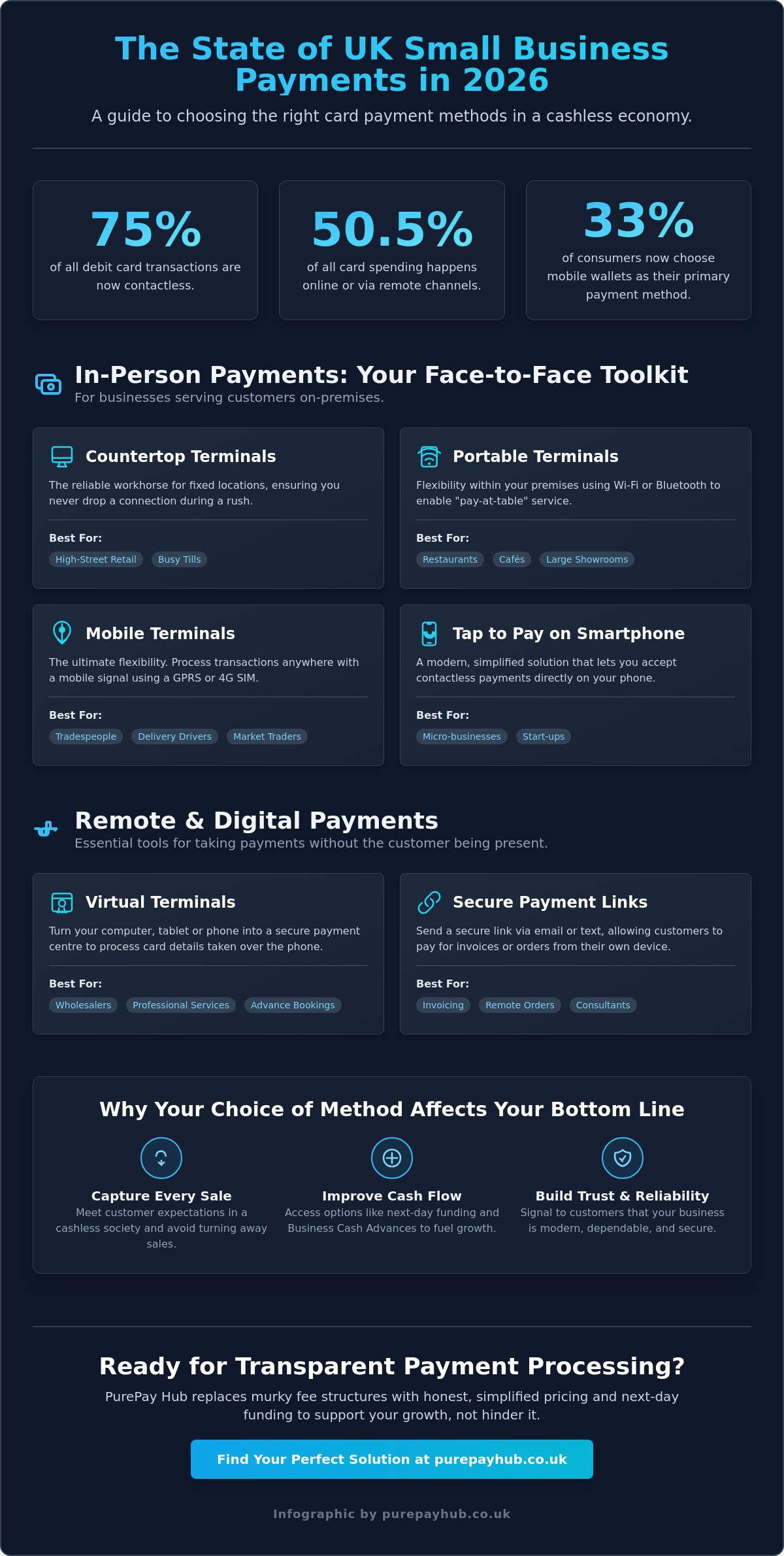
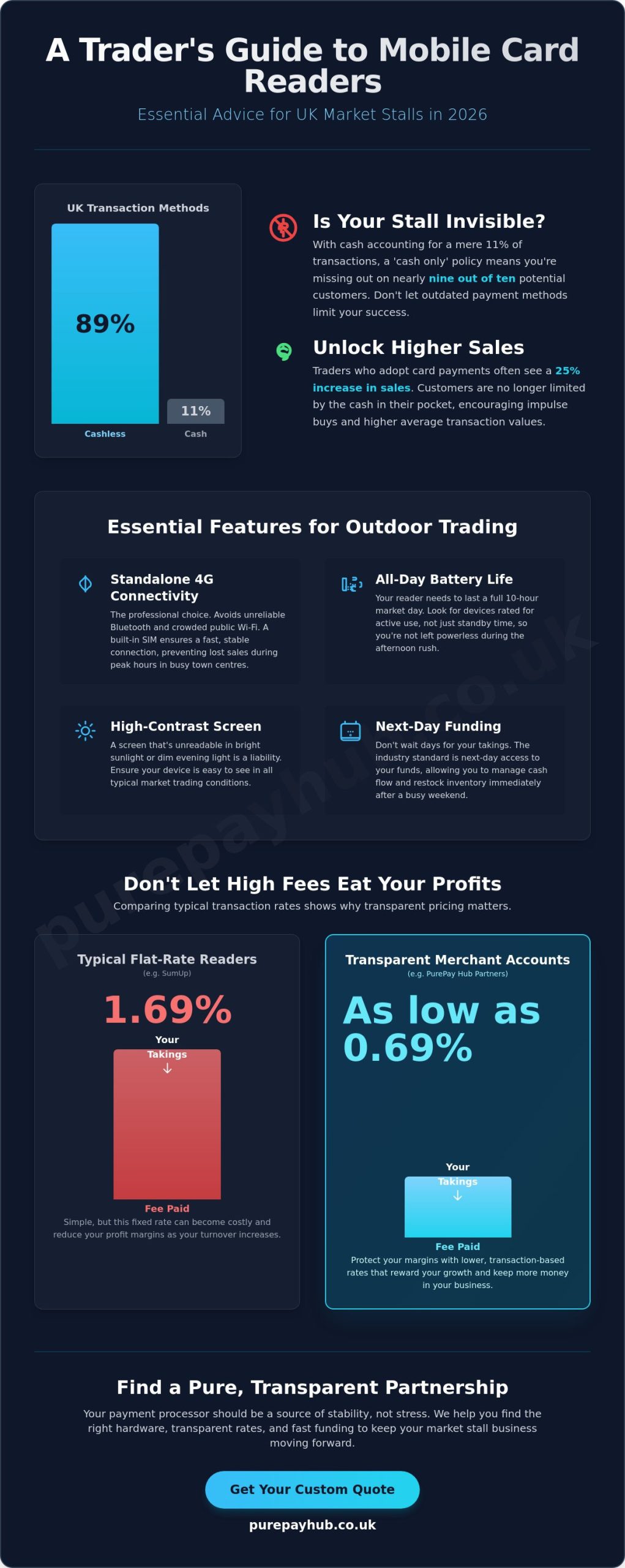
    Countertop machines are the reliable workhorses of the retail world. They sit at your fixed till point and usually connect via Ethernet for maximum stability. If your customers always come to you, this is your foundation. Portable units offer more freedom, using Bluetooth or Wi-Fi to reach tables in a restaurant or move around a showroom floor. For tradespeople or mobile caterers, a SIM-based mobile machine is essential. It connects to the 4G or 5G network so you can process transactions anywhere with a signal. An mPOS, or mobile Point of Sale, is the ultimate tool for on-the-go flexibility.

    Remote Payments: Virtual Terminals and Links

    Not every sale happens face-to-face. A virtual terminal allows you to take payments over the phone securely. You simply log into a secure webpage and type in the customer’s details whilst they are on the line. It’s a professional way to handle “card-not-present” transactions without needing physical hardware on site.

    Payment links are another favourite choice for service-based SMEs and wholesalers. You generate a secure URL and send it via email or SMS. The customer clicks, pays at their convenience, and the settlement process begins. It’s transparent, honest, and incredibly fast. If you’re looking for a transparent partnership to manage these different streams, choosing a unified provider is the first step toward financial clarity. This approach ensures your business stays agile as the UK market continues to move away from traditional cash transactions.

    How to Take Payments: The Ultimate SME Checklist for 2026

    Decoding the Costs: Transaction Fees vs. Monthly Rentals

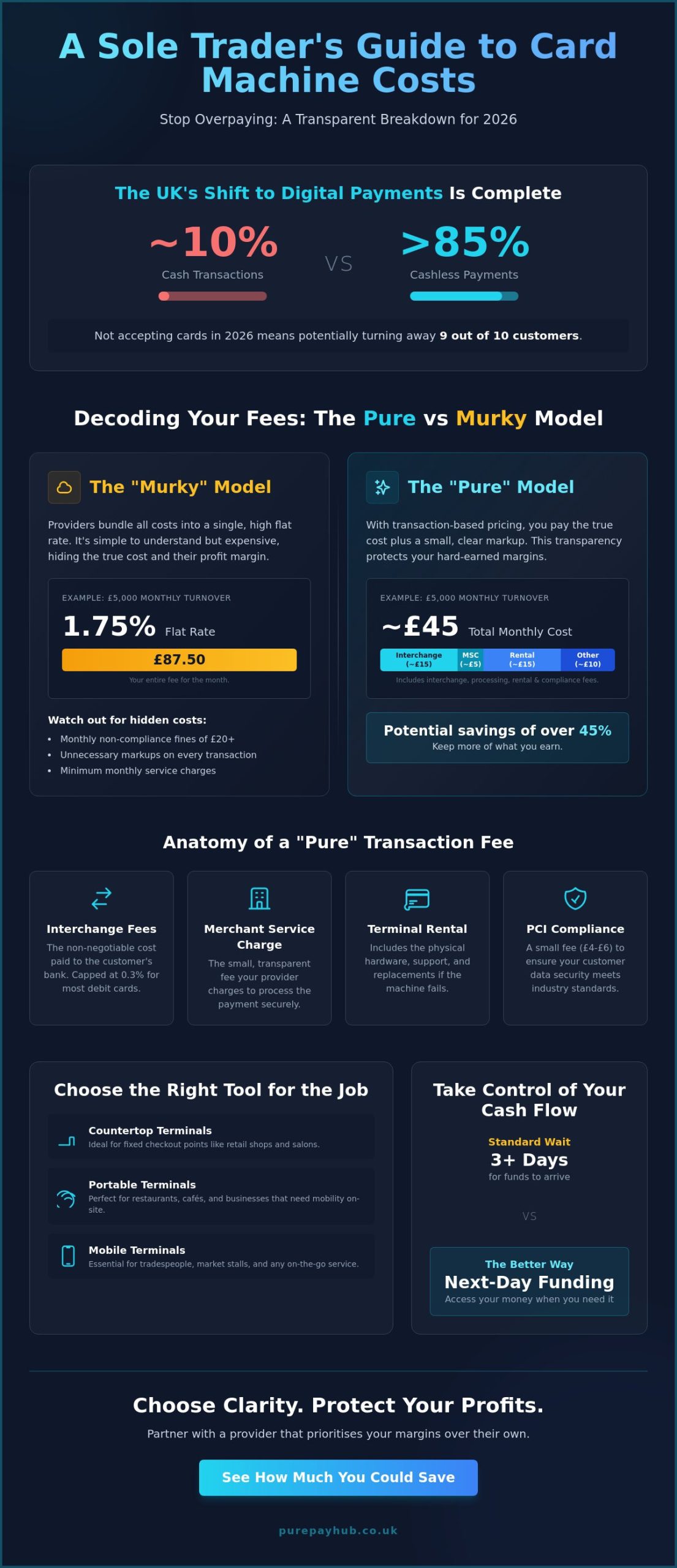
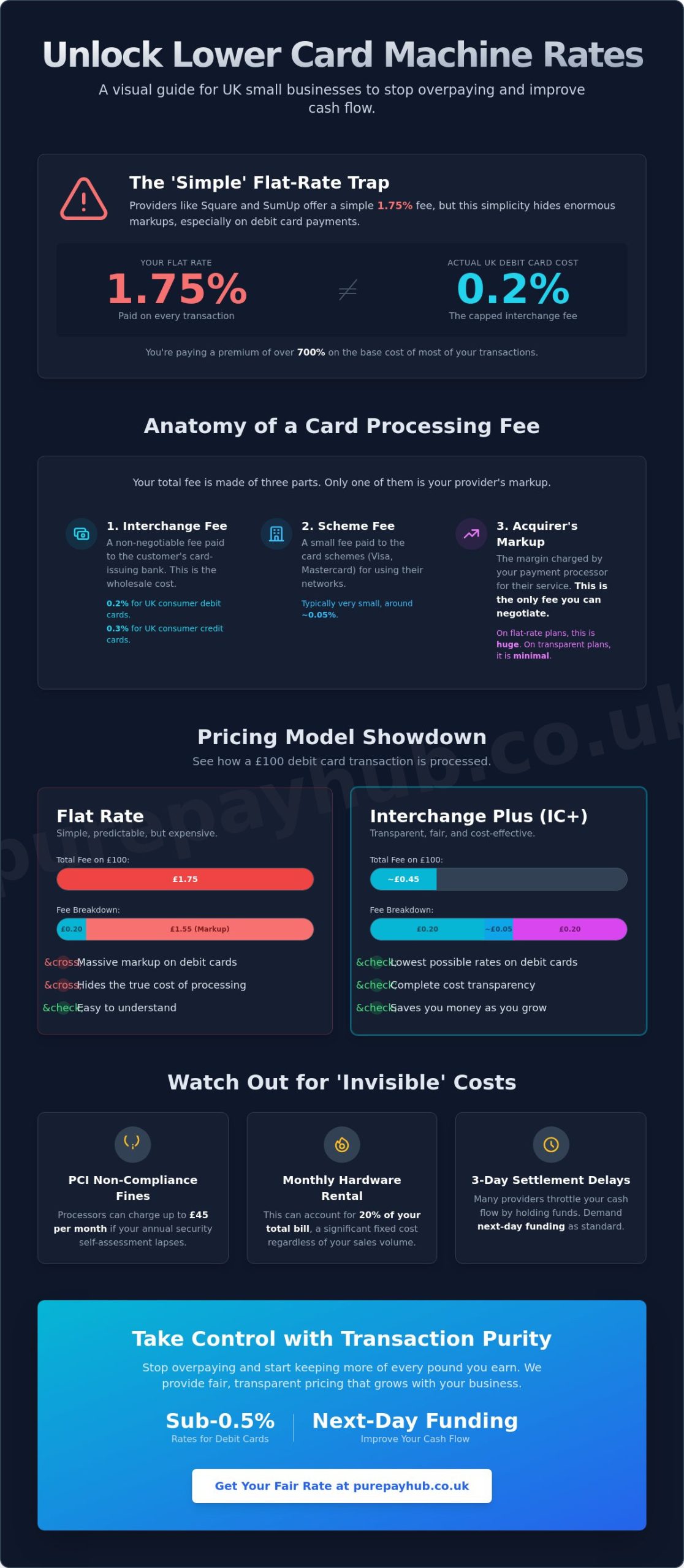
    Understanding the true cost to take payments is often the biggest hurdle for UK business owners. Most providers present a “blended” rate that looks simple but actually hides significant markups. The Merchant Service Charge (MSC) is the core fee you pay on every transaction. Typically, debit card rates are significantly lower than credit card rates because the risk to the bank is lower. With the average processing cost for Visa and Mastercard sitting at approximately 2.35%, any rate significantly higher than this suggests a heavy processor markup.

    Hardware rental is another area where transparency is often lacking. A fair monthly price for a modern countertop unit should be clear and fixed. However, the real danger lies in the “hidden” extras. Many legacy providers charge a Minimum Monthly Service Charge (MMSC) if you don’t hit a certain sales volume. They also levy heavy fines for PCI non-compliance. Since PCI DSS v4.0.1 became mandatory on 31 March 2025, these fines have become a common way for processors to squeeze extra profit from unsuspecting merchants. We believe in a different approach. We advocate for transaction-based clarity where you only pay for what you use.

    Understanding Interchange Plus Pricing

    Interchange Plus is the “pure” alternative to confusing flat rates. This model reveals exactly what the card schemes charge (the interchange) and exactly what the processor takes as their fee. It’s the most honest way to view your statements. For high-volume merchants, debit card charges can start as low as 0.3%, whilst credit cards remain higher. This model allows you to see the direct benefit of the proposed 0.1 percentage point reduction in interchange fees scheduled to last for the next five years.

    Avoiding the ‘Exit Fee’ Trap

    The UK market is notorious for long-term contracts. These agreements often stretch from 12 to 48 months and include aggressive exit fees. Always check the small print for rolling renewals that lock you in for another year without your knowledge. You should also look for cancellation notice periods, which can sometimes be as long as six months. PurePay Hub simplifies the onboarding process to avoid these legacy headaches. We focus on building a partnership based on performance rather than restrictive legal traps. This ensures your business remains agile and ready to grow.

    The Merchant’s Checklist: 5 Steps to Take Payments

    Setting up your business to take payments shouldn’t be a months-long ordeal. Whilst legacy banks often move at a glacial pace, a modern fintech approach allows you to get up and running with speed and precision. This checklist serves as your roadmap to a secure, transparent setup that avoids the common pitfalls of hidden fees and technical friction.

    Step 1: Audit your sales volume. Before signing any contract, look at your average transaction size and your monthly turnover. If your average sale is small, per-transaction pence fees matter more than percentages. If you’re a high-ticket wholesaler, the percentage rate is your priority. Step 2: Choose your primary environment. A busy cafe needs a portable Wi-Fi unit for table service, whilst a boutique retail shop might prefer a fixed countertop terminal. If you’re selling across multiple channels, ensure your hardware and online gateway are synced through a single Hub to keep your reporting clean.

    Preparing Your Documentation

    To speed up your application, you must organise your “Know Your Customer” (KYC) documents in advance. You’ll typically need a valid photo ID, proof of business address, and three months of recent bank statements. Having a dedicated business bank account is essential for clean accounting and faster settlement. When your documents are ready, modern onboarding can often be completed within 24-48 hours, getting you ready to take payments almost immediately.

    Integrating with EPOS Systems

    Step 4: Select hardware that integrates. Integrated payments are vastly superior to standalone units for any growing business. In an integrated setup, the till communicates directly with the card machine. This eliminates the need to type the amount in twice, which drastically reduces human error and prevents costly mistakes during busy shifts. It’s particularly vital for the fast-paced nature of UK hospitality. You can explore our specialised integrated EPOS systems for hospitality UK to see how this works in practice.

    Step 5: Run a penny test. Once your hardware arrives, process a transaction for £0.01. This “penny test” ensures that the connection to the acquiring bank is active and that your settlement path is clear. It’s the final check to guarantee that when you start your first full day of trading, your funds will arrive in your account without delay. If you’re ready to start your journey, apply for your merchant account today and join a partnership built on purity and clarity.

    Beyond the Transaction: Cash Flow and Growth

    Your business doesn’t stop once the customer leaves the premises. The real work of growth begins when those funds hit your account. When you take payments, you’re generating more than just revenue; you’re creating a data map of your business’s health. In 2026, the speed of your settlement and the flexibility of your capital determine how quickly you can respond to new opportunities. We position PurePay Hub as your central command centre, ensuring that the bridge between a sale and your bank balance is as short as possible.

    Your transaction history is a powerful tool for tracking customer behaviour and seasonal trends. By analysing when people choose to take payments most frequently, you can optimise your staffing levels and stock orders. Our Hub provides this clarity through simplified reporting that strips away the noise. This allows you to make informed decisions based on pure data rather than guesswork. When your payment processor acts as a growth partner, your business is built to scale sustainably.

    Next-Day Access to Funds

    Standard settlement periods often leave merchants waiting between 3 and 5 working days for their money. This delay creates a bottleneck that prevents you from restocking inventory or paying staff on time. For UK SMEs in 2026, next-day access to funds has moved from a luxury to a non-negotiable requirement. It provides the liquidity needed to keep your operations fluid and responsive. You can learn more about this in our Next-Day Funding for Retailers guide.

    Business Cash Advances Explained

    Traditional bank loans often come with rigid monthly repayments that don’t account for your actual trading volume. A Business Cash Advance is a more transparent and honest alternative. You receive a lump sum upfront and repay it as a fixed percentage of your daily card sales. This “pay-as-you-trade” model is inherently safer for seasonal businesses. If you have a quiet Tuesday, you pay back less. If you have a record-breaking Saturday, you pay back more. It’s a partnership that aligns with your success. Discover how PurePay Hub can support your cash flow with a Business Cash Advance today.

    Secure Your Financial Future Today

    The UK payment landscape is evolving rapidly. With Visa increasing fees on 24 January 2026, you cannot afford to stay with a provider that hides behind complex jargon. You now have a clear checklist to audit your sales, choose the right hardware, and secure your cash flow with next-day funding. The ability to take payments should be a pure utility that supports your growth rather than a drain on your resources.

    By moving away from “blended” rates and embracing the transparency of an Interchange Plus model, you protect your margins from hidden monthly markups. You also ensure your business stays ahead of mandatory security standards like PCI DSS v4.0.1. We act as your reliable ally in this shifting market, providing the stability your business needs to thrive.

    Switch to PurePay Hub for transparent, transaction-based payments today. You will benefit from debit card rates starting from 0.3% and next-day funding as standard. It’s time to simplify your setup and focus on your customers. Your business deserves a partner that values honesty as much as you do.

    Frequently Asked Questions

    How long does it take to set up a merchant account to take payments?

    Modern onboarding allows you to set up a merchant account within 24 to 48 hours. If you have your “Know Your Customer” documentation ready, such as photo ID and bank statements, the process is streamlined and efficient. This ensures you can take payments and start trading without the long delays typically associated with traditional high-street banks.

    Can I take payments on my phone without a card machine?

    You can take payments on your smartphone using a virtual terminal or secure payment links. A virtual terminal turns your phone’s browser into a secure interface for over-the-phone orders. Alternatively, you can send a unique URL via SMS or email, allowing the customer to pay instantly from their own device without needing a physical terminal on site.

    What are the average transaction fees for small businesses in the UK?

    Small businesses in the UK typically pay between 1.5% and 3.5% per credit card transaction. As of May 2026, the average processing cost for Visa and Mastercard is approximately 2.35%. These rates vary depending on whether you use a “blended” flat rate or a more transparent “interchange plus” model that reveals the true cost of processing.

    Is it possible to take payments online and in-store with the same provider?

    Managing both online and in-store sales with a single provider is the most efficient way to run your business. Using a unified “Hub” simplifies your reporting and gives you a single view of your cash flow. For those operating as digital platforms or marketplaces, click here to learn more about Gemba’s specialised banking infrastructure. It also ensures your transaction-based fees remain consistent and clear across all your sales channels, from your website to your physical till.

    What happens if my card machine loses Wi-Fi connection during a sale?

    Most modern terminals switch automatically to a 4G or 5G SIM connection if your Wi-Fi drops. This ensures you don’t lose a sale during busy shifts. If you don’t have a SIM-enabled device, some units offer an “offline mode” that stores the transaction data securely and processes it once your internet connection is restored.

    How do I avoid paying monthly PCI non-compliance fees?

    You avoid non-compliance fees by providing 12 months of continuous operational evidence for PCI DSS v4.0.1. This became mandatory for all UK businesses on 31 March 2025. We help you through the annual self-assessment process to ensure your security standards are met, protecting you from the unnecessary penalties that many traditional processors charge.

    Can I take payments from international customers with a UK merchant account?

    You can accept cards from international customers, but these transactions often carry different interchange fees. Whilst your UK merchant account handles global payments, be aware that currency conversion and “non-EEA” card rates can impact your final settlement. We advocate for transparency here so you always know the exact cost of your global sales.

    What is the difference between a merchant account and a business bank account?

    A merchant account is a temporary holding area where funds are cleared and authorised after a transaction. A business bank account is the final destination where your hard-earned profits are settled. You need both to function; the merchant account acts as the bridge that moves money from your customer’s bank to your own balance.

  • Virtual Terminal: The Complete Guide to Taking Remote Payments in 2026

    Virtual Terminal: The Complete Guide to Taking Remote Payments in 2026

    With card-not-present fraud now accounting for 70% of all UK card fraud losses, taking a payment over the phone often feels like a high-stakes gamble. You’ve likely experienced the frustration of opaque fee structures that climb as high as 2.95% plus 30p per transaction. It’s exhausting to manage complex security requirements whilst waiting days for your hard-earned money to reach your bank account. You deserve a payment partner that prioritises clarity over corporate jargon.

    This guide demonstrates how a virtual terminal can transform your computer into a secure, PCI-compliant payment centre with total fee transparency. We’ll show you how to achieve next-day funding and lower your overheads by leveraging the January 2026 PSR interchange fee caps. From mastering the March 2025 PCI DSS v4.0 standards to choosing a transaction-based model that fits your volume, you’ll learn how to build a more profitable payment hub for your business.

    Key Takeaways

    • Understand how a virtual terminal converts your existing laptop or tablet into a secure payment centre for immediate phone sales.
    • Learn the essential steps to stay compliant with PCI DSS v4.0 standards whilst protecting sensitive cardholder data.
    • Discover how to streamline your cash flow with next-day funding and a 24-hour onboarding process that requires no physical hardware.
    • Identify when to use real-time terminal processing versus flexible payment links to better suit your customer’s buying journey.
    • See why shifting to a “Pure” transaction-based pricing model offers better value and transparency than traditional flat-rate structures.

    What is a Virtual Terminal and Why Does Your Business Need One?

    A virtual terminal is a secure, cloud-based portal that transforms your existing hardware into a professional payment centre. You don’t need a bulky card machine to take a payment. Instead, you log into a browser-based dashboard and enter your customer’s details manually whilst they remain on the line. This technology is specifically designed for “Card-Not-Present” (CNP) transactions. By September 2025, online and remote spending accounted for 50.5% of total card spending in the UK. Having the right tools to capture this market isn’t just a luxury; it’s a necessity for survival.

    Understanding What is a Virtual Terminal helps clarify how it functions as the backbone of remote commerce. Unlike traditional shopfront setups, this software handles the complex encryption on your behalf. This ensures your business meets the March 2025 PCI DSS v4.0 standards without requiring a massive investment in cybersecurity infrastructure. For remote-first businesses, wholesalers, and tradespeople, it eliminates the need for physical hardware. This directly reduces your monthly rental costs and removes the headache of maintaining fragile card machines.

    The Core Difference Between Physical and Virtual Terminals

    Physical terminals rely on the card being present for a chip and pin or contactless tap. Whilst contactless payments reached 76% of all debit card transactions by December 2025, they don’t help when your client is fifty miles away. A virtual terminal bridges this gap. It allows for manual entry of card details during a telephone call. For B2B firms and professional services, this is often the preferred choice. It projects a more professional image than asking a client to visit a physical location just to settle an invoice. You maintain full control of the transaction flow whilst providing a seamless experience for your customer.

    Common Use Cases for UK Service Businesses

    Many tradespeople and consultants use this technology to secure their time and protect their cash flow. Common applications include:

    • Securing deposits: Take a booking fee immediately to prevent no-shows and cover initial material costs.
    • Settling invoices: Process balance payments over the telephone as soon as a job is completed.
    • Managing retainers: Handle recurring monthly payments for long-term clients without them needing to take manual action each time.

    Using a centralised hub for these tasks keeps your records transparent and honest. It moves your business away from the opaque practices of traditional banks and toward a fairer, transaction-based model that supports your growth. By choosing a setup that prioritises clarity, you can focus on your craft rather than chasing payments. For instance, property providers can discover Unipad to see how they present clear room options and manage student bookings efficiently.

    How a Virtual Terminal Works: A Step-by-Step Walkthrough

    Accessing your virtual terminal starts with a secure login to your merchant hub using any standard web browser on your computer or tablet. You don’t need special software or complex downloads to get started. Once you are in, the interface is designed for speed and clarity. You enter the transaction amount and a brief description for your records. This description is vital because it appears on the customer’s receipt and helps you identify the sale later in your dashboard.

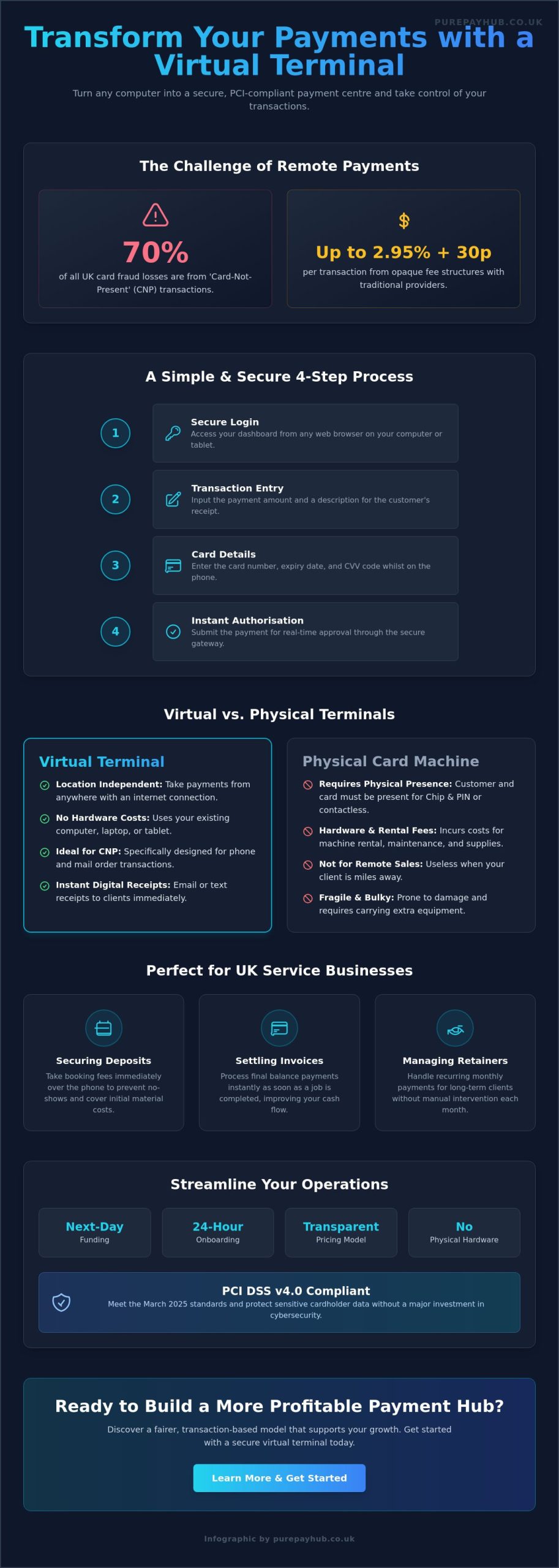
    The process follows four clear steps:

    • Secure Login: Access your dashboard via any web browser on your tablet or computer.
    • Transaction Entry: Input the amount and a description for the customer’s receipt.
    • Card Details: Enter the card number, expiry date, and CVV code whilst the customer is on the phone.
    • Submission: Submit the payment for real-time authorisation through the secure payment gateway.

    This entire sequence takes seconds. It provides an immediate result whilst your customer is still on the line. For many UK businesses, this speed is a significant upgrade over manual bank transfers or waiting for cheques to clear.

    The Anatomy of a Remote Transaction

    Behind every successful click, a complex series of security checks ensures the payment is legitimate. With card fraud losses seeing an 11% year-on-year increase in the UK, these checks are your first line of defence. This process is often detailed in any comprehensive guide to virtual terminals. First, the system performs a verification check. It confirms the card is valid and has sufficient funds for the purchase. Authorisation follows immediately. This is a split-second communication between the terminal and the customer’s bank. Finally, the confirmation step generates an instant digital receipt. You can email or text this directly to your client, providing immediate peace of mind for both parties.

    Managing Your Virtual Ledger

    Every sale you process appears instantly in your merchant dashboard. This real-time tracking is essential for modern business management. It allows you to organise your sales data for end-of-month accounting and VAT returns without sifting through piles of paper. Maintaining a healthy cash flow is the top priority for any growing SME. We understand that waiting for funds can stifle your operations. That’s why next-day funding is a core feature of our service. It ensures your money is in your bank account quickly, allowing you to reinvest in your business without delay. If you want to streamline your billing, you can explore our transparent hub options to see how we simplify remote payments.

    Virtual Terminal: The Complete Guide to Taking Remote Payments in 2026

    Choosing between these two methods depends on how you interact with your clients. A virtual terminal gives you direct control. You enter the card details whilst the customer is on the line, ensuring the transaction is finalised immediately. Conversely, a payment link shifts the responsibility to the customer. They receive a secure URL via email or SMS and complete the payment in their own time. Both methods are essential parts of a modern payment hub, but they serve different psychological needs and operational workflows.

    The “trust factor” varies significantly between demographics. Some customers feel more secure giving their details to a live person they’ve just spoken with. Others prefer the privacy of a digital link where they don’t have to read their CVV code aloud. From a cost perspective, both methods typically fall under the same “Card-Not-Present” (CNP) fee category. In 2026, typical UK transaction rates for these services range from 1.99% to 2.95%, often with an additional 25p to 30p per-transaction charge. Your choice should focus on which method delivers the smoothest experience for your specific clientele.

    When to Use a Virtual Terminal

    This method is ideal for high-pressure sales environments where closing the deal on the call is vital. If you let a customer hang up to wait for an email, you risk losing that momentum. A virtual terminal is the ultimate tool for immediate telephone commerce, ensuring the transaction is finalised before the call ends. It’s also the preferred choice for older demographics who might be less comfortable navigating digital links or mobile banking apps. For service providers taking deposits over the phone, it provides instant confirmation that the time slot is secured.

    When Payment Links Take the Lead

    Payment links are perfect for “out of hours” billing. You don’t need to be present to take the payment; you simply send the link and wait for the notification. This method also reduces the risk of human error in data entry. Since the customer inputs their own card number and expiry date, the liability for typos shifts away from your staff. Links are particularly effective when integrated into digital invoices. A “click-to-pay” button on a PDF invoice creates a seamless journey for B2B clients who may need to pass the link to their own finance department for settlement.

    Whether you prefer the direct approach of a terminal or the flexibility of a link, our “Pure” fee model ensures you never pay more than necessary. We prioritise honesty in our pricing, allowing your business to grow without the burden of hidden markups or complex tiered structures.

    Security, Compliance, and Fair Pricing for UK Merchants

    Security is the foundation of every transaction you process. With card-not-present fraud making up 70% of all UK card fraud losses, protecting your revenue is a non-negotiable priority. A professional virtual terminal acts as a secure buffer between sensitive customer data and your internal systems. It ensures you never need to write down card details on scraps of paper or store them in unsecured spreadsheets. Following the March 2025 transition to PCI DSS v4.0, the requirements for handling data became even stricter. Using a dedicated hub ensures you stay on the right side of these regulations without needing an in-house IT department.

    Fairness in pricing is just as vital as security. Many traditional providers trap SMEs in flat-rate models that hide the true cost of processing. We believe in a “Pure” transaction-based model. This approach is inherently fairer for growing businesses because it reflects the actual cost of each payment. When combined with next-day funding, this transparency helps you manage stock levels and payroll more effectively. You shouldn’t have to wait a week to access the money you earned yesterday. We ensure your funds are in your account within 24 hours, keeping your cash flow healthy and predictable.

    Navigating PCI Compliance Without the Stress

    Compliance often feels like a burden, but it’s actually your best defence against monthly non-compliance fines. Your virtual terminal provider handles the heavy lifting by encrypting data the moment it’s entered. To keep your team safe, establish a strict “no-paper” policy. Never record CVV codes or full card numbers outside of the secure portal. Fraud prevention tools like the Address Verification Service (AVS) add an extra layer of protection. They cross-reference the customer’s billing address with their bank records, stopping unauthorised transactions before they happen.

    Decoding Transaction Rates: Debit vs. Credit

    Not all cards cost the same to process. As of January 2026, the PSR has capped interchange fees for EEA transactions at 0.2% for debit and 0.3% for credit cards. Your monthly statements should reflect these differences through “Interchange Plus” pricing. This model separates the bank’s fee from the processor’s markup, allowing you to see exactly where every penny goes. If your current provider charges a single high rate for every card type, you are likely paying hidden markups. Identifying these costs is the first step toward a more profitable partnership. Switch to a fairer partner and get a transparent quote for your business today.

    Getting Started with a PurePay Hub Virtual Terminal

    Moving your business to a more transparent model shouldn’t be a hurdle. Our onboarding process is engineered for speed and simplicity. Most UK merchants are ready to take their first payment through the virtual terminal within 24 hours of starting their application. You don’t need to wait for a courier to deliver expensive hardware or pay monthly rental fees for a card reader you might only use occasionally. Instead, you use the secure devices you already own, such as your office computer, laptop, or tablet. This approach turns your existing workspace into a professional payment centre without any additional overheads.

    We ensure a seamless transition by integrating our hub with your existing reporting tools. This means your end-of-month reconciliation remains simple and accurate. If you hit a snag, you won’t be stuck in a global call centre queue. Our expert UK-based support team acts as your merchant ally. We help you optimise your payment flow and identify ways to reduce your processing costs based on your specific transaction volume. This partnership ensures you aren’t just getting a service; you’re gaining a specialist team dedicated to your business growth.

    The PurePay Hub Advantage

    We distinguish ourselves through a commitment to honesty. The “Pure” model means you get transaction-based fees without the hidden markups that often plague traditional banking agreements. By leveraging the January 2026 PSR fee caps, we ensure your business retains more of every sale. Accessing next-day funding keeps your business moving at pace. It allows you to settle supplier invoices or manage payroll without the typical three-to-five-day delay associated with older processors. We treat every merchant as a favourite ally, providing a stabilizing force for your business finances through our centralised hub.

    Your Next Steps to Secure Remote Payments

    Transitioning to a fairer system is straightforward. To get started, you’ll need to provide basic business information, including your UK bank account details and proof of identity. This allows us to verify your account quickly and maintain the high security standards required by the March 2025 PCI DSS v4.0 regulations. You can request a quote today to compare your current rates with our transparent model. Most businesses find that our “Pure” approach provides significant clarity over their monthly overheads. We don’t use complex tiered structures, so you’ll always know exactly what you are paying for every transaction.

    Contact us today to simplify your telephone payments and join a partnership built on growth, integrity, and absolute fee transparency.

    Secure Your Business Growth with Transparent Payments

    A virtual terminal is more than just a tool for taking phone orders; it’s a strategic asset that streamlines your entire cash flow. By removing the need for physical hardware and embracing the January 2026 PSR fee caps, you can significantly reduce your operating costs whilst maintaining total security. You’ve seen how simple it is to transition to a PCI-compliant environment that protects your revenue from the 11% year-on-year increase in card-not-present fraud.

    Choosing a partner that offers debit rates from 0.3% and next-day access to funds allows you to reinvest in your business without delay. This transaction-based approach eliminates the stress of hidden markups and opaque banking practices. It’s time to treat your business to the clarity and partnership it deserves. Switch to a fairer virtual terminal and start saving today to experience a professional service that prioritises your success. We are ready to help you build a more profitable future for your business.

    Frequently Asked Questions

    What exactly is a virtual terminal?

    A virtual terminal is a secure webpage that allows you to process card payments on any device with an internet connection. It functions as a digital version of a physical card machine, designed specifically for card-not-present transactions where you manually enter customer details. This setup is perfect for businesses that take orders over the phone or via post, as it requires no hardware beyond your existing computer or tablet.

    Do I need a special bank account to use a virtual terminal?

    You need a merchant account to process payments, but this typically connects directly to your existing UK business bank account. The merchant account acts as a holding area where transactions are verified before being settled into your main account. We help you set up this link during our 24-hour onboarding process, ensuring your funds flow smoothly into your current business banking setup without any additional complexity.

    How much does a virtual terminal cost per month in the UK?

    Monthly fees for these services in 2026 range from £0 for pay-as-you-go models to over £20 for subscription-based plans. Some providers charge a flat monthly fee to unlock lower per-transaction rates, whilst others offer no fixed costs in exchange for a higher percentage on each sale. It’s vital to choose a model that matches your volume to avoid overpaying for features you don’t use.

    Is it safe to take card details over the phone?

    Taking details over the phone is safe if you use a platform that complies with the March 2025 PCI DSS v4.0 standards. You must never write card details down or record them on unsecured devices. By entering the information directly into a secure virtual terminal, the data is encrypted immediately. This protects both your business and your customer from the 11% year-on-year rise in card-not-present fraud.

    Can I use a virtual terminal on my mobile phone or tablet?

    You can use a virtual terminal on any modern mobile phone or tablet that has a standard web browser. There is no need for a dedicated app or specialised hardware to take payments on the go. This flexibility is ideal for tradespeople or service providers who need to settle invoices or take deposits whilst working away from their main office or centre.

    How long does it take for the money to reach my bank account?

    Most modern providers offer next-day funding, ensuring your hard-earned money is available within 24 hours of the transaction. Whilst some traditional banks may still take three to five working days to settle funds, our transaction-based model prioritises your cash flow. Rapid access to capital is essential for managing stock and payroll in a fast-moving UK market.

    What is the difference between a virtual terminal and a payment gateway?

    A virtual terminal is the user interface where you manually enter card data, whereas a payment gateway is the invisible technology that authorises the transaction. Think of the terminal as the digital checkout counter and the gateway as the secure tunnel connecting that counter to the bank. Both work together to ensure every remote payment is processed, verified, and settled with total transparency.

    Are there any long-term contracts for virtual terminal services?

    Contract lengths vary by provider, but many modern fintech companies now offer rolling monthly agreements with no long-term commitment. Traditional banks often require 12 to 18-month contracts, which can be restrictive for growing SMEs. We favour a flexible approach that earns your loyalty through fair pricing and honest service rather than binding legal terms.

  • Business Cash Advance Based on Card Sales: The UK Merchant’s Guide

    Business Cash Advance Based on Card Sales: The UK Merchant’s Guide

    Why should your business be forced to pay the same fixed loan instalment during a quiet Tuesday in February as it does during the peak December rush? Most UK merchants find that traditional bank lending is far too rigid for the modern market. If you are looking for a more flexible alternative, a business cash advance based on card sales offers a financial solution that actually mirrors your daily turnover. You already know the stress of complex applications and the fear of high fixed costs during slow trading months. We are here to change that dynamic with a fairer approach to funding.

    In this guide, you will discover how to secure unsecured capital within 72 hours through a process built on transparency and speed. We will explain how to access a repayment structure that breathes with your sales volume, ensuring your repayments always match your actual cash flow. We will also break down our clear fee structure, giving you the clarity needed to invest in stock, repairs, or growth with complete confidence. It is time to move away from the frustration of high-street banks and toward a partnership that supports your business through every peak and trough.

    Key Takeaways

    • Learn how a business cash advance based on card sales provides an unsecured injection of capital that moves in sync with your daily turnover.
    • Discover the “breathing” repayment model where you pay back more on busy days and less during quiet periods, protecting your vital cash flow.
    • Understand the no-nonsense application process that requires minimal documentation and rewards established UK merchants with fast, flexible funding.
    • Identify the most effective revenue-generating ways to use your capital, from securing seasonal stock to investing in essential equipment upgrades.
    • See how integrating your funding with PurePay Hub’s countertop card machines creates a transparent and seamless partnership for business growth.

    What is a Business Cash Advance Based on Card Sales?

    A business cash advance based on card sales provides a flexible alternative to restrictive bank funding. It’s an unsecured injection of capital built entirely on your future credit and debit card turnover. Instead of a bank manager demanding a charge over your property, this model looks at your terminal’s performance. You receive a lump sum upfront, and you pay it back as a small percentage of every card transaction you process.

    This funding isn’t a loan in the legal sense. It is technically a “purchase of future sales” where a provider buys a portion of your future revenue at a discount. Because it isn’t a debt instrument, you won’t face fixed terms, APRs, or monthly standing orders that drain your account during quiet weeks. If your sales drop, your repayments drop too. To understand the broader context of this financial product, you can read more about What is a Merchant Cash Advance? to see how it differs from traditional lending.

    At PurePay Hub, we prioritize transparency through our “Pure” advantage. We believe merchants deserve a partnership based on honesty rather than hidden administrative markups. You get a clear quote from the start, ensuring the total cost is visible before you commit. We’ve removed the complex fee structures that often make business finance feel like a trap.

    The Core Difference: BCA vs. Traditional Business Loans

    Traditional bank loans are rigid. They require fixed monthly payments regardless of whether you’ve had a record-breaking month or a total washout. A business cash advance based on card sales is different because it’s inherently flexible. Since there’s no physical collateral like property or equipment required, your personal assets stay protected. The Factor Rate is the fixed multiplier applied to your advance amount that determines the total sum you will repay.

    Who is this Funding Model For?

    This model is built for high-volume card businesses. If you run a busy cafe, a retail shop, or an e-commerce site, your card turnover is your strongest asset. Seasonal businesses particularly favour this approach. During the winter “off-season,” a pub might see a 40% dip in takings, and a BCA automatically adjusts to ensure repayments don’t stifle cash flow. This funding is designed for UK-registered businesses that can demonstrate at least 3 to 6 months of consistent trading history.

    How the “Breathing” Repayment Mechanism Works

    Traditional bank loans are rigid. They demand the same payment every month, regardless of whether your till is ringing or silent. A business cash advance based on card sales operates on a fundamentally different principle. We call it the “breathing” mechanism. Instead of a fixed monthly sum, you repay a small, agreed percentage of your daily credit and debit card takings.

    This system mirrors the natural rhythm of your business. If you have a quiet Monday with only £200 in card takings, your repayment is proportionally small. When a busy Saturday brings in a surge of £3,000 in sales, you pay back more. This flexibility protects your cash flow during seasonal dips or unexpected quiet patches. Because the percentage is fixed, you always know exactly what portion of every sale is being diverted. There are no fixed deadlines and no late fees. The advance is settled only when you make a sale, which removes the pressure of a ticking clock.

    The Role of Your Card Machine

    The entire process is automated through your existing payment setup. A processor like PurePay Hub facilitates the split of funds at the moment of transaction. There’s no need for manual bank transfers or the old-fashioned hassle of writing cheques. This seamless integration ensures that your focus remains on operations, not debt management. It provides a pure, hands-off experience that allows you to grow without the administrative burden of traditional financing. You don’t have to remember to move money or worry about missing a payment date.

    Understanding the Factor Rate

    Clarity is vital for any UK merchant. Unlike traditional loans with fluctuating interest rates, a cash advance uses a fixed factor rate. This is a simple multiplier that determines the total cost of the funding from the start. It’s a transparent way to see exactly what you owe without hidden surprises. This straightforward approach is often cited in any Guide for Businesses Needing Funding as a key advantage for small enterprises that value certainty.

    Consider a hypothetical example. If you secure an advance of £10,000 at a factor rate of 1.2, your total repayment amount is exactly £12,000. It doesn’t matter if it takes six months or ten months to reach that total; the cost remains the same. You won’t find yourself trapped by compounding interest or penalty charges for taking longer to pay during a slow season. This certainty helps you plan your budget with confidence. You’re in control of the pace, and the total cost is locked in from day one.

    Business Cash Advance Based on Card Sales: The UK Merchant’s Guide

    Eligibility and the No-Nonsense Application Process

    Securing a business cash advance based on card sales is designed to be a painless experience. Traditional banks often demand years of audited accounts and thick stacks of paperwork; we prefer a transparent, modern approach that respects your time. To qualify, your business must be based in the UK and have at least three months of trading history. Most lenders look for a minimum monthly card turnover of £2,500. This low barrier makes capital accessible to a vast majority of small businesses that might otherwise struggle with high-street lenders.

    Understanding how a merchant cash advance works helps you see why the documentation requirements are so light. You won’t need to produce complex business plans or five-year projections. Instead, you usually only need to provide your last three months of merchant statements. Digital onboarding ensures the entire process is “Pure” and efficient, allowing for approval in as little as 24 to 48 hours. Your personal credit score doesn’t tell the whole story here. Lenders focus on the health and consistency of your sales rather than just a single credit number.

    Step-by-Step: From Quote to Capital

    • Step 1: You share basic business details and your recent card processing volume through a secure online portal.
    • Step 2: You receive a transparent quote. This shows the total advance amount and the factor rate, ensuring there are no hidden surprises.
    • Step 3: Once you’re happy, you sign the digital contract. The lender performs a final verification of your merchant accounts and the funds are typically transferred within one working day.

    Why Approvals are Higher than Traditional Loans

    Lenders in this space prioritise real-time sales data over historical balance sheets. They don’t get hung up on what happened two years ago; they care about the “pulse” of your business today. A consistent flow of card sales serves as the primary security for the funder, which significantly reduces their risk. This shift in focus means that even businesses with less-than-perfect credit can still qualify. If your turnover is strong and your daily transactions are steady, you’re a viable candidate for a business cash advance based on card sales. It’s a fairer way to assess a modern UK business, moving away from the rigid and often exclusionary criteria used by old-fashioned financial institutions.

    Strategic Growth: When to Use Your Cash Advance

    A business cash advance based on card sales isn’t a life support machine for a failing model. It’s high-octane fuel for growth. You shouldn’t use this capital to pay off long-term structural debt or cover basic rent arrears. Instead, think of it as a tactical tool. The most effective use of these funds involves revenue-generating activities that offer a clear return on investment. This includes purchasing extra stock for peak seasons, launching a targeted marketing campaign, or upgrading kitchen equipment to increase table turnover. These investments pay for themselves by driving more customers through your door. For those in the health and supplement sectors, this funding could even help you discover Simplepack Ltd and their specialist contract packing services to help you scale your product lines efficiently.

    Because there’s no fixed monthly burden, your daily operational cash flow remains protected. You aren’t forced to find a specific sum when the till is quiet. This flexibility ensures your business stays agile. You can focus on expansion without the constant worry of a looming bank deadline. It’s about using capital to create more capital, rather than just filling a hole.

    Managing Seasonal Fluctuations

    Seasonality is the biggest challenge for UK retail and hospitality. A seaside cafe in Cornwall might see a 70% drop in footfall during January, while a London toy shop prepares for a 300% surge in December. A business cash advance based on card sales provides the peace of mind needed to bridge these gaps. You can stock up on inventory in October without draining your reserves. Repayments automatically scale down when sales are lean, ensuring you don’t feel the squeeze during a quiet week. This model is a favourite amongst hospitality and retail sectors because it mirrors the natural rhythm of their trade.

    The Opportunity Cost of Waiting

    In business, speed is often more profitable than a low interest rate. Imagine a supplier offers a 20% discount on a bulk order, but the deal expires in 48 hours. Traditional bank loans often take weeks to approve. By the time the funds arrive, the opportunity has vanished. The cost of missing that discount is often far higher than the fixed cost of the advance. Access to capital is often more valuable than the cost of the capital itself. Quick funding allows you to react to market shifts faster than your competitors, securing better margins and exclusive stock before anyone else.

    Ready to fuel your next growth phase? Explore our transparent funding options.

    The PurePay Hub Advantage: Transparent Merchant Funding

    At PurePay Hub, we believe you deserve better than the opaque practices often found in traditional lending. We’ve built our reputation as a merchant’s ally by stripping away the complexity that clouds UK business finance. Our approach is defined by “Purity.” This means no hidden fees and no confusing jargon. We view a business cash advance based on card sales as a strategic partnership for your growth, not a weight of debt to carry. It’s a tool designed to help you seize opportunities without the stress of fixed monthly repayments.

    Traditional finance often feels like a maze; we’ve cleared the path. By focusing on your actual card takings, we provide a funding solution that breathes with your business. When you’re busy, you pay back more. During quieter weeks, the repayment amount drops automatically. This flexibility ensures your cash flow remains healthy, allowing you to focus on what you do best: running your business.

    Next-Day Access and Integrated Systems

    Managing your finances is simpler when your processing and funding live under one roof. Our Countertop Card Machines integrate directly with the funding process, creating a seamless loop for your cash flow. You’ll benefit from next-day access to your daily takings alongside your cash advance. This unified system lets you track every transaction and repayment through a single, clear reporting interface. You won’t have to log into multiple portals or cross-reference different bank statements. By centralising your financial tools, you gain a level of control that fragmented systems can’t offer. You’ll spend less time on admin and more time serving your customers.

    Getting Your Personalised Quote

    Every UK business has its own rhythm, and we don’t believe in one-size-fits-all finance. Your factor rate is tailored to your specific card volume and trading history. We look at the health of your business rather than just a credit score. Our UK-based team is here to walk you through your offer, ensuring you understand every detail before moving forward. We’re here to support your next big step, whether that’s a kitchen refit, a stock expansion, or a new marketing campaign. Transparency isn’t just a buzzword for us; it’s our standard. A business cash advance based on card sales should be easy to understand and even easier to manage. Apply for your transparent business cash advance today and experience a fairer, more honest way to fund your future.

    Take Control of Your Business Growth Today

    Traditional bank loans often feel like a heavy burden during quiet trading periods. A business cash advance based on card sales removes that pressure by aligning repayments with your actual daily takings. You get the capital you need today without the stress of fixed monthly commitments or hidden late fees. It’s a transparent way to fund new equipment, stock, or renovations whilst keeping your cash flow healthy and predictable.

    At PurePay Hub, we prioritise straightforward funding for UK merchants. We offer debit card charges starting from 0.3% and provide approval in as little as 24 hours. There aren’t any rigid schedules here; if your sales slow down, your repayments slow down too. This breathing mechanism ensures you stay in control of your finances without the fear of penalties. We’re here to act as your ally, providing the pure clarity you deserve in a complex financial world.

    Secure your flexible business cash advance with PurePay Hub and start scaling your operations with confidence. We’re ready to help your business reach its full potential.

    Frequently Asked Questions

    Is a business cash advance based on card sales a loan?

    No, a business cash advance based on card sales isn’t a traditional loan. It’s the purchase of your future credit and debit card revenue at a discounted rate. Unlike a bank loan with fixed monthly instalments, this arrangement moves in harmony with your turnover. You only pay back a small percentage of what you earn, keeping your cash flow pure and predictable.

    How much can my business typically borrow through a merchant cash advance?

    Most UK merchants can access funding between £2,500 and £500,000. Lenders typically offer an amount equal to 100% or 150% of your average monthly card turnover. If your boutique or cafe processes £20,000 a month in card payments, you could qualify for £20,000 to £30,000 in upfront funding to support your growth.

    Will a cash advance affect my ability to get other business finance?

    It’s unlikely to stop you from securing other finance. Because a cash advance is a commercial transaction rather than a traditional debt, it doesn’t always appear on your credit report in the same way a bank loan does. This flexibility helps you maintain a healthy financial profile while you grow, acting as a supportive partnership rather than a restrictive burden. If you’re also looking into personal borrowing options like car financing, you can check out I Need Cash for more information on their range of credit products.

    What happens if I have a day with zero card sales?

    If you don’t make a sale, you don’t make a payment. This is the core benefit of a business cash advance based on card sales. On a quiet Monday with zero transactions, the lender takes nothing. You only repay when your customers pay you, which removes the stress of fixed deadlines during seasonal lulls or slow trading periods.

    Are there any hidden fees or “non-utilisation” charges?

    Transparent providers don’t use hidden “non-utilisation” fees or surprise costs. You agree to a single, fixed cost upfront known as a factor rate. There are no compound interest charges or late payment penalties. This no-nonsense approach ensures what you see at the start is exactly what you’ll pay back over time, with no nasty surprises in the small print.

    Can I pay off the cash advance early to save on costs?

    You can settle the balance early, but it won’t typically reduce the total cost. Since you pay a fixed fee rather than accruing interest, the amount stays the same regardless of how quickly you repay. This clarity ensures you know your total commitment from day one, allowing you to plan your business finances with absolute certainty.

    What is the minimum monthly card turnover required for a BCA?

    Most providers require a minimum average turnover of £2,500 per month from card sales. You also need to have been trading for at least 3 to 6 months. This baseline ensures your business has a consistent enough history to support the repayment structure through your card terminal without affecting your daily operations.

    How long does the application process take from start to finish?

    The process is remarkably fast, often taking between 24 and 48 hours from application to funding. You’ll need to provide your last 3 months of merchant statements to get started. Once approved, the funds are usually transferred to your business bank account within 24 hours, providing the quick capital you need to seize new opportunities.