Month: May 2026

  • Hidden Fees in Card Processing: A UK Merchant’s Guide to Transparency in 2026

    Hidden Fees in Card Processing: A UK Merchant’s Guide to Transparency in 2026

    Why is your card processing bill so much higher than the percentage rate you signed up for? It’s a question we hear from local merchants every week. You likely chose your provider based on a competitive headline rate, yet your monthly statement remains a confusing maze of unexpected admin charges and compliance fees. These hidden fees card processing UK businesses face are often a deliberate tactic to mask the true cost of service.

    We agree that reconciling your accounts shouldn’t feel like a full-time job. With the Payment Systems Regulator currently focusing on tackling high card fees through 2026 and 2027, there has never been a better time to demand transparency. This guide uncovers the opaque charges eroding your margins and explains how to calculate your effective rate, which is the only metric that truly matters. We will provide a checklist to compare providers fairly and show you how to secure next-day funding without the hidden premiums that often trap growing businesses.

    Key Takeaways

    • Learn how to decode your monthly merchant statement to identify charges that weren’t mentioned in your initial sales proposal.
    • Master a simple five-step audit to calculate your ‘Effective Rate’ and see exactly what your processing truly costs.
    • Identify common contractual traps like Minimum Monthly Service Charges and PCI non-compliance fines that drain your monthly margins.
    • Uncover the reality of hidden fees card processing UK providers often bury within complex tiered pricing structures.
    • Discover how a transparent partnership prioritises your business with next-day funding and clear, punchy reporting.

    The Reality of Card Processing Fees in the UK

    Hidden fees aren’t just a minor annoyance. They are a direct hit to your bottom line. In the UK merchant services market, hidden fees are any costs that weren’t explicitly highlighted in your initial sales proposal or headline rate. You might sign a contract based on a low percentage, only to find your monthly statement littered with unexpected admin or compliance line items. Despite the Payment Systems Regulator focusing on fee transparency through 2026 and 2027, the industry remains intentionally opaque. This complexity makes it difficult for local business owners to reconcile their accounts or compare providers fairly.

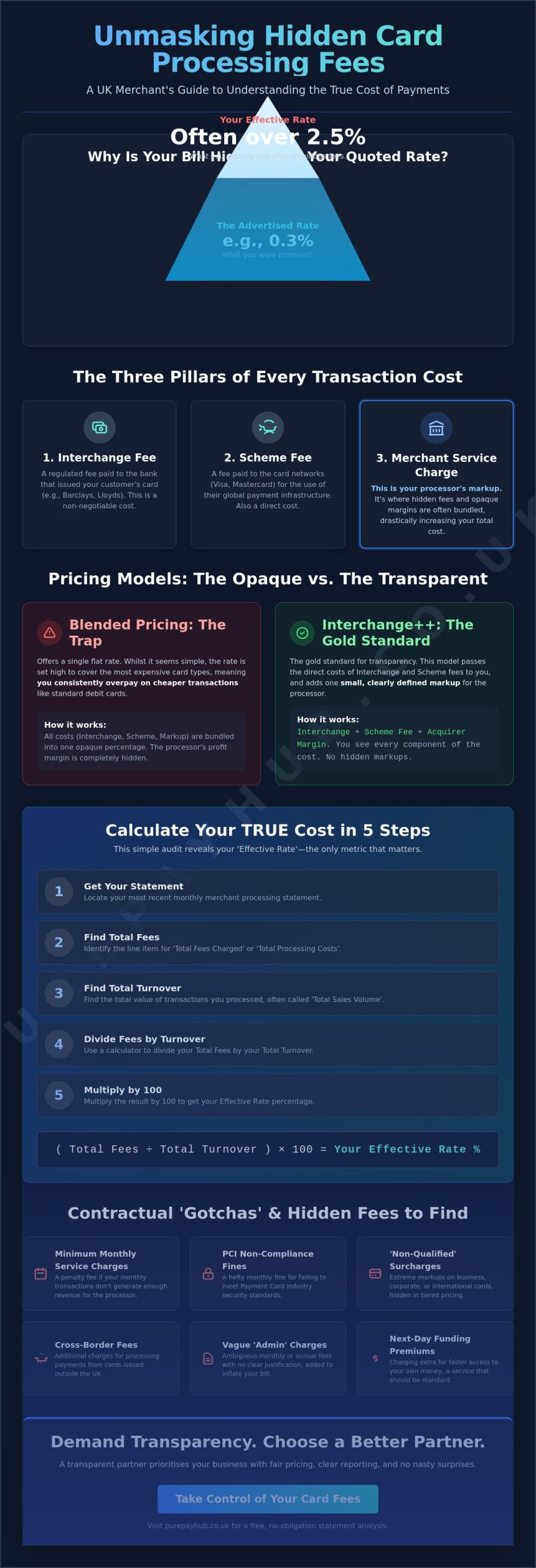
    The gap between what you are promised and what you actually pay can be staggering. A headline rate of 0.3% sounds like a bargain, but it rarely represents the final cost. When you factor in various markups, that figure can easily climb toward a 2.5% effective rate for an SME. Understanding these hidden fees card processing UK providers often use is the first step toward reclaiming your margins. It requires looking past the marketing and into the mechanics of how payments are actually priced.

    The Three Pillars of Payment Costs

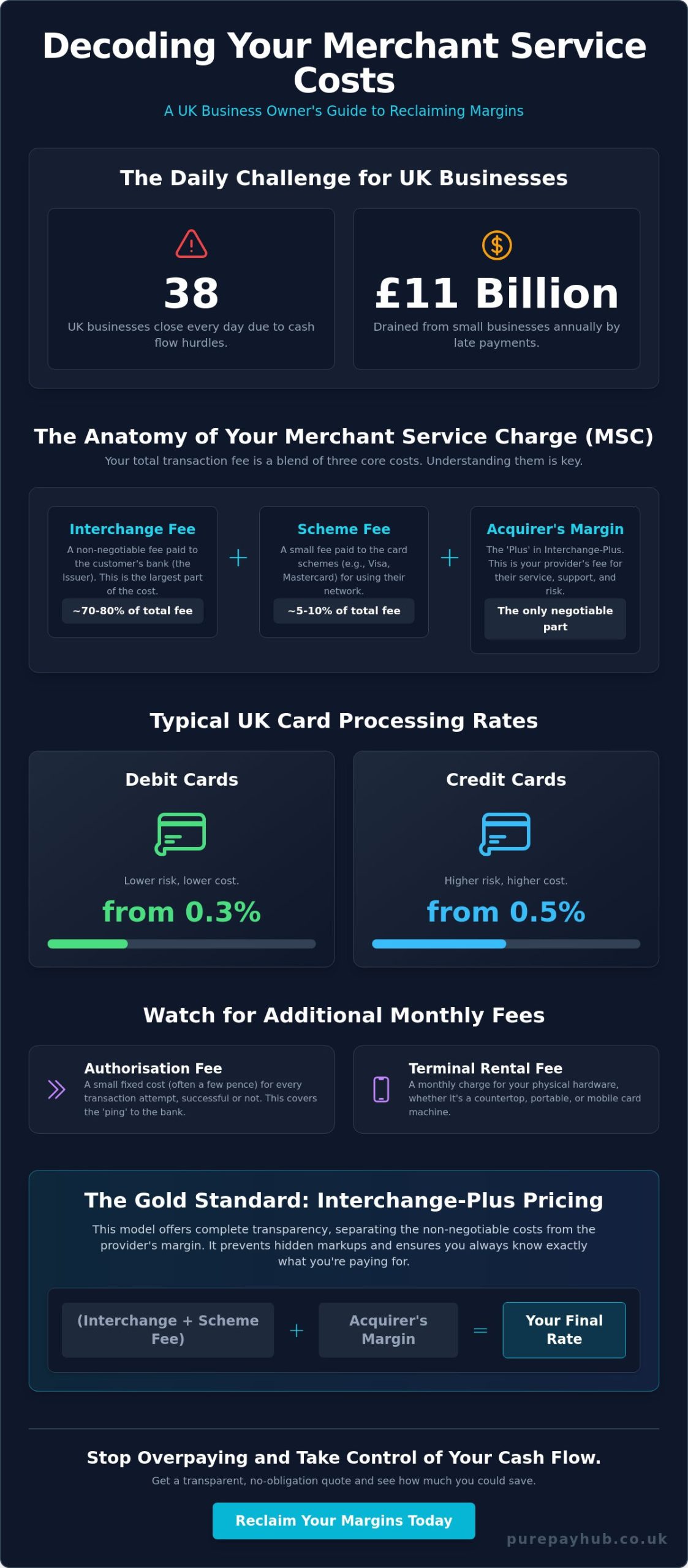
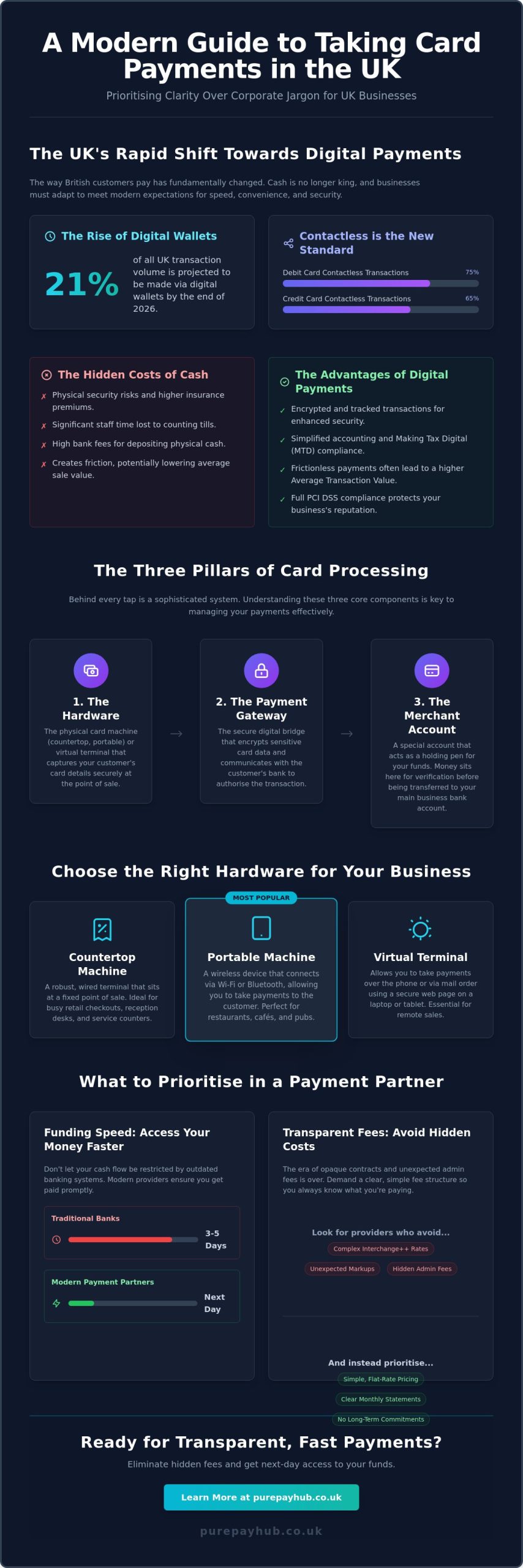
    Every transaction you process consists of three distinct cost components. The first is the Interchange fee. This is a regulated fee paid to the bank that issued your customer’s card. The second is the scheme fee, which Visa and Mastercard charge for the use of their global networks. The third pillar is the Merchant Service Charge (MSC). This is the processor’s cut. While interchange and scheme fees are relatively fixed, the MSC is where hidden margins often live. Many providers bundle these together to hide exactly how much they are taking for themselves.

    Why ‘Cheap’ Rates Can Be Expensive

    Low headline rates are frequently used as bait to trap busy merchants. A provider might quote you a tiny percentage that only applies to domestic consumer debit cards. They often omit the much higher rates for commercial, corporate, or international cards. These transactions can carry markups that are three or four times higher than the quoted rate.

    This “bait and switch” tactic relies on you not checking your “Effective Rate”—the total cost divided by your total turnover. If you don’t monitor this metric, you won’t see how cross-border fees or monthly “minimum service” charges are eroding your annual profits. A transparent partner should provide a clear breakdown of these costs from day one, ensuring you don’t get a nasty surprise when your first statement arrives.

    Decoding the Merchant Statement: Identifying Common Markups

    Reading your monthly merchant statement shouldn’t require a finance degree. Most providers design these documents to be intentionally confusing. They bury the most expensive charges in the fine print. To find the hidden fees card processing UK providers often tuck away, you need to look past the summary page. The real story is told in the transaction breakdown. Your statement is more than just a bill. It is a map of where your provider is prioritising their profit over your partnership.

    The Tiered Pricing Trap

    Many UK merchants are on tiered pricing models without realising it. This model groups transactions into “Qualified”, “Mid-Qualified”, and “Non-Qualified” categories. Qualified rates apply to standard consumer debit cards. Mid-Qualified usually covers cards that are manually keyed in. Non-Qualified is the catch-all for corporate, international, and premium reward cards.

    Processors often hide their highest margins in the Non-Qualified tier. Since these transactions are more complex, providers assume you won’t question a higher rate. If you see a large portion of your turnover falling into the Non-Qualified category, you are likely overpaying. Common triggers for these higher tiers include:

    • Business or corporate credit cards.
    • International cards from outside the UK or EU.
    • Transactions where the card wasn’t physically present, such as phone orders.

    Interchange++ vs. Blended Pricing

    Blended pricing is a common model for small businesses. It offers a single flat rate for all transactions. Whilst this sounds simple, it usually includes a significant safety margin for the provider. They set the rate high enough to cover the most expensive cards. This means you pay a premium on every standard debit transaction to protect the processor’s margin. It is a model built on convenience rather than cost-efficiency.

    Interchange++ is the gold standard for transparency. It breaks the cost into three distinct parts: the interchange fee, the scheme fee, and the acquirer margin. This model ensures you only pay the exact cost of the transaction plus a fixed fee for the processor. It prevents providers from padding scheme fees or hiding extra markups. If you want a partner that prioritises this level of clarity, you might want to explore a fairer way to manage your payments.

    Look closely at the “Scheme Fees” section of your statement. Some providers add a small markup to the fees set by Visa and Mastercard. Because these are technical costs, most merchants assume they are fixed. A transparent statement will show these costs as pass-through charges with no added padding. If your provider won’t show you the exact breakdown of these three components, they are likely hiding something. Demand a statement that treats you like a business partner, not a source of easy profit.
    Hidden Fees in Card Processing: A UK Merchant’s Guide to Transparency in 2026

    Contractual ‘Gotchas’ and Opaque Monthly Charges

    Transaction rates are only half the story. To truly understand the hidden fees card processing UK merchants face, you must look at your fixed monthly costs. Many providers lure you in with low percentages but claw that money back through contractual gotchas. These charges apply regardless of your sales volume. They turn a seemingly fair deal into a heavy financial burden that is difficult to reconcile at the end of the month.

    The Minimum Monthly Service Charge (MMSC) is one of the most common traps. If your total transaction fees don’t reach a set threshold, the provider charges you the difference. You are essentially paying a penalty for doing too little business. It is a fee for a service you never actually used. For seasonal businesses or those just starting out, this can make your effective rate skyrocket during quiet periods.

    Administrative and Compliance Fees

    PCI DSS Management fees are often presented as a necessary security service. In reality, they are frequently just a high-margin line item. Whilst data security is vital, many providers charge non-compliance fines that typically exceed £10 per month. Some processors make the compliance paperwork intentionally difficult so they can keep collecting these penalties. You might also find statement fees on your bill. There is a distinct irony in paying a monthly fee just for the right to see how many other fees you have been charged. High-volume retailers should also watch for authorisation fees. These small per-click costs apply to every transaction attempt and can quickly add up amongst hundreds of daily sales.

    The Hardware Lease Loophole

    Hardware leases are a major red flag in the merchant services industry. A 48-month lease for a Countertop Card Machine or a Portable Card Machine might seem affordable at first. However, the total cost of ownership over four years often ends up being triple the price of buying the unit outright. These leases are usually managed by third-party finance companies, making them nearly impossible to cancel even if you close your business.

    You should also be wary of maintenance and support fees bundled into these leases. Often, these charges provide very little actual value. If your terminal breaks, you may still find yourself waiting days for a replacement despite paying a monthly support premium. Always check the exit fees and notice periods before signing. Trying to leave a bad deal can often cost thousands of pounds in remaining lease payments and contract buy-out fees. A transparent partner will offer flexible terms that don’t rely on trapping you in a four-year hardware loop.

    How to Audit Your Processing Costs in 5 Steps

    Taking control of your finances starts with a clear audit. You cannot fix what you cannot measure. Identifying hidden fees card processing UK businesses are subject to requires a methodical approach. By stripping away the sales jargon, you can see exactly how much of your hard-earned revenue is being siphoned off by your provider. Follow these five steps to uncover the truth about your merchant account.

    • Step 1: Calculate your ‘Effective Rate’. Divide your total monthly card fees by your total monthly card turnover. This single percentage is the ultimate truth of your processing costs.
    • Step 2: Isolate fixed monthly costs. Look for line items that appear every month regardless of your sales volume. This includes terminal hire, MMSC, and statement fees.
    • Step 3: Review your ‘Card Mix’. Check your statement to see if you are being penalised for business, corporate, or international cards. These often carry massive hidden markups.
    • Step 4: Target compliance and admin fees. Identify PCI non-compliance fines or “security” fees. If you are compliant, these should not exist on your bill.
    • Step 5: Request a breakout quote. Ask a transparent provider for a side-by-side comparison. A fair partner will show you exactly where you can save money without hiding behind complex bundles.

    Calculating Your True Effective Rate

    Your effective rate is the only metric that bypasses marketing fluff. To find it, take your most recent monthly statement. Locate the total amount deducted for all card services and divide it by your total card sales for that period. For example, if you paid £150 in total fees on £10,000 of sales, your effective rate is 1.5%.

    In 2026, a competitive effective rate for a UK business often sits between 0.4% and 1.7% for debit-heavy industries. If your rate is consistently above 2% or 3%, you are likely paying for services you don’t need or markups you didn’t agree to. This formula allows you to compare different providers on a level playing field, regardless of how they structure their individual transaction rates.

    Negotiating with Your Current Provider

    Once you have your data, it’s time to challenge your provider. Use direct language. Ask them why your “miscellaneous” or “admin” charges are so high. Specifically, ask them to switch your account to an Interchange++ pricing model. This model removes the “safety margin” that providers build into blended rates.

    If they refuse to provide a clear breakdown, it is a sign that the partnership is no longer serving your business. Sometimes the long-term savings of a transparent deal far outweigh the one-off cost of an exit fee. You deserve a partner that treats your margins with respect. If you are ready for a clearer picture of your costs, you should request a breakout quote to see the difference transparency makes.

    Choosing a Transparent Partner for Your UK Business

    PurePay Hub doesn’t just provide technology. We act as a fair partner to regional business owners. Traditional providers often treat merchants as a source of passive income. They hide markups in complex tiered structures and obscure their true margins. We believe that transparency is the only way to build a dependable financial relationship. By eliminating the hidden fees card processing UK merchants typically endure, we help you keep more of your revenue where it belongs. Our role is to provide clarity in an industry that has long thrived on confusion.

    Our approach focuses on directness. We offer a comprehensive suite of tools including Countertop Card Machines, Portable Card Machines, and Mobile Card Machines. Each device is backed by a commitment to honest pricing. Whether you use our EPOS Systems or our Online Payment Gateway, you receive punchy, clear reporting. You will always know exactly what you are paying and why. This level of detail ensures your accounts are always easy to reconcile.

    The PurePay Hub Difference

    Onboarding should be simple. We avoid the fine print that traps merchants in long-term, high-cost contracts. Our process is direct. It prioritises your business needs over corporate jargon. One of our core commitments is providing next-day access to funds. We understand that cash flow is the lifeblood of your operation. We don’t believe in holding onto your money to support our bank balance. You earned it; you should have it. Hardware costs are another area where we lead with honesty. We offer fair rental terms for our equipment without the 48-month lease traps discussed earlier. You get the equipment you need to take payments in person or via Payment Links without worrying about inflated ownership costs.

    Taking the Next Step Toward Fairness

    The journey to a fairer deal starts with an audit. Our experts provide a free, no-obligation review of your current merchant statement. We look for the “non-qualified” markups and the admin charges that erode your margins. We then show you a clear path to a more transparent model. This isn’t just about switching providers. It is about reclaiming the profit that your hard work generates.

    Switching is a straightforward process. We handle the technicalities so you can focus on running your business. You deserve a payment partner that prioritises your growth and treats you with respect. If you are tired of the maze of monthly charges and opaque billing, it is time to take action. You can audit my merchant statement today to discover the true cost of your current processing and see how much your business could save with a transparent partner.

    Reclaim Your Margins with Absolute Transparency

    You’ve now uncovered how the hidden fees card processing UK providers often hide can quietly erode your hard-earned profits. By calculating your effective rate and auditing your monthly statement for fixed admin charges, you take the power back from opaque institutions. You don’t have to settle for confusing bundles or predatory lease terms that hold your business back. Reclaiming your revenue starts with the simple decision to demand total clarity.

    A fair partnership is built on clarity and mutual respect. At PurePay Hub, we prioritise your success by offering debit card rates from 0.3% and next-day funding as standard. You shouldn’t have to wait for your money or guess what your bill will be at the end of the month. Our independent UK-based support team is here to ensure you always have a direct line to an expert who understands your local business needs. We focus on being a supportive ally rather than a distant financial firm.

    It’s time to stop overpaying for complexity and start keeping more of every pound you earn. Take the first step toward a simpler, fairer financial future for your business by choosing a partner that values honesty as much as you do. You deserve a payment solution that works just as hard as you do.

    Get a Transparent Quote from PurePay Hub Today

    Frequently Asked Questions

    What is a Minimum Monthly Service Charge (MMSC) in the UK?

    A Minimum Monthly Service Charge is a baseline fee you pay if your monthly transaction volume is low. If your earned transaction fees don’t reach this set amount, the processor charges you the difference. It ensures the provider makes a profit even during quiet periods. You should check your statement for this charge if your business is seasonal or just starting out.

    How can I tell if I am being overcharged for PCI compliance?

    You are likely being overcharged if you see a “PCI Non-Compliance Fee” every month on your statement. These penalties usually cost more than £10 per month. A fair partner helps you complete your paperwork to remove these fines. If you are paying for “PCI Management” but still receiving penalties, your provider is profiting from your lack of support.

    Are debit card fees always lower than credit card fees?

    Consumer debit card fees are usually lower than credit card fees because they carry less risk and have lower regulated interchange caps. In the UK, consumer debit interchange is capped at 0.2% whilst consumer credit is 0.3%. However, commercial and international cards don’t follow these caps. These hidden fees card processing UK merchants often see can push credit costs much higher.

    What is an ‘effective rate’ and why is it important for my business?

    Your effective rate is the total cost of processing divided by your total monthly turnover. It is the most important metric because it reveals the true percentage you pay after all markups are added. It bypasses headline rates and sales jargon. Monitoring this number helps you understand if your current deal is actually as cheap as you were promised.

    Can I switch card machine providers if I am still in a contract?

    You can switch providers at any time, but you must first calculate your exit fees. Traditional contracts often have long notice periods or terminal lease buy-outs. Sometimes the monthly savings from a transparent partnership outweigh the one-off cost of leaving a bad deal. It’s best to have an expert audit your current contract before making the move.

    Why does my statement show ‘non-qualified’ transactions?

    Non-qualified transactions appear on your statement when a sale doesn’t meet the criteria for your lowest “qualified” rate. This usually happens with corporate cards, international cards, or manually keyed-in orders. These transactions carry higher markups that providers often hide in the fine print. Seeing many of these is a sign that your current pricing model isn’t built for your card mix.

    What are authorisation fees and should I be paying them?

    Authorisation fees are small charges applied every time your card machine requests approval from the customer’s bank. These “per-click” costs apply to every transaction attempt, even if it is declined. Whilst common, they can become a significant cost for high-volume retailers. You should ensure these fees are clearly stated in your initial quote to avoid surprises.

    Is next-day funding usually an extra hidden cost?

    Next-day funding is frequently sold as a premium service with an extra hidden cost. Many traditional providers hold your funds for three to five days to support their own bank balance. A transparent partner provides next-day access to your money as a standard feature. You shouldn’t have to pay a premium to access your own revenue quickly.

  • Card Machine Rental vs Buying in the UK: The 2026 Merchant Guide

    Card Machine Rental vs Buying in the UK: The 2026 Merchant Guide

    That “low-cost” card reader you bought outright might actually be the most expensive piece of kit in your shop. Many UK business owners choose to buy hardware to avoid monthly fees, only to find themselves stuck with obsolete tech when security regulations shift. When weighing up card machine rental vs buying UK, the right choice depends on more than just the initial price tag. You’ve likely felt the sting of hidden markups or the frustration of a long-term contract that feels like a trap. We believe in a no-nonsense approach that puts clarity and honesty first.

    You deserve a payment setup that supports your growth instead of holding it back. This guide will show you how to calculate the best value for your business by comparing total costs, contract flexibility, and ongoing technical support. We’ll explore how the 2026 removal of the £100 contactless cap and mandatory PCI DSS v4.0 compliance impact your hardware choice. You’ll gain the confidence to decide whether a mobile card machine you own or a countertop terminal you rent offers the fairest deal for your till.

    Key Takeaways

    • Understand how the rapid shift to a cashless society and strict security regulations make your choice of hardware a critical business decision.
    • Learn how to calculate the true break-even point in the card machine rental vs buying UK debate to ensure your payment setup remains profitable as volume grows.
    • Discover why rental models often suit established businesses by bundling technical support and automatic upgrades to prevent hardware obsolescence.
    • Evaluate the freedom of the pay-as-you-go model for smaller ventures, where owning your device removes monthly overheads during quieter periods.
    • Find out how PurePay Hub provides transparent, jargon-free merchant services that balance high-quality hardware with fair, sustainable transaction rates.

    Understanding the UK Card Payment Landscape in 2026

    British consumers have largely moved away from physical coins and notes. By late 2025, contactless payments accounted for 76% of all debit card transactions in the UK. This isn’t just a trend; it’s the new standard for every high street shop and local cafe. The Payment Systems Regulator (PSR) has recently enforced stricter rules on contract transparency. These changes prevent merchants from being trapped in long-term, opaque agreements that don’t serve their interests. This regulatory shift makes the debate of card machine rental vs buying UK more relevant than ever. You now have more power to choose a path that truly fits your business model.

    Your decision between ownership and a managed service directly impacts your daily cash flow. Buying hardware outright requires an immediate capital outlay. That money might be better spent on stock, staff, or marketing. Rental models spread this cost into predictable monthly payments. At PurePay Hub, we believe in a no-nonsense approach to these costs. A managed service often includes support and maintenance, providing a stabilising force for your finances. Whether you need a countertop card machine or a mobile unit, your choice will dictate how smoothly your till operates during the busiest periods.

    The Evolution of Card Machines

    The days of clunky, dial-up hardware are gone. Modern businesses now rely on integrated smart terminals that do much more than just process a transaction. If you’re interested in the technical background, you can explore what is a payment terminal to see how these devices have evolved from basic swipe tools into high-speed computers. Digital wallet adoption is soaring. In 2024, 57% of UK adults were registered for a mobile wallet. For a growing SME, a basic card reader might feel restrictive. You need a device that handles inventory, integrates with your EPOS, and processes Apple Pay or Google Pay instantly.

    Regulatory Standards and Security

    Security is a non-negotiable part of modern trade. As of March 31, 2025, every UK merchant must be fully compliant with PCI DSS v4.0 standards. This update introduced mandatory multi-factor authentication and more frequent vulnerability scanning. Staying compliant is a significant burden if you own your hardware. You’re responsible for every software patch and security update. Managed rental services simplify this. They often automate these security requirements, ensuring your terminal is always up to date. The Financial Conduct Authority (FCA) oversees the industry to ensure fairness, but the practical task of protecting cardholder data remains your responsibility. A managed service acts as a reliable partner in this process.

    The Case for Card Machine Rental: Managed Services and Support

    Choosing a rental model is often about more than just avoiding an initial purchase price. It is a strategic decision to prioritise business continuity. When you compare card machine rental vs buying UK, the most immediate benefit is the preservation of your capital. Instead of spending hundreds of pounds on hardware, you keep that cash for stock or marketing. This approach turns a lumpy capital expense into a predictable, fixed monthly operating cost. It simplifies your bookkeeping and ensures there are no nasty surprises when a device needs replacing.

    Technology in the payments industry moves at a relentless pace. A machine that is top-of-the-range today might struggle with new security protocols or software updates in two years. Rental agreements solve this problem by offering continuous hardware upgrades. You aren’t stuck with obsolete kit that slows down your service. Instead, your provider ensures your terminal remains compliant with the latest UK Payment Services Regulations. This peace of mind is invaluable for busy merchants who don’t have time to track regulatory shifts.

    Hardware Maintenance and Swap-Out Services

    Downtime kills profit. Imagine your card terminal failing on a busy Saturday afternoon whilst a queue of customers waits. If you own the device, you’re responsible for the repair or the cost of a new unit. With a managed rental service, technical support is part of the package. Most professional contracts include a swap-out service where a faulty machine is replaced within one business day. The cost of a single day of lost sales often far outweighs a year of rental fees. A reliable portable card machine from a managed provider acts as an insurance policy for your revenue.

    Software Updates and Remote Management

    Modern payment terminals are sophisticated computers that require regular maintenance. Managed rental services handle automatic security patching and feature updates remotely. This is particularly useful if you manage multiple terminals across different sites. You can ensure every device is running the same software version without manual intervention. These systems also offer seamless integration with cloud-based EPOS systems. This connectivity allows for real-time reporting and better inventory management. By choosing a managed path, you delegate the technical headaches to experts, allowing you to focus on serving your customers and growing your brand.

    Card Machine Rental vs Buying in the UK: The 2026 Merchant Guide

    Buying Outright: Ownership, Flexibility, and Pay-As-You-Go

    Buying your hardware outright feels like the ultimate freedom for many new ventures. You pay for the device once and it’s yours. There are no monthly rental fees to worry about during a slow month. This “pay-as-you-go” model is particularly attractive for micro-businesses or seasonal traders who only need to process payments occasionally. Onboarding is typically fast and digital, letting you start taking cards within days. However, when evaluating card machine rental vs buying UK, the initial purchase price is often a distraction from the true cost of doing business.

    The real expense isn’t the plastic and silicon in your hand; it is the transaction rate attached to it. Most “buy-only” providers use a flat-rate fee structure. Whilst this is simple to understand, it is rarely the most cost-effective path for a growing merchant. As your volume increases, those higher flat rates eat into your margins far more than a modest monthly rental fee would. You are essentially trading a low monthly overhead for a permanent tax on your growth. This is the “Total Cost of Ownership” trap that many small businesses fall into during their first year of trade.

    The Hidden Costs of Ownership

    Ownership brings a level of responsibility that can be stressful during peak times. If your owned terminal stops working, you are the one who pays for the fix. Batteries eventually lose their capacity, and screens can crack during a busy shift. Unlike a managed service, there is no “next-day swap” included in your purchase price. You’ll either pay for an out-of-warranty repair or buy a whole new unit, all whilst losing sales in the meantime. There is also the risk of technical obsolescence. As network standards shift or security requirements tighten, an owned device can quickly become a paperweight that you cannot upgrade without buying a new one.

    Transaction Fee Structures for Owned Devices

    Simplicity often comes at a premium. Flat-rate providers usually charge significantly more per transaction than traditional merchant accounts. They don’t offer bespoke pricing for high-volume traders because their model relies on a “one size fits all” approach. According to recent UK Payment Market Trends, the dominance of debit cards and contactless payments means your transaction volume will likely grow faster than you expect. For a busy retail or hospitality environment, the “Interchange-plus” models typically found with managed services are almost always cheaper than the flat rates found on owned devices. You must decide if the lack of a monthly fee is worth the long-term drain on your profits.

    The Decision Matrix: Which Model Suits Your Business?

    Choosing between card machine rental vs buying UK shouldn’t be a guessing game. It requires a cold, hard look at your growth trajectory rather than just your current bank balance. Many small business owners make the mistake of choosing a payment setup based on where they are today. A smarter approach is to choose based on where you plan to be in twelve months. If your monthly turnover is climbing, those “no-fee” readers with high transaction rates will quickly become a heavy tax on your success. You need a model that scales with you, not one that penalises your hard work.

    The break-even point is the most critical metric in this decision. For micro-businesses processing very low volumes, buying a basic reader often makes sense. However, once your sales reach a consistent level, the lower transaction rates offered by managed rental accounts usually offset the monthly fee. This transition is a hallmark of a maturing business. It marks the shift from a “side hustle” mentality to a professional operation that values efficiency and long-term profit over short-term savings.

    High-Volume vs. Low-Volume Merchants

    High-volume businesses almost always find better value in a rental model. Traditional merchant accounts often provide “Interchange-plus” pricing, which is significantly more transparent than the flat rates found on bought devices. Seasonal businesses, like Christmas markets or summer festivals, might prefer the “pay-as-you-go” flexibility of an owned device. But if you find yourself processing payments every day, it’s time to consider a managed terminal. Moving from a bought reader to a professional setup is simpler than you think and can save you hundreds of pounds in transaction fees over a single year.

    Sector-Specific Requirements

    Your industry dictates your hardware needs. In hospitality, you need robust, portable card machines that can handle a full shift on one charge and integrate seamlessly with your EPOS system. Retailers, on the other hand, prioritse countertop reliability and blistering checkout speeds to keep queues moving. For mobile services like plumbers or electricians, 5G connectivity is the 2026 standard. You can’t afford to stand on a doorstep waiting for a 3G signal that no longer exists. Modern rental units now include biometric security, such as fingerprint or facial recognition, ensuring that high-value transactions are as secure as possible. This level of tech is rarely found on entry-level readers you buy outright. Future-proofing your business means choosing a partner who provides the latest hardware as standard.

    PurePay Hub: Transparent Solutions for UK Merchants

    PurePay Hub acts as a stabilising force for your business finances. We understand that the debate over card machine rental vs buying UK often leaves merchants feeling skeptical and frustrated. Our approach removes the guesswork by balancing high-grade hardware with industry-leading transaction rates. We don’t believe in the opaque pricing models used by traditional banks. Instead, we offer a no-nonsense service that prioritises your profit margins and operational efficiency.

    Cash flow is the lifeblood of any regional business. Waiting days for your funds to clear is a burden you shouldn’t have to carry in 2026. We provide next-day funding as standard to ensure your revenue is available when you need it most. This commitment to speed extends to our support. We provide a modern fintech experience without losing the personal touch that local business owners value. Whether you are using a countertop card machine or our online payment gateway, our systems are designed to keep your trade moving without interruption.

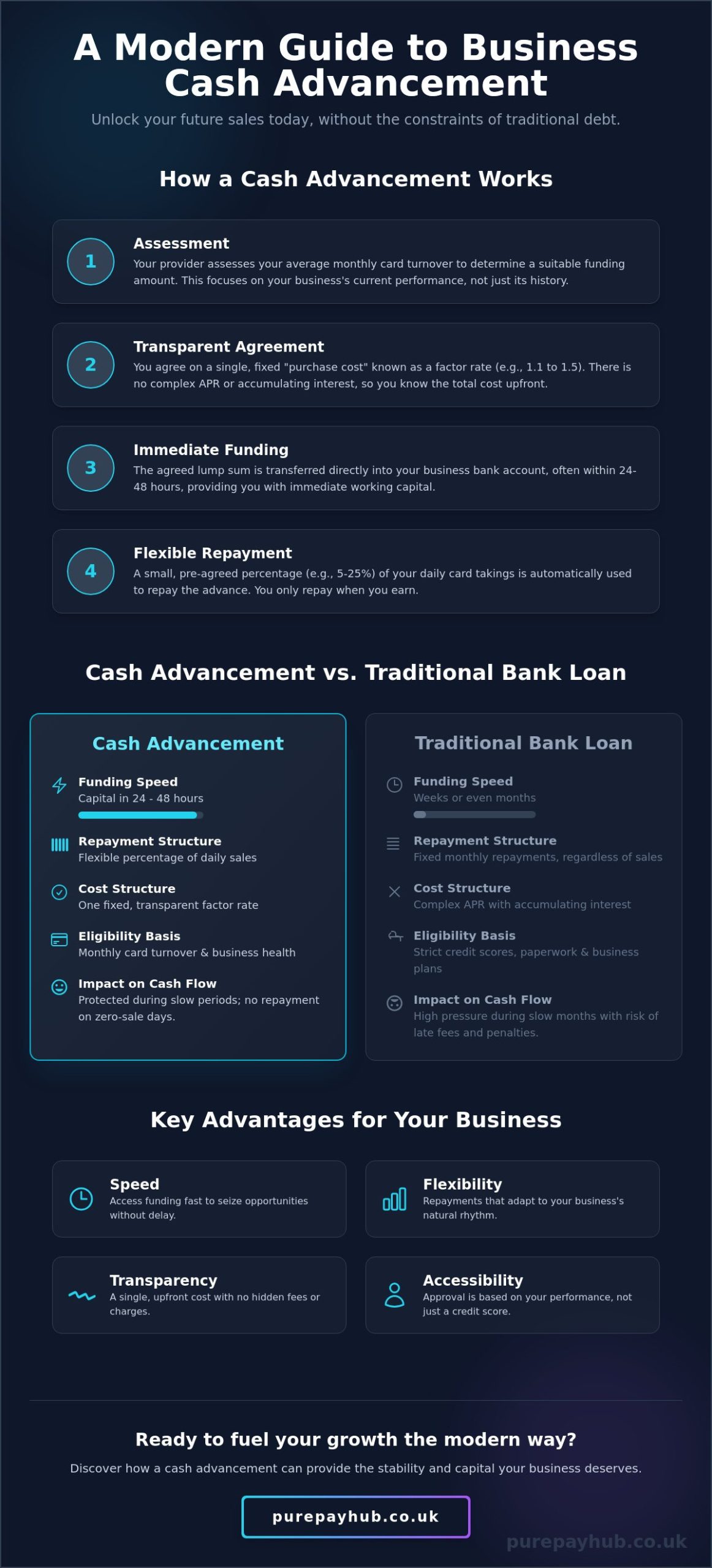
    We support your long-term growth with a suite of integrated tools. Our EPOS Systems provide the deep insights you need to manage inventory and staff effectively. If you need to expand or refurbish your premises, our Business Cash Advance offers a fair and flexible way to access capital based on your card turnover. We are more than just a terminal provider; we are a dedicated partner in your business development.

    A Partnership Approach to Payments

    We treat every merchant as a long-term ally rather than a distant account number. Our fee structure is built on a foundation of honesty and integrity. You will never find hidden markups or surprise “admin fees” in our statements. This transparency is a core identity of the PurePay Hub brand. If you ever run into a technical snag, you won’t be directed to an automated chatbot. You’ll have access to UK-based support experts who understand the local market and can provide decisive resolutions quickly.

    Getting Started with PurePay Hub

    Moving your payment processing to a fairer provider is a simple, stress-free process. Our onboarding is designed for efficiency, taking you from your initial enquiry to taking live payments with minimal fuss. We help you customise your setup to match your specific trade environment. You can choose from a range of hardware options to suit your needs:

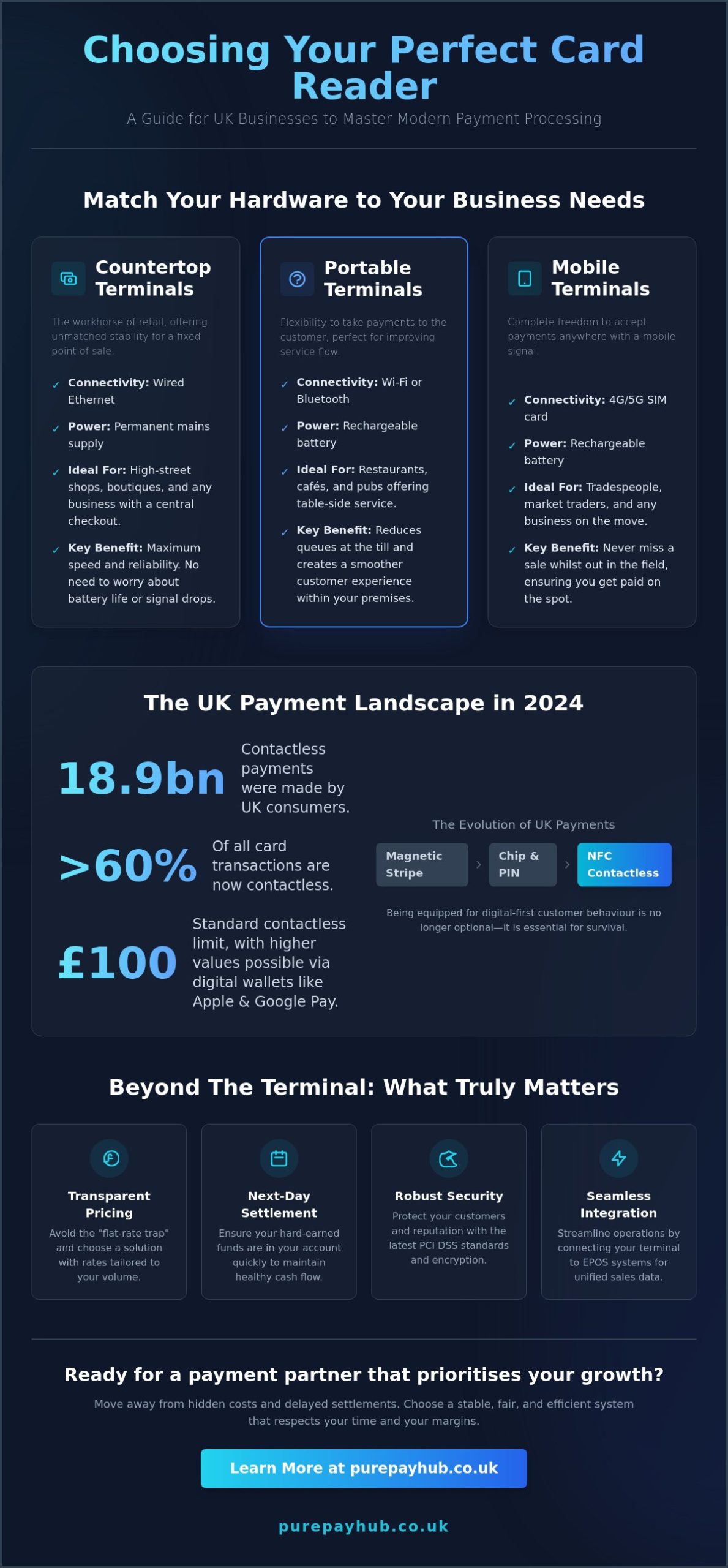
    • Countertop Card Machine: Ideal for fixed retail points and fast-paced checkouts.
    • Portable Card Machine: Perfect for hospitality businesses serving customers at tables.
    • Mobile Card Machine: The standard for tradespeople and mobile services requiring 5G connectivity.

    You deserve a payment partner that values your business as much as you do. Take the first step toward a more transparent and supportive merchant service today. Get a transparent quote from PurePay Hub today.

    Secure Your Business Future with a Smarter Payment Strategy

    The choice between ownership and rental isn’t just about a one-off payment. It’s about ensuring your till never stops ringing during a busy Saturday. We’ve explored how the card machine rental vs buying UK decision impacts your long-term margins and technical resilience. Owning a device might offer a quick start for a side hustle. However, a managed service provides the security of automatic updates and hardware that never goes obsolete. Your business deserves a setup that’s as modern and dependable as the service you provide.

    You don’t have to tolerate the stress of hidden markups or opaque fee structures. We focus on clarity and fairness. With debit card rates starting from 0.3% and next-day access to your funds, we help you keep your cash flow healthy and your finances stable. Take control of your processing costs and build a partnership that actually supports your growth. It’s time to move away from distant financial institutions and work with a local expert who values your success.

    Switch to a fairer way of taking payments with PurePay Hub

    Frequently Asked Questions

    Is it cheaper to rent or buy a card machine in the UK?

    The answer depends on your monthly transaction volume and your need for technical support. Buying a machine often has a lower upfront cost, but it usually comes with higher transaction fees that can eat into your profits. Renting a machine typically offers lower rates and included maintenance, making it more cost-effective as your sales grow. When evaluating card machine rental vs buying UK, you should calculate the total cost of ownership over two years rather than just the initial price.

    What is the average monthly rental cost for a card terminal?

    Monthly rental costs vary based on the specific hardware you choose and the length of your service agreement. These fees generally cover the physical device, mandatory security updates, and access to technical support. You’ll find that a fixed monthly fee provides more stability for your business budgeting than the unpredictable costs of repairing or replacing owned hardware. We recommend requesting a transparent quote to see exactly what is included in your service package.

    Can I switch from buying to renting if my business grows?

    You can certainly upgrade your payment setup as your business matures. Many small traders start with a basic bought reader to keep overheads low during their first few months. Once your turnover reaches a consistent level, switching to a managed rental service allows you to access professional-grade hardware and lower transaction rates. This transition is a logical step for any business that wants to prioritise efficiency and profit as they scale.

    Are there hidden fees in card machine rental contracts?

    Traditional providers often hide extra charges in their contracts, but modern fintech companies are moving toward a no-nonsense approach. The Payment Systems Regulator (PSR) has introduced new rules to ensure UK merchants receive clearer information about their agreements. You should always look for a provider that offers a transparent breakdown of every cost. Avoid contracts that include vague “admin fees” or “PCI management charges” without a clear explanation of the value they provide.

    Do I need a merchant account if I buy my own card reader?

    You always need a merchant account or a payment processing service to accept card payments. Some providers that sell readers outright bundle the hardware and the account together for simplicity. Managed rental services often provide a dedicated merchant account, which can offer more bespoke pricing and better stability for established businesses. This setup ensures that your funds are handled securely and reach your bank account as quickly as possible.

    What happens if my rented card machine breaks?

    Technical support is a core benefit of a managed rental agreement. If your machine fails, your provider will usually troubleshoot the issue remotely or send a replacement unit to your premises. This swap-out service often happens as quickly as the next business day. This minimises downtime and prevents the frustration of turning away customers during a busy shift. If you own your machine, you’re responsible for the cost and delay of a repair.

    How long are typical card machine rental contracts in 2026?

    Contract lengths have become much shorter and more flexible in 2026. You’ll find many agreements now range from 12 to 18 months, which is a significant improvement over the old four-year lock-ins. This shift gives you the freedom to review your payment setup and ensure it still meets your needs as your business evolves. Always check the notice period and exit terms before signing any new agreement.

    Does buying a card machine affect my transaction rates?

    Buying a machine outright often limits you to a flat-rate transaction model, which can be more expensive for high-volume traders. Managed rental services generally provide access to more competitive, variable rates that save you money as your sales increase. Choosing card machine rental vs buying UK is often a trade-off between low monthly overheads and the long-term savings of a professional merchant account. You must decide which model offers the best value for your specific growth trajectory.

  • How to Increase Average Transaction Value: A Guide for UK Businesses in 2026

    How to Increase Average Transaction Value: A Guide for UK Businesses in 2026

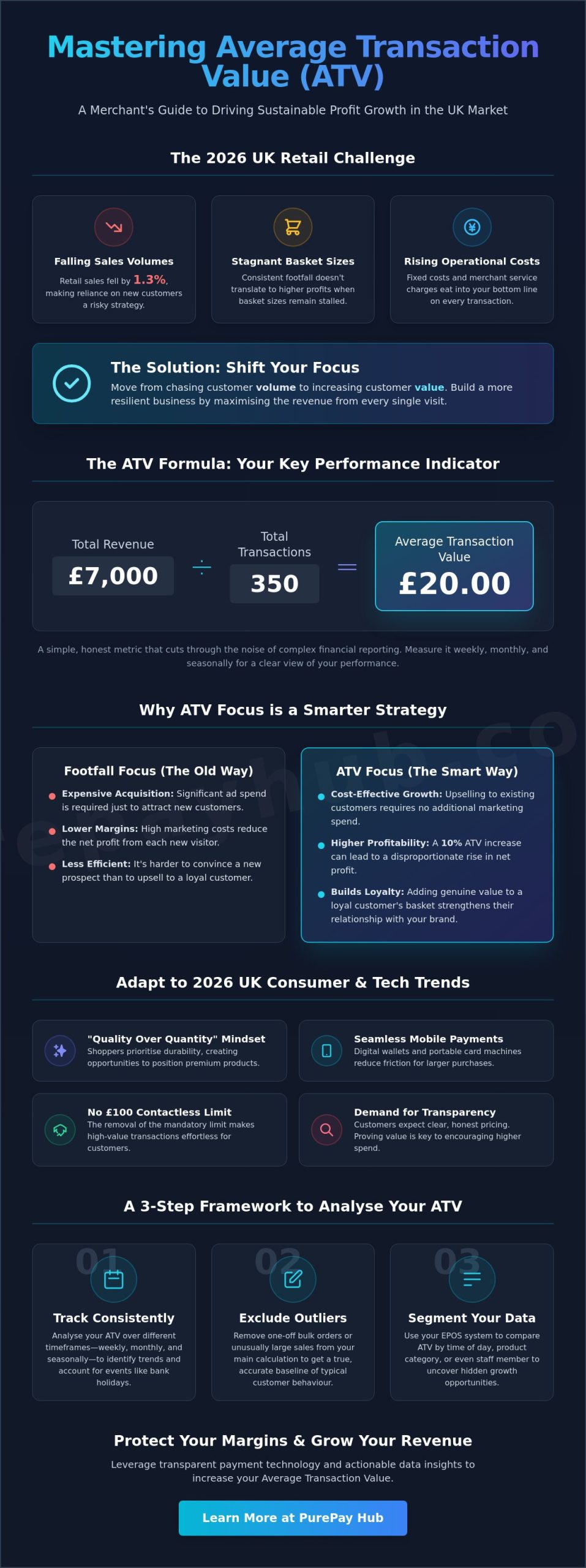
    In April 2026, retail sales volumes in Great Britain fell by 1.3%, leaving many merchants struggling to maintain their margins against rising operational costs. You aren’t alone if you’ve noticed your basket sizes have stalled whilst merchant service charges continue to eat into your bottom line. Learning how to increase average transaction value uk isn’t about aggressive upselling. It’s about refining the customer journey and using transparent technology to encourage natural growth.

    We know that stagnant sales figures and high overheads make every penny count. It’s frustrating to see consistent footfall that doesn’t translate into higher profit margins per transaction. This guide will help you master the strategies and payment technology required to boost your average transaction value and drive sustainable profit growth. We’ll explore a clear framework that turns your existing POS data into actionable insights, whilst using tools like payment links and portable card machines to remove friction and capture higher value sales following the removal of the £100 contactless limit.

    Key Takeaways

    • Shift your focus from customer volume to basket value to build a more resilient and sustainable business model in a fluctuating market.
    • Learn how to accurately calculate and benchmark your success using seasonal data to identify your most profitable trading windows.
    • Implement upselling and cross-selling frameworks that add genuine value to the customer experience while naturally increasing spend per visit.
    • Discover how to increase average transaction value uk by leveraging mobile card machines and payment links to reduce friction and capture impulse purchases.
    • Understand the role of transparent processing fees and efficient EPOS systems in protecting your margins as your transaction sizes grow.

    Understanding Average Transaction Value in the 2026 UK Market

    Average Transaction Value (ATV) is the average amount a customer spends during a single visit. While it’s closely related to the Average selling price (ASP) of individual items, ATV looks at the total basket. In a market where retail sales volumes fell by 1.3% in April 2026, relying solely on new footfall is a risky strategy. Smart growth now comes from within your existing customer base.

    Focusing on how to increase average transaction value uk is the most direct way to protect your margins. Every time a customer walks through your door, you pay for the lights, the rent, and the staff. These fixed costs don’t change whether a customer spends £5 or £50. By increasing the spend per head, you spread your overheads across a larger revenue base. This directly boosts your net profit and provides a buffer against rising merchant service charges.

    Why ATV Beats Footfall in a Competitive Economy

    Marketing to new customers is expensive. You often have to spend significant sums on advertising just to get them to your shop or website. Upselling to someone who is already holding their wallet is far more efficient. A 10% increase in your ATV can result in a disproportionate rise in profit because it requires no additional marketing spend. This is where customer loyalty plays a key role. A loyal customer is already convinced of your value; they’re the most receptive audience for premium upgrades or helpful add-ons.

    The 2026 Shift in British Consumer Behaviour

    The British public has moved toward a “quality over quantity” mindset. Shoppers are increasingly prioritising sustainability and durability over cheap, disposable goods. This shift allows you to position premium products as the logical choice. For retailers in the wellness sector, you can learn more about how advanced technology like molecular hydrogen generators can serve as a high-value addition to your product range. Additionally, the payment landscape has evolved. The removal of the mandatory £100 contactless limit in March 2026 has made high-value transactions seamless. Digital wallets and NFC technology have reduced the psychological “pain of paying,” making it easier for customers to commit to larger purchases without the friction of entering a PIN for every mid-range buy.

    Transparency is now a non-negotiable requirement for UK shoppers. They expect clear, honest pricing without hidden fees. To drive sustainable growth, you must prove the value of every pound spent. Use your EPOS data to understand what your customers want, then provide clear options that meet those needs. When you remove friction and offer genuine value, your transaction sizes will grow naturally. It’s a partnership between you and the customer that rewards quality service with higher spend.

    The ATV Formula: Calculating and Benchmarking Your Success

    You can’t improve what you don’t measure. The formula for Average Transaction Value is refreshingly simple: divide your total revenue by the total number of transactions over a set period. If your business generates £7,000 in weekly revenue from 350 individual sales, your ATV sits at exactly £20. It’s a clear, honest metric that cuts through the noise of complex financial reporting.

    To get a true representation of your performance, you must exclude outliers. A single bulk order or an unusually large corporate booking can skew your data and lead to false confidence. Remove these anomalies to find your genuine baseline. You should also vary your timeframes. Weekly checks help you spot immediate trends, whilst monthly and seasonal reviews allow you to account for UK bank holidays or the Christmas rush. Learning how to increase average transaction value uk requires more than just a surface-level glance at your bank balance; it requires consistent, disciplined tracking.

    Segmenting Your Data for Deeper Insights

    Averages can hide as much as they reveal. Segmenting your data by time of day often uncovers hidden opportunities. You might find your morning trade has a high volume but a low spend, whereas your late-afternoon customers buy more per visit. Comparing ATV across different product categories is equally vital. It highlights which items act as “basket fillers” and which ones drive significant revenue. Modern EPOS systems provide these insights automatically, allowing you to track staff performance and see which team members are most effective at upselling premium options.

    Benchmarking Against UK Industry Standards

    Context is everything. A local deli might target an ATV of £15, whereas a boutique clothing store in a city centre might aim for £120. Setting realistic growth targets for the next financial quarter depends on understanding your specific sector’s “normal.” Don’t just chase a higher Gross Transaction Value (GTV); focus on the quality of those transactions. To set meaningful goals, you should consider The Elements of Value that drive your customers’ decisions. Are they looking for functional savings or emotional satisfaction? Aligning your targets with these motivations ensures your growth is sustainable and customer-focused. Aiming for a 5-10% increase in ATV per quarter is a disciplined, achievable goal for most UK SMEs.

    How to Increase Average Transaction Value: A Guide for UK Businesses in 2026

    Five Proven Strategies to Increase Average Transaction Value

    Once you understand your baseline, you can start testing specific tactics. Increasing your revenue doesn’t require a complete overhaul of your business model. Often, the most effective methods for how to increase average transaction value uk involve small, psychological nudges that guide customers toward higher value choices. These five proven strategies help you grow your margins without alienating your local customer base.

    • Upselling: This involves encouraging a customer to purchase a higher-end version of the product they’re already considering.
    • Cross-selling: You suggest complementary items that enhance the primary purchase, such as a protective case for a new tablet.
    • Strategic Bundling: Grouping related products together at a slightly discounted rate simplifies the decision-making process for the shopper.
    • Threshold Incentives: Offer a reward, such as a small discount or a gift, once a specific spend threshold is met.
    • Loyalty Schemes: Design your rewards so that customers are encouraged to “top up” their basket to reach the next tier of benefits.

    The Art of the British Upsell

    British shoppers are famously wary of the “hard sell.” To be effective, your suggestions must feel like genuine advocacy rather than a pushy script. Train your staff to listen for verbal cues. If a customer mentions they’re buying a gift, suggesting a premium gift-wrap service or a higher-quality variant of the item feels helpful. A “good, better, best” pricing structure is particularly effective here. By presenting three clear options, you provide a frame of reference that naturally guides many customers toward the middle or premium tier. It’s about empowering the customer to make a better choice for their specific needs.

    Bundling and Cross-selling Tactics

    Bundling works because it solves a problem. Instead of selling individual gardening tools, create a “Spring Ready Kit” that includes everything a beginner needs. This adds value whilst increasing the total sale price. Implementing these tactics is a practical way to see how to increase average transaction value uk in a competitive local market. Your checkout area is your most valuable space for these tactics. Use small, high-margin items near your countertop card machine to encourage last-minute additions. You can also leverage seasonal UK events like Mothering Sunday or the August bank holiday to create themed bundles. These limited-time offers create a sense of urgency and provide an easy way for customers to spend more whilst feeling they’ve secured a bargain.

    Leveraging Payment Technology to Reduce Transaction Friction

    Friction is the silent killer of the high-value sale. When a customer decides to add a premium item to their basket, any delay at the till gives them a window to reconsider. Fast, reliable countertop card machines are your first line of defence against basket abandonment. A seamless checkout experience ensures that the positive emotions of a purchase aren’t replaced by the frustration of a slow terminal. Removing technical barriers is a fundamental part of how to increase average transaction value uk, as it allows the customer to focus on the product rather than the process.

    Mobile card machines further reduce this friction by bringing the point of sale directly to the customer. Whether you’re running a busy boutique or a large showroom, being able to close a sale on the spot is vital. It prevents queues from forming and encourages impulse buys that might otherwise be lost if the customer has to hunt for a fixed till. For remote or bespoke orders, payment links provide a secure, professional way to handle higher-value transactions without the clunkiness of phone payments.

    Integrating your payment hardware with modern EPOS systems allows for smarter cross-selling. When your inventory and sales data sync in real time, your system can prompt staff to suggest relevant add-ons based on what’s actually in stock. This data-driven approach removes the guesswork and ensures every suggestion is backed by logic. If you want to see how these tools can transform your business, explore our range of card machines and EPOS systems to find the right fit for your needs.

    Removing the “Pain of Paying” with NFC

    The psychological “pain of paying” is real, but modern technology has largely neutralised it. Since March 19, 2026, the removal of the mandatory £100 contactless limit in the UK has allowed for much higher value taps. This change, combined with the 2024 statistic that 95% of in-store transactions were already contactless, has made spending feel almost invisible. Customers no longer need to worry about PIN limits for mid-range purchases. To stay competitive, you must ensure your terminal supports every modern digital wallet like Apple Pay and Google Pay. When a customer can pay with a flick of their wrist, they’re statistically more likely to commit to a larger total.

    Data-Driven Decisions via Your Merchant Account

    Your merchant account should be more than just a way to receive money. It’s a powerful diagnostic tool. Real-time reporting allows you to see exactly how to increase average transaction value uk by identifying which of your strategies are actually moving the needle. You can spot “dead zones” in your physical shop where high-value items are being overlooked and adjust your layout accordingly. By analysing transaction history, you can also identify patterns in customer behaviour. This allows you to personalise future offers, ensuring that your upselling efforts are always relevant and welcome.

    How PurePay Hub Supports Your Revenue Growth Strategy

    Boosting your income is only half the battle. If your merchant service charges increase alongside your sales, you aren’t actually making more money. PurePay Hub provides the infrastructure you need to ensure that every strategy you implement for how to increase average transaction value uk results in tangible profit. We offer a suite of reliable countertop and portable card machines designed specifically for the needs of UK SMEs. These tools don’t just process payments; they act as a stabilising force for your business finances. By removing technical friction, they allow you to focus on building the customer relationship.

    Speed is just as important as reliability. Our next-day funding ensures that the revenue from your higher-value sales is available almost immediately. This allows you to reinvest in high-margin inventory or seasonal stock without waiting for traditional banking cycles. When you have the cash flow to support your growth, you can be more aggressive with your upselling and bundling tactics. You won’t be held back by the slow processing times of distant financial institutions. Instead, you’ll have a partner that values your efficiency as much as you do.

    Transparent Rates: Ensuring ATV Growth Equals Profit Growth

    Hidden markups and complex fee structures often negate the benefits of a higher transaction value. Traditional high-street banks frequently hide costs in fine print, making it difficult to calculate your actual margin. PurePay Hub takes a different approach. Our transparent processing rates, such as our 0.3% debit rate, keep more profit in your pocket. This commitment to no-nonsense pricing means you always know exactly what you’re paying. When your costs are fixed and fair, every increase in ATV directly improves your bottom line. It’s a simple, honest model that respects your hard work and rewards your development.

    Funding Your Next Big Strategy

    Sometimes, the best way to grow is to invest in your space or your stock. A Business Cash Advance from PurePay Hub can fund shop floor re-organisations or targeted marketing campaigns. You might use this capital to buy inventory in bulk, allowing you to create the value-led bundles discussed earlier in this guide. Unlike a traditional loan, you repay your advance as a small percentage of your daily card sales. This flexible model is perfect for managing seasonal shifts in the UK market. It ensures your repayments always remain manageable, regardless of your daily footfall. See how PurePay Hub can transform your payments and help you achieve sustainable, long-term growth.

    Take Control of Your Profit Growth in 2026

    Mastering how to increase average transaction value uk is no longer optional for businesses facing rising operational costs. By shifting your focus from chasing new footfall to maximising the value of every existing customer, you create a more resilient and profitable enterprise. You’ve seen how strategic bundling, staff training, and the removal of payment friction can transform your daily takings. Now is the time to ensure those gains aren’t lost to hidden fees or slow funding cycles.

    Your choice of payment partner is the final piece of the puzzle. You deserve a service that prioritises your margins with debit rates starting from 0.3% and next-day access to your funds. We believe in straight-talking and fair partnership. This is why you’ll never find hidden markups or complex jargon in our agreements. Switch to PurePay Hub for fairer rates and faster funding and start reinvesting in your growth today. With the right tools and a disciplined strategy, your business is well-positioned to thrive in the evolving UK market.

    Frequently Asked Questions

    What is a good average transaction value for a UK retail store?

    A good value depends entirely on your specific sector and product range. A high-end boutique will naturally have a much higher figure than a local newsagent. Instead of comparing yourself to others, focus on your own historical data to set a baseline. Aiming for a steady 5% to 10% increase per quarter is a healthy and achievable target for most UK merchants.

    How is ATV different from Average Order Value (AOV)?

    ATV and AOV are essentially the same metric but used in different business contexts. Average Transaction Value is the standard term used in physical retail and face-to-face services. Average Order Value is more common in the e-commerce world. Both measure the average amount spent per customer visit or checkout session to track revenue efficiency.

    Can upselling actually hurt my customer retention?

    Upselling only hurts retention if it feels like a forced or aggressive sales pitch. When your staff offer genuine advice that adds value to the purchase, it actually builds long-term trust. The goal is to act as a helpful expert rather than a pushy salesperson. This ensures customers return to your business because they value your insight and honest recommendations.

    How often should I calculate my average transaction value?

    You should calculate your baseline monthly but monitor weekly trends to spot immediate changes in behaviour. Seasonal shifts in the UK market mean your December figures will likely look very different from your January results. Monitoring these patterns is a vital part of how to increase average transaction value uk because it reveals which promotions are actually working.

    What is the most effective way to train staff on increasing ATV?

    The most effective training involves practical roleplay and teaching staff to listen for specific verbal cues. Instead of using a rigid script, give them a “good, better, best” framework to guide their suggestions. This empowers your team to offer solutions that fit the customer’s specific needs and budget without feeling like they’re being overly demanding.

    Does the speed of my card machine affect my transaction value?

    Yes, a slow or unreliable card machine creates friction that can lead to basket abandonment at the till. If a customer is on the fence about a premium item, a long wait gives them time to reconsider the purchase. Fast countertop and portable card machines keep the momentum of the sale positive and ensure the checkout process is entirely seamless.

    How do I increase ATV without offering discounts?

    You can grow your spend per head by focusing on value and convenience rather than price cuts. Strategic bundling and upselling to premium versions of a product are highly effective methods. You might also introduce threshold rewards, such as a small gift for spending over a certain amount, to encourage that extra “top-up” purchase at the checkout.

    Can I use my card machine data to see which products have the highest ATV?

    You can certainly use your data to identify high-performing categories when your hardware is integrated with an EPOS system. This allows you to see exactly how to increase average transaction value uk by highlighting which items frequently appear in your highest-value baskets. Use these insights to inform your shop layout and future stock purchasing decisions.

  • Google Pay for UK Businesses: The Complete Merchant Guide to Digital Wallet Payments in 2026

    Google Pay for UK Businesses: The Complete Merchant Guide to Digital Wallet Payments in 2026

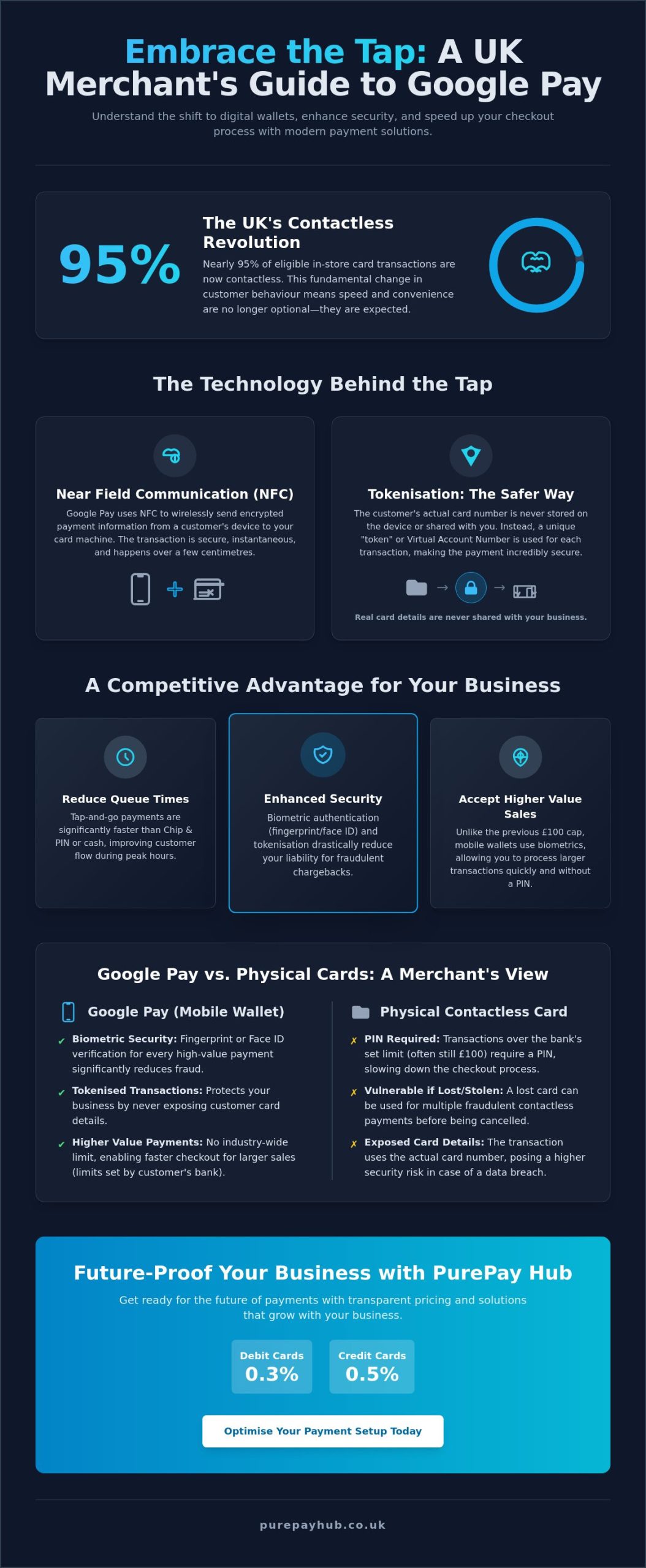
    Nearly 95% of eligible in-store card transactions in the UK are now contactless. This shift represents a fundamental change in how your customers prefer to shop and pay. You’ve probably felt the pressure of a growing queue during peak hours or worried about the security of mobile transactions. These are valid concerns that deserve clear, honest answers rather than corporate jargon. Integrating google pay into your business is a practical way to address these hurdles while ensuring your checkout remains fast and dependable.

    You deserve a payment partner that values transparency as much as you do. This guide will show you how to speed up your transactions and significantly reduce the risk of fraudulent chargebacks. We’ll preview the latest 2026 updates, including how the removal of the £100 contactless limit impacts your choice of card machine or online payment gateway. By the end of this article, you’ll have the clarity needed to optimise your payment setup and provide a better experience for every customer who walks through your door.

    Key Takeaways

    • Understand the shift away from physical cash and why digital wallets are now the preferred choice for UK shoppers.
    • Learn how NFC and tokenisation technology provide a secure barrier against fraud and data breaches.
    • Discover how accepting google pay can significantly reduce queue times and improve the checkout experience for your patrons.
    • Identify the best hardware for your business model, including Countertop, Portable, and Mobile Card Machines.
    • Protect your profits with PurePay Hub’s transparent pricing, offering straightforward rates of 0.3% for debit and 0.5% for credit cards.

    Understanding Google Pay: Why Digital Wallets Matter for UK Merchants

    UK retail is changing fast. Physical cash is no longer the king of the high street. For most merchants, this shift isn’t just about modern tech; it’s about staying relevant to a customer base that values speed above all else. Google Pay is a digital wallet platform that allows your customers to store their debit and credit card details securely on their smartphones or smartwatches. It uses Near Field Communication (NFC) to transmit payment data to your card machine with a simple tap. For you, the business owner, accepting a payment via Google Pay technology is identical to processing a standard contactless card. You don’t need complex new software or a degree in finance to manage it. Your existing hardware handles the transaction, ensuring the funds reach your account without unnecessary delay.

    The “tap-and-go” culture has fundamentally reshaped customer expectations in the UK. Shoppers now expect a frictionless experience where they can pay and leave in seconds. If your checkout process is slow or requires fumbling for change, you’re creating a barrier to a sale. Integrating google pay into your daily operations removes this friction. It turns a smartphone into a secure payment tool, allowing you to focus on service rather than counting coins. It’s a straightforward solution to a modern problem, helping you keep your queues short and your customers satisfied.

    The Rise of Contactless Payments in the UK

    By early 2026, mobile-first payment behaviours have become the standard amongst younger demographics. These shoppers often leave their physical wallets at home, relying entirely on their devices. If your business fails to adapt, you risk losing walk-in customers who simply cannot pay with cash or plastic. A major shift occurred in March 2026 when the FCA removed the industry-wide £100 cap on contactless payments. While physical cards now have limits set by individual banks, mobile wallets like google pay often allow for much higher transaction values. This is because the device uses biometric security to verify the user. It’s a clear advantage for your business; you can process larger sales quickly without the time-consuming friction of a PIN entry.

    Google Pay vs. Physical Cards: The Merchant Perspective

    You might worry that digital wallets require specialised, expensive equipment. They don’t. Whether you use a Countertop Card Machine or a Portable Card Machine, the processing remains the same. The customer taps their phone, and the payment authorises in seconds. Digital wallets actually offer superior security compared to physical plastic. Because the customer must use a fingerprint or face ID to unlock the payment, the risk of your business accepting a lost or stolen card is significantly lower. This built-in authentication helps protect you from fraudulent chargebacks, providing a more stable and dependable financial environment for your shop or restaurant.

    The Technology Behind the Tap: How Google Pay Ensures Secure Transactions

    Understanding the “how” behind digital payments helps build the trust you need to run a confident business. At its simplest, google pay uses Near Field Communication (NFC) to bridge the gap between a customer’s device and your terminal. NFC is a short-range wireless technology that allows two devices to exchange data when they are within a few centimetres of each other. When a customer holds their phone near your Countertop Card Machine, a secure, encrypted signal is sent to initiate the payment. This process is nearly instantaneous, but the layers of protection happening in that split second are incredibly robust. Your business remains protected because the sensitive data is never exposed during transit.

    What is Tokenisation and Why is it Safer?

    Tokenisation is the hidden engine that makes digital wallets more secure than traditional plastic cards. When a customer adds their bank details to their device, Google doesn’t store the actual 16-digit card number. Instead, it creates a Virtual Account Number, also known as a token. This unique identifier is what gets shared with your payment system during a transaction. This is a significant advantage for your business because you never see, handle, or store the customer’s real financial details. By removing this sensitive data from your environment, you drastically reduce your PCI DSS compliance burden. You can’t lose what you don’t have. If a hacker were to intercept a token, it would be completely useless to them because it only functions with that specific device and transaction.

    Biometric Security: Reducing Your Fraud Liability

    Security isn’t just about encryption; it’s about verifying that the person paying is actually the cardholder. Google Pay requires biometric authentication, such as a fingerprint scan or FaceID, before a payment is released. This acts as a powerful second factor of authentication that physical cards often lack. For you, this means a much lower risk of disputed transactions and fraudulent chargebacks. It’s particularly effective at preventing “friendly fraud,” where a customer might claim they didn’t authorise a purchase. Because their unique biometric data was used to unlock the payment, the bank has clear proof of authorisation. The future of UK payments technology is built on this foundation of verified identity. This leads to a more stable financial environment, allowing you to focus on growth rather than managing disputes.

    Google Pay for UK Businesses: The Complete Merchant Guide to Digital Wallet Payments in 2026

    Business Benefits: Why Accepting Google Pay is a Competitive Advantage

    Efficiency is the lifeblood of any successful UK business. When your shop or restaurant is at its busiest, every second counts. Accepting google pay isn’t just about following a trend; it’s a strategic move to streamline your cash flow and keep your customers happy. By offering this modern payment method, you remove the physical and psychological barriers that often lead to abandoned purchases. It’s about providing a service that feels as professional and reliable as the products you sell.

    Operational Efficiency and Queue Management

    A single transaction using google pay takes roughly two seconds. Compare this to the time spent fumbling with coins, counting change, or waiting for a customer to find their physical card and enter a PIN. Over a busy lunch hour or a Saturday shift, those saved seconds add up to significant labour hours. Your staff can serve more people in less time, reducing the frustration of long queues. This speed creates a positive psychological impact; customers feel they’re in a modern, efficient environment where their time is respected.

    Beyond speed, you’ll also see a reduction in cash handling. This means fewer trips to the bank and lower deposit fees, which are often a hidden drain on your profits. Many traditional merchant banks hide these costs in complex contracts, but the shift toward digital payments makes your overheads much easier to track. By using a modern EPOS System, you can reconcile your daily takings instantly, ensuring your books are always accurate and transparent.

    Attracting the Modern Tech-Savvy Consumer

    Offering digital wallet payments signals that your business is forward-thinking. It provides “payment parity” with national chains, showing your customers that you value their convenience just as much as the big retailers do. This is especially vital for the hospitality and travel sectors, where customers often expect a seamless, device-led experience. Since nearly 95% of eligible UK card transactions were contactless by 2024, failing to accept mobile wallets can alienate a massive portion of the market. You don’t want to turn away a sale just because a customer left their physical wallet at home.

    Google Pay also allows for deeper customer engagement through integrated loyalty programmes and digital receipts. Instead of printing paper that ends up in the bin, you can provide a clean, digital record of the transaction. This tech-first approach lowers the barrier to buy and ensures you never miss a sale due to a simple oversight. It’s a fair and simple way to build a lasting partnership with your patrons while keeping your operations lean and dependable.

    How to Accept Google Pay in Your Shop or Restaurant

    Setting up your business to accept digital wallets is a straightforward process that shouldn’t involve complex hurdles. You don’t need to navigate a maze of technical requirements or deal with the opaque contracts often found at traditional banks. By following a few clear steps, you can modernise your checkout and start reaping the rewards of faster transaction times. Our goal is to provide a reliable system that works for you and your customers without hidden complications or unnecessary stress.

    • Partner with a transparent provider. Choose a merchant service partner like PurePay Hub that prioritises clarity over corporate jargon. You need a partner who offers fair rates and honest service.
    • Choose your hardware. Select the terminal that fits your business model. Whether it’s a fixed till or table service, the right machine makes all the difference to your staff efficiency.
    • Verify NFC compatibility. Ensure your device is NFC-enabled. Look for the universal contactless symbol on the screen or the terminal casing to confirm it can receive digital signals.
    • Train your staff. Make sure your team knows how to prompt for mobile payments. A simple question like “Would you like to pay by phone or card?” can speed up the entire queue during peak hours.
    • Display signage. Use official decals to let your customers know you accept google pay. This small visual cue can prevent “forgotten wallet” walk-outs and build immediate trust.

    Choosing the Right Card Machine for Digital Wallets

    Your choice of hardware depends on how you interact with your customers. If you run a retail shop with a fixed till, a Countertop Card Machine is your best option. It’s a robust, permanent fixture that provides a stabilising force for your daily sales. For restaurants or cafes, a Portable Card Machine allows you to take the checkout directly to the customer’s table. This flexibility is essential for maintaining a high standard of service. All PurePay Hub terminals are fully NFC-compatible by default. If you need a more comprehensive solution, our integrated EPOS Systems combine inventory management with seamless payment processing.

    Setting Up Your Merchant Account

    Onboarding is fast and transparent. We’ve designed a simple, no-nonsense process to get you up and running without the usual banking headaches. Once your account is active, you can process google pay transactions with the same ease as a standard debit card. A critical advantage of our service is next-day funding. We understand that healthy cash flow is vital for regional business owners, so we ensure your money reaches your account without unnecessary delays. You’ll also benefit from a fee structure that is untainted by hidden markups. We believe in total honesty, which is why we offer straightforward rates of 0.3% for debit and 0.5% for credit cards. Explore our range of card machines today and start providing the modern payment experience your customers expect.

    Future-Proofing Your Business with PurePay Hub’s Integrated Solutions

    Choosing a payment partner is a significant decision for any regional business owner. You need more than just a provider; you need a supportive ally that values your growth as much as you do. PurePay Hub provides a stabilising force for your finances through a no-nonsense approach to contracts. We have stripped away the complex fee structures and hidden markups that often plague the industry. Our focus remains on clarity, ensuring you always know exactly what you are paying and why. This transparency allows you to plan for the future with informed confidence.

    Our integrated EPOS Systems are designed to make google pay acceptance effortless. These systems act as a centralised hub for your business, managing everything from inventory to final payment in one clean interface. By streamlining your operations, you reduce the risk of human error and improve staff efficiency. It’s a modern solution built for the specific needs of UK merchants who value straight-talking and principled service.

    Transparent Rates and Next-Day Access to Funds

    Your revenue belongs in your pocket, not lost in a sea of bank fees. We offer straightforward, fair rates of 0.3% for debit cards and 0.5% for credit cards. These figures are untainted by the murky markups used by traditional competitors. When you process a sale via google pay, you shouldn’t have to wait days to access your money. Our next-day funding model ensures that your sales are reflected in your bank account by the following working day. This rapid access to capital is essential for maintaining a healthy cash flow and funding your daily operations. If you’re tired of opaque pricing models, it’s time to switch to a partner that prioritises your success.

    Supportive Partnership for National Growth

    We believe in building lasting relationships with the local merchant community. Our commitment goes beyond providing hardware; we offer a steady promise of better service. Every card machine rental includes 24/7 technical support, ensuring that your business never grinds to a halt due to a technical glitch. Whether you are a small cafe or a growing retail chain, we provide the tools and guidance needed to thrive in a digital-first economy. We invite you to experience a fairer way of doing business.

    Switch to PurePay Hub and start accepting Google Pay today to secure your business’s financial future with a partner you can trust.

    Take Control of Your Business Payments

    The shift toward a cashless UK is a permanent change in consumer behaviour. You now have the tools to turn this challenge into a distinct competitive advantage. By embracing google pay, you ensure that your checkout is fast and secure whilst remaining ready for the high-value transactions made possible by the removal of contactless limits. This guide has shown that the right technology, paired with a transparent partner, can significantly reduce your operational stress and fraud liability.

    You shouldn’t have to settle for opaque fees or delayed access to your hard-earned revenue. We offer a fair, no-nonsense alternative with debit card rates from 0.3% and next-day funding as standard. Our goal is to provide the reliability you need to focus on what matters most: serving your customers and growing your business. There are no hidden markups or murky contracts here; just straightforward service designed for your success.

    Start accepting Google Pay with PurePay Hub’s low-rate card machines today. We look forward to supporting your growth with the honesty and clarity your business deserves.

    Frequently Asked Questions

    Does it cost more to accept Google Pay than standard card payments?

    No, you won’t pay extra for accepting google pay. It’s processed at the same rate as a standard contactless card transaction. We don’t believe in penalising you for offering modern payment options. Your existing fee structure remains the same, ensuring your overheads are predictable and transparent. This consistency helps you manage your cash flow without worrying about surprise charges on your monthly statement.

    Is there a limit on how much a customer can pay via Google Pay?

    There is no longer a strict £100 industry-wide cap on contactless payments following the FCA’s rule change in March 2026. Because google pay uses biometric security like fingerprints or face ID, banks often allow much higher transaction limits than they do for physical cards. This flexibility is perfect for businesses with higher average order values. You should check with your specific provider to see what individual limits they have set for their customers.

    Do I need a special merchant account to accept Google Pay?

    You don’t need a specialised account to accept digital wallets. A standard merchant account paired with an NFC-enabled terminal is all you need to get started. Our onboarding process is designed to be simple and honest, getting you set up without the typical banking delays. Once your account is active, your machine will automatically recognise and process these payments just like any other debit or credit card.

    How long does it take for Google Pay transactions to reach my bank account?

    The time it takes for funds to arrive depends entirely on your payment partner. At PurePay Hub, we provide next-day funding as standard for all transactions. This ensures your revenue is available to you almost immediately, helping you maintain a healthy and stable business. Some traditional banks may hold your funds for several days, so it’s always best to choose a partner that values your liquidity.

    Is Google Pay safer for my business than physical credit cards?

    Digital wallets are significantly safer for your business than traditional plastic cards. They use a process called tokenisation, which replaces sensitive card numbers with a unique virtual identifier. This means you never store or handle the customer’s actual bank details, reducing your security risk. Additionally, the requirement for biometric authentication on the device makes it nearly impossible for someone to use a stolen phone for fraudulent purchases.

    What happens if a customer’s phone battery dies during a transaction?

    If a customer’s device loses power, the transaction simply cannot take place. NFC technology requires the device to be active to transmit the secure token to your terminal. In these instances, the customer will need to use a physical card or an alternative payment method. It’s a rare occurrence, but it’s another reason why keeping a reliable card machine on your counter is essential for every sale.

    Can I accept Google Pay on a mobile card machine while off-site?

    You can absolutely accept mobile payments while working away from your main premises. By using a Mobile Card Machine with a built-in SIM card or Wi-Fi connection, you can take payments anywhere with a signal. This is an ideal solution for tradespeople, delivery drivers, or market stall owners who want to offer the same convenience as a high-street shop. The security and speed remain identical to in-store transactions.

    Do I need to change my EPOS system to accept digital wallets?

    Most modern EPOS systems are already compatible with digital wallets. You only need to upgrade if your current software or hardware doesn’t support NFC-enabled terminals. If your system is outdated, switching to an integrated solution can simplify your daily reconciliations and inventory management. We provide modern systems that work seamlessly with mobile wallets, ensuring your business is ready for the future of UK payments.

  • Business Cash Advance: The UK Merchant’s Guide to Flexible Funding in 2026

    Business Cash Advance: The UK Merchant’s Guide to Flexible Funding in 2026

    What if your business funding actually breathed with you, expanding when trade is booming and shrinking when the high street goes quiet? You likely already know the stress of rigid bank loans that demand the same heavy payment regardless of whether you’ve had a record-breaking Saturday or a silent Tuesday. It feels wrong to be penalised by a fixed schedule when your revenue naturally fluctuates; it is an outdated way to manage a modern shop or restaurant.

    This guide explains how a business cash advance offers a more transparent, flexible alternative for UK merchants in 2026. You’ll discover how to access unsecured capital between £1,000 and £1,000,000, often within just 48 hours, whilst keeping your repayments perfectly mirrored to your daily card sales. We’ll break down the simple factor rate structure that replaces complex interest, the minimum turnover requirements you need to meet, and how this modern funding model ensures you never overextend your cash flow during a slow month. It is time to move away from opaque banking and toward a partnership that understands how your business actually works.

    Key Takeaways

    • Learn how a business cash advance provides a flexible funding solution where repayments automatically scale up or down based on your daily card sales.
    • Understand the straightforward eligibility requirements for UK merchants, typically requiring just three to six months of trading history and £2,500 in monthly turnover.
    • Discover the transparency of factor rates, which ensure you pay one fixed, agreed-upon amount without the worry of accruing interest or hidden monthly fees.
    • See how PurePay Hub leverages your card machine data to offer next-day access to unsecured capital, removing the need for complex bank applications or collateral.

    What is a Business Cash Advance? A Flexible Alternative for UK SMEs

    A business cash advance is a straightforward way to access capital without the rigid constraints of a traditional bank loan. Instead of borrowing money and paying it back with interest, you’re essentially selling a small portion of your future card sales in exchange for an immediate lump sum. This distinction is vital for your financial health. Because it’s technically a purchase of future receivables rather than a debt, it doesn’t sit on your balance sheet in the same way a loan does. This often protects your credit profile whilst giving you the liquidity needed to grow.

    For a deeper dive into the technical background, you can read more about What is a Merchant Cash Advance? and how it differs from conventional lending. This model is particularly effective for businesses that process high volumes of card transactions, such as local boutiques, independent pubs, and busy restaurants. The core appeal is simple: your repayments breathe with your business. When trade is brisk, you pay back more; when things slow down, your repayments automatically reduce.

    The Mechanics of Merchant Funding

    The process involves a seamless partnership between you, the funding provider, and your payment processor. When you take a business cash advance, there are no fixed monthly instalments to worry about. Instead, a small, agreed-upon percentage of your daily card takings is automatically deducted from your daily batches. If you have a quiet day, you pay back less. If you’re closed for a bank holiday, you pay nothing at all. Crucially, this is unsecured capital. You don’t need to put your home or business premises at risk to secure the funds, making it a much safer prospect for independent owners.

    Why UK Businesses are Moving Away from High-Street Banks

    In 2026, many UK SMEs find themselves stuck in a “funding gap”. Traditional high-street banks have become increasingly risk-averse, often requiring mountains of paperwork and taking months to reach a decision. Modern merchants don’t have months to wait. Whether you need to repair a commercial oven or stock up for a seasonal rush, speed is everything.

    A business cash advance can often be approved and funded within 24 to 48 hours. This agility is essential in a post-digital retail environment where consumer trends shift rapidly. You get the funds you need to stay competitive without the bureaucratic headaches of a 19th-century banking model. It’s about finding a partner that values your daily performance over a static credit score.

    How Business Cash Advances Work: Factor Rates and Repayments

    Understanding the mechanics of a business cash advance is the first step toward taking control of your cash flow. Unlike a bank loan where interest compounds over time, this funding uses a “factor rate”. This means the total cost of your capital is fixed from the very first day. You won’t face the anxiety of fluctuating interest rates or the pressure of a ticking clock that makes traditional debt so stressful for small business owners.

    A factor rate is a fixed multiplier of the advance amount. For instance, if you secure a £10,000 advance with a factor rate of 1.2, your total repayment amount is exactly £12,000. There are no complex calculations to perform later and no surprises in your monthly statements. You know exactly what the facility costs before you even sign the agreement.

    The repayment happens through an automated process often called a “sweep” or “holdback”. You agree on a percentage of your daily card sales, typically between 5% and 20%, which is automatically deducted before the funds reach your bank account. This percentage is designed to balance your growth goals with your daily operational needs. Most merchants find that a modest holdback allows them to settle the advance comfortably without feeling a pinch in their working capital. This automatic process removes the administrative burden of manual transfers, allowing you to focus on running your shop or restaurant whilst the technology handles the rest.

    Factor Rates vs. APR: Calculating the Real Cost

    Traditional loans use APR, which can be confusing when you’re trying to calculate short-term costs for a seasonal project. In contrast, a factor rate provides total clarity for short-term cash flow planning. You can find more details on how these structures fit into the wider market in the UK government guidance on Merchant Cash Advances. It’s a transparent model that prioritises your ability to manage daily overheads without the hidden markups often found in high-street banking products.

    The Repayment Journey: Walking Through a Typical Month

    Imagine a busy Saturday where your pub is packed; your repayment that day will be higher because your sales are higher. On a quiet Monday morning when you only serve a few coffees, the deduction is tiny. If you decide to close for a week for renovations and take £0 in card sales, you pay £0 that week. This flexibility prevents the “debt spiral” often triggered by fixed-cost loans that demand payment even when the till is empty. If you’re looking for a funding partner that offers this level of transparency, exploring a business cash advance through PurePay Hub could be the stabilising force your finances need.

    Business Cash Advance: The UK Merchant’s Guide to Flexible Funding in 2026

    Business Cash Advance vs. Traditional Loans: A Comparison

    Choosing between a traditional bank loan and a business cash advance often comes down to what you value more: a rigid, low-cost structure for the long term or a flexible, high-speed solution for the present. Banks prioritise the past. They spend weeks auditing your historical accounts and scrutinising your personal credit score. If your score isn’t perfect or you don’t have property to offer as collateral, the door often stays shut. An advance shifts the focus to your future sales, using your current card turnover as the primary metric for approval.

    The speed of funding is perhaps the most striking difference. Whilst a high-street lender might take a month to process a small business application, an advance can put capital in your bank account within 24 to 48 hours. This makes it a tactical tool for merchants who need to move quickly. Whether you’re jumping on a bulk stock discount or fixing a broken shopfront, you don’t always have the luxury of a thirty-day waiting period. Understanding what is a merchant cash advance helps clarify why it’s a “tactical” choice rather than a “structural” one; it’s about solving immediate cash flow needs without the bureaucratic weight of a bank.

    When is a Traditional Bank Loan Better?

    MCAs aren’t a universal fix for every financial need. If you’re planning a multi-year infrastructure project or purchasing the freehold for your premises, a traditional bank loan is usually the better choice. These long-term projects benefit from the lower overall cost of debt that banks provide over five or ten years. It’s also worth checking for early repayment penalties on bank products. Most business cash advance agreements don’t have them because there’s no fixed term, but a bank might charge you extra for clearing your debt ahead of schedule.

    The Seasonal Advantage for Hospitality and Retail

    For a local pub or a seasonal boutique, the “variable” nature of an advance is its greatest strength. Imagine using the funds to build a new beer garden in May. During the sun-soaked summer months, your repayments are high because your sales are booming. You settle the balance quickly whilst the cash is flowing. When the “quiet January” period arrives and footfall drops, your outgoings automatically shrink to match your lower takings. This synchronisation means the funding is effectively breathing with your business. You never have to worry about a fixed monthly overhead draining your accounts when the high street is empty.

    Qualifying for Funding: Eligibility and Application

    Qualifying for a business cash advance is often a refreshing experience for merchants used to the rigid demands of high-street banks. Instead of focusing on your personal assets or long-term credit history, lenders look at the health of your daily trade. The primary requirement is a consistent monthly card turnover, typically starting at £2,500. This ensures that your business has the natural “breathing room” to settle the advance through the small daily deductions we’ve already explored.

    Most providers look for a minimum trading history of at least 3 to 6 months. This window provides enough data for real-time algorithms to assess your business health accurately. These systems aren’t looking for perfection; they’re looking for reliability. By analysing your digital footprint through card processing statements, lenders can reach an approval decision much faster than a human auditor ever could. It’s a modern approach that rewards active, trading businesses over those with the most collateral.

    Preparing Your Application for Success

    Speed is the hallmark of this funding model, but you can accelerate the process even further by having your records in order. Most lenders will request your last three months of merchant statements to verify your transaction volume and average sale value. You should also ensure your PCI compliance is up to date, as this demonstrates a level of professional management and security that reassures potential partners. A healthy mix of debit and credit sales improves approval odds by showing you have a varied and stable customer base. Having your bank records organised alongside these statements will often lead to an approval in hours rather than days.

    Red Flags to Avoid

    Whilst the approval rates are high, there are a few pitfalls to keep in mind. A sudden, unexplained drop in your card volume just before or during your application can trigger a deeper review from the underwriting team. If you’ve recently changed your business model or had a temporary closure, it’s better to be transparent about it from the start. Honesty regarding any existing business debt is also vital; lenders value clarity and are more likely to work with you if they have the full picture. Always look for a partner with a no-nonsense fee structure that avoids hidden “non-utilisation” charges. If you’re ready to see what you qualify for, you can start your application with PurePay Hub today to get a clear, fast decision.

    Securing Your Advance with PurePay Hub: The Integrated Advantage

    Most financial products feel disconnected from your daily operations. A business cash advance from PurePay Hub is different because it’s built directly into your merchant services. We don’t need to ask for mountains of paperwork that you’ve already provided elsewhere. Since we already manage your payment processing, we have a clear, real-time view of your business health. This integration removes the friction that usually slows down traditional lending. It’s a cleaner, more efficient way to fund your next project.

    Speed is our standard. We focus on “Next-Day Access” to bridge the gap between your approval and the capital hitting your account. You won’t find any hidden markups or confusing corporate jargon in our agreements. We believe in straight-talking finance that supports your growth rather than complicating it. This approach provides a reliable foundation for your next big step, ensuring you have the liquid capital to act when opportunities arise. We’re not just a distant lender; we’re a stabilizing force for your business finances.

    Why Our Merchants Choose Integrated Funding

    Our role as your payment processor means we already understand the rhythm of your trade. Whether you’re using our countertop card machines or our EPOS systems, your transaction data tells a story of hard work and consistency. Having your funding and your payment hardware under one roof simplifies your administrative life. It also allows us to offer a fairer service specifically tailored to regional UK business owners who are often overlooked by national banks. We take pride in being a supportive ally, offering a modern fintech solution that hasn’t lost its focus on the individual merchant. Our commitment to transparency ensures you can plan for the future with absolute confidence.

    Start Your Growth Journey Today

    Getting a quote is a risk-free process that won’t affect your personal credit score. We can use the data from your portable card machine or virtual terminal to provide an accurate, transparent offer in minutes. Our team operates with a sense of calm advocacy; we’re here to help you find the right fit for your specific needs. You can secure the capital required to refurbish your premises or expand your inventory without the stress of traditional debt. It’s time to experience a funding partner that values your business as much as you do.

    Get a transparent business cash advance quote from PurePay Hub

    Fuel Your Business Growth on Your Own Terms

    You now have a clear roadmap for securing capital that respects your cash flow. By choosing a business cash advance, you move away from the rigid constraints of traditional debt and toward a model that breathes with your daily sales. This guide has shown how factor rates provide absolute cost certainty and how integrated funding removes the bureaucratic hurdles that often block SME growth. It’s about having the financial agility to act when the time is right.

    At PurePay Hub, we prioritise clarity and speed. Our merchants benefit from debit card rates starting from 0.3% and a no-nonsense fee structure that eliminates hidden surprises. With next-day funding available, you can bridge the gap between approval and action almost instantly. We’re here to provide the steady support you need to expand your shop, pub, or restaurant with confidence.

    Apply for a transparent Business Cash Advance with PurePay Hub. Your business deserves a partner that values honesty and efficiency as much as you do.

    Frequently Asked Questions

    Is a business cash advance expensive compared to a bank loan?

    A business cash advance is priced using a fixed factor rate rather than an annual interest rate (APR). Whilst the total cost might be higher than a traditional secured loan, you’re paying for speed and the lack of collateral requirements. There’s no compounding interest and no late fees; you simply pay back one agreed-upon total. This makes it a transparent choice for short-term tactical projects where speed is your main priority.

    Will an MCA affect my business credit score?

    Generally, this type of funding doesn’t appear as debt on your credit file because it’s a purchase of future sales. Most lenders perform a “soft” credit search during the application process which doesn’t impact your score. Because there are no fixed monthly deadlines, you don’t risk “late payment” markers during slow trading periods. It’s a safer way to protect your financial profile whilst accessing the capital you need to grow.

    What happens if my business has a very slow month?

    Your repayments automatically decrease during quiet periods. Since the deduction is a fixed percentage of your daily card sales, a drop in revenue leads to a smaller daily repayment. If your shop or restaurant has a day with zero card transactions, you pay nothing at all that day. This flexibility removes the stress of fixed overheads and ensures you always have enough working capital to manage your daily operations.

    Do I need to change my card machine provider to get an advance?

    You don’t always need to switch, but using an integrated provider like PurePay Hub can significantly speed up the approval process. When you use our countertop or portable card machines, we already have access to the data needed to verify your turnover. This allows for a much smoother “sweep” process where repayments are handled automatically. It’s a cleaner way to manage your funding and your merchant services under one reliable roof.

    Can I pay off my business cash advance early?

    You can usually settle the full balance ahead of schedule without facing early repayment penalties. However, it’s important to remember that the total cost is fixed at the start of the agreement via the factor rate. Paying it back faster doesn’t typically reduce the total amount owed, but it does clear your future revenue from further deductions. Always check your specific agreement to ensure there are no hidden fees for early settlement.

    What can I use the funding for? Are there restrictions?

    You have complete freedom to use a business cash advance for any legitimate business purpose. Most UK merchants use the funds for refurbishments, bulk inventory purchases, or seasonal marketing campaigns. Unlike some bank products that require a specific business case, this capital is yours to deploy wherever it adds the most value. It’s an excellent tool for bridging cash flow gaps or seizing unexpected opportunities that require immediate action.

    How quickly will the money be in my bank account?

    Speed is the primary advantage of this model; capital often reaches your bank account in just 24 to 48 hours. The digital application process removes the need for weeks of auditing and manual paperwork. Once your card processing data is verified and the agreement is signed, the funds are transferred electronically. This allows you to respond to business needs in real-time rather than waiting for a bank committee to reach a decision.

  • Choosing the Best Pub EPOS System: A 2026 Guide to Efficiency and Profit

    Choosing the Best Pub EPOS System: A 2026 Guide to Efficiency and Profit

    Your current till system might be the most expensive member of staff you have ever hired. When the Friday night rush hits, a slow pub epos system does more than just frustrate your regulars; it actively drains your margins through missed rounds and stock discrepancies. You likely feel the pressure of a packed bar whilst managing complex wet-led inventory and worrying about those opaque transaction fees that eat into your hard-earned profits. It’s a common frustration for publicans who want to focus on service rather than fighting with their own technology.

    We believe your payment tech should be a stabilising force for your finances, not a source of stress. This guide shows you how to choose a system that transforms operations, slashes transaction costs, and secures your cash flow through total transparency. We’ll explore the latest 2026 requirements, including Martyn’s Law and new HFSS rules, whilst comparing the top providers to help you find a reliable partner. You’ll learn how to achieve faster table turnover and simple stock management to keep your business moving forward with confidence.

    Key Takeaways

    • Learn how a modern pub epos system synchronises your payments and stock to eliminate hidden wastage and manual errors.
    • Identify the specific hardware features that prioritise speed of service during peak hours to ensure your bar staff never miss a round.
    • Understand the true cost of card processing and why transparent debit rates are more vital for your bottom line than monthly software fees.
    • Discover the best practices for a stress-free transition, including how to migrate your menu data and when to schedule your system switch.
    • See how integrated payment solutions and next-day funding provide a stabilising force for your pub’s weekly cash flow.

    What is a Pub EPOS System and Why Does Your Bar Need One?

    A pub EPOS is a centralised digital hub for all bar transactions. Unlike a standard cash register, an Electronic Point of Sale system integrates sophisticated software with robust hardware to manage the complex demands of a modern hospitality environment. It’s the engine room of your business, synchronising your card payments, stock levels, and staff performance in one place. To understand the broader context of this technology, you can explore the history and evolution of What is a Point of Sale (POS) system through foundational industry records.

    In 2026, the best pub epos system options use cloud technology to give you real-time oversight of your venue. This means you can check your live sales data or adjust menu prices from your phone whilst away from the bar. It moves your operations beyond simple money-taking and into the realm of intelligent business management. By connecting every part of your service, you ensure that no pint goes unrecorded and no transaction is lost to manual error.

    The Shift from Traditional Tills to Integrated EPOS

    Legacy “dumb” tills are a primary cause of reconciliation errors. When your payment terminal doesn’t talk to your till, staff must manually enter amounts twice. This leads to typos, lost revenue, and hours spent at the end of a shift trying to figure out why the numbers don’t match. An integrated system removes this human error factor entirely. For multi-site operators, the advantage is even clearer. You gain 24/7 cloud access to every location, allowing you to compare performance across your estate without needing to be physically present at the bar.

    The Core Components: Hardware vs Software

    Your system is only as strong as its weakest link. In a high-pressure bar environment, your hardware must be “pub-proof”. This means touchscreen terminals that can handle sticky fingers and the occasional spill, along with printers that won’t fail in a hot, humid kitchen or cellar. The software is the brain of the operation, handling essential tasks like table management and complex split billing for large groups. It should be intuitive enough that new staff can learn the basics in minutes, keeping your service moving during the Friday night rush.

    Consider these essential elements for a reliable setup:

    • Touchscreen Terminals: High-speed interfaces that reduce order time and improve accuracy.
    • Integrated Card Machines: Devices that automatically pull the total from the till to prevent entry mistakes.
    • Stock Management Modules: Software that tracks every pint poured and bottle sold in real time.
    • Loyalty Programmes: Built-in tools to reward your regulars and encourage repeat visits.

    By choosing a modern pub epos system, you aren’t just buying a till; you’re investing in a partner that protects your margins and simplifies your working day. It provides the clarity you need to make informed decisions about your stock, your staff, and your future growth.

    Essential Features for High-Volume Pub Environments

    In a high-volume pub, speed is your most critical metric. When the bar is three deep, your pub epos system must respond instantly to every touch. Modern publicans are increasingly adopting modern financial technology to manage these peak periods with precision. Beyond simple order entry, your system needs to handle “Order & Pay” at the table, which has become a standard expectation for customers in 2026. To keep your books balanced, Z-reports and X-reports provide instant financial clarity by giving you a real-time summary of your takings at any point during the day.

    Wet-Led Inventory and Wastage Management

    Managing a wet-led cellar requires more than just counting bottles. Your inventory tracking must account for draught beer by the pint and spirits by the exact measure. A common drain on profits is the lack of a proper wastage log for weekly line cleaning or accidental spills. The right pub epos system allows you to record these events specifically, ensuring your stock levels remain accurate. You can also set automated low-stock alerts so you never have to tell a customer their favourite ale is off. For more advanced tracking, exploring integrated stock modules can help protect your bottom line.

    Table Management and Customisable Floor Plans

    Visualising your bar and garden layout is essential for effective service. A customisable floor plan allows you to manage server sections and track table occupancy at a glance. It’s common for customers to start a tab at the bar and later move to a table for food; your system should handle this transition seamlessly. Handling large groups becomes much simpler with a dedicated “split bill” feature. This allows your team to divide costs by item or value without holding up the queue or causing confusion during payment.

    Staff Performance and Security Features

    Security is vital in a fast-paced environment. Individual staff logins via RFID fobs or unique PINs help you track sales and prevent “no-sale” theft at the till. These logs also allow you to monitor average transaction values, helping you identify which team members are your top performers. To maintain control, you should use permission tiers that restrict sensitive actions like refunds or voids to management-level staff only. This creates a transparent, accountable culture within your team whilst safeguarding your daily revenue.

    Choosing the Best Pub EPOS System: A 2026 Guide to Efficiency and Profit

    Calculating the Real Cost: Software, Hardware, and Transaction Fees

    Choosing a pub epos system based solely on the monthly software price is a common mistake. Whilst a low subscription fee looks attractive on paper, the real cost of your technology is often hidden in the small print of your merchant agreement. You need a system that protects your margins, not one that slowly erodes them through opaque charges and delayed access to your own money. Cash flow is the lifeblood of any bar; waiting three to five days for funds to clear is no longer acceptable for a modern business. Securing next-day funding ensures your takings are in your account when you need to pay suppliers or staff.

    Upfront vs Recurring Costs: What to Budget For

    Your initial investment usually involves a choice between buying hardware outright or choosing a monthly rental model. Buying your touchscreen terminals and integrated card machines upfront can reduce your long-term monthly outgoings, but rentals offer a lower barrier to entry for new venues. Beyond the physical kit, your Software-as-a-Service (SaaS) fees should cover more than just a digital till. Ensure your provider includes 24/7 UK-based support and regular software updates within that price. You don’t want to be hit with extra maintenance charges when you need help during a busy bank holiday weekend.

    The “Hidden Tax” of High Transaction Rates

    The true financial impact of your pub epos system lies in the transaction rates. Many high-street banks and traditional providers use blended rates that hide their own markups. A difference of just 1% in your processing fee can cost a busy pub thousands of pounds every year. At PurePay Hub, we prioritise transparency by offering debit rates from 0.3%, which is significantly lower than many standard market offerings. We use clear fee structures to ensure you keep more of every pint sold. You should also watch out for these common hidden costs:

    • PCI Compliance Fines: Monthly penalties for not meeting security standards that your provider should help you manage.
    • Exit Fees: Punitive charges designed to stop you from switching to a fairer partner.
    • Minimum Monthly Service Charges: Fees that apply even if your seasonal trade is quiet.

    By moving away from murky fee structures and toward a partnership based on clarity, you turn your payment processing into a stabilising force for your finances. It is about choosing a partner that values your growth as much as you do. When you compare providers, always ask for the total cost of ownership including all processing fees and hardware maintenance.

    Implementation: Switching Your Pub EPOS Without the Stress

    Switching your pub epos system doesn’t have to be a headache. It’s a process that requires planning and discipline rather than just technical skill. Most publicans make the mistake of trying to install new kit on a Friday afternoon. Don’t do this. A Monday morning is far better because it gives you a quiet window to iron out any kinks before the weekend rush. It also ensures that support teams are fully available if you hit a snag during the initial setup.

    Data migration is your next hurdle. You shouldn’t have to rebuild your entire menu from scratch. Most modern providers allow you to export your existing stock lists and pricing from your old provider. This saves hours of manual entry and prevents pricing errors. You also need to verify your connectivity. Cloud-based systems are brilliant, but they rely on stable Wi-Fi. If your bar has thick stone walls, you might need to install additional access points to handle the peak load of a busy Saturday night without slowing down your payment processing.

    The Pre-Installation Checklist

    Before you unbox your new terminals, audit your current setup. Some hardware, like heavy-duty cash drawers, can often be repurposed to save on upfront costs. You also need to organise your back-office categories. Define your groups clearly: Draught, Spirits, Food, and Soft Drinks. This structure makes your reporting much cleaner later on. Finally, check that your merchant account is fully verified so you can access next-day funding immediately.

    Training Your Team for Success

    A confident team is a fast team. Run “mock service” sessions where staff can practice taking complex orders and splitting bills without the pressure of a real queue. Teach them how to handle “offline mode” too. High-quality systems will continue to process payments even if the internet drops out. Establish a clear process for reporting tech issues. If a staff member knows exactly who to tell when a printer jams, it prevents small glitches from becoming major service delays. If you’re ready to upgrade your bar’s technology, you can explore our integrated EPOS systems today.

    PurePay Hub: The Integrated Payment and Growth Partner for UK Pubs

    PurePay Hub is more than just a technology provider; it’s a dedicated partner for the independent publican. We combine elite software with industry-leading debit rates starting from 0.3%. This ensures your pub epos system works for your bottom line rather than against it. By bringing your till, card machine, and financial management under one roof, we eliminate the friction of dealing with multiple distant institutions. You deserve a professional support team that understands the no-nonsense reality of running a busy bar.

    Next-Day Funding: A Game-Changer for Pub Cash Flow

    Waiting three days for your weekend takings to clear is a relic of the past. In an industry where supplier payments and payroll are constant pressures, faster access to your capital is essential. The PurePay Hub promise is simple: your money arrives in your account when you need it. This next-day access provides the stability required to manage your weekly outgoings with confidence. You shouldn’t have to wait for your own hard-earned profit whilst your bills continue to mount.

    Unlocking Growth with Business Cash Advances

    Your transaction history is a valuable asset. We use your EPOS data to help you secure a Business Cash Advance, providing unsecured capital for your next big project. Whether you are planning a major refurbishment, upgrading your beer garden for the summer, or making large seasonal stock buys, this funding adapts to your business. This model is particularly effective for regional pubs that experience seasonal peaks. Repayments fluctuate with your sales; you pay more when the bar is busy and less during quieter weeks. It is a flexible, supportive way to grow without the rigid constraints of a traditional bank loan.

    Take the Next Step Toward a Fairer Partnership

    Switching your provider is often easier than you think. We help you move to PurePay Hub without the stress of extortionate exit fees or complex setup processes. Our team can provide a transparent rate review to show exactly how much your pub could save annually by moving to a fairer structure. It is time to stop overpaying for your processing and start working with a partner that values your success as much as you do. You can get a transparent quote for your pub EPOS today and see the difference clarity makes to your business.

    Future-Proof Your Bar with Transparent Technology

    Your bar deserves a technology partner that values clarity over hidden markups. A modern pub epos system is much more than a digital till; it’s a financial anchor that secures your cash flow and simplifies complex wet-led stock management. By prioritising speed of service and demanding transparent transaction rates, you protect your hard-earned margins from the opaque practices of traditional providers. Successful implementation simply requires a planned transition during quiet periods to ensure your team is confident and ready for the weekend rush.

    PurePay Hub acts as a supportive business ally by offering the stability your venue needs to thrive. We provide debit card rates from 0.3% and guaranteed next-day access to your funds to keep your operations moving. When you’re ready to expand, our integrated Business Cash Advance options provide the flexible capital required for refurbishments or seasonal stock buys. Switch to a fairer pub EPOS and payment system with PurePay Hub today. You’ve built your business on honest service, so it’s time your payment partner did the same.

    Frequently Asked Questions

    How much does a pub EPOS system typically cost in the UK?

    Costs for a pub epos system in the UK vary significantly based on your choice between pay-as-you-go models and monthly subscriptions. In 2026, entry-level software plans from providers like Square or SumUp start at £0 per month with higher transaction fees, whilst premium hospitality packages like Lightspeed or Tabology range from £39 to £79 per month. Hardware bundles can be purchased outright or rented through monthly instalments. You should always check for hidden costs like support fees or charges for additional terminals.

    Can I use my existing card machine with a new EPOS system?

    You can only use an existing card machine if it is fully compatible with the new software’s specific integration protocols. Most publicans find that using a non-integrated terminal leads to frequent manual entry errors and slower service during peak hours. Switching to a fully integrated partner ensures your till and card machine communicate perfectly. This eliminates the need for double-entry and speeds up the reconciliation process at the end of every shift.

    What happens to my pub EPOS if the internet goes down?

    Most modern systems include an “offline mode” that allows you to continue taking orders and processing payments if your internet connection fails. The data is stored locally on your terminal and synchronises with the cloud once your connection is restored. This prevents your service from grinding to a halt during a busy Friday night rush. It is a vital feature for rural pubs where connectivity can be less reliable than in city centres.

    Is it difficult to move my menu and stock data to a new system?

    Moving your menu and stock data is typically a straightforward process using CSV or Excel exports from your old provider. Most systems allow you to map your existing categories, such as draught beers, spirits, and snacks, directly into the new interface. This prevents you from having to enter hundreds of individual items manually. It is best to perform this migration on a quiet Monday morning to ensure every price and measure is accurate before you open.

    Do I need a specific type of card machine for a pub environment?

    A pub environment requires rugged, spill-proof hardware that can withstand the heat and humidity of a busy bar. Whilst a countertop card machine is standard for the main service area, portable card machine options are better for table service and beer gardens. These devices use Wi-Fi or mobile data to ensure your staff can take payments anywhere on the premises. This flexibility reduces queues and improves the overall customer experience during high-volume periods.

    What is the benefit of next-day funding for a hospitality business?

    Next-day funding improves your cash flow by giving you access to your weekend takings on Monday morning. Traditional banking structures often leave you waiting three to five days for funds to clear, which can cause unnecessary stress when paying suppliers or staff. Having immediate access to your capital allows you to manage your outgoings with total confidence. It turns your daily revenue into a stabilising force for your business finances rather than a source of frustration.

    How does a Business Cash Advance work with my EPOS system?

    A Business Cash Advance uses your historical transaction data to provide unsecured capital for your venue. Instead of fixed monthly payments, you repay the advance as a small, pre-agreed percentage of your daily card sales. This means you pay back more when the bar is booming and less during quieter seasonal periods. It is an ideal solution for funding refurbishments or beer garden upgrades without the rigid pressure associated with a traditional bank loan.

    What security measures should I look for in a pub EPOS?

    You should look for individual staff logins and customisable permission tiers to prevent “no-sale” theft and unauthorised refunds. Your pub epos system must also be fully PCI compliant to protect your customers’ sensitive payment data. High-quality systems include detailed audit trails that track every action taken on the till. These security features provide the transparency you need to manage your team and protect your hard-earned revenue from both internal and external threats.

  • The Business Owner’s Guide to Cash Advancement: Unlocking Capital in 2026

    The Business Owner’s Guide to Cash Advancement: Unlocking Capital in 2026

    Your future sales are not just a forecast; they are the liquid capital you need to grow your business right now. Traditional bank loans often feel like a trap because they demand fixed monthly repayments regardless of whether your footfall is high or your shop floor is empty. A cash advancement isn’t debt in the conventional sense. It’s an early purchase of your future success at a fixed, transparent cost that respects your actual revenue.

    You likely feel that the current banking system is too slow and too rigid for the pace of modern trade. We agree that your business deserves a financial partner, not a distant creditor who ignores your seasonal ebbs and flows. This guide promises to demystify the process of securing capital so you can stabilise your cash flow with total confidence. We will examine how factor rates replace complex interest calculations, how repayments scale naturally with your card sales, and how you can bypass the bank’s red tape to secure funding that moves as fast as you do.

    Key Takeaways

    • Learn how a cash advancement differs from traditional debt by selling a small portion of your future card turnover for immediate working capital.
    • Discover why the fixed “purchase cost” model provides more transparency than complex APR structures found in traditional banking.
    • Compare the speed of merchant funding against slow bank approvals to see how capital can be accessed in as little as 24 to 48 hours.
    • Understand why your merchant behaviour and monthly card turnover are more critical for eligibility than a standard credit score.
    • See how integrating your card machines with PurePay Hub simplifies the funding process and creates a reliable partnership for growth.

    What is Cash Advancement? Defining Merchant Funding for UK SMEs

    Many business owners feel a sense of hesitation when they first hear the term “cash advancement”. This is often because traditional high-street banks use similar language to describe expensive credit card withdrawals for individuals. In a commercial context, the reality is far more supportive. A cash advancement is not a loan. It is a modern financial arrangement where a provider purchases a specific portion of your future card takings at a discount. Your card machine provider plays a central role here; they provide the data that proves your business’s strength, acting as the bridge between your daily trade and the capital you need to expand.

    This mechanism allows you to access capital immediately without waiting for your customers to tap their cards over the coming months. To understand the technical foundation of this model, it helps to look at What is a Merchant Cash Advance? and how it differs from debt. Essentially, you are trading tomorrow’s revenue for today’s opportunity. Because the provider is buying an asset, your future sales, there is no fixed interest rate or rigid monthly repayment schedule to worry about.

    The Crucial Difference: Consumer vs Business Advancement

    Searching for financial help often leads to personal banking results that don’t apply to your shop, restaurant, or salon. Consumer advances are high-cost loans against a credit limit. By contrast, a business cash advancement is an unsecured product designed specifically for growth. It doesn’t rely on a fixed monthly interest charge. Instead, the cost is agreed upfront as a single, transparent fee. This ensures that you never face the “interest on interest” trap that can plague traditional commercial credit or personal banking products.

    Why UK Businesses are Moving Away from Traditional Debt

    The economic landscape in 2026 has seen a significant shift in how SMEs view capital. With the Bank of England base rate sitting at 4.75 per cent as of March 2026, traditional bank loans have become both more expensive and harder to secure. Many merchants find that banks have tightened their lending criteria, leading to weeks of frustrating paperwork and eventual rejection. Business owners are choosing advancement because of the speed and flexibility it offers. Approval often happens within 24 to 48 hours. This is because your eligibility is based on the healthy behaviour of your card turnover rather than just a historic credit number. In an era where agility is everything, waiting months for a bank manager to review a business plan is no longer a viable option for a growing company.

    How Business Cash Advancement Works: The Mechanism of Future Sales

    Understanding the mechanics of a cash advancement is the first step toward regaining financial control. Unlike the opaque approval processes at a traditional bank, this model relies on the objective data generated by your business every day. It’s a logical, four-step journey from application to funding. First, the provider assesses your average monthly card turnover. This figure determines how much capital you can comfortably access. Second, you agree on a fixed “purchase cost”. In the UK market, this is usually expressed as a factor rate between 1.1 and 1.5. Because there is no APR, you know the total cost of the funding before you receive a single penny.

    Once the terms are settled, you receive the lump sum directly into your business bank account. The final step is the automatic repayment. Instead of a monthly bill, a small percentage of your daily card machine takings, often between 5 per cent and 25 per cent, is used to settle the balance. This ensures that the pace of repayment always matches the pace of your trade. To get a deeper sense of how a merchant cash advance works compared to other financial products, it’s helpful to see it as a partnership rather than a debt.

    The Repayment Logic: Pay Whilst You Earn

    The beauty of this system lies in its flexibility. This process, often called “split-funding”, means the provider receives their agreed percentage before the rest of the daily settlement hits your bank account. It protects your cash flow during quiet trading periods. If you have a slow Tuesday with no card sales, you make no repayment. There are no late fees or penalties for a slow month. You only pay back the advance when your customers are paying you. This synchronisation removes the anxiety of fixed overheads during seasonal dips.

    The Role of Your Card Machine Infrastructure

    Your hardware is the foundation of this entire process. Modern Countertop Card Machines make data collection seamless and transparent. Your transaction history serves as the ultimate proof of your business’s health. For most providers, this consistent behaviour matters far more than a historic credit score. Accurate reporting via your merchant account dashboard ensures that the funding amount is perfectly scaled to your capacity. If you are ready to see how your turnover translates into capital, exploring a Business Cash Advance can provide the clarity you need.

    The Business Owner’s Guide to Cash Advancement: Unlocking Capital in 2026

    Business Cash Advance vs Traditional Bank Loans: Which is Better?

    Choosing between a high-street bank loan and a cash advancement often comes down to the rhythm of your business. Traditional loans are built on a foundation of rigidity. They require fixed monthly repayments that stay the same regardless of your sales volume. If you have a quiet month in your shop or cafe, the bank still expects the same cheque. A merchant cash advance works differently. Because it is revenue-based, your repayments scale naturally with your takings. This eliminates the anxiety of a fixed overhead during slow trading periods. You aren’t just borrowing money; you’re selling a portion of future sales to a partner who shares the risk of a quiet week.

    Speed is another defining factor. Securing a bank loan can take weeks or even months of back-and-forth communication. In contrast, most merchant funding providers can approve and deposit funds within 24 to 48 hours. This is because the decision is based on your card turnover data rather than a complex manual review of your entire business history. There is also the significant advantage of protection. Most business cash advances are unsecured. You don’t have to put your home or business premises up as collateral. This “No Collateral” approach keeps your personal assets safe whilst giving you the capital to grow.

    Transparency is the final piece of the puzzle. Banks often hide the true cost of borrowing behind compound interest rates, arrangement fees, and late payment penalties. With an advancement, you agree to one single, upfront fee. There are no “APR surprises” or hidden markups. You know exactly what you will pay back from the very first day.

    When to Choose a Traditional Bank Loan

    Bank loans still have their place in the financial ecosystem. They are often the better choice for long-term property purchases or multi-year capital projects where you need five to ten years to repay. If your business has a high volume of BACS payments or cash but very low card turnover, a bank might be your only option. They are also suitable for established firms with a perfect ten-year credit history that can afford to wait through a long approval process for slightly lower long-term costs.

    When Cash Advancement is the Superior Strategy

    For most modern retailers and hospitality venues, a cash advancement is the more agile choice. It is ideal for inventory purchasing ahead of peak seasons like Christmas or summer holidays. It also provides a vital safety net for emergency equipment repairs or sudden Portable Card Machine upgrades. If you need to bridge a cash flow gap whilst waiting for a merchant account settlement, this flexible funding ensures your operations never grind to a halt. It puts the power back into your hands, allowing you to react to opportunities or challenges in real-time.

    Eligibility and Best Practices: Is Your Business Ready for Funding?

    Eligibility for merchant funding is refreshingly simple compared to the hurdles of traditional banking. Providers prioritise the current health of your business over the mistakes of your past. Your “merchant behaviour” is the primary metric for approval. This includes the consistency and volume of your daily card takings. This shift toward data-driven assessment means that even businesses with less-than-perfect credit scores can secure the capital they need to grow. The approval process bypasses the subjective judgement of a bank manager and looks at the objective reality of your sales.

    Before you apply for a cash advancement, it’s vital to organise your finances to ensure a smooth journey. Most providers require at least three to six months of trading history to establish a reliable average of your turnover. By having your merchant statements ready, you provide a clear window into your business’s success. This transparency builds immediate trust and allows for a much faster decision than a standard commercial loan application.

    Qualifying for an Advancement in the UK

    To qualify for funding in the UK, your business typically needs to process at least £2,500 in monthly card sales. You must be a UK-registered business with a valid merchant ID. PurePay Hub takes a forward-looking approach to these requirements. We focus on your future potential rather than just your historic balance sheet. If your shop or restaurant has a steady stream of customers using card machines, you are already halfway to securing the capital you need. This model is specifically designed for the regional merchant community who may be underserved by distant financial institutions.

    Managing Your Advancement Responsibly

    Responsible management starts with the “1.5x rule”. As a best practice, you should avoid taking an advance that exceeds 1.5 times your average monthly card turnover. This ensures that the daily repayment percentage doesn’t hamper your ability to cover essential overheads like rent or wages. Stability is the goal. You should also avoid “stacking” multiple advances from different providers at the same time. This can create unnecessary pressure on your cash flow. Instead, use the funds for clear, revenue-generating activities. This might include:

    • Purchasing bulk inventory ahead of a busy seasonal peak.
    • Launching a targeted local marketing campaign.
    • Upgrading your kitchen or salon equipment to increase capacity.
    • Hiring additional staff for the Christmas or summer holidays.

    Monitoring your daily percentage via your merchant dashboard allows you to keep a close eye on your progress. If you’re ready to see how your turnover translates into growth, you can apply for a Business Cash Advance today. This simple step can unlock the capital you need to take your business to the next level without the burden of traditional debt.

    Strategic Cash Flow with PurePay Hub: Transparency First

    PurePay Hub simplifies the cash advancement process by removing the friction typical of traditional finance. We believe that your payment data should work for you. By using a single partner for your payment infrastructure and your capital needs, you gain a level of clarity that distant banks simply cannot provide. This integrated approach means we already understand the pulse of your business. There is no need to spend days gathering historic paperwork when your daily trade tells the story of your success.

    Speed is a critical component of our service. We offer next-day funding because we know that opportunities in the regional merchant community don’t wait for bank committees. Whether you are facing an unexpected repair or a sudden chance to buy stock at a discount, the capital is there when you actually need it. The PurePay promise is rooted in absolute honesty. You will never encounter hidden markups, complex jargon, or the murky fee structures that often plague this industry. We provide a stabilizing force for your finances through a partnership built on trust.

    Beyond the Capital: A Partnership for Growth

    Our relationship with you extends far beyond a one-off transaction. We provide access to competitive Card Machine Rates alongside our funding options. This dual focus ensures that your daily processing costs remain lean whilst your growth capital remains accessible. Our experts are always on hand to help you understand your merchant statements. We look for ways to streamline your operations as your turnover increases. As your business scales, our solutions scale with you. This provides a dependable financial foundation that evolves alongside your ambitions.

    Getting Started Today

    You don’t need to produce a 50-page business plan to work with us. Our application process is direct and efficient. We prioritise straight-talking and human connection. When you contact us, you speak to a person who understands the local business landscape, not a pre-programmed algorithm. We act as your supportive business ally, ensuring you feel informed and confident at every stage. If you are ready to unlock the capital hidden in your future sales, you can Enquire about a Business Cash Advance with PurePay Hub today. It’s time to experience a fairer, faster way to fund your future.

    Secure Your Future with Flexible Funding

    You now understand that capital doesn’t have to come with the heavy burden of fixed debt. By choosing a cash advancement, you align your repayments with your actual success. This guide has shown how revenue-based funding protects your cash flow and how simple eligibility criteria can replace the rigid demands of high-street banks. It’s about moving away from the frustration of slow approvals and toward a model that values your daily trade. You’ve learned that your card turnover is your greatest asset.

    PurePay Hub is here to act as your supportive business partner. We offer a transparent alternative to traditional lending, providing next-day access to funds and debit card rates from 0.3 per cent. Because there are no fixed monthly repayments, you can trade with informed confidence. You’re ready to stop waiting for bank managers and start investing in your own potential. Our no-nonsense approach ensures you stay in control of every penny without the worry of hidden markups or complex jargon.

    Secure your business cash advancement with PurePay Hub today and take the first step toward a more stable, successful 2026. We are ready to help you grow on your own terms.

    Frequently Asked Questions

    Is a business cash advancement regulated by the FCA?

    No, the Financial Conduct Authority (FCA) does not currently regulate commercial lending or merchant cash advances. As of May 2026, the FCA is undertaking a review of how its regulations can help SMEs access finance, but there are no specific new regulations impacting these products at this time. We prioritise transparency to ensure you always understand your agreement without the need for complex regulatory jargon.

    How much does a cash advancement actually cost in total?

    You agree to a single, fixed cost upfront that is determined by a factor rate. This is not a loan with a fluctuating interest rate, so the total amount you repay never changes once you sign the contract. Because there is no APR, you don’t face compound interest or hidden markups. We believe in straight-talking finance where the price you see is the price you pay from the start.

    Can I get a cash advance if I have a poor credit score?

    Yes, it’s possible because your approval depends on your recent card machine turnover rather than a historic credit number. Providers look at your current business health and the consistency of your daily takings. If your shop or restaurant has a steady flow of customers, you have a high chance of approval. This makes a cash advancement a viable option for merchants who have been turned away by traditional banks.

    How long does it take to receive the funds in my bank account?

    You can typically receive your funds within 24 to 48 hours of approval. Our process is designed for speed because we know that business opportunities don’t wait for slow bank committees. Once we verify your card sales data, the capital is transferred directly to your business bank account. This ensures you have the liquid capital needed to buy stock or repair equipment immediately.

    Will a cash advancement affect my ability to get a bank loan later?

    It shouldn’t negatively impact your ability to secure traditional debt in the future. Because this is the sale of future receivables rather than a traditional loan, it doesn’t appear on your balance sheet in the same way as bank debt. Maintaining healthy cash flow through an advance can show future lenders that your business is stable and growing. It’s always wise to check with your accountant regarding specific reporting.

    What happens if my business has a very slow month of sales?

    Your repayments automatically reduce during slow months because they are based on a percentage of your daily sales. If you have a day with no card takings, you make no repayment. This flexibility protects your business from the pressure of fixed monthly bills during quiet periods. It ensures that your financial obligations always match the actual rhythm of your trade.

    Do I need to switch my card machine provider to get an advance?

    Not necessarily, but having an integrated partner for both your machine and your funding makes the process much simpler. Using PurePay Hub for your Countertop or Portable Card Machines allows for seamless data sharing and faster approval. We can often provide more competitive support when we handle your payment processing and your capital needs under one roof.

    Are there any restrictions on what I can use the funding for?

    There are no rigid restrictions on how you use your capital. Most merchants use the funds for revenue-generating activities such as purchasing bulk inventory, launching marketing campaigns, or hiring extra staff for busy seasons. Unlike some bank loans that require a specific spending plan, this funding gives you the freedom to invest where your business needs it most.

  • How to Take Card Payments in the UK: The Complete Merchant Guide for 2026

    How to Take Card Payments in the UK: The Complete Merchant Guide for 2026

    The era of opaque payment contracts and hidden admin fees is finally coming to an end. Why should figuring out how to take card payments UK feel like you’re trying to crack an encrypted code? You likely started your business to serve your local community, not to spend your evenings deciphering Interchange++ or wondering why your revenue vanished into unexpected markups. It’s a common frustration that stems from an industry that has relied on complexity to hide its costs for far too long.

    We believe you deserve a partner that prioritises clarity over corporate jargon. This guide promises to show you the most cost-effective ways to accept payments whilst ensuring you maintain next-day access to your funds. You’ll discover how to choose reliable hardware that won’t fail during your busiest periods and learn how to avoid rigid, long-term commitments. We’ll preview the 2026 regulatory landscape, the rise of digital wallets to 21% of UK transactions, and the specific tools you need to keep your business moving forward with confidence.

    Key Takeaways

    • Master the mechanics of card processing by distinguishing between your merchant account and payment gateway.
    • Navigate the setup process for how to take card payments UK by preparing your KYC documentation and bank statements in advance.
    • Evaluate whether a countertop, portable, or mobile card machine best suits your business layout and customer interaction style.
    • Uncover the reality of transaction fees and hardware rentals to ensure you aren’t overpaying for basic processing services.
    • Prioritise next-day funding to eliminate the 3-5 day waiting period often imposed by traditional financial institutions.

    The Modern Payment Landscape: Why UK Businesses are Moving Away from Cash

    Card processing for the modern UK SME is no longer a secondary service. In 2026, it functions as the digital backbone of your entire operation. It is the bridge between a customer’s intent to buy and the funds arriving in your account. Understanding how to take card payments UK involves more than just choosing a device; it requires a shift in how you view your business’s financial infrastructure. The transition to digital is not just a trend. It is a fundamental change in how the British public interacts with local commerce.

    The data confirms this shift. UK Finance reported in April 2026 that contactless payments accounted for 75% of all debit card transactions and 65% of credit card transactions in January of this year. Consumers now expect a frictionless experience at the point of sale. If you only accept cash, you’re effectively turning away a massive portion of the market. Digital wallets are also gaining ground rapidly. PwC UK projects that these wallets will account for 21% of all UK transaction volume by the end of 2026. This isn’t just about convenience; it’s about meeting your customers where they already are.

    Many business owners focus on transaction fees, but cash has its own set of invisible costs. When you’re researching how to take card payments UK, it’s vital to weigh these against the price of processing. Cash requires physical security, higher insurance premiums for on-site storage, and significant staff time spent counting till drawers. Banks also charge hefty fees for cash deposits. Digital payments eliminate these burdens. They also offer a psychological advantage. Frictionless “tap” payments often lead to a higher Average Transaction Value (ATV). When customers aren’t constrained by the physical cash in their pockets, they feel more comfortable adding that extra item to their basket.

    The Rise of Contactless and Digital Wallets

    The “tap and go” culture is now the British standard for small transactions. Most major UK banks have retained the £100 limit for contactless payments, making it the primary choice for retail and hospitality. To accept these, you need a modern payment terminal equipped with Near Field Communication (NFC) technology. This tech allows your customers to pay using smartphones and wearable devices instantly. It’s not a luxury anymore. It’s a baseline requirement for any trader who wants to keep their queues moving and their customers happy.

    Security and Compliance Benefits

    Digital payments remove the target from your back. You don’t have to worry about counterfeit notes or the physical theft of a heavy till at the end of the day. Every transaction is encrypted and tracked. Accepting cards also brings you under the umbrella of PCI DSS compliance. This set of security standards ensures you’re handling customer data safely, which protects your hard-earned reputation. Furthermore, digital records simplify your Making Tax Digital (MTD) obligations. Every sale is logged automatically, turning your end-of-year accounts into a straightforward task rather than a week-long headache.

    The Three Pillars of Card Processing: How the System Works

    Behind every two-second transaction is a sophisticated financial engine. Understanding how to take card payments UK merchants must navigate starts with three distinct pillars: the merchant account, the payment gateway, and the hardware. These components work together to ensure money moves safely from your customer’s pocket to your business bank account. The process is invisible to the consumer, but for the business owner, these pillars represent the difference between a smooth operation and a cash flow headache.

    The first pillar is your merchant account. This isn’t a standard bank account; it’s a digital holding pen for your card funds. When a customer pays, the money sits here whilst it’s verified. The second pillar is the payment gateway. This is the secure bridge that encrypts sensitive data and asks the customer’s bank for permission to take the money. Finally, you have the hardware. This could be a countertop card machine at your till, a portable card machine for table service, or even a virtual terminal on your laptop for taking orders over the phone. Choosing the right combination is the first step toward a more efficient business.

    Merchant Accounts vs. Business Bank Accounts

    You cannot use a personal bank account or a standard business current account to process card sales. High-street banks require a dedicated merchant account to manage the specific risks associated with card transactions. This account is provided by an ‘Acquiring Bank’ that acts as your sponsor in the Visa and Mastercard networks. PurePay Hub streamlines this process, helping you secure a unique Merchant ID (MID) without the typical bureaucratic hurdles. Following UK government guidance on taking payments ensures you remain compliant with consumer protection laws during this setup.

    Authorisation, Clearing, and Settlement

    The transaction lifecycle happens in three stages. Authorisation is the immediate check to see if the customer has sufficient funds. Clearing is the background communication between the card networks and the banks to confirm the debt. The final stage is settlement. This is when the money actually hits your bank account. Whilst traditional banks may keep you waiting 3-5 days, modern providers prioritise next-day access to your funds. If you’re tired of waiting for your own money, a straight-talking payment partner can provide the speed and transparency your cash flow requires.

    Every step of this lifecycle involves small costs, often hidden in complex jargon. By understanding that the gateway, the account, and the hardware are separate but linked, you can better identify where your money is going. This clarity is essential for any business looking to scale whilst avoiding the murky fee structures used by traditional competitors.

    How to Take Card Payments in the UK: The Complete Merchant Guide for 2026

    Decoding the Cost: Understanding UK Transaction Fees and Rentals

    Price transparency is the only metric that matters when choosing a payment provider. Many business owners feel overwhelmed by the sheer volume of acronyms and hidden costs associated with how to take card payments UK. It’s a valid concern. Traditional providers often bury markups in complex contracts; however, a fair partnership starts with clear numbers. Your total cost usually splits into two categories: transaction fees and hardware rentals. Understanding these separate elements is the only way to ensure you aren’t being overcharged for basic services.

    Transaction fees are the small percentages you pay on every sale. For domestic transactions, you might see rates around 0.3% for debit cards and 0.5% for credit cards. These are influenced by the UK’s domestic interchange caps, which are currently 0.2% for debit and 0.3% for credit. Some providers offer a “Blended Rate” where you pay one flat fee for everything. Whilst this sounds simple, it often hides a significant markup. A more transparent model is “Interchange++”, which separates the actual cost of the card network from the provider’s small margin. This guide to accepting card payments can help you compare these models effectively and identify where providers might be adding unnecessary padding.

    Hardware choice is another critical factor in your overall expenditure. You might be tempted by a cheap, “no-monthly-fee” reader; nevertheless, these often come with higher transaction rates that eat your profits as you grow. Renting a professional countertop card machine or portable card machine usually costs between £15 and £40 per month. This monthly investment unlocks lower transaction rates, often ranging from 0.75% to 1.5%. For a busy SME, the savings on transactions usually far outweigh the rental cost. Understanding the total cost of how to take card payments UK involves looking beyond the headline rates and identifying hidden “admin” fees like PCI compliance charges, minimum monthly service fees, and statement costs.

    Pay-As-You-Go vs. Monthly Subscription Models

    Pay-As-You-Go (PAYG) models are excellent for seasonal traders or micro-businesses. They typically charge between 1.69% and 1.75% per transaction with no fixed monthly cost. However, there is a clear break-even point. Once your monthly turnover reaches a certain level, the high transaction fees of PAYG become more expensive than a monthly rental contract. Growing SMEs should calculate this point carefully to avoid overpaying for their processing. We advocate for a disciplined approach to these calculations to ensure your revenue stays in your pocket.

    Managing Chargebacks and Refunds

    Chargebacks occur when a customer disputes a transaction through their bank. UK banks facilitate these to protect consumers, but they can be a headache for merchants. When a refund is processed, the original transaction fee is rarely returned to you. This means every refund costs you money beyond the sale value. You can reduce these risks by using reliable hardware that supports biometric authentication and by keeping clear digital records of every transaction. Proactive management is the best way to avoid unnecessary admin fees and protect your business’s bottom line.

    Step-by-Step: Setting Up Your Business to Accept Card Payments

    Setting up your infrastructure shouldn’t be a bureaucratic nightmare. When you’re ready to learn how to take card payments UK, the process follows a logical path from assessment to integration. It starts with a clear-eyed look at your daily operations. Do you serve customers at a fixed till, or do you need to take the payment to them? Identifying your business behaviour ensures you don’t end up with expensive hardware that doesn’t fit your workflow. It’s about finding a stabilizing force for your finances, not adding more complexity.

    Once you’ve chosen your path, the paperwork begins. This is where many providers fall short by failing to explain the Know Your Customer (KYC) requirements. You’ll need to gather specific documentation to prove your identity and business legitimacy. Usually, this includes a valid photo ID, a recent utility bill as proof of address, and your most recent business bank statements. Having these ready prevents the back-and-forth emails that often delay approval by days or even weeks. A disciplined approach to your documentation is the fastest way to get your Merchant ID (MID) approved.

    Choosing the Right Hardware for Your Environment

    Your physical environment dictates your hardware needs. A countertop card machine is the workhorse of the retail world. These units plug directly into your power and internet, making them the most reliable choice for fixed points like receptions or retail desks. For hospitality, a portable card machine using Bluetooth or Wi-Fi allows your staff to take payments at the table. This improves the customer experience and speeds up service. If you’re a tradesperson or delivery driver, a mobile card machine with GPRS or 4G connectivity ensures you can accept payments whilst on the move across the UK.

    The Onboarding and Approval Process

    Every application undergoes a risk assessment. UK processors look at your industry type and expected turnover to ensure everything is legitimate. Delays usually happen when information is missing or inconsistent. PurePay Hub prioritises a streamlined onboarding process, focusing on speed and transparency to get you trading as quickly as possible. We understand that every day without a card machine is a day of lost revenue. Once approved, your hardware is delivered and pre-configured. You’ll perform a ‘Test Transaction’ to ensure the link between your terminal and the bank is secure. Finally, you can integrate your system with your EPOS or accounting software to automate your bookkeeping. If you’re ready to start, you can get your business set up today with a partner that values your time and your bottom line.

    Why PurePay Hub is the Transparent Choice for UK Merchants

    Choosing the right partner for your business finances is a decision that impacts your daily peace of mind. PurePay Hub operates on a philosophy of calm advocacy and total transparency. We’ve seen the frustration that hidden markups and complex jargon cause for local merchants. Our approach is different. We provide a stabilising force for your business by removing the barriers between you and your hard-earned revenue. When you’re deciding how to take card payments UK, you deserve a service that respects your bottom line as much as you do.

    Cash flow is the lifeblood of any SME. Waiting three to five days for funds to clear is an outdated practice that hampers your ability to restock or pay staff. We’ve made next-day funding our standard. This ensures that the sales you make today are available in your account tomorrow. It’s a simple, decisive resolution to a common industry pain point. We also offer integrated solutions that connect your portable card machine or countertop card machine directly to your EPOS systems and online payment gateway. This creates a unified view of your finances, making reconciliation a matter of minutes rather than hours.

    Growth requires capital, and our business cash advance offering provides a flexible alternative to traditional loans. Instead of fixed monthly payments, you repay the advance as a small percentage of your future card sales. This means your repayments naturally adjust to your business’s performance, protecting your cash flow during quieter periods. It is a modern way to secure growth capital without the stress of rigid bank schedules.

    Fairness and Partnership in Merchant Services

    We disdain the murky fee structures used by traditional high-street banks. Our commitment to fairness means our rates for debit cards start at 0.3%, ensuring more profit stays in your pocket. Reliability is equally important. If your hardware fails during a busy Saturday afternoon, you need immediate help. We provide 24/7 UK-based technical support to keep your business moving. We don’t just sell hardware; we act as a supportive business ally that understands the local merchant community. We prioritise clarity over corporate jargon every time.

    Future-Proofing Your Business Finances

    As your business grows amongst its competitors, your payment setup must scale with you. You might start with a single terminal and eventually need a virtual terminal to take secure orders over the phone. Our systems are designed for this development. We provide the tools you need to stay modern and dependable in a digital-first economy. If you’re ready for a fairer way to manage your revenue, get a transparent quote from PurePay Hub today. Understanding how to take card payments UK is the first step toward a more efficient future; choosing the right partner is the final one.

    Future-Proof Your Business with Transparent Payments

    The shift toward a digital-first economy is no longer a prediction; it is your current reality. Mastering how to take card payments UK merchants need to thrive involves more than just plugging in a device. It requires a commitment to understanding your total costs and ensuring your cash flow remains uninterrupted. By moving away from the hidden burdens of cash and the opaque contracts of traditional banks, you reclaim control over your revenue. You now have the roadmap to choose the right hardware and navigate the onboarding process with confidence.

    Now is the time to align your business with a partner that values integrity as much as you do. Experience a stabilising force for your finances with debit rates starting from 0.3% and the certainty of next-day funding as standard. We’ve eliminated hidden monthly markups to ensure your profit stays exactly where it belongs. You don’t have to settle for complex jargon or long settlement periods anymore.

    Switch to a fairer way to take card payments with PurePay Hub and build a more resilient, modern business today. Your growth starts with a partnership built on clarity and trust.

    Frequently Asked Questions

    How long does it take to set up card payments for a new UK business?

    Setting up how to take card payments UK typically takes between three to seven working days. This timeline includes your application review, KYC document verification, and the physical delivery of your chosen hardware. PurePay Hub focuses on streamlined onboarding to get you trading as quickly as possible. Having your ID and bank statements ready in advance is the best way to prevent unnecessary delays during the risk assessment phase.

    What is the difference between a card reader and a card machine?

    A card reader usually requires a Bluetooth connection to a smartphone app, whereas a card machine is a standalone professional device. Readers are common for micro-businesses but often carry higher transaction fees. Standalone machines, such as countertop or portable units, offer greater reliability and lower processing rates for established SMEs. They are designed to handle high-volume trade without the need for secondary devices.

    Can I take card payments over the phone without a physical machine?

    You can take phone payments easily by using a Virtual Terminal. This secure web-based portal allows you to enter customer card details directly into your computer or tablet. It is an ideal solution for service-based businesses or those taking remote orders. You don’t need physical hardware to process these sales; you simply need a secure internet connection and an active merchant account.

    Do I need a specific business bank account to accept card payments?

    You must have a dedicated business bank account to receive settled funds. Personal accounts are not suitable for merchant processing due to bank terms and risk management rules. Your merchant account acts as a digital bridge; it collects the card funds and then transfers them into your business current account. Keeping these finances separate is also essential for meeting your Making Tax Digital (MTD) obligations.

    What are the legal requirements for taking card payments in the UK?

    The primary legal requirements involve PCI DSS compliance and adherence to UK GDPR. These regulations ensure you are protecting customer data and handling sensitive information securely. When researching how to take card payments UK, you should also follow government guidance on transparent pricing. This means you cannot add surcharges for card payments; the price must be the same regardless of the payment method used.

    How much are the typical transaction fees for a small UK business in 2026?

    Transaction fees for small businesses generally fall into two categories in 2026. Pay-As-You-Go providers typically charge between 1.69% and 1.75% per transaction. If you opt for a monthly contract, these rates often drop to between 0.75% and 1.5%. These fees are influenced by the UK domestic interchange caps, which currently sit at 0.2% for debit cards and 0.3% for credit cards.

    What happens if my card machine loses its Wi-Fi connection during a sale?

    If your Wi-Fi fails, most professional machines will automatically switch to a GPRS or 4G mobile data backup. This ensures you never lose a sale during busy periods. Mobile card machines are specifically designed with this redundancy in mind. If you are in an area with no signal at all, some units offer offline processing, though this carries a higher risk of transaction failure later.

    Is there a limit on how much a customer can pay via a card machine?

    There is no legal maximum for Chip and PIN sales, but contactless transactions are usually limited to £100. While the mandatory limit was removed in March 2026, most UK banks have retained the £100 cap to protect customers from fraud. For any sale above this amount, the customer will need to insert their card and enter their PIN. This ensures the security of higher-value sales for your business.

  • Card Reader Guide 2026: Choosing the Best Payment Terminal for Your UK Business

    Card Reader Guide 2026: Choosing the Best Payment Terminal for Your UK Business

    What if your card reader was a tool for growth rather than a drain on your hard-earned margins? Many UK business owners accept high transaction fees and delayed access to funds as a necessary evil of doing business. It’s a frustrating reality that can stifle your cash flow whilst you wait days for settlements to reach your account. You deserve a partner that prioritises transparency over hidden costs and complex contracts.

    Finding the right terminal is about more than just the upfront cost of the hardware. This guide will help you master the complexities of modern payment processing, from hardware types to securing the most cost-effective rates for your specific volume. We’ll show you how to achieve next-day access to your funds and choose durable equipment that stays connected when you need it most. We’ll explore the latest UK market trends for 2026, compare transaction models, and provide the clarity you need to make an informed decision for your business.

    Key Takeaways

    • Identify the right hardware for your specific environment, choosing between countertop stability, portable Wi-Fi units, or mobile flexibility.
    • Avoid the “flat-rate trap” by selecting a card reader solution that offers transparent pricing tailored to your actual transaction volume.
    • Prioritise next-day settlement to ensure your hard-earned funds are available in your account whilst avoiding unnecessary delays.
    • Protect your reputation and your customers by implementing the latest PCI DSS security standards and end-to-end encryption.
    • Streamline your business by integrating payment terminals with EPOS systems and online gateways for a unified sales experience.

    What is a Card Reader and How Does it Benefit UK Merchants?

    A business card reader is far more than a simple plastic gadget. It’s a sophisticated payment terminal designed to act as a secure gateway between your customer’s bank and your merchant account. These devices capture sensitive financial data, encrypt it instantly, and transmit it through secure networks to ensure every penny reaches its destination. In the modern UK economy, these terminals are the lifeblood of commerce. They don’t just sit on a counter; they integrate directly with EPOS systems to manage your inventory and sales data in real-time. This connectivity means when you sell an item, your stock levels update automatically. It removes the guesswork from your daily operations and lets you focus on serving your community.

    The role of the merchant account in this journey is vital. Think of it as a holding pen where funds are verified before they land in your business bank account. Without a robust terminal and a reliable merchant setup, your cash flow becomes unpredictable. We believe in providing the tools that make this journey as short and transparent as possible. By using professional hardware, you signal to your customers that their data is safe and your business is dependable.

    The Evolution of Payment Acceptance in the UK

    British payment behaviour has undergone a massive transformation. We’ve moved quickly from the era of magnetic stripes to the security of Chip and PIN. Today, Near Field Communication (NFC) is the standard. In 2024, UK consumers made 18.9 billion contactless payments, which accounted for over 60% of all card transactions. This shift has made mobile wallets like Apple Pay and Google Pay essential for every local shop. These methods rely on biometric authentication, offering a level of security that traditional cards cannot match. As the standard contactless limit remains at £100 for most physical cards, digital wallets allow for even larger secure transactions. If your business isn’t equipped for digital-first behaviour, you’re effectively closing your doors to a significant portion of the market.

    Merchant Accounts vs. Payment Service Providers

    Choosing how your payments are handled is a critical business decision. Many “off-the-shelf” providers act as aggregators. They bundle your transactions with thousands of other businesses into one large account. This often leads to account stability issues or sudden freezes when a provider’s automated system flags a perfectly normal transaction. A dedicated merchant account is different. It provides you with a unique Merchant ID, offering a much higher level of reliability and professional support. PurePay Hub simplifies the onboarding process for these accounts. We’ve stripped away the corporate jargon and hidden markups that often plague traditional banking. Our goal is to get you set up with a stable, fair, and efficient system that respects your time and your margins. You get the benefit of a direct partnership without the headache of complex, opaque contracts.

    Portable, Mobile, or Countertop: Choosing Your Hardware

    Selecting the right hardware is a foundational decision for your business. It isn’t just about aesthetics; it’s about reliability under pressure. A card reader that fails during a busy Saturday lunch rush is more than an inconvenience. It’s a lost sale and a damaged reputation. To avoid this, you must match your terminal to your physical workspace. Whether you operate from a fixed boutique, a bustling restaurant, or a mobile van, there is a specific machine designed for your workflow.

    Fixed Countertop Terminals for Retail

    Countertop card machines are the workhorses of the retail world. They rely on a permanent power source and a wired Ethernet connection. This provides unmatched stability compared to wireless alternatives. These units sit at the heart of your checkout, often integrating seamlessly with cash drawers and receipt printers. If your customers always come to you to pay, a fixed terminal ensures you never have to worry about battery life or signal drops. They are the ideal choice for high-street shops that require a fast, dependable central checkout point.

    Roaming with Portable and Mobile Units

    If you need to take the payment to the customer, portable and mobile units are the solution. Portable machines use Wi-Fi or Bluetooth to roam within a specific premises, making them the favourite for hospitality venues offering table-side service. This flexibility reduces queues at the till and creates a smoother experience for your guests. For those who work on the go, such as tradespeople or market traders, a mobile card machine with a built-in 4G or 5G SIM is essential. These devices allow you to accept payments anywhere with a mobile signal, ensuring you never miss a sale whilst out in the field.

    Ruggedness is a key factor for any roaming device. If you’re working on a construction site or in a busy kitchen, your equipment needs to withstand drops and spills. We recommend looking for hardware with “all-day” battery life to ensure you aren’t left stranded mid-shift. Reliability in your hardware is just one half of the story; the other is the fairness of the rates you pay. The UK’s Payment Systems Regulator closely monitors the industry to ensure processing fees remain competitive for small businesses. Choosing the right device should be a stress-free process. If you need a solution that moves with your staff, you might consider a portable card machine that offers both durability and ease of use. Your hardware should be a silent partner that just works, allowing you to focus on your craft.

    Card Reader Guide 2026: Choosing the Best Payment Terminal for Your UK Business

    Decoding Transaction Fees: Avoiding the Flat-Rate Trap

    Many business owners choose a card reader based on how quickly they can get it out of the box. They often land on a flat-rate pricing model because it seems predictable. However, that simplicity often comes at a high price. A standard flat rate of 1.75% might suit a tiny hobbyist stall, but it quickly eats into the margins of a growing shop or restaurant. You’re effectively paying a massive premium for the illusion of simplicity. Savvy owners look deeper into the fee structure to find a model that scales with their success.

    Interchange Plus pricing is the professional alternative to the flat-rate trap. This model splits the fee into the actual cost from the card issuer and a small, transparent markup. For many merchants, this brings debit card rates down to the 0.3% range and credit cards to around 0.5%. When you compare these figures to a flat fee nearing 2%, the savings are staggering. Over a year, this difference can represent thousands of pounds back in your pocket. You also need to weigh up the cost of hardware. Buying a terminal upfront for a small fee is common for starters, but established businesses often prefer monthly rentals. This usually includes better technical support and ensures your hardware never becomes obsolete.

    Why Volume Matters for Your Rate

    As your turnover increases, your “break-even” point shifts. Once you process more than a few thousand pounds a month, flat rates become a financial burden rather than a convenience. PurePay Hub focuses on this critical transition. We tailor transaction rates to your specific business volume rather than forcing you into a one-size-fits-all box. It’s a no-nonsense approach that rewards your growth instead of taxing it. By understanding your monthly throughput, you can negotiate a deal that reflects the actual cost of processing your payments.

    Hidden Costs to Watch Out For

    Low headline rates often mask other charges that appear on your monthly statement. PCI compliance is a major factor. If you don’t stay compliant with the PCI Data Security Standard (PCI DSS), you could face significant non-compliance fines every month. Some providers also bury exit fees or minimum monthly service charges in the small print. These “subscription traps” are exactly what modern regulations aim to prevent. We believe you should stay with a provider because of good service, not because you’re locked in by a contract. Finally, consider funding speed. Waiting three to five days for your money is an outdated practice that hurts your cash flow. Next-day funding should be a standard feature for any serious merchant terminal.

    Essential Security and Compliance for UK Businesses

    Security is the foundation of trust between you and your customers. A modern card reader does more than just process a transaction; it acts as a fortress for sensitive financial data. Every time a customer taps or inserts their card, the terminal uses end-to-end encryption to scramble the details instantly. This ensures that even if data is intercepted, it remains completely unreadable to unauthorised parties. Point-to-Point Encryption (P2PE) takes this a step further by protecting data from the moment it enters the terminal until it reaches the secure payment gateway. By using P2PE-validated hardware, you significantly reduce your business’s liability and simplify the complex compliance landscape.

    Physical security is just as important as digital protection. You should regularly inspect your terminal for signs of tampering. Look for broken security seals, unusual wires, or added bulk to the card slot. A secure terminal is designed to be tamper-evident. It will often shut down or display an error message if its internal components are disturbed. Maintaining this vigilance protects your reputation and keeps your merchant account in good standing.

    Navigating PCI Compliance with Ease

    Compliance is a mandatory requirement for every UK merchant, regardless of size. The transition to the PCI DSS v4.0 standard was finalised on March 31, 2025. This update places a greater emphasis on multi-factor authentication and continuous security monitoring. For most SMEs, this involves an annual Self-Assessment Questionnaire (SAQ). It’s a task that many business owners find daunting. PurePay Hub removes the stress by assisting with compliance management. We help you meet the v4.0 requirements without the headache. Failing to comply isn’t just a technical oversight; it carries heavy financial risks. Non-compliance fines can be substantial, and the cost of a data breach can be terminal for a small business.

    Fraud Prevention in the Age of Contactless

    Fraudulent behaviour is a constant threat, but modern technology provides powerful defences. Current terminals use advanced algorithms to detect and block suspicious card patterns in real-time. The rise of mobile wallets has also bolstered security. Services like Apple Pay and Google Pay use biometric authorisation, such as Face ID or fingerprint scanning, to verify the user. Because these methods don’t share the actual card number with the terminal, they are inherently more secure than physical cards. This technology helps protect your business from the frustration of chargebacks and disputes. If you’re ready to secure your sales with a platform that prioritises your safety, you can apply for a secure merchant account today. We provide the stability you need to grow with confidence.

    Maximising Cash Flow with PurePay Hub

    Cash flow is the lifeblood of every local business. A reliable card reader should do more than just process sales; it should actively support your liquidity. Many traditional providers hold onto your money for days, creating unnecessary bottlenecks in your daily operations. PurePay Hub prioritises your access to capital by providing next-day settlement. This ensures that the money you earn today is available in your account tomorrow. It’s a straightforward approach that respects your hard work and helps you manage your overheads with confidence.

    Our solutions offer seamless integration across all your sales channels. Whether you use a countertop machine in a boutique or a mobile unit for outdoor events, your data remains centralised. This consistency extends to our online payment gateway and payment links, allowing you to manage retail, hospitality, and digital sales from a single platform. You also benefit from a professional, UK-based support partner. We don’t believe in distant call centres or automated scripts. When you need help, you speak to a local expert who understands the unique challenges of the British merchant community.

    Funding Your Future with Cash Advances

    Growth often requires a sudden injection of capital, whether for refurbishing your premises or stocking up for a peak season. A Business Cash Advance provides a flexible alternative to traditional bank loans. Instead of rigid monthly payments and fixed interest rates, you secure funding based on your future card turnover. Repayment happens as a small, pre-agreed percentage of your daily sales. This is a fairer system because it aligns with your actual performance. If you have a quiet week, your repayments automatically decrease. It’s an unsecured way to access capital that works with your business rhythm rather than against it.

    Getting Started with PurePay Hub

    Switching your payment provider shouldn’t be a source of stress. We’ve designed our onboarding process to be quick, clear, and entirely transparent. We help you move away from murky fee structures and hidden markups without disrupting your service. Our team handles the technicalities, ensuring your new hardware and EPOS systems are ready to go from day one. You deserve a partner that acts as a stabilising force for your finances rather than a drain on your resources. If you’re ready to see how much you could save on your transaction fees, organise your free rate review with PurePay Hub today. We’ll provide a no-nonsense comparison that puts you back in control of your margins.

    Take Control of Your Business Payments in 2026

    Choosing the right card reader is a pivotal step toward securing your business’s financial health. We’ve explored how matching your hardware to your workspace ensures reliability whilst a transparent fee structure protects your margins from the flat-rate trap. By prioritising modern security standards like PCI DSS v4.0, you build lasting trust with your customers and safeguard your reputation against fraud. Reliability in your payment terminal is no longer a luxury; it’s a fundamental requirement for any competitive UK merchant.

    Your business deserves a partner that values fairness as much as you do. With debit rates starting from 0.3% and next-day funding as standard, you can keep your cash flow moving without the frustration of hidden costs. Our UK-based expert technical support is always on hand to ensure your operations run smoothly, allowing you to focus on growth rather than paperwork. We believe in providing the clarity and stability you need to thrive in an evolving market.

    Ready to move away from opaque contracts and high fees? Get a personalised quote and start saving on your card reader rates today. Let’s work together to build a more efficient and profitable future for your business.

    Frequently Asked Questions

    How much does a card reader cost for a small business?

    Hardware costs depend on whether you choose to buy your terminal upfront or opt for a monthly rental. Whilst entry-level units are affordable for starters, established businesses often prefer rental models to ensure they always have the latest secure technology. You should weigh up the initial purchase price against the long-term value of included technical support and software updates.

    Can I use a card reader without a business bank account?

    You generally cannot use a professional merchant terminal without a dedicated business bank account. Financial regulations in the UK require that commercial funds are processed through an account designed to handle business-level volumes. Using a personal account for business transactions often leads to account freezes or closures by your bank. It’s better to establish a clear, professional financial structure from day one.

    How long does it take for card payments to reach my bank account?

    Settlement speeds depend on your provider, but you should expect next-day funding as a standard feature. Older systems might still take three to five working days to clear your hard-earned money. Delayed access to funds can hurt your cash flow. It’s vital to choose a partner that prioritises quick settlements to keep your business moving.

    What is the cheapest way to take card payments in the UK?

    Interchange Plus pricing is typically the most cost-effective way to process payments for growing businesses. Whilst flat-rate models seem simple, they often hide high markups that eat into your margins as your turnover increases. By choosing a transparent fee structure, you ensure that you only pay a fair rate based on the actual cost of the transaction.

    Do I need a separate card reader for Apple Pay and Google Pay?

    You don’t need a separate device for mobile wallets. Any modern card reader equipped with NFC technology can process Apple Pay and Google Pay transactions seamlessly. These digital wallets use the same secure contactless technology as physical cards. This makes it easy for you to offer your customers the payment methods they prefer without extra hardware.

    What happens if my card reader loses its Wi-Fi connection?

    If your terminal loses its Wi-Fi signal, it will usually try to reconnect automatically or switch to a built-in mobile data SIM. Reliable hardware is designed to handle these interruptions without losing transaction data. If you work in an area with poor connectivity, choosing a mobile unit with 4G or 5G backup ensures you never miss a sale.

    Are there any monthly fees for renting a card machine?

    Monthly rental fees are common for professional-grade hardware and often provide better long-term value. These fees usually include essential software updates, PCI compliance assistance, and swift hardware replacements if something goes wrong. It’s a predictable cost that prevents your business from facing unexpected repair bills or outdated, insecure equipment.

    How do I switch card machine providers without paying huge fees?

    Switching providers starts with a clear understanding of your current contract and a professional rate review. You should look for a partner that offers transparent, no-nonsense terms without hidden exit fees or subscription traps. A good provider will help you manage the onboarding process quickly, ensuring your new card reader is ready to use without disrupting your daily sales.