Tag: payments

  • The Invisible Marketing Gap: How Payments Build Brands

    The Invisible Marketing Gap: How Payments Build Brands

    What if your most powerful marketing tool isn’t a glossy advert or a costly social media campaign? Most regional business owners are exhausted by the relentless cycle of ad fatigue and diminishing returns. You’ve likely felt the pressure to constantly create content whilst your real work sits on the back burner. This disconnect between chasing new leads and keeping current ones happy is often caused by 2. The “Invisible Marketing” Gap. It’s the missed opportunity to let your operations do the selling for you.

    We believe that business growth should be simple and transparent. You don’t need a massive marketing budget to stay relevant; you need a system that works in the background. This guide explores how background automation and frictionless payments can build brand loyalty without constant manual effort. We will look at how tools like EPOS systems and virtual terminals create a professional, reliable image that earns trust. You’ll discover how to reclaim your time and build a brand that sells itself during every checkout.

    Key Takeaways

    • Understand how to bridge 2. The “Invisible Marketing” Gap by aligning your active advertising with a seamless, passive customer experience.
    • Learn why “cognitive fluency” drives brand loyalty by making every interaction feel effortless for your customers.
    • Discover why your card machine or EPOS system acts as a vital brand ambassador that can reduce buyer’s remorse instantly.
    • Identify the specific friction points in your current customer journey where manual marketing can be replaced by background automation.
    • Explore how PurePay Hub supports SME growth through transparent rates and reliable, quiet payment technology.

    What is the Invisible Marketing Gap and why does it matter?

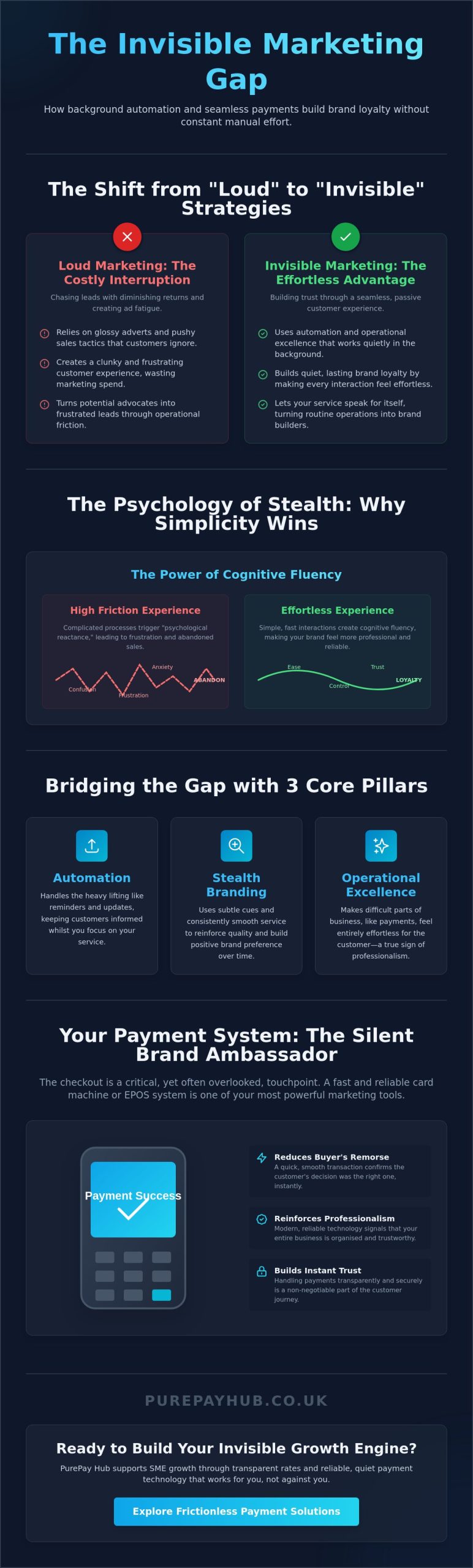
    Traditional advertising is louder than ever, yet consumers have never been better at tuning it out. Ad fatigue isn’t just a buzzword; it’s a measurable decline in how people respond to flashy banners and pushy sales tactics. This disconnect creates a specific problem for regional businesses. You spend money to get people through the door, but if the actual experience feels clunky, that investment is wasted. We call this 2. The “Invisible Marketing” Gap. It represents the distance between your active advertising and the passive customer experience you provide every day.

    In 2026, brand loyalty is built on trust and ease rather than volume. People don’t want to be sold to; they want their problems solved without fuss. This shift relies on three essential pillars: automation, stealth branding, and operational excellence. Automation handles the heavy lifting whilst you focus on the customer. Stealth branding uses subtle cues to reinforce your quality. Operational excellence makes the difficult parts of business, like payments, feel entirely effortless. When these pillars work together, they build a quiet brand loyalty that lasts longer than any social media campaign.

    The evolution from “Loud” to “Invisible” strategies

    Consumer behaviour has moved away from the era of the flashy billboard. Today, customers favour frictionless interactions that respect their time. This is where the “mere exposure effect” comes into play. By providing a consistently smooth service, you build a positive brand preference in the customer’s mind without them even realising it. Whilst large corporations often feel cold and distant, SMEs can use invisible marketing to highlight their local expertise and reliability. It’s about being dependable, not just visible. You win by being the easiest choice in your community.

    Identifying the gaps in your current strategy

    Take a moment to audit your customer touchpoints. Every time a customer has to wait too long or deal with a confusing process, you lose a bit of their trust. This friction is expensive. It negates your active marketing spend by turning a potential advocate into a frustrated lead. 2. The “Invisible Marketing” Gap is the missed opportunity to turn routine operations into brand builders. If your card machine is slow or your booking system is complex, you’re widening that gap. Closing it starts with making your backend operations your most effective sales tool. True growth happens when your service speaks for itself.

    The Psychology of Stealth: Why background efforts win

    Why do some brands feel like a natural part of our lives whilst others feel like a constant interruption? The answer lies in the psychology of stealth. When a business operates smoothly in the background, it respects the customer’s time and mental energy. This is the most effective way to bridge 2. The “Invisible Marketing” Gap. Instead of bombarding people with messages, you focus on the quality of the interaction itself. This approach wins because it aligns with how our brains actually work. You don’t need a loud voice when your actions are consistent and reliable.

    Cognitive fluency is the ease with which we process information. When a process is simple and fast, we perceive it as more truthful and reliable. A fast payment gateway or a responsive countertop card machine isn’t just a utility. It’s a psychological trigger that says, “This business is professional.” Complicated systems do the opposite. They create friction that drives customers away, regardless of how good your marketing campaign was. By making the path of least resistance your standard operating procedure, you secure your status as a favourite brand in the customer’s mind.

    Cognitive Fluency and the path of least resistance

    The human brain is wired to seek simplicity. Complicated systems, like a multi-step checkout or a glitchy card machine, trigger “psychological reactance.” This is the feeling of being restricted or frustrated, which often leads to customers abandoning their purchase. A smooth, fast checkout does more than just complete a sale; it reinforces your authority. When the process is familiar and fast, customers feel in control. This sense of ease is what brings people back time and again without you needing to spend a penny on new adverts.

    Building trust through consistent background presence

    Trust isn’t always built through large gestures. Often, trust is built in the quiet moments between transactions. Automated reminders or status updates keep the customer informed without being intrusive. These background efforts reduce anxiety and show you’re organised. Payments and checkouts are often overlooked yet crucial touchpoints in this journey. If these moments are handled with speed and transparency, your brand authority grows naturally. Using “invisible” data to personalise these interactions makes the customer feel seen, rather than just managed.

    Operational speed is a direct signal of competence. If you can process a transaction or answer a query instantly, you project an image of authority. This leads to organic advocacy. Customers who have a frictionless experience are more likely to recommend you to others. They become your marketing team without you ever having to pay for a testimonial. If you want to turn your operations into a silent growth engine, consider how modern EPOS systems can help you automate these crucial background tasks whilst you focus on serving your community.
    The Invisible Marketing Gap: How Payments Build Brands

    Bridging the Gap: The payment experience as marketing

    Whilst many business owners focus their energy on social media campaigns or local flyers, they often overlook the most critical touchpoint in the building. The card machine is the final brand ambassador your customer interacts with. If that interaction is slow or awkward, it leaves a lasting negative impression. A seamless transaction is the most direct way to close 2. The “Invisible Marketing” Gap. It ensures that the positive feeling of the purchase isn’t ruined by a frustrating checkout process. You’ve worked hard to win the sale; don’t let a clunky terminal lose the customer’s future loyalty.

    Modern payment technology like NFC (Near Field Communication) and integrated EPOS systems do more than just process money. They reduce “buyer’s remorse” by making the transaction happen in the blink of an eye. The faster the payment, the less time there is for doubt to creep in. This isn’t about tricking the customer. It’s about respecting their time and maintaining the momentum of a positive experience. Professionalism is also reinforced through digital Payment Links and branded receipts. These tools keep your name in front of the customer long after they’ve left the premises, reinforcing your brand identity without an active sales pitch.

    The Countertop Card Machine: More than just a terminal

    A sleek, fast Countertop Card Machine signals that your business is legitimate and modern. It tells the customer that you value their convenience. By accepting all payment types, including Apple Pay and Google Pay, you show brand inclusivity. You aren’t just taking their money; you’re providing a service that fits their lifestyle. You can also use payment data to identify your most loyal customers. This allows you to offer “invisible” rewards, such as a surprise discount on their next visit, without needing a complex loyalty card scheme. It’s a simple way to make people feel valued.

    Integrated EPOS systems: The heart of invisible operations

    For hospitality and retail businesses, efficiency is everything. Integrated EPOS systems ensure that your front-of-house “talks” directly to the kitchen or stockroom. This reduces wait times and prevents errors that could damage your reputation. When your systems are integrated, your staff don’t have to spend their time on manual data entry or running back and forth to check stock. They can stay focused on the customer. This operational excellence is a form of marketing that builds trust through consistent, high-quality service. It turns a routine transaction into a professional experience that customers will want to repeat. You win by being the business that just works.

    Implementing Invisible Strategies in your SME

    Closing the gap between what you promise in your adverts and what you deliver at the till requires a structured plan. You can’t fix every operational hurdle at once. Instead, you must systematically replace manual, “loud” efforts with quiet, automated systems. This is the most practical way to bridge 2. The “Invisible Marketing” Gap. It turns your daily operations into a self-sustaining growth engine that doesn’t rely on your constant manual intervention. You win by being the business that is simply easier to deal with.

    The first step is to map your customer journey from discovery to post-purchase. Identify the friction points where active effort is currently needed. Are you manually chasing payments? Are customers waiting for an old terminal to dial out? These moments are where “invisible” systems should take over. Upgrading your hardware to support modern expectations is essential. Whether it’s a portable card machine for tableside service or a mobile card machine for trade work, speed is your best marketing tool. Finally, you must monitor “invisible” metrics like transaction speed and repeat visit rates. These figures provide a clearer picture of your brand health than any social media metric.

    Automating the post-purchase loop

    The relationship shouldn’t end the moment the receipt is printed. You can set up “invisible” review requests that trigger automatically after a successful card payment. This builds your online reputation whilst you focus on the next customer. For service-based businesses, using a virtual terminal ensures that your invoicing is professional and arrives on time. You can also use payment links in follow-up emails for subtle upselling. It’s a low-pressure way to encourage repeat business without the customer feeling pestered. It keeps your brand in their mind through utility rather than interruption.

    Maintaining PCI compliance as a trust signal

    Security is the ultimate form of invisible marketing. When your payment systems work perfectly, no one notices the complex encryption happening in the background. This builds a vital foundation of safety. Customers feel confident returning to a business where their financial data is handled with integrity. PurePay Hub manages the complexity of PCI compliance for you, which removes a significant administrative burden from your shoulders. You can find more detail on staying protected in The Merchant’s Guide to PCI Compliance. When security is seamless, trust becomes a permanent part of your brand identity.

    If you’re ready to stop chasing leads and start building a brand that sells itself, view our range of smart card machines to find the right fit for your business.

    PurePay Hub: Your partner in invisible growth

    Every successful business needs a quiet engine running in the background. At PurePay Hub, we position ourselves as that engine for UK SMEs. We understand that your focus should remain on your customers and your craft, not on the technicalities of financial processing. By providing reliable, “no-nonsense” technology, we help you bridge 2. The “Invisible Marketing” Gap. You don’t need a loud payment provider; you need a fair partner that ensures every transaction reinforces your brand’s professionalism. We act as a stabilizing force for your finances so you can grow with confidence.

    Our approach is built on the principles of honesty and integrity. We offer competitive rates, such as 0.3% for debit transactions, with absolutely no hidden markups. This transparency allows you to maintain a healthy cash flow without the stress of unexpected costs. Next-day funding ensures your capital is available when you need it, supporting the invisible health of your daily operations. Whether you utilize our integrated EPOS systems or our portable card machines, you gain the flexibility to serve your community wherever they are. We provide the tools; you provide the excellence.

    Transparent fees for a clearer business focus

    Clarity is the foundation of trust. We break down our rates to ensure you know exactly what you are paying for every sale. Our promise is to provide the lowest card machine rates for small business UK merchants whilst maintaining a high standard of service. By eliminating the murky fee structures used by traditional competitors, we allow you to reinvest your savings back into your business. You deserve a partnership that is untainted by corporate jargon or complex contracts. Our goal is to help you stay focused on what matters most: your growth.

    Support that works in the background

    Our commitment to your success goes beyond just processing payments. We offer quick onboarding and dependable technical support to ensure your systems never skip a beat. If you need capital for a new project, a business cash advance can provide the necessary funds based on your future card sales. This is support that works with you, not against you. We handle the complexities of the backend so your brand remains a symbol of reliability in the eyes of your customers. Trust is built through consistency, and we are here to provide that steady presence for your business.

    Ready to close the gap? Explore our card machine solutions today.

    Transform Your Operations into Your Greatest Advocate

    Growing a business doesn’t require a louder voice; it requires a smoother system. By focusing on the customer experience at the point of sale, you bridge 2. The “Invisible Marketing” Gap. This strategy turns every routine transaction into a quiet endorsement of your brand’s quality and reliability. You’ve seen how frictionless payments and automated follow-ups build long-term loyalty without the constant drain of expensive advertising campaigns. Operational excellence is the most honest way to prove your value to your local community.

    It’s time to let your backend systems do the heavy lifting for you. We provide the tools to make your business growth feel effortless and professional. With debit rates starting from 0.3% and next-day access to funds, your cash flow stays as healthy as your reputation. Our next-generation integrated EPOS systems ensure your team can focus on serving people rather than managing paperwork. Switch to PurePay Hub for transparent, high-speed card processing and start building a brand that speaks for itself. You have the vision; we provide the steady technology to support it.

    Frequently Asked Questions

    What exactly is invisible marketing for a small business?

    Invisible marketing is the practice of using operational excellence and seamless customer experiences to build brand loyalty without overt advertising. For a small business, this means making every interaction so smooth that the customer feels valued and respected. It addresses 2. The “Invisible Marketing” Gap by turning necessary tasks, like processing a payment, into positive touchpoints. This builds trust quietly and effectively through consistent reliability.

    How do card machines contribute to my marketing strategy?

    A card machine is the final touchpoint in a physical store and acts as a vital brand ambassador. Using a fast, modern Countertop Card Machine signals that your business is professional and values the customer’s time. It reduces friction at the most sensitive part of the journey. Accepting modern methods like Apple Pay shows you are inclusive and technologically capable. This leaves a lasting positive impression that encourages repeat visits.

    Can automation really replace a marketing department for an SME?

    Automation doesn’t replace the need for a strategy, but it handles the repetitive tasks that drain your time. Background systems can manage review requests, digital receipts, and loyalty rewards automatically. This allows a small business owner to maintain a consistent brand presence without hiring a full team. It ensures that your background efforts are working 24/7 whilst you focus on your core service and community.

    Is invisible marketing ethical for UK businesses?

    Yes, because it is based on improving the customer experience rather than using trickery. Invisible marketing is about removing hurdles and becoming more efficient for the benefit of the buyer. It relies on transparency and reliability to win trust over time. By providing a better service through smoother operations, you are being a fair partner to your customers. It’s a principled approach that respects the consumer’s desire for simplicity.

    How much do integrated EPOS systems cost to run?

    Costs for integrated EPOS systems vary depending on your business size and specific requirements. You should check with providers for tailored quotes that suit your particular industry and volume. These systems often save money in the long run by reducing manual errors and improving stock management. We prioritise clarity in our fee structures to ensure you aren’t surprised by hidden costs. We focus on providing value through operational efficiency.

    How can I measure the ROI of background marketing efforts?

    You can measure the return on investment by tracking specific operational metrics rather than just clicks. Look at your repeat customer rate, average transaction speed, and the number of organic reviews you receive. These data points indicate how well your background systems are closing 2. The “Invisible Marketing” Gap. If customers return more frequently and leave positive feedback without being prompted, your strategy is working effectively to build long-term value.

    What is the difference between stealth marketing and invisible marketing?

    Stealth marketing often involves hidden advertisements or paid influencers who don’t disclose their relationship with a brand. Invisible marketing is different because it focuses on the quality of the actual service provided. It isn’t about hiding a sales pitch; it’s about making the service so good that the pitch isn’t necessary. One relies on secrecy to influence, whilst the other relies on operational excellence and customer respect to earn loyalty.

    How does next-day funding help my business growth?

    Next-day funding keeps your cash flow healthy and predictable. It ensures that the money you’ve earned is available almost immediately to pay suppliers or invest in new stock. This stability allows you to respond quickly to local opportunities without waiting for traditional banking cycles to complete. It’s a quiet form of support that keeps your business moving forward without financial bottlenecks. Reliable cash flow is the foundation of any growing brand.

  • Card Payment Methods for Small Business UK: The 2026 Merchant’s Guide

    Card Payment Methods for Small Business UK: The 2026 Merchant’s Guide

    In January 2026, contactless payments accounted for a staggering 75% of all debit card transactions across the UK. Since the mandatory £100 limit was removed on 19 March 2026, the way your customers pay has shifted permanently. Finding the most efficient card payment methods for small business UK shouldn’t feel like a battle against hidden “non-compliance” fees or complex contracts. You’ve likely grown tired of waiting days for your funds to clear or dealing with hardware that fails during a busy Saturday afternoon.

    We believe that payment processing should be a transparent partnership that fuels your cash flow, not a cost centre filled with markups. This guide promises to show you the most cost-effective ways to accept card payments, from physical terminals to remote payment links. We will explore the latest transaction-based pricing models and next-day funding options available to you right now. You’ll gain the clarity needed to choose reliable hardware that stays connected, allowing you to focus on growing your business with absolute confidence.

    Key Takeaways

    • Understand why offering diverse card payment methods for small business UK is essential in 2026 to capture every sale in an increasingly cashless economy.
    • Compare the benefits of countertop, portable, and mobile hardware against remote solutions like virtual terminals and secure payment links.
    • Learn how to decode complex merchant statements and move toward a transparent, transaction-based pricing model that removes hidden markups.
    • Discover how next-day funding and Business Cash Advances can improve your cash flow and provide the capital you need for growth.
    • Identify the specific payment setup your industry requires, from “pay-at-table” hospitality tech to integrated EPOS systems for retail shops.

    The Evolution of Card Payment Methods for Small Business UK

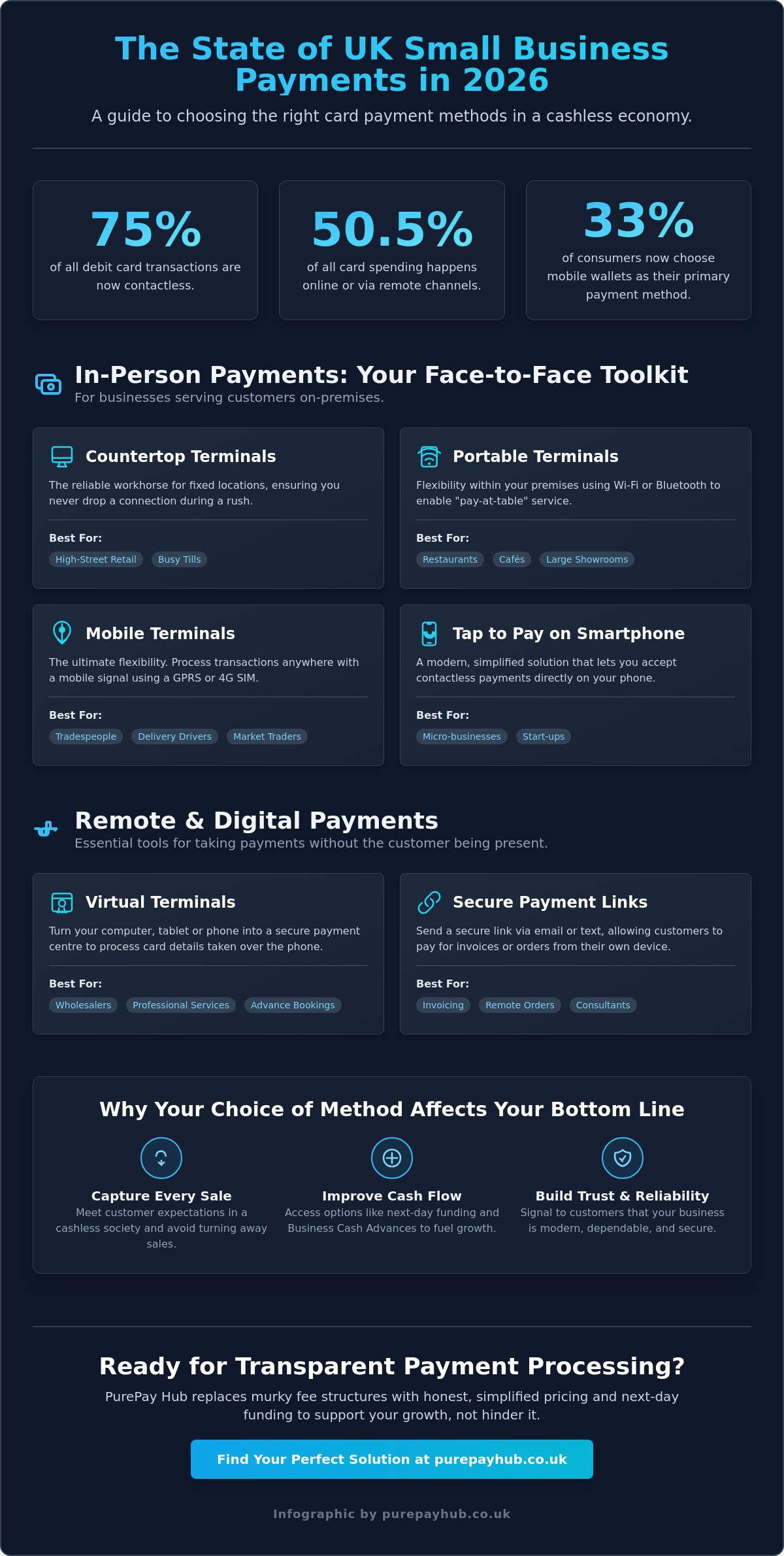
    The UK’s journey toward a cashless society has reached a definitive milestone in 2026. By January of this year, contactless transactions accounted for 75% of all debit card activity. We’ve moved beyond the era where “cash only” signs were acceptable. For modern SMEs, providing robust card payment methods for small business UK is no longer a luxury; it’s a fundamental pillar of trade. If you aren’t equipped to handle digital payments, you’re effectively turning away a massive portion of the market that no longer carries a physical wallet.

    At the centre of this evolution is the PurePay Hub. We position our service as a stabilising force for your finances, ensuring that your payment infrastructure is as reliable as your service. This “Pure” approach is built on transaction-based clarity. It removes the murky fee structures used by competitors and replaces them with honest, simplified pricing that supports your growth rather than hindering it. Whether you’re taking payments face-to-face via a mobile terminal, online through a gateway, or remotely using secure payment links, transparency is our default setting.

    Current UK Payment Trends and Consumer Behaviour

    Shoppers in the UK have embraced digital convenience with record-breaking speed. The history of contactless payments shows how quickly we moved from niche adoption to total market dominance. Since 19 March 2026, banks have had the freedom to set their own contactless limits, effectively ending the old £100 cap for many providers. This change has made mobile wallets the primary choice for 33% of consumers. If your checkout is slow or your hardware drops connection, you aren’t just losing time. You’re losing the trust of a customer who expects an instant, secure experience. Speed has become a primary currency in the British retail and hospitality sectors.

    Why Your Choice of Method Affects Your Bottom Line

    The decision to limit your payment options directly impacts your profit margins. Cash-only policies are increasingly rare, especially whilst 50.5% of all card spending now happens online or via remote channels. Beyond the risk of lost footfall, manual bookkeeping for cash sales often leads to errors that cost businesses hours of administrative time. By using integrated card payment methods for small business UK, you automate your record-keeping and reduce the risk of manual mistakes. Secure, professional interfaces don’t just process money; they signal to your customers that your business is dependable and modern. This reliability is what turns a one-time visitor into a loyal advocate for your brand.

    In-Person vs Remote: Comparing Your Payment Options

    Every UK merchant has a unique workflow. A florist might need a countertop machine for their shopfront in the morning but require a secure payment link for a wedding order in the afternoon. Choosing the right card payment methods for small business UK isn’t about finding a one-size-fits-all device. It’s about building a toolkit that mirrors how you actually trade. Whether you are serving customers face-to-face or taking orders over the phone, your setup must be fast, reliable, and entirely transparent.

    Physical Terminals: Countertop to Mobile

    For businesses with a fixed location, countertop card machines remain the reliable workhorse. These devices plug directly into your power supply and ethernet port, ensuring they never run out of battery or drop a Wi-Fi signal during a rush. They are the gold standard for high-street retail where speed at the till is a priority. If your business involves moving around a premises, such as a restaurant or a large showroom, portable units are the better fit. These use Wi-Fi or Bluetooth to allow for “pay-at-table” service, which significantly improves the customer experience.

    Mobile card machines represent the ultimate flexibility for tradespeople, delivery drivers, and market traders. These devices use GPRS or 4G SIM cards to process transactions anywhere with a mobile signal. You don’t need to rely on a customer’s guest Wi-Fi or a patchy hotspot. Many micro-businesses in 2026 are also adopting “Tap to Pay” technology. This allows you to accept contactless payments directly on your smartphone without needing any additional hardware at all. It’s a simplified, modern solution for those just starting their journey.

    Remote and Digital Payment Methods

    Remote payments are often the missing piece in a merchant’s strategy. Virtual terminals turn your computer, tablet, or phone into a secure payment centre. They allow you to take card details over the phone and process them through a secure web-based dashboard. This is a vital tool for wholesalers, professional services, and any business that takes bookings in advance. It removes the need for physical contact whilst maintaining high security standards.

    Payment links have become one of the most popular card payment methods for small business UK due to their sheer simplicity. You generate a unique “pay now” button and send it to your customer via email, SMS, or WhatsApp. The customer pays at their convenience using their own device. This method is particularly effective for chasing invoices or taking deposits. For those with a website, an online payment gateway is essential. It provides a seamless checkout experience that keeps your brand front and centre. If you’re looking to upgrade your current setup, exploring transparent payment solutions can help you find the right balance between hardware and digital tools.

    Deciding between a standalone card reader and an integrated EPOS system depends on your growth plans. Standalone readers are excellent for simplicity. However, an integrated EPOS system connects your payments directly to your inventory and accounting software. This link reduces manual entry errors and gives you a real-time view of your business health. It’s a disciplined approach to management that saves hours of administrative work every week.

    Card Payment Methods for Small Business UK: The 2026 Merchant's Guide

    Decoding Merchant Fees: The PurePay Hub Transparency Model

    Most merchants feel a sense of dread when their monthly statement arrives. It’s often a dense document filled with acronyms like MSC, IFR, and PCI, designed to confuse rather than clarify. Understanding the fee structure behind card payment methods for small business UK is the first step to protecting your margins. We believe in a different standard. Our “Pure” approach replaces industry jargon with absolute clarity, ensuring you know exactly where every penny of your transaction fee is going.

    The cost of taking a payment is split into three main parts: the interchange fee, the card scheme fee, and the merchant service charge. Under the UK’s Interchange Fee Regulation (IFR), domestic consumer card fees are capped at 0.2% for debit cards and 0.3% for credit cards. However, many providers add significant markups on top of these base rates. Whilst typical transaction fees for small businesses range from 1.4% to 2.5%, some “flat-rate” providers charge a premium for simplicity. We advocate for a transaction-based model that reflects the actual cost of processing, giving you a fairer deal on every sale.

    Breaking Down the Costs of Taking Cards

    Debit cards remain the favourite method for daily transactions in Britain. Because of the 0.2% interchange cap, these are the most cost-effective payments to process. Credit cards are slightly more expensive due to their 0.3% cap and the additional risk involved for the bank. You should also consider your hardware costs. Monthly

    Selecting the Right Setup for Your Business Type

    Every industry has a distinct rhythm. A local butcher has different operational needs than a mobile plumber or a high-street solicitor. The goal is to match your choice of card payment methods for small business UK to your specific customer behaviour. When you align your hardware with how your clients actually prefer to pay, you remove friction from the sale. This alignment is the foundation of a disciplined, professional merchant strategy.

    Retail and Hospitality Configurations

    High-street shops prioritising high throughput need countertop machines at permanent checkout points. In a busy retail environment, every second saved reduces queues and prevents lost sales. Integrated EPOS systems are essential here. They link your card machine directly to your stock levels and accounting software. This integration removes the need for tedious double-entry and stops staff from making manual pricing errors. It provides a real-time view of your business health, allowing for more accurate stock management and financial planning.

    For UK pubs and cafes, the “pay-at-table” model is now the expected standard. Since the 19 March 2026 change to contactless limits, customers expect to settle bills quickly without leaving their seats. Portable machines using Wi-Fi allow your team to take payments anywhere on the premises. This flexibility keeps the atmosphere relaxed whilst ensuring your table turnover remains high. Reliable hardware that doesn’t drop its connection is the difference between a smooth service and a frustrated customer.

    Service-Based and Mobile Business Needs

    Mobile trades and delivery drivers face the unique challenge of patchy connectivity. Relying on a customer’s home Wi-Fi is often unprofessional and unreliable. Mobile card machines with GPRS or 4G SIMs ensure you can take payments in the field, whether you’re in a city centre or a rural village. Payment links are also a brilliant tool for collecting deposits before work begins. You can send a link via WhatsApp or email, allowing the customer to pay instantly from their own device. This method has seen massive growth, especially as digital wallet preferences reached 33% of UK customers by early 2026. To find the perfect configuration for your trade, you can view our full range of merchant solutions today.

    By choosing card payment methods for small business UK that fit your specific workflow, you build a foundation for growth. Whether you need the speed of an integrated retail till or the mobility of a GPRS-enabled reader, the right setup ensures you never miss a sale. A transparent partnership with your processor means you can scale your equipment as your business expands.

    Maximising Growth with PurePay Hub Solutions

    Taking payments is the heartbeat of your enterprise. However, the right card payment methods for small business UK should do more than just process a transaction. They should act as a catalyst for your expansion. We don’t just provide hardware; we offer a partnership that prioritises your financial health. This starts with our commitment to simplicity and ends with your business reaching its full potential through reliable, honest service.

    Accelerating Your Cash Flow

    The standard 3-5 day wait for funds to clear is a relic of the past. It’s a delay that many SMEs simply cannot afford whilst managing daily overheads and supplier invoices. We’ve replaced this friction with next-day funding as a standard feature. Getting your money into your bank account within 24 hours ensures your cash flow remains fluid and predictable. It allows you to reinvest in stock or pay your team without the stress of a clearing cycle.

    Our “Hub” approach centralises all your payment data into one clean, modern dashboard. You can track every sale across your mobile readers, countertop units, and virtual terminals in real time. This transaction-based reporting removes the guesswork from your finances. You won’t have to sift through complex statements to find hidden costs. Instead, you get a transparent view of your earnings, helping you maintain a disciplined approach to your business accounting.

    Funding Your Future Growth

    Sometimes, growth requires a capital injection that traditional banks are slow to provide. A Business Cash Advance offers a modern alternative by using your future card sales to fund current projects. Unlike a rigid bank loan with fixed monthly costs, this is a flexible arrangement where you repay as you earn. Repayments are calculated as a small percentage of your daily card takings, meaning they stay in sync with your actual performance.

    If you have a quieter month, your repayments naturally decrease in proportion to your sales. This makes it a much safer option for card payment methods for small business UK than traditional debt. It’s a fair way to fund a new piece of equipment, a marketing campaign, or a shop fit-out. We know that time is your most valuable asset, so our onboarding process is designed to be completed within 24 hours. You don’t have to navigate corporate jargon or wait weeks for a decision. Once you’re live, our dedicated UK support team is always on hand to help you navigate any challenges.

    We are here to ensure your payment infrastructure is a source of strength, not a cause of frustration. If you’re ready to experience a more transparent way of working, you can Get a transparent quote from PurePay Hub today. Let’s build a partnership that puts your growth first.

    Future-Proof Your Business with Transparent Payments

    The UK’s transition to a truly digital economy is complete. With contactless payments dominating 75% of debit transactions as of January 2026, your choice of card payment methods for small business UK determines your daily efficiency. You’ve seen how the right mix of hardware and remote links can streamline your operations. Now it’s time to ensure your processing costs are just as efficient as your service.

    We believe in a partnership where your success comes first. This means providing debit rates from 0.3% and ensuring next-day access to your funds to keep your cash flow moving. We’ve removed the stress of hidden monthly compliance fees and complex contracts. You deserve a payment partner that acts as a reliable ally for your growth. Switch to PurePay Hub for transparent, transaction-based card payments and take control of your financial future today. Your business is ready for the next level of clarity.

    Frequently Asked Questions

    What are the cheapest card payment methods for small business UK?

    Debit cards are the most cost-effective option because domestic interchange fees are capped at 0.2% under UK regulations. To keep costs low, you should choose a provider that offers transparent, transaction-based pricing rather than tiered models that hide markups. Avoiding monthly “non-compliance” fees and choosing hardware with no hidden rental costs will also protect your margins. For many SMEs, the most efficient card payment methods for small business UK are those that align fees directly with your actual sales volume.

    Do I need a business bank account to take card payments?

    Yes, you must have a dedicated business bank account to clear funds from a merchant services provider. UK regulations and anti-money laundering rules require a clear separation between personal and professional finances. This ensures that your tax records remain accurate and that your business income is easily auditable. Whilst some micro-payment apps might offer workarounds, a professional merchant account will always require a verified business bank account to ensure next-day funding arrives safely.

    How long does it take to set up a card machine for my business?

    Digital onboarding for a new merchant account can be completed in as little as 24 hours. Once your application is approved, physical hardware such as countertop or portable machines are typically dispatched via next-day courier. This means you can go from your initial enquiry to taking your first payment in just two or three working days. We prioritise speed and simplicity to ensure your trade isn’t interrupted by lengthy administrative delays or complex paperwork.

    Can I take card payments on my phone without a machine?

    Yes, you can accept contactless payments directly on a compatible smartphone using “Tap to Pay” technology. This has become a major trend in 2026 for mobile traders and service providers who don’t want to carry extra hardware. Alternatively, you can use payment links or virtual terminals to process transactions via your phone’s web browser. These methods are perfect for micro-businesses that need a flexible, software-led approach to their daily sales.

    What is the difference between a merchant account and a payment gateway?

    A merchant account is a dedicated holding area where your funds sit after a sale before being settled into your bank account. A payment gateway is the digital “tunnel” that securely sends card data from your website or virtual terminal to the banks for authorisation. Think of the gateway as the digital card machine and the merchant account as the temporary vault. You need both to accept online or remote payments, but they are often bundled together in one transparent package.

    How much are typical card machine transaction fees in the UK?

    For small businesses, typical transaction fees for card payment methods for small business UK range from 1.4% to 2.5% per sale. These rates depend on whether you are processing a domestic debit card, which is capped at 0.2% interchange, or a credit card, which is capped at 0.3%. Some providers offer flat-rate pricing, such as 1.69%, whilst others provide bespoke rates for businesses with a turnover exceeding £75,000. Always check for hidden “admin” fees that can inflate these base percentages.

    Is it legal to charge customers extra for using a credit card in the UK?

    No, it is illegal to charge customers a surcharge for using a consumer credit or debit card in the UK. This ban was introduced in January 2018 under the Payment Services Directive 2 (PSD2) to protect shoppers from unfair costs. You must build your processing fees into your general pricing strategy rather than adding them at the point of sale. This rule applies to both online and face-to-face transactions, ensuring a fair and transparent experience for every customer.

    What happens if my card machine loses its Wi-Fi connection?

    Professional card machines are designed with built-in redundancy to prevent lost sales during a connection failure. Most portable and mobile units will automatically switch to a GPRS or 4G mobile signal via a roaming SIM card if the Wi-Fi drops. Some devices also offer an “offline mode” or “Store and Forward” feature, which allows you to capture payment details and process them once the connection is restored. This ensures your checkout remains fast and reliable even in areas with patchy internet coverage.