Tag: NFC

  • Apple Pay for UK Businesses: The Complete Merchant Guide for 2026

    Apple Pay for UK Businesses: The Complete Merchant Guide for 2026

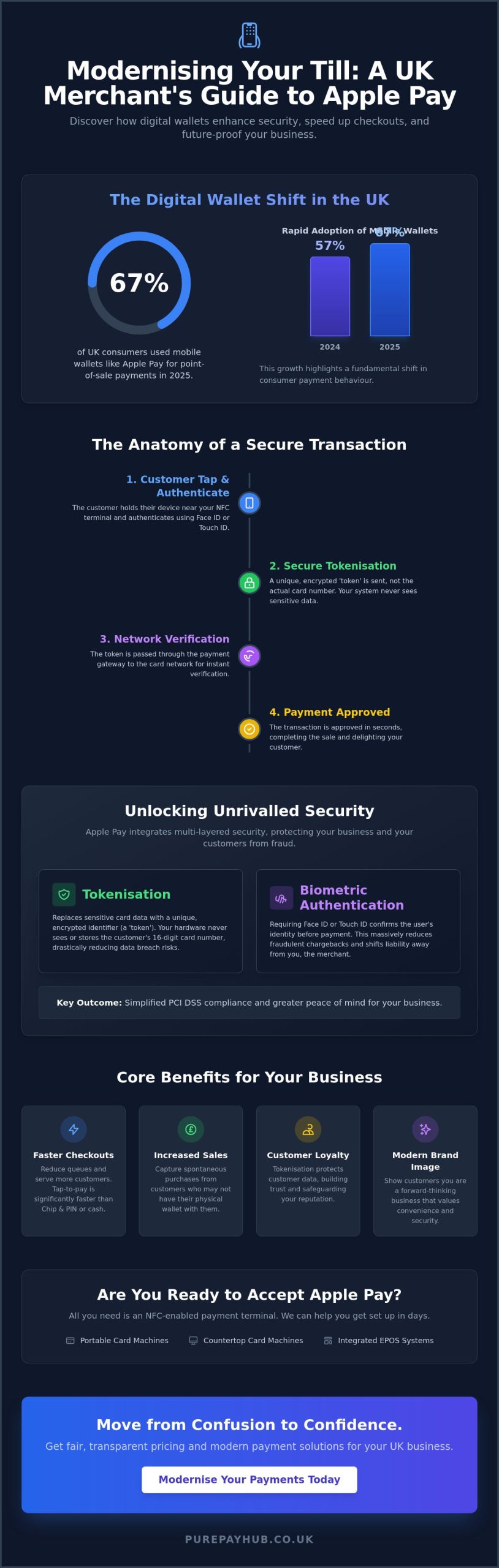
    In 2025, 67% of people in the UK used apple pay for point-of-sale transactions, proving that mobile wallets are now a standard expectation rather than a luxury. You have likely felt the frustration of watching a queue grow whilst a customer fumbles for a physical card or cash. It is a common pain point that leads to lost sales and unnecessary stress for your team. You deserve a payment partner that prioritises your efficiency over complex fee structures and opaque banking jargon.

    Discover how accepting Apple Pay can streamline your checkout, enhance your security, and lower transaction friction for your UK business. We believe in providing a fair, transparent path to modernising your till without the usual industry headaches. This guide covers everything from the latest 2026 interchange fee regulations to how our portable card machines and EPOS systems integrate seamlessly with NFC technology. We will help you move from confusion to confidence, ensuring your processing costs remain predictable and your customers stay satisfied.

    Key Takeaways

    • Understand why UK consumers are rapidly moving away from physical cards and how this shift affects your checkout speed.
    • Discover how tokenisation and biometrics in apple pay work together to shield your business from fraudulent chargebacks.
    • Clear up the confusion around processing fees with a transparent breakdown of merchant service charges for mobile wallets.
    • Learn how to quickly audit your card machine hardware to ensure you are ready for the latest NFC technology.
    • Find out how to secure predictable processing rates and get your merchant services up and running in a matter of days.

    What is Apple Pay for Businesses and Why Does it Matter?

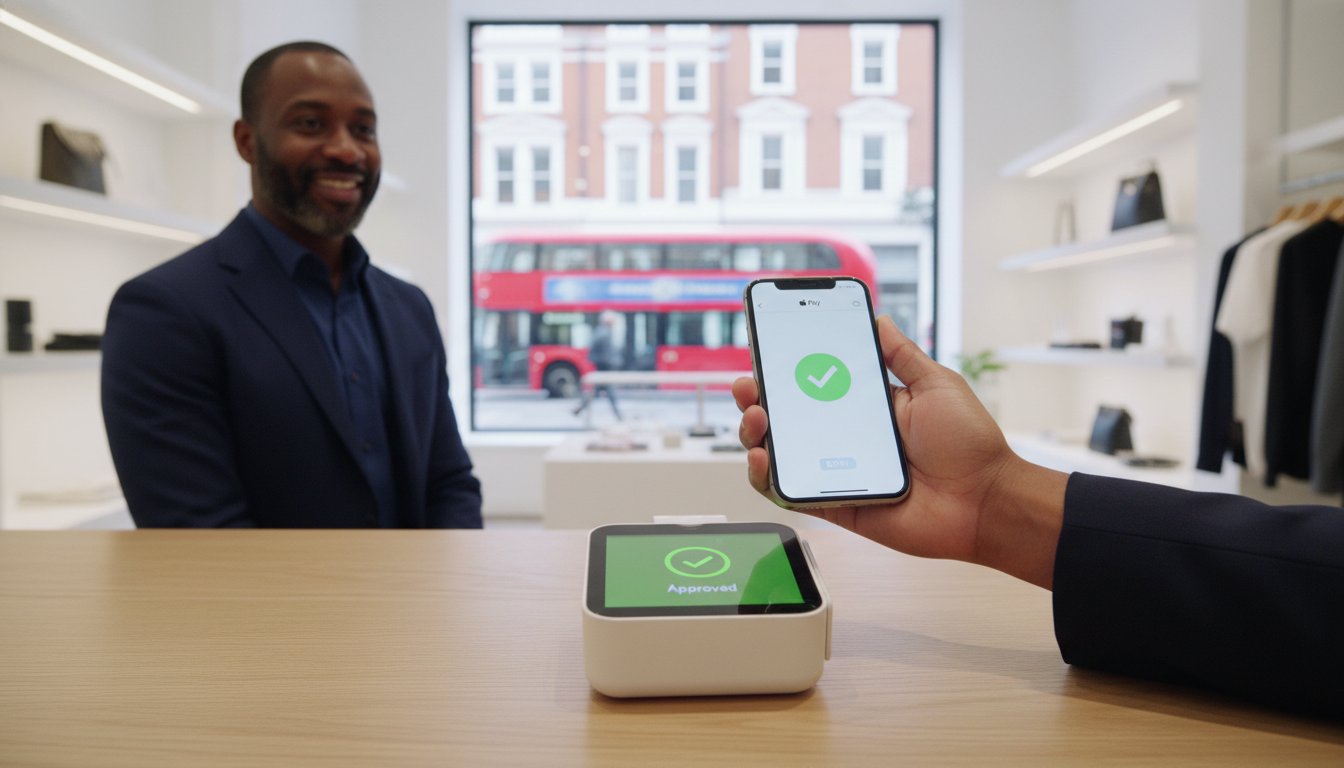
    The way we pay has changed forever. For a modern merchant, understanding What is Apple Pay is the first step toward a more efficient till. It is a mobile payment and digital wallet service that allows customers to pay using an iPhone or Apple Watch via Near Field Communication (NFC) technology. Whilst consumers see a sleek app, you see a tool that reduces checkout friction. By 2026, the shift is undeniable. Over half of all UK contactless payments are now mobile-based, driven by a desire for speed and security.

    Accepting apple pay requires more than just a bank account. You need an NFC-enabled terminal, such as a Portable Card Machine or a Countertop Card Machine, to bridge the gap between the customer’s device and your merchant account. This technology fits perfectly into the UK’s rapid move toward a cashless society. It is no longer about just ‘taking cards’; it’s about meeting your customers exactly where they are. We see this as a partnership between your business and the latest financial tech.

    The Growth of Digital Wallets in the UK

    Data from UK Finance shows that 57% of UK adults were registered for a mobile wallet in 2024. By 2025, adoption surged even further, with 67% of the population using the service for point-of-sale transactions. Regional businesses are moving away from cash-only models because digital wallets encourage spontaneous purchases. A customer who forgets their physical wallet can still buy from you if they have their phone. This flexibility builds immediate loyalty and ensures you never lose a sale to a ‘cash only’ sign. It makes your business feel modern and accessible to every demographic.

    Core Terminology for Merchants

    NFC stands for Near Field Communication. It is a short-range wireless technology that allows two devices to talk when they are close together. Your physical card reader or EPOS System detects the encrypted signal from an iPhone and processes it instantly. This differs from a Virtual Terminal, which is used for keyed-in remote payments. Whilst ‘Contactless’ and ‘Apple Pay’ seem the same at the till, the backend involves different layers of security. This process, known as tokenisation, ensures that sensitive card data is never actually shared with your hardware, protecting both you and your customer.

    How Apple Pay Works: Security and Tokenisation Explained

    Security shouldn’t be a headache for a busy business owner. In an industry often viewed with skepticism, apple pay offers a level of protection that traditional magnetic stripe or even Chip and Pin methods simply cannot match. The foundation of this system is tokenisation. This process replaces sensitive card data with a unique, encrypted identifier called a “token”. When a customer taps their iPhone against your Portable Card Machine, your hardware never actually “sees” or stores their 16-digit card number. This ensures that even if your local system were compromised, there is no usable financial data for a criminal to steal.

    Biometric authentication adds another layer of calm advocacy for your business. By requiring Face ID, Touch ID, or a passcode, the system confirms the user’s identity before the transaction is even broadcast. This significantly reduces the risk of fraudulent chargebacks. For you, the merchant, this often results in a liability shift. Because the authentication is handled securely on the device, the risk for “card-present” fraud typically moves away from your business and toward the card-issuing bank. You can find more detail on these technical safeguards in this overview of Apple Pay security and privacy.

    The Process of a Transaction

    The journey from a tap to your bank account is remarkably swift. First, the customer’s device sends the digital token to your Payment Gateway. The gateway then passes this token to the card network for verification. Because there is no physical card to insert or mechanical chip to read, these transactions are typically faster than traditional methods. This speed reduces queues and keeps your customers happy. Choosing the right NFC-enabled terminal is the first step toward securing your till and speeding up your throughput.

    PCI Compliance and Data Protection

    Managing data protection is a heavy burden for regional merchants. However, using mobile wallets simplifies your PCI DSS compliance requirements. Since you aren’t storing actual credit card numbers on your local servers or EPOS Systems, the scope of your security audits is greatly reduced. This isn’t just a technical benefit; it’s a brand promise. You can confidently reassure your customers that their data is safe, positioning yourself as a modern, dependable business partner in the local community. It is a no-nonsense approach to safety that lets you focus on growth rather than red tape.
    Apple Pay for UK Businesses: The Complete Merchant Guide for 2026

    Accepting Apple Pay: Merchant Costs and Business Benefits

    A common misconception amongst regional business owners is that modern mobile wallets carry hidden premiums. This simply isn’t true. Accepting apple pay typically costs exactly the same as a standard contactless card transaction. You pay your agreed Merchant Service Charge (MSC) to your processor, and that is it. Apple does not charge merchants a penny extra for the privilege of using their platform. By removing this barrier, you can focus on what really matters: moving customers through your shop faster and more securely.

    Speed is a silent revenue generator. When you reduce queue times during peak hours, you capture sales that might otherwise be lost to frustration. Features like “Express Mode” allow for even faster transactions in high-volume retail environments, as customers don’t even need to wake their device. This efficiency doesn’t just improve the atmosphere of your shop; it directly boosts your throughput at the till. It is a no-nonsense way to modernise your service without increasing your overheads.

    Fee Structures for UK Small Businesses

    Understanding your costs requires looking at two main components: interchange fees and processor markups. In the UK, domestic interchange fees are capped at 0.2% for debit cards and 0.3% for credit cards. Transparent, fixed-rate pricing models often provide the best value for apple pay volume because they offer predictability. Contrast this with the hidden costs of cash. Between bank deposit fees, insurance premiums, and the risk of theft, digital payments are often the more cost-effective choice for a disciplined business. We prioritise clarity, ensuring you know exactly what leaves your account every month.

    The Hidden Value of Digital Payments

    Digital payments often lead to higher average transaction values. When customers aren’t limited by the physical cash in their pockets, they feel more comfortable making spontaneous additions to their baskets. Beyond the immediate sale, these systems integrate seamlessly with digital loyalty programmes and e-receipts. This allows you to build a direct relationship with your local community. Reconciliation also becomes a breeze. Instead of counting coins at the end of a long shift, your EPOS Systems and Portable Card Machines provide digital-first reporting that organises your finances in seconds.

    Setting Up Apple Pay on Your Card Machine or EPOS

    Transitioning to mobile payments is simpler than traditional banks suggest. It starts with a clear, no-nonsense audit of your current setup. You don’t need a degree in computer science to get your business ready for 2026. Follow these five steps to ensure your till is fully optimised for apple pay.

    • Audit your hardware: Look for the universal contactless symbol on your current terminal. If your machine was manufactured before the mid-2010s, it likely lacks the necessary NFC chip.
    • Enable acceptance: Contact your merchant service provider. They must toggle mobile wallet acceptance on your account backend to ensure tokens are processed correctly.
    • Update your EPOS software: Running the latest version of your EPOS Systems software prevents integration glitches and ensures security patches are current.
    • Train your team: Your staff should know that customers don’t need to ‘wake’ their device to pay. Simple cues make the process feel seamless for everyone involved.
    • Display signage: Use official decals to show you are modernised. Letting customers know you accept their favourite payment method reduces hesitation at the point of sale.

    Hardware Requirements

    Your choice of hardware should mirror your business layout. A Countertop Card Machine is a stabilising force for fixed retail points. However, if you run a restaurant or a busy showroom, a Portable Card Machine allows you to take the till to the customer. This flexibility is essential for maintaining high throughput. Regardless of the model, a stable Wi-Fi or 4G connection is non-negotiable. Mobile transactions rely on real-time token verification; a dropped signal means a lost sale. We also understand the importance of cash flow, which is why we prioritise next-day funding for businesses processing high volumes of mobile payments.

    Common Integration Troubleshooting

    Even the best systems encounter occasional hiccups. If a customer’s apple pay is declined whilst their physical card works, it is usually a bank-side security check rather than a hardware fault. Ask them to try again or use their physical card. Handling refunds is also slightly different. You will need the last four digits of their Device Account Number, found in their Apple Wallet, rather than their physical card number. Finally, remember that Apple Pay often bypasses the standard £100 contactless limit through biometric authentication. This allows for larger transactions without the need for a PIN. If you are ready to upgrade your hardware, explore our range of NFC-enabled card machines today.

    Why PurePay Hub is the Ideal Partner for Apple Pay Integration

    Choosing a payment partner is about more than just hardware. It is about finding a fair ally that values your time and your bottom line. We provide a refreshingly transparent fee structure with rates starting from 0.3% for debit and 0.5% for credit. This includes all apple pay transactions, ensuring you never face hidden markups or “premium wallet” surcharges. Our goal is to provide a stabilising force for your finances, allowing you to plan your growth with total certainty.

    Efficiency is at the heart of our no-nonsense onboarding process. We understand that regional merchants can’t afford to wait weeks for new equipment. You can have your NFC-enabled terminal delivered and ready for the till in days. Once you are up and running, our next-day funding ensures your cash flow remains healthy as your digital volume grows. If you ever need help, our UK-based support team is just a phone call away. They understand the local business landscape and speak your language, not corporate jargon.

    Growth Beyond Payments

    Your transaction data is more than just a record of sales. It is a roadmap for your future development. By building a consistent history of apple pay and card transactions, your business may qualify for a Business Cash Advance. This flexible funding option is based on your future sales, providing the capital you need to renovate, restock, or expand. Our reporting tools also allow you to track mobile versus physical card trends, giving you the insights needed to future-proof your business against the next wave of digital payment innovation.

    Take the Next Step with PurePay Hub

    The “PurePay Promise” is simple: clarity, fairness, and direct partnership. We aren’t a distant financial institution; we are a supportive ally to the UK’s local merchant community. Whether you need a free rate review to see how much you could save or a hardware upgrade to a modern Portable Card Machine, we are here to help. Modernising your checkout shouldn’t be a struggle. It should be the catalyst that takes your business to the next level. Get your Apple Pay-ready card machine from PurePay Hub today.

    Future-Proof Your Business with Confident Payment Solutions

    The transition toward a digital-first economy represents a significant opportunity to strengthen your regional business. By embracing apple pay, you secure your transactions through advanced tokenisation whilst providing the rapid checkout experience your customers now expect. You don’t have to settle for the opaque fee structures or the frustratingly slow settlement times often found with traditional banks. Efficiency and transparency are within your reach when you choose a partner that prioritises your growth.

    Modernising your till should be a straightforward step toward long-term development. We act as your reliable local expert, ensuring your move to mobile payments is both smooth and cost-effective. You can focus on serving your community whilst we manage the technicalities of your financial processing with honesty and integrity. It is time to replace confusion with informed confidence and a stable financial foundation.

    Switch to PurePay Hub for transparent Apple Pay rates and next-day funding. Benefit from debit rates starting at 0.3%, next-day funding as standard, and a total absence of hidden monthly markups. We are ready to help you stabilise your finances and build a more resilient business today.

    Frequently Asked Questions

    Do I need a special card machine to accept Apple Pay?

    You need a terminal equipped with Near Field Communication (NFC) technology. Most modern Countertop Card Machines and Portable Card Machines include this as standard. If your current hardware displays the universal contactless symbol, it is already capable of communicating with an iPhone or Apple Watch. If you are using an older device, upgrading to a modern NFC-enabled terminal is a quick and straightforward process that ensures you don’t miss out on mobile sales.

    Is Apple Pay more expensive for merchants than standard card payments?

    No, it is not more expensive. You simply pay the standard Merchant Service Charge agreed with your processor for a contactless transaction. Apple does not charge merchants any additional fees for the privilege of using their platform. This makes apple pay a cost-effective way to speed up your checkout without increasing your overheads or dealing with the hidden markups often found in traditional banking contracts.

    What is the transaction limit for Apple Pay in the UK for 2026?

    Whilst the standard UK contactless limit for physical cards remains at £100, mobile wallets operate differently. Because the customer authenticates the payment using Face ID or Touch ID, they can often complete transactions well above this limit. This is known as Consumer Device Cardholder Verification Method (CDCVM). It allows your business to accept larger payments securely without the customer needing to remember their physical card or PIN.

    How do I process a refund for a customer who paid with Apple Pay?

    Processing a refund is simple but requires the customer’s Device Account Number rather than their physical card number. They can find these last four digits in their Apple Wallet under the card’s information. You then enter this number into your card machine or EPOS System to match the original transaction token. This ensures the funds are returned safely to the correct account whilst maintaining the security of the customer’s actual card details.

    Does Apple Pay work without an internet connection on the customer’s phone?

    Yes, the customer’s device does not require an active internet connection to complete a purchase. The communication happens via short-range radio waves between the phone and your terminal. However, your card reader or Online Payment Gateway must have a stable connection to the internet to authorise the transaction with the bank. This ensures that the digital token is verified and the funds are secured in real-time.

    Are Apple Pay transactions secure for my business?

    Mobile payments are significantly more secure than traditional card methods. Tokenisation ensures that sensitive card data is never shared with your business hardware or stored on your servers. Additionally, biometric authentication nearly eliminates the risk of fraudulent transactions from lost or stolen devices. This security architecture protects your business from the stress of chargebacks and simplifies your overall PCI compliance requirements.

    How long does it take for Apple Pay funds to reach my bank account?

    The time it takes for funds to reach your account depends entirely on your merchant service provider. Many traditional banks still take three to five working days to settle funds. We understand that cash flow is the lifeblood of a regional business, which is why we provide next-day funding as standard. This ensures that your apple pay revenue is available for you to use almost immediately.

    Can I accept Apple Pay on my website as well as in-store?

    Absolutely. You can accept mobile payments online by integrating an Online Payment Gateway into your website checkout. This provides a ‘one-tap’ purchase experience that reduces cart abandonment. For businesses without a full website, Payment Links offer a no-nonsense way to accept these payments via email or SMS. Both methods use the same secure tokenisation technology to protect your business and your customers.
  • NFC Technology: A Merchant’s Guide to Contactless Payments in 2026

    NFC Technology: A Merchant’s Guide to Contactless Payments in 2026

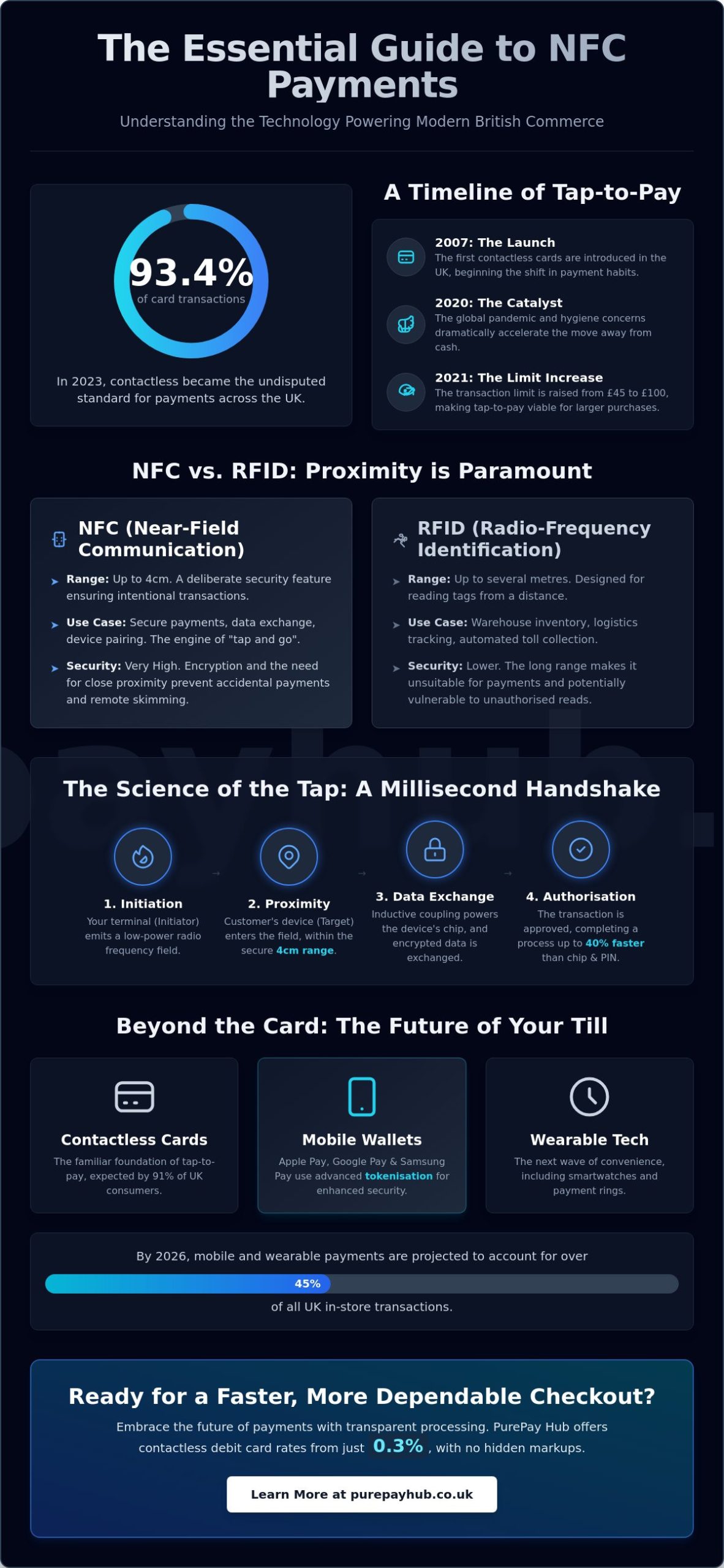
    According to UK Finance, contactless payments accounted for 93.4% of all card transactions in 2023. By 2026, a merchant without a reliable nfc strategy will struggle to keep pace with the expectations of the British high street. You likely feel the pressure of peak-hour queues and the constant need to reassure customers that their digital data is safe. You don’t want technology to be a barrier; you want it to be a bridge to better service.

    We believe in a pure and transparent approach to payment processing that puts the merchant first. This guide will show you how Near-Field Communication works to streamline your operations whilst improving customer satisfaction. You will learn the clear differences between NFC and RFID, discover how to integrate mobile wallets like Apple Pay seamlessly, and find out how to secure your business against modern fraud. We are moving beyond the jargon to give you the clarity you need for a faster, more dependable checkout hub.

    Key Takeaways

    • Understand why contactless payments have become the non-negotiable standard for British consumers and how this shift impacts your daily operations.
    • Master the mechanics of nfc technology, from the deliberate 4cm security range to the advanced tokenisation that keeps your transactions safe from fraud.
    • Identify the ideal hardware for your specific business flow, whether you require a fixed countertop terminal or a portable device for mobile service.
    • Discover how to eliminate hidden markups and access transparent processing rates, with debit card charges starting from just 0.3% for contactless payments.
    • Learn how to streamline your checkout process to reduce queues and significantly enhance customer satisfaction through modern payment solutions.

    What is NFC and Why is it Essential for UK Merchants?

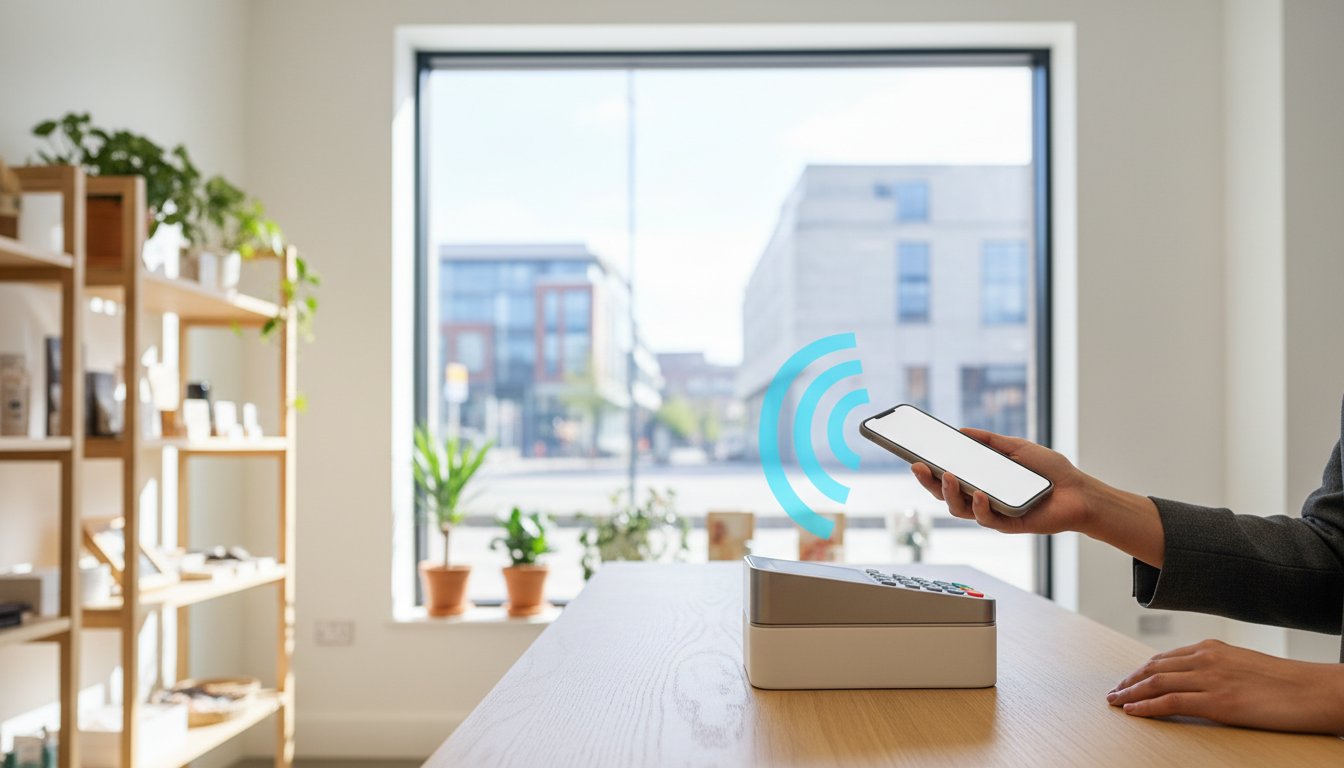
    Near-field communication (NFC) is a short-range wireless technology that allows two devices to communicate when held within 4 centimetres of each other. NFC is a proximity-based data transfer protocol operating at 13.56 MHz. For a British business owner, it’s the invisible engine behind every “tap and go” transaction at your till. Unlike older systems, it offers a secure, encrypted handshake that protects both your revenue and your customer’s data. This technology turns a standard payment terminal into a high-speed gateway for modern commerce.

    Understanding the difference between NFC and RFID is vital for your point of sale. While RFID can track items from several metres away, NFC is strictly limited to close range. This physical proximity is a security feature; it ensures that a customer cannot accidentally pay for someone else’s shopping whilst standing in a queue. It provides the “tap and go” experience that 91% of UK consumers now expect at the checkout. At PurePay Hub, we see this technology as the foundation of a transparent and efficient transaction model.

    The Evolution of Contactless Payments in the UK

    The UK payment landscape changed forever in 2007 with the introduction of the first contactless cards. Adoption was steady until the COVID-19 pandemic in 2020. During that period, hygiene concerns accelerated a massive shift away from cash. In October 2021, the UK government increased the contactless limit from £45 to £100. This change allowed merchants to process the vast majority of all card transactions via contactless, significantly increasing average transaction speed. Contactless is no longer a convenience; it’s the default behaviour for 87% of UK shoppers.

    NFC Beyond the Credit Card

    Your customers are increasingly leaving their physical wallets at home. The rise of mobile wallets like Apple Pay, Google Pay, and Samsung Pay has turned smartphones into secure payment hubs. These digital wallets use tokenisation to hide actual card details, making them even more secure than traditional plastic. Beyond phones, wearable technology is gaining ground. Smartwatches and even payment rings now utilise this technology to facilitate instant transactions. By 2026, these alternative form factors are expected to account for over 45% of all in-store payments in the UK. We provide the clarity and tools you need to accept every tap with confidence.

    How NFC Technology Works: The Science of the Tap

    NFC technology isn’t magic. It’s precision engineering designed for the modern UK high street. At its core, the process involves an “Initiator” and a “Target.” Your card terminal acts as the initiator, constantly emitting a small radio frequency field. When a customer brings their phone or card within 4cm, that device becomes the target. This 4cm limit is a deliberate security feature. It ensures that transactions only happen when intended, preventing accidental payments from passersby or “skimming” from a distance. It’s a short-range constraint that provides a long-range sense of security for your customers.

    There are three distinct modes of nfc operation that power today’s digital economy. Card Emulation is the most common for merchants, allowing a smartphone to act exactly like a physical credit card. Reader/Writer mode lets your terminal pull data from smart tags or posters. Peer-to-Peer allows two devices to swap information directly. This system operates at the speed of light, making it significantly faster than the old magnetic stripe method. Traditional stripes rely on physical friction and analogue data reading, which is slow and prone to wear. NFC uses digital packets sent via radio waves, reducing transaction times by up to 40% compared to older contact-based methods. For a busy London cafe or a retail shop in Birmingham, these seconds saved per customer directly translate to shorter queues and higher turnover.

    Inductive Coupling Explained

    NFC relies on inductive coupling to transfer power and data simultaneously. Your terminal’s internal antenna creates an electromagnetic field. When a contactless card enters this field, the card’s own antenna picks up the energy. This powers the chip without needing a battery. Physical contact isn’t actually necessary. The term “tap” is simply a user-friendly way to describe bringing two antennas into close proximity. It’s a pure, wireless handshake that happens in milliseconds, ensuring the data remains encrypted and the connection remains stable throughout the brief interaction.

    Data Exchange Protocols

    Security relies on strict global standards to maintain integrity. Most payment systems use ISO/IEC 14443. This protocol ensures that a terminal in Manchester can talk to a card issued in New York without friction. Implementing NFC correctly means choosing hardware that adheres to these standards whilst remaining updateable. As software evolves, your hardware must stay compatible with new encryption methods. At PurePay Hub, we believe your payment nfc setup should be a stable foundation for your business growth. If you want to simplify your checkout and remove technical headaches, you can explore our transparent terminal options to find a partner that values your time.

    NFC Technology: A Merchant’s Guide to Contactless Payments in 2026

    Security and Trust: Is NFC Safe for Your Business?

    Many UK business owners worry about nfc signals being “skimmed” by digital pickpockets. This fear often stems from early contactless adoption, but the technology has moved on. Modern payment standards make it incredibly difficult for fraudsters to intercept usable data. While 2024 industry data suggests that physical card theft is still a threat, digital nfc interception is practically non-existent in real-world retail environments. To understand the full landscape of NFC security threats and solutions, we need to look at how data is shielded during every tap. Security isn’t just an add-on; it’s the foundation of a Pure payment environment.

    The Power of Tokenisation

    Tokenisation is your strongest shield against data breaches. When a customer taps their device, the system doesn’t transmit the actual 16-digit card number. Instead, it sends a “token,” which is a random string of numbers that only the bank can decode. If a hacker intercepted this token, it would be useless for any other transaction or merchant. Tokenisation ensures the merchant never actually “sees” or stores the customer’s real card details. By keeping sensitive data out of your Hub, you lower your liability and protect your business from the fallout of a potential data leak. It’s a transparent way to handle sensitive info without the risk.

    Dynamic CVV and Encryption

    Every tap creates a unique cryptographic signature that validates the transaction. Unlike a physical card where the CVV is static and printed on the back, mobile wallets use a dynamic version. This security code changes for every single tap. “Replay attacks,” where a fraudster tries to use intercepted data for a second time, are virtually impossible because the bank’s system rejects any code that has already been used. This entire process happens within the Secure Element (SE) chip. This hardware is physically isolated from the rest of the smartphone’s operating system, meaning even if a phone is infected with malware, the payment keys remain untouched.

    Mobile NFC payments offer a distinct advantage over physical cards through biometric verification. A lost contactless card can be used by anyone until it’s cancelled. A smartphone requires FaceID, a fingerprint, or a passcode before the nfc chip activates. This simple step eliminates a massive portion of fraudulent activity at the point of sale. For your business, using modern hardware also simplifies your PCI DSS compliance. These devices are built to meet the latest security standards, ensuring your partnership with us is based on honesty and technical integrity. You get to focus on growth while the hardware handles the heavy lifting of data protection.

    Implementing NFC: Choosing the Right Hardware for Your Shop

    You probably already have the foundation for nfc payments sitting on your counter. Take a look at your current terminal. If you see the four curved waves symbol, you’re likely ready to accept contactless payments. However, hardware manufactured before 2020 often lacks the processing power to handle the complex encrypted handshakes required by the latest digital wallets. Upgrading your kit isn’t just a technical necessity; it’s a commitment to your customer’s time.

    Countertop vs. Mobile NFC Terminals

    Fixed countertop units are the reliable workhorses of the UK high street. They thrive in environments with high transaction volumes, like boutiques or local convenience stores. Because these units typically use wired Ethernet connections, they offer a level of stability that wireless units can’t always match. You won’t have to worry about a “searching for signal” message during a busy Saturday afternoon rush.

    Portable and mobile units are essential for hospitality and service-based businesses. Data from UK Finance shows that contactless payments accounted for 93% of all card transactions in 2023. To capture this demand at the table or on the move, you need hardware with robust battery life. Prioritise devices that offer 4G or 5G failover. If your shop’s Wi-Fi stutters, the terminal switches to mobile data instantly, keeping your revenue flowing without a hitch.

    Setting Up Your NFC Payment Zone

    The physical placement of your terminal dictates the rhythm of your shop. Place the unit at a natural elbow height to ensure the “tap” feels intuitive for the customer. A cluttered counter leads to awkward retries and “failed taps.” Use clear visual indicators to show exactly where the nfc sensor is located on the device. This simple step reduces transaction times by several seconds per person, which adds up during peak hours.

    • Keep the tap zone clear of metal objects or other electronic interference.
    • Train staff to recognise when a thick phone case or a “wallet” style cover is blocking the signal.
    • Ensure the terminal screen is visible to the customer for immediate “Approved” feedback.

    Integration is where your hardware truly becomes a Hub for your business. When your terminal speaks directly to your EPOS system, inventory management becomes automatic. You won’t need to manually count stock or reconcile receipts at the end of a long shift. Every tap updates your records in real-time, providing a pure, transparent view of your daily performance. This synergy eliminates human error and protects your profit margins.

    Our team provides the clarity you need to choose the right kit for your business. Join our partnership for honest, transaction-based processing.

    PurePay Hub: Transparent NFC Processing for UK SMEs

    PurePay Hub operates on a simple principle: your hard-earned revenue belongs to you. We’ve built our “Pure” approach to eliminate the murky markups that often drain UK small businesses. When your customers tap to pay, you shouldn’t have to guess what the final cost will be. We offer competitive rates that reflect the actual cost of processing, with debit card charges starting from just 0.3% for nfc payments. This isn’t a teaser rate; it’s our commitment to fairness.

    Cash flow is the lifeblood of any local shop or service provider. Waiting a week for your funds to clear is a relic of the past. We provide next-day funding, ensuring your nfc sales revenue reaches your bank account the very next business day. By centralising your payment data through our Hub, we give you the insights needed to track busy periods and manage stock more effectively. We don’t just process payments; we provide the clarity you need to grow.

    Simplified Fee Structures

    Many providers lure merchants in with a flat-rate model that seems simple but hides significant costs. These opaque structures often mean you’re overpaying for low-risk debit transactions. Our transaction-based model is different. We break down exactly where every penny goes. We organise your monthly statements so they’re easy to read at a glance, removing the stress of deciphering complex financial jargon.

    • No hidden markups: You pay for the service you use, nothing more.
    • Clear reporting: See your daily totals and fee breakdowns without the headache.
    • Fairness for SMEs: We provide the same transparent pricing to a local café that we would to a larger retailer.

    British merchants deserve a partner that respects their bottom line. We prioritise honesty because we know that trust is built through consistent, predictable costs. You’ll never find a surprise fee on a PurePay Hub statement.

    Getting Started with PurePay Hub

    We’ve streamlined our onboarding process to be as fast as a contactless tap. Moving from your initial enquiry to taking your first payment happens in record time. We know you’re busy running a business, so we’ve removed the bureaucratic hurdles that slow down traditional bank applications. Our team handles the heavy lifting so you can focus on your customers.

    Our hardware range fits every business type. Whether you need a robust countertop terminal for a boutique in Manchester or a sleek mobile solution for a food stall in London, we’ve got you covered. Every device we provide is fully nfc-enabled and ready for the 2026 payment landscape. It’s time to move away from providers that hide behind fine print. Join the UK’s most transparent payment hub today and experience processing as it should be.

    Future-Proof Your Business with Modern Payments

    The shift toward a cashless society isn’t just a passing trend; it’s the operational standard for 2026. By mastering nfc technology, you ensure your shop stays competitive whilst providing the seamless security your customers now expect as standard. You’ve seen how the science of the tap reduces queues and how fully PCI compliant hardware protects your hard-earned revenue from modern threats. It’s time to strip away the complex fee structures and hidden markups that too often plague the UK merchant industry.

    PurePay Hub offers a partnership built on honesty and clarity. We provide debit card rates starting from 0.3% and ensure you have next-day access to your funds to keep your cash flow healthy. You deserve a payment partner that values your business growth as much as you do. Our hardware is reliable and straightforward, keeping your shop safe without the typical corporate jargon or confusing contracts. We’re here to help you navigate the future of payments with total confidence and pure transparency.

    Switch to PurePay Hub for transparent, low-rate NFC processing

    Take control of your processing today and watch your business thrive in a digital-first economy.

    Frequently Asked Questions

    What is the current contactless payment limit in the UK for 2026?

    The standard contactless limit for physical cards in the United Kingdom remains £100 throughout 2026. This limit was established by the Financial Conduct Authority in October 2021 to balance merchant convenience with fraud prevention. Whilst physical cards are capped at this amount, mobile wallet transactions via Apple Pay or Google Pay often have no fixed limit because they use secure biometric authentication like FaceID or fingerprint scanning.

    Can I accept Apple Pay and Google Pay with a standard NFC card machine?

    You can accept Apple Pay, Google Pay, and other digital wallets on any standard card machine equipped with nfc technology. These mobile wallets use the same radio frequency standards as physical contactless cards to transmit payment data securely. Your terminal doesn’t require special software updates for each phone brand; it simply needs an active NFC reader to process the encrypted token sent from the customer’s device.

    Do I pay higher transaction fees for NFC or contactless payments?

    You won’t pay higher transaction fees for NFC or contactless payments compared to traditional chip-and-pin transactions. At PurePay Hub, we ensure your costs remain transparent and transaction-based regardless of how the customer chooses to pay. Most UK acquirers treat all card-present transactions under the same fee structure, so you can offer your customers the speed of contactless without worrying about hidden markups or price hikes.

    Is it possible for a customer to be charged twice if they tap their card twice?

    It’s impossible for a customer to be charged twice for a single transaction if they accidentally tap their card or phone twice. NFC terminals are designed to process only one authorised transaction at a time and will automatically close the payment window once the first tap is successful. If a customer taps again, the machine will display an “Already Paid” or “Transaction Complete” message, protecting your business from duplicate entries.

    What should I do if a customer’s NFC payment is declined but their chip-and-pin works?

    If a contactless payment is declined but the chip-and-pin works, it’s usually due to a security check known as Strong Customer Authentication (SCA). UK regulations require banks to prompt for a PIN after a customer reaches a cumulative contactless spend of £300 or after five consecutive taps. Simply ask the customer to insert their card into the reader; this resets their contactless counter and allows the transaction to proceed safely.

    Does my business need a specific type of internet connection for NFC terminals?

    Your NFC terminal requires a stable internet connection but doesn’t need a specific high-speed fibre line to function correctly. A standard Wi-Fi connection with speeds of at least 2 Mbps or a reliable 4G mobile data signal is sufficient for processing payments. The data packets sent during an NFC transaction are extremely small, typically measuring less than 15 kilobytes, so reliability is more important than raw bandwidth.

    How far away does a card need to be for the NFC terminal to pick it up?

    A card or mobile device must be within 4 centimetres of the terminal for the NFC reader to pick up the signal. This short range is a deliberate security feature designed to prevent accidental payments from people walking past your counter. For the best results, we recommend customers tap their card directly against the screen or the contactless symbol, ensuring the transaction completes in under two seconds.

    Can NFC technology be used for things other than payments in my shop?

    NFC technology serves many purposes beyond taking payments, such as managing digital loyalty schemes or sharing shop information. You can use nfc tags to share your guest Wi-Fi password or to trigger digital coupons when a phone is tapped against a shelf display. In 2026, 45 percent of UK retailers are expected to use these tags for smart shelving, where customers tap a label to see detailed product origins.