Tag: merchant fees

  • Calculating the True Cost of Card Payments: A Merchant’s Guide to UK Fees

    Calculating the True Cost of Card Payments: A Merchant’s Guide to UK Fees

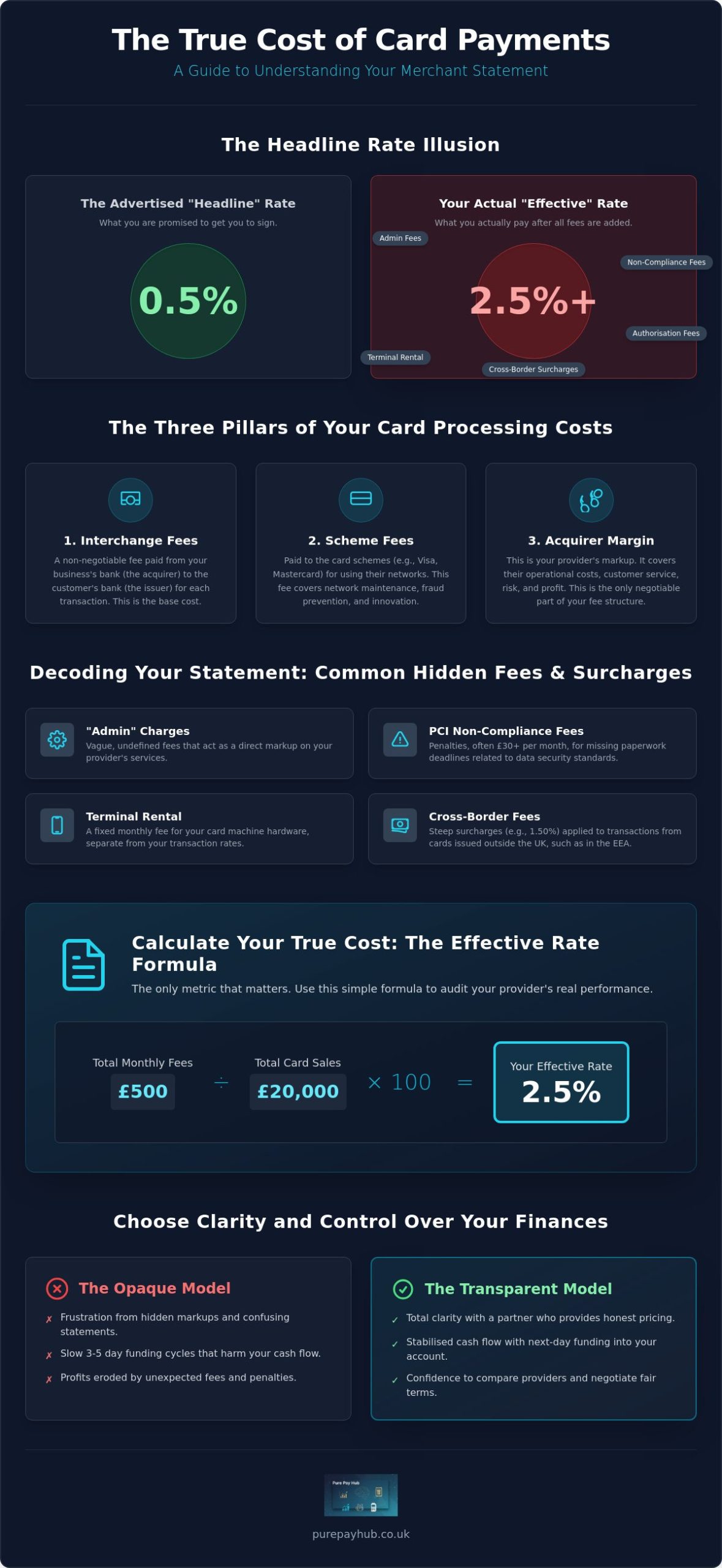
    Why does your monthly statement show a 2.5% charge when you signed a contract for 0.5%? Most UK business owners find that their “headline rate” is little more than a marketing myth. You might think you’ve secured a competitive deal, only to see your profits eroded by unexpected “admin” charges or “non-compliance” penalties. Calculating the true cost of card payments shouldn’t require a degree in forensic accounting. It’s time to pull back the curtain on the opaque fee structures that legacy providers use to hide their markups.

    We know how exhausting it is to navigate a sea of jargon just to understand your own finances. At PurePay Hub, we believe you deserve a partner who treats your business with honesty and provides total clarity. This guide will help you decode every line item on your statement, from domestic interchange caps to the steep 1.50% cross-border fees on EEA credit cards. We’ll provide the exact formula to calculate your “effective rate,” which is the only metric that truly reflects your processing costs. By the end, you’ll be able to compare provider quotes with confidence and negotiate the fair terms your business deserves.

    Key Takeaways

    • Discover why the low “headline rate” on your contract often bears little resemblance to the actual amount deducted from your bank account.
    • Identify the specific “admin” and “non-compliance” surcharges that frequently clutter UK merchant statements and inflate your monthly processing bills.
    • Learn the three pillars of payment costs; Interchange, Scheme Fees, and Acquirer Margin; to understand exactly how your fees are structured.
    • Master a simple, step-by-step formula for calculating the true cost of card payments to audit your provider’s performance with total accuracy.
    • Find out how switching to a transparent model with next-day funding can stabilise your cash flow and eliminate the frustration of hidden markups.

    Beyond the Headline: Why Calculating the True Cost of Card Payments Matters

    The headline rate you see on a provider’s marketing materials is often a distraction. For many UK merchants, a quoted rate of 0.3% for debit or 0.5% for credit sounds like an unbeatable bargain. However, the “True Cost” of your processing is the total sum of every transactional charge, fixed monthly fee, and administrative surcharge combined. Without calculating the true cost of card payments across your entire turnover, you’re essentially flying blind. This section explores why the headline figure is rarely the final figure on your bank statement.

    Most traditional providers use these low figures as a hook. They know that once you’ve integrated their hardware and signed a lengthy contract, the secondary charges will begin to accumulate. These hidden costs often turn a “cheap” deal into a significant financial burden. Understanding the difference between what you were promised and what you’re actually paying is the first step toward taking control of your business’s financial health.

    The Difference Between Headline Rates and Actual Costs

    Teaser rates are designed to lure businesses into long-term agreements. These rates usually apply only to the most basic consumer debit cards issued within the UK. In reality, your daily sales include a complex mix of premium rewards cards, corporate cards, and international transactions. Each of these carries a different Interchange fee, which is the underlying cost paid between banks to process the payment. When your provider adds their markup and various “scheme fees” on top, that 0.3% headline rate quickly vanishes. You might find yourself paying three or four times your quoted rate for a significant portion of your transactions, whilst still being charged for terminal rental and PCI management on top.

    How Processing Fees Erode SME Profitability

    In high-volume sectors like hospitality or retail, profit margins are often razor-thin. A 1% difference in your processing rate might seem negligible on a single transaction, but it equates to thousands of pounds in lost revenue over a trading year. This is money that could have been reinvested in staff, stock, or marketing. Calculating the true cost of card payments reveals exactly how much of your hard-earned profit is being diverted to your acquirer’s bottom line.

    Beyond the transaction itself, there’s the “invisible” cost of slow funding cycles. If your provider holds onto your money for three to five days, your cash flow suffers. This delay can prevent you from paying suppliers or managing daily overheads effectively. To gain total clarity, you must look at your “Effective Rate.” The Effective Rate is the total monthly cost of all fees and charges divided by your total card sales volume.

    Decoding Your Merchant Statement: Identifying Hidden Fees and Surcharges

    Reading a merchant statement often feels like deciphering a dead language. Legacy banks frequently use complex layouts and technical jargon to obscure the true price of their services. Whilst the first page might look straightforward, the real story is usually buried in the granular breakdown on the following pages. To master calculating the true cost of card payments, you must learn to spot the line items that don’t belong to the transaction rate itself. These fees are often listed separately to keep the headline rate looking artificially low.

    Most statements follow a predictable pattern. You will see a summary of your total turnover, followed by a list of transaction types and then a section for “surcharges” or “service fees.” It is in this final section where most of the hidden costs reside. If your current provider makes it difficult to find these numbers, it is likely by design. A transparent partner should provide a clear, honest view of every penny leaving your account.

    Common Fixed Costs on Your Monthly Bill

    Fixed costs are the baseline expenses you pay regardless of how many sales you process. Terminal rental fees are the most common, covering the physical hardware like your Countertop Card Machine or Portable Card Machine. You should also look for PCI DSS compliance fees. Whilst data security is essential, many providers also levy “non-compliance” fees. These are essentially penalties for missing a paperwork deadline, often costing businesses £30 or more each month. Finally, watch out for authorisation fees. This is a small “ping” fee charged every time your machine contacts the bank, which can quietly add up to a significant sum by month-end.

    Variable Surcharges to Watch Out For

    Variable surcharges fluctuate based on your card mix and how you take payments. The Minimum Monthly Service Charge (MMSC) is particularly punishing for seasonal or low-volume traders. If your total transaction fees don’t reach a set threshold, the bank charges you the difference. You should also check for Card Not Present (CNP) surcharges, which apply whenever you use a Virtual Terminal or take a payment over the phone. Because these are deemed higher risk, legacy providers often add a significant markup. If your statement is cluttered with these confusing extras, you might prefer a partner that prioritises transparent card processing without the murky markups.

    International and corporate cards are another area where costs can spiral. These cards aren’t subject to the same regulatory caps as UK consumer cards, allowing acquirers to justify much higher rates. When calculating the true cost of card payments, these variable surcharges are often the reason your effective rate ends up much higher than your contract suggested, though high-volume B2B specialists like P2EZPay Merchant Services can help navigate these specific complexities.

    The Three Pillars of UK Card Processing Costs

    Every time a customer taps their card on your Countertop Card Machine, the transaction fee you pay is split into three distinct parts. These components combined form your Merchant Service Charge (MSC). Understanding this structure is the only way to succeed in calculating the true cost of card payments. Many legacy providers bundle these costs together to hide exactly how much profit they are taking from each sale. By breaking them down, you can see where your money is actually going.

    The UK payment landscape is governed by specific regulations that dictate these costs. Whilst some elements are fixed by international card schemes, others are entirely within your provider’s control. A transparent partner will always be happy to show you the “unbundled” view of these three pillars.

    Interchange Fees: The Non-Negotiable Core

    The interchange fee is the largest portion of the transaction cost. This is the fee paid to the bank that issued the customer’s card. In the UK, the Interchange Fee Regulation (IFR) caps these costs for domestic consumer cards at 0.2% for debit and 0.3% for credit. These caps are designed to protect merchants from spiralling costs. However, these regulations don’t apply to every card. Business cards, premium rewards cards, and international cards often carry much higher rates. For example, as of July 2026, cross-border transactions between the UK and the EEA attract uncapped fees of 1.15% for debit and 1.50% for credit. This is why your “headline rate” rarely reflects your actual monthly bill.

    Scheme Fees and Acquirer Markups

    Scheme fees are essentially a toll paid to Visa or Mastercard for the right to use their global payment networks. These fees are set by the card brands themselves and are passed on to you by your acquirer. The final pillar is the Acquirer Margin. This is the markup your provider adds to cover their own operational costs, risk management, and profit. When calculating the true cost of card payments, this is the only part of the transaction fee that is truly negotiable. If your provider uses a “Blended” pricing model, they charge you one flat rate for everything. This might seem simple, but it often allows them to pocket the difference when you process low-cost domestic debit cards.

    Smart business owners prefer “Interchange Plus” pricing. This model separates the interchange and scheme fees from the provider’s markup. It ensures you benefit from the lower regulatory caps on UK consumer cards rather than paying a high flat rate across the board. This level of transparency is essential for any business looking to protect its margins from unnecessary markups.
    Calculating the True Cost of Card Payments: A Merchant’s Guide to UK Fees

    The Effective Rate Formula: A Practical Guide to Auditing Your Costs

    You can’t manage what you don’t measure. Calculating the true cost of card payments requires moving beyond individual line items to see the bigger picture. The most reliable way to do this is by finding your “Effective Rate.” This single percentage represents the total impact of processing on your revenue. It strips away the marketing fluff and reveals the reality of your overheads. By aggregating every charge from your merchant statement, you gain the clarity needed to decide if your current deal is actually fair.

    Before you begin, gather your statements from the last three months. Auditing a single month can be misleading, especially if your sales are seasonal. A three-month average provides a more stable view of your business’s health. It’s also vital to treat one-off setup costs separately from your ongoing rate. Whilst setup fees impact your first-year profits, they don’t reflect your monthly processing efficiency.

    Step-by-Step: Calculating Your Business Effective Rate

    Follow these three steps to find your true cost. First, total every fee listed on your statement. This must include your transaction rates, terminal rental, PCI compliance charges, and any authorisation “ping” fees. If you’re VAT-registered, use the net fee amount to see the service cost, or the gross amount to see the total cash impact. Second, identify your total gross card turnover for that same period. Do not subtract refunds or chargebacks yet; we want the raw volume processed through your Portable Card Machine or Online Payment Gateway.

    Third, divide your total fees by your gross turnover and multiply by 100. For example, if you paid £200 in total fees on £10,000 of sales, your effective rate is 2%. An effective rate above 2.5% for a standard retail business may indicate overcharging. If you need help Understanding Your Merchant Account Fees, we recommend starting with this simple audit to identify where your money is going.

    Benchmarking Your Results Against Industry Standards

    Once you have your number, you need to know how it stacks up. In 2026, a “Good” effective rate for a high-volume UK retail business typically sits below 1.5%. A “Fair” rate ranges between 1.6% and 2.2%, whilst anything above 2.3% is generally considered “Poor” for standard domestic trade. These benchmarks change if you have a low average transaction value (ATV), as fixed authorisation fees will represent a larger slice of each sale.

    Business volume also plays a role. Higher turnover usually grants you more leverage to negotiate the acquirer margin. If your audit reveals a poor rate, it’s time to speak with a partner that offers transparent card machine pricing without hidden markups. Understanding your data is the first step toward reclaiming your profit margins.

    Optimising Your Payment Strategy with PurePay Hub

    You’ve done the hard work. By following our formula, you now have a clear view of your effective rate and how it stacks up against the UK market. If your audit revealed that you’re paying more than 2.3% for standard domestic trade, your business is likely subsidising your provider’s hidden markups. Calculating the true cost of card payments is only the first step; the second is choosing a partner that prioritises your profitability. At PurePay Hub, we believe that transparency is the foundation of a fair business partnership.

    Switching your provider shouldn’t be a source of stress. We’ve designed our service to act as a stabilising force for your finances, replacing murky fee structures with absolute clarity. Whether you use a Countertop Card Machine in a local shop or an Online Payment Gateway for national sales, you deserve to know exactly where every penny goes. Our team specialises in “Switch and Save” audits, where we help you identify every unnecessary surcharge on your current statement and provide a straightforward alternative.

    Transparent Pricing with No Hidden Markups

    PurePay Hub simplifies your monthly reporting by eliminating the jargon that legacy banks use to hide their margins. We offer competitive debit rates starting from 0.3% and credit rates from 0.5%, ensuring your business keeps more of every sale. By providing a centralised “hub” for your payments, we help you manage everything from a Mobile Card Machine to Payment Links through a single, easy-to-read interface. This integration extends to our EPOS Systems, which reduce administrative overheads by automatically reconciling your sales and fees. You’ll spend less time on forensics and more time on growth.

    Next-Day Access to Your Hard-Earned Funds

    Cash flow is the lifeblood of any UK SME. Waiting three to five days for your funds to clear can stall your operations and make it difficult to manage supplier payments. We solve this by providing next-day access to your funds, ensuring your hard-earned money is back in your account when you need it most. This rapid settlement cycle is a core part of our commitment to supporting regional business owners. For those looking to expand, we also offer a Business Cash Advance based on your card sales, providing a flexible way to fund new equipment or stock without the rigid constraints of traditional bank loans.

    Taking control of your overheads starts with an honest conversation. If you’re ready to stop calculating the true cost of card payments and start enjoying a fairer rate, our specialists are here to help. We’ll review your current statement and show you exactly how much you could save by moving to a transparent model. Request a transparent quote from PurePay Hub today and experience the difference that professional, no-nonsense card processing can make to your bottom line.

    Reclaiming Your Profit Margins with Total Clarity

    You now have the tools to audit your merchant statement and identify the hidden surcharges that erode your bottom line. By calculating the true cost of card payments, you’ve moved from confusion to informed confidence. You understand that the “headline rate” is often a distraction and that your effective rate is the only metric that truly reflects your processing efficiency. Knowledge is your best defence against the opaque practices of legacy providers.

    It’s time to stop overpaying for murky services and start working with a partner that values your business. PurePay Hub offers a fair, no-nonsense alternative with debit rates starting from 0.3% and next-day funding provided as standard. We eliminate complex jargon and hidden markups to ensure you always know exactly what you’re paying. Get a transparent card payment quote from PurePay Hub

    Your hard-earned revenue belongs in your bank account, not your provider’s pocket. Take the first step toward a more profitable future today. We’re ready to help you stabilise your finances and grow with confidence.

    Frequently Asked Questions

    What is a typical credit card processing fee for small businesses in the UK?

    Typical effective rates for UK small businesses often range between 1.0% and 2.5%, depending on your industry and card mix. Whilst domestic consumer credit cards have an interchange cap of 0.3%, your final fee includes scheme fees and the acquirer’s markup. Businesses with lower turnover or those processing many international cards will usually see rates at the higher end of this scale.

    Why is my merchant statement so much higher than my agreed transaction rate?

    Your agreed rate is likely a “headline rate” that only applies to basic UK consumer cards. When calculating the true cost of card payments, you must account for premium, corporate, and international cards that carry much higher surcharges. Statements also include fixed monthly costs like terminal rental, authorisation fees, and PCI compliance charges that aren’t part of your transaction percentage.

    Can I negotiate my card processing fees with my current provider?

    You can negotiate the acquirer margin, which is the specific markup your provider adds to cover their own costs and profit. Interchange fees and scheme fees are set by the banks and card brands and are non-negotiable. If you’ve been with the same provider for several years, you likely have room to secure a fairer deal by auditing your current effective rate.

    What is the difference between a merchant account fee and a transaction fee?

    A merchant account fee is a fixed monthly cost you pay regardless of how many sales you make, such as terminal rental or PCI management fees. A transaction fee is the variable cost charged every time a customer uses their card. Understanding the balance between these two is essential for calculating the true cost of card payments across your total turnover.

    Are there hidden costs associated with “free” card machine offers?

    Providers often recoup the cost of “free” hardware by charging significantly higher transaction rates or locking you into long, restrictive contracts. You might also find higher monthly “admin” or “service” fees buried in the small print. It is often more cost-effective to pay a transparent monthly rental for a high-quality Portable Card Machine than to accept a “free” offer with murky markups.

    How do PCI compliance fees work and can I avoid them?

    PCI fees cover the administrative costs of ensuring your business handles card data securely. Whilst you can’t avoid the security requirements, you can avoid expensive “non-compliance” penalties by completing your annual self-assessment questionnaire. Many modern providers now include basic compliance management in their service to help you stay protected without facing unexpected monthly fines.

    What happens if my business does not meet the Minimum Monthly Service Charge?

    If your total transaction fees for the month don’t reach the Minimum Monthly Service Charge (MMSC) threshold, your provider will charge you the difference. This ensures they maintain a minimum level of revenue from your account even during quiet periods. This fee can be particularly frustrating for seasonal traders or new businesses that are still building their customer base.

    Is it cheaper to accept debit cards or credit cards in the UK?

    Debit cards are significantly cheaper to process because their domestic interchange fees are capped at 0.2%, compared to 0.3% for credit cards. This lower baseline cost means your provider can offer much more competitive rates for debit transactions. Encouraging customers to use debit cards can be a simple way to protect your profit margins and reduce your overall processing overheads.

  • Mastering Growth: The Financial Psychology Gap Explained

    Mastering Growth: The Financial Psychology Gap Explained

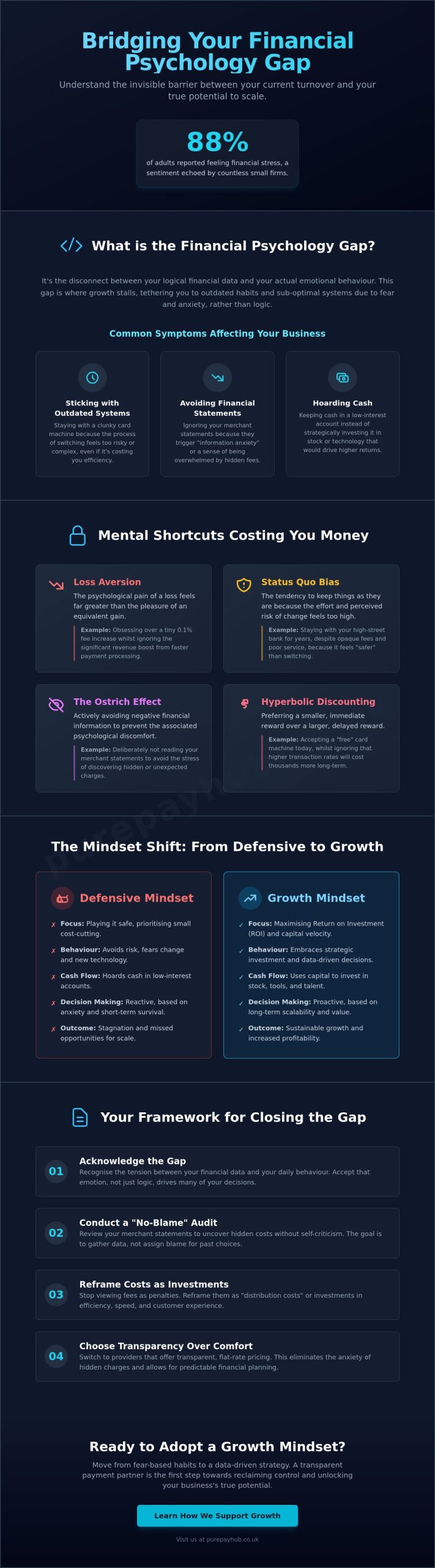
    Why does your business feel financially stagnant even though your sales are consistent? It’s a common frustration for many regional business owners who feel trapped by the very systems meant to support them. Recent research from the National Endowment for Financial Education shows that 88% of adults reported feeling financial stress in early 2026. For small firms, this often manifests as 4. The “Financial Psychology” Gap (Mindset). This gap is the invisible barrier between your current turnover and your true potential for scale.

    You likely recognise the anxiety that comes with hidden card machine fees or the fatigue of wading through corporate jargon. It’s easy to feel overwhelmed and stay with a sub-optimal provider simply because the risk of switching feels too high. We’re here to help you bridge that gap. This guide will provide actionable steps to reduce your financial stress and offer a framework for evaluating providers based on value rather than fear. You’ll learn how to move from defensive cash management to a mindset of strategic growth and clearer decision-making.

    Key Takeaways

    • Understand the hidden tension between your financial data and daily behaviour to stop “playing it safe” from hindering your long-term growth.
    • Identify how psychological biases like loss aversion cause you to over-prioritise small fees over significant revenue gains.
    • Learn to bridge 4. The “Financial Psychology” Gap (Mindset) by replacing fear-based habits with a transparent, data-driven approach to your finances.
    • Discover a “no-blame” audit framework for your merchant statements to uncover hidden costs and reclaim control of your cash flow.
    • Transition from a defensive, risk-avoidant stance to a growth mindset that focuses on capital velocity and business scalability.

    What is the Financial Psychology Gap in Business?

    Your balance sheet tells one story, but your daily actions often tell another. The distance between your financial data and your actual financial behaviour is where growth often stalls. This disconnect is what we call 4. The “Financial Psychology” Gap (Mindset). It’s a psychological hurdle that keeps you tethered to legacy banking systems and outdated habits, even when the numbers suggest a different path. Understanding this gap is the first step toward reclaiming your time and your profit margins.

    Many UK business owners inherit “money scripts” from early career experiences or family backgrounds. These scripts act as internal rules that dictate how you handle capital. If you were taught that debt is always dangerous or that banks are the only safe harbour, you might view strategic investment with unnecessary suspicion. This is deeply rooted in behavioural economics, where emotional triggers often override cold, hard logic. Sticking with a high-street giant because it feels “safe” is a common trap. In reality, these legacy institutions often drain your resources through opaque fee structures and slow fund availability.

    The Symptoms of a Mindset Gap

    How do you know if this gap is affecting your business? Look at your decision-making patterns. You might find yourself obsessing over a 0.1% difference in transaction fees whilst completely ignoring the fact that your current provider holds your funds for three working days. This is a classic symptom of focusing on the wrong metric due to underlying anxiety. Other signs include:

    • Avoiding your financial statements because they trigger “information anxiety” or a sense of being overwhelmed.
    • Staying with an outdated, clunky countertop card machine simply because the process of switching feels too risky or complex.
    • Hoarding cash in a low-interest account instead of using a business cash advance to purchase stock that would drive a higher return.

    Why Business Logic Often Fails

    Rational accounting usually takes a backseat to emotional survival instincts during periods of economic pressure. When you are worried about overheads, your brain naturally narrows its focus to immediate, short-term costs. This survival mode prevents you from considering the long-term ROI of better equipment or faster payment gateways. You aren’t being “bad at business”; you’re simply human. The conflict between your rational brain and your emotional gut feeling is what creates the friction. The Mindset Gap is the primary barrier to SME scaling in 2026. By recognising that your hesitation is psychological rather than mathematical, you can start making decisions based on growth rather than fear.

    Common Psychological Biases Affecting Your Cash Flow

    Your brain is hardwired for survival, not necessarily for profit optimisation. Whilst you might believe your business decisions are purely logical, they are often steered by deep-seated behavioral biases. These mental shortcuts helped our ancestors avoid predators, but in 2026, they often lead to stagnant cash flow and missed scaling opportunities. Recognising these biases is essential to closing 4. The “Financial Psychology” Gap (Mindset) and moving your business forward.

    Loss aversion is perhaps the most damaging bias for a merchant. It describes why the psychological pain of a £10 fee feels significantly more intense than the joy of a £1000 sale. This leads many owners to “The Ostrich Effect,” where they ignore merchant statements entirely to avoid the stress of seeing hidden charges. Similarly, hyperbolic discounting tempts owners to accept a “free” card machine today, ignoring the fact that higher transaction rates will cost them thousands over the next two years. These biases create a fog of confusion that prevents clear, data-driven action.

    Loss Aversion and Merchant Fees

    Fear of variable rates often stops businesses from adopting efficient, integrated EPOS systems. You might fixate on a tiny percentage increase in one area whilst ignoring the massive efficiency gains elsewhere. To overcome this, try reframing “fees” as “distribution costs.” Just as you pay for fuel or packaging, payment processing is a necessary vehicle for your revenue. Shifting to transparent, flat-rate pricing models can lower this emotional resistance. It replaces the “nasty surprise” of hidden markups with a predictable cost structure you can actually plan around.

    Overcoming the Status Quo Bias

    The status quo bias is the tendency to keep things as they are because change feels “risky.” This is the primary reason many merchants stay with sub-optimal providers for years. They focus on the “switching friction” instead of the opportunity cost. Consider the difference between three-day funding and next-day access to your capital. In a climate where 41.3% of small businesses cite cash flow as their top challenge in 2026, those extra 48 hours of liquidity are vital. Auditing your provider without emotional attachment allows you to see the numbers for what they are. If you are ready to see how a fairer partnership looks, you can explore our transparent payment solutions designed for regional growth.

    Closing the gap requires a disciplined approach to your finances. Start by identifying one “fear-based” habit this week. Whether it is finally opening that statement or questioning a “free” equipment offer, every small step reduces the power these biases have over your bottom line. By moving from a defensive posture to a growth-oriented one, you ensure your business is built on a foundation of clarity rather than avoidance.

    The Defensive Mindset vs. The Growth Mindset

    A defensive mindset is often born from a desire to protect what you have already built. Whilst this sounds sensible, it frequently manifests as obsessive cost-cutting and a deep-seated avoidance of any perceived risk. This approach creates a psychological ceiling. You might find yourself hoarding cash in low-interest accounts or delaying essential upgrades because the immediate cost feels too high. This is a survival tactic, not a strategy for expansion. It keeps you small by forcing you to focus on the pennies whilst the pounds of potential profit slip away.

    Transitioning to a growth mindset requires viewing capital through the lens of movement and velocity. Instead of asking “how much does this cost?”, you begin to ask “how quickly will this help me scale?”. Your choice of payment technology is a clear signal of which mindset is currently driving your business. If you are clinging to a clunky, unreliable terminal simply because you fear the friction of switching, you are likely trapped in 4. The “Financial Psychology” Gap (Mindset). Realising that transparent, fair partnerships are the foundation of a growth-oriented business allows you to stop playing it safe and start playing to win.

    Hoarding vs. Velocity

    Waiting for funds to clear for three or four working days creates a “scarcity” loop in your daily operations. It forces you into a defensive posture where you hesitate to pay suppliers or restock popular items because you are waiting for your own money to arrive. This stagnation is the enemy of growth. By prioritising next-day funding, you maintain a healthy “flow” state in your stock management. This mindset shift also changes how you view a Business Cash Advance. To a defensive owner, it looks like debt to be avoided. To a growth-oriented owner, it is a powerful lever to seize a time-sensitive opportunity or bridge a seasonal gap without slowing down.

    Customer Experience as a Psychological Asset

    Friction at the point of sale creates a subtle but damaging psychological burden for both the owner and the customer. A slow terminal or a confusing checkout process generates “micro-stress” that erodes confidence. Conversely, using modern, sleek portable card machines provides an immediate professional boost. It signals to your customers that your business is modern, efficient, and dependable. Investing in high-quality PurePay Hub countertop solutions is a direct investment in your professional pride. When your tools work perfectly, you can focus entirely on the human side of your business, knowing that the technical foundations are stable and untainted by hidden markups.

    Mastering Growth: The Financial Psychology Gap Explained

    Practical Steps to Close the Financial Psychology Gap

    Closing the gap isn’t a matter of willpower; it’s a matter of process. You’ve already identified the biases that hold you back. Now, you must implement systems that make those biases irrelevant. Bridging 4. The “Financial Psychology” Gap (Mindset) requires a transition from emotional avoidance to disciplined, data-driven action. By following these four practical steps, you can dismantle the barriers to your business growth and create a more resilient cash flow.

    Start with a “No-Blame” audit of your last three merchant statements. The goal isn’t to regret past decisions, but to understand your current baseline. Identify one fear-based habit, such as ignoring your daily settlement reports, and replace it with a five-minute review each morning. Once you have a handle on your habits, automate your transparency. Choose providers that offer clear reporting tools and integrate your EPOS systems with your card machines. This integration eliminates manual errors and reclaims hours of your week previously spent on reconciliation.

    The 10-Minute Statement Audit

    When you open your statement, look specifically for the distinction between interchange fees and provider markups. Interchange is the non-negotiable cost set by card schemes, whilst markups are where legacy banks often hide their profit. Gaining total clarity on your fee structures immediately lowers the physiological stress associated with financial management. During this audit, keep an eye out for “zombie” subscriptions. These are recurring monthly charges for “premium” services or insurance that you likely haven’t used in years. Cutting these unnecessary costs provides an immediate, risk-free boost to your bottom line.

    Building a Supportive Financial Ecosystem

    Your business thrives when you surround yourself with transparent partners rather than opaque institutions. The psychological relief of having Next-Day Access to your own hard-earned money cannot be overstated. It moves you from a scarcity loop into a state of operational flow. When you decide to upgrade your systems, communicate the change clearly to your team. Explain that moving to modern technology isn’t just about saving money; it’s about making their jobs easier and the customer experience smoother. This alignment ensures everyone is moving toward a growth mindset. If you’re ready to remove the mystery from your merchant services, switch to a transparent provider that prioritises your growth.

    How PurePay Hub Supports a Growth Mindset

    PurePay Hub operates on a simple, no-nonsense philosophy. We believe that financial anxiety is often fuelled by unnecessary jargon and opaque fee structures. By stripping away these complexities, we act as a calm, reliable advocate for your business finances. Our goal is to help you bridge 4. The “Financial Psychology” Gap (Mindset) by providing a service that is both transparent and predictable. We don’t just process payments; we provide a stable foundation for your growth.

    Transparency is our primary service. We offer debit card charges from 0.3% with no hidden surprises. This clarity allows you to plan your cash flow with confidence. We also empower UK merchants with next-day funding and a quick onboarding process. You won’t be left waiting for your own money. Instead, you’ll have the liquidity you need to respond to opportunities as they arise. This speed of capital is essential for moving from a defensive posture to a growth-oriented strategy.

    Tech that Works for You, Not Against You

    Our technology is designed to reduce operational friction. For hospitality and retail businesses, our integrated EPOS systems provide immense psychological ease. They remove the need for manual reconciliation and reduce the risk of human error. If your business requires mobility, our portable and mobile card machines offer the reliability you need to trade anywhere. For those who manage sales remotely, our Virtual Terminals simplify the process of getting paid. These tools aren’t just gadgets; they’re professional assets that reinforce your growth mindset by making the “money part” of your job feel effortless.

    Fairness as a Core Identity

    We prioritise fair rates because we value long-term trust over short-term markups. By offering 0.5% for credit cards, we ensure that your processing costs remain manageable as you scale. This commitment to fairness is backed by a support team that provides reassuring, professional guidance whenever you need it. You aren’t just another account number to us; you’re a partner. Moving away from traditional banking doesn’t mean losing support. It means gaining a partner that actually understands the regional merchant community. If you’re ready to see the difference that total transparency makes, organise a transparent rate review with PurePay Hub today.

    Reclaim Your Financial Future

    Moving your business from a state of survival to a state of scale requires more than just better sales figures. It demands a fundamental shift in how you perceive and manage your capital. By auditing your statements and identifying the biases that keep you tethered to legacy banks, you can finally bridge 4. The “Financial Psychology” Gap (Mindset). This transition allows you to replace fear-based hesitation with the informed confidence needed to invest in your own success.

    You deserve a partner that prioritises your clarity over their own markups. With debit rates starting from 0.3% and next-day access to your funds, we provide the stability and velocity your cash flow needs. Our no-nonsense, UK-based support team is here to ensure you never feel overwhelmed by jargon again. It’s time to stop playing it safe with providers that hold you back. Switch to a transparent payment partner and close the gap today. Your growth is waiting; let us help you reach it.

    Frequently Asked Questions

    What is financial psychology in a business context?

    Financial psychology refers to the emotional and cognitive factors that influence how a business owner manages their company’s capital. It explores the deep-seated “money scripts” and biases that dictate your financial behaviour. By understanding these psychological drivers, you can move away from irrational, fear-based habits and start making decisions that prioritise long-term scalability and efficiency over short-term survival instincts.

    How does my mindset affect my business bank balance?

    Your mindset acts as either a catalyst or a ceiling for your liquidity and profit margins. A defensive mindset often leads to cash hoarding and the avoidance of strategic investments, which can leave your balance stagnant. Conversely, a growth mindset focuses on the velocity of capital. By viewing your finances as a tool for expansion rather than a resource to be protected, you open the door to higher returns.

    Why do I feel anxious when checking my merchant statements?

    This anxiety is often a result of the “Ostrich Effect” combined with the opaque jargon used by traditional providers. When statements are cluttered with hidden markups and complex fee structures, your brain perceives them as a threat rather than a management tool. Switching to a provider that offers total transparency can eliminate this micro-stress, allowing you to review your data with a sense of calm and control.

    Can changing my card machine provider really improve my business mindset?

    Yes, because removing the friction of a sub-optimal service directly reduces operational stress. Transitioning to a transparent, fair partner helps bridge 4. The “Financial Psychology” Gap (Mindset) by providing predictable costs and reliable technology. When you don’t have to worry about hidden surprises, you can focus your mental energy on high-level strategy and customer experience rather than administrative frustration.

    What is the most common psychological barrier to business growth?

    Loss aversion is the most frequent barrier for regional merchants. It describes the tendency for the pain of a small transaction fee to feel more intense than the gain of a significant sale. This bias often keeps owners tied to legacy banks that offer poor value, simply because the “risk” of switching feels too high. Overcoming this requires reframing these costs as necessary vehicles for revenue distribution.

    How do I stop making emotional decisions about my business finances?

    You can reduce emotional interference by implementing automated, data-driven systems. Integrated EPOS systems and clear merchant dashboards replace “gut feelings” with objective facts. When you have immediate access to accurate data, you’re less likely to fall victim to the survival instincts that lead to short-sighted decisions. Discipline comes from having tools that provide clarity and remove the guesswork from your daily operations.

    Why is transparency so important in merchant services?

    Transparency is the foundation of trust in any financial partnership. It removes the “information anxiety” that fuels poor financial behaviour and allows for precise budgeting. Knowing exactly what you pay for every transaction prevents the frustration of unexpected costs. Clear, upfront pricing models enable you to evaluate your provider based on the actual value they add to your business rather than fear of the unknown.

    How can next-day funding reduce business stress?

    Next-day funding eliminates the “scarcity loop” created by waiting multiple days for your funds to clear. Having immediate access to your own hard-earned money provides the liquidity needed to pay suppliers and manage stock levels without hesitation. This steady flow of capital reduces the psychological burden of cash flow management, allowing you to maintain a proactive and growth-oriented stance in your daily business activities.

  • Building a Business Case for a New POS System: The 2026 ROI Guide

    Building a Business Case for a New POS System: The 2026 ROI Guide

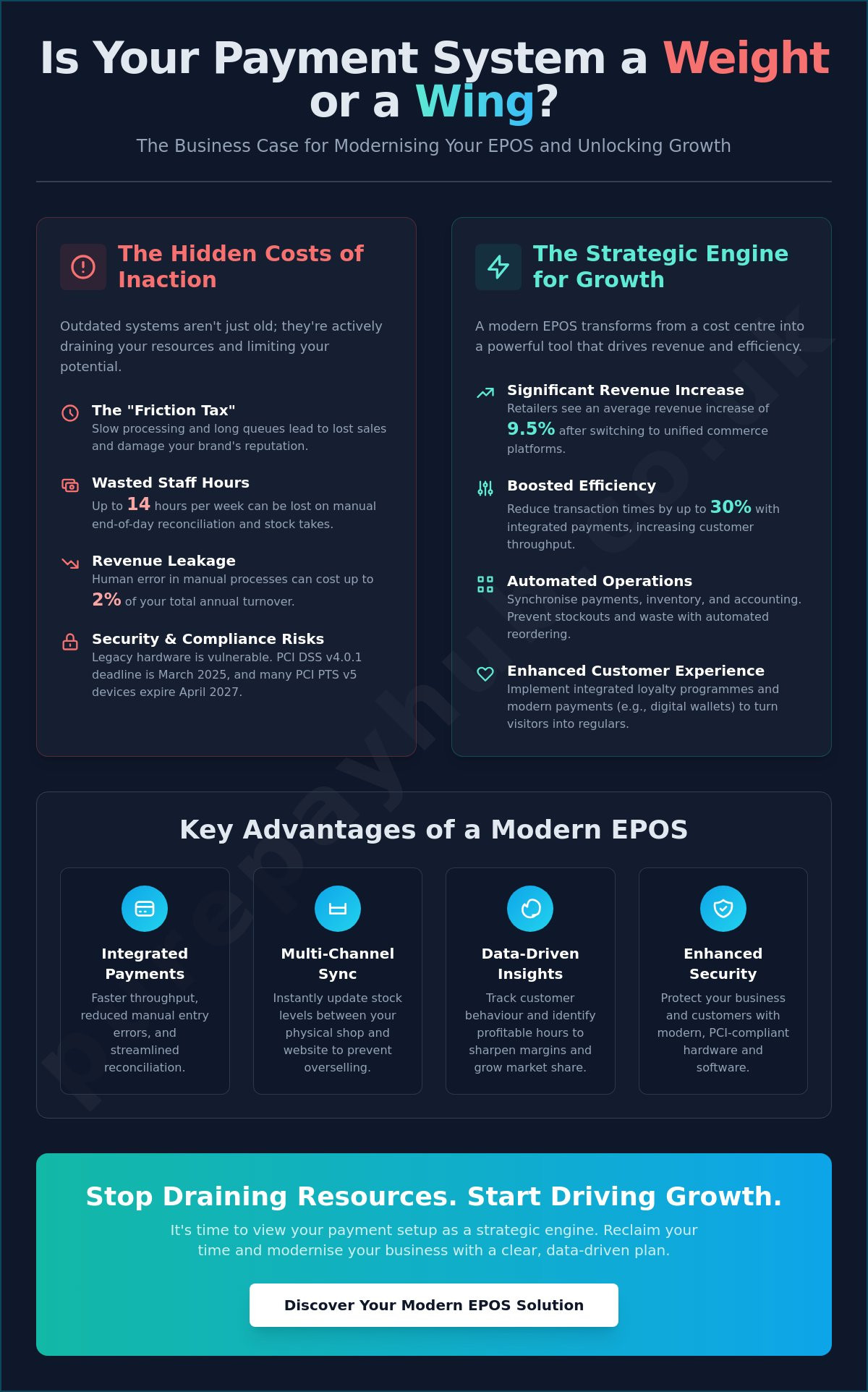
    Retailers who switch to unified commerce platforms see an average revenue increase of 9.5 per cent, according to data from ConnectPOS. If your current setup feels more like a weight than a wing, you aren’t alone. Many business owners spend hours on manual end-of-day reconciliation whilst high transaction fees eat into their margins. Building a solid business case for a new POS system is the first step toward stopping this drain on your resources. It’s time to stop viewing your payment setup as a simple cost and start seeing it as a strategic engine for growth.

    We understand that upgrading feels like a daunting task, especially with the April 2027 expiry of older PCI PTS POI v5 devices fast approaching. You want clarity and fairness, not more corporate jargon. This guide will help you justify an upgrade by quantifying real efficiency gains and identifying hidden revenue streams. We will show you how to lower merchant service charges, automate your accounting integration, and speed up customer throughput. By the end of this article, you’ll have a clear, data-driven plan to modernise your business and reclaim your time.

    Key Takeaways

    • Identify the “friction tax” of slow processing and how manual reconciliation errors lead to avoidable revenue leakage.
    • Learn how to draft a persuasive business case for a new POS system by focusing on efficiency, security, and long-term growth.
    • Understand the impact of integrated payments on customer throughput and how automated accounting saves hours of administrative work.
    • Quantify the direct financial benefits of switching, from reduced transaction fees to unlocking hidden revenue streams.
    • Discover the advantage of transparent, no-nonsense fee structures that prioritise your business’s bottom line over hidden markups.

    The Hidden Cost of Inaction: Why Your Current System is Costing You Money

    Staying with an outdated payment setup isn’t the safe or frugal choice. It’s often the most expensive path a merchant can take. Many regional business owners view a hardware upgrade as a pure expense, but this perspective ignores the daily financial leak caused by legacy tech. When you begin building a business case for new POS system adoption, you must first account for the “friction tax.” This is the invisible cost of slow processing speeds. If a customer sees a long queue caused by a sluggish card reader, they often walk away. That isn’t just a lost sale; it’s a permanent dent in your brand’s reputation.

    To understand the full scope of the problem, we must look at what a POS system is in a modern context. It is no longer just a digital till; it’s the central engine of your business operations. Relying on older setups means you’re missing out on vital, real-time data. Without these insights, you cannot track customer behaviour or identify your most profitable trading hours. You are effectively flying blind whilst your competitors use data to sharpen their margins and steal your market share.

    Quantifying Manual Labour and Human Error

    Manual stock takes and end-of-day reports are massive drains on your resources. If your staff spend two hours every evening reconciling paper receipts and spreadsheets, that equates to fourteen hours of wages wasted every single week. Human error is inevitable in these manual processes, leading to “ghost inventory” where your records show items that aren’t actually on the shelf. This leads to missed sales opportunities and frustrated buyers. Industry data suggests that the cost of manual reconciliation often accounts for as much as 2 per cent of a merchant’s total annual turnover.

    The Risk of Legacy Hardware Failure

    System crashes during peak Saturday trade are a disaster for your brand. Patching old software is a temporary fix that often costs more in technician hours than a full upgrade. It also leaves your business vulnerable to security breaches. With PCI DSS v4.0.1 requirements becoming mandatory as of March 31, 2025, and many PCI PTS POI v5 devices set to expire on April 30, 2027, staying put is a significant regulatory risk. Legacy terminals also lack support for modern payment methods like digital wallets, which alienates a growing demographic of shoppers who no longer carry physical cards.

    Strategic Advantages: How Modern EPOS Systems Drive Business Growth

    A modern EPOS is far more than a digital cash drawer. It acts as a centralised hub that synchronises your payments, inventory, and staff management into one cohesive unit. When you develop a business case for new POS system investment, you’re looking at a shift from reactive management to proactive growth. Integrated payments are a core part of this transition. By removing the need for manual entry on a card terminal, businesses can reduce transaction times by up to 30 per cent. This speed doesn’t just please customers; it directly impacts your bottom line by increasing the volume of sales you can handle during your busiest hours.

    For retailers and hospitality venues, multi-channel synchronisation is no longer optional. It ensures that a sale made on your website instantly updates the stock levels in your physical shop. This prevents the embarrassment of overselling and allows for more aggressive, accurate promotion strategies based on real-time data. If you’re ready to see how these efficiencies look in practice, exploring modern EPOS Systems is a logical next step for your growth strategy.

    Inventory Mastery and Waste Reduction

    Automated reordering is a game-changer for maintaining healthy cash flow. It prevents the twin traps of stockouts and overstocking by triggering orders only when needed. In the hospitality sector, ingredient-level tracking is essential to reduce food waste and protect margins. The many benefits of a new POS become clear when you can instantly identify your most and least profitable lines. This allows you to cut dead stock and double down on the products your customers actually want.

    Enhancing Customer Experience and Loyalty

    Integrated loyalty programmes turn one-off visitors into regulars. By capturing transaction data at the point of sale, you can create personalised marketing campaigns that resonate with your local community. Mobile POS and “pay at table” features also significantly reduce queues, allowing your staff to spend more time on service and less time tethered to a fixed counter. This improved experience is a key pillar in any business case for new POS system adoption, as retailers with unified commerce platforms see a 9.5 per cent increase in revenue on average according to data from ConnectPOS.

    Building a Business Case for a New POS System: The 2026 ROI Guide

    Calculating the ROI: Quantifying the Value of an Upgrade

    Numbers don’t lie. Proving the value of an upgrade requires looking beyond the initial setup cost and examining the long-term impact on your overheads. You need a clear business case for new POS system adoption that speaks the language of profit and loss. When you quantify the direct savings and the potential for revenue uplift, the decision to modernise often moves from a “maybe” to a “must.”

    Transaction Fee Optimisation

    Legacy high-street banks often rely on your inertia. They keep you on outdated fee structures that include hidden markups and complex monthly rentals. Switching to an independent provider often reveals immediate savings. A reduction of just 0.5 per cent in your transaction fees can translate into thousands of pounds in annual profit for a busy merchant. This isn’t just about the rate; it’s about liquidity. Next-day funding ensures your takings are in your account when you need them, rather than being held by a distant bank for three to five working days. This immediate access to cash allows you to pay suppliers promptly and manage your stock more effectively.

    Operational Efficiency Gains

    Time is your most valuable asset. An intuitive interface reduces staff training time from days to hours. This is crucial for businesses with high staff turnover or seasonal peaks. You should also consider the financial benefit of tighter system permissions. By controlling who can issue refunds or void transactions, you significantly reduce “shrinkage” and internal errors. Automated reporting is the final piece of the puzzle. It typically saves senior management between five and ten hours per week by eliminating manual spreadsheet updates and data entry.

    Manual data entry is a silent profit killer. Integrating your EPOS with accounting software like Xero or QuickBooks eliminates hours of administrative drudgery. If your manager reclaims five hours a week from bookkeeping, that is over 250 hours a year redirected toward high-value tasks like staff development or customer engagement. This efficiency is a cornerstone of a robust business case for new POS system investment.

    Higher throughput is a direct result of faster service. If your team can process transactions 30 per cent faster, you can serve more customers during peak periods without increasing your headcount. In a restaurant setting, this often leads to an extra table turnover per evening. Finally, don’t ignore the tax side. Capital allowances often mean you can deduct the full cost of your hardware from your taxable profits in the first year, significantly reducing the net cost of your upgrade.

    Building the Business Case: Aligning Stakeholders and Operations

    A successful business case for new POS system adoption starts with a compelling executive summary. You must move beyond technical specifications and focus on three core pillars: Efficiency, Security, and Growth. Decision-makers need to see that this isn’t just a hardware swap. It is a strategic move to protect margins and scale the business. Start by auditing your current system’s performance. Record your average transaction times, the frequency of system freezes, and the hours spent on manual data entry each week. These baseline figures turn vague frustrations into hard data that justifies the investment.

    Mapping the solution involves directly connecting new features to your specific pain points. If your main issue is slow service during the Friday rush, highlight how integrated payments and mobile terminals remove bottlenecks. When you present a clear link between a feature and a financial gain, the argument for change becomes undeniable. If you are ready to start this transition with a partner who values transparency, you can view our range of EPOS Systems to see how modern hardware fits your specific operational needs.

    Addressing Stakeholder Objections

    The most common hurdle is the “if it isn’t broken, don’t fix it” mentality. You can counter this by pointing to the upcoming April 2027 expiry of legacy payment devices and the mandatory PCI DSS v4.0.1 requirements. A system that “works” but leaves you open to fines or crashes is, by definition, broken. Many stakeholders also fear the complexity of data migration. Modern cloud platforms have made this process remarkably simple, allowing you to move your product lists and customer data with minimal manual input. For businesses prioritising liquidity, hardware rental models offer a low-risk alternative to upfront purchases, keeping your cash flow steady whilst you upgrade.

    The Implementation Roadmap

    Setting realistic expectations is vital for maintaining staff morale. A structured roadmap should include five distinct phases: Audit, Selection, Testing, Training, and Go-Live. To ensure zero lost sales, consider a “parallel run” where you test the new setup during quiet hours before fully switching over. This prevents the chaos of learning a new system whilst a queue of customers waits. Training should be hands-on and concise; modern interfaces are designed to be as intuitive as a smartphone, which naturally reduces the learning curve. Finally, ensure you have access to 24/7 technical support during the first 30 days to handle any teething issues with confidence.

    The PurePay Hub Advantage: Simplifying Your Payment Infrastructure

    Choosing the right partner is the final step in solidifying your business case for new POS system adoption. At PurePay Hub, we strip away the complexity and hidden markups that define the traditional banking sector. Our commitment is simple: we provide transparent, professional payment solutions designed specifically for the UK merchant community. We don’t believe in corporate jargon or opaque fee structures. Instead, we offer a “no-nonsense” approach that ensures you know exactly what you are paying for and why.

    Efficiency starts with fair pricing. We offer UK-leading rates, with Debit transactions starting from 0.3 per cent and Credit from 0.5 per cent. When combined with our next-day funding, these rates provide a significant boost to your daily liquidity. Waiting for your money to clear is a thing of the past. We ensure your takings are available to re-invest in stock or staff when you need them most. This reliability acts as a stabilising force for your finances, allowing you to plan for growth with absolute confidence.

    Tailored Solutions for UK Merchants

    Every business has unique requirements. Whether you need a Countertop Card Machine for a fixed till point or a Portable Card Machine for table service, our hardware range is built for the rigours of daily trade. For those seeking a fully integrated experience, our EPOS Systems provide the centralised control we discussed earlier in this guide. We also offer a Business Cash Advance feature, providing a flexible way to fund expansion or refurbishments without the rigid constraints of traditional bank loans. Onboarding is designed to be stress-free, and we work closely with SMEs to ensure a smooth switch that avoids the typical exit fee headaches.

    A Partnership Built on Trust

    We position ourselves as a fair partner rather than a distant financial institution. This means you aren’t just another account number in a database. Every merchant we support has access to a dedicated account manager who understands the local business landscape. If you encounter a technical hurdle, our UK-based assistance team is ready to provide immediate, clear resolutions. We value discipline and integrity, ensuring that our support continues long after the initial sale is complete. Our goal is to act as your supportive business ally, helping you navigate the evolving world of payments with clarity and ease.

    Modernising your infrastructure is an investment in your future. If you are ready to stop the revenue leakage caused by legacy tech and start enjoying fairer rates, we are here to help. Build your business case with a transparent quote from PurePay Hub and take the first step toward a more profitable, efficient operation today.

    Modernise Your Business with Confidence

    Building a robust business case for new POS system adoption is about more than just hardware; it’s about reclaiming your time and protecting your margins. We’ve detailed how quantifying the “friction tax” of slow processing and automating manual reconciliation can turn a cost centre into a growth engine. With the 2027 hardware deadlines fast approaching, staying with legacy tech is no longer the frugal choice. It’s a risk to your brand and your bottom line.

    At PurePay Hub, we believe in fairness and clarity. We provide debit rates from 0.3% and ensure you have next-day access to your funds. There are no hidden markups or confusing corporate jargon here. We act as your supportive partner, helping you simplify your infrastructure so you can focus on your customers. You don’t have to navigate these changes alone. Take control of your financial future by making an informed choice today.

    Get a transparent POS and payment quote for your business

    Frequently Asked Questions

    How long does it typically take to see an ROI on a new POS system?

    You can typically expect a return on investment within 18 to 24 months. For high-volume merchants, the timeline is often shorter because the immediate reduction in transaction fees and administrative labour provides instant relief to your cash flow. This makes the business case for new POS system adoption particularly strong for businesses looking to scale quickly and reduce their daily overheads.

    What are the essential features I should look for in a modern EPOS?

    Look for a system that offers real-time inventory tracking, integrated payment processing, and automated reporting. A modern EPOS should act as a centralised hub for your operations, allowing you to manage staff and stock across multiple locations or online channels from a single interface. These features reduce manual errors and help you make data-driven decisions that protect your profit margins whilst improving the customer experience.

    Can I keep my current merchant account when upgrading my POS hardware?

    Whilst it is sometimes technically possible, we generally recommend switching to a provider that offers integrated processing. Using a separate, distant merchant account often results in higher fees and slower funding times. By moving to a unified setup, you benefit from a single point of contact for support and a more transparent fee structure that is untainted by hidden banking markups.

    How does a new POS system help with PCI compliance?

    New POS systems significantly simplify your compliance journey by using advanced encryption and tokenisation. This ensures that sensitive card data never actually enters your local network, which reduces the scope of your annual PCI DSS assessment. Modern terminals are also updated automatically to meet the latest security standards, ensuring you remain compliant with mandatory requirements like PCI DSS v4.0.1 without constant manual oversight.

    Is it better to lease or buy POS hardware upfront?

    Buying your hardware upfront is usually the most cost-effective option over a three-year period. However, leasing is an excellent alternative for businesses that prefer to preserve their cash flow for stock or expansion. We offer flexible models that allow you to access the latest EPOS Systems without a heavy initial capital outlay, making the transition manageable and predictable for regional SMEs.

    What happens to my data if the internet goes down during service?

    Most modern systems include an “offline mode” that allows you to continue processing transactions even if your internet connection fails. Your sales data is stored securely on the device and automatically synchronises with the cloud once your connection is restored. This prevents lost sales and ensures your business remains operational during peak hours, providing a stabilizing force for your finances regardless of technical glitches.

    How do integrated payments differ from using a standalone card machine?

    Integrated payments allow your POS hardware and card machine to communicate directly, eliminating the need for manual data entry. This reduces human error and speeds up the checkout process significantly. In contrast, a standalone machine requires your staff to type in the amount twice, which increases the risk of mistakes and slows down your service, ultimately leading to longer queues and customer frustration.

    Will a new POS system integrate with my existing accounting software?

    Yes, a modern EPOS will seamlessly integrate with leading accounting platforms like Xero or QuickBooks. This connection automates your daily sales sync and bank reconciliation, saving senior management several hours of administrative work each week. It is a vital component of any business case for new POS system investment, as it provides an accurate, real-time view of your financial health without the need for manual spreadsheets.