Tag: Cash Flow

  • Lowest Card Machine Rates for Small Business UK: The 2026 Merchant Guide

    Lowest Card Machine Rates for Small Business UK: The 2026 Merchant Guide

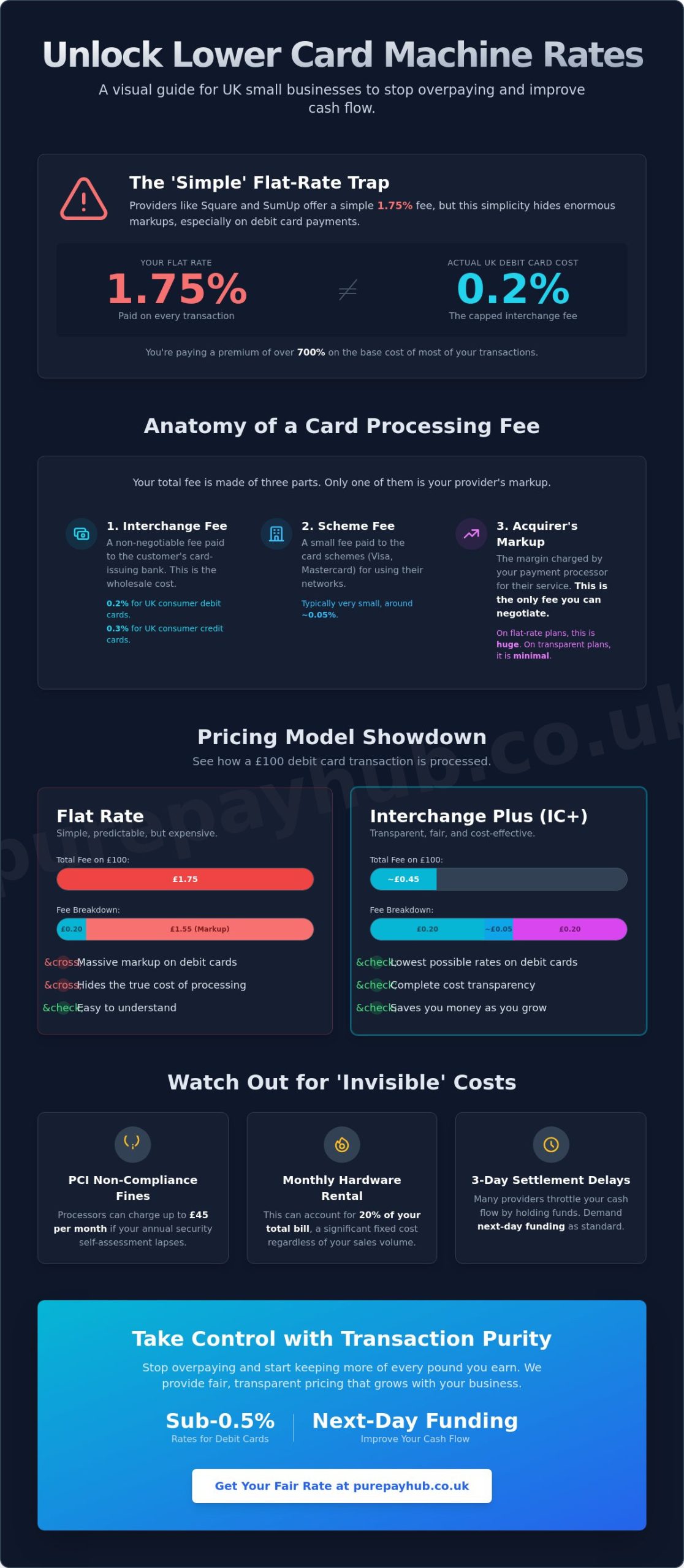
    The “flat-rate” 1.75% fee you are currently paying might feel simple, but it is likely the most expensive way to run your shop or cafe. Whilst providers like Square and SumUp offer predictability, they often mask the reality that UK domestic debit card interchange fees are capped at a mere 0.2%. If you are hunting for the lowest card machine rates for small business UK, chasing a single headline figure is a trap that hides significant markups. You need a payment partner that prioritises transaction purity over padded margins.

    We know you are tired of seeing your cash flow throttled by three-day settlement delays and confusing monthly statements. This guide promises to show you how to slash transaction costs to sub-0.5% for debit cards while securing the next-day funding your business requires. We will break down the 2026 market landscape, explain the impact of the latest PSD3 regulations, and reveal the most transparent providers available today. It is time to stop settling for opaque pricing and start keeping more of every pound you earn.

    Key Takeaways

    • Understand why the “lowest” rate is subjective and depends entirely on your specific turnover, average transaction value, and industry sector.
    • Learn to decode your merchant statement by identifying the core interchange fee and spotting hidden markups that inflate your monthly costs.
    • Discover why moving from a flat-rate fee to an Interchange Plus model is the most effective way to unlock the lowest card machine rates for small business UK.
    • Follow a clear framework to audit your current payment setup and use your annual card turnover to negotiate a fairer, more transparent deal.
    • Explore how transaction-based purity can provide your business with sub-0.5% rates and next-day funding to significantly improve your cash flow.

    Understanding the UK Card Machine Market in 2026

    Traditional high-street banks no longer hold a monopoly on how you take payments. In 2026, the UK merchant services market has matured into a competitive ecosystem where agility beats legacy. Most business owners are moving away from restrictive bank-led contracts toward specialised providers that treat payment processing as a central financial hub. Finding the lowest card machine rates for small business UK requires looking beyond the big bank logos and understanding how your specific trade impacts your bottom line.

    A “low” rate is entirely subjective. For a high-volume coffee shop with a £5 average transaction value (ATV), a fixed fee might be a burden. Conversely, a luxury furniture retailer with a £2,000 ATV needs a different structure entirely. Your monthly turnover and transaction patterns dictate which pricing model is actually the cheapest. We believe your payment provider should act as a merchant’s ally, offering clarity instead of complexity through a transaction-based “Hub” approach that stabilises your finances.

    The Evolution of Payment Processing for SMEs

    We have moved past the era of clunky, tethered countertop units that restricted service to a single point. Today, UK SMEs favour portable and mobile-first solutions that integrate directly with their EPOS systems. With cash usage predicted to fall to just 4% by 2034, being “cashless” is no longer an option; it is the non-negotiable standard. We advocate for “Pure” processing, which ensures your transaction data is untainted by the legacy markups that traditional banks still try to enforce. This shift allows you to accept payments anywhere in your premises, matching the modern consumer’s expectation for speed and convenience.

    Why Headline Rates Can Be Deceptive

    Flashy marketing often hides an expensive reality. Many providers lure you in with “0% for 3 months” offers that eventually revert to punishingly high long-term percentages once the honeymoon period ends. It is vital to distinguish between a merchant account and a payment aggregator. While aggregators offer quick setup, they often lack the depth of a dedicated merchant account when it comes to volume-based discounts. You might start on a flat rate, but as your business grows, that simplicity becomes a tax on your success.

    A critical component of your total cost is Interchange fees, which are the non-negotiable costs paid to the card issuer. To find the lowest card machine rates for small business UK, you must look at the total package, not just the teaser rate. The Merchant Service Charge is the core fee merchants must optimise to ensure they aren’t overpaying for the privilege of getting paid. By stripping away hidden markups, you can finally achieve the transparency your business deserves.

    The Anatomy of Card Processing Fees: What “Lowest” Really Means

    Understanding the true cost of taking payments requires looking past the headline percentage. To secure the lowest card machine rates for small business UK, you must dissect three specific pillars: transaction fees, hardware rental, and administrative charges. Most merchants focus solely on the transaction fee. Yet, monthly hardware rental and admin costs often represent 20% of the total bill for smaller enterprises. This complexity is often a deliberate choice by traditional providers to obscure their margins. PurePay Hub simplifies this by stripping away the jargon and focusing on transaction-based clarity.

    Decoding the Interchange Fee

    The interchange fee is the non-negotiable baseline of every transaction. It’s the fee paid to the customer’s bank. In the UK, domestic consumer debit cards are capped at 0.2% and credit cards at 0.3%. These rates are fixed by card schemes like Visa and Mastercard. However, these caps don’t apply to commercial or international cards. Following Brexit, cross-border fees for EEA cards rose significantly, with debit cards hitting 1.15% and credit cards reaching 1.5%. You can find more detail in this complete guide to credit card processing fees to see how these stack against your current statement.

    The “Invisible” Costs: PCI Compliance and Admin

    PCI DSS compliance is a mandatory security standard for everyone accepting card payments. Many providers charge a nominal monthly fee for this, but the real danger lies in “non-compliance” penalties. Some processors use these fines as a profit centre, charging up to £45 per month if your annual self-assessment isn’t updated. It’s a frustrating and unnecessary drain on your resources that many business owners overlook until the statement arrives.

    Hardware rental is another area where costs can creep up. A portable card machine should include all software updates and technical support within the base price. You shouldn’t be charged extra for “gateway fees” or “statement fees” that provide no additional value. We promote “Pure” processing. This means we eliminate the murky “Hub” or “Platform” fees that other companies tack onto your statement. If you want a partner that acts as a transparent merchant ally, it starts with knowing exactly where every penny of your processing fee goes. By removing these hidden layers, you ensure your business keeps more of its hard-earned revenue.

    Lowest Card Machine Rates for Small Business UK: The 2026 Merchant Guide

    Comparing Pricing Models: Flat Rate vs. Interchange Plus

    Choosing between a flat-rate and an Interchange Plus (IC+) model is often the difference between a thriving margin and a struggling one. Flat-rate providers charge a single percentage, typically around 1.75%, regardless of the card type used. This simplicity comes at a high price. High-volume businesses on these plans are effectively subsidising the costs of smaller, riskier merchants. When you pay a flat fee, you are paying a premium for convenience that rarely reflects the actual cost of your specific transactions.

    The Payment Systems Regulator market review highlights how complex fee structures can limit competition and transparency. Over a 12-month period, a typical SME processing £10,000 monthly on a 1.75% flat rate will spend £2,100 in transaction fees. Switching to an IC+ model could reduce this significantly, as it separates the non-negotiable interchange fee from the provider’s markup. This transparency is the only way to secure the lowest card machine rates for small business UK as you scale.

    When is a Flat Rate Actually Better?

    Flat rates are designed for micro-merchants. If your business processes under £2,000 per month, the predictability of a fixed fee is often worth the higher percentage. It suits seasonal sole traders or hobbyist businesses that need a simple “pay-as-you-go” structure without monthly commitments. However, this model quickly becomes a growth trap. As your turnover increases, that 1.75% starts to eat into your scaling margins, costing you hundreds of pounds more than a tailored merchant account would.

    The Power of Interchange Plus (IC+) for Growing SMEs

    Interchange Plus is the gold standard for professional merchant services. It offers total “Pure” transparency by showing you the exact cost of the transaction plus a small, fair margin. For instance, whilst a flat rate might charge you 1.75% for a domestic debit card payment, an IC+ model reveals the 0.2% capped interchange fee and adds a transparent markup. This can lead to an effective rate as low as 0.3% for debit transactions. PurePay Hub specialises in tailoring these rates to business volume. By moving away from the “one-size-fits-all” approach, you ensure your payment setup acts as a central Hub for growth rather than a drain on your resources.

    How to Secure the Lowest Card Machine Rates for Your Business

    Securing a better deal requires more than just a quick search; it demands a forensic look at your current statement. Many providers hide their true margins in a thicket of technical terms. To find the lowest card machine rates for small business UK, you must look beyond the headline percentage and evaluate the total cost of ownership. This involves auditing your existing fees, understanding your leverage, and avoiding long-term terminal rental traps that can cost your business thousands over a three-year contract.

    Your annual Gross Transaction Value (GTV) is your biggest bargaining chip. If your turnover has grown by 20% or more since you last signed a contract, you are likely overpaying. Providers are eager for stable, growing businesses. You should use your actual processing data to demand a bespoke rate rather than accepting a generic off-the-shelf package. Always check for a Minimum Monthly Service Charge (MIRA). If your transaction volume drops during a quiet month, a high MIRA ensures the provider still gets paid, even if you don’t. We believe you should only pay for the value you receive.

    Auditing Your Current Merchant Statement

    The most important number on your statement isn’t the headline rate; it’s your Effective Rate. You calculate this by dividing your total monthly fees by your total turnover. It’s common to see a “headline” rate of 1.5% jump to an effective rate of 2.5% once you add in authorisation fees, which can range from 1p to 5p per tap. Check your statement for “Minimum Monthly Fees” and “PCI Non-Compliance” charges. These small, recurring amounts are designed to stay under the radar whilst padding the processor’s profits. Identifying these markups is the first step toward reclaiming your margin.

    Switching Providers Without the Stress

    The fear of downtime often keeps merchants trapped in bad contracts. However, the “Right to Switch” and modern onboarding processes have made the transition smoother than ever. Most exit fees can be offset by the savings you’ll make in the first three months with a fairer partner. The key is ensuring your new Merchant IDs (MIDs) are ready before you disconnect your old hardware. PurePay Hub offers quick onboarding to facilitate seamless transitions, acting as a supportive ally throughout the move. If you are ready to stop the drain on your profits, you can get a transparent fee audit today and see the difference transaction-based purity makes.

    PurePay Hub: Transparent, Transaction-Based Payments for UK Growth

    PurePay Hub isn’t just another payment processor. We act as your merchant’s ally by stripping away the complexity that traditional banks rely on to inflate their profits. By focusing on transaction-based purity, we offer starting rates of 0.3% for debit cards and 0.5% for credit cards. These figures represent some of the lowest card machine rates for small business UK currently available. We understand that a low rate is only half the battle. Your business also needs liquidity to thrive.

    Whilst traditional banks might keep you waiting up to five working days for your own money, we provide next-day access to funds as standard. This ensures you can restock inventory or pay staff without the stress of delayed settlements. This integrated approach turns your payment terminal from a simple tool into a central Hub for financial stability. We provide the transparency you need to plan for the future with confidence and clarity.

    Fairness and Clarity as Standard

    We take a no-nonsense approach to fee structures. Unlike shared aggregators that often provide limited support and opaque pricing, we give you a dedicated merchant account tailored to your specific turnover. This direct relationship allows for greater flexibility and lower costs as you scale. If your business requires a boost for expansion, we also offer Business Cash Advances based on your card sales. This growth tool provides a fair alternative to traditional bank loans, with repayments that fluctuate naturally with your daily takings. You only pay back more when you are busy, and less when things are quiet.

    Choosing Your Hardware: From Countertop to Mobile

    Every UK business has unique requirements for its physical point of sale. We offer a range of solutions to fit your specific sector:

    • Countertop Card Machines: Ideal for retail shops or pharmacies with a fixed till point and a stable internet connection.
    • Portable Card Machines: Perfect for restaurants or cafes that need to take payments at the table via Wi-Fi or Bluetooth.
    • Mobile Card Machines: A must-have for tradespeople or market stalls that require GPRS or 4G connectivity on the move.

    Integrating these terminals with your EPOS system further reduces admin time and eliminates costly manual accounting errors. It’s about more than just a machine; it’s about a partnership that supports your long-term growth. Get a transparent quote from PurePay Hub today and start keeping more of every transaction your business processes.

    Take Control of Your Transaction Costs

    Finding the lowest card machine rates for small business UK isn’t about luck; it’s about data and transparency. You’ve seen how auditing your monthly statements can uncover hidden authorisation fees and why the common flat-rate model often acts as a growth tax on your success. By switching to a transaction-based model, you reclaim the margin that traditional banks have quietly siphoned away for years. It is time to treat your payment processing as a strategic asset rather than a fixed expense that drains your monthly revenue.

    PurePay Hub provides the clarity you need to scale with confidence. We offer debit rates starting from 0.3% and ensure your cash flow remains healthy with next-day funding available as standard. You won’t find any hidden markups or murky fee structures here. We act as your merchant ally, providing the honest partnership your business deserves to thrive in a competitive market. Secure your lowest card machine rate with PurePay Hub today and keep more of your hard-earned revenue. Your business deserves a fair deal.

    Frequently Asked Questions

    What is the average card machine rate for a small business in the UK?

    The average flat rate for a UK small business is 1.75% per transaction. However, this figure is often much higher than the actual cost of processing, as domestic debit interchange is capped at 0.2%. If you process over £2,000 monthly, you should move away from averages and seek the lowest card machine rates for small business UK through an Interchange Plus model.

    Is it cheaper to buy or rent a card machine for my business?

    Choosing between buying or renting depends on your monthly turnover and need for technical support. Buying a terminal upfront for around £19 plus VAT removes monthly rental costs, which suits micro-merchants or seasonal traders. For established SMEs, renting a professional portable card machine ensures you receive essential software updates and 24/7 technical support without a large initial capital outlay.

    How do I avoid high exit fees when switching card machine providers?

    You can avoid high exit fees by prioritising providers that offer rolling monthly contracts or shorter 12-month terms. Always scrutinise the “Term” section of your agreement before signing. If you are already trapped, some new providers might offer to cover a portion of your exit costs to help you switch to a fairer, more transparent processing model.

    What is the difference between a transaction fee and a merchant service charge?

    A transaction fee is typically a fixed cost in pence for each tap or dip of a card. The Merchant Service Charge (MSC) is the percentage fee applied to the total value of the sale. To find the lowest card machine rates for small business UK, you must look at the combined total of both these figures on your monthly statement.

    Can I get a card machine with no monthly fees as a sole trader?

    Sole traders can access card machines with no monthly fees through payment aggregators. These providers don’t charge for the Hub or platform access, but they compensate for this with much higher transaction percentages, often 1.75% or more. It’s a trade-off between fixed monthly costs and the variable cost of every sale you make.

    What happens if my business doesn’t meet the minimum monthly transaction volume?

    If your business fails to meet a specific transaction threshold, you may be charged a Minimum Monthly Service Charge (MIRA). This fee ensures the provider covers their overheads even during your quietest months. It’s usually a fixed amount, such as £10 or £15, which is only billed if your total transaction fees for that month fall below that level.

    How long does it take for card payments to reach my UK bank account?

    Card payments typically reach UK bank accounts within one to three working days. Whilst traditional banks and older processors often lean toward the longer end of this scale, modern fintech partners prioritise your cash flow. PurePay Hub offers next-day access to funds to ensure your business remains liquid and ready for daily operational expenses.

    Are there extra charges for accepting Apple Pay or Google Pay?

    There are no additional fees specifically for accepting Apple Pay or Google Pay on your terminal. These digital wallet payments are processed as standard contactless transactions using the underlying card’s domestic or international rate. They are a secure, high-speed way to take payments that 85% of UK consumers now prefer over cash.

  • How to Take Payments: The Ultimate SME Checklist for 2026

    How to Take Payments: The Ultimate SME Checklist for 2026

    Did you know that Visa is scheduled to increase its fees on 24 January 2026? Whilst the industry average for credit card processing sits at 2.35%, many UK merchants are actually paying far more because of “non-compliance” penalties and murky markups. You’ve likely felt the sting of long settlement periods delaying your cash flow or stared at a statement filled with jargon like “interchange plus” and wondered where your profit went. It’s frustrating when the simple act to take payments feels like a constant battle against hidden costs.

    You deserve a partner that prioritises clarity over corporate jargon. We’ve built this guide to help you master the essentials of UK payment processing and strip away the confusion of complex fee structures. You’ll discover how to secure faster access to your hard-earned funds and ensure your setup is fully compliant with the mandatory PCI DSS v4.0.1 standards. We’ll walk you through choosing the right methods for 2026 and setting up a merchant account that scales as your business grows.

    Key Takeaways

    • Understand the three essential pillars of processing to ensure your money moves securely from the customer’s bank to your business account.
    • Identify the most efficient ways to take payments across retail, hospitality, and online environments to suit your specific sales volume.
    • Decode the difference between transaction-based fees and hardware rentals to remove hidden markups from your monthly statements.
    • Follow a proven five-step checklist to audit your business needs and choose a merchant setup that truly scales.
    • Optimise your cash flow with next-day funding and learn how flexible finance can support your long-term growth plans.

    What Does it Actually Mean to Take Payments in 2026?

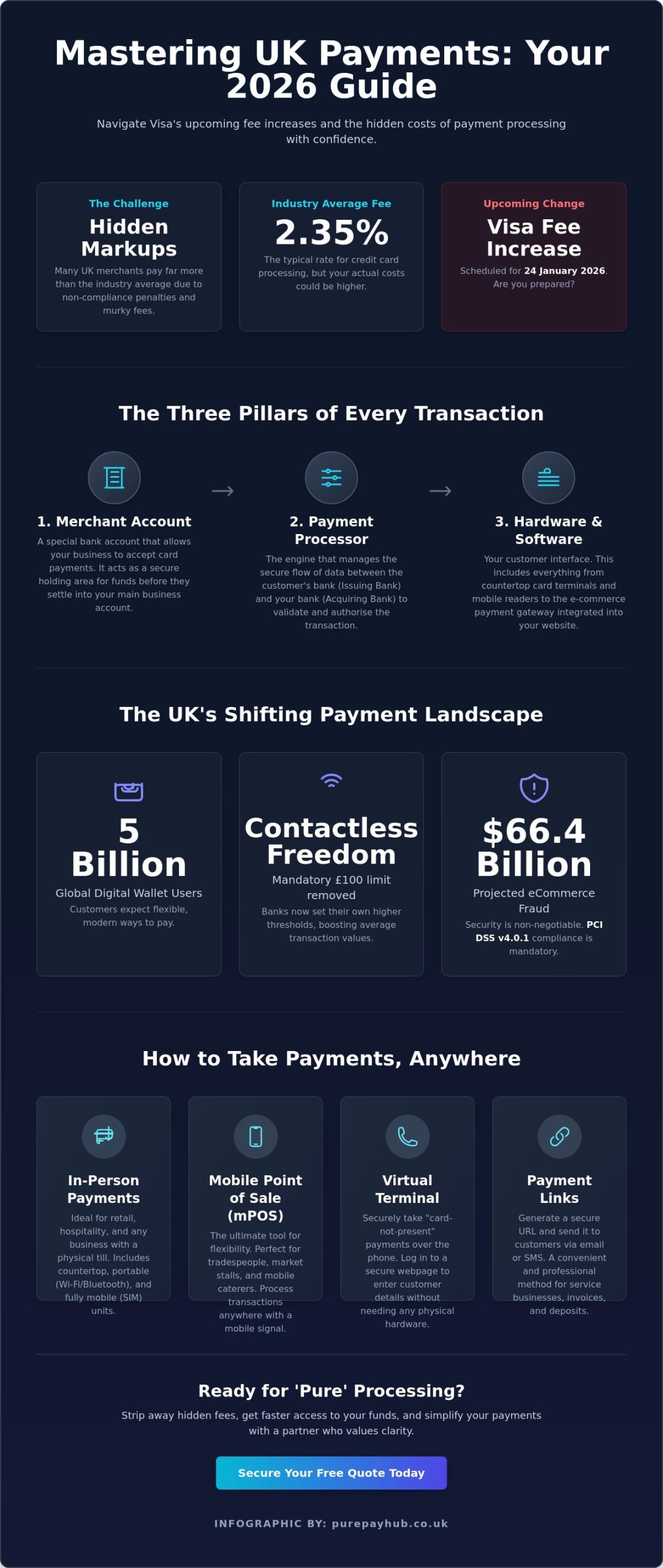
    Taking payments is no longer just about swapping cash for goods. In 2026, payment processing acts as the vital digital bridge between your customer’s bank account and your business balance. It’s a complex journey that happens in seconds. For a modern SME, the ability to take payments efficiently is a utility, much like electricity or water. You need it to be reliable, invisible, and fairly priced. With Visa scheduled to increase its fees on 24 January 2026, understanding how this bridge works is essential for protecting your margins.

    To understand the process, you must look at the three pillars that support every transaction:

    • The Merchant Account: This is a specific bank account that allows your business to accept card payments. It acts as a temporary holding area before funds are cleared and moved to your business bank account.
    • The Payment Processor: This is the engine. It manages the flow of data between the banks to ensure the transaction is valid, authorised, and secure.
    • Hardware and Software: This is your interface. It includes everything from sleek countertop terminals in a shop to the e-commerce gateway on your website.

    At PurePay Hub, we advocate for “pure” processing. This means we strip away the hidden fluff and complex markups that traditional providers often bury in the small print. We focus on secure, transaction-based clarity so you can focus on growth. When your processing is pure, you aren’t surprised by unexpected costs at the end of the month.

    The Shift in UK Consumer Behaviour

    Consumer habits have transformed rapidly. By January 2026, global digital wallet users reached 5 billion. In the UK, the mandatory £100 contactless limit was removed on 19 March 2026, whilst banks now set their own thresholds. Relying on “cash only” is a risk few businesses can afford. Accepting diverse methods, from physical cards to digital tap-to-pay on smartphones, directly increases your average transaction value (ATV). This shift is also paving the way for digital asset integration, where fintech providers like Pallapay are helping businesses adapt to new ways of exchanging value. Customers naturally spend more when they aren’t limited by the physical notes in their wallet.

    Key Terminology Every Merchant Should Know

    The industry is full of jargon, but the basics are simple. Your Acquiring Bank is the institution that maintains your merchant account and “acquires” the funds for you. The Issuing Bank is the customer’s bank that “issues” their card. Settlement is the final step where funds are moved into your bank balance. In 2026, security is governed by PCI DSS v4.0.1. This is the mandatory gold standard that ensures every tap is protected against the $66.4 billion eCommerce fraud threat projected for this year.

    Choosing Your Method: How to Take Payments Anywhere

    Your business might start at a physical till, but it shouldn’t end there. In 2026, 92% of merchants accept digital wallets, and your customers expect that same level of flexibility whether they are in your shop or on your website. To stay competitive, you need a setup that handles every scenario. Whether you are selling at a local market or invoicing a client across the country, the goal is to take payments without friction or technical delays.

    We view your payment setup as a central Hub. Instead of juggling different providers for your shop, your website, and your phone orders, a unified system brings everything together. This creates a stabilising force for your finances and provides one clear view of your cash flow. This clarity is vital when eCommerce fraud is projected to cost merchants $66.4 billion this year. By centralising your streams, you reduce your risk and simplify your reporting.

    In-Person: Countertop vs. Mobile Units

    Countertop machines are the reliable workhorses of the retail world. They sit at your fixed till point and usually connect via Ethernet for maximum stability. If your customers always come to you, this is your foundation. Portable units offer more freedom, using Bluetooth or Wi-Fi to reach tables in a restaurant or move around a showroom floor. For tradespeople or mobile caterers, a SIM-based mobile machine is essential. It connects to the 4G or 5G network so you can process transactions anywhere with a signal. An mPOS, or mobile Point of Sale, is the ultimate tool for on-the-go flexibility.

    Remote Payments: Virtual Terminals and Links

    Not every sale happens face-to-face. A virtual terminal allows you to take payments over the phone securely. You simply log into a secure webpage and type in the customer’s details whilst they are on the line. It’s a professional way to handle “card-not-present” transactions without needing physical hardware on site.

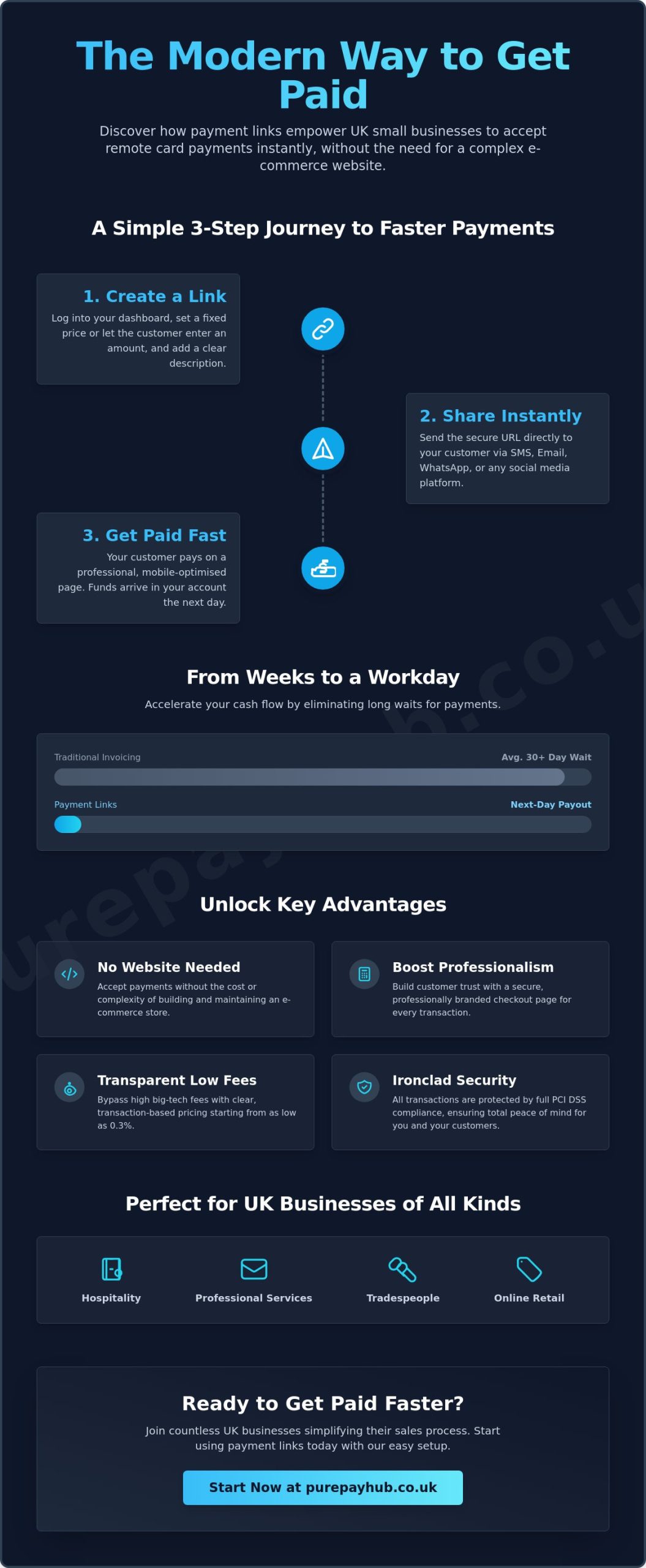
    Payment links are another favourite choice for service-based SMEs and wholesalers. You generate a secure URL and send it via email or SMS. The customer clicks, pays at their convenience, and the settlement process begins. It’s transparent, honest, and incredibly fast. If you’re looking for a transparent partnership to manage these different streams, choosing a unified provider is the first step toward financial clarity. This approach ensures your business stays agile as the UK market continues to move away from traditional cash transactions.

    How to Take Payments: The Ultimate SME Checklist for 2026

    Decoding the Costs: Transaction Fees vs. Monthly Rentals

    Understanding the true cost to take payments is often the biggest hurdle for UK business owners. Most providers present a “blended” rate that looks simple but actually hides significant markups. The Merchant Service Charge (MSC) is the core fee you pay on every transaction. Typically, debit card rates are significantly lower than credit card rates because the risk to the bank is lower. With the average processing cost for Visa and Mastercard sitting at approximately 2.35%, any rate significantly higher than this suggests a heavy processor markup.

    Hardware rental is another area where transparency is often lacking. A fair monthly price for a modern countertop unit should be clear and fixed. However, the real danger lies in the “hidden” extras. Many legacy providers charge a Minimum Monthly Service Charge (MMSC) if you don’t hit a certain sales volume. They also levy heavy fines for PCI non-compliance. Since PCI DSS v4.0.1 became mandatory on 31 March 2025, these fines have become a common way for processors to squeeze extra profit from unsuspecting merchants. We believe in a different approach. We advocate for transaction-based clarity where you only pay for what you use.

    Understanding Interchange Plus Pricing

    Interchange Plus is the “pure” alternative to confusing flat rates. This model reveals exactly what the card schemes charge (the interchange) and exactly what the processor takes as their fee. It’s the most honest way to view your statements. For high-volume merchants, debit card charges can start as low as 0.3%, whilst credit cards remain higher. This model allows you to see the direct benefit of the proposed 0.1 percentage point reduction in interchange fees scheduled to last for the next five years.

    Avoiding the ‘Exit Fee’ Trap

    The UK market is notorious for long-term contracts. These agreements often stretch from 12 to 48 months and include aggressive exit fees. Always check the small print for rolling renewals that lock you in for another year without your knowledge. You should also look for cancellation notice periods, which can sometimes be as long as six months. PurePay Hub simplifies the onboarding process to avoid these legacy headaches. We focus on building a partnership based on performance rather than restrictive legal traps. This ensures your business remains agile and ready to grow.

    The Merchant’s Checklist: 5 Steps to Take Payments

    Setting up your business to take payments shouldn’t be a months-long ordeal. Whilst legacy banks often move at a glacial pace, a modern fintech approach allows you to get up and running with speed and precision. This checklist serves as your roadmap to a secure, transparent setup that avoids the common pitfalls of hidden fees and technical friction.

    Step 1: Audit your sales volume. Before signing any contract, look at your average transaction size and your monthly turnover. If your average sale is small, per-transaction pence fees matter more than percentages. If you’re a high-ticket wholesaler, the percentage rate is your priority. Step 2: Choose your primary environment. A busy cafe needs a portable Wi-Fi unit for table service, whilst a boutique retail shop might prefer a fixed countertop terminal. If you’re selling across multiple channels, ensure your hardware and online gateway are synced through a single Hub to keep your reporting clean.

    Preparing Your Documentation

    To speed up your application, you must organise your “Know Your Customer” (KYC) documents in advance. You’ll typically need a valid photo ID, proof of business address, and three months of recent bank statements. Having a dedicated business bank account is essential for clean accounting and faster settlement. When your documents are ready, modern onboarding can often be completed within 24-48 hours, getting you ready to take payments almost immediately.

    Integrating with EPOS Systems

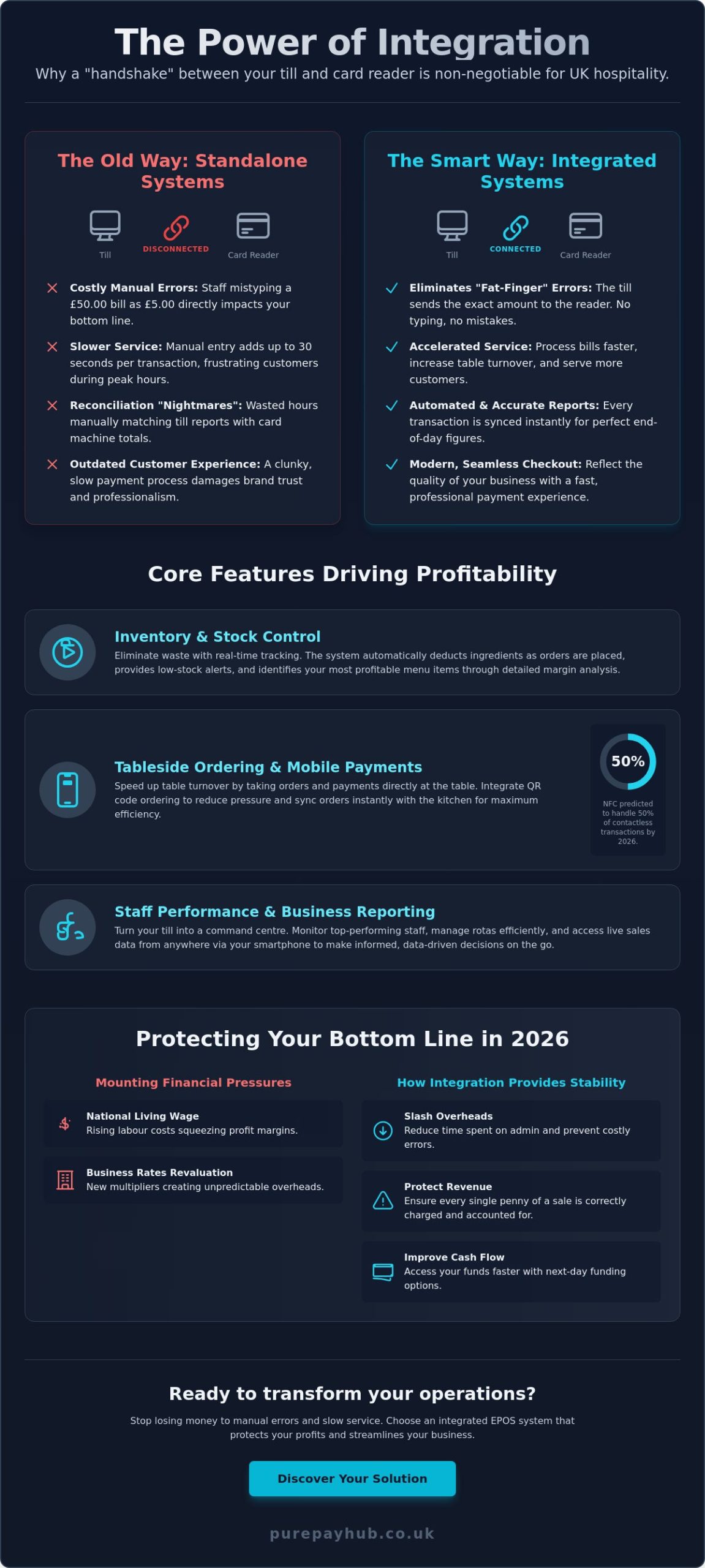
    Step 4: Select hardware that integrates. Integrated payments are vastly superior to standalone units for any growing business. In an integrated setup, the till communicates directly with the card machine. This eliminates the need to type the amount in twice, which drastically reduces human error and prevents costly mistakes during busy shifts. It’s particularly vital for the fast-paced nature of UK hospitality. You can explore our specialised integrated EPOS systems for hospitality UK to see how this works in practice.

    Step 5: Run a penny test. Once your hardware arrives, process a transaction for £0.01. This “penny test” ensures that the connection to the acquiring bank is active and that your settlement path is clear. It’s the final check to guarantee that when you start your first full day of trading, your funds will arrive in your account without delay. If you’re ready to start your journey, apply for your merchant account today and join a partnership built on purity and clarity.

    Beyond the Transaction: Cash Flow and Growth

    Your business doesn’t stop once the customer leaves the premises. The real work of growth begins when those funds hit your account. When you take payments, you’re generating more than just revenue; you’re creating a data map of your business’s health. In 2026, the speed of your settlement and the flexibility of your capital determine how quickly you can respond to new opportunities. We position PurePay Hub as your central command centre, ensuring that the bridge between a sale and your bank balance is as short as possible.

    Your transaction history is a powerful tool for tracking customer behaviour and seasonal trends. By analysing when people choose to take payments most frequently, you can optimise your staffing levels and stock orders. Our Hub provides this clarity through simplified reporting that strips away the noise. This allows you to make informed decisions based on pure data rather than guesswork. When your payment processor acts as a growth partner, your business is built to scale sustainably.

    Next-Day Access to Funds

    Standard settlement periods often leave merchants waiting between 3 and 5 working days for their money. This delay creates a bottleneck that prevents you from restocking inventory or paying staff on time. For UK SMEs in 2026, next-day access to funds has moved from a luxury to a non-negotiable requirement. It provides the liquidity needed to keep your operations fluid and responsive. You can learn more about this in our Next-Day Funding for Retailers guide.

    Business Cash Advances Explained

    Traditional bank loans often come with rigid monthly repayments that don’t account for your actual trading volume. A Business Cash Advance is a more transparent and honest alternative. You receive a lump sum upfront and repay it as a fixed percentage of your daily card sales. This “pay-as-you-trade” model is inherently safer for seasonal businesses. If you have a quiet Tuesday, you pay back less. If you have a record-breaking Saturday, you pay back more. It’s a partnership that aligns with your success. Discover how PurePay Hub can support your cash flow with a Business Cash Advance today.

    Secure Your Financial Future Today

    The UK payment landscape is evolving rapidly. With Visa increasing fees on 24 January 2026, you cannot afford to stay with a provider that hides behind complex jargon. You now have a clear checklist to audit your sales, choose the right hardware, and secure your cash flow with next-day funding. The ability to take payments should be a pure utility that supports your growth rather than a drain on your resources.

    By moving away from “blended” rates and embracing the transparency of an Interchange Plus model, you protect your margins from hidden monthly markups. You also ensure your business stays ahead of mandatory security standards like PCI DSS v4.0.1. We act as your reliable ally in this shifting market, providing the stability your business needs to thrive.

    Switch to PurePay Hub for transparent, transaction-based payments today. You will benefit from debit card rates starting from 0.3% and next-day funding as standard. It’s time to simplify your setup and focus on your customers. Your business deserves a partner that values honesty as much as you do.

    Frequently Asked Questions

    How long does it take to set up a merchant account to take payments?

    Modern onboarding allows you to set up a merchant account within 24 to 48 hours. If you have your “Know Your Customer” documentation ready, such as photo ID and bank statements, the process is streamlined and efficient. This ensures you can take payments and start trading without the long delays typically associated with traditional high-street banks.

    Can I take payments on my phone without a card machine?

    You can take payments on your smartphone using a virtual terminal or secure payment links. A virtual terminal turns your phone’s browser into a secure interface for over-the-phone orders. Alternatively, you can send a unique URL via SMS or email, allowing the customer to pay instantly from their own device without needing a physical terminal on site.

    What are the average transaction fees for small businesses in the UK?

    Small businesses in the UK typically pay between 1.5% and 3.5% per credit card transaction. As of May 2026, the average processing cost for Visa and Mastercard is approximately 2.35%. These rates vary depending on whether you use a “blended” flat rate or a more transparent “interchange plus” model that reveals the true cost of processing.

    Is it possible to take payments online and in-store with the same provider?

    Managing both online and in-store sales with a single provider is the most efficient way to run your business. Using a unified “Hub” simplifies your reporting and gives you a single view of your cash flow. For those operating as digital platforms or marketplaces, click here to learn more about Gemba’s specialised banking infrastructure. It also ensures your transaction-based fees remain consistent and clear across all your sales channels, from your website to your physical till.

    What happens if my card machine loses Wi-Fi connection during a sale?

    Most modern terminals switch automatically to a 4G or 5G SIM connection if your Wi-Fi drops. This ensures you don’t lose a sale during busy shifts. If you don’t have a SIM-enabled device, some units offer an “offline mode” that stores the transaction data securely and processes it once your internet connection is restored.

    How do I avoid paying monthly PCI non-compliance fees?

    You avoid non-compliance fees by providing 12 months of continuous operational evidence for PCI DSS v4.0.1. This became mandatory for all UK businesses on 31 March 2025. We help you through the annual self-assessment process to ensure your security standards are met, protecting you from the unnecessary penalties that many traditional processors charge.

    Can I take payments from international customers with a UK merchant account?

    You can accept cards from international customers, but these transactions often carry different interchange fees. Whilst your UK merchant account handles global payments, be aware that currency conversion and “non-EEA” card rates can impact your final settlement. We advocate for transparency here so you always know the exact cost of your global sales.

    What is the difference between a merchant account and a business bank account?

    A merchant account is a temporary holding area where funds are cleared and authorised after a transaction. A business bank account is the final destination where your hard-earned profits are settled. You need both to function; the merchant account acts as the bridge that moves money from your customer’s bank to your own balance.

  • The Ultimate Guide to Choosing a Card Machine for Your UK Business in 2026

    The Ultimate Guide to Choosing a Card Machine for Your UK Business in 2026

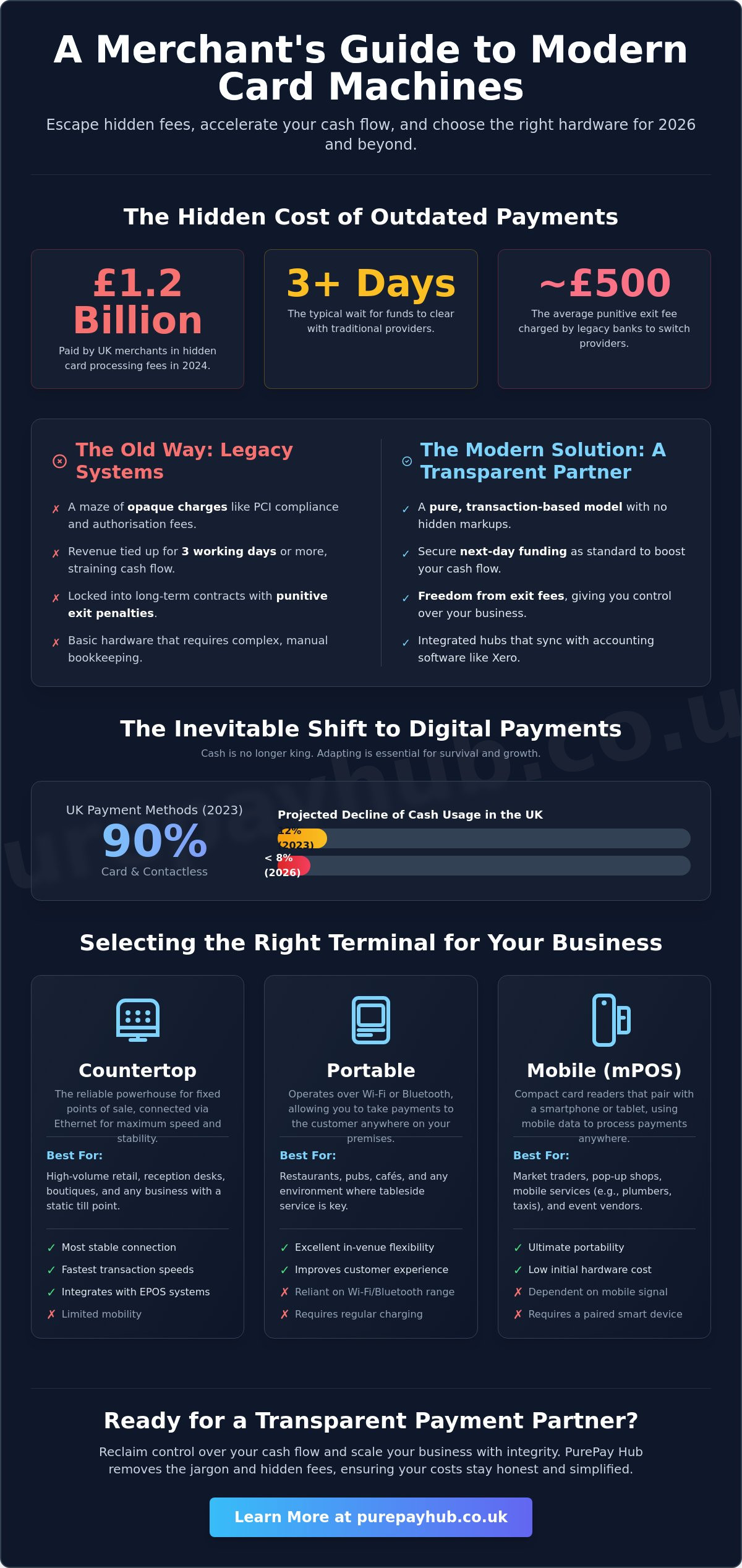
    What if the very tool you use to take payments is actually siphoning away your profit through a maze of opaque charges? In 2024, UK merchants paid an estimated £1.2 billion in hidden card processing fees, a figure that continues to rise as legacy providers cling to complex contracts. You’ve likely felt the sting of waiting three working days for funds to clear or discovered a “PCI compliance fee” that was never mentioned during the sales pitch. It’s frustrating to see your hard-earned revenue tied up in outdated systems whilst you’re trying to grow your business.

    This guide cuts through the corporate jargon to help you choose a card machine that prioritises your cash flow. You’ll discover how to secure next-day funding as standard and move to a pure, transaction-based model that eliminates hidden markups. We’ll examine the hardware reliability you need for 2026 and provide a clear roadmap to escape the £500 exit fees often charged by traditional banks.

    Key Takeaways

    • Understand how modern payment terminals have evolved into integrated financial hubs designed to streamline your daily business operations.
    • Select the perfect card machine for your specific needs by comparing the reliability of countertop units against the versatility of portable technology.
    • Learn to identify hidden costs within common pricing models and why transaction-based clarity is essential for protecting your bottom line.
    • Gain the confidence to audit your existing merchant statements and navigate provider switches whilst avoiding punitive exit fees.
    • Explore how a transparent partnership with PurePay Hub can help you reclaim control over your cash flow and scale your business with integrity.

    What is a Card Machine and How Does it Function in 2026?

    A card machine is no longer just a peripheral; it’s the heartbeat of a modern storefront. It functions as a secure terminal that encrypts card data and transmits it to authorisation centres in milliseconds. By 2026, these devices have transitioned from basic hardware into integrated financial hubs for UK SMEs. They provide a transparent link between your physical sales and your digital ledger. If you’re curious about the technical specifications, you can read about what is a payment terminal to understand its historical development and core mechanics. Accepting digital payments is now essential for consumer trust. UK Finance data from 2023 showed that 90% of all UK payments were made via card or contactless methods. By 2026, refusing to use a card machine effectively closes your doors to the majority of the British public.

    The role of NFC (Near Field Communication) technology is central to this shift. It facilitates near-instant contactless and mobile wallet payments through services like Apple Pay and Google Pay. This technology isn’t just about convenience; it’s about security. Every transaction is tokenised, meaning your customer’s actual card details are never stored on your device. This level of “pure” security protects your business from data breaches and builds long-term loyalty with your clientele.

    The Core Components of Modern Payment Processing

    Modern processing relies on three pillars to ensure funds move safely from the customer to your pocket. Your merchant account acts as the essential bridge between the terminal and your business bank. The payment gateway ensures every transaction is encrypted and secure during transmission. Finally, the acquiring bank settles the funds into your account. At PurePay Hub, we prioritise clarity in this chain. We remove the jargon and the hidden fees that traditional banks often bury in the small print, ensuring your transaction-based costs stay honest and simplified.

    Why Businesses are Moving Away from Cash

    The shift away from physical currency is driven by efficiency and safety. Cash carries high insurance premiums and theft risks that digital payments simply don’t have. According to industry reports, cash usage in the UK dropped to just 12% in 2023, and it’s projected to fall below 8% by 2026. Transitioning to a digital-first model offers several clear wins for your business:

    • Faster Checkout: Contactless transactions usually complete in under two seconds, which significantly increases your peak-time turnover.
    • Reduced Risk: Digital payments eliminate the danger of counterfeit notes and internal shrinkage.
    • Automated Bookkeeping: Modern card machine systems sync directly with accounting software like Xero, making your tax returns a breeze.

    By embracing these integrated hubs, you aren’t just taking payments. You’re organising your entire financial life through a single, dependable partner.

    Countertop, Portable, or Mobile: Selecting the Right Terminal

    Your business layout dictates your hardware choice. A card machine isn’t a one-size-fits-all tool; it’s the physical bridge between your service and your revenue. Choosing the wrong terminal leads to dropped connections at the table or cluttered wires at the till. PurePay Hub prioritises hardware that fits your specific workflow, ensuring that every transaction is as clean and efficient as possible.

    Assessing your environment is the first step toward pure performance. If you operate from a fixed point, like a boutique or a reception desk, stability is your priority. If you move amongst customers, range and battery life become the primary metrics for success. Recent data from the 2022 market review into UK payment regulations highlighted that merchants often overlook the impact of hardware contracts on their total cost of ownership. We believe in providing the right tool without the typical industry fluff.

    Countertop Terminals for Fixed Retail

    Countertop units are the reliable powerhouses of the retail world. These devices connect directly via Ethernet, providing the fastest and most stable connection available. They’re perfect for high-volume businesses where the point of sale never moves. Because they’re plugged into a power source, you never have to worry about a dead battery during a midday rush. Most modern countertop units integrate seamlessly with EPOS systems. This connection ensures your inventory levels update the moment a sale is made, removing the need for manual reconciliation at the end of the day.

    Portable vs Mobile: Understanding the Difference

    The terms “portable” and “mobile” are often used interchangeably, but they serve very different needs. Understanding the distinction helps you avoid paying for features you won’t use.

    • Portable: These devices use Wi-Fi or Bluetooth to connect to a base station. They’re designed for short-range movement, such as taking a card machine to a table in a restaurant or a chair in a salon. They offer the flexibility of movement within a roughly 50-metre radius of your router.
    • Mobile: These terminals are essential for tradespeople, delivery drivers, or market stall holders. They use an internal SIM card to connect to GPRS, 4G, or 5G networks. This provides national coverage, allowing you to take payments wherever you have a mobile signal.

    Battery life is the deciding factor for businesses on the move. A high-quality mobile terminal should last for at least 8 to 10 hours of active use, or roughly 200 transactions, before needing a charge. If you’re operating at an outdoor festival or a remote site, this longevity is non-negotiable. It’s about maintaining a professional image; a terminal that dies mid-transaction creates unnecessary friction. You can find a terminal that matches your pace by choosing hardware designed for your specific industry demands.

    The Ultimate Guide to Choosing a Card Machine for Your UK Business in 2026

    The Real Cost of Processing: Understanding Fee Structures

    Choosing a card machine involves more than just picking a device. You need to look at the numbers beneath the surface. Many providers offer “free” equipment or no monthly costs, yet they claw back that value through inflated transaction percentages. A transparent, transaction-based model ensures you only pay for the service you use. At PurePay Hub, we advocate for clarity over complexity. Our “Pure” approach offers transparent rates starting from 0.3% for debit cards, ensuring your hard-earned revenue stays in your business.

    The Trap of Flat-Rate Pricing

    Flat rates often act as a convenience tax for small businesses. A standard 1.75% rate feels manageable when you’re starting out. However, as your business grows, this fixed percentage becomes a significant drain on your profits. Interchange fees are the base costs set by card schemes like Visa and Mastercard. Most debit card transactions carry a very low interchange cost. When you pay a flat 1.75%, the provider pockets the massive difference between that base cost and what they charge you.

    Variable rates are the fairer alternative. They reflect the actual cost of the card used by your customer. By moving away from flat-rate models, you align your costs with reality. This creates a partnership where your success isn’t penalised by static, high-margin fees. For a business processing £10,000 a month, switching from a 1.75% flat rate to a transparent 0.3% debit rate can save over £100 monthly.

    Essential Fees and Value-Added Services

    Understanding your Merchant Service Charge (MSC) is the first step toward financial clarity. This is the total fee you pay to process a payment. Beyond the transaction fee, you must watch for hidden extras that traditional banks often slip into the small print. These include:

    • MMSC: Minimum Monthly Service Charges that apply if your transaction volume is low.
    • Statement Fees: Charges for receiving a breakdown of your activity.
    • PCI DSS Penalties: Fines for not meeting security standards, often costing £20 to £50 per month.

    Hardware rental provides a low entry cost and includes technical support, whilst purchasing your card machine outright offers better long-term value for established shops. We help you navigate these choices without the jargon. Staying PCI compliant is essential for security, and we provide the tools to help you avoid unnecessary fines. We focus on keeping your processing “Pure” so you can focus on your customers.

    How to Switch Providers and Optimise Your Setup

    Switching your card machine provider is a strategic move for your bottom line. It isn’t just about a lower rate; it’s about reclaiming control over your business finances. Many UK merchants stay with expensive providers because the process feels daunting. In reality, a structured approach makes the transition seamless and profitable. Your first step is a clinical audit of your current costs. Look beyond the headline rate. Divide your total monthly fees by your total turnover to find your true effective rate. This often reveals hidden markups that traditional banks fail to mention.

    To ensure a smooth migration, follow these essential steps:

    • Review your contract: Identify if you are in a rolling 30-day notice period or tied into a longer term. Check for any “early exit” fees.
    • Request a Pure comparison: Send your latest statement to a transparent provider like PurePay Hub. We provide a side-by-side breakdown of where you are losing money.
    • Organise your documents: Have your proof of ID, business bank details, and VAT registration ready. This speeds up the underwriting process significantly.
    • Synchronise the swap: Keep your old terminal active until your new hardware is tested and your first transaction is successfully processed.

    Overcoming the Fear of Switching

    The biggest myth in payment processing is that switching causes downtime. You don’t have to stop taking payments. By running two systems in parallel for 24 hours, you eliminate risk. We handle the heavy lifting of the transition, ensuring your new hardware integrates with your favourite EPOS software from day one. Modern setups are designed to be “plug and play,” meaning you can be up and running within minutes of unboxing your new device.

    The Importance of Next-Day Funding

    Slow settlement times can cripple a small business. Waiting 3 to 5 working days for your own money is a relic of old banking. If you process £2,000 on a busy Saturday, you need that capital in your account by Sunday or Monday to restock inventory. Next-day funding provides a massive competitive advantage for cash flow management. It turns yesterday’s sales into today’s buying power. Always verify that your new contract includes a guarantee for funding speed before you sign.

    Stop overpaying for your processing and start growing your business with a partner you can trust. Request your transparent side-by-side comparison today.

    PurePay Hub: A Modern Ally for UK Merchants

    Choosing a card machine shouldn’t feel like signing a contract with a hidden enemy. Many UK small businesses struggle with opaque fee structures and delayed settlements that stifle their growth. PurePay Hub operates differently. We’ve built our service on a foundation of transparency and direct support. Our transaction-based fees are designed to help your business scale without the fear of sudden cost spikes. You get a fair price that reflects your actual usage, not a generic corporate estimate.

    Efficiency is at the heart of our platform. We provide integrated EPOS solutions specifically tailored for sectors ranging from retail and hospitality to healthcare providers like Maximal Physio. These systems do more than just process payments; they unify your inventory and sales data into one streamlined workflow. To keep your operations moving, we provide next-day funding as a standard feature for our merchants. You won’t be left waiting for your hard-earned revenue to clear. This speed ensures your cash flow remains healthy, allowing you to restock or pay staff without delay.

    Beyond Payments: Business Cash Advances

    Growth often requires capital that traditional banks are slow to provide. We offer access to Business Cash Advances that prioritise your potential over your credit history. You can secure unsecured capital without the burden of fixed monthly interest rates. Repayment is structured as a simple percentage of your daily sales. When you’re busy, you pay back more. During quiet spells, your repayments automatically drop. We use your card machine data to prove your creditworthiness, making growth funding accessible and stress-free for every merchant we support.

    Why Purity in Processing Matters

    We’ve eliminated corporate jargon to provide honest, straight-talking support for every merchant. The Hub concept is central to our philosophy. It centralises your payments, detailed reporting, and funding options into one manageable space. You don’t need to jump between different providers or confusing spreadsheets to understand your finances. It’s a single, reliable point of truth for your business. Join PurePay Hub today for a fairer way to take payments and experience a partnership built on clarity.

    Future-Proof Your UK Payments Today

    Navigating the UK payment landscape in 2026 requires more than just hardware; it requires a strategy built on transparency and speed. You’ve seen how the right card machine can transform your daily operations, whether you’re serving customers at a fixed counter or on the move. The key is to look past the shiny devices and focus on the underlying fee structure. Many providers still hide costs in complex tiers, but your business deserves a model that prioritises clarity.

    PurePay Hub offers a refreshing alternative for merchants who are tired of opaque markups. We provide a pure, transaction-based approach that puts you in control of your margins. With debit card rates starting from 0.3% and next-day access to your funds, you can stop waiting for your money and start reinvesting it. It’s time to leave behind the frustration of hidden fees and partner with an ally that values your growth.

    Switch to PurePay Hub for transparent rates and next-day funding and take the first step towards a fairer financial future for your business. Success is built on the right partnerships, and we’re ready to help yours thrive.

    Frequently Asked Questions

    How much does a card machine cost for a small business in the UK?

    Costs vary based on your choice of hardware. You can buy a basic card reader for £19 plus VAT, or invest in a standalone card machine for £150 to £250. Transaction fees are the most important factor, usually ranging from 1.1% to 2.5%. We believe in pure transparency, so you’ll always know exactly what you’re paying without hidden markups or confusing fee tiers.

    Can I get a card machine with no monthly contract or rental fees?

    You can certainly find no-contract options that remove the burden of monthly rental fees. These pay-as-you-go models involve a one-off purchase of the hardware followed by a fixed percentage fee per sale. It’s a fair partnership for seasonal businesses or startups. This simplified approach ensures you only pay when you’re actually making money, keeping your overheads predictable and honest.

    What is the difference between a card reader and a card machine?

    A card reader typically requires a Bluetooth connection to a smartphone or tablet to process payments. In contrast, a standalone card machine functions independently with its own operating system and often a built-in receipt printer. Modern businesses often choose the latter for a more professional checkout experience. This choice provides the stability of a dedicated hub for all your daily financial transactions.

    How long does it take to get funds from card sales into my bank account?

    Funds typically reach your bank account within 1 to 3 business days. While some legacy banks take longer, many modern providers now offer next-day or even instant settlement. This speed is vital for maintaining healthy cash flow. We focus on providing a clear, logical path for your money to travel from the customer’s pocket to your bank account without unnecessary delays.

    What happens if my business Wi-Fi goes down whilst I am taking a payment?

    Your payment won’t fail if your device has a built-in SIM card for 4G connectivity. Most professional terminals automatically switch to mobile data if the Wi-Fi signal drops. This fail-safe ensures you never miss a sale during peak trading hours. It’s a dependable solution that keeps your business running smoothly, even when your local internet provider lets you down whilst you’re busy.

    Is it difficult to switch card machine providers if I am already in a contract?

    Switching is straightforward, though you must check your current contract for any exit fees or notice periods. Many providers now offer buyout incentives, sometimes covering up to £3,000 in cancellation costs to help you move. We act as your ally during this transition, ensuring the move is handled with integrity. It’s about finding a fairer deal that supports your long-term business growth.

    What security standards do card machines need to meet in the UK?

    Every device must comply with PCI DSS regulations. These strict rules ensure that 100% of transaction data is encrypted and handled safely. Using certified hardware protects your business from fraud and builds essential trust with your customers. It’s a non-negotiable standard that brings purity and security to every single tap, dip, or swipe at your counter.

    Can I use my card machine to accept Apple Pay and Google Pay?

    You can accept Apple Pay, Google Pay, and other digital wallets on any contactless-enabled terminal. These mobile payments use Near Field Communication technology to complete transactions in under two seconds. It’s a modern requirement for UK merchants, as 50% of all retail transactions now involve contactless methods. Supporting these options shows your customers that you’re a forward-thinking, efficient business.