Month: April 2026

  • Starting as a Sole Trader in the UK: The Complete 2026 Guide

    Starting as a Sole Trader in the UK: The Complete 2026 Guide

    The biggest threat to your new business isn’t a lack of customers; it’s the £3,000 penalty HMRC can issue for avoidable tax errors. You want the freedom of working for yourself, but the technicalities of becoming a sole trader often feel like a barrier designed to slow you down. We understand that frustration. Most of the 3.1 million small business owners in the UK started with a passion for their craft, not a love for National Insurance categories or unlimited liability risks. You deserve a clear path that cuts through the corporate jargon and focuses on your actual growth.

    We agree that business admin shouldn’t be a source of constant anxiety or hidden costs. This guide provides the honest roadmap you need to manage your finances with confidence and integrity. You’ll learn exactly how to register correctly, how to organise your tax affairs, and how to accept customer payments without the stress of complex fee structures. We are moving from initial setup to long-term financial health, ensuring you have a pure and simplified strategy for your professional future.

    Key Takeaways

    • Understand the legal requirements of becoming a sole trader and how to protect your personal assets from the risks of unlimited liability.
    • Master the HMRC registration process and the critical 5 October deadline to ensure your new venture remains fully compliant.
    • Discover why separating your personal and business finances is vital and how a dedicated merchant account simplifies taking card payments.
    • Identify common cash flow pitfalls and learn to use real-time reporting to monitor performance and capitalise on peak trading periods.
    • Find out how PurePay Hub supports your growth with pure transparency and tailored payment solutions that feature no hidden markups.

    What is a Sole Trader? Definition and UK Requirements

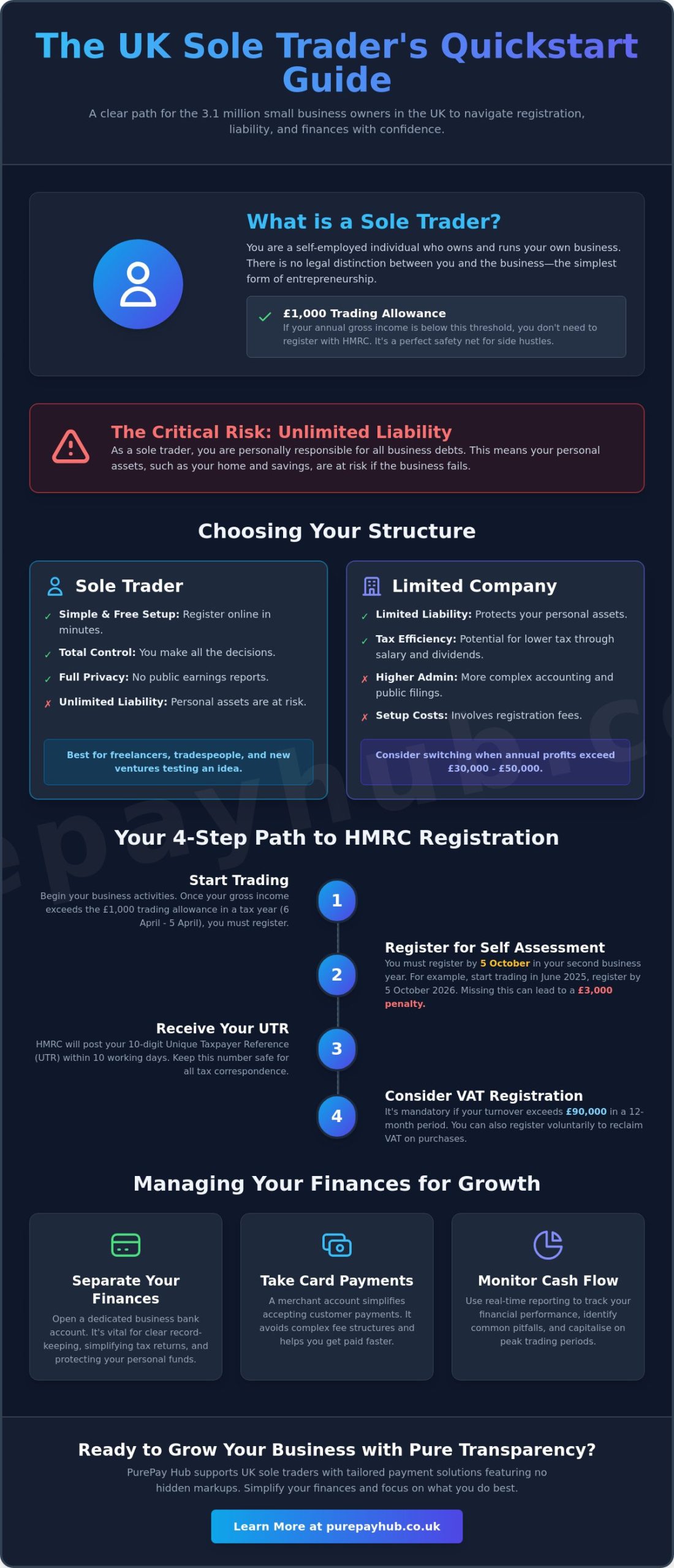
    Starting a business in the UK often begins with the most direct path. A sole trader is an individual who owns and runs their own business as a self-employed person. There is no legal separation between you and the business entity. This Definition of a sole trader confirms that you are the sole decision-maker and the sole beneficiary of all profits after tax. We see this structure as the purest form of entrepreneurship because it removes the layers of complexity found in larger corporate setups.

    This simplicity comes with a significant legal reality known as unlimited liability. Because you and the business are the same legal entity, you are personally responsible for every debt the business incurs. If your business fails to pay a supplier or faces a legal claim, your personal assets are on the line. This includes your home, car, and personal savings. It is a high-stakes arrangement that demands disciplined financial management and clear record-keeping.

    For those testing a new idea, the UK government provides a £1,000 tax-free trading allowance. If your annual gross income from self-employment stays below this £1,000 threshold, you don’t need to register with HMRC or pay tax on that income. Once your earnings exceed this limit between 6 April and 5 April of the following year, you must register for Self Assessment by 5 October. This allowance acts as a helpful buffer for side hustles and micro-businesses before they fully commit to the sole trader path.

    Pros and Cons of the Sole Trader Structure

    The primary advantage of this structure is total control. You make every decision without consulting a board of directors. Setup is free and can be completed in minutes via the HMRC website. You also benefit from increased privacy. Unlike limited companies, you aren’t required to file public accounts with Companies House, keeping your earnings confidential. However, the burden of personal liability is a heavy disadvantage. You might also face higher tax rates once your profits move into the 40% or 45% brackets. This structure works best for freelancers, local tradespeople, and independent shop owners who value agility over complex scaling.

    For independent shop owners or those in the logistics sector, you can explore the Courier Pro matching platform to find cost-effective ways to manage your deliveries by connecting with couriers who have spare capacity.

    Sole Trader vs. Limited Company

    Choosing between these two paths depends on your profit levels and risk appetite. A limited company is a separate legal entity, which offers “limited liability” to protect your personal wealth. However, the administrative burden is much higher. You’ll face setup costs, annual filing fees, and stricter accounting standards. While a sole trader pays personal income tax on all profits, a company director can often extract funds more efficiently using a combination of a small salary and dividends. We typically suggest merchants consider switching to a limited company structure once annual profits consistently exceed £30,000 to £50,000. This transition provides the protection and tax efficiency needed for a growing enterprise.

    How to Register as a Sole Trader in 2026

    Starting your journey as a sole trader requires more than just a talent for your craft. You must formalise your relationship with HMRC to ensure your business remains compliant and transparent. The most critical date in your calendar is 5 October. You must register for Self Assessment by this date in your second business year. For example, if you start trading in June 2025, you must register by 5 October 2026. Missing this deadline often results in unnecessary penalties that eat into your initial profits.

    The registration process begins at the GOV.UK website. You’ll first set up a Government Gateway account using your email address and a secure password. Once your identity is verified, you can apply for your Unique Taxpayer Reference (UTR). This ten-digit code identifies your business within the tax system. HMRC typically sends this number via post within 10 working days. Keep this document safe; you’ll need it for every official interaction and tax return you submit.

    VAT registration is another vital consideration. It’s mandatory if your taxable turnover exceeds £90,000 over a rolling 12-month period. However, many small businesses choose to register voluntarily even if they’re below this threshold. This allows you to reclaim VAT on business-related purchases and projects a more established image to corporate clients. Our transparent payment tools provide the clarity you need to track this turnover in real time, ensuring you never miss a mandatory registration trigger.

    Your Responsibilities to HMRC

    Running a business brings specific annual obligations. You must submit a Self Assessment tax return by 31 January each year. This filing details your income and expenses to determine your tax bill. Managing your finances also involves paying Class 4 National Insurance contributions if your annual profits exceed £12,570. Starting in April 2026, the Making Tax Digital (MTD) rules expand. If your qualifying income is over £50,000, you’ll need to keep digital records and use MTD-compatible software to provide quarterly updates to HMRC.

    Naming Your Business and Legal Compliance

    Choosing a name is a significant milestone for any sole trader. You can trade under your own name or create a business title. If you choose a trading name, it mustn’t include “Ltd”, “Plc”, or “Limited”. It also shouldn’t be offensive or infringe on existing trademarks. Beyond naming, you must protect your venture with the right insurance. Public liability insurance is essential if you interact with the public, whilst professional indemnity insurance protects you against claims of negligence or mistakes in your work.

    Data protection is a legal requirement, not an option. Under GDPR, you’re responsible for any personal data you collect from customers, such as names, addresses, or payment details. You must store this information securely and provide a clear privacy policy. Being a disciplined business owner means staying on top of these details from day one. This proactive approach builds a foundation of trust with your clients and keeps your business running smoothly without legal interruptions.

    Starting as a Sole Trader in the UK: The Complete 2026 Guide

    Managing Finances and Taking Payments

    Mixing your personal cash with your business income is a recipe for administrative stress. You should open a dedicated business bank account as soon as you follow the official government guide to setting up as a sole trader. Keeping these finances separate simplifies your bookkeeping. It ensures you can track every pound that enters or leaves your business without confusion. Clear records are your best defence during a tax audit and make your annual self-assessment far more manageable.

    To accept card payments, you require a merchant account. This isn’t a standard bank account. It’s a secure holding area that validates transactions before funds move to your business account. The right merchant account provides the infrastructure for growth. You then need to choose the right hardware for your specific workflow. Countertop machines suit fixed retail points with a permanent power source. Portable units use Bluetooth or Wi-Fi to reach customers at their tables or within a shop. Mobile card machines rely on 4G or GPRS, making them the perfect tool for a sole trader working on-site or at outdoor markets across the UK.

    Specialist service businesses such as UK Carpet Care Ltd provide a great example of how professional cleaning and restoration firms across the East of England can use these mobile tools to deliver expert service and handle transactions securely on-site.

    Modern Payment Solutions for Sole Traders

    Customer expectations are shifting toward speed and convenience. Accepting Apple Pay and Google Pay isn’t just a luxury; it’s a way to reduce queues and improve the checkout experience. For service-based work, payment links offer a flexible alternative to traditional invoicing. You simply send a secure link via email or WhatsApp, and the customer pays instantly from their device. If you handle bookings over the phone, virtual terminals allow you to process payments securely through your web browser without needing physical hardware in front of you.

    Transparent Fee Structures

    Many providers push “flat-rate” fees because they sound simple. These often hide significant markups that eat into your margins. Transaction-based processing is a fairer model because it charges you based on the specific type of card used. Debit cards usually cost less to process than premium credit cards. Understanding your statement is easier when you know what you’re paying for. Interchange fees are the non-negotiable costs set by card networks like Visa and Mastercard that are paid directly to the card-issuing bank for every transaction.

    PurePay Hub focuses on removing the “hidden” elements from your bill. We help you avoid monthly non-compliance fines by ensuring your setup meets current security standards from day one. Our goal is to provide a pure, honest view of your processing costs. This clarity helps you manage your cash flow with confidence. You deserve a partner that treats your sole trader business with the respect it earns through hard work. We prioritise directness, ensuring your hard-earned money stays where it belongs.
    Scaling Your Business: Cash Flow and Growth

    Managing cash flow is the primary challenge for any sole trader. According to 2023 data from the Federation of Small Businesses, 52% of small firms in the UK experienced late payments, which directly restricts growth. You need a transparent view of your finances to avoid these pitfalls. Real-time reporting allows you to identify your peak trading hours and seasonal trends with precision. This clarity helps you manage stock levels and staffing without guesswork.

    Waiting for funds to clear can stall your momentum. Next-day funding is essential for maintaining a healthy bank balance and paying suppliers on time. It ensures your hard-earned revenue is available when you need it most. You must also plan for HMRC. Setting aside 25% of every transaction into a dedicated tax account prevents the stress of a surprise bill during the January self-assessment period. This disciplined approach keeps your business finances pure and predictable.

    • Track daily performance to spot growth opportunities.
    • Prioritise processors that offer next-day settlement.
    • Automate your tax savings to ensure compliance.
    • Monitor transaction-based fees to maintain your margins.

    Accessing Capital for Growth

    Traditional bank loans often require collateral and involve rigid, fixed monthly repayments. For a growing sole trader, a business cash advance offers a more flexible path. This model provides unsecured capital based on your future card sales. Instead of a fixed fee, repayments fluctuate with your daily turnover. When trade is quiet, your repayments reduce. When business is booming, you pay back more. This creates a fair partnership where the lending matches your actual performance.

    Leveraging EPOS Systems

    An integrated EPOS system acts as your central business hub. It does more than just process payments; it manages your inventory in real-time to prevent stockouts. For hospitality traders, guest management and loyalty features help turn one-off visitors into regular clients. By streamlining the checkout process, you reduce friction and can increase average basket values by up to 15% through faster, more efficient service.

    Keep your business moving forward with clear, honest processing. Discover how PurePay Hub supports your growth with transparent tools designed for the modern merchant.

    How PurePay Hub Supports UK Sole Traders

    Starting as a sole trader in the UK involves juggling multiple roles at once. You’re the CEO, the marketing department, and the accountant. PurePay Hub acts as your financial ally, stripping away the complexity of payment processing so you can focus on growth. We believe in “Pure” transparency. This means you’ll never face hidden markups or confusing monthly statements. Our model is built on honesty, ensuring every penny you earn is accounted for without surprise deductions.

    Cash flow is the lifeblood of any small venture. Waiting a week for your money to clear isn’t an option when bills are due. We provide next-day access to your funds, keeping your business moving at the pace it deserves. Whether you’re running a boutique cafe or offering consultancy services, our UK-based support team is always available to help, serving sole traders nationwide. We also take the headache out of PCI compliance, handling the technical heavy lifting so you stay secure and compliant without the stress.

    Fair Rates for Small Volumes

    Small businesses often get penalised with high fees because they don’t process millions. We do things differently. Our competitive rates start from 0.3% for debit cards, providing a fair deal regardless of your size. The onboarding process is designed for busy entrepreneurs; you can get set up whilst you grab a coffee. We offer flexible hardware options without the trap of exit fees, giving you the freedom to scale or change as your business evolves.

    Get Started Today

    Switching to a fairer payment partner shouldn’t take weeks. You can move to PurePay Hub in minutes, gaining immediate clarity over your costs. Our promise is simple: we provide a partnership built on integrity and shared growth. We don’t just process payments; we help you build a sustainable future. Every sole trader deserves a provider that values their hard work as much as they do.

    Experience fair payment processing with PurePay Hub and see the difference transparency makes to your bottom line.

    Take Control of Your Business Growth

    Launching as a sole trader in 2026 requires more than just a great idea; it demands a clear grasp of HMRC registration and a disciplined approach to cash flow. You’ve now seen how to organise your tax obligations and why separating your personal and professional finances is vital for long-term success. Growth happens when you strip away the noise and focus on your craft. We believe your hard-earned revenue shouldn’t be eroded by hidden markups or sluggish processing cycles. You deserve a partner that prioritises clarity over corporate jargon. PurePay Hub serves as your financial centre, providing the stability and pure transparency required to scale with absolute confidence. We offer debit card rates starting from 0.3% and ensure you have next-day access to your funds. Our UK-based expert support is always on hand to help you navigate the unique challenges of the British market. It’s time to trade on your own terms and keep more of what you earn.

    Join the UK merchants choosing transparency at PurePay Hub

    Frequently Asked Questions

    Do I need a separate business bank account as a sole trader?

    You aren’t legally required to have a separate business bank account as a sole trader in the UK. However, most high street banks include terms that prohibit using personal accounts for business transactions. Opening a dedicated account ensures pure transparency for your bookkeeping and simplifies your Self Assessment. It also makes it easier to track your £1,000 tax-free trading allowance without personal spending clouding the data.

    How much tax do I pay as a sole trader in the UK?

    You pay Income Tax on profits that exceed your £12,570 Personal Allowance. For the 2024/25 tax year, the basic rate is 20% on profits up to £50,270, whilst the higher rate is 40% on earnings above that. You also pay Class 4 National Insurance at 6% on profits between £12,570 and £50,270. These rates ensure your tax contribution remains fair and proportional to your actual business growth.

    Can I be employed and a sole trader at the same time?

    You can definitely be an employee and a sole trader simultaneously. This is a popular way to build a business whilst maintaining the security of a monthly salary. You must register for Self Assessment if your side income exceeds £1,000 before expenses. HMRC will calculate your total tax bill by looking at your combined income from both your job and your business venture.

    What business expenses can I claim back as a sole trader?

    You can claim for any costs that are “wholly and exclusively” for business use. This includes office supplies, stock, marketing costs, and business insurance. If you work from home, you can use simplified expenses, such as claiming £10 per month if you work between 25 and 50 hours. Keeping honest, clear records of these costs ensures you only pay tax on your actual profits rather than your total turnover.

    Is it better to be a sole trader or a limited company?

    The sole trader model is better if you want simplicity, lower setup costs, and minimal paperwork. You have total control over the business, but you’re personally liable for any losses. A limited company offers more protection for your personal assets but involves higher administrative fees and stricter filing dates. Many merchants start as sole traders and switch once their annual profits consistently exceed £30,000.

    How do I register for VAT as a sole trader?

    You must register for VAT if your taxable turnover exceeds £90,000 over a rolling 12-month period. This threshold was updated on 1 April 2024 to support small business growth. You can register online through the HMRC website to receive your VAT certificate. Once registered, you must charge VAT on your sales and can reclaim the VAT you’ve paid on valid business purchases, helping you maintain a pure and balanced cash flow.

    What happens if my sole trader business goes into debt?

    You are personally responsible for all business debts because the law doesn’t distinguish between you and your business. This means creditors can pursue your personal assets, such as your car or home, to settle any outstanding balances. It’s vital to use a transparent payment system that helps you monitor your margins closely. Staying disciplined with your finances is the best way to protect your personal livelihood from business risks.

    Can I employ staff if I am a sole trader?

    You can certainly employ staff as a sole trader; there are no restrictions on hiring help to grow your business. You’ll need to register as an employer with HMRC and set up a PAYE system to manage tax and National Insurance contributions. You must also obtain employers’ liability insurance with at least £5 million of cover. This allows you to build a team whilst keeping your business structure simple and easy to manage.
  • NFC Technology: A Merchant’s Guide to Contactless Payments in 2026

    NFC Technology: A Merchant’s Guide to Contactless Payments in 2026

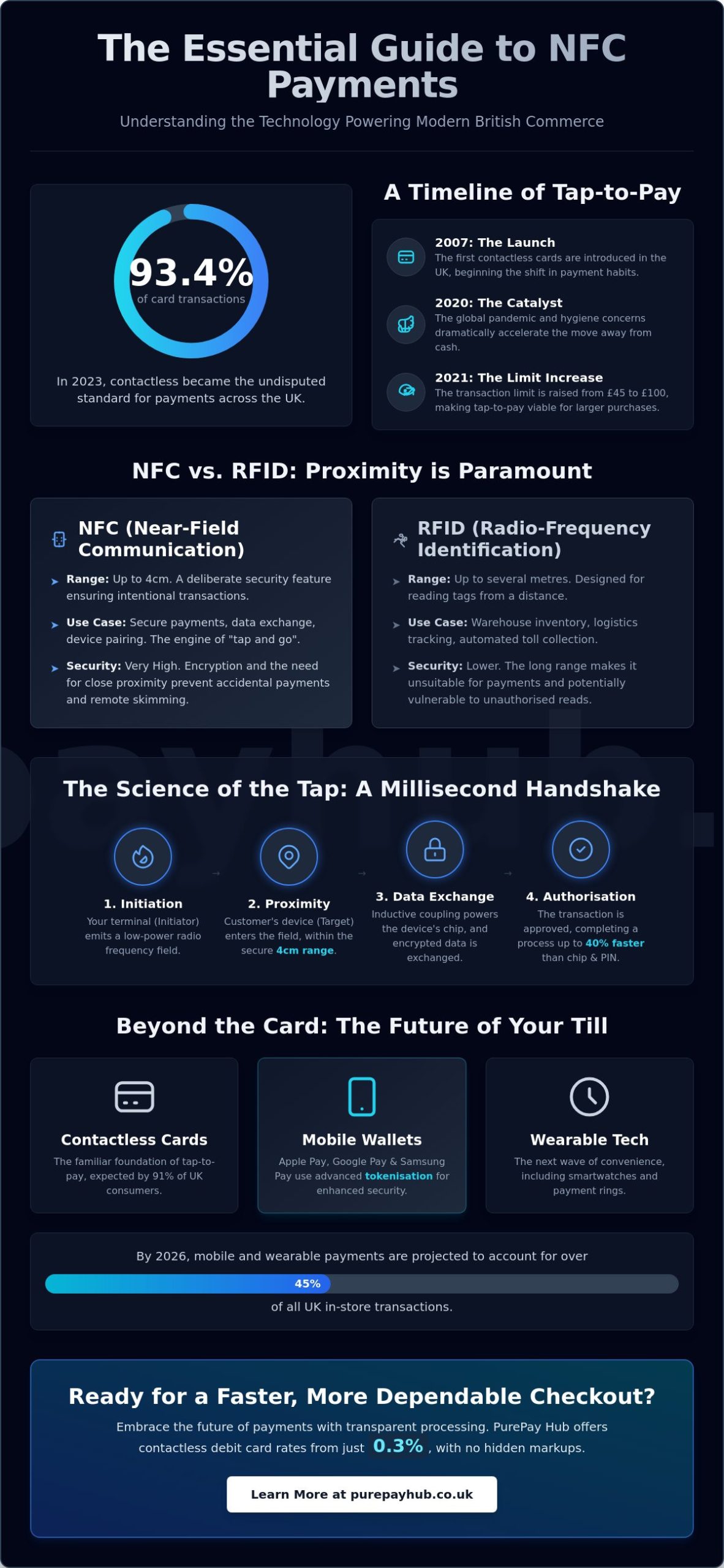
    According to UK Finance, contactless payments accounted for 93.4% of all card transactions in 2023. By 2026, a merchant without a reliable nfc strategy will struggle to keep pace with the expectations of the British high street. You likely feel the pressure of peak-hour queues and the constant need to reassure customers that their digital data is safe. You don’t want technology to be a barrier; you want it to be a bridge to better service.

    We believe in a pure and transparent approach to payment processing that puts the merchant first. This guide will show you how Near-Field Communication works to streamline your operations whilst improving customer satisfaction. You will learn the clear differences between NFC and RFID, discover how to integrate mobile wallets like Apple Pay seamlessly, and find out how to secure your business against modern fraud. We are moving beyond the jargon to give you the clarity you need for a faster, more dependable checkout hub.

    Key Takeaways

    • Understand why contactless payments have become the non-negotiable standard for British consumers and how this shift impacts your daily operations.
    • Master the mechanics of nfc technology, from the deliberate 4cm security range to the advanced tokenisation that keeps your transactions safe from fraud.
    • Identify the ideal hardware for your specific business flow, whether you require a fixed countertop terminal or a portable device for mobile service.
    • Discover how to eliminate hidden markups and access transparent processing rates, with debit card charges starting from just 0.3% for contactless payments.
    • Learn how to streamline your checkout process to reduce queues and significantly enhance customer satisfaction through modern payment solutions.

    What is NFC and Why is it Essential for UK Merchants?

    Near-field communication (NFC) is a short-range wireless technology that allows two devices to communicate when held within 4 centimetres of each other. NFC is a proximity-based data transfer protocol operating at 13.56 MHz. For a British business owner, it’s the invisible engine behind every “tap and go” transaction at your till. Unlike older systems, it offers a secure, encrypted handshake that protects both your revenue and your customer’s data. This technology turns a standard payment terminal into a high-speed gateway for modern commerce.

    Understanding the difference between NFC and RFID is vital for your point of sale. While RFID can track items from several metres away, NFC is strictly limited to close range. This physical proximity is a security feature; it ensures that a customer cannot accidentally pay for someone else’s shopping whilst standing in a queue. It provides the “tap and go” experience that 91% of UK consumers now expect at the checkout. At PurePay Hub, we see this technology as the foundation of a transparent and efficient transaction model.

    The Evolution of Contactless Payments in the UK

    The UK payment landscape changed forever in 2007 with the introduction of the first contactless cards. Adoption was steady until the COVID-19 pandemic in 2020. During that period, hygiene concerns accelerated a massive shift away from cash. In October 2021, the UK government increased the contactless limit from £45 to £100. This change allowed merchants to process the vast majority of all card transactions via contactless, significantly increasing average transaction speed. Contactless is no longer a convenience; it’s the default behaviour for 87% of UK shoppers.

    NFC Beyond the Credit Card

    Your customers are increasingly leaving their physical wallets at home. The rise of mobile wallets like Apple Pay, Google Pay, and Samsung Pay has turned smartphones into secure payment hubs. These digital wallets use tokenisation to hide actual card details, making them even more secure than traditional plastic. Beyond phones, wearable technology is gaining ground. Smartwatches and even payment rings now utilise this technology to facilitate instant transactions. By 2026, these alternative form factors are expected to account for over 45% of all in-store payments in the UK. We provide the clarity and tools you need to accept every tap with confidence.

    How NFC Technology Works: The Science of the Tap

    NFC technology isn’t magic. It’s precision engineering designed for the modern UK high street. At its core, the process involves an “Initiator” and a “Target.” Your card terminal acts as the initiator, constantly emitting a small radio frequency field. When a customer brings their phone or card within 4cm, that device becomes the target. This 4cm limit is a deliberate security feature. It ensures that transactions only happen when intended, preventing accidental payments from passersby or “skimming” from a distance. It’s a short-range constraint that provides a long-range sense of security for your customers.

    There are three distinct modes of nfc operation that power today’s digital economy. Card Emulation is the most common for merchants, allowing a smartphone to act exactly like a physical credit card. Reader/Writer mode lets your terminal pull data from smart tags or posters. Peer-to-Peer allows two devices to swap information directly. This system operates at the speed of light, making it significantly faster than the old magnetic stripe method. Traditional stripes rely on physical friction and analogue data reading, which is slow and prone to wear. NFC uses digital packets sent via radio waves, reducing transaction times by up to 40% compared to older contact-based methods. For a busy London cafe or a retail shop in Birmingham, these seconds saved per customer directly translate to shorter queues and higher turnover.

    Inductive Coupling Explained

    NFC relies on inductive coupling to transfer power and data simultaneously. Your terminal’s internal antenna creates an electromagnetic field. When a contactless card enters this field, the card’s own antenna picks up the energy. This powers the chip without needing a battery. Physical contact isn’t actually necessary. The term “tap” is simply a user-friendly way to describe bringing two antennas into close proximity. It’s a pure, wireless handshake that happens in milliseconds, ensuring the data remains encrypted and the connection remains stable throughout the brief interaction.

    Data Exchange Protocols

    Security relies on strict global standards to maintain integrity. Most payment systems use ISO/IEC 14443. This protocol ensures that a terminal in Manchester can talk to a card issued in New York without friction. Implementing NFC correctly means choosing hardware that adheres to these standards whilst remaining updateable. As software evolves, your hardware must stay compatible with new encryption methods. At PurePay Hub, we believe your payment nfc setup should be a stable foundation for your business growth. If you want to simplify your checkout and remove technical headaches, you can explore our transparent terminal options to find a partner that values your time.

    NFC Technology: A Merchant’s Guide to Contactless Payments in 2026

    Security and Trust: Is NFC Safe for Your Business?

    Many UK business owners worry about nfc signals being “skimmed” by digital pickpockets. This fear often stems from early contactless adoption, but the technology has moved on. Modern payment standards make it incredibly difficult for fraudsters to intercept usable data. While 2024 industry data suggests that physical card theft is still a threat, digital nfc interception is practically non-existent in real-world retail environments. To understand the full landscape of NFC security threats and solutions, we need to look at how data is shielded during every tap. Security isn’t just an add-on; it’s the foundation of a Pure payment environment.

    The Power of Tokenisation

    Tokenisation is your strongest shield against data breaches. When a customer taps their device, the system doesn’t transmit the actual 16-digit card number. Instead, it sends a “token,” which is a random string of numbers that only the bank can decode. If a hacker intercepted this token, it would be useless for any other transaction or merchant. Tokenisation ensures the merchant never actually “sees” or stores the customer’s real card details. By keeping sensitive data out of your Hub, you lower your liability and protect your business from the fallout of a potential data leak. It’s a transparent way to handle sensitive info without the risk.

    Dynamic CVV and Encryption

    Every tap creates a unique cryptographic signature that validates the transaction. Unlike a physical card where the CVV is static and printed on the back, mobile wallets use a dynamic version. This security code changes for every single tap. “Replay attacks,” where a fraudster tries to use intercepted data for a second time, are virtually impossible because the bank’s system rejects any code that has already been used. This entire process happens within the Secure Element (SE) chip. This hardware is physically isolated from the rest of the smartphone’s operating system, meaning even if a phone is infected with malware, the payment keys remain untouched.

    Mobile NFC payments offer a distinct advantage over physical cards through biometric verification. A lost contactless card can be used by anyone until it’s cancelled. A smartphone requires FaceID, a fingerprint, or a passcode before the nfc chip activates. This simple step eliminates a massive portion of fraudulent activity at the point of sale. For your business, using modern hardware also simplifies your PCI DSS compliance. These devices are built to meet the latest security standards, ensuring your partnership with us is based on honesty and technical integrity. You get to focus on growth while the hardware handles the heavy lifting of data protection.

    Implementing NFC: Choosing the Right Hardware for Your Shop

    You probably already have the foundation for nfc payments sitting on your counter. Take a look at your current terminal. If you see the four curved waves symbol, you’re likely ready to accept contactless payments. However, hardware manufactured before 2020 often lacks the processing power to handle the complex encrypted handshakes required by the latest digital wallets. Upgrading your kit isn’t just a technical necessity; it’s a commitment to your customer’s time.

    Countertop vs. Mobile NFC Terminals

    Fixed countertop units are the reliable workhorses of the UK high street. They thrive in environments with high transaction volumes, like boutiques or local convenience stores. Because these units typically use wired Ethernet connections, they offer a level of stability that wireless units can’t always match. You won’t have to worry about a “searching for signal” message during a busy Saturday afternoon rush.

    Portable and mobile units are essential for hospitality and service-based businesses. Data from UK Finance shows that contactless payments accounted for 93% of all card transactions in 2023. To capture this demand at the table or on the move, you need hardware with robust battery life. Prioritise devices that offer 4G or 5G failover. If your shop’s Wi-Fi stutters, the terminal switches to mobile data instantly, keeping your revenue flowing without a hitch.

    Setting Up Your NFC Payment Zone

    The physical placement of your terminal dictates the rhythm of your shop. Place the unit at a natural elbow height to ensure the “tap” feels intuitive for the customer. A cluttered counter leads to awkward retries and “failed taps.” Use clear visual indicators to show exactly where the nfc sensor is located on the device. This simple step reduces transaction times by several seconds per person, which adds up during peak hours.

    • Keep the tap zone clear of metal objects or other electronic interference.
    • Train staff to recognise when a thick phone case or a “wallet” style cover is blocking the signal.
    • Ensure the terminal screen is visible to the customer for immediate “Approved” feedback.

    Integration is where your hardware truly becomes a Hub for your business. When your terminal speaks directly to your EPOS system, inventory management becomes automatic. You won’t need to manually count stock or reconcile receipts at the end of a long shift. Every tap updates your records in real-time, providing a pure, transparent view of your daily performance. This synergy eliminates human error and protects your profit margins.

    Our team provides the clarity you need to choose the right kit for your business. Join our partnership for honest, transaction-based processing.

    PurePay Hub: Transparent NFC Processing for UK SMEs

    PurePay Hub operates on a simple principle: your hard-earned revenue belongs to you. We’ve built our “Pure” approach to eliminate the murky markups that often drain UK small businesses. When your customers tap to pay, you shouldn’t have to guess what the final cost will be. We offer competitive rates that reflect the actual cost of processing, with debit card charges starting from just 0.3% for nfc payments. This isn’t a teaser rate; it’s our commitment to fairness.

    Cash flow is the lifeblood of any local shop or service provider. Waiting a week for your funds to clear is a relic of the past. We provide next-day funding, ensuring your nfc sales revenue reaches your bank account the very next business day. By centralising your payment data through our Hub, we give you the insights needed to track busy periods and manage stock more effectively. We don’t just process payments; we provide the clarity you need to grow.

    Simplified Fee Structures

    Many providers lure merchants in with a flat-rate model that seems simple but hides significant costs. These opaque structures often mean you’re overpaying for low-risk debit transactions. Our transaction-based model is different. We break down exactly where every penny goes. We organise your monthly statements so they’re easy to read at a glance, removing the stress of deciphering complex financial jargon.

    • No hidden markups: You pay for the service you use, nothing more.
    • Clear reporting: See your daily totals and fee breakdowns without the headache.
    • Fairness for SMEs: We provide the same transparent pricing to a local café that we would to a larger retailer.

    British merchants deserve a partner that respects their bottom line. We prioritise honesty because we know that trust is built through consistent, predictable costs. You’ll never find a surprise fee on a PurePay Hub statement.

    Getting Started with PurePay Hub

    We’ve streamlined our onboarding process to be as fast as a contactless tap. Moving from your initial enquiry to taking your first payment happens in record time. We know you’re busy running a business, so we’ve removed the bureaucratic hurdles that slow down traditional bank applications. Our team handles the heavy lifting so you can focus on your customers.

    Our hardware range fits every business type. Whether you need a robust countertop terminal for a boutique in Manchester or a sleek mobile solution for a food stall in London, we’ve got you covered. Every device we provide is fully nfc-enabled and ready for the 2026 payment landscape. It’s time to move away from providers that hide behind fine print. Join the UK’s most transparent payment hub today and experience processing as it should be.

    Future-Proof Your Business with Modern Payments

    The shift toward a cashless society isn’t just a passing trend; it’s the operational standard for 2026. By mastering nfc technology, you ensure your shop stays competitive whilst providing the seamless security your customers now expect as standard. You’ve seen how the science of the tap reduces queues and how fully PCI compliant hardware protects your hard-earned revenue from modern threats. It’s time to strip away the complex fee structures and hidden markups that too often plague the UK merchant industry.

    PurePay Hub offers a partnership built on honesty and clarity. We provide debit card rates starting from 0.3% and ensure you have next-day access to your funds to keep your cash flow healthy. You deserve a payment partner that values your business growth as much as you do. Our hardware is reliable and straightforward, keeping your shop safe without the typical corporate jargon or confusing contracts. We’re here to help you navigate the future of payments with total confidence and pure transparency.

    Switch to PurePay Hub for transparent, low-rate NFC processing

    Take control of your processing today and watch your business thrive in a digital-first economy.

    Frequently Asked Questions

    What is the current contactless payment limit in the UK for 2026?

    The standard contactless limit for physical cards in the United Kingdom remains £100 throughout 2026. This limit was established by the Financial Conduct Authority in October 2021 to balance merchant convenience with fraud prevention. Whilst physical cards are capped at this amount, mobile wallet transactions via Apple Pay or Google Pay often have no fixed limit because they use secure biometric authentication like FaceID or fingerprint scanning.

    Can I accept Apple Pay and Google Pay with a standard NFC card machine?

    You can accept Apple Pay, Google Pay, and other digital wallets on any standard card machine equipped with nfc technology. These mobile wallets use the same radio frequency standards as physical contactless cards to transmit payment data securely. Your terminal doesn’t require special software updates for each phone brand; it simply needs an active NFC reader to process the encrypted token sent from the customer’s device.

    Do I pay higher transaction fees for NFC or contactless payments?

    You won’t pay higher transaction fees for NFC or contactless payments compared to traditional chip-and-pin transactions. At PurePay Hub, we ensure your costs remain transparent and transaction-based regardless of how the customer chooses to pay. Most UK acquirers treat all card-present transactions under the same fee structure, so you can offer your customers the speed of contactless without worrying about hidden markups or price hikes.

    Is it possible for a customer to be charged twice if they tap their card twice?

    It’s impossible for a customer to be charged twice for a single transaction if they accidentally tap their card or phone twice. NFC terminals are designed to process only one authorised transaction at a time and will automatically close the payment window once the first tap is successful. If a customer taps again, the machine will display an “Already Paid” or “Transaction Complete” message, protecting your business from duplicate entries.

    What should I do if a customer’s NFC payment is declined but their chip-and-pin works?

    If a contactless payment is declined but the chip-and-pin works, it’s usually due to a security check known as Strong Customer Authentication (SCA). UK regulations require banks to prompt for a PIN after a customer reaches a cumulative contactless spend of £300 or after five consecutive taps. Simply ask the customer to insert their card into the reader; this resets their contactless counter and allows the transaction to proceed safely.

    Does my business need a specific type of internet connection for NFC terminals?

    Your NFC terminal requires a stable internet connection but doesn’t need a specific high-speed fibre line to function correctly. A standard Wi-Fi connection with speeds of at least 2 Mbps or a reliable 4G mobile data signal is sufficient for processing payments. The data packets sent during an NFC transaction are extremely small, typically measuring less than 15 kilobytes, so reliability is more important than raw bandwidth.

    How far away does a card need to be for the NFC terminal to pick it up?

    A card or mobile device must be within 4 centimetres of the terminal for the NFC reader to pick up the signal. This short range is a deliberate security feature designed to prevent accidental payments from people walking past your counter. For the best results, we recommend customers tap their card directly against the screen or the contactless symbol, ensuring the transaction completes in under two seconds.

    Can NFC technology be used for things other than payments in my shop?

    NFC technology serves many purposes beyond taking payments, such as managing digital loyalty schemes or sharing shop information. You can use nfc tags to share your guest Wi-Fi password or to trigger digital coupons when a phone is tapped against a shelf display. In 2026, 45 percent of UK retailers are expected to use these tags for smart shelving, where customers tap a label to see detailed product origins.

  • The Ultimate Guide to Choosing a Card Machine for Your UK Business in 2026

    The Ultimate Guide to Choosing a Card Machine for Your UK Business in 2026

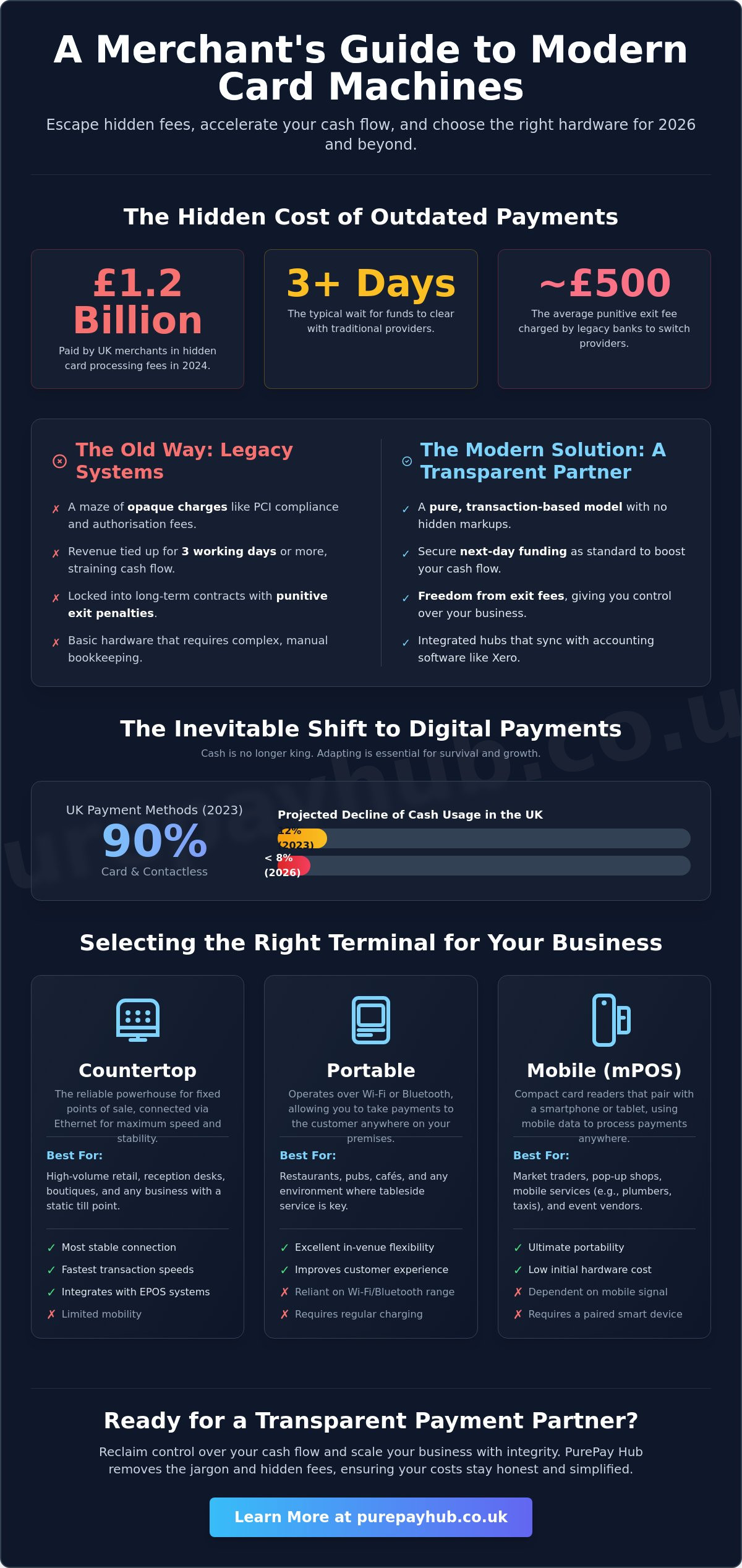
    What if the very tool you use to take payments is actually siphoning away your profit through a maze of opaque charges? In 2024, UK merchants paid an estimated £1.2 billion in hidden card processing fees, a figure that continues to rise as legacy providers cling to complex contracts. You’ve likely felt the sting of waiting three working days for funds to clear or discovered a “PCI compliance fee” that was never mentioned during the sales pitch. It’s frustrating to see your hard-earned revenue tied up in outdated systems whilst you’re trying to grow your business.

    This guide cuts through the corporate jargon to help you choose a card machine that prioritises your cash flow. You’ll discover how to secure next-day funding as standard and move to a pure, transaction-based model that eliminates hidden markups. We’ll examine the hardware reliability you need for 2026 and provide a clear roadmap to escape the £500 exit fees often charged by traditional banks.

    Key Takeaways

    • Understand how modern payment terminals have evolved into integrated financial hubs designed to streamline your daily business operations.
    • Select the perfect card machine for your specific needs by comparing the reliability of countertop units against the versatility of portable technology.
    • Learn to identify hidden costs within common pricing models and why transaction-based clarity is essential for protecting your bottom line.
    • Gain the confidence to audit your existing merchant statements and navigate provider switches whilst avoiding punitive exit fees.
    • Explore how a transparent partnership with PurePay Hub can help you reclaim control over your cash flow and scale your business with integrity.

    What is a Card Machine and How Does it Function in 2026?

    A card machine is no longer just a peripheral; it’s the heartbeat of a modern storefront. It functions as a secure terminal that encrypts card data and transmits it to authorisation centres in milliseconds. By 2026, these devices have transitioned from basic hardware into integrated financial hubs for UK SMEs. They provide a transparent link between your physical sales and your digital ledger. If you’re curious about the technical specifications, you can read about what is a payment terminal to understand its historical development and core mechanics. Accepting digital payments is now essential for consumer trust. UK Finance data from 2023 showed that 90% of all UK payments were made via card or contactless methods. By 2026, refusing to use a card machine effectively closes your doors to the majority of the British public.

    The role of NFC (Near Field Communication) technology is central to this shift. It facilitates near-instant contactless and mobile wallet payments through services like Apple Pay and Google Pay. This technology isn’t just about convenience; it’s about security. Every transaction is tokenised, meaning your customer’s actual card details are never stored on your device. This level of “pure” security protects your business from data breaches and builds long-term loyalty with your clientele.

    The Core Components of Modern Payment Processing

    Modern processing relies on three pillars to ensure funds move safely from the customer to your pocket. Your merchant account acts as the essential bridge between the terminal and your business bank. The payment gateway ensures every transaction is encrypted and secure during transmission. Finally, the acquiring bank settles the funds into your account. At PurePay Hub, we prioritise clarity in this chain. We remove the jargon and the hidden fees that traditional banks often bury in the small print, ensuring your transaction-based costs stay honest and simplified.

    Why Businesses are Moving Away from Cash

    The shift away from physical currency is driven by efficiency and safety. Cash carries high insurance premiums and theft risks that digital payments simply don’t have. According to industry reports, cash usage in the UK dropped to just 12% in 2023, and it’s projected to fall below 8% by 2026. Transitioning to a digital-first model offers several clear wins for your business:

    • Faster Checkout: Contactless transactions usually complete in under two seconds, which significantly increases your peak-time turnover.
    • Reduced Risk: Digital payments eliminate the danger of counterfeit notes and internal shrinkage.
    • Automated Bookkeeping: Modern card machine systems sync directly with accounting software like Xero, making your tax returns a breeze.

    By embracing these integrated hubs, you aren’t just taking payments. You’re organising your entire financial life through a single, dependable partner.

    Countertop, Portable, or Mobile: Selecting the Right Terminal

    Your business layout dictates your hardware choice. A card machine isn’t a one-size-fits-all tool; it’s the physical bridge between your service and your revenue. Choosing the wrong terminal leads to dropped connections at the table or cluttered wires at the till. PurePay Hub prioritises hardware that fits your specific workflow, ensuring that every transaction is as clean and efficient as possible.

    Assessing your environment is the first step toward pure performance. If you operate from a fixed point, like a boutique or a reception desk, stability is your priority. If you move amongst customers, range and battery life become the primary metrics for success. Recent data from the 2022 market review into UK payment regulations highlighted that merchants often overlook the impact of hardware contracts on their total cost of ownership. We believe in providing the right tool without the typical industry fluff.

    Countertop Terminals for Fixed Retail

    Countertop units are the reliable powerhouses of the retail world. These devices connect directly via Ethernet, providing the fastest and most stable connection available. They’re perfect for high-volume businesses where the point of sale never moves. Because they’re plugged into a power source, you never have to worry about a dead battery during a midday rush. Most modern countertop units integrate seamlessly with EPOS systems. This connection ensures your inventory levels update the moment a sale is made, removing the need for manual reconciliation at the end of the day.

    Portable vs Mobile: Understanding the Difference

    The terms “portable” and “mobile” are often used interchangeably, but they serve very different needs. Understanding the distinction helps you avoid paying for features you won’t use.

    • Portable: These devices use Wi-Fi or Bluetooth to connect to a base station. They’re designed for short-range movement, such as taking a card machine to a table in a restaurant or a chair in a salon. They offer the flexibility of movement within a roughly 50-metre radius of your router.
    • Mobile: These terminals are essential for tradespeople, delivery drivers, or market stall holders. They use an internal SIM card to connect to GPRS, 4G, or 5G networks. This provides national coverage, allowing you to take payments wherever you have a mobile signal.

    Battery life is the deciding factor for businesses on the move. A high-quality mobile terminal should last for at least 8 to 10 hours of active use, or roughly 200 transactions, before needing a charge. If you’re operating at an outdoor festival or a remote site, this longevity is non-negotiable. It’s about maintaining a professional image; a terminal that dies mid-transaction creates unnecessary friction. You can find a terminal that matches your pace by choosing hardware designed for your specific industry demands.

    The Ultimate Guide to Choosing a Card Machine for Your UK Business in 2026

    The Real Cost of Processing: Understanding Fee Structures

    Choosing a card machine involves more than just picking a device. You need to look at the numbers beneath the surface. Many providers offer “free” equipment or no monthly costs, yet they claw back that value through inflated transaction percentages. A transparent, transaction-based model ensures you only pay for the service you use. At PurePay Hub, we advocate for clarity over complexity. Our “Pure” approach offers transparent rates starting from 0.3% for debit cards, ensuring your hard-earned revenue stays in your business.

    The Trap of Flat-Rate Pricing

    Flat rates often act as a convenience tax for small businesses. A standard 1.75% rate feels manageable when you’re starting out. However, as your business grows, this fixed percentage becomes a significant drain on your profits. Interchange fees are the base costs set by card schemes like Visa and Mastercard. Most debit card transactions carry a very low interchange cost. When you pay a flat 1.75%, the provider pockets the massive difference between that base cost and what they charge you.

    Variable rates are the fairer alternative. They reflect the actual cost of the card used by your customer. By moving away from flat-rate models, you align your costs with reality. This creates a partnership where your success isn’t penalised by static, high-margin fees. For a business processing £10,000 a month, switching from a 1.75% flat rate to a transparent 0.3% debit rate can save over £100 monthly.

    Essential Fees and Value-Added Services

    Understanding your Merchant Service Charge (MSC) is the first step toward financial clarity. This is the total fee you pay to process a payment. Beyond the transaction fee, you must watch for hidden extras that traditional banks often slip into the small print. These include:

    • MMSC: Minimum Monthly Service Charges that apply if your transaction volume is low.
    • Statement Fees: Charges for receiving a breakdown of your activity.
    • PCI DSS Penalties: Fines for not meeting security standards, often costing £20 to £50 per month.

    Hardware rental provides a low entry cost and includes technical support, whilst purchasing your card machine outright offers better long-term value for established shops. We help you navigate these choices without the jargon. Staying PCI compliant is essential for security, and we provide the tools to help you avoid unnecessary fines. We focus on keeping your processing “Pure” so you can focus on your customers.

    How to Switch Providers and Optimise Your Setup

    Switching your card machine provider is a strategic move for your bottom line. It isn’t just about a lower rate; it’s about reclaiming control over your business finances. Many UK merchants stay with expensive providers because the process feels daunting. In reality, a structured approach makes the transition seamless and profitable. Your first step is a clinical audit of your current costs. Look beyond the headline rate. Divide your total monthly fees by your total turnover to find your true effective rate. This often reveals hidden markups that traditional banks fail to mention.

    To ensure a smooth migration, follow these essential steps:

    • Review your contract: Identify if you are in a rolling 30-day notice period or tied into a longer term. Check for any “early exit” fees.
    • Request a Pure comparison: Send your latest statement to a transparent provider like PurePay Hub. We provide a side-by-side breakdown of where you are losing money.
    • Organise your documents: Have your proof of ID, business bank details, and VAT registration ready. This speeds up the underwriting process significantly.
    • Synchronise the swap: Keep your old terminal active until your new hardware is tested and your first transaction is successfully processed.

    Overcoming the Fear of Switching

    The biggest myth in payment processing is that switching causes downtime. You don’t have to stop taking payments. By running two systems in parallel for 24 hours, you eliminate risk. We handle the heavy lifting of the transition, ensuring your new hardware integrates with your favourite EPOS software from day one. Modern setups are designed to be “plug and play,” meaning you can be up and running within minutes of unboxing your new device.

    The Importance of Next-Day Funding

    Slow settlement times can cripple a small business. Waiting 3 to 5 working days for your own money is a relic of old banking. If you process £2,000 on a busy Saturday, you need that capital in your account by Sunday or Monday to restock inventory. Next-day funding provides a massive competitive advantage for cash flow management. It turns yesterday’s sales into today’s buying power. Always verify that your new contract includes a guarantee for funding speed before you sign.

    Stop overpaying for your processing and start growing your business with a partner you can trust. Request your transparent side-by-side comparison today.

    PurePay Hub: A Modern Ally for UK Merchants

    Choosing a card machine shouldn’t feel like signing a contract with a hidden enemy. Many UK small businesses struggle with opaque fee structures and delayed settlements that stifle their growth. PurePay Hub operates differently. We’ve built our service on a foundation of transparency and direct support. Our transaction-based fees are designed to help your business scale without the fear of sudden cost spikes. You get a fair price that reflects your actual usage, not a generic corporate estimate.

    Efficiency is at the heart of our platform. We provide integrated EPOS solutions specifically tailored for sectors ranging from retail and hospitality to healthcare providers like Maximal Physio. These systems do more than just process payments; they unify your inventory and sales data into one streamlined workflow. To keep your operations moving, we provide next-day funding as a standard feature for our merchants. You won’t be left waiting for your hard-earned revenue to clear. This speed ensures your cash flow remains healthy, allowing you to restock or pay staff without delay.

    Beyond Payments: Business Cash Advances

    Growth often requires capital that traditional banks are slow to provide. We offer access to Business Cash Advances that prioritise your potential over your credit history. You can secure unsecured capital without the burden of fixed monthly interest rates. Repayment is structured as a simple percentage of your daily sales. When you’re busy, you pay back more. During quiet spells, your repayments automatically drop. We use your card machine data to prove your creditworthiness, making growth funding accessible and stress-free for every merchant we support.

    Why Purity in Processing Matters

    We’ve eliminated corporate jargon to provide honest, straight-talking support for every merchant. The Hub concept is central to our philosophy. It centralises your payments, detailed reporting, and funding options into one manageable space. You don’t need to jump between different providers or confusing spreadsheets to understand your finances. It’s a single, reliable point of truth for your business. Join PurePay Hub today for a fairer way to take payments and experience a partnership built on clarity.

    Future-Proof Your UK Payments Today

    Navigating the UK payment landscape in 2026 requires more than just hardware; it requires a strategy built on transparency and speed. You’ve seen how the right card machine can transform your daily operations, whether you’re serving customers at a fixed counter or on the move. The key is to look past the shiny devices and focus on the underlying fee structure. Many providers still hide costs in complex tiers, but your business deserves a model that prioritises clarity.

    PurePay Hub offers a refreshing alternative for merchants who are tired of opaque markups. We provide a pure, transaction-based approach that puts you in control of your margins. With debit card rates starting from 0.3% and next-day access to your funds, you can stop waiting for your money and start reinvesting it. It’s time to leave behind the frustration of hidden fees and partner with an ally that values your growth.

    Switch to PurePay Hub for transparent rates and next-day funding and take the first step towards a fairer financial future for your business. Success is built on the right partnerships, and we’re ready to help yours thrive.

    Frequently Asked Questions

    How much does a card machine cost for a small business in the UK?

    Costs vary based on your choice of hardware. You can buy a basic card reader for £19 plus VAT, or invest in a standalone card machine for £150 to £250. Transaction fees are the most important factor, usually ranging from 1.1% to 2.5%. We believe in pure transparency, so you’ll always know exactly what you’re paying without hidden markups or confusing fee tiers.

    Can I get a card machine with no monthly contract or rental fees?

    You can certainly find no-contract options that remove the burden of monthly rental fees. These pay-as-you-go models involve a one-off purchase of the hardware followed by a fixed percentage fee per sale. It’s a fair partnership for seasonal businesses or startups. This simplified approach ensures you only pay when you’re actually making money, keeping your overheads predictable and honest.

    What is the difference between a card reader and a card machine?

    A card reader typically requires a Bluetooth connection to a smartphone or tablet to process payments. In contrast, a standalone card machine functions independently with its own operating system and often a built-in receipt printer. Modern businesses often choose the latter for a more professional checkout experience. This choice provides the stability of a dedicated hub for all your daily financial transactions.

    How long does it take to get funds from card sales into my bank account?

    Funds typically reach your bank account within 1 to 3 business days. While some legacy banks take longer, many modern providers now offer next-day or even instant settlement. This speed is vital for maintaining healthy cash flow. We focus on providing a clear, logical path for your money to travel from the customer’s pocket to your bank account without unnecessary delays.

    What happens if my business Wi-Fi goes down whilst I am taking a payment?

    Your payment won’t fail if your device has a built-in SIM card for 4G connectivity. Most professional terminals automatically switch to mobile data if the Wi-Fi signal drops. This fail-safe ensures you never miss a sale during peak trading hours. It’s a dependable solution that keeps your business running smoothly, even when your local internet provider lets you down whilst you’re busy.

    Is it difficult to switch card machine providers if I am already in a contract?

    Switching is straightforward, though you must check your current contract for any exit fees or notice periods. Many providers now offer buyout incentives, sometimes covering up to £3,000 in cancellation costs to help you move. We act as your ally during this transition, ensuring the move is handled with integrity. It’s about finding a fairer deal that supports your long-term business growth.

    What security standards do card machines need to meet in the UK?

    Every device must comply with PCI DSS regulations. These strict rules ensure that 100% of transaction data is encrypted and handled safely. Using certified hardware protects your business from fraud and builds essential trust with your customers. It’s a non-negotiable standard that brings purity and security to every single tap, dip, or swipe at your counter.

    Can I use my card machine to accept Apple Pay and Google Pay?

    You can accept Apple Pay, Google Pay, and other digital wallets on any contactless-enabled terminal. These mobile payments use Near Field Communication technology to complete transactions in under two seconds. It’s a modern requirement for UK merchants, as 50% of all retail transactions now involve contactless methods. Supporting these options shows your customers that you’re a forward-thinking, efficient business.