Tag: UK Merchants

  • How to Prevent Chargebacks: A 2026 Guide for UK Small Businesses

    How to Prevent Chargebacks: A 2026 Guide for UK Small Businesses

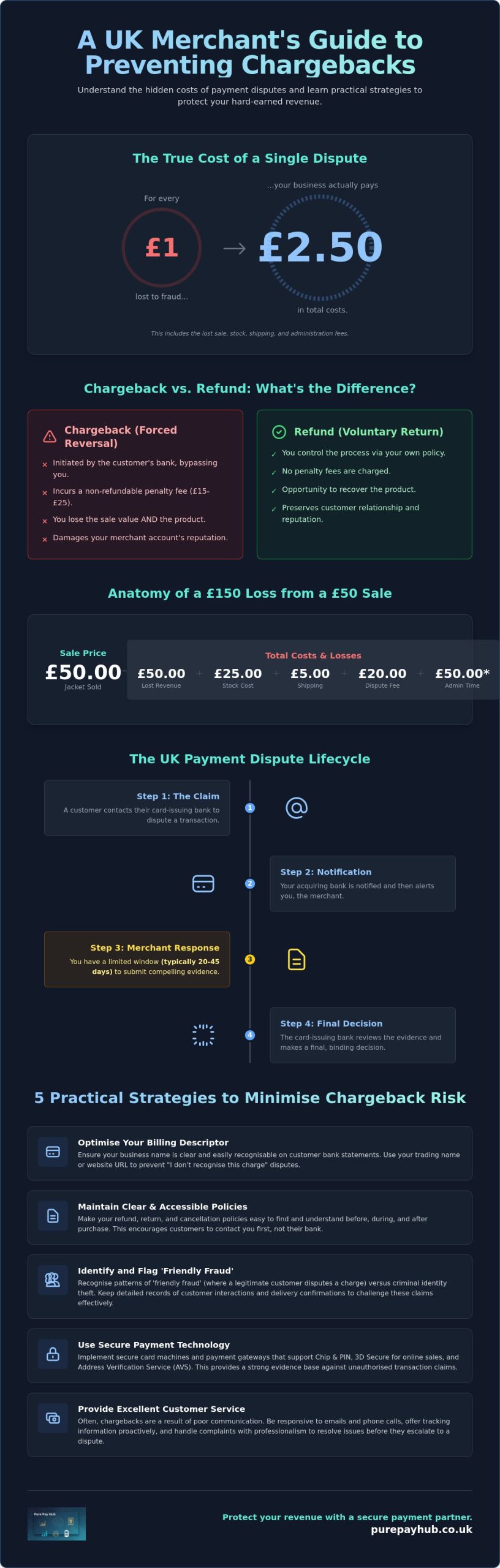
    Did you know that for every £1 lost to fraud, the average UK merchant actually pays out £2.50 once administration fees and lost stock are tallied? It’s a staggering drain on your hard-earned revenue that goes far beyond the initial transaction. If you feel like the system is weighted against you, you’re certainly not alone. Losing both your product and the sale price to a dispute is incredibly frustrating, especially when it feels like a customer is simply bypassing your refund policy to claim their money back. You deserve a payment partner that helps you fight back against these hidden costs.

    This guide explains exactly how to prevent chargebacks UK small businesses face in 2026. We’ll show you how to protect your bank account from ‘friendly fraud’ and secure your payment process with practical, no-nonsense strategies. We’ll explore how to upgrade your payment hardware, clarify the difference between refunds and disputes, and master the specific evidence required to win your case. By the end, you’ll have a clear roadmap to keep your chargeback ratio well below the 1.5% threshold and keep more of what you earn.

    Key Takeaways

    • Understand the true cost of disputes, which includes lost inventory, shipping expenses, and non-refundable bank fees.
    • Optimise your billing descriptor to ensure your business name is easily recognisable on customer statements, reducing accidental disputes.
    • Learn exactly how to prevent chargebacks UK merchants face by implementing clear, accessible refund and return policies.
    • Identify the difference between criminal identity theft and ‘friendly fraud’ to better protect your revenue and stock.
    • Discover how secure card machines and next-day funding can stabilise your cash flow whilst you manage payment disputes.

    What is a Chargeback and Why is it Rising in the UK?

    A chargeback is more than just a simple reversal of funds. It is a consumer protection mechanism that allows a cardholder to bypass the merchant and go straight to their bank to demand their money back. Essentially, what is a chargeback is a safety net designed to protect shoppers against fraud or businesses that fail to deliver. However, for a small business owner, it represents a significant operational hurdle that can disrupt your cash flow without warning.

    In 2026, the UK landscape has shifted significantly for retailers and service providers. Recent data indicates that 1 in every 200 payments now results in a dispute. This rising trend makes learning how to prevent chargebacks UK businesses face an essential survival skill for anyone accepting card payments. Consumers are becoming more aware of their rights, but this awareness often leads to an increase in disputes that could have been resolved through simple communication.

    You might wonder why a chargeback is considered more damaging than a standard refund. When you issue a refund, you remain in control of the process. You keep your processing reputation intact and avoid penalty fees. A chargeback is forced upon you by the bank. You lose the sale and the stock, but you’re also hit with a non-refundable administration fee. These fees often range from £15 to £25 per incident, regardless of whether you eventually win the dispute.

    Chargebacks vs. Section 75: Knowing the Difference

    UK merchants must distinguish between card scheme chargebacks and Section 75 of the Consumer Credit Act 1974. Section 75 is a legal requirement for credit card purchases between £100 and £30,000. It makes the card provider jointly liable with the retailer for any breach of contract or misrepresentation. Whilst chargebacks apply to both debit and credit cards and are governed by card network rules, Section 75 is a statutory right that provides shoppers with a much stronger legal footing. Understanding how to prevent chargebacks UK requires you to recognise that high-value credit card sales carry this additional layer of legal liability.

    The Lifecycle of a UK Payment Dispute

    The dispute process follows a strict, time-sensitive path. It begins when a customer contacts their issuing bank to claim a transaction was unauthorised or the goods were faulty. The bank then notifies your ‘acquirer’, which is the bank that processes your card payments. Your acquirer will then alert you to the claim. You don’t have an indefinite amount of time to fight back. Merchants typically have between 20 and 45 days to provide evidence, such as proof of delivery or signed receipts. The issuing bank holds the final word, acting as the judge in the dispute resolution process. If you fail to respond within the deadline, the funds are permanently returned to the customer.

    The Financial Impact: Why You Cannot Ignore Disputes

    Disputes are an expensive drain on your business resources. When a customer triggers a reversal, you lose far more than the initial sale price. You lose the physical stock, the original shipping costs, and the merchant service charges. On top of this, you’re hit with a non-refundable chargeback fee that stands regardless of the outcome. For every £1 of fraud, UK merchants can spend up to 2.5 times the transaction value on related costs. This is why knowing how to prevent chargebacks UK is a financial necessity, not just a security preference.

    Even if you win the dispute, the victory is often bittersweet. You’ve spent hours hunting down proof of delivery and communication logs. That time could have been spent growing your business or serving loyal customers. The card networks also record the incident regardless of the final decision. A history of frequent disputes makes you look like a high-risk partner. This reputational damage can lead to higher rolling reserves or restricted access to newer payment technologies. Using a secure payment gateway helps you keep these metrics in the green and your reputation intact.

    Calculating the Total Cost of a Single Dispute

    Let’s look at a typical UK retail scenario. Suppose you sell a jacket for £50. If that customer files a dispute, you lose the £50 immediately. You’ve already paid £25 for the stock and £5 for shipping. Your processor then charges a £20 dispute fee. Add in two hours of administrative time to gather evidence, and your £50 sale has morphed into a £150 total loss. These figures quickly erode the thin margins small businesses rely on to survive. For a regional merchant, just a few of these incidents a month can turn a profitable week into a deficit.

    The ‘Chargeback Ratio’ and Your Merchant Account

    Your chargeback ratio is a simple calculation: the number of disputes divided by your total monthly transactions. Card networks like Visa and Mastercard keep a close eye on this percentage. If your volume creeps too high, they place you into monitoring programmes like Visa’s Acquirer Monitoring Program (VAMP). As of 2026, the threshold for “excessive” disputes in the UK is just 1.50%. If you exceed this, you face higher processing rates or even the total termination of your merchant account. You can find this metric on your monthly merchant statements. Monitoring it allows you to spot trends early and adjust your fraud prevention settings before the banks intervene.

    Identifying the Threat: Fraud vs. Friendly Fraud

    To master how to prevent chargebacks UK businesses must first look beyond traditional theft. Whilst criminal fraud involves bad actors using stolen credentials, a much larger threat comes from your own customer base. Understanding the difference between these two categories is essential for protecting your revenue. Criminal fraud is a deliberate attack on your system, whereas ‘friendly fraud’ is often accidental or a result of consumer confusion. Both result in the same financial loss, but they require very different defensive strategies.

    Traditional security tools are excellent at spotting stolen cards, but they struggle to identify a legitimate customer who later regrets a purchase. Research indicates that friendly fraud now accounts for between 75% and 86% of all chargebacks. This means the majority of your disputes aren’t coming from hackers, but from people who have actually walked through your doors or used your website. Recognising this shift is the first step toward a more secure payment environment.

    Red Flags for Criminal Fraud in Your Shop

    Why ‘Friendly Fraud’ is a Growing UK Problem

    Friendly fraud is the primary cause of modern UK disputes, often occurring when a customer doesn’t recognise the business name on their bank statement. Confusing billing descriptors cost UK merchants over £128 million annually. If your bank statement name doesn’t match your shop sign, a customer might assume the charge is fraudulent and contact their bank immediately. We also see a rise in ‘buy now, regret later’ behaviour. A shopper might forget they signed up for a subscription or simply decide they want their money back without returning the item. Because these transactions involve legitimate cards and verified addresses, they bypass most standard fraud filters. This is why clear communication and recognisable branding on every transaction are your best defences in learning how to prevent chargebacks UK wide.

    How to Prevent Chargebacks: A 2026 Guide for UK Small Businesses

    5 Practical Strategies to Minimise Chargeback Risk

    Proactive prevention is your best defence. Whilst you cannot control every customer’s behaviour, you can certainly control your business’s response. Implementing these five strategies will help you build a more resilient payment environment. Learning how to prevent chargebacks UK merchants face involves closing the gaps where confusion and fraud thrive. By making a few simple adjustments to your daily operations, you can significantly reduce the likelihood of a bank reversing your hard-earned funds.

    Perfecting Your Billing Descriptors

    Confusion is the leading cause of ‘friendly fraud’. If a customer sees an unrecognisable name on their banking app, they will likely panic and report it. Take a moment to check exactly what appears on mobile bank statements for your transactions. Your billing descriptor should match your shop sign or website name perfectly. If your legal name is different from your trading name, update it with your payment provider immediately. Adding a phone number or a short URL to the descriptor is also a brilliant way to encourage customers to call you first before they call their bank.

    Receipt Management and Evidence Gathering

    Winning a dispute requires a solid paper trail. You need to gather specific evidence like tracking numbers, signed invoices, and IP addresses for digital sales. Banks operate on a very strict timeline. You must have these records organised and ready to go. An integrated EPOS System is invaluable here. It allows you to link every sale to a specific customer profile and transaction history. Having this data at your fingertips makes it much easier to respond within the narrow 20 to 45-day window that banks allow for evidence submission.

    Communication as a Defence Mechanism

    Clear communication stops disputes before they start. Send an instant email or SMS receipt for every transaction, even for in-person sales. If a delivery is delayed or a service is postponed, tell the customer immediately. Managing their expectations reduces the frustration that leads to chargebacks. Remember that a quick refund is always cheaper than a lost dispute. If a customer is unhappy, it’s often better to return the funds yourself rather than risk the administrative fees and reputational damage of a forced reversal.

    Your hardware choice also plays a vital role in your security. Modern Countertop Card Machines and Portable Card Machines come with built-in encryption and 3D Secure support for remote payments. These features ensure that every transaction is authenticated and tracked, giving you the best possible protection against both criminal and accidental fraud. If you’re ready to upgrade your security, you can view our range of secure card machines to find the right fit for your business.

    How PurePay Hub Helps You Protect Your Revenue

    At PurePay Hub, we position ourselves as a fair partner to regional business owners rather than a distant financial institution. We understand the frustration of hidden costs and the complex fee structures that traditional providers often hide behind. Our mission is to provide a reliable, untainted service that lets you focus on your business growth. When you are researching how to prevent chargebacks UK, you will find that speed and clarity are your best weapons. We provide next-day access to your funds, ensuring your cash flow remains steady even whilst you are gathering evidence for a dispute. This immediate liquidity acts as a stabilising force for your finances.

    We take a no-nonsense approach to security, stripping away the corporate jargon to provide tools that actually work. Our relationship is built on calm advocacy; we want to alleviate the stress caused by payment disputes through transparent reporting and robust hardware. By choosing a partner that values integrity over hidden markups, you can build a payment environment that is both efficient and highly dependable. We are here to help you navigate the 2026 landscape with informed confidence.

    Secure Card Machines for Every Business

    Our hardware is designed for maximum efficiency and transparency. Whether you use a Countertop Card Machine for your main till or a Portable Card Machine for floor service, you are protected by the latest encryption standards. These devices serve as your first line of defence against point-of-sale fraud. For remote transactions, our Virtual Terminal and Payment Links use 3D Secure authentication. This technology is vital because it shifts the liability for unauthorised claims away from your business and onto the card issuer. All PurePay Hub hardware is fully PCI compliant, ensuring you meet the highest security standards without the stress of navigating technical manuals alone.

    Transparent Reporting and Support

    We believe that informed confidence is the key to a successful business. Our merchant portal provides a clean, modern interface where you can track every transaction in real-time. This level of visibility allows you to spot suspicious patterns or duplicate charges before they trigger a bank reversal. If you are ever confused by your monthly statement, our UK-based support team is always available to help. We speak your language, not industry jargon, and we are committed to helping you understand how to prevent chargebacks UK wide. We avoid the opaque practices of our competitors, offering a straight-talking service that treats you as a direct partner. Protect your business with a secure PurePay Hub card machine today.

    Secure Your Revenue and Minimise Dispute Risks

    Managing payment disputes doesn’t have to be a source of constant anxiety. By refining your billing descriptors and maintaining meticulous records, you’ve already taken the most important steps in learning how to prevent chargebacks UK businesses encounter. Remember that clear communication often resolves a problem before it ever reaches a bank. Whether it’s an instant digital receipt or a proactive update on a delayed delivery, these small touchpoints protect your reputation and your bank balance.

    You deserve a payment partner that prioritises your stability over hidden markups. PurePay Hub offers a transparent approach to card processing with debit card rates starting from 0.3% and next-day access to your funds. We’ve removed the surprise monthly fees found elsewhere, providing a clear and dependable service designed specifically for local merchants. You can focus on growth whilst we handle the technical security.

    Switch to PurePay Hub for secure, transparent card processing. Take control of your payment security today and keep your focus on what you do best: running your business.

    Frequently Asked Questions

    Can I refuse a chargeback if I have proof of delivery?

    Yes, you can challenge a chargeback using proof of delivery as your primary evidence. You must submit this during the representment phase, which usually lasts between 20 and 45 days. Signed delivery notes or GPS tracking data from your courier are incredibly effective for proving that the customer received the goods as described.

    How long does a customer have to file a chargeback in the UK?

    Customers generally have 120 days from the transaction date to file a claim with their bank. However, this window can extend up to 540 days if the goods or services were intended for a future date or were never delivered. It’s vital to keep your transaction records organised for at least two years to stay protected against late claims.

    What is a ‘friendly fraud’ and how do I spot it?

    Friendly fraud occurs when a legitimate customer disputes a valid purchase they actually made. You can spot this by looking for customers who claim they don’t recognise your business name on their bank statement. It often happens when your trading name differs from your legal name, causing confusion when the shopper reviews their monthly outgoings.

    Does a refund stop a chargeback from happening?

    A proactive refund stops a chargeback if you process it before the customer contacts their bank. This is a key strategy for how to prevent chargebacks UK retailers rely on to avoid high administration fees. Once the bank initiates the formal dispute process, a refund will no longer stop the non-refundable chargeback fee from being applied to your account.

    What happens if my chargeback ratio goes above 1%?

    Crossing the 1% threshold often triggers “high-risk” monitoring from card networks like Visa and Mastercard. You’ll likely face higher processing fees and more frequent audits from your acquirer. If the ratio reaches 1.5%, you risk having your merchant account suspended or terminated entirely, which would stop you from accepting card payments.

    Are chargeback fees refundable if I win the dispute?

    No, chargeback administration fees are almost never refundable. Even if you win the dispute and recover the original sale amount, the £15 to £25 fee is usually kept by the processor. This fee covers the administrative time and resources required to manage the communication between the issuing and acquiring banks.

    How do I change the name that appears on my customer’s bank statement?

    You must contact your payment processor to update your “billing descriptor”. This is the text that appears on mobile banking apps and paper statements. Ensure it matches your shop sign or website branding perfectly so customers recognise the charge immediately and don’t report it as suspicious activity.

    Is it better to fight a chargeback or just accept it?

    You should always fight a dispute if you have clear evidence of a valid sale and successful delivery. Accepting every claim makes your business look like an easy target for ‘friendly fraud’ and sets a dangerous precedent. It also keeps your chargeback ratio high, which threatens your long-term ability to maintain a merchant account.

  • Business Cash Advance: The UK Merchant’s Guide to Flexible Funding in 2026

    Business Cash Advance: The UK Merchant’s Guide to Flexible Funding in 2026

    What if your business funding actually breathed with you, expanding when trade is booming and shrinking when the high street goes quiet? You likely already know the stress of rigid bank loans that demand the same heavy payment regardless of whether you’ve had a record-breaking Saturday or a silent Tuesday. It feels wrong to be penalised by a fixed schedule when your revenue naturally fluctuates; it is an outdated way to manage a modern shop or restaurant.

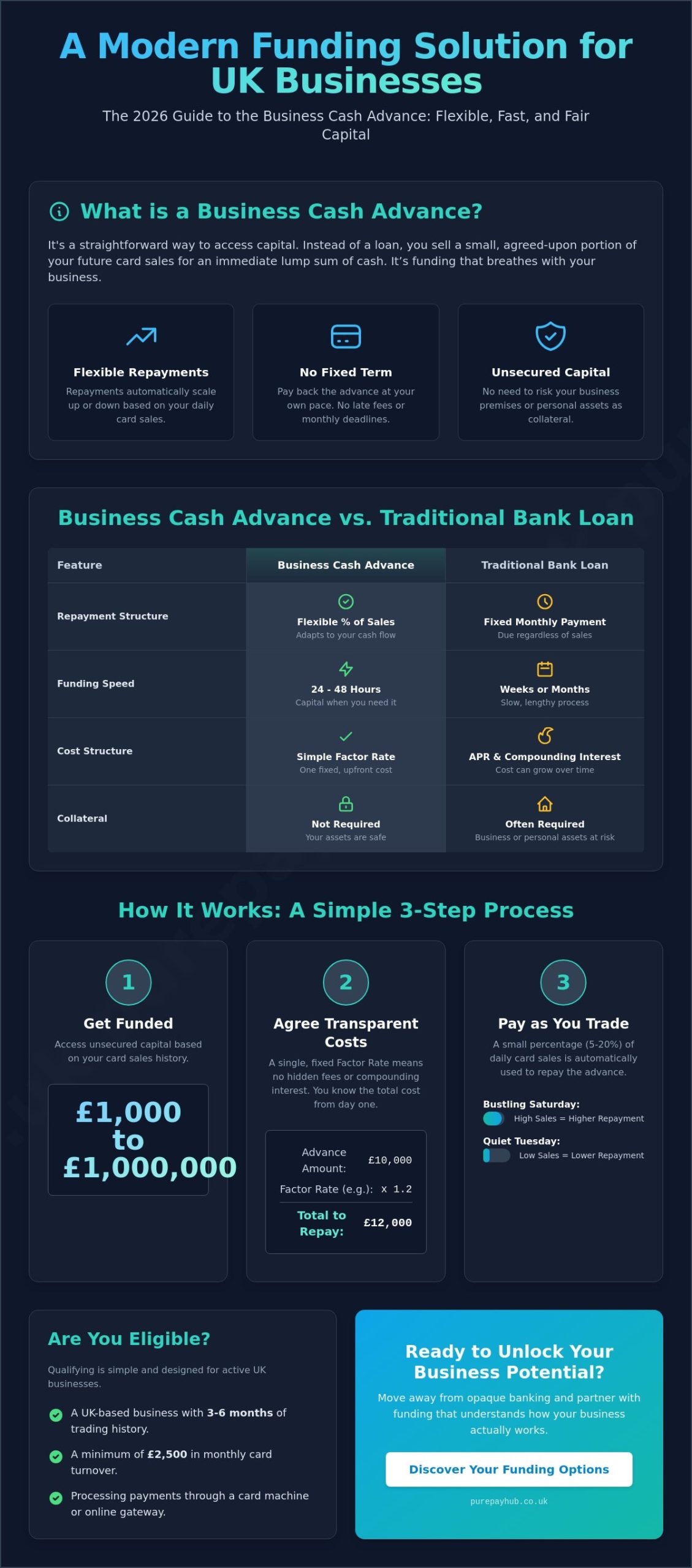
    This guide explains how a business cash advance offers a more transparent, flexible alternative for UK merchants in 2026. You’ll discover how to access unsecured capital between £1,000 and £1,000,000, often within just 48 hours, whilst keeping your repayments perfectly mirrored to your daily card sales. We’ll break down the simple factor rate structure that replaces complex interest, the minimum turnover requirements you need to meet, and how this modern funding model ensures you never overextend your cash flow during a slow month. It is time to move away from opaque banking and toward a partnership that understands how your business actually works.

    Key Takeaways

    • Learn how a business cash advance provides a flexible funding solution where repayments automatically scale up or down based on your daily card sales.
    • Understand the straightforward eligibility requirements for UK merchants, typically requiring just three to six months of trading history and £2,500 in monthly turnover.
    • Discover the transparency of factor rates, which ensure you pay one fixed, agreed-upon amount without the worry of accruing interest or hidden monthly fees.
    • See how PurePay Hub leverages your card machine data to offer next-day access to unsecured capital, removing the need for complex bank applications or collateral.

    What is a Business Cash Advance? A Flexible Alternative for UK SMEs

    A business cash advance is a straightforward way to access capital without the rigid constraints of a traditional bank loan. Instead of borrowing money and paying it back with interest, you’re essentially selling a small portion of your future card sales in exchange for an immediate lump sum. This distinction is vital for your financial health. Because it’s technically a purchase of future receivables rather than a debt, it doesn’t sit on your balance sheet in the same way a loan does. This often protects your credit profile whilst giving you the liquidity needed to grow.

    For a deeper dive into the technical background, you can read more about What is a Merchant Cash Advance? and how it differs from conventional lending. This model is particularly effective for businesses that process high volumes of card transactions, such as local boutiques, independent pubs, and busy restaurants. The core appeal is simple: your repayments breathe with your business. When trade is brisk, you pay back more; when things slow down, your repayments automatically reduce.

    The Mechanics of Merchant Funding

    The process involves a seamless partnership between you, the funding provider, and your payment processor. When you take a business cash advance, there are no fixed monthly instalments to worry about. Instead, a small, agreed-upon percentage of your daily card takings is automatically deducted from your daily batches. If you have a quiet day, you pay back less. If you’re closed for a bank holiday, you pay nothing at all. Crucially, this is unsecured capital. You don’t need to put your home or business premises at risk to secure the funds, making it a much safer prospect for independent owners.

    Why UK Businesses are Moving Away from High-Street Banks

    In 2026, many UK SMEs find themselves stuck in a “funding gap”. Traditional high-street banks have become increasingly risk-averse, often requiring mountains of paperwork and taking months to reach a decision. Modern merchants don’t have months to wait. Whether you need to repair a commercial oven or stock up for a seasonal rush, speed is everything.

    A business cash advance can often be approved and funded within 24 to 48 hours. This agility is essential in a post-digital retail environment where consumer trends shift rapidly. You get the funds you need to stay competitive without the bureaucratic headaches of a 19th-century banking model. It’s about finding a partner that values your daily performance over a static credit score.

    How Business Cash Advances Work: Factor Rates and Repayments

    Understanding the mechanics of a business cash advance is the first step toward taking control of your cash flow. Unlike a bank loan where interest compounds over time, this funding uses a “factor rate”. This means the total cost of your capital is fixed from the very first day. You won’t face the anxiety of fluctuating interest rates or the pressure of a ticking clock that makes traditional debt so stressful for small business owners.

    A factor rate is a fixed multiplier of the advance amount. For instance, if you secure a £10,000 advance with a factor rate of 1.2, your total repayment amount is exactly £12,000. There are no complex calculations to perform later and no surprises in your monthly statements. You know exactly what the facility costs before you even sign the agreement.

    The repayment happens through an automated process often called a “sweep” or “holdback”. You agree on a percentage of your daily card sales, typically between 5% and 20%, which is automatically deducted before the funds reach your bank account. This percentage is designed to balance your growth goals with your daily operational needs. Most merchants find that a modest holdback allows them to settle the advance comfortably without feeling a pinch in their working capital. This automatic process removes the administrative burden of manual transfers, allowing you to focus on running your shop or restaurant whilst the technology handles the rest.

    Factor Rates vs. APR: Calculating the Real Cost

    Traditional loans use APR, which can be confusing when you’re trying to calculate short-term costs for a seasonal project. In contrast, a factor rate provides total clarity for short-term cash flow planning. You can find more details on how these structures fit into the wider market in the UK government guidance on Merchant Cash Advances. It’s a transparent model that prioritises your ability to manage daily overheads without the hidden markups often found in high-street banking products.

    The Repayment Journey: Walking Through a Typical Month

    Imagine a busy Saturday where your pub is packed; your repayment that day will be higher because your sales are higher. On a quiet Monday morning when you only serve a few coffees, the deduction is tiny. If you decide to close for a week for renovations and take £0 in card sales, you pay £0 that week. This flexibility prevents the “debt spiral” often triggered by fixed-cost loans that demand payment even when the till is empty. If you’re looking for a funding partner that offers this level of transparency, exploring a business cash advance through PurePay Hub could be the stabilising force your finances need.

    Business Cash Advance: The UK Merchant’s Guide to Flexible Funding in 2026

    Business Cash Advance vs. Traditional Loans: A Comparison

    Choosing between a traditional bank loan and a business cash advance often comes down to what you value more: a rigid, low-cost structure for the long term or a flexible, high-speed solution for the present. Banks prioritise the past. They spend weeks auditing your historical accounts and scrutinising your personal credit score. If your score isn’t perfect or you don’t have property to offer as collateral, the door often stays shut. An advance shifts the focus to your future sales, using your current card turnover as the primary metric for approval.

    The speed of funding is perhaps the most striking difference. Whilst a high-street lender might take a month to process a small business application, an advance can put capital in your bank account within 24 to 48 hours. This makes it a tactical tool for merchants who need to move quickly. Whether you’re jumping on a bulk stock discount or fixing a broken shopfront, you don’t always have the luxury of a thirty-day waiting period. Understanding what is a merchant cash advance helps clarify why it’s a “tactical” choice rather than a “structural” one; it’s about solving immediate cash flow needs without the bureaucratic weight of a bank.

    When is a Traditional Bank Loan Better?

    MCAs aren’t a universal fix for every financial need. If you’re planning a multi-year infrastructure project or purchasing the freehold for your premises, a traditional bank loan is usually the better choice. These long-term projects benefit from the lower overall cost of debt that banks provide over five or ten years. It’s also worth checking for early repayment penalties on bank products. Most business cash advance agreements don’t have them because there’s no fixed term, but a bank might charge you extra for clearing your debt ahead of schedule.

    The Seasonal Advantage for Hospitality and Retail

    For a local pub or a seasonal boutique, the “variable” nature of an advance is its greatest strength. Imagine using the funds to build a new beer garden in May. During the sun-soaked summer months, your repayments are high because your sales are booming. You settle the balance quickly whilst the cash is flowing. When the “quiet January” period arrives and footfall drops, your outgoings automatically shrink to match your lower takings. This synchronisation means the funding is effectively breathing with your business. You never have to worry about a fixed monthly overhead draining your accounts when the high street is empty.

    Qualifying for Funding: Eligibility and Application

    Qualifying for a business cash advance is often a refreshing experience for merchants used to the rigid demands of high-street banks. Instead of focusing on your personal assets or long-term credit history, lenders look at the health of your daily trade. The primary requirement is a consistent monthly card turnover, typically starting at £2,500. This ensures that your business has the natural “breathing room” to settle the advance through the small daily deductions we’ve already explored.

    Most providers look for a minimum trading history of at least 3 to 6 months. This window provides enough data for real-time algorithms to assess your business health accurately. These systems aren’t looking for perfection; they’re looking for reliability. By analysing your digital footprint through card processing statements, lenders can reach an approval decision much faster than a human auditor ever could. It’s a modern approach that rewards active, trading businesses over those with the most collateral.

    Preparing Your Application for Success

    Speed is the hallmark of this funding model, but you can accelerate the process even further by having your records in order. Most lenders will request your last three months of merchant statements to verify your transaction volume and average sale value. You should also ensure your PCI compliance is up to date, as this demonstrates a level of professional management and security that reassures potential partners. A healthy mix of debit and credit sales improves approval odds by showing you have a varied and stable customer base. Having your bank records organised alongside these statements will often lead to an approval in hours rather than days.

    Red Flags to Avoid

    Whilst the approval rates are high, there are a few pitfalls to keep in mind. A sudden, unexplained drop in your card volume just before or during your application can trigger a deeper review from the underwriting team. If you’ve recently changed your business model or had a temporary closure, it’s better to be transparent about it from the start. Honesty regarding any existing business debt is also vital; lenders value clarity and are more likely to work with you if they have the full picture. Always look for a partner with a no-nonsense fee structure that avoids hidden “non-utilisation” charges. If you’re ready to see what you qualify for, you can start your application with PurePay Hub today to get a clear, fast decision.

    Securing Your Advance with PurePay Hub: The Integrated Advantage

    Most financial products feel disconnected from your daily operations. A business cash advance from PurePay Hub is different because it’s built directly into your merchant services. We don’t need to ask for mountains of paperwork that you’ve already provided elsewhere. Since we already manage your payment processing, we have a clear, real-time view of your business health. This integration removes the friction that usually slows down traditional lending. It’s a cleaner, more efficient way to fund your next project.

    Speed is our standard. We focus on “Next-Day Access” to bridge the gap between your approval and the capital hitting your account. You won’t find any hidden markups or confusing corporate jargon in our agreements. We believe in straight-talking finance that supports your growth rather than complicating it. This approach provides a reliable foundation for your next big step, ensuring you have the liquid capital to act when opportunities arise. We’re not just a distant lender; we’re a stabilizing force for your business finances.

    Why Our Merchants Choose Integrated Funding

    Our role as your payment processor means we already understand the rhythm of your trade. Whether you’re using our countertop card machines or our EPOS systems, your transaction data tells a story of hard work and consistency. Having your funding and your payment hardware under one roof simplifies your administrative life. It also allows us to offer a fairer service specifically tailored to regional UK business owners who are often overlooked by national banks. We take pride in being a supportive ally, offering a modern fintech solution that hasn’t lost its focus on the individual merchant. Our commitment to transparency ensures you can plan for the future with absolute confidence.

    Start Your Growth Journey Today

    Getting a quote is a risk-free process that won’t affect your personal credit score. We can use the data from your portable card machine or virtual terminal to provide an accurate, transparent offer in minutes. Our team operates with a sense of calm advocacy; we’re here to help you find the right fit for your specific needs. You can secure the capital required to refurbish your premises or expand your inventory without the stress of traditional debt. It’s time to experience a funding partner that values your business as much as you do.

    Get a transparent business cash advance quote from PurePay Hub

    Fuel Your Business Growth on Your Own Terms

    You now have a clear roadmap for securing capital that respects your cash flow. By choosing a business cash advance, you move away from the rigid constraints of traditional debt and toward a model that breathes with your daily sales. This guide has shown how factor rates provide absolute cost certainty and how integrated funding removes the bureaucratic hurdles that often block SME growth. It’s about having the financial agility to act when the time is right.

    At PurePay Hub, we prioritise clarity and speed. Our merchants benefit from debit card rates starting from 0.3% and a no-nonsense fee structure that eliminates hidden surprises. With next-day funding available, you can bridge the gap between approval and action almost instantly. We’re here to provide the steady support you need to expand your shop, pub, or restaurant with confidence.

    Apply for a transparent Business Cash Advance with PurePay Hub. Your business deserves a partner that values honesty and efficiency as much as you do.

    Frequently Asked Questions

    Is a business cash advance expensive compared to a bank loan?

    A business cash advance is priced using a fixed factor rate rather than an annual interest rate (APR). Whilst the total cost might be higher than a traditional secured loan, you’re paying for speed and the lack of collateral requirements. There’s no compounding interest and no late fees; you simply pay back one agreed-upon total. This makes it a transparent choice for short-term tactical projects where speed is your main priority.

    Will an MCA affect my business credit score?

    Generally, this type of funding doesn’t appear as debt on your credit file because it’s a purchase of future sales. Most lenders perform a “soft” credit search during the application process which doesn’t impact your score. Because there are no fixed monthly deadlines, you don’t risk “late payment” markers during slow trading periods. It’s a safer way to protect your financial profile whilst accessing the capital you need to grow.

    What happens if my business has a very slow month?

    Your repayments automatically decrease during quiet periods. Since the deduction is a fixed percentage of your daily card sales, a drop in revenue leads to a smaller daily repayment. If your shop or restaurant has a day with zero card transactions, you pay nothing at all that day. This flexibility removes the stress of fixed overheads and ensures you always have enough working capital to manage your daily operations.

    Do I need to change my card machine provider to get an advance?

    You don’t always need to switch, but using an integrated provider like PurePay Hub can significantly speed up the approval process. When you use our countertop or portable card machines, we already have access to the data needed to verify your turnover. This allows for a much smoother “sweep” process where repayments are handled automatically. It’s a cleaner way to manage your funding and your merchant services under one reliable roof.

    Can I pay off my business cash advance early?

    You can usually settle the full balance ahead of schedule without facing early repayment penalties. However, it’s important to remember that the total cost is fixed at the start of the agreement via the factor rate. Paying it back faster doesn’t typically reduce the total amount owed, but it does clear your future revenue from further deductions. Always check your specific agreement to ensure there are no hidden fees for early settlement.

    What can I use the funding for? Are there restrictions?

    You have complete freedom to use a business cash advance for any legitimate business purpose. Most UK merchants use the funds for refurbishments, bulk inventory purchases, or seasonal marketing campaigns. Unlike some bank products that require a specific business case, this capital is yours to deploy wherever it adds the most value. It’s an excellent tool for bridging cash flow gaps or seizing unexpected opportunities that require immediate action.

    How quickly will the money be in my bank account?

    Speed is the primary advantage of this model; capital often reaches your bank account in just 24 to 48 hours. The digital application process removes the need for weeks of auditing and manual paperwork. Once your card processing data is verified and the agreement is signed, the funds are transferred electronically. This allows you to respond to business needs in real-time rather than waiting for a bank committee to reach a decision.

  • How to Accept Apple Pay on Card Machines: The Complete 2026 UK Merchant Guide

    How to Accept Apple Pay on Card Machines: The Complete 2026 UK Merchant Guide

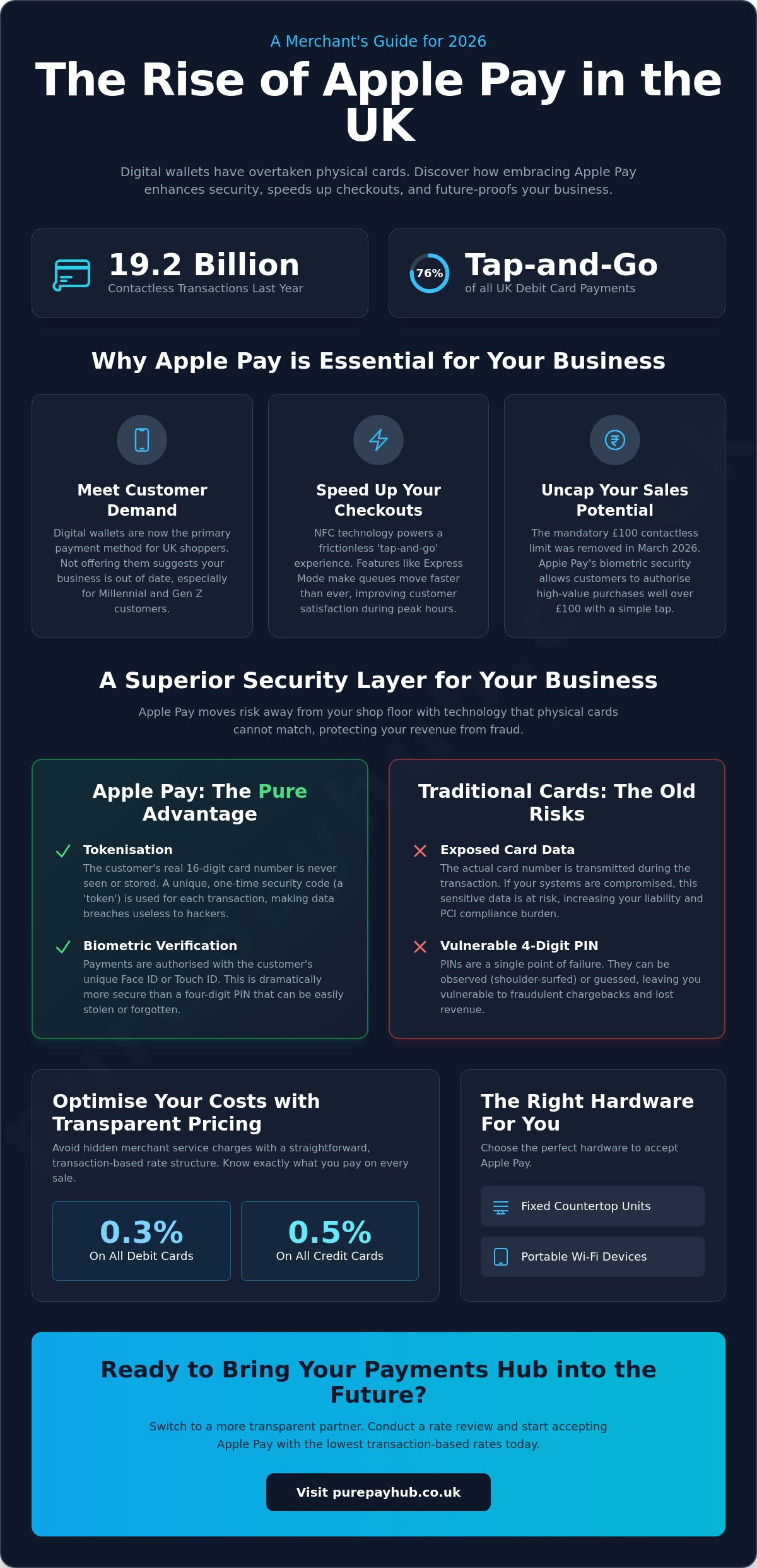
    Did you know that contactless payments reached a staggering 19.2 billion transactions in the UK last year? As of March 2026, UK Finance reports that 76% of all debit card payments are now tap-and-go. If you want to accept Apple Pay on card machine UK terminals, you aren’t just following a trend; you’re building a Pure security layer for your business. You likely feel the weight of opaque fee structures from traditional banks and worry about the technical glitches that often strike during peak trading hours.

    We understand that the shift toward mobile wallets can feel complex, especially with the FCA’s March 2026 removal of the mandatory £100 contactless limit. This guide cuts through the corporate jargon to show you exactly how to integrate Apple Pay whilst securing the lowest transaction-based rates. You will discover how to speed up your checkouts, protect your revenue from fraudulent chargebacks, and navigate the latest 2026 pricing from providers like SumUp and Square. It’s time to bring clarity and honesty back to your payment processing hub.

    Key Takeaways

    • Learn how tokenisation and biometric verification provide a superior security layer against fraud compared to traditional 4-digit PINs.
    • Discover how to choose the perfect hardware to accept Apple Pay on card machine UK terminals, whether you require fixed countertop units or portable Wi-Fi devices.
    • Understand the “Pure” advantage of transaction-based pricing, featuring 0.3% debit and 0.5% credit rates to help you avoid hidden merchant service charges.
    • Gain insight into why digital wallets have become the primary payment method for UK shoppers in 2026 and how this trend boosts your checkout speed.
    • Follow our straightforward guide to conducting a rate review, allowing you to identify unfair markups and switch to a more transparent payment partner.

    What is Apple Pay and why is it essential for UK businesses in 2026?

    Understanding What is Apple Pay is the first step toward modernising your checkout. It’s a mobile payment service that uses Near Field Communication (NFC) to allow secure, contactless transactions via iPhone and Apple Watch. To accept Apple Pay on card machine UK terminals is no longer a luxury for niche retailers. It’s a fundamental expectation for every merchant. By May 2026, the shift in consumer behaviour is undeniable. Digital wallets have officially overtaken physical plastic cards amongst UK shoppers as the preferred way to pay.

    According to UK Finance data from March 2026, contactless payments now account for 76% of all debit card transactions. Consumers don’t want to fumble for a physical wallet or remember a four-digit code. They want to tap and go. At PurePay Hub, we see mobile wallet acceptance as a baseline requirement for business credibility. If you don’t support these methods, you’re telling your customers that your business is stuck in the past. We help you bridge that gap with transparent, transaction-based tools that keep your cash flow moving.

    There’s also a common myth regarding the “Contactless Limit” that needs debunking. Whilst the FCA removed the mandatory £100 cap on March 19, 2026, many traditional banks still enforce this limit for physical cards to mitigate risk. Apple Pay is different. Because it uses biometric verification, such as FaceID or TouchID, it allows your customers to authorise high-value transactions well over £100. This makes it a powerful tool for luxury retail, electronics, and hospitality businesses where average transaction values often exceed the standard contactless ceiling.

    The evolution of UK payment behaviour

    The UK’s transition toward a cashless society has moved at a record pace over the last three years. Gen Z and Millennial customers are particularly decisive about where they spend their money. Research shows these demographics will often abandon a basket or leave a restaurant if mobile payment options aren’t available. They value friction-free speed. Features like “Express Mode” have also transformed quick-service retail and transport. This allows customers to accept Apple Pay on card machine UK readers without even waking their device or using biometrics, making the queue move faster than ever before.

    NFC technology: The silent engine of your checkout

    NFC technology operates on a specific 13.56 MHz frequency to create a secure, wireless connection. It’s the technical “handshake” that powers every tap. Near Field Communication (NFC) is the short-range wireless link between a device and a card machine. This modern standard is significantly more reliable than the magnetic stripes or early chip-and-pin systems used in previous decades. It reduces physical wear on your hardware and ensures a more stable connection during your busiest trading periods. By using NFC, you ensure that every transaction is processed with the highest level of technical precision and speed.

    How Apple Pay security protects your business

    Security is often discussed from the customer’s perspective, but for a merchant, it’s about protecting your bottom line. When you choose to accept Apple Pay on card machine UK terminals, you are implementing a security layer that physical cards simply cannot match. Digital wallets move the risk away from your shop floor and onto the encrypted infrastructure of the card issuer. This shift provides a level of “Pure” protection that helps you avoid the stress of fraudulent activity and administrative headaches.

    The primary mechanism here is tokenisation. When a customer taps their device, your card machine never actually “sees” or stores the real 16-digit card number. Instead, Apple replaces sensitive data with a unique Device Account Number. You can read more about this on the Official Apple Pay UK page. If your business systems were ever compromised, there would be no sensitive card data for hackers to steal. This drastically reduces the impact of potential data breaches on your business reputation.

    Understanding Tokenisation

    Tokenisation ensures that transaction data is both secure and transparent. By using a one-time security code for every payment, Apple Pay prevents the replay of transaction data. Your terminal handles the “token” whilst the actual financial details remain isolated. This setup simplifies your annual PCI DSS compliance reporting. Since you aren’t storing raw cardholder data, your security obligations are significantly lighter, allowing you to focus on serving your customers.

    Biometrics vs. PIN: A security comparison

    A four-digit PIN can be overlooked or stolen. Biometric verification through FaceID or TouchID cannot. These credentials are stored in a “Secure Enclave” on the user’s iPhone or Apple Watch, meaning the data never leaves the device. This makes “friendly fraud”, where a customer falsely claims they didn’t authorise a purchase, much harder to commit. For a merchant, this extra security layer leads to fewer disputed transactions and lower costs.

    This leads to the “Merchant Liability Shift,” a crucial benefit that many providers fail to explain. Because Apple Pay transactions are verified with biometrics, they meet the requirements for Strong Customer Authentication (SCA). In most cases, this shifts the liability for fraudulent transactions from you, the merchant, back to the card issuer. You are no longer the one left out of pocket if a payment is disputed. To secure your revenue with the latest hardware, you might want to explore our range of secure card machines designed for the UK market.

    How to Accept Apple Pay on Card Machines: The Complete 2026 UK Merchant Guide

    Choosing the right card machine to accept Apple Pay

    While some tech companies suggest you can run a professional business entirely from a smartphone, experienced UK merchants know that dedicated hardware is the backbone of reliability. To accept Apple Pay on card machine UK terminals, you need hardware that is robust, fast, and pre-configured for the latest NFC updates. Choosing the wrong device can lead to connection drops during peak trading, which frustrates your customers and stalls your cash flow. We believe in providing hardware that acts as a stabilising force for your business finances.

    There are three primary categories of hardware to consider for your shop floor or mobile service:

    • Countertop Card Machines: These are the gold standard for fixed retail points and busy reception desks. They use a wired Ethernet connection, ensuring maximum uptime and transaction speed.
    • Portable Card Machines: Essential for hospitality, these devices use Wi-Fi or Bluetooth to take the payment directly to the customer’s table.
    • Mobile Card Machines: Built for tradespeople and mobile retailers, these units use roaming GPRS or 4G SIM cards to process payments anywhere in the UK.

    Hardware for the hospitality sector

    In a busy restaurant or cafe, every second counts toward your table turnover. Portable units allow your staff to provide tableside service, which significantly reduces “wait-to-pay” times for your guests. When your card machine is integrated with your EPOS system, Apple Pay sales sync automatically with your kitchen and inventory. This eliminates manual entry errors and ensures your books are always accurate. We recommend specific, robust portable units that can withstand the high-traffic environment of a professional bar or bistro. Customers can easily learn How to set up Apple Pay on their own devices, but it is your hardware that ensures the “tap” is successful every time.

    Retail and service-based solutions

    For shopfronts, countertop reliability remains unbeatable. A wired connection avoids the signal interference issues that can sometimes plague wireless networks in crowded shopping centres. If you operate a service-based business without a physical storefront, you can still accept Apple Pay on card machine UK systems via digital alternatives. Virtual Terminals and Payment Links allow you to send a secure request to your customer, which they can then settle using Apple Pay on their own device. This is a “Pure” way to handle remote billing without the need for physical contact. Whether you use a physical countertop unit or a digital link, a clear display is vital. Informative prompts build customer confidence and ensure the transaction is completed quickly and honestly.

    Optimising your transaction costs and cash flow

    You shouldn’t be penalised for your success. When you accept Apple Pay on card machine UK setups, you want to see that money in your bank account, not swallowed by opaque fee structures. Traditional aggregators often lure small businesses with the promise of “simple” flat rates. However, for established UK merchants, these flat fees often hide a significant markup that drains your monthly revenue. Choosing a partner that prioritises purity in their pricing ensures you keep more of every pound you earn.

    The Merchant Service Charge (MSC) is the core fee you pay for every transaction. It’s usually split between debit and credit rates. Because Apple Pay transactions are processed at the same rate as standard contactless payments, you can significantly lower your overheads by moving away from flat-fee models. We also help you avoid common traps like monthly minimum service charges, PCI non-compliance fines, and unnecessary statement fees that traditional banks often slip into their contracts.

    The true cost of “Simple” flat rates

    Let’s look at the numbers. While a flat rate of 1.75% from providers like Square or Zettle seems convenient, it doesn’t reflect the actual cost of processing for a growing business. Most UK debit card transactions have a much lower interchange cost. By switching to a transaction-based model, you reward your own growth. Here is how a £1,000 transaction compares:

    • Aggregator Flat Rate (1.75%): £17.50 fee
    • PurePay Hub Debit Rate (0.3%): £3.00 fee
    • Your Monthly Saving: £14.50 per £1,000 processed

    This transparency is what we call “Pure” processing. Seasonal businesses especially benefit from this structure because you aren’t tied down by fixed monthly costs during quieter trading months. You only pay for what you process, ensuring your costs always align with your actual income.

    Accelerating your access to capital

    Speed of payment is just as vital as the cost. Waiting 3-5 working days for your funds to clear is an outdated banking practice that harms your cash flow. We provide next-day funding, ensuring your Apple Pay takings are available to use almost immediately. This liquidity allows you to restock inventory or pay staff without delay, keeping your business agile.

    If you’re looking to scale, your digital sales history is a powerful asset. Through our Business Cash Advance service, you can secure unsecured growth capital based on your future card takings. Everything is managed through the central “Hub,” giving you real-time reporting to monitor your finances with total clarity. If you’re ready to stop overpaying and start growing, get a transparent quote for your card processing today.

    How to switch and start accepting Apple Pay today

    Switching your payment provider doesn’t have to be a source of stress. We’ve simplified the transition to ensure you can accept Apple Pay on card machine UK terminals without the technical headaches or hidden costs of traditional banking. Our goal is to move you from frustration to informed confidence. By following a clear, four-step path, you can modernise your checkout whilst protecting your hard-earned revenue.

    • Step 1: Conduct a rate review. Send us your recent merchant statements. We will identify every hidden markup and show you exactly how much you can save by switching to our transaction-based model.
    • Step 2: Select your “Pure” hardware. Whether you need a fixed Countertop unit for a reception desk or a Portable device for tableside service, choose the hardware that fits your specific workflow.
    • Step 3: Complete digital onboarding. Our UK-based support team handles the heavy lifting. We guide you through the setup process to ensure your account is verified and ready for action.
    • Step 4: Plug in and play. Your new card machine arrives pre-configured for Apple Pay. There’s no complex coding required. You simply connect to your network and start trading.

    The PurePay Hub onboarding experience

    We act as your dedicated “Merchant Ally” throughout the entire process. Our team understands that peak trading hours are not the time for technical glitches. That’s why we ensure your hardware is fully tested before it reaches your door. Training your staff is also straightforward. Because Apple Pay transactions are authenticated on the customer’s device, your team only needs to enter the amount and prompt the tap. If a rare issue does occur, our UK-based experts are just a phone call away. You don’t have to navigate an automated menu to find a human who understands your business needs.

    Ready to modernise your checkout?

    The benefits of a modern payment hub are clear. You gain faster checkout speeds, superior biometric security, and significant cost savings on every transaction. Many merchants worry about exit fees from their current provider. We can often help you navigate these costs to make the switch as smooth as possible. Don’t let opaque contracts hold your business back from the future of payments. It is time to embrace a fairer, more transparent way of working. Organise a transparent rate review and upgrade your card machine today.

    Secure your growth with a fairer payment partnership

    The shift toward a digital-first economy is now complete. Since 76% of all UK debit transactions are now contactless, your ability to accept Apple Pay on card machine UK terminals is the key to maintaining customer trust in 2026. You’ve seen how biometric verification shifts liability away from your business and how dedicated hardware ensures reliability during your busiest hours. It’s time to move past the opaque fee structures and high flat-rates that have held local merchants back for too long.

    Choosing a Pure approach means choosing total clarity for your finances. We provide debit card rates from 0.3% and credit from 0.5%, alongside next-day funding as standard to keep your cash flow moving. There are no hidden markups or confusing statement fees; just honest, transaction-based processing designed for your specific needs. Switch to a PurePay Hub card machine and accept Apple Pay with rates from 0.3% today. We’re ready to act as your merchant ally and help you build a more profitable, secure future.

    Frequently Asked Questions

    Does it cost more for a business to accept Apple Pay than a standard card?

    No, merchants aren’t charged any additional fees by Apple for accepting these payments. Every transaction is processed at the same rate as a standard contactless card payment. If you use a transparent, transaction-based pricing model, you’ll benefit from the same fair rates you receive for physical debit and credit cards.

    Is there a limit on how much a customer can pay with Apple Pay in the UK?

    There is no fixed transaction limit for Apple Pay in the UK. Unlike physical cards, which often still adhere to a £100 cap despite the March 2026 FCA regulation changes, Apple Pay uses biometric authentication. Face ID and Touch ID allow customers to authorise high-value purchases securely, which is a major advantage for luxury retail and hospitality sectors.

    Do I need a specific type of merchant account to accept Apple Pay?

    You don’t need a specialised account to accept Apple Pay on card machine UK terminals. A standard merchant account paired with NFC-enabled hardware is all that’s required. Most modern payment hubs include this capability as a baseline feature to ensure you can meet the expectations of the 76% of UK shoppers who prefer contactless methods.

    How long does it take for Apple Pay funds to reach my business bank account?

    Settlement times depend entirely on your merchant service provider. Whilst traditional banks may still take 3-5 working days to clear funds, we offer next-day funding as standard for all UK merchants. This ensures that your digital takings are available to support your business growth almost immediately after the transaction is completed.

    Will Apple Pay work on my old card machine if it already does contactless?

    Yes, if your current machine is NFC-compatible and already accepts contactless cards, it should support Apple Pay. However, older hardware might lack the processing speed or latest security updates required for seamless high-value transactions. Upgrading to a modern, robust unit ensures your checkout remains fast and dependable during peak trading periods.

    What should I do if an Apple Pay transaction is declined?

    You should treat a declined Apple Pay transaction exactly like a failed physical card payment. First, ensure the customer has a valid card selected in their digital wallet and a stable data connection. If the terminal continues to decline the tap, ask the customer to use a physical card or an alternative payment method to complete the sale.

    Can I accept Apple Pay for phone or mail-order transactions?

    You cannot accept Apple Pay on card machine UK terminals directly over a phone call because the customer’s device must be physically near the NFC reader. To accept it remotely, you should use Payment Links. This allows you to send a secure URL to the customer, who can then settle the invoice using Apple Pay on their own device.

    Is Apple Pay safer for my business than physical chip-and-pin cards?

    Yes, Apple Pay is significantly more secure due to tokenisation and biometric verification. Because your card machine never stores the actual card numbers, the risk of a data breach is virtually eliminated. These transactions also meet Strong Customer Authentication (SCA) requirements, which shifts the liability for fraudulent chargebacks away from your business and back to the card issuer.