
Tag: Stock Control

  • EPOS System for a Multi-Site Business: The 2026 Management Guide

    EPOS System for a Multi-Site Business: The 2026 Management Guide

    What if the biggest drain on your multi-site margins isn’t your rent or your staff costs, but the silent friction of fragmented data? Managing several locations often feels like running entirely different companies, especially when you’re stuck with inconsistent pricing across sites and manual data consolidation that takes hours of your time. It’s a common frustration for growing brands. Finding the right EPOS system for a multi-site business is about more than just taking payments; it’s about gaining total control over your entire estate from a single screen.

    You deserve a setup that works as hard as you do. In this 2026 guide, you’ll discover how to unify your operations, eliminate data silos, and significantly reduce transaction costs across every location. We’ll look at the shift towards cloud-connected terminals, which 82% of retail chain operators now prioritise, and show you how to achieve seamless stock transfers and robust staff auditing. From lower transaction rates through volume to real-time visibility, we’ll outline the path to a leaner, more transparent multi-site operation.

    Key Takeaways

    • Stop losing hours to manual data reconciliation by centralising your sales and stock into a single, cloud-based source of truth.
    • Identify the critical features of a high-performance EPOS system for a multi-site business, from inter-site stock transfers to regional reporting clusters.
    • Avoid the “flat rate” trap by switching to a transparent interchange-plus model that rewards your growing transaction volume with lower fees.
    • Improve cash flow stability across your entire estate with next-day funding and integrated payment solutions designed for high-volume groups.
    • Streamline staff management and auditing with robust tools that maintain operational consistency across every location.

    The Multi-Site Challenge: Why Standard EPOS Systems Fail Growing Businesses

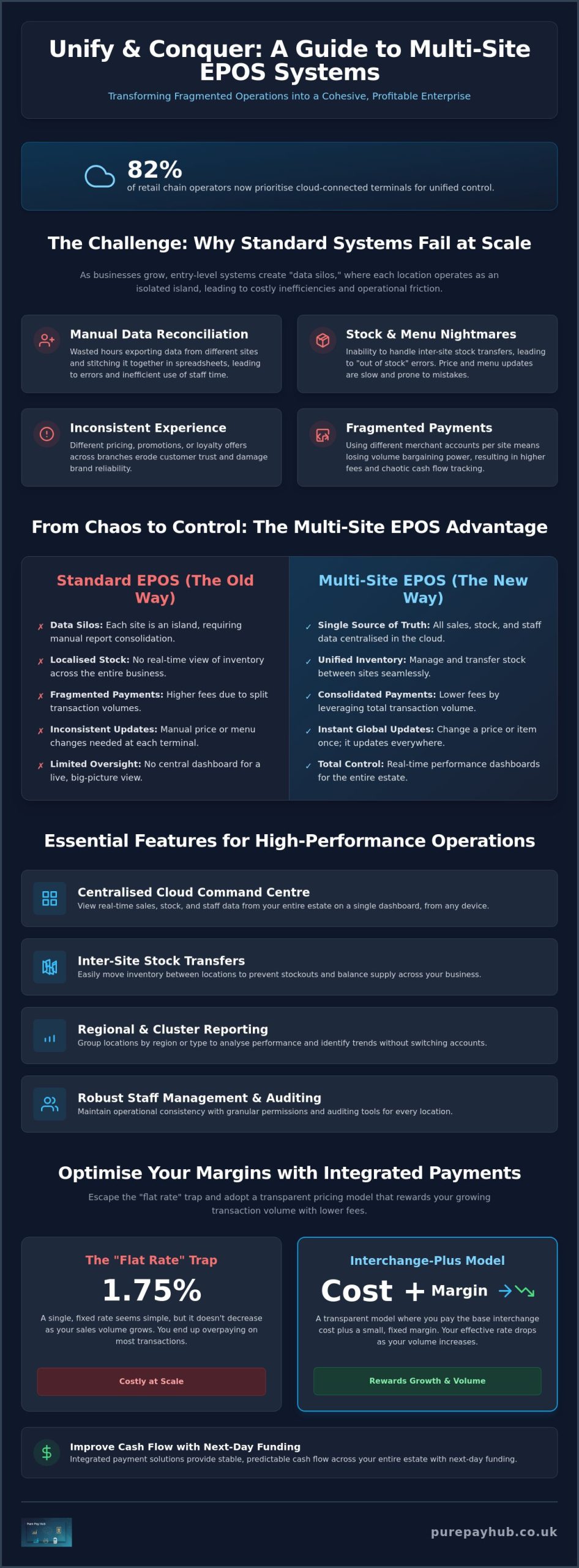
    Scaling a business is a significant achievement, but it often reveals the limitations of entry-level technology. A standard Point of Sale (POS) system works perfectly for a single shop or cafe. However, as you add locations, that same system often becomes a bottleneck that stifles growth. The primary issue is the “data silo” trap, where each site operates as an isolated island. Your sales figures, staff performance, and inventory levels are trapped within individual walls, making it impossible to see the big picture.

    This fragmentation leads to a massive hidden cost: manual reconciliation. Head office staff often spend hours every week exporting data from different terminals and stitching it together in complex spreadsheets. It’s an inefficient use of talent and a frequent source of human error. Beyond the office, decentralised systems create inconsistent customer experiences. If a customer finds different pricing or loyalty offers across your branches, your brand’s reliability takes a hit. There are also security risks to consider; managing staff permissions and auditing becomes almost impossible when permissions are handled site-by-site.

    The Problem of Fragmented Payment Processing

    Many businesses mistakenly use different merchant accounts for each site. This fragments your financial data and often leads to higher overall fees. You lose the bargaining power that comes with your total transaction volume. Tracking consolidated cash flow becomes a guessing game when you’re dealing with multiple providers and varying settlement dates. It also prevents you from seeing a unified view of customer behaviour, making it harder to reward your most frequent visitors across your entire estate.

    Operational Friction in Stock and Menu Management

    Managing inventory across multiple locations is a logistical nightmare without a dedicated EPOS system for a multi-site business. Updating a price or adding a new menu item site-by-site is slow and prone to mistakes. Without real-time communication between branches, you face frequent “out of stock” errors that frustrate customers. Basic systems simply aren’t built to handle the complexity of inter-site transfers or managing stock across multiple warehouses and storage rooms. You need a system that treats your business as one cohesive organisation, not a collection of separate parts.

    What is a Multi-Site EPOS System? Defining Centralised Control

    At its core, an enterprise-grade EPOS system for a multi-site business is a cloud-based command centre. It isn’t just a digital version of a traditional till; it’s a sophisticated hub that centralises sales, stock, and staff data from every corner of your organisation. For a business director, this creates a “single source of truth”. Instead of chasing managers for end-of-day reports, you have a live, unified dashboard that reflects the pulse of your entire estate in real-time. This level of synchronisation is what separates a modern business from one still struggling with manual admin.

    There’s a significant difference between a basic cloud POS and a true multi-site manager. Simple systems often require you to log in to each site individually to see data. An enterprise-grade EPOS system for a multi-site business allows you to view performance by region, cluster, or individual branch without ever switching accounts. It provides the architectural stability needed to manage hundreds of terminals as easily as one. This setup ensures that your business remains agile, allowing you to spot trends or issues as they happen, rather than weeks later during a monthly review.

    Centralised vs. Localised Management

    The most successful multi-site operators find a balance between top-down control and local flexibility. You might choose to keep core pricing and branding locked at head office level to ensure consistency. However, giving site managers the autonomy to run local promotions can boost morale and respond to regional demand. Maintaining this balance is crucial to avoid the hazards of ‘Ivory Tower Syndrome’, where head office decisions become detached from the daily realities of the shop floor. Using restricted access accounts ensures that whilst managers have the tools they need, sensitive financial settings remain protected.

    Cloud Infrastructure and Offline Resilience

    Cloud-based data allows you to manage your business from any device, anywhere in the world. However, UK high streets are notorious for patchy internet connections. This makes “offline mode” a non-negotiable feature. Your terminals must continue to process transactions and store data even if the Wi-Fi drops, synchronising everything once the connection returns. Choosing a partner that offers integrated EPOS and card processing ensures your data remains secure and your funds settle quickly. This infrastructure acts as a stabilising force, protecting your finances from technical glitches and ensuring that a single site’s connection issues don’t disrupt your entire reporting chain.

    Essential Features for High-Performance Multi-Location POS

    Building a high-performance estate requires tools that go beyond simple transaction recording. When you invest in an EPOS system for a multi-site business, you’re looking for features that turn raw data into actionable strategies. It’s about moving from reacting to problems to predicting opportunities. High-performance systems prioritise speed and accuracy at every till, ensuring that your customer service remains sharp even during peak trading hours. These tools provide the structural support needed to manage hundreds of staff members and thousands of products without losing your grip on the details.

    For specialised retailers like Sherwood E-Bikes Ltd., this structural support is vital for maintaining inventory accuracy and delivering a consistent customer experience across all sales channels.

    Advanced Reporting and Data Insights

    Modern reporting allows you to dive deep into “basket analysis” across your entire estate. You can see exactly which items are frequently bought together, helping you refine your cross-selling strategies. This isn’t just about total sales; it’s about understanding the unique buying behaviour of customers in different regions. By comparing site performance, you can identify “best practice” behaviours to replicate. If one branch is consistently outperforming others in a specific category, you can use those insights to train your wider team. Automated end-of-day reporting then ensures that head office stakeholders receive the latest figures directly, removing the need for manual requests.

    Inventory Control and Warehouse Integration

    Inventory control is the backbone of multi-site success. A robust EPOS system for a multi-site business manages a central warehouse that feeds multiple retail or hospitality units seamlessly. Inter-site stock transfer capabilities allow you to move slow-moving items from one branch to another where demand is higher. This prevents dead stock from eating into your margins. Predictive ordering tools use historical data to ensure high-performing sites never run dry. Additionally, bulk import tools allow you to update thousands of SKUs across every location instantly, keeping your pricing and product data perfectly synchronised without any manual effort. To further streamline your operations, especially if you are managing a growing online shop, you can check out EZ3PL Ltd for end-to-end fulfilment services.

    Unified staff management turns your workforce into a cohesive team. You can set specific sales targets for different clusters and track performance in real-time. This transparency helps you identify your top performers and see where additional support or training is required. Finally, integrated payment processing is essential for maintaining speed at the point of sale. It eliminates the risk of manual entry errors and ensures that your financial data matches your sales records perfectly. This level of integration provides the stability your business needs to scale with confidence and clarity.
    EPOS System for a Multi-Site Business: The 2026 Management Guide

    Calculating ROI: How Integrated Payments Reduce Multi-Site Overheads

    Return on investment for an EPOS system for a multi-site business isn’t just about the hardware cost. It’s found in the margins of every transaction. Many operators fall into the “flat rate” trap, paying the same percentage regardless of their growth. As you scale to multiple locations, your total transaction volume gives you significant leverage. Transitioning to a transparent interchange-plus pricing model ensures you benefit from your size, rather than being penalised by a one-size-fits-all fee structure.

    The time saved at head office provides another immediate boost to your ROI. Eliminating manual data entry can save your administrative team several hours every week. Instead of stitching together reports from five different providers, you have one clear view of your finances. Next-day funding is also a game-changer for multi-site cash flow. It ensures you have the capital ready for payroll or sudden expansion opportunities, without waiting days for your own money to clear. This stability is vital for maintaining momentum across a growing estate with an EPOS system for a multi-site business.

    The Hidden Costs of Opaque Merchant Services

    Traditional providers often bury “non-compliance” or “admin” fees in the small print. When you have multiple sites, these small charges multiply quickly, eating into your regional profits. Integrated payments solve this by reducing “shrinkage” and human error at the checkout. Because the terminal and the EPOS communicate directly, there’s no risk of staff entering the wrong amount. A single merchant ID for your entire estate simplifies your consolidated financial reporting, making tax season and internal audits much faster.

    Transitioning and Implementation Strategy

    Switching systems across a large estate requires a disciplined approach. We recommend a staged rollout to ensure your trading remains undisrupted. Start with a flagship site to refine the process before moving to other clusters. A “train-the-trainer” model is often the most effective way to upskill a large workforce. By training your site managers first, they can support their own teams locally. Centralising your provider also makes PCI compliance easier to manage, as you’re following one set of robust security protocols across your entire business.

    Ready to see how much you could save on your transaction fees? Explore our transparent multi-site payment solutions and start reclaiming your margins today.

    Future-Proofing with PurePay Hub: The Unified Multi-Site Solution

    PurePay Hub acts as a principled ally for regional business owners looking to scale. We believe that an EPOS system for a multi-site business shouldn’t be a source of constant financial stress or hidden markups. Instead, it should be a stabilising force for your finances. By stripping away the opaque fee structures used by traditional banks and offering debit rates from 0.3%, we help you build a more resilient estate. Our next-day funding model means you aren’t left waiting for your own money to clear. You can manage payroll and overheads across every location with total confidence and clarity.

    Our approach is built on the idea of a fair partnership. We provide a unified dashboard that acts as a central nervous system for your entire organisation. It eliminates the confusion of dealing with fragmented providers and brings all your sales data into one clear view. This transparency allows you to make informed decisions about your growth without the fear of unexpected admin costs eating into your regional margins. We prioritise simplicity because we know your time is better spent running your business than deciphering complex merchant statements.

    Seamless Integration and Scalable Hardware

    Hardware flexibility is vital for busy UK sites that need to remain agile. We provide a range of dependable tools, from the standard Countertop Card Machine for fixed points to the Mobile Card Machine for queue busting during peak hours. Our EPOS software is designed to evolve alongside your brand. It provides a seamless transition as you grow from two sites to two hundred, ensuring your reporting remains consistent throughout. Every terminal in your estate is backed by reliable, UK-based support. This ensures that a technical glitch at one branch never becomes a crisis for your entire operation.

    Unlocking Capital for Expansion

    Opening a new location is a capital-intensive process that requires a supportive financial partner. We offer a Business Cash Advance as a no-nonsense alternative to traditional bank loans. This allows you to use your existing card turnover to secure unsecured expansion capital for new fit-outs or equipment. There are no fixed monthly repayments to worry about. Instead, the repayment is based on a small, agreed percentage of your daily sales. If you have a quiet day, you pay less. It’s a flexible and disciplined way to fund the next chapter of your business journey without the pressure of rigid debt structures.

    Organise a free multi-site audit with PurePay Hub today and discover how our transparent approach can help you reclaim your margins whilst you grow.

    Take Command of Your Multi-Site Growth

    Managing a growing estate shouldn’t mean drowning in manual admin or opaque fees. By moving to a unified EPOS system for a multi-site business, you replace fragmented silos with a single source of truth. You gain the visibility needed to replicate your best-performing sites whilst reclaiming margins through fairer, volume-based transaction rates. This shift allows you to move from simply running a business to strategically leading a brand.

    PurePay Hub provides the stability your finances need. We offer debit rates from 0.3% and credit from 0.5%, ensuring your growth is rewarded with lower costs rather than penalised by flat fees. With next-day access to funds and no hidden monthly markups, you can keep your operations agile and your cash flow predictable across every branch. Our integrated UK-wide support ensures every till in your estate remains a reliable asset for your team.

    Get a transparent multi-site quote from PurePay Hub and start future-proofing your operations today. Scaling your brand is a significant journey. With the right technology and a fair partner by your side, you can focus on opening your next location with complete confidence.

    Frequently Asked Questions

    What is the difference between a single-site and multi-site EPOS?

    A multi-site system acts as a centralised command centre for your entire estate. Unlike single-site setups that trap data within one building, an EPOS system for a multi-site business syncs every transaction to a cloud-based hub. This allows you to view consolidated reports and manage your entire organisation without manually stitching spreadsheets together from different locations.

    Can I update prices for all my shops at the same time?

    Yes, you can update prices across your entire estate instantly from your central dashboard. You don’t need to visit each branch or log in to separate terminals to make changes. This ensures pricing consistency for your customers and allows you to launch estate-wide promotions or seasonal adjustments with a single click.

    How does a multi-site EPOS handle stock transfers between locations?

    Multi-site systems manage stock transfers by digitally logging the movement of goods between your branches. When you move inventory, the system automatically updates the stock levels for both the sending and receiving sites in real-time. This prevents “out of stock” errors and helps you balance your inventory based on specific regional demand.

    Will I get a better card processing rate if I have multiple sites?

    You often secure better card processing rates by leveraging your total transaction volume across all locations. Providers like PurePay Hub reward growing businesses with lower fees as their collective turnover increases. Instead of paying high flat rates at every site, you benefit from the combined bargaining power of your entire organisation.

    Is it possible to track individual staff performance across different branches?

    Yes, you can track individual staff performance across every branch from one central screen. You can set sales targets for specific regions or individuals and monitor their progress as it happens. This transparency helps you identify your top performers and see exactly where additional training or support might be required.

    What happens if the internet goes down at one of my locations?

    Transactions continue to process as normal if your terminals have an “offline mode” feature. Your system will store the encrypted data securely and synchronise it with the cloud hub as soon as the connection returns. This resilience is essential for maintaining service and protecting your revenue on busy high streets.

    How long does it typically take to roll out a new EPOS across 5+ sites?

    The timeline for rolling out an EPOS system for a multi-site business varies based on your estate’s size and data complexity. Most operators prefer a staged rollout, starting with a flagship site to refine the configuration. This disciplined approach minimises disruption to your daily trading and ensures your staff are fully confident before each site goes live.

    Can I see real-time sales data from my phone whilst away from the office?

    You can view live sales data from any mobile device with an internet connection. Because the data is hosted in the cloud, you have a constant pulse on your business whilst you are away from the office. This allows you to check performance, adjust staff levels, or respond to trading trends the moment they occur.

  • Choosing the Best Pub EPOS System: A 2026 Guide to Efficiency and Profit

    Choosing the Best Pub EPOS System: A 2026 Guide to Efficiency and Profit

    Your current till system might be the most expensive member of staff you have ever hired. When the Friday night rush hits, a slow pub epos system does more than just frustrate your regulars; it actively drains your margins through missed rounds and stock discrepancies. You likely feel the pressure of a packed bar whilst managing complex wet-led inventory and worrying about those opaque transaction fees that eat into your hard-earned profits. It’s a common frustration for publicans who want to focus on service rather than fighting with their own technology.

    We believe your payment tech should be a stabilising force for your finances, not a source of stress. This guide shows you how to choose a system that transforms operations, slashes transaction costs, and secures your cash flow through total transparency. We’ll explore the latest 2026 requirements, including Martyn’s Law and new HFSS rules, whilst comparing the top providers to help you find a reliable partner. You’ll learn how to achieve faster table turnover and simple stock management to keep your business moving forward with confidence.

    Key Takeaways

    • Learn how a modern pub epos system synchronises your payments and stock to eliminate hidden wastage and manual errors.
    • Identify the specific hardware features that prioritise speed of service during peak hours to ensure your bar staff never miss a round.
    • Understand the true cost of card processing and why transparent debit rates are more vital for your bottom line than monthly software fees.
    • Discover the best practices for a stress-free transition, including how to migrate your menu data and when to schedule your system switch.
    • See how integrated payment solutions and next-day funding provide a stabilising force for your pub’s weekly cash flow.

    What is a Pub EPOS System and Why Does Your Bar Need One?

    A pub EPOS is a centralised digital hub for all bar transactions. Unlike a standard cash register, an Electronic Point of Sale system integrates sophisticated software with robust hardware to manage the complex demands of a modern hospitality environment. It’s the engine room of your business, synchronising your card payments, stock levels, and staff performance in one place. To understand the broader context of this technology, you can explore the history and evolution of What is a Point of Sale (POS) system through foundational industry records.

    In 2026, the best pub epos system options use cloud technology to give you real-time oversight of your venue. This means you can check your live sales data or adjust menu prices from your phone whilst away from the bar. It moves your operations beyond simple money-taking and into the realm of intelligent business management. By connecting every part of your service, you ensure that no pint goes unrecorded and no transaction is lost to manual error.

    The Shift from Traditional Tills to Integrated EPOS

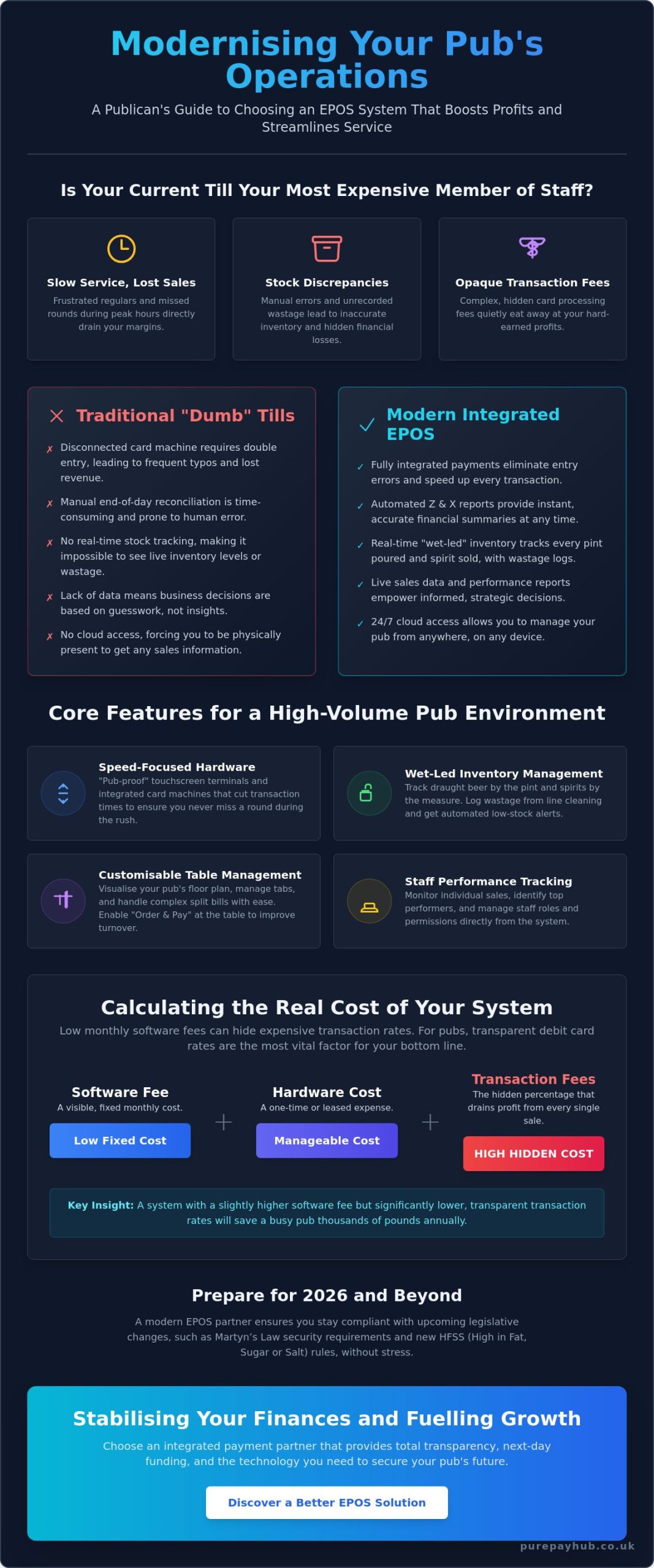
    Legacy “dumb” tills are a primary cause of reconciliation errors. When your payment terminal doesn’t talk to your till, staff must manually enter amounts twice. This leads to typos, lost revenue, and hours spent at the end of a shift trying to figure out why the numbers don’t match. An integrated system removes this human error factor entirely. For multi-site operators, the advantage is even clearer. You gain 24/7 cloud access to every location, allowing you to compare performance across your estate without needing to be physically present at the bar.

    The Core Components: Hardware vs Software

    Your system is only as strong as its weakest link. In a high-pressure bar environment, your hardware must be “pub-proof”. This means touchscreen terminals that can handle sticky fingers and the occasional spill, along with printers that won’t fail in a hot, humid kitchen or cellar. The software is the brain of the operation, handling essential tasks like table management and complex split billing for large groups. It should be intuitive enough that new staff can learn the basics in minutes, keeping your service moving during the Friday night rush.

    Consider these essential elements for a reliable setup:

    • Touchscreen Terminals: High-speed interfaces that reduce order time and improve accuracy.
    • Integrated Card Machines: Devices that automatically pull the total from the till to prevent entry mistakes.
    • Stock Management Modules: Software that tracks every pint poured and bottle sold in real time.
    • Loyalty Programmes: Built-in tools to reward your regulars and encourage repeat visits.

    By choosing a modern pub epos system, you aren’t just buying a till; you’re investing in a partner that protects your margins and simplifies your working day. It provides the clarity you need to make informed decisions about your stock, your staff, and your future growth.

    Essential Features for High-Volume Pub Environments

    In a high-volume pub, speed is your most critical metric. When the bar is three deep, your pub epos system must respond instantly to every touch. Modern publicans are increasingly adopting modern financial technology to manage these peak periods with precision. Beyond simple order entry, your system needs to handle “Order & Pay” at the table, which has become a standard expectation for customers in 2026. To keep your books balanced, Z-reports and X-reports provide instant financial clarity by giving you a real-time summary of your takings at any point during the day.

    Wet-Led Inventory and Wastage Management

    Managing a wet-led cellar requires more than just counting bottles. Your inventory tracking must account for draught beer by the pint and spirits by the exact measure. A common drain on profits is the lack of a proper wastage log for weekly line cleaning or accidental spills. The right pub epos system allows you to record these events specifically, ensuring your stock levels remain accurate. You can also set automated low-stock alerts so you never have to tell a customer their favourite ale is off. For more advanced tracking, exploring integrated stock modules can help protect your bottom line.

    Table Management and Customisable Floor Plans

    Visualising your bar and garden layout is essential for effective service. A customisable floor plan allows you to manage server sections and track table occupancy at a glance. It’s common for customers to start a tab at the bar and later move to a table for food; your system should handle this transition seamlessly. Handling large groups becomes much simpler with a dedicated “split bill” feature. This allows your team to divide costs by item or value without holding up the queue or causing confusion during payment.

    Staff Performance and Security Features

    Security is vital in a fast-paced environment. Individual staff logins via RFID fobs or unique PINs help you track sales and prevent “no-sale” theft at the till. These logs also allow you to monitor average transaction values, helping you identify which team members are your top performers. To maintain control, you should use permission tiers that restrict sensitive actions like refunds or voids to management-level staff only. This creates a transparent, accountable culture within your team whilst safeguarding your daily revenue.

    Choosing the Best Pub EPOS System: A 2026 Guide to Efficiency and Profit

    Calculating the Real Cost: Software, Hardware, and Transaction Fees

    Choosing a pub epos system based solely on the monthly software price is a common mistake. Whilst a low subscription fee looks attractive on paper, the real cost of your technology is often hidden in the small print of your merchant agreement. You need a system that protects your margins, not one that slowly erodes them through opaque charges and delayed access to your own money. Cash flow is the lifeblood of any bar; waiting three to five days for funds to clear is no longer acceptable for a modern business. Securing next-day funding ensures your takings are in your account when you need to pay suppliers or staff.

    Upfront vs Recurring Costs: What to Budget For

    Your initial investment usually involves a choice between buying hardware outright or choosing a monthly rental model. Buying your touchscreen terminals and integrated card machines upfront can reduce your long-term monthly outgoings, but rentals offer a lower barrier to entry for new venues. Beyond the physical kit, your Software-as-a-Service (SaaS) fees should cover more than just a digital till. Ensure your provider includes 24/7 UK-based support and regular software updates within that price. You don’t want to be hit with extra maintenance charges when you need help during a busy bank holiday weekend.

    The “Hidden Tax” of High Transaction Rates

    The true financial impact of your pub epos system lies in the transaction rates. Many high-street banks and traditional providers use blended rates that hide their own markups. A difference of just 1% in your processing fee can cost a busy pub thousands of pounds every year. At PurePay Hub, we prioritise transparency by offering debit rates from 0.3%, which is significantly lower than many standard market offerings. We use clear fee structures to ensure you keep more of every pint sold. You should also watch out for these common hidden costs:

    • PCI Compliance Fines: Monthly penalties for not meeting security standards that your provider should help you manage.
    • Exit Fees: Punitive charges designed to stop you from switching to a fairer partner.
    • Minimum Monthly Service Charges: Fees that apply even if your seasonal trade is quiet.

    By moving away from murky fee structures and toward a partnership based on clarity, you turn your payment processing into a stabilising force for your finances. It is about choosing a partner that values your growth as much as you do. When you compare providers, always ask for the total cost of ownership including all processing fees and hardware maintenance.

    Implementation: Switching Your Pub EPOS Without the Stress

    Switching your pub epos system doesn’t have to be a headache. It’s a process that requires planning and discipline rather than just technical skill. Most publicans make the mistake of trying to install new kit on a Friday afternoon. Don’t do this. A Monday morning is far better because it gives you a quiet window to iron out any kinks before the weekend rush. It also ensures that support teams are fully available if you hit a snag during the initial setup.

    Data migration is your next hurdle. You shouldn’t have to rebuild your entire menu from scratch. Most modern providers allow you to export your existing stock lists and pricing from your old provider. This saves hours of manual entry and prevents pricing errors. You also need to verify your connectivity. Cloud-based systems are brilliant, but they rely on stable Wi-Fi. If your bar has thick stone walls, you might need to install additional access points to handle the peak load of a busy Saturday night without slowing down your payment processing.

    The Pre-Installation Checklist

    Before you unbox your new terminals, audit your current setup. Some hardware, like heavy-duty cash drawers, can often be repurposed to save on upfront costs. You also need to organise your back-office categories. Define your groups clearly: Draught, Spirits, Food, and Soft Drinks. This structure makes your reporting much cleaner later on. Finally, check that your merchant account is fully verified so you can access next-day funding immediately.

    Training Your Team for Success

    A confident team is a fast team. Run “mock service” sessions where staff can practice taking complex orders and splitting bills without the pressure of a real queue. Teach them how to handle “offline mode” too. High-quality systems will continue to process payments even if the internet drops out. Establish a clear process for reporting tech issues. If a staff member knows exactly who to tell when a printer jams, it prevents small glitches from becoming major service delays. If you’re ready to upgrade your bar’s technology, you can explore our integrated EPOS systems today.

    PurePay Hub: The Integrated Payment and Growth Partner for UK Pubs

    PurePay Hub is more than just a technology provider; it’s a dedicated partner for the independent publican. We combine elite software with industry-leading debit rates starting from 0.3%. This ensures your pub epos system works for your bottom line rather than against it. By bringing your till, card machine, and financial management under one roof, we eliminate the friction of dealing with multiple distant institutions. You deserve a professional support team that understands the no-nonsense reality of running a busy bar.

    Next-Day Funding: A Game-Changer for Pub Cash Flow

    Waiting three days for your weekend takings to clear is a relic of the past. In an industry where supplier payments and payroll are constant pressures, faster access to your capital is essential. The PurePay Hub promise is simple: your money arrives in your account when you need it. This next-day access provides the stability required to manage your weekly outgoings with confidence. You shouldn’t have to wait for your own hard-earned profit whilst your bills continue to mount.

    Unlocking Growth with Business Cash Advances

    Your transaction history is a valuable asset. We use your EPOS data to help you secure a Business Cash Advance, providing unsecured capital for your next big project. Whether you are planning a major refurbishment, upgrading your beer garden for the summer, or making large seasonal stock buys, this funding adapts to your business. This model is particularly effective for regional pubs that experience seasonal peaks. Repayments fluctuate with your sales; you pay more when the bar is busy and less during quieter weeks. It is a flexible, supportive way to grow without the rigid constraints of a traditional bank loan.

    Take the Next Step Toward a Fairer Partnership

    Switching your provider is often easier than you think. We help you move to PurePay Hub without the stress of extortionate exit fees or complex setup processes. Our team can provide a transparent rate review to show exactly how much your pub could save annually by moving to a fairer structure. It is time to stop overpaying for your processing and start working with a partner that values your success as much as you do. You can get a transparent quote for your pub EPOS today and see the difference clarity makes to your business.

    Future-Proof Your Bar with Transparent Technology

    Your bar deserves a technology partner that values clarity over hidden markups. A modern pub epos system is much more than a digital till; it’s a financial anchor that secures your cash flow and simplifies complex wet-led stock management. By prioritising speed of service and demanding transparent transaction rates, you protect your hard-earned margins from the opaque practices of traditional providers. Successful implementation simply requires a planned transition during quiet periods to ensure your team is confident and ready for the weekend rush.

    PurePay Hub acts as a supportive business ally by offering the stability your venue needs to thrive. We provide debit card rates from 0.3% and guaranteed next-day access to your funds to keep your operations moving. When you’re ready to expand, our integrated Business Cash Advance options provide the flexible capital required for refurbishments or seasonal stock buys. Switch to a fairer pub EPOS and payment system with PurePay Hub today. You’ve built your business on honest service, so it’s time your payment partner did the same.

    Frequently Asked Questions

    How much does a pub EPOS system typically cost in the UK?

    Costs for a pub epos system in the UK vary significantly based on your choice between pay-as-you-go models and monthly subscriptions. In 2026, entry-level software plans from providers like Square or SumUp start at £0 per month with higher transaction fees, whilst premium hospitality packages like Lightspeed or Tabology range from £39 to £79 per month. Hardware bundles can be purchased outright or rented through monthly instalments. You should always check for hidden costs like support fees or charges for additional terminals.

    Can I use my existing card machine with a new EPOS system?

    You can only use an existing card machine if it is fully compatible with the new software’s specific integration protocols. Most publicans find that using a non-integrated terminal leads to frequent manual entry errors and slower service during peak hours. Switching to a fully integrated partner ensures your till and card machine communicate perfectly. This eliminates the need for double-entry and speeds up the reconciliation process at the end of every shift.

    What happens to my pub EPOS if the internet goes down?

    Most modern systems include an “offline mode” that allows you to continue taking orders and processing payments if your internet connection fails. The data is stored locally on your terminal and synchronises with the cloud once your connection is restored. This prevents your service from grinding to a halt during a busy Friday night rush. It is a vital feature for rural pubs where connectivity can be less reliable than in city centres.

    Is it difficult to move my menu and stock data to a new system?

    Moving your menu and stock data is typically a straightforward process using CSV or Excel exports from your old provider. Most systems allow you to map your existing categories, such as draught beers, spirits, and snacks, directly into the new interface. This prevents you from having to enter hundreds of individual items manually. It is best to perform this migration on a quiet Monday morning to ensure every price and measure is accurate before you open.

    Do I need a specific type of card machine for a pub environment?

    A pub environment requires rugged, spill-proof hardware that can withstand the heat and humidity of a busy bar. Whilst a countertop card machine is standard for the main service area, portable card machine options are better for table service and beer gardens. These devices use Wi-Fi or mobile data to ensure your staff can take payments anywhere on the premises. This flexibility reduces queues and improves the overall customer experience during high-volume periods.

    What is the benefit of next-day funding for a hospitality business?

    Next-day funding improves your cash flow by giving you access to your weekend takings on Monday morning. Traditional banking structures often leave you waiting three to five days for funds to clear, which can cause unnecessary stress when paying suppliers or staff. Having immediate access to your capital allows you to manage your outgoings with total confidence. It turns your daily revenue into a stabilising force for your business finances rather than a source of frustration.

    How does a Business Cash Advance work with my EPOS system?

    A Business Cash Advance uses your historical transaction data to provide unsecured capital for your venue. Instead of fixed monthly payments, you repay the advance as a small, pre-agreed percentage of your daily card sales. This means you pay back more when the bar is booming and less during quieter seasonal periods. It is an ideal solution for funding refurbishments or beer garden upgrades without the rigid pressure associated with a traditional bank loan.

    What security measures should I look for in a pub EPOS?

    You should look for individual staff logins and customisable permission tiers to prevent “no-sale” theft and unauthorised refunds. Your pub epos system must also be fully PCI compliant to protect your customers’ sensitive payment data. High-quality systems include detailed audit trails that track every action taken on the till. These security features provide the transparency you need to manage your team and protect your hard-earned revenue from both internal and external threats.