
Tag: sole trader

  • Self-Employed Card Machine UK: The Definitive Guide for 2026

    Self-Employed Card Machine UK: The Definitive Guide for 2026

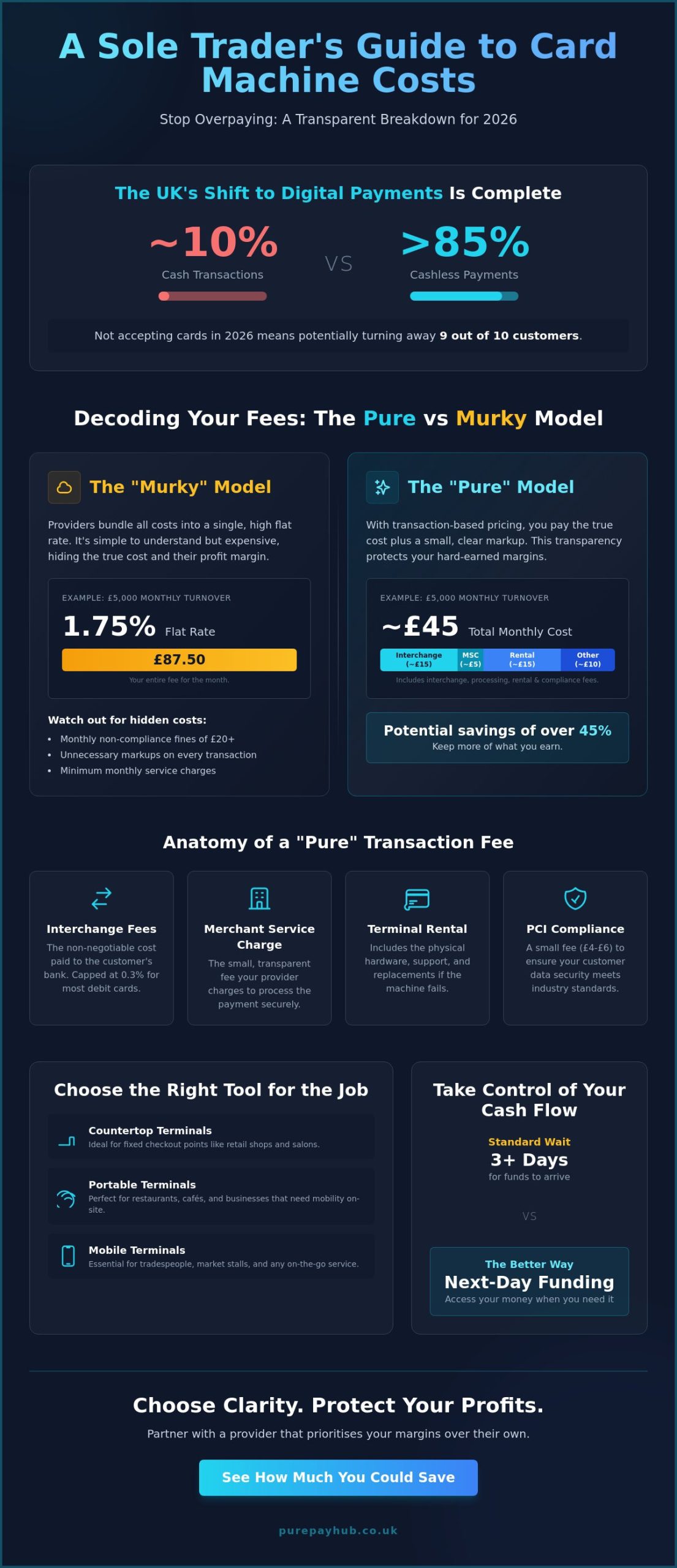
    With cashless transactions accounting for over 85% of all UK payments as of October 2025, your choice of a self employed card machine UK is the most critical tool in your business kit. It is the difference between a seamless sale and a frustrated customer. Many sole traders still struggle with opaque fee structures that hide the true cost of doing business. You shouldn’t have to settle for clunky hardware or wait three days for your money to arrive.

    We agree that your hard-earned margins deserve protection from unnecessary markups. This guide promises to show you exactly how to secure transaction rates below 1% and ensure next-day access to your funds. We provide a transparent breakdown of the best hardware for 2026. We compare everything from the £25 SumUp Air to high-performance portable units. You will learn how to simplify your payments through a reliable partnership that prioritises purity and clarity in every transaction.

    Key Takeaways

    • Maximise your sales potential by adapting to a UK landscape where cash transactions have dropped below 10% of total sales.
    • Secure a self employed card machine UK with transparent, transaction-based rates starting from 0.3% to protect your business margins.
    • Identify the ideal hardware for your specific setup, comparing the connectivity and durability of countertop, portable, and mobile terminals.
    • Solve cash flow delays by choosing settlement options that provide next-day access to your funds instead of the standard multi-day wait.
    • Eliminate hidden markups and “murky” fee structures by adopting a simplified, honest approach to your merchant service agreement.

    Why a Self-Employed Card Machine is Essential in 2026

    2026 has arrived; and for the UK’s 4.1 million sole traders, the ability to accept digital payments is no longer a luxury. It’s the baseline. A self employed card machine UK is the primary tool that ensures you never miss a sale. With cash transactions now accounting for less than 10% of total UK sales, relying on physical currency is a high-risk strategy that alienates the modern shopper. If you aren’t equipped to take card payments, you’re effectively closing your doors to nine out of ten potential customers.

    Asking for a bank transfer or searching for a nearby ATM creates unnecessary friction. A dedicated payment terminal signals that your business is legitimate, modern, and ready to serve. Research consistently shows that British consumers spend more when they pay by card. It removes the “wallet ceiling” imposed by how much physical cash they happen to be carrying, allowing your average transaction value to grow naturally. Professionalism matters in a competitive market; and nothing says “established business” like a sleek, reliable payment process.

    The Shift from Cash to Contactless

    Digital wallets like Apple Pay and Google Pay have moved from being alternative methods to the standard. In 2026, “Tap to Pay” is the instinctive behaviour for the majority of UK shoppers, especially in urban centres. If your business doesn’t facilitate this, you’re creating a barrier to entry. The modern card machine is a gateway to financial inclusion for SMEs. It allows even the smallest micro-business to compete on a level playing field with high-street giants by providing the same seamless checkout experience.

    Benefits Beyond Simple Payment Acceptance

    Accepting card payments does more than just move money. It simplifies your entire back-office operation. Integration with accounting software makes Making Tax Digital (MTD) compliance straightforward rather than a quarterly headache. You spend less time counting coins and making trips to the bank; this reduces the physical risk of carrying cash and the time-cost of manual reconciliation. Many modern machines now support payment links and virtual terminals too. This means you can take secure payments whilst away from your primary place of work. It is perfect for tradespeople or consultants who need to secure deposits or finalise invoices on the move without the delay of traditional banking.

    Decoding Self-Employed Card Machine Costs: Pure vs Murky Fees

    Understanding the true cost of a self employed card machine UK requires looking past the flashy hardware. Most providers hide their profits behind a single, flat percentage. This “murky” model is easy to understand but expensive to scale. To protect your margins, you must understand the three core pillars of payment costs. These dictate what actually leaves your bank account every month. Transparency is the only way to ensure you aren’t overpaying for the simple act of accepting money.

    Every transaction fee consists of several layers. A fair provider will break these down for you, rather than bundling them into a high, flat rate. These components typically include:

    • Interchange Fees: The non-negotiable cost paid to the customer’s bank.
    • Merchant Service Charge (MSC): The fee your provider charges to process the payment.
    • Terminal Rental: The monthly cost for the physical hardware and support.
    • PCI Compliance: A small fee, usually between £4 and £6, to ensure your data security meets industry standards.

    According to recent UK payment trends, the shift towards digital payments has made fee transparency a top priority for small businesses. Beware of “hidden” costs like non-compliance fines. If you don’t complete your annual security questionnaire, some providers will charge you £20 or more every month. A reliable partner helps you avoid these penalties through clear communication and support.

    The 0.3% Advantage: Transaction-Based Pricing

    The “Pure” model uses transaction-based pricing. In the UK, interchange fees are capped at 0.3% for most debit cards and 0.5% for credit cards. If you pay a flat 1.75% rate, you are effectively giving away 1.45% of every sale in pure profit to your provider. Consider a sole trader with a £5,000 monthly turnover. At a 1.75% flat rate, you pay £87.50. With a transaction-based model, even including a £15 rental fee and small processing markups, your total cost could drop to approximately £45. You can see how much you could save by switching to a model that prioritises your margins over provider profit.

    Monthly Rental vs Outright Purchase

    Renting your terminal is often the most efficient choice for established sole traders. It provides peace of mind; if the hardware fails, your provider replaces it immediately. Rental contracts also ensure you always have the latest software updates to stay compliant with UK regulations. From a tax perspective, monthly rental fees are a fully deductible business expense. While buying a basic mobile reader for £25 makes sense for very low-volume micro-businesses, the higher transaction rates on those devices quickly become a burden as your sales grow. Once you process more than £2,000 per month, the lower rates found in rental agreements far outweigh the initial hardware saving.
    Self-Employed Card Machine UK: The Definitive Guide for 2026

    Choosing the Right Terminal for Your Business Type

    Your hardware choice is a personal decision that dictates your daily workflow. You need a device that matches your pace and environment. A self employed card machine UK should never be a bottleneck during a busy shift. The right terminal ensures you stay connected; whether you’re behind a counter or at a customer’s front door. We categorise these devices into three primary types to help you find your perfect fit.

    Countertop units are the traditional workhorses of the retail world. They plug directly into your power supply and use a fixed Ethernet or Wi-Fi connection. These are the most stable options for permanent shops. Portable units offer more freedom; they allow you to take the terminal to a customer within your premises. These typically rely on Wi-Fi or Bluetooth. For those who work on the road, mobile units are essential. They use internal SIM cards to connect to 4G or GPRS networks, ensuring you can take payments anywhere in the country with a mobile signal. You can explore our full range of Mobile & Portable Payment Solutions to see which technology suits your specific trade.

    Connectivity is the backbone of your payment process. Ethernet remains the gold standard for reliability in fixed locations. However, if you’re mobile, 4G connectivity is superior to Bluetooth pairing with a smartphone. It eliminates the frustration of dropped connections and sync errors. Battery life is equally critical. If you’re a courier or a mobile hairdresser, a dead battery means lost revenue. Look for hardware that offers at least 8 hours of active use or 48 hours of standby time to get through your longest days without anxiety.

    Mobile Card Machines for Tradespeople and Couriers

    If you’re always on the move, you need a device that is both lightweight and rugged. Mobile terminals are designed to fit in a pocket or a tool bag. They use pre-installed SIM cards to provide a standalone connection, so you don’t have to rely on a customer’s Wi-Fi. For outdoor environments, durability is a priority; look for units with reinforced casing. If a customer isn’t physically present, you can use payment links as a secure backup. This allows you to send a simple URL via text or email, ensuring you get paid for deposits or remote call-outs without delay.

    Portable and Countertop Units for Fixed Locations

    Fixed locations like cafes or salons benefit from the speed of portable and countertop units. Portable devices are perfect for hospitality; they allow for “pay at table” service which improves table turnover. These units often feature integrated thermal printers for physical receipts, which many British customers still prefer for their records. Countertop units are ideal for high-volume retail centres where a stable, wired connection is available. They are built for speed and constant use, providing a central, stabilizing force for your checkout area.

    Managing Cash Flow: Next-Day Funding and Advances

    Cash flow is the ultimate metric of health for any UK sole trader. You can have a record-breaking day of sales; but if that money is trapped in a clearing cycle, your business is effectively at a standstill. This is why settlement speed is often the primary objection when choosing a self employed card machine UK. Standard processing times of three to five working days are an outdated relic of traditional banking. They don’t reflect the fast-paced reality of running a modern business in 2026.

    Next-Day Funding changes the equation. It means that the sales you process today are sitting in your bank account by the next working day. This level of liquidity allows you to respond to opportunities in real-time. You don’t have to check your balance with anxiety before ordering new supplies or paying a supplier. We view our role as a central, stabilising force for your finances. By removing the wait, we turn your payment terminal into a high-speed engine for your business’s daily operations.

    Why Settlement Speed Matters

    Slow funding cycles do more than just cause stress; they actively limit your ability to scale. If you are a tradesperson waiting for a large invoice to clear before you can purchase materials for the next job, you are losing billable hours. PurePay Hub prioritises rapid access to funds because we understand that time is money for a merchant. We ensure that your card machine remains a bridge to your next success rather than a barrier to entry. Your hardware should facilitate your growth, not act as a financial bottleneck.

    Flexible Funding via Your Card Sales

    Beyond daily settlements, your card turnover can unlock significant growth capital. A Business Cash Advance is a flexible, modern alternative to a rigid bank loan. Unlike traditional lending, there are no fixed monthly repayments that stay the same regardless of your income. Instead, you repay a set percentage of your daily card sales. This model is inherently fair; you pay back more during your peak seasons and less during the quieter months. It aligns perfectly with the natural ebb and flow of self-employed life.

    This is unsecured capital. It doesn’t require bricks-and-mortar collateral, making it an accessible option for self-employed professionals who don’t own commercial property. It is a partnership based on your actual performance rather than a credit score from a distant institution. You can learn more about our Business Cash Advance Based on Card Sales to see how this flexible funding can support your next project without the stress of fixed debt.

    Why PurePay Hub is the Best Partner for the Self-Employed

    Choosing a self employed card machine UK is about more than just hardware. It is about finding an ally who values your margins as much as you do. We built PurePay Hub on a “Pure” philosophy. This means we provide transaction-based pricing without the hidden markups that often plague the industry. We don’t believe in corporate jargon; we believe in clarity. Our goal is to act as a central, stabilising force for your business finances, allowing you to focus on growth while we handle the technicalities of every “tap” and “swipe”.

    Our service adapts to your specific needs. Whether you require a countertop unit for a fixed shop or a mobile terminal for trade on the road, our hardware range is designed for reliability. We prioritise honesty in our partnerships. You won’t find yourself trapped in a murky contract with escalating fees. Instead, you get a simplified model that scales with your success. By choosing us, you are choosing a modern fintech partner that understands the individual pressure of being a sole trader in the UK today.

    The PurePay Hub Onboarding Experience

    We know that your time is your most valuable asset. The process of getting a Merchant ID and setting up your first terminal shouldn’t take weeks. We have refined our onboarding to be fast and intuitive. Once you apply, we move quickly to get you approved and your hardware dispatched. You won’t be left to struggle with complex manuals either. Our dedicated UK support team is always available to ensure your first sale goes through without a hitch. We provide the technical backbone so you never have to worry about a Sale Failed message during a busy shift.

    Switch to PurePay Hub today for fairer, faster payments

    Commitment to the UK Merchant Community

    Our approach is shaped by the latest UK standards. On April 21, 2026, the UK government announced new measures to modernise payment services regulation. We have already integrated these digital frameworks into our systems to ensure you stay ahead of the curve. You also benefit from updated protection; we provide at least 90 days’ notice for any service changes, which is a significant improvement over the previous 60-day industry standard. This commitment to transparency is matched by our focus on security. Every system we provide is fully PCI-compliant, giving you and your customers total peace of mind during every transaction.

    Get your bespoke quote for a self-employed card machine

    Secure Your Margins and Simplify Your Payments

    Running a business as a sole trader in 2026 demands efficiency and absolute clarity. You have seen how the right self employed card machine UK turns every transaction into a growth opportunity. By moving away from murky flat-rate fees and adopting a transaction-based model, you keep more of your hard-earned profit. Speed matters just as much as cost. Next-day access to your funds ensures your cash flow remains fluid; this allows you to pay suppliers and manage stock without the standard three-day delay.

    The choice of hardware, from mobile terminals for traders on the move to stable countertop units, should always match your specific workflow. We believe in providing a pure, honest partnership that eliminates the stress of hidden markups and technical failures. You deserve a payment partner that acts as a reliable hub for your growth. It is time to stop overpaying for the simple act of accepting money and start protecting your margins with a fairer system.

    Join the thousands of UK merchants using PurePay Hub for transparent processing and benefit from debit rates starting from 0.3% and next-day funding with no hidden monthly markups. Your business is ready for the next level; we are here to help you reach it.

    Frequently Asked Questions

    Is it better to buy or rent a card machine when self-employed?

    Renting is the superior choice for established sole traders who prioritise reliability and support. When you rent, your provider handles software updates and replaces faulty hardware immediately. This ensures your self employed card machine UK never becomes a point of failure. Buying a basic reader outright makes sense for micro-businesses with very low turnover; but the higher transaction fees on those devices quickly erode any initial hardware savings.

    How much are the average transaction fees for a sole trader in the UK?

    Average fees vary significantly depending on your pricing model. Most flat-rate providers charge approximately 1.75% per transaction regardless of the card type used. In contrast; a transaction-based model allows you to pay closer to the actual interchange rates. These are currently capped at 0.3% for most UK debit cards and 0.5% for credit cards. Choosing a transparent model can reduce your total processing costs by over 50%.

    Can I take card payments without a physical machine?

    You can accept payments remotely using a Virtual Terminal or Payment Links. A Virtual Terminal allows you to type card details into a secure web browser whilst speaking to a customer over the phone. Payment Links are even simpler; you send a secure URL via text or email. These digital tools are perfect for consultants or tradespeople who need to take deposits before arriving on-site.

    What is a merchant account and do I need one if I am self-employed?

    A merchant account is a dedicated holding area where funds are checked and authorised before being sent to your bank. You definitely need one to accept card payments. Modern providers usually bundle this into your service agreement; so you don’t have to apply for one separately at a high-street bank. It acts as the essential bridge between your customer’s card and your business bank account.

    How long does it take for card payments to reach my bank account?

    Standard settlement times in the UK typically range from three to five working days. However; many modern providers now offer Next-Day Funding as a standard or premium feature. This speed is vital for managing your daily cash flow and paying suppliers on time. If you process a sale on Monday; the funds should be available in your account by Tuesday morning.

    What happens if my card machine loses Wi-Fi connection during a sale?

    High-quality mobile and portable machines automatically switch to a GPRS or 4G backup signal if the Wi-Fi fails. This ensures your self employed card machine UK stays online even in areas with poor internet. Some devices also offer an “offline mode” that stores the transaction data securely. The payment then processes once the connection is restored; so you never have to turn a customer away.

    Are there any hidden costs like PCI compliance fees I should know about?

    You should be aware of PCI compliance fees and potential non-compliance fines. Most providers charge a small monthly fee, usually between £4 and £6, to manage your data security certification. If you fail to complete your annual security profile; you may be hit with a non-compliance fine of £20 or more every month. Transparent providers will help you navigate this process to avoid these unnecessary penalties.

    Can I use a personal bank account for my card machine sales?

    Some entry-level providers allow you to link a personal account; but most dedicated merchant services require a business bank account. Using a business account is best practice for tax purposes and Making Tax Digital (MTD) compliance. It keeps your professional earnings separate from your personal spending. Most UK banks also have terms and conditions that prohibit using personal accounts for business activities.

  • Starting as a Sole Trader in the UK: The Complete 2026 Guide

    Starting as a Sole Trader in the UK: The Complete 2026 Guide

    The biggest threat to your new business isn’t a lack of customers; it’s the £3,000 penalty HMRC can issue for avoidable tax errors. You want the freedom of working for yourself, but the technicalities of becoming a sole trader often feel like a barrier designed to slow you down. We understand that frustration. Most of the 3.1 million small business owners in the UK started with a passion for their craft, not a love for National Insurance categories or unlimited liability risks. You deserve a clear path that cuts through the corporate jargon and focuses on your actual growth.

    We agree that business admin shouldn’t be a source of constant anxiety or hidden costs. This guide provides the honest roadmap you need to manage your finances with confidence and integrity. You’ll learn exactly how to register correctly, how to organise your tax affairs, and how to accept customer payments without the stress of complex fee structures. We are moving from initial setup to long-term financial health, ensuring you have a pure and simplified strategy for your professional future.

    Key Takeaways

    • Understand the legal requirements of becoming a sole trader and how to protect your personal assets from the risks of unlimited liability.
    • Master the HMRC registration process and the critical 5 October deadline to ensure your new venture remains fully compliant.
    • Discover why separating your personal and business finances is vital and how a dedicated merchant account simplifies taking card payments.
    • Identify common cash flow pitfalls and learn to use real-time reporting to monitor performance and capitalise on peak trading periods.
    • Find out how PurePay Hub supports your growth with pure transparency and tailored payment solutions that feature no hidden markups.

    What is a Sole Trader? Definition and UK Requirements

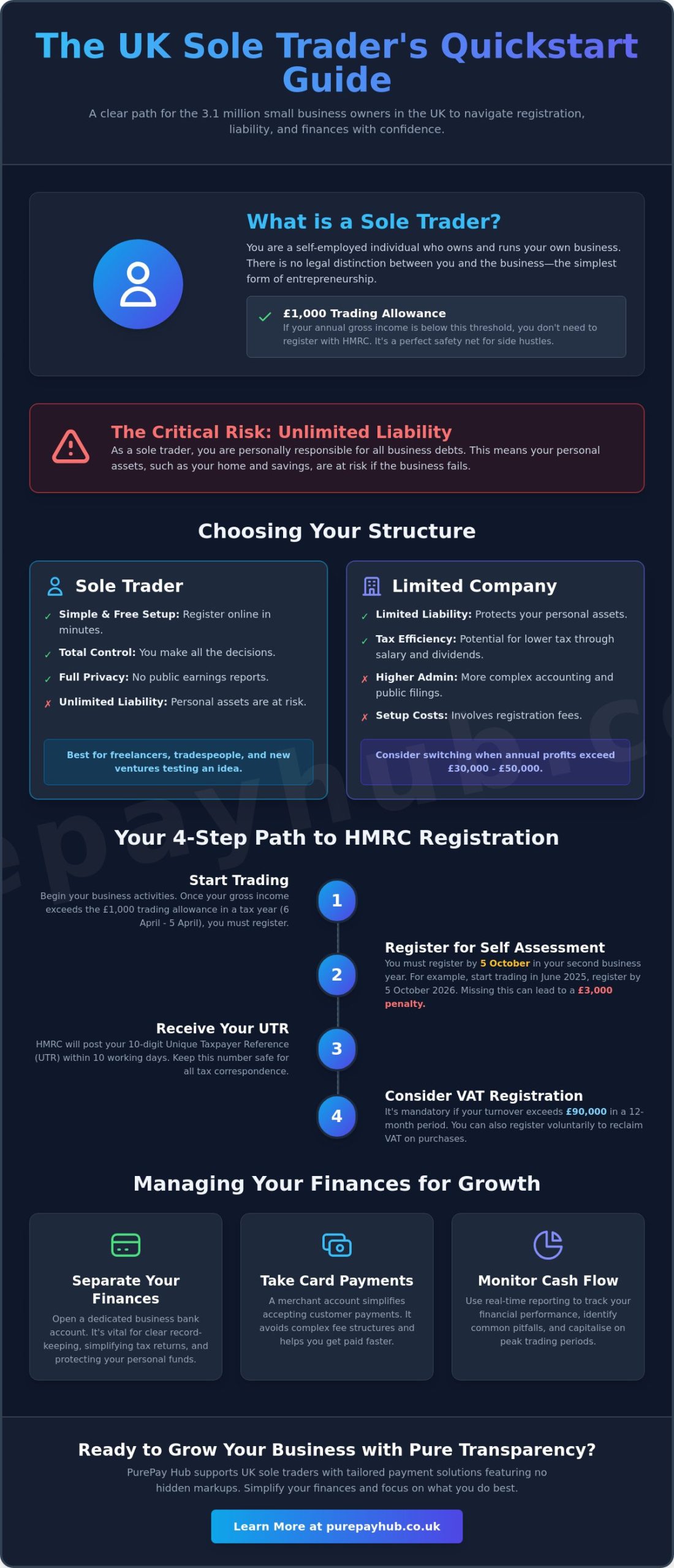
    Starting a business in the UK often begins with the most direct path. A sole trader is an individual who owns and runs their own business as a self-employed person. There is no legal separation between you and the business entity. This Definition of a sole trader confirms that you are the sole decision-maker and the sole beneficiary of all profits after tax. We see this structure as the purest form of entrepreneurship because it removes the layers of complexity found in larger corporate setups.

    This simplicity comes with a significant legal reality known as unlimited liability. Because you and the business are the same legal entity, you are personally responsible for every debt the business incurs. If your business fails to pay a supplier or faces a legal claim, your personal assets are on the line. This includes your home, car, and personal savings. It is a high-stakes arrangement that demands disciplined financial management and clear record-keeping.

    For those testing a new idea, the UK government provides a £1,000 tax-free trading allowance. If your annual gross income from self-employment stays below this £1,000 threshold, you don’t need to register with HMRC or pay tax on that income. Once your earnings exceed this limit between 6 April and 5 April of the following year, you must register for Self Assessment by 5 October. This allowance acts as a helpful buffer for side hustles and micro-businesses before they fully commit to the sole trader path.

    Pros and Cons of the Sole Trader Structure

    The primary advantage of this structure is total control. You make every decision without consulting a board of directors. Setup is free and can be completed in minutes via the HMRC website. You also benefit from increased privacy. Unlike limited companies, you aren’t required to file public accounts with Companies House, keeping your earnings confidential. However, the burden of personal liability is a heavy disadvantage. You might also face higher tax rates once your profits move into the 40% or 45% brackets. This structure works best for freelancers, local tradespeople, and independent shop owners who value agility over complex scaling.

    For independent shop owners or those in the logistics sector, you can explore the Courier Pro matching platform to find cost-effective ways to manage your deliveries by connecting with couriers who have spare capacity.

    Sole Trader vs. Limited Company

    Choosing between these two paths depends on your profit levels and risk appetite. A limited company is a separate legal entity, which offers “limited liability” to protect your personal wealth. However, the administrative burden is much higher. You’ll face setup costs, annual filing fees, and stricter accounting standards. While a sole trader pays personal income tax on all profits, a company director can often extract funds more efficiently using a combination of a small salary and dividends. We typically suggest merchants consider switching to a limited company structure once annual profits consistently exceed £30,000 to £50,000. This transition provides the protection and tax efficiency needed for a growing enterprise.

    How to Register as a Sole Trader in 2026

    Starting your journey as a sole trader requires more than just a talent for your craft. You must formalise your relationship with HMRC to ensure your business remains compliant and transparent. The most critical date in your calendar is 5 October. You must register for Self Assessment by this date in your second business year. For example, if you start trading in June 2025, you must register by 5 October 2026. Missing this deadline often results in unnecessary penalties that eat into your initial profits.

    The registration process begins at the GOV.UK website. You’ll first set up a Government Gateway account using your email address and a secure password. Once your identity is verified, you can apply for your Unique Taxpayer Reference (UTR). This ten-digit code identifies your business within the tax system. HMRC typically sends this number via post within 10 working days. Keep this document safe; you’ll need it for every official interaction and tax return you submit.

    VAT registration is another vital consideration. It’s mandatory if your taxable turnover exceeds £90,000 over a rolling 12-month period. However, many small businesses choose to register voluntarily even if they’re below this threshold. This allows you to reclaim VAT on business-related purchases and projects a more established image to corporate clients. Our transparent payment tools provide the clarity you need to track this turnover in real time, ensuring you never miss a mandatory registration trigger.

    Your Responsibilities to HMRC

    Running a business brings specific annual obligations. You must submit a Self Assessment tax return by 31 January each year. This filing details your income and expenses to determine your tax bill. Managing your finances also involves paying Class 4 National Insurance contributions if your annual profits exceed £12,570. Starting in April 2026, the Making Tax Digital (MTD) rules expand. If your qualifying income is over £50,000, you’ll need to keep digital records and use MTD-compatible software to provide quarterly updates to HMRC.

    Naming Your Business and Legal Compliance

    Choosing a name is a significant milestone for any sole trader. You can trade under your own name or create a business title. If you choose a trading name, it mustn’t include “Ltd”, “Plc”, or “Limited”. It also shouldn’t be offensive or infringe on existing trademarks. Beyond naming, you must protect your venture with the right insurance. Public liability insurance is essential if you interact with the public, whilst professional indemnity insurance protects you against claims of negligence or mistakes in your work.

    Data protection is a legal requirement, not an option. Under GDPR, you’re responsible for any personal data you collect from customers, such as names, addresses, or payment details. You must store this information securely and provide a clear privacy policy. Being a disciplined business owner means staying on top of these details from day one. This proactive approach builds a foundation of trust with your clients and keeps your business running smoothly without legal interruptions.

    Starting as a Sole Trader in the UK: The Complete 2026 Guide

    Managing Finances and Taking Payments

    Mixing your personal cash with your business income is a recipe for administrative stress. You should open a dedicated business bank account as soon as you follow the official government guide to setting up as a sole trader. Keeping these finances separate simplifies your bookkeeping. It ensures you can track every pound that enters or leaves your business without confusion. Clear records are your best defence during a tax audit and make your annual self-assessment far more manageable.

    To accept card payments, you require a merchant account. This isn’t a standard bank account. It’s a secure holding area that validates transactions before funds move to your business account. The right merchant account provides the infrastructure for growth. You then need to choose the right hardware for your specific workflow. Countertop machines suit fixed retail points with a permanent power source. Portable units use Bluetooth or Wi-Fi to reach customers at their tables or within a shop. Mobile card machines rely on 4G or GPRS, making them the perfect tool for a sole trader working on-site or at outdoor markets across the UK.

    Specialist service businesses such as UK Carpet Care Ltd provide a great example of how professional cleaning and restoration firms across the East of England can use these mobile tools to deliver expert service and handle transactions securely on-site.

    Modern Payment Solutions for Sole Traders

    Customer expectations are shifting toward speed and convenience. Accepting Apple Pay and Google Pay isn’t just a luxury; it’s a way to reduce queues and improve the checkout experience. For service-based work, payment links offer a flexible alternative to traditional invoicing. You simply send a secure link via email or WhatsApp, and the customer pays instantly from their device. If you handle bookings over the phone, virtual terminals allow you to process payments securely through your web browser without needing physical hardware in front of you.

    Transparent Fee Structures

    Many providers push “flat-rate” fees because they sound simple. These often hide significant markups that eat into your margins. Transaction-based processing is a fairer model because it charges you based on the specific type of card used. Debit cards usually cost less to process than premium credit cards. Understanding your statement is easier when you know what you’re paying for. Interchange fees are the non-negotiable costs set by card networks like Visa and Mastercard that are paid directly to the card-issuing bank for every transaction.

    PurePay Hub focuses on removing the “hidden” elements from your bill. We help you avoid monthly non-compliance fines by ensuring your setup meets current security standards from day one. Our goal is to provide a pure, honest view of your processing costs. This clarity helps you manage your cash flow with confidence. You deserve a partner that treats your sole trader business with the respect it earns through hard work. We prioritise directness, ensuring your hard-earned money stays where it belongs.

    Scaling Your Business: Cash Flow and Growth

    Managing cash flow is the primary challenge for any sole trader. According to 2023 data from the Federation of Small Businesses, 52% of small firms in the UK experienced late payments, which directly restricts growth. You need a transparent view of your finances to avoid these pitfalls. Real-time reporting allows you to identify your peak trading hours and seasonal trends with precision. This clarity helps you manage stock levels and staffing without guesswork.

    Waiting for funds to clear can stall your momentum. Next-day funding is essential for maintaining a healthy bank balance and paying suppliers on time. It ensures your hard-earned revenue is available when you need it most. You must also plan for HMRC. Setting aside 25% of every transaction into a dedicated tax account prevents the stress of a surprise bill during the January self-assessment period. This disciplined approach keeps your business finances pure and predictable.

    • Track daily performance to spot growth opportunities.
    • Prioritise processors that offer next-day settlement.
    • Automate your tax savings to ensure compliance.
    • Monitor transaction-based fees to maintain your margins.

    Accessing Capital for Growth

    Traditional bank loans often require collateral and involve rigid, fixed monthly repayments. For a growing sole trader, a business cash advance offers a more flexible path. This model provides unsecured capital based on your future card sales. Instead of a fixed fee, repayments fluctuate with your daily turnover. When trade is quiet, your repayments reduce. When business is booming, you pay back more. This creates a fair partnership where the lending matches your actual performance.

    Leveraging EPOS Systems

    An integrated EPOS system acts as your central business hub. It does more than just process payments; it manages your inventory in real-time to prevent stockouts. For hospitality traders, guest management and loyalty features help turn one-off visitors into regular clients. By streamlining the checkout process, you reduce friction and can increase average basket values by up to 15% through faster, more efficient service.

    Keep your business moving forward with clear, honest processing. Discover how PurePay Hub supports your growth with transparent tools designed for the modern merchant.

    How PurePay Hub Supports UK Sole Traders

    Starting as a sole trader in the UK involves juggling multiple roles at once. You’re the CEO, the marketing department, and the accountant. PurePay Hub acts as your financial ally, stripping away the complexity of payment processing so you can focus on growth. We believe in “Pure” transparency. This means you’ll never face hidden markups or confusing monthly statements. Our model is built on honesty, ensuring every penny you earn is accounted for without surprise deductions.

    Cash flow is the lifeblood of any small venture. Waiting a week for your money to clear isn’t an option when bills are due. We provide next-day access to your funds, keeping your business moving at the pace it deserves. Whether you’re running a boutique cafe or offering consultancy services, our UK-based support team is always available to help, serving sole traders nationwide. We also take the headache out of PCI compliance, handling the technical heavy lifting so you stay secure and compliant without the stress.

    Fair Rates for Small Volumes

    Small businesses often get penalised with high fees because they don’t process millions. We do things differently. Our competitive rates start from 0.3% for debit cards, providing a fair deal regardless of your size. The onboarding process is designed for busy entrepreneurs; you can get set up whilst you grab a coffee. We offer flexible hardware options without the trap of exit fees, giving you the freedom to scale or change as your business evolves.

    Get Started Today

    Switching to a fairer payment partner shouldn’t take weeks. You can move to PurePay Hub in minutes, gaining immediate clarity over your costs. Our promise is simple: we provide a partnership built on integrity and shared growth. We don’t just process payments; we help you build a sustainable future. Every sole trader deserves a provider that values their hard work as much as they do.

    Experience fair payment processing with PurePay Hub and see the difference transparency makes to your bottom line.

    Take Control of Your Business Growth

    Launching as a sole trader in 2026 requires more than just a great idea; it demands a clear grasp of HMRC registration and a disciplined approach to cash flow. You’ve now seen how to organise your tax obligations and why separating your personal and professional finances is vital for long-term success. Growth happens when you strip away the noise and focus on your craft. We believe your hard-earned revenue shouldn’t be eroded by hidden markups or sluggish processing cycles. You deserve a partner that prioritises clarity over corporate jargon. PurePay Hub serves as your financial centre, providing the stability and pure transparency required to scale with absolute confidence. We offer debit card rates starting from 0.3% and ensure you have next-day access to your funds. Our UK-based expert support is always on hand to help you navigate the unique challenges of the British market. It’s time to trade on your own terms and keep more of what you earn.

    Join the UK merchants choosing transparency at PurePay Hub

    Frequently Asked Questions

    Do I need a separate business bank account as a sole trader?

    You aren’t legally required to have a separate business bank account as a sole trader in the UK. However, most high street banks include terms that prohibit using personal accounts for business transactions. Opening a dedicated account ensures pure transparency for your bookkeeping and simplifies your Self Assessment. It also makes it easier to track your £1,000 tax-free trading allowance without personal spending clouding the data.

    How much tax do I pay as a sole trader in the UK?

    You pay Income Tax on profits that exceed your £12,570 Personal Allowance. For the 2024/25 tax year, the basic rate is 20% on profits up to £50,270, whilst the higher rate is 40% on earnings above that. You also pay Class 4 National Insurance at 6% on profits between £12,570 and £50,270. These rates ensure your tax contribution remains fair and proportional to your actual business growth.

    Can I be employed and a sole trader at the same time?

    You can definitely be an employee and a sole trader simultaneously. This is a popular way to build a business whilst maintaining the security of a monthly salary. You must register for Self Assessment if your side income exceeds £1,000 before expenses. HMRC will calculate your total tax bill by looking at your combined income from both your job and your business venture.

    What business expenses can I claim back as a sole trader?

    You can claim for any costs that are “wholly and exclusively” for business use. This includes office supplies, stock, marketing costs, and business insurance. If you work from home, you can use simplified expenses, such as claiming £10 per month if you work between 25 and 50 hours. Keeping honest, clear records of these costs ensures you only pay tax on your actual profits rather than your total turnover.

    Is it better to be a sole trader or a limited company?

    The sole trader model is better if you want simplicity, lower setup costs, and minimal paperwork. You have total control over the business, but you’re personally liable for any losses. A limited company offers more protection for your personal assets but involves higher administrative fees and stricter filing dates. Many merchants start as sole traders and switch once their annual profits consistently exceed £30,000.

    How do I register for VAT as a sole trader?

    You must register for VAT if your taxable turnover exceeds £90,000 over a rolling 12-month period. This threshold was updated on 1 April 2024 to support small business growth. You can register online through the HMRC website to receive your VAT certificate. Once registered, you must charge VAT on your sales and can reclaim the VAT you’ve paid on valid business purchases, helping you maintain a pure and balanced cash flow.

    What happens if my sole trader business goes into debt?

    You are personally responsible for all business debts because the law doesn’t distinguish between you and your business. This means creditors can pursue your personal assets, such as your car or home, to settle any outstanding balances. It’s vital to use a transparent payment system that helps you monitor your margins closely. Staying disciplined with your finances is the best way to protect your personal livelihood from business risks.

    Can I employ staff if I am a sole trader?

    You can certainly employ staff as a sole trader; there are no restrictions on hiring help to grow your business. You’ll need to register as an employer with HMRC and set up a PAYE system to manage tax and National Insurance contributions. You must also obtain employers’ liability insurance with at least £5 million of cover. This allows you to build a team whilst keeping your business structure simple and easy to manage.