It is 9:00 PM on a Friday. Instead of heading home to relax, you are hunched over a desk, cross-referencing a mountain of paper card receipts against your till report to find a single missing transaction. It is a frustrating scene that plays out in shops and cafes across the country. You likely agree that manual data entry is a drain on your energy, and those slow queues at the checkout during peak hours are definitely costing you sales. It feels like a necessary part of running a business, but it’s actually a sign of an outdated process.
Learning about the benefits of an integrated payment system will change how you view your daily operations. By connecting your card machine directly to your EPOS system, you eliminate manual errors and speed up the reconciliation process instantly. This guide shows how automation leads to faster transaction times and provides clearer visibility of your business performance through a single, clean dashboard. We will explore how to boost your bottom line by making your technology work harder for you, ensuring your records are accurate without the midnight maths sessions.
Key Takeaways
- Connect your card machine directly to your EPOS to eliminate manual entry mistakes and stop wasting hours on evening reconciliation.
- Speed up your checkout process during peak trading hours by removing the need to type amounts twice, keeping queues moving and customers satisfied.
- Centralise your sales data into one dashboard to get a clear, honest picture of your business performance across all payment types.
- Understand the benefits of an integrated payment system for securing faster business cash advances through more accurate turnover reporting.
- Follow a practical roadmap to audit your existing hardware and switch to a partner that offers fair, transparent transaction rates.
What is an Integrated Payment System and Why Does it Matter?
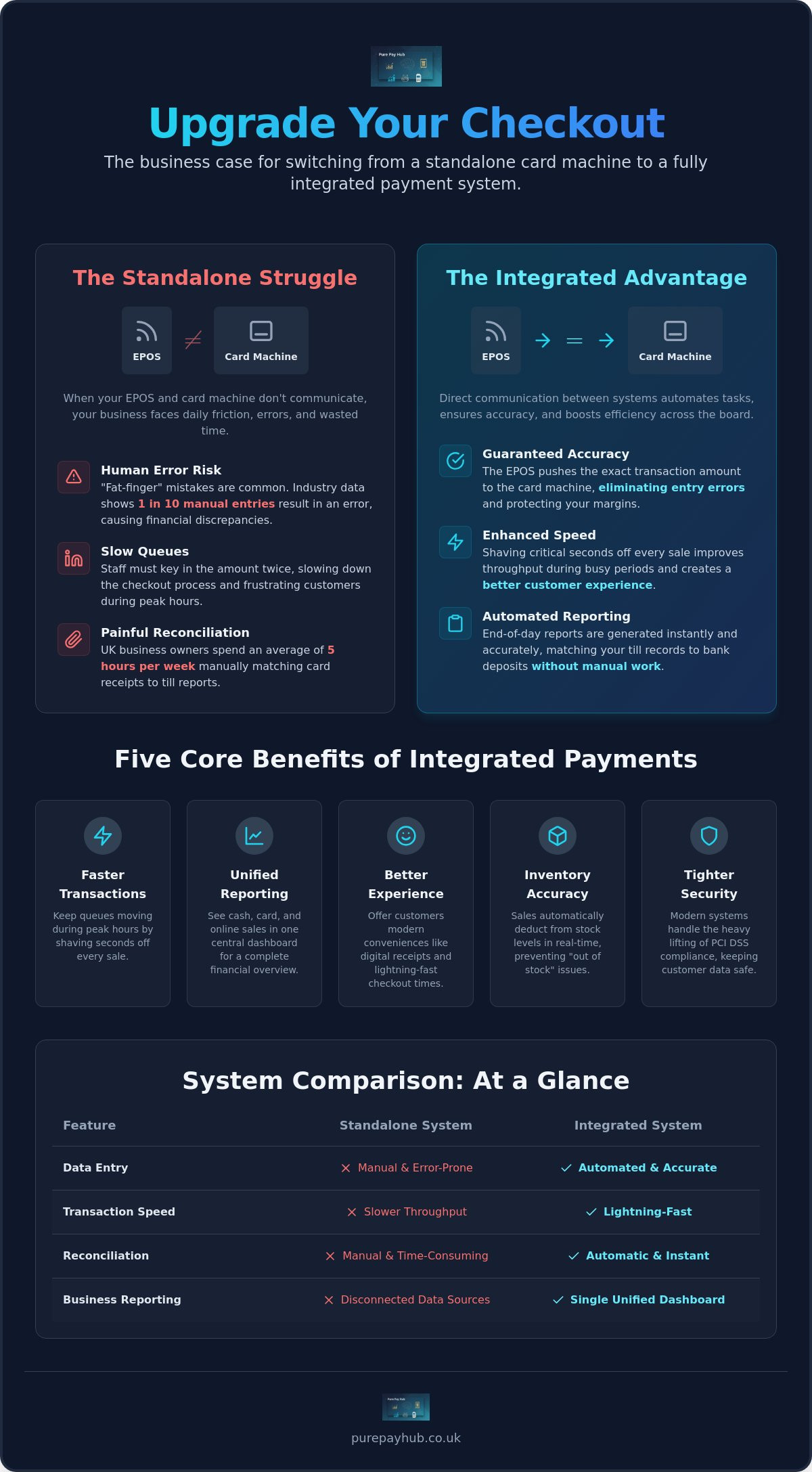
An integrated payment system is a setup where your card machine and EPOS (Electronic Point of Sale) communicate directly with each other. In a traditional “standalone” environment, these two pieces of hardware exist in isolation. You calculate the bill on the till, then manually type that amount into the card reader. This disconnect is the root of most checkout friction. Understanding what is a payment system in the modern sense means looking at how these components link together to form a single, efficient unit.
The shift towards integration has accelerated throughout 2026. UK consumers now expect a seamless experience. They have little patience for staff members who have to double-key figures whilst a queue builds up. One of the primary benefits of an integrated payment system is the total removal of this manual step. When your systems talk to each other, the transaction value is pushed automatically from the EPOS to the card machine. This creates a real-time flow of data that starts the moment a customer taps their card and ends with an accurate entry in your accounting software.
The “standalone” problem is more than just a minor inconvenience. Industry data suggests that manually typing amounts into a card reader leads to 1 in 10 entry errors. These mistakes might seem small at the moment, but they create a significant headache for your bookkeeping. Over a month of trading, these discrepancies add up. They lead to a messy set of records that is difficult and expensive to untangle. Integration solves this by ensuring the data is correct at the source.
The End of Manual Reconciliation
Reconciliation is the process of matching your internal sales records against your actual bank deposits to ensure every penny is accounted for. It is often the most dreaded part of the day for a merchant. UK business owners spend an average of five hours a week on this type of administrative work. An integrated system handles this automatically. It matches every penny spent to a specific sale in real time. This means your end-of-day reports actually match your till reports without you having to spend your evenings with a calculator.
Reducing Human Error at the Till
Human error is inevitable when staff are busy or tired. A simple “fat-finger” mistake, such as typing £10.00 instead of £100.00, can be devastating for your daily margins. Conversely, overcharging a customer by mistake damages your reputation and leads to awkward refund processes. Integration acts as a digital safety net. It prevents staff from accidentally undercharging or overcharging because the human element is removed from the data entry phase. For business owners who are not on-site every day, this provides essential peace of mind that every transaction is being handled with absolute precision.
5 Core Benefits of Integrating Your Payments
Moving beyond the basic reduction of errors, the true benefits of an integrated payment system lie in how it transforms your daily operations. Modern UK businesses require more than just a way to take money; they need a system that acts as a central hub for all activity. For those looking to future-proof their backend, Crypto Chief offers a unified infrastructure that can support advanced digital transactions. By linking your card machine to your EPOS, you create a unified environment where data flows freely and securely. This connection ensures that every part of your business is in sync from the moment a customer pays.
- Enhanced Transaction Speed: Shaving seconds off every sale keeps your staff focused on service rather than hardware.
- Unified Reporting: See your cash, card, and online sales in one central dashboard for a complete financial overview.
- Improved Customer Experience: Offer modern conveniences like digital receipts and lightning-fast checkout times.
- Inventory Accuracy: Sales automatically deduct from stock levels in real-time, preventing awkward “out of stock” conversations.
- Security and Compliance: Integrated systems often handle the heavy lifting of PCI DSS requirements, keeping your data safe.
A recent Bank for International Settlements report highlights that structural integration in payments reduces intermediaries and increases transparency. This isn’t just a technical upgrade. It’s a strategic move that lowers costs and enhances the quality of your business data. If you are looking to modernise your setup, you can explore our EPOS systems to see how these features work in practice.
Faster Throughput During Peak Times
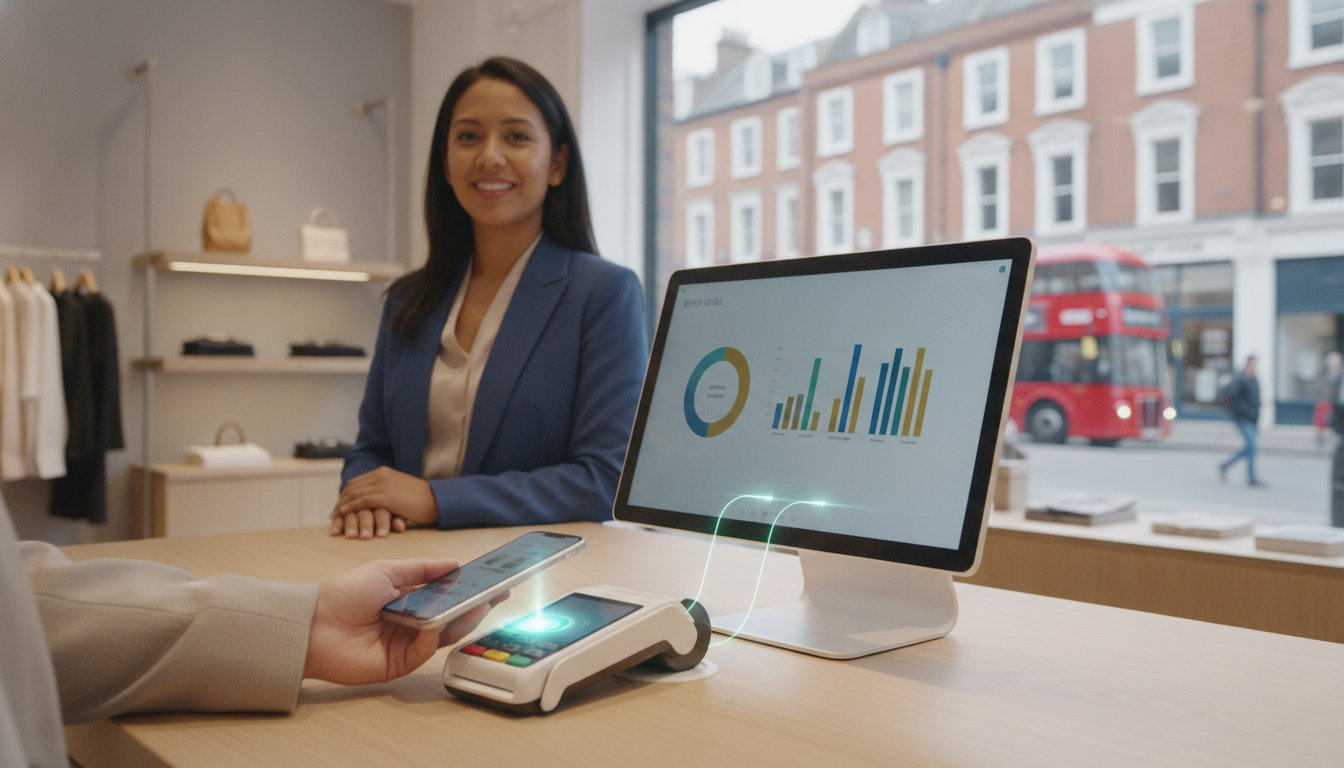
Hospitality and retail businesses in the UK cannot afford slow hardware, especially during a busy Saturday lunch rush or the Christmas period. The psychology of the queue is simple: long waits drive customers straight to your competitors. When your card machine is integrated, the “double-keying” delay disappears. Your staff tap a button on the till, and the card reader wakes up instantly with the correct amount. This efficiency allows you to serve more people in less time without increasing your staff headcount.
Better Data for Smarter Decisions
Integrated sales data allows you to identify your best-selling products with absolute certainty. You can see exactly which items are moving at what time of day, helping you optimise your staff rotas and stock orders. PurePay Hub’s reporting tools are designed to help you spot these trends before they happen. Instead of guessing which promotion worked, you have hard evidence. This clarity helps you make informed decisions that actually grow your profit margins rather than just maintaining the status quo.
Integrated vs Standalone: Which is Right for Your Business?
Choosing between a standalone card reader and a full EPOS system is a defining moment for any merchant. A standalone setup operates like a calculator; it takes a payment but doesn’t share that information with your records. This is often the starting point for micro-businesses with low volume and very simple needs. If you are a mobile trader processing just a few transactions a week, a basic reader might suffice. However, as your business grows, the limitations of this “disconnected” model quickly become a burden.
For established SMEs, hospitality venues, and multi-site retailers, an integrated system is the only logical choice. One of the greatest benefits of an integrated payment system is its ability to scale alongside you. When you open a second location or expand your product range, your technology should simplify that growth rather than complicate it. Managing multiple sites from a single, remote dashboard is only possible when your payments and sales data are unified.
Whilst integrated setups may involve higher initial hardware costs, the return on investment is significant. You aren’t just buying a card machine; you are buying back your time. A KPMG digital payments analysis suggests that digital integration is a key enabler of long-term growth, as it optimises working capital and improves cash flow visibility. By automating the data flow, you reduce the need for manual labour in your back office, allowing you to focus on high-value tasks instead of data entry.
The Hidden Costs of Standalone Systems
Standalone readers are often marketed as the “cheap” option, but they carry hidden costs that drain your profits. Mis-keying losses are a direct hit to your bottom line. If a staff member accidentally types £15 instead of £51, that money is simply gone. There is also the cost of staff time. Every minute spent fixing a mismatched end-of-day Z-report is a minute you are paying for admin that shouldn’t exist. Over a year, these small leaks can cost your business thousands of pounds in lost revenue and wasted wages.
When to Make the Switch
There are telltale signs that your business has outgrown its basic card reader. If you find yourself dreading the evening reconciliation or notice customers leaving because the queue is moving too slowly, it’s time to upgrade. Healthy cash flow is the lifeblood of any UK business, and next-day funding is a vital tool for maintaining it. PurePay Hub facilitates a smooth transition between providers, ensuring your new integrated system is up and running without disrupting your daily trade. We handle the technical setup so you can start seeing the results immediately.
Implementing an Integrated System: A Practical Roadmap
Transitioning to a connected setup shouldn’t be a source of stress. Whilst the technical side happens behind the scenes, you need a clear plan to ensure your business continues to trade smoothly. Moving from a standalone model to one where your hardware talks to each other is a straightforward process when you follow a logical roadmap. It is about moving away from the “messy” side of merchant services and into a state of informed confidence.
Step 1: Audit your current setup. Start by checking your existing hardware and software compatibility. Most modern EPOS Systems are built to integrate, but older legacy units might require a software bridge or a hardware upgrade. PurePay Hub provides direct support to help you identify exactly what you need without recommending unnecessary extras.
Step 2: Choose the right partner. This is the most critical stage. You need a merchant partner that offers transparent, low rates and a clear fee structure. Look for providers that offer debit card rates from 0.3% and avoid those that bury hidden costs in the small print. A fair partnership is built on honesty, not complex jargon.
Step 3: Plan your installation. Timing is everything. Schedule your switch during a quiet trading window to minimise any potential downtime. Most integrated systems are “plug and play,” meaning you can be up and running in a matter of minutes rather than hours. Testing the connection before your first customer arrives ensures a seamless experience from the start.
Step 4: Train your team. One of the hidden benefits of an integrated payment system is how much simpler it makes life for your staff. Because the system is intuitive and removes the need for manual data entry, training usually takes very little time. Your team will likely appreciate the reduced pressure during busy shifts.
Compatibility and Software Links
Ensuring your card machine works perfectly with your favourite EPOS software is essential. This connection is often managed by a Payment Gateway, which acts as the secure bridge between your offline sales and your digital records. If you are unsure about your current compatibility, you can contact us for a free setup audit to see how we can link your systems together.
Minimising Business Disruption
Choosing a provider with UK-based support is vital during the setup phase. If you have a question, you need an expert who understands the local merchant community. You should also ensure that “Next-Day Funding” is activated from day one. This prevents cash flow gaps and ensures that the money you take today is in your bank account tomorrow, keeping your business agile and responsive.
The PurePay Hub Advantage: Integration Meets Growth
Choosing a payment partner is about more than just hardware. It is about finding a fair ally that understands the pressure of running a regional business in the UK. At PurePay Hub, we take a distinct “no-nonsense” approach to merchant services. We don’t hide behind corporate jargon or complex fee structures that leave you guessing at your monthly costs. Instead, we offer transparent pricing with debit card rates from 0.3% and absolutely no hidden markups. This clarity is designed to build immediate trust and alleviate the stress often associated with financial processing.
Our service is a stabilizing force for your finances. We provide next-day access to funds as standard for all our integrated partners. You shouldn’t have to wait days to access the money you have already earned. By ensuring your cash flow remains fluid, we help you stay agile in a competitive market. One of the most impactful benefits of an integrated payment system is how it turns your daily transaction data into a roadmap for future expansion. When your records are accurate and unified, you can make bold decisions with total confidence.
This drive for financial agility is also transforming other sectors globally. For those with property interests in the UAE, you can check out Rentify to discover how their Rent Now, Pay Later solutions bring similar digital efficiency to the rental market.
Unlocking Capital Through Integrated Sales
Integrated data is a powerful asset that many traditional banks overlook. PurePay Hub uses your real-time sales information to unlock unsecured capital through our Business Cash Advance offering. Because your card machine and EPOS system are in sync, we have a clear, honest view of your turnover. This allows us to provide funding that is tailored to your actual performance rather than an arbitrary credit score. It is a modern solution for businesses that value growth but want to avoid the rigidity of traditional lending.
The repayment process is entirely effortless. Rather than facing a fixed monthly bill that might strain your resources during a quiet week, repayments are a fixed percentage of your daily card sales. You only pay back the advance when you are actually trading. A Merchant Cash Advance provides a flexible alternative to bank loans because the repayment schedule naturally mirrors your business’s rhythm. If your sales are high, you pay back more; if things are slow, your repayments automatically reduce to match your pace.
Reliable UK Support When You Need It
We pride ourselves on being a local expert that acts as a supportive business partner. Our team understands the specific needs of the UK merchant community, from small high-street shops to busy hospitality venues. We are committed to fairness and disciplined service, showing a clear disdain for the opaque practices found elsewhere in the industry. You deserve a partner that prioritises your efficiency and provides straight-talking advice whenever you have a question. Our goal is to lead you away from frustration and toward a state of informed confidence.
Ready to modernise your checkout and unlock your business’s full potential? Organise your integrated payment system with PurePay Hub today and experience a fairer way to manage your merchant services.
Modernise Your Merchant Services Today
Updating your technology is about reclaiming your time and protecting your profit. You’ve seen how removing manual data entry stops costly “fat-finger” mistakes and keeps your checkout moving during the busiest hours. A connected setup doesn’t just simplify your admin; it acts as a stabilising force for your entire business. By embracing the benefits of an integrated payment system, you gain the clarity needed to make smarter decisions whilst ensuring your records are always accurate.
PurePay Hub is here to act as your supportive business partner. We offer a fair, no-nonsense service with debit card rates starting from just 0.3%. You can enjoy next-day access to your funds for better cash flow and apply for Business Cash Advances based on your future card turnover. This is merchant services built on honesty and integrity rather than hidden costs. It’s time to leave the messy side of finance behind and move forward with a partner that values your growth.
Switch to a fairer, integrated payment partner today and start growing your business with confidence. We look forward to helping you build a more efficient, profitable future.
Frequently Asked Questions
What is the difference between integrated and non-integrated payments?
Integrated payments involve a direct digital link between your EPOS system and your card machine. In a non-integrated or “standalone” setup, these two devices don’t communicate; you have to manually type the sale amount into the card reader. This manual step is the primary cause of bookkeeping errors and slows down your service during busy periods.
Do I need a specific type of internet connection for integrated payments?
A stable, standard broadband connection via Wi-Fi or Ethernet is usually all you need. Whilst you don’t require ultra-fast speeds for individual transactions, a reliable connection ensures that data flows between your till and terminal without interruption. Many UK merchants also use a 4G or 5G backup to keep their systems running if their main line goes down.
How much does it cost to switch to an integrated EPOS system?
The cost of switching varies based on your specific hardware needs and the size of your business. Whilst there is an initial investment for professional EPOS Systems, the return on investment comes from saved labour and the total removal of manual entry mistakes. We prioritise a fair, transparent fee model that avoids the hidden costs often found with traditional bank providers.
Can I use my existing card machine with a new integrated software?
Compatibility depends entirely on the make and model of your current hardware. Some card machines are “locked” to specific providers and won’t talk to third-party software. We recommend a quick audit of your existing equipment to see if it can be repurposed; this ensures you don’t spend money on new hardware unless it is strictly necessary for your growth.
What happens if my EPOS system goes offline during a sale?
Most modern integrated systems feature an “offline mode” that allows you to continue taking payments during a temporary network outage. The transaction data is stored securely on the encrypted device and synchronised with your central records as soon as the connection is restored. This prevents lost revenue and ensures your business stays operational even during local technical issues.
How does integration help with PCI compliance?
Integration simplifies your security requirements by ensuring sensitive cardholder data never actually enters your EPOS software. The payment is handled in a separate, secure environment, which significantly reduces the scope of your annual PCI DSS assessment. It is one of the most important security benefits of an integrated payment system for any business that values customer trust and data integrity.
Is next-day funding available for all integrated transactions?
Next-day funding is a standard feature for all merchants who choose PurePay Hub for their integrated setup. This ensures that the money you take today is in your bank account the following working day, regardless of your transaction volume. It is a vital tool for maintaining healthy cash flow and gives you immediate access to your revenue for stock orders or daily expenses.
How long does it take to set up an integrated payment system?
A typical setup takes between three to five working days once your hardware has been delivered to your site. The physical installation is designed to be “plug and play,” meaning you can often be up and running within an hour. This rapid deployment is one of the practical benefits of an integrated payment system, allowing you to modernise your checkout with almost zero disruption to your trade.