
Tag: SME Advice

  • How to Improve Business Cash Flow: 2026 UK Guide

    How to Improve Business Cash Flow: 2026 UK Guide

    Did you know that 82% of UK SMEs have faced cash flow difficulties as of March 2026? It is a staggering figure that highlights a common frustration: doing the hard work but waiting far too long to see the money in your bank account. You are likely tired of slow settlement times from card providers and the drain of high transaction costs on your margins. We understand that liquidity isn’t just a line on a spreadsheet; it’s the lifeblood of your daily operations.

    This guide will show you how to improve business cash flow uk wide by mastering practical strategies and modern tools designed for the current economic climate. You’ll learn how to accelerate your revenue through next-day funding and use the latest Small Business Protections Bill to tackle late payments. We’ll also provide a clear plan for managing seasonal dips and lowering your monthly overheads. By the end of this article, you’ll have a decisive roadmap to secure your liquidity and keep your business moving forward with confidence.

    Key Takeaways

    • Learn why liquidity has become the primary survival metric for 2026 and how to prioritise it over simple turnover figures.
    • Implement a 13-week rolling forecast to identify seasonal patterns and financial “danger zones” before they impact your daily operations.
    • Discover how to improve business cash flow uk wide by moving away from slow, outdated settlement cycles toward modern payment technology.
    • Manage your outflows more effectively by negotiating stronger supplier terms and avoiding the “inventory trap” that ties up your capital.
    • Understand how next-day funding acts as a vital cash flow accelerator, ensuring your earned revenue is available for immediate use.

    What is Business Cash Flow and Why Does it Matter in 2026?

    Cash flow is the literal movement of money into and out of your business bank account. Unlike profit, which is an accounting figure representing what you have earned on paper, cash flow tells you if you can actually pay your bills today. Professional analysts define What is Business Cash Flow through three distinct categories: operational, investing, and financing. Operational flow covers your daily trading activity; investing involves buying or selling assets like equipment; and financing relates to loans or capital injections. In the current climate, your ability to manage these movements determines whether you stay afloat or sink.

    Many owners focus exclusively on their Profit and Loss statement, but a healthy P&L can be a dangerous mask. You might show a £50,000 profit for the quarter, but if that money is trapped in unpaid invoices whilst your suppliers demand immediate payment, you are facing a crisis. Understanding how to improve business cash flow uk businesses need to look beyond the top line and focus on the speed of their settlement cycles. Liquidity is the only metric that guarantees you can meet payroll and settle your tax liabilities on time.

    The 2026 UK Economic Context

    The UK economy in 2026 presents unique hurdles for small and medium enterprises. With the Bank of England base rate at 3.75%, the cost of traditional borrowing remains a significant burden for those relying on overdrafts or credit lines. Recent data from March 2026 reveals that 82% of UK SMEs have faced cash flow difficulties, highlighting a systemic struggle with liquidity across the country. Additionally, HMRC’s Making Tax Digital requirements now demand more frequent reporting, which has forced many owners to gain better visibility of their books, even as they struggle with the 7.75% late payment interest rate imposed by the tax office.

    Cash Flow vs Profitability

    The timing gap is the most common killer of otherwise successful firms. This is the delay between you delivering a service and the client finally paying the invoice. If you operate in a B2B environment, you might face 30, 60, or even 90-day terms. During this wait, you still have to pay rent, wages, and transaction fees. This often leads to the growth trap; a scenario where winning a huge new contract actually drains your cash because you must hire staff or buy stock before the first payment arrives. Success is expensive, and without a clear plan on how to improve business cash flow uk companies often find themselves “profitable” but insolvent.

    Strategic Forecasting: How to Predict Your Financial Future

    Forecasting is not just a task for corporate accountants. A 13-week rolling cash flow forecast is the most effective tool for any small business owner. It breaks the year into manageable quarters, allowing you to identify seasonal dips and financial “danger zones” before they arrive. If you want to know how to improve business cash flow uk specialists recommend looking at your bank balance three months ahead. This foresight gives you the time to adjust your spending or accelerate your invoicing before a shortfall occurs.

    Scenario planning acts as your financial safety net. You should regularly ask yourself “what if” questions. What happens if your main supplier raises prices by 10%? What if your utility bills spike during the winter months? By running these models, you can determine the exact size of the buffer fund you need to stay secure. A rainy day fund is no longer a luxury. With the Bank of England base rate sitting at 3.75% as of July 2026, emergency borrowing is expensive. Aiming for a cash reserve that covers at least three months of operating costs provides the stability your business deserves.

    Tools for Accurate Forecasting

    Ditch the manual spreadsheets. They are prone to human error and are often out of date before you even finish them. Modern EPOS systems provide real-time sales data that integrates directly with cloud accounting software. This automation gives you a live view of your cash position. When your bank feed, card machine data, and accounting software talk to each other, you gain a level of clarity that manual entry simply cannot match. It allows you to spend less time on data entry and more time on strategic growth.

    Managing Trade Debtors

    Late payments are a significant drain on UK liquidity. In 2025, 90% of companies experienced late payments, and the average small business is currently owed around £22,000 in overdue invoices. You must implement a strict credit control programme to combat this. Don’t feel pressured to offer 30-day terms if your business cannot support the wait. Moving to Net 7 or even payment upon receipt is a valid way how to improve business cash flow uk wide. Automated reminders take the emotion out of chasing money. They ensure your clients understand that you are a principled partner who values prompt settlement.

    Accelerating Inflows: Getting Paid Faster in the UK

    Earning revenue is only half the battle. Accessing it is what keeps your business alive. For too long, UK merchants have accepted T+3 settlement cycles as the industry standard. This means waiting three working days for your card sales to reach your bank account. In a fast-moving economy, this delay is more than a nuisance; it’s a structural weakness that drains your liquidity. If you take a large payment on a Friday, you shouldn’t have to wait until Wednesday to use those funds.

    Digital-first payment methods are no longer optional. They are the primary way how to improve business cash flow uk businesses can regain control. By reducing the friction at the point of sale, you increase transaction volume and ensure that every interaction leads to a successful payment. Moving away from cash and slow-clearing cheques is the first step toward a more responsive financial model. You need systems that prioritise speed and transparency over traditional banking bureaucracy.

    The Power of Next-Day Funding

    Next-day funding acts as a vital cash flow accelerator for your operations. If you trade heavily over a weekend, receiving those funds on Monday instead of Wednesday completely changes your ability to restock or meet Monday payroll. Switching from a three-day to a one-day settlement cycle effectively gives your business two extra days of liquidity every single week. When you compare payment providers, you should look at their funding speed as closely as their rates. A slightly lower fee is worthless if your money is trapped in a clearing system when you need it most.

    Modern Payment Solutions

    Technology now allows you to collect payments remotely and instantly, bypassing the need for a physical presence. These tools are designed to fit the way modern customers prefer to pay, which naturally speeds up your inflows.

    • Payment Links: These allow you to secure deposits or full payments via a simple URL sent through email or SMS. It’s an ideal way to ensure you aren’t out of pocket before work begins.
    • Virtual Terminals: These turn your computer or tablet into a card machine, allowing you to take secure telephone orders without expensive hardware.
    • Portable Card Machines: High-performance mobile devices reduce queue times in retail and hospitality. Faster service means more transactions per hour and a healthier bottom line.

    Integrating these tools into your daily routine is a practical way how to improve business cash flow uk owners can see immediate results. You don’t need to wait for a better economic cycle to see an improvement in your bank balance. You simply need to upgrade the infrastructure that handles your earned revenue to ensure it moves at the same pace as your business.

    Optimising Outflows and Bridging the Funding Gap

    Controlling the money leaving your business is just as vital as accelerating what comes in. When exploring how to improve business cash flow uk, many owners forget to audit their own spending habits. Start with your suppliers. Negotiating a move from 30-day to 45 or 60-day terms provides an immediate liquidity boost. It gives you more time to convert your stock or services into cash before the bill falls due. You should also be wary of the “Inventory Trap”. Excess stock sitting in a warehouse is simply dead capital that could be better used for marketing or payroll. Keep your inventory lean and responsive to actual demand.

    Strategic financing can bridge temporary gaps without depleting your hard-earned reserves. However, traditional debt can be a double-edged sword. With the Bank of England base rate at 3.75% as of July 2026, the cost of a standard bank loan is significant. These loans often come with rigid monthly repayments that don’t account for the natural ebbs and flows of your trade. If you have a quiet month, a fixed loan payment can quickly become a burden that threatens your stability.

    The Business Cash Advance Advantage

    A Business Cash Advance offers a more flexible alternative to traditional lending. Unlike a bank loan, there are no fixed monthly payments. Instead, you repay the advance through a small, agreed percentage of your future card sales. This creates a natural “safety valve” for your business. When trade is booming, you repay faster; when things slow down, your repayments reduce automatically. It’s an unsecured form of capital, meaning you don’t need to put your home or business assets at risk. This makes it an ideal tool for managing seasonal stock purchases or funding a sudden repair without the stress of a fixed debt schedule.

    Reducing Fixed Overheads

    Hidden costs are the silent killers of liquidity. You must regularly audit your merchant service charges for opaque markups and “junk” fees that many traditional providers slip into their monthly statements. These small, recurring costs eat into your margins over time. Switching to a provider with transparent pricing and an integrated EPOS system can drastically reduce these leaks. Integrated systems also cut down on manual admin costs, as your sales data flows directly into your accounts without the need for time-consuming data entry. If you want to see exactly where you can save, you can check our fair card machine rates to ensure you aren’t paying more than you should. By tightening these outflows, you ensure more of your revenue stays where it belongs: in your bank account.

    Modernising Your Infrastructure with PurePay Hub

    Many traditional banks and payment providers focus on cutting your operating costs whilst ignoring the “cost of taking money”. High merchant fees and hidden markups are silent drains on your liquidity. We take a different approach. PurePay Hub provides transparent pricing with debit rates from 0.3% and credit card rates from 0.5%. By stripping away the murky fee structures used by competitors, we ensure more of your hard-earned revenue stays within your business. This clarity is essential for anyone looking at how to improve business cash flow uk wide.

    Speed is our standard. We provide next-day access to your funds as a core feature, not a premium add-on. This removes the T+3 settlement bottleneck that hampers so many UK SMEs. When your card machine data syncs seamlessly with your hospitality or retail EPOS system, your entire financial infrastructure becomes more efficient. You gain real-time visibility and faster access to capital. Our onboarding process is designed to be no-nonsense and straightforward, supported by expert UK-based professionals who understand the local merchant community.

    A Partner, Not Just a Provider

    We position ourselves as a supportive ally to your business. PurePay Hub organises your payment processing to maximise your daily liquidity. You won’t be left to deal with a distant call centre. Instead, you benefit from a dedicated merchant account manager who understands your specific industry challenges. If you need to bridge a seasonal gap or fund an expansion, we facilitate flexible funding via our Business Cash Advance. This allows you to access capital that you repay only as you make sales, providing a stabilising force for your finances during quieter periods.

    Taking the Next Step

    Switching your payment provider shouldn’t be a headache. We help you navigate the transition without the worry of hidden exit fees from your current contract. Our team can perform a free, transparent audit of your existing processing statements to identify exactly where you are losing money to unnecessary markups. It is a simple, effective way to see how to improve business cash flow uk for your specific circumstances. You deserve a partner that values fairness and straight-talking over corporate jargon.

    Join PurePay Hub and accelerate your cash flow today. Take control of your revenue and secure the liquidity your business needs to thrive in 2026.

    Securing Your Financial Stability for the Years Ahead

    Managing liquidity requires a dual approach of sharp forecasting and modern technology. You’ve seen how a rolling forecast and tighter credit control can prevent shortfalls before they occur. However, the most immediate impact comes from shortening the distance between a customer’s payment and the funds arriving in your bank account. It’s time to move beyond paper profits and focus on the real-time health of your bank balance.

    Mastering how to improve business cash flow uk wide isn’t just about cutting costs; it’s about building a responsive infrastructure that supports your growth. By choosing a partner that prioritises transparency and speed, you remove the friction that traditionally stalls SME development. We are here to act as your supportive business ally with expert UK-based support and a no-nonsense onboarding process.

    Switch to PurePay Hub for 0.3% rates and next-day funding to reclaim control of your earned revenue. With next-day access to your funds as standard and debit rates starting from 0.3%, you can focus on what you do best whilst we ensure your liquidity remains robust. You have the tools and the plan; now it’s time to put them into action with confidence.

    Frequently Asked Questions

    What is the most effective way to improve cash flow quickly?

    The fastest method is to accelerate your receivables by switching to next-day settlement for card payments. Many traditional providers hold your funds for up to three days, which creates a needless delay. By accessing your earned revenue within 24 hours, you gain immediate liquidity to pay suppliers or staff. Combining this with shorter invoice terms for B2B clients ensures that cash enters your account at the same pace as your sales.

    How does a Business Cash Advance help with seasonal cash flow?

    A Business Cash Advance provides flexible capital that you repay as a small percentage of your future card sales. This is particularly helpful for seasonal businesses because your repayments automatically decrease during quieter months. Unlike a traditional bank loan with fixed monthly costs, this model scales with your trade. It acts as a financial buffer, allowing you to buy stock or cover overheads without the pressure of a rigid debt schedule.

    Why is my business making a profit but I have no cash in the bank?

    Profit is an accounting figure that records revenue when an invoice is raised, but cash flow only tracks when money actually arrives. You might have thousands of pounds in paper profit whilst your bank account remains empty because of unpaid invoices or high stock levels. This timing gap is a primary reason why owners seek advice on how to improve business cash flow uk wide. Success often requires upfront spending that drains your liquidity before the customer pays.

    What are the typical card machine rates for small businesses in the UK?

    Card processing fees vary significantly between providers, but you should look for transparent models without hidden markups. We offer debit card rates starting from 0.3% and credit card rates from 0.5%. Many traditional banks bundle fees into complex structures that make it difficult to see what you are actually paying. Always audit your monthly statements to identify junk fees or extra charges that eat into your margins.

    Can I get my card machine payments settled the next day?

    Yes, next-day settlement is available and should be considered a standard requirement for modern businesses. Whilst some older systems still rely on three-day clearing cycles, our infrastructure ensures you have access to your funds on the next working day. This rapid settlement prevents your revenue from being trapped in the banking system. It allows you to maintain a steady flow of capital to meet your daily operational needs without delay.

    What is the difference between cash flow and liquidity?

    Cash flow is the movement of money into and out of your business over a specific period. Liquidity refers to your overall ability to meet immediate financial obligations using cash or assets that can be quickly converted. High liquidity means you have the ready money to handle emergencies or sudden opportunities. Understanding the relationship between these two metrics is vital for maintaining a resilient and stable business in the current economic climate.

    How does an integrated EPOS system help manage business finances?

    An integrated EPOS system connects your sales directly to your accounting software and merchant account. This automation removes the need for manual data entry and reduces the risk of human error. It provides a real-time view of your sales performance and stock levels, allowing for more accurate forecasting. When your hardware and software work together, you spend less time on administration and more time on strategic growth.

    What should I do if my cash flow forecast shows a negative balance?

    You must act immediately to bridge the gap if your forecast predicts a shortfall. Start by chasing overdue invoices or offering small discounts for early settlement. Review your upcoming outflows and negotiate longer terms with suppliers to keep cash in the bank. If the gap is significant, consider a flexible funding option like a Business Cash Advance. This proactive approach is a key part of how to improve business cash flow uk businesses use to survive seasonal dips.

  • 5 Strategic Knowledge Gaps to Fill for Business Growth

    5 Strategic Knowledge Gaps to Fill for Business Growth

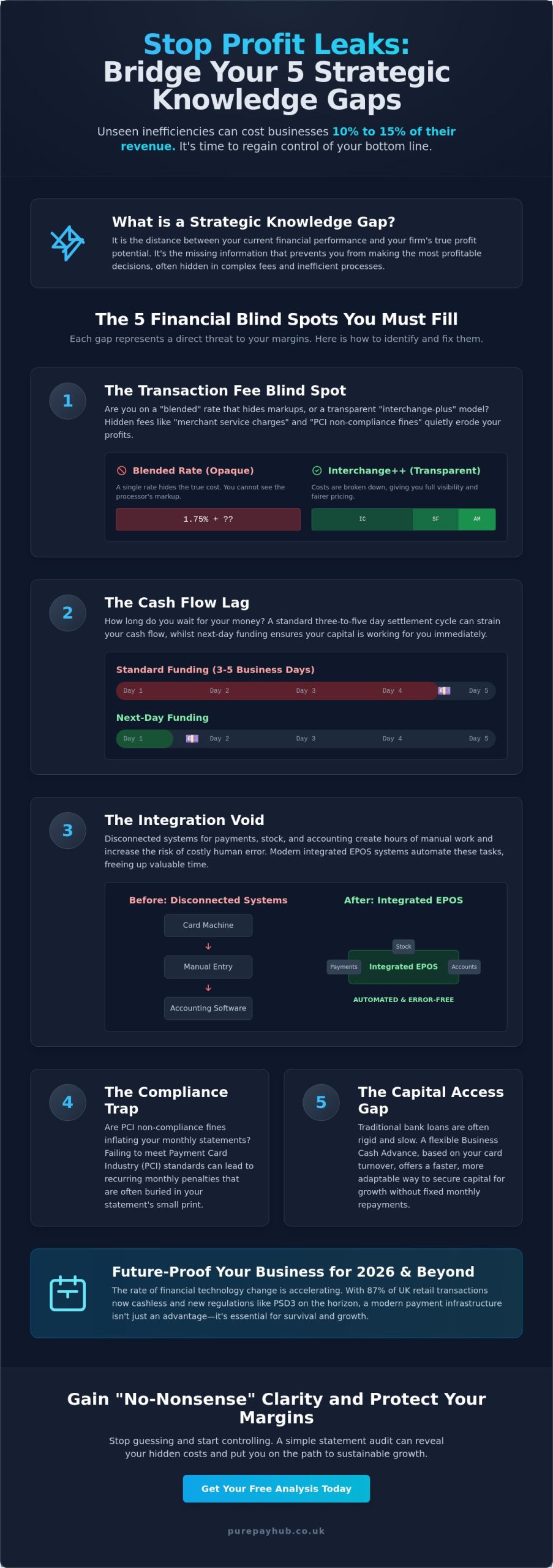
    Businesses that lack clear visibility into their profit margins by product or customer can lose approximately 10% to 15% of their revenue. It’s a staggering figure, yet many regional business owners still struggle with opaque financial terminology and rising operational costs that feel out of their control. You might often feel like your competitors have access to better rates or more advanced tools. Here are 5 strategic knowledge gaps you can fill to stop the profit leaks and regain control over your bottom line.

    We understand the frustration of seeing your hard-earned margins squeezed by hidden markups and complex fee structures. It’s exhausting to manage daily operations whilst wondering if your payment infrastructure is actually working against you. PurePay Hub is here to act as your supportive business ally, showing you how to identify these critical blind spots to protect your margins and accelerate your business growth. We will explore clear, actionable areas for improvement, from mastering your transaction data to preparing for 2026 payment regulations, ensuring your cash flow remains steady and your overheads stay low. By the end of this guide, you will have a transparent roadmap to move from financial uncertainty toward a state of informed confidence.

    Key Takeaways

    • Understand that a strategic knowledge gap is the distance between your current financial performance and your business’s actual profit potential.
    • Here are 5 strategic knowledge gaps you can fill to protect your margins, focusing on invisible fee structures and cash flow inefficiencies.
    • Learn how to conduct a rigorous Statement Audit to identify hidden costs and evaluate your Funding Velocity to ensure quicker access to your capital.
    • Discover how modern payment infrastructure, such as integrated EPOS Systems, can automate manual processes and reclaim lost time.
    • Find out how to align with a supportive partner to gain the “no-nonsense” clarity required for long-term, sustainable business growth.

    What is a Strategic Knowledge Gap in a Business Context?

    In simple terms, a strategic knowledge gap represents the distance between your company’s current financial performance and its true profit potential. Whilst many owners focus on increasing sales, they often overlook the internal inefficiencies that quietly drain their bank accounts. What is a Strategic Knowledge Gap in a Business Context? It is essentially the missing information that prevents you from making the most profitable decisions for your firm’s future. Here are 5 strategic knowledge gaps you can fill to transform your business from a reactive operation into a proactive market leader.

    These gaps often remain invisible because you’re busy with the daily grind of serving customers and managing staff. Traditional banking institutions often thrive on this lack of clarity, using complex jargon to hide the true cost of their services. It’s vital to distinguish between “soft skill” gaps, like leadership styles, and “strategic financial” gaps that directly impact your margins. A soft skill gap might slow down a meeting; a financial knowledge gap can cost you thousands in unnecessary transaction fees every single month.

    As of June 2026, the “half-life” of financial technology knowledge is shorter than ever. With 87% of UK retail transactions now being cashless, what worked in 2024 is likely obsolete today. New regulations like PSD3 and the mandatory shift to structured payment addresses mean that yesterday’s “good enough” setup is now a liability. Staying stagnant isn’t just a choice; it’s a risk to your business’s survival.

    The Cost of “Not Knowing” in the UK Market

    Unaddressed knowledge gaps lead to a significant loss of competitiveness amongst UK SMEs. When you don’t understand the true mechanics of your overheads, you cannot price your services effectively or negotiate better terms with suppliers. Honesty in auditing your own level of expertise is the first step toward building better vendor partnerships. A strategic knowledge gap is a measurable barrier to revenue growth.

    Why Traditional “Team Training” Isn’t the Only Answer

    Not every gap requires a classroom or a seminar. In the modern fintech world, some gaps are best filled by better systems rather than just more training. We call this “systemic knowledge,” where your hardware, such as advanced EPOS Systems, does the heavy lifting for you. This creates a bridge between your internal expertise and external strategic awareness, allowing you to focus on growth whilst your infrastructure manages the technicalities of payment processing and cash flow security.

    The 5 Strategic Knowledge Gaps You Must Fill to Scale

    Scaling a business isn’t just about hiring more people or increasing your marketing budget. It’s about fixing the leaks in your bucket before you pour more water in. Here are 5 strategic knowledge gaps you can fill to ensure your infrastructure supports your growth rather than hindering it. These aren’t HR issues; they are financial blind spots that directly affect your bottom line. Learning How to Identify Your Business’s Financial Blind Spots often starts with looking at your outgoing payments and incoming settlements.

    • The Transaction Fee Blind Spot: Understanding if you are on a “blended” rate or an “interchange-plus” model.
    • The Cash Flow Lag: Knowing how next-day funding compares to standard three-to-five day cycles.
    • The Integration Void: Recognising the cost of non-integrated systems in terms of staff labour and manual entry errors.
    • The Compliance Trap: Identifying the impact of PCI non-compliance fines that quietly inflate your monthly statements.
    • The Capital Access Gap: Differentiating between rigid bank loans and flexible Business Cash Advances.

    Deep Dive: The Transaction Fee Blind Spot

    Hidden markups are the enemy of profit. A headline rate of 0.3% for debit cards sounds excellent. However, this can be undermined by “merchant service charges” and “minimum monthly fees” tucked away in the small print. Transparent pricing is a strategic advantage because it allows you to forecast your costs with total precision. To find the truth, grab your latest statement and look for these items:

    • PCI Non-Compliance fees (usually around £30 per month).
    • Minimum Monthly Service Charge (MMSC).
    • Authorisation fees hidden inside a “blended” rate.

    Deep Dive: The Integration Void

    In a busy UK hospitality environment, manual entry is a recipe for disaster. It leads to “leakage” where staff enter the wrong amount or forget to record a sale entirely. Integrated EPOS Systems ensure your till and card terminal speak the same language. This setup reduces errors and speeds up the checkout process. It turns a clunky manual task into a seamless experience for both your team and your customers. Filling this gap doesn’t just save money; it saves time and reduces staff stress during peak hours. When your hardware does the thinking, your team can focus on service.

    5 Strategic Knowledge Gaps to Fill for Business Growth

    How to Identify Your Business’s Financial Blind Spots

    Identification is the first step toward recovery. You can’t fix what you haven’t measured. Here are 5 strategic knowledge gaps you can fill by starting with a rigorous look at your current financial setup. Most business owners avoid their merchant statements because they’re intentionally designed to be confusing. It’s time to cut through the noise and look at the hard data. You need to know exactly where your money is going before it ever reaches your business account.

    Start with a Statement Audit. Open your last three statements and look past the headline rate. Are you paying “minimum monthly service charges” or “non-compliance fees”? These are often avoidable costs that traditional banks hope you won’t notice. Next, evaluate your Funding Velocity. Check your bank records to see how long it takes for your card takings to clear. If your money takes three to five days to arrive, your provider is holding onto your capital whilst you wait to pay suppliers. In 2026, next-day funding should be your baseline for healthy cash flow management.

    Assess your Hardware Friction by observing your staff during peak hours. Do they have to restart the terminal frequently? Does the battery on your Portable Card Machine die mid-shift? This friction costs you customer goodwill and reduces your total turnover. Finally, review your Compliance Health. If you see a £30 “PCI fee” on your statement every month, you’re paying a fine for a gap in your paperwork. It’s a simple fix that puts money back in your pocket immediately without requiring a single extra sale.

    The 10-Minute Financial Health Check

    Clarity beats corporate jargon every time. You can organise your financial priorities by looking at your costs objectively. Compare your current credit card processing rate, which might be as high as 1.5%, against the 0.5% industry standard for credit cards. If there’s a 1% difference, you’re essentially giving away a portion of your margin for no reason. This check isn’t about being an accountant; it’s about being a disciplined owner who values transparency and fairness.

    Analysing Customer Behaviour and Payment Preferences

    Your customers’ habits have changed rapidly over the last two years. If you don’t offer Payment Links for remote orders or Virtual Terminals for phone payments, you’re creating a barrier to sale. Failing to support favourite methods like NFC or digital wallets is a significant knowledge gap that directly affects your conversion rates. Modern customers expect a frictionless checkout experience that matches their digital lifestyle. Meeting these expectations is a strategic necessity. If your current setup doesn’t support these tools, you’re likely losing sales to competitors who have already modernised their payment infrastructure.

    Closing the Gap: Implementing Modern Payment Infrastructure

    Technology isn’t just a tool; it’s a bridge. Some industry voices suggest that closing skills gaps is an impossible task that requires years of intensive training. We disagree. Here are 5 strategic knowledge gaps you can fill simply by upgrading the infrastructure that handles your daily transactions. By moving from manual entry to automated systems, you eliminate the human error that leads to financial blind spots. Modern fintech solutions allow your hardware to do the heavy lifting, ensuring your data remains accurate and your margins stay protected.

    Cash flow is the lifeblood of any UK business. If you are currently waiting several days for your funds to clear, you have a systemic gap in your liquidity that is entirely avoidable. Switching to a provider that offers next-day access to funds solves this problem instantly. It allows you to pay suppliers promptly and manage your stock levels with greater agility. This isn’t just a convenience; it is a strategic move that keeps your capital working for you rather than sitting in a bank’s clearing system.

    Expansion also requires mobility. Portable Card Machines and Mobile Card Machines allow your staff to take payments at the table, on the shop floor, or even on the road. This expands your service area without the need for fixed, expensive infrastructure. It turns every customer interaction into a potential point of sale, ensuring you never miss a transaction due to technical limitations.

    The Power of Integrated EPOS Systems

    Integrated systems centre all your business data in one place. In the retail and hospitality sectors, this means your inventory levels, staff performance, and sales data are always in sync. You no longer need to guess which products are your most profitable or which hours are your busiest. This efficiency gain allows you to make decisions based on real-time facts rather than gut feeling. Next-day funding should be a standard expectation in this environment. It’s a foundational requirement for any modern, competitive business that values its time as much as its profit.

    Leveraging Business Cash Advances for Growth

    Traditional high-street bank loans often come with murky structures and rigid monthly repayments. This can be dangerous for seasonal businesses that experience fluctuating turnover. A Business Cash Advance offers a fairer, more transparent alternative. You receive unsecured capital up-front and repay it through a fixed percentage of your daily card sales. This means if you have a quiet day, your repayment is naturally smaller. It’s a disciplined way to bridge seasonal gaps or fund a new project without the stress of fixed debt obligations hanging over your head.

    Ready to modernise your setup? Get started with PurePay Hub today to fill your strategic gaps with transparent, reliable payment solutions.

    How PurePay Hub Bridges Your Strategic Knowledge Gaps

    PurePay Hub acts as the bridge between your current financial frustration and future clarity. We provide the no-nonsense partnership that regional business owners have been missing for far too long. Identifying a problem is the first step, but solving it requires the right tools and a partner who advocates for your success. Here are 5 strategic knowledge gaps you can fill by aligning with a provider that values transparency as much as you do. We aim to move you from a state of uncertainty to being fully operational with a modern setup within a matter of days.

    Our approach centres on fairness and discipline. We believe that a 0.3% debit rate and a 0.5% credit rate should be the benchmark for a “filled” fee gap. Unlike traditional institutions that hide behind complex terminology, we prioritise your bottom line. We also provide dedicated merchant account management to ensure your business stays on top of PCI compliance. This active support prevents those avoidable monthly fines from creeping back into your statements, allowing you to focus on growth whilst we manage the technicalities of security.

    The transition process is designed for speed and simplicity because we know you don’t have weeks to wait for new hardware. Our onboarding is streamlined to get your new EPOS Systems or card terminals running quickly. Once you are live, our team takes over the heavy lifting of compliance and transaction routing. This provides a stabilising force for your finances, turning your payment infrastructure into a reliable engine for development rather than a source of stress.

    Transparent Rates, No Hidden Markups

    Trust is built through honesty and clear communication. PurePay Hub is proud to be untainted by hidden markups, providing you with monthly reporting statements that actually make sense to a busy owner. We break down every transaction so you can see your true costs without the corporate jargon. This level of clarity allows you to reclaim your margins and reinvest in your firm’s future. Organise a free statement audit with PurePay Hub today to see exactly where your current provider is letting you down.

    Your Partner in National Business Growth

    We position ourselves as a supportive ally rather than a distant financial institution. Whether you need a Countertop Card Machine for a fixed till point or a Mobile Card Machine for taking payments on the move, we have the hardware to suit your specific business model. Our goal is to provide the steady promise of better, fairer service that helps you scale with confidence. Explore our card machine solutions and close your knowledge gaps to start your journey toward informed financial confidence today.

    Secure Your Business Future with Financial Clarity

    Identifying blind spots is only the first step toward reclaiming your profit. You now understand how a rigorous Statement Audit reveals hidden markups and how integrated EPOS systems prevent costly manual errors. Here are 5 strategic knowledge gaps you can fill to ensure your margins remain protected whilst your competitors struggle with outdated, opaque fee structures. By prioritising transparency and modern infrastructure, you turn your payment setup from a necessary cost into a powerful growth engine.

    It’s time to stop the profit leaks and demand a fairer deal for your business. Switch to PurePay Hub and start saving on your card processing fees today. You’ll benefit from debit card rates starting from 0.3%, next-day access to funds, and the no-nonsense transparent pricing your firm deserves. Taking control of your financial data is the most impactful move you can make for your business this year. We’re ready to help you build a more profitable, dependable future.

    Frequently Asked Questions

    What exactly is a strategic knowledge gap in a small business?

    It is the measurable difference between your current operational performance and your maximum profit potential. In a payment context, it’s often a lack of awareness regarding hidden processing costs or inefficient cash flow cycles that drain your margins. Here are 5 strategic knowledge gaps you can fill to bridge this distance and ensure your infrastructure supports your scaling ambitions rather than hindering them.

    How can I tell if I am paying too much for my card machine processing?

    You should compare your total monthly fees against your total card turnover to calculate your “effective rate”. If this percentage is significantly higher than the headline rates you were originally promised, you are likely being hit by hidden markups or minimum monthly charges. A honest statement audit is the only way to uncover these discrepancies and identify exactly where your current provider is overcharging for their services.

    Can an EPOS system really help me make better strategic decisions?

    Yes, because it centralises your sales, inventory, and staff data into a single source of truth. Instead of guessing your busiest hours or most profitable products, you can use real-time reporting to optimise your stock levels and staff rotas. This shift from gut feeling to data-driven management allows you to respond to market changes with informed confidence rather than reactive panic during peak periods.

    Is a business cash advance better than a traditional bank loan?

    It is often a fairer choice for businesses with fluctuating turnover because repayments are linked directly to your daily card sales. Unlike a bank loan with fixed monthly instalments, a Business Cash Advance adjusts to your performance; you pay less during quiet periods and more when business is booming. This flexible structure protects your liquidity without the need for traditional property-based collateral or rigid repayment schedules.

    How long does it take to switch providers and get next-day funding?

    The transition process is designed to be swift, typically taking just a few working days from your initial application to being fully operational. Once your account is set up and your new hardware arrives, next-day funding becomes your standard settlement cycle. This immediate improvement in your funding velocity ensures your capital is available for reinvestment almost as soon as a sale is made, keeping your cash flow steady.

    What are the most common hidden fees in merchant service contracts?

    You should look for “minimum monthly service charges”, “authorisation fees”, and “PCI non-compliance fines” on your statements. These costs are frequently omitted from the initial sales pitch but appear once you’ve signed the contract. Here are 5 strategic knowledge gaps you can fill by learning to identify these murky structures and switching to a provider that prioritises transparent, no-nonsense pricing models for every merchant.

    How does PCI compliance affect my monthly business costs?

    Failing to maintain compliance can result in a monthly fine appearing on your merchant statement, which is an avoidable overhead that quietly drains your profits. Whilst this fee is common amongst traditional providers, it’s often a sign of a lack of support. Dedicated merchant account management helps you stay compliant, ensuring you only pay for the services you actually use rather than penalties for incomplete or outdated paperwork.