Tag: small business accounting

  • How EPOS Systems Streamline Small Business Accounting: A 2026 Guide

    How EPOS Systems Streamline Small Business Accounting: A 2026 Guide

    Why are you still spending your evenings manually typing sales figures into a spreadsheet? It’s a common frustration for local shop owners and restaurateurs who find themselves buried in receipts long after the doors have closed. If you’ve ever felt that sinking feeling during a stressful end-of-day cashing up session, you’re not alone. Learning how EPOS systems streamline small business accounting is no longer just a luxury. It’s a vital step for any merchant wanting to navigate the 2026 regulatory shifts with confidence.

    We know that the fear of HMRC errors or missing a Making Tax Digital deadline can be exhausting. You deserve a partner that simplifies the link between your daily sales and your bank balance. This guide promises to show you how modern EPOS integration automates your bookkeeping, removes the risk of manual errors, and ensures you stay compliant with ease. We will explore the tools that provide a real-time view of your cash flow and explain why automated VAT calculations are the secret to a stress-free tax season.

    Key Takeaways

    • Learn why an integrated digital bridge is the essential link between your shop floor and your bookkeeping software.
    • Discover how EPOS systems streamline small business accounting by syncing every transaction in real-time to eliminate manual data entry.
    • Understand how to automate VAT calculations and ensure your business remains fully MTD-compliant as regulations evolve in 2026.
    • Find out how to remove human error from your daily cashing up and achieve perfect reconciliation between your till and your bank.
    • Explore how combining low transaction rates with next-day funding can transform your cash flow and financial clarity.

    What is an Integrated EPOS System in an Accounting Context?

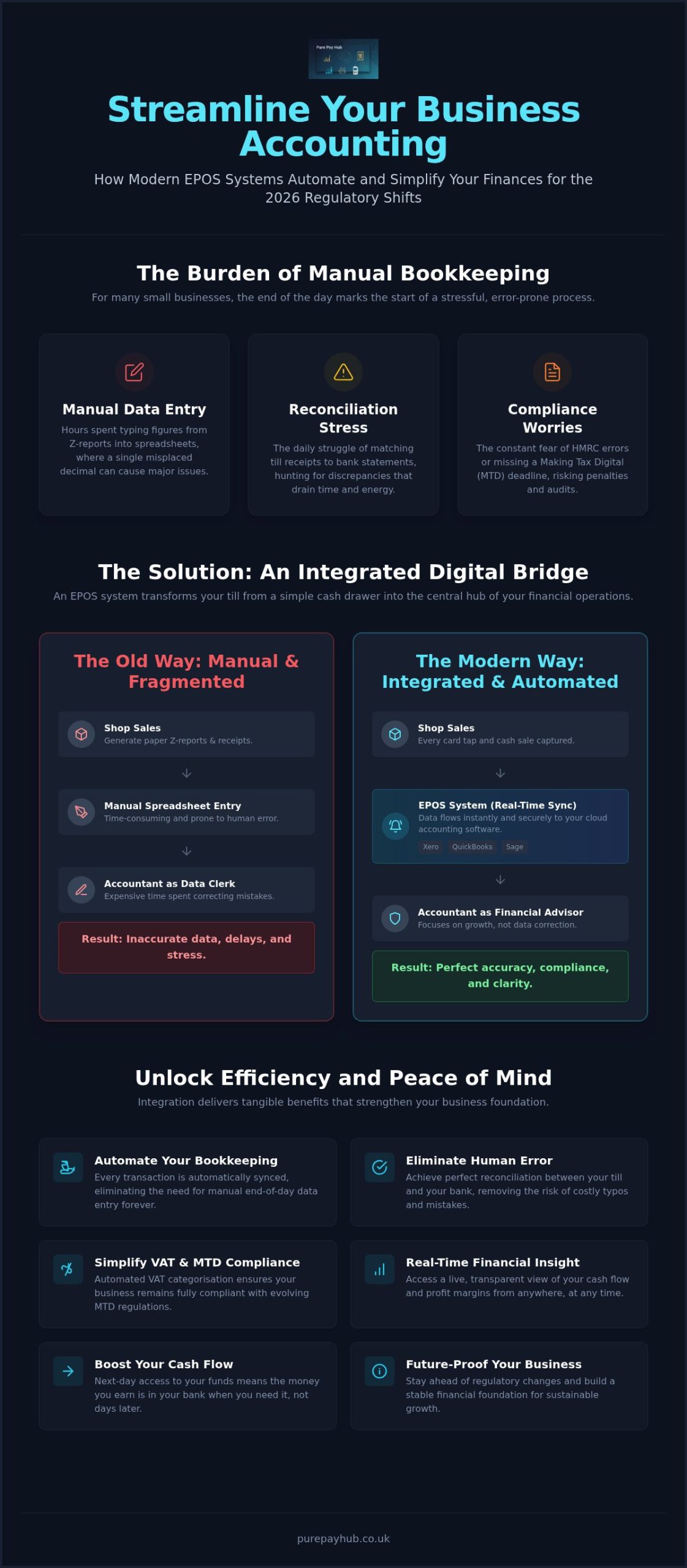
    Understanding how EPOS systems streamline small business accounting starts with redefining the till itself. In a modern setting, an EPOS is no longer just a locked drawer for cash. It functions as a digital bridge that connects your physical sales floor directly to your financial ledger. Every time a customer taps their card, a wealth of data moves across this bridge. This includes the price, the specific VAT rate, the stock deducted, and even which staff member processed the transaction.

    The old legacy cash registers were “dumb” machines. They recorded a total and printed a receipt, leaving you to piece together the story of your business at the end of the month. Modern data-driven systems are different. They provide a transparent, real-time narrative of your business health. For your bookkeeper, “integrated” is the most important word in their vocabulary. It means your sales data flows automatically into your accounting software without anyone having to lift a pen or open a spreadsheet.

    The Move from Manual to Digital Bookkeeping

    Manual data entry is the biggest threat to your business accuracy. When you spend hours typing figures from Z-reports into a computer, mistakes are inevitable. A single misplaced decimal point can lead to a stressful HMRC enquiry or a skewed view of your profits. Transitioning to automated tools is the primary way how EPOS systems streamline small business accounting in a competitive market. The humble UK till has evolved into a sophisticated financial management hub that protects you from these human errors.

    An EPOS system is a real-time data synchronisation tool that allows SMEs to link every transaction directly to their financial records. This evolution ensures that your business stays compliant whilst you focus on serving your customers.

    Core Components of a Modern Accounting-First EPOS

    A high-quality Point of Sale (POS) system built for 2026 focuses on three core pillars to support your accounting:

    • Cloud-based storage: This gives you and your accountant instant access to financial records from any location, ensuring you aren’t tied to the shop floor to check your numbers.
    • Automated VAT categorisation: The system identifies whether an item is standard, reduced, or zero-rated at the point of sale, removing the guesswork from your tax returns.
    • Hardware integration: Seamless connections with a Countertop Card Machine ensure that the amount on the till always matches the amount processed by the bank.

    By centralising these functions, you create a stable foundation for your finances. You won’t just save time; you’ll gain the clarity needed to make informed decisions about your business growth and development.

    Real-Time Data Synchronisation with Accounting Software

    The “monthly shoebox” is a relic of the past. For years, small business owners spent the first Monday of every month sorting through crumpled receipts and faded Z-reports. This manual process isn’t just tedious; it’s expensive. When you hand a messy bundle of paperwork to your accountant, you’re paying them to be a data entry clerk rather than a financial advisor. Real-time synchronisation changes this dynamic. By using API connections, your till literally talks to your accounting software. This is a primary example of how EPOS systems streamline small business accounting by ensuring every sale is recorded the moment it happens.

    Cloud updates allow you to monitor your profit margins whilst you’re at home or even asleep. You don’t need to wait for a quarterly report to see if your food costs are too high or if a specific product line isn’t performing. The data is “clean,” meaning it arrives in your ledger pre-categorised and ready for review. Governments worldwide are encouraging this shift, highlighting the importance of digital tools for tax management to reduce administrative burdens and improve transparency.

    Seamless Integration with Xero, QuickBooks, and Sage

    Most UK merchants already use platforms like Xero, QuickBooks, or Sage. A modern EPOS doesn’t replace these; it feeds them. Whether a customer pays by cash or card, the system splits the transaction into its component parts. It identifies the net sale, the VAT, and the payment method. This automation ensures your bank reconciliation is a simple “click and confirm” process rather than a multi-hour detective job. You can see your physical sales match your digital records instantly without any manual intervention.

    The Benefit of Next-Day Access to Funds

    Cash flow is the heartbeat of any retail or hospitality business. If your sales data says you’ve had a record-breaking Friday, but the money doesn’t hit your bank until Wednesday, your accounting becomes a guessing game. PurePay Hub provides next-day access to funds, which is a critical metric for accurate forecasting. This speed allows you to match your digital sales reports with actual bank deposits almost immediately. It removes the stress of “pending” balances and gives you a true view of your available capital.

    When your bank balance reflects your till reports within 24 hours, your cash flow forecasting becomes reliable. You can pay suppliers, manage payroll, and invest in stock with total confidence. If you want to see this level of clarity in your own books, exploring an integrated EPOS system is the logical next step. It turns your payment processing into a stabilising force for your entire business.

    Simplifying VAT Compliance and Making Tax Digital (MTD)

    Tax season doesn’t have to be a period of dread. For many merchants, the complexity of VAT is what makes bookkeeping feel like a second job. This is where you see exactly how EPOS systems streamline small business accounting by removing the manual calculation of tax on every pint, pastry, or pair of shoes sold. Instead of checking every receipt, the system applies the correct VAT rate the moment the barcode is scanned or the item is selected on the screen. It also monitors your taxable turnover against the compulsory £90,000 VAT registration threshold, ensuring you know exactly when you need to register or if you are approaching the £88,000 deregistration limit.

    Managing standard, reduced, and zero-rated items happens entirely in the background. By integrating with other business tools, your EPOS ensures that these figures are not just accurate at the till but are also correctly categorised in your final ledger. This creates a digital paper trail that is essentially “audit-ready” from day one. If HMRC ever requests a review of your records, you can generate a comprehensive report at the touch of a button. You no longer have to worry about missing digital records or inconsistent data entry that could trigger an investigation.

    Staying Compliant with MTD Requirements

    Making Tax Digital (MTD) is shifting from a suggestion to a strict requirement for almost every UK business. From April 2026, self-employed individuals and landlords with an annual income over £50,000 must comply with MTD for Income Tax Self Assessment (ITSA). This threshold will extend to those earning over £30,000 in April 2027. Your EPOS acts as the “functional compatible software” needed to bridge the gap between your daily operations and HMRC’s digital portal. It stores your records in the required digital format, helping you avoid costly fines whilst keeping your focus on daily growth.

    Managing Split VAT and Hospitality Complexities

    In the hospitality sector, VAT is famously complex. A sandwich sold to a customer sitting in a chair carries a different VAT implication than one taken away. Integrated systems handle these “split VAT” scenarios automatically. They prevent the expensive miscalculations that often occur when staff are busy and have to make manual tax decisions on the fly. For pub and restaurant owners, this automation turns a potential accounting nightmare into a simple, background process. It provides total clarity on what is owed, protecting your profit margins from unexpected tax bills at the end of the quarter.
    How EPOS Systems Streamline Small Business Accounting: A 2026 Guide

    Eliminating Human Error and Reconciliation Stress

    Reconciliation is a fancy word for a simple question: does the money in the bank match what the till says you sold? For many, this is where the evening takes a turn for the worse. Manual reconciliation is the primary source of accounting errors. It usually involves a tired business owner squinting at a card machine receipt whilst typing numbers into a spreadsheet. One slip of the finger and your books are out by hundreds of pounds, leading to hours of forensic searching for a misplaced decimal point.

    The “Double Entry” problem disappears when your hardware is synced. Because your card machine is linked to your EPOS, there is no need for staff to “key in” the price twice. This automated matching is a core reason how EPOS systems streamline small business accounting for modern retailers. It ensures that the till and the bank always match; identifying discrepancies instantly rather than at the end of a long month. This creates a culture of financial transparency amongst your staff, as every penny is accounted for in real-time. You can spot a mistake the moment it happens, rather than chasing a phantom error weeks later.

    Automated End-of-Day Reporting

    Cashing up used to mean manual Z-reports and piles of paper. Modern systems generate these reports automatically and can email them directly to your accountant in a format they actually like. It removes the friction from your daily routine. The psychological relief of seeing a perfectly balanced till every single evening is worth the investment alone. It means you can go home knowing your data is accurate and your ledger is clean, without the nagging worry of a cashing-up catastrophe.

    Tracking Stock Value for Accurate Balance Sheets

    Your accounting isn’t just about sales; it’s about assets. An integrated system links stock control directly to your business assets, allowing for a much more precise balance sheet. This automation provides several key benefits:

    • Automated COGS: Your “Cost of Goods Sold” is calculated on the fly, giving you accurate profit reporting for every single shift.
    • Real-time Valuation: You always know the exact value of the stock sitting on your shelves, which is vital for insurance and tax purposes.
    • Reduced Stocktakes: Whilst you’ll still need an occasional count, the need for massive, manual year-end stocktakes is significantly reduced.

    Accurate stock data means your balance sheet reflects the true value of your business at all times. If you want to stop the late-night stress and ensure your records are always spot on, browse our integrated EPOS systems and reclaim your evenings.

    Future-Proofing Your Business with PurePay Hub

    A reliable accounting process is built on a foundation of transparency. If your merchant service provider hides costs within complex fee structures, your reconciliation will never be truly accurate. We believe that clarity is the most important tool for any business owner. By combining low transaction rates with high-end accounting efficiency, you can ensure your business remains profitable and organised as you grow. This is the final piece of the puzzle in understanding how EPOS systems streamline small business accounting; they turn your payment data into a strategic asset rather than a daily chore.

    Scaling your business should be an exciting milestone, not an accounting headache. Whether you are opening a second boutique or a third cafe, an integrated system allows you to manage multiple locations from a single, centralised dashboard. You can compare the performance of different sites and ensure that your bookkeeping remains consistent across the entire brand. This bird’s-eye view prevents the fragmentation that often occurs when small businesses expand too quickly without the right digital infrastructure in place.

    Clean data also opens doors to growth capital. Traditional bank loans often require mountains of paperwork and weeks of waiting. However, because your EPOS records every transaction, you have a verified history of your revenue. This makes accessing a Business Cash Advance much simpler. Lenders can see the health of your business through your sales data, allowing you to secure funding based on your actual performance rather than just a credit score. It is a modern way to fund renovations or stock purchases whilst keeping your cash flow stable.

    The PurePay Hub Advantage for UK SMEs

    We position ourselves as a fair partner to regional business owners. This starts with debit rates from 0.3%, ensuring you keep more of your hard-earned revenue. We don’t hide behind corporate jargon or opaque markups. Instead, we provide reliable UK-based support to help you organise your setup from day one. Our no-nonsense approach to merchant services means you get a modern fintech experience with the personal touch of a local expert who understands the UK market.

    Taking the Next Step Toward Automation

    Switching to a more efficient system shouldn’t be a burden. We help merchants move away from restrictive contracts by offering solutions that allow you to switch to an integrated system without the stress of exit fees. Every business is unique, which is why consulting with a PurePay Hub expert is the best way to find your perfect EPOS match. We will look at your specific sector and accounting needs to build a package that works for you. Don’t let manual data entry hold your business back any longer. You can get a transparent quote and streamline your accounts today to see the difference that true integration makes.

    Reclaim Your Time and Protect Your Profits

    The shift toward digital finance is inevitable, but it doesn’t have to be a source of stress. We have explored how EPOS systems streamline small business accounting by turning every transaction into a clean data point for your ledger. You now understand how real-time synchronisation removes the need for manual data entry and ensures your VAT calculations are always audit-ready. By automating these repetitive tasks, you protect your business from human error and remain fully compliant with the latest MTD requirements.

    PurePay Hub is here to act as your supportive business ally. We offer a transparent fee model with debit card rates starting from 0.3% and next-day funding as standard. There are no hidden markups or opaque fee structures; just a reliable, modern system designed to stabilise your finances. It’s time to stop worrying about cashing-up discrepancies and start focusing on your growth. Switch to PurePay Hub and start saving on every transaction today. We look forward to helping you build a more efficient, future-proof business.

    Frequently Asked Questions

    Can an EPOS system really replace my manual bookkeeping?

    An EPOS system automates the vast majority of your daily sales record keeping. It acts as a digital bridge that captures every transaction, meaning you no longer need to manually log individual sales or Z-reports. Whilst it doesn’t replace the strategic advice of an accountant, it eliminates the tedious hours of data entry that often lead to mistakes. It ensures your ledger is always up to date without the need for a pen and paper.

    Does an EPOS system automatically calculate VAT for HMRC?

    Yes, modern systems automatically apply the correct VAT rate to every item sold at the point of sale. Whether an item is standard, reduced, or zero-rated, the software categorises the tax instantly. This is a key way how EPOS systems streamline small business accounting, as it prevents the need for manual calculations at the end of the quarter. It ensures your VAT returns are based on precise, per-transaction data rather than estimates.

    Which accounting software is best to use with a UK EPOS system?

    Most UK merchants find that Xero, QuickBooks, or Sage offer the best integration capabilities. These platforms are designed to talk to your EPOS through secure API connections. This allows for a seamless flow of data where your sales, stock, and VAT figures appear in your accounts automatically. Choosing a well-known platform ensures that your accountant can easily access the clean data they need to manage your business finances effectively.

    How does an integrated card machine reduce accounting errors?

    An integrated card machine removes the need for staff to manually type the transaction amount into the terminal. When the till and the card machine are linked, the price is sent directly to the device. This eliminates keying-in errors where a staff member might accidentally enter the wrong figure. It ensures your bank deposits always match your till reports, which makes your daily reconciliation a stress-free and accurate process.

    What are the costs involved in connecting EPOS to accounting software?

    Connecting your systems usually involves a monthly software subscription fee and an initial hardware investment. Some providers also charge a small integration fee to link your till with your chosen accounting platform. You should always check for transparent fee structures to avoid hidden markups. Investing in this connection often pays for itself by reducing the number of hours your accountant spends on manual data entry and reconciliation.

    Is my data safe when syncing EPOS with cloud accounting tools?

    Yes, cloud-based systems use high-level encryption to protect your financial data during the synchronisation process. This is the same level of security used by major banks to ensure your information remains confidential. By storing your records in the cloud, you also protect your business from data loss caused by hardware failure or theft. It provides a secure, centralised location for your records that you can access safely from any location.

    How do I manage cash payments alongside card sales in my accounts?

    Your EPOS system categorises every sale by payment type, allowing you to track cash and card transactions separately. When you perform your end-of-day cashing up, the system tells you exactly how much cash should be in the drawer. This data is then synced to your accounting software under different headings. It ensures your books reflect your actual bankings and helps you identify any discrepancies in your cash handling immediately.

    Can I use an EPOS system to help with my Making Tax Digital (MTD) returns?

    Absolutely, an EPOS system is a vital tool for meeting your Making Tax Digital obligations. It acts as the functional compatible software required by HMRC to keep digital records of your transactions. By automatically capturing your sales and VAT data, it ensures you have an accurate, digital paper trail for your quarterly returns. This is essential for how EPOS systems streamline small business accounting as we approach the 2026 MTD deadlines.

  • Bridging the Gap: Moving from the Shoebox Method to Modern VAT Prep in 2026

    Bridging the Gap: Moving from the Shoebox Method to Modern VAT Prep in 2026

    Imagine it’s 10 PM on a Sunday, and you’re surrounded by a mountain of crumpled thermal receipts, trying to decipher a faded ink blotch from three months ago. Most UK business owners dread the quarterly VAT cycle. You likely feel the pressure of potential HMRC penalties for a simple manual entry error, or the frustration of paying an accountant high fees just to sort through basic data entry. This “shoebox method” isn’t just stressful; it’s a drain on your focus and your finances.

    You can reclaim your time and gain total confidence in your compliance by understanding how epos systems simplify vat returns for small business. This shift transforms your accounting from a manual chore into a seamless, automated background process. We’ll explore how to align with the 2026 Making Tax Digital (MTD) regulations and transform your VAT preparation into a paperless, audit-ready workflow that keeps your records accurate and your accountancy costs low.

    Key Takeaways

    • Understand why physical receipts create data silos and how moving to digital records prepares you for the 2026 MTD deadline.
    • Discover how epos systems simplify vat returns for small business by automatically capturing transaction fees that are often missed during manual entry.
    • Reduce your quarterly VAT workload from hours of stressful sorting to minutes of simple digital review through automated data integration.
    • Follow a practical roadmap to audit your current paper trail and transition to a payment provider with built-in reporting capabilities.
    • Benefit from transparent fee structures and a “digital shoebox” that helps lower your accountancy costs whilst protecting you during HMRC audits.

    What is the “Shoebox Method” and Why is it Failing UK Businesses?

    The “shoebox method” isn’t a strategy. It’s a survival tactic. For decades, many UK small business owners have relied on the habit of stuffing physical receipts, invoices, and bank statements into a literal or metaphorical box. You wait until the end of the quarter, tip the contents onto a desk, and hope for the best. This creates a massive “data silo.” Your financial information exists in a physical form that your accounting software simply cannot see. It’s invisible, unsearchable, and prone to decay.

    This approach fuels a specific type of psychological stress: deadline dread. As the VAT submission window nears, the pressure builds. You know you’ll spend your weekend sorting through crumpled paper instead of resting or growing your business. By the time 2026 arrives, this method won’t just be stressful; it will be a regulatory liability. Physical records alone are no longer sufficient for a modern, compliant business. PurePay Hub helps bridge this gap by turning your daily transactions into clear, digital records that are always audit-ready.

    The High Cost of Manual Entry Errors

    Manual data entry is a gamble. A single misread digit on a faded receipt can lead to an incorrect VAT return. HMRC views these discrepancies with scrutiny. One small typo could trigger a full audit, consuming weeks of your time and peace of mind. Discovering how epos systems simplify vat returns for small business allows you to replace these manual risks with digital precision.

    There’s also a hidden financial drain. If you hand a box of paper to an accountant, you’re paying professional rates for basic data entry. It’s a poor use of your budget. Perhaps most importantly, physical receipts are fragile. If a receipt for a large business expense goes missing, you lose the ability to claim that VAT back. You’re essentially leaving your own money on the table because of a piece of paper that went missing in transit.

    Why 2026 is the Turning Point for Digital Compliance

    The regulatory environment in the UK is shifting permanently. Making Tax Digital (MTD) is expanding its scope to cover more businesses, including those previously below certain thresholds. HMRC is moving away from annual or quarterly summaries towards a system of real-time data submission and mandatory digital links. You can no longer simply type a total figure into a box on a website. MTD is the mandatory digital link between business records and HMRC. By 2026, every transaction needs a clear, digital trail. PurePay Hub acts as your digital shoebox, ensuring every card payment is recorded and categorised correctly from the moment the customer taps their card. Relying on paper is a risk that modern businesses can’t afford to take.

    Understanding the VAT Gap: How Small Errors Cost You Thousands

    The VAT Gap isn’t just a figure for Treasury spreadsheets. At the business level, it represents the difference between what you actually owe and what you report. This gap often grows from tiny, recurring errors rather than deliberate evasion. For many UK merchants, these inaccuracies lead to overpaying tax or, worse, underpaying and facing heavy penalties. Identifying these leaks is the first step toward financial clarity.

    Manual reconciliation between bank statements and card reports is where most systems fail. Your bank statement usually shows a “net settlement” figure, which is your total sales minus the merchant fees. If you only record that net figure, you’re missing out on deductible expenses. Understanding how epos systems simplify vat returns for small business is essential here. These systems break down every transaction into its constituent parts, ensuring you see the gross sale and the fee separately.

    Product categorisation at the till is another common trap. If you sell a mix of standard-rated and zero-rated items, such as hot food and cold takeaway, a manual system relies on the operator to remember the difference every time. One mistake per hour adds up to thousands of pounds in miscalculated tax over a year. Modern systems automate this, applying the correct VAT rate based on the product code, which removes the risk of human error at the point of sale.

    The Financial Leakage of Merchant Fees

    Merchant service charges are a deductible business expense. If you aren’t tracking them accurately, you’re essentially paying tax on money you never actually kept. Integrated systems automatically track these fees for every transaction processed, creating a clear paper trail for your accountant. Contrast this with manual methods where fees are often “lost” in the net figures hitting your bank account. Switching to a provider that offers integrated reporting ensures these fees are never ignored and always accounted for in your favour.

    HMRC Penalties in 2026: A Warning for the Unprepared

    HMRC has moved to a points-based penalty system for VAT. Every late or inaccurate submission earns you a point. Once you hit a specific threshold, you face a £200 fine for every subsequent mistake. It’s a cumulative system designed to punish persistent manual errors. Interest charges are also aggressive, often applied after just 16 days of late payment. To avoid an inspection, watch out for these manual “red flags”:

    • Inconsistent gross profit margins that don’t match your industry average.
    • Frequent “round number” entries that suggest estimation rather than precision.
    • Discrepancies between your annual accounts and your quarterly VAT returns.
    • Missing digital links between your sales records and your submission software.

    By automating your data capture, you eliminate these red flags and provide HMRC with the transparent, digital evidence they require. This proactive approach saves you from the stress of an audit and the drain of avoidable fines.

    Manual vs. Integrated VAT Prep: A Comparison for 2026

    The difference between manual and integrated VAT preparation is stark. For a typical small business, manual sorting takes roughly 10 hours every quarter. You spend this time hunting for receipts and cross-referencing bank statements. In contrast, a digital review takes about 10 minutes. This efficiency is exactly how epos systems simplify vat returns for small business. You aren’t building the data from scratch. You’re simply verifying what has already been captured at the point of sale.

    Manual entry carries a high risk of transposition errors. Typing “£19.99” as “£19.66” might seem minor. Across hundreds of transactions, it distorts your liability and attracts HMRC scrutiny. By 2026, HMRC’s “Digital Link” requirement means that data must flow electronically between software programs. Simply copy-pasting figures from a spreadsheet into a VAT portal is no longer compliant. Integrated systems ensure that your sales data moves from the point of purchase to your tax return without human interference.

    Managing the cash flow for a quarterly VAT bill is a common headache. Integrated systems with next-day funding allow you to see your cleared funds almost immediately. This visibility helps you set aside tax obligations in real-time. You avoid the stress of a surprise bill because you have a constant, accurate view of your cleared balance.

    The Role of Integrated Card Machines

    A PurePay Hub card machine doesn’t work in isolation. It talks directly to your EPOS and your ledger. This integration creates a centralised Merchant Portal that acts as a digital dashboard for all your sales and fee data. You no longer need to print and store physical end-of-day Z-reports. Everything is logged digitally. This creates a permanent, searchable record that is impossible to lose or damage.

    Lowering Your Accountancy Fees

    Clean data saves money. Accountants often charge by the hour. If you provide them with a clean, digital data export, they spend less time on basic data entry. This shifts the relationship. You stop paying for administrative chores and start paying for strategic advice that helps your business grow. A simple way to speed this up is by sharing portal access directly with your bookkeeper. This removes you from the middle of the data chain and ensures your records are always up to date without your constant intervention.

    The 2026 Transition Roadmap: Moving to Digital VAT Prep

    Transitioning to a digital-first model is a logical progression, not a sudden leap. You need a clear roadmap to move away from the paper-heavy habits of the past. Following a structured plan ensures you remain compliant whilst reducing your administrative burden.

    Step 1: Audit your current “shoebox.” Identify exactly where your paper trail begins. Is it physical supplier invoices, till rolls, or handwritten petty cash slips? Knowing where the paper enters helps you block those manual entry points. Step 2: Select a digital-first payment provider. You need more than just a terminal; you need a partner that offers integrated reporting as standard. Step 3: Connect your hardware to your software. This is how epos systems simplify vat returns for small business. When your card machine and EPOS talk to your cloud accounting platform, your VAT records update automatically in the background. Step 4: Train your staff. Proper categorisation at the point of purchase ensures your data is clean from the start. Step 5: Replace the “Quarterly Scramble” with a “Monthly Digital Review.” A ten-minute check-in once a month keeps you ahead of the game and removes the stress of the VAT deadline.

    Choosing the Right Hardware for Compliance

    Your choice of hardware impacts your compliance. Whether you use countertop card machines or portable units, they must offer integrated reporting. Reliable connectivity is non-negotiable. Look for devices with 4G and Wi-Fi backup to ensure no transaction data is lost during a signal drop. For remote or B2B sales, Payment Links are invaluable. They keep your non-face-to-face sales within the same digital ecosystem, providing a consistent audit trail for HMRC. Explore our range of integrated card machines to start your digital transition today.

    Setting Up Your Digital Links

    Under current HMRC MTD rules, a “Digital Link” is a mandatory electronic transfer of data between software programmes. Manual copy-pasting or typing figures from one screen to another is no longer compliant. PurePay Hub automates this flow, sending transaction data directly to your ledger. This isn’t just about speed; it’s about security. High-level PCI compliance protects this digital data flow, ensuring your financial records remain private and untampered with. By automating these links, you create a robust, audit-ready system that satisfies HMRC requirements without the need for manual intervention.

    PurePay Hub: Bridging the Gap with Transparent Payments

    PurePay Hub acts as the bridge between your daily sales and your final tax submission. We don’t just provide hardware; we offer a way to simplify your entire financial workflow. By moving away from the shoebox, you gain a partner dedicated to your growth. Our no-nonsense fee structure starts with debit card rates from 0.3% and credit card rates from 0.5%. These transparent costs mean you always know exactly what’s being deducted from your sales. This clarity is a fundamental part of how epos systems simplify vat returns for small business. You no longer have to guess your margins or hunt for hidden markups in your reporting.

    Our integrated EPOS systems are particularly effective for the hospitality sector. They solve the business-level VAT Gap by automatically applying the correct tax rates to mixed products. Whether it’s a takeaway coffee or a sit-down meal, the system handles the calculation at the till. This precision protects you from overpaying tax or underreporting revenue. To help you manage your quarterly VAT liabilities, we offer next-day access to your funds. This steady cash flow ensures you always have the capital ready when your tax bill arrives.

    A Partner, Not Just a Provider

    We pride ourselves on being a local expert for regional business owners. Our UK-based support team understands the specific challenges you face. Through our Merchant Portal, you can generate audit-ready reports at the touch of a button. It serves as your digital shoebox, keeping every record safe and accessible. If you’re unsure about your current costs, we invite you to a “Health Check.” We’ll review your existing card machine rates and show you exactly where you can save money whilst improving your VAT prep.

    Next Steps for Your Business

    Moving from chaos to clarity doesn’t have to be a long process. You can ensure HMRC compliance and lower your accountancy fees by making the switch now. It’s time to ditch the shoebox and embrace an automated, stress-free workflow. Our quick onboarding process means you can be up and running before your next VAT quarter begins. Contact PurePay Hub today to transform your payment processing into your most reliable accounting tool.

    Secure Your Business Future Before 2026

    Moving from a paper-heavy “shoebox” to a streamlined digital workflow is no longer just a matter of convenience; it’s a necessity for UK compliance. By automating your record-keeping at the point of sale, you eliminate the stress of the quarterly scramble and protect your business from costly HMRC penalties. This transition highlights how epos systems simplify vat returns for small business by creating mandatory digital links and capturing deductible merchant fees automatically.

    PurePay Hub supports local merchants with a transparent, no-nonsense approach to payments. With debit card rates starting from 0.3%, next-day funding as standard, and integrated reporting for HMRC MTD compliance, we provide the stability your finances need. You can ditch the manual data entry and focus on growing your business with confidence. We’re here to ensure your move to digital is simple, fair, and reliable.

    Get a no-nonsense quote and simplify your VAT prep with PurePay Hub.

    Take the first step toward a paperless, audit-ready future today. Trade the stress of Sunday night sorting for the clarity of automated accounting.

    Frequently Asked Questions

    What exactly is the “Shoebox Method” in accounting?

    The shoebox method is the manual habit of collecting physical receipts and invoices in a container to be processed at a later date. This creates a data silo that is invisible to modern accounting software and relies entirely on manual entry. It often leads to a stressful quarterly scramble where errors are common and valuable deductible expenses are frequently missed or lost.

    Is the shoebox method still legal for UK businesses in 2026?

    No, the pure shoebox method is no longer compliant for VAT-registered businesses under Making Tax Digital (MTD) rules. By 2026, HMRC requires digital records and automated links between your sales and your tax return. Whilst you can keep physical copies for your own records, the actual submission process must be digital. Relying solely on paper records is now a significant regulatory risk.

    How does an integrated card machine help with my VAT return?

    An integrated card machine automatically transfers transaction data to your EPOS and accounting software. This is how epos systems simplify vat returns for small business by removing the need for manual data entry at the end of the day. Every sale is logged in real-time with the correct VAT rate applied, ensuring your digital records are accurate and ready for submission without any extra work.

    What are the penalties for manual entry errors on a VAT return in 2026?

    HMRC uses a points-based penalty system where each inaccurate or late submission earns you a point. Once you reach a specific threshold, you face a £200 fine for every subsequent mistake. Additionally, interest charges apply to unpaid tax after just 16 days. Moving to an automated system helps you avoid these red flags and protects your cash flow from the drain of avoidable cumulative fines.

    Do I need expensive software to move away from the shoebox method?

    You don’t need a complex or high-cost setup to transition to digital accounting. Many modern payment providers include integrated reporting as part of their standard service. By choosing hardware that talks directly to your existing ledger, you can automate your workflow without a massive upfront investment. This shift often pays for itself by significantly reducing the hours your accountant spends on basic data entry.

    How can I reclaim VAT on my card machine transaction fees?

    You can reclaim VAT on merchant service charges because they are a deductible business expense. Integrated systems track these fees for every transaction, providing the clear digital evidence HMRC requires for an audit. Manual methods often lose these figures in net settlement totals. Using a digital portal ensures every penny of your deductible fees is accounted for, which naturally lowers your overall tax liability.

    Can PurePay Hub help me if I am already behind on my VAT prep?

    Yes, we can help you get back on track by providing immediate access to clear, digital reporting. Our Merchant Portal acts as a digital archive for all transactions processed through our machines, allowing you to export clean, organised data for previous periods. Our quick onboarding process means you can start capturing accurate, compliant data before your next quarterly deadline, helping you avoid future points-based penalties.

    What is the “Digital Link” requirement in Making Tax Digital?

    A digital link is a mandatory electronic transfer of data between software programmes or applications. HMRC rules state that these links must be automated; you cannot manually copy and paste figures between a spreadsheet and your VAT software. Integrated systems satisfy this requirement by moving your sales data from the point of purchase directly to your ledger. This ensures the data remains untainted by manual errors during the transfer.