Tag: PDQ machines

  • Understanding Card Machine Rental Agreements in the UK: A Transparent Guide for 2026

    Understanding Card Machine Rental Agreements in the UK: A Transparent Guide for 2026

    Why does a small piece of payment hardware often come with a forty-page contract designed to leave you feeling more confused than when you started? For many merchants, understanding card machine rental agreements UK feels like navigating a minefield of aggressive sales tactics and opaque fee structures. You want a tool that works for your business; you don’t want a legal headache that ties you into expensive, long-term commitments with no clear exit strategy.

    We believe that transparency is the only way to build a real partnership. It’s time to pull back the curtain on how these contracts actually function in 2026. You deserve a payment setup that prioritises your cash flow over confusing fine print. This guide will help you master the complexities of merchant contracts, identify sneaky hidden costs, and learn how to secure a flexible agreement that suits your specific needs. We’ll examine the reality of terminal hire, explain how to navigate termination terms, and show you how to access modern hardware that actually supports your growth.

    Key Takeaways

    • Learn how the three-way relationship between your business, the ISO, and the acquirer works to ensure you aren’t paying for services you don’t need.
    • Master the fine print by understanding card machine rental agreements UK, specifically focusing on how to spot hidden service charges and minimum monthly fees.
    • Evaluate whether renting or purchasing hardware is better for your cash flow, factoring in the importance of ongoing technical support and avoiding outdated technology.
    • Identify common red flags, such as automatic renewal clauses and restrictive notice periods, to keep your business flexible and avoid expensive exit fees.
    • See how next-day funding and transparent, no-nonsense pricing can support your business growth more effectively than traditional, slow-moving banks.

    The Landscape of Card Machine Rental Agreements in the UK

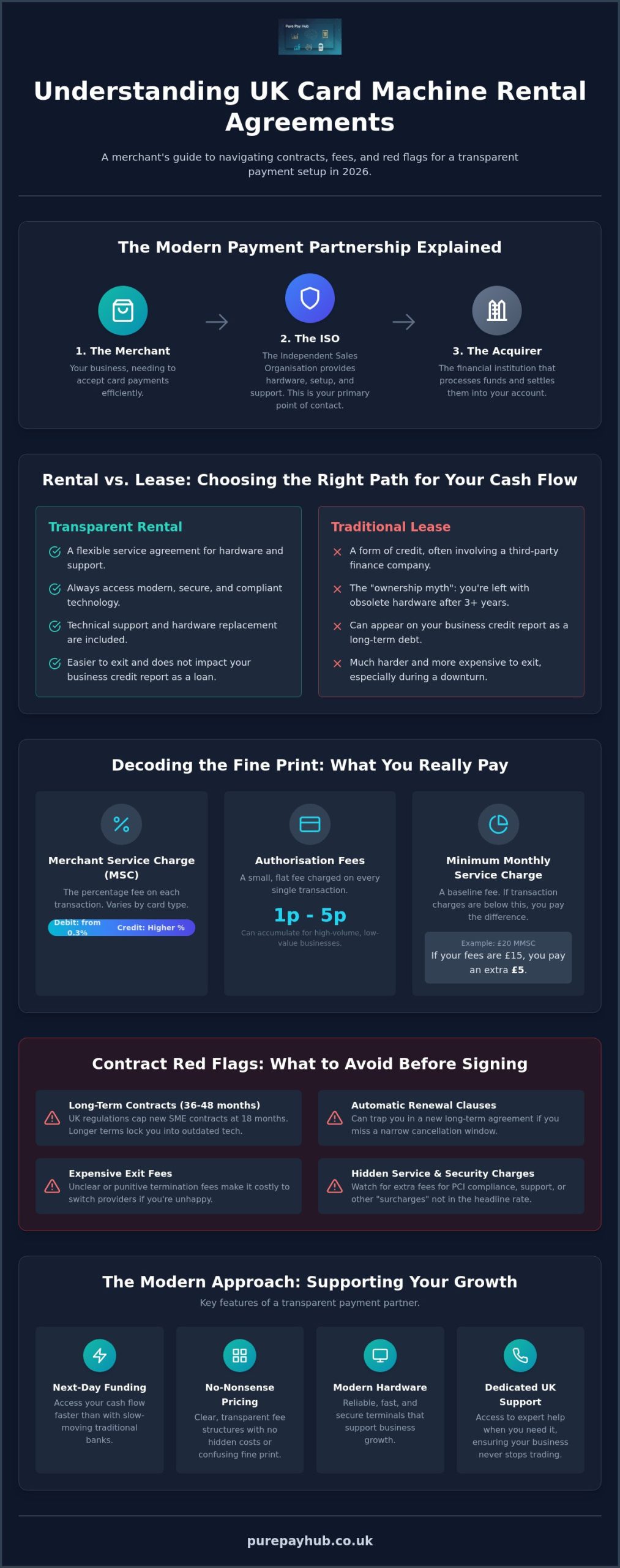
    The UK payment sector has changed. It’s no longer dominated by rigid, five-year contracts from high-street banks. Instead, a more agile system has emerged. When you look into understanding card machine rental agreements UK, you’ll find a three-way partnership at its core. First, there is you, the merchant. Second, there is the Acquirer; this is the financial institution that processes the funds and settles them into your account. Finally, there is the Independent Sales Organisation (ISO), such as PurePay Hub. We act as your primary point of contact, handling the setup, support, and hardware provision.

    This shift towards ISOs has brought much-needed transparency to the market. Unlike traditional banks, we focus on providing a Payment terminal that fits your specific trade. Whilst pay-as-you-go models are popular for very small startups, they often carry transaction rates as high as 1.75%. For established businesses, a rental agreement offers a more predictable cost structure with significantly lower transaction rates, often starting from 0.3% for debit cards. This balance of a small monthly fee and low processing costs usually results in better long-term value.

    The 18-Month Rule: Your Regulatory Protection

    The Payment Systems Regulator (PSR) stepped in to fix a broken market. In the past, many providers used “lock-in” tactics, forcing small businesses into four or five-year commitments. These contracts often included automatic renewals that were nearly impossible to cancel. Under current regulations, terminal hire contracts for small and medium enterprises are capped at a maximum of 18 months. This ensures you aren’t trapped with outdated technology or unfair pricing. You should never sign a 36 or 48-month terminal lease; it’s usually a sign of an outdated provider using aggressive sales tactics.

    Rental vs. Leasing: Knowing the Difference

    It’s vital to distinguish between a simple rental and a financial lease. A rental is a service agreement. You pay a monthly fee for the use of the hardware and the associated support. If the machine breaks, we replace it. A lease, however, is a form of credit. It often involves a third-party finance company and can appear on your business credit report. If your business experiences a downturn, a lease is much harder to exit than a standard rental agreement.

    Leasing often leads to the “ownership myth.” Some providers claim you’ll own the device after three years. In reality, a three-year-old card machine is often technically obsolete. Security standards evolve, and software slows down. By choosing a transparent rental model, you ensure your business always has access to modern hardware and dedicated technical support without the risks associated with long-term debt.

    Decoding the Fine Print: Fees and Contractual Terms

    A card machine contract is more than just a monthly rental fee. The Merchant Service Charge (MSC) is the primary cost you’ll encounter. It’s the percentage charged on every transaction you process. For many UK businesses, consumer debit rates are the most affordable, whilst commercial or international credit cards carry higher premiums. Gaining a thorough understanding card machine rental agreements UK means looking past the headline rate to see how these percentages impact your specific sales mix.

    Authorisation fees also play a significant role. These are small, flat fees, typically between 1p and 5p, applied to every transaction regardless of the sale value. If you run a high-frequency business with low average transaction values, such as a newsagent or a coffee shop, these pennies can accumulate into a substantial monthly expense. You must ensure your provider is clear about these “per-click” costs before you sign on the dotted line.

    The Minimum Monthly Service Charge (MMSC) Explained

    The MMSC is the floor price you pay regardless of sales volume. If your total transaction fees for the month don’t reach a specific threshold, the provider charges you the difference. For example, if your agreement has a £20 MMSC but you only generate £15 in transaction charges, you’ll still be billed the full £20. It’s a mechanism used by many providers to guarantee a baseline revenue from every account, even during seasonal lulls or quiet periods. We advocate for transparent payment solutions that clearly define these thresholds so you can accurately forecast your monthly overheads.

    PCI DSS and Security Surcharges

    Security is a mandatory requirement in the payments industry. Every merchant must comply with the Payment Card Industry Data Security Standard (PCI DSS). However, some providers turn this into a profit centre by charging “non-compliance fees” if you haven’t completed your annual self-assessment questionnaire. These fines can range from £20 to £50 per month. You should look for partners who offer managed compliance support rather than those who simply penalise you for administrative delays. Always verify your provider’s credentials through the Financial Conduct Authority (FCA) to ensure they meet the necessary regulatory standards for handling your business data. This prevents you from falling into the trap of paying “admin fees” that add no genuine value to your security posture.

    Rental vs Purchase: Making the Right Choice for Your Cash Flow

    Decisions regarding payment hardware often come down to a choice between capital expenditure and operational expenditure. When you buy a card reader outright, you own the asset. However, for many established businesses, the ongoing service provided by a rental agreement outweighs the appeal of ownership. A deeper understanding card machine rental agreements UK reveals that rental models often include essential technical support and hardware insurance that purchase models lack.

    The choice is about more than the initial price tag. It’s about ensuring your business remains operational regardless of technical glitches. Whilst pay-as-you-go readers are popular for market stalls, a dedicated rental terminal provides the stability needed for high-volume environments. It’s a strategic partnership that allows you to focus on your customers instead of your hardware.

    The Total Cost of Ownership (TCO) Analysis

    Let’s look at the numbers. A basic mobile reader might cost £79 to buy, whilst a professional standalone terminal with a SIM card and printer can cost between £100 and £250. Conversely, a rental agreement might cost around £20 per month. Over three years, the rental totals £720. Whilst the purchase price is lower, it doesn’t account for the complex Credit Card Processing Fees and security updates required to keep the device compliant.

    • Tax efficiency: Rental payments are usually treated as deductible business expenses rather than capital assets, which can be simpler for your accounting.
    • Software lifecycle: Security patches and software updates are managed remotely by the provider, ensuring you never fall behind on PCI standards.
    • Scalability: You can easily add extra units for seasonal peaks or new locations without a massive upfront capital hit.

    Hardware Reliability and “Swap-Out” Services

    What happens when your machine stops working on a busy Saturday afternoon? If you own the hardware, you’re responsible for the repair or replacement. This downtime can cost your business hundreds in lost sales. PurePay Hub prioritises business continuity. Our rental agreements typically feature “swap-out” services, ensuring a replacement device arrives quickly, often by the next working day. This level of support is rarely available when you buy a device from a retail shelf.

    Modern payment methods like Apple Pay and Google Pay require frequent firmware updates. Rental terminals receive these automatically. This ensures your customers always enjoy a seamless checkout experience. We believe that a card machine should be a tool for growth, not a source of technical frustration. By choosing a transparent rental model, you secure both modern hardware and the peace of mind that comes with professional technical advocacy.
    Understanding Card Machine Rental Agreements in the UK: A Transparent Guide for 2026

    Red Flags: What to Look for Before Signing a Contract

    Signing a contract shouldn’t feel like a gamble. When you’re understanding card machine rental agreements UK, you must look for the small print that dictates your future freedom. Many aggressive providers rely on automatic renewal clauses. These roll-over terms can bind you to a new 18-month term if you miss a tiny cancellation window. A fair contract should offer a standard 30-day notice period. If you see a 90-day requirement, consider it a major warning sign. These tactics are designed to keep you paying long after the service has stopped being competitive.

    Stability matters in a fluctuating economy. Fixed rates provide predictable costs, whilst variable rates can leave your monthly bill at the mercy of market shifts. You should also check for exclusivity agreements. Some contracts forbid you from using alternative payment methods, such as payment links or mobile readers from other providers. This limits your flexibility. It prevents you from adopting new technology as it emerges. A supportive partner will encourage you to use the best tools for your business, not restrict your choices through legal threats.

    Understanding Termination and Exit Fees

    The term “Liquidated Damages” is often buried deep in the terms and conditions. It essentially means you must pay a significant portion of the remaining contract value if you leave early. A vital part of understanding card machine rental agreements UK involves scrutinising these termination clauses. Calculating this cost is simple but painful; you multiply the monthly rental by the months left on your term. Some providers also add an admin fee on top. When negotiating, ask for a no-exit-fee trial period. This gives you time to test the service without the risk of a heavy financial penalty. If a provider refuses this, they likely don’t have confidence in their own service levels.

    Integration and EPOS Compatibility

    Your card machine needs to talk to your till. Proprietary lock-in happens when a provider forces you to use their specific EPOS system to get a better rate on your card machine. This makes it incredibly difficult to switch either service later. You end up stuck with software that might not suit your workflow just to keep your processing costs down. At PurePay Hub, we offer integrated EPOS solutions designed for hospitality and retail that maintain your flexibility. We believe your hardware should work for you, not the other way around. If you want to avoid these common traps and secure a fair deal, get a transparent quote from PurePay Hub today.

    PurePay Hub: Transparent Payment Solutions for UK Growth

    PurePay Hub isn’t just another distant financial institution. We are a supportive partner for UK merchants. We believe that understanding card machine rental agreements UK should be a straightforward process. You shouldn’t need a law degree to process a simple payment. Our approach is built on total transparency and efficiency. We offer debit rates starting from 0.3% and credit from 0.5%, ensuring your costs remain predictable and fair. We strip away the corporate jargon to provide a service that prioritises your business growth over our own bottom line.

    Next-day funding is a core part of our commitment to your success. Many traditional banks still hold your funds for three to five days. We find this practice outdated and unnecessary. Your cash flow is the lifeblood of your business. By providing next-day access to your funds, we help you manage your stock, pay your staff, and handle daily expenses with confidence. It is your money. You earned it. You should have it.

    Leveraging Your Turnover with Business Cash Advances

    Your card machine is more than a way to take payments; it’s a gateway to capital. We facilitate business cash advances based on your future card sales. This isn’t a traditional loan with fixed, stressful monthly payments. Instead, you pay back a small, agreed percentage of your daily card takings. If you have a quiet day, you pay back less. If you’re busy, you clear the balance faster. Understanding card machine rental agreements UK through a partner like PurePay Hub means unlocking a flexible way to fund renovations, new stock, or business expansions without rigid bank terms.

    Setting Up Your Countertop or Mobile Solution

    We’ve streamlined the onboarding process to be as fast as possible. We want you trading without delay. From your initial application to your first transaction, our expert team provides constant advocacy and support. You can choose the hardware that fits your specific business workflow:

    • Countertop Card Machine: Ideal for fixed retail points and reception desks.
    • Portable Card Machine: Perfect for tableside service in hospitality environments.
    • Mobile Card Machine: Designed for tradespeople and businesses on the move.

    Every unit we provide is modern, secure, and fully compliant with the latest standards. We handle the technical updates and security patches remotely, ensuring your service is never interrupted. We believe in straight-talking and fair deals. Get a transparent quote from PurePay Hub today and experience a partnership that actually works for your business.

    Secure a Fairer Deal for Your Merchant Services

    You now have the tools to identify predatory contract terms and hidden service charges. By staying informed about PSR regulations and the true cost of terminal hire, you can protect your business from unnecessary financial strain. Choosing the right partner means prioritising flexibility and transparency over rigid, long-term debt. It’s about ensuring your payment setup supports your growth rather than hindering your cash flow.

    Gaining a clear understanding card machine rental agreements UK is the first step toward reclaiming control of your finances. You don’t have to accept slow funding or opaque pricing models from traditional banks. We offer a modern alternative with debit rates starting at 0.3% and the reassurance of independent, UK-based support. You deserve a payment partner that treats you as an equal ally.

    Switch to PurePay Hub for fair rates and next-day funding and gain next-day access to your hard-earned funds. Your turnover belongs in your business account, not tied up in processing delays. Take the next step toward a more predictable and supportive payment setup today. We are ready to help your business thrive.

    Frequently Asked Questions

    How long is a standard card machine rental contract in the UK?

    Standard contracts for small and medium businesses are now capped at a maximum of 18 months due to Payment Systems Regulator (PSR) rules. This regulation was introduced to stop providers from locking merchants into three or five-year commitments that were difficult to exit. You should always check your agreement for any automatic renewal clauses that could roll you into a new term without your explicit consent.

    Can I switch card machine providers if I am still in a contract?

    You can switch providers at any time, but you will likely face early termination fees if your minimum term hasn’t expired. These exit costs are often calculated by multiplying your monthly rental fee by the number of months remaining on the contract. It’s vital to review your “Liquidated Damages” clause to understand the exact financial impact before moving to a new partner.

    What is the average monthly cost for card machine rental?

    Monthly costs depend on whether you choose a countertop, portable, or mobile unit and your expected transaction volume. Most businesses pay a fixed monthly hire fee plus a small percentage on every sale processed. When understanding card machine rental agreements UK, it’s important to remember that the lowest monthly rental doesn’t always mean the best deal if the transaction rates are high.

    Do I need a separate merchant account for my rental agreement?

    Yes, every card machine requires a merchant account to process payments and settle funds into your bank. Most modern providers bundle the terminal hire and the merchant account setup together to simplify the onboarding process. This ensures that your hardware and your payment processing are fully integrated and supported by a single point of contact.

    What happens if my card machine breaks during the rental period?

    Your provider is responsible for the maintenance and repair of the hardware throughout the rental term. Unlike buying a machine, where you’d have to pay for a replacement, a rental agreement usually includes a next-day swap-out service. This minimises downtime and ensures you don’t lose out on sales due to technical failures or hardware age.

    Are there any hidden fees in card machine rental agreements?

    Common extra costs include Minimum Monthly Service Charges (MMSC) and PCI non-compliance fees. Some providers also charge for paper statements or “account management” fees that add little value to your service. A transparent provider will list every potential charge clearly in your initial quote so you aren’t surprised by your first monthly bill.

    Is it better to rent or buy a card machine for a small business?

    Renting is generally better for businesses that prioritise technical support, regular hardware upgrades, and lower transaction rates. Buying a machine outright might suit very low-volume traders who only process a few hundred pounds a month. However, owners of purchased machines must handle their own repairs and often pay much higher processing fees than those on a rental contract.

  • How to Choose a Card Machine for a Startup: The 2026 Founder’s Guide

    How to Choose a Card Machine for a Startup: The 2026 Founder’s Guide

    The slickest-looking card reader on the market could be the very thing that drains your startup’s bank account before you’ve even found your feet. Many founders focus on the hardware’s aesthetic, but learning how to choose a card machine for a startup is actually about protecting your bottom line from predatory fee structures. In 2026, with nearly all UK transactions being contactless and the FCA relaxing limit caps, the stakes for your cash flow have never been higher.

    You’re likely feeling the pressure of hidden monthly costs and the confusing jargon of interchange fees versus merchant service charges. It’s frustrating to feel like you’re signing away your freedom to a long-term contract just to take a simple payment. We understand that anxiety. This guide will show you how to secure transparent pricing and next-day funding whilst choosing hardware that looks professional to your customers. We will break down the technicalities of PCI DSS v4.0.1 and show you exactly how to find a payment partner that scales with your ambition rather than holding it back.

    Key Takeaways

    • Understand why your card machine is the heartbeat of your revenue and why “free” hardware often hides the most expensive transaction rates.
    • Learn to decode the Merchant Service Charge and discover why lower debit card rates offer a vital boost to your startup’s margins.
    • Select the right hardware for your specific business model, whether you require a Countertop Card Machine for a fixed location or a Mobile Card Machine for life on the move.
    • Master how to choose a card machine for a startup by prioritising next-day funding speed and avoiding restrictive, multi-year contract traps.
    • Discover how to scale your venture with transparent payment solutions that prioritise clarity and cash flow over complex, hidden markups.

    Why Your Choice of Card Machine is a Strategic Startup Decision

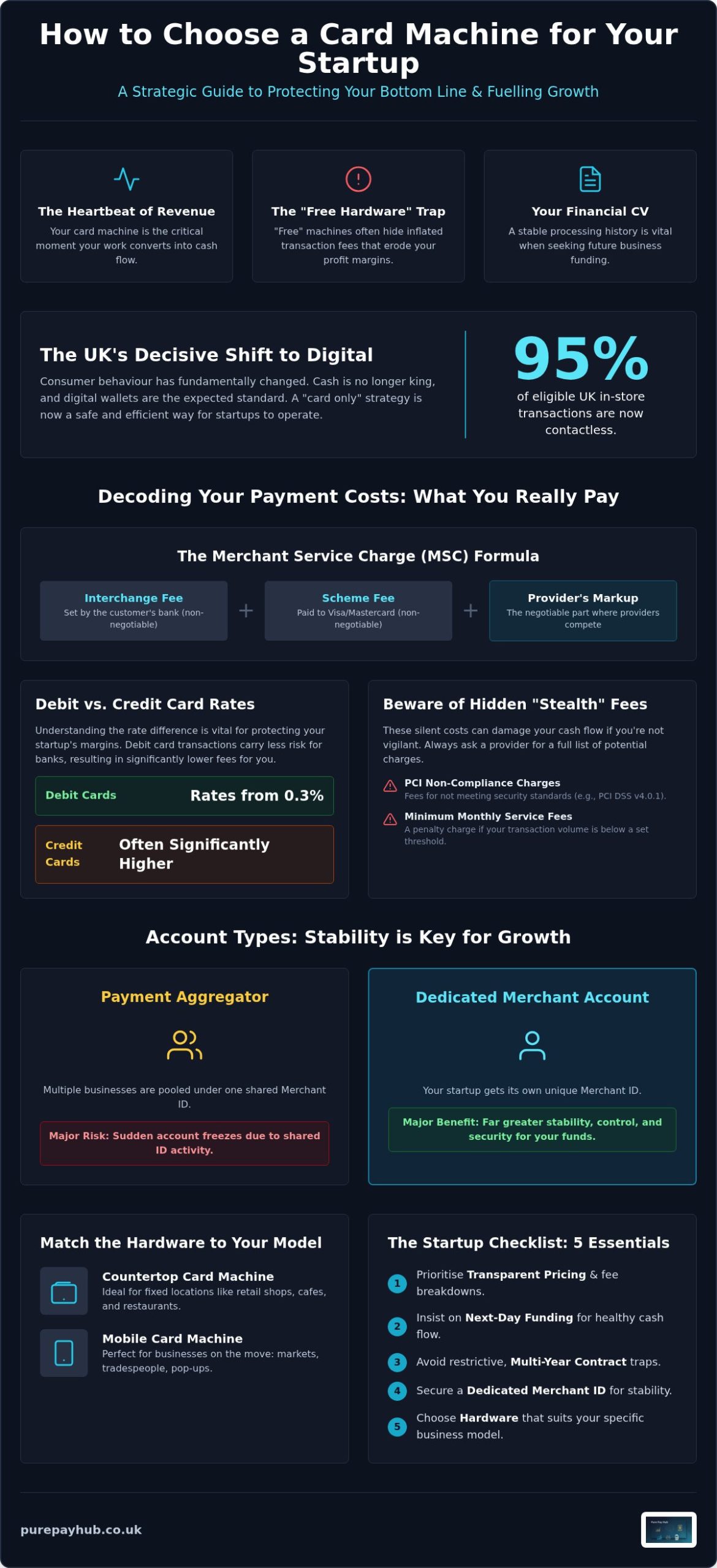
    Your card machine is the heartbeat of your startup’s revenue stream. It represents the exact moment your hard work converts into liquid cash. Many founders treat this as a last-minute errand, but understanding how to choose a card machine for a startup is a vital strategic move. A poor choice doesn’t just look unprofessional; it can actively stifle your growth by locking you into high rates or delaying access to your own money.

    Beware of the “free hardware” lure. In the payments industry, “free” usually means you’ll pay significantly more through inflated transaction fees. These costs eat into your margins every time a customer taps their card. For a new business, those pennies add up to pounds that could have been reinvested in stock or marketing. Beyond the cost, there is a psychological weight to payment reliability. If your machine fails during a peak period, you lose more than a sale; you lose the trust of a first-time customer.

    Your processing history also acts as a financial CV. When you eventually look for a Business Cash Advance or other forms of growth capital, lenders will scrutinise your transaction data. A stable, professional setup shows your business is a reliable prospect for future funding. It demonstrates that you have a disciplined approach to your finances from day one.

    The Shift from Cash to Contactless in the UK

    The UK has moved decisively away from cash. In 2024, nearly 95% of eligible in-store transactions were contactless. Consumer behaviour has shifted toward digital wallets like Apple Pay and Google Pay as a minimum standard. For a startup, a “card only” strategy is no longer a risk; it’s often a safer, more efficient way to operate that reduces the security burden of handling physical cash. Ensuring your Payment Terminal is equipped with the latest NFC technology is essential for meeting these expectations.

    Merchant Accounts vs. Payment Aggregators

    When deciding how to choose a card machine for a startup, you must consider the difference between sharing an ID and having your own. Startups often begin with aggregators because the setup is fast. However, these platforms pool multiple businesses under one Merchant ID, which can lead to sudden account freezes if your sales spike. A dedicated merchant account provides far more stability. PurePay Hub offers this professional stability whilst keeping the onboarding process fast and transparent. By securing your own Merchant ID, you gain more control over your funds and build a resilient foundation for your growing venture.

    Decoding Startup Payment Costs: Rates, Rentals, and Hidden Fees

    Every penny counts during your first year of trading. Understanding the Merchant Service Charge (MSC) is the first step in mastering how to choose a card machine for a startup. This charge is the total percentage you pay on every transaction. It isn’t a single fee, but a combination of three distinct costs: interchange fees, scheme fees, and the provider’s markup. Many traditional banks bundle these together, making it nearly impossible to see where your money is actually going.

    The most significant cost difference you’ll notice is between debit and credit cards. Debit card rates can start as low as 0.3%, whilst credit cards are often significantly higher. This is because debit transactions carry less risk for the banks; the money is already in the customer’s account. Before signing any contract, it’s wise to review the standard steps to accept card payments to ensure you aren’t skipping vital security or registration requirements that could inflate these rates later.

    Stealth fees are the silent killers of startup cash flow. You might encounter PCI non-compliance charges if you don’t keep up with the latest v4.0.1 security standards. Some providers also enforce a “minimum monthly service fee.” If you don’t process enough transactions to meet their threshold, they’ll charge you the difference anyway. Whilst you compare these structures, consider how a transparent pricing model can simplify your monthly overheads and keep your margins predictable.

    Interchange Fees and Scheme Fees Explained

    Interchange fees are set by the card issuer (the customer’s bank), whilst scheme fees are paid to the card brand, such as Visa or Mastercard. These are non-negotiable base costs. A trustworthy partner will be open about these “at-cost” rates. If a provider refuses to show you the breakdown between the base rate and their own markup, they’re likely hiding a heavy commission that will hurt your business as it scales.

    The Real Cost of “No Monthly Fee” Models

    Many startups are drawn to providers that offer “no monthly fees” and high flat-rate transaction costs, often around 1.75%. This feels safe when you’re starting out, but the “break-even” point arrives sooner than you think. If your startup processes £5,000 a month, a 1.75% fee costs you £87.50. In contrast, a how to choose a card machine for a startup strategy that includes a small monthly rental and a 0.3% debit rate could save you over £50 every single month. Those savings are better spent on your own growth than on a processor’s bottom line.

    Choosing the Right Hardware for Your Startup Business Model

    The physical environment of your business dictates your technical requirements. A coffee shop in a busy city centre has vastly different needs compared to a plumber working from a van. When researching how to choose a card machine for a startup, you must first map out your customer’s journey to the payment point. Is the transaction happening at a fixed counter, or are you bringing the machine to a table? Your choice here affects everything from transaction speed to the perceived legitimacy of your brand.

    For hospitality ventures, integrated EPOS Systems are a non-negotiable requirement. These systems sync your sales data with your inventory and accounting software in real-time. This level of integration prevents human error and saves hours of manual reconciliation at the end of the day. When Choosing the Right Payment Processor, the hardware you select becomes the physical face of your brand. A sleek, heavy countertop unit suggests permanence and reliability, whilst a tiny, plastic mobile reader might not provide the same sense of security for high-value transactions.

    Countertop and Portable Terminals

    A Countertop Card Machine is the bedrock of retail shops and boutiques. These units connect via Ethernet or phone lines, providing unmatched connection stability. They don’t rely on battery life; this makes them perfect for high-volume environments where you can’t afford a device dying mid-afternoon. If your business requires movement within a fixed premises, a Portable Card Machine is the logical step. These units use Bluetooth or Wi-Fi to allow for “at the table” payments. They offer the flexibility of movement whilst maintaining a professional, robust appearance that customers recognise and trust.

    Mobile Readers and Virtual Terminals

    How to Choose a Card Machine for a Startup: The 2026 Founder’s Guide

    The Startup Checklist: 5 Essentials Before Signing an Agreement

    Before you put pen to paper, you must look beyond the shiny hardware. Learning how to choose a card machine for a startup involves a deep dive into the small print that affects your daily operations. Your agility as a new business depends on the terms you accept today. Here are the five essentials every founder must verify before committing to a provider.

    • Funding Speed: Your cash flow is your lifeblood. Some providers wait three to five working days to settle your funds. For a new business, this delay is unacceptable. Demand next-day access to your money to keep your stock levels high and your bills paid.
    • Contract Flexibility: Avoid the multi-year trap. Many traditional banks lock you into three-year terms with heavy exit fees. If your business model shifts, you’re stuck. Seek out rolling contracts or short-term agreements that respect your need for flexibility.
    • Onboarding Support: Some platforms claim you can sign up in minutes, but getting your hardware delivered and your account fully verified can take weeks. Ask for a clear timeline on when you’ll actually be taking your first payment.
    • PCI Compliance: This isn’t just a tick-box exercise. It’s a security standard that protects your customers. A partner that manages this for you saves you from the stress of monthly non-compliance fines.
    • Technical Support: When your machine stops working on a busy Saturday afternoon, a chatbot won’t help. You need to speak to a human expert immediately whilst your customers are waiting.

    Security and Compliance for New Founders

    PCI DSS v4.0.1 is the current security gold standard. It ensures that every transaction is encrypted from end to end. If you don’t meet these requirements, you face significant financial penalties. A professional provider will guide you through the compliance process, turning a complex technical hurdle into a simple, manageable task. This protection preserves your reputation and maintains your favour amongst your first customers.

    Integration and Future-Proofing

    Your card machine shouldn’t be an island. It needs to talk to your accounting software and your EPOS Systems. Real-time reporting allows you to track your early growth without manually entering data into spreadsheets. Choosing a scalable system now prevents a painful and expensive migration once your transaction volume increases. Ready to secure a partner that values your cash flow as much as you do? Explore our transparent merchant services and get your startup live with next-day funding.

    Scaling Your Venture with PurePay Hub’s Transparent Solutions

    Traditional banks often view new ventures with suspicion, hiding high rates behind complex corporate jargon. PurePay Hub is the straight-talking alternative. We prioritise clarity and fairness because we know that a startup’s success depends on predictable overheads. When you’re deciding how to choose a card machine for a startup, you need a partner that advocates for your growth rather than one that merely provides a piece of hardware. We position ourselves as a supportive ally to the local merchant community.

    Our 0.3% debit rates provide an immediate boost to your margins. In the early stages of a business, every saved pound is capital you can use to hire your first employee or expand your product line. We don’t believe in the murky markups used by traditional competitors. Instead, we offer a modern fintech experience that keeps its focus on the individual business owner. This transparency builds the trust necessary for a long-term professional partnership.

    Next-Day Funding: The Startup Lifeline

    Waiting three to five working days for your money to clear is a relic of a slower era. In 2026, your supply chain moves fast. You need your revenue available to restock inventory or settle urgent invoices immediately. PurePay Hub’s quick settlement ensures your cash flow remains fluid and your momentum never stalls. Next-day funding is the standard for modern UK merchant services.

    Unlocking Capital with Business Cash Advances

    Scaling a business often requires a sudden injection of capital. Whether you need to fund a marketing push or buy stock in bulk, a Business Cash Advance offers a flexible solution. Unlike traditional loans, this is unsecured capital based on your card turnover. You repay the advance as a small, agreed percentage of your daily card sales. This means your repayments always stay in proportion with your actual income.

    This model is particularly safe for seasonal startups. If you have a quiet week, your repayments automatically reduce. It’s a supportive way to grow that mirrors the actual performance of your venture. Our UK-based support team is here to guide you through every step of this process, providing the expert partnership your startup deserves. Understanding how to choose a card machine for a startup is just the beginning of our journey together. We are ready to help you scale with confidence and clarity.

    Get your startup started with a PurePay Hub card machine today.

    Secure Your Startup’s Financial Future Today

    Choosing your payment partner is one of the most significant hurdles you’ll face as a new founder. By prioritising funding speed and transparent fee structures, you protect your business’s ability to scale without being weighed down by predatory costs. Mastering how to choose a card machine for a startup isn’t just about selecting a device; it’s about building a resilient revenue stream that works as hard as you do. You now understand that “free” hardware often masks expensive transaction rates and that next-day funding is essential for maintaining a healthy supply chain.

    We believe in a straight-talking approach that puts the business owner first. With debit rates from 0.3% and next-day funding as standard, we ensure your hard-earned money stays where it belongs: in your bank account. Our no-nonsense UK-based support team acts as a reliable expert to help you navigate any technical challenges whilst you focus on growth. Join the UK startups choosing transparency with PurePay Hub and take control of your payments from day one. Your ambition deserves a partner that values clarity over complexity. We are ready to help you turn your vision into a thriving, profitable reality.

    Frequently Asked Questions

    How long does it take to set up a card machine for a new business?

    You can typically expect your card machine to be live and ready for use within three to five working days. This timeframe includes the necessary security checks and the physical delivery of your hardware. Whilst some providers claim near-instant setup, these often lack the stability of a dedicated merchant account. We prioritise a thorough but efficient onboarding process to ensure your business is protected and compliant from day one.

    Can I get a card machine if I have a poor credit history as a founder?

    Yes, a poor credit history doesn’t automatically disqualify you from accepting card payments. Merchant service providers focus primarily on the risk associated with your business model rather than just your personal credit score. You might find that some providers require a rolling reserve or slightly different terms initially. We look at the potential of your venture and provide a fair assessment based on your projected transaction volumes and business type.

    Is it cheaper to buy or rent a card payment terminal?

    Renting is often the more cost-effective choice for startups because it includes ongoing technical support and automatic hardware upgrades. Buying a device outright involves a larger upfront cost and leaves you responsible for repairs or replacements if the technology becomes obsolete. When deciding how to choose a card machine for a startup, consider that rental models often provide better long-term value through inclusive maintenance and security updates.

    What documents do I need to provide for a startup merchant account?

    You will generally need to provide valid photo identification, proof of your home address, and a recent business bank statement. If you’ve incorporated, you’ll also need your Companies House registration details. These documents help providers verify your identity and ensure your business is legitimate. Providing clear, digital copies of these files during your application will significantly speed up the verification process and get you trading sooner.

    Do I need a separate business bank account for my card machine payments?

    Yes, having a dedicated business bank account is essential for maintaining clear financial records and is a requirement for most professional merchant services. It ensures that your business revenue is never blurred with your personal finances, making tax returns and accounting much simpler. Using a separate account also builds a professional profile for your startup, which is vital when you eventually seek further business funding or growth capital.

    Can my startup take payments over the phone or via email links?

    You can easily accept payments remotely using a Virtual Terminal or secure Payment Links. A Virtual Terminal turns your computer or tablet into a card reader for phone orders, whilst Payment Links allow you to send a secure checkout page directly to a customer via email or social media. These tools are perfect for startups that don’t always interact with their customers in a face-to-face retail environment or those offering remote consultations.

    What happens if my Wi-Fi goes down during a transaction?

    Most modern machines, such as a Mobile Card Machine, feature a built-in SIM card that automatically switches to a 4G mobile network if your Wi-Fi fails. This ensures you never miss a sale due to a poor internet connection. If you’re using a fixed Countertop Card Machine, having a backup mobile hotspot or choosing a device with dual-connectivity is a smart way to protect your revenue during local technical outages.

    Are there any hidden exit fees if my startup needs to switch providers?

    Some traditional providers hide steep cancellation charges in the small print of long-term contracts. It’s crucial to check for these fees before you sign any agreement. We advocate for contract flexibility, offering rolling agreements that don’t trap you if your business needs change. When researching how to choose a card machine for a startup, always prioritise providers that allow you to leave without facing punitive financial penalties or complex notice periods.

  • Card Machine Lease Agreement Pitfalls: A UK Merchant’s Survival Guide (2026)

    Card Machine Lease Agreement Pitfalls: A UK Merchant’s Survival Guide (2026)

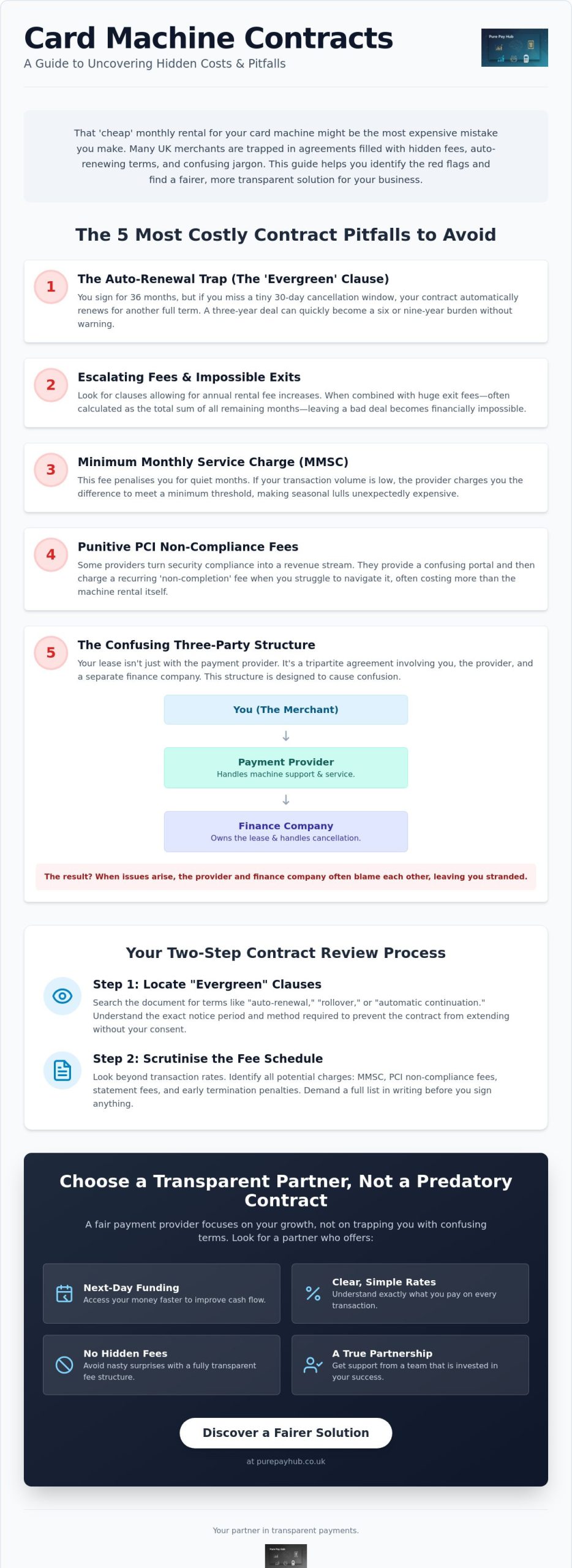
    The cheapest monthly rental price on your screen today might actually be the most expensive mistake your business makes this year. Many UK merchants sign contracts believing they’ve secured a bargain, only to discover that card machine lease agreement pitfalls are hidden deep within the small print. You likely feel frustrated by unexpected monthly fees or the realisation that you can’t cancel without facing a massive penalty. It’s a common experience in an industry that often thrives on complexity and opaque terms.

    We believe you deserve a partner, not a distant financial institution. This guide will help you identify red-flag clauses, understand the true total cost of ownership, and avoid predatory fees that drain your hard-earned margins. We’ll break down the jargon so you can secure a fair deal for your payment hardware. We’re going to explore how to spot transparent alternatives that prioritise your business growth over restrictive contracts.

    Key Takeaways

    • Identify the most common card machine lease agreement pitfalls, including auto-renewal traps that can double your contract length without warning.
    • Learn how to calculate the total cost of ownership to avoid paying for hardware that becomes obsolete before your lease ends.
    • Master a two-step review process to locate hidden “Evergreen” clauses and non-standard fees in any merchant service contract.
    • Understand why the lure of low upfront costs often leads to higher long-term expenses through hidden minimum monthly charges.
    • Discover how a transparent partner provides next-day funding and clear rates whilst avoiding the industry’s usual jargon.

    The Reality of Card Machine Lease Agreements in the UK

    Signing a contract for a new payment terminal often feels like a quick win for a busy business owner. You need to accept card payments; the provider offers a sleek machine for a small monthly fee. It seems straightforward. However, this simplicity is often a facade. Most UK merchants aren’t just renting a piece of kit. They are entering a rigid financial commitment that can last for years. This initial lack of clarity is exactly how many card machine lease agreement pitfalls begin to take root.

    The “Low Upfront Cost” lure is particularly effective at blindsiding entrepreneurs. When you’re managing staff, stock, and daily operations, a low entry price looks like a smart way to protect your cash flow. It’s a calculated tactic used by many traditional providers. They lead with the hardware price whilst burying the long-term cost in the fine print. At PurePay Hub, we believe your payment hardware should be a tool for growth. It should never be a weight that stifles your business with hidden markups or restrictive terms.

    Why Leases are Common Amongst UK SMEs

    Leasing is a frequent choice because it allows businesses to access the latest countertop or portable technology without a large capital outlay. This helps you keep your funds available for more urgent needs, such as seasonal stock or payroll. Independent Sales Organisations (ISOs) usually facilitate these deals. They act as a bridge between the merchant and the technology. Whilst a 36-month term is often sold as the “standard” industry duration, the reality is that these contracts can be incredibly difficult to exit if your business model evolves or if you find a better service elsewhere.

    The Three Parties Involved in Your Contract

    One of the most confusing aspects of these agreements is that they involve more than two people. A lease is a tripartite agreement involving the merchant, the payment provider, and a third-party finance company. This structure is the root cause of many support and cancellation frustrations. If the machine breaks, you call the provider. If you want to cancel the contract, you have to deal with the finance house. This separation often leads to a cycle of finger-pointing that leaves the business owner stranded. Understanding that you are essentially taking out a loan to pay for the equipment is the first step toward avoiding common card machine lease agreement pitfalls.

    The 5 Most Costly Pitfalls in Merchant Service Contracts

    Contractual fine print is where many businesses lose their hard-earned profit. One of the most aggressive card machine lease agreement pitfalls is the ‘Auto-Renewal’ trap. You might sign what you believe is a 36-month deal, but if you don’t cancel within a specific 30-day window, the contract often rolls over for another full term. It’s a predatory cycle that can turn a short-term commitment into a decade-long burden. Many merchants only realise they are trapped when they try to switch providers, only to be told they missed their notice window by a single day.

    Additionally, keep a sharp eye out for clauses that allow for annual rental fee increases. These escalating fees often fly under the radar during the initial sales pitch. When combined with exit fees, which are often calculated as the total sum of all remaining months in the lease, leaving a bad deal becomes financially impossible. Aligning your contract with the Crown Commercial Service guidance on merchant services can help you understand the standard components you should expect, rather than these hidden extras. These hidden costs are why understanding card machine lease agreement pitfalls is vital before you put pen to paper.

    The Minimum Monthly Service Charge (MMSC) Explained

    The MMSC is a common fee that catches seasonal businesses off guard. It sets a minimum floor for transaction fees. If your monthly card volume is low and your processing fees don’t reach this threshold, the provider charges you the difference. This essentially penalises you for having a quiet month or taking a holiday. For a small gift shop or a seaside cafe, this can make winter months significantly more expensive than they need to be. When reviewing new agreements, try to negotiate a zero-MMSC term to ensure you only pay for what you actually use.

    PCI DSS Compliance and Non-Completion Fees

    Every UK business must be PCI compliant to protect customer data. However, some providers treat this as a recurring revenue stream rather than a security measure. They might provide a complex, confusing portal for compliance and then charge a monthly ‘non-completion’ fee when you struggle to navigate it. These fees can quickly add up, often costing more than the actual rental of the machine. We take a different approach at PurePay Hub, providing proactive support to ensure you stay compliant without the stress of recurring fines. We believe in building partnerships based on clarity, not penalties.

    Calculating Total Cost of Ownership: Lease vs. Buy vs. Rental

    Choosing how to acquire your payment hardware is a balancing act between upfront capital and long-term commitment. Whilst the initial price tag is important, the true cost of ownership includes transaction rates, monthly subscriptions, and the eventual cost of replacement. Many business owners overlook the reality that card machines are essentially specialised computers. Like any computer, they require regular updates and eventually become obsolete. This is where many card machine lease agreement pitfalls become painfully clear; you might find yourself paying for a device that is technically out of date long before the contract ends.

    A typical lease might look attractive because it spreads the cost of high-end hardware over several years. However, this often locks you into transaction rates that are higher than the market average. When you add up the monthly lease payments and the inflated processing fees, the total cost often far exceeds the value of the machine. At PurePay Hub, we advocate for a middle ground that provides the latest technology without the predatory strings of a traditional finance deal.

    The Hidden Costs of Owning Your Hardware

    Buying a machine outright is often marketed as the ultimate way to save money. It’s true that you avoid monthly rental fees, but you also take on all the risk. If a countertop machine fails on a busy Saturday morning, you don’t have a ‘swap-out’ service to rely on. You have to buy a new one and wait for delivery, losing sales in the meantime. Additionally, security standards like P2PE and NFC evolve rapidly. A machine purchased today might not support the security requirements or payment methods of 2029. Without a managed service, you’re responsible for every repair and every firmware update, which can lead to your hardware becoming an expensive paperweight.

    The Rental Alternative: Flexibility and Support

    Our rental model is designed to offer the stability of a managed service with the flexibility that modern businesses need. We provide clear monthly costs that include ongoing technical support and hardware maintenance. This means if your portable card machine develops a fault, we handle the resolution so you can focus on your customers. Having your hardware and merchant account managed under one roof simplifies your operations and removes the friction often found in tripartite leases. We also provide next-day access to funds, ensuring your cash flow remains as healthy as your technology. It’s a transparent approach that avoids common card machine lease agreement pitfalls by putting your business needs first.

    Card Machine Lease Agreement Pitfalls: A UK Merchant’s Survival Guide (2026)

    How to Review a Card Machine Contract Before Signing

    Reviewing a contract is your final line of defence. Do not rely on verbal promises from a sales representative. Instead, conduct a systematic audit of the physical or digital document. The first step is to locate the ‘Term and Termination’ clause. Look specifically for ‘Rolling’ or ‘Evergreen’ language. These terms often indicate that your contract will renew automatically for another full term unless you cancel within a tiny, specific window. This is a classic example of card machine lease agreement pitfalls that catch busy merchants off guard.

    Next, scrutinise the ‘Schedule of Fees’. Sales pitches often focus on the headline transaction rate whilst ignoring authorisation and statement fees. These small charges add pennies to every transaction; they can significantly impact your monthly margins. Demand a written confirmation of the total monthly cost, including every ‘extra’ service like premium support or reporting tools. Finally, check the notice period. A 30-day notice period is fair and standard. If you see a 12-month notice requirement, treat it as a massive red flag and consider looking elsewhere.

    Red Flag Phrases to Spot in the Fine Print

    Keep an eye out for ‘Liquidated Damages’. This legal phrase means you might be liable for the full remaining value of the contract if you try to leave early. You should also watch for ‘Variation of Terms’ clauses. These allow providers to increase your rates without your consent whilst keeping you locked into the agreement. It’s also vital to verify if the contract is an ‘exclusive’ or ‘non-exclusive’ agreement. An exclusive deal prevents you from using any other provider, even if your current service fails or becomes too expensive.

    Questions to Ask Your Sales Representative

    Before you sign, ask direct questions and ensure the answers match the written contract. Does the provider charge a ‘restocking fee’ if you return the equipment? Are your rates ‘blended’ or based on ‘Interchange Plus Plus’? Blended rates are simpler but often more expensive for larger businesses. Finally, ask what happens if your business closes or is sold. A fair partner will have a clear, reasonable exit strategy that doesn’t involve bankrupting you. If you want a contract that values transparency over traps, request a clear quote from PurePay Hub today. We provide straightforward terms designed to support your business, not trap it.

    Choosing a Transparent Payment Partner for Your Business

    Finding a partner that values your success is the best way to move past the frustration of traditional banking. At PurePay Hub, we prioritise a no-nonsense approach to merchant services. We don’t believe in hiding behind complex jargon or confusing fee structures. Instead, we offer competitive debit rates starting at 0.3% and provide next-day funding as standard. This ensures your capital stays in your business where it can do the most good. By moving away from the common card machine lease agreement pitfalls, you can establish a foundation for long-term growth and stability.

    Our integrated EPOS systems are designed to do more than just process payments. They help you organise your business behaviour by providing clear insights into your sales patterns and inventory levels. This level of efficiency is often missing from basic lease deals that only provide the hardware without the supporting ecosystem. We provide the tools you need to run a modern, data-driven business whilst keeping your costs transparent and predictable. We believe a partnership should be built on trust; not restrictive small print.

    The PurePay Hub Difference: Calm Advocacy

    We act as a supportive ally for regional business owners in a market that is often crowded and confusing. Our commitment to honesty and integrity means we won’t trap you in a deal that doesn’t fit your needs. If you’re currently stuck in a restrictive contract, we can help you switch providers whilst navigating the common exit fee traps that traditional finance houses use. We also understand that growth sometimes requires a capital boost. Our business cash advance offering supports your cash flow without the burden of fixed monthly interest, allowing you to repay as you earn. It is a flexible solution for a modern economy.

    Next Steps: Getting a Fair Quote

    Securing a better deal starts with a clear understanding of your current costs. To prepare for an honest comparison, gather your most recent merchant statements. We will help you look past the headline rates to see the true total cost of ownership. Onboarding with a partner that values clarity over jargon is a straightforward process. We handle the technicalities so you can focus on serving your customers. Get a transparent quote from PurePay Hub today and experience a partnership built on trust and reliability. We are here to help you avoid card machine lease agreement pitfalls for good.

    Take Control of Your Payment Hardware

    You now have the tools to navigate the complex world of merchant services with confidence. By identifying auto-renewal traps and scrutinising the fine print for hidden charges, you’ve already taken the most important step toward protecting your margins. Avoiding card machine lease agreement pitfalls isn’t just about saving money; it’s about ensuring your business remains agile and unburdened by restrictive, long-term debt. Your hardware should be a catalyst for growth, not a source of constant frustration.

    We believe that fairness should be the industry standard. That’s why we offer a transparent alternative that puts your needs first. With debit card rates from 0.3%, next-day access to your funds, and a complete absence of opaque fee structures, we provide a stabilising force for your finances. You don’t have to settle for a contract that feels like a trap. Switch to a fairer deal with PurePay Hub and experience the difference of a partnership built on integrity. Your business deserves a partner that works as hard as you do.

    Frequently Asked Questions

    How do I get out of a card machine lease agreement early?

    Terminating a lease early usually requires paying a settlement figure, which often equals the total sum of all remaining monthly payments. You must check your contract for a specific ‘buy-out’ clause or cancellation fee. Always provide your written notice within the required window, typically 30 days before the contract is due to renew. If you are struggling with a restrictive deal, some transparent providers can help you navigate the exit process safely.

    What is the standard length for a card machine contract in the UK?

    Card machine contracts in the UK are typically 12 to 18 months in length. However, some providers may offer longer terms of up to 36 or 48 months to lower the headline monthly rental cost. Whilst a longer deal might seem attractive for your cash flow, it increases the risk of being stuck with obsolete hardware. Always confirm the initial term and the notice period required to prevent an automatic rollover.

    Are there hidden fees in every card machine lease?

    Not all agreements contain hidden fees, but many traditional contracts include non-standard charges that aren’t highlighted during the sales process. You should look for authorisation fees, statement fees, and minimum monthly service charges (MMSC). These are common card machine lease agreement pitfalls that can quietly drain your profits. Choosing a partner that values clear, honest pricing is the best way to avoid these unexpected costs and protect your margins.

    Can I switch card machine providers if I am still in a lease?

    Yes, you can switch your payment processing to a new provider whilst still being tied to a hardware lease. Since the lease is often a separate tripartite agreement with a finance house, it doesn’t always end when you move your merchant account. You can continue to pay the monthly rental for your existing equipment whilst benefiting from the fairer transaction rates and better service of a new, transparent payment partner.

    What happens to the card machine if my business closes?

    Closing your business doesn’t usually terminate the financial obligation of a lease. Most finance companies expect the remaining balance of the contract to be paid in full as a ‘liquidated damages’ settlement. It’s vital to check if you signed a personal guarantee, as this could make you personally responsible for the debt even if your limited company is dissolved. Always discuss your situation with your provider to see if they offer any flexibility.

    Is it better to lease or buy a card machine for a new small business?

    Buying a machine outright for £20 to £180 is often best for very small businesses with lower transaction volumes. However, leasing or renting becomes more beneficial for businesses with a monthly turnover above £8,000, as it provides access to lower transaction rates and included technical support. Renting offers a flexible middle ground, giving you the security of a managed service without the long-term debt of a traditional lease agreement.

    Why is my merchant statement higher than the agreed transaction rate?

    Your statement total is often inflated by authorisation fees, PCI non-compliance penalties, or higher rates for international and business cards. Domestic interchange fee caps of 0.2% for debit and 0.3% for credit only apply to UK-issued consumer cards. If you process many cross-border transactions, your costs will naturally be higher. Reviewing each line item helps you identify where hidden markups might be affecting your final bill every month.

    What is a non-compliance fee and why am I being charged it?

    A non-compliance fee is a penalty for not completing your annual PCI DSS security assessment. Every UK merchant must prove they handle card data securely to protect their customers. Some providers make this process confusing and then profit from the resulting fines. We take a different approach, providing proactive support to help you stay compliant. This ensures your business is secure whilst avoiding the stress of recurring, unnecessary penalties.

  • Card Machine Rental vs Buying in the UK: The 2026 Merchant Guide

    Card Machine Rental vs Buying in the UK: The 2026 Merchant Guide

    That “low-cost” card reader you bought outright might actually be the most expensive piece of kit in your shop. Many UK business owners choose to buy hardware to avoid monthly fees, only to find themselves stuck with obsolete tech when security regulations shift. When weighing up card machine rental vs buying UK, the right choice depends on more than just the initial price tag. You’ve likely felt the sting of hidden markups or the frustration of a long-term contract that feels like a trap. We believe in a no-nonsense approach that puts clarity and honesty first.

    You deserve a payment setup that supports your growth instead of holding it back. This guide will show you how to calculate the best value for your business by comparing total costs, contract flexibility, and ongoing technical support. We’ll explore how the 2026 removal of the £100 contactless cap and mandatory PCI DSS v4.0 compliance impact your hardware choice. You’ll gain the confidence to decide whether a mobile card machine you own or a countertop terminal you rent offers the fairest deal for your till.

    Key Takeaways

    • Understand how the rapid shift to a cashless society and strict security regulations make your choice of hardware a critical business decision.
    • Learn how to calculate the true break-even point in the card machine rental vs buying UK debate to ensure your payment setup remains profitable as volume grows.
    • Discover why rental models often suit established businesses by bundling technical support and automatic upgrades to prevent hardware obsolescence.
    • Evaluate the freedom of the pay-as-you-go model for smaller ventures, where owning your device removes monthly overheads during quieter periods.
    • Find out how PurePay Hub provides transparent, jargon-free merchant services that balance high-quality hardware with fair, sustainable transaction rates.

    Understanding the UK Card Payment Landscape in 2026

    British consumers have largely moved away from physical coins and notes. By late 2025, contactless payments accounted for 76% of all debit card transactions in the UK. This isn’t just a trend; it’s the new standard for every high street shop and local cafe. The Payment Systems Regulator (PSR) has recently enforced stricter rules on contract transparency. These changes prevent merchants from being trapped in long-term, opaque agreements that don’t serve their interests. This regulatory shift makes the debate of card machine rental vs buying UK more relevant than ever. You now have more power to choose a path that truly fits your business model.

    Your decision between ownership and a managed service directly impacts your daily cash flow. Buying hardware outright requires an immediate capital outlay. That money might be better spent on stock, staff, or marketing. Rental models spread this cost into predictable monthly payments. At PurePay Hub, we believe in a no-nonsense approach to these costs. A managed service often includes support and maintenance, providing a stabilising force for your finances. Whether you need a countertop card machine or a mobile unit, your choice will dictate how smoothly your till operates during the busiest periods.

    The Evolution of Card Machines

    The days of clunky, dial-up hardware are gone. Modern businesses now rely on integrated smart terminals that do much more than just process a transaction. If you’re interested in the technical background, you can explore what is a payment terminal to see how these devices have evolved from basic swipe tools into high-speed computers. Digital wallet adoption is soaring. In 2024, 57% of UK adults were registered for a mobile wallet. For a growing SME, a basic card reader might feel restrictive. You need a device that handles inventory, integrates with your EPOS, and processes Apple Pay or Google Pay instantly.

    Regulatory Standards and Security

    Security is a non-negotiable part of modern trade. As of March 31, 2025, every UK merchant must be fully compliant with PCI DSS v4.0 standards. This update introduced mandatory multi-factor authentication and more frequent vulnerability scanning. Staying compliant is a significant burden if you own your hardware. You’re responsible for every software patch and security update. Managed rental services simplify this. They often automate these security requirements, ensuring your terminal is always up to date. The Financial Conduct Authority (FCA) oversees the industry to ensure fairness, but the practical task of protecting cardholder data remains your responsibility. A managed service acts as a reliable partner in this process.

    The Case for Card Machine Rental: Managed Services and Support

    Choosing a rental model is often about more than just avoiding an initial purchase price. It is a strategic decision to prioritise business continuity. When you compare card machine rental vs buying UK, the most immediate benefit is the preservation of your capital. Instead of spending hundreds of pounds on hardware, you keep that cash for stock or marketing. This approach turns a lumpy capital expense into a predictable, fixed monthly operating cost. It simplifies your bookkeeping and ensures there are no nasty surprises when a device needs replacing.

    Technology in the payments industry moves at a relentless pace. A machine that is top-of-the-range today might struggle with new security protocols or software updates in two years. Rental agreements solve this problem by offering continuous hardware upgrades. You aren’t stuck with obsolete kit that slows down your service. Instead, your provider ensures your terminal remains compliant with the latest UK Payment Services Regulations. This peace of mind is invaluable for busy merchants who don’t have time to track regulatory shifts.

    Hardware Maintenance and Swap-Out Services

    Downtime kills profit. Imagine your card terminal failing on a busy Saturday afternoon whilst a queue of customers waits. If you own the device, you’re responsible for the repair or the cost of a new unit. With a managed rental service, technical support is part of the package. Most professional contracts include a swap-out service where a faulty machine is replaced within one business day. The cost of a single day of lost sales often far outweighs a year of rental fees. A reliable portable card machine from a managed provider acts as an insurance policy for your revenue.

    Software Updates and Remote Management

    Modern payment terminals are sophisticated computers that require regular maintenance. Managed rental services handle automatic security patching and feature updates remotely. This is particularly useful if you manage multiple terminals across different sites. You can ensure every device is running the same software version without manual intervention. These systems also offer seamless integration with cloud-based EPOS systems. This connectivity allows for real-time reporting and better inventory management. By choosing a managed path, you delegate the technical headaches to experts, allowing you to focus on serving your customers and growing your brand.

    Card Machine Rental vs Buying in the UK: The 2026 Merchant Guide

    Buying Outright: Ownership, Flexibility, and Pay-As-You-Go

    Buying your hardware outright feels like the ultimate freedom for many new ventures. You pay for the device once and it’s yours. There are no monthly rental fees to worry about during a slow month. This “pay-as-you-go” model is particularly attractive for micro-businesses or seasonal traders who only need to process payments occasionally. Onboarding is typically fast and digital, letting you start taking cards within days. However, when evaluating card machine rental vs buying UK, the initial purchase price is often a distraction from the true cost of doing business.

    The real expense isn’t the plastic and silicon in your hand; it is the transaction rate attached to it. Most “buy-only” providers use a flat-rate fee structure. Whilst this is simple to understand, it is rarely the most cost-effective path for a growing merchant. As your volume increases, those higher flat rates eat into your margins far more than a modest monthly rental fee would. You are essentially trading a low monthly overhead for a permanent tax on your growth. This is the “Total Cost of Ownership” trap that many small businesses fall into during their first year of trade.

    The Hidden Costs of Ownership

    Ownership brings a level of responsibility that can be stressful during peak times. If your owned terminal stops working, you are the one who pays for the fix. Batteries eventually lose their capacity, and screens can crack during a busy shift. Unlike a managed service, there is no “next-day swap” included in your purchase price. You’ll either pay for an out-of-warranty repair or buy a whole new unit, all whilst losing sales in the meantime. There is also the risk of technical obsolescence. As network standards shift or security requirements tighten, an owned device can quickly become a paperweight that you cannot upgrade without buying a new one.

    Transaction Fee Structures for Owned Devices

    Simplicity often comes at a premium. Flat-rate providers usually charge significantly more per transaction than traditional merchant accounts. They don’t offer bespoke pricing for high-volume traders because their model relies on a “one size fits all” approach. According to recent UK Payment Market Trends, the dominance of debit cards and contactless payments means your transaction volume will likely grow faster than you expect. For a busy retail or hospitality environment, the “Interchange-plus” models typically found with managed services are almost always cheaper than the flat rates found on owned devices. You must decide if the lack of a monthly fee is worth the long-term drain on your profits.

    The Decision Matrix: Which Model Suits Your Business?

    Choosing between card machine rental vs buying UK shouldn’t be a guessing game. It requires a cold, hard look at your growth trajectory rather than just your current bank balance. Many small business owners make the mistake of choosing a payment setup based on where they are today. A smarter approach is to choose based on where you plan to be in twelve months. If your monthly turnover is climbing, those “no-fee” readers with high transaction rates will quickly become a heavy tax on your success. You need a model that scales with you, not one that penalises your hard work.

    The break-even point is the most critical metric in this decision. For micro-businesses processing very low volumes, buying a basic reader often makes sense. However, once your sales reach a consistent level, the lower transaction rates offered by managed rental accounts usually offset the monthly fee. This transition is a hallmark of a maturing business. It marks the shift from a “side hustle” mentality to a professional operation that values efficiency and long-term profit over short-term savings.

    High-Volume vs. Low-Volume Merchants

    High-volume businesses almost always find better value in a rental model. Traditional merchant accounts often provide “Interchange-plus” pricing, which is significantly more transparent than the flat rates found on bought devices. Seasonal businesses, like Christmas markets or summer festivals, might prefer the “pay-as-you-go” flexibility of an owned device. But if you find yourself processing payments every day, it’s time to consider a managed terminal. Moving from a bought reader to a professional setup is simpler than you think and can save you hundreds of pounds in transaction fees over a single year.

    Sector-Specific Requirements

    Your industry dictates your hardware needs. In hospitality, you need robust, portable card machines that can handle a full shift on one charge and integrate seamlessly with your EPOS system. Retailers, on the other hand, prioritse countertop reliability and blistering checkout speeds to keep queues moving. For mobile services like plumbers or electricians, 5G connectivity is the 2026 standard. You can’t afford to stand on a doorstep waiting for a 3G signal that no longer exists. Modern rental units now include biometric security, such as fingerprint or facial recognition, ensuring that high-value transactions are as secure as possible. This level of tech is rarely found on entry-level readers you buy outright. Future-proofing your business means choosing a partner who provides the latest hardware as standard.

    PurePay Hub: Transparent Solutions for UK Merchants

    PurePay Hub acts as a stabilising force for your business finances. We understand that the debate over card machine rental vs buying UK often leaves merchants feeling skeptical and frustrated. Our approach removes the guesswork by balancing high-grade hardware with industry-leading transaction rates. We don’t believe in the opaque pricing models used by traditional banks. Instead, we offer a no-nonsense service that prioritises your profit margins and operational efficiency.

    Cash flow is the lifeblood of any regional business. Waiting days for your funds to clear is a burden you shouldn’t have to carry in 2026. We provide next-day funding as standard to ensure your revenue is available when you need it most. This commitment to speed extends to our support. We provide a modern fintech experience without losing the personal touch that local business owners value. Whether you are using a countertop card machine or our online payment gateway, our systems are designed to keep your trade moving without interruption.

    We support your long-term growth with a suite of integrated tools. Our EPOS Systems provide the deep insights you need to manage inventory and staff effectively. If you need to expand or refurbish your premises, our Business Cash Advance offers a fair and flexible way to access capital based on your card turnover. We are more than just a terminal provider; we are a dedicated partner in your business development.

    A Partnership Approach to Payments

    We treat every merchant as a long-term ally rather than a distant account number. Our fee structure is built on a foundation of honesty and integrity. You will never find hidden markups or surprise “admin fees” in our statements. This transparency is a core identity of the PurePay Hub brand. If you ever run into a technical snag, you won’t be directed to an automated chatbot. You’ll have access to UK-based support experts who understand the local market and can provide decisive resolutions quickly.

    Getting Started with PurePay Hub

    Moving your payment processing to a fairer provider is a simple, stress-free process. Our onboarding is designed for efficiency, taking you from your initial enquiry to taking live payments with minimal fuss. We help you customise your setup to match your specific trade environment. You can choose from a range of hardware options to suit your needs:

    • Countertop Card Machine: Ideal for fixed retail points and fast-paced checkouts.
    • Portable Card Machine: Perfect for hospitality businesses serving customers at tables.
    • Mobile Card Machine: The standard for tradespeople and mobile services requiring 5G connectivity.

    You deserve a payment partner that values your business as much as you do. Take the first step toward a more transparent and supportive merchant service today. Get a transparent quote from PurePay Hub today.

    Secure Your Business Future with a Smarter Payment Strategy

    The choice between ownership and rental isn’t just about a one-off payment. It’s about ensuring your till never stops ringing during a busy Saturday. We’ve explored how the card machine rental vs buying UK decision impacts your long-term margins and technical resilience. Owning a device might offer a quick start for a side hustle. However, a managed service provides the security of automatic updates and hardware that never goes obsolete. Your business deserves a setup that’s as modern and dependable as the service you provide.

    You don’t have to tolerate the stress of hidden markups or opaque fee structures. We focus on clarity and fairness. With debit card rates starting from 0.3% and next-day access to your funds, we help you keep your cash flow healthy and your finances stable. Take control of your processing costs and build a partnership that actually supports your growth. It’s time to move away from distant financial institutions and work with a local expert who values your success.

    Switch to a fairer way of taking payments with PurePay Hub

    Frequently Asked Questions

    Is it cheaper to rent or buy a card machine in the UK?

    The answer depends on your monthly transaction volume and your need for technical support. Buying a machine often has a lower upfront cost, but it usually comes with higher transaction fees that can eat into your profits. Renting a machine typically offers lower rates and included maintenance, making it more cost-effective as your sales grow. When evaluating card machine rental vs buying UK, you should calculate the total cost of ownership over two years rather than just the initial price.

    What is the average monthly rental cost for a card terminal?

    Monthly rental costs vary based on the specific hardware you choose and the length of your service agreement. These fees generally cover the physical device, mandatory security updates, and access to technical support. You’ll find that a fixed monthly fee provides more stability for your business budgeting than the unpredictable costs of repairing or replacing owned hardware. We recommend requesting a transparent quote to see exactly what is included in your service package.

    Can I switch from buying to renting if my business grows?

    You can certainly upgrade your payment setup as your business matures. Many small traders start with a basic bought reader to keep overheads low during their first few months. Once your turnover reaches a consistent level, switching to a managed rental service allows you to access professional-grade hardware and lower transaction rates. This transition is a logical step for any business that wants to prioritise efficiency and profit as they scale.

    Are there hidden fees in card machine rental contracts?

    Traditional providers often hide extra charges in their contracts, but modern fintech companies are moving toward a no-nonsense approach. The Payment Systems Regulator (PSR) has introduced new rules to ensure UK merchants receive clearer information about their agreements. You should always look for a provider that offers a transparent breakdown of every cost. Avoid contracts that include vague “admin fees” or “PCI management charges” without a clear explanation of the value they provide.

    Do I need a merchant account if I buy my own card reader?

    You always need a merchant account or a payment processing service to accept card payments. Some providers that sell readers outright bundle the hardware and the account together for simplicity. Managed rental services often provide a dedicated merchant account, which can offer more bespoke pricing and better stability for established businesses. This setup ensures that your funds are handled securely and reach your bank account as quickly as possible.

    What happens if my rented card machine breaks?

    Technical support is a core benefit of a managed rental agreement. If your machine fails, your provider will usually troubleshoot the issue remotely or send a replacement unit to your premises. This swap-out service often happens as quickly as the next business day. This minimises downtime and prevents the frustration of turning away customers during a busy shift. If you own your machine, you’re responsible for the cost and delay of a repair.

    How long are typical card machine rental contracts in 2026?

    Contract lengths have become much shorter and more flexible in 2026. You’ll find many agreements now range from 12 to 18 months, which is a significant improvement over the old four-year lock-ins. This shift gives you the freedom to review your payment setup and ensure it still meets your needs as your business evolves. Always check the notice period and exit terms before signing any new agreement.

    Does buying a card machine affect my transaction rates?

    Buying a machine outright often limits you to a flat-rate transaction model, which can be more expensive for high-volume traders. Managed rental services generally provide access to more competitive, variable rates that save you money as your sales increase. Choosing card machine rental vs buying UK is often a trade-off between low monthly overheads and the long-term savings of a professional merchant account. You must decide which model offers the best value for your specific growth trajectory.