
Tag: Payment Terminal

  • Emergency Card Machine Replacement: How to Restore Your Business Payments

    Emergency Card Machine Replacement: How to Restore Your Business Payments

    Imagine it’s a busy Saturday afternoon and your shop is full, but suddenly your terminal displays a “System Tamper” error. Within minutes, a queue forms and you’re forced to tape a “Cash Only” sign to your front door. It’s a nightmare scenario that costs you revenue and reputation. If your current provider is dragging their feet, you need an emergency card machine replacement to get your business back online before the next customer walks away.

    We understand how frustrating it is to feel abandoned by legacy providers when your livelihood is on the line. With nearly 95% of in-store transactions now being contactless, being unable to take card payments is no longer a minor hiccup; it’s a total shutdown. You shouldn’t have to wait days for a resolution or navigate complex onboarding during a crisis. Business owners deserve a partner that acts with the same urgency they do.

    This article will help you secure a rapid replacement terminal and keep your business trading whilst your main system is down. We’ll look at the quickest ways to restore your payments, the importance of modern hardware compatibility, and how a supportive partner can turn a technical disaster into a seamless transition.

    Key Takeaways

    • Learn the immediate troubleshooting steps to take when a terminal fails, from performing hard resets to verifying network-wide outages with your provider.
    • Discover how to keep revenue flowing using a Virtual Terminal or Payment Links whilst your physical hardware is out of action.
    • Understand the timeline for an emergency card machine replacement and why digital onboarding speed is the real bottleneck for most businesses.
    • Identify the key contract features, such as swap-out warranties and UK-based support, that protect your business from future payment disruptions.
    • Compare the slow response times of legacy banks against modern providers that prioritise rapid account activation and next-day hardware delivery.

    Immediate Steps to Take When Your Card Machine Fails

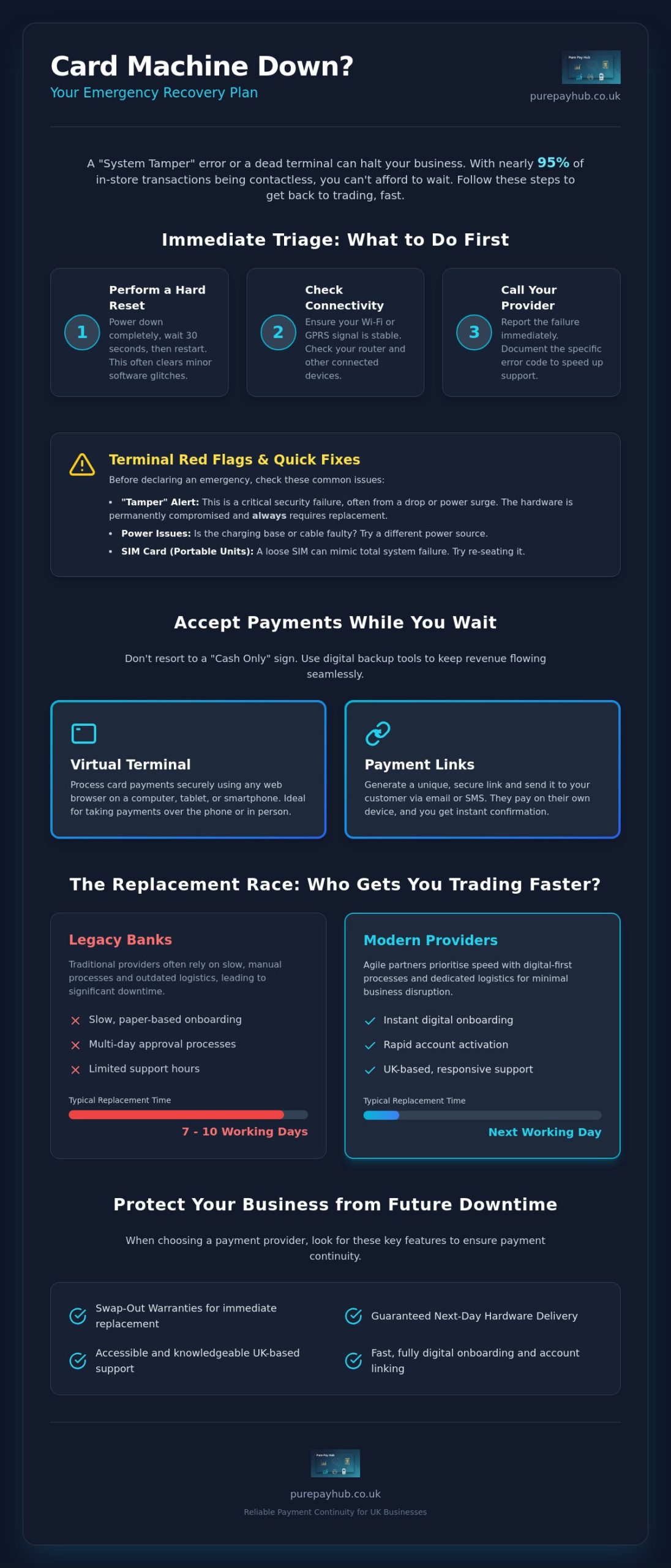
    When your card machine stops working, the clock starts ticking on your daily revenue. Don’t panic. Start with a hard reset. Power the unit down completely, wait thirty seconds, and restart. This simple step often clears temporary software glitches that stall transactions. If the screen remains blank or frozen, check your connectivity. Most modern hardware relies on stable Wi-Fi or a GPRS signal to communicate with the bank. A Payment terminal is a sophisticated piece of kit, but it’s only as good as the network it sits on. Ensure your router is functioning and that other devices can connect to the same network.

    If the reset fails, call your provider immediately. You need to know if you’re facing a widespread network outage or a localised hardware failure. Ask the support agent for a specific error code. Documenting this code is vital. It speeds up the technical support process and proves you’ve done your due diligence. If they confirm the hardware is dead and cannot be fixed over the phone, you’re officially in the market for an emergency card machine replacement. Do not wait for a “call back” that might never come; insist on a clear timeline for a new unit.

    Whilst you wait for a resolution, switch to a backup method. Don’t turn customers away with a “Cash Only” sign. If you have access to a Virtual Terminal or can generate Payment Links, use them. These tools allow you to process payments via a tablet or smartphone. They keep the queue moving while your main terminal is out of action. It’s about maintaining momentum and showing your customers that you’re prepared for technical hitches.

    Troubleshooting Common Terminal Errors

    “Tamper” alerts are the red flag of the payment world. They usually mean the internal security sensors have been tripped, often due to a drop or a power surge. This hardware is permanently compromised for security reasons and cannot be reset. Also, check the basics. Is the charging base faulty? Try a different cable to rule out power issues. For portable units, reseat the SIM card. A loose connection here can mimic a total system failure and is a quick fix that avoids an unnecessary emergency card machine replacement.

    When to Declare a Hardware Emergency

    Identify the point of no return early. If there’s visible physical damage or the software is stuck in a reboot loop, it’s time to act. Calculate your downtime. If your current provider quotes a seven-day lead time but you’re losing hundreds of pounds an hour, that’s a genuine hardware emergency. You need a partner who offers next-day dispatch to minimise the damage to your bottom line. Remember that just buying a generic reader from a local shop won’t work instantly. You need a provider who can handle the digital onboarding and account linking just as fast as the physical delivery.

    Speed of Replacement: How Quickly Can You Get Back to Trading?

    Speed is a relative term in the payments industry. For a legacy bank, “fast” might mean a replacement unit arriving in a week. For a local merchant losing sales, “fast” means tomorrow morning. When you’re searching for an emergency card machine replacement, you must distinguish between the delivery of the hardware and the activation of the service. A shiny new device sitting on your counter is just an expensive paperweight until the software is live and linked to your account. You need both the physical and digital tracks moving at the same pace to restore your cash flow.

    Traditional high-street banks often struggle with this dual requirement. They rely on outdated logistics networks and manual approval processes that aren’t designed for a crisis. It’s common for these institutions to quote 7-10 working days for a replacement. In a modern retail environment, that delay is a disaster. You shouldn’t be penalised for hardware failure, yet slow support from a legacy provider does exactly that. Choosing a provider that treats your downtime with urgency is the only way to protect your bottom line.

    Hardware Delivery Timelines in the UK

    In the UK, the logistics of merchant services are well-established. Reliable providers use dedicated courier networks to ensure next-day delivery for countertop and portable machines. This is the baseline you should demand. If a provider cannot guarantee a 24-hour window, they aren’t equipped for emergency scenarios. Always verify that the replacement package is comprehensive. This includes the terminal, the correct power adapter, and the specific charging cradle for your model. Retail and hospitality businesses don’t have time to hunt for spare cables whilst customers are waiting to pay. A complete “plug-and-play” kit is essential for a smooth emergency card machine replacement.

    The Onboarding Bottleneck

    The digital onboarding process is the most common cause of extended downtime. Even with hardware in hand, you might be stuck waiting for background checks. To bypass this, choose a partner that uses automated verification systems for “Instant Activation”. You can play your part by keeping your business documentation organised and ready for upload. This includes your latest business bank statements and valid photo identification. Having these files ready allows a modern provider to verify your account in hours rather than days. At PurePay Hub, we’ve stripped away the unnecessary red tape. Our system is built for speed and transparency, ensuring your account is ready to process transactions the moment your hardware is unboxed. We believe that restoring your payments should be a simple, straight-talking process that gets you back to trading without the typical corporate run-around.

    Accepting Payments Without a Physical Terminal

    Waiting for your emergency card machine replacement to arrive doesn’t mean your business has to grind to a halt. You can bridge the gap between a hardware failure and the arrival of a new unit by using software-based payment tools. These interim solutions allow you to keep processing transactions without a physical terminal in your hand. They’re quick to set up and ensure that your customers aren’t met with a “Cash Only” sign. By diversifying how you accept money, you build a more resilient business that can survive technical hitches.

    Most modern merchant accounts include access to digital payment methods as standard. If you’ve been relying solely on a countertop or portable unit, now is the time to explore your dashboard. These tools aren’t just for emergencies; they’re valuable additions to your trading arsenal. They offer flexibility for phone orders, off-site events, or simply managing a sudden surge in customers when your main system is under pressure.

    Virtual Terminals as a Backup Plan

    A Virtual Terminal is a cloud-based checkout for manual entry. It allows you to turn any device with an internet connection into a secure payment point. You simply log in to your provider’s secure browser-based portal and type in the customer’s card details. This is particularly effective for taking deposits or processing orders over the phone. It’s a professional way to handle transactions whilst you wait for your emergency card machine replacement. Ideally, you should verify that this feature is activated on your account before a crisis occurs, as it provides an instant safety net for your revenue.

    Payment Links for Socially Distanced Sales

    Payment Links are another powerful tool for maintaining trade. You can create a unique URL for a specific transaction amount in seconds and send it to your customer via SMS, email, or even a QR code. The customer then pays on their own smartphone using their preferred method, such as Apple Pay or Google Pay. This keeps your queues moving and removes the need for physical contact with a terminal. You can track these link payments in real-time through your merchant dashboard, giving you total clarity on your cash flow even without a working card reader on your counter.

    For mobile merchants, Tap-to-Pay technology can turn a standard smartphone into a temporary card reader. This allows you to accept contactless payments directly onto your phone. It’s a discreet and efficient way to trade during a hardware emergency. However, no matter which interim method you choose, you must ensure your solution remains PCI compliant. As of 2026, PCI DSS v4.0.1 is the sole active standard. Your provider should handle the heavy lifting of security, but you must remain disciplined about never storing sensitive card data on your own devices. Security shouldn’t be sacrificed for speed, even in a crisis.
    Emergency Card Machine Replacement: How to Restore Your Business Payments

    Choosing a Provider That Minimises Future Downtime

    Securing an emergency card machine replacement is a vital reactive step, but the ultimate goal is to ensure you never face a total blackout again. The reliability of your payment system depends heavily on the infrastructure of your provider. Many legacy banks offer hardware as an afterthought to their main banking services, which leads to slow support and outdated technology. You need a partner that treats payment processing as a mission-critical function. This means prioritising providers that offer “Swap-Out” warranties. Under these agreements, a new unit is dispatched the moment a fault is logged, rather than waiting for a technician to attempt a repair on-site.

    Contract flexibility is another essential factor. Avoid being locked into long-term, restrictive agreements with providers that have already failed you during a crisis. If a company cannot meet its service-level agreements during an outage, you should have the freedom to move. A modern provider wins your loyalty through consistent performance and transparent fees, not through fine-print traps. Look for rolling monthly contracts or short-term commitments that keep the pressure on the provider to deliver excellent service every single day.

    The Importance of UK-Based Support

    When your machine fails on a busy Saturday night, you cannot afford to wait for a support centre in a different time zone to open. UK-based technical support is a non-negotiable requirement for regional merchants. You need to speak with someone who understands the local retail environment and the specific banking regulations that govern UK payments. Direct phone support is always superior to slow, ticket-based systems that leave you in the dark for hours. A quick conversation with an expert can often resolve a configuration issue in minutes, potentially saving you from needing a full emergency card machine replacement.

    Technical Resilience in Modern Card Machines

    Modern hardware should be built to withstand network failures. Look for multi-comms terminals that feature automatic roaming. These units can switch seamlessly between Wi-Fi and 4G signals if one connection drops out. This dual-path connectivity is essential for portable units used in busy restaurants or at outdoor events. Additionally, consider integrated EPOS systems that offer “offline caching”. These systems can securely store transaction data during a temporary internet outage and process them once the connection is restored. Auditing a provider’s historical uptime is a sensible step before you sign any lease; a dependable partner will be happy to share their reliability record.

    If your current provider is letting you down, it is time to switch to a partner that values your business continuity. You can view our range of resilient card machines to find a solution that keeps your payments stable and your queues moving.

    Switching to PurePay Hub for Reliable Payment Continuity

    When your current system fails, you need more than just a new box on the counter. You need a partner that understands the high-stakes reality of a busy retail environment. At PurePay Hub, we’ve built our service around the needs of regional merchants who can’t afford to wait. We offer an emergency card machine replacement process that focuses on both physical speed and digital readiness. Our team ensures your hardware is dispatched for next-day delivery, but we don’t stop there. We also prioritise next-day funding. This ensures the money you earn today is in your bank account tomorrow, keeping your cash flow stable whilst you transition to a more reliable system.

    Traditional banks often treat small business owners as a number in a long queue. We take a different approach. Our onboarding is designed to be punchy and efficient. You won’t be trapped in a cycle of endless paperwork or vague timelines. Instead, you’ll have direct access to account managers who understand that every hour without a terminal is an hour of lost revenue. We believe in straight-talking and fair partnership, ensuring you’re never left in the dark during a technical crisis.

    Rapid Setup for UK Businesses

    Our streamlined application process is specifically designed to get you back to work. We’ve removed the unnecessary hurdles that legacy institutions often put in your way. By using modern verification tools, we can approve your account in a fraction of the time it takes a traditional bank. PurePay Hub prioritises business continuity through fast-track approval. This means your digital account is often live and ready to process transactions before the courier even arrives with your new device. You get a direct line to experts who prioritise urgent requests, ensuring your emergency card machine replacement is handled with the gravity it deserves.

    A Fairer Approach to Merchant Services

    Transparency is the core of our identity. We’ve seen the murky fee structures and hidden markups used by legacy providers, and we’ve chosen a cleaner path. There are no opaque charges, even for urgent setups. We also include our Virtual Terminal and Payment Links as standard for every client. These tools act as your permanent safety net, allowing you to take payments over the phone or via SMS if your hardware ever fails again. If you need a capital injection to help your business grow, we also offer a business cash advance based on your card turnover. It’s a flexible way to fund development without the stress of fixed monthly repayments. Restore your payments today with PurePay Hub and experience a service built on honesty, efficiency, and reliability.

    Secure Your Trading Future with Resilient Payments

    A hardware failure is a stressful event, but it’s also an opportunity to build a more resilient business. By understanding the immediate steps to take and utilising interim tools like Payment Links, you can protect your revenue during a crisis. Ultimately, the impact of a technical fault depends on the agility of your provider. An emergency card machine replacement should be a swift, transparent process that prioritises your continuity over corporate bureaucracy.

    You shouldn’t have to settle for slow support or hidden fees when your livelihood is on the line. We provide the stability your business needs with next-day delivery, UK-based expert support, and fair rates starting from 0.3% for debit cards. It’s time to move away from legacy systems that let you down when you need them most. Our goal is to replace frustration with informed confidence.

    Get your business back on track with a reliable card machine from PurePay Hub. Take control of your payments today. Ensure you’re always ready to trade, no matter what happens to your hardware.

    Frequently Asked Questions

    How long does it take to get a replacement card machine?

    A replacement typically arrives within 24 hours when you use a provider that offers next-day delivery. Legacy banks often take much longer, sometimes up to 10 working days, which can be devastating for your cash flow. You should always check if your contract includes a swap-out warranty to ensure the fastest possible dispatch. Modern providers prioritise hardware logistics to minimise your downtime.

    Can I use my phone as a card machine while I wait for a replacement?

    You can use your smartphone to accept payments by utilising Tap-to-Pay technology or generating Payment Links. These digital tools turn your mobile device into a temporary terminal, allowing you to process contactless transactions without physical hardware. It is an excellent way to maintain trading momentum whilst waiting for your emergency card machine replacement. Most modern accounts include these features as standard.

    Do I have to pay for a replacement card terminal?

    Whether you pay for a replacement depends on your specific merchant agreement and the cause of the failure. Most rental or lease plans include hardware support and free replacements for technical faults. However, if you purchased the machine outright or the damage is accidental, you may need to pay for a new unit. Always review your service-level agreement to see what coverage you have.

    Will a replacement machine work with my existing merchant account?

    A replacement machine will work with your existing account as long as it is supplied and configured by your current merchant service provider. You cannot simply buy a generic reader from a retail shop and link it to your old account instantly. The hardware must be mapped to your unique merchant ID by your provider’s technical team to ensure secure processing.

    What is the fastest way to get a card reader for my business?

    The fastest route is to partner with a modern fintech provider that offers next-day hardware delivery and rapid digital onboarding. Whilst some retail shops sell basic card readers over the counter, these still require account approval which can take several days. Choosing a partner that handles both the logistics and the verification in-house is the most efficient solution for a business in a hurry.

    Is it possible to get a card machine with same-day activation?

    Same-day activation is generally only possible for digital tools like Virtual Terminals and Payment Links. While physical hardware usually requires at least 24 hours for courier delivery, a modern provider can often approve your digital account within a few hours. This allows you to start taking phone or online payments on the very same day you apply for an emergency card machine replacement.

    What should I do if my card machine is stolen?

    You must contact your merchant service provider immediately to deactivate the terminal and prevent fraudulent use. Because card machines contain sensitive security keys, a stolen unit poses a significant risk to your business data. Once the old unit is blacklisted, your provider will help you secure a replacement and ensure your account remains PCI compliant during the transition.

    Can I switch providers if my current terminal is broken?

    You can switch providers at any time, and doing so is often the quickest way to escape poor service from a legacy bank. If your current provider is quoting long lead times or charging high fees for support, moving to a specialist can get you back to trading faster. Just ensure you check your existing contract for any notice periods or exit fees before making the move.
  • Card Reader Guide 2026: Choosing the Best Payment Terminal for Your UK Business

    Card Reader Guide 2026: Choosing the Best Payment Terminal for Your UK Business

    What if your card reader was a tool for growth rather than a drain on your hard-earned margins? Many UK business owners accept high transaction fees and delayed access to funds as a necessary evil of doing business. It’s a frustrating reality that can stifle your cash flow whilst you wait days for settlements to reach your account. You deserve a partner that prioritises transparency over hidden costs and complex contracts.

    Finding the right terminal is about more than just the upfront cost of the hardware. This guide will help you master the complexities of modern payment processing, from hardware types to securing the most cost-effective rates for your specific volume. We’ll show you how to achieve next-day access to your funds and choose durable equipment that stays connected when you need it most. We’ll explore the latest UK market trends for 2026, compare transaction models, and provide the clarity you need to make an informed decision for your business.

    Key Takeaways

    • Identify the right hardware for your specific environment, choosing between countertop stability, portable Wi-Fi units, or mobile flexibility.
    • Avoid the “flat-rate trap” by selecting a card reader solution that offers transparent pricing tailored to your actual transaction volume.
    • Prioritise next-day settlement to ensure your hard-earned funds are available in your account whilst avoiding unnecessary delays.
    • Protect your reputation and your customers by implementing the latest PCI DSS security standards and end-to-end encryption.
    • Streamline your business by integrating payment terminals with EPOS systems and online gateways for a unified sales experience.

    What is a Card Reader and How Does it Benefit UK Merchants?

    A business card reader is far more than a simple plastic gadget. It’s a sophisticated payment terminal designed to act as a secure gateway between your customer’s bank and your merchant account. These devices capture sensitive financial data, encrypt it instantly, and transmit it through secure networks to ensure every penny reaches its destination. In the modern UK economy, these terminals are the lifeblood of commerce. They don’t just sit on a counter; they integrate directly with EPOS systems to manage your inventory and sales data in real-time. This connectivity means when you sell an item, your stock levels update automatically. It removes the guesswork from your daily operations and lets you focus on serving your community.

    The role of the merchant account in this journey is vital. Think of it as a holding pen where funds are verified before they land in your business bank account. Without a robust terminal and a reliable merchant setup, your cash flow becomes unpredictable. We believe in providing the tools that make this journey as short and transparent as possible. By using professional hardware, you signal to your customers that their data is safe and your business is dependable.

    The Evolution of Payment Acceptance in the UK

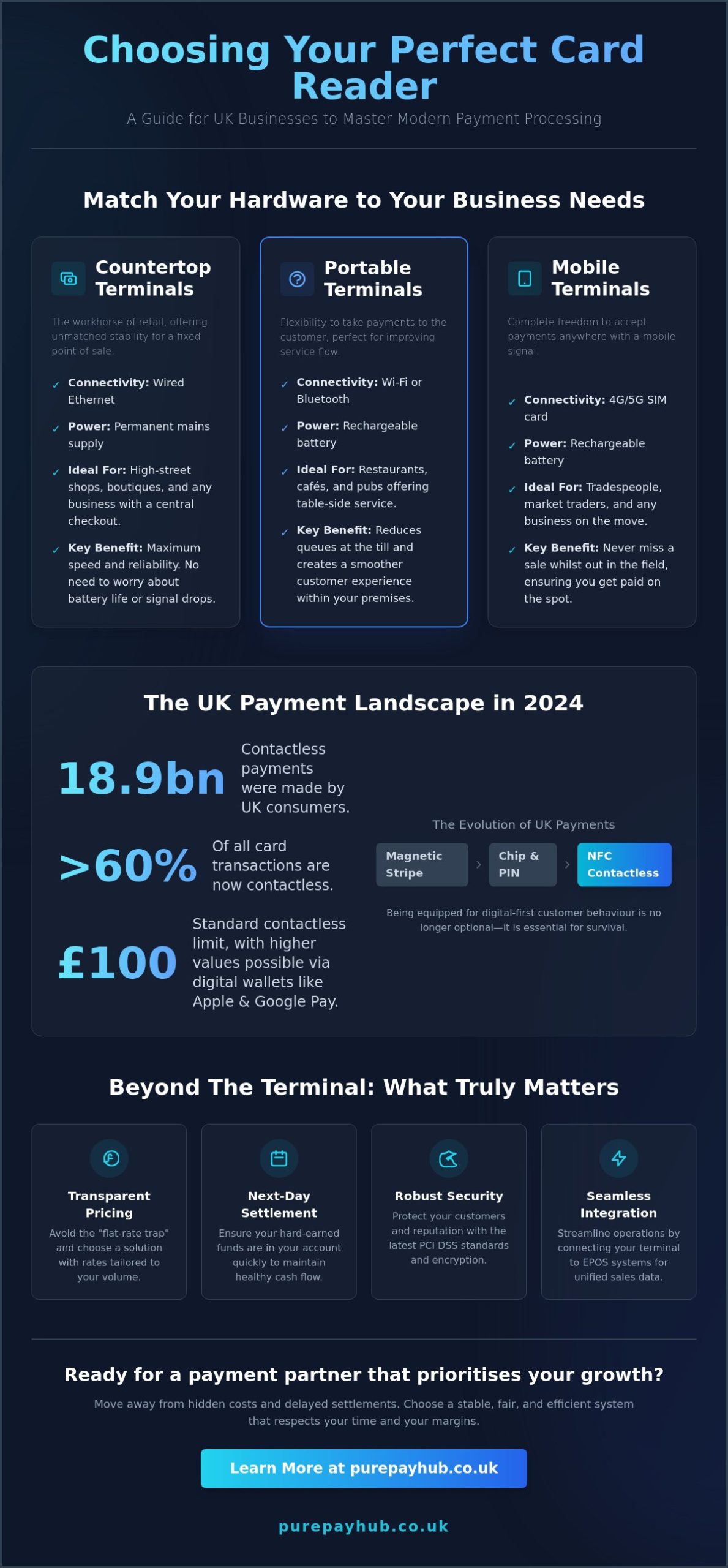
    British payment behaviour has undergone a massive transformation. We’ve moved quickly from the era of magnetic stripes to the security of Chip and PIN. Today, Near Field Communication (NFC) is the standard. In 2024, UK consumers made 18.9 billion contactless payments, which accounted for over 60% of all card transactions. This shift has made mobile wallets like Apple Pay and Google Pay essential for every local shop. These methods rely on biometric authentication, offering a level of security that traditional cards cannot match. As the standard contactless limit remains at £100 for most physical cards, digital wallets allow for even larger secure transactions. If your business isn’t equipped for digital-first behaviour, you’re effectively closing your doors to a significant portion of the market.

    Merchant Accounts vs. Payment Service Providers

    Choosing how your payments are handled is a critical business decision. Many “off-the-shelf” providers act as aggregators. They bundle your transactions with thousands of other businesses into one large account. This often leads to account stability issues or sudden freezes when a provider’s automated system flags a perfectly normal transaction. A dedicated merchant account is different. It provides you with a unique Merchant ID, offering a much higher level of reliability and professional support. PurePay Hub simplifies the onboarding process for these accounts. We’ve stripped away the corporate jargon and hidden markups that often plague traditional banking. Our goal is to get you set up with a stable, fair, and efficient system that respects your time and your margins. You get the benefit of a direct partnership without the headache of complex, opaque contracts.

    Portable, Mobile, or Countertop: Choosing Your Hardware

    Selecting the right hardware is a foundational decision for your business. It isn’t just about aesthetics; it’s about reliability under pressure. A card reader that fails during a busy Saturday lunch rush is more than an inconvenience. It’s a lost sale and a damaged reputation. To avoid this, you must match your terminal to your physical workspace. Whether you operate from a fixed boutique, a bustling restaurant, or a mobile van, there is a specific machine designed for your workflow.

    Fixed Countertop Terminals for Retail

    Countertop card machines are the workhorses of the retail world. They rely on a permanent power source and a wired Ethernet connection. This provides unmatched stability compared to wireless alternatives. These units sit at the heart of your checkout, often integrating seamlessly with cash drawers and receipt printers. If your customers always come to you to pay, a fixed terminal ensures you never have to worry about battery life or signal drops. They are the ideal choice for high-street shops that require a fast, dependable central checkout point.

    Roaming with Portable and Mobile Units

    If you need to take the payment to the customer, portable and mobile units are the solution. Portable machines use Wi-Fi or Bluetooth to roam within a specific premises, making them the favourite for hospitality venues offering table-side service. This flexibility reduces queues at the till and creates a smoother experience for your guests. For those who work on the go, such as tradespeople or market traders, a mobile card machine with a built-in 4G or 5G SIM is essential. These devices allow you to accept payments anywhere with a mobile signal, ensuring you never miss a sale whilst out in the field.

    Ruggedness is a key factor for any roaming device. If you’re working on a construction site or in a busy kitchen, your equipment needs to withstand drops and spills. We recommend looking for hardware with “all-day” battery life to ensure you aren’t left stranded mid-shift. Reliability in your hardware is just one half of the story; the other is the fairness of the rates you pay. The UK’s Payment Systems Regulator closely monitors the industry to ensure processing fees remain competitive for small businesses. Choosing the right device should be a stress-free process. If you need a solution that moves with your staff, you might consider a portable card machine that offers both durability and ease of use. Your hardware should be a silent partner that just works, allowing you to focus on your craft.

    Card Reader Guide 2026: Choosing the Best Payment Terminal for Your UK Business

    Decoding Transaction Fees: Avoiding the Flat-Rate Trap

    Many business owners choose a card reader based on how quickly they can get it out of the box. They often land on a flat-rate pricing model because it seems predictable. However, that simplicity often comes at a high price. A standard flat rate of 1.75% might suit a tiny hobbyist stall, but it quickly eats into the margins of a growing shop or restaurant. You’re effectively paying a massive premium for the illusion of simplicity. Savvy owners look deeper into the fee structure to find a model that scales with their success.

    Interchange Plus pricing is the professional alternative to the flat-rate trap. This model splits the fee into the actual cost from the card issuer and a small, transparent markup. For many merchants, this brings debit card rates down to the 0.3% range and credit cards to around 0.5%. When you compare these figures to a flat fee nearing 2%, the savings are staggering. Over a year, this difference can represent thousands of pounds back in your pocket. You also need to weigh up the cost of hardware. Buying a terminal upfront for a small fee is common for starters, but established businesses often prefer monthly rentals. This usually includes better technical support and ensures your hardware never becomes obsolete.

    Why Volume Matters for Your Rate

    As your turnover increases, your “break-even” point shifts. Once you process more than a few thousand pounds a month, flat rates become a financial burden rather than a convenience. PurePay Hub focuses on this critical transition. We tailor transaction rates to your specific business volume rather than forcing you into a one-size-fits-all box. It’s a no-nonsense approach that rewards your growth instead of taxing it. By understanding your monthly throughput, you can negotiate a deal that reflects the actual cost of processing your payments.

    Hidden Costs to Watch Out For

    Low headline rates often mask other charges that appear on your monthly statement. PCI compliance is a major factor. If you don’t stay compliant with the PCI Data Security Standard (PCI DSS), you could face significant non-compliance fines every month. Some providers also bury exit fees or minimum monthly service charges in the small print. These “subscription traps” are exactly what modern regulations aim to prevent. We believe you should stay with a provider because of good service, not because you’re locked in by a contract. Finally, consider funding speed. Waiting three to five days for your money is an outdated practice that hurts your cash flow. Next-day funding should be a standard feature for any serious merchant terminal.

    Essential Security and Compliance for UK Businesses

    Security is the foundation of trust between you and your customers. A modern card reader does more than just process a transaction; it acts as a fortress for sensitive financial data. Every time a customer taps or inserts their card, the terminal uses end-to-end encryption to scramble the details instantly. This ensures that even if data is intercepted, it remains completely unreadable to unauthorised parties. Point-to-Point Encryption (P2PE) takes this a step further by protecting data from the moment it enters the terminal until it reaches the secure payment gateway. By using P2PE-validated hardware, you significantly reduce your business’s liability and simplify the complex compliance landscape.

    Physical security is just as important as digital protection. You should regularly inspect your terminal for signs of tampering. Look for broken security seals, unusual wires, or added bulk to the card slot. A secure terminal is designed to be tamper-evident. It will often shut down or display an error message if its internal components are disturbed. Maintaining this vigilance protects your reputation and keeps your merchant account in good standing.

    Navigating PCI Compliance with Ease

    Compliance is a mandatory requirement for every UK merchant, regardless of size. The transition to the PCI DSS v4.0 standard was finalised on March 31, 2025. This update places a greater emphasis on multi-factor authentication and continuous security monitoring. For most SMEs, this involves an annual Self-Assessment Questionnaire (SAQ). It’s a task that many business owners find daunting. PurePay Hub removes the stress by assisting with compliance management. We help you meet the v4.0 requirements without the headache. Failing to comply isn’t just a technical oversight; it carries heavy financial risks. Non-compliance fines can be substantial, and the cost of a data breach can be terminal for a small business.

    Fraud Prevention in the Age of Contactless

    Fraudulent behaviour is a constant threat, but modern technology provides powerful defences. Current terminals use advanced algorithms to detect and block suspicious card patterns in real-time. The rise of mobile wallets has also bolstered security. Services like Apple Pay and Google Pay use biometric authorisation, such as Face ID or fingerprint scanning, to verify the user. Because these methods don’t share the actual card number with the terminal, they are inherently more secure than physical cards. This technology helps protect your business from the frustration of chargebacks and disputes. If you’re ready to secure your sales with a platform that prioritises your safety, you can apply for a secure merchant account today. We provide the stability you need to grow with confidence.

    Maximising Cash Flow with PurePay Hub

    Cash flow is the lifeblood of every local business. A reliable card reader should do more than just process sales; it should actively support your liquidity. Many traditional providers hold onto your money for days, creating unnecessary bottlenecks in your daily operations. PurePay Hub prioritises your access to capital by providing next-day settlement. This ensures that the money you earn today is available in your account tomorrow. It’s a straightforward approach that respects your hard work and helps you manage your overheads with confidence.

    Our solutions offer seamless integration across all your sales channels. Whether you use a countertop machine in a boutique or a mobile unit for outdoor events, your data remains centralised. This consistency extends to our online payment gateway and payment links, allowing you to manage retail, hospitality, and digital sales from a single platform. You also benefit from a professional, UK-based support partner. We don’t believe in distant call centres or automated scripts. When you need help, you speak to a local expert who understands the unique challenges of the British merchant community.

    Funding Your Future with Cash Advances

    Growth often requires a sudden injection of capital, whether for refurbishing your premises or stocking up for a peak season. A Business Cash Advance provides a flexible alternative to traditional bank loans. Instead of rigid monthly payments and fixed interest rates, you secure funding based on your future card turnover. Repayment happens as a small, pre-agreed percentage of your daily sales. This is a fairer system because it aligns with your actual performance. If you have a quiet week, your repayments automatically decrease. It’s an unsecured way to access capital that works with your business rhythm rather than against it.

    Getting Started with PurePay Hub

    Switching your payment provider shouldn’t be a source of stress. We’ve designed our onboarding process to be quick, clear, and entirely transparent. We help you move away from murky fee structures and hidden markups without disrupting your service. Our team handles the technicalities, ensuring your new hardware and EPOS systems are ready to go from day one. You deserve a partner that acts as a stabilising force for your finances rather than a drain on your resources. If you’re ready to see how much you could save on your transaction fees, organise your free rate review with PurePay Hub today. We’ll provide a no-nonsense comparison that puts you back in control of your margins.

    Take Control of Your Business Payments in 2026

    Choosing the right card reader is a pivotal step toward securing your business’s financial health. We’ve explored how matching your hardware to your workspace ensures reliability whilst a transparent fee structure protects your margins from the flat-rate trap. By prioritising modern security standards like PCI DSS v4.0, you build lasting trust with your customers and safeguard your reputation against fraud. Reliability in your payment terminal is no longer a luxury; it’s a fundamental requirement for any competitive UK merchant.

    Your business deserves a partner that values fairness as much as you do. With debit rates starting from 0.3% and next-day funding as standard, you can keep your cash flow moving without the frustration of hidden costs. Our UK-based expert technical support is always on hand to ensure your operations run smoothly, allowing you to focus on growth rather than paperwork. We believe in providing the clarity and stability you need to thrive in an evolving market.

    Ready to move away from opaque contracts and high fees? Get a personalised quote and start saving on your card reader rates today. Let’s work together to build a more efficient and profitable future for your business.

    Frequently Asked Questions

    How much does a card reader cost for a small business?

    Hardware costs depend on whether you choose to buy your terminal upfront or opt for a monthly rental. Whilst entry-level units are affordable for starters, established businesses often prefer rental models to ensure they always have the latest secure technology. You should weigh up the initial purchase price against the long-term value of included technical support and software updates.

    Can I use a card reader without a business bank account?

    You generally cannot use a professional merchant terminal without a dedicated business bank account. Financial regulations in the UK require that commercial funds are processed through an account designed to handle business-level volumes. Using a personal account for business transactions often leads to account freezes or closures by your bank. It’s better to establish a clear, professional financial structure from day one.

    How long does it take for card payments to reach my bank account?

    Settlement speeds depend on your provider, but you should expect next-day funding as a standard feature. Older systems might still take three to five working days to clear your hard-earned money. Delayed access to funds can hurt your cash flow. It’s vital to choose a partner that prioritises quick settlements to keep your business moving.

    What is the cheapest way to take card payments in the UK?

    Interchange Plus pricing is typically the most cost-effective way to process payments for growing businesses. Whilst flat-rate models seem simple, they often hide high markups that eat into your margins as your turnover increases. By choosing a transparent fee structure, you ensure that you only pay a fair rate based on the actual cost of the transaction.

    Do I need a separate card reader for Apple Pay and Google Pay?

    You don’t need a separate device for mobile wallets. Any modern card reader equipped with NFC technology can process Apple Pay and Google Pay transactions seamlessly. These digital wallets use the same secure contactless technology as physical cards. This makes it easy for you to offer your customers the payment methods they prefer without extra hardware.

    What happens if my card reader loses its Wi-Fi connection?

    If your terminal loses its Wi-Fi signal, it will usually try to reconnect automatically or switch to a built-in mobile data SIM. Reliable hardware is designed to handle these interruptions without losing transaction data. If you work in an area with poor connectivity, choosing a mobile unit with 4G or 5G backup ensures you never miss a sale.

    Are there any monthly fees for renting a card machine?

    Monthly rental fees are common for professional-grade hardware and often provide better long-term value. These fees usually include essential software updates, PCI compliance assistance, and swift hardware replacements if something goes wrong. It’s a predictable cost that prevents your business from facing unexpected repair bills or outdated, insecure equipment.

    How do I switch card machine providers without paying huge fees?

    Switching providers starts with a clear understanding of your current contract and a professional rate review. You should look for a partner that offers transparent, no-nonsense terms without hidden exit fees or subscription traps. A good provider will help you manage the onboarding process quickly, ensuring your new card reader is ready to use without disrupting your daily sales.