Tag: online payments

  • Secure Online Payment Gateway for Ecommerce: The 2026 Merchant Guide

    Secure Online Payment Gateway for Ecommerce: The 2026 Merchant Guide

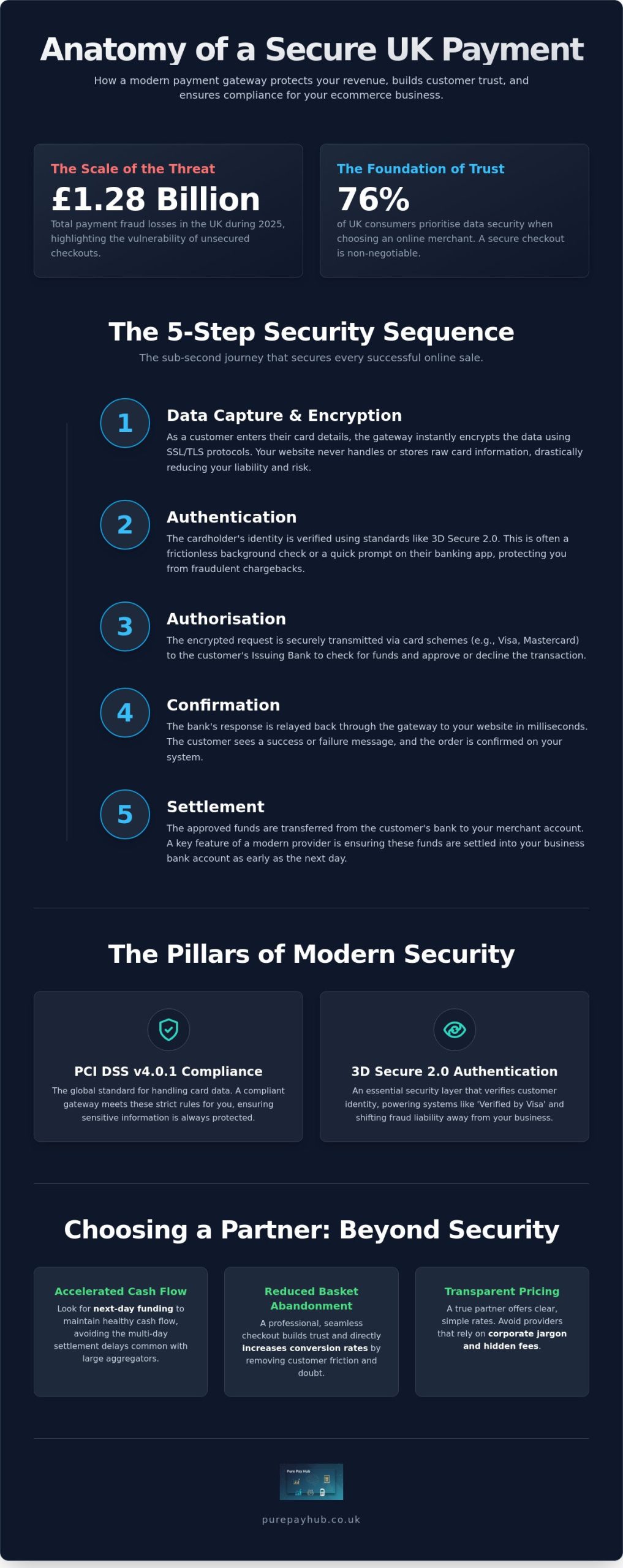
    Total payment fraud losses in the UK reached £1.28 billion in 2025, a stark reminder that your checkout is often the most vulnerable part of your business. Finding a secure online payment gateway for ecommerce isn’t just about technical compliance. It’s about protecting your revenue and building genuine trust with every customer. You’ve likely felt the frustration of abandoned carts caused by clunky checkouts, or the stress of seeing your funds held for days on end by traditional, distant providers.

    We believe in a no-nonsense approach to finance that prioritises the merchant. You deserve a partner that offers clarity instead of corporate jargon and hidden fees. This guide will help you master the technical and security essentials required to protect your business whilst providing a seamless checkout experience for your UK customers. We’ll show you how to turn your payment setup into a competitive advantage.

    We’ll examine the requirements of PCI DSS v4.0.1 and the July 2026 Mastercard data mandate. You’ll also discover how to secure next-day access to your sales revenue and achieve transaction rates that actually support your growth. It’s time to move from frustration toward a state of informed confidence.

    Key Takeaways

    • Understand why your digital “handshake” is the key to reducing basket abandonment and building lasting trust with your UK customer base.
    • Learn how to navigate the latest PCI-DSS v4.0.1 requirements and 3D Secure 2.0 to protect your business from rising fraud.
    • Discover why next-day funding is a critical feature for maintaining healthy cash flow compared to the slow settlement times of major aggregators.
    • Master the essentials of choosing a secure online payment gateway for ecommerce that offers transparent pricing and integrates with your card machines.
    • Demystify the complex journey of a transaction from the moment a customer clicks “Pay Now” to the final settlement in your account.

    Why a Secure Online Payment Gateway is Critical for Your UK Ecommerce Growth

    Think of your gateway as the digital “handshake” between your website and the global banking network. It is the precise moment where trust is either solidified or broken. Implementing a secure online payment gateway for ecommerce is no longer just a technical tick-box exercise. It is a fundamental requirement for survival in a market where 76% of UK consumers now prioritise data security when choosing an online merchant. If that handshake feels weak or suspicious, your customers will simply walk away.

    There is a direct correlation between visible security markers and reduced basket abandonment. British shoppers are savvy; they look for reassurance before entering their card details. When a checkout looks professional and displays recognised security protocols, friction disappears. Conversely, the cost of insecurity is absolute. A single data breach can end a small UK business overnight. Beyond the immediate financial penalties, the loss of reputation is often impossible to recover. With UK payment fraud losses reaching £1.28 billion in 2025, your gateway acts as your first and strongest line of defence.

    The goal for 2026 is a “frictionless” secure checkout. Security should never be a hurdle that slows down a legitimate purchase. Modern gateways use background authentication to verify users without forcing them through endless pop-up windows. This balance keeps your revenue safe whilst ensuring the user journey remains fast and intuitive.

    The Role of the Gateway in the Payment Ecosystem

    Confusion often exists between a gateway and a merchant account. Your gateway is the messenger that carries transaction data. The merchant account is the destination where your funds are held before being settled into your business bank account. You need both to accept card payments online in the UK. To understand the technical journey, it helps to research How Payment Gateways Work as a secure relay. This system doesn’t just move data; it protects you from fraudulent chargebacks by verifying the legitimacy of every request in real-time.

    Building Customer Trust in 2026

    Trust is built through familiarity and technical excellence. Standards like 3D Secure 2.0, including “Verified by Visa” and “Mastercard ID Check”, are now the expected norm for British shoppers. These tools provide an extra layer of protection that reduces your liability for fraud. Localised payment methods also play a vital role in conversion. A secure online payment gateway for ecommerce should feel local to the shopper, offering the currencies and card types they use every day. A payment gateway is a secure bridge for encrypted transaction data. By ensuring this bridge is robust, you provide the stability your business needs to grow.

    Behind the Scenes: How Payment Gateways Secure Every Transaction

    When your customer clicks “Pay Now”, a complex sequence of events triggers in less than a second. This millisecond journey is the difference between a successful sale and a potential security breach. A secure online payment gateway for ecommerce acts as the invisible orchestrator between your website, the card schemes, and the banking network. It ensures that sensitive data travels safely whilst filtering out malicious actors before they can impact your bottom line.

    The process involves two primary financial institutions: the Acquiring Bank and the Issuing Bank. The Acquiring Bank is your business bank, responsible for receiving the funds. The Issuing Bank belongs to your customer and is the entity that approves or declines the transaction based on available funds and security checks. Between these two points, encryption serves as a protective tunnel. By using SSL/TLS protocols at the browser level, the gateway prevents “man-in-the-middle” attacks, where hackers attempt to intercept data as it moves through the internet.

    The 5-Step Security Sequence

    • Step 1: Data Capture and Encryption. Card details are immediately encrypted at the point of entry. This ensures your website never actually “sees” or stores the raw data.
    • Step 2: Authentication. The system uses 3D Secure protocols to verify the cardholder’s identity, often through a mobile app notification or biometric check.
    • Step 3: Authorisation. A request is sent through card schemes like Visa or Mastercard to the Issuing Bank to confirm the transaction is legitimate.
    • Step 4: Fraud Scrubbing. The gateway applies advanced filters to check for suspicious patterns, such as high-risk IP addresses or unusual purchase behaviour.
    • Step 5: Final Response. The gateway relays the approval or decline back to your checkout page to complete the user journey.

    This rigorous verification and response phase happens instantly. If you are looking for a partner to manage this complexity with total transparency, our Online Payment Gateway is designed specifically for the needs of British merchants.

    Tokenisation: The Future of Card Data Security

    Tokenisation is a game-changer for modern ecommerce. It replaces sensitive card numbers with unique, non-sensitive “tokens”. If a hacker were to breach a database of tokens, the information would be useless to them. This technology significantly reduces your burden when adhering to PCI-DSS Security Standards. Because the actual card data stays with the processor, your compliance requirements are simplified.

    Beyond security, tokenisation enables the seamless experiences customers now expect. It powers “one-click” checkouts and manages recurring subscriptions without requiring the customer to re-enter their details. This balance of safety and speed is what defines a truly effective secure online payment gateway for ecommerce in 2026. It allows you to focus on growth whilst the technical heavy lifting happens safely in the background.

    Security standards are often viewed as a burden; however, they are your best defence against the growing threat of cybercrime. For any merchant, a secure online payment gateway for ecommerce must adhere to the Payment Card Industry Data Security Standard (PCI-DSS). This is not a suggestion. It is a global requirement to ensure all companies that process, store, or transmit card information maintain a secure environment. If you fail to meet these standards, the consequences are significant.

    The legal implications for non-compliance in the UK are severe. Beyond the risk of heavy fines from card schemes, you face the potential loss of your ability to process payments entirely. Most small businesses don’t have the resources to build a digital fortress. This is where a hosted payment page becomes invaluable. By redirecting your customers to a secure environment managed by your provider, you offload 99% of your security risk. Your servers never touch the sensitive data, which simplifies your life and protects your customers.

    Understanding Your PCI Compliance Responsibilities

    Compliance levels vary based on how you handle data. Most small ecommerce sites fall under SAQ A, which applies when you use a hosted page. If you store card data on your own servers, you face the much more rigorous SAQ D. We help our merchants navigate these requirements to avoid the monthly non-compliance fees that often catch business owners off guard. Choosing a Level 1 PCI Service Provider is non-negotiable. It ensures your partner meets the highest possible security audit standards.

    The Evolution of 3D Secure

    The original 3D Secure was a conversion killer. It forced customers to remember complex passwords, leading to abandoned carts. 3D Secure 2.0 (3DS2) has changed the game by using biometrics and app-based verification. This aligns with the requirements for Strong Customer Authentication (SCA) in the UK. It ensures that high-risk transactions are verified without ruining the user experience.

    Customers today are more aware of secure online shopping practices than ever before. They expect a checkout that feels modern and safe. A major benefit of using 3DS2 is the liability shift. By successfully authenticating a transaction through 3DS2, the liability for fraudulent chargebacks shifts from the merchant to the bank. This provides an essential layer of financial protection for your business. Implementing a secure online payment gateway for ecommerce that supports these protocols isn’t just about safety. It is about building a resilient, trusted brand that prioritises customer security.

    Secure Online Payment Gateway for Ecommerce: The 2026 Merchant Guide

    Choosing Your Provider: Beyond Just Transaction Rates

    Choosing a secure online payment gateway for ecommerce involves looking past the flashy marketing of global aggregators. Many merchants fall into the trap of only comparing the headline transaction fee. Whilst a low percentage looks attractive on paper, it often masks inefficiencies that can cripple your daily operations. Large, multi-national payment platforms are popular for their quick setup. However, they often lack the localised support and flexible funding options that an independent UK provider can offer.

    You must also be vigilant regarding hidden costs. It’s common to see extra charges for gateway access, PCI compliance, and monthly statements. These micro-fees quickly add up, eating into your margins. A transparent partner will lay these out clearly from the start. If you sell both online and in-person, ensure your gateway integrates with your EPOS Systems. Having a single view of your sales across all channels simplifies your accounting and inventory management.

    Settlement Speeds: Why 7 Days is Too Long

    The funding gap is the silent killer of small business cash flow. This is the delay between a customer paying and the money actually landing in your bank account. Standard settlement windows can stretch to seven days or more. This delay makes it difficult to manage payroll, pay suppliers, or restock inventory. We believe you should have next-day access to your sales revenue. Accelerated settlement provides a significant competitive edge for UK SMEs, allowing you to reinvest your hard-earned cash immediately rather than waiting for a distant processor to release it.

    Pricing Models: Interchange-Plus vs Flat Rate

    Flat-rate pricing is simple but often expensive. If you pay a flat 1.75% on every transaction, you’re likely overpaying for debit card payments. Debit cards carry much lower processing costs than premium credit cards. Interchange-plus pricing is the no-nonsense alternative. It provides total transparency by separating the actual cost of the transaction from the processor’s markup. This ensures you only pay a fair margin on top of the base rates. PurePay Hub offers rates as low as 0.3% for debit and 0.5% for credit cards, reflecting our commitment to fair and honest pricing for the local merchant community. If you’re ready for a fairer deal, you can get a transparent quote today to see how much you could save.

    A secure online payment gateway for ecommerce should be a tool for growth, not a source of frustration. By prioritising settlement speed and pricing transparency, you ensure your business remains agile and profitable in an increasingly competitive UK market.

    PurePay Hub: Transparent, Secure, and Built for British Business

    Traditional corporate processors often treat merchants like entries on a spreadsheet. They hide behind layers of jargon and opaque fee structures that make it impossible to know what you are actually paying. PurePay Hub was founded to disrupt this culture. We provide a no-nonsense alternative designed specifically for regional business owners who value honesty and integrity. We aren’t a distant financial institution. We are a fair partner committed to your growth.

    One of the biggest frustrations for merchants is the lack of support when things go wrong. Most technical guides focus on the code, but they ignore the human reality of a gateway failure. When a transaction won’t process during your busiest hour, you don’t need a chatbot or a generic ticket number. You need a UK-based expert who understands your market and can provide immediate clarity. Our support team is disciplined and knowledgeable, ensuring you never feel abandoned by your technology. We’ve simplified the onboarding process, allowing most businesses to start taking payments within 24 to 48 hours.

    The PurePay Hub Advantage for Ecommerce

    Efficiency shouldn’t be complicated. Our secure online payment gateway for ecommerce integrates seamlessly with major platforms like Shopify, WooCommerce, and Magento. This ensures your technical transition is smooth and your checkout remains stable from day one. We also address the funding gap mentioned earlier by providing next-day funding as standard. This keeps your cash flow healthy and allows you to reinvest in your business without delay. You can track every penny through our centralised merchant dashboard, which offers transparent reporting untainted by hidden markups.

    Supporting Your Growth with Business Cash Advances

    Growth often requires capital, but traditional bank loans can be rigid and slow. We offer a Business Cash Advance as a flexible alternative for retailers. This facility provides capital based on your future card sales. Instead of fixed monthly payments, the advance is repaid as a small percentage of your daily takings. This means your repayments stay in sync with your actual revenue; if you have a quiet day, you pay back less. It is a fairer way to fund inventory or expansion without the stress of a traditional debt schedule.

    Choosing a secure online payment gateway for ecommerce is about more than just security protocols. It is about finding a single partner that can handle your card machines, online payments, and growth capital with total transparency. If you are ready to move away from the opaque practices of traditional competitors, we are here to help. Organise your secure payment gateway with PurePay Hub today and experience a fairer way to take payments.

    Secure Your Future with a Fairer Payment Partner

    The landscape of digital payments in 2026 demands a balance between rigorous security and an effortless user experience. You now know that a secure online payment gateway for ecommerce is more than just a technical necessity. It’s the foundation of your customer’s trust and your business’s financial health. By prioritising Level 1 PCI security and embracing 3DS2 protocols, you protect your revenue whilst reducing friction at the checkout.

    Don’t let slow settlement times or opaque fee structures hold your growth back. You deserve a partner that offers clarity and rewards your hard work with faster access to your funds. Transitioning to a system that puts the merchant first provides the stability you need to scale in the competitive UK market. It’s about moving from technical confusion to a state of total confidence.

    Switch to a fairer, more secure payment gateway with PurePay Hub and benefit from debit card rates from 0.3%, next-day funding for UK merchants, and Level 1 PCI-compliant security. We’re ready to help you build a more resilient and profitable business today.

    Frequently Asked Questions

    What is the difference between a payment gateway and a payment processor?

    A payment gateway is the digital “handshake” that encrypts transaction data at the point of sale. The processor is the back-end system that actually moves the money between the different banks involved. You need both to function, though many modern providers bundle these services together for simplicity. This integration helps you avoid the technical headache of managing multiple different contracts and connections.

    How much does a secure online payment gateway cost in the UK?

    Costs vary based on your transaction volume and the pricing model you choose. Most providers charge a percentage per transaction plus a small fixed fee. You should also look for monthly gateway fees or PCI compliance charges that might be hidden in the small print. A transparent provider will always show you these costs upfront to help you manage your business cash flow effectively.

    Is my business too small to need a secure payment gateway?

    No business is too small to prioritise security. Every merchant needs a secure online payment gateway for ecommerce regardless of their turnover. Fraudsters often target smaller sites because they assume the security measures are weaker. Protecting your customer data is a legal requirement in the UK and is essential for building a brand that shoppers can actually trust.

    How long does it take to set up an online payment gateway?

    Setting up a modern gateway typically takes between 24 and 48 hours. This includes the time needed for identity checks and linking the system to your website. Once your account is approved, integration is usually a simple process of installing a plugin or entering an API key. You can be taking payments and generating revenue almost immediately after your application is processed.

    Can I use the same gateway for my physical shop and my online store?

    Yes, you can use an integrated system to manage both your physical shop and your online store. This is often achieved through an EPOS system that synchronises your inventory and sales data in one centralised place. It simplifies your accounting significantly and provides a consistent experience for your customers, whether they are buying from you in person or through your website.

    What happens if my payment gateway goes down?

    If a gateway goes down, your website cannot accept payments, which leads to immediate revenue loss and frustrated customers. High-quality providers maintain multiple redundant servers to ensure maximum uptime. You should always choose a partner with a proven track record of stability. This ensures your business remains open for orders every hour of the day without technical interruptions.

    Do I need a separate merchant account for my ecommerce gateway?

    You do need a merchant account to receive funds, but it doesn’t always have to be a separate contract. Some providers offer a bundled service where the secure online payment gateway for ecommerce and the merchant account are provided as one package. This often makes the setup process much faster for new businesses and provides you with a single point of contact for support.

    How does 3D Secure 2.0 affect my checkout conversion rate?

    3D Secure 2.0 actually helps improve conversion rates by making the authentication process frictionless for the shopper. Unlike the old system that required complex passwords, 3DS2 uses biometrics and background data checks to verify the cardholder. This reduces basket abandonment whilst providing the high level of security your customers expect. It turns a potential hurdle into a smooth and reassuring experience.

  • Moving Your Tax and Payments Online: A Complete Guide

    Moving Your Tax and Payments Online: A Complete Guide

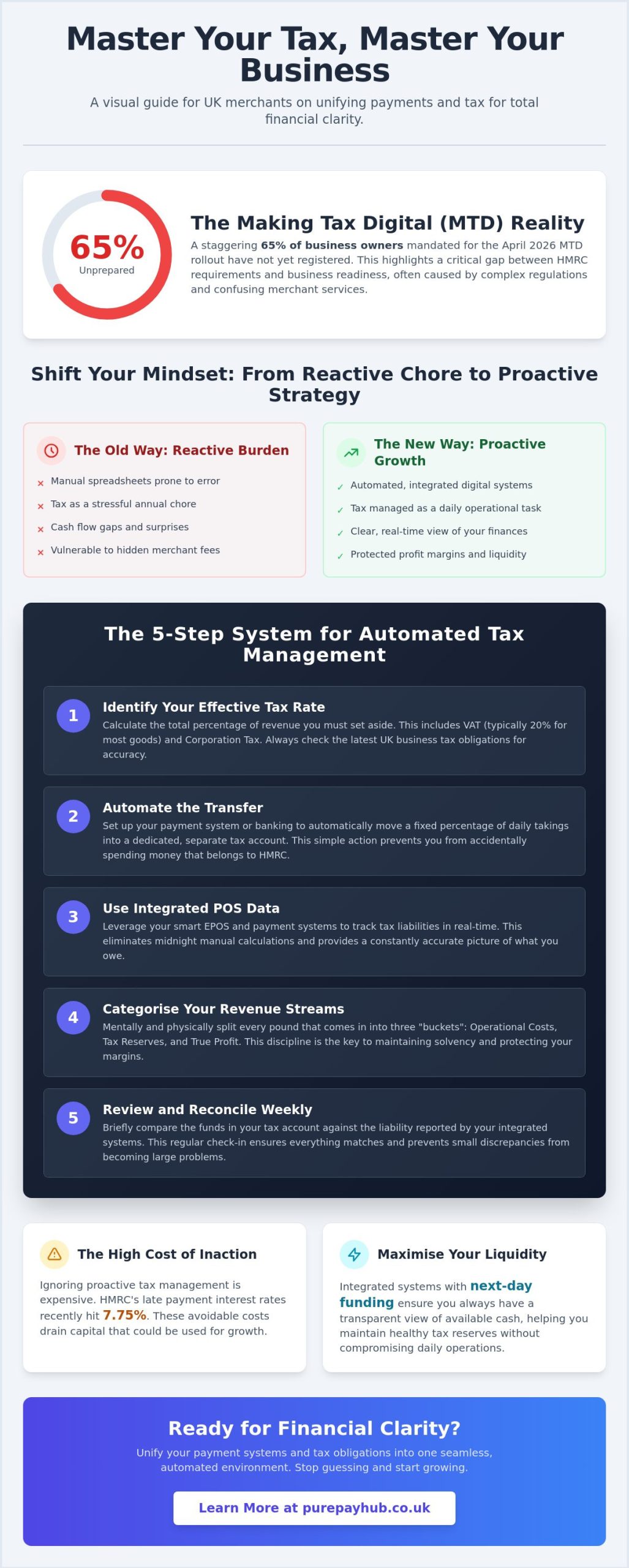
    Did you know that 65% of business owners mandated for the April 2026 Making Tax Digital rollout still haven’t registered? It’s a staggering figure that highlights how daunting HMRC requirements feel when you’re already busy running a company. Many merchants feel stuck between complex regulations and merchant services that hide true costs in fine print. Our mission is to teach them to move their tax and payment systems into a unified digital environment that prioritises clarity over confusion.

    You likely agree that the stress of cash flow gaps during tax season is a distraction you don’t need. This guide promises to help you demystify tax management by implementing a system that organises your revenue automatically. We will explore the tools that provide a transparent view of every pound earned, from portable card machines to online payment gateways. By the end of this article, you’ll understand how to set aside tax effortlessly and maintain total peace of mind regarding PCI compliance.

    Key Takeaways

    • Shift your mindset by treating tax management as a proactive growth strategy rather than an annual administrative burden.
    • Discover how to teach them to move their tax and revenue streams into automated digital buckets to protect your profit margins.
    • Learn to spot hidden fees in traditional merchant services that complicate your accounting and drain your business capital.
    • Utilise integrated systems like a countertop card machine to capture precise data for effortless HMRC compliance.
    • Maximise your liquidity with next-day funding to ensure you always have a transparent view of your available tax reserves.

    The Reality of Tax Education: Why Every Business Owner Needs a Strategy

    Most UK business owners view tax as a reactive chore. It’s the seasonal headache that arrives with an HMRC envelope. True tax management is actually a proactive growth strategy. It isn’t just about compliance; it’s about maintaining a transparent view of your business health. When you treat tax as a fundamental part of your daily operations, you stop being a victim of deadlines and start becoming a master of your cash flow.

    The UK national curriculum often fails to prepare merchants for the complexities of VAT and Corporation Tax. Most people enter the business world with very little financial education. This gap forces many into a cycle of confusion. We aim to teach them to move their tax and payment workflows into a digital environment where every penny is accounted for. Ignorance carries a heavy price tag. HMRC late payment interest rates reached 7.75% in mid-2026. These avoidable costs drain your capital and limit your ability to secure a Business Cash Advance when you need to scale.

    Bridging the Knowledge Gap in Your Business

    Transparency starts with your team. Every person handling a sale should understand the gross versus net reality of that transaction. It’s vital to encourage healthy financial behaviour amongst your staff. Clarity reduces the collective stress of HMRC deadlines. When everyone knows that a portion of every pound belongs to the taxman, the business operates with more discipline. We act as a supportive ally to help you simplify these complex structures and build a team that values financial integrity.

    Moving Beyond Spreadsheets

    Manual record-keeping is the favourite hiding place for hidden costs. Spreadsheets are prone to human error and often mask the true impact of merchant fees. The shift towards digital-first financial management in the UK is no longer optional. Modern e-commerce payment systems and smart EPOS systems now provide the centre for all your business data. When you teach them to move their tax and cash flow tracking to a modern system, you remove the guesswork from your quarterly updates. You gain a reliable, real-time view of what you actually owe, ensuring that your profit stays in your pocket.

    Teach Them to Move Their Tax: How to Organise Your Revenue Streams

    Managing revenue effectively requires a shift from seeing money in the bank as yours to seeing it as a collection of distinct obligations. You must establish a tax-first mindset. This means identifying the tax portion of every sale and moving it immediately. If you wait until the end of the quarter to calculate what’s owed, you’re playing a dangerous game with your liquidity. The goal is to teach them to move their tax and revenue into organised streams that reflect the true state of the business at any given moment. This ensures you never accidentally spend money that belongs to HMRC.

    Categorising your revenue into operational, tax, and profit buckets is the only way to guarantee you stay solvent. When funds are lumped together, it’s easy to overspend on stock or overheads. By separating these streams, you protect your profit margins and ensure that your tax reserve remains untouched. This level of discipline turns a chaotic bank balance into a structured financial roadmap.

    The 5-Step System for Moving Tax

    • Step 1: Identify your effective tax rate. This includes VAT, which is currently 20% for most goods, and Corporation Tax. Check the latest UK business tax obligations to ensure your percentages are accurate.
    • Step 2: Automate the transfer. Set up your banking or payment system to move a fixed percentage of daily takings into a dedicated tax account.
    • Step 3: Use integrated POS data. Your EPOS systems should track these liabilities in real-time. This eliminates the need for manual calculations at midnight before a deadline.
    • Step 4: Categorise your streams. Split every pound into operational costs, tax reserves, and actual profit.
    • Step 5: Review weekly. Compare your organised funds against your real-time liability to ensure they match exactly.

    Creating a Culture of Financial Transparency

    Accurate transaction logging isn’t just a task for the accountants; it’s a vital duty for every member of staff. You need to explain the cost of doing business to your employees so they understand why precision matters. If a staff member fails to log a refund or a specific tax-exempt sale correctly, it creates a ripple effect that complicates your final return. Use simple, punchy reports to show the health of the company. When the team sees that the business is disciplined, they’re more likely to follow suit. Honest financial behaviour starts at the top. If you’re transparent about the company’s obligations, your team will respect the systems you’ve put in place. By using a centralised platform like PurePay Hub, you can share these insights easily without getting bogged down in jargon.

    Common Misconceptions: Why Tax Management Doesn’t Have to be Opaque

    Many merchants believe they need an ACA qualification to understand their own cash flow. This is a common myth that keeps business owners in a state of financial anxiety. You don’t need a professional degree to see where your money goes. The goal is to teach them to move their tax and payment tracking into a system that uses plain English instead of technical jargon. When you understand your data, you regain control of your business destiny.

    Hidden markups in financial services are another significant hurdle. Traditional merchant services often promise the “lowest rates” but hide complex fee structures in the fine print. These opaque practices make accounting much harder than it needs to be. A headline rate of 0.5% might look attractive until you see the added costs for “premium” cards or “minimum monthly service” fees. These layers of complexity create confusion when you try to calculate your true profit. There is a vital difference between your total turnover and your actual profit after the HMRC slice. Clarity here is the difference between a thriving business and a cash flow crisis.

    Simplifying the Jargon

    Financial terminology often feels like a barrier to entry. BACS (Bankers’ Automated Clearing System) is simply a way to send money between bank accounts over three days. CHAPS (Clearing House Automated Payment System) does the same thing but faster and for a higher cost. Your Merchant Service Charge (MSC) is the total fee you pay for every card transaction. Using no-nonsense terminology is your best friend during tax season. If you can’t explain a charge on your statement, it shouldn’t be there. Spotting opaque practices starts with demanding a clear breakdown of every penny you spend on processing.

    The Truth About PCI Compliance

    PCI compliance is often viewed as a frustrating tick-box exercise. In reality, it’s a critical security standard that protects your revenue from fraud. Non-compliance fines are avoidable costs that drain your tax bucket and damage your reputation. By using secure, modern hardware like a countertop card machine or an integrated EPOS system, you ensure your data remains protected. We teach them to move their tax and payment processing to platforms that prioritise security. This proactive approach keeps your funds safe and ensures you aren’t wasting capital on penalties that could have been avoided with better equipment.

    Managing your obligations becomes much simpler when you have a direct line of sight to your liabilities. You should regularly check your HMRC business tax account to stay updated on your current standing. Combining this government data with your real-time payment reports provides the ultimate shield against financial surprises at the end of the year.

    Moving Your Tax and Payments Online: A Complete Guide

    Integrating Your Payment Systems with Your Tax Obligations

    Your countertop card machine is more than a tool for accepting payments. It serves as your primary data source for tax. Every transaction logged through a modern terminal creates a digital audit trail that HMRC values. This level of precision is the cornerstone of a successful financial strategy. We teach them to move their tax and revenue tracking away from manual entry and into these automated hardware solutions. It ensures that every pound is accounted for from the moment a customer taps their card.

    Next-day funding is a game-changer for maintaining an organised tax reserve. Traditional merchant services often hold your money for several days. This delay creates a gap in your cash flow that makes it difficult to see your true liability. With faster access to your funds, you can move the tax portion of your sales into your dedicated account immediately. For hospitality businesses, integrated EPOS systems are the favourite tool for staying tax-efficient. They sync sales data directly with accounting software, making the quarterly update process much smoother.

    Seamless Data Flow from Till to Tax Return

    Digital receipts and transaction logs significantly reduce manual errors. When your payment gateway and POS system talk to each other, you eliminate the risk of missing a sale or miscalculating VAT. Having a single hub for all card payment types, including online sales via Payment Links or a Virtual Terminal, keeps your records tidy. Real-time reporting is no longer a luxury. It’s a necessity for Making Tax Digital (MTD). With the April 2026 deadline approaching for those with qualifying income over £50,000, having your data ready is vital. You can explore integrated payment solutions that simplify this transition today.

    Leveraging Business Cash Advances Responsibly

    Seasonal dips can make tax deadlines feel overwhelming. A Business Cash Advance based on your card sales can help you manage these gaps without the stress of traditional debt. Unlike a bank loan with fixed monthly payments, this advancement is repaid as a small percentage of your future card sales. This means if you have a slow month, your repayments reduce automatically. It’s a flexible way to keep your finances organised whilst ensuring you have the liquidity to meet your HMRC obligations on time. This approach keeps your business moving forward without the rigid pressure of a standard financial institution.

    PurePay Hub: Simplifying Financial Clarity for UK Merchants

    PurePay Hub stands as a transparent partner for UK business owners who are tired of the opaque practices of traditional banks. We believe that financial processing should be a stabilising force for your company, not a source of confusion. By offering debit card rates starting at 0.3%, we ensure you maximise your profit margins on every transaction. This isn’t just about saving money on fees. It’s about having more capital available to meet your tax obligations without the usual stress. Our no-nonsense approach prioritises your business growth over corporate markups.

    The road to the April 2026 Making Tax Digital rollout requires a reliable, integrated system. We teach them to move their tax and payment data into a centralised environment that is fully ready for these new HMRC regulations. Our onboarding process is designed to be swift and clear. We get you set up with the right hardware, such as a portable card machine or an online payment gateway, without the corporate jargon that usually complicates switching providers. With next-day access to your funds, you can move your tax reserves into their dedicated accounts faster than ever before.

    Our Commitment to Transparency

    Trust is built on honesty and clarity. We avoid the hidden markups and confusing fee structures that make manual accounting a nightmare for regional merchants. Your monthly hardware rental fees for a countertop card machine or mobile unit are clearly structured and easy to understand from day one. Having a reliable, local expert in your corner means you can focus on your customers whilst we handle the technicalities of your transaction data. We act as a supportive ally, ensuring your financial behaviour remains disciplined and your records stay untainted by unexpected costs or service charges.

    Get Started with a Fairer Payment Solution

    Switching providers doesn’t have to be a stressful experience for your team. Our specialists manage the transition to ensure your business continues to process sales smoothly without any downtime. Fairer rates have a significant impact on your long-term tax planning and overall business development. When you aren’t overpaying for every tap and swipe, your cash flow becomes more predictable and easier to manage. This predictability is the foundation of a healthy, sustainable business. You can organise your business payments with PurePay Hub and start building a more transparent financial future today.

    Secure Your Financial Future Today

    Moving your tax and payment systems online is more than a compliance requirement; it’s a step toward total business clarity. You’ve seen how a proactive strategy replaces reactive stress. By categorising revenue streams and using integrated data from your card machines, you ensure that HMRC deadlines never cause a cash flow crisis. We want to teach them to move their tax and financial records into a space where every pound is visible and every fee is fair.

    PurePay Hub is here to act as your supportive ally. We provide a no-nonsense service with debit card charges starting from 0.3% and next-day access to your funds. You won’t find any hidden markups or corporate jargon in our agreements. It’s time to stop overpaying for processing and start focusing on your growth.

    Discover fairer card machine rates with PurePay Hub and take control of your business health. You have the tools to build a more transparent, disciplined company. We’re ready to help you make it happen.

    Frequently Asked Questions

    How can I teach my staff to move their tax mindset toward profitability?

    Start by explaining that every sale includes a portion that belongs to HMRC. When your team understands the “gross versus net” reality of a transaction, they become more accurate with transaction logging. Transparency about the company’s obligations builds a disciplined team that values financial health over simple turnover figures.

    What is the best way to organise business finances for a sole trader in the UK?

    Use a dedicated business account and separate your revenue the moment it hits your bank. Categorise your funds into three distinct buckets: operational costs, tax reserves, and actual profit. Automated systems that track your income in real-time are far more reliable than manual spreadsheets for maintaining a clear view of your available capital.

    Can a card machine help me with my Making Tax Digital (MTD) obligations?

    Yes, a modern card machine serves as a primary data source for MTD by creating a secure digital audit trail for every sale. We teach them to move their tax and payment records into integrated systems that sync directly with accounting software. This ensures your quarterly updates to HMRC are based on precise, real-time transaction data rather than guesswork.

    Why is next-day funding important for managing my tax reserves?

    Faster access to your cash allows you to move the tax portion of your sales into a separate account immediately. Traditional merchant services often hold funds for several days, which creates confusing cash flow gaps. Next-day funding ensures your tax reserves are always up to date and reflective of your true, current liability.

    Is it better to use a separate bank account for VAT and Corporation Tax?

    Yes, using a separate account for your tax liabilities is a highly effective way to prevent accidental overspending on stock or overheads. It provides a physical barrier between your operational cash and the money you owe the government. This simple structure ensures you always have the liquidity to meet your deadlines without financial stress.

    How do high transaction fees impact my ability to save for tax?

    High fees and hidden markups directly drain your profit margins, leaving less capital available for your tax bucket. When you use a provider with fair, transparent rates, you keep more of every pound you earn. This extra margin makes it much easier to build a robust tax reserve whilst maintaining a healthy, growing business.

    What are the common hidden costs in merchant services that complicate tax prep?

    Many providers hide costs like “minimum monthly service fees” or “PCI non-compliance penalties” deep within their fine print. These unexpected charges create discrepancies in your accounts and make tax reconciliation much more difficult. Choosing a partner with transparent pricing ensures your financial records remain clear and easy for your accountant to process.

    How does a business cash advance affect my tax liability?

    A Business Cash Advance is an advancement against future card sales rather than a traditional loan, so it doesn’t typically increase your tax liability. However, you should always consult your accountant regarding the specific reporting of these funds. We teach them to move their tax and cash flow management toward these flexible solutions to handle seasonal dips without the rigid pressure of bank debt.

  • Payment Links: The Merchant’s Guide to Getting Paid Without a Website

    Payment Links: The Merchant’s Guide to Getting Paid Without a Website

    Why spend thousands building a complex online shop when a single URL can settle your invoices instantly? For many UK small businesses, the traditional e-commerce route feels like a hurdle rather than a help. You want to sell remotely without high transaction fees or the technical headache of a website. This is where payment links provide the purest solution for your cash flow. They allow you to send a secure, professional payment page directly to your customer via email, text, or social media.

    You’re likely tired of waiting days for funds to clear whilst hidden costs eat into your margins. We understand that security and transparency are the foundations of a healthy partnership. This article shows you how to simplify your remote sales and secure next-day access to your funds using honest, transparent tools. We will explore how transaction-based fees and professional payment pages can help you get paid faster and keep your business moving forward with total clarity.

    Key Takeaways

    • Learn how to accept remote card payments instantly without the expense or complexity of building a full e-commerce website.
    • Discover the simple three-step method to generate and share payment links via SMS, email, or WhatsApp to settle invoices faster.
    • Understand the essential security protocols, including PCI DSS compliance, that keep your transactions safe and protect your business from fraud.
    • See how different UK sectors, from hospitality to professional services, use these tools to secure deposits and eliminate late payments.
    • Find out how to bypass high big-tech fees with transparent, transaction-based pricing that starts as low as 0.3%.

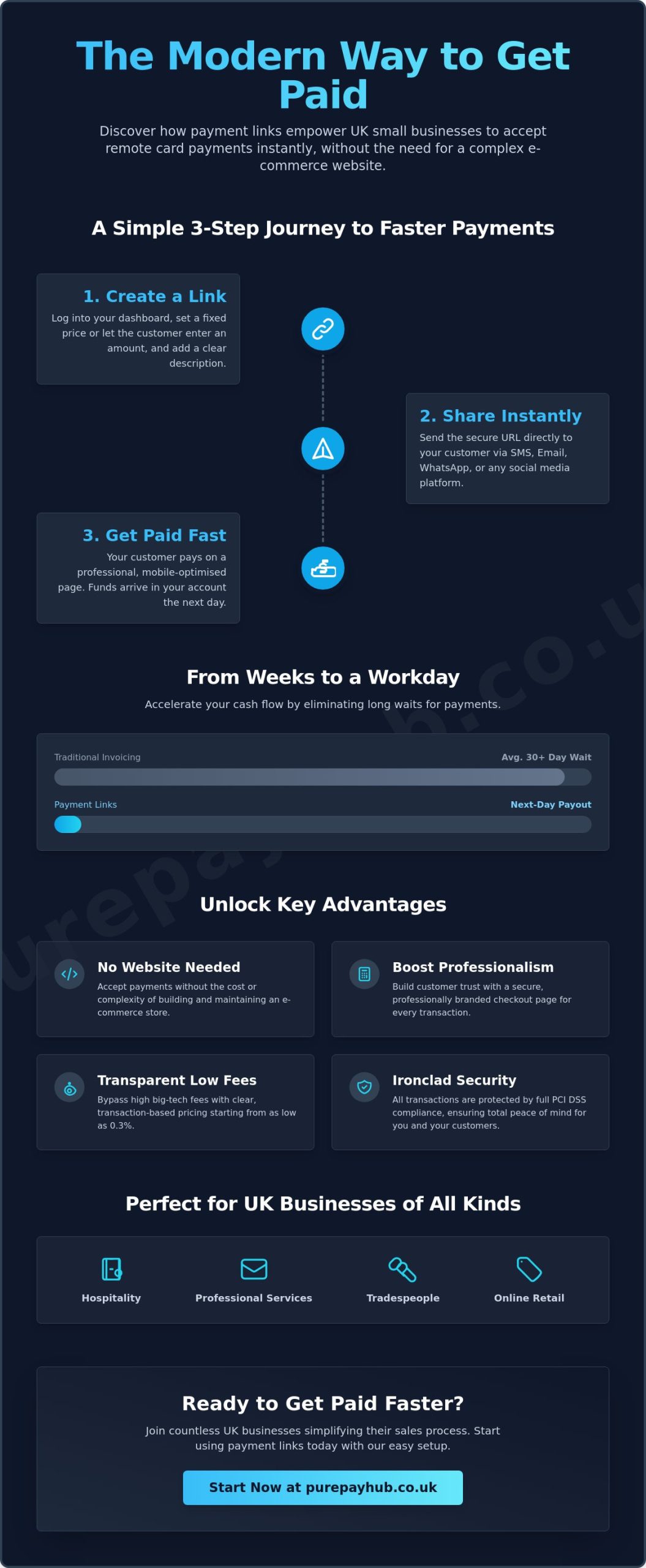
    A payment link is a secure URL that directs your customers to a professionally hosted checkout page. It is the simplest way to get paid in the digital age. For many UK small businesses, this tool removes the expensive hurdle of building a full e-commerce website or hiring developers for complex coding. You don’t need a digital storefront to sell your services online. Whether you’re a plumber sending a quote or a craft maker selling through Instagram, payment links allow you to settle transactions instantly.

    Transitioning from a “cash only” model to a digital-first operation can feel daunting. However, sharing your bank details for BACS transfers often feels informal and creates extra work for your customers. Links provide a professional alternative that builds immediate trust. They represent a clean, modern approach to commerce that fits the needs of a busy merchant. You get the benefits of an online shop without the technical headache or the high maintenance costs whilst maintaining a professional image.

    The Evolution of Remote Payments

    Remote payments have undergone a massive shift. We’ve moved from “card not present” phone calls, where you’d manually type card numbers into a terminal, to secure digital links. This change is driven by consumer behaviour. Modern buyers favour speed and mobile wallets over traditional methods. The broader payment system now prioritises convenience and security. UK merchants are moving away from restrictive traditional banking to embrace this agility and pure transparency.

    Key Advantages Over Traditional Invoicing

    Cash flow is the lifeblood of your business. Traditional invoicing often means waiting 30 days for funds to arrive. Using payment links turns that wait into a 30-second action. You’ll reduce your administrative burden by automating payment confirmations. No more cross-referencing bank statements on a Friday night. Plus, customers pay faster when they can use Apple Pay or Google Pay. This leads to a higher conversion rate, as you’re meeting the customer where they already are: on their smartphone. It’s about removing friction and building trust through a professional interface.

    Getting started with payment links shouldn’t require a manual or a degree in computer science. The process is a clean, three-step journey designed to get you paid without the friction. It starts in your central Hub, where you have total control over every transaction. You don’t need to wait for a developer to update a website; you simply create, share, and receive. This agility is what makes modern merchants more resilient in a fast-moving UK market. By removing the technical barriers to entry, you can focus on what you do best: running your business.

    Creating Your First Link

    You begin by logging into your merchant dashboard or mobile app. Here, you define the parameters of the sale. You can set a fixed price for a specific product or service, or you can allow the customer to enter the amount themselves. This flexibility is vital for businesses like consultants or tradespeople who deal with variable quotes. Adding clear product descriptions or reference numbers makes your bookkeeping effortless. You can organise your links for one-off sales or keep them active for recurring services, ensuring your record-keeping remains pure and transparent.

    The Customer Experience

    Once you share the link via SMS, WhatsApp, or email, the ball is in the customer’s court. They click the URL and arrive at a mobile-optimised checkout page that looks professional and dependable on any device. They can choose their favourite payment method, including debit cards, credit cards, or digital wallets like Google Pay. This process is governed by the Payment Services Regulations 2017, which mandates secure authentication to protect both you and your buyer. Once the transaction is complete, an instant digital receipt is sent to their inbox, providing immediate peace of mind.

    The final step is where many traditional processors fall short. Whilst big-tech rivals often keep your money for days, we prioritise your cash flow. We ensure you have next-day access to your funds so you can reinvest in your growth immediately. There are no hidden delays or murky holding periods. This transaction-based clarity is why so many UK businesses consider us a reliable ally. If you want to see how quickly your business can move, you can start using payment links with our simplified setup today.

    Payment Links: The Merchant’s Guide to Getting Paid Without a Website

    Security and Compliance: Ensuring Trust in Every Transaction

    Security shouldn’t be a source of stress for your business. When you use payment links, you’re adopting a system where protection is baked into the technology, not added as an afterthought. We believe in “pure” security. This means every transaction is shielded by the highest industry standards without you needing to become a technical expert. By removing the merchant from the direct handling of sensitive card data, we eliminate the primary target for hackers. You get to focus on your sales, whilst we handle the complex task of keeping your customers’ information safe.

    Trust is the foundation of every remote sale. If a customer feels hesitant about a payment page, they’ll abandon the purchase. Our links provide a professional, secure environment that reassures your buyers. This isn’t just about ticking boxes; it’s about creating a dependable experience that protects your brand’s reputation. We prioritise honesty in our security protocols, ensuring that both you and your customers have total peace of mind during every interaction.

    Understanding PCI DSS for Small Businesses

    The Payment Card Industry Data Security Standard (PCI DSS) is often a headache for UK SMEs. Traditional banks might hit you with monthly non-compliance fines if you don’t jump through their complex hoops. However, using a dedicated provider for your links significantly reduces this compliance burden. The payment gateway tokenises sensitive information. This means the actual card details never touch your devices or servers. Since you aren’t storing the data, your compliance path is simplified and much cheaper. We act as your protective shield, ensuring you meet all requirements without the usual paperwork or financial penalties.

    Fraud Prevention and Chargeback Protection

    Fraud is a reality of remote commerce, but it doesn’t have to be your reality. We use advanced fraud monitoring to spot suspicious patterns before they become problems. Every transaction is supported by 3D Secure technology. This verifies the customer’s identity with their bank in real-time, adding a vital layer of defence against unauthorised use. It’s a professional way to ensure that the person at the other end of the link is who they claim to be.

    To further protect your margins, we recommend a few best practices. Always verify the delivery address for high-value remote orders before fulfilment. Because our transaction-based processing provides a clear, digital audit trail, you’re in a much stronger position if a dispute ever arises. You have a transparent record of the entire journey. This clarity is essential for resolving chargebacks quickly and fairly. We don’t just process your money; we protect your right to keep it. This partnership ensures that security is a stabilising force for your finances, not a constant worry.

    Practical Use Cases for UK Businesses

    Payment links aren’t just a digital backup; they are a versatile tool for almost every UK sector. Whether you’re running a high-street cafe or a specialist consultancy, these links adapt to your specific workflow. They bridge the gap between physical service and digital settlement with total clarity. By using a single URL, you can transform how you interact with your customers, making every transaction feel like a professional partnership rather than a technical hurdle.

    In hospitality, no-shows are a constant threat to your margins. Taking a deposit via a link at the time of booking creates a fair commitment that protects your time and your table turnover. For professional services like solicitors or accountants, waiting for cheque clearance or manual bank transfers is a relic of the past. Sending a link allows for instant fee settlement, keeping your cash flow predictable. It removes the friction of chasing payments, allowing you to focus on delivering value to your clients.

    Retailers are also finding success through social selling. You can close a sale in an Instagram DM window or a Facebook Shop without directing customers to a clunky external site. Meanwhile, field services and tradespeople can send a link whilst they’re still on-site. This ensures the job is settled before they even pack their tools, removing the need for awkward follow-up calls or late-night invoicing. It’s a clean, efficient way to manage your business on the move.

    Deposits and Pre-payments

    Managing cash flow for bespoke orders or large events requires upfront security. You can use payment links to secure part-payments or full settlements before you even begin work. This reduces your financial risk and ensures the customer is invested in the project. Many merchants now integrate these links directly into their booking confirmation emails. This automated approach reduces your administrative burden and provides the customer with a professional, secure way to pay at their convenience.

    In-Person QR Code Payments

    Traditional processors often treat online and in-person payments as separate worlds. We see them as one. A significant advantage of using these links is how they act as a fail-safe for your physical hardware. If your portable card machine runs out of battery or loses signal at a busy market, you aren’t stuck. You can generate a QR code from your mobile app and let the customer scan it to pay on their own device. This “self-checkout” method reduces queues and ensures you never miss a sale. Crucially, this data flows into the same central Hub as your countertop card machine transactions. This unified reporting gives you a pure, transparent view of your daily takings without merging multiple spreadsheets.

    Ready to protect your margins and simplify your sales? Get started with our transparent payment links and take control of your cash flow today.

    The PurePay Hub Advantage: Transparent Rates and Local Support

    Choosing a partner for your payment links shouldn’t feel like a gamble. Whilst global big-tech rivals often hide high margins behind “simple” flat-rate pricing, we prioritise pure transparency. We understand that every penny counts for a growing UK business. That’s why our debit card rates start as low as 0.3%. This is significantly lower than the standard rates you’ll find with traditional app-based providers. By choosing a transaction-based model, you ensure that your costs remain fair and predictable as your sales volume increases.

    Cash flow is another area where we refuse to compromise. Waiting days for your hard-earned money to clear is a frustration you don’t need. We provide next-day funding as standard for our merchants. This ensures your sales turn into usable cash quickly, allowing you to pay suppliers, manage payroll, or reinvest in new stock without delay. You’re dealing with a dedicated UK partner that understands the specific challenges of our national market, from high-street shifts to digital transitions.

    Comparing the Real Costs

    The difference between a 1.5% fee and a 0.3% fee might look small on a single transaction, but it adds up fast. Flat-rate providers often charge upwards of 2.9% for online payments, which can quietly drain your annual profits. A 1% difference in fees can save a business thousands over a year. We don’t use hidden markups or complex tiered structures that leave you guessing at the end of the month. Our pricing is honest and easy to digest, giving you a stabilising force for your business finances.

    Joining the Hub: Quick Onboarding

    You shouldn’t be held hostage by a provider with poor service or high fees. If you’re worried about switching, we make the transition seamless. We can often help you move from your current provider without you paying expensive exit fees. Once you’re on board, your digital tools work in harmony with your physical ones. You can manage your links alongside your countertop or mobile card machines within a single, unified dashboard. This gives you a clear view of your entire business in one place. It’s time to stop overpaying for “convenience” and start building a partnership based on clarity. You can get your transparent payment link quote from PurePay Hub today and see the difference a pure approach makes to your bottom line.

    Secure Your Cash Flow with Pure Clarity

    You’ve seen how payment links transform remote sales from a technical headache into a streamlined, professional process. By removing the need for a complex website and providing a secure checkout, you can meet your customers exactly where they are. Whether you’re taking deposits for a busy restaurant or settling a trade invoice on-site, the focus remains on speed and trust. You get the benefit of PCI DSS security and 3D Secure protection without the usual administrative burden or compliance stress.

    It’s time to move away from opaque fee structures and lengthy settlement periods. We believe in a partnership built on honesty and clarity. Our model prioritises your growth by offering debit card rates from 0.3% and next-day access to your funds as standard. There are no hidden monthly markups to eat into your hard-earned margins. You deserve a payment system that acts as a stabilising force for your finances rather than a source of frustration.

    Switch to PurePay Hub today for transparent rates and next-day funding and take the first step toward a fairer way of doing business. We are ready to act as your reliable merchant ally. Your growth is our priority, and we’re here to help you achieve it with total transparency.

    Frequently Asked Questions

    What is a payment link and how does it work?

    A payment link is a unique URL generated within your merchant dashboard that directs customers to a secure, hosted checkout page. You simply create the link, share it with your buyer, and they enter their card details to complete the transaction. This process bypasses the need for traditional invoicing or bank transfers, providing a faster and more professional settlement method for your business.

    How much do payment links cost for a UK business?

    Costs vary between providers, but we prioritise a transaction-based model to keep your margins healthy. Whilst big-tech competitors often charge flat rates of 2.9% or higher, our debit card rates start from 0.3%. You won’t find hidden monthly markups or surprise fees here. This transparent approach ensures you only pay for what you process, making it a fair solution for businesses of all sizes.

    Are payment links secure for my customers?

    Yes, every link is protected by high-level encryption and PCI DSS compliance as standard. We use 3D Secure technology to verify the customer’s identity with their bank, which significantly reduces the risk of fraudulent transactions. Since the sensitive card data is handled by the secure payment gateway rather than your own devices, your customers can pay with total confidence and peace of mind.

    Do I need a website to use payment links?

    You don’t need a website or any technical coding skills to use payment links. They are designed specifically for merchants who sell via social media, over the phone, or in person without an e-commerce storefront. This makes them an ideal tool for tradespeople, consultants, and market traders who want to accept digital payments without the overhead costs of maintaining an online shop.

    How quickly will I receive funds from a payment link sale?

    We provide next-day funding as standard to keep your cash flow moving. Unlike some traditional processors that hold your money for three to five working days, our system ensures you have access to your sales revenue almost immediately. This speed is a core part of our commitment to being a reliable ally for UK small businesses, allowing you to reinvest in your growth without delay.

    Can I send payment links via WhatsApp or SMS?

    You can share payment links through any digital channel including WhatsApp, SMS, email, or social media direct messages. Once you generate the URL in your app, you simply copy and paste it into your chosen messaging platform. This flexibility allows you to meet your customers where they are most comfortable, making it easier than ever to close a sale and get paid instantly.

    Is there a limit to how much I can charge via a link?

    Transaction limits are typically determined by your specific merchant agreement and the nature of your business. Whilst there is no technical cap on the link itself, high-value transactions may undergo additional security checks to protect both you and the customer. If you regularly process large settlements, we can tailor your account settings to ensure your transactions flow smoothly and securely through the Hub.

    Do I need a special merchant account to start?

    You will need a merchant account to process card payments, but we handle the setup as part of our onboarding process. We don’t believe in complex barriers or lengthy applications. Our team organises everything you need to start accepting payments, ensuring your account is configured for both digital links and physical card machines if required. It’s a simplified, all-in-one solution designed for busy business owners.