
Why does your business feel financially stagnant even though your sales are consistent? It’s a common frustration for many regional business owners who feel trapped by the very systems meant to support them. Recent research from the National Endowment for Financial Education shows that 88% of adults reported feeling financial stress in early 2026. For small firms, this often manifests as 4. The “Financial Psychology” Gap (Mindset). This gap is the invisible barrier between your current turnover and your true potential for scale.
You likely recognise the anxiety that comes with hidden card machine fees or the fatigue of wading through corporate jargon. It’s easy to feel overwhelmed and stay with a sub-optimal provider simply because the risk of switching feels too high. We’re here to help you bridge that gap. This guide will provide actionable steps to reduce your financial stress and offer a framework for evaluating providers based on value rather than fear. You’ll learn how to move from defensive cash management to a mindset of strategic growth and clearer decision-making.
Key Takeaways
- Understand the hidden tension between your financial data and daily behaviour to stop “playing it safe” from hindering your long-term growth.
- Identify how psychological biases like loss aversion cause you to over-prioritise small fees over significant revenue gains.
- Learn to bridge 4. The “Financial Psychology” Gap (Mindset) by replacing fear-based habits with a transparent, data-driven approach to your finances.
- Discover a “no-blame” audit framework for your merchant statements to uncover hidden costs and reclaim control of your cash flow.
- Transition from a defensive, risk-avoidant stance to a growth mindset that focuses on capital velocity and business scalability.
What is the Financial Psychology Gap in Business?
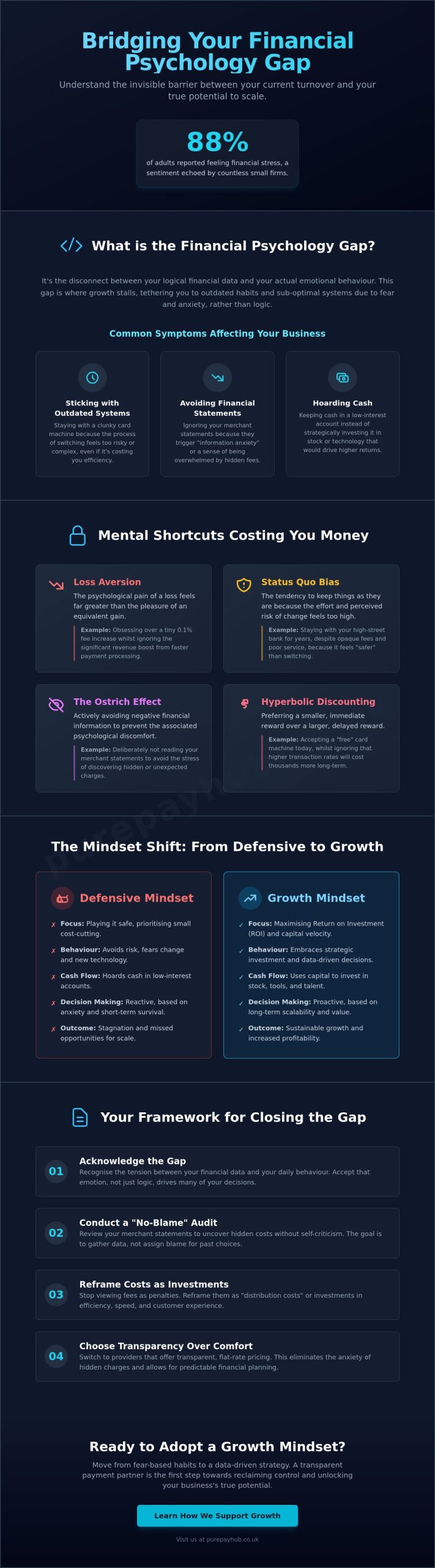
Your balance sheet tells one story, but your daily actions often tell another. The distance between your financial data and your actual financial behaviour is where growth often stalls. This disconnect is what we call 4. The “Financial Psychology” Gap (Mindset). It’s a psychological hurdle that keeps you tethered to legacy banking systems and outdated habits, even when the numbers suggest a different path. Understanding this gap is the first step toward reclaiming your time and your profit margins.
Many UK business owners inherit “money scripts” from early career experiences or family backgrounds. These scripts act as internal rules that dictate how you handle capital. If you were taught that debt is always dangerous or that banks are the only safe harbour, you might view strategic investment with unnecessary suspicion. This is deeply rooted in behavioural economics, where emotional triggers often override cold, hard logic. Sticking with a high-street giant because it feels “safe” is a common trap. In reality, these legacy institutions often drain your resources through opaque fee structures and slow fund availability.
The Symptoms of a Mindset Gap
How do you know if this gap is affecting your business? Look at your decision-making patterns. You might find yourself obsessing over a 0.1% difference in transaction fees whilst completely ignoring the fact that your current provider holds your funds for three working days. This is a classic symptom of focusing on the wrong metric due to underlying anxiety. Other signs include:
- Avoiding your financial statements because they trigger “information anxiety” or a sense of being overwhelmed.
- Staying with an outdated, clunky countertop card machine simply because the process of switching feels too risky or complex.
- Hoarding cash in a low-interest account instead of using a business cash advance to purchase stock that would drive a higher return.
Why Business Logic Often Fails
Rational accounting usually takes a backseat to emotional survival instincts during periods of economic pressure. When you are worried about overheads, your brain naturally narrows its focus to immediate, short-term costs. This survival mode prevents you from considering the long-term ROI of better equipment or faster payment gateways. You aren’t being “bad at business”; you’re simply human. The conflict between your rational brain and your emotional gut feeling is what creates the friction. The Mindset Gap is the primary barrier to SME scaling in 2026. By recognising that your hesitation is psychological rather than mathematical, you can start making decisions based on growth rather than fear.
Common Psychological Biases Affecting Your Cash Flow
Your brain is hardwired for survival, not necessarily for profit optimisation. Whilst you might believe your business decisions are purely logical, they are often steered by deep-seated behavioral biases. These mental shortcuts helped our ancestors avoid predators, but in 2026, they often lead to stagnant cash flow and missed scaling opportunities. Recognising these biases is essential to closing 4. The “Financial Psychology” Gap (Mindset) and moving your business forward.
Loss aversion is perhaps the most damaging bias for a merchant. It describes why the psychological pain of a £10 fee feels significantly more intense than the joy of a £1000 sale. This leads many owners to “The Ostrich Effect,” where they ignore merchant statements entirely to avoid the stress of seeing hidden charges. Similarly, hyperbolic discounting tempts owners to accept a “free” card machine today, ignoring the fact that higher transaction rates will cost them thousands over the next two years. These biases create a fog of confusion that prevents clear, data-driven action.
Loss Aversion and Merchant Fees
Fear of variable rates often stops businesses from adopting efficient, integrated EPOS systems. You might fixate on a tiny percentage increase in one area whilst ignoring the massive efficiency gains elsewhere. To overcome this, try reframing “fees” as “distribution costs.” Just as you pay for fuel or packaging, payment processing is a necessary vehicle for your revenue. Shifting to transparent, flat-rate pricing models can lower this emotional resistance. It replaces the “nasty surprise” of hidden markups with a predictable cost structure you can actually plan around.
Overcoming the Status Quo Bias
The status quo bias is the tendency to keep things as they are because change feels “risky.” This is the primary reason many merchants stay with sub-optimal providers for years. They focus on the “switching friction” instead of the opportunity cost. Consider the difference between three-day funding and next-day access to your capital. In a climate where 41.3% of small businesses cite cash flow as their top challenge in 2026, those extra 48 hours of liquidity are vital. Auditing your provider without emotional attachment allows you to see the numbers for what they are. If you are ready to see how a fairer partnership looks, you can explore our transparent payment solutions designed for regional growth.
Closing the gap requires a disciplined approach to your finances. Start by identifying one “fear-based” habit this week. Whether it is finally opening that statement or questioning a “free” equipment offer, every small step reduces the power these biases have over your bottom line. By moving from a defensive posture to a growth-oriented one, you ensure your business is built on a foundation of clarity rather than avoidance.
The Defensive Mindset vs. The Growth Mindset
A defensive mindset is often born from a desire to protect what you have already built. Whilst this sounds sensible, it frequently manifests as obsessive cost-cutting and a deep-seated avoidance of any perceived risk. This approach creates a psychological ceiling. You might find yourself hoarding cash in low-interest accounts or delaying essential upgrades because the immediate cost feels too high. This is a survival tactic, not a strategy for expansion. It keeps you small by forcing you to focus on the pennies whilst the pounds of potential profit slip away.
Transitioning to a growth mindset requires viewing capital through the lens of movement and velocity. Instead of asking “how much does this cost?”, you begin to ask “how quickly will this help me scale?”. Your choice of payment technology is a clear signal of which mindset is currently driving your business. If you are clinging to a clunky, unreliable terminal simply because you fear the friction of switching, you are likely trapped in 4. The “Financial Psychology” Gap (Mindset). Realising that transparent, fair partnerships are the foundation of a growth-oriented business allows you to stop playing it safe and start playing to win.
Hoarding vs. Velocity
Waiting for funds to clear for three or four working days creates a “scarcity” loop in your daily operations. It forces you into a defensive posture where you hesitate to pay suppliers or restock popular items because you are waiting for your own money to arrive. This stagnation is the enemy of growth. By prioritising next-day funding, you maintain a healthy “flow” state in your stock management. This mindset shift also changes how you view a Business Cash Advance. To a defensive owner, it looks like debt to be avoided. To a growth-oriented owner, it is a powerful lever to seize a time-sensitive opportunity or bridge a seasonal gap without slowing down.
Customer Experience as a Psychological Asset
Friction at the point of sale creates a subtle but damaging psychological burden for both the owner and the customer. A slow terminal or a confusing checkout process generates “micro-stress” that erodes confidence. Conversely, using modern, sleek portable card machines provides an immediate professional boost. It signals to your customers that your business is modern, efficient, and dependable. Investing in high-quality PurePay Hub countertop solutions is a direct investment in your professional pride. When your tools work perfectly, you can focus entirely on the human side of your business, knowing that the technical foundations are stable and untainted by hidden markups.
Practical Steps to Close the Financial Psychology Gap
Closing the gap isn’t a matter of willpower; it’s a matter of process. You’ve already identified the biases that hold you back. Now, you must implement systems that make those biases irrelevant. Bridging 4. The “Financial Psychology” Gap (Mindset) requires a transition from emotional avoidance to disciplined, data-driven action. By following these four practical steps, you can dismantle the barriers to your business growth and create a more resilient cash flow.
Start with a “No-Blame” audit of your last three merchant statements. The goal isn’t to regret past decisions, but to understand your current baseline. Identify one fear-based habit, such as ignoring your daily settlement reports, and replace it with a five-minute review each morning. Once you have a handle on your habits, automate your transparency. Choose providers that offer clear reporting tools and integrate your EPOS systems with your card machines. This integration eliminates manual errors and reclaims hours of your week previously spent on reconciliation.
The 10-Minute Statement Audit
When you open your statement, look specifically for the distinction between interchange fees and provider markups. Interchange is the non-negotiable cost set by card schemes, whilst markups are where legacy banks often hide their profit. Gaining total clarity on your fee structures immediately lowers the physiological stress associated with financial management. During this audit, keep an eye out for “zombie” subscriptions. These are recurring monthly charges for “premium” services or insurance that you likely haven’t used in years. Cutting these unnecessary costs provides an immediate, risk-free boost to your bottom line.
Building a Supportive Financial Ecosystem
Your business thrives when you surround yourself with transparent partners rather than opaque institutions. The psychological relief of having Next-Day Access to your own hard-earned money cannot be overstated. It moves you from a scarcity loop into a state of operational flow. When you decide to upgrade your systems, communicate the change clearly to your team. Explain that moving to modern technology isn’t just about saving money; it’s about making their jobs easier and the customer experience smoother. This alignment ensures everyone is moving toward a growth mindset. If you’re ready to remove the mystery from your merchant services, switch to a transparent provider that prioritises your growth.
How PurePay Hub Supports a Growth Mindset
PurePay Hub operates on a simple, no-nonsense philosophy. We believe that financial anxiety is often fuelled by unnecessary jargon and opaque fee structures. By stripping away these complexities, we act as a calm, reliable advocate for your business finances. Our goal is to help you bridge 4. The “Financial Psychology” Gap (Mindset) by providing a service that is both transparent and predictable. We don’t just process payments; we provide a stable foundation for your growth.
Transparency is our primary service. We offer debit card charges from 0.3% with no hidden surprises. This clarity allows you to plan your cash flow with confidence. We also empower UK merchants with next-day funding and a quick onboarding process. You won’t be left waiting for your own money. Instead, you’ll have the liquidity you need to respond to opportunities as they arise. This speed of capital is essential for moving from a defensive posture to a growth-oriented strategy.
Tech that Works for You, Not Against You
Our technology is designed to reduce operational friction. For hospitality and retail businesses, our integrated EPOS systems provide immense psychological ease. They remove the need for manual reconciliation and reduce the risk of human error. If your business requires mobility, our portable and mobile card machines offer the reliability you need to trade anywhere. For those who manage sales remotely, our Virtual Terminals simplify the process of getting paid. These tools aren’t just gadgets; they’re professional assets that reinforce your growth mindset by making the “money part” of your job feel effortless.
Fairness as a Core Identity
We prioritise fair rates because we value long-term trust over short-term markups. By offering 0.5% for credit cards, we ensure that your processing costs remain manageable as you scale. This commitment to fairness is backed by a support team that provides reassuring, professional guidance whenever you need it. You aren’t just another account number to us; you’re a partner. Moving away from traditional banking doesn’t mean losing support. It means gaining a partner that actually understands the regional merchant community. If you’re ready to see the difference that total transparency makes, organise a transparent rate review with PurePay Hub today.
Reclaim Your Financial Future
Moving your business from a state of survival to a state of scale requires more than just better sales figures. It demands a fundamental shift in how you perceive and manage your capital. By auditing your statements and identifying the biases that keep you tethered to legacy banks, you can finally bridge 4. The “Financial Psychology” Gap (Mindset). This transition allows you to replace fear-based hesitation with the informed confidence needed to invest in your own success.
You deserve a partner that prioritises your clarity over their own markups. With debit rates starting from 0.3% and next-day access to your funds, we provide the stability and velocity your cash flow needs. Our no-nonsense, UK-based support team is here to ensure you never feel overwhelmed by jargon again. It’s time to stop playing it safe with providers that hold you back. Switch to a transparent payment partner and close the gap today. Your growth is waiting; let us help you reach it.
Frequently Asked Questions
What is financial psychology in a business context?
Financial psychology refers to the emotional and cognitive factors that influence how a business owner manages their company’s capital. It explores the deep-seated “money scripts” and biases that dictate your financial behaviour. By understanding these psychological drivers, you can move away from irrational, fear-based habits and start making decisions that prioritise long-term scalability and efficiency over short-term survival instincts.
How does my mindset affect my business bank balance?
Your mindset acts as either a catalyst or a ceiling for your liquidity and profit margins. A defensive mindset often leads to cash hoarding and the avoidance of strategic investments, which can leave your balance stagnant. Conversely, a growth mindset focuses on the velocity of capital. By viewing your finances as a tool for expansion rather than a resource to be protected, you open the door to higher returns.
Why do I feel anxious when checking my merchant statements?
This anxiety is often a result of the “Ostrich Effect” combined with the opaque jargon used by traditional providers. When statements are cluttered with hidden markups and complex fee structures, your brain perceives them as a threat rather than a management tool. Switching to a provider that offers total transparency can eliminate this micro-stress, allowing you to review your data with a sense of calm and control.
Can changing my card machine provider really improve my business mindset?
Yes, because removing the friction of a sub-optimal service directly reduces operational stress. Transitioning to a transparent, fair partner helps bridge 4. The “Financial Psychology” Gap (Mindset) by providing predictable costs and reliable technology. When you don’t have to worry about hidden surprises, you can focus your mental energy on high-level strategy and customer experience rather than administrative frustration.
What is the most common psychological barrier to business growth?
Loss aversion is the most frequent barrier for regional merchants. It describes the tendency for the pain of a small transaction fee to feel more intense than the gain of a significant sale. This bias often keeps owners tied to legacy banks that offer poor value, simply because the “risk” of switching feels too high. Overcoming this requires reframing these costs as necessary vehicles for revenue distribution.
How do I stop making emotional decisions about my business finances?
You can reduce emotional interference by implementing automated, data-driven systems. Integrated EPOS systems and clear merchant dashboards replace “gut feelings” with objective facts. When you have immediate access to accurate data, you’re less likely to fall victim to the survival instincts that lead to short-sighted decisions. Discipline comes from having tools that provide clarity and remove the guesswork from your daily operations.
Why is transparency so important in merchant services?
Transparency is the foundation of trust in any financial partnership. It removes the “information anxiety” that fuels poor financial behaviour and allows for precise budgeting. Knowing exactly what you pay for every transaction prevents the frustration of unexpected costs. Clear, upfront pricing models enable you to evaluate your provider based on the actual value they add to your business rather than fear of the unknown.
How can next-day funding reduce business stress?
Next-day funding eliminates the “scarcity loop” created by waiting multiple days for your funds to clear. Having immediate access to your own hard-earned money provides the liquidity needed to pay suppliers and manage stock levels without hesitation. This steady flow of capital reduces the psychological burden of cash flow management, allowing you to maintain a proactive and growth-oriented stance in your daily business activities.