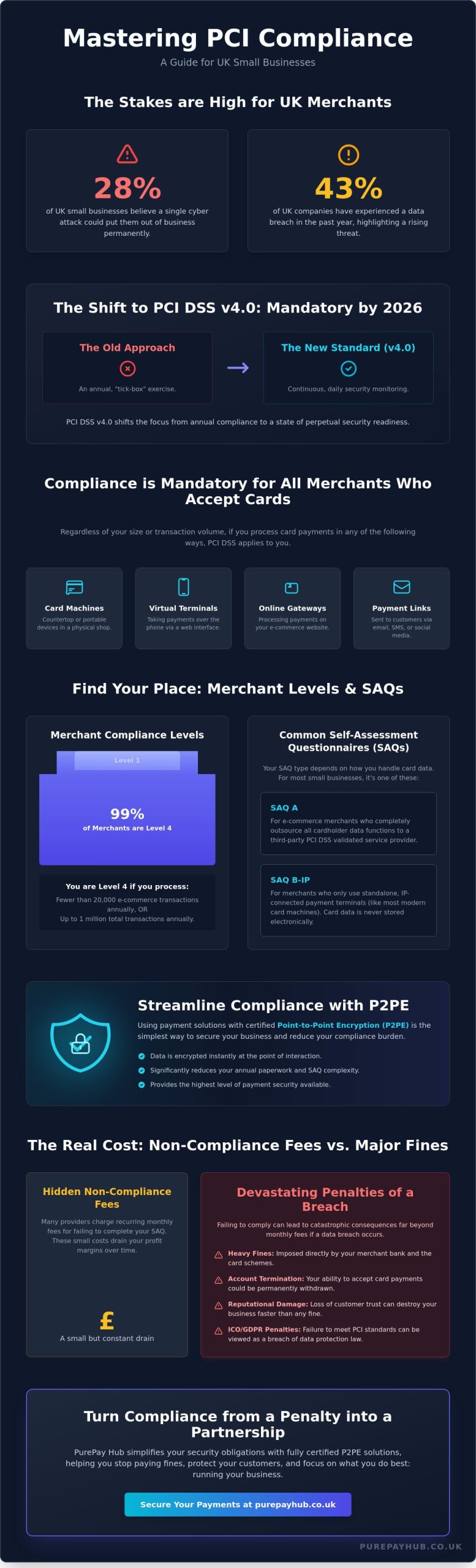
Did you know that 28% of UK small businesses believe a single cyber attack could put them out of business for good? It’s a sobering thought for any merchant handling customer card details. We understand that managing PCI compliance for small business UK often feels like a trap designed to catch you out with hidden monthly non-compliance fees and confusing technical jargon like SAQ and DSS. You’d rather focus on serving your customers than decoding complex security manuals or worrying about the 43% of UK companies that have experienced a breach this year.
You shouldn’t have to choose between security and simplicity. This guide helps you master the essentials of PCI DSS v4.0 so you can stop paying those frustrating non-compliance fines and ensure your customer data remains secure; all whilst maintaining a fast checkout. We’ll break down the mandatory 2026 requirements and show you how to protect your business from the rising threat of data theft. Here is how you can turn compliance from a monthly penalty into a steady security partnership that keeps your business and your reputation untainted.
Key Takeaways
- Identify your specific merchant level and the correct SAQ type to ensure your business meets the latest 2026 standards.
- Learn how to spot hidden non-compliance charges on your statement to master PCI compliance for small business UK and protect your margins.
- Follow a practical checklist to secure your card machines and digital environment against common physical and password-based vulnerabilities.
- Understand the shift to PCI DSS v4.0 and why continuous security is now a mandatory requirement for every UK merchant.
- Discover how P2PE-certified payment solutions can streamline your path to compliance and significantly reduce your annual paperwork.
Understanding PCI Compliance for UK Small Businesses
At its heart, the Payment Card Industry Data Security Standard (PCI DSS) is a set of security requirements designed to ensure that all companies processing, storing, or transmitting credit card information maintain a secure environment. It isn’t a government law, but a global standard established by the major card schemes like Visa, Mastercard, and American Express. These industry giants realised that for digital commerce to thrive, customers needed to feel safe. They created these rules to protect the entire ecosystem from the devastating impact of data theft. Managing PCI compliance for small business UK is about more than just avoiding fines; it’s about protecting your livelihood.
By 2026, the role of the PCI Security Standards Council has evolved significantly. We’re no longer in an era where you can simply tick a box once a year and forget about it. The latest standards, specifically PCI DSS v4.0, demand continuous security monitoring. This means your security measures must be active and verified every single day. Whilst the standards may seem technical, their purpose is simple: to make fraud as difficult as possible for criminals. Compliance isn’t optional for specific niches. It applies to you if you use any of the following:
- Countertop or portable card machines in a physical shop.
- Virtual terminals for taking payments over the phone.
- Online payment gateways for e-commerce websites.
- Payment links sent via email or SMS.
PCI compliance for small business UK is mandatory for every merchant, regardless of your size or transaction volume. Whether you process ten payments a month or ten thousand, the requirement to protect that data remains the same.
Why PCI Compliance Matters for Your Reputation
Security is the foundation of customer loyalty. When a local shopper taps their card on your mobile card machine, they’re trusting you with their financial life. Maintaining these standards builds a wall of trust amongst your customer base. It reduces the risk of card fraud and positions your business as a professional, secure centre for commerce. A single slip-up can destroy years of hard-earned reputation. Staying compliant is the best way to keep your brand untainted by the scandal of a data breach.
The Legal and Contractual Reality
Many business owners ask if PCI compliance is a legal requirement in the UK. While it isn’t a law passed by Parliament, it’s a strict contractual obligation between you and your merchant bank. If you fail to comply, you’re breaking your agreement. This can lead to heavy non-compliance fines or even the withdrawal of your ability to take card payments. The Information Commissioner’s Office (ICO) also takes a dim view of any business that suffers a breach due to poor security. Failing to meet PCI standards is often seen as a failure to protect personal data under GDPR, which can lead to severe regulatory penalties.
Identifying Your Compliance Level and SAQ Type
Knowing your place in the PCI hierarchy is the first step toward clearing the fog. The industry divides merchants into four levels based on their annual transaction volume. The vast majority, roughly 99% of companies, fall into Level 4. This level applies if you process fewer than 20,000 e-commerce transactions or up to 1 million total transactions annually. Managing PCI compliance for small business UK becomes far easier once you identify your specific merchant level, as it dictates the complexity of your reporting requirements.
To prove you are following the rules, you must complete a Self-Assessment Questionnaire (SAQ). There are currently nine different types of SAQs under the v4.0 standards. The PCI Security Standards Council (PCI SSC) provides these documents to help you evaluate your security posture. The specific form you need depends entirely on how you handle card data. If you use a standalone, plug-and-play card machine, your workload is significantly lighter than a business hosting its own payment server.
Common SAQ Types for UK Retailers and Hospitality
Most high-street shops and cafes will deal with either SAQ A or SAQ B-IP. SAQ A is generally for e-commerce merchants who outsource all payment processing. If you use a countertop card machine connected via the internet, you likely need SAQ B-IP. We recommend looking for hardware that supports Point-to-Point Encryption (P2PE). This technology encrypts data from the moment a card is tapped until it reaches the processor. Using P2PE-certified devices or integrated EPOS systems can drastically reduce the number of security questions you have to answer each year.
The Annual Renewal Cycle
Compliance is a continuous cycle, not a one-time event. Your certification is valid for one year; you must renew it before the expiry date to avoid automatic non-compliance fines. These penalties can range from £20 to £40 per month, which quickly eats into your profits. We suggest setting a reminder three months before your certificate expires. Keep a dedicated digital folder for your network scans, staff training logs, and equipment inspection records. Organising your documentation throughout the year makes the renewal process a simple, stress-free task rather than a last-minute scramble. Maintaining your PCI compliance for small business UK status is about building consistent habits that protect your customers and your cash flow.
The Real Cost of PCI Compliance: Fees vs Fines
Your monthly merchant statement often contains a confusing list of acronyms and charges. One of the most misunderstood is the “PCI Management Fee”. This is a standard service charge, typically ranging from £5 to £15 per month, which covers the cost of the security tools and support provided by your payment processor. It’s a legitimate cost of doing business safely. However, a “PCI Non-Compliance Fee” is entirely different. This is a penalty, not a service. If you see a charge between £20 and £40 on your statement, you’re being fined for failing to prove your security status. Understanding the financial side of PCI compliance for small business UK is essential for protecting your bottom line.
Some traditional providers rely on opaque fee structures to boost their margins. They might bury non-compliance penalties deep in your statement, hoping you won’t notice the monthly drain on your cash flow. A fair partner should be transparent about these costs. They’ll help you achieve compliance rather than simply profiting from your confusion. The goal is to move from paying penalties to investing in a secure partnership that keeps your business untainted by unnecessary costs. Transparency is the hallmark of a modern fintech ally.
How to Spot and Stop Non-Compliance Fines
Check your statement for terms like “Non-PCI Compliant Fee” or “PCI Penalty”. If you find one, take immediate action. Log into your compliance portal or contact your provider to find out which documentation is missing. Completing your assessment can instantly stop these fines and boost your monthly cash flow. It’s often a simple matter of updating your records or confirming your hardware settings. Don’t let these preventable charges become a permanent fixture on your overheads whilst you are trying to grow your business.
The Hidden Costs of a Data Breach
The fines for non-compliance are small compared to the true cost of a data breach. Research shows the average direct cost of a cyber attack for a small UK business is £3,398. But this is just the tip of the iceberg. A breach where cardholder data is stolen triggers mandatory forensic audits that can cost thousands of pounds. You’ll also face the price of mandatory hardware replacement and the cost of notifying every affected customer. Beyond the immediate financial hit, the long-term brand damage is often irreversible. Customers value their security; if they feel their data isn’t safe, they’ll simply take their custom elsewhere. Maintaining PCI compliance for small business UK is your best defence against these business-ending threats.
A Practical Checklist for PCI DSS v4.0 Standards
The transition to the v4.0 standards has changed the landscape of PCI compliance for small business UK. It’s no longer enough to just own a secure device; you must manage the entire environment where payments happen. This starts with basic digital hygiene. Using a password like “admin123” or “password” is a major compliance failure that hackers can exploit in seconds. You need unique, complex credentials for every piece of hardware and software in your payment chain. If your staff use shared logins, you’re creating a security blind spot that v4.0 specifically aims to close.
Network safety is another critical pillar for any modern shop or cafe. You must separate your guest Wi-Fi from the network used by your payment terminal. If a customer’s phone is on the same network as your card machine, you’ve created a potential doorway for data theft. Similarly, your data storage rules must be absolute. Never, ever write down card numbers or CVV codes on paper or in digital notes. If you don’t store the data, you can’t lose it. Training your team to recognise secure payment behaviour is now a mandatory requirement, ensuring everyone understands their role in protecting the business.
Securing Your Physical Business Premises
Physical tampering remains a persistent threat for UK retailers. We recommend performing daily visual checks on your portable card machine to look for skimming devices or evidence of casing swaps. Ensure your router and payment hardware are kept in a restricted area, ideally behind a counter or in a locked cabinet. You should also maintain a documented list of authorised staff who are permitted to handle the terminals. Staying on top of these physical checks is a vital part of maintaining PCI compliance for small business UK and keeping your equipment untainted by fraud.
Digital Hygiene and Network Security
If you use integrated EPOS systems, a robust firewall is your first line of defence. It acts as a digital bouncer, keeping unauthorised traffic away from your transaction data. For those taking payments over the phone, you must use a secure virtual terminal. Handling “Card Not Present” transactions requires specific protocols to ensure you aren’t inadvertently storing sensitive data during the call. If you’re looking for hardware that simplifies these requirements, our range of P2PE-certified card machines is designed to meet the highest security standards with minimal effort from your side.
How PurePay Hub Simplifies Your Security Obligations
PurePay Hub believes that payment security shouldn’t be a source of stress. We’ve built our service to act as a stabilising force for your finances. Managing PCI compliance for small business UK often feels like a full-time job. We aim to change that. Our approach prioritises clarity over corporate jargon, ensuring you understand your obligations without the headache. We provide the tools and the support you need to keep your business untainted by security failures. Our team serves as a reliable expert, helping you stay principled and disciplined in your data protection efforts.
Our hardware comes pre-certified with the latest P2PE standards. This isn’t just a technical detail. It’s a commitment to reducing your administrative burden. By using our pre-configured devices, you significantly shorten your annual Self-Assessment Questionnaire. You can spend less time on paperwork and more time on growth. We act as a fair partner, making sure the technicalities of security don’t slow down your operations. We disdain the opaque practices of traditional competitors who leave you to figure out these complex rules on your own.
Integrated Security in Every Transaction
Our countertop and mobile units handle encryption automatically. The moment a customer taps their card, the data is shielded immediately. This level of protection provides the peace of mind you need to focus on the daily run of your shop or cafe. We also offer next-day funding, ensuring your cash flow remains as secure as your transaction data. Best of all, our transaction rates are untainted by hidden markups or the murky fee structures used by traditional banks. We believe in fairness and transparency in every transaction. You’ll always know exactly what you’re paying and why, with no hidden surprises on your monthly statement.
Expert Support for Your SAQ
You don’t have to face the transition to PCI DSS v4.0 alone. We provide access to UK-based technical support to help with any compliance queries you might have. Our team acts as a supportive business partner, guiding you through the technicalities of the 2026 standards. We’ll help you manage PCI compliance for small business UK whilst you navigate the assessment process, ensuring you avoid those unnecessary non-compliance fines discussed earlier. It’s about more than just providing software; it’s about a steady security partnership that values your time. We’re here to ensure your business stays compliant and your reputation remains spotless.
Speak to a PurePay Hub expert about your merchant account today.
Secure Your Future with a Fair Partner
Securing your business shouldn’t feel like a constant battle against hidden costs and technical jargon. You now have the roadmap to master PCI compliance for small business UK, from identifying your SAQ type to implementing the latest v4.0 standards. By staying disciplined with your physical checks and digital hygiene, you protect your reputation whilst keeping your finances untainted by unnecessary penalties. Compliance is no longer a hurdle; it’s a foundation for a professional, trustworthy merchant environment.
It’s time to move away from opaque fee structures and toward a partnership built on integrity. We’re here to help you navigate these obligations with clarity and confidence. Switch to PurePay Hub for transparent card processing and expert PCI support. You’ll benefit from debit card rates starting from 0.3%, next-day access to funds, and the reassurance of no-nonsense UK-based support. We’re ready to help you simplify your security so you can focus on what you do best: running your business. Let’s make your payment processing fairer and more secure today.
Frequently Asked Questions
Is PCI compliance mandatory for small businesses in the UK?
Yes, PCI compliance is a mandatory contractual requirement for any UK merchant that accepts card payments. It isn’t a government law, but a set of security standards enforced by major card schemes like Visa and Mastercard. If you don’t comply, you’re breaking your agreement with your merchant bank. This can lead to your ability to take payments being withdrawn entirely.
How much does PCI compliance actually cost per month?
Most UK merchants pay a small monthly fee to their processor to cover the cost of compliance tools and support. These fees typically range from £5 to £15 per month. This is a legitimate service charge that helps you maintain your security status. It’s much more affordable than the non-compliance penalties that providers charge if you fail to prove your status each year.
What happens if my business is not PCI compliant?
Failing to meet the standards for PCI compliance for small business UK leads to immediate financial penalties. Most processors will add a monthly non-compliance fine to your statement, often between £20 and £40. You’ll also be fully liable for all costs if a data breach occurs. This includes forensic audits, card replacement fees, and potential legal claims that could bankrupt a small firm.
Do I need PCI compliance if I only use a mobile card reader?
Yes, every device that processes card payments requires compliance, including mobile card readers. Even if you only take a few payments a week, the data passing through your reader must be protected. Using a modern, P2PE-certified mobile reader simplifies the process, but you still need to complete an annual Self-Assessment Questionnaire to confirm your business follows safe handling procedures.
What is the difference between PCI DSS v3.2.1 and v4.0?
PCI DSS v4.0 replaced the older v3.2.1 version to address more sophisticated modern threats. The biggest change is the shift from an annual tick-box exercise to continuous security monitoring. It introduces stricter requirements for multi-factor authentication and more rigorous testing of security controls. This ensures that your business remains protected every day of the year, not just on the day you fill out your forms.
How often do I need to renew my PCI compliance certificate?
You must renew your PCI compliance certificate every 12 months. Your Self-Assessment Questionnaire (SAQ) is only valid for one year from the date of submission. We recommend starting your renewal process at least 90 days before the expiry date. This gives you plenty of time to address any technical issues or network scan failures without risking a lapse in your compliant status.
Can I handle PCI compliance myself or do I need a consultant?
Most small UK businesses can handle the PCI compliance for small business UK process themselves without hiring expensive consultants. Your payment provider should offer a compliance portal and technical support to guide you through the SAQ. If your business has a complex network or processes millions of transactions, you might need a Qualified Security Assessor, but for most local merchants, a supportive partner is enough.