What if a significant portion of your daily sales simply didn’t arrive in your bank account when you expected it? For many entrepreneurs, discovering that a chunk of their revenue is being held in a rolling reserve feels like an unfair, hidden penalty. It’s a stressful experience that can stall your growth and complicate your daily operations. Truly understanding merchant account fees UK providers charge is the first step toward clearing up this confusion. These holds aren’t designed to punish you. Instead, they act as a protective buffer against chargebacks and fraud whilst keeping the payment ecosystem stable.
We know it’s frustrating to have your cash flow restricted by complex terms you didn’t expect. This guide explains exactly how rolling reserves work and why UK processors use them to manage risk. You’ll discover how the release timeline functions and get practical tips to reduce your reserve percentage. We’ll provide the clarity you need to manage your business finances with confidence and choose a transparent merchant partner that treats you like a fair ally.
Key Takeaways
- Learn how a rolling reserve acts as a temporary buffer by withholding a small percentage of your gross sales to manage potential chargebacks.
- Gain clarity on the mechanics of your processing costs by understanding merchant account fees UK providers use to mitigate future delivery risks.
- Discover why even low-risk businesses might face reserves and how factors like bespoke lead times influence your acquirer’s decision.
- Identify actionable steps to lower your reserve percentage, such as maintaining a chargeback ratio below 1% and providing proactive delivery evidence.
- Find out how to partner with a transparent provider like PurePay Hub to ensure your account structure supports your long-term business growth.
What is a Rolling Merchant Account? The Core Definition
Cash flow is the lifeblood of any growing business. When you notice that a portion of your daily sales isn’t hitting your bank account immediately, it’s natural to feel a sense of alarm. A rolling merchant account is essentially a standard merchant ID that operates with an integrated reserve fund. It’s a common risk management tool used across the industry to ensure financial stability for both the merchant and the provider. Understanding merchant account fees UK providers apply is often the first step toward realising that this reserve isn’t an extra cost; it’s a temporary hold on your own capital.
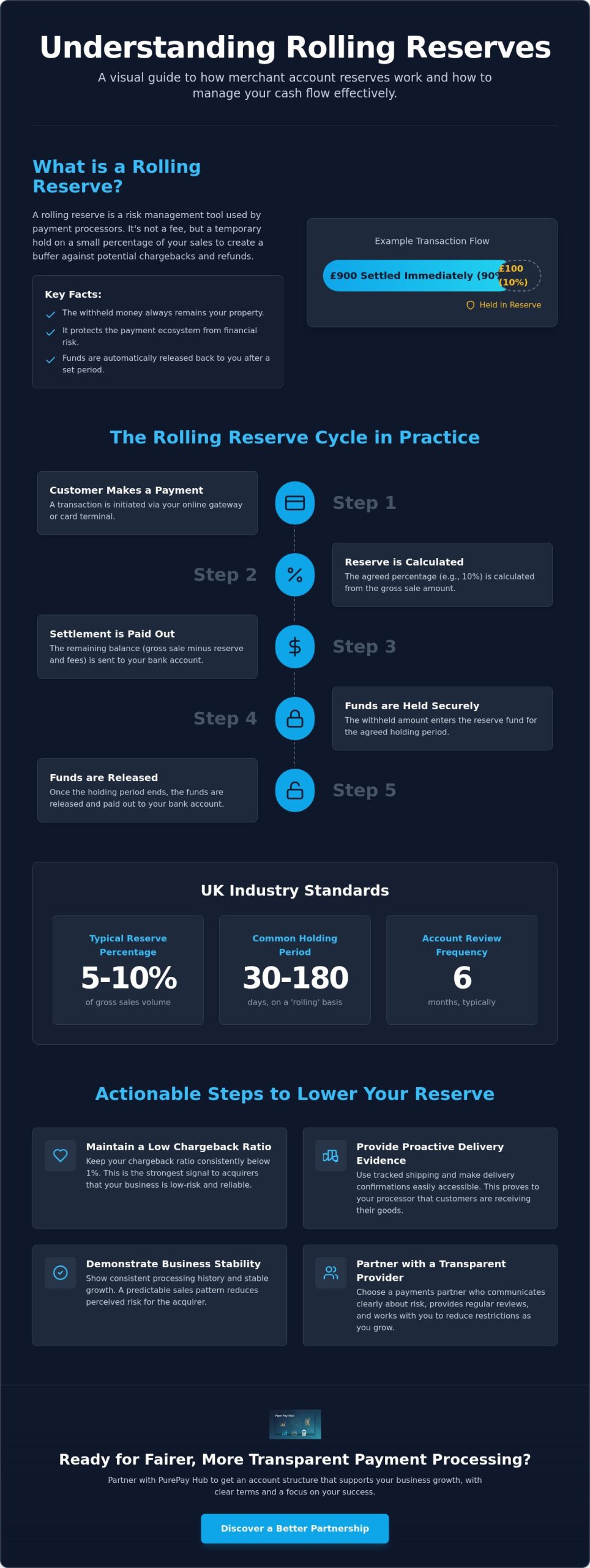
During a rolling reserve agreement, the acquirer withholds a specific percentage of your gross sales for a predetermined period. This percentage typically ranges between 5% and 10% depending on your industry and risk profile. It’s vital to remember that this is not a fee. The money remains yours and is held in a separate, secure account. Its primary purpose is to protect the entire payment ecosystem from potential chargebacks or customer refunds. Every Payment processor must account for the possibility of a business being unable to cover these liabilities, and the reserve acts as a vital safety net.
The Difference Between Rolling and Fixed Reserves
Traditional fixed reserves often require a significant lump sum of capital to be deposited up-front before you can even begin processing. This can be a major barrier for SMEs. In contrast, rolling reserves grow naturally alongside your sales volume. This makes them far more accessible for businesses that are scaling quickly but have limited initial cash reserves. Some providers also offer a capped reserve model. Under this structure, the withholding stops entirely once the fund reaches a specific total, such as £5,000 or a percentage of your average monthly turnover. This gives you a clear target and a predictable end point for the withholding phase.
Why Rolling is the Key Term
The term “rolling” describes the continuous, fluid nature of the fund. It operates on a first-in, first-out basis. Imagine a revolving door; as new sales enter the reserve from your latest transactions, the oldest funds that have finished their holding period are released back into your settlements. Once you complete the initial cycle, which might be 30 or 60 days, you will begin to see a steady stream of settlements again. The amount being withheld is balanced out by the amount being released. This creates a predictable rhythm that allows you to manage your daily operations whilst maintaining the security buffer required by your acquirer.
How the Rolling Reserve Cycle Works in Practice
Gaining a clear perspective on understanding merchant account fees UK businesses encounter requires a look at the daily mechanics of your transactions. The rolling reserve isn’t an abstract concept; it’s a precise, five-step cycle that repeats with every sale you make. By breaking down this process, you can accurately forecast your available cash and avoid the anxiety of “missing” funds. This cycle ensures that while a portion of your revenue is held, it is never truly gone.
- Step 1: A customer makes a card payment via your terminal or online gateway.
- Step 2: The acquirer identifies the transaction and calculates the agreed reserve percentage.
- Step 3: The remaining balance, which is the total sale minus the reserve and standard processing fees, is settled to your business bank account.
- Step 4: The withheld amount remains in a secure reserve fund for a predetermined holding period.
- Step 5: Once the holding period ends, that specific withheld amount is released back to your bank account on a rolling basis.
Common Percentage and Timeframe Standards in the UK
For the majority of UK merchant accounts, the reserve percentage typically falls between 5% and 10%. This rate isn’t permanent. Risk departments at your acquirer or ISO review these terms periodically, often every six months. If your business shows a low chargeback ratio and consistent delivery times, they may reduce or even remove the requirement entirely. Holding periods generally range from 30 to 180 days. Given the vast scale of the UK e-commerce market, processors use these timeframes to ensure they have enough coverage to handle potential disputes from customers who might not receive their goods immediately.
The Impact on Your Daily Settlement
Let’s look at the numbers. If you process £1,000 in sales today with a 10% reserve, you’ll receive £900 in your settlement. The remaining £100 enters the reserve. During your very first holding period, you’ll notice a slight settlement gap. This is the only time your cash flow feels pinched because you’re building the fund from scratch. Once you reach the end of the first cycle, the funds released from your earlier sales begin to supplement your new settlements. The system becomes self-sustaining and predictable. If you’re concerned about how these cycles might affect your liquidity, choosing a provider with a portable card machine that offers transparent settlement terms is essential. This steady rhythm ensures you always have a predictable stream of income to cover your overheads whilst your business grows.
Why Do UK Processors Require a Rolling Reserve?
Many UK business owners assume that if they aren’t selling “high-risk” items, they shouldn’t face a reserve. This is a common misunderstanding. When you are first understanding merchant account fees UK processors offer, you’ll see that risk is about more than just the product. It’s about stability. Acquirers look at the age of your business and the credit history amongst your directors. If you’re a new startup or have a thin credit file, a reserve acts as a trust-building tool. It provides the processor with the confidence to support your growth whilst you establish a proven track record of successful transactions. It’s about partnership.
Future Delivery Risk is another major factor that often catches merchants off guard. This affects businesses like bespoke furniture makers or event planners who take payment today for a service delivered weeks or months later. If a business fails before delivery, the processor is legally liable to refund the customers. Because of the UK Interchange Fee Regulation, certain fee components are capped, but risk management remains a flexible area where processors must protect themselves. A rolling reserve ensures that funds are available to cover these potential liabilities without affecting your ability to process new sales.
High-Risk Industries vs. High-Risk Behaviours
Specific sectors naturally carry higher refund risks. Travel agencies, ticketing platforms, and high-end furniture retailers are often categorised this way because of their high transaction values and long fulfilment windows. However, your behaviour as a merchant matters just as much. A sudden spike in volume or a series of high-value outlier sales can trigger a risk review. Seasonal businesses often see reserves applied only during peak trading months to manage the increased exposure. Maintaining a consistent chargeback ratio is the primary metric used by risk teams to determine if your reserve levels should be adjusted. Risk teams watch closely.
Protecting Against the Chargeback Timeframe
Cardholders in the UK can often dispute a transaction and request a chargeback up to 180 days after the initial purchase. This long window creates a significant financial exposure for any payment processor. If a merchant’s business fails or they cannot cover a sudden wave of refunds, the processor is left holding the bill. The rolling reserve ensures there is always a dedicated pool of funds to settle these disputes. This protection keeps the wider card network stable for all UK businesses. It prevents systemic losses that would eventually lead to higher costs for everyone.
Strategies to Minimise or Remove Your Reserve Requirements
A rolling reserve is not a permanent fixture. It is a risk management tool that should evolve as your business proves its reliability. Taking a proactive approach to understanding merchant account fees UK processors implement allows you to negotiate from a position of strength. You have the power to influence these terms by demonstrating operational excellence. By reducing the perceived risk to your acquirer, you can often secure a lower reserve percentage or have the requirement removed entirely.
Maintaining a chargeback ratio of under 1% is the most effective way to show stability. Risk teams view this metric as the ultimate health check for your business. If disputes are rare, the need for a large protective buffer vanishes. You should also ensure your business bank statements show healthy liquidity. If you can prove your business has the cash to cover potential refunds without dipping into a reserve, the processor is much more likely to relax their withholding terms. Don’t wait for them to notice your progress. Request a formal account review every six months to present your data and ask for an adjustment. Most providers won’t volunteer to release these funds; you must lead the conversation.
Reducing Chargebacks and Disputes
Clarity is your best defence against disputes. Ensure your “Doing Business As” name matches what customers see on their bank statements. If a customer doesn’t recognise a charge, they are likely to call their bank rather than you. Implementing an instant refund policy also prevents minor issues from escalating into formal chargebacks. It is always cheaper to refund a customer directly than to lose a dispute and pay a chargeback fee. Keep meticulous records of tracking numbers and signed delivery notes for every order. Having this evidence ready allows you to challenge any unfair disputes with confidence.
Improving Your Merchant Profile
Transparency during the onboarding process is vital. Being honest about your lead times and business model prevents surprise reserves from being applied later. Processors prefer consistent processing volumes over erratic, large transactions that look like outliers. Sudden spikes trigger red flags. Demonstrating high security standards is equally important. Following our guide on PCI compliance shows your acquirer that you take data protection and fraud prevention seriously. Using 3D Secure and other modern fraud tools significantly lowers the likelihood of disputed sales. If you are ready for a partner that rewards your operational discipline with fairer terms, explore our online payment gateway today to see how we support UK growth.
Fairer Payment Processing with PurePay Hub
Choosing a payment partner is one of the most important decisions for your business. At PurePay Hub, we’ve built our reputation on a foundation of absolute transparency and no-nonsense service. We believe that understanding merchant account fees UK providers charge should be straightforward. You deserve to know exactly where your money is and when it will arrive in your bank account. Our team is dedicated to stripping away the corporate jargon that often plagues the financial sector. We provide clear, actionable information that helps you make informed decisions for your future.
Our onboarding process is designed to be thorough but efficient. We don’t believe in one-size-fits-all solutions. Instead, we take the time to identify the right account structure for your specific UK industry. Whether you’re in retail, hospitality, or a service-based sector, we ensure your terms reflect your actual risk profile. We offer competitive rates that help offset any temporary cash flow impacts from rolling reserves. This allows you to focus on growth whilst we handle the technicalities of your payment processing. You get a fair partner who values your success as much as you do.
Transparent Terms for UK SMEs
We believe in clear communication regarding settlements and any necessary security measures. Our primary goal is to get your business on next-day funding as quickly as your risk profile allows. We know that waiting for your money is not an option in a fast-paced market. To support your daily operations, we provide a range of countertop card machines and portable card machines designed for national reliability. These tools ensure you can accept payments anywhere in the UK with total confidence. We keep our terms simple so you can spend less time reading statements and more time serving your customers.
A Partner, Not Just a Processor
Sometimes, the timing of a rolling reserve can create temporary liquidity challenges. If you find yourself in this position, our business cash advance can help bridge cash flow gaps whilst your reserve fund is being established. This is just one way we act as a supportive business ally rather than a distant financial institution. Having a UK-based partner who understands the local landscape makes a significant difference to your daily peace of mind. We are here to help you navigate the complexities of the payment world with honesty and integrity. If you’re ready for a fairer approach to processing, organise a transparent quote with PurePay Hub today.
Take Control of Your Business Cash Flow
Rolling reserves don’t have to be a source of anxiety for your business. By now, you’ve seen that these funds act as a strategic safety net rather than a lost cost. Operational success comes down to maintaining a low chargeback ratio and keeping an open line of communication with your processor. Truly understanding merchant account fees UK providers set is the first step toward reclaiming your financial predictability. You have the tools to influence your account structure through consistent, high-quality operations and proactive account reviews.
We believe every UK business deserves a partner that prioritises honesty over hidden markups. PurePay Hub offers a refreshing alternative to traditional banking. With debit rates starting from 0.3% and next-day funding available, we help you keep your revenue moving exactly where it belongs. Our no-nonsense UK support team is always ready to explain your statement with total clarity. Switch to a fairer, more transparent merchant account with PurePay Hub. You’ve built a great business; let’s make sure your payment processing supports that hard work every step of the way.
Frequently Asked Questions
Is a rolling reserve the same as a transaction fee?
No, a rolling reserve is not a fee. It is a portion of your revenue held temporarily by the acquirer to cover potential risks. Unlike transaction fees, which are permanent costs of processing, the money in a reserve remains yours. It is eventually settled to your bank account once the holding period ends. Understanding merchant account fees UK businesses pay means distinguishing between what you spend and what you are simply waiting for.
How long will the bank hold my rolling reserve funds?
Most UK processors hold reserve funds for between 30 and 180 days. This timeframe depends on your industry and the specific risk profile of your business. For example, a business with a long delivery window will likely face a longer holding period. Once the initial cycle is complete, the oldest funds are released daily or weekly. This ensures a steady flow of settlements back into your bank account.
Can I get a merchant account without a rolling reserve?
Yes, many low-risk businesses operate without any reserve requirement. If you have a strong processing history, low chargeback rates, and a solid credit profile, your acquirer may offer a standard account structure. New businesses in certain sectors or those with high transaction values are more likely to see a reserve applied. You can often request to have a reserve removed after proving your operational stability over six to twelve months.
What happens to the reserve if I close my merchant account?
If you close your account, the processor will hold the remaining reserve balance until the chargeback window expires. This period is typically 180 days from the date of your last transaction. This policy protects the processor from any final disputes or refund requests that might arrive after you stop trading. Once this window closes and all liabilities are settled, the remaining balance is paid out to your nominated business bank account.
Does every new UK business need a rolling reserve?
Not every new business requires a rolling reserve. Acquirers evaluate each application based on the business model, the length of the fulfilment cycle, and the directors’ credit history. A local cafe with immediate delivery has a different risk profile than a bespoke furniture maker. Whilst reserves are common for startups to build trust, they are not a universal requirement for every entrepreneur entering the UK market.
How can I see how much money is currently in my rolling reserve?
You can monitor your reserve balance through your online merchant portal or your monthly processing statements. Most modern dashboards provide a clear breakdown of settled funds versus held reserves. This transparency is vital for understanding merchant account fees UK providers charge and managing your cash flow. If you can’t find this information, your account manager should be able to provide a detailed report of your current fund status.
Will a rolling reserve affect my business credit score?
No, a rolling reserve does not directly impact your business credit score. It is an internal risk management tool used by your payment processor, not a form of debt or credit. However, maintaining a healthy reserve can actually be a positive sign of stability. It shows that you are managing your chargeback risks effectively. Your credit score is more likely to be influenced by your overall payment history and financial health.
Can I negotiate the percentage of my rolling reserve?
Yes, you can and should negotiate your reserve percentage. Most acquirers are willing to review your terms if you can demonstrate a low chargeback ratio and consistent processing volumes over six months. Providing evidence of fast delivery and high customer satisfaction can also strengthen your case. Don’t accept the initial terms as permanent. Proactively asking for a review shows that you are a disciplined and professional business partner.