Tag: Martyn’s Law

  • Choosing the Best Pub EPOS System: A 2026 Guide to Efficiency and Profit

    Choosing the Best Pub EPOS System: A 2026 Guide to Efficiency and Profit

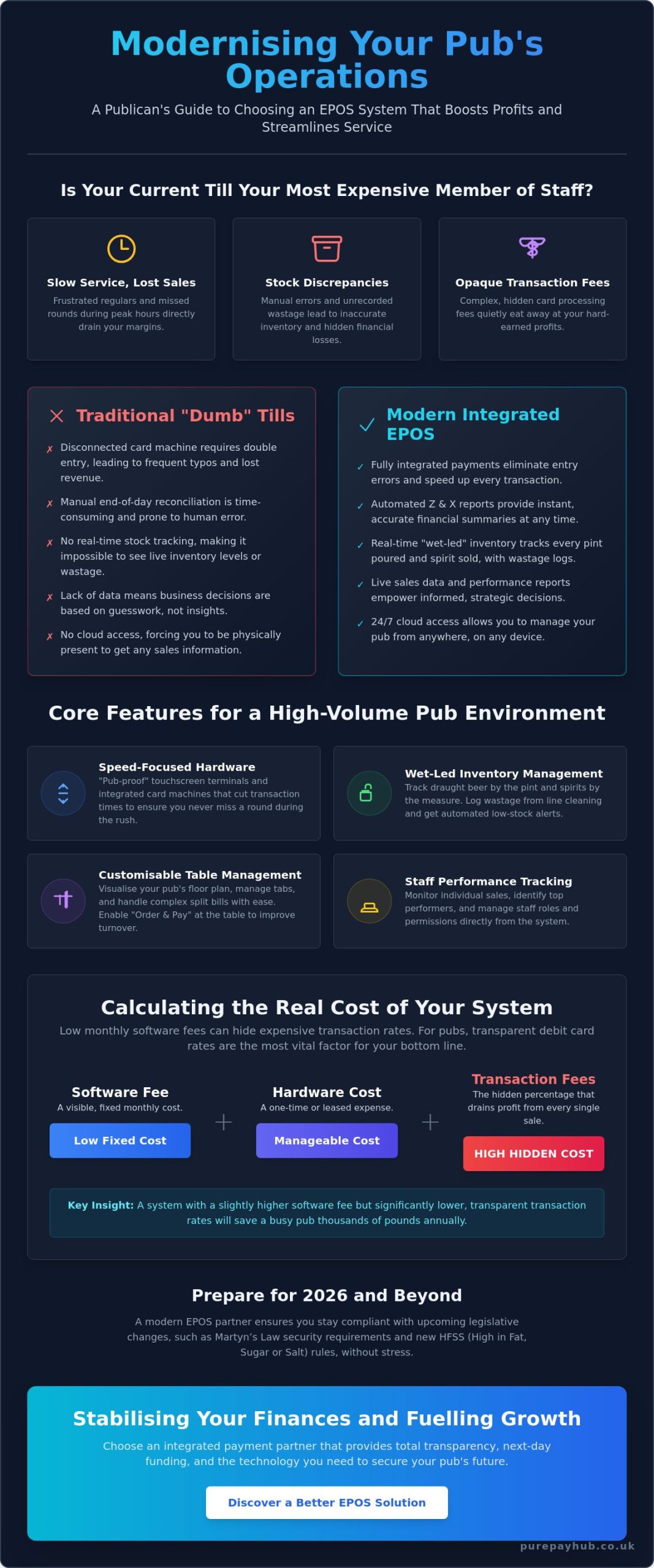
    Your current till system might be the most expensive member of staff you have ever hired. When the Friday night rush hits, a slow pub epos system does more than just frustrate your regulars; it actively drains your margins through missed rounds and stock discrepancies. You likely feel the pressure of a packed bar whilst managing complex wet-led inventory and worrying about those opaque transaction fees that eat into your hard-earned profits. It’s a common frustration for publicans who want to focus on service rather than fighting with their own technology.

    We believe your payment tech should be a stabilising force for your finances, not a source of stress. This guide shows you how to choose a system that transforms operations, slashes transaction costs, and secures your cash flow through total transparency. We’ll explore the latest 2026 requirements, including Martyn’s Law and new HFSS rules, whilst comparing the top providers to help you find a reliable partner. You’ll learn how to achieve faster table turnover and simple stock management to keep your business moving forward with confidence.

    Key Takeaways

    • Learn how a modern pub epos system synchronises your payments and stock to eliminate hidden wastage and manual errors.
    • Identify the specific hardware features that prioritise speed of service during peak hours to ensure your bar staff never miss a round.
    • Understand the true cost of card processing and why transparent debit rates are more vital for your bottom line than monthly software fees.
    • Discover the best practices for a stress-free transition, including how to migrate your menu data and when to schedule your system switch.
    • See how integrated payment solutions and next-day funding provide a stabilising force for your pub’s weekly cash flow.

    What is a Pub EPOS System and Why Does Your Bar Need One?

    A pub EPOS is a centralised digital hub for all bar transactions. Unlike a standard cash register, an Electronic Point of Sale system integrates sophisticated software with robust hardware to manage the complex demands of a modern hospitality environment. It’s the engine room of your business, synchronising your card payments, stock levels, and staff performance in one place. To understand the broader context of this technology, you can explore the history and evolution of What is a Point of Sale (POS) system through foundational industry records.

    In 2026, the best pub epos system options use cloud technology to give you real-time oversight of your venue. This means you can check your live sales data or adjust menu prices from your phone whilst away from the bar. It moves your operations beyond simple money-taking and into the realm of intelligent business management. By connecting every part of your service, you ensure that no pint goes unrecorded and no transaction is lost to manual error.

    The Shift from Traditional Tills to Integrated EPOS

    Legacy “dumb” tills are a primary cause of reconciliation errors. When your payment terminal doesn’t talk to your till, staff must manually enter amounts twice. This leads to typos, lost revenue, and hours spent at the end of a shift trying to figure out why the numbers don’t match. An integrated system removes this human error factor entirely. For multi-site operators, the advantage is even clearer. You gain 24/7 cloud access to every location, allowing you to compare performance across your estate without needing to be physically present at the bar.

    The Core Components: Hardware vs Software

    Your system is only as strong as its weakest link. In a high-pressure bar environment, your hardware must be “pub-proof”. This means touchscreen terminals that can handle sticky fingers and the occasional spill, along with printers that won’t fail in a hot, humid kitchen or cellar. The software is the brain of the operation, handling essential tasks like table management and complex split billing for large groups. It should be intuitive enough that new staff can learn the basics in minutes, keeping your service moving during the Friday night rush.

    Consider these essential elements for a reliable setup:

    • Touchscreen Terminals: High-speed interfaces that reduce order time and improve accuracy.
    • Integrated Card Machines: Devices that automatically pull the total from the till to prevent entry mistakes.
    • Stock Management Modules: Software that tracks every pint poured and bottle sold in real time.
    • Loyalty Programmes: Built-in tools to reward your regulars and encourage repeat visits.

    By choosing a modern pub epos system, you aren’t just buying a till; you’re investing in a partner that protects your margins and simplifies your working day. It provides the clarity you need to make informed decisions about your stock, your staff, and your future growth.

    Essential Features for High-Volume Pub Environments

    In a high-volume pub, speed is your most critical metric. When the bar is three deep, your pub epos system must respond instantly to every touch. Modern publicans are increasingly adopting modern financial technology to manage these peak periods with precision. Beyond simple order entry, your system needs to handle “Order & Pay” at the table, which has become a standard expectation for customers in 2026. To keep your books balanced, Z-reports and X-reports provide instant financial clarity by giving you a real-time summary of your takings at any point during the day.

    Wet-Led Inventory and Wastage Management

    Managing a wet-led cellar requires more than just counting bottles. Your inventory tracking must account for draught beer by the pint and spirits by the exact measure. A common drain on profits is the lack of a proper wastage log for weekly line cleaning or accidental spills. The right pub epos system allows you to record these events specifically, ensuring your stock levels remain accurate. You can also set automated low-stock alerts so you never have to tell a customer their favourite ale is off. For more advanced tracking, exploring integrated stock modules can help protect your bottom line.

    Table Management and Customisable Floor Plans

    Visualising your bar and garden layout is essential for effective service. A customisable floor plan allows you to manage server sections and track table occupancy at a glance. It’s common for customers to start a tab at the bar and later move to a table for food; your system should handle this transition seamlessly. Handling large groups becomes much simpler with a dedicated “split bill” feature. This allows your team to divide costs by item or value without holding up the queue or causing confusion during payment.

    Staff Performance and Security Features

    Security is vital in a fast-paced environment. Individual staff logins via RFID fobs or unique PINs help you track sales and prevent “no-sale” theft at the till. These logs also allow you to monitor average transaction values, helping you identify which team members are your top performers. To maintain control, you should use permission tiers that restrict sensitive actions like refunds or voids to management-level staff only. This creates a transparent, accountable culture within your team whilst safeguarding your daily revenue.
    Choosing the Best Pub EPOS System: A 2026 Guide to Efficiency and Profit

    Calculating the Real Cost: Software, Hardware, and Transaction Fees

    Choosing a pub epos system based solely on the monthly software price is a common mistake. Whilst a low subscription fee looks attractive on paper, the real cost of your technology is often hidden in the small print of your merchant agreement. You need a system that protects your margins, not one that slowly erodes them through opaque charges and delayed access to your own money. Cash flow is the lifeblood of any bar; waiting three to five days for funds to clear is no longer acceptable for a modern business. Securing next-day funding ensures your takings are in your account when you need to pay suppliers or staff.

    Upfront vs Recurring Costs: What to Budget For

    Your initial investment usually involves a choice between buying hardware outright or choosing a monthly rental model. Buying your touchscreen terminals and integrated card machines upfront can reduce your long-term monthly outgoings, but rentals offer a lower barrier to entry for new venues. Beyond the physical kit, your Software-as-a-Service (SaaS) fees should cover more than just a digital till. Ensure your provider includes 24/7 UK-based support and regular software updates within that price. You don’t want to be hit with extra maintenance charges when you need help during a busy bank holiday weekend.

    The “Hidden Tax” of High Transaction Rates

    The true financial impact of your pub epos system lies in the transaction rates. Many high-street banks and traditional providers use blended rates that hide their own markups. A difference of just 1% in your processing fee can cost a busy pub thousands of pounds every year. At PurePay Hub, we prioritise transparency by offering debit rates from 0.3%, which is significantly lower than many standard market offerings. We use clear fee structures to ensure you keep more of every pint sold. You should also watch out for these common hidden costs:

    • PCI Compliance Fines: Monthly penalties for not meeting security standards that your provider should help you manage.
    • Exit Fees: Punitive charges designed to stop you from switching to a fairer partner.
    • Minimum Monthly Service Charges: Fees that apply even if your seasonal trade is quiet.

    By moving away from murky fee structures and toward a partnership based on clarity, you turn your payment processing into a stabilising force for your finances. It is about choosing a partner that values your growth as much as you do. When you compare providers, always ask for the total cost of ownership including all processing fees and hardware maintenance.

    Implementation: Switching Your Pub EPOS Without the Stress

    Switching your pub epos system doesn’t have to be a headache. It’s a process that requires planning and discipline rather than just technical skill. Most publicans make the mistake of trying to install new kit on a Friday afternoon. Don’t do this. A Monday morning is far better because it gives you a quiet window to iron out any kinks before the weekend rush. It also ensures that support teams are fully available if you hit a snag during the initial setup.

    Data migration is your next hurdle. You shouldn’t have to rebuild your entire menu from scratch. Most modern providers allow you to export your existing stock lists and pricing from your old provider. This saves hours of manual entry and prevents pricing errors. You also need to verify your connectivity. Cloud-based systems are brilliant, but they rely on stable Wi-Fi. If your bar has thick stone walls, you might need to install additional access points to handle the peak load of a busy Saturday night without slowing down your payment processing.

    The Pre-Installation Checklist

    Before you unbox your new terminals, audit your current setup. Some hardware, like heavy-duty cash drawers, can often be repurposed to save on upfront costs. You also need to organise your back-office categories. Define your groups clearly: Draught, Spirits, Food, and Soft Drinks. This structure makes your reporting much cleaner later on. Finally, check that your merchant account is fully verified so you can access next-day funding immediately.

    Training Your Team for Success

    A confident team is a fast team. Run “mock service” sessions where staff can practice taking complex orders and splitting bills without the pressure of a real queue. Teach them how to handle “offline mode” too. High-quality systems will continue to process payments even if the internet drops out. Establish a clear process for reporting tech issues. If a staff member knows exactly who to tell when a printer jams, it prevents small glitches from becoming major service delays. If you’re ready to upgrade your bar’s technology, you can explore our integrated EPOS systems today.

    PurePay Hub: The Integrated Payment and Growth Partner for UK Pubs

    PurePay Hub is more than just a technology provider; it’s a dedicated partner for the independent publican. We combine elite software with industry-leading debit rates starting from 0.3%. This ensures your pub epos system works for your bottom line rather than against it. By bringing your till, card machine, and financial management under one roof, we eliminate the friction of dealing with multiple distant institutions. You deserve a professional support team that understands the no-nonsense reality of running a busy bar.

    Next-Day Funding: A Game-Changer for Pub Cash Flow

    Waiting three days for your weekend takings to clear is a relic of the past. In an industry where supplier payments and payroll are constant pressures, faster access to your capital is essential. The PurePay Hub promise is simple: your money arrives in your account when you need it. This next-day access provides the stability required to manage your weekly outgoings with confidence. You shouldn’t have to wait for your own hard-earned profit whilst your bills continue to mount.

    Unlocking Growth with Business Cash Advances

    Your transaction history is a valuable asset. We use your EPOS data to help you secure a Business Cash Advance, providing unsecured capital for your next big project. Whether you are planning a major refurbishment, upgrading your beer garden for the summer, or making large seasonal stock buys, this funding adapts to your business. This model is particularly effective for regional pubs that experience seasonal peaks. Repayments fluctuate with your sales; you pay more when the bar is busy and less during quieter weeks. It is a flexible, supportive way to grow without the rigid constraints of a traditional bank loan.

    Take the Next Step Toward a Fairer Partnership

    Switching your provider is often easier than you think. We help you move to PurePay Hub without the stress of extortionate exit fees or complex setup processes. Our team can provide a transparent rate review to show exactly how much your pub could save annually by moving to a fairer structure. It is time to stop overpaying for your processing and start working with a partner that values your success as much as you do. You can get a transparent quote for your pub EPOS today and see the difference clarity makes to your business.

    Future-Proof Your Bar with Transparent Technology

    Your bar deserves a technology partner that values clarity over hidden markups. A modern pub epos system is much more than a digital till; it’s a financial anchor that secures your cash flow and simplifies complex wet-led stock management. By prioritising speed of service and demanding transparent transaction rates, you protect your hard-earned margins from the opaque practices of traditional providers. Successful implementation simply requires a planned transition during quiet periods to ensure your team is confident and ready for the weekend rush.

    PurePay Hub acts as a supportive business ally by offering the stability your venue needs to thrive. We provide debit card rates from 0.3% and guaranteed next-day access to your funds to keep your operations moving. When you’re ready to expand, our integrated Business Cash Advance options provide the flexible capital required for refurbishments or seasonal stock buys. Switch to a fairer pub EPOS and payment system with PurePay Hub today. You’ve built your business on honest service, so it’s time your payment partner did the same.

    Frequently Asked Questions

    How much does a pub EPOS system typically cost in the UK?

    Costs for a pub epos system in the UK vary significantly based on your choice between pay-as-you-go models and monthly subscriptions. In 2026, entry-level software plans from providers like Square or SumUp start at £0 per month with higher transaction fees, whilst premium hospitality packages like Lightspeed or Tabology range from £39 to £79 per month. Hardware bundles can be purchased outright or rented through monthly instalments. You should always check for hidden costs like support fees or charges for additional terminals.

    Can I use my existing card machine with a new EPOS system?

    You can only use an existing card machine if it is fully compatible with the new software’s specific integration protocols. Most publicans find that using a non-integrated terminal leads to frequent manual entry errors and slower service during peak hours. Switching to a fully integrated partner ensures your till and card machine communicate perfectly. This eliminates the need for double-entry and speeds up the reconciliation process at the end of every shift.

    What happens to my pub EPOS if the internet goes down?

    Most modern systems include an “offline mode” that allows you to continue taking orders and processing payments if your internet connection fails. The data is stored locally on your terminal and synchronises with the cloud once your connection is restored. This prevents your service from grinding to a halt during a busy Friday night rush. It is a vital feature for rural pubs where connectivity can be less reliable than in city centres.

    Is it difficult to move my menu and stock data to a new system?

    Moving your menu and stock data is typically a straightforward process using CSV or Excel exports from your old provider. Most systems allow you to map your existing categories, such as draught beers, spirits, and snacks, directly into the new interface. This prevents you from having to enter hundreds of individual items manually. It is best to perform this migration on a quiet Monday morning to ensure every price and measure is accurate before you open.

    Do I need a specific type of card machine for a pub environment?

    A pub environment requires rugged, spill-proof hardware that can withstand the heat and humidity of a busy bar. Whilst a countertop card machine is standard for the main service area, portable card machine options are better for table service and beer gardens. These devices use Wi-Fi or mobile data to ensure your staff can take payments anywhere on the premises. This flexibility reduces queues and improves the overall customer experience during high-volume periods.

    What is the benefit of next-day funding for a hospitality business?

    Next-day funding improves your cash flow by giving you access to your weekend takings on Monday morning. Traditional banking structures often leave you waiting three to five days for funds to clear, which can cause unnecessary stress when paying suppliers or staff. Having immediate access to your capital allows you to manage your outgoings with total confidence. It turns your daily revenue into a stabilising force for your business finances rather than a source of frustration.

    How does a Business Cash Advance work with my EPOS system?

    A Business Cash Advance uses your historical transaction data to provide unsecured capital for your venue. Instead of fixed monthly payments, you repay the advance as a small, pre-agreed percentage of your daily card sales. This means you pay back more when the bar is booming and less during quieter seasonal periods. It is an ideal solution for funding refurbishments or beer garden upgrades without the rigid pressure associated with a traditional bank loan.

    What security measures should I look for in a pub EPOS?

    You should look for individual staff logins and customisable permission tiers to prevent “no-sale” theft and unauthorised refunds. Your pub epos system must also be fully PCI compliant to protect your customers’ sensitive payment data. High-quality systems include detailed audit trails that track every action taken on the till. These security features provide the transparency you need to manage your team and protect your hard-earned revenue from both internal and external threats.
  • Restaurant Table Management System UK: The 2026 Guide to Efficient Service

    Restaurant Table Management System UK: The 2026 Guide to Efficient Service

    How much revenue did your restaurant lose to empty chairs and third-party commission fees last month? You likely feel the pressure of rising wages and the new 2026 business rates multipliers, yet manual booking logs and inaccurate wait times continue to frustrate your guests. It’s a common struggle. Many owners find that high booking fees for every cover quickly erode their hard-earned profits. Implementing a modern restaurant table management system UK venues can trust is the most effective way to regain control over your floor plan and your finances.

    We understand that you want to provide a seamless guest experience without being penalised by hidden costs. This guide shows you how to optimise your seating, eliminate costly no-shows, and boost table turnover through better data. We also examine how 2026 regulatory changes, such as Martyn’s Law and the updated Employment Rights Act, impact your daily service. You’ll discover a clear strategy to increase your margins and streamline your operations using efficient EPOS systems and integrated payment technology.

    Key Takeaways

    • Learn how to replace manual logs with a digital “brain” that synchronises your dining room floor in real-time to prevent lost covers.
    • Discover how a modern restaurant table management system UK businesses rely on can increase turnover through visual floor plans and live status tracking.
    • Identify the “hidden tax” of per-cover commission fees and understand how switching to a direct booking model protects your profit margins.
    • Find out how to select durable hardware and implement a phased roll-out strategy that avoids service disruption during staff training.
    • See how integrated EPOS systems from PurePay Hub eliminate manual entry errors by connecting your table management directly to the payment process.

    Optimising Your Floor: Why UK Restaurants Need a Table Management System

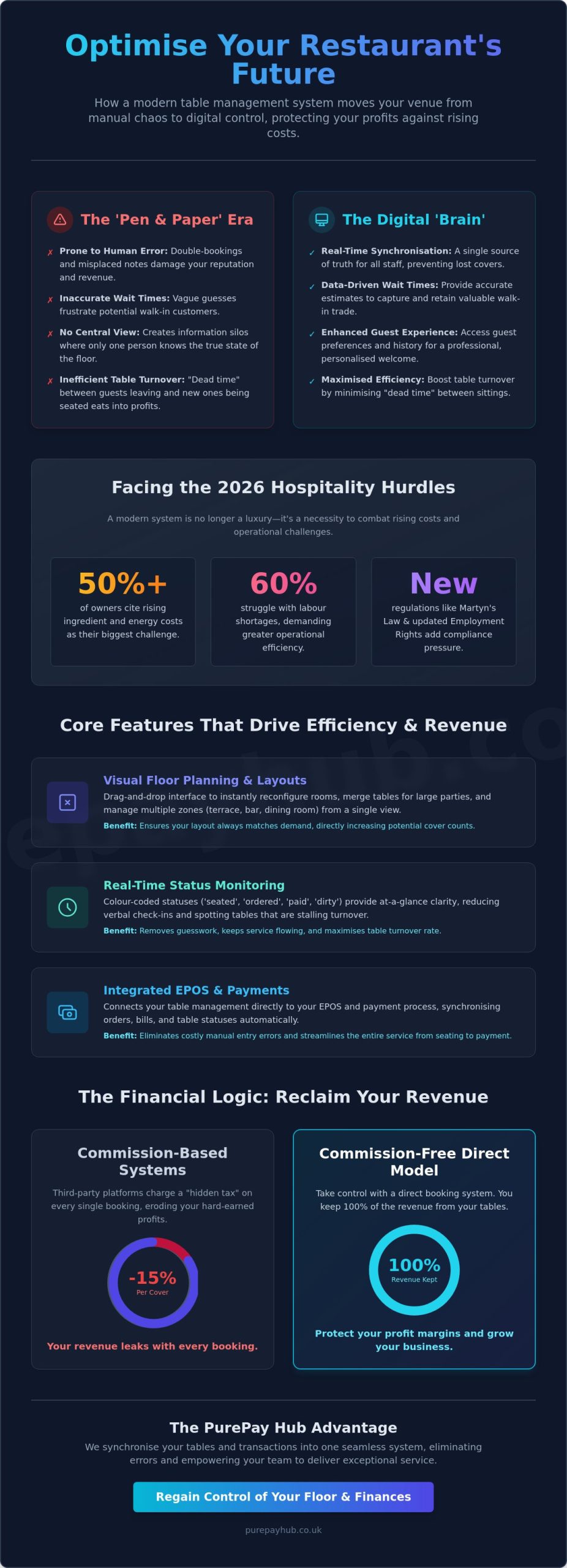
    Think about the dining room as a living organism. A restaurant table management system UK operators use acts as the central brain. It doesn’t just record names; it coordinates every movement on the floor. In 2026, the UK hospitality sector faces a unique set of hurdles. With over 50% of owners citing rising ingredient and energy costs as their biggest challenge, and 60% struggling with labour shortages, you can’t afford operational “blind spots.” Adopting a dedicated restaurant table management system UK wide is no longer a luxury; it’s a necessity for survival.

    Digital synchronisation replaces the guesswork of traditional service. While a physical diary might seem simple, it’s often a source of friction. It creates silos where only the person holding the book knows the true state of the room. A digital system ensures every staff member sees the same live data. This transparency allows your team to move beyond simple booking entries toward active floor control.

    The End of the ‘Pen and Paper’ Era

    Manual diaries are prone to human error. A single misplaced scribble can lead to double-bookings, which directly impacts your reputation and revenue. Beyond avoiding mistakes, switching to a digital platform provides a professional first impression. When a guest arrives, your team shouldn’t be frantically flipping through pages. Instead, they should have immediate access to guest preferences and booking history. This “single source of truth” empowers your team to work with confidence, even when you’re short-staffed. It ensures that every guest feels expected and valued from the moment they step through the door.

    Driving Revenue through Real-Time Visibility

    Efficiency is your most powerful tool for protecting margins. Modern Point-of-sale (POS) systems now integrate directly with your floor plan to show exactly where every table stands. You’ll know at a glance if a party is on their mains, waiting for the bill, or if the table is currently “dirty” and needs clearing. This level of detail is vital for maximising your covers without overstretching your kitchen or front-of-house staff.

    This visibility reduces the “dead time” between a guest leaving and the next being seated. Even a five-minute saving per turn adds up to extra covers over a busy weekend. Additionally, it transforms the walk-in experience. Instead of vague “20-minute” guesses that frustrate guests, you can provide accurate, data-driven wait times. This level of control is essential for managing the 2026 economic climate, where every seated guest represents a vital contribution to your bottom line. By synchronising your floor, you ensure that no potential revenue is left on the table.

    Core Features That Drive Efficiency and Revenue

    Selecting a restaurant table management system UK operators can trust involves looking far beyond a basic digital diary. You need a suite of tools that actively solve service bottlenecks. Efficiency isn’t just about speed. It’s about making every square foot of your venue work harder for you. In 2026, where profit margins are under constant pressure from rising utility costs and inflation, these features act as your primary defence.

    Visual Floor Planning and Layouts

    A static floor plan is a liability during a busy shift. Modern systems offer drag-and-drop interfaces that allow you to reconfigure your room in seconds. Whether you’re managing a terrace, a bar area, or a main dining room, you need a single view of all zones. If a large walk-in party arrives, your staff can merge tables digitally to reflect the physical change immediately. Floor plan flexibility directly impacts your cover counts by ensuring your layout always matches the actual demand on the floor.

    Real-Time Status Monitoring

    Colour-coded statuses are the visual shorthand of a high-performing floor. By identifying ‘seated’, ‘ordered’, ‘paid’, or ‘dirty’ at a glance, your team reduces the need for constant verbal check-ins. This clarity is a key trend highlighted in the UK Food Council’s technology report, which notes that smarter integration between the floor and the kitchen is now a baseline expectation for successful venues. It removes the guesswork and keeps service moving at a steady pace.

    These systems also help you spot ‘slow’ tables that might be stalling your turnover. If a party has been ‘seated’ for an extended period without an order, the system flags it for attention. This allows for a subtle, professional nudge to move the meal along. When integrated with your EPOS systems, the status updates automatically when a bill is printed or paid. This automation closes the loop between the kitchen and the front door, ensuring your host knows exactly when a table is about to become free.

    Beyond the floor, your system should act as a guest database. Profiles allow you to track visit history and dietary requirements, turning a first-time visitor into a regular through personalised service. To protect your bottom line, automated reminders serve as your first line of defence against no-shows. By sending a simple SMS or email confirmation, you significantly reduce the risk of empty tables during peak hours. Waitlist management keeps walk-ins engaged by providing live updates to their phones, ensuring they don’t wander off to a competitor whilst waiting for their spot.

    Restaurant Table Management System UK: The 2026 Guide to Efficient Service

    The Financial Logic: Commissions vs. Commission-Free Systems

    Every booking on your floor has a price tag attached. When selecting a restaurant table management system UK operators must choose between two distinct financial models: third-party marketplaces or direct, commission-free systems. Third-party platforms like OpenTable or Resy offer visibility, but they often impose a “hidden tax” that erodes your hard-earned margins. Every time a guest clicks “book” through their app, you pay a fee for a customer you might have already earned through your own reputation.

    The numbers quickly become staggering. If your venue handles 1,500 covers per month and you pay a £1.50 commission per head, you are losing £2,250 every single month. That is £27,000 a year paid out simply for the privilege of seating guests. A direct, commission-free restaurant table management system UK businesses prefer allows you to keep that revenue. Beyond the immediate cash saving, direct systems ensure you own your guest data. Your guest list is your most valuable marketing asset. Don’t let a third party sit between you and your regulars, controlling when and how you can contact them.

    Protecting Your Profit Margins

    For high-volume venues, a flat monthly subscription is almost always the more logical choice than unpredictable per-booking charges. It provides the financial clarity you need to plan for the long term. You can successfully transition guests from third-party apps by placing your direct booking link prominently on your social media profiles and physical menus. This shift ensures that the revenue from a busy Saturday night stays in your business. It allows you to reinvest in your team or your menu rather than subsidising a marketplace’s marketing budget.

    Tackling No-Shows with Integrated Payments

    No-shows are a direct threat to your profitability, especially on high-value Friday and Saturday nights. You can mitigate this risk by using “card on file” features or requiring pre-paid deposits for peak times. This simple step changes the psychology of the booking. When a guest has a financial stake in their reservation, they are far more likely to show up or cancel with enough notice for you to re-sell the table. Automated SMS reminders provide a professional nudge that further reduces unfulfilled bookings.

    PurePay Hub facilitates this security through PCI-compliant payment technology. By using our Online Payment Gateway or sending Payment Links for large party deposits, you ensure that every booking represents a commitment. This integration turns your reservation book into a stable, predictable revenue stream that protects your business from the volatility of empty chairs.

    Implementing Your System: From Floor Plans to Staff Training

    The success of a restaurant table management system UK operators choose depends entirely on how well it integrates into the daily heat of service. Software is only as effective as the hardware it runs on and the team using it. Transitioning from manual logs or basic spreadsheets requires a structured approach to avoid confusing your staff or frustrating your guests. A phased roll-out is the most reliable method. Start by using the system for simple bookings during quieter weekday shifts before relying on it for complex floor management during a busy Saturday night.

    Hardware and Connectivity Essentials

    Hospitality environments are notoriously harsh on technology. Your hardware must survive spills, drops, and high kitchen temperatures without failing. Reliable, high-speed Wi-Fi is the non-negotiable backbone of your operation. If your connection drops, your floor plan stops synchronising, which leads to immediate service delays. Many venues find that a mix of countertop units for the host stand and handheld terminals for the floor provides the best balance of control and mobility.

    Connectivity also extends to your payment hardware. Your table management software should communicate directly with your card machines to ensure that when a table is marked as “paid,” the status updates across all devices instantly. This prevents servers from hovering over tables that have already settled their bills. If you are looking to upgrade your physical setup, our range of EPOS systems provides the durability and integration needed for modern UK hospitality.

    Staff Adoption and Soft Turnover Tactics

    Training your team to use the system as a tool rather than a distraction is vital. Servers should be able to update table statuses in two or three taps whilst they are on the move. When your team understands that the data they enter helps them manage their sections more effectively, adoption rates increase. You can use this data to identify peak performance times and recognise your most efficient servers, creating a culture of transparency and reward rather than surveillance.

    Managing the human side of table turnover is often the most delicate part of implementation. During peak periods, you may need to enforce time limits on bookings. The key is to manage these “soft” turnovers politely. Digital systems help by tracking exactly how long a party has been seated, allowing your host to approach a table with accurate information. A simple, professional mention of the next booking when the bill is requested is usually enough to keep the floor moving. By using the system to provide accurate wait times for walk-ins, you maintain a steady flow of covers without ever making your seated guests feel rushed.

    The PurePay Hub Advantage: Synchronising Tables and Transactions

    The “last mile” of service is often where the guest experience falters. You have optimised your floor and managed your waitlist perfectly, but a slow payment process can leave a bitter taste. Integrating your restaurant table management system UK wide with your payment hardware is the final step in protecting your margins. PurePay Hub focuses on this critical link. Our EPOS Systems communicate directly with our card machines. This eliminates the need for staff to re-key amounts manually, which removes the risk of costly entry errors.

    Cash flow is the lifeblood of any UK venue. We provide next-day funding as standard to ensure your revenue is available when you need it. Our pricing is built on transparency rather than hidden markups. We offer clear transaction rates, such as 0.3% for debit cards, so you always know exactly what you are paying. This straightforward approach allows you to keep more profit within your business. It turns your payment processing from a necessary expense into a stabilizing force for your finances.

    Seamless Checkout, Faster Turnovers

    Reducing the time guests spend waiting for the bill is one of the easiest ways to increase satisfaction. By using a Portable Card Machine or a Mobile Card Machine, your servers can settle transactions at the table instantly. This speed allows you to turn tables faster and welcome the next party sooner. Integrated payments automatically sync with your records, which reduces the time spent on manual reconciliation at the end of every night.

    A Partnership for UK Hospitality Growth

    We view ourselves as a supportive partner rather than just a service provider. The UK hospitality industry is complex enough without opaque fee structures and corporate jargon. We offer a no-nonsense alternative that prioritises your growth. If you are looking to upgrade your venue or invest in new technology, our Business Cash Advance provides a flexible way to fund your next development. We are here to help you build a more efficient, profitable business through steady and fair service.

    Discover how PurePay Hub can transform your restaurant’s efficiency

    Future-Proofing Your Restaurant Floor

    Success in 2026 requires more than excellent service; it demands operational precision. A robust restaurant table management system UK venues rely on provides the foundation for this efficiency. It’s about total control. By reclaiming your guest data and avoiding the “hidden tax” of per-cover commissions, you protect your hard-earned margins. Every cover counts. You’ve seen how visual floor plans and real-time status tracking eliminate “dead time” and keep your kitchen running at peak performance.

    The final step is ensuring your service and your payments work in perfect harmony. PurePay Hub acts as your reliable business ally. We offer integrated EPOS solutions for UK hospitality that connect your table management directly to our card machines. With debit card rates from 0.3% and next-day funding as standard, we provide the stability you need to grow in a challenging market. We prioritise fairness over corporate jargon. Our goal is to help your business thrive through honest, dependable support.

    Switch to a fairer, faster payment partner with PurePay Hub and take control of your restaurant’s future today.

    Frequently Asked Questions

    What is a restaurant table management system?

    A restaurant table management system is the digital brain of your dining room floor. It replaces manual booking diaries with a live, visual map of your venue to coordinate reservations, walk-ins, and table statuses. By synchronising data across all devices, it ensures your host and servers are always looking at a single source of truth for every guest and table.

    How much does a table management system cost in the UK?

    Costs vary significantly depending on whether you choose a commission-based model or a flat monthly subscription. Some providers charge a fee for every cover booked through their marketplace, whilst others offer a fixed price for the software. You should also consider the hardware costs for terminals and the transaction rates for integrated payment processing when calculating your total investment.

    Can a table management system help reduce no-shows?

    Yes, these systems are your most effective tool for protecting your revenue against unfulfilled bookings. They use automated SMS and email reminders to confirm attendance and can require deposits for high-value shifts. Implementing a restaurant table management system UK wide allows you to secure a financial commitment from guests, which significantly changes the psychology of the reservation.

    Do I need a new EPOS system to use table management software?

    You don’t always need to replace your existing setup, but integration provides the best results. A standalone system requires manual updates, whereas integrated EPOS systems automatically change table statuses when a bill is printed or paid. This automation removes the risk of human error and ensures your host knows exactly when a table is about to become free for the next guest.

    Is it better to use a commission-free booking system?

    For high-volume venues, a commission-free system is almost always the more profitable choice. It removes the “hidden tax” of paying a fee for every guest seated, allowing you to keep more of your hard-earned margins. Additionally, commission-free systems ensure you own your guest data, which is vital for building a loyal customer base through direct marketing and personalised service.

    What happens if my Wi-Fi goes down during service?

    Most modern systems are designed with hospitality realities in mind and offer an offline mode or 4G/5G failover. This ensures that your floor plan remains accessible even if your primary internet connection falters. We recommend using hardware that supports SIM cards as a backup to keep your restaurant table management system UK operations running smoothly during peak hours.

    How do I move my floor plan from paper to a digital system?

    The transition starts with using a visual builder to recreate your physical layout, including specific zones like a terrace or bar. You define table capacities and joining rules for larger parties. We suggest a phased roll-out where you run the digital system alongside your paper diary for a few quiet shifts to ensure your team feels confident before a busy weekend.

    Can I take deposits through my table management system?

    Yes, you can take secure, PCI-compliant deposits using integrated payment technology. You can send payment links for large party bookings or require a “card on file” for peak times like Friday and Saturday nights. This ensures that if a party fails to show up, your business is still compensated for the lost table time and ingredients.