
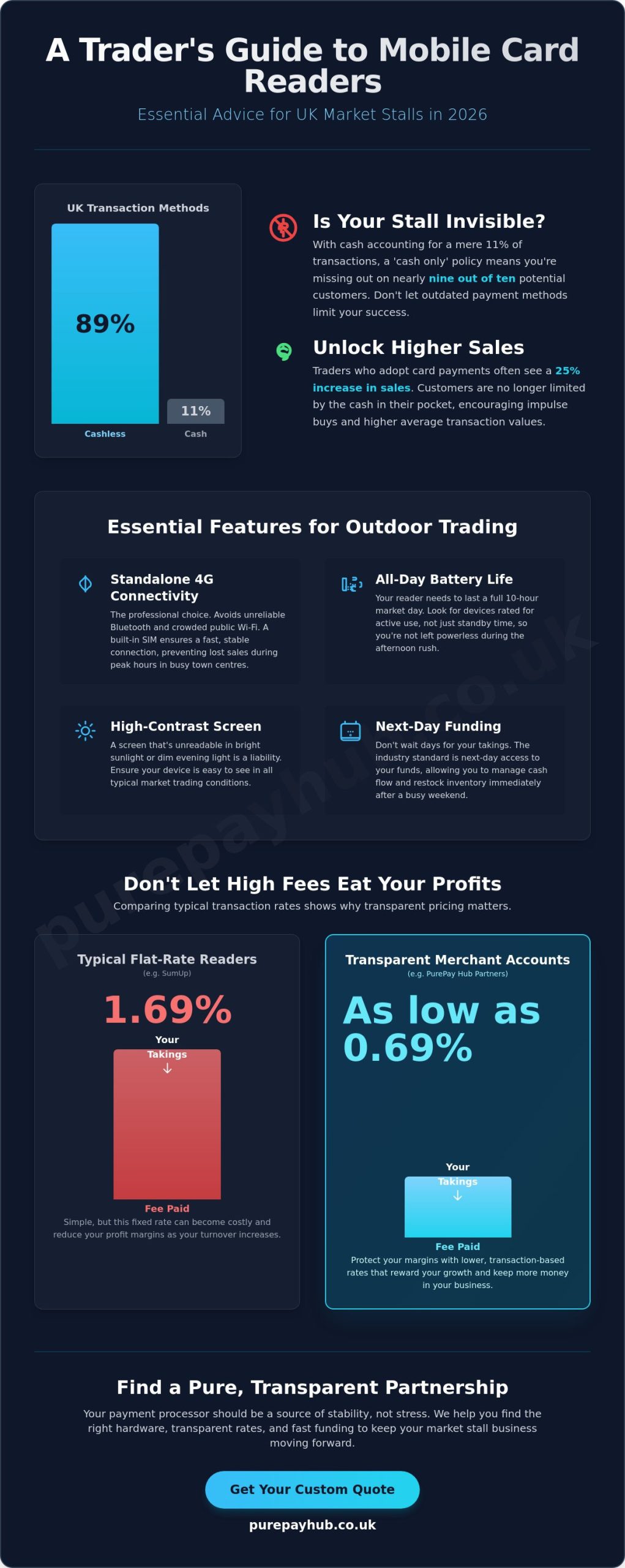
With cash now accounting for a mere 11% of all UK transactions, a market stall that cannot accept a tap or a phone is essentially invisible to nine out of ten shoppers. You’ve likely felt the sting of a signal dropout in a crowded town centre or the panic of a battery dying right as a queue starts to form. It’s frustrating when the “simple” solution you chose starts eating your profit through opaque fees that scale up just as your business finally grows.
We believe your payment processing should be a source of stability, not stress. This guide shows you how to choose a mobile card reader for market stalls UK that prioritises 4G reliability and next-day fund access. You’ll discover how to navigate the latest 2026 transaction rates, from Tide’s 0.69% monthly plans to the 1.69% standard at SumUp, ensuring your margins stay protected. We’ll break down the essential features for outdoor trading and help you find a pure, transparent partnership that keeps your business moving forward.
Key Takeaways
- Learn why a mobile card reader for market stalls UK is now vital for capturing the 89% of shoppers who prefer cashless payments.
- Identify why standalone 4G connectivity is essential so you don’t lose sales to signal dropouts in busy town centres.
- Uncover how moving away from expensive flat-rate fees toward transparent, transaction-based pricing can significantly protect your profit margins.
- Discover how to use flexible funding options like Business Cash Advances to manage stock and seasonal peaks with confidence.
Why Market Stalls Must Prioritise Mobile Payment Technology in 2026
Success at a British market stall used to depend on your location and the weather. Today, it depends on your ability to say “yes” when a customer asks to tap their phone. A mobile card reader for market stalls UK is a handheld, battery-powered device that connects via 4G or Bluetooth to process secure transactions anywhere. It’s no longer a luxury for high-end craft boutiques; it’s a vital tool for every trader from the local farmers’ market to massive Christmas festivals.
The “Impulse Buy” factor has transformed the way people shop outdoors. In 2026, shoppers rarely visit a cash machine before browsing. If a visitor spots a unique item but only has a few coins in their pocket, a “cash only” sign acts as a physical barrier to the sale. Accepting cards removes this friction. It often increases the average transaction value because customers aren’t limited by the physical cash they’re carrying. They buy what they want, not just what they can afford with their loose change. This behaviour often leads to a 25% increase in sales for traders who ditch the cash-only model.
Security is another critical driver for this shift. Carrying a heavy cash box through a busy town centre at 5:00 PM makes you a target. Digital payments move that money directly into your account, reducing the risk of theft or simple human error when counting change in the rain. It’s about protecting your hard-earned profit and your personal safety. You can spend more time engaging with your customers and less time worrying about the physical security of your takings.
The Shift from Cash to Contactless
UK consumer behaviour has reached a tipping point where 95% of eligible in-store card transactions are now contactless. This speed is essential for high-footfall events. Using contactless payment technology allows you to clear a queue in seconds, ensuring you don’t lose frustrated customers to the stall next door. Integration with Apple Pay and Google Pay is now a non-negotiable requirement for 2026, as many younger shoppers leave their physical wallets at home and rely entirely on their smartwatches or phones.
Meeting Merchant Expectations in 2026
Modern traders demand more than just a piece of hardware. You need a partnership that respects your cash flow. Next-day funding has become the industry standard because it allows you to restock your inventory immediately after a busy Saturday. We’ve also seen a massive move away from using personal bank accounts for business. Professional merchants now require dedicated merchant IDs and transparent, transaction-based fee structures that don’t hide costs in complex tiers. You deserve clarity in every transaction to ensure your business remains profitable and sustainable.
Essential Features for Outdoor Trading: Battery, 4G, and Offline Mode
Outdoor trading is unpredictable. A mobile card reader for market stalls UK must survive more than just a light drizzle; it needs to withstand the technical strain of a busy trading day. Most entry-level readers rely on a Bluetooth connection to your smartphone. This works in a quiet shop, but in a crowded town centre with thousands of active devices, Bluetooth interference can cause your connection to drop exactly when you’re about to close a sale. It’s an embarrassing moment that often results in the customer walking away.
Standalone 4G connectivity is the only professional choice for serious traders. These devices come with their own SIM card and don’t drain your phone’s battery. They connect directly to the network, ensuring a faster, more reliable transaction. Whilst some traders look for government support for small businesses to help with initial setup costs, choosing the right hardware from the start prevents lost revenue later. You need a device that works as hard as you do, regardless of how many people are clogging the local signal.
Battery life is another non-negotiable factor. A 10-hour shift at a Christmas market requires a device that doesn’t quit at 2:00 PM. Look for “all-day” battery ratings that specifically account for active transaction time, not just standby mode. Visibility also matters. You need a high-contrast screen that remains readable in direct July sunlight or under the dim lights of a winter evening stall. While digital receipts via SMS or email are becoming the norm, some elderly customers still prefer a physical slip. Consider whether an integrated printer is worth the extra weight, or if a sleek, digital-first device fits your brand better.
Connectivity Strategies for Busy Markets
Public Wi-Fi is rarely viable for outdoor stalls. It’s often unsecured and fluctuates as people move around. A 4G roaming SIM is far superior because it automatically switches to the strongest available network. If one provider has a blackout, your reader stays online by jumping to another. Using your phone as a hotspot is a decent emergency backup, but it’s a clunky solution that risks overheating your phone and leaving you with two dead devices instead of one.
Understanding Offline Mode Risks
Offline mode allows you to store transaction data when there’s absolutely no signal. It’s a tempting safety net, but it carries significant risk. Because the card isn’t authorised in real-time, you won’t know if it’s declined until you reconnect to the internet. This opens you up to card-not-present fraud and lost stock. Use it as a last resort only. For most traders, a reliable standalone mobile card machine with 4G is a much safer investment than relying on offline processing.
Comparing Costs: Why Flat-Rate Readers Might Be Costing You More
Simplicity often carries a hidden price tag. Many traders choose a mobile card reader for market stalls UK based on a “no monthly fee” promise, accepting a flat rate like 1.75% as the industry standard. While this feels safe when you’re just starting, it quickly becomes a heavy anchor as your turnover grows. Aggregators use these flat rates to subsidise the higher cost of premium credit cards by overcharging you for every standard debit card transaction.
The alternative is an interchange-plus model, which separates the actual costs from the provider’s margin. Interchange fees are the wholesale cost of card processing. By using a transparent model, your rates for UK debit cards can drop as low as 0.3%. When you’re processing hundreds of transactions at a busy weekend market, that 1.45% difference stays in your bank account instead of disappearing into your provider’s pocket. It’s about ensuring your hard-earned profit isn’t eroded by a one-size-fits-all pricing structure.
You must also look beyond the headline transaction fee. Many “simple” providers hide costs in the fine print. You might encounter PCI compliance fees or, even worse, “non-compliance” penalties that reach £20 or £30 per month if you don’t complete complex paperwork. We believe in a no-nonsense approach where these costs are either eliminated or handled for you. Total Cost of Ownership (TCO) isn’t just about the hardware; it’s the sum of every penny that leaves your business over a full trading year.
Transaction Fee Breakdown: PurePay vs Aggregators
Consider a successful market day with a £1,000 turnover. At a flat rate of 1.75%, you’ll pay £17.50 in fees. With a transparent 0.5% rate, that cost drops to just £5.00. Over a single month of weekend trading, this saves you £100.00, which is more than enough to cover the cost of a premium 4G device or additional stock. Debit cards are inherently cheaper to process than credit cards, and your fee structure should reflect that reality.
The Truth About “Free” Card Readers
Cheap or “free” hardware is a classic lure. These devices often lack the 4G reliability we discussed earlier, and they’re tied to those high flat-rate fees that cost you more in the long run. Hardware rental is often a smarter choice for established traders. It usually includes inclusive maintenance, automatic software updates, and 4G data costs. PurePay Hub organises fees with total clarity, ensuring you always know exactly what you’re paying and why, without the sting of hidden markups.
Managing Seasonal Cash Flow with Business Cash Advances
Market trading in the UK is rarely a steady climb. It’s a series of peaks and troughs. You might see record-breaking sales during the December Christmas markets, followed by a quiet, rainy January where footfall drops significantly. This volatility makes traditional bank loans a poor fit for most traders. Banks often demand fixed monthly repayments regardless of your actual income. If you’ve had a bad week, that fixed debt becomes a source of immense stress.
A Business Cash Advance works differently. It’s a flexible funding solution designed specifically for businesses that take card payments. Instead of a fixed monthly bill, you repay the advance through a small, agreed percentage of your future card sales. If you have a slow day, you pay back less. If you’re closed for a week, you pay back nothing at all. This model aligns your costs with your actual performance, ensuring you never face a repayment you can’t afford.
Your sales history on your mobile card reader for market stalls UK is your most valuable asset here. Because the lender can see your real-time trading data, they don’t need the endless paperwork or collateral required by high-street banks. It’s a faster, more transparent way to access capital that respects the unique rhythm of your business. You can find more information on government support for small businesses and alternative financing through official research briefings.
Funding Your Next Big Event
Securing a prime pitch at a major festival or stocking up for the summer season requires upfront capital. Often, the best bulk discounts from suppliers are only available if you can pay immediately. An unsecured Business Cash Advance provides the liquidity you need to seize these opportunities. Once approved, you can often access funds within 24 hours, keeping your supply chain moving and ensuring you never miss a profitable window.
The “Pure” Approach to Repayment
We believe in a partnership that grows with you. Our fixed percentage repayment model is built on transparency. There are no “late fees” or “hidden interest” because the repayment is tied directly to your card sales. This “Pure” approach ensures that your cash flow remains healthy even during the inevitable quiet months. You can scale your market business with confidence, knowing that your funding partner only succeeds when you do. Check out our flexible Business Cash Advance options to see how we can support your growth.
PurePay Hub: The Merchant’s Ally for UK Market Stalls
We understand that your business doesn’t sit still. A professional mobile card reader for market stalls UK must be as mobile as you are. Our standalone machines eliminate the need for a separate phone connection; they use built-in 4G to ensure you never miss a sale due to a signal blackout. With batteries designed to last through the longest ten-hour shifts, you can trade from dawn until dusk with total confidence. You get a device that’s built for the realities of the British weather and the demands of a busy market day.
We prioritises your profit margins by offering bespoke transaction rates. While aggregators often trap you in a 1.75% flat-rate model, we offer rates starting from just 0.3% for debit cards. This is a significant saving that goes directly back into your business. We also provide next-day funding as standard. You shouldn’t have to wait days or weeks for your money to arrive; we ensure your cash flow remains steady so you can restock and grow without delay. Our goal is to be a stabilizing force for your finances.
Our team acts as your dedicated UK-based support system. We handle the complexities of PCI compliance management for you, removing the risk of expensive non-compliance penalties. You get a partner that values clarity over confusion. We provide the technical precision you need with the personal service you deserve, acting as a true ally in an often-impersonal industry.
Transparent Payment Processing
We offer a no-nonsense fee structure with no hidden markups. Our “Pure” promise is simple: we provide honest partnership and fair rates that reflect the actual cost of your transactions. For traders who need more than just a payment terminal, we offer integrated EPOS options. These systems allow you to manage your stock levels in real-time, helping you identify your best-selling items and plan for future markets with data-driven confidence.
How to Get Started
Our onboarding process is designed to be quick and efficient for new market traders. To apply, you simply need a business bank account and proof of identity. We move fast because we know that every day without a card reader is a day of lost sales. Once you’re set up, you’ll join a community of merchants who value transparency and growth. Contact PurePay Hub for a transparent quote today and see how we can simplify your payments whilst protecting your margins.
Future-Proof Your Trading Today
Success at a British market in 2026 requires more than just a great product. You need a payment partner that understands the specific technical and financial challenges of outdoor commerce. Selecting a mobile card reader for market stalls UK with standalone 4G connectivity ensures you never lose a customer to an embarrassing signal blackout. Moving away from expensive 1.75% flat rates toward a transparent, transaction-based model protects your margins and keeps more profit in your business account.
We believe in honest partnerships built on clarity and fairness. You shouldn’t have to wait days for your money or settle for opaque fee structures that hide the true cost of processing. By prioritising next-day access to funds, you can manage your seasonal cash flow with confidence and focus on scaling your stall. It’s time to ditch the “standard” high fees and choose a service that respects your hard work.
Switch to PurePay Hub for lower rates and next-day funding and benefit from debit rates starting from 0.3%, 4G-enabled mobile terminals, and next-day access to your funds. Your business deserves a partner that works as hard as you do.
Frequently Asked Questions
What is the best mobile card reader for a market stall with poor signal?
A standalone device with a built-in 4G roaming SIM is the most reliable choice for locations with poor signal. Unlike Bluetooth readers that rely on your phone’s connection, these machines jump between UK networks to find the strongest available signal. This prevents the dropouts common in crowded town centres. It’s a professional solution that ensures your mobile card reader for market stalls UK stays online even when local Wi-Fi fails.
Do I need a business bank account to use a card reader for my stall?
You will typically need a dedicated business bank account to process card payments. Most UK providers require this to ensure a clear audit trail between your personal finances and your merchant takings. Having a separate account also simplifies your tax returns and allows for faster settlement of funds. It’s a key step in professionalising your market stall operations as you scale.
How much are the transaction fees for a mobile card reader in the UK?
Fees vary significantly depending on your provider and the type of card being used. Aggregators like Zettle and Square usually charge a flat rate of 1.75%. However, if you choose a transparent interchange-plus model, debit card rates can drop to approximately 0.3%. Always check for hidden costs like PCI compliance fees which can add £20 per month to your expenses if not managed correctly.
Can I take card payments at a market without Wi-Fi?
You can absolutely take card payments without a Wi-Fi connection by using a 4G-enabled device or a Bluetooth reader paired with your smartphone’s data. Modern mobile card machines are built specifically for outdoor trading environments where public Wi-Fi is either unsecured or non-existent. This flexibility allows you to trade at remote festivals or rural farmers’ markets without worrying about internet access.
What happens if a card is declined whilst I am using offline mode?
If a card is declined whilst you’re using offline mode, you’ll likely lose the money and the stock you’ve already handed over. The transaction data is stored on the device and only attempts authorisation once you reconnect to a network. Because you aren’t notified of a failure in real-time, we recommend using offline mode only as a last resort during emergency signal outages.
How quickly will I receive the money from my market stall card sales?
Most modern providers now offer next-day access to your funds as standard. While some older systems still take three to five working days to settle, 2026 standards prioritise your cash flow. This speed is essential for market traders who need to buy fresh stock or pay for pitch fees immediately after a busy weekend. Always confirm the settlement schedule before signing a contract.
Are there mobile card readers with no monthly fees for seasonal traders?
Pay-as-you-go readers from companies like SumUp or Square are popular with seasonal traders because they have no fixed monthly costs. You only pay a fee when you actually make a sale. This is ideal if you only trade during the summer months or at Christmas markets. However, remember that these “free” models often have higher transaction rates than bespoke monthly plans for high-volume sellers.
Is it better to buy a card reader outright or rent one for my business?
Buying a reader outright is often cheaper for new businesses, but renting a device usually includes inclusive maintenance and automatic software updates. If your rented machine breaks during a busy market, your provider will typically send a replacement the next day. This peace of mind is often worth the small monthly cost, as it prevents you from being unable to take payments during peak trading hours.