
Tag: Integrated Payments

  • Best EPOS System for a Small Cafe with Table Service: 2026 Buyer’s Guide

    Best EPOS System for a Small Cafe with Table Service: 2026 Buyer’s Guide

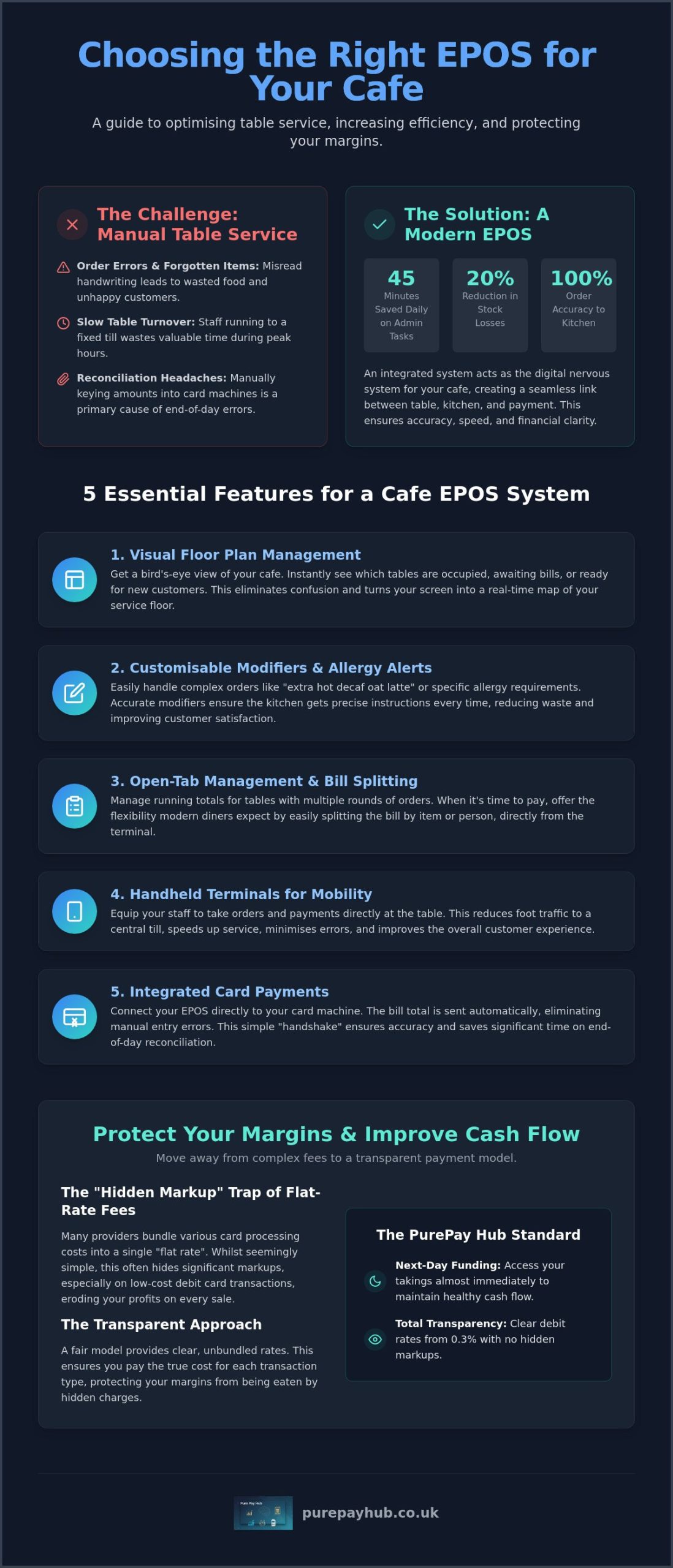
    Did you know that businesses using a modern EPOS system save an average of 45 minutes every single day on administrative tasks? For a busy cafe owner, that is time better spent with customers or refining the menu. You likely already know that manual table service is a recipe for errors; a misplaced order or a forgotten drink can quickly turn a profitable lunch shift into a series of apologies. Finding the right EPOS system for a small cafe with table service is about more than just taking payments. It is about creating a seamless link between the table and the kitchen whilst keeping your overheads predictable.

    We promise to help you cut through the jargon of merchant service charges and hardware rentals. This guide explains how to select a hospitality system that speeds up table turnover and ensures every order is transmitted accurately. You will discover how the PurePay Hub standard for transparent transaction rates and next-day funding can protect your margins from being eroded by hidden markups. We will explore the must-have features for 2026, including cloud-based analytics and integrated card machines, to give you total clarity over your business finances.

    Key Takeaways

    • Learn how to eliminate order errors by using visual floor plans and customisable modifiers that connect your tables directly to the kitchen.
    • Discover why choosing the right EPOS system for a small cafe with table service requires a focus on open-tab management and handheld flexibility.
    • Understand the “hidden markup” trap and how shifting from flat-rate fees to transparent models can significantly protect your cafe’s margins.
    • Compare the benefits of all-in-one smart terminals versus fixed tills to find the setup that best avoids counter bottlenecks during peak hours.
    • See how integrated payments and next-day funding provide the financial clarity and cash flow stability needed to support your cafe’s growth.

    Why Table Service Changes the EPOS Requirements for Small Cafes

    A modern Point of Sale (POS) system in 2026 is no longer a static box sitting on a counter. For small venues, it acts as the digital nervous system of the entire floor. Unlike traditional counter service where a customer pays before they sit, table service requires your technology to manage “open” states. This means tracking table numbers, handling multiple rounds of drinks, and keeping a running total that stays accurate until the final bill is requested. If you are searching for the best EPOS system for a small cafe with table service, you need a solution that prioritises this real-time communication.

    Choosing an EPOS system for a small cafe with table service allows you to move away from the chaos of handwritten tickets. When a server takes an order at the table, that data must sync instantly with both the kitchen and the central bill. This “handshake” ensures that the chef starts cooking immediately whilst the front-of-house staff can focus on the next customer. If your system doesn’t sync in real-time, you risk slow turnaround times that directly eat into your peak-hour revenue. Every minute a table sits empty because of a slow billing process is money lost.

    Fixed tills are becoming a relic for small, agile cafes. If your staff have to walk back to a central station after every interaction, you’re losing valuable minutes and increasing the chance of error. To complement mobile EPOS systems, many busy venues use discreet radio earpieces from Earpiece Hub to ensure the floor and kitchen stay perfectly synced without staff needing to leave their tables. Modern hospitality demands mobility. Handheld terminals allow staff to stay on the floor, improving the customer experience and ensuring that no “extra coffee” or “side of cake” is ever forgotten. This transition from a stationary till to a mobile workflow is the single biggest operational shift for independent cafes this year.

    The Shift from Counter to Table: Operational Challenges

    The biggest risk in manual table service is the forgotten item. Verified industry data shows that the use of a modern EPOS system can reduce stock losses by up to 20% by ensuring every item served is actually recorded. In a small venue, table turnover speed is your primary revenue driver. If staff are stuck deciphering messy handwriting or running back and forth to a fixed till, your “order-at-table” workflow breaks down. Efficient systems allow you to close bills faster, freeing up seats for new customers during the busy lunch rush.

    The Role of Integrated Card Payments

    True integration happens when your EPOS talks directly to your card machine. This eliminates the need for staff to manually type the bill amount into a separate terminal. Manual entry is the primary cause of end-of-day reconciliation headaches and costly errors. At PurePay Hub, we prioritise this seamless connection to ensure your totals always match. This level of accuracy saves businesses an average of 45 minutes per day on administrative tasks.

    Cash flow is the lifeblood of any independent cafe. Waiting days for your hard-earned money to clear is a thing of the past. We provide next-day funding so you can access your takings almost immediately. Combined with transparent debit rates starting from 0.3%, this integrated approach keeps your margins protected and your finances clear. We believe in being a fair partner rather than a distant financial institution.

    5 Essential Features Your Cafe EPOS Must Have for Table Service

    Selecting an EPOS system for a small cafe with table service is about more than just processing transactions. It is about operational precision. A visual floor plan management tool is the foundation of a smooth shift. It allows your staff to see which tables are occupied, which are waiting for bills, and which need clearing at a glance. This bird’s-eye view eliminates the “who’s serving table four?” confusion that often plagues busy venues during the lunch rush. It turns your screen into a real-time map of your success.

    Accuracy at the point of order is equally vital for protecting your reputation. Your system must handle complex menu customisation and modifiers with ease. Whether it is a request for an “extra hot decaf oat latte” or a specific allergy requirement, the software should prompt the server to include these details. According to a Forbes analysis of restaurant EPOS features, tableside ordering is critical for maintaining high service standards. These tools ensure the kitchen receives exact requirements every time, reducing the cost of wasted ingredients and remade drinks.

    Modern diners expect flexibility when the bill arrives. Bill splitting functionality is now a non-negotiable feature for UK cafes. Whether customers want to pay by item or split the total equally, your software must handle this at the table. This prevents awkward delays and bottlenecks at the counter. Simultaneously, a Kitchen Display System (KDS) or cloud-based printing ensures orders reach the barista or chef instantly. This removes the need for physical tickets that often get lost or stained in a frantic kitchen environment. If you want to streamline these workflows, our integrated hospitality EPOS options provide the stable connection you need between the floor and the till.

    Managing the Table Journey

    Your EPOS should support the natural flow of a customer’s visit. This includes managing “Open Tabs” for those who wish to linger and add a second round of cakes. It also requires seamless “Table Transfers” for when a party moves from a small window seat to a larger centre table. Effective systems also allow for “Course Firing,” ensuring that the coffee doesn’t arrive ten minutes after the food is finished. This level of control keeps your service professional and your customers satisfied.

    Staff Performance and Accountability

    Transparency extends to your team management as well. Individual staff logins allow you to identify your best upsellers and track performance accurately. “Void Tracking” is another essential tool; it helps you reduce wastage and unauthorised “freebies” by requiring a reason for every cancelled item. By analysing this data, you can organise your staff rotas based on peak table occupancy, ensuring you are never overstaffed during quiet spells or under pressure when the tables are full.

    Calculating the Real Cost: Software, Hardware, and Processing Fees

    Many cafe owners fall into a common trap when selecting their technology. They focus on a single price point, such as a “free” software offer, without considering the long-term impact on their margins. To find the best EPOS system for a small cafe with table service, you must evaluate the three pillars of cost: your monthly SaaS subscription, the physical hardware, and the transaction fees. To understand these costs better, you can explore SaaS monthly subscription fees that offer transparent pricing for food businesses. A low monthly fee often hides high processing rates that quietly erode your profits with every flat white you serve.

    The “Hidden Markup” trap is particularly dangerous for hospitality venues. Flat-rate models, which often charge around 1.75% per transaction, are marketed as simple. However, if your business processes a high volume of debit card payments, this simplicity becomes expensive. When you could be paying debit rates from 0.3%, a flat 1.75% rate means you are handing over an extra 1.45% on almost every sale. For a busy cafe, this difference amounts to hundreds of pounds every month. We believe in a no-nonsense approach where your rates reflect the actual cost of processing, not an arbitrary markup.

    Beyond the headline rates, you must account for PCI compliance and fund accessibility. Non-compliance fines can appear unexpectedly on your monthly bill if your provider doesn’t proactively support your security standards. Furthermore, next-day access to funds is a critical but often overlooked value. Waiting three to five working days for your takings to clear creates unnecessary pressure on your cash flow. Accessing your money the following day ensures you can pay suppliers and staff without stress.

    Transaction Rates: The 0.3% vs 1.75% Debate

    Flat-rate models are often popular with startups because they require little commitment. However, established cafes with steady turnover benefit far more from interchange-plus models. Interchange-Plus is the most transparent pricing model for UK merchants because it separates the actual card scheme costs from the provider’s margin. By switching to this model, cafes can secure debit card rates as low as 0.3%, allowing them to reinvest those savings back into the business rather than losing them to opaque fees.

    Hardware Investment: Rental vs. Upfront Purchase

    Deciding whether to lease or buy your hardware depends on your capital and growth plans. Buying equipment outright reduces your monthly outgoings and gives you total ownership of your assets. However, leasing can be a smart move in 2026 as it allows you to upgrade to the latest tech more easily. Modern hardware should prioritise battery life and 4G connectivity to ensure your EPOS system for a small cafe with table service works perfectly in outdoor seating areas or during a Wi-Fi outage. When calculating the total cost of ownership over a three-year period, remember to include the cost of built-in printers and replacement batteries to avoid “bill shock” later on.
    Best EPOS System for a Small Cafe with Table Service: 2026 Buyer’s Guide

    Choosing Your Setup: Handheld Tablets vs. Fixed Counter Tills

    Space is a premium in any small venue. A fixed counter till often acts as a magnet for crowds, creating a bottleneck that disrupts the flow of your floor. When you implement an EPOS system for a small cafe with table service, you have to decide whether your staff should be tethered to a desk or free to roam. In 2026, the all-in-one smart terminal has become the industry standard. These devices allow your team to take an order and process the payment on a single handheld unit. This removes the need for customers to queue at the counter, keeping your entrance clear and your atmosphere relaxed.

    Reliability matters more than aesthetics. Many independent cafes operate out of older stone buildings or offer outdoor seating where Wi-Fi signals frequently drop. Your hardware must include a 4G backup to ensure you never lose a sale during a connectivity dip. This technical resilience ensures your EPOS system for a small cafe with table service remains functional even when the local infrastructure fails. Beyond the technology, modern handheld service changes how customers perceive your brand. It moves the focus away from the transaction and back to the hospitality, reinforcing that “favourite local spot” vibe. If you are ready to upgrade your hardware, explore our mobile card machine and EPOS options to find your perfect fit.

    The Case for Handheld Terminals

    Staff efficiency improves when you adopt “Pay at Table” workflows. This approach reduces the time a table sits empty by approximately five to ten minutes per party. By closing the bill at the table, your team can begin resetting the space immediately. There are also distinct hygiene benefits to this model. You avoid having large groups huddle around a central counter, which keeps your dining area feeling spacious and clean. Additionally, smart software includes “Upsell Prompts” that remind staff to offer a second round of drinks or a dessert, boosting your average transaction value without extra effort.

    Integrating with Your Existing Space

    Small, steam-heavy environments require durable hardware. When choosing printers for your kitchen or barista station, consider the difference between thermal and impact models. Impact printers are often better for hot kitchens as the paper is more resistant to heat and steam. You also need to ensure your system features a robust “Offline Mode.” This allows you to continue taking orders and recording sales even if the internet goes down whilst the cafe is full. Finally, consider the design. Modern hardware comes in various colours and styles, allowing you to choose equipment that complements your cafe’s unique interior design rather than clashing with it.

    PurePay Hub: Seamless Hospitality EPOS and Transparent Payments

    PurePay Hub offers a standard of quality that replaces industry skepticism with genuine clarity. We combine industry-leading software with ultra-low transaction rates to ensure your technology supports your growth rather than hindering it. When you select an EPOS system for a small cafe with table service, you shouldn’t have to compromise between advanced functionality and fair pricing. We provide both. Our “No-Nonsense” promise means you will never encounter hidden markups or opaque fee structures. We position ourselves as your supportive business ally.

    Speed is essential for independent venues. Our quick onboarding process ensures you are ready to manage your tables in days, not weeks. We understand that cash flow is the lifeblood of your business. This is why we prioritise next-day funding as a standard feature. You shouldn’t have to wait for your own money whilst your bills continue to arrive. We ensure your takings are in your account the following day, providing the financial stability you need to manage suppliers and staff with confidence.

    Tailored Rates for Small Businesses

    Our pricing model is built to protect your small margins. We offer debit card charges starting at 0.3% and credit card rates from 0.5%. This transparent approach allows you to keep more of every sale compared to expensive flat-rate providers. We also take the weight of merchant account management off your shoulders. Our team handles the complexities of PCI compliance and reporting so you can focus on your coffee and your customers. For cafes looking to expand or invest in a fresh refurb, we also facilitate a business cash advance to help you grow without the stress of traditional banking.

    Ready to Transform Your Table Service?

    Service excellence starts with the right partner. We invite you to see the difference that honesty and integrity make to your bottom line. You can get a transparent quote based on your actual card turnover without any corporate jargon. Our UK-based support team provides calm advocacy whenever you need assistance. We are here to help you build a more efficient and profitable cafe. It is time to move away from hidden fees and toward a fairer way of doing business.

    Organise your free PurePay Hub quote today

    Future-Proof Your Cafe Service

    Selecting the right EPOS system for a small cafe with table service is a strategic move that balances operational speed with financial clarity. You now understand that moving away from fixed tills to mobile terminals can significantly reduce table turnover time. More importantly, you know that a “free” software offer is often a mask for high transaction rates that drain your profits. Transitioning to a transparent fee model allows you to reclaim your margins whilst providing a seamless experience for your customers.

    At PurePay Hub, we are committed to being a fair partner to independent business owners. We offer debit card rates from 0.3% and provide next-day access to your sales funds. Our integrated UK-based technical support is always available to ensure your service never falters. Switch to PurePay Hub for Fairer Rates and Faster Funding today. Your cafe deserves a technology partner that values integrity as much as you do.

    Frequently Asked Questions

    What is the difference between a POS and an EPOS system for a cafe?

    A Point of Sale (POS) refers generally to the location where a transaction takes place, whilst an Electronic Point of Sale (EPOS) uses digital hardware and cloud-based software to manage the process. For your venue, an EPOS system does more than just open a cash drawer. It tracks stock, manages table numbers, and provides real-time sales data to help you make informed business decisions.

    Can I use my existing iPad for a cafe EPOS system with table service?

    You can often use an existing iPad, but specialized hospitality hardware is usually more reliable in a busy environment. A professional EPOS system for a small cafe with table service often requires tablets that are designed to withstand steam, spills, and constant use. If you choose to use your own device, ensure it supports the latest 2026 security updates to remain fully PCI compliant.

    How much does a hospitality EPOS system typically cost in the UK?

    Monthly software costs for a cafe system in the UK typically range from £20 to £150. Upfront hardware costs generally fall between £500 and £2,500 depending on the number of terminals and printers you need. It is vital to look beyond the initial price tag; high transaction fees can often cost you more over a year than the hardware itself.

    Do I need a separate merchant account for my cafe EPOS?

    You do need a merchant account to accept and process card payments through your till. Some providers bundle this into a flat-rate package, whilst others provide a dedicated account with transparent pricing. Having a dedicated merchant account often gives you better clarity over your fees and allows you to access more competitive debit rates as your business grows.

    How does an EPOS system help with bill splitting at the table?

    Modern software allows staff to split bills by individual items or by a specific number of covers directly at the table. This functionality eliminates the need for customers to queue at the counter to pay separately. It automates the calculation, which reduces manual errors and ensures your staff can clear and reset tables much faster during your busiest hours.

    What happens to my table orders if the Wi-Fi goes down?

    Professional systems include an “Offline Mode” or 4G backup to ensure your EPOS system for a small cafe with table service stays functional. This feature allows you to continue taking orders and recording sales locally on the device. Once your internet connection is restored, the system automatically syncs all data to the cloud so your records remain accurate and up to date.

    Is it better to rent or buy my cafe card machine and till?

    Buying your hardware outright usually offers the best long-term value and lowers your fixed monthly outgoings. However, renting can be a sensible choice if you want to preserve your initial capital or upgrade to the latest technology every few years. You should evaluate the total cost of ownership over a three-year period to decide which option best suits your current budget.

    How quickly can I access my funds with a PurePay Hub integrated system?

    We provide next-day access to your sales funds to keep your cafe’s cash flow stable and predictable. Many traditional providers hold your takings for three to five working days, which can create unnecessary financial pressure. With our integrated approach, your hard-earned money is available almost immediately to help you pay staff and suppliers without the usual wait.
  • The Top Benefits of an Integrated Payment System for UK Businesses in 2026

    The Top Benefits of an Integrated Payment System for UK Businesses in 2026

    It is 9:00 PM on a Friday. Instead of heading home to relax, you are hunched over a desk, cross-referencing a mountain of paper card receipts against your till report to find a single missing transaction. It is a frustrating scene that plays out in shops and cafes across the country. You likely agree that manual data entry is a drain on your energy, and those slow queues at the checkout during peak hours are definitely costing you sales. It feels like a necessary part of running a business, but it’s actually a sign of an outdated process.

    Learning about the benefits of an integrated payment system will change how you view your daily operations. By connecting your card machine directly to your EPOS system, you eliminate manual errors and speed up the reconciliation process instantly. This guide shows how automation leads to faster transaction times and provides clearer visibility of your business performance through a single, clean dashboard. We will explore how to boost your bottom line by making your technology work harder for you, ensuring your records are accurate without the midnight maths sessions.

    Key Takeaways

    • Connect your card machine directly to your EPOS to eliminate manual entry mistakes and stop wasting hours on evening reconciliation.
    • Speed up your checkout process during peak trading hours by removing the need to type amounts twice, keeping queues moving and customers satisfied.
    • Centralise your sales data into one dashboard to get a clear, honest picture of your business performance across all payment types.
    • Understand the benefits of an integrated payment system for securing faster business cash advances through more accurate turnover reporting.
    • Follow a practical roadmap to audit your existing hardware and switch to a partner that offers fair, transparent transaction rates.

    What is an Integrated Payment System and Why Does it Matter?

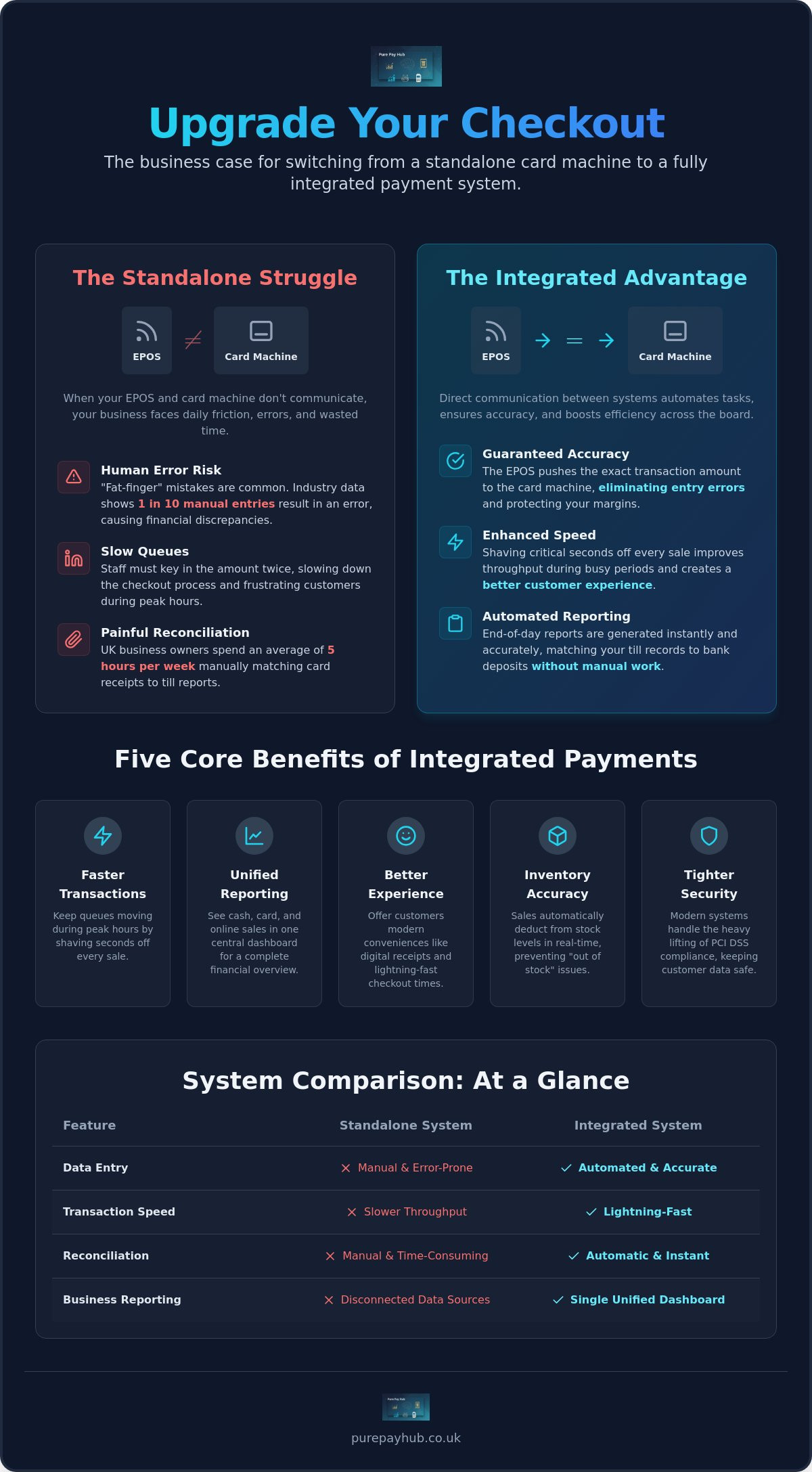
    An integrated payment system is a setup where your card machine and EPOS (Electronic Point of Sale) communicate directly with each other. In a traditional “standalone” environment, these two pieces of hardware exist in isolation. You calculate the bill on the till, then manually type that amount into the card reader. This disconnect is the root of most checkout friction. Understanding what is a payment system in the modern sense means looking at how these components link together to form a single, efficient unit.

    The shift towards integration has accelerated throughout 2026. UK consumers now expect a seamless experience. They have little patience for staff members who have to double-key figures whilst a queue builds up. One of the primary benefits of an integrated payment system is the total removal of this manual step. When your systems talk to each other, the transaction value is pushed automatically from the EPOS to the card machine. This creates a real-time flow of data that starts the moment a customer taps their card and ends with an accurate entry in your accounting software.

    The “standalone” problem is more than just a minor inconvenience. Industry data suggests that manually typing amounts into a card reader leads to 1 in 10 entry errors. These mistakes might seem small at the moment, but they create a significant headache for your bookkeeping. Over a month of trading, these discrepancies add up. They lead to a messy set of records that is difficult and expensive to untangle. Integration solves this by ensuring the data is correct at the source.

    The End of Manual Reconciliation

    Reconciliation is the process of matching your internal sales records against your actual bank deposits to ensure every penny is accounted for. It is often the most dreaded part of the day for a merchant. UK business owners spend an average of five hours a week on this type of administrative work. An integrated system handles this automatically. It matches every penny spent to a specific sale in real time. This means your end-of-day reports actually match your till reports without you having to spend your evenings with a calculator.

    Reducing Human Error at the Till

    Human error is inevitable when staff are busy or tired. A simple “fat-finger” mistake, such as typing £10.00 instead of £100.00, can be devastating for your daily margins. Conversely, overcharging a customer by mistake damages your reputation and leads to awkward refund processes. Integration acts as a digital safety net. It prevents staff from accidentally undercharging or overcharging because the human element is removed from the data entry phase. For business owners who are not on-site every day, this provides essential peace of mind that every transaction is being handled with absolute precision.

    5 Core Benefits of Integrating Your Payments

    Moving beyond the basic reduction of errors, the true benefits of an integrated payment system lie in how it transforms your daily operations. Modern UK businesses require more than just a way to take money; they need a system that acts as a central hub for all activity. For those looking to future-proof their backend, Crypto Chief offers a unified infrastructure that can support advanced digital transactions. By linking your card machine to your EPOS, you create a unified environment where data flows freely and securely. This connection ensures that every part of your business is in sync from the moment a customer pays.

    • Enhanced Transaction Speed: Shaving seconds off every sale keeps your staff focused on service rather than hardware.
    • Unified Reporting: See your cash, card, and online sales in one central dashboard for a complete financial overview.
    • Improved Customer Experience: Offer modern conveniences like digital receipts and lightning-fast checkout times.
    • Inventory Accuracy: Sales automatically deduct from stock levels in real-time, preventing awkward “out of stock” conversations.
    • Security and Compliance: Integrated systems often handle the heavy lifting of PCI DSS requirements, keeping your data safe.

    A recent Bank for International Settlements report highlights that structural integration in payments reduces intermediaries and increases transparency. This isn’t just a technical upgrade. It’s a strategic move that lowers costs and enhances the quality of your business data. If you are looking to modernise your setup, you can explore our EPOS systems to see how these features work in practice.

    Faster Throughput During Peak Times

    Hospitality and retail businesses in the UK cannot afford slow hardware, especially during a busy Saturday lunch rush or the Christmas period. The psychology of the queue is simple: long waits drive customers straight to your competitors. When your card machine is integrated, the “double-keying” delay disappears. Your staff tap a button on the till, and the card reader wakes up instantly with the correct amount. This efficiency allows you to serve more people in less time without increasing your staff headcount.

    Better Data for Smarter Decisions

    Integrated sales data allows you to identify your best-selling products with absolute certainty. You can see exactly which items are moving at what time of day, helping you optimise your staff rotas and stock orders. PurePay Hub’s reporting tools are designed to help you spot these trends before they happen. Instead of guessing which promotion worked, you have hard evidence. This clarity helps you make informed decisions that actually grow your profit margins rather than just maintaining the status quo.

    Integrated vs Standalone: Which is Right for Your Business?

    Choosing between a standalone card reader and a full EPOS system is a defining moment for any merchant. A standalone setup operates like a calculator; it takes a payment but doesn’t share that information with your records. This is often the starting point for micro-businesses with low volume and very simple needs. If you are a mobile trader processing just a few transactions a week, a basic reader might suffice. However, as your business grows, the limitations of this “disconnected” model quickly become a burden.

    For established SMEs, hospitality venues, and multi-site retailers, an integrated system is the only logical choice. One of the greatest benefits of an integrated payment system is its ability to scale alongside you. When you open a second location or expand your product range, your technology should simplify that growth rather than complicate it. Managing multiple sites from a single, remote dashboard is only possible when your payments and sales data are unified.

    Whilst integrated setups may involve higher initial hardware costs, the return on investment is significant. You aren’t just buying a card machine; you are buying back your time. A KPMG digital payments analysis suggests that digital integration is a key enabler of long-term growth, as it optimises working capital and improves cash flow visibility. By automating the data flow, you reduce the need for manual labour in your back office, allowing you to focus on high-value tasks instead of data entry.

    The Hidden Costs of Standalone Systems

    Standalone readers are often marketed as the “cheap” option, but they carry hidden costs that drain your profits. Mis-keying losses are a direct hit to your bottom line. If a staff member accidentally types £15 instead of £51, that money is simply gone. There is also the cost of staff time. Every minute spent fixing a mismatched end-of-day Z-report is a minute you are paying for admin that shouldn’t exist. Over a year, these small leaks can cost your business thousands of pounds in lost revenue and wasted wages.

    When to Make the Switch

    There are telltale signs that your business has outgrown its basic card reader. If you find yourself dreading the evening reconciliation or notice customers leaving because the queue is moving too slowly, it’s time to upgrade. Healthy cash flow is the lifeblood of any UK business, and next-day funding is a vital tool for maintaining it. PurePay Hub facilitates a smooth transition between providers, ensuring your new integrated system is up and running without disrupting your daily trade. We handle the technical setup so you can start seeing the results immediately.

    The Top Benefits of an Integrated Payment System for UK Businesses in 2026

    Implementing an Integrated System: A Practical Roadmap

    Transitioning to a connected setup shouldn’t be a source of stress. Whilst the technical side happens behind the scenes, you need a clear plan to ensure your business continues to trade smoothly. Moving from a standalone model to one where your hardware talks to each other is a straightforward process when you follow a logical roadmap. It is about moving away from the “messy” side of merchant services and into a state of informed confidence.

    Step 1: Audit your current setup. Start by checking your existing hardware and software compatibility. Most modern EPOS Systems are built to integrate, but older legacy units might require a software bridge or a hardware upgrade. PurePay Hub provides direct support to help you identify exactly what you need without recommending unnecessary extras.

    Step 2: Choose the right partner. This is the most critical stage. You need a merchant partner that offers transparent, low rates and a clear fee structure. Look for providers that offer debit card rates from 0.3% and avoid those that bury hidden costs in the small print. A fair partnership is built on honesty, not complex jargon.

    Step 3: Plan your installation. Timing is everything. Schedule your switch during a quiet trading window to minimise any potential downtime. Most integrated systems are “plug and play,” meaning you can be up and running in a matter of minutes rather than hours. Testing the connection before your first customer arrives ensures a seamless experience from the start.

    Step 4: Train your team. One of the hidden benefits of an integrated payment system is how much simpler it makes life for your staff. Because the system is intuitive and removes the need for manual data entry, training usually takes very little time. Your team will likely appreciate the reduced pressure during busy shifts.

    Compatibility and Software Links

    Ensuring your card machine works perfectly with your favourite EPOS software is essential. This connection is often managed by a Payment Gateway, which acts as the secure bridge between your offline sales and your digital records. If you are unsure about your current compatibility, you can contact us for a free setup audit to see how we can link your systems together.

    Minimising Business Disruption

    Choosing a provider with UK-based support is vital during the setup phase. If you have a question, you need an expert who understands the local merchant community. You should also ensure that “Next-Day Funding” is activated from day one. This prevents cash flow gaps and ensures that the money you take today is in your bank account tomorrow, keeping your business agile and responsive.

    The PurePay Hub Advantage: Integration Meets Growth

    Choosing a payment partner is about more than just hardware. It is about finding a fair ally that understands the pressure of running a regional business in the UK. At PurePay Hub, we take a distinct “no-nonsense” approach to merchant services. We don’t hide behind corporate jargon or complex fee structures that leave you guessing at your monthly costs. Instead, we offer transparent pricing with debit card rates from 0.3% and absolutely no hidden markups. This clarity is designed to build immediate trust and alleviate the stress often associated with financial processing.

    Our service is a stabilizing force for your finances. We provide next-day access to funds as standard for all our integrated partners. You shouldn’t have to wait days to access the money you have already earned. By ensuring your cash flow remains fluid, we help you stay agile in a competitive market. One of the most impactful benefits of an integrated payment system is how it turns your daily transaction data into a roadmap for future expansion. When your records are accurate and unified, you can make bold decisions with total confidence.

    This drive for financial agility is also transforming other sectors globally. For those with property interests in the UAE, you can check out Rentify to discover how their Rent Now, Pay Later solutions bring similar digital efficiency to the rental market.

    Unlocking Capital Through Integrated Sales

    Integrated data is a powerful asset that many traditional banks overlook. PurePay Hub uses your real-time sales information to unlock unsecured capital through our Business Cash Advance offering. Because your card machine and EPOS system are in sync, we have a clear, honest view of your turnover. This allows us to provide funding that is tailored to your actual performance rather than an arbitrary credit score. It is a modern solution for businesses that value growth but want to avoid the rigidity of traditional lending.

    The repayment process is entirely effortless. Rather than facing a fixed monthly bill that might strain your resources during a quiet week, repayments are a fixed percentage of your daily card sales. You only pay back the advance when you are actually trading. A Merchant Cash Advance provides a flexible alternative to bank loans because the repayment schedule naturally mirrors your business’s rhythm. If your sales are high, you pay back more; if things are slow, your repayments automatically reduce to match your pace.

    Reliable UK Support When You Need It

    We pride ourselves on being a local expert that acts as a supportive business partner. Our team understands the specific needs of the UK merchant community, from small high-street shops to busy hospitality venues. We are committed to fairness and disciplined service, showing a clear disdain for the opaque practices found elsewhere in the industry. You deserve a partner that prioritises your efficiency and provides straight-talking advice whenever you have a question. Our goal is to lead you away from frustration and toward a state of informed confidence.

    Ready to modernise your checkout and unlock your business’s full potential? Organise your integrated payment system with PurePay Hub today and experience a fairer way to manage your merchant services.

    Modernise Your Merchant Services Today

    Updating your technology is about reclaiming your time and protecting your profit. You’ve seen how removing manual data entry stops costly “fat-finger” mistakes and keeps your checkout moving during the busiest hours. A connected setup doesn’t just simplify your admin; it acts as a stabilising force for your entire business. By embracing the benefits of an integrated payment system, you gain the clarity needed to make smarter decisions whilst ensuring your records are always accurate.

    PurePay Hub is here to act as your supportive business partner. We offer a fair, no-nonsense service with debit card rates starting from just 0.3%. You can enjoy next-day access to your funds for better cash flow and apply for Business Cash Advances based on your future card turnover. This is merchant services built on honesty and integrity rather than hidden costs. It’s time to leave the messy side of finance behind and move forward with a partner that values your growth.

    Switch to a fairer, integrated payment partner today and start growing your business with confidence. We look forward to helping you build a more efficient, profitable future.

    Frequently Asked Questions

    What is the difference between integrated and non-integrated payments?

    Integrated payments involve a direct digital link between your EPOS system and your card machine. In a non-integrated or “standalone” setup, these two devices don’t communicate; you have to manually type the sale amount into the card reader. This manual step is the primary cause of bookkeeping errors and slows down your service during busy periods.

    Do I need a specific type of internet connection for integrated payments?

    A stable, standard broadband connection via Wi-Fi or Ethernet is usually all you need. Whilst you don’t require ultra-fast speeds for individual transactions, a reliable connection ensures that data flows between your till and terminal without interruption. Many UK merchants also use a 4G or 5G backup to keep their systems running if their main line goes down.

    How much does it cost to switch to an integrated EPOS system?

    The cost of switching varies based on your specific hardware needs and the size of your business. Whilst there is an initial investment for professional EPOS Systems, the return on investment comes from saved labour and the total removal of manual entry mistakes. We prioritise a fair, transparent fee model that avoids the hidden costs often found with traditional bank providers.

    Can I use my existing card machine with a new integrated software?

    Compatibility depends entirely on the make and model of your current hardware. Some card machines are “locked” to specific providers and won’t talk to third-party software. We recommend a quick audit of your existing equipment to see if it can be repurposed; this ensures you don’t spend money on new hardware unless it is strictly necessary for your growth.

    What happens if my EPOS system goes offline during a sale?

    Most modern integrated systems feature an “offline mode” that allows you to continue taking payments during a temporary network outage. The transaction data is stored securely on the encrypted device and synchronised with your central records as soon as the connection is restored. This prevents lost revenue and ensures your business stays operational even during local technical issues.

    How does integration help with PCI compliance?

    Integration simplifies your security requirements by ensuring sensitive cardholder data never actually enters your EPOS software. The payment is handled in a separate, secure environment, which significantly reduces the scope of your annual PCI DSS assessment. It is one of the most important security benefits of an integrated payment system for any business that values customer trust and data integrity.

    Is next-day funding available for all integrated transactions?

    Next-day funding is a standard feature for all merchants who choose PurePay Hub for their integrated setup. This ensures that the money you take today is in your bank account the following working day, regardless of your transaction volume. It is a vital tool for maintaining healthy cash flow and gives you immediate access to your revenue for stock orders or daily expenses.

    How long does it take to set up an integrated payment system?

    A typical setup takes between three to five working days once your hardware has been delivered to your site. The physical installation is designed to be “plug and play,” meaning you can often be up and running within an hour. This rapid deployment is one of the practical benefits of an integrated payment system, allowing you to modernise your checkout with almost zero disruption to your trade.