Why does the figure on your card machine receipt rarely match the deposit in your bank account? It’s the question that keeps many UK business owners at their desks long after the shutters have closed. Learning how to reconcile card machine payments with bank statements shouldn’t feel like a forensic investigation. You’ve likely spent hours squinting at spreadsheets, trying to account for transaction fees or the frustrating delay between a sale and a settlement. It makes VAT returns and tax season far more stressful than they need to be.
At PurePay Hub, we believe reconciliation is about synchronising your business rhythm with your payment provider’s clock. This guide will help you master the art of matching your daily card takings with your bank deposits to ensure every penny is accounted for and your books are perfectly balanced. We’ll show you how to build a streamlined routine that gives you clear visibility on your net profit and keeps your records ready for HMRC. With a transparent approach to your finances, you can stop guessing and start growing with confidence.
Key Takeaways
- Identify why payment reconciliation is your best defence against fraud and banking errors whilst ensuring your HMRC records remain perfectly balanced.
- Uncover the technical reasons behind the “Gross vs Net” settlement gap to understand why your daily takings don’t always match your bank statement.
- Master a simple step-by-step routine for how to reconcile card machine payments with bank statements using consistent “End of Day” terminal reports.
- Learn how to automate your bookkeeping by connecting your EPOS system and card machine directly to your favourite accounting software.
- Discover how next-day funding and clear, integrated reporting can remove the stress from your monthly VAT returns and financial planning.
What is Payment Reconciliation and Why Does it Matter?
Payment reconciliation is the essential process of cross-referencing your internal sales records with the actual funds received in your bank account. It is the only reliable way to ensure your business remains profitable and compliant. For any UK merchant, learning how to reconcile card machine payments with bank statements is a fundamental skill that prevents money from slipping through the cracks. It isn’t just a chore for the end of the month; it’s a daily habit that protects your livelihood.
Performing this check helps you detect fraud, identify bank errors, and ensure your tax reporting is spot on. When you have a clear view of your finances, you can make better decisions about stock, staffing, and growth. It turns your bank statement from a confusing list of numbers into a clear map of your business’s health. By understanding how to reconcile card machine payments with bank statements, you gain a level of cash flow visibility that many small business owners lack. This clarity is what allows a business to move from simply surviving to truly thriving.
We often recommend the “Three-Way Match” as the ultimate verification method. This involves comparing your EPOS or till report, your daily card machine totals, and your final bank statement. If these three figures don’t align, you have a discrepancy that needs investigating. It might be a simple human error at the till or a more complex technical glitch. Either way, spotting it early saves you from a massive headache during tax season.
Internal vs External Financial Records
Your financial data comes from two distinct directions. Internal records include your EPOS reports, manual till rolls, and customer invoices. These show what you should have earned based on your sales activity. External records are the statements from your bank and your merchant service provider, showing what you actually received after processing. The Three-Way Match is the gold standard for UK bookkeeping as it compares your till report, card machine report, and bank statement to ensure total accuracy.
The Consequences of Poor Reconciliation
Neglecting your books can lead to a domino effect of problems. Unnoticed transaction failures mean you’ve given away products or services for free. You also risk submitting inaccurate VAT returns to HMRC, which can lead to costly penalties and unwanted scrutiny. Messy books also make it much harder to access growth capital. If you ever apply for a Business Cash Advance, lenders will look for clear, reconciled statements to prove your business is a safe bet. Transparent reporting ensures you never have to worry about these hidden traps.
A Step-by-Step Guide to Reconciling Card Payments
Mastering how to reconcile card machine payments with bank statements requires a disciplined routine. It turns a mountain of data into a manageable checklist. Follow these five steps to ensure your books stay balanced and your cash flow remains transparent.
- Step 1: Perform an “End of Day” closure. Run this on your card terminal at the same time every day. This creates a clear snapshot of your takings and sets a firm boundary for your reporting period.
- Step 2: Export your daily sales report. Pull this data from your EPOS system or till. This is your internal proof of what should have been collected during the shift.
- Step 3: Compare gross sales with the “Capture” total. Your terminal report will show a “Capture” figure. Match this against your till’s gross sales to ensure every transaction was successfully sent to the processor.
- Step 4: Identify the “Settlement” amount. This is the actual cash that arrives in your bank account. Depending on your provider, this figure might be the net amount after fees are deducted, appearing one to three days after the sale.
- Step 5: Use a “suspense account” for discrepancies. If the numbers don’t align, don’t panic. Log the difference in a temporary account so you can investigate without halting your entire bookkeeping process.
Setting Your Reconciliation Schedule
High-volume hospitality businesses should aim for daily checks. It’s far easier to spot a £20 error from yesterday than to find one from three weeks ago. Synchronise your till closure with your provider’s cut-off time, which is often 10pm or midnight, to avoid sales bleeding into the next day’s report. Always keep physical Z-reports as a backup; they are a vital safety net if your digital records ever glitch.
Matching Transactions to Bank Deposits
Transaction batches usually appear as a single lump sum on your bank statement. Traditional banking often creates a “Friday to Monday” weekend lag, where three days of sales arrive as one confusing deposit. This delay makes matching a nightmare for busy merchants. Our next-day funding simplifies this step by providing a 1:1 daily match, ensuring your bank account mirrors your terminal report without the frustrating wait. This clarity allows you to see exactly what you’ve earned the very next morning.
Why Your Bank Statement Doesn’t Match Your Card Machine
It is one of the most persistent frustrations for UK merchants. You check your card machine report, then your bank statement, and the figures simply don’t align. This discrepancy is usually the biggest hurdle when learning how to reconcile card machine payments with bank statements. In most cases, it isn’t a sign of a missing sale or a bank error. Instead, it’s a result of how your payment provider handles your fees and settlement timing.
Variable costs also play a role. Merchant Service Charges (MSC) are often made up of Interchange fees set by card schemes like Visa and Mastercard. These costs fluctuate based on the type of card your customer uses, such as a premium rewards card versus a standard debit card. Because these costs vary, the final amount deposited into your bank can change daily. This makes manual reconciliation a complex task for even the most organised business owner.
Refunds and chargebacks add another layer of confusion. If you issue a refund, that amount is clawed back from your future settlements. This creates “phantom” gaps where your sales records show a higher total than your bank deposits. Tracking these individual deductions is vital to ensure your books remain accurate and your net profit is clearly visible.
Gross Settlement vs Net Settlement
The way you receive your money depends on your settlement model. With Gross Settlement, you receive the full value of your sales, and your provider invoices you for fees later. This makes your books easy to read. However, many providers use Net Settlement. This means they strip out their transaction fees before the money ever reaches your account. Net settlement is the most common cause of “missing” money in your bank account. If your till says £500 but your bank says £492, those missing pounds are likely your transaction fees.
Timing Discrepancies and Cut-off Points
Timing is the other major factor. Most providers have a strict cut-off point, often around 10pm or midnight. Any transaction made after this time will “roll over” to the next business day’s report. If you run a late-night bar or restaurant, your Friday night takings might be split across two different settlement dates. This creates a disconnect between your daily till closure and your actual bank deposits.
Bank holidays and weekends also disrupt the flow. Traditional banks don’t process settlements on non-business days. This means your Friday, Saturday, and Sunday sales often arrive as one giant lump sum on Tuesday morning. Pending transactions on your bank statement can also be misleading. These are merely authorisations; they haven’t settled yet. Relying on pending figures will inevitably lead to errors in your daily books. Understanding these rhythms is the key to a stress-free reconciliation process.
Tools to Automate and Organise Your Reconciliation
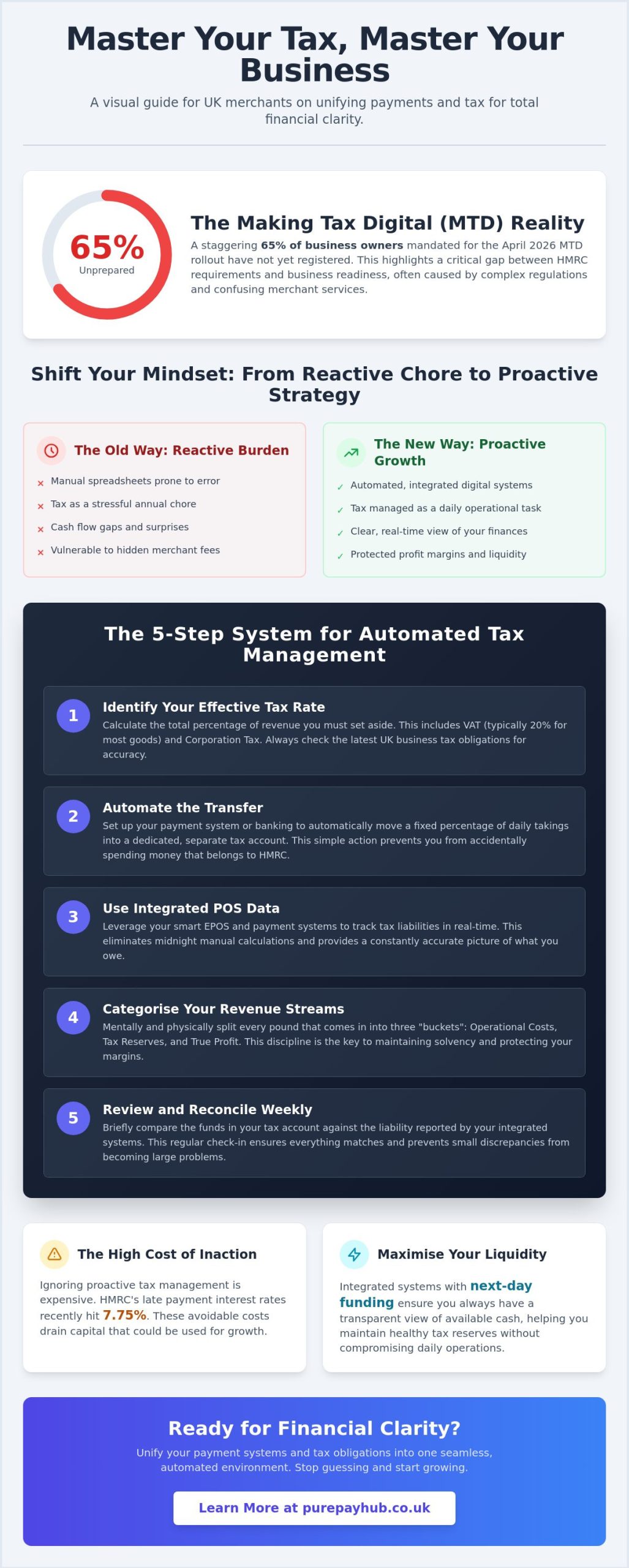
Manual spreadsheets are the enemy of efficiency. If you are still typing transaction numbers into Excel every Sunday night, you are working harder than you need to. Modern accounting tools have completely changed how to reconcile card machine payments with bank statements by doing the heavy lifting for you. By connecting your merchant account directly to your financial software, you can turn a three-hour task into a five-minute check. This automation ensures your records stay accurate whilst giving you back your valuable time.
Cloud-based reporting dashboards offer real-time visibility that paper statements simply cannot match. Instead of waiting for the end of the month, you can see exactly which payments have settled and which are still processing. Using “Bank Feeds” allows your accounting software to pull data directly from your bank, automatically suggesting matches for your sales records. This proactive approach means you can spot a discrepancy the moment it happens rather than discovering it weeks later during a stressful audit.
Software Integrations for UK SMEs
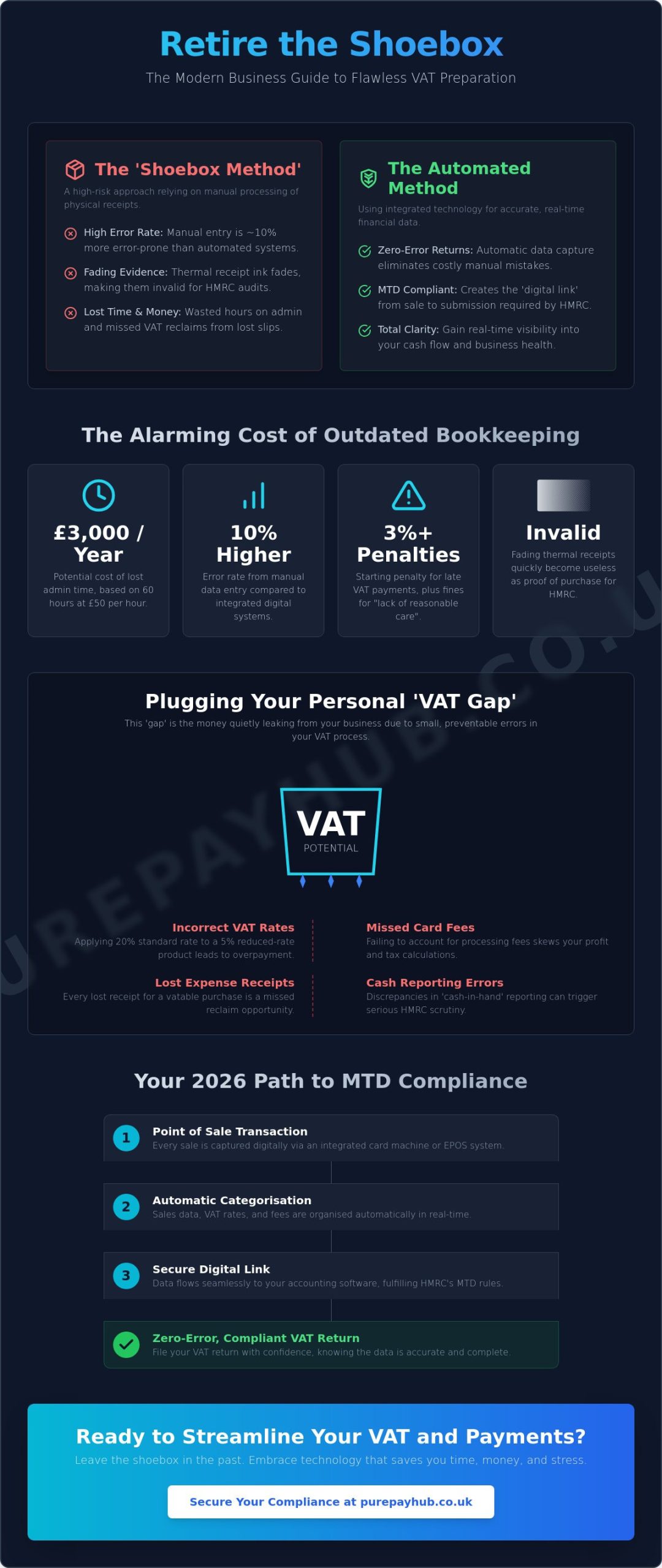
Platforms like Xero, QuickBooks, and Sage are the backbone of modern UK bookkeeping. In Xero, you can set up specific bank rules that automatically recognise your merchant provider’s deposits. QuickBooks handles “Merchant Fees” as a separate expense line, which is vital for keeping your books clean. Many merchants overlook the VAT implications of card processing fees; whilst these fees are often exempt, they must be recorded correctly to ensure your net profit figures are honest. Moving away from manual entry dramatically reduces human error and keeps your business compliant with HMRC standards.
The Role of Integrated Payments
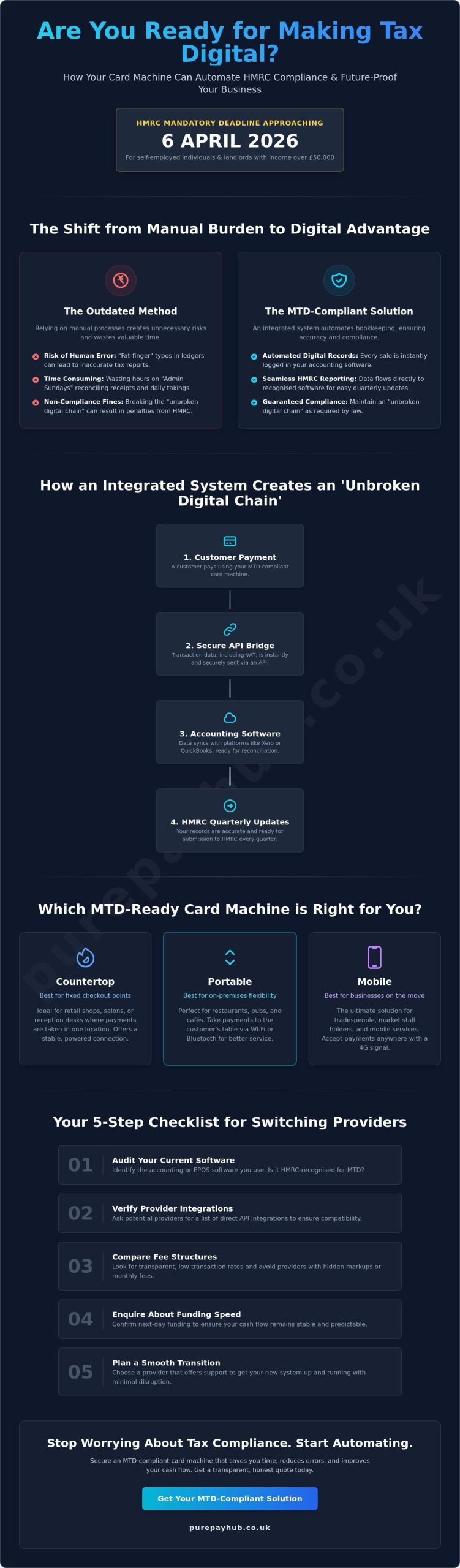
An integrated EPOS system acts as a bridge between your sales and your bank account. It eliminates the need for “double entry” by sending the exact bill amount from your till directly to your card machine. This ensures the figure on your till report always matches the figure on your card terminal. This level of precision is essential for “Making Tax Digital” (MTD) compliance. When your systems talk to each other, your VAT submissions become a simple task rather than a source of dread.
One local hospitality business reported saving five hours a week simply by moving to an automated setup. Before the change, the owner spent every Monday morning manually matching paper receipts to bank lines. After integrating their card machine with their accounting software, the system matched the vast majority of transactions automatically. This isn’t just about saving time; it’s about having the mental space to focus on your customers instead of your calculator. If you’re ready to stop the manual grind, our EPOS systems provide the seamless integration you need to keep your business running smoothly.
How PurePay Hub Simplifies Your Daily Finances
Managing your business shouldn’t mean staying up late to balance the books. At PurePay Hub, we’ve designed our services to remove the friction from your financial routine. Understanding how to reconcile card machine payments with bank statements becomes simple when your provider prioritises clarity. We provide the tools you need to see exactly where your money is at any given moment. Our goal is to act as a stabilising force for your finances, ensuring every penny is accounted for without the usual administrative headache.
One of the biggest hurdles we’ve discussed is the timing gap between a sale and a deposit. Traditional banks often leave you waiting days for your funds to settle; this makes your bank statement look like a jigsaw puzzle with missing pieces. We offer next-day funding as a standard feature. This means your bank statement matches your daily sales much more closely. It eliminates the confusion of weekend lags and holiday delays, providing a predictable rhythm that simplifies your bookkeeping and improves your cash flow visibility.
Clarity You Can Count On
Our monthly reporting statements are built for busy merchants. You won’t find hidden markups or confusing “admin” fees buried in the small print. Every transaction and fee is broken down clearly; this makes it easy to identify your true net profit at a glance. You can manage everything through a centralised dashboard, giving you a bird’s-eye view of your takings across every location you operate. This no-nonsense approach reduces the mental load of financial management and saves you hours of manual work every single week.
Our card machines talk directly to your EPOS systems and accounting software. This integration ensures that your internal sales records and external bank deposits are always in sync. If you ever have a question about a specific entry or a complex settlement, our UK-based team is here to help. We act as a supportive business ally, providing straight-talking advice to help you understand your statements. You’re never just a number to us; we’re here to help your local business grow by providing the professional support you deserve.
Getting Started with a Fairer Partner
Switching to a provider that values transparency is a decisive step toward better business health. Our merchant accounts work seamlessly with your existing bank, so there’s no need to change your established banking relationships. You get the benefit of competitive rates, with debit card rates starting from 0.3%, and the reliability of a modern fintech partner. Mastering how to reconcile card machine payments with bank statements is much easier when you have a partner that values honesty as much as you do.
Speak to PurePay Hub today for a transparent quote and discover a fairer way to manage your payments.
Take Control of Your Business Finances Today
Balanced books are the foundation of every successful UK business. By following a disciplined routine and understanding the technical nuances of settlement models, you can eliminate the stress of mismatched totals. Mastering how to reconcile card machine payments with bank statements ensures you always have clear visibility on your net profit. It protects you from fraud, keeps your records compliant for HMRC, and gives you the confidence to make informed growth decisions.
You don’t have to face the spreadsheets alone. With debit card rates from 0.3% and next-day funding as standard, our systems are built to make your daily routine effortless. Our UK-based professional support team is always on hand to help you navigate your statements with total clarity. It’s time to move away from the manual grind and partner with a provider that values transparency as much as you do. Switch to a card machine with transparent reporting and next-day funding today. Your perfectly balanced books are just one step away.
Frequently Asked Questions
Why is my card machine total higher than my bank deposit?
Your bank deposit is often lower because transaction fees are stripped out before the money reaches you. This is known as net settlement. It’s the most frequent hurdle for those learning how to reconcile card machine payments with bank statements. Other reasons include refunds or sales made after your daily cut-off time rolling over to the next settlement period.
How long should it take for card payments to appear in my bank account?
Standard settlement usually takes between one and three business days in the UK. However, PurePay Hub provides next-day funding as a standard feature to reduce this frustrating delay. Faster access to your money makes your daily bookkeeping much simpler and gives you a clearer view of your actual cash flow without the long wait.
What is the best way to record card machine fees in my accounts?
You should record card machine fees as a separate business expense rather than just recording the net amount you receive. This ensures your gross sales figures remain accurate for HMRC. Whilst most processing fees are exempt from VAT, you must still document them correctly to keep your profit and loss statements honest and professional.
Do I need to reconcile card payments every single day?
Daily reconciliation is the gold standard for high-volume businesses like cafes or shops. It allows you to spot human errors or technical glitches whilst the day’s events are still fresh in your mind. If your volume is lower, a weekly check might suffice, but daily habits prevent small discrepancies from turning into a massive headache at the end of the month.
What happens if a customer initiates a chargeback during reconciliation?
A chargeback will appear as a deduction from your future settlements, creating a gap in your expected totals. When this happens, log the disputed amount in a suspense account to keep your books balanced whilst you investigate. It’s important to track these separately so they don’t skew your daily sales reports or VAT calculations during tax season.
Can I use Xero or QuickBooks to reconcile my card machine payments?
Yes, you can use these platforms to automate how to reconcile card machine payments with bank statements. By connecting your merchant account to Xero or QuickBooks, the software can automatically match bank deposits with your sales invoices. This reduces the risk of manual data entry errors and saves you hours of administrative work every week.
Why do weekend sales take longer to show up in my bank account?
Traditional banks don’t process settlements over the weekend or on bank holidays. This means your sales from Friday, Saturday, and Sunday usually arrive as a single lump sum on Tuesday morning. This weekend lag is a common source of confusion, but choosing a provider with next-day funding can help bypass these archaic processing cycles for a more consistent cash flow.
What is a merchant statement and how do I read it?
A merchant statement is a monthly document that provides a transparent breakdown of every transaction and fee. To read it correctly, focus on the gross value of sales versus the net settlement deposited into your account. It serves as your primary tool for verifying that your provider is charging you fairly and according to your agreed rates without hidden markups.