
Tag: faster payments

  • Speed Up Customer Payments: A Guide for UK Businesses

    Speed Up Customer Payments: A Guide for UK Businesses

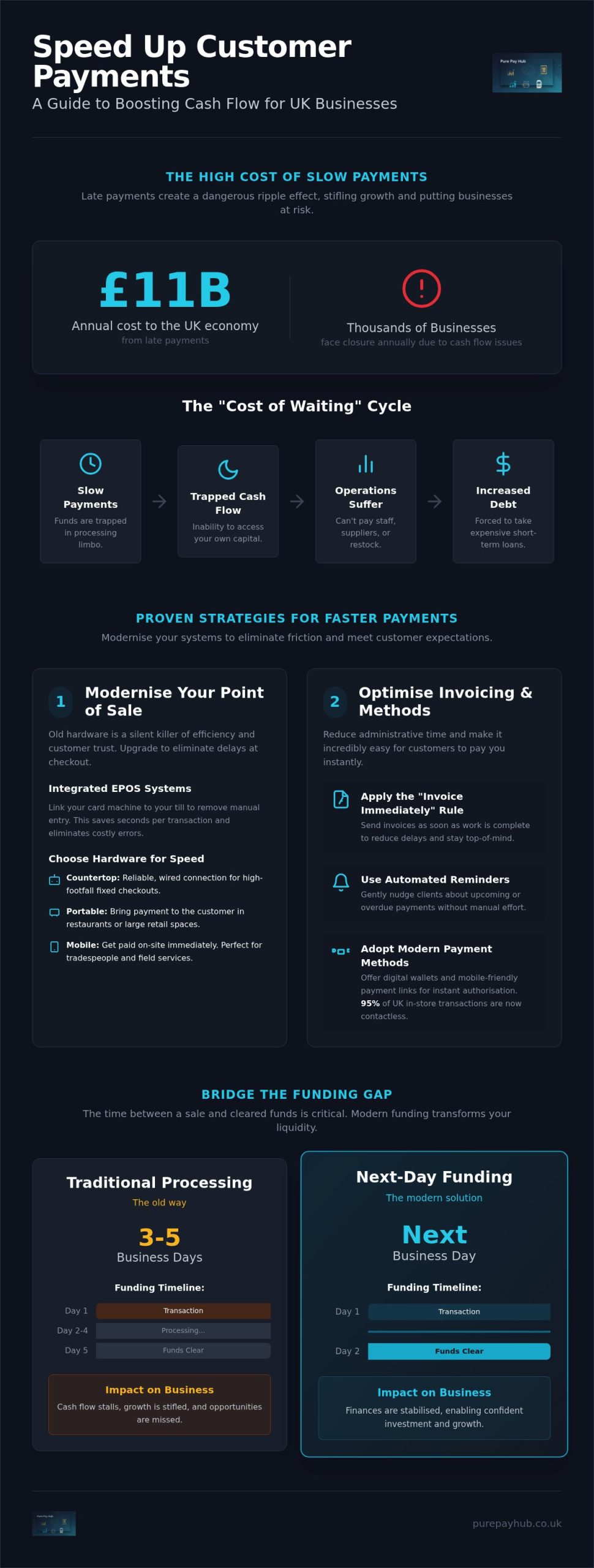
    Late payments cost the UK economy an estimated £11 billion every year, a staggering figure that leads to the closure of thousands of businesses annually. If you have ever felt the stress of a mounting invoice list whilst your own bank balance stays stagnant, you are certainly not alone. Most business owners agree that chasing money is the most frustrating part of the job. It drains your time and stifles your growth, but it is a cycle you can break.

    Learning how to speed up customer payments is the most effective way to protect your cash flow and modernise your operations. This guide shares proven strategies to reduce payment friction, automate your collections, and ensure funds reach your account without delay. We will look at how integrated EPOS systems and next-day funding can transform your liquidity. We also cover the latest UK late payment reforms and why moving beyond traditional Bacs processing is essential for a competitive edge. Discover how to create a fairer, faster payment experience that benefits both your business and your customers.

    Key Takeaways

    • Understand why reducing the “cost of waiting” is vital for maintaining healthy cash flow and funding your business growth.
    • Learn how modernising your hardware with integrated EPOS systems can eliminate manual entry errors and speed up the checkout process.
    • Discover how to speed up customer payments by adopting digital wallets and mobile-friendly payment links that offer instant authorisation.
    • Apply the “Invoice Immediately” rule and use automated reminders to reduce administrative time spent chasing outstanding funds.
    • Explore how PurePay Hub’s next-day funding provides a stabilising force for your finances compared to traditional 3-5 day clearing cycles.

    Why Payment Speed is the Lifeblood of Your Cash Flow

    Payment speed is the specific window of time between a completed sale and the moment those funds clear into your bank account. It is not just about the transaction itself; it is about the accessibility of your capital. For many UK merchants, this gap is where growth stalls. Understanding how to speed up customer payments is the first step toward building a resilient business that can weather economic shifts. The mechanics of modern payment systems have evolved rapidly, moving from slow manual settlements to near-instant digital transfers. If your business is still relying on outdated cycles, you are essentially providing interest-free loans to your customers whilst your own bills mount up.

    The “cost of waiting” is a heavy burden for SMEs. When funds are trapped in processing limbo, your ability to restock inventory, pay staff, or invest in new equipment is compromised. This often leads to an increased reliance on expensive short-term borrowing just to keep the lights on. Beyond the balance sheet, there is a significant psychological element to consider. Customers are far more likely to settle an account or complete a purchase when the process is seamless and immediate. Friction causes hesitation, and hesitation leads to delays or, worse, lost sales.

    The Financial Impact of Late and Slow Payments

    Slow turnover creates a dangerous ripple effect through your supply chain. If you can’t pay your suppliers on time because your customers haven’t paid you, your professional reputation suffers. Days Sales Outstanding, or DSO, is a metric that tracks the average number of days your business takes to collect payment after a sale is completed. A high DSO is a red flag for any business. Recent UK economic data suggests that late payments cost the economy £11 billion annually, pushing thousands of firms toward critical financial distress. Reducing this window is not just about efficiency; it is about survival.

    Customer Expectations in a Digital-First Economy

    Consumer behaviour has shifted dramatically across the UK. As of 2024, almost 95% of eligible in-store transactions are made using contactless methods. Customers now expect speed as a standard feature of any service. A slow checkout experience or a clunky invoicing process leads to frustration and basket abandonment. In the retail and hospitality sectors, a delay of just a few seconds can be the difference between a loyal regular and a one-time visitor. By removing hurdles, you position your brand as a modern, favourite choice amongst local shoppers who value their time as much as their money.

    Eliminating Friction: Modernising Your Point of Sale

    Old hardware is a silent killer of business efficiency. If your card terminal takes ten seconds to connect or frequently drops its signal, you’re losing more than just time. You’re losing customer trust. Every second a person spends waiting at the till is a moment they spend reconsidering their purchase or feeling frustrated by your service. Modernising your physical hardware is one of the most direct ways to address how to speed up customer payments in a face-to-face environment. High-performance terminals ensure that the moment a card or phone is tapped, the transaction is authorised and completed without hesitation.

    The Power of Integrated EPOS Systems

    Manual data entry is slow and prone to expensive errors. Integrated EPOS Systems link your card machine directly to your till, which completely removes the need for “double-keying” prices. When the staff member rings up an item, the exact total is sent to the terminal instantly. This doesn’t just save several seconds per transaction; it simplifies your end-of-day reconciliation by ensuring your reports always match your bank deposits. This level of precision is becoming increasingly important as the government’s late payment reforms place more scrutiny on how businesses manage their financial workflows and reporting. Efficient, integrated systems make this compliance effortless whilst keeping your queues moving during peak trading periods.

    Portable vs. Countertop: Choosing for Speed

    The right tool depends entirely on your business layout. Countertop Card Machines are reliable workhorses for fixed retail points with high footfall. They provide a stable, wired connection that never fails. However, in hospitality or large retail spaces, speed often means bringing the payment to the customer rather than making them walk to you. Portable Card Machines allow your team to take payments at the table or even in the middle of a queue, preventing bottlenecks from forming at the bar. For tradespeople or field-based services, a Mobile Card Machine ensures you get paid before you even leave the site. Getting the money immediately via a handheld device is always faster and more reliable than sending an invoice and waiting for a bank transfer. If you want to see which technology suits your specific workflow, you can compare the latest portable and mobile card machines to find a perfect fit.

    Prioritising hardware that supports the latest NFC and contactless standards is no longer optional. With the removal of the fixed £100 contactless limit in early 2026, your equipment must be ready to handle higher-value transactions securely. Modern terminals allow for greater flexibility, letting customers pay for larger orders with a simple tap of their phone or watch. This reduces the friction of PIN entry and keeps your business at the forefront of UK payment trends.

    Choosing the Right Payment Methods for Faster Settlements

    Selecting the correct payment channel is the most tactical decision you can make regarding how to speed up customer payments. Whilst cash feels immediate, it carries hidden delays in the form of bank trips and manual counting. Bacs payments, a staple for many UK businesses, still operate on a rigid three-working-day cycle. If you submit a payment on Monday, the funds won’t clear until Wednesday. This delay is a relic of an older era. In contrast, card transactions and digital wallets provide authorisation in seconds, allowing you to move on to the next task with confidence. Cheque culture is even more restrictive, often taking a full week to clear whilst leaving your business vulnerable to bounces.

    Digital wallets like Apple Pay and Google Pay have revolutionised the checkout experience. They eliminate the need for physical cards and, more importantly, the need for a PIN. Encouraging “one-tap” behaviour reduces the time spent at the point of sale, which is vital for high-volume traders. By offering these methods, you align your business with the fastest settlement technologies available today. It isn’t just about the technology; it’s about matching the pace of your customers’ lives.

    Contactless and Digital Wallet Dominance

    Biometric authorisation via FaceID or TouchID is significantly faster than traditional PIN entry. It is also more secure. As of March 2026, the fixed £100 contactless limit in the UK has been removed. This change allows banks and payment providers to set their own limits, enabling your customers to pay for more expensive items with a simple tap. You should ensure your terminals are updated to accept these higher-value transactions without requiring a PIN. Accepting all major cards ensures you never turn a customer away, keeping your revenue flowing without interruption.

    Online Payment Gateways and Virtual Terminals

    If you provide services over the phone or remotely, you need tools that match your pace. A Virtual Terminal allows you to take secure card payments during a call, securing the funds immediately rather than waiting for a bank transfer. For even greater speed, “Payment Links” let you send a secure checkout page via email or SMS. This is a game-changer for tradespeople and consultants. It allows the customer to pay on their mobile in seconds. To prevent drop-outs on your website, keep your checkout process to a single page with minimal steps. Every extra click is an opportunity for a customer to change their mind. Efficiency in your Online Payment Gateway is the best way to turn a “maybe” into a completed sale.
    Speed Up Customer Payments: A Guide for UK Businesses

    Streamlining Invoicing and Recurring Payment Workflows

    Waiting until the end of the month to send your invoices is a common mistake that creates an artificial bottleneck in your cash flow. If you complete a job on the 5th but don’t bill until the 30th, you’ve already lost three weeks of liquidity. Adopting an “Invoice Immediately” rule ensures your business stays at the top of your customer’s priority list whilst the value of your work is still fresh in their mind. This simple shift in timing is one of the most effective answers to how to speed up customer payments without needing to invest in complex new infrastructure.

    You can also influence payment behaviour through strategic incentives. Offering a small early settlement discount, perhaps 2%, can motivate clients to pay within days rather than weeks. Conversely, you should be clear about late payment penalties. Under current UK legislation, you have the right to charge interest of 8% above the Bank of England base rate on late business-to-business payments. Whilst you may not always choose to enforce this, having it stated clearly on your terms of service sets a professional boundary that discourages ditherers.

    Best Practices for Clear and Transparent Invoicing

    A UK-compliant tax invoice must include your business name, address, a unique identification number, and a clear breakdown of the VAT and total amount due. Ambiguity is the enemy of speed. If a customer has to call you to clarify an itemised charge or find your bank details, the invoice will sit at the bottom of their pile. You can eliminate this friction by including multiple “Pay Now” options directly within the digital document. Using Payment Links inside your email or PDF allows the customer to settle the balance instantly via their smartphone, bypassing the need for manual bank transfers entirely.

    Automating the Collections Process

    Chasing money manually is a drain on your mental energy and your administrative budget. Modern software allows you to set up automated email sequences that nudge customers as the due date approaches. These reminders should be polite but firm, providing a direct link to pay in every message. By syncing your payment provider with accounting platforms like Xero or QuickBooks, your books update automatically the moment a transaction clears. For businesses with variable or one-off high-value sales, this automation is far more flexible than traditional Direct Debit. If you are ready to stop the manual chase, you can set up secure Payment Links to start collecting funds the moment your work is done.

    Whilst Bacs remains a cost-effective choice for high-volume payroll, it is often too slow for modern business needs. Transitioning your recurring billing to automated card payments ensures that you are in control of the collection date. This moves your relationship from one of “waiting and hoping” to one of “consistent settlement,” providing the financial stability you need to plan for the future.

    Accelerating Growth with PurePay Hub’s Next-Day Funding

    Most discussions regarding how to speed up customer payments focus entirely on the point of sale. However, the final hurdle for any UK business is settlement speed. This is the time it takes for money to move from your payment processor into your actual bank account. Whilst many traditional providers keep your hard-earned funds in limbo for three to five working days, PurePay Hub operates differently. We act as a stabilizing force for your finances by providing next-day access to your funds. This ensures that the revenue you generated yesterday is available to spend, reinvest, or save by the following morning.

    Our commitment to UK business owners is built on a foundation of transparency and fairness. We offer debit card rates starting from 0.3 per cent, which is a significant departure from the opaque and inflated fee structures used by many competitors. By lowering your transaction costs, we help you retain more of your margin. This extra capital can then be used to reinvest in the integrated EPOS systems or mobile hardware discussed earlier in this guide. When your processing fees are low and your settlement is fast, your business gains a distinct competitive advantage.

    Next-Day Funding: The Ultimate Cash Flow Tool

    Accessing your card sales the very next day fundamentally changes how you plan your business operations. It provides a level of liquidity that allows you to respond to opportunities or emergencies without hesitation. You no longer have to rely on expensive bank overdrafts or high-interest short-term loans to cover a temporary gap. This steady, predictable flow of capital is especially vital for regional merchants who need to manage inventory levels with precision. The PurePay Hub onboarding process is designed for speed and simplicity. We ensure you are set up and ready to receive next-day settlements with minimal administrative delay.

    A Partner in Your Business Development

    We pride ourselves on a no-nonsense approach to merchant services. You won’t find hidden markups or complex jargon in our contracts. Instead, you get a supportive business ally that understands the local merchant community. Our UK-based support team is always available to help you manage PCI compliance or troubleshoot technical issues, ensuring your payment links and terminals never miss a beat. For businesses facing seasonal peaks or looking to expand, we also offer Business Cash Advances based on your card turnover. This provides a flexible way to bridge gaps whilst waiting for your busiest periods to arrive. If you are ready to transform your settlement cycle, you can organise a consultation with PurePay Hub to speed up your payments today and take full control of your cash flow.

    Take Control of Your Financial Future

    Mastering how to speed up customer payments is about more than just convenience. It is a fundamental shift in how you protect your business’s liquidity and professional reputation. By modernising your point of sale with integrated EPOS solutions and embracing digital wallets, you remove the hurdles that cause customers to hesitate. Streamlining your invoicing and adopting an “Invoice Immediately” rule prevents your capital from being trapped in outdated cycles.

    At PurePay Hub, we position ourselves as your fair partner in this transition. We provide a stabilising force for your finances by offering debit rates from 0.3% and providing next-day funding as standard. This ensures your money works for you without the frustration of traditional bank delays. Stop waiting for old systems to catch up with your ambition. Start taking faster payments with PurePay Hub – Get a quote today. You have built a dependable business; now give it the cash flow it deserves to thrive.

    Frequently Asked Questions

    How can I encourage my customers to pay invoices on time?

    You can encourage timely payments by sending invoices the moment a job is finished rather than waiting until the end of the month. Providing a direct “Pay Now” button through Payment Links makes it easier for customers to settle up instantly on their mobile. Clear terms and small early-payment discounts also provide a strong incentive for clients to prioritise your bill over others.

    What is the fastest payment method for a small UK business?

    Card payments and digital wallets are the fastest methods for immediate authorisation at the point of sale. Whilst cash feels instant, it requires manual handling and bank trips that delay your actual access to the funds. For bank-to-bank transfers, the Faster Payments scheme is the best option for near-instant settlement compared to the traditional three-day Bacs cycle used by many larger firms.

    Does integrated EPOS really speed up customer service?

    Integrated EPOS systems significantly speed up service by linking your till directly to your card machine. This eliminates “double-keying,” where staff have to manually type the price into the terminal for every sale. It reduces human error and cuts several seconds off every transaction. This is vital for managing queues and improving the customer experience during your busiest trading periods.

    What is next-day funding and how does it work?

    Next-day funding is a service where the money from your card sales is deposited into your bank account on the next working day. Traditional providers often take three to five days to clear these funds, which can stall your business growth. By reducing this gap, you improve your liquidity and reduce the need for expensive short-term borrowing or bank overdrafts to cover your costs.

    Are digital wallets like Apple Pay faster than physical cards?

    Digital wallets like Apple Pay and Google Pay are generally faster than physical cards because they use biometric authorisation such as FaceID or TouchID. This removes the need for customers to enter a PIN, even for transactions that exceed the old £100 contactless limit. It creates a seamless “one-tap” experience that keeps your checkout process moving at a modern, digital-first pace.

    How much do card machine transaction fees affect my cash flow?

    High transaction fees directly reduce your profit margins and the total capital available to reinvest in your business. Opaque fee structures with hidden markups can make it difficult to predict your exact weekly income. Choosing a provider with transparent rates, such as debit charges starting from 0.3%, ensures more of every sale stays in your pocket to support your ongoing development.

    Can I take payments over the phone to speed up collections?

    You can take secure phone payments instantly by using a Virtual Terminal. This allows you to process a customer’s card details securely during a conversation, securing the funds immediately. It is a much more efficient alternative to sending a traditional invoice and waiting days for a client to log into their banking app and set up a manual transfer.

    What should I do if a customer consistently pays late?

    If a customer consistently pays late, you should implement automated email reminders and consider charging statutory late payment interest. For recurring services, switching the customer from manual bank transfers to automated card payments is a proactive way to address how to speed up customer payments. This ensures you are in total control of the collection date rather than waiting on the customer’s own schedule.

  • Next Day Settlement Payment Processing: A Guide for UK Businesses in 2026

    Next Day Settlement Payment Processing: A Guide for UK Businesses in 2026

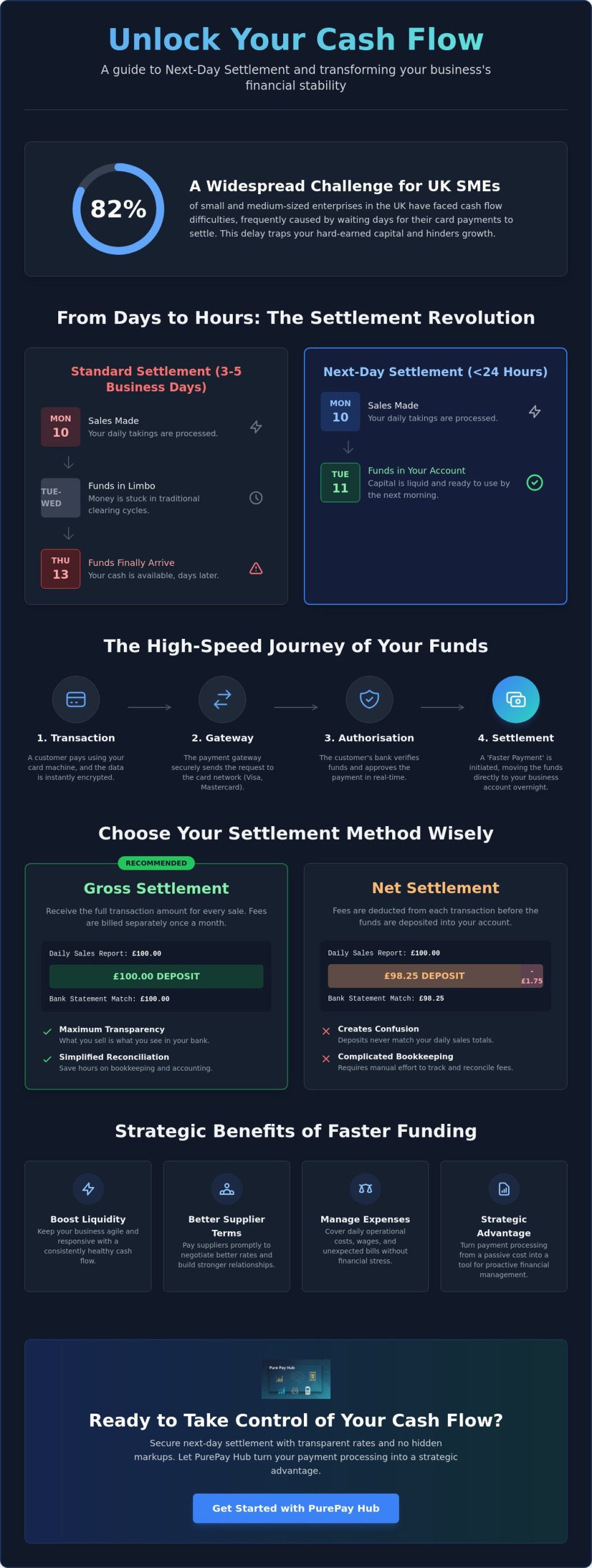
    Did you know that 82% of UK SMEs have faced cash flow difficulties, often because they lack access to reliable next day settlement payment processing? It is a common frustration to see a healthy daily sales report whilst your bank balance remains stagnant for days. You have suppliers to pay and a business to grow, yet your hard-earned capital is trapped in a processing queue. This delay is a barrier to your stability.

    We believe that access to your own money should be simple and reliable. This guide explains how to secure your funds within 24 hours and transform your cash flow. You will discover how to obtain faster funding without the burden of hidden costs or the confusing fee structures that often hide in the small print. At PurePay Hub, our goal is to provide the clarity you need to act as a confident partner in your own financial growth.

    We will break down the latest 2026 payment regulations and provide a clear roadmap for achieving transparent, low transaction rates. We will also show you how to simplify your daily reconciliation so you can spend less time on paperwork and more time serving your customers. This is about turning your payment processing from a passive cost into a strategic advantage for your business.

    Key Takeaways

    • Shorten your funding cycle from several days to under 24 hours to ensure your business remains liquid whilst maintaining a healthy cash flow.
    • Understand the technical steps behind next day settlement payment processing and how modern gateways bypass traditional banking delays.
    • Discover how immediate access to capital allows you to negotiate better terms with suppliers and manage daily expenses without stress.
    • Compare standard and next-day timelines to see exactly how Monday’s sales can reach your bank account by Tuesday morning.
    • Learn how PurePay Hub organises the onboarding process to get your merchant account live with transparent rates and no hidden markups.

    What is Next Day Settlement Payment Processing?

    Next day settlement payment processing is a merchant service that ensures funds from card transactions reach your bank account within 24 hours. Historically, UK businesses accepted a 3-5 working day delay as an unavoidable cost of doing business. This is no longer the case. By 2026, the expectation for real-time or near-real-time funding has become the benchmark for operational efficiency. If you’re waiting a week for Monday’s takings to arrive, your business is effectively providing an interest-free loan to your bank.

    There is a fundamental difference between authorisation and settlement. When your customer taps their card, an authorisation message confirms the transaction is valid. This is the moment of the sale, signified by the familiar “beep” of the card machine, but it isn’t the moment you get paid. The financial settlement process represents the actual transfer of value. Modern processing standards now allow this transfer to happen almost as quickly as the authorisation itself, moving money from a “pending” state into your available balance overnight.

    The Difference Between Gross and Net Settlement

    Choosing how you receive your funds is just as important as how fast they arrive. Gross settlement means you receive the total value of every sale. Your processing fees are calculated separately and usually collected via a single monthly direct debit. This model is often the favourite for UK business owners because it simplifies reconciliation. Every penny on your daily sales report appears in your bank statement, making your accounting process transparent and error-free.

    Net settlement operates differently. Your provider deducts their commission from each transaction before the funds are deposited. Whilst this means you don’t have a large bill at the end of the month, it often creates a reconciliation headache. Your bank deposits will never quite match your till totals. For businesses prioritising clarity and simple bookkeeping, gross settlement is the superior choice for managing daily revenue.

    Why High Street Banks Still Lag Behind

    Traditional high street banks often struggle to provide these faster timelines. Many still operate on legacy systems that rely on batch processing. This method groups transactions together and processes them in fixed windows, often leading to significant delays over weekends and bank holidays. These institutions are frequently tethered to old-fashioned clearing cycles that were designed before the internet era.

    Independent providers have disrupted this space by building modern, agile infrastructure from the ground up. They bypass the bureaucratic bottlenecks of traditional banking to deliver funds directly. Settlement is the final transfer of funds from the customer’s bank to yours. By choosing a partner that prioritises speed, you ensure your revenue is working for you, not sitting idle in a bank’s clearing account.

    How the Next Day Settlement Process Works

    The journey from a customer tapping their card to funds appearing in your balance involves several high-speed digital handshakes. In the past, these steps were separated by days of manual clearing and legacy banking delays. Today, the process is streamlined into a continuous 24-hour cycle. It’s a precise sequence where technology replaces bureaucracy to keep your cash moving.

    • Step 1: The customer interacts with your hardware. Whether they use a Countertop Card Machine or a Portable Card Machine, the device captures and encrypts the transaction details instantly.
    • Step 2: The payment gateway acts as a secure messenger. It transmits this data to the card networks, such as Visa or Mastercard, to request payment.
    • Step 3: The issuing bank (the customer’s bank) checks for sufficient funds and fraud indicators. If the transaction is safe, they send an authorisation code back to your terminal.
    • Step 4: This is where next day settlement payment processing differs from traditional models. Your acquiring bank uses the infrastructure of UK payment systems to initiate a ‘Faster Payment’ directly to your business account.

    The Role of the Acquiring Bank

    Your acquiring bank is the essential middleman in this process. They guarantee the funds to you before they’ve even fully collected them from the customer’s bank. This is why your choice of partner is vital. A modern acquirer provides the stability needed for reliable 24-hour funding. Older, traditional banks often have rigid “cut-off” times. If you miss their 4 pm window, you might wait an extra day for your money. Modern independent providers often offer much later cut-off times, ensuring your evening trade is included in the next morning’s payout. If you’re looking for a partner that prioritises this reliability, you can view our range of card machines designed for rapid funding. Having UK-based support is also a major advantage. If a technical glitch delays a settlement batch, you need a local expert who understands the UK banking landscape to resolve it quickly.

    Security and PCI Compliance During Settlement

    Speed never comes at the expense of safety. Every stage of the 24-hour cycle uses point-to-point encryption to protect sensitive data. Interestingly, faster settlement actually reduces your “risk window”. Because funds are cleared and settled quickly, there’s less time for certain types of transaction disputes to linger in a pending state. It creates a cleaner financial trail for your business. PCI DSS compliance is mandatory for all next day processing. This global standard ensures that your business and your customers remain protected against data breaches throughout the entire settlement journey.

    Comparing Settlement Timelines: Next Day vs Standard

    Understanding the difference between standard and next day settlement is best achieved by looking at a typical trading week. In a standard cycle, which is often the default for high street banks, a transaction made on Monday usually doesn’t arrive in your account until Friday. This is known as a T+3 or T+4 settlement period. It leaves your capital in a state of limbo for the majority of the working week.

    By contrast, next day settlement payment processing ensures that those same Monday sales are available in your bank account by Tuesday morning. This shift significantly reduces the gap between making a sale and having the cash available to reinvest. This efficiency is made possible by the Faster Payment System, which allows for near-instant transfers between UK financial institutions once the initial card data is cleared.

    The disparity becomes even more apparent when you consider weekends and bank holidays.

    • Standard Model: Friday sales might not clear until the following Wednesday or Thursday.
    • Next Day Model: Friday sales typically arrive on Monday morning, keeping your weekend revenue accessible for the start of the new week.

    Bank holidays often act as “hidden” delays in the standard model, potentially stretching a 3-day wait into a 6-day ordeal. For a business with tight margins, this delay isn’t just an inconvenience; it’s a risk to operational stability.

    The Real Cost of Waiting 3-5 Days

    Waiting for your funds carries a measurable opportunity cost. When your money sits in a clearing account, it isn’t earning interest, paying off debt, or purchasing stock. Many UK businesses find themselves forced to use expensive overdrafts or short-term credit lines simply to bridge the gap created by their own slow payment processor. Research indicates that 82% of UK SMEs have faced cash flow difficulties, a statistic often driven by these avoidable delays. There is also a significant psychological benefit to seeing your bank balance reflect your hard work within 24 hours. It provides a sense of control and clarity that traditional banking simply cannot match.

    Same-Day vs Next-Day: Is there a difference?

    You might wonder if you should push for same-day settlement instead. For high-volume hospitality businesses that need to pay staff or buy fresh produce daily, same-day funding can be a necessity. However, it often comes with a higher fee premium that can eat into your profits. For the vast majority of UK SMEs, next day settlement is the “sweet spot”. It provides the speed required for healthy cash flow whilst keeping transaction costs low and manageable. It aligns perfectly with standard accounting practices, allowing for simple daily reconciliation without the added expense of ultra-fast funding options.

    Next Day Settlement Payment Processing: A Guide for UK Businesses in 2026

    Strategic Benefits of Faster Funding for UK SMEs

    Faster funding is more than a simple convenience; it is a strategic lever for growth. When you implement next day settlement payment processing, you improve your working capital ratio instantly. This ratio represents the difference between your current assets and your liabilities. By shortening the time it takes for sales to become cash, you make your business significantly more resilient. In 2025, 90% of UK companies experienced late payments. You can avoid this trap by ensuring your own revenue isn’t part of the problem.

    Liquidity gives you the power to negotiate. You can often secure better terms or early settlement discounts with your suppliers by offering faster payments yourself. This directly boosts your profit margins. It also simplifies payroll management. If you employ casual or shift-based staff who expect prompt payment, having your weekend takings in the bank by Monday morning ensures you meet those obligations without relying on credit. You gain the freedom to make real-time decisions on stock levels and marketing spend based on the cash you actually have, rather than what you’re waiting for.

    Managing Seasonal Peaks with Confidence

    Retail and hospitality businesses know the pressure of a busy weekend or a bank holiday. Next day settlement allows you to restock your inventory by Monday afternoon, ready for the week ahead. You effectively close the funding gap that typically occurs during major UK sales events. This agility ensures you never miss a sale due to low stock levels. Learn how a business cash advance can further support your seasonal growth if you require a larger capital injection for a planned expansion.

    Streamlining Your Bookkeeping

    Reconciliation should be a simple task, not a daily chore. With next day settlement payment processing, your bank statement finally matches your card machine’s daily Z-report. This clarity reduces the time your accountant spends on unreconciled transactions. It also makes your financial reporting more accurate. Modern, integrated EPOS Systems are designed to track these fast-moving funds automatically. They provide a clear, real-time view of your financial health that traditional, slower systems simply cannot match. If you’re ready to take control of your revenue, you can explore our EPOS systems to see how they integrate with your funding cycle.

    Securing Next Day Settlement with PurePay Hub

    PurePay Hub is built on a foundation of transparency and honesty. We reject the opaque practices of traditional banks that treat fast funding as a luxury. Our commitment to next day settlement payment processing is standard for every UK merchant we partner with. We believe you should access your revenue without paying “express” fees or navigating complex markups. Our indicative rates are designed to be fair; typically sitting within the 0.3% range for debit cards and 0.5% for credit cards. This no-nonsense approach ensures your hard-earned capital stays where it belongs: in your business.

    We organise our onboarding process to move at the speed of your business. We understand that every day spent waiting for a merchant ID is a day of restricted cash flow. Our team acts as a supportive ally, guiding you through the technical setup with clarity and discipline. We don’t use corporate jargon to hide costs. Instead, we provide a clean, dependable service that turns your payment processing into a stabilizing force for your finances. You deserve a partner that values efficiency as much as you do.

    Hardware Options for Fast Funding

    Every piece of hardware we provide is fully compatible with our rapid settlement cycle. Our Countertop Card Machine is the perfect anchor for retail stores, whilst our Portable Card Machine allows hospitality staff to take payments at the table. If you’re a service-based business or a mobile trader, our Mobile Card Machine ensures you get paid securely whilst on the move. We also provide a Virtual Terminal and Online Payment Gateway for those taking payments over the phone or internet. Every transaction, whether face-to-face or digital, is processed with the same commitment to 24-hour settlement.

    How to Switch and Start Receiving Funds Faster

    Transitioning from a legacy provider to a modern system is simpler than you might think. We follow a logical 3-step process to get you started. First, we provide a transparent comparison against your current rates. Second, we help you navigate the process of leaving your old provider, including assistance with understanding any exit fees. Finally, we setup your new merchant ID and ship your hardware. We handle the technicalities so you can focus on your customers. Get a transparent quote and start your next-day settlement journey today. It’s time to stop waiting for your money and start growing your business with a partner you can trust.

    Secure the Financial Stability Your Business Deserves

    The traditional wait for card payments is an unnecessary burden on your working capital. By choosing a partner that prioritises speed and clarity, you ensure that Monday’s revenue is ready for reinvestment by Tuesday morning. This shift allows you to manage stock, pay staff, and negotiate with suppliers from a position of strength. You gain control over your liquidity without the stress of pending balances or stagnant funds.

    Implementing next day settlement payment processing is a decisive step toward a more resilient business model. At PurePay Hub, we make this transition seamless. We provide next-day access to funds as standard and offer industry-leading debit rates starting from 0.3%. If you’re worried about the cost of moving, we provide assistance with hidden exit fees from your current provider. We believe in being a fair partner to every merchant we serve.

    Stop letting legacy banking cycles hold back your growth. Switch to PurePay Hub for transparent rates and next-day settlement and start putting your revenue to work immediately. We are ready to help you build a faster, fairer future for your business.

    Frequently Asked Questions

    Does next day settlement work on weekends and bank holidays?

    Next day settlement typically operates on a working day basis. This means that transactions processed on Friday, Saturday, and Sunday will usually arrive in your bank account on Monday morning. Bank holidays are not classed as working days; therefore, your funds will settle on the next available business day following the holiday period.

    Are there extra fees for next day settlement compared to standard processing?

    Many traditional banks still charge “premium” or “express” fees for faster funding, but modern providers often include this as a standard feature. At PurePay Hub, we believe next day settlement payment processing should be transparent and accessible without hidden markups. You should always check your merchant agreement for any daily service charges that some legacy processors still apply.

    Do I need to change my business bank account to get next day funding?

    You do not need to switch your existing business bank account to access faster settlement. Your payment processor will link your merchant ID directly to your current account using the UK’s Faster Payment System. This allows you to keep your primary banking relationship whilst benefiting from a significantly improved cash flow cycle.

    Is there a limit on the transaction volume for next day settlement?

    There is generally no specific limit on the volume of transactions that can be settled within 24 hours. However, extremely large or unusual spikes in your daily sales may occasionally trigger a standard security review by the acquiring bank. These reviews are a necessary part of fraud prevention and ensure the safety of your business revenue.

    How do I reconcile next day settlements with my accounting software?

    The simplest way to reconcile your accounts is to use a gross settlement model where the total sales on your Z-report match your bank deposit exactly. Most modern EPOS systems and accounting platforms can integrate directly with your merchant service. This automation allows you to track next day settlement payment processing within your software, reducing manual data entry and accounting errors.

    What is the ‘cut-off time’ for transactions to be included in the next day’s payout?

    The cut-off time is the specific hour when your daily transactions are batched for processing. Traditional high street banks often have early cut-off times around 4pm, which can delay your evening sales. Modern independent providers frequently offer much later windows, sometimes up to midnight, ensuring your full day of trading is included in the next morning’s payout.

    Can I get next day settlement for online payments and virtual terminals?

    Yes, next day settlement is available for transactions made through an Online Payment Gateway or Virtual Terminal. The speed of your funding is determined by your contract with the processor rather than the hardware you use. This ensures that your e-commerce and phone-based sales provide the same liquidity as your face-to-face card transactions.

    What happens if a settlement is delayed or doesn’t arrive as expected?

    If your funds don’t arrive as expected, you should first verify if there is a UK bank holiday or a scheduled maintenance window for the Faster Payment System. If the delay persists, contact your provider’s UK-based support team immediately. A reliable partner will offer transparent tracking and a direct line of communication to resolve any technical or security-related delays quickly.