Tag: EPOS Integration

  • Fix the Tax & Logistics Efficiency Gap with Smart Payments

    Fix the Tax & Logistics Efficiency Gap with Smart Payments

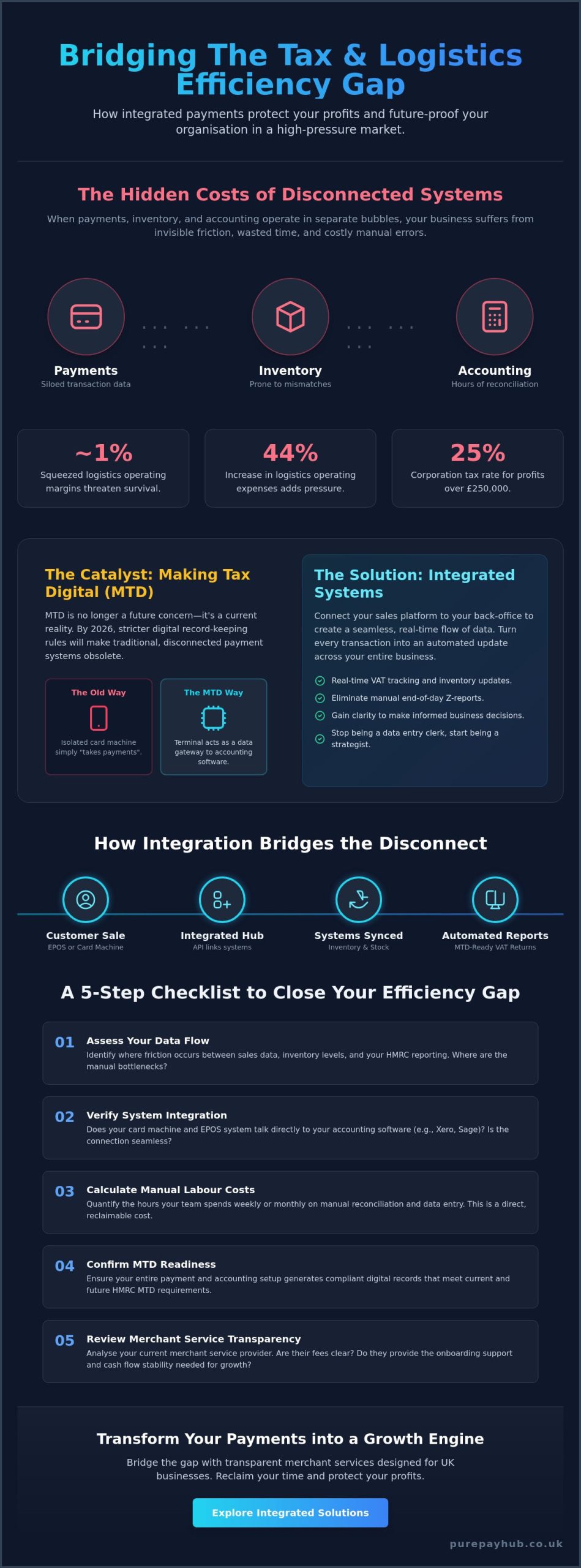
    With logistics operating margins squeezed as tight as 1%, losing even a fraction of a percent to manual errors isn’t just an inconvenience; it’s a threat to your survival. You’ve likely felt the pressure of rising costs, from the 44% increase in logistics operating expenses to the 25% corporation tax rate for profits over £250,000. These pressures are often worsened by 3. The “Tax & Logistics” Efficiency Gap, where siloed payment data leads to inventory mismatches and hours of slow reconciliation between card sales and bank statements.

    We believe your financial tools should work as hard as you do. This guide explains how to bridge that disconnect by turning your payment processing into a central engine for your operations. You’ll discover how to implement MTD-ready systems for automated VAT reporting and link card transactions directly to your inventory in real-time. We’ll show you how to reclaim lost time, speed up your access to funds, and protect your hard-earned profits with a more transparent, professional approach to your business finances.

    Key Takeaways

    • Identify how 3. The “Tax & Logistics” Efficiency Gap creates friction between your sales data and HMRC reporting, leading to costly manual errors.
    • Discover how linking your EPOS systems and card machines to accounting software creates a seamless flow between your sales and inventory management.
    • Compare the real-world cost of manual bookkeeping against automated systems to see exactly how much time your business can reclaim.
    • Follow a structured five-step checklist to audit your current payment setup and ensure it is fully compatible with modern MTD requirements.
    • Learn how switching to a transparent merchant service can simplify your onboarding process and provide the cash flow stability needed for logistical expansion.

    What is the Tax & Logistics Efficiency Gap in UK Business?

    Running a successful business requires more than just making sales; it demands a precise synchronisation of data. For many UK merchants, payments, tax reporting, and inventory management exist in separate bubbles. This structural failure is what we call 3. The “Tax & Logistics” Efficiency Gap. It is the invisible friction that occurs when your card machine doesn’t talk to your accounting software, and your warehouse doesn’t know what your shop floor has sold. When these systems remain siloed, your business loses time and money through repetitive manual entry and avoidable errors.

    This gap often manifests as “logistics lag.” Imagine a scenario where your online store sells your last three items of stock, but your physical card machine at a pop-up event sells them again ten minutes later because the systems aren’t linked. Whilst enterprise-level supply chain management software exists to solve these issues for corporations, SMEs often find themselves trapped in a cycle of manual reconciliation. You spend hours every week cross-referencing bank statements with sales reports just to ensure your VAT figures are correct. In an industry where logistics operating margins can be as thin as 1%, this wasted labour is a cost you simply cannot afford.

    The Hidden Costs of Siloed Data

    Manual data entry is the primary enemy of efficiency. Every time a staff member types a transaction total into a spreadsheet, the risk of a typo increases. These small errors snowball into significant headaches during your year-end reconciliation. HMRC penalties for inaccurate VAT returns are a genuine risk, and the stress of a potential audit hangs over many business owners who rely on fragmented systems. Beyond the immediate financial risk, the efficiency gap represents a fundamental barrier to scalable growth that prevents local merchants from competing with automated giants. If you’re too busy fixing data errors, you aren’t busy growing your brand.

    Why MTD is the Catalyst for Change

    The Making Tax Digital (MTD) mandate is no longer a future concern; it is a current reality for UK businesses. By 2026, the requirements for digital record-keeping will be even more stringent. Traditional card machines that merely “take payments” are becoming obsolete because they fail to meet modern digital standards. We are seeing a permanent shift from simply processing a transaction to managing a complex data flow. Your payment terminal must act as a gateway that feeds information directly into your MTD-ready accounting software. By closing 3. The “Tax & Logistics” Efficiency Gap, you stop being a data entry clerk and start being a business strategist. You gain the clarity needed to make informed decisions about your stock, your taxes, and your future.

    How Integrated Payment Systems Bridge the Disconnect

    Integrated payment systems are the definitive solution to the friction identified in the previous section. By connecting your sales platform directly to your back-office, you transform a simple transaction into a rich data event. This integration closes 3. The “Tax & Logistics” Efficiency Gap by ensuring that every sale triggers an immediate update across your entire business ecosystem. You no longer need to bridge the gap yourself with spreadsheets and manual entries; the software does the heavy lifting for you.

    The magic happens through API links. When you process a sale, your EPOS system communicates instantly with accounting software like Xero or Sage. This allows for real-time tax tracking. You can see your VAT liability grow with every tap of a card, rather than waiting for a monthly or quarterly surprise. This level of clarity is vital for staying compliant with complex regulations, such as the UK VAT rules for overseas goods, which often catch businesses off guard during the reconciliation process. With a synchronised system, the data is always accurate and always ready for HMRC.

    EPOS and Card Machine Synergy

    Your Countertop Card Machine shouldn’t be an island. In an integrated setup, it works in perfect harmony with your central EPOS hub. This synergy eliminates the tedious requirement for manual end-of-day Z-reports. Instead, the data flows automatically, ensuring every penny is accounted for across your physical and online sales channels. If you want to see how this works in practice, you can explore integrated EPOS systems to find a setup that fits your shop floor. This connection ensures that your bank statement and your sales reports match perfectly every single day.

    Automating the Logistical Chain

    Integration extends far beyond the till. By linking your Virtual Terminal or Payment Links to your warehouse, you create a responsive logistical chain. A payment received via a link can automatically trigger a picking list in the warehouse or a booking in your service calendar. This automation reduces logistical friction and prevents stock-outs. By using payment analytics to identify high-velocity items, your system can even suggest automated reordering. This ensures you never miss a sale due to empty shelves, effectively turning your payment data into a powerful tool for inventory control.

    Manual vs. Automated: Calculating the Real Efficiency Gap

    The administrative burden on UK SMEs is a documented reality. An Office of Tax Simplification report highlights how complex tax compliance drains vital resources from smaller firms. When you calculate the impact of 3. The “Tax & Logistics” Efficiency Gap, you see more than just lost minutes. You see lost potential. A business owner spending five hours a week on manual reconciliation is losing over 250 hours a year. That is time stolen from marketing, staff training, or product development. If your systems don’t talk to each other, you’re paying a “manual tax” every single day.

    Automated data syncing removes the guesswork. If your card sales don’t automatically match your bank statements, you’re forced into a game of financial detective. One missed transaction or a single typo in a VAT entry can lead to significant discrepancies in your HMRC filings. These errors aren’t just annoying; they’re expensive. Inaccuracies can trigger audits or lead to unexpected tax bills that cripple your cash flow. By automating the link between your card reader and your ledger, you ensure that every penny is tracked without human intervention.

    The ROI of Integration

    Investing in modern payment hardware often feels like an added expense for a growing business. However, the return on investment is immediate when you factor in labour savings. Staff members who previously spent hours manually counting stock or cross-referencing receipts can now focus on serving customers. Automated systems provide a real-time view of your inventory, preventing the need for disruptive, after-hours stock takes. On average, businesses switching to an integrated EPOS system save 10 hours of administrative work every single month. This reclaimed time allows you to avoid the late filing fees associated with complex manual accounting whilst keeping your overheads predictable and lean.

    Human Error and Tax Accuracy

    Tax anxiety is a very real burden for local business owners. The constant fear of “getting it wrong” creates unnecessary stress during every tax window. Automated systems act as a compliance safety net by ensuring your favourite accounting tools are always fed accurate, real-time data. By closing 3. The “Tax & Logistics” Efficiency Gap, you eliminate the risk of human error during the data transfer process. Your records remain untainted by manual intervention, providing you with a clear and honest view of your financial health. This transparency isn’t just about satisfying HMRC; it’s about giving you the confidence to lead your business with facts rather than estimates.
    Fix the Tax & Logistics Efficiency Gap with Smart Payments

    Closing the Gap: A 5-Step Checklist for Your Business

    Transitioning from a fragmented system to a streamlined operation requires a structured approach. You’ve already seen how 3. The “Tax & Logistics” Efficiency Gap drains your resources; now it’s time to take control. Closing this gap isn’t just about software; it’s about aligning your physical processes with your digital data. By following this 5-step checklist, you can reclaim your time and ensure your business is resilient for the future.

    • Audit your hardware: Check if your current card machines and EPOS systems are fully compatible with MTD-ready accounting software.
    • Centralise your data: Use a single merchant account provider to ensure all sales channels feed into one central reporting hub.
    • Organise inventory categories: Align your physical stock categories with your EPOS reporting to ensure your logistics data is clean and actionable.
    • Train your team: Ensure every staff member understands how to use integrated features correctly at the point of sale to maintain data integrity.
    • Review your funding: Analyse your current funding cycle to ensure that logistical costs, such as fuel or stock reordering, are never delayed by slow payment settlements.

    Taking these steps creates a solid foundation for growth. When your payments, taxes, and logistics move in sync, you eliminate the friction that holds back so many UK SMEs. If you’re ready to start this process, you can view our range of integrated payment solutions to see which tools best fit your specific business model.

    Auditing Your Current Infrastructure

    Legacy hardware is often the biggest contributor to 3. The “Tax & Logistics” Efficiency Gap. If your card reader doesn’t have a reliable connection to your Wi-Fi or 4G network, you risk data drops that lead to manual reconciliation later. You should also ensure your Virtual Terminal is fully PCI compliant. Compliance isn’t just a legal requirement; it’s a safeguard against the non-compliance fines that can suddenly derail your financial planning. A modern infrastructure is the first line of defence against administrative waste.

    Streamlining the Funding Cycle

    Logistical momentum depends on cash flow. If you’re waiting days for funds to clear, you can’t respond quickly to stock shortages or rising fuel costs. Next-day funding is essential for maintaining a healthy supply chain. For businesses facing seasonal fluctuations, a Business Cash Advance can bridge the gap without the stress of fixed monthly repayments. This flexibility ensures your logistics are always supported by your sales. Discover how PurePay Hub can accelerate your funding to keep your business moving forward without unnecessary delays.

    PurePay Hub: Bridging the Gap with Transparent Merchant Services

    At PurePay Hub, we believe that your payment provider should be an ally, not an obstacle. We have built our services specifically to resolve the friction caused by 3. The “Tax & Logistics” Efficiency Gap. By offering 0.3% debit rates, we ensure that a larger portion of every sale stays within your business. This isn’t just about saving pennies; it’s about reclaiming capital that you can reinvest in logistical improvements, such as upgrading your delivery fleet or expanding your warehouse capacity. Our mission is to provide the financial stability you need to focus on growth rather than administrative survival.

    We understand that time is your most valuable asset. That is why our onboarding process is designed to be seamless. You can close your efficiency gap in days rather than weeks. Our integrated EPOS systems and card machines are engineered specifically for the UK market, ensuring full compatibility with local tax requirements and banking standards. We take a disciplined, no-nonsense approach to pricing. You’ll never find hidden markups or opaque fee structures in our contracts. This commitment to honesty ensures that your financial data remains untainted and easy to manage from day one.

    Transparent Fees, Simpler Tax

    Complexity is the enemy of accuracy. Traditional merchant services often hide costs behind layered fee models, which makes your accounting reconciliation a nightmare. We provide clear, predictable fee structures that make your year-end reporting effortless. When every cost is transparent, you avoid the “hidden fee” trap that so often complicates VAT calculations and corporation tax filings. Our predictable monthly hardware costs for card machines allow you to forecast your overheads with total confidence. You get the technical precision of a modern fintech partner with the reliability of a local expert.

    A Partner in Your Logistics Growth

    Logistical efficiency depends on the speed of your cash flow. If your funds are trapped in a clearing cycle, your supply chain stalls. We provide next-day access to your funds to ensure your operations never miss a beat. Whether you are paying hauliers or reordering high-velocity stock, our rapid settlement keeps your business moving forward. Our expert technical support team is always available to ensure your data flow between sales and accounting is never interrupted. We act as a stabilising force for your finances, allowing you to scale without the fear of data silos. Switch to PurePay Hub and close your efficiency gap today.

    Take Control of Your Business Future

    Closing 3. The “Tax & Logistics” Efficiency Gap is a strategic move to secure your business’s future. By synchronising your sales data with your inventory and tax reporting, you eliminate the manual errors that drain your energy and profit. You’ve seen how integrated systems turn hours of administrative work into seconds of background processing. This clarity allows you to focus on what matters most; growing your brand and serving your community.

    We act as your reliable business partner by offering fair, disciplined merchant services that prioritise your success. With debit card charges from 0.3% and next-day access to funds, we provide the cash flow momentum needed to keep your logistics moving. Our expert UK-based technical support ensures your data flow remains uninterrupted and professional. Your business deserves a financial partner that values transparency and straight-talking as much as you do.

    Get a transparent quote and close your efficiency gap today. Taking control of your finances is the first step toward a more efficient, stress-free operation. We look forward to helping you build a more resilient and profitable business.

    Frequently Asked Questions

    What exactly is the Tax & Logistics Efficiency Gap?

    3. The “Tax & Logistics” Efficiency Gap is the friction created when your payment data, HMRC tax filings, and warehouse stock levels aren’t synchronised. This disconnect forces business owners into repetitive manual reconciliation, which leads to human error and wasted productive time. By closing this gap, you ensure that every transaction automatically updates your inventory and your accounting ledger simultaneously, creating a single source of truth for your business.

    How does an integrated card machine help with Making Tax Digital (MTD)?

    Integrated card machines act as a digital bridge by feeding real-time transaction data directly into your MTD-compliant accounting software. This automation ensures your digital records are always accurate and ready for HMRC submissions without manual intervention. It removes the need for tedious data entry, which is the primary cause of errors in tax reporting for small businesses, whilst keeping you fully compliant with modern regulations.

    Can I link my existing card machine to my favourite accounting software?

    Compatibility depends entirely on your specific hardware, but many legacy card machines lack the necessary API links to connect with modern accounting tools. If your current terminal operates in a silo, you’ll likely need to upgrade to a modern integrated EPOS system to achieve seamless data syncing. We recommend auditing your current hardware to ensure it supports the digital data flows required for modern business efficiency.

    Will switching to an integrated EPOS system cause downtime for my business?

    Switching to an integrated system shouldn’t cause significant downtime if you work with a professional partner. Most modern EPOS systems are designed for quick setup and can be configured alongside your existing hardware before you make the final transition. Our onboarding process focuses on speed and clarity, ensuring your shop floor remains operational whilst we help you close your efficiency gap in days.

    How does next-day funding improve my logistical operations?

    Next-day funding provides the immediate liquidity needed to respond to logistical demands like fuel price hikes or sudden stock shortages. When your funds are settled quickly, you don’t have to wait for traditional banking cycles to complete before reordering essential supplies. This rapid access to capital keeps your supply chain moving and prevents bottlenecks caused by trapped cash flow, which is vital for thin-margin businesses.

    Are integrated payment systems more expensive than traditional card readers?

    Whilst the initial investment in integrated hardware can be slightly higher, the total cost of ownership is often lower due to significant labour savings. You eliminate the high cost of manual bookkeeping and the risk of expensive tax penalties from HMRC. When you factor in the value of reclaimed time and improved stock accuracy, an integrated system is a more cost-effective choice for any growing business.

    What happens if my internet goes down? Will it break my data integration?

    Modern integrated systems are built with resilience in mind and often feature offline processing modes or 4G SIM backups. If your primary internet connection fails, your transaction data is stored securely on the device and synced once the connection is restored. This ensures your data integration remains intact and your tax records stay accurate without any manual intervention or loss of sales during a temporary outage.

    How do I know if my current business is suffering from an efficiency gap?

    You are likely suffering from 3. The “Tax & Logistics” Efficiency Gap if you spend more than two hours a week manually reconciling bank statements. Other red flags include frequent stock-outs, inventory levels that don’t match your sales reports, and high levels of anxiety during VAT submission windows. If your systems feel like they are working in separate silos, it is time to consider a more integrated approach.
  • Best Card Machine for Small Retail Shop: A 2026 Guide to UK Merchant Services

    Best Card Machine for Small Retail Shop: A 2026 Guide to UK Merchant Services

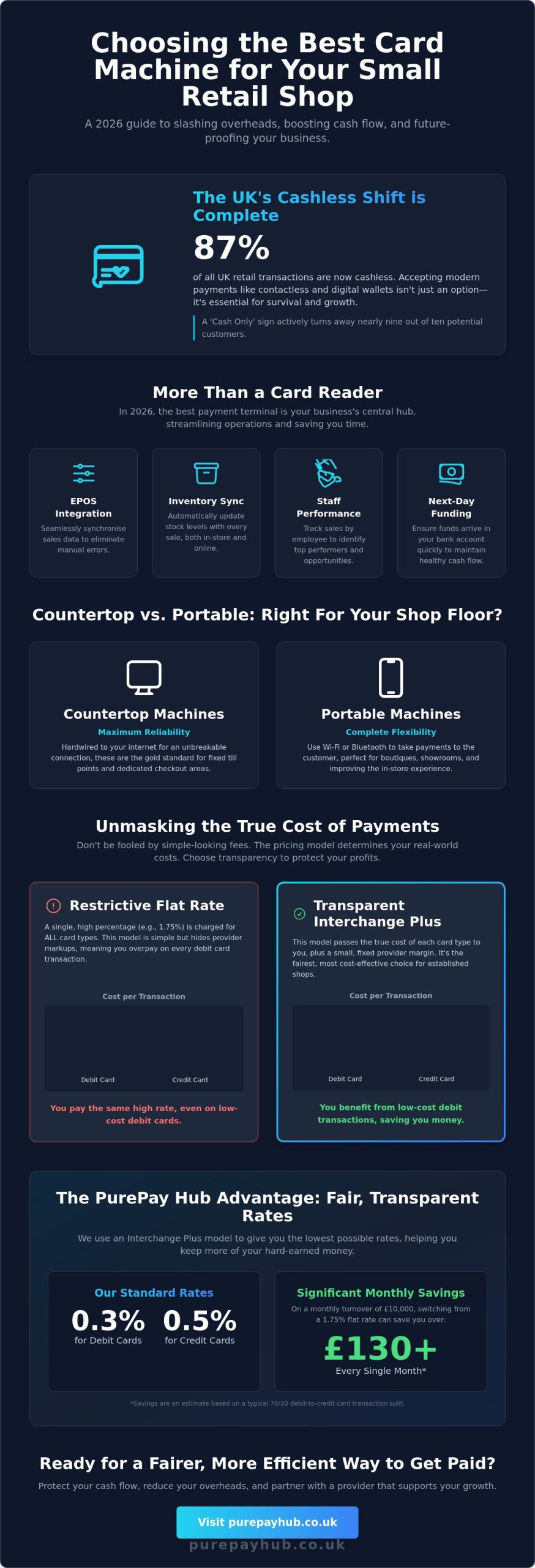
    Did you know that 87% of UK retail transactions are now cashless? In 2026, your payment terminal is the most critical piece of equipment in your building. Finding the best card machine for small retail shop owners is no longer just about convenience; it is about survival. You’ve likely felt the frustration of high transaction fees draining your daily takings or the stress of waiting days for funds to clear. Managing the latest PCI DSS v4.0 compliance standards shouldn’t feel like a second job when you’re busy serving customers.

    We understand that every penny counts. You deserve a payment partner that offers total transparency and reliability during your peak hours. This guide will show you how to choose a card machine that slashes overheads and provides the next-day funding your cash flow needs. We will break down the latest merchant service trends, from the removal of contactless limits to the most dependable hardware on the market. By the end, you’ll have a clear path to a fairer, more efficient way to get paid.

    Key Takeaways

    • Identify why the best card machine for small retail shop owners in 2026 must serve as a central hub for growth rather than a simple card reader.
    • Master the difference between restrictive flat-rate pricing and transparent interchange plus models to significantly reduce your monthly overheads.
    • Protect your shop’s cash flow by selecting a payment partner that provides next-day funding and deep integration with your EPOS systems.
    • Explore how modern tools like payment links and virtual terminals allow you to take secure payments anywhere without needing a physical terminal.
    • Learn how PurePay Hub offers a fairer partnership with transparent transaction rates of 0.3% for debit and 0.5% for credit cards.

    What is the Best Card Machine for a Small Retail Shop in 2026?

    The definition of what a payment terminal is has undergone a radical transformation. Gone are the days when a card reader was merely a peripheral device tucked away at the end of a counter. In 2026, the best card machine for small retail shop owners acts as a central business hub. It synchronises your physical sales with your digital inventory; it tracks staff performance; and it ensures your cash flow remains fluid. If your current machine only “takes payments,” it is already holding your business back.

    Choosing the right hardware requires a clear understanding of your shop’s daily rhythm. You aren’t just looking for a piece of plastic and silicon; you’re looking for a reliable partner that won’t fail during a busy Saturday afternoon rush. Modern retail management now relies on the seamless integration of hardware and software to eliminate manual errors and save hours of administrative work. Efficiency is the key to protecting your margins.

    The Retail Shift: Why Cashless is No Longer Optional

    British consumer behaviour has shifted permanently. Recent data shows that 87% of UK retail transactions are now cashless. With the mandatory £100 contactless limit having been removed in March 2026, customers now expect the same “tap and go” convenience for high-value purchases that they once reserved for a coffee or a magazine. Digital wallets like Apple Pay and Google Pay have become the standard. If you display a “Cash Only” sign, you aren’t just being traditional; you’re actively turning away nearly nine out of ten potential customers. Accepting every major card and mobile wallet is the bare minimum for any shop aiming for growth.

    Countertop vs. Portable: Which Suits Your Shop Floor?

    Selecting the best card machine for small retail shop environments often comes down to your physical layout. Countertop machines remain the gold standard for fixed till points. They offer the highest level of reliability because they are usually hardwired to your internet connection. This makes them perfect for traditional retailers with a dedicated checkout area.

    Portable machines offer more flexibility. They use Wi-Fi or Bluetooth to allow you to take the payment to the customer. This is a game-changer for boutique clothing stores or furniture showrooms where closing the sale on the shop floor feels more personal and less transactional. Mobile readers are a different category entirely. Whilst they are popular for market stalls or pop-up events, they often rely on expensive flat-rate fee models that can eat into the margins of a permanent retail shop. For a dedicated storefront, a professional Countertop or Portable solution is almost always the more cost-effective choice.

    Understanding the Real Cost of Payment Processing

    Merchant statements are often designed to be confusing. They hide markups behind complex terminology to prevent you from seeing exactly where your money goes. If you are searching for the best card machine for small retail shop operations, you must look past the headline price of the terminal. The true cost of your service is found in the transaction fees and the underlying pricing model. Many providers rely on “Flat Rate” models that charge a single high percentage regardless of the card type. This is simple, but it is rarely the most cost-effective choice for a growing business.

    Established retailers benefit far more from an “Interchange Plus” model. This approach breaks down the cost into three parts: the interchange fee set by the card brand, the scheme fee, and the provider’s margin. It prevents your provider from hiding extra profits in a bloated flat rate. Whilst some best mobile credit card readers marketed to casual sellers use flat rates for simplicity, a professional shop needs more precision. Transparency is the only way to ensure you aren’t overpaying for every sale you make.

    Transaction Fees: Debit vs. Credit Card Rates

    Debit cards are the backbone of UK retail sales. They are significantly cheaper for providers to process than credit cards, yet many “no-nonsense” apps charge you the same high rate for both. This means they are pocketing the difference every time a customer pays with a standard bank card. Interchange Plus is the most transparent pricing structure for merchants. By using this model, you can access debit rates as low as 0.3%, compared to the 1.75% often found with entry-level apps. On a monthly turnover of £10,000, that difference represents hundreds of pounds kept in your own pocket rather than handed to a payment processor.

    Hardware Rental vs. Outright Purchase

    The “No Monthly Fee” myth is a common trap. Providers who don’t charge a rental fee for their hardware almost always compensate by inflating your transaction commissions. Buying a cheap reader outright might save you a few pounds today, but it can lead to expensive downtime if the device fails during a peak period. Professional merchant services usually offer hardware on a rental basis. This model includes several vital benefits:

    • Automatic Upgrades: Your hardware stays current with the latest security and software standards.
    • Inclusive Support: If your machine breaks, your provider is responsible for a swift replacement.
    • Lower Rates: Monthly rental fees are usually offset by significantly lower transaction commissions.

    Leasing a professional Countertop Card Machine ensures your till point remains a reliable pillar of your business. Switching to a transparent model like the one offered by PurePay Hub can immediately improve your bottom line by aligning your costs with your actual sales volume.

    Best Card Machine for Small Retail Shop: A 2026 Guide to UK Merchant Services

    Top Features to Look for in a Retail Card Machine

    When you search for the best card machine for small retail shop use, you must look beyond the sleek design of the hardware. The device is only as good as the features supporting your daily operations. Reliability is your first priority. A machine that loses connection during a Saturday afternoon rush isn’t just an inconvenience; it’s a direct loss of revenue. You need a terminal that offers dual-connectivity, switching seamlessly between Wi-Fi and 4G roaming SIMs to ensure zero downtime. This redundancy protects your business from local internet outages or weak signals.

    Security is the next critical pillar. As of June 2026, all UK businesses must be fully compliant with PCI DSS v4.0. This is no longer a “tick-box” exercise but a requirement for continuous monitoring. With 43% of UK companies experiencing a data breach in the last year, robust encryption is your first line of defence. Your merchant partner should handle the heavy lifting of compliance. This ensures your shop operates within the UK Payment Services Regulations 2017 without you needing to become a cybersecurity expert yourself.

    Next-Day Funding: Protecting Your Cash Flow

    Standard settlement periods of three to five business days are a relic of the past. In a modern retail environment, your cash needs to be as agile as your inventory. Next-day funding ensures that Tuesday’s sales are in your bank account by Wednesday morning. This speed allows you to restock popular items immediately and maintain a healthy cash position. PurePay Hub understands that for a small shop, liquidity is life. We prioritise rapid settlements so you can focus on growth rather than waiting for your own funds to clear.

    Integrated EPOS and Inventory Management

    The best card machine for small retail shop environments is one that communicates perfectly with your other systems. Integrating your card machine with EPOS Systems eliminates the need for manual data entry at the till. When a sale is made, your inventory levels should update automatically. This reduces human error and slashes the time spent on end-of-day cashing-up. Instead of reconciling stacks of paper receipts, you get a clean, digital overview of your business performance. This integration turns your payment terminal into a powerful tool for queue busting and precise stock management.

    Strategic Growth: Beyond Just Taking Payments

    Selecting the best card machine for small retail shop use involves more than comparing hardware specs. It is about choosing a platform that acts as a gateway to essential financial tools. Your payment data is a valuable asset that can be used to prove the health of your business and unlock opportunities for expansion. Many shop owners don’t realise that their daily takings can become a bridge to the capital they need for growth. By moving beyond a simple “plug and play” reader, you gain access to a professional merchant profile that carries weight with lenders and suppliers alike.

    We often hear from merchants who feel trapped by high fees but worry that switching is too difficult. They dread the potential for downtime or the complexity of setting up a new system. PurePay Hub solves this through a disciplined, managed onboarding process. We act as your supportive partner, organising the technical transition so you don’t miss a single sale. This straight-talking approach ensures you move from an expensive consumer app to a professional merchant account without the stress of traditional banking hurdles.

    Unlocking Capital with Business Cash Advances

    One of the most powerful benefits of a professional payment partner is the ability to access Business Cash Advance funding. Unlike a rigid bank loan with fixed monthly repayments, a cash advance is designed for the natural ebb and flow of retail. You receive an unsecured lump sum based on your average card turnover. Repayment is simple; you pay back a small, agreed percentage of your future card sales. If you have a quiet month, your repayments automatically decrease. This “repay as you earn” model protects your cash flow during seasonal dips, making it an ideal way to fund shop renovations or seasonal stock purchases.

    Virtual Terminals and Remote Payments

    The best card machine for small retail shop environments is one that doesn’t limit you to the physical counter. Modern retail is omnichannel. You should be able to take orders over the phone securely using a Virtual Terminal. This turns your computer or tablet into a secure payment point, allowing you to process transactions for local deliveries or bespoke orders without the customer needing to be present.

    You can also use Payment Links to close sales directly through social media or email. By sending a secure link to a customer, you provide a professional checkout experience that mirrors an online store. These tools allow you to expand your local shop into a regional delivery hub, ensuring you never lose a sale just because a customer couldn’t make it to your storefront.

    Ready to scale your retail business with a partner that values transparency? Contact PurePay Hub today to secure a fairer rate for your shop.

    Why PurePay Hub is the Partner Your Shop Deserves

    Choosing the best card machine for small retail shop owners often feels like a choice between two evils: high-street banks with archaic systems or faceless fintech apps with predatory flat rates. PurePay Hub was founded to offer a third way. We provide a transparent, professional alternative that treats you as a partner rather than just another transaction. Our goal is to stabilise your business finances through honest pricing and reliable hardware.

    We don’t hide behind corporate jargon or complex fee structures. Instead, we offer a straight-talking service that prioritises your margins. By providing you with a dedicated merchant ID and professional support, we ensure your shop has the same financial tools as the national chains. You deserve a partner that understands the regional retail landscape and advocates for your success.

    Transparent Rates and Fair Partnership

    Profitability in retail is won in the small percentages. Whilst other providers might push you toward a 1.75% flat rate, we offer a model built on genuine clarity. Our competitive rates allow you to keep more of your hard-earned money from every sale:

    • Debit Cards: 0.3% per transaction.
    • Credit Cards: 0.5% per transaction.
    • Zero Hidden Markups: No surprise fees for PCI compliance or statement access.

    We believe that a fair partnership starts with knowing exactly what you are paying for every tap or swipe. This commitment to honesty is why so many UK merchants are moving away from restrictive app-based readers and joining the PurePay Hub community. We provide the stability your business needs to thrive in an increasingly cashless economy.

    Getting Started: A Seamless Transition

    We know that the biggest barrier to switching is the fear of disruption. You can’t afford a single hour of downtime at your till point. That is why we provide a managed onboarding process designed specifically for busy retailers. We handle the technical heavy lifting, from setting up your Countertop Card Machine to ensuring your EPOS Systems are perfectly synced. Our team also manages your transition to the latest PCI DSS v4.0 standards, giving you total peace of mind that your customer data is secure.

    It’s time to reclaim the revenue your shop is losing to opaque fee models. Switching is simple; the savings start from the very first transaction you process. Don’t let high commissions hold back your retail growth any longer. Get a transparent quote from PurePay Hub today and discover how a fairer payment partner can transform your shop’s bottom line.

    Take Control of Your Shop’s Financial Future

    Your choice of payment hardware determines more than just how you take money. It dictates your cash flow, your inventory accuracy, and your ability to scale. Finding the best card machine for small retail shop owners in 2026 means looking for a partner that prioritises your margins over their own commissions. You’ve seen how transparent pricing models and integrated EPOS systems can remove the daily friction of running a busy storefront. Moving away from expensive, faceless apps is the first step toward reclaiming your revenue and stabilising your business.

    By choosing a provider that offers debit card rates from 0.3% and next-day access to your funds, you ensure your shop remains agile and well-stocked. You don’t have to navigate these technical shifts alone. Our team provides the UK-based professional support you need to make the switch without missing a single sale. It is time to move beyond simple card reading and start using a payment system that actively supports your growth.

    Join PurePay Hub for fairer, faster retail payments

    We look forward to helping your business thrive with the honesty and clarity you deserve.

    Frequently Asked Questions

    What is the cheapest card machine for a small retail business?

    The cheapest option depends on your transaction volume rather than just the upfront hardware cost. Whilst a basic mobile reader might cost less initially, a professional terminal with lower transaction rates often results in the lowest total cost of ownership for an established shop. You should always calculate the combined cost of hardware and monthly commissions to find the true value.

    How much are the typical monthly fees for a card machine in the UK?

    Monthly fees vary significantly based on your provider and the specific hardware you choose. Some providers offer “no monthly fee” models but compensate with higher transaction commissions; others charge a fixed rental fee for professional hardware to provide you with much lower processing rates. It is a balance between fixed overheads and variable transaction costs.

    Can I get a card machine with next-day funding?

    Yes, next-day funding is a standard feature for professional merchant services designed to support retail cash flow. This ensures your daily takings are settled into your account by the following morning, allowing you to restock inventory and manage overheads without waiting days for funds to clear. It is a vital tool for maintaining liquidity in a busy shop.

    What is the difference between a merchant account and a card reader?

    A card reader is the physical hardware used to take a payment, whilst a merchant account is the financial backend where your funds are held and processed. You need both to accept card payments; the reader captures the customer’s data, and the merchant account ensures the money is securely verified and transferred to your bank account.

    Do I need a business bank account to use a card machine?

    Most professional merchant service providers require you to have a dedicated business bank account to receive your settled funds. This is a standard security requirement in the UK that helps you keep your personal and professional finances separate whilst ensuring compliance with anti-money laundering regulations. It also projects a more professional image to your suppliers and partners.

    How long does it take to switch card machine providers?

    Switching providers typically takes between three to five working days once your application is approved. A managed onboarding process ensures that your new hardware arrives and is fully configured before you deactivate your old service. This prevents any disruption to your shop’s daily operations and ensures you don’t miss a single sale during the transition.

    Are there card machines with no monthly contract?

    Yes, several providers offer rolling monthly contracts or pay-as-you-go models with no long-term commitment. These are often considered the best card machine for small retail shop owners who are just starting out or running seasonal pop-up events. However, established shops usually find that a fixed contract offers much more competitive transaction rates and better hardware support.

    What happens if my card machine loses its Wi-Fi connection?

    Professional terminals with dual-connectivity will automatically switch to a 4G roaming SIM if your local Wi-Fi fails. This ensures you can continue taking payments without any interruption to your service. If your machine is a Wi-Fi only model, you may need to rely on a mobile hotspot until your primary internet connection is restored.