
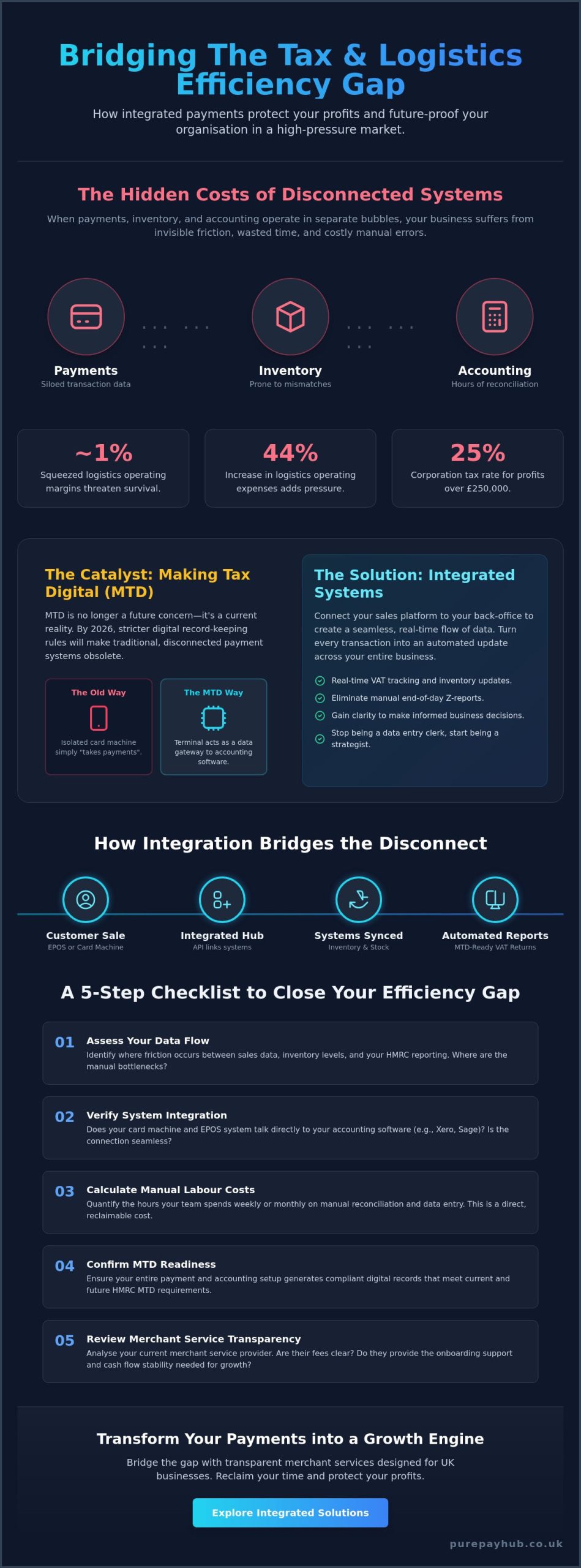
With logistics operating margins squeezed as tight as 1%, losing even a fraction of a percent to manual errors isn’t just an inconvenience; it’s a threat to your survival. You’ve likely felt the pressure of rising costs, from the 44% increase in logistics operating expenses to the 25% corporation tax rate for profits over £250,000. These pressures are often worsened by 3. The “Tax & Logistics” Efficiency Gap, where siloed payment data leads to inventory mismatches and hours of slow reconciliation between card sales and bank statements.
We believe your financial tools should work as hard as you do. This guide explains how to bridge that disconnect by turning your payment processing into a central engine for your operations. You’ll discover how to implement MTD-ready systems for automated VAT reporting and link card transactions directly to your inventory in real-time. We’ll show you how to reclaim lost time, speed up your access to funds, and protect your hard-earned profits with a more transparent, professional approach to your business finances.
Key Takeaways
- Identify how 3. The “Tax & Logistics” Efficiency Gap creates friction between your sales data and HMRC reporting, leading to costly manual errors.
- Discover how linking your EPOS systems and card machines to accounting software creates a seamless flow between your sales and inventory management.
- Compare the real-world cost of manual bookkeeping against automated systems to see exactly how much time your business can reclaim.
- Follow a structured five-step checklist to audit your current payment setup and ensure it is fully compatible with modern MTD requirements.
- Learn how switching to a transparent merchant service can simplify your onboarding process and provide the cash flow stability needed for logistical expansion.
What is the Tax & Logistics Efficiency Gap in UK Business?
Running a successful business requires more than just making sales; it demands a precise synchronisation of data. For many UK merchants, payments, tax reporting, and inventory management exist in separate bubbles. This structural failure is what we call 3. The “Tax & Logistics” Efficiency Gap. It is the invisible friction that occurs when your card machine doesn’t talk to your accounting software, and your warehouse doesn’t know what your shop floor has sold. When these systems remain siloed, your business loses time and money through repetitive manual entry and avoidable errors.
This gap often manifests as “logistics lag.” Imagine a scenario where your online store sells your last three items of stock, but your physical card machine at a pop-up event sells them again ten minutes later because the systems aren’t linked. Whilst enterprise-level supply chain management software exists to solve these issues for corporations, SMEs often find themselves trapped in a cycle of manual reconciliation. You spend hours every week cross-referencing bank statements with sales reports just to ensure your VAT figures are correct. In an industry where logistics operating margins can be as thin as 1%, this wasted labour is a cost you simply cannot afford.
The Hidden Costs of Siloed Data
Manual data entry is the primary enemy of efficiency. Every time a staff member types a transaction total into a spreadsheet, the risk of a typo increases. These small errors snowball into significant headaches during your year-end reconciliation. HMRC penalties for inaccurate VAT returns are a genuine risk, and the stress of a potential audit hangs over many business owners who rely on fragmented systems. Beyond the immediate financial risk, the efficiency gap represents a fundamental barrier to scalable growth that prevents local merchants from competing with automated giants. If you’re too busy fixing data errors, you aren’t busy growing your brand.
While larger corporations use Computer Market Research to streamline their global distribution and manage different types of channel partners, SMEs can achieve similar efficiency gains by first integrating their core payment and accounting systems.
Why MTD is the Catalyst for Change
The Making Tax Digital (MTD) mandate is no longer a future concern; it is a current reality for UK businesses. By 2026, the requirements for digital record-keeping will be even more stringent. Traditional card machines that merely “take payments” are becoming obsolete because they fail to meet modern digital standards. We are seeing a permanent shift from simply processing a transaction to managing a complex data flow. Your payment terminal must act as a gateway that feeds information directly into your MTD-ready accounting software. By closing 3. The “Tax & Logistics” Efficiency Gap, you stop being a data entry clerk and start being a business strategist. You gain the clarity needed to make informed decisions about your stock, your taxes, and your future.
How Integrated Payment Systems Bridge the Disconnect
Integrated payment systems are the definitive solution to the friction identified in the previous section. By connecting your sales platform directly to your back-office, you transform a simple transaction into a rich data event. This integration closes 3. The “Tax & Logistics” Efficiency Gap by ensuring that every sale triggers an immediate update across your entire business ecosystem. You no longer need to bridge the gap yourself with spreadsheets and manual entries; the software does the heavy lifting for you.
The magic happens through API links. When you process a sale, your EPOS system communicates instantly with accounting software like Xero or Sage. This allows for real-time tax tracking. You can see your VAT liability grow with every tap of a card, rather than waiting for a monthly or quarterly surprise. This level of clarity is vital for staying compliant with complex regulations, such as the UK VAT rules for overseas goods, which often catch businesses off guard during the reconciliation process. With a synchronised system, the data is always accurate and always ready for HMRC.
EPOS and Card Machine Synergy
Your Countertop Card Machine shouldn’t be an island. In an integrated setup, it works in perfect harmony with your central EPOS hub. This synergy eliminates the tedious requirement for manual end-of-day Z-reports. Instead, the data flows automatically, ensuring every penny is accounted for across your physical and online sales channels. If you want to see how this works in practice, you can explore integrated EPOS systems to find a setup that fits your shop floor. This connection ensures that your bank statement and your sales reports match perfectly every single day.
Automating the Logistical Chain
Integration extends far beyond the till. By linking your Virtual Terminal or Payment Links to your warehouse, you create a responsive logistical chain. A payment received via a link can automatically trigger a picking list in the warehouse or a booking in your service calendar. This automation reduces logistical friction and prevents stock-outs. By using payment analytics to identify high-velocity items, your system can even suggest automated reordering. This ensures you never miss a sale due to empty shelves, effectively turning your payment data into a powerful tool for inventory control.
Manual vs. Automated: Calculating the Real Efficiency Gap
The administrative burden on UK SMEs is a documented reality. An Office of Tax Simplification report highlights how complex tax compliance drains vital resources from smaller firms. When you calculate the impact of 3. The “Tax & Logistics” Efficiency Gap, you see more than just lost minutes. You see lost potential. A business owner spending five hours a week on manual reconciliation is losing over 250 hours a year. That is time stolen from marketing, staff training, or product development. If your systems don’t talk to each other, you’re paying a “manual tax” every single day.
Automated data syncing removes the guesswork. If your card sales don’t automatically match your bank statements, you’re forced into a game of financial detective. One missed transaction or a single typo in a VAT entry can lead to significant discrepancies in your HMRC filings. These errors aren’t just annoying; they’re expensive. Inaccuracies can trigger audits or lead to unexpected tax bills that cripple your cash flow. By automating the link between your card reader and your ledger, you ensure that every penny is tracked without human intervention.
The ROI of Integration
Investing in modern payment hardware often feels like an added expense for a growing business. However, the return on investment is immediate when you factor in labour savings. Staff members who previously spent hours manually counting stock or cross-referencing receipts can now focus on serving customers. Automated systems provide a real-time view of your inventory, preventing the need for disruptive, after-hours stock takes. On average, businesses switching to an integrated EPOS system save 10 hours of administrative work every single month. This reclaimed time allows you to avoid the late filing fees associated with complex manual accounting whilst keeping your overheads predictable and lean.
Human Error and Tax Accuracy
Tax anxiety is a very real burden for local business owners. The constant fear of “getting it wrong” creates unnecessary stress during every tax window. Automated systems act as a compliance safety net by ensuring your favourite accounting tools are always fed accurate, real-time data. By closing 3. The “Tax & Logistics” Efficiency Gap, you eliminate the risk of human error during the data transfer process. Your records remain untainted by manual intervention, providing you with a clear and honest view of your financial health. This transparency isn’t just about satisfying HMRC; it’s about giving you the confidence to lead your business with facts rather than estimates.
Closing the Gap: A 5-Step Checklist for Your Business
Transitioning from a fragmented system to a streamlined operation requires a structured approach. You’ve already seen how 3. The “Tax & Logistics” Efficiency Gap drains your resources; now it’s time to take control. Closing this gap isn’t just about software; it’s about aligning your physical processes with your digital data. By following this 5-step checklist, you can reclaim your time and ensure your business is resilient for the future.
- Audit your hardware: Check if your current card machines and EPOS systems are fully compatible with MTD-ready accounting software.
- Centralise your data: Use a single merchant account provider to ensure all sales channels feed into one central reporting hub.
- Organise inventory categories: Align your physical stock categories with your EPOS reporting to ensure your logistics data is clean and actionable.
- Train your team: Ensure every staff member understands how to use integrated features correctly at the point of sale to maintain data integrity.
- Review your funding: Analyse your current funding cycle to ensure that logistical costs, such as fuel or stock reordering, are never delayed by slow payment settlements.
Taking these steps creates a solid foundation for growth. When your payments, taxes, and logistics move in sync, you eliminate the friction that holds back so many UK SMEs. If you’re ready to start this process, you can view our range of integrated payment solutions to see which tools best fit your specific business model.
Auditing Your Current Infrastructure
Legacy hardware is often the biggest contributor to 3. The “Tax & Logistics” Efficiency Gap. If your card reader doesn’t have a reliable connection to your Wi-Fi or 4G network, you risk data drops that lead to manual reconciliation later. You should also ensure your Virtual Terminal is fully PCI compliant. Compliance isn’t just a legal requirement; it’s a safeguard against the non-compliance fines that can suddenly derail your financial planning. A modern infrastructure is the first line of defence against administrative waste, often requiring the bespoke technology solutions provided by Cornerstone Business Solutions to ensure everything runs smoothly.
Streamlining the Funding Cycle
Logistical momentum depends on cash flow. If you’re waiting days for funds to clear, you can’t respond quickly to stock shortages or rising fuel costs. Next-day funding is essential for maintaining a healthy supply chain. For businesses facing seasonal fluctuations, a Business Cash Advance can bridge the gap without the stress of fixed monthly repayments. This flexibility ensures your logistics are always supported by your sales. Discover how PurePay Hub can accelerate your funding to keep your business moving forward without unnecessary delays.
PurePay Hub: Bridging the Gap with Transparent Merchant Services
At PurePay Hub, we believe that your payment provider should be an ally, not an obstacle. We have built our services specifically to resolve the friction caused by 3. The “Tax & Logistics” Efficiency Gap. By offering 0.3% debit rates, we ensure that a larger portion of every sale stays within your business. This isn’t just about saving pennies; it’s about reclaiming capital that you can reinvest in logistical improvements, such as upgrading your delivery fleet or expanding your warehouse capacity. Our mission is to provide the financial stability you need to focus on growth rather than administrative survival.
We understand that time is your most valuable asset. That is why our onboarding process is designed to be seamless. You can close your efficiency gap in days rather than weeks. Our integrated EPOS systems and card machines are engineered specifically for the UK market, ensuring full compatibility with local tax requirements and banking standards. We take a disciplined, no-nonsense approach to pricing. You’ll never find hidden markups or opaque fee structures in our contracts. This commitment to honesty ensures that your financial data remains untainted and easy to manage from day one.
Transparent Fees, Simpler Tax
Complexity is the enemy of accuracy. Traditional merchant services often hide costs behind layered fee models, which makes your accounting reconciliation a nightmare. We provide clear, predictable fee structures that make your year-end reporting effortless. When every cost is transparent, you avoid the “hidden fee” trap that so often complicates VAT calculations and corporation tax filings. Our predictable monthly hardware costs for card machines allow you to forecast your overheads with total confidence. You get the technical precision of a modern fintech partner with the reliability of a local expert.
A Partner in Your Logistics Growth
Logistical efficiency depends on the speed of your cash flow. If your funds are trapped in a clearing cycle, your supply chain stalls. We provide next-day access to your funds to ensure your operations never miss a beat. Whether you are paying hauliers or reordering high-velocity stock, our rapid settlement keeps your business moving forward. Our expert technical support team is always available to ensure your data flow between sales and accounting is never interrupted. We act as a stabilising force for your finances, allowing you to scale without the fear of data silos. Switch to PurePay Hub and close your efficiency gap today.
Take Control of Your Business Future
Closing 3. The “Tax & Logistics” Efficiency Gap is a strategic move to secure your business’s future. By synchronising your sales data with your inventory and tax reporting, you eliminate the manual errors that drain your energy and profit. You’ve seen how integrated systems turn hours of administrative work into seconds of background processing. This clarity allows you to focus on what matters most; growing your brand and serving your community.
We act as your reliable business partner by offering fair, disciplined merchant services that prioritise your success. With debit card charges from 0.3% and next-day access to funds, we provide the cash flow momentum needed to keep your logistics moving. Our expert UK-based technical support ensures your data flow remains uninterrupted and professional. Your business deserves a financial partner that values transparency and straight-talking as much as you do.
Get a transparent quote and close your efficiency gap today. Taking control of your finances is the first step toward a more efficient, stress-free operation. We look forward to helping you build a more resilient and profitable business.
Frequently Asked Questions
What exactly is the Tax & Logistics Efficiency Gap?
3. The “Tax & Logistics” Efficiency Gap is the friction created when your payment data, HMRC tax filings, and warehouse stock levels aren’t synchronised. This disconnect forces business owners into repetitive manual reconciliation, which leads to human error and wasted productive time. By closing this gap, you ensure that every transaction automatically updates your inventory and your accounting ledger simultaneously, creating a single source of truth for your business.
How does an integrated card machine help with Making Tax Digital (MTD)?
Integrated card machines act as a digital bridge by feeding real-time transaction data directly into your MTD-compliant accounting software. This automation ensures your digital records are always accurate and ready for HMRC submissions without manual intervention. It removes the need for tedious data entry, which is the primary cause of errors in tax reporting for small businesses, whilst keeping you fully compliant with modern regulations.
Can I link my existing card machine to my favourite accounting software?
Compatibility depends entirely on your specific hardware, but many legacy card machines lack the necessary API links to connect with modern accounting tools. If your current terminal operates in a silo, you’ll likely need to upgrade to a modern integrated EPOS system to achieve seamless data syncing. We recommend auditing your current hardware to ensure it supports the digital data flows required for modern business efficiency.
Will switching to an integrated EPOS system cause downtime for my business?
Switching to an integrated system shouldn’t cause significant downtime if you work with a professional partner. Most modern EPOS systems are designed for quick setup and can be configured alongside your existing hardware before you make the final transition. Our onboarding process focuses on speed and clarity, ensuring your shop floor remains operational whilst we help you close your efficiency gap in days.
How does next-day funding improve my logistical operations?
Next-day funding provides the immediate liquidity needed to respond to logistical demands like fuel price hikes or sudden stock shortages. When your funds are settled quickly, you don’t have to wait for traditional banking cycles to complete before reordering essential supplies. This rapid access to capital keeps your supply chain moving and prevents bottlenecks caused by trapped cash flow, which is vital for thin-margin businesses.
Are integrated payment systems more expensive than traditional card readers?
Whilst the initial investment in integrated hardware can be slightly higher, the total cost of ownership is often lower due to significant labour savings. You eliminate the high cost of manual bookkeeping and the risk of expensive tax penalties from HMRC. When you factor in the value of reclaimed time and improved stock accuracy, an integrated system is a more cost-effective choice for any growing business.
What happens if my internet goes down? Will it break my data integration?
Modern integrated systems are built with resilience in mind and often feature offline processing modes or 4G SIM backups. If your primary internet connection fails, your transaction data is stored securely on the device and synced once the connection is restored. This ensures your data integration remains intact and your tax records stay accurate without any manual intervention or loss of sales during a temporary outage.
How do I know if my current business is suffering from an efficiency gap?
You are likely suffering from 3. The “Tax & Logistics” Efficiency Gap if you spend more than two hours a week manually reconciling bank statements. Other red flags include frequent stock-outs, inventory levels that don’t match your sales reports, and high levels of anxiety during VAT submission windows. If your systems feel like they are working in separate silos, it is time to consider a more integrated approach.