Tag: cost saving

  • Choosing the Best Restaurant EPOS System in the UK for 2026

    Choosing the Best Restaurant EPOS System in the UK for 2026

    How much of your hard-earned Friday night profit is disappearing into opaque transaction fees before the weekend even starts? You likely know the frustration of thin margins being eaten away by hidden charges and the stress of system downtime during a peak dinner rush. It’s common to feel that your current setup, with its fragmented reporting between the till and the card machine, is holding your business back rather than helping it grow.

    Choosing the right restaurant EPOS system UK for 2026 can change that by slashing transaction costs and finally uniting your front-of-house with the kitchen. We promise to show you how to select an integrated solution that provides next-day access to your funds, lowers your merchant service charges, and ensures your operations run seamlessly. This guide explores the latest hardware and software strategies to help you reclaim your margins whilst maintaining the transparency your business deserves. You’ll learn how to move from a state of frustration to one of informed confidence, ensuring your technology acts as a supportive partner in your success.

    Key Takeaways

    • Understand how to transition from a basic till to an integrated ecosystem that manages payments, staff, and stock from one central hub.
    • Identify the essential features for a restaurant EPOS system UK, including floor plan customisation and Kitchen Display Systems that reduce order errors.
    • Learn to calculate the Total Cost of Ownership by contrasting fixed hardware costs with variable merchant service charges to protect your margins.
    • Discover the steps to ensure a seamless transition between providers without experiencing system downtime or losing a single night of trade.
    • Leverage transparent transaction rates as low as 0.3% for debit and 0.5% for credit to turn every payment into a growth opportunity.

    What is a Restaurant EPOS System and Why is it Critical in 2026?

    A What is a Point of Sale (POS) system is no longer just a box for holding cash. In 2026, a restaurant EPOS system UK acts as the central nervous system of your entire hospitality business. It’s the point where every customer interaction, kitchen order, and stock adjustment meets. The days of simple, standalone tills are over. Modern owners have transitioned toward integrated ecosystems that manage payments, staff scheduling, and inventory in one place. This shift is critical because 2026 brings unique pressures. With rising operational costs and thin margins, you need real-time data synchronisation to make informed decisions. You aren’t just managing a till anymore; you’re optimising a digital business partner that works as hard as you do.

    The Evolution of Hospitality Tech: From Tills to Ecosystems

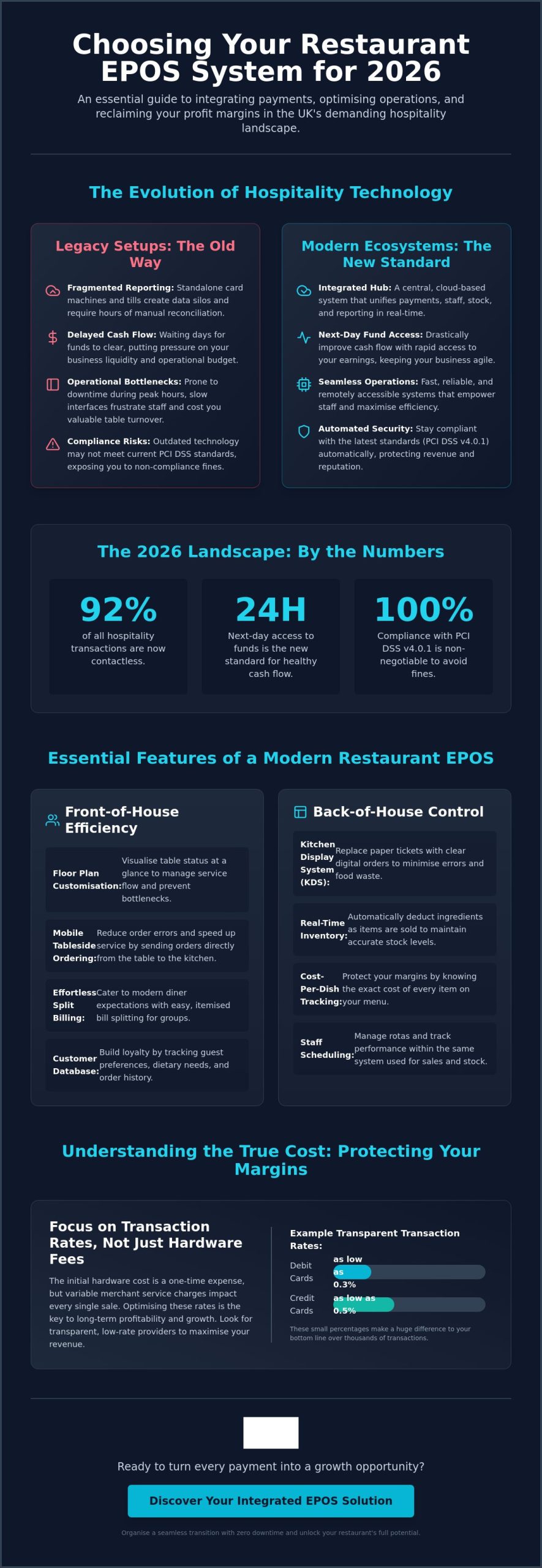
    Legacy setups often relied on standalone card machines that didn’t talk to the till. This created fragmented reporting and endless manual reconciliation. Modern EPOS systems remove this friction entirely. Because they’re cloud-based, you can monitor your restaurant’s performance from your phone whilst away from the site. This transparency is vital for spotting waste or staffing issues early. In a high-inflation economy, the speed of your cash flow is also paramount. Integrated systems provide next-day access to funds, ensuring your business stays liquid and ready for the next delivery. This reliability helps alleviate the stress that business owners feel regarding complex fee structures and delayed payments.

    Why “Good Enough” is No Longer Enough for UK Restaurants

    Consumer behaviour has changed rapidly. Statistics from early 2026 show that contactless payments now account for 92% of all hospitality transactions. If your system is slow or prone to downtime, you’re directly hurting your table turnover. A laggy interface during a peak Friday night doesn’t just frustrate staff; it costs you covers. Security is another non-negotiable factor. With PCI DSS v4.0.1 now being the sole supported standard as of 2025, using outdated tech risks monthly non-compliance fines. A modern restaurant EPOS system UK keeps you compliant automatically, protecting your reputation and your revenue. By prioritising clarity and efficiency, you ensure your technology supports your growth rather than acting as a bottleneck.

    Essential Features Every UK Restaurant EPOS Must Have

    The best systems don’t just process payments; they orchestrate the entire floor. A robust restaurant EPOS system UK provides a clear, customisable floor plan that acts as the foundation for your service speed. Your staff should be able to see, at a glance, which tables are waiting for drinks, which are mid-course, and which are ready for the bill. This visual clarity prevents bottlenecks and ensures no customer is left waiting during a frantic shift. Beyond the floor plan, your system must offer granular inventory tracking. With food prices remaining volatile in 2026, knowing your exact cost-per-dish is the only way to protect your margins. Every ingredient should be accounted for, from the premium steaks to the garnish.

    Front-of-House Efficiency: Table Management and Mobile Ordering

    Speed at the table is the heartbeat of a busy shift. By adopting restaurant industry technology trends like mobile tableside ordering, you eliminate the constant back-and-forth to a central terminal. Waitstaff can send orders directly to the kitchen the moment they are taken; this significantly reduces lead times and improves order accuracy. For weekend diners, split-billing features are no longer optional. Customers expect to pay for exactly what they had without a mathematical debate at the end of the night. These tools also allow you to build a database of your guests. Recognising a favourite customer’s previous order or dietary preference builds the kind of loyalty that keeps a local business thriving.

    Back-of-House Control: Inventory and Kitchen Integration

    Your kitchen is where your margins are won or lost. A Kitchen Display System (KDS) replaces messy paper tickets with clear, digital prompts that reduce errors and food waste. These screens ensure the kitchen team receives orders the second they are placed, keeping the rhythm of service steady. Integration with your inventory is equally vital. When a burger is sold, your system should automatically deduct a bun and a patty from your stock levels in real-time. Automated low-stock alerts prevent the awkwardness of a server having to tell a guest that a menu item is unavailable mid-service. This level of control allows you to run a leaner, more profitable operation. If you are looking to upgrade, choosing a modern EPOS system can help you centralise these complex tasks into one manageable dashboard.

    Managing your team effectively requires more than just a paper rota. Modern systems include staff management tools that track individual performance and handle shift scheduling. You can see which servers are upselling effectively and which shifts require more support. By identifying these patterns, you can optimise your labour costs whilst ensuring your best staff are rewarded. This data-driven approach turns your EPOS from a simple tool into a strategic asset for your restaurant’s long-term growth.

    Calculating the Real Cost: Software Fees vs. Transaction Rates

    Finding the most cost-effective restaurant EPOS system UK requires looking past the initial sales pitch. You must evaluate the Total Cost of Ownership (TCO) to understand how much money actually leaves your bank account each month. Many owners focus on the hardware price or the software subscription whilst ignoring the variable merchant service charges that follow. These transaction fees are often the largest expense in your technology stack. The effective rate is the true measure of payment processing costs; it represents your total monthly fees as a percentage of your total sales volume.

    A transparent financial strategy balances fixed and variable costs. Fixed monthly hardware rentals provide predictability, but they shouldn’t be bundled with opaque processing terms. You need a partner that identifies every cost clearly, from the terminal lease to the per-transaction markup. This clarity helps you move from a state of frustration regarding hidden fees toward a state of informed confidence in your margins. Your technology should be a stabilizing force for your business finances, not a source of unexpected overheads.

    The Trap of “Free” EPOS Software

    Entry-level providers often lure business owners with the promise of “free” software. This is frequently a financial trap that punishes your success. These systems usually carry high transaction rates of 1.75% or more, which can cost a thriving restaurant thousands of pounds in unnecessary fees. For a restaurant with a £20,000 monthly turnover, a “free” system at a 1.5% rate costs you £300 a month. Conversely, a paid system with a £50 monthly fee and a 0.3% rate costs you only £110 in total. The “free” option is actually £190 more expensive every single month. You should also insist on next-day access to funds as a standard feature. In a fast-moving hospitality environment, waiting days for your own money is an outdated practice you don’t have to accept.

    Understanding Merchant Service Charges (MSC)

    Transparency in Merchant Service Charges (MSC) is the no-nonsense approach every owner should demand. You deserve to know exactly what you’re paying for debit and credit transactions. Fair rates, such as those from PurePay, typically start around 0.3% for debit cards and 0.5% for credit cards. These small differences in percentage points can save you enough to hire another staff member or upgrade your kitchen equipment over the course of a year. Avoid long-term contracts that hide annual fee increases or exit penalties. A supportive business ally won’t need to lock you in with complex legalese; they’ll keep your business through fair service and honest pricing. By prioritising these clear fee structures, you ensure your technology acts as a growth engine rather than a drain on your resources.

    Choosing the Best Restaurant EPOS System in the UK for 2026

    Organising a Seamless Transition to Your New System

    Switching your restaurant EPOS system UK shouldn’t feel like a leap into the dark. It’s a strategic move. It requires a structured plan to avoid losing a single night of trade. Many owners worry about the administrative headache of setting up new technology during a busy season. The right partner makes this transition effortless by prioritising clarity over complexity. You need a system that stabilises your finances from day one. This transition follows a simple logic: identify the bottlenecks in your old setup and configure the new one to solve them. It’s about improvement, not just replacement.

    Data Migration: Moving Your Menu and Stock

    Moving your data is the perfect time for a digital spring clean. Audit your current menu before you start the import. Remove unpopular items that clutter your interface and slow down your servers. This ensures a clean import into your new setup. Crucially, you must map your VAT categories correctly. This keeps you compliant with HMRC and prevents accounting errors later. Generic global advice often ignores these UK-specific banking and tax requirements. A provider that offers dedicated technical support during this phase prevents costly mistakes. They help you bridge the gap between your old till and your new integrated ecosystem whilst ensuring your historical data remains accessible for year-end reporting.

    Staff Buy-In: Training for Peak Performance

    Your staff use the system during the frantic Saturday night rush. They need an interface that makes sense immediately. A punchy, intuitive design reduces the learning curve for new hires and seasoned veterans alike. Don’t go live without a mock service. Run a practice shift with your team to test the workflow. This builds the confidence your team needs to handle high-pressure situations without hesitation. Once live, use the granular reporting to reward your most efficient performers. You can see which staff members are upselling effectively or managing their tables with the most speed. This turns a technical change into a motivational tool for your entire team.

    A successful transition relies on a partner who values your time and your margins. You deserve a system that is as disciplined and professional as your kitchen. By following a clear onboarding framework, you can upgrade your technology without the stress usually associated with new software. If you’re ready to leave behind opaque fees and fragmented reporting, you can switch to a more transparent EPOS system today and start reclaiming your hard-earned profits.

    Why PurePay Hub is the Growth Engine for UK Restaurants

    PurePay Hub acts as a stabilising force for your restaurant’s finances. In an industry often viewed with scepticism, we provide a transparent alternative to the opaque practices of traditional banks. Choosing our restaurant EPOS system UK means you aren’t just buying hardware; you’re entering a disciplined partnership. We offer 0.3% debit and 0.5% credit transaction rates to ensure your margins remain protected. This clear fee structure allows you to forecast your overheads with absolute certainty. Our goal is to alleviate the stress that business owners feel regarding hidden costs and complex markup models.

    Integrated Payments and Next-Day Funding

    Integrated payments remove the frustration of manual entry on card machines. When your till and your terminal speak the same language, human errors disappear. This efficiency is supported by our range of Countertop Card Machines and Portable Card Machines, designed to suit any restaurant layout. We believe in calm advocacy for our partners, which is why next-day access to your funds is a standard feature. You shouldn’t have to wait for your own money to arrive whilst your suppliers need paying. By prioritising your cash flow, we ensure your technology acts as a supportive ally rather than a bottleneck.

    Unlocking Capital with Business Cash Advances

    We understand that growth requires capital, but traditional bank loans are often too rigid for the hospitality sector. Our Business Cash Advance allows you to use your future card sales to secure unsecured capital today. This is a game-changer for owners planning refurbishments or kitchen upgrades. Unlike bank loans with fixed monthly repayments, this model follows a “pay-as-you-earn” structure. Your repayments are a small, agreed percentage of your daily card sales. If you have a quieter week, your repayments automatically reduce. It’s a flexible, no-nonsense way to fund your expansion without the pressure of traditional debt cycles.

    Our focus remains on the individual business owner. We disdain hidden markups and corporate jargon, choosing instead to lead our partners toward a state of informed confidence. By centralising your payments, your reporting, and your funding, we help you lead your business with a clear head. You deserve a partner that values efficiency and straight-talking as much as you do. You can organise a transparent rate review with PurePay Hub today to discover how much your business could save.

    Reclaiming Your Margins in 2026

    The right technology should be a stabilising force for your finances, not a source of stress. You’ve seen how a modern restaurant EPOS system UK acts as a central nervous system, uniting your front-of-house with the kitchen whilst protecting your hard-earned margins. By looking past the trap of “free” software and focusing on transparent transaction rates, you can turn every payment into a growth opportunity. Whether you’re streamlining a single site or planning a multi-venue expansion, the path to a more profitable 2026 starts with clarity and integrated reporting.

    We are here to act as your fair partner in an industry that often feels opaque. You deserve a setup that offers next-day funding as standard and provides no-nonsense, UK-based support when you need it most. It’s time to stop letting hidden fees eat into your success. We provide debit rates from 0.3% and credit rates from 0.5% to ensure you keep more of what you earn every single day.

    Switch to PurePay Hub for 0.3% rates and integrated EPOS

    Take the next step toward a more efficient, profitable future for your restaurant. Your success is our priority.

    Frequently Asked Questions

    How much does a typical restaurant EPOS system cost in the UK?

    The total cost depends on your specific hardware needs and the number of terminals required for your floor plan. You will typically encounter a combination of upfront hardware costs for screens and printers; a monthly software subscription fee; and variable transaction rates. It is vital to look at the total cost of ownership rather than just the initial price tag to ensure your margins remain protected from hidden markups.

    Can I keep my existing card machine when I switch EPOS providers?

    You can technically use a standalone card machine, but you will lose the significant advantages of an integrated restaurant EPOS system UK. Integrated systems allow your till and terminal to communicate directly; this removes the need for manual data entry and prevents reconciliation errors at the end of a shift. Switching to a unified provider usually simplifies your reporting and results in faster access to your funds.

    What is the difference between an EPOS system and a standard cash register?

    A standard cash register is a passive tool for recording sales and storing cash; an EPOS system is an active partner that helps you optimise your entire business. It tracks inventory in real-time, manages staff rotas, and provides granular data on your most profitable dishes. Whilst a till only handles the final transaction, an EPOS system orchestrates everything from the initial order to the final kitchen prompt.

    How long does it take to install a new restaurant EPOS system?

    A standard installation usually takes between one and three days depending on the size of your venue and the complexity of your menu. This period includes the physical setup of your terminals and a dedicated training session to ensure your team is confident before the first live service. Choosing a partner that prioritises quick onboarding helps you transition between systems without losing a single night of trade.

    Do I need a specific internet speed to run a cloud-based EPOS?

    Stability is more important than raw speed; most cloud-based systems run perfectly on a standard fibre connection with speeds of 10-20Mbps. You should ensure your Wi-Fi coverage is consistent across your entire dining area to support portable card machines for tableside ordering. We recommend using a dedicated network for your business operations to keep your connection fast and secure during peak periods.

    Is a business cash advance better than a traditional bank loan for my restaurant?

    A business cash advance offers more flexibility for the hospitality sector because repayments are based on a small percentage of your daily card sales. This “pay-as-you-earn” model means you pay back less during quieter weeks, which protects your cash flow. Traditional bank loans require rigid monthly payments regardless of your turnover; this can create unnecessary financial pressure during the off-season or slower months.

    What happens if my internet goes down during service?

    Modern systems include an offline mode that allows you to continue taking orders and processing payments even if your connection drops. All data synchronises automatically once your internet is restored. This feature ensures that a temporary technical glitch doesn’t disrupt your service or lead to lost revenue during a busy Friday night rush. Your business remains operational and your data remains secure.

    How does an integrated EPOS help with HMRC and VAT reporting?

    An integrated restaurant EPOS system UK automatically maps every sale to the correct VAT category; this ensures your reporting is accurate and fully compliant with HMRC requirements. You can export clean, professional data directly into your accounting software, which saves hours of manual reconciliation for your bookkeeper. This level of transparency provides you with an effortless audit trail and total confidence in your financial records.

  • Understanding Merchant Account Fees: A Transparent Guide for UK Businesses in 2026

    Understanding Merchant Account Fees: A Transparent Guide for UK Businesses in 2026

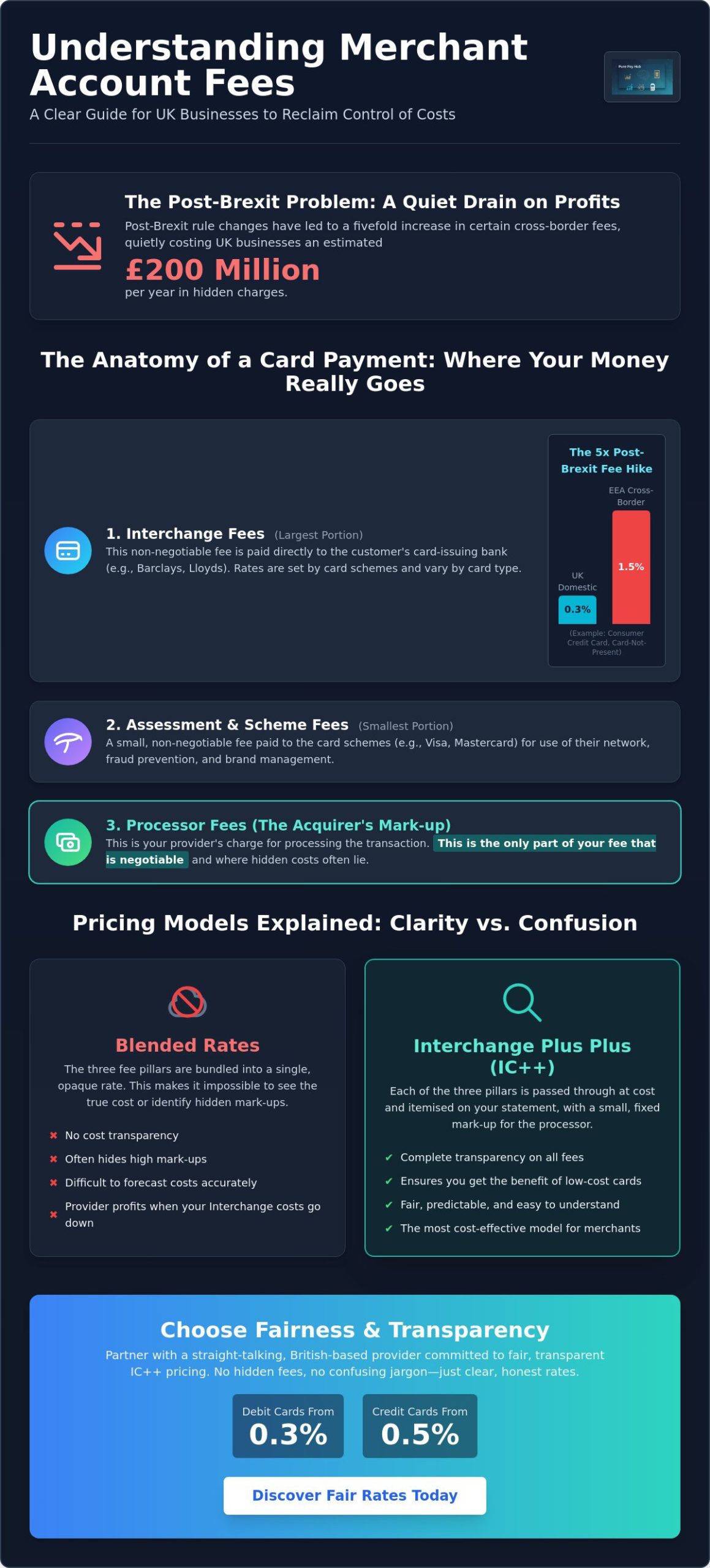
    Did you know that post-Brexit fee increases have quietly drained up to £200 million a year from UK businesses? It’s frustrating to look at your monthly statement and feel like you’re reading a foreign language. You see “non-compliance” fines and “scheme fees” without any clear explanation of why they’re there or how to stop them. Most business owners feel the same way, stuck in long-term contracts with expensive exit fees and opaque billing structures that seem designed to confuse.

    We’re here to change that. By understanding merchant account fees through a transparent lens, you can reclaim control over your bottom line and eliminate the hidden markups that traditional providers often bury in the fine print. You deserve a partner who speaks your language and prioritises fairness over corporate jargon. We believe that clarity isn’t just a preference; it’s a requirement for your growth.

    This guide provides total clarity on your transaction costs. We’ll break down the three pillars of fees, explain the impact of the January 2026 High Court ruling on cross-border charges, and show you exactly how to lower your Merchant Service Charge (MSC) for a more profitable year.

    Key Takeaways

    • Decode the three essential pillars: Interchange, Assessment, and Processor fees, to see exactly where your money goes.
    • Discover why understanding merchant account fees through the Interchange Plus Plus (IC++) model provides far better value and transparency than traditional blended rates.
    • Learn how to navigate monthly hardware rental and PCI DSS compliance costs without falling victim to hidden markups or unexpected fines.
    • Identify the specific strategies needed to lower your Merchant Service Charge (MSC) and reclaim control of your business’s bottom line.
    • Explore how a straight-talking, British-based partnership can deliver fair rates, starting from 0.3% for debit cards and 0.5% for credit cards.

    What Are Merchant Account Fees and Why Do They Matter?

    Merchant account fees represent the total cost your business pays to accept card payments from your customers. Essentially, these fees act as the financial bridge between the customer’s bank and your business’s bank account. Without this bridge, you can’t process digital transactions or grow in an increasingly cashless society. However, many providers build this bridge with hidden toll booths that quietly eat away at your hard-earned revenue. Understanding What is a merchant account? is the first step in identifying where these costs originate and how to control them.

    Gaining a deep level of understanding merchant account fees is critical for protecting your profit margins in 2026. With operating costs rising across the UK, you can’t afford to lose a percentage of every sale to “mystery” charges. It’s time for a psychological shift. You should view your payment processor as a strategic partner rather than just another utility bill. A fair partner helps you find efficiencies and lower costs as you scale. A distant institution simply views you as a data point on a balance sheet.

    The True Cost of a Transaction

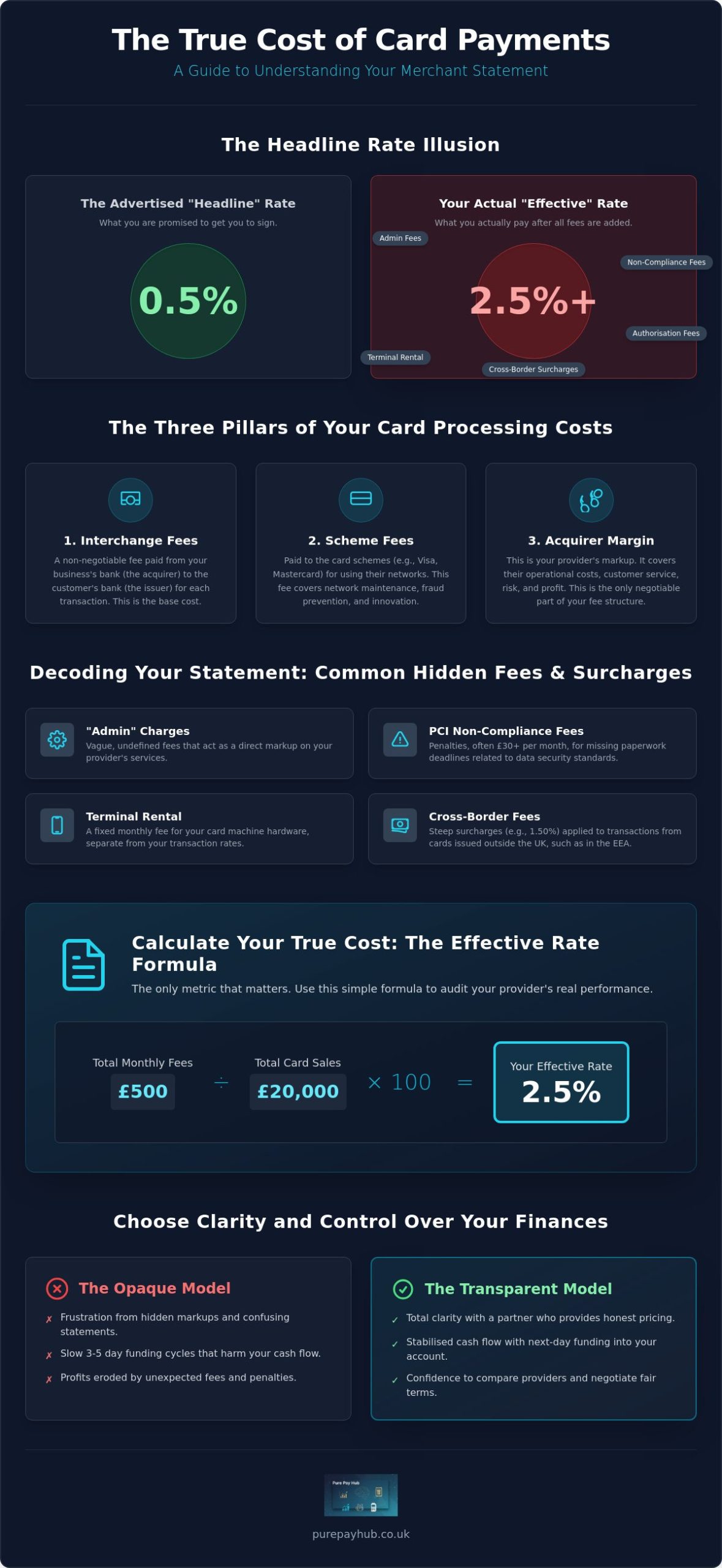
    When a customer taps their card on your Countertop Card Machine, the money doesn’t arrive in your account instantly or in full. Fees are typically deducted at the source. This means the amount you see in your bank balance is already “net” of costs. This is where the frustration begins for many British merchants. Many providers lure you in with attractive headline rates that look incredibly cheap on paper. They use these low numbers to get you through the door, only to add extras later.

    The reality is often different. Your effective rate, the actual percentage you pay once every fee is tallied, can be significantly higher than that headline promise. UK businesses often pay more than they should because their monthly statements lack basic clarity. If you can’t tell exactly why a specific transaction cost what it did, you’re likely overpaying for your processing. We believe you should see every penny accounted for without having to hunt for it.

    Why Transparency is Your Best Business Asset

    The UK merchant services industry has a long history of opaque pricing. Complex terminology and bundled rates often hide the true cost of doing business. This lack of transparency makes it nearly impossible to forecast cash flow accurately. When you don’t know what your bill will look like at the end of the month, you’re operating in the dark. It’s a stressful and unnecessary way to run a regional company.

    Clear fee structures are a genuine business asset. They allow you to plan, reinvest, and scale with confidence. At PurePay Hub, we’ve committed to a no-nonsense billing approach for British merchants. We prioritise straight-talking over corporate jargon. By removing the smoke and mirrors, we help you focus on what really matters: serving your local community and growing your business with total peace of mind.

    The Three Pillars: Interchange, Assessment, and Processor Fees

    Every card payment you take is split into three distinct pieces. Understanding merchant account fees means looking past the single “total” on your statement to see exactly who is taking a slice of your sale. These three pillars combine to form your Merchant Service Charge (MSC). If your provider bundles these together without explanation, you’re likely paying more than you should for the privilege of accepting payments.

    Interchange Fees: The Non-Negotiable Core

    The largest portion of your transaction cost is the Interchange Fee. This money goes directly to the bank that issued your customer’s card. In the UK, domestic interchange is capped at 0.2% for consumer debit cards and 0.3% for consumer credit cards. These caps were designed to protect merchants, but they only apply to standard consumer cards. Business, corporate, and international cards often carry much higher rates because they fall outside these regulations.

    Brexit has also significantly impacted these costs. For online “card-not-present” transactions involving cards issued in the European Economic Area (EEA), fees have jumped to approximately 1.15% for debit and 1.5% for credit. This fivefold increase has cost UK businesses an estimated £150 million to £200 million a year. Because these rates are set by the banks, they are non-negotiable. However, a fair provider will pass on the lower domestic rates to you rather than hiding them behind a high “blended” average.

    Assessment Fees and Card Schemes

    Card schemes like Visa and Mastercard charge Assessment Fees to fund their global payment networks. These are mandatory costs that every merchant in the world must pay. They are typically very small. For instance, Mastercard might charge an Acquirer Volume Fee of 0.0050% for domestic transactions. Visa often applies a Clearing and Settlement Fee of roughly €0.0050 alongside a Card Not Present Service Fee of 0.0330% for domestic online sales. These rates are fixed and rarely change, but they form a vital part of the total cost of every tap, dip, or click.

    The Processor’s Markup: Where You Can Save

    The final pillar is the Processor’s Markup. This is the fee your merchant service provider charges for their service, technical support, and risk management. This is the only part of the fee structure where you have the power to negotiate and save. Some traditional banks inflate this margin with hidden extras or “service premiums” that add no real value to your business. Since UK law prohibits you from passing these costs directly to your customers under the rules on payment surcharges, finding a provider with a fair markup is the only way to protect your margins.

    Independent providers often offer more competitive markups than high-street banks because they prioritise efficiency and straight-talking over corporate overheads. If you want to see how these pillars look in practice for your specific business, you can request a transparent quote from our team. We provide a clear breakdown so you know exactly what you’re paying for, with debit card charges starting from 0.3% and credit cards from 0.5%.

    Monthly Hardware and Administrative Charges Explained

    A vital part of understanding merchant account fees involves looking at the fixed costs that appear on your statement every month, regardless of how many sales you make. Whilst transaction fees are tied to your volume, administrative and hardware charges are the baseline costs of keeping your payment infrastructure running. If you don’t keep a close eye on these line items, they can quietly erode your margins during slower trading periods.

    Card Machine Rental and Maintenance

    Hardware is the physical face of your payment system. When you lease a Countertop Card Machine or a Portable Card Machine, you aren’t just paying for the plastic and electronics; you’re paying for a service. A standard rental agreement should include regular software updates, security patches, and access to technical support. Leasing is the preferred route for most UK merchants because it ensures your hardware stays current with the latest UK payment standards. Owning your equipment might seem cheaper upfront, but you risk being left with an obsolete device that can’t handle new security requirements or card types.

    PCI Compliance and the ‘Non-Compliance’ Trap

    PCI DSS compliance is a mandatory security standard designed to keep your customers’ data secure. Most providers charge a standard ‘compliance fee’ to cover the costs of these annual security checks. However, many traditional banks use this as a way to levy ‘non-compliance fines’ if you haven’t completed your paperwork on time. PCI non-compliance fines are often avoidable with the right support. We help our partners prioritise and organise their security monitoring to ensure they meet the necessary standards. This proactive approach turns a potential financial penalty into a simple, managed part of your business administration.

    MMSC: Managing the Minimum Spend

    The Minimum Monthly Service Charge (MMSC) is a fee that applies if your total transaction charges don’t reach a specific threshold. It acts as a safety net for the provider to cover their basic account maintenance costs. This charge is a common source of frustration for seasonal businesses, such as coastal gift shops or Christmas markets, that may have months with very little activity. You should look for a provider with a fair MMSC threshold that reflects your business’s reality. If you find yourself consistently paying this fee, it’s a clear signal that your current contract isn’t aligned with your actual processing volume.

    Beyond these main charges, watch out for the ‘hidden’ cost of paper statements and administrative reporting. Many legacy providers still charge several pounds a month just to post you a physical bill. Switching to digital-only reporting is a quick way to eliminate these unnecessary drains on your cash flow. By staying disciplined with your account settings, you ensure that every penny you spend on merchant services is actually contributing to your business’s growth.

    Understanding Merchant Account Fees: A Transparent Guide for UK Businesses in 2026

    Comparing Pricing Models: Blended vs. Interchange Plus Plus

    Choosing the right pricing model is the final step in understanding merchant account fees. It dictates how your provider presents those three pillars we discussed earlier. Most UK businesses find themselves choosing between the simplicity of a blended rate or the total transparency of Interchange Plus Plus (IC++). Whilst one offers predictability, the other prioritises fairness and cost-efficiency. Avoid “tiered” pricing models where possible. These categorise transactions into “qualified” or “non-qualified” buckets without explaining why, making them the least transparent option for British SMEs.

    The Pros and Cons of Blended Rates

    Blended pricing offers a single, flat rate for all card types. It’s predictable and easy to calculate, which is why many new businesses prefer it. You know exactly what will be deducted from a £50 sale, regardless of the card used. However, this simplicity comes at a hidden cost. Because domestic debit card interchange fees are capped at 0.2% in the UK, a flat rate of 1.5% means your provider is pocketing a significant margin on every debit transaction. You’re effectively paying a premium for the convenience of not having to look at the details.

    Decoding IC++: The Gold Standard for Transparency

    Interchange Plus Plus (IC++) is the gold standard for transparency in the payments industry. It separates the interchange fee, the scheme fee, and the processor’s markup into three distinct line items. This model allows you to see the exact cost of every sale. Savvy SMEs and high-volume merchants favour this because it passes on the savings from lower-cost cards directly to the business. Research indicates that businesses processing over £10,000 per month could find IC++ pricing 30-40% cheaper than blended models. Reading an IC++ statement is straightforward once you recognise that you’re only paying the processor for their specific service, not a hidden markup on the bank’s fees.

    Switching Without the Stress

    Switching your provider shouldn’t be a source of stress. Start by identifying the exit fees in your current contract. Some legacy providers use expensive “early termination” clauses to keep you locked into opaque billing structures. When you compare new options, always ask for a “like-for-like” quote based on your actual card mix from the last three months. This ensures you aren’t comparing a “teaser” rate with your current effective rate. At PurePay Hub, we’ve designed our onboarding process to be quick and honest, helping you move to a fairer structure without the technical headache. Switch to a fairer pricing model today and start protecting your margins with a partner you can trust.

    Partnering for Fairness: The PurePay Hub Approach

    We believe that understanding merchant account fees shouldn’t require a background in high finance. Our approach is built on the principle of calm advocacy for the British business owner. Whilst traditional banks hide behind layers of corporate jargon, we prioritise straight-talking and absolute clarity. You deserve to know exactly what you’re paying for and why it matters for your growth. We don’t see ourselves as a distant financial institution; we’re a fair partner committed to your success.

    Our fee structure is designed to be as clean as our service. We offer competitive rates that respect your margins, with debit card charges starting from 0.3% and credit cards from 0.5%. We also understand that cash flow is the lifeblood of any regional business. That’s why we provide next-day access to your funds as standard. You shouldn’t have to wait days for your own money to reach your account. By integrating our EPOS Systems with your checkout process, we create a seamless experience that benefits both you and your customers.

    Support That Speaks Your Language

    When something goes wrong with your card machine, you need a solution, not a script. We provide British-based technical support to ensure you’re always connected. Our team acts as a supportive ally, speaking your language and resolving issues with efficiency. Whether you’re using a Portable Card Machine in a busy restaurant or a Countertop Card Machine in a boutique, we’re here to keep your business moving. This local expertise is what distinguishes us from global giants who often lose focus on the individual merchant.

    Beyond Payments: Business Cash Advances

    Sometimes your business needs a boost to reach the next level. We facilitate a Business Cash Advance as a flexible alternative to traditional bank loans. This is unsecured capital based on your future card turnover. It follows a simple “pay-as-you-earn” model. You repay the advance as a fixed percentage of your daily sales. If you have a quiet day, you pay back less. If you have a busy day, you pay back more. It’s a disciplined way to access funding without the stress of rigid monthly repayments.

    Get Started with Total Clarity

    Joining the PurePay Hub community is a straightforward process. We’ve removed the hurdles and complex paperwork that often stall a switch. During your first 30 days, you can expect total transparency on every transaction. We’ll show you how to read your statements and identify every cost layer. This is about moving from a state of frustration to one of informed confidence. We’re ready to help you eliminate hidden markups and reclaim your bottom line. Discover fair payment processing with PurePay Hub and experience the difference of a partner who values your business as much as you do.

    Secure Your Profit Margins with Total Clarity

    Mastering the hidden details of your payment statements is the most effective way to protect your business’s bottom line. We’ve explored how identifying the three pillars of transaction costs and choosing transparent IC++ models can prevent unnecessary revenue drain. By staying vigilant regarding PCI non-compliance traps and administrative markups, you move from a position of frustration to one of informed control.

    Understanding merchant account fees isn’t just about saving pennies; it’s about building a sustainable partnership that supports your growth. You deserve a provider that prioritises straight-talking and fairness over complex corporate structures. With debit rates starting from 0.3% and next-day funding as standard, the transition to a cleaner payment model is easier than you might think. Our British-based expert support is always ready to act as a supportive ally for your regional business.

    Ready to eliminate the mystery from your monthly billing? Switch to a fairer merchant account with PurePay Hub today. Take the first step toward a more transparent and profitable financial future for your company.

    Frequently Asked Questions

    What is the average merchant fee for a small business in the UK?

    Typical blended transaction fees for small businesses in the UK usually range from 1.4% to 2.5%. These rates vary based on your monthly processing volume and the specific mix of cards your customers use. Businesses with higher volumes often find better value by moving away from flat rates toward more transparent pricing models that reveal the true cost of each transaction.

    Why are credit card fees higher than debit card fees?

    Credit card fees are higher because they carry more financial risk and have higher interchange caps. In the UK, domestic interchange is capped at 0.2% for consumer debit cards but 0.3% for consumer credit cards. Business, corporate, and international credit cards often have even higher rates because they fall outside the standard domestic regulations that protect smaller transactions.

    Can I pass my merchant account fees on to my customers?

    No, you cannot legally pass these fees to your customers under current UK law. Since 2018, surcharging for most consumer credit and debit card payments has been prohibited. You must instead incorporate the cost of processing into your overall pricing strategy. This makes understanding merchant account fees essential for maintaining healthy profit margins without breaking compliance rules.

    What is a PCI non-compliance fee and how do I avoid it?

    A PCI non-compliance fee is a monthly penalty charged when a business fails to prove they meet mandatory data security standards. You can avoid this trap by completing your annual Self-Assessment Questionnaire (SAQ) and ensuring your security settings are up to date. A proactive provider will help you organise this documentation to ensure you never pay these avoidable fines.

    What is the difference between a merchant account and a business bank account?

    A merchant account is a dedicated holding account that authorises and processes card payments, whilst a business bank account is for your general day-to-day finances. When a customer pays by card, the funds settle in your merchant account first. After the provider deducts their fees, the remaining balance is then transferred to your regular business bank account for you to use.

    How long does it take for card payments to reach my bank account?

    Standard settlement times in the UK industry are usually between two and three working days. However, some providers now offer next-day funding as a standard feature to support your business’s cash flow. This ensures that the money you earn on a Monday is available in your business bank account by Tuesday, helping you manage your stock and expenses more effectively.

    Are there any hidden fees I should look for in my merchant contract?

    You should keep a close eye out for exit fees, Minimum Monthly Service Charges (MMSC), and paper statement fees. Some providers also add “PCI management” fees or inflate their margins on international cards without clearly stating the markup. Always ask for a full list of all administrative charges to ensure your understanding merchant account fees is based on reality rather than a teaser rate.

    Is it worth switching merchant providers if I’m on a long contract?

    It is often worth switching if the long-term savings on your transaction rates exceed the cost of your current provider’s exit fees. You should calculate your total “effective rate” over a full year to see the true impact of a switch. If a new partner can offer significantly lower markups and better support, the initial cost of leaving a contract can be recovered very quickly.