
Tag: card machine rental

  • Understanding Card Machine Rental Agreements in the UK: A Transparent Guide for 2026

    Understanding Card Machine Rental Agreements in the UK: A Transparent Guide for 2026

    Why does a small piece of payment hardware often come with a forty-page contract designed to leave you feeling more confused than when you started? For many merchants, understanding card machine rental agreements UK feels like navigating a minefield of aggressive sales tactics and opaque fee structures. You want a tool that works for your business; you don’t want a legal headache that ties you into expensive, long-term commitments with no clear exit strategy.

    We believe that transparency is the only way to build a real partnership. It’s time to pull back the curtain on how these contracts actually function in 2026. You deserve a payment setup that prioritises your cash flow over confusing fine print. This guide will help you master the complexities of merchant contracts, identify sneaky hidden costs, and learn how to secure a flexible agreement that suits your specific needs. We’ll examine the reality of terminal hire, explain how to navigate termination terms, and show you how to access modern hardware that actually supports your growth.

    Key Takeaways

    • Learn how the three-way relationship between your business, the ISO, and the acquirer works to ensure you aren’t paying for services you don’t need.
    • Master the fine print by understanding card machine rental agreements UK, specifically focusing on how to spot hidden service charges and minimum monthly fees.
    • Evaluate whether renting or purchasing hardware is better for your cash flow, factoring in the importance of ongoing technical support and avoiding outdated technology.
    • Identify common red flags, such as automatic renewal clauses and restrictive notice periods, to keep your business flexible and avoid expensive exit fees.
    • See how next-day funding and transparent, no-nonsense pricing can support your business growth more effectively than traditional, slow-moving banks.

    The Landscape of Card Machine Rental Agreements in the UK

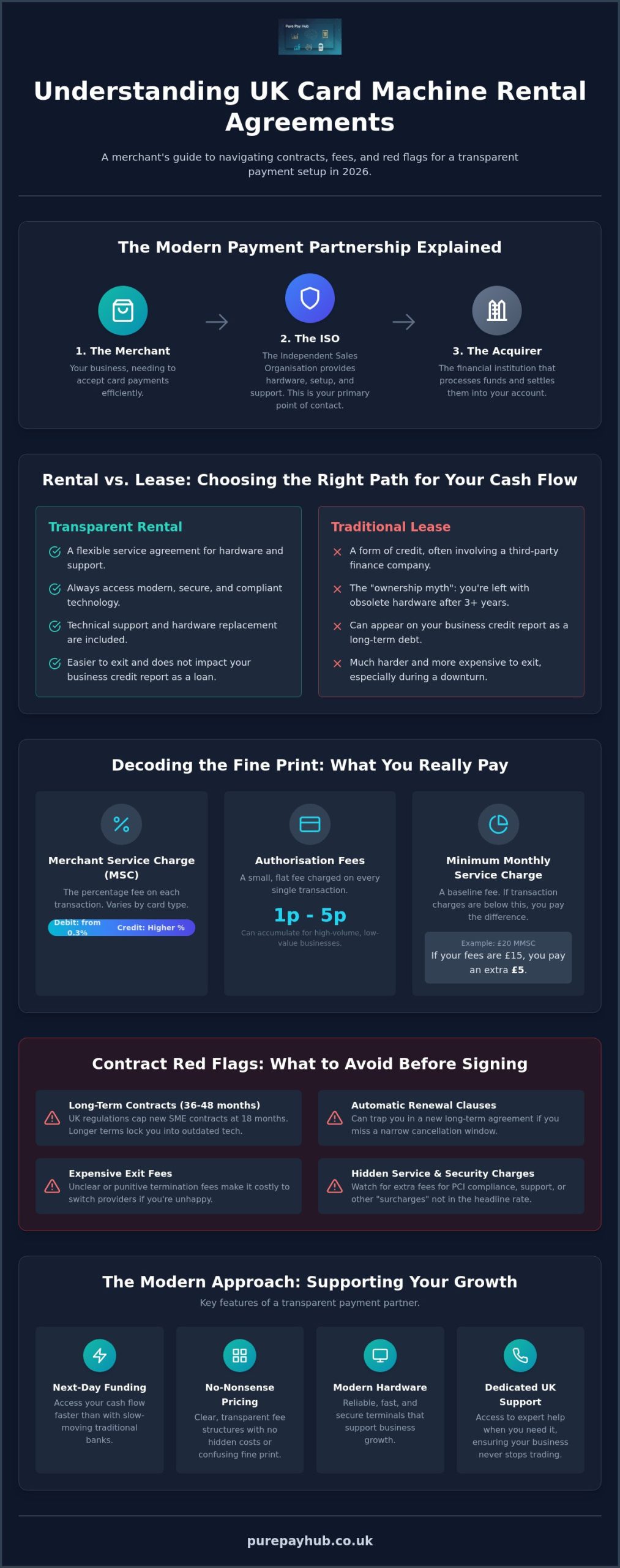
    The UK payment sector has changed. It’s no longer dominated by rigid, five-year contracts from high-street banks. Instead, a more agile system has emerged. When you look into understanding card machine rental agreements UK, you’ll find a three-way partnership at its core. First, there is you, the merchant. Second, there is the Acquirer; this is the financial institution that processes the funds and settles them into your account. Finally, there is the Independent Sales Organisation (ISO), such as PurePay Hub. We act as your primary point of contact, handling the setup, support, and hardware provision.

    This shift towards ISOs has brought much-needed transparency to the market. Unlike traditional banks, we focus on providing a Payment terminal that fits your specific trade. Whilst pay-as-you-go models are popular for very small startups, they often carry transaction rates as high as 1.75%. For established businesses, a rental agreement offers a more predictable cost structure with significantly lower transaction rates, often starting from 0.3% for debit cards. This balance of a small monthly fee and low processing costs usually results in better long-term value.

    The 18-Month Rule: Your Regulatory Protection

    The Payment Systems Regulator (PSR) stepped in to fix a broken market. In the past, many providers used “lock-in” tactics, forcing small businesses into four or five-year commitments. These contracts often included automatic renewals that were nearly impossible to cancel. Under current regulations, terminal hire contracts for small and medium enterprises are capped at a maximum of 18 months. This ensures you aren’t trapped with outdated technology or unfair pricing. You should never sign a 36 or 48-month terminal lease; it’s usually a sign of an outdated provider using aggressive sales tactics.

    Rental vs. Leasing: Knowing the Difference

    It’s vital to distinguish between a simple rental and a financial lease. A rental is a service agreement. You pay a monthly fee for the use of the hardware and the associated support. If the machine breaks, we replace it. A lease, however, is a form of credit. It often involves a third-party finance company and can appear on your business credit report. If your business experiences a downturn, a lease is much harder to exit than a standard rental agreement.

    Leasing often leads to the “ownership myth.” Some providers claim you’ll own the device after three years. In reality, a three-year-old card machine is often technically obsolete. Security standards evolve, and software slows down. By choosing a transparent rental model, you ensure your business always has access to modern hardware and dedicated technical support without the risks associated with long-term debt.

    Decoding the Fine Print: Fees and Contractual Terms

    A card machine contract is more than just a monthly rental fee. The Merchant Service Charge (MSC) is the primary cost you’ll encounter. It’s the percentage charged on every transaction you process. For many UK businesses, consumer debit rates are the most affordable, whilst commercial or international credit cards carry higher premiums. Gaining a thorough understanding card machine rental agreements UK means looking past the headline rate to see how these percentages impact your specific sales mix.

    Authorisation fees also play a significant role. These are small, flat fees, typically between 1p and 5p, applied to every transaction regardless of the sale value. If you run a high-frequency business with low average transaction values, such as a newsagent or a coffee shop, these pennies can accumulate into a substantial monthly expense. You must ensure your provider is clear about these “per-click” costs before you sign on the dotted line.

    The Minimum Monthly Service Charge (MMSC) Explained

    The MMSC is the floor price you pay regardless of sales volume. If your total transaction fees for the month don’t reach a specific threshold, the provider charges you the difference. For example, if your agreement has a £20 MMSC but you only generate £15 in transaction charges, you’ll still be billed the full £20. It’s a mechanism used by many providers to guarantee a baseline revenue from every account, even during seasonal lulls or quiet periods. We advocate for transparent payment solutions that clearly define these thresholds so you can accurately forecast your monthly overheads.

    PCI DSS and Security Surcharges

    Security is a mandatory requirement in the payments industry. Every merchant must comply with the Payment Card Industry Data Security Standard (PCI DSS). However, some providers turn this into a profit centre by charging “non-compliance fees” if you haven’t completed your annual self-assessment questionnaire. These fines can range from £20 to £50 per month. You should look for partners who offer managed compliance support rather than those who simply penalise you for administrative delays. Always verify your provider’s credentials through the Financial Conduct Authority (FCA) to ensure they meet the necessary regulatory standards for handling your business data. This prevents you from falling into the trap of paying “admin fees” that add no genuine value to your security posture.

    Rental vs Purchase: Making the Right Choice for Your Cash Flow

    Decisions regarding payment hardware often come down to a choice between capital expenditure and operational expenditure. When you buy a card reader outright, you own the asset. However, for many established businesses, the ongoing service provided by a rental agreement outweighs the appeal of ownership. A deeper understanding card machine rental agreements UK reveals that rental models often include essential technical support and hardware insurance that purchase models lack.

    The choice is about more than the initial price tag. It’s about ensuring your business remains operational regardless of technical glitches. Whilst pay-as-you-go readers are popular for market stalls, a dedicated rental terminal provides the stability needed for high-volume environments. It’s a strategic partnership that allows you to focus on your customers instead of your hardware.

    The Total Cost of Ownership (TCO) Analysis

    Let’s look at the numbers. A basic mobile reader might cost £79 to buy, whilst a professional standalone terminal with a SIM card and printer can cost between £100 and £250. Conversely, a rental agreement might cost around £20 per month. Over three years, the rental totals £720. Whilst the purchase price is lower, it doesn’t account for the complex Credit Card Processing Fees and security updates required to keep the device compliant.

    • Tax efficiency: Rental payments are usually treated as deductible business expenses rather than capital assets, which can be simpler for your accounting.
    • Software lifecycle: Security patches and software updates are managed remotely by the provider, ensuring you never fall behind on PCI standards.
    • Scalability: You can easily add extra units for seasonal peaks or new locations without a massive upfront capital hit.

    Hardware Reliability and “Swap-Out” Services

    What happens when your machine stops working on a busy Saturday afternoon? If you own the hardware, you’re responsible for the repair or replacement. This downtime can cost your business hundreds in lost sales. PurePay Hub prioritises business continuity. Our rental agreements typically feature “swap-out” services, ensuring a replacement device arrives quickly, often by the next working day. This level of support is rarely available when you buy a device from a retail shelf.

    Modern payment methods like Apple Pay and Google Pay require frequent firmware updates. Rental terminals receive these automatically. This ensures your customers always enjoy a seamless checkout experience. We believe that a card machine should be a tool for growth, not a source of technical frustration. By choosing a transparent rental model, you secure both modern hardware and the peace of mind that comes with professional technical advocacy.
    Understanding Card Machine Rental Agreements in the UK: A Transparent Guide for 2026

    Red Flags: What to Look for Before Signing a Contract

    Signing a contract shouldn’t feel like a gamble. When you’re understanding card machine rental agreements UK, you must look for the small print that dictates your future freedom. Many aggressive providers rely on automatic renewal clauses. These roll-over terms can bind you to a new 18-month term if you miss a tiny cancellation window. A fair contract should offer a standard 30-day notice period. If you see a 90-day requirement, consider it a major warning sign. These tactics are designed to keep you paying long after the service has stopped being competitive.

    Stability matters in a fluctuating economy. Fixed rates provide predictable costs, whilst variable rates can leave your monthly bill at the mercy of market shifts. You should also check for exclusivity agreements. Some contracts forbid you from using alternative payment methods, such as payment links or mobile readers from other providers. This limits your flexibility. It prevents you from adopting new technology as it emerges. A supportive partner will encourage you to use the best tools for your business, not restrict your choices through legal threats.

    Understanding Termination and Exit Fees

    The term “Liquidated Damages” is often buried deep in the terms and conditions. It essentially means you must pay a significant portion of the remaining contract value if you leave early. A vital part of understanding card machine rental agreements UK involves scrutinising these termination clauses. Calculating this cost is simple but painful; you multiply the monthly rental by the months left on your term. Some providers also add an admin fee on top. When negotiating, ask for a no-exit-fee trial period. This gives you time to test the service without the risk of a heavy financial penalty. If a provider refuses this, they likely don’t have confidence in their own service levels.

    Integration and EPOS Compatibility

    Your card machine needs to talk to your till. Proprietary lock-in happens when a provider forces you to use their specific EPOS system to get a better rate on your card machine. This makes it incredibly difficult to switch either service later. You end up stuck with software that might not suit your workflow just to keep your processing costs down. At PurePay Hub, we offer integrated EPOS solutions designed for hospitality and retail that maintain your flexibility. We believe your hardware should work for you, not the other way around. If you want to avoid these common traps and secure a fair deal, get a transparent quote from PurePay Hub today.

    PurePay Hub: Transparent Payment Solutions for UK Growth

    PurePay Hub isn’t just another distant financial institution. We are a supportive partner for UK merchants. We believe that understanding card machine rental agreements UK should be a straightforward process. You shouldn’t need a law degree to process a simple payment. Our approach is built on total transparency and efficiency. We offer debit rates starting from 0.3% and credit from 0.5%, ensuring your costs remain predictable and fair. We strip away the corporate jargon to provide a service that prioritises your business growth over our own bottom line.

    Next-day funding is a core part of our commitment to your success. Many traditional banks still hold your funds for three to five days. We find this practice outdated and unnecessary. Your cash flow is the lifeblood of your business. By providing next-day access to your funds, we help you manage your stock, pay your staff, and handle daily expenses with confidence. It is your money. You earned it. You should have it.

    Leveraging Your Turnover with Business Cash Advances

    Your card machine is more than a way to take payments; it’s a gateway to capital. We facilitate business cash advances based on your future card sales. This isn’t a traditional loan with fixed, stressful monthly payments. Instead, you pay back a small, agreed percentage of your daily card takings. If you have a quiet day, you pay back less. If you’re busy, you clear the balance faster. Understanding card machine rental agreements UK through a partner like PurePay Hub means unlocking a flexible way to fund renovations, new stock, or business expansions without rigid bank terms.

    Setting Up Your Countertop or Mobile Solution

    We’ve streamlined the onboarding process to be as fast as possible. We want you trading without delay. From your initial application to your first transaction, our expert team provides constant advocacy and support. You can choose the hardware that fits your specific business workflow:

    • Countertop Card Machine: Ideal for fixed retail points and reception desks.
    • Portable Card Machine: Perfect for tableside service in hospitality environments.
    • Mobile Card Machine: Designed for tradespeople and businesses on the move.

    Every unit we provide is modern, secure, and fully compliant with the latest standards. We handle the technical updates and security patches remotely, ensuring your service is never interrupted. We believe in straight-talking and fair deals. Get a transparent quote from PurePay Hub today and experience a partnership that actually works for your business.

    Secure a Fairer Deal for Your Merchant Services

    You now have the tools to identify predatory contract terms and hidden service charges. By staying informed about PSR regulations and the true cost of terminal hire, you can protect your business from unnecessary financial strain. Choosing the right partner means prioritising flexibility and transparency over rigid, long-term debt. It’s about ensuring your payment setup supports your growth rather than hindering your cash flow.

    Gaining a clear understanding card machine rental agreements UK is the first step toward reclaiming control of your finances. You don’t have to accept slow funding or opaque pricing models from traditional banks. We offer a modern alternative with debit rates starting at 0.3% and the reassurance of independent, UK-based support. You deserve a payment partner that treats you as an equal ally.

    Switch to PurePay Hub for fair rates and next-day funding and gain next-day access to your hard-earned funds. Your turnover belongs in your business account, not tied up in processing delays. Take the next step toward a more predictable and supportive payment setup today. We are ready to help your business thrive.

    Frequently Asked Questions

    How long is a standard card machine rental contract in the UK?

    Standard contracts for small and medium businesses are now capped at a maximum of 18 months due to Payment Systems Regulator (PSR) rules. This regulation was introduced to stop providers from locking merchants into three or five-year commitments that were difficult to exit. You should always check your agreement for any automatic renewal clauses that could roll you into a new term without your explicit consent.

    Can I switch card machine providers if I am still in a contract?

    You can switch providers at any time, but you will likely face early termination fees if your minimum term hasn’t expired. These exit costs are often calculated by multiplying your monthly rental fee by the number of months remaining on the contract. It’s vital to review your “Liquidated Damages” clause to understand the exact financial impact before moving to a new partner.

    What is the average monthly cost for card machine rental?

    Monthly costs depend on whether you choose a countertop, portable, or mobile unit and your expected transaction volume. Most businesses pay a fixed monthly hire fee plus a small percentage on every sale processed. When understanding card machine rental agreements UK, it’s important to remember that the lowest monthly rental doesn’t always mean the best deal if the transaction rates are high.

    Do I need a separate merchant account for my rental agreement?

    Yes, every card machine requires a merchant account to process payments and settle funds into your bank. Most modern providers bundle the terminal hire and the merchant account setup together to simplify the onboarding process. This ensures that your hardware and your payment processing are fully integrated and supported by a single point of contact.

    What happens if my card machine breaks during the rental period?

    Your provider is responsible for the maintenance and repair of the hardware throughout the rental term. Unlike buying a machine, where you’d have to pay for a replacement, a rental agreement usually includes a next-day swap-out service. This minimises downtime and ensures you don’t lose out on sales due to technical failures or hardware age.

    Are there any hidden fees in card machine rental agreements?

    Common extra costs include Minimum Monthly Service Charges (MMSC) and PCI non-compliance fees. Some providers also charge for paper statements or “account management” fees that add little value to your service. A transparent provider will list every potential charge clearly in your initial quote so you aren’t surprised by your first monthly bill.

    Is it better to rent or buy a card machine for a small business?

    Renting is generally better for businesses that prioritise technical support, regular hardware upgrades, and lower transaction rates. Buying a machine outright might suit very low-volume traders who only process a few hundred pounds a month. However, owners of purchased machines must handle their own repairs and often pay much higher processing fees than those on a rental contract.

  • Cost of Renting a Card Machine UK: The 2026 Merchant’s Guide

    Cost of Renting a Card Machine UK: The 2026 Merchant’s Guide

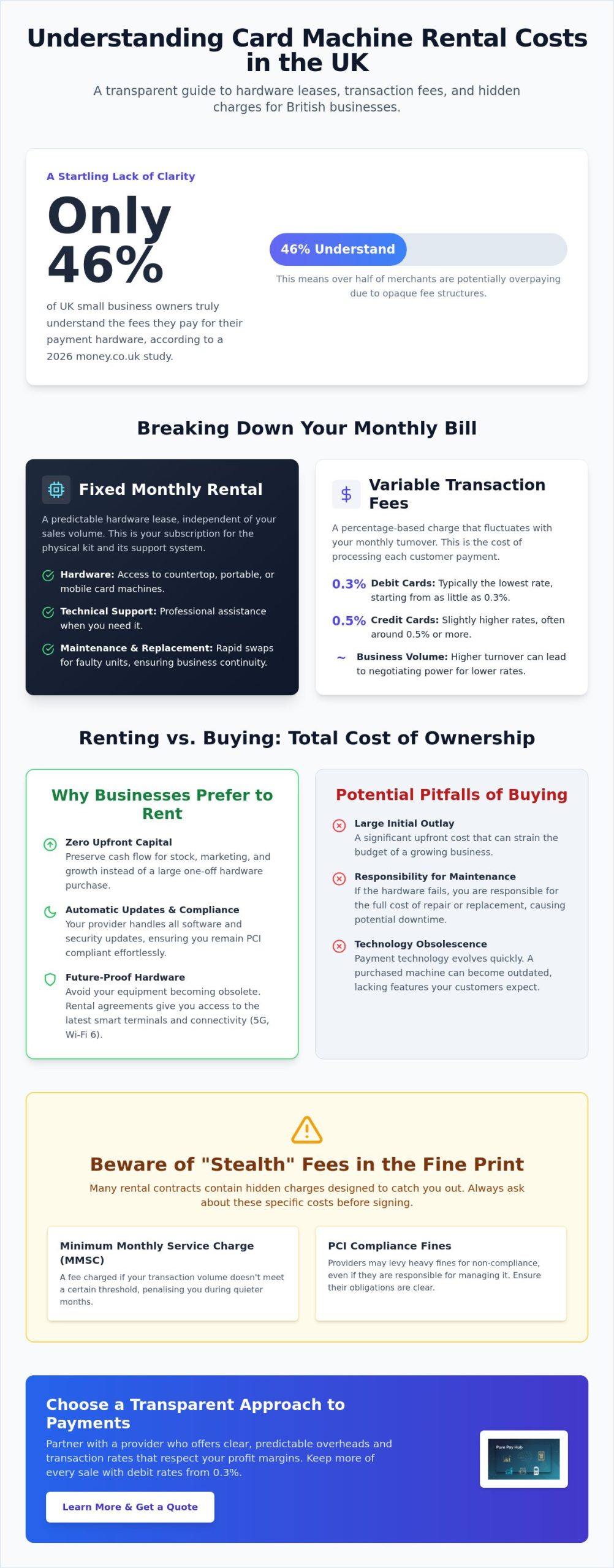
    A 2026 study by money.co.uk found that only 46% of UK small business owners truly understand the fees they pay for their payment hardware. It’s a startling figure that highlights just how opaque the industry has become. If you’re trying to pin down the cost of renting a card machine UK, you’ve likely encountered a wall of jargon and hidden “statement fees” that make budgeting feel like guesswork.

    We believe you deserve clear, predictable overheads and transaction rates that respect your profit margins. It’s exhausting to deal with long-term contracts and PCI compliance fines that feel designed to catch you out. This guide provides a transparent breakdown of monthly rental structures, transaction fees, and the specific charges that often stay hidden. We’ll help you calculate your true monthly spend so you can secure next-day access to your funds and keep your business moving with confidence.

    Key Takeaways

    • Understand the 2026 shift toward smart terminals and how integrated EPOS hardware can streamline your daily business operations.
    • Learn how to calculate the true monthly cost of renting a card machine UK by separating fixed hardware leases from variable transaction rates.
    • Compare the total cost of ownership between renting and buying to ensure your hardware never becomes obsolete or a drain on profit.
    • Identify and eliminate “stealth” fees such as minimum monthly service charges and PCI compliance fines to protect your cash flow.
    • Discover a transparent approach to payment processing where debit rates from 0.3% help you keep more of every sale.

    Understanding Card Machine Rental in the UK Market

    Renting a Payment terminal is a service-led agreement. It isn’t just about the physical box on your counter. You’re paying for a comprehensive package that includes the hardware, ongoing technical support, and critical software updates. Whilst a purchased reader might fail and leave you stranded, a rented unit includes a maintenance guarantee. If the tech breaks, the provider replaces it. This reliability is a core factor when calculating the true cost of renting a card machine UK. Most agreements in the current market span between 12 and 36 months, offering a stable framework for your business planning.

    Why UK Businesses Prefer Rental Over Purchase

    Many merchants choose rental to avoid large upfront costs. This preserves your capital for stock or marketing. You gain access to professional-grade hardware like a Countertop Card Machine or a Portable Card Machine without a heavy initial hit to your bank balance. Centralised updates are another win. Your provider pushes software changes automatically. This ensures your business stays compliant with the latest security standards without you needing to lift a finger. It’s about peace of mind. By removing the burden of hardware ownership, you can focus on growth instead of troubleshooting.

    • Zero upfront capital: Better cash flow management for growing businesses.
    • Automatic updates: PCI compliance is handled centrally by the provider.
    • Hardware access: Use high-spec Mobile Card Machines without high purchase prices.

    The 2026 Landscape: Smart Terminals and Connectivity

    The market has moved far beyond simple chip-and-pin. In 2026, smart terminals are the standard. These devices integrate directly with your EPOS Systems to sync sales data in real time. Connectivity is faster than ever. New hardware utilises 5G and Wi-Fi 6 to ensure checkouts are instant, matching modern customer behaviour. Speed matters. Nobody wants to wait for a spinning wheel whilst a payment processes. When you evaluate the cost of renting a card machine UK, you’re investing in this future-proof infrastructure.

    We’re also seeing a shift toward environmental responsibility. Modern rental agreements often feature eco-certified hardware and paperless receipt options. These small changes help your business meet local sustainability expectations whilst reducing waste. Integration with digital wallets like Apple Pay and Google Pay is now a baseline requirement. It’s a partnership that keeps your payment technology current whilst you focus on serving your customers.

    Breaking Down the Monthly Cost: Rental vs Transaction Fees

    Understanding the cost of renting a card machine UK requires looking at two separate but connected pillars. The first is your hardware lease. This is a fixed monthly payment that stays the same regardless of your sales volume. The second is your transaction processing fee. This fluctuates based on your monthly turnover. Together, they form your Total Cost of Ownership (TCO). Many providers also include a Merchant Account Management fee. This covers the administrative cost of keeping your account secure and active. It’s a standard industry practice, but the price can vary significantly between providers.

    The Hardware Lease: What Are You Paying For?

    Think of this as the subscription fee for your physical kit. Whether you choose a Countertop Card Machine for a fixed till point or a Portable Card Machine for table service, the monthly fee provides a predictable baseline for your budget. This isn’t just a payment for the plastic and wires. It covers essential services that keep your business running. This includes professional technical support, rapid replacement units if your hardware fails, and constant security monitoring. Basic readers often come with lower monthly fees, but they lack the depth of integrated EPOS-ready terminals. These smarter units sync directly with your sales software, which reduces human error and saves hours of manual reconciliation every week.

    Transaction-Based Processing Fees Explained

    This is where the financial detail becomes critical. Rates are typically split based on the card type used. For example, you might see debit card charges at 0.3% whilst credit card fees sit at 0.5%. These rates are built from interchange fees and merchant service charges. The Payment Systems Regulator market review has highlighted how these fee structures impact UK merchants. It’s a complex area where transparency is often lacking.

    Your business volume plays a massive role here. High-volume retailers often have the leverage to negotiate lower percentage rates. Whilst “fixed-rate” models marketed by some fintech companies look simple, they can actually be more expensive once you reach a certain turnover. A variable model that scales with your business is often the more professional choice for established shops. If you want to see how these pillars work together for your specific turnover, you can request a transparent fee breakdown to see exactly what you’ll pay each month. Balancing these two costs effectively is the secret to protecting your profit margins whilst maintaining a modern checkout behaviour.

    Renting vs Buying: A Total Cost of Ownership Comparison

    Choosing between owning your hardware and leasing it requires a long-term view. A simple price tag on a reader doesn’t tell the whole story. When you calculate the cost of renting a card machine UK over a three-year period, the numbers often flip in favour of the rental model for established businesses. Ownership carries an invisible burden of obsolescence. If you buy a device today, you’re stuck with that technology until it dies or you pay to replace it. Renters don’t have this worry. Their providers swap out ageing units for modern, 5G-ready hardware as standard. This ensures your checkout process remains fast and efficient without further investment.

    Downtime is the silent profit killer. If your owned reader fails during a busy Saturday service, your revenue stops instantly. You’ll spend hours on hold with a generic tech support line or wait days for a new delivery. A rental agreement acts as an insurance policy. It includes a support contract that ensures hardware is replaced rapidly, often by the next business day. This protection of your cash flow is a value that purchase-only models simply can’t match. When you’re processing high volumes, the reliability of a managed service outweighs the one-off saving of a cheap reader.

    Admin time also has a tangible financial value. Managing PCI compliance manually is a tedious, complex task for any owner. Rental providers handle the bulk of this centrally. They ensure your system remains secure and compliant without constant manual intervention. This reduces the risk of expensive non-compliance fines and frees you up to focus on your customers. For businesses with a monthly card turnover above £8,000, the lower transaction rates offered in rental contracts typically make this the most cost-effective path over the long term.

    When Buying Makes Sense

    Buying a basic reader is often the right choice for micro-businesses or seasonal traders. If you only trade at Christmas markets or summer festivals, a monthly rental fee might sit idle for half the year. Sole traders who don’t require integrated EPOS Systems or advanced reporting can benefit from the low entry price of a simple mobile reader. It’s a low-commitment way to start taking payments, provided you don’t mind slightly higher transaction fees on every sale.

    The Strategic Advantage of Renting

    For growing businesses, renting offers unmatched scalability. You can easily add more Portable Card Machines to your fleet as your team expands or your premises grow. There’s also a significant tax advantage. Rental payments are typically fully deductible as a business expense, which simplifies your accounting. You gain peace of mind with 24/7 technical support and the knowledge that your cost of renting a card machine UK covers every eventuality, from hardware failure to software security updates.

    Cost of Renting a Card Machine UK: The 2026 Merchant’s Guide

    Avoiding the Fine Print: Hidden Costs in Rental Contracts

    The headline price on a quote rarely tells the whole story. When you calculate the true cost of renting a card machine UK, you must look past the hardware lease and transaction rates. Many traditional providers bury “stealth” fees in the fine print that can quickly erode your profit margins. Statement fees are a classic example. These are monthly charges just to receive a digital summary of your own sales data. Exit fees and auto-renewal clauses are even more restrictive. If you don’t cancel your agreement within a narrow window, your 18-month contract might reset for another full term without your consent. It’s a practice designed to trap you in long-term cycles.

    Chargeback fees and refund charges also impact your monthly spend. Every time a customer disputes a payment or you process a return, the provider may charge an administrative fee. Whilst these are sometimes unavoidable, they should be clearly defined from day one. You also need to watch for “authorised” vs “unauthorised” fee structures. These can lead to unexpected markups on certain card types that weren’t clearly explained during the initial sales pitch. If you’re tired of decoding complex bills, you can get a transparent quote today to see how we eliminate these hidden markups.

    The PCI Compliance Trap

    PCI Non-Compliance fines are perhaps the most avoidable hidden cost on your bill. If you haven’t completed your annual security assessment, providers often slap a fee on your statement. These fines can reach £30 or more every single month. A supportive partner won’t just fine you. They will help you organise your business and guide you through the Self-Assessment Questionnaire (SAQ) to ensure your terminal security is standard across all your sites. This proactive approach saves you hundreds of pounds a year whilst keeping your customer data safe.

    Minimum Monthly Service Charges (MMSC)

    Minimum Monthly Service Charges (MMSC) act as a safety net for the provider, not for you. This fee works by setting a floor for your transaction processing. If your transaction fees don’t reach a set threshold, you pay the difference to the provider. This matters immensely for seasonal businesses or those with fluctuating trade. If you have a quiet month in January, you’re essentially paying for transactions you never made. When assessing the cost of renting a card machine UK, always look for providers with fair or zero MMSC structures to protect your cash flow during slower periods.

    PurePay Hub: Transparent Terminal Rental for UK Merchants

    PurePay Hub provides a standard of quality that traditional banks often miss. We understand that the cost of renting a card machine UK shouldn’t be a mystery. Our approach is built on professional advocacy for the local merchant. We offer competitive rates that respect your margins. Debit card processing starts from 0.3% and credit cards from 0.5%. This clarity allows you to budget with precision. You won’t find any hidden markups here.

    Our range covers every operational need. You can choose a Countertop Card Machine for busy retail points or mobile solutions for trading on the move. We also provide integrated EPOS Systems that sync your sales and stock data effortlessly. A critical advantage of our service is next-day access to your funds. Whilst some providers hold onto your money for days, we ensure your cash flow remains healthy. It’s your money. You should have it when you need it. This speed acts as a stabilising force for your business finances.

    A Partnership Built on Transparency

    We’ve built our reputation on eliminating hidden markups. This has made our service a favourite amongst UK SMEs who are tired of murky fee structures. The onboarding process is disciplined and efficient. We aim to get your business set up and taking payments within days, not weeks. Beyond hardware, we act as a supportive ally for your future development. This includes access to a Business Cash Advance. It’s a flexible way to fund growth based on your future card sales. We position ourselves as a fair partner rather than a distant financial institution.

    Next Steps for Your Business

    Every business is unique. A generic price list won’t reflect your specific transaction volume or card mix. We recommend a personalised review of your current merchant statements. This allows us to identify exactly where you are overpaying. We can then provide a tailored quote that reflects your actual trading behaviour. This ensures the cost of renting a card machine UK remains as low as possible for your specific circumstances. We value straight-talking and efficiency above all else.

    Stop guessing about your overheads. You can Get a transparent card machine rental quote from PurePay Hub today. Our team is ready to provide the straight-talking advice you need to manage your payments effectively. Let’s build a partnership that prioritises your profit and provides the clarity you deserve.

    Take Control of Your Payment Overheads

    Effective business management requires more than a working terminal. It demands a partnership built on honesty. We have explored how hardware reliability and the absence of hidden stealth fees are the true markers of a sustainable agreement. By choosing a model that scales with your turnover, you ensure that your checkout technology remains a tool for growth rather than a drain on your margins. Understanding the cost of renting a card machine UK allows you to move past the confusion of traditional banking and into a state of informed confidence.

    You shouldn’t have to wait for your own money or decode complex monthly statements. We provide a no-nonsense approach that prioritises your cash flow and rewards your hard work. With debit rates starting from 0.3% and next-day funding as standard, you can focus on serving your community whilst we handle the technicalities. It’s time to demand better from your payment provider. Switch to a fairer payment partner with PurePay Hub and experience the clarity of a truly transparent service. Your business deserves a partner that values integrity as much as you do.

    Frequently Asked Questions

    How much does it typically cost to rent a card machine in the UK?

    Typical terminal rental in the UK costs between £10 and £40 per month. This price varies based on the hardware type and the length of your contract. For example, a basic Countertop Card Machine usually sits at the lower end of the scale. A feature-rich Portable Card Machine with 4G connectivity will naturally command a higher monthly fee to cover the advanced technology.

    Are there any hidden fees I should look out for in a rental contract?

    Watch for statement fees, minimum monthly service charges (MMSC), and exit fees. These are common hidden costs that aren’t always mentioned in the initial sales pitch. You should also check for PCI non-compliance fines. These can reach £30 per month if you don’t complete your annual security tasks. Some providers also charge extra for till rolls or processing customer refunds.

    Can I rent a card machine for a short-term event or pop-up shop?

    Short-term rental is possible for pop-up shops and seasonal events. Whilst standard contracts are longer, some providers offer rolling monthly agreements or specific event hire. Be aware that the daily or monthly rate for these flexible options is often higher than a traditional 18-month lease. It is a practical solution for businesses that don’t need a permanent payment till point.

    What is the difference between a rental fee and a transaction fee?

    A rental fee is a fixed monthly payment for your hardware, whilst a transaction fee is a variable percentage of each sale. The total cost of renting a card machine UK involves balancing these two figures. Renters often pay a monthly fee to access lower transaction rates. This approach typically saves money as your monthly sales volume grows over time.

    Is it better to rent or buy a card machine for a small business?

    Renting is usually better for businesses with a monthly card turnover exceeding £8,000. At this level, the lower transaction rates of 0.75% to 1.5% found in rental contracts outweigh the monthly hardware fee. For micro-businesses with lower volumes, buying a reader outright with a flat 1.75% rate can be more cost-effective over a three-year period.

    How long are the typical contract terms for card machine hire?

    Most UK rental contracts last for 12 to 18 months. Some providers offer longer terms of up to five years to lower the monthly hardware cost. You must check for auto-renewal clauses. These can automatically extend your commitment if you don’t provide notice within a specific timeframe. Always ensure you understand the notice period required to exit the agreement.

    What happens if my rented card machine stops working?

    Your agreement should include technical support and rapid hardware replacement as part of the service. If your device fails, most rental providers will send a new unit by the next business day. This protection is included in your monthly fee. It prevents the lost revenue that occurs when a purchased reader breaks and the owner has no immediate support or replacement.

    Do rental costs include PCI compliance management?

    Many providers include compliance assistance, but you are still responsible for completing the necessary assessments. The cost of renting a card machine UK can escalate if you are hit with non-compliance fines. These charges are avoidable if you work with a partner who helps you organise your security documentation and guides you through the self-assessment questionnaire correctly.

  • Card Machine Rental vs Buying in the UK: The 2026 Merchant Guide

    Card Machine Rental vs Buying in the UK: The 2026 Merchant Guide

    That “low-cost” card reader you bought outright might actually be the most expensive piece of kit in your shop. Many UK business owners choose to buy hardware to avoid monthly fees, only to find themselves stuck with obsolete tech when security regulations shift. When weighing up card machine rental vs buying UK, the right choice depends on more than just the initial price tag. You’ve likely felt the sting of hidden markups or the frustration of a long-term contract that feels like a trap. We believe in a no-nonsense approach that puts clarity and honesty first.

    You deserve a payment setup that supports your growth instead of holding it back. This guide will show you how to calculate the best value for your business by comparing total costs, contract flexibility, and ongoing technical support. We’ll explore how the 2026 removal of the £100 contactless cap and mandatory PCI DSS v4.0 compliance impact your hardware choice. You’ll gain the confidence to decide whether a mobile card machine you own or a countertop terminal you rent offers the fairest deal for your till.

    Key Takeaways

    • Understand how the rapid shift to a cashless society and strict security regulations make your choice of hardware a critical business decision.
    • Learn how to calculate the true break-even point in the card machine rental vs buying UK debate to ensure your payment setup remains profitable as volume grows.
    • Discover why rental models often suit established businesses by bundling technical support and automatic upgrades to prevent hardware obsolescence.
    • Evaluate the freedom of the pay-as-you-go model for smaller ventures, where owning your device removes monthly overheads during quieter periods.
    • Find out how PurePay Hub provides transparent, jargon-free merchant services that balance high-quality hardware with fair, sustainable transaction rates.

    Understanding the UK Card Payment Landscape in 2026

    British consumers have largely moved away from physical coins and notes. By late 2025, contactless payments accounted for 76% of all debit card transactions in the UK. This isn’t just a trend; it’s the new standard for every high street shop and local cafe. The Payment Systems Regulator (PSR) has recently enforced stricter rules on contract transparency. These changes prevent merchants from being trapped in long-term, opaque agreements that don’t serve their interests. This regulatory shift makes the debate of card machine rental vs buying UK more relevant than ever. You now have more power to choose a path that truly fits your business model.

    Your decision between ownership and a managed service directly impacts your daily cash flow. Buying hardware outright requires an immediate capital outlay. That money might be better spent on stock, staff, or marketing. Rental models spread this cost into predictable monthly payments. At PurePay Hub, we believe in a no-nonsense approach to these costs. A managed service often includes support and maintenance, providing a stabilising force for your finances. Whether you need a countertop card machine or a mobile unit, your choice will dictate how smoothly your till operates during the busiest periods.

    The Evolution of Card Machines

    The days of clunky, dial-up hardware are gone. Modern businesses now rely on integrated smart terminals that do much more than just process a transaction. If you’re interested in the technical background, you can explore what is a payment terminal to see how these devices have evolved from basic swipe tools into high-speed computers. Digital wallet adoption is soaring. In 2024, 57% of UK adults were registered for a mobile wallet. For a growing SME, a basic card reader might feel restrictive. You need a device that handles inventory, integrates with your EPOS, and processes Apple Pay or Google Pay instantly.

    Regulatory Standards and Security

    Security is a non-negotiable part of modern trade. As of March 31, 2025, every UK merchant must be fully compliant with PCI DSS v4.0 standards. This update introduced mandatory multi-factor authentication and more frequent vulnerability scanning. Staying compliant is a significant burden if you own your hardware. You’re responsible for every software patch and security update. Managed rental services simplify this. They often automate these security requirements, ensuring your terminal is always up to date. The Financial Conduct Authority (FCA) oversees the industry to ensure fairness, but the practical task of protecting cardholder data remains your responsibility. A managed service acts as a reliable partner in this process.

    The Case for Card Machine Rental: Managed Services and Support

    Choosing a rental model is often about more than just avoiding an initial purchase price. It is a strategic decision to prioritise business continuity. When you compare card machine rental vs buying UK, the most immediate benefit is the preservation of your capital. Instead of spending hundreds of pounds on hardware, you keep that cash for stock or marketing. This approach turns a lumpy capital expense into a predictable, fixed monthly operating cost. It simplifies your bookkeeping and ensures there are no nasty surprises when a device needs replacing.

    Technology in the payments industry moves at a relentless pace. A machine that is top-of-the-range today might struggle with new security protocols or software updates in two years. Rental agreements solve this problem by offering continuous hardware upgrades. You aren’t stuck with obsolete kit that slows down your service. Instead, your provider ensures your terminal remains compliant with the latest UK Payment Services Regulations. This peace of mind is invaluable for busy merchants who don’t have time to track regulatory shifts.

    Hardware Maintenance and Swap-Out Services

    Downtime kills profit. Imagine your card terminal failing on a busy Saturday afternoon whilst a queue of customers waits. If you own the device, you’re responsible for the repair or the cost of a new unit. With a managed rental service, technical support is part of the package. Most professional contracts include a swap-out service where a faulty machine is replaced within one business day. The cost of a single day of lost sales often far outweighs a year of rental fees. A reliable portable card machine from a managed provider acts as an insurance policy for your revenue.

    Software Updates and Remote Management

    Modern payment terminals are sophisticated computers that require regular maintenance. Managed rental services handle automatic security patching and feature updates remotely. This is particularly useful if you manage multiple terminals across different sites. You can ensure every device is running the same software version without manual intervention. These systems also offer seamless integration with cloud-based EPOS systems. This connectivity allows for real-time reporting and better inventory management. By choosing a managed path, you delegate the technical headaches to experts, allowing you to focus on serving your customers and growing your brand.

    Card Machine Rental vs Buying in the UK: The 2026 Merchant Guide

    Buying Outright: Ownership, Flexibility, and Pay-As-You-Go

    Buying your hardware outright feels like the ultimate freedom for many new ventures. You pay for the device once and it’s yours. There are no monthly rental fees to worry about during a slow month. This “pay-as-you-go” model is particularly attractive for micro-businesses or seasonal traders who only need to process payments occasionally. Onboarding is typically fast and digital, letting you start taking cards within days. However, when evaluating card machine rental vs buying UK, the initial purchase price is often a distraction from the true cost of doing business.

    The real expense isn’t the plastic and silicon in your hand; it is the transaction rate attached to it. Most “buy-only” providers use a flat-rate fee structure. Whilst this is simple to understand, it is rarely the most cost-effective path for a growing merchant. As your volume increases, those higher flat rates eat into your margins far more than a modest monthly rental fee would. You are essentially trading a low monthly overhead for a permanent tax on your growth. This is the “Total Cost of Ownership” trap that many small businesses fall into during their first year of trade.

    The Hidden Costs of Ownership

    Ownership brings a level of responsibility that can be stressful during peak times. If your owned terminal stops working, you are the one who pays for the fix. Batteries eventually lose their capacity, and screens can crack during a busy shift. Unlike a managed service, there is no “next-day swap” included in your purchase price. You’ll either pay for an out-of-warranty repair or buy a whole new unit, all whilst losing sales in the meantime. There is also the risk of technical obsolescence. As network standards shift or security requirements tighten, an owned device can quickly become a paperweight that you cannot upgrade without buying a new one.

    Transaction Fee Structures for Owned Devices

    Simplicity often comes at a premium. Flat-rate providers usually charge significantly more per transaction than traditional merchant accounts. They don’t offer bespoke pricing for high-volume traders because their model relies on a “one size fits all” approach. According to recent UK Payment Market Trends, the dominance of debit cards and contactless payments means your transaction volume will likely grow faster than you expect. For a busy retail or hospitality environment, the “Interchange-plus” models typically found with managed services are almost always cheaper than the flat rates found on owned devices. You must decide if the lack of a monthly fee is worth the long-term drain on your profits.

    The Decision Matrix: Which Model Suits Your Business?

    Choosing between card machine rental vs buying UK shouldn’t be a guessing game. It requires a cold, hard look at your growth trajectory rather than just your current bank balance. Many small business owners make the mistake of choosing a payment setup based on where they are today. A smarter approach is to choose based on where you plan to be in twelve months. If your monthly turnover is climbing, those “no-fee” readers with high transaction rates will quickly become a heavy tax on your success. You need a model that scales with you, not one that penalises your hard work.

    The break-even point is the most critical metric in this decision. For micro-businesses processing very low volumes, buying a basic reader often makes sense. However, once your sales reach a consistent level, the lower transaction rates offered by managed rental accounts usually offset the monthly fee. This transition is a hallmark of a maturing business. It marks the shift from a “side hustle” mentality to a professional operation that values efficiency and long-term profit over short-term savings.

    High-Volume vs. Low-Volume Merchants

    High-volume businesses almost always find better value in a rental model. Traditional merchant accounts often provide “Interchange-plus” pricing, which is significantly more transparent than the flat rates found on bought devices. Seasonal businesses, like Christmas markets or summer festivals, might prefer the “pay-as-you-go” flexibility of an owned device. But if you find yourself processing payments every day, it’s time to consider a managed terminal. Moving from a bought reader to a professional setup is simpler than you think and can save you hundreds of pounds in transaction fees over a single year.

    Sector-Specific Requirements

    Your industry dictates your hardware needs. In hospitality, you need robust, portable card machines that can handle a full shift on one charge and integrate seamlessly with your EPOS system. Retailers, on the other hand, prioritse countertop reliability and blistering checkout speeds to keep queues moving. For mobile services like plumbers or electricians, 5G connectivity is the 2026 standard. You can’t afford to stand on a doorstep waiting for a 3G signal that no longer exists. Modern rental units now include biometric security, such as fingerprint or facial recognition, ensuring that high-value transactions are as secure as possible. This level of tech is rarely found on entry-level readers you buy outright. Future-proofing your business means choosing a partner who provides the latest hardware as standard.

    PurePay Hub: Transparent Solutions for UK Merchants

    PurePay Hub acts as a stabilising force for your business finances. We understand that the debate over card machine rental vs buying UK often leaves merchants feeling skeptical and frustrated. Our approach removes the guesswork by balancing high-grade hardware with industry-leading transaction rates. We don’t believe in the opaque pricing models used by traditional banks. Instead, we offer a no-nonsense service that prioritises your profit margins and operational efficiency.

    Cash flow is the lifeblood of any regional business. Waiting days for your funds to clear is a burden you shouldn’t have to carry in 2026. We provide next-day funding as standard to ensure your revenue is available when you need it most. This commitment to speed extends to our support. We provide a modern fintech experience without losing the personal touch that local business owners value. Whether you are using a countertop card machine or our online payment gateway, our systems are designed to keep your trade moving without interruption.

    We support your long-term growth with a suite of integrated tools. Our EPOS Systems provide the deep insights you need to manage inventory and staff effectively. If you need to expand or refurbish your premises, our Business Cash Advance offers a fair and flexible way to access capital based on your card turnover. We are more than just a terminal provider; we are a dedicated partner in your business development.

    A Partnership Approach to Payments

    We treat every merchant as a long-term ally rather than a distant account number. Our fee structure is built on a foundation of honesty and integrity. You will never find hidden markups or surprise “admin fees” in our statements. This transparency is a core identity of the PurePay Hub brand. If you ever run into a technical snag, you won’t be directed to an automated chatbot. You’ll have access to UK-based support experts who understand the local market and can provide decisive resolutions quickly.

    Getting Started with PurePay Hub

    Moving your payment processing to a fairer provider is a simple, stress-free process. Our onboarding is designed for efficiency, taking you from your initial enquiry to taking live payments with minimal fuss. We help you customise your setup to match your specific trade environment. You can choose from a range of hardware options to suit your needs:

    • Countertop Card Machine: Ideal for fixed retail points and fast-paced checkouts.
    • Portable Card Machine: Perfect for hospitality businesses serving customers at tables.
    • Mobile Card Machine: The standard for tradespeople and mobile services requiring 5G connectivity.

    You deserve a payment partner that values your business as much as you do. Take the first step toward a more transparent and supportive merchant service today. Get a transparent quote from PurePay Hub today.

    Secure Your Business Future with a Smarter Payment Strategy

    The choice between ownership and rental isn’t just about a one-off payment. It’s about ensuring your till never stops ringing during a busy Saturday. We’ve explored how the card machine rental vs buying UK decision impacts your long-term margins and technical resilience. Owning a device might offer a quick start for a side hustle. However, a managed service provides the security of automatic updates and hardware that never goes obsolete. Your business deserves a setup that’s as modern and dependable as the service you provide.

    You don’t have to tolerate the stress of hidden markups or opaque fee structures. We focus on clarity and fairness. With debit card rates starting from 0.3% and next-day access to your funds, we help you keep your cash flow healthy and your finances stable. Take control of your processing costs and build a partnership that actually supports your growth. It’s time to move away from distant financial institutions and work with a local expert who values your success.

    Switch to a fairer way of taking payments with PurePay Hub

    Frequently Asked Questions

    Is it cheaper to rent or buy a card machine in the UK?

    The answer depends on your monthly transaction volume and your need for technical support. Buying a machine often has a lower upfront cost, but it usually comes with higher transaction fees that can eat into your profits. Renting a machine typically offers lower rates and included maintenance, making it more cost-effective as your sales grow. When evaluating card machine rental vs buying UK, you should calculate the total cost of ownership over two years rather than just the initial price.

    What is the average monthly rental cost for a card terminal?

    Monthly rental costs vary based on the specific hardware you choose and the length of your service agreement. These fees generally cover the physical device, mandatory security updates, and access to technical support. You’ll find that a fixed monthly fee provides more stability for your business budgeting than the unpredictable costs of repairing or replacing owned hardware. We recommend requesting a transparent quote to see exactly what is included in your service package.

    Can I switch from buying to renting if my business grows?

    You can certainly upgrade your payment setup as your business matures. Many small traders start with a basic bought reader to keep overheads low during their first few months. Once your turnover reaches a consistent level, switching to a managed rental service allows you to access professional-grade hardware and lower transaction rates. This transition is a logical step for any business that wants to prioritise efficiency and profit as they scale.

    Are there hidden fees in card machine rental contracts?

    Traditional providers often hide extra charges in their contracts, but modern fintech companies are moving toward a no-nonsense approach. The Payment Systems Regulator (PSR) has introduced new rules to ensure UK merchants receive clearer information about their agreements. You should always look for a provider that offers a transparent breakdown of every cost. Avoid contracts that include vague “admin fees” or “PCI management charges” without a clear explanation of the value they provide.

    Do I need a merchant account if I buy my own card reader?

    You always need a merchant account or a payment processing service to accept card payments. Some providers that sell readers outright bundle the hardware and the account together for simplicity. Managed rental services often provide a dedicated merchant account, which can offer more bespoke pricing and better stability for established businesses. This setup ensures that your funds are handled securely and reach your bank account as quickly as possible.

    What happens if my rented card machine breaks?

    Technical support is a core benefit of a managed rental agreement. If your machine fails, your provider will usually troubleshoot the issue remotely or send a replacement unit to your premises. This swap-out service often happens as quickly as the next business day. This minimises downtime and prevents the frustration of turning away customers during a busy shift. If you own your machine, you’re responsible for the cost and delay of a repair.

    How long are typical card machine rental contracts in 2026?

    Contract lengths have become much shorter and more flexible in 2026. You’ll find many agreements now range from 12 to 18 months, which is a significant improvement over the old four-year lock-ins. This shift gives you the freedom to review your payment setup and ensure it still meets your needs as your business evolves. Always check the notice period and exit terms before signing any new agreement.

    Does buying a card machine affect my transaction rates?

    Buying a machine outright often limits you to a flat-rate transaction model, which can be more expensive for high-volume traders. Managed rental services generally provide access to more competitive, variable rates that save you money as your sales increase. Choosing card machine rental vs buying UK is often a trade-off between low monthly overheads and the long-term savings of a professional merchant account. You must decide which model offers the best value for your specific growth trajectory.