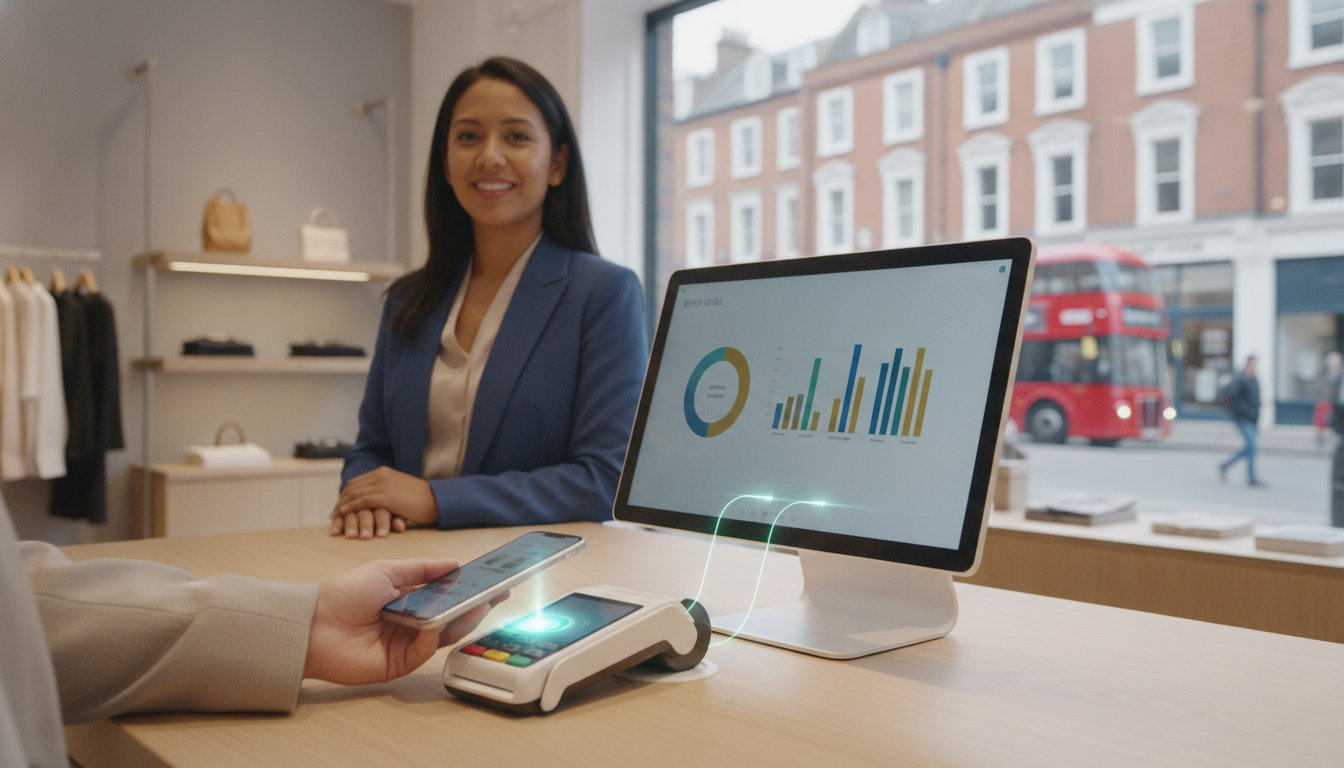
Tag: business technology

  • The Top Benefits of an Integrated Payment System for UK Businesses in 2026

    The Top Benefits of an Integrated Payment System for UK Businesses in 2026

    It is 9:00 PM on a Friday. Instead of heading home to relax, you are hunched over a desk, cross-referencing a mountain of paper card receipts against your till report to find a single missing transaction. It is a frustrating scene that plays out in shops and cafes across the country. You likely agree that manual data entry is a drain on your energy, and those slow queues at the checkout during peak hours are definitely costing you sales. It feels like a necessary part of running a business, but it’s actually a sign of an outdated process.

    Learning about the benefits of an integrated payment system will change how you view your daily operations. By connecting your card machine directly to your EPOS system, you eliminate manual errors and speed up the reconciliation process instantly. This guide shows how automation leads to faster transaction times and provides clearer visibility of your business performance through a single, clean dashboard. We will explore how to boost your bottom line by making your technology work harder for you, ensuring your records are accurate without the midnight maths sessions.

    Key Takeaways

    • Connect your card machine directly to your EPOS to eliminate manual entry mistakes and stop wasting hours on evening reconciliation.
    • Speed up your checkout process during peak trading hours by removing the need to type amounts twice, keeping queues moving and customers satisfied.
    • Centralise your sales data into one dashboard to get a clear, honest picture of your business performance across all payment types.
    • Understand the benefits of an integrated payment system for securing faster business cash advances through more accurate turnover reporting.
    • Follow a practical roadmap to audit your existing hardware and switch to a partner that offers fair, transparent transaction rates.

    What is an Integrated Payment System and Why Does it Matter?

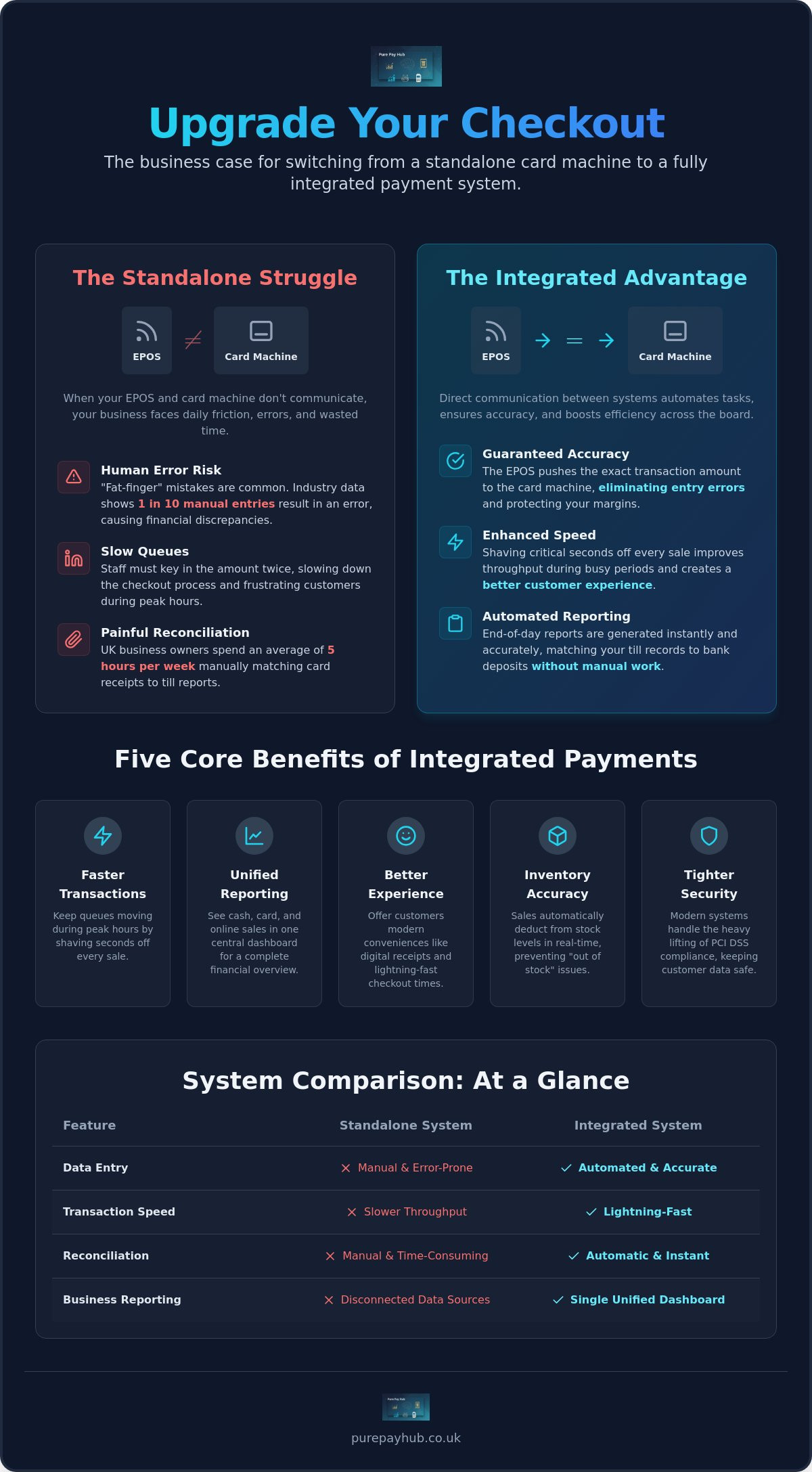
    An integrated payment system is a setup where your card machine and EPOS (Electronic Point of Sale) communicate directly with each other. In a traditional “standalone” environment, these two pieces of hardware exist in isolation. You calculate the bill on the till, then manually type that amount into the card reader. This disconnect is the root of most checkout friction. Understanding what is a payment system in the modern sense means looking at how these components link together to form a single, efficient unit.

    The shift towards integration has accelerated throughout 2026. UK consumers now expect a seamless experience. They have little patience for staff members who have to double-key figures whilst a queue builds up. One of the primary benefits of an integrated payment system is the total removal of this manual step. When your systems talk to each other, the transaction value is pushed automatically from the EPOS to the card machine. This creates a real-time flow of data that starts the moment a customer taps their card and ends with an accurate entry in your accounting software.

    The “standalone” problem is more than just a minor inconvenience. Industry data suggests that manually typing amounts into a card reader leads to 1 in 10 entry errors. These mistakes might seem small at the moment, but they create a significant headache for your bookkeeping. Over a month of trading, these discrepancies add up. They lead to a messy set of records that is difficult and expensive to untangle. Integration solves this by ensuring the data is correct at the source.

    The End of Manual Reconciliation

    Reconciliation is the process of matching your internal sales records against your actual bank deposits to ensure every penny is accounted for. It is often the most dreaded part of the day for a merchant. UK business owners spend an average of five hours a week on this type of administrative work. An integrated system handles this automatically. It matches every penny spent to a specific sale in real time. This means your end-of-day reports actually match your till reports without you having to spend your evenings with a calculator.

    Reducing Human Error at the Till

    Human error is inevitable when staff are busy or tired. A simple “fat-finger” mistake, such as typing £10.00 instead of £100.00, can be devastating for your daily margins. Conversely, overcharging a customer by mistake damages your reputation and leads to awkward refund processes. Integration acts as a digital safety net. It prevents staff from accidentally undercharging or overcharging because the human element is removed from the data entry phase. For business owners who are not on-site every day, this provides essential peace of mind that every transaction is being handled with absolute precision.

    5 Core Benefits of Integrating Your Payments

    Moving beyond the basic reduction of errors, the true benefits of an integrated payment system lie in how it transforms your daily operations. Modern UK businesses require more than just a way to take money; they need a system that acts as a central hub for all activity. For those looking to future-proof their backend, Crypto Chief offers a unified infrastructure that can support advanced digital transactions. By linking your card machine to your EPOS, you create a unified environment where data flows freely and securely. This connection ensures that every part of your business is in sync from the moment a customer pays.

    • Enhanced Transaction Speed: Shaving seconds off every sale keeps your staff focused on service rather than hardware.
    • Unified Reporting: See your cash, card, and online sales in one central dashboard for a complete financial overview.
    • Improved Customer Experience: Offer modern conveniences like digital receipts and lightning-fast checkout times.
    • Inventory Accuracy: Sales automatically deduct from stock levels in real-time, preventing awkward “out of stock” conversations.
    • Security and Compliance: Integrated systems often handle the heavy lifting of PCI DSS requirements, keeping your data safe.

    A recent Bank for International Settlements report highlights that structural integration in payments reduces intermediaries and increases transparency. This isn’t just a technical upgrade. It’s a strategic move that lowers costs and enhances the quality of your business data. If you are looking to modernise your setup, you can explore our EPOS systems to see how these features work in practice.

    Faster Throughput During Peak Times

    Hospitality and retail businesses in the UK cannot afford slow hardware, especially during a busy Saturday lunch rush or the Christmas period. The psychology of the queue is simple: long waits drive customers straight to your competitors. When your card machine is integrated, the “double-keying” delay disappears. Your staff tap a button on the till, and the card reader wakes up instantly with the correct amount. This efficiency allows you to serve more people in less time without increasing your staff headcount.

    Better Data for Smarter Decisions

    Integrated sales data allows you to identify your best-selling products with absolute certainty. You can see exactly which items are moving at what time of day, helping you optimise your staff rotas and stock orders. PurePay Hub’s reporting tools are designed to help you spot these trends before they happen. Instead of guessing which promotion worked, you have hard evidence. This clarity helps you make informed decisions that actually grow your profit margins rather than just maintaining the status quo.

    Integrated vs Standalone: Which is Right for Your Business?

    Choosing between a standalone card reader and a full EPOS system is a defining moment for any merchant. A standalone setup operates like a calculator; it takes a payment but doesn’t share that information with your records. This is often the starting point for micro-businesses with low volume and very simple needs. If you are a mobile trader processing just a few transactions a week, a basic reader might suffice. However, as your business grows, the limitations of this “disconnected” model quickly become a burden.

    For established SMEs, hospitality venues, and multi-site retailers, an integrated system is the only logical choice. One of the greatest benefits of an integrated payment system is its ability to scale alongside you. When you open a second location or expand your product range, your technology should simplify that growth rather than complicate it. Managing multiple sites from a single, remote dashboard is only possible when your payments and sales data are unified.

    Whilst integrated setups may involve higher initial hardware costs, the return on investment is significant. You aren’t just buying a card machine; you are buying back your time. A KPMG digital payments analysis suggests that digital integration is a key enabler of long-term growth, as it optimises working capital and improves cash flow visibility. By automating the data flow, you reduce the need for manual labour in your back office, allowing you to focus on high-value tasks instead of data entry.

    The Hidden Costs of Standalone Systems

    Standalone readers are often marketed as the “cheap” option, but they carry hidden costs that drain your profits. Mis-keying losses are a direct hit to your bottom line. If a staff member accidentally types £15 instead of £51, that money is simply gone. There is also the cost of staff time. Every minute spent fixing a mismatched end-of-day Z-report is a minute you are paying for admin that shouldn’t exist. Over a year, these small leaks can cost your business thousands of pounds in lost revenue and wasted wages.

    When to Make the Switch

    There are telltale signs that your business has outgrown its basic card reader. If you find yourself dreading the evening reconciliation or notice customers leaving because the queue is moving too slowly, it’s time to upgrade. Healthy cash flow is the lifeblood of any UK business, and next-day funding is a vital tool for maintaining it. PurePay Hub facilitates a smooth transition between providers, ensuring your new integrated system is up and running without disrupting your daily trade. We handle the technical setup so you can start seeing the results immediately.
    The Top Benefits of an Integrated Payment System for UK Businesses in 2026

    Implementing an Integrated System: A Practical Roadmap

    Transitioning to a connected setup shouldn’t be a source of stress. Whilst the technical side happens behind the scenes, you need a clear plan to ensure your business continues to trade smoothly. Moving from a standalone model to one where your hardware talks to each other is a straightforward process when you follow a logical roadmap. It is about moving away from the “messy” side of merchant services and into a state of informed confidence.

    Step 1: Audit your current setup. Start by checking your existing hardware and software compatibility. Most modern EPOS Systems are built to integrate, but older legacy units might require a software bridge or a hardware upgrade. PurePay Hub provides direct support to help you identify exactly what you need without recommending unnecessary extras.

    Step 2: Choose the right partner. This is the most critical stage. You need a merchant partner that offers transparent, low rates and a clear fee structure. Look for providers that offer debit card rates from 0.3% and avoid those that bury hidden costs in the small print. A fair partnership is built on honesty, not complex jargon.

    Step 3: Plan your installation. Timing is everything. Schedule your switch during a quiet trading window to minimise any potential downtime. Most integrated systems are “plug and play,” meaning you can be up and running in a matter of minutes rather than hours. Testing the connection before your first customer arrives ensures a seamless experience from the start.

    Step 4: Train your team. One of the hidden benefits of an integrated payment system is how much simpler it makes life for your staff. Because the system is intuitive and removes the need for manual data entry, training usually takes very little time. Your team will likely appreciate the reduced pressure during busy shifts.

    Compatibility and Software Links

    Ensuring your card machine works perfectly with your favourite EPOS software is essential. This connection is often managed by a Payment Gateway, which acts as the secure bridge between your offline sales and your digital records. If you are unsure about your current compatibility, you can contact us for a free setup audit to see how we can link your systems together.

    Minimising Business Disruption

    Choosing a provider with UK-based support is vital during the setup phase. If you have a question, you need an expert who understands the local merchant community. You should also ensure that “Next-Day Funding” is activated from day one. This prevents cash flow gaps and ensures that the money you take today is in your bank account tomorrow, keeping your business agile and responsive.

    The PurePay Hub Advantage: Integration Meets Growth

    Choosing a payment partner is about more than just hardware. It is about finding a fair ally that understands the pressure of running a regional business in the UK. At PurePay Hub, we take a distinct “no-nonsense” approach to merchant services. We don’t hide behind corporate jargon or complex fee structures that leave you guessing at your monthly costs. Instead, we offer transparent pricing with debit card rates from 0.3% and absolutely no hidden markups. This clarity is designed to build immediate trust and alleviate the stress often associated with financial processing.

    Our service is a stabilizing force for your finances. We provide next-day access to funds as standard for all our integrated partners. You shouldn’t have to wait days to access the money you have already earned. By ensuring your cash flow remains fluid, we help you stay agile in a competitive market. One of the most impactful benefits of an integrated payment system is how it turns your daily transaction data into a roadmap for future expansion. When your records are accurate and unified, you can make bold decisions with total confidence.

    This drive for financial agility is also transforming other sectors globally. For those with property interests in the UAE, you can check out Rentify to discover how their Rent Now, Pay Later solutions bring similar digital efficiency to the rental market.

    Unlocking Capital Through Integrated Sales

    Integrated data is a powerful asset that many traditional banks overlook. PurePay Hub uses your real-time sales information to unlock unsecured capital through our Business Cash Advance offering. Because your card machine and EPOS system are in sync, we have a clear, honest view of your turnover. This allows us to provide funding that is tailored to your actual performance rather than an arbitrary credit score. It is a modern solution for businesses that value growth but want to avoid the rigidity of traditional lending.

    The repayment process is entirely effortless. Rather than facing a fixed monthly bill that might strain your resources during a quiet week, repayments are a fixed percentage of your daily card sales. You only pay back the advance when you are actually trading. A Merchant Cash Advance provides a flexible alternative to bank loans because the repayment schedule naturally mirrors your business’s rhythm. If your sales are high, you pay back more; if things are slow, your repayments automatically reduce to match your pace.

    Reliable UK Support When You Need It

    We pride ourselves on being a local expert that acts as a supportive business partner. Our team understands the specific needs of the UK merchant community, from small high-street shops to busy hospitality venues. We are committed to fairness and disciplined service, showing a clear disdain for the opaque practices found elsewhere in the industry. You deserve a partner that prioritises your efficiency and provides straight-talking advice whenever you have a question. Our goal is to lead you away from frustration and toward a state of informed confidence.

    Ready to modernise your checkout and unlock your business’s full potential? Organise your integrated payment system with PurePay Hub today and experience a fairer way to manage your merchant services.

    Modernise Your Merchant Services Today

    Updating your technology is about reclaiming your time and protecting your profit. You’ve seen how removing manual data entry stops costly “fat-finger” mistakes and keeps your checkout moving during the busiest hours. A connected setup doesn’t just simplify your admin; it acts as a stabilising force for your entire business. By embracing the benefits of an integrated payment system, you gain the clarity needed to make smarter decisions whilst ensuring your records are always accurate.

    PurePay Hub is here to act as your supportive business partner. We offer a fair, no-nonsense service with debit card rates starting from just 0.3%. You can enjoy next-day access to your funds for better cash flow and apply for Business Cash Advances based on your future card turnover. This is merchant services built on honesty and integrity rather than hidden costs. It’s time to leave the messy side of finance behind and move forward with a partner that values your growth.

    Switch to a fairer, integrated payment partner today and start growing your business with confidence. We look forward to helping you build a more efficient, profitable future.

    Frequently Asked Questions

    What is the difference between integrated and non-integrated payments?

    Integrated payments involve a direct digital link between your EPOS system and your card machine. In a non-integrated or “standalone” setup, these two devices don’t communicate; you have to manually type the sale amount into the card reader. This manual step is the primary cause of bookkeeping errors and slows down your service during busy periods.

    Do I need a specific type of internet connection for integrated payments?

    A stable, standard broadband connection via Wi-Fi or Ethernet is usually all you need. Whilst you don’t require ultra-fast speeds for individual transactions, a reliable connection ensures that data flows between your till and terminal without interruption. Many UK merchants also use a 4G or 5G backup to keep their systems running if their main line goes down.

    How much does it cost to switch to an integrated EPOS system?

    The cost of switching varies based on your specific hardware needs and the size of your business. Whilst there is an initial investment for professional EPOS Systems, the return on investment comes from saved labour and the total removal of manual entry mistakes. We prioritise a fair, transparent fee model that avoids the hidden costs often found with traditional bank providers.

    Can I use my existing card machine with a new integrated software?

    Compatibility depends entirely on the make and model of your current hardware. Some card machines are “locked” to specific providers and won’t talk to third-party software. We recommend a quick audit of your existing equipment to see if it can be repurposed; this ensures you don’t spend money on new hardware unless it is strictly necessary for your growth.

    What happens if my EPOS system goes offline during a sale?

    Most modern integrated systems feature an “offline mode” that allows you to continue taking payments during a temporary network outage. The transaction data is stored securely on the encrypted device and synchronised with your central records as soon as the connection is restored. This prevents lost revenue and ensures your business stays operational even during local technical issues.

    How does integration help with PCI compliance?

    Integration simplifies your security requirements by ensuring sensitive cardholder data never actually enters your EPOS software. The payment is handled in a separate, secure environment, which significantly reduces the scope of your annual PCI DSS assessment. It is one of the most important security benefits of an integrated payment system for any business that values customer trust and data integrity.

    Is next-day funding available for all integrated transactions?

    Next-day funding is a standard feature for all merchants who choose PurePay Hub for their integrated setup. This ensures that the money you take today is in your bank account the following working day, regardless of your transaction volume. It is a vital tool for maintaining healthy cash flow and gives you immediate access to your revenue for stock orders or daily expenses.

    How long does it take to set up an integrated payment system?

    A typical setup takes between three to five working days once your hardware has been delivered to your site. The physical installation is designed to be “plug and play,” meaning you can often be up and running within an hour. This rapid deployment is one of the practical benefits of an integrated payment system, allowing you to modernise your checkout with almost zero disruption to your trade.
  • Troubleshooting Card Machine Connection Issues: The Complete UK Business Guide (2026)

    Troubleshooting Card Machine Connection Issues: The Complete UK Business Guide (2026)

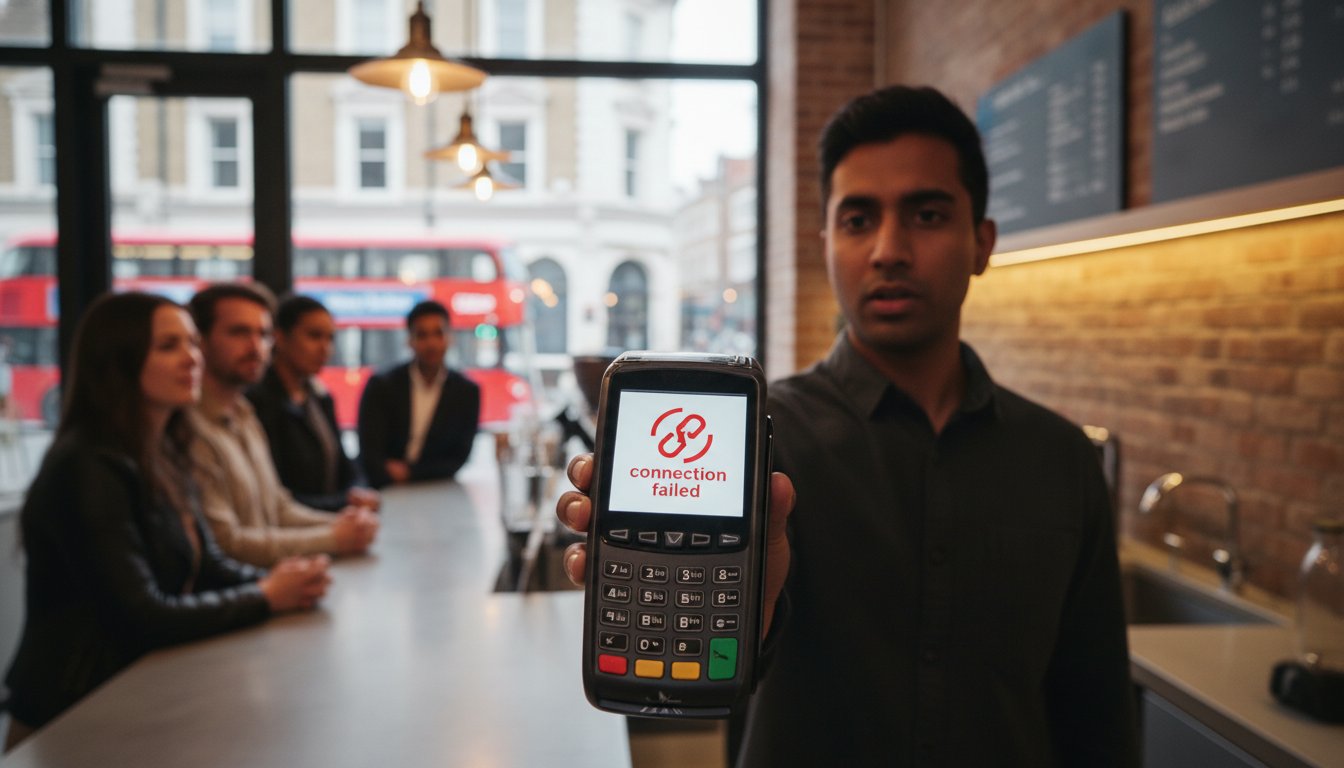
    UK retail and hospitality businesses lost an estimated £1.6 billion in 2025 due to payment system failures. You likely know the sinking feeling when a queue builds up and your screen displays a confusing “Connection Error” just as a customer reaches for their card. It’s frustrating to watch revenue slip away because of technical glitches, but mastering the art of troubleshooting card machine connection issues can save your trade.

    We understand that your business relies on seamless transactions; after all, debit cards now account for 80% of all UK payments. This guide provides the clear, no-nonsense steps you need to diagnose and fix connectivity faults instantly. You’ll learn how to restore your service without waiting hours for bank support and how to distinguish between a simple network drop and a hardware failure. We also explain how to stay compliant with the latest PCI DSS 4.0 standards to keep your local business secure and reliable.

    Key Takeaways

    • Identify why modern UK businesses must move away from analogue-dependent terminals to maintain reliable cash flow and customer trust.
    • Master the art of decoding error messages to quickly distinguish between local Wi-Fi faults and mobile SIM signal drops.
    • Implement a logical 5-step process for troubleshooting card machine connection issues, including the 30-second power cycle to restore service instantly.
    • Compare the reliability of Ethernet, Wi-Fi, and 4G roaming SIMs to ensure your hardware choice matches your specific business environment.
    • Discover how automatic failover technology can protect your revenue by switching seamlessly between networks during a local outage.

    Why Your Card Machine Keeps Losing Connection: Common UK Culprits

    Connectivity is the heartbeat of your business. When your terminal fails, queues grow and revenue stops. Effective troubleshooting card machine connection issues requires a clear understanding of why these drops happen in the first place. Often, the cause is a mix of ageing infrastructure and local network strain. You need to know if the fault lies with your Internet Service Provider (ISP), the payment gateway, or the hardware itself.

    If your Wi-Fi works on your smartphone but the terminal remains offline, the issue is likely the payment gateway or the device. Conversely, if no devices can connect, your ISP is the culprit. Hardware age is a frequent but overlooked factor. Over time, internal capacitors degrade and Wi-Fi antennas lose their sensitivity. If your device hasn’t been updated to the latest firmware, it may struggle to communicate with modern routers that use newer encryption standards. A modern payment terminal requires a stable, high-speed data exchange to process transactions securely. Keeping your hardware current is the first step in avoiding the headache of troubleshooting card machine connection issues during a busy shift.

    The Impact of the UK Digital Switchover

    The UK has moved away from traditional analogue infrastructure. Older machines that rely on Public Switched Telephone Network (PSTN) lines are now effectively obsolete. These phone-line connections can’t provide the “always-on” reliability required for 2026 business standards. Modern countertop units must use IP-based (Internet Protocol) connectivity via Ethernet or Wi-Fi. Older hardware often lacks the processing power to handle the complex security handshakes mandated by PCI DSS 4.0, leading to frequent timeouts and failed connections.

    Network Congestion in Retail Environments

    Your local environment is often the biggest hurdle. Many business owners provide guest Wi-Fi for customers, but this can throttle the bandwidth your terminal needs. During a “Friday Night Peak,” the surge in connected devices can cause your signal to drop exactly when you’re busiest. Interference is another silent killer. On a crowded high street, Bluetooth signals from neighbouring shops or even kitchen equipment can disrupt the wireless frequency your portable machine uses. Switching to a dedicated frequency or a wired Ethernet connection for fixed points is often the simplest fix for these environmental gremlins.

    Decoding Common Card Machine Error Messages

    Error codes are your first diagnostic tool, not just a nuisance. They provide the specific data needed for troubleshooting card machine connection issues. Instead of guessing why a payment failed, look directly at the screen for a specific prompt. These messages act as a map, telling you exactly where the digital handshake failed.

    “No Signal” or “No Service” typically points to a physical environment problem. For a mobile card machine, this means the roaming SIM cannot find a local mast. For a countertop unit, it suggests the Wi-Fi or Ethernet signal has dropped entirely. “Host Busy” or “Connection Timed Out” shifts the blame away from your shop. These messages mean your terminal successfully reached the internet, but the payment gateway or bank server is struggling to respond. This is usually temporary and requires a few minutes of patience rather than a hardware reset.

    One code you never want to see is “Alert Irruption.” This is a critical security feature mandated by the Payment Card Industry Data Security Standard (PCI DSS). It triggers when the terminal detects physical tampering or a significant internal hardware failure. Once this appears, the machine is permanently disabled to protect cardholder data. You cannot fix this through software; you will need a physical replacement from your provider to resume trading.

    Network vs. Hardware Errors

    A “Comms Error” usually signals a local network configuration fault. It often happens if your router’s firewall is too restrictive or if an IP conflict exists. In contrast, “Terminal Blocked” is rarely about the wire. It’s a security flag on your merchant account, often triggered by unusual activity or an expired compliance certificate. If you still use a digital VoIP adapter for an older unit, “Line Busy” suggests the adapter is failing to convert the digital signal correctly. If these errors persist, upgrading to modern Portable Card Machines with built-in 4G failover can eliminate these local bottlenecks.

    Offline Mode: “Store and Forward” Explained

    When connectivity fails, some terminals offer “Offline Mode” or “Store and Forward.” Your screen might say “Offline Transaction Accepted.” This allows you to keep the queue moving, but it carries risk. The machine stores the card data and attempts to process it once the connection returns. This is a vital fallback when troubleshooting card machine connection issues during peak hours.

    Because the transaction isn’t authorised in real-time, you won’t know if the card has sufficient funds or is reported stolen until later. If the authorisation fails when you reconnect, you lose that revenue. To clear the “Pending Transactions” queue, ensure your signal is strong and select the “Reconcile” or “End of Day” function. This pushes all stored data to the payment gateway for final processing and confirms your cash flow.

    Comparing Connectivity Methods: Ethernet vs. Wi-Fi vs. Mobile SIM

    Your choice of connection dictates your uptime percentage and transaction speed. If you operate from a fixed retail centre, Ethernet is the gold standard for your countertop card machine. It provides a dedicated, physical path for data that bypasses the fluctuations of wireless signals. Reliability is the primary goal here. A wired connection is almost immune to the environmental interference that plagues wireless setups. It ensures that the handshake between your terminal and the payment gateway remains unbroken.

    Whilst Wi-Fi offers essential flexibility for hospitality, it’s often prone to “dead zones” and signal drops. In busy restaurants or pubs, Bluetooth base-station interference is a common culprit that many guides overlook. When multiple wireless devices compete for the same frequency, your terminal can lose its connection to the server. Understanding the UK’s card payment systems helps merchants realise that stability isn’t just a technical preference; it’s a regulatory necessity for maintaining consistent service. If you find yourself constantly troubleshooting card machine connection issues, the physical method of connection is often the first place to look.

    The Power of Multi-Network Roaming SIMs

    For portable and mobile card machines, a standard consumer SIM is insufficient. Professional payment hardware relies on multi-network roaming SIMs. These intelligent chips don’t stick to one provider. Instead, they scan for the strongest available signal amongst O2, EE, and Vodafone. If one network suffers an outage, the machine switches to another automatically. This prevents you from being stranded in a signal blackspot during a busy shift. Whilst mobile data carries a specific monthly cost, the benefit of never missing a sale far outweighs the small overhead compared to the risk of total downtime.

    Optimising Your In-Store Network

    You can significantly reduce the need for troubleshooting card machine connection issues by segregating your digital traffic. Always put your card machines on a dedicated VLAN (Virtual Local Area Network). This ensures your payment data isn’t competing for bandwidth with guest Wi-Fi or your back-office streaming services. In larger venues, mesh Wi-Fi or signal boosters are essential to maintain a strong signal across the entire floor. You should also consider a “failover” system. This setup ensures that if your primary fixed-line broadband fails, your hardware automatically switches to a 4G backup. It acts as a silent insurance policy for your daily revenue.

    The Master 5-Step Troubleshooting Guide for UK Merchants

    When your queue is out the door, you don’t have time for long wait times for bank support. Following a logical sequence is the fastest way to restore service. Most connection faults are temporary glitches that you can resolve in under five minutes. Use this master 5-step guide for troubleshooting card machine connection issues to get your payments back on track.

    Step 1: The Power Cycle. Switch the unit off. Wait exactly 30 seconds. This duration is vital because it allows internal capacitors to discharge completely, clearing any lingering software loops. Step 2: Physical Layer Check. Inspect every connection. A loose Ethernet cable or a poorly seated battery can mimic a network outage. Step 3: Network Refresh. Disconnect from your Wi-Fi and re-enter the credentials. This forces the router to assign a fresh DHCP lease to the terminal, clearing IP conflicts. Step 4: Software Update. Perform a manual “Logon” or “System Initialisation” from the terminal menu. This forces the hardware to verify its security certificates against the payment gateway, ensuring you meet the latest PCI DSS 4.0 requirements. Step 5: Isolation Test. Try connecting the machine to a mobile hotspot to rule out your local ISP as the source of the fault.

    If your current hardware fails these tests frequently, it’s time to upgrade to reliable Countertop Card Machines built for the modern UK high street.

    Step 1 & 2: The Physical Fundamentals

    Physical wear is a silent revenue killer. If you use a portable card machine, remove the back cover and unseat the roaming SIM card. Use a dry, lint-free cloth to clean the gold contacts before re-inserting it firmly. For countertop units using Power-over-Ethernet (PoE), check the “comms” cable for fraying or sharp bends. Low voltage caused by damaged wires can lead to intermittent signal drops. Finally, ensure the charging base contacts are free from dust or grease; a weak charge often results in a weak wireless antenna performance.

    Advanced Diagnostic: The Hotspot Test

    The hotspot test is the most effective way to identify a local network failure. Turn on the personal hotspot on your smartphone and connect your card machine to it. If the terminal processes a test transaction immediately, your business router or firewall is the culprit. This proves the hardware is functional and the issue lies with your ISP or internal security settings. You can then tell your IT provider exactly what you’ve discovered. Providing this specific data helps them bypass basic scripts and implement a permanent fix for your network configuration much faster.

    Future-Proofing Your Payments with PurePay Hub Hardware

    Reliability shouldn’t be a luxury for your business. If you find yourself constantly troubleshooting card machine connection issues, your current hardware is likely failing to meet the demands of a modern retail environment. PurePay Hub provides a different approach by focusing on resilient technology that keeps your queue moving. We position ourselves as a fair partner to regional business owners, ensuring your payment system is a source of stability rather than stress.

    Our terminals are engineered specifically for the rigours of the modern UK high street. They feature automatic failover technology as standard. If your shop’s Wi-Fi drops, the machine seamlessly switches to a 4G roaming SIM without interrupting the transaction. You won’t even notice the transition. This built-in redundancy ensures you never miss a sale due to local network instability or broadband outages. It’s a no-nonsense solution designed to protect your revenue at all times.

    We also understand that cash flow is your lifeline. Even if you experience a brief connection drop during the day, our next-day funding ensures your money reaches your account without unnecessary delays. If you do encounter a complex fault, you won’t be stuck in a generic call centre queue. You’ll talk directly to a UK-based expert who understands your specific terminal and the unique challenges of your local business community. This direct partnership is what sets us apart from distant financial institutions.

    The PurePay Hub Advantage

    We take the technical burden off your shoulders from day one. Every PurePay Hub terminal arrives pre-configured for your specific needs. We organise the network settings before shipping, making it a true plug-and-play solution for your storefront. With low rates starting from 0.3%, more of your hard-earned profit stays exactly where it belongs. Our 24/7 technical support is always available to guide you through any unexpected hurdles, ensuring that troubleshooting card machine connection issues becomes a thing of the past.

    Choosing the Right Machine for Your Environment

    Selecting the right tool for the job is essential for maintaining high uptime percentages. Our countertop units provide reliable, fixed-point service for traditional retail environments where Ethernet stability is preferred. If you run a restaurant or pub, our portable units offer extended Wi-Fi range and long battery life for seamless table-side service. For tradespeople and delivery drivers on the move, our mobile units with global roaming ensure you can take secure payments anywhere in the UK.

    Don’t let technical glitches or opaque support practices dictate your daily revenue. Upgrade to a reliable PurePay Hub card machine today and experience the clarity of a fair, professional payment partnership that values your time as much as you do.

    Secure Your Trade with Resilient Payments

    Connectivity is the lifeline of your cash flow. We’ve explored how identifying local network bottlenecks and decoding specific error messages can save your trade during peak hours. Whilst mastering the art of troubleshooting card machine connection issues is a vital skill for any merchant, the ultimate goal is to eliminate the need for it entirely. By choosing hardware with automatic failover and segregating your digital traffic, you move from a state of frustration to one of informed confidence.

    Don’t let outdated terminals or opaque support structures hold your business back. You deserve a payment partner that prioritises transparency and uptime as much as you do. With debit rates starting from 0.3% and next-day funding as standard, our service is designed to keep your revenue moving. You’ll also benefit from direct access to UK-based technical support whenever you need a straight answer.

    Switch to PurePay Hub for reliable, UK-supported card machines and get back to what you do best: serving your local customers. Your business is built on hard work; your payment system should be too.

    Frequently Asked Questions

    Why is my card machine saying “No Connection” but my Wi-Fi is working?

    Your terminal likely faces a firewall restriction or an IP address conflict. Even if other devices connect to the internet, your card machine requires specific ports to be open to reach the payment gateway. You should check your router settings to ensure the terminal isn’t being blocked by a security protocol or try assigning it a static IP to prevent future drops.

    How do I reset my card machine without losing my daily totals?

    You can perform a soft reset by holding down the power button or using the “Restart” option in the settings menu. This action clears the temporary cache without affecting your stored batch totals or “Store and Forward” transactions. Avoid selecting “Factory Reset” or “Clear All Data” unless specifically instructed by your provider, as these will wipe your daily records.

    Can I still take payments if my business broadband goes down?

    Yes, provided your hardware has a roaming SIM or an “Offline Mode” feature. Mobile card machines will switch to a 4G or 5G signal automatically when the broadband fails. If you use a countertop unit without a SIM, you may be able to process transactions in “Store and Forward” mode, though these aren’t authorised in real-time and carry a higher risk of later decline.

    What does “Alert Irruption” mean and can I fix it myself?

    This is a terminal-locking security failure that you cannot fix yourself. It triggers when the device’s internal sensors detect physical tampering or a significant hardware fault. Because this is a protective measure for cardholder data, the machine is permanently disabled. You must contact your provider to arrange for a replacement unit to be shipped to your business.

    How often should I update the software on my payment terminal?

    You should allow your machine to update whenever a prompt appears, which usually happens during the “End of Day” process. Regular updates are essential for troubleshooting card machine connection issues and ensuring your business remains compliant with PCI DSS 4.0. Most modern units perform these updates automatically overnight to minimise disruption to your trading hours.

    Why does my portable card machine lose signal at the back of my shop?

    Physical obstructions like thick stone walls, metal shelving, or even kitchen equipment often cause “dead zones” in your premises. Wireless signals struggle to penetrate dense materials, leading to intermittent connectivity. If you frequently lose signal, consider installing a mesh Wi-Fi system or switching to a terminal that uses a multi-network roaming SIM for better coverage.

    Will my card machine work with a 5G network in 2026?

    Yes, modern payment hardware is designed to be forward-compatible with the latest UK mobile infrastructure. As 5G becomes the standard across the country, your terminal will prioritise the fastest available data network. This ensures that your transaction speeds remain high and your connection stays stable, even in crowded high-street environments where 4G bands might be congested.

    How do I check if the payment gateway provider is having an outage?

    The fastest way is to check the official status page of your payment provider or use a service like Downdetector. If your local internet is working on other devices but the terminal fails the “Host Connection” test, the issue is likely at the gateway level. In these instances, you simply have to wait for the provider to restore their central services.